EP0453603B1 - Piroxicam enthaltende pharmazeutische Zusammensetzung zur topischen Anwendung - Google Patents
Piroxicam enthaltende pharmazeutische Zusammensetzung zur topischen Anwendung Download PDFInfo
- Publication number
- EP0453603B1 EP0453603B1 EP90107992A EP90107992A EP0453603B1 EP 0453603 B1 EP0453603 B1 EP 0453603B1 EP 90107992 A EP90107992 A EP 90107992A EP 90107992 A EP90107992 A EP 90107992A EP 0453603 B1 EP0453603 B1 EP 0453603B1
- Authority
- EP
- European Patent Office
- Prior art keywords
- composition according
- piroxicam
- oil
- phase
- acid esters
- Prior art date
- Legal status (The legal status is an assumption and is not a legal conclusion. Google has not performed a legal analysis and makes no representation as to the accuracy of the status listed.)
- Expired - Lifetime
Links
- QYSPLQLAKJAUJT-UHFFFAOYSA-N piroxicam Chemical compound OC=1C2=CC=CC=C2S(=O)(=O)N(C)C=1C(=O)NC1=CC=CC=N1 QYSPLQLAKJAUJT-UHFFFAOYSA-N 0.000 title claims abstract description 48
- 229960002702 piroxicam Drugs 0.000 title claims abstract description 46
- 230000000699 topical effect Effects 0.000 title claims abstract description 13
- 239000008194 pharmaceutical composition Substances 0.000 title claims abstract description 10
- 239000000203 mixture Substances 0.000 claims abstract description 75
- 239000000839 emulsion Substances 0.000 claims abstract description 12
- 230000003110 anti-inflammatory effect Effects 0.000 claims abstract description 10
- 239000013543 active substance Substances 0.000 claims abstract description 4
- 230000003356 anti-rheumatic effect Effects 0.000 claims abstract description 4
- 239000003435 antirheumatic agent Substances 0.000 claims abstract description 4
- 239000003921 oil Substances 0.000 claims description 31
- DNIAPMSPPWPWGF-UHFFFAOYSA-N Propylene glycol Chemical compound CC(O)CO DNIAPMSPPWPWGF-UHFFFAOYSA-N 0.000 claims description 30
- -1 polyethylene Polymers 0.000 claims description 29
- XLYOFNOQVPJJNP-UHFFFAOYSA-N water Substances O XLYOFNOQVPJJNP-UHFFFAOYSA-N 0.000 claims description 26
- PEDCQBHIVMGVHV-UHFFFAOYSA-N Glycerol Natural products OCC(O)CO PEDCQBHIVMGVHV-UHFFFAOYSA-N 0.000 claims description 25
- 239000006071 cream Substances 0.000 claims description 21
- 239000003995 emulsifying agent Substances 0.000 claims description 15
- 239000003755 preservative agent Substances 0.000 claims description 11
- 235000014113 dietary fatty acids Nutrition 0.000 claims description 10
- 239000000194 fatty acid Substances 0.000 claims description 10
- 229930195729 fatty acid Natural products 0.000 claims description 10
- 239000003381 stabilizer Substances 0.000 claims description 10
- 239000004698 Polyethylene Substances 0.000 claims description 9
- 229920000573 polyethylene Polymers 0.000 claims description 9
- BEFDCLMNVWHSGT-UHFFFAOYSA-N ethenylcyclopentane Chemical compound C=CC1CCCC1 BEFDCLMNVWHSGT-UHFFFAOYSA-N 0.000 claims description 8
- 238000000034 method Methods 0.000 claims description 8
- 235000010199 sorbic acid Nutrition 0.000 claims description 8
- 239000004334 sorbic acid Substances 0.000 claims description 8
- 229940075582 sorbic acid Drugs 0.000 claims description 8
- LEACJMVNYZDSKR-UHFFFAOYSA-N 2-octyldodecan-1-ol Chemical compound CCCCCCCCCCC(CO)CCCCCCCC LEACJMVNYZDSKR-UHFFFAOYSA-N 0.000 claims description 7
- 239000003963 antioxidant agent Substances 0.000 claims description 7
- 235000006708 antioxidants Nutrition 0.000 claims description 7
- CZBZUDVBLSSABA-UHFFFAOYSA-N butylated hydroxyanisole Chemical compound COC1=CC=C(O)C(C(C)(C)C)=C1.COC1=CC=C(O)C=C1C(C)(C)C CZBZUDVBLSSABA-UHFFFAOYSA-N 0.000 claims description 7
- 239000003883 ointment base Substances 0.000 claims description 7
- 230000002335 preservative effect Effects 0.000 claims description 7
- 239000002253 acid Substances 0.000 claims description 6
- 239000002260 anti-inflammatory agent Substances 0.000 claims description 6
- 239000006185 dispersion Substances 0.000 claims description 6
- 229940057917 medium chain triglycerides Drugs 0.000 claims description 6
- 239000003961 penetration enhancing agent Substances 0.000 claims description 6
- 239000001993 wax Substances 0.000 claims description 6
- 239000003795 chemical substances by application Substances 0.000 claims description 5
- 150000002148 esters Chemical class 0.000 claims description 5
- 239000003906 humectant Substances 0.000 claims description 5
- 230000035515 penetration Effects 0.000 claims description 5
- 230000008569 process Effects 0.000 claims description 5
- FBPFZTCFMRRESA-FSIIMWSLSA-N D-Glucitol Natural products OC[C@H](O)[C@H](O)[C@@H](O)[C@H](O)CO FBPFZTCFMRRESA-FSIIMWSLSA-N 0.000 claims description 4
- WRUGWIBCXHJTDG-UHFFFAOYSA-L magnesium sulfate heptahydrate Chemical compound O.O.O.O.O.O.O.[Mg+2].[O-]S([O-])(=O)=O WRUGWIBCXHJTDG-UHFFFAOYSA-L 0.000 claims description 4
- 239000002304 perfume Substances 0.000 claims description 4
- 239000000600 sorbitol Substances 0.000 claims description 4
- 239000000725 suspension Substances 0.000 claims description 4
- FBPFZTCFMRRESA-JGWLITMVSA-N D-glucitol Chemical compound OC[C@H](O)[C@@H](O)[C@H](O)[C@H](O)CO FBPFZTCFMRRESA-JGWLITMVSA-N 0.000 claims description 3
- 239000004166 Lanolin Substances 0.000 claims description 2
- 239000005662 Paraffin oil Substances 0.000 claims description 2
- TVXBFESIOXBWNM-UHFFFAOYSA-N Xylitol Natural products OCCC(O)C(O)C(O)CCO TVXBFESIOXBWNM-UHFFFAOYSA-N 0.000 claims description 2
- 235000019388 lanolin Nutrition 0.000 claims description 2
- HEBKCHPVOIAQTA-UHFFFAOYSA-N meso ribitol Natural products OCC(O)C(O)C(O)CO HEBKCHPVOIAQTA-UHFFFAOYSA-N 0.000 claims description 2
- 239000000546 pharmaceutical excipient Substances 0.000 claims description 2
- 239000002904 solvent Substances 0.000 claims description 2
- 239000003871 white petrolatum Substances 0.000 claims description 2
- 239000000811 xylitol Substances 0.000 claims description 2
- HEBKCHPVOIAQTA-SCDXWVJYSA-N xylitol Chemical compound OC[C@H](O)[C@@H](O)[C@H](O)CO HEBKCHPVOIAQTA-SCDXWVJYSA-N 0.000 claims description 2
- 235000010447 xylitol Nutrition 0.000 claims description 2
- 229960002675 xylitol Drugs 0.000 claims description 2
- 235000011187 glycerol Nutrition 0.000 claims 4
- HIQIXEFWDLTDED-UHFFFAOYSA-N 4-hydroxy-1-piperidin-4-ylpyrrolidin-2-one Chemical compound O=C1CC(O)CN1C1CCNCC1 HIQIXEFWDLTDED-UHFFFAOYSA-N 0.000 claims 1
- 230000001741 anti-phlogistic effect Effects 0.000 claims 1
- 239000003814 drug Substances 0.000 claims 1
- 230000003019 stabilising effect Effects 0.000 claims 1
- 239000012071 phase Substances 0.000 description 37
- 235000019198 oils Nutrition 0.000 description 20
- 239000003595 mist Substances 0.000 description 17
- 239000004480 active ingredient Substances 0.000 description 14
- 238000002360 preparation method Methods 0.000 description 13
- 239000000499 gel Substances 0.000 description 7
- WVDDGKGOMKODPV-UHFFFAOYSA-N Benzyl alcohol Chemical compound OCC1=CC=CC=C1 WVDDGKGOMKODPV-UHFFFAOYSA-N 0.000 description 6
- 238000009472 formulation Methods 0.000 description 6
- 239000002674 ointment Substances 0.000 description 6
- 206010015150 Erythema Diseases 0.000 description 5
- LFQSCWFLJHTTHZ-UHFFFAOYSA-N Ethanol Chemical compound CCO LFQSCWFLJHTTHZ-UHFFFAOYSA-N 0.000 description 5
- NWGKJDSIEKMTRX-BFWOXRRGSA-N [(2r)-2-[(3r,4s)-3,4-dihydroxyoxolan-2-yl]-2-hydroxyethyl] (z)-octadec-9-enoate Chemical compound CCCCCCCC\C=C/CCCCCCCC(=O)OC[C@@H](O)C1OC[C@H](O)[C@H]1O NWGKJDSIEKMTRX-BFWOXRRGSA-N 0.000 description 5
- 231100000321 erythema Toxicity 0.000 description 5
- 239000000126 substance Substances 0.000 description 5
- 208000027418 Wounds and injury Diseases 0.000 description 4
- 230000006378 damage Effects 0.000 description 4
- 201000010099 disease Diseases 0.000 description 4
- 208000037265 diseases, disorders, signs and symptoms Diseases 0.000 description 4
- 230000002401 inhibitory effect Effects 0.000 description 4
- 208000014674 injury Diseases 0.000 description 4
- 230000007774 longterm Effects 0.000 description 4
- 239000006072 paste Substances 0.000 description 4
- 239000007762 w/o emulsion Substances 0.000 description 4
- SDJQUPRVYCURBW-UHFFFAOYSA-N 4-hydroxy-2-methyl-1,1-dioxo-n-pyridin-2-yl-1$l^{6},2-benzothiazine-3-carboxamide;hydrate Chemical compound O.OC=1C2=CC=CC=C2S(=O)(=O)N(C)C=1C(=O)NC1=CC=CC=N1 SDJQUPRVYCURBW-UHFFFAOYSA-N 0.000 description 3
- KFZMGEQAYNKOFK-UHFFFAOYSA-N Isopropanol Chemical compound CC(C)O KFZMGEQAYNKOFK-UHFFFAOYSA-N 0.000 description 3
- CSNNHWWHGAXBCP-UHFFFAOYSA-L Magnesium sulfate Chemical compound [Mg+2].[O-][S+2]([O-])([O-])[O-] CSNNHWWHGAXBCP-UHFFFAOYSA-L 0.000 description 3
- 229940124599 anti-inflammatory drug Drugs 0.000 description 3
- 230000003078 antioxidant effect Effects 0.000 description 3
- 230000000052 comparative effect Effects 0.000 description 3
- 239000000470 constituent Substances 0.000 description 3
- 238000002845 discoloration Methods 0.000 description 3
- 235000019441 ethanol Nutrition 0.000 description 3
- 238000004519 manufacturing process Methods 0.000 description 3
- 238000013112 stability test Methods 0.000 description 3
- 150000005846 sugar alcohols Polymers 0.000 description 3
- 150000003626 triacylglycerols Chemical class 0.000 description 3
- VBICKXHEKHSIBG-UHFFFAOYSA-N 1-monostearoylglycerol Chemical compound CCCCCCCCCCCCCCCCCC(=O)OCC(O)CO VBICKXHEKHSIBG-UHFFFAOYSA-N 0.000 description 2
- 239000004255 Butylated hydroxyanisole Substances 0.000 description 2
- RTZKZFJDLAIYFH-UHFFFAOYSA-N Diethyl ether Chemical compound CCOCC RTZKZFJDLAIYFH-UHFFFAOYSA-N 0.000 description 2
- 229920003171 Poly (ethylene oxide) Polymers 0.000 description 2
- ZTHYODDOHIVTJV-UHFFFAOYSA-N Propyl gallate Chemical compound CCCOC(=O)C1=CC(O)=C(O)C(O)=C1 ZTHYODDOHIVTJV-UHFFFAOYSA-N 0.000 description 2
- 208000025747 Rheumatic disease Diseases 0.000 description 2
- 229920002125 Sokalan® Polymers 0.000 description 2
- 229940121363 anti-inflammatory agent Drugs 0.000 description 2
- 238000013459 approach Methods 0.000 description 2
- 235000019445 benzyl alcohol Nutrition 0.000 description 2
- 229960004217 benzyl alcohol Drugs 0.000 description 2
- KVYGGMBOZFWZBQ-UHFFFAOYSA-N benzyl nicotinate Chemical compound C=1C=CN=CC=1C(=O)OCC1=CC=CC=C1 KVYGGMBOZFWZBQ-UHFFFAOYSA-N 0.000 description 2
- 235000019282 butylated hydroxyanisole Nutrition 0.000 description 2
- 239000000969 carrier Substances 0.000 description 2
- POULHZVOKOAJMA-UHFFFAOYSA-M dodecanoate Chemical compound CCCCCCCCCCCC([O-])=O POULHZVOKOAJMA-UHFFFAOYSA-M 0.000 description 2
- 238000001035 drying Methods 0.000 description 2
- 230000000694 effects Effects 0.000 description 2
- 125000001495 ethyl group Chemical group [H]C([H])([H])C([H])([H])* 0.000 description 2
- 150000002191 fatty alcohols Chemical class 0.000 description 2
- 238000010438 heat treatment Methods 0.000 description 2
- 238000011835 investigation Methods 0.000 description 2
- 229940070765 laurate Drugs 0.000 description 2
- 229940061634 magnesium sulfate heptahydrate Drugs 0.000 description 2
- 150000004682 monohydrates Chemical class 0.000 description 2
- 210000002346 musculoskeletal system Anatomy 0.000 description 2
- 229940105132 myristate Drugs 0.000 description 2
- ZQPPMHVWECSIRJ-KTKRTIGZSA-N oleic acid Chemical compound CCCCCCCC\C=C/CCCCCCCC(O)=O ZQPPMHVWECSIRJ-KTKRTIGZSA-N 0.000 description 2
- 230000003287 optical effect Effects 0.000 description 2
- 230000000552 rheumatic effect Effects 0.000 description 2
- 229920006395 saturated elastomer Polymers 0.000 description 2
- 208000017520 skin disease Diseases 0.000 description 2
- 239000000243 solution Substances 0.000 description 2
- 238000003756 stirring Methods 0.000 description 2
- TUNFSRHWOTWDNC-UHFFFAOYSA-N tetradecanoic acid Chemical compound CCCCCCCCCCCCCC(O)=O TUNFSRHWOTWDNC-UHFFFAOYSA-N 0.000 description 2
- 238000002560 therapeutic procedure Methods 0.000 description 2
- 230000007704 transition Effects 0.000 description 2
- JNYAEWCLZODPBN-JGWLITMVSA-N (2r,3r,4s)-2-[(1r)-1,2-dihydroxyethyl]oxolane-3,4-diol Chemical compound OC[C@@H](O)[C@H]1OC[C@H](O)[C@H]1O JNYAEWCLZODPBN-JGWLITMVSA-N 0.000 description 1
- DSEKYWAQQVUQTP-XEWMWGOFSA-N (2r,4r,4as,6as,6as,6br,8ar,12ar,14as,14bs)-2-hydroxy-4,4a,6a,6b,8a,11,11,14a-octamethyl-2,4,5,6,6a,7,8,9,10,12,12a,13,14,14b-tetradecahydro-1h-picen-3-one Chemical compound C([C@H]1[C@]2(C)CC[C@@]34C)C(C)(C)CC[C@]1(C)CC[C@]2(C)[C@H]4CC[C@@]1(C)[C@H]3C[C@@H](O)C(=O)[C@@H]1C DSEKYWAQQVUQTP-XEWMWGOFSA-N 0.000 description 1
- WRIDQFICGBMAFQ-UHFFFAOYSA-N (E)-8-Octadecenoic acid Natural products CCCCCCCCCC=CCCCCCCC(O)=O WRIDQFICGBMAFQ-UHFFFAOYSA-N 0.000 description 1
- DNIAPMSPPWPWGF-GSVOUGTGSA-N (R)-(-)-Propylene glycol Chemical compound C[C@@H](O)CO DNIAPMSPPWPWGF-GSVOUGTGSA-N 0.000 description 1
- ZORQXIQZAOLNGE-UHFFFAOYSA-N 1,1-difluorocyclohexane Chemical compound FC1(F)CCCCC1 ZORQXIQZAOLNGE-UHFFFAOYSA-N 0.000 description 1
- AFSHUZFNMVJNKX-UHFFFAOYSA-N 1,2-di-(9Z-octadecenoyl)glycerol Natural products CCCCCCCCC=CCCCCCCCC(=O)OCC(CO)OC(=O)CCCCCCCC=CCCCCCCCC AFSHUZFNMVJNKX-UHFFFAOYSA-N 0.000 description 1
- AFSHUZFNMVJNKX-LLWMBOQKSA-N 1,2-dioleoyl-sn-glycerol Chemical compound CCCCCCCC\C=C/CCCCCCCC(=O)OC[C@H](CO)OC(=O)CCCCCCC\C=C/CCCCCCCC AFSHUZFNMVJNKX-LLWMBOQKSA-N 0.000 description 1
- FLPJVCMIKUWSDR-UHFFFAOYSA-N 2-(4-formylphenoxy)acetamide Chemical compound NC(=O)COC1=CC=C(C=O)C=C1 FLPJVCMIKUWSDR-UHFFFAOYSA-N 0.000 description 1
- BFDKCZMYQOSTJG-UHFFFAOYSA-N 2-[4-(trifluoromethylsulfanyl)phenyl]acetic acid Chemical compound OC(=O)CC1=CC=C(SC(F)(F)F)C=C1 BFDKCZMYQOSTJG-UHFFFAOYSA-N 0.000 description 1
- SFAAOBGYWOUHLU-UHFFFAOYSA-N 2-ethylhexyl hexadecanoate Chemical compound CCCCCCCCCCCCCCCC(=O)OCC(CC)CCCC SFAAOBGYWOUHLU-UHFFFAOYSA-N 0.000 description 1
- LQJBNNIYVWPHFW-UHFFFAOYSA-N 20:1omega9c fatty acid Natural products CCCCCCCCCCC=CCCCCCCCC(O)=O LQJBNNIYVWPHFW-UHFFFAOYSA-N 0.000 description 1
- NWWJFMCCTZLKNT-UHFFFAOYSA-N 3,4-dihydro-2h-thiazine Chemical class C1CC=CSN1 NWWJFMCCTZLKNT-UHFFFAOYSA-N 0.000 description 1
- CWSZBVAUYPTXTG-UHFFFAOYSA-N 5-[6-[[3,4-dihydroxy-6-(hydroxymethyl)-5-methoxyoxan-2-yl]oxymethyl]-3,4-dihydroxy-5-[4-hydroxy-3-(2-hydroxyethoxy)-6-(hydroxymethyl)-5-methoxyoxan-2-yl]oxyoxan-2-yl]oxy-6-(hydroxymethyl)-2-methyloxane-3,4-diol Chemical compound O1C(CO)C(OC)C(O)C(O)C1OCC1C(OC2C(C(O)C(OC)C(CO)O2)OCCO)C(O)C(O)C(OC2C(OC(C)C(O)C2O)CO)O1 CWSZBVAUYPTXTG-UHFFFAOYSA-N 0.000 description 1
- SJIDAAGFCNIAJP-UHFFFAOYSA-N 6-methylheptyl octadecanoate Chemical compound CCCCCCCCCCCCCCCCCC(=O)OCCCCCC(C)C SJIDAAGFCNIAJP-UHFFFAOYSA-N 0.000 description 1
- QSBYPNXLFMSGKH-UHFFFAOYSA-N 9-Heptadecensaeure Natural products CCCCCCCC=CCCCCCCCC(O)=O QSBYPNXLFMSGKH-UHFFFAOYSA-N 0.000 description 1
- 208000025978 Athletic injury Diseases 0.000 description 1
- 239000004322 Butylated hydroxytoluene Substances 0.000 description 1
- NLZUEZXRPGMBCV-UHFFFAOYSA-N Butylhydroxytoluene Chemical compound CC1=CC(C(C)(C)C)=C(O)C(C(C)(C)C)=C1 NLZUEZXRPGMBCV-UHFFFAOYSA-N 0.000 description 1
- 241000700198 Cavia Species 0.000 description 1
- 241000700199 Cavia porcellus Species 0.000 description 1
- 235000005979 Citrus limon Nutrition 0.000 description 1
- 244000131522 Citrus pyriformis Species 0.000 description 1
- ZAKOWWREFLAJOT-CEFNRUSXSA-N D-alpha-tocopherylacetate Chemical compound CC(=O)OC1=C(C)C(C)=C2O[C@@](CCC[C@H](C)CCC[C@H](C)CCCC(C)C)(C)CCC2=C1C ZAKOWWREFLAJOT-CEFNRUSXSA-N 0.000 description 1
- 208000001840 Dandruff Diseases 0.000 description 1
- XTJFFFGAUHQWII-UHFFFAOYSA-N Dibutyl adipate Chemical compound CCCCOC(=O)CCCCC(=O)OCCCC XTJFFFGAUHQWII-UHFFFAOYSA-N 0.000 description 1
- 208000012671 Gastrointestinal haemorrhages Diseases 0.000 description 1
- CMBYOWLFQAFZCP-UHFFFAOYSA-N Hexyl dodecanoate Chemical compound CCCCCCCCCCCC(=O)OCCCCCC CMBYOWLFQAFZCP-UHFFFAOYSA-N 0.000 description 1
- 241001465754 Metazoa Species 0.000 description 1
- PVNIIMVLHYAWGP-UHFFFAOYSA-N Niacin Chemical class OC(=O)C1=CC=CN=C1 PVNIIMVLHYAWGP-UHFFFAOYSA-N 0.000 description 1
- 239000005642 Oleic acid Substances 0.000 description 1
- ZQPPMHVWECSIRJ-UHFFFAOYSA-N Oleic acid Natural products CCCCCCCCC=CCCCCCCCC(O)=O ZQPPMHVWECSIRJ-UHFFFAOYSA-N 0.000 description 1
- 235000019483 Peanut oil Nutrition 0.000 description 1
- 241000218657 Picea Species 0.000 description 1
- 229930182558 Sterol Natural products 0.000 description 1
- 230000002378 acidificating effect Effects 0.000 description 1
- 150000007513 acids Chemical class 0.000 description 1
- 239000000654 additive Substances 0.000 description 1
- 230000000172 allergic effect Effects 0.000 description 1
- 150000008064 anhydrides Chemical class 0.000 description 1
- 239000003242 anti bacterial agent Substances 0.000 description 1
- 230000001760 anti-analgesic effect Effects 0.000 description 1
- 229940088710 antibiotic agent Drugs 0.000 description 1
- 229940111133 antiinflammatory and antirheumatic drug oxicams Drugs 0.000 description 1
- 239000008346 aqueous phase Substances 0.000 description 1
- 239000007864 aqueous solution Substances 0.000 description 1
- 239000003125 aqueous solvent Substances 0.000 description 1
- 208000010668 atopic eczema Diseases 0.000 description 1
- 230000008901 benefit Effects 0.000 description 1
- 229950004580 benzyl nicotinate Drugs 0.000 description 1
- 230000015572 biosynthetic process Effects 0.000 description 1
- SAOKZLXYCUGLFA-UHFFFAOYSA-N bis(2-ethylhexyl) adipate Chemical compound CCCCC(CC)COC(=O)CCCCC(=O)OCC(CC)CCCC SAOKZLXYCUGLFA-UHFFFAOYSA-N 0.000 description 1
- 239000008280 blood Substances 0.000 description 1
- 210000004369 blood Anatomy 0.000 description 1
- CDQSJQSWAWPGKG-UHFFFAOYSA-N butane-1,1-diol Chemical compound CCCC(O)O CDQSJQSWAWPGKG-UHFFFAOYSA-N 0.000 description 1
- 229940043253 butylated hydroxyanisole Drugs 0.000 description 1
- 235000010354 butylated hydroxytoluene Nutrition 0.000 description 1
- 229940095259 butylated hydroxytoluene Drugs 0.000 description 1
- 125000004432 carbon atom Chemical group C* 0.000 description 1
- 229940074979 cetyl palmitate Drugs 0.000 description 1
- 230000008859 change Effects 0.000 description 1
- 238000001816 cooling Methods 0.000 description 1
- ZAKOWWREFLAJOT-UHFFFAOYSA-N d-alpha-Tocopheryl acetate Natural products CC(=O)OC1=C(C)C(C)=C2OC(CCCC(C)CCCC(C)CCCC(C)C)(C)CCC2=C1C ZAKOWWREFLAJOT-UHFFFAOYSA-N 0.000 description 1
- SASYSVUEVMOWPL-NXVVXOECSA-N decyl oleate Chemical compound CCCCCCCCCCOC(=O)CCCCCCC\C=C/CCCCCCCC SASYSVUEVMOWPL-NXVVXOECSA-N 0.000 description 1
- 239000000645 desinfectant Substances 0.000 description 1
- ZBCBWPMODOFKDW-UHFFFAOYSA-N diethanolamine Chemical compound OCCNCCO ZBCBWPMODOFKDW-UHFFFAOYSA-N 0.000 description 1
- 230000004069 differentiation Effects 0.000 description 1
- 239000002552 dosage form Substances 0.000 description 1
- 239000003937 drug carrier Substances 0.000 description 1
- 239000000975 dye Substances 0.000 description 1
- 230000002500 effect on skin Effects 0.000 description 1
- 238000000605 extraction Methods 0.000 description 1
- 150000004665 fatty acids Chemical class 0.000 description 1
- 239000006025 fining agent Substances 0.000 description 1
- 239000012530 fluid Substances 0.000 description 1
- 208000030304 gastrointestinal bleeding Diseases 0.000 description 1
- YQEMORVAKMFKLG-UHFFFAOYSA-N glycerine monostearate Natural products CCCCCCCCCCCCCCCCCC(=O)OC(CO)CO YQEMORVAKMFKLG-UHFFFAOYSA-N 0.000 description 1
- UHUSDOQQWJGJQS-UHFFFAOYSA-N glycerol 1,2-dioctadecanoate Chemical compound CCCCCCCCCCCCCCCCCC(=O)OCC(CO)OC(=O)CCCCCCCCCCCCCCCCC UHUSDOQQWJGJQS-UHFFFAOYSA-N 0.000 description 1
- SVUQHVRAGMNPLW-UHFFFAOYSA-N glycerol monostearate Natural products CCCCCCCCCCCCCCCCC(=O)OCC(O)CO SVUQHVRAGMNPLW-UHFFFAOYSA-N 0.000 description 1
- 230000004217 heart function Effects 0.000 description 1
- IPCSVZSSVZVIGE-UHFFFAOYSA-M hexadecanoate Chemical compound CCCCCCCCCCCCCCCC([O-])=O IPCSVZSSVZVIGE-UHFFFAOYSA-M 0.000 description 1
- PXDJXZJSCPSGGI-UHFFFAOYSA-N hexadecanoic acid hexadecyl ester Natural products CCCCCCCCCCCCCCCCOC(=O)CCCCCCCCCCCCCCC PXDJXZJSCPSGGI-UHFFFAOYSA-N 0.000 description 1
- 229940100463 hexyl laurate Drugs 0.000 description 1
- 235000019447 hydroxyethyl cellulose Nutrition 0.000 description 1
- 238000010348 incorporation Methods 0.000 description 1
- 230000036512 infertility Effects 0.000 description 1
- 239000004615 ingredient Substances 0.000 description 1
- QXJSBBXBKPUZAA-UHFFFAOYSA-N isooleic acid Natural products CCCCCCCC=CCCCCCCCCC(O)=O QXJSBBXBKPUZAA-UHFFFAOYSA-N 0.000 description 1
- 229940119170 jojoba wax Drugs 0.000 description 1
- 239000004611 light stabiliser Substances 0.000 description 1
- 229940057995 liquid paraffin Drugs 0.000 description 1
- 230000005923 long-lasting effect Effects 0.000 description 1
- 229910052943 magnesium sulfate Inorganic materials 0.000 description 1
- 235000019341 magnesium sulphate Nutrition 0.000 description 1
- 244000005700 microbiome Species 0.000 description 1
- 239000004200 microcrystalline wax Substances 0.000 description 1
- 239000002480 mineral oil Substances 0.000 description 1
- 235000010446 mineral oil Nutrition 0.000 description 1
- 230000007935 neutral effect Effects 0.000 description 1
- 229940021182 non-steroidal anti-inflammatory drug Drugs 0.000 description 1
- FBUKVWPVBMHYJY-UHFFFAOYSA-N nonanoic acid Chemical class CCCCCCCCC(O)=O FBUKVWPVBMHYJY-UHFFFAOYSA-N 0.000 description 1
- QIQXTHQIDYTFRH-UHFFFAOYSA-N octadecanoic acid Chemical compound CCCCCCCCCCCCCCCCCC(O)=O QIQXTHQIDYTFRH-UHFFFAOYSA-N 0.000 description 1
- 230000009965 odorless effect Effects 0.000 description 1
- 229940049964 oleate Drugs 0.000 description 1
- 229940124641 pain reliever Drugs 0.000 description 1
- 239000012188 paraffin wax Substances 0.000 description 1
- 239000000312 peanut oil Substances 0.000 description 1
- 235000019271 petrolatum Nutrition 0.000 description 1
- 239000000825 pharmaceutical preparation Substances 0.000 description 1
- 239000000902 placebo Substances 0.000 description 1
- 229940068196 placebo Drugs 0.000 description 1
- 229920000223 polyglycerol Polymers 0.000 description 1
- 229920005862 polyol Polymers 0.000 description 1
- 239000001267 polyvinylpyrrolidone Substances 0.000 description 1
- 229920000036 polyvinylpyrrolidone Polymers 0.000 description 1
- 235000013855 polyvinylpyrrolidone Nutrition 0.000 description 1
- 238000004321 preservation Methods 0.000 description 1
- 239000000047 product Substances 0.000 description 1
- 239000000473 propyl gallate Substances 0.000 description 1
- 235000010388 propyl gallate Nutrition 0.000 description 1
- 229940075579 propyl gallate Drugs 0.000 description 1
- 235000013772 propylene glycol Nutrition 0.000 description 1
- 239000008213 purified water Substances 0.000 description 1
- 230000009467 reduction Effects 0.000 description 1
- 230000008085 renal dysfunction Effects 0.000 description 1
- 150000003902 salicylic acid esters Chemical class 0.000 description 1
- 230000035945 sensitivity Effects 0.000 description 1
- 230000037384 skin absorption Effects 0.000 description 1
- 231100000274 skin absorption Toxicity 0.000 description 1
- 239000007787 solid Substances 0.000 description 1
- 230000003381 solubilizing effect Effects 0.000 description 1
- 239000001593 sorbitan monooleate Substances 0.000 description 1
- 229940035049 sorbitan monooleate Drugs 0.000 description 1
- 235000011069 sorbitan monooleate Nutrition 0.000 description 1
- 230000006641 stabilisation Effects 0.000 description 1
- 238000011105 stabilization Methods 0.000 description 1
- 229910001220 stainless steel Inorganic materials 0.000 description 1
- 239000010935 stainless steel Substances 0.000 description 1
- 229940114926 stearate Drugs 0.000 description 1
- 235000003702 sterols Nutrition 0.000 description 1
- 238000003860 storage Methods 0.000 description 1
- 229940124530 sulfonamide Drugs 0.000 description 1
- 150000003456 sulfonamides Chemical class 0.000 description 1
- 239000013589 supplement Substances 0.000 description 1
- 208000024891 symptom Diseases 0.000 description 1
- 229940042585 tocopherol acetate Drugs 0.000 description 1
- 238000011200 topical administration Methods 0.000 description 1
- UFTFJSFQGQCHQW-UHFFFAOYSA-N triformin Chemical compound O=COCC(OC=O)COC=O UFTFJSFQGQCHQW-UHFFFAOYSA-N 0.000 description 1
- 239000000341 volatile oil Substances 0.000 description 1
- 238000004383 yellowing Methods 0.000 description 1
Classifications
-
- A—HUMAN NECESSITIES
- A61—MEDICAL OR VETERINARY SCIENCE; HYGIENE
- A61K—PREPARATIONS FOR MEDICAL, DENTAL OR TOILETRY PURPOSES
- A61K9/00—Medicinal preparations characterised by special physical form
- A61K9/06—Ointments; Bases therefor; Other semi-solid forms, e.g. creams, sticks, gels
-
- A—HUMAN NECESSITIES
- A61—MEDICAL OR VETERINARY SCIENCE; HYGIENE
- A61K—PREPARATIONS FOR MEDICAL, DENTAL OR TOILETRY PURPOSES
- A61K31/00—Medicinal preparations containing organic active ingredients
- A61K31/33—Heterocyclic compounds
- A61K31/395—Heterocyclic compounds having nitrogen as a ring hetero atom, e.g. guanethidine or rifamycins
- A61K31/54—Heterocyclic compounds having nitrogen as a ring hetero atom, e.g. guanethidine or rifamycins having six-membered rings with at least one nitrogen and one sulfur as the ring hetero atoms, e.g. sulthiame
Definitions
- the invention relates to a pharmaceutical composition containing piroxicam for topical use in diseases and injuries of the musculoskeletal system (sports injuries, rheumatic type).
- Piroxicam (4-hydroxy-2-methyl-N-2-pyridyl-2H-1,2-benzothiazine-3-carboxamide-1,1-dioxide), a substance belonging to the group of oxicams (dihydrothiazine derivatives), is not stereoidal anti-inflammatory drug / anti-inflammatory drug (NSAID) and pain reliever, e.g. for injuries and tooth extractions, known for many years (cf. DE-PS 1943265); Despite its high effectiveness and long-lasting effect, its oral use is accompanied by the NSAID's own side effects, such as gastrointestinal bleeding, cardiac and renal dysfunction (see e.g. Pharmacy in our time 13 (1984) 177, 185).
- NSAID stereoidal anti-inflammatory drug / anti-inflammatory drug
- EP-A-0331382 describes compositions for transdermal application with an increased transdermal flow which, in addition to the active ingredient, e.g. Piroxicam, and an aqueous solvent system contain a penetration enhancer from the group of 1-alkylazacycloheptan-2-one.
- Anti-inflammatory and analgesic compositions containing piroxicam are known from Japanese published patent application JP 5913714 (8413714), e.g. in the form of an ointment with an O / W ointment base, which contains carboxyvinyl polymer, ethanol, propylene glycol, diethanolamine, 2-hydroxyethyl cellulose ether, polyvinyl pyrrolidone and water.
- EP-B-0101178 describes a topical, anti-inflammatory agent in gel ointment form in an aqueous system which contains an effective, anti-inflammatory amount of piroxicam, 10 to 50% by weight of a lower alkanol, a gel-forming amount of carboxyvinyl polymer, 5 to 40% by weight of a polyhydric alcohol and contains a piroxicam solubilizing amount of at least one alkanolamine in water.
- non-steroidal anti-inflammatory drugs such as piroxicam
- hydrophilic bases such as the oil-in-water gel ointment form mentioned above, or gels which contain the piroxicam in propylene glycol, ethyl and isopropyl alcohol have the advantage of that they can be diluted with water Systems are easily washable; they are also odorless and non-greasy.
- Piroxicam forms a monohydrate with a lemon yellow color. This hydrate is less soluble than piroxicam, so that aqueous solutions of piroxicam in the pH range from about 2-8 are metastable in the sense that yellow piroxicam monohydrate can crystallize from them.
- EP-A-0179430 describes a preparation containing piroxicam in which the yellow piroxicam monohydrate is incorporated in an O / W cream.
- Formulations in hydrophilic bases usually have the property that the active ingredient is well released to the skin.
- the object of the invention was to provide a pharmaceutical composition containing piroxicam for topical use, which does not have the disadvantages mentioned above (discoloration due to instability, drying out of the skin), has good stability over a longer period of time, and is easy to use externally on the Skin.
- the invention therefore relates to a pharmaceutical composition according to claim 1 for topical use based on a water-in-oil (W / O) emulsion, which is characterized in that it contains piroxicam as the active substance in the oil phase, and optionally other agents for stabilization, preservation and / or customary pharmaceutical auxiliaries and / or carriers.
- W / O water-in-oil
- composition according to the invention based on a water-in-oil emulsion contains the piroxicam in the fat phase; Direct incorporation into the fat phase makes it possible to quickly separate the piroxicam from the water, resulting in a preparation with excellent long-term stability.
- the preparations according to the invention have at least as good an anti-rheumatic / anti-inflammatory activity; skin absorption can be optimized by incorporating penetration-promoting substances.
- the pharmaceutical preparations according to the invention for example in the form of a cream, show no optical change, such as, for example, yellow discoloration. Even with a longer application, they do not cause dandruff or allergic symptoms.
- the skin care properties are usually superior to those of an O / W system.
- composition according to the invention based on a water-in-oil emulsion can be in the form of an ointment, cream, paste or emulsion, the transition between these forms being fluid; according to the usual definitions, the composition according to the invention, when in the form of a paste, contains e.g. also powdery components, e.g. Suitable pharmaceutical auxiliaries and / or additives (for the definition and differentiation of the above-mentioned terms, see Römpp's Chemie Lexikon, 8th revised edition, 1979, page 3661).
- the fat phase components customary for the medicinal forms according to the invention can be used as constituents which build up the fat phase.
- polyethylene wax dispersion based on polyethylene and mineral oil is preferably used as the main component for the production of the fat phase base (ointment base), e.g. Polycos 20 (from Croda GmbH, 4054 Nettetal).
- Further fat phase components (as oil components) preferred according to the invention are triglycerides, preferably medium-chain C 8 to C 10 triglycerides, such as e.g.
- composition according to the invention preferably contains a mixture of polyethylene wax dispersion and medium-chain triglycerides.
- the fat phase also contains other common components such as emulsifiers, stabilizers, antioxidants, penetration promoters, penetration accelerators, solubilizers, preservatives, emulsion stabilizers, etc.
- W / O emulsifiers customary in accordance with the invention are used as emulsifiers, preferably nonionic emulsifiers, such as, for example, higher fatty alcohols and sterol alcohols, partial fatty acid esters of polyhydric alcohols, Partial fatty acid esters of sorbitan, sorbitol ethers of polyoxyethylene, fatty alcohol ethers of polyoxyethylene, fatty acid esters of polyglycerol;
- the selection of suitable emulsifiers is based in particular on the HLB value (Hydrophylic Lipophylic Balance), essentially using HLB values of 3 to 10, in particular 3 to 6, as are typically used in W / O emulsions (see R.
- HLB value Hydrophillic Lipophylic Balance
- glycerol-sorbitan oleostearate (a mixture of partial esters of glycerol and sorbitol including its anhydrides with oleostearic acid, which may contain varying amounts of other fatty acids), e.g. Arlacel®481 (company ICI).
- butylhydroxyanisole e.g. Embanox® BHA
- a penetration enhancer which should provide a dermatophilic slide for lipoid-soluble active substances, 2-octyldodecanol, e.g. Eutanol®G from Henkel, Düsseldorf
- penetration accelerators for dermal and transdermal therapy cf. e.g. J. Petersen-Lehman, Pharm. Ztd. 134 (1989) 1031-1032
- such as e.g. Propylene glycol and / or medium chain triglycerides such as Miglyol®812.
- Sorbic acid is preferably used as the preservative, and in particular a mixture of sorbic acid and propylene glycol.
- Magnesium sulfate heptahydrate is preferably used as the emulsion stabilizer [cf. e.g. H.G. Wolf, Pharm. Ztg. 133 (1988) 32].
- compositions according to the invention also contain further constituents, for example agents for adjusting the pH, light stabilizers, fining agents, dyes, humectants, perfume oils and / or other pharmaceutical auxiliaries and / or carriers customary for such pharmaceutical formulations.
- the compositions according to the invention are expediently stored in tightly closed containers, and are protected from cooling and light.
- the piroxicam content depends in particular on the pharmaceutical form in which the pharmaceutical compositions according to the invention are based on a W / O emulsion;
- the compositions according to the invention contain the piroxicam in an amount of 0.1 to 10% by weight, preferably 0.2 to 5% by weight, and in particular in an amount of 0.5 to 1% by weight.
- Particularly preferred embodiments of the compositions according to the invention are W / O creams with a content of 0.5 to 1% by weight of piroxicam.
- the compositions can contain not only the actual active ingredient piroxicam but also other pharmaceutical active ingredients which are compatible with piroxicam in the course of the application, e.g.
- Nicotinic acid esters e.g. benzyl nicotinate
- salicylic acid esters e.g. bornyl salicylate
- Extractum Capsici fructus e.g. spruce needle oil
- the ratio of the oil phase / water phase, as well as the type and the amount of the individual components of the oil and water phase, depend in particular on the type (pharmaceutical form) of the composition according to the invention, but also on the amount of active ingredient and the type of application envisaged (for example for short-term use) Injuries, or for long-term use in rheumatic Manifestations).
- the fat phase (oil phase) of the compositions according to the invention preferably comprises a mixture of polyethylene wax dispersion (as an ointment base), glycerol-sorbitan oleostearate (as an emulsifier), 2-octyl-dodecanol and / or medium-chain triglycerides, preferably with 8 to 10 carbon atoms (as Oil components), and butylated hydroxyanisole (as an antioxidant).
- compositions according to the invention preferably contain these constituents in the following amounts: 5 to 30% ointment base, 5 to 25% emulsifier, in each case 0.5 to 15% of one or more oil components, 0.005 to 0.15% antioxidant (the amounts given are based on% by weight on the overall composition).
- composition according to the invention is preferably in the form of a W / O cream.
- weight ratio of oil phase to water phase is expediently 3 to 2.
- the water phase preferably contains propylene glycol (as a humectant, penetration enhancer and preservative), sorbic acid (as a preservative), magnesium sulfate heptahydrate (as a stabilizer), optionally perfume oil and / or other pharmaceutical carriers and / or additives customary for such compositions.
- the water phase preferably contains the ingredients in the following amounts: 1 to 20% humectant / penetration enhancer, 0.01 to 0.2% preservative, 0.25 to 1.0% stabilizers and 20 to 65% purified water (in% by weight, based on the total composition).
- ointment base wool wax, polyethylene with paraffin oil, cetyl palmitate, saturated triglycerides, oleogel DAB9, white petroleum jelly, yellow petroleum jelly, ozokerite, a mixture of solid paraffin (micro wax) and liquid paraffin; as emulsifier: W / O emulsifiers with HLB values from 3 to 10, in particular from 3 to 6, such as primarily mixtures of glycerol fatty acid esters (eg glycerol monostearate, palmitate, laurate, myristate and / or oleate) , or glycerol monodifatty acid esters (eg glycerol monodistearate) or glycerol difatty acid esters (eg glycerol dioleate, glycerol distearate) with sorbitan fatty acid esters (eg sorbitan monooleate, sesquioleate, trioleate, stearate, laurate,
- compositions according to the invention can be prepared in a manner which is generally known per se for the preparation of such water-in-oil emulsions, for example in the form of pastes, ointments, emulsions or in particular in the form of W / O creams.
- the active ingredient (piroxicam) is preferably suspended in advance in a subset of the oil components.
- a suitable fat phase is first prepared, in which the active ingredient (piroxicam) is incorporated to form the oil phase, which is preferably done with heating.
- the amount of water (water phase) suitable for the desired dosage form, preferably in the presence of an emulsifier to form a stable emulsion is added with stirring.
- compositions according to the invention are expedient to produce and / or preserve the compositions according to the invention in a sterile manner. Due to the manufacturing process it is possible to determine the sterility of the composition e.g. to be achieved in a simple manner by heating the fat / oil phase, because any phase transitions of the active ingredient from one phase into the other, which may occur, do not play such a large role in the composition and effectiveness of the agent according to the invention.
- the invention therefore also relates to a process according to claim 21 for the preparation of a composition according to the invention, which is characterized in that the active ingredient (piroxicam) is incorporated into the oil phase and this is then homogenized with the water phase.
- active ingredient piroxicam
- the piroxicam is preferably suspended in a medium-chain C 8 to C 10 triglyceride, and this suspension is then stirred into the molten fat phase to form the oil phase.
- the composition of the fat phase (oil phase) and the water phase preferably corresponds to that given above for the fat phase and the water phase Compositions.
- compositions according to the invention and the process for their preparation without restricting the invention to these embodiments.
- percentages and amounts, unless otherwise stated, relate to the weight.
- piroxicam cream produced in Example 1 (active ingredient content 0.5% by weight) was tested for its anti-inflammatory effect and compared with a comparative preparation (gel made from propylene glycol, ethyl and benzyl alcohol with 0.5% by weight piroxicam).
- the anti-inflammatory effect on the UV-induced erythema of the guinea pig was examined (10 animals / group in each case).
- the hairy back skin of the guinea pigs was irradiated with UV-B light (280 to 315 nm) for 1 minute. Then 50 mg of the corresponding preparations were applied to the irradiated area.
- the 0.5% "piroxicam cream” inhibited the manifestation of the erythema between 27.8% and 60%, the maximum inhibitory effect being 2 hours p.a. occurred.
- the comparison preparation had inhibitory effects between 13.3% and 66.7%, the maximum after 1 hour p.a. was recorded, where the erythema was not yet fully developed in the control group. At later times of the investigation, the inhibitory effect of the comparative preparation was weaker than that of the "piroxicam cream" according to the invention.
- the invention therefore also relates to a pharmaceutical composition according to the invention as an anti-rheumatic, anti-inflammatory and / or anti-inflammatory drug for the treatment of corresponding diseases.
- the type, dose and frequency of topical administration depend in particular on the severity of the disease and the general condition of the patient, but also on the condition and sensitivity of the skin. As a rule, the administration corresponds to the conditions usual for such compositions.
Landscapes
- Health & Medical Sciences (AREA)
- Chemical & Material Sciences (AREA)
- Medicinal Chemistry (AREA)
- Pharmacology & Pharmacy (AREA)
- Epidemiology (AREA)
- Life Sciences & Earth Sciences (AREA)
- Animal Behavior & Ethology (AREA)
- General Health & Medical Sciences (AREA)
- Public Health (AREA)
- Veterinary Medicine (AREA)
- Pharmaceuticals Containing Other Organic And Inorganic Compounds (AREA)
- Medicinal Preparation (AREA)
Description
- Die Erfindung betrifft eine Piroxicam enthaltende pharmazeutische Zusammensetzung zur topischen Anwendung bei Erkrankungen und Verletzungen des Bewegungsapparates (Sportverletzungen, rheumatischer Formenkreis).
- Piroxicam (4-Hydroxy-2-methyl-N-2-pyridyl-2H-1,2-benzothiazin-3-carboxamid-1,1-dioxid), eine zur Gruppe der Oxicame (Dihydrothiazinderivate) gehörende Substanz, ist als nicht-stereoidales Antirheumatikum/Antiphlogistikum (NSAR) und Schmerzmittel, z.B. bei Verletzungen und bei Zahnextraktionen, seit vielen Jahren bekannt (vgl. DE-PS 1943265); trotz seiner hohen Wirksamkeit und lange andauernden Wirkung ist seine orale Anwendung aber von den NSAR eigenen Nebenwirkungen, wie Magen-Darmblutungen, Herz- und Nierenfunktionsschädigungen, begleitet (vgl. z.B. Pharmazie in unserer Zeit 13 (1984) 177, 185).
- Zur Vermeidung oder Verringerung von Nebenwirkungen ist es deshalb wünschenswert, die orale Applikation durch eine topische Applikation zu ergänzen, insbesondere bei örtlich lokalisierten Verletzungen oder Erkrankungen des Bewegungsapparates.
- Für eine topische Anwendung, d.h. Abgabe an und durch die Haut über einen längeren Zeitraum, wurden medizinische Pflaster vorgeschlagen, die als Wirkstoff ein Antiphlogistikum enthalten (vgl. DE-A-3344691, 3347277, 3347278).
- Die EP-A-0331382 beschreibt Zusammensetzungen zur transdermalen Applikation mit einem gesteigerten transdermalen Fluß, die neben dem Wirkstoff, z.B. Piroxicam, und einem wässerigen Lösungsmittelsystem einen Penetrationsförderer aus der Gruppe der 1-Alkylazacycloheptan-2-one enthalten.
- Aus der japanischen veröffentlichten Patentanmeldung JP 5913714 (8413714) sind Piroxicam enthaltende antiinflammatorisch und analgetisch wirkende Zusammensetzungen bekannt, z.B. in Form einer Salbe mit einer O/W-Salbengrundlage, die Carboxyvinylpolymer, Ethanol, Propylenglycol, Diethanolamin, 2-Hydroxyethyl-celluloseether, Polyvinylpyrrolidon und Wasser enthält.
- Die EP-B-0101178 beschreibt ein topisches, entzündungshemmendes Mittel in Gelsalbenform in einem wässerigen System, das eine wirksame, entzündungshemmende Menge Piroxicam, 10 bis 50 Gew. % eines Niederalkanols, eine gelbildende Menge Carboxyvinylpolymer, 5 bis 40 Gew. % eines mehrwertigen Alkohols und eine das Piroxicam löslichmachende Menge von wenigstens einem Alkanolamin in Wasser enthält.
- Solche Formulierungen nicht-stereoidaler Antirheumatika, wie z.B. Piroxicam, zur topischen Anwendung in hydrophilen Grundlagen, wie z.B. die vorstehend genannte Öl-in-Wasser-Gelsalbenform, oder Gele, die das Piroxicam in Propylenglycol, Ethyl- und Isopropylalkohol enthalten, besitzen den Vorteil, daß sie als mit Wasser verdünnbare Systeme leicht abwaschbar sind; außerdem sind sie geruchlos und nicht fettend.
Piroxicam bildet ein Monohydrat mit zitronengelber Farbe. Dieses Hydrat ist schwerer löslich als Piroxicam, sodaß wässerige Lösungen von Piroxicam im pH-Bereich von ca. 2-8 als metastabil in der Hinsicht anzusehen sind, daß aus ihnen gelbes Piroxicam-Monohydrat auskristallisieren kann. Die bekannten, Piroxicam enthaltenden Formulierungen in hydrophilen Grundlagen, wie z.B. zur topischen Anwendung geeignete O/W-Cremes besitzen daher den Nachteil, daß sie sich während einer längeren Aufbewahrungszeit aufgrund der Eigenschaft von Piroxicam, sich in das gelbe Monohydrat umzuwandeln, gelbverfärben. Aufgrund dieser Instabilität, und auch wegen des durch die Verfärbung hervorgerufenen unschönen optischen Erscheinungsbildes werden diese Formulierungen vom Verbraucher häufig abgelehnt. - Die EP-A-0179430 beschreibt eine Piroxicam enthaltende Zubereitung, in der das gelbe Piroxicam-monohydrat in einer O/W-Creme eingearbeitet ist.
- Formulierungen in hydrophilen Grundlagen besitzen in der Regel die Eigenschaft, daß der Wirkstoff gut an die Haut abgegeben wird.
- Die Formulierungen auf der Basis hydrophiler Grundlagen zur topischen Anwendung, wie Gele oder O/W-Cremes, besitzen allerdings den Nachteil, daß sie zu einer Austrocknung der Haut führen.
- Aufgabe der Erfindung war es, eine Piroxicam enthaltende pharmazeutische Zusammensetzung zur topischen Anwendung bereitzustellen, die die vorstehend genannten Nachteile (Verfärbung aufgrund von Instabilität, Austrocknen der Haut) nicht aufweist, eine gute Stabilität über einen längeren Zeitraum besitzt, und die sich leicht zur äußerlichen Anwendung auf der Haut eignet.
- Es wurde nun gefunden, daß diese Aufgabe mit einer Zusammensetzung gelöst werden kann, die den Wirkstoff in einem lipophilen Wasser-in-Öl (W/O)-System enthält.
- Gegenstand der Erfindung ist deshalb eine pharmazeutische Zusammensetzung nach Anspruch 1 zur topischen Anwendung auf der Grundlage einer Wasser-in-Öl(W/O)-Emulsion, die dadurch gekennzeichnet ist, daß sie in der Ölphase als Wirksubstanz Piroxicam enthält, und gegebenenfalls weitere Mittel zur Stabilisierung, Konservierung und/oder übliche pharmazeutische Hilfs- und/oder Trägerstoffe.
- Zweckmäßige Ausgestaltungen dieser Zusammensetzung sind Gegenstand der Ansprüche 2 bis 20.
- Die erfindungsgemäße Zusammensetzung auf der Grundlage einer Wasser-in-Öl-Emulsion enthält das Piroxicam in der Fettphase; durch direkte Einarbeitung in die Fettphase ist es auf diese Weise möglich, das Piroxicam rasch vom Wasser abzutrennen, wodurch sich eine Zubereitung mit einer hervorragenden Langzeitstabilität ergibt. Bei einer im Vergleich zu bisher gebräuchlichen Piroxicam enthaltenden Zubereitungen zur topischen Anwendung besitzen die erfindungsgemäßen Zubereitungen eine zumindest gleich gute antirheumtische /antiinflammatorische Wirksamkeit; durch Einarbeitung von penetrationsfördernden Stoffen läßt sich die Hautresorption optimieren. Die erfindungsgemäßen pharmazeutischen Zubereitungen, z.B. in Form einer Creme, zeigen aufgrund ihrer hervorragenden Langzeitstabilität keine optische Veränderung, wie z.B. Gelbverfärbung. Sie verursachen auch bei einer längeren Applikation keine Schuppenbildung oder allergische Erscheinungen. Die hautpflegenden Eigenschaften sind in der Regel denen eines O/W-Systems überlegen.
- Die erfindungsgemäße Zusammensetzung auf der Basis einer Wasser-in-Öl-Emulsion kann in Form einer Salbe, Creme, Paste oder Emulsion vorliegen, wobei der Übergang zwischen diesen Formen fließend sein kann; gemäß der üblichen Definitionen enthält die erfindungsgemäße Zusammensetzung, wenn sie in Form einer Paste vorliegt, z.B. auch noch pulverförmige Bestandteile, z.B. geeignete pharmazeutische Hilfs- und/oder Zusatzstoffe (zur Definition und zur Unterscheidung der vorstehend genannten Begriffe vergleiche Römpp's Chemie Lexikon, 8. neubearbeitete Auflage, 1979, Seite 3661).
- Als die Fettphase aufbauende Bestandteile können die für die erfindungsgemäßen Arzneiformen (Salben, Pasten, Emulsionen und insbesondere Cremes) üblichen Fettphasenkomponenten, und insbesondere die für die Herstellung von Dermatika üblichen Komponenten verwendet werden. Als Hauptkomponente für die Herstellung der Fettphasengrundlage (Salbengrundlage) wird erfindungsgemäß bevorzugt Polyethylenwachs-Dispersion auf der Basis von Polyethylen und Mineralöl eingesetzt, z.B. Polycos 20 (von der Firma Croda GmbH, 4054 Nettetal). Weitere erfindungsgemäß bevorzugte Fettphasenkomponenten (als Ölkomponenten) sind Triglyceride, vorzugsweise mittelkettige C 8 bis C 10-Triglyceride, wie z.B. Miglyol®812 (von Dynamit Nobel, Troisdorf) und/oder 2-Octyl-dodecanol. Vorzugsweise enthält die erfindungsgemäße Zusammensetzung ein Gemisch von Polyethylenwachs-Dispersion und mittelkettigen Triglyceriden. Daneben enthält die Fettphase (Ölphase) noch weitere übliche Komponenten, wie Emulgatoren, Stabilisatoren, Antioxidantien, Penetrationsförderer, Penetrationsbeschleuniger, Lösungsvermittler, Konservierungsmittel, Emulsionsstabilisatoren usw.
- Als Emulgatoren werden erfindungsgemäß übliche W/O-Emulgatoren eingesetzt, vorzugsweise nichtionogene Emulgatoren, wie z.B. höhere Fettalkohole und Sterinalkohole, Partialfettsäureester mehrwertiger Alkohole, Partialfettsäureester von Sorbitan, Sorbitolether des Polyoxyethylens, Fettalkoholether des Polyoxyethylens, Fettsäureester des Polyglycerols; die Auswahl der geeigneten Emulgatoren richtet sich dabei insbesondere nach dem HLB-Wert (Hydrophylic Lipophylic Balance), wobei im wesentlichen HLB-Werte von 3 bis 10, insbesondere von 3 bis 6, wie sie typischerweise in W/O-Emulsionen verwendet werden, eingesetzt werden (vgl. R. Voigt, Lehrbuch der Pharmazeutischen Technologie, Verlag Chemie, Weinheim-New York 1979, Seiten 358 bis 366; H. Sucker, P. Fuchs und P. Speiser, Pharmazeutische Technologie, Georg Thieme Verlag, Stuttgart 1978, Seiten 300 bis 305).
- Besonders bevorzugt wird erfindungsgemäß als Emulgator Glycerin-Sorbitan-Oleostearat (ein Gemisch von Partialestern des Glycerins und Sorbits einschließlich seiner Anhydride mit Oleostearinsäure, die wechselnde Mengen anderer Fettsäuren enthalten kann), z.B. Arlacel®481 (Firma ICI).
- Als Stabilisator/Antioxidans wird erfindungsgemäß bevorzugt Butylhydroxyanisol (z.B. Embanox® BHA) eingesetzt; als Penetrationsförderer, der eine dermatophile Gleitschiene für lipoidlösliche Wirkstoffe bereitstellen sollen, wird vorzugsweise 2-Octyldodecanol, z.B. Eutanol®G der Firma Henkel, Düsseldorf) eingesetzt, und/oder Penetrationsbeschleuniger zur dermalen und transdermalen Therapie [vgl. z.B. J. Petersen-Lehman, Pharm. Ztd. 134 (1989) 1031 bis 1032], wie z.B. Propylenglycol und/oder mittelkettige Triglyceride, wie z.B.Miglyol®812.
- Als Konservierungsmittel wird vorzugsweise Sorbinsäure eingesetzt, und insbesondere eine Mischung von Sorbinsäure und Propylenglycol. Als Emulsionsstabilisator wird vorzugsweise Magnesiumsulfat-Heptahydrat eingesetzt [vgl. z.B. H.G. Wolf, Pharm. Ztg. 133 (1988) 32].
- Neben den vorstehend genannten Komponenten können die erfindungsgemäßen Zusammensetzungen noch weitere Bestandteile enthalten, z.B. Mittel zur pH-Wert-Einstellung, Lichtschutzmittel, Schönungsmittel, Farbstoffe, Feuchthaltemittel, Parfümöle und/oder weitere für derartige Arzneiformel übliche pharmazeutische Hilfs- und/oder Trägerstoffe. Die Aufbewahrung der erfindungsgemäßen Zusammensetzungen erfolgt zweckmäßigerweise in dicht verschlossenen Behältern, sowie kühl- und lichtgeschützt.
- Der Gehalt an Piroxicam richtet sich insbesondere nach der Arzneiform, in der die erfindungsgemäßen pharmazeutischen Zusammensetzungen auf der Grundlage einer W/O-Emulsion vorliegen; in der Regel enthalten die erfindungsgemäßen Zusammensetzungen das Piroxicam in einer Menge von 0.1 bis 10 Gew. %, vorzugsweise von 0.2 bis 5 Gew. %, und insbesondere in einer Menge von 0.5 bis 1 Gew.%. Besonders bevorzugte Ausführungsformen der erfindungsgemäßen Zusammensetzungen sind W/O-Cremes mit einem Gehalt von 0.5 bis 1 Gew. % Piroxicam. Gegebenenfalls können die Zusammensetzungen neben dem eigentlichen Wirkstoff Piroxicam auch noch weitere pharmazeutische Wirkstoffe, die mit Piroxicam im Rahmen der Applikation verträglich sind, enthalten, z.B. weitere Wirkstoffe zur Therapie von Hauterkrankungen (Dermatosen), Antibiotika, Sulfonamide, Desinfektionsmittel, Corticoide, Hautpflegemittel und/oder durchblutungsfördernde (hyperämisierende) Mittel, wie z.B. Nicotinsäureester (z.B. Benzylnicotinat), Salicylsäureester (z.B. Bornylsalicylat), Extractum Capsici fructus, ätherische Öle (z.B. Fichtennadelöl).
- Das Verhältnis Ölphase/Wasserphase, sowie die Art und die Menge der einzelnen Komponenten der Öl- und Wasserphase sind insbesondere abhängig von der Art (Arzneiform) der erfindungsgemäßen Zusammensetzung, aber auch von der Wirkstoffmenge und der Art der beabsichtigten Applikation (z.B. für kurzfristige Anwendung bei Verletzungen, oder zur längerfristigen Anwendung bei rheumatischen Erscheinungsformen).
Die Fettphase (Ölphase) der erfindungsgemäßen Zusammensetzungen umfaßt vorzugsweise ein Gemisch aus Polyethylenwachs-Dispersion (als Salbengrundlage), Glycerin-Sorbitan-Oleostearat (als Emulgator), 2-Octyl-dodecanol und/oder mittelkettigen Triglyceriden, vorzugsweise mit 8 bis 10 Kohlenstoffatomen (als Ölkomponenten), und Butylhydroxyanisol (als Antioxidans). Die erfindungsgemäßen Zusammensetzungen enthalten diese Bestandteile vorzugsweise in den folgenden Mengen: 5 bis 30 % Salbengrundlage, 5 bis 25 % Emulgator, jeweils 0.5 bis 15 % einer oder mehrerer Ölkomponenten, 0.005 bis 0.15 % Antioxidans (die Mengenangaben beziehen sich auf Gew. %, bezogen auf die Gesamtzusammensetzung). - Vorzugsweise liegt die erfindungsgemäße Zusammensetzung in Form einer W/O-Creme vor. Für diesen Fall beträgt das Gewichtsverhältnis von Ölphase zu Wasserphase zweckmäßigerweise 3 zu 2.
- Die Wasserphase enthält vorzugsweise Propylenglycol (als Feuchthaltemittel, Penetrationsverstärker und Konservierungsmittel), Sorbinsäure (als Konservierungsmittel), Magnesiumsulfat-Heptahydrat (als Stabilisator), gegebenenfalls Parfümöl und/oder weitere für derartige Zusammensetzungen übliche pharmazeutische Träger- und/oder Zusatzstoffe. Die Wasserphase enthält die Bestandteile vorzugsweise in den folgenden Mengen: 1 bis 20 % Feuchthaltemittel/Penetrationsverstärker, 0.01 bis 0.2% Konservierungsmittel, 0.25 bis 1.0 % Stabilisatoren und 20 bis 65 % gereinigtes Wasser (in Gew. %, bezogen auf die Gesamtzusammensetzung).
- Die vorstehend für die einzelnen Komponenten der erfindungsgemäßen Zusammensetzungen genannten Substanzen können aber auch durch andere für derartige Zusammensetzungen übliche Substanzen ersetzt oder ergänzt werden, insbesondere durch eine oder mehrere der folgenden Substanzen:
- Als Salbengrundlage: Wollwachs, Polyethylen mit Paraffinöl, Cetylpalmitat, gesättigte Triglyceride, Oleogel DAB9, weißes Vaselin, gelbes Vaselin, Ozokerit, eine Mischung aus festem Paraffin (Mikrowachs) und flüssigem Paraffin; als Emulgator: W/O-Emulgatoren mit HLB-Werten von 3 bis 10, insbesondere von 3 bis 6, wie in erster Linie Mischungen aus Glycerin-Fettsäureestern (z.B. Glycerinmonostearat, -palmitat, -laurat, -myristat und/oder -oleat), bzw. Glycerinmonodifettsäureestern (z.B. Glycerinmonodistearat) bzw. Glycerindifettsäureester (z.B. Glycerindioleat, Glycerindistearat) mit Sorbitanfettsäureestern (z.B. Sorbitanmonooleat, -sesquioleat, -trioleat, -stearat, -laurat, -myristat, -palmitat und/oder -isostearat); für die Ölkomponenten: gesättigte und ungesättigte Fettalkohole mit C₁₂ - C₁₈-Kettenlängen, Ölsäureoleylester, Polyol-Fettsäureester, Isooctylstearat, Hexyllaurat, Di-n-butyladipat, Oleylerucat, Capryl/Caprinsäureester von gesättigten C₁₂ - C₁₈ Fettalkoholen, Myristylmyristat, Isoadipat, Isopropylpalmitat, Isopropylmyristat, Decyloleat, 2-Ethylhexyl-palmitat, Di-(2-ethylhexyl)-adipat, natürliche Öle (z.B. Erdnußöl, Jojobaöl usw.); als Antioxidantien: α-Tocopherol-acetat, Butylhydroxytoluol, Propylgallat; als Feuchthaltemittel/Penetrationsverstärker: mehrwertige Alkohole, wie z.B. Butandiol, Glycerol, Sorbitol, Pentaerythrol, Xylitol; als Konservierungsmittel: PHB-Ester, Benzylalkohol.
Die Herstellung der erfindungsgemäßen Zusammensetzungen kann auf eine für die Herstellung solcher Wasser-in-Öl-Emulsionen, z.B. in Form von Pasten, Salben, Emulsionen oder insbesondere in Form von W/O-Cremen, an sich übliche, allgemein bekannte Weise erfolgen. Dabei wird der Wirkstoff (Piroxicam) vorzugsweise vorab in einer Teilmenge der Ölkomponenten suspendiert. In einer zweckmäßigen Ausführungsform wird zuerst eine geeignete Fettphase hergestellt, in die dann der Wirkstoff (Piroxicam) unter Bildung der Ölphase eingearbeitet wird, was vorzugsweise unter Erwärmen erfolgt. Dann wird unter Rühren die für die gewünschte Darreichungsform geeignete Menge Wasser (Wasserphase), vorzugsweise in Gegenwart eines Emulgators zur Ausbildung einer stabilen Emulsion, zugegeben. - Wenn neutrale Konservierungsmittel verwendet werden, ist die wässerige Phase mit geeigneten Säuren auf einen sauren pH-Wert (pH = 2 bis 5) einzustellen.
- Weil bei derartigen Emulsionen die Möglichkeit des Wachstums von Mikroorganismen besteht, ist es zweckmäßig, die erfindungsgemäßen Zusammensetzungen steril herzustellen und/oder zu konservieren. Aufgrund des Herstellungsverfahrens ist es möglich, die Sterilität der Zusammensetzung z.B. auf einfache Weise durch Erhitzen der Fett/Ölphase zu erreichen, weil für die Zusammensetzung und Wirksamkeit des erfindungsgemäßen Mittels gegebenenfalls stattfindende Phasenübergänge des Wirkstoffs von einer Phase in die andere keine so große Rolle spielen.
- Gegenstand der Erfindung ist deshalb auch ein Verfahren gemäß Anspruch 21 zur Herstellung einer erfindungsgemäßen Zusammensetzung, das dadurch gekennzeichnet ist, daß man den Wirkstoff (Piroxicam) in die Ölphase einarbeitet, und diese dann mit der Wasserphase homogenisiert.
- Eine zweckmäßige Ausgestaltung dieses Verfahrens ist Gegenstand von Anspruch 22.
- Vorzugsweise wird das Piroxicam in einem mittelkettigen C 8 bis C 10-Triglycerid suspendiert, und diese Suspension dann in die geschmolzene Fettphase zur Bildung der Ölphase eingerührt. Die Zusammensetzung der Fettphase (Ölphase) und der Wasserphase entspricht dabei vorzugsweise den vorstehend für die Fettphase und die Wasserphase angegebenen Zusammensetzungen.
- Die nachfolgenden Beispiele beschreiben erfindungsgemäße Zusammensetzungen und das Verfahren zu ihrer Herstellung, ohne die Erfindung auf diese Ausführungsformen zu beschränken. Vorstehend und nachfolgend beziehen sich Prozent- und Mengenangaben, wenn nicht anders angegeben, auf das Gewicht.
-
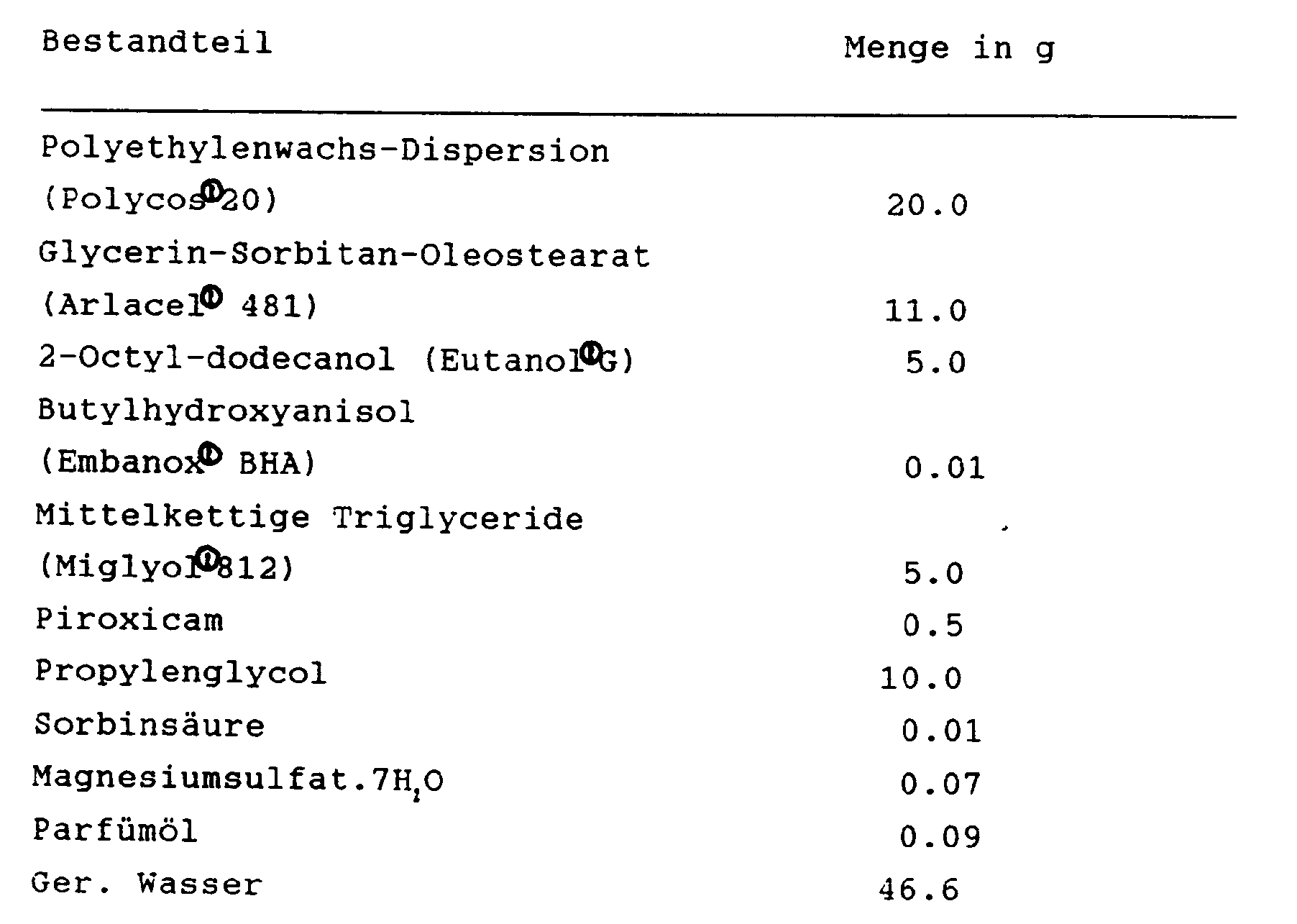
- Die Herstellung der Creme erfolgt mit den folgenden Verfahrensschritten:
- 1. Die vorstehend genannten Bestandteile Polycos, Arlacel, Eutanol, Miglyol (4.0 g) und Embanox werden in einem VA-Topf unter Rühren bei 80°C aufgeschmolzen, wobei insbesondere auf ein vollständiges Aufschmelzen von Arlacel zu achten ist;
- 2. Die Sorbinsäure wird in Propylenglycol bei ca. 55°C gelöst;
- 3. das Wasser wird in einem VA-Topf auf 65 bis 70°C erwärmt, dann wird das Magnesiumsulfat gelöst, danach die unter 2 hergestellte Sorbinsäure-Lösung eingerührt; die Temperatur der so hergestellten Wasserphase soll 65°C betragen;
- 4. das Piroxicam wird mit einer hochtourigen Rühreinrichtung in Miglyol (1.0 g) suspendiert, und diese Suspension dann zur geschmolzenen Fettphase gegeben und kurz eingerührt;
- 5. die unter 3 hergestellte Wasserphase wird zur Fettphase zugegeben, emulgiert und homogenisiert;
- 6. es wird unter Vakuum kaltgerührt, bei 40°C dann das Parfüm eingerührt, dann ohne Vakuum kaltgerührt, und das Gefäß bei 28 bis 30°C entleert.
- Eine bisher über 21 Monate laufende Stabilitätsprüfung an 2 Chargen zeigt eine leichte, im Rahmen der Spezifikation liegende Gelbfärbung. Gelbe Punkte, wie sie bei O/W-Cremes durch Bildung des gelben Piroxicam-Monohydrates auftreten, sind nicht zu erkennen. Die laufende Stabilitätsprüfung weist die W/O-Creme als stabile Arzneiform für Piroxicam aus.
- Nach dem im Beispiel 1 beschriebenen Verfahren wurde die nachfolgende Zusammensetzung hergestellt.
- Ansatz: 100 g

- Eine Stabilitätsprüfung dieser Zusammensetzung zeigte gleich gute Ergebnisse wie die Zusammensetzung gemäß Beispiel 1.
- Nach dem im Beispiel 1 angegebenen Verfahren wurde die folgende Zusammensetzung hergestellt:
- Ansatz: 100 g

- Die Stabilität dieser Zusammensetzung ist mit der der Zusammensetzungen der Beispiele 1 und 2 vergleichbar.
- Die im Beispiel 1 hergestellte "Piroxicam-Creme" (Wirkstoffgehalt 0.5 Gew.%) wurde auf die antiphlogistische Wirkung geprüft, und mit einem Vergleichspräparat (Gel aus Propylenglycol, Ethyl- und Benzylalkohol mit 0.5 Gew. % Piroxicam) verglichen.
- Es wurde die antiphlogistische Wirkung am UV-induzierten Erythem des Meerschweinchens untersucht (jeweils 10 Tiere/Gruppe).
- Zur Auslösung des Erythems wurde die enthaarte Rückenhaut der Meerschweinchen 1 Minute mit UV-B-Licht (280 bis 315 nm bestrahlt). Anschließend wurden jeweils 50 mg der entsprechenden Präparate auf die bestrahlte Stelle aufgetragen.
- Die 0.5 %-ige "Piroxicam-Creme" (erfindungsgemäß) hemmte die Ausprägung der Erytheme zwischen 27.8 % und 60 %, wobei die maximale Hemmwirkung 2 Stunden p.a. auftrat. Das Vergleichspräparat (Gel) wies Hemmwirkungen zwischen 13.3 % und 66.7 % auf, wobei das Maximum nach 1 Stunde p.a. verzeichnet wurde, wo auch in der Kontrollgruppe das Erythem noch nicht voll ausgeprägt war. Zu späteren Untersuchungszeitpunkten war die Hemmwirkung des Vergleichspräparates schwächer ausgeprägt als die der erfindungsgemäßen "Piroxicam-Creme".
- Mit einer erfindungsgemäßen "Piroxicam-Creme" , die 1 Gew. % Wirkstoff (Piroxicam) enthielt, wurden ähnliche Hemmwirkungen (zwischen 22.2 % und 60.0 %) festgestellt, wobei das Maximum ebenfalls 2 Stunden p.a. registriert wurde.
- Signifikante Verminderungen der Häufigkeit von Erythembefunden ≧ 2 wurden in der Gruppe, die mit 0.5 %-iger "Piroxicam-Creme" behandelt wurde, 4 Stunden p.a., in der Gruppe, die mit 1 %-iger "Piroxicam-Creme" behandelt wurde 3 Stunden nach dem Auftragen im Vergleich zur Kontrollgruppe (Placebo-Gruppe) verzeichnet.
- Die in der vorstehenden Untersuchung erzielten Ergebnisse zeigen deutlich die ausgeprägte antiphlogistische Wirkung der erfindungsgemäßen W/O-Cremes, wobei die antiphlogistische Wirkung des Vergleichspräparates gemäß dem Stande der Technik (Gel) im Hinblick auf eine Langzeitwirkung noch übertroffen wird.
- Gegenstand der Erfindung ist deshalb auch eine erfindungsgemäße pharmazeutische Zusammensetzung als antirheumatisch, antiphlogistisch und/oder antiinflammatorisch wirkendes Arzneimittel zur Behandlung entsprechender Erkrankungen.
- Die Art, Dosis und Häufigkeit der topischen Verabreichung richtet sich insbesondere nach der Schwere der Erkrankung und dem Allgemeinzustand des Patienten, aber auch nach dem Zustand und der Empfindlichkeit der Haut. In der Regel entspricht die Verabreichung den für derartige Zusammensetzungen üblichen Bedingungen.
Claims (23)
- Pharmazeutische Zusammensetzung zur topischen Anwendung auf der Grundlage einer W/O-Emulsion, dadurch gekennzeichnet, daß sie in der Ölphase als Wirksubstanz Piroxicam enthält, und gegebenenfalls weitere Mittel zur Stabilisierung, Konservierung und/oder übliche pharmazeutische Hilfs- und/oder Trägerstoffe.
- Zusammensetzung nach Anspruch 1, dadurch gekennzeichnet, daß die Ölphase eine Polyethylenwachs-Dispersion enthält.
- Zusammensetzung nach Anspruch 1 oder 2, dadurch gekennzeichnet, daß die Ölphase mittelkettige Triglyceride und/oder 2-Octyldodecanol enthält.
- Zusammensetzung nach einem der Ansprüche 1 bis 3, dadurch gekennzeichnet, daß sie Emulgatoren, Stabilisatoren, Antioxidantien, Lösungsvermittler, Penetrationsförderer, Penetrationsbeschleuniger, Konservierungsmittel, Emulsionsstabilisatoren und/oder Parfüms enthält.
- Zusammensetzung nach Anspruch 4, dadurch gekennzeichnet, daß sie Glycerin-Sorbitan-Oleostearat, Butylhydroxyanisol, 2-Octyldodecanol, Propylenglycol und/oder Magnesiumsulfat-Heptahydrat enthält.
- Zusammensetzung nach einem der Ansprüche 1 bis 5, dadurch gekennzeichnet, daß sie als Konservierungsmittel Sorbinsäure oder ein Gemisch aus Sorbinsäure und Propylenglycol enthält.
- Zusammensetzung nach einem der Ansprüche 1 bis 6, dadurch gekennzeichnet, daß sie das Piroxicam in einer Menge von 0.1 bis 10 Gew. % enthält.
- Zusammensetzung nach Anspruch 7, dadurch gekennzeichnet, daß sie das Piroxicam in einer Menge von 0.2 bis 5 Gew. %, und insbesondere in einer Menge von 0.5 bis 1 Gew. % enthält.
- Zusammensetzung nach einem der Ansprüche 1 bis 8, dadurch gekennzeichnet, daß sie in Form einer W/O-Creme vorliegt.
- Zusammensetzung nach einem der Ansprüche 1 bis 9, dadurch gekennzeichnet, daß sie als Salbengrundlage Polyethylenwachs-Dispersion, Wollwachs, weißes Vaselin, und/oder Polyethylen mit Paraffinöl enthält.
- Zusammensetzung nach einem der Ansprüche 1 bis 10, dadurch gekennzeichnet, daß sie als Ölkomponente mittelkettige Triglyceride, 2-Octyldodecanol und/oder Isopropylmyristat enthält.
- Zusammensetzung nach einem der Ansprüche 1 bis 11, dadurch gekennzeichnet, daß sie als Emulgator einen oder mehrere Emulgatoren mit einem HLB-Wert von 3 bis 6 enthält.
- Zusammensetzung nach Anspruch 12, dadurch gekennzeichnet, daß sie als Emulgator Sorbitanfettsäureester und/oder Mischungen von Sorbitanfettsäureestern mit Glycerinfettsäureestern, Glycerinmonodifettsäureestern und/oder Glycerindifettsäureestern enthält.
- Zusammensetzung nach einem der Ansprüche 9 bis 13, dadurch gekennzeichnet, daß sie ein Gemisch aus Polyethylenwachs-Dispersion, Glycerin-Sorbitan-Oleostearat, 2-Octyldodecanol und/oder mittelkettigen Triglyceriden, und Butylhydroxyanisol umfaßt.
- Zusammensetzung nach einem der Ansprüche 9 bis 14, dadurch gekennzeichnet, daß sie 5 bis 30 % Salbengrundlage, 5 bis 25 % Emulgator, jeweils 0.5 bis 15 % einer oder mehrerer Ölkomponenten und 0.005 bis 0.15 % Antioxidantien, bezogen auf das Gewicht der Gesamtzusammensetzung, enthält.
- Zusammensetzung nach einem der Ansprüche 9 bis 15, dadurch gekennzeichnet, daß das Gewichtsverhältnis von Ölphase zu Wasserphase ca. 3 zu 2 beträgt.
- Zusammensetzung nach einem der Ansprüche 9 bis 16, dadurch gekennzeichnet, daß die Wasserphase Glycerol, Sorbitol, Pentaerythrol, Xylitol und/oder Propylenglycol enthält.
- Zusammensetzung nach einem der Ansprüche 9 bis 17, dadurch gekennzeichnet, daß die Wasserphase Konservierungsmittel und/oder Stabilisatoren enthält.
- Zusammensetzung nach Anspruch 18, dadurch gekennzeichnet, daß die Wasserphase Sorbinssäure und/oder Magnesiumsulfat-Heptahydrat enthält.
- Zusammensetzung nach einem der Ansprüche 9 bis 19, dadurch gekennzeichnet, daß die Wasserphase 1 bis 20 % Feuchthaltemittel/Penetrationsverstärker, 0.01 bis 0.2 % Konservierungsmittel und/oder 0.25 bis 1.0 % Stabilisatoren, bezogen auf das Gewicht der Gesamtzusammensetzung, enthält.
- Verfahren zur Herstellung einer Zusammensetzung nach einem der Ansprüche 1 bis 20, dadurch gekennzeichnet, daß man das Piroxicam in die Ölphase einarbeitet, und diese dann mit der Wasserphase homogenisiert.
- Verfahren nach Anspruch 21 , dadurch gekennzeichnet, daß man das Piroxicam in der Ölkomponente suspendiert und diese Suspension in eine geschmolzene Fettphase zur Bildung der Ölphase einrührt.
- Pharmazeutische Zusammensetzung nach einem der Ansprüche 1 bis 20 zur Verwendung als antirheumatisch, antiphlogistisch und/oder antiinflammatorisch wirkendes Arzneimittel.
Priority Applications (7)
| Application Number | Priority Date | Filing Date | Title |
|---|---|---|---|
| EP90107992A EP0453603B1 (de) | 1990-04-26 | 1990-04-26 | Piroxicam enthaltende pharmazeutische Zusammensetzung zur topischen Anwendung |
| AT90107992T ATE95421T1 (de) | 1990-04-26 | 1990-04-26 | Piroxicam enthaltende pharmazeutische zusammensetzung zur topischen anwendung. |
| ES90107992T ES2059869T3 (es) | 1990-04-26 | 1990-04-26 | Preparado farmaceutico que contiene piroxicam para uso topico. |
| DE90107992T DE59003020D1 (de) | 1990-04-26 | 1990-04-26 | Piroxicam enthaltende pharmazeutische Zusammensetzung zur topischen Anwendung. |
| DK90107992.1T DK0453603T3 (da) | 1990-04-26 | 1990-04-26 | Piroxicamholdige farmaceutiske præparater til topisk anvendelse |
| JP2254025A JP2557557B2 (ja) | 1990-04-26 | 1990-09-20 | ピロキシカム含有局所投与用医薬組成物 |
| US07/604,677 US5196417A (en) | 1990-04-04 | 1990-10-26 | Piroxicam-containing pharmaceutical composition for topical use |
Applications Claiming Priority (1)
| Application Number | Priority Date | Filing Date | Title |
|---|---|---|---|
| EP90107992A EP0453603B1 (de) | 1990-04-26 | 1990-04-26 | Piroxicam enthaltende pharmazeutische Zusammensetzung zur topischen Anwendung |
Publications (2)
| Publication Number | Publication Date |
|---|---|
| EP0453603A1 EP0453603A1 (de) | 1991-10-30 |
| EP0453603B1 true EP0453603B1 (de) | 1993-10-06 |
Family
ID=8203917
Family Applications (1)
| Application Number | Title | Priority Date | Filing Date |
|---|---|---|---|
| EP90107992A Expired - Lifetime EP0453603B1 (de) | 1990-04-04 | 1990-04-26 | Piroxicam enthaltende pharmazeutische Zusammensetzung zur topischen Anwendung |
Country Status (7)
| Country | Link |
|---|---|
| US (1) | US5196417A (de) |
| EP (1) | EP0453603B1 (de) |
| JP (1) | JP2557557B2 (de) |
| AT (1) | ATE95421T1 (de) |
| DE (1) | DE59003020D1 (de) |
| DK (1) | DK0453603T3 (de) |
| ES (1) | ES2059869T3 (de) |
Families Citing this family (10)
| Publication number | Priority date | Publication date | Assignee | Title |
|---|---|---|---|---|
| US5318960A (en) * | 1992-06-03 | 1994-06-07 | Frank Toppo | System for transdermal delivery of pain relieving substances |
| HU209518B (en) * | 1992-12-23 | 1994-06-28 | Egyt Gyogyszervegyeszeti Gyar | Process for production of free of skin damaging effect unguent preparation containing piroxicam |
| DE4337030A1 (de) * | 1993-10-29 | 1995-05-04 | Henkel Kgaa | Verfahren zur Herstellung von Wachsdispersionen |
| DE4341794C1 (de) * | 1993-12-08 | 1995-01-19 | Henkel Kgaa | Kosmetische und/oder pharmazeutische Zubereitungen mit verbessertem Hautgefühl |
| KR100288190B1 (ko) * | 1998-02-09 | 2001-04-16 | 김용규 | 피록시캄 함유 알콜성 하이드로겔 조성물 |
| US6573299B1 (en) * | 1999-09-20 | 2003-06-03 | Advanced Medical Instruments | Method and compositions for treatment of the aging eye |
| WO2005089317A2 (en) * | 2004-03-15 | 2005-09-29 | 3M Innovative Properties Company | Immune response modifier formulations and methods |
| US7282225B1 (en) | 2006-09-27 | 2007-10-16 | Occular Technologies, Inc. | Composition and methods for improving retinal health |
| DE102010014290A1 (de) * | 2010-04-08 | 2011-10-13 | Hans Otto Meyer zu Spelbrink | Mittel zur prophylaktischen und therapeutischen Behandlung von Herpes-Infektionen |
| CN117257726B (zh) * | 2023-11-16 | 2024-01-16 | 济南广盛源生物科技有限公司 | 一种米氮平软膏剂及其制备方法和应用 |
Family Cites Families (9)
| Publication number | Priority date | Publication date | Assignee | Title |
|---|---|---|---|---|
| JPS5913714A (ja) * | 1982-07-13 | 1984-01-24 | Taito Pfizer Kk | 外用消炎鎮痛剤 |
| DE3344691A1 (de) * | 1983-12-10 | 1985-06-20 | Bayer Ag, 5090 Leverkusen | Wirkstoffabgasesysteme |
| DE3347278A1 (de) * | 1983-12-28 | 1985-07-11 | Bayer Ag, 5090 Leverkusen | Wirkstoffabgabesysteme |
| DE3347277A1 (de) * | 1983-12-28 | 1985-07-11 | Bayer Ag, 5090 Leverkusen | Wirkstoffabgabesysteme |
| JPS6160620A (ja) * | 1984-09-03 | 1986-03-28 | Teijin Ltd | ピログルタミン酸エステル類を含有する医薬品組成物 |
| IT1196307B (it) * | 1984-10-22 | 1988-11-16 | Chiesi Farma Spa | Formulazioni farmaceutiche acquose di piroxicam monoidrato |
| US4847071A (en) * | 1987-10-22 | 1989-07-11 | The Procter & Gamble Company | Photoprotection compositions comprising tocopherol sorbate and an anti-inflammatory agent |
| ES2051998T3 (es) * | 1988-02-29 | 1994-07-01 | Pfizer | Composiciones aumentadoras del flujo transdermal. |
| JPH01256015A (ja) * | 1988-04-05 | 1989-10-12 | Hitachi Ltd | 記録再生シリンダ |
-
1990
- 1990-04-26 AT AT90107992T patent/ATE95421T1/de not_active IP Right Cessation
- 1990-04-26 EP EP90107992A patent/EP0453603B1/de not_active Expired - Lifetime
- 1990-04-26 ES ES90107992T patent/ES2059869T3/es not_active Expired - Lifetime
- 1990-04-26 DK DK90107992.1T patent/DK0453603T3/da active
- 1990-04-26 DE DE90107992T patent/DE59003020D1/de not_active Expired - Lifetime
- 1990-09-20 JP JP2254025A patent/JP2557557B2/ja not_active Expired - Lifetime
- 1990-10-26 US US07/604,677 patent/US5196417A/en not_active Expired - Fee Related
Also Published As
| Publication number | Publication date |
|---|---|
| JP2557557B2 (ja) | 1996-11-27 |
| ES2059869T3 (es) | 1994-11-16 |
| EP0453603A1 (de) | 1991-10-30 |
| ATE95421T1 (de) | 1993-10-15 |
| DE59003020D1 (de) | 1993-11-11 |
| JPH0413624A (ja) | 1992-01-17 |
| DK0453603T3 (da) | 1993-11-22 |
| US5196417A (en) | 1993-03-23 |
Similar Documents
| Publication | Publication Date | Title |
|---|---|---|
| DE69926843T2 (de) | Aktives vitamin-d3 enthaltende lotionen in form von emulsionen | |
| DE2513797C2 (de) | Pharmazeutische zusammensetzung | |
| DE3503279C2 (de) | ||
| DE60028384T2 (de) | Propofol enthaltende anästhetische zusammensetzung zur intravenösen injektion | |
| EP0117888B1 (de) | Flüssigzubereitungen von Dihydropyridinen, ein Verfahren zu ihrer Herstellung, sowie ihre Verwendung bei der Bekämpfung von Erkrankungen | |
| EP0586621B1 (de) | Linsidomin zur behandlung erektiler dysfunktionen | |
| DE4133694C2 (de) | Verwendung einer Emulsion mit mehrfach ungesättigten Fettsären zur i.v.-Verabreichung zur Behandlung von Hauterkrankungen | |
| DE69733086T2 (de) | Pharmazeutische zusammensetzungen welche kukui nuss öl enthalten | |
| DE69626103T2 (de) | Parenterale pharmazeutische zusammensetzungen ammoniumalkylsalze von 2-arylpropionsäuren enthaltend | |
| DE69807065T2 (de) | Topische mittel | |
| DE68912459T2 (de) | Verwendung von Thromboxan-A2-Rezeptorantagonisten zur Herstellung einer pharmazeutischen Zusammensetzung zur Behandlung von Hautkrankheiten. | |
| DE3780091T2 (de) | Behandlung von pilzinfektionen. | |
| DE69920201T2 (de) | Zusammensetzungen enthaltend glykolderivate, alkohole und vitamin d | |
| DE69231287T2 (de) | Verwendung von Dibutyl-Adipat und Isopropyl-Myristat in topischen und transdermalen Produkten | |
| DE2818553A1 (de) | Zusammensetzung zur behandlung von proliferativen hautkrankheiten | |
| CH693764A5 (de) | Pharmazeutische Zusammensetzung enthaltend Propofol und Edetat. | |
| DE19809304A1 (de) | Formulierungen mit antiviraler Wirkung | |
| DE4345186C2 (de) | Hydrocortison-21-acetat-17-propionat enthaltende W/O-Lotionen | |
| EP1539155B1 (de) | Stabile creme-zubereitungen von phenyl-pyridonverbindungen für topische anwendung | |
| DE60308888T2 (de) | Injizierbare 2,6-diisopropylphenol enthaltende anästhetische zusammensetzung und verfahren | |
| DE69427981T2 (de) | Verkapselter arzneistoff | |
| DE69208941T2 (de) | Augenpräparate mit verlängerter Freigabe | |
| EP0453603A1 (de) | Piroxicam enthaltende pharmazeutische Zusammensetzung zur topischen Anwendung | |
| DE4200555C2 (de) | Herstellung eines Kamillenextraktes mit antimikrobiellen Eigenschaften | |
| EP0450123B1 (de) | Diclofenac-Natrium enthaltende pharmazeutische Zusammensetzung zur topischen Anwendung |
Legal Events
| Date | Code | Title | Description |
|---|---|---|---|
| PUAI | Public reference made under article 153(3) epc to a published international application that has entered the european phase |
Free format text: ORIGINAL CODE: 0009012 |
|
| AK | Designated contracting states |
Kind code of ref document: A1 Designated state(s): AT BE CH DE DK ES FR GB GR IT LI LU NL SE |
|
| 17P | Request for examination filed |
Effective date: 19920306 |
|
| 17Q | First examination report despatched |
Effective date: 19921007 |
|
| GRAA | (expected) grant |
Free format text: ORIGINAL CODE: 0009210 |
|
| AK | Designated contracting states |
Kind code of ref document: B1 Designated state(s): AT BE CH DE DK ES FR GB GR IT LI LU NL SE |
|
| REF | Corresponds to: |
Ref document number: 95421 Country of ref document: AT Date of ref document: 19931015 Kind code of ref document: T |
|
| ITF | It: translation for a ep patent filed | ||
| REF | Corresponds to: |
Ref document number: 59003020 Country of ref document: DE Date of ref document: 19931111 |
|
| ET | Fr: translation filed | ||
| REG | Reference to a national code |
Ref country code: DK Ref legal event code: T3 |
|
| GBT | Gb: translation of ep patent filed (gb section 77(6)(a)/1977) |
Effective date: 19931021 |
|
| REG | Reference to a national code |
Ref country code: GR Ref legal event code: FG4A Free format text: 3009693 |
|
| EPTA | Lu: last paid annual fee | ||
| PLBE | No opposition filed within time limit |
Free format text: ORIGINAL CODE: 0009261 |
|
| STAA | Information on the status of an ep patent application or granted ep patent |
Free format text: STATUS: NO OPPOSITION FILED WITHIN TIME LIMIT |
|
| 26N | No opposition filed | ||
| REG | Reference to a national code |
Ref country code: ES Ref legal event code: FG2A Ref document number: 2059869 Country of ref document: ES Kind code of ref document: T3 |
|
| EAL | Se: european patent in force in sweden |
Ref document number: 90107992.1 |
|
| ITPR | It: changes in ownership of a european patent |
Owner name: CESSIONE;COM - PHARM ARZNEIMITTEL GMBH |
|
| REG | Reference to a national code |
Ref country code: CH Ref legal event code: PUE Owner name: COM-PHARM ARZNEIMITTEL GMBH |
|
| REG | Reference to a national code |
Ref country code: GB Ref legal event code: 732E |
|
| REG | Reference to a national code |
Ref country code: FR Ref legal event code: TP |
|
| NLS | Nl: assignments of ep-patents |
Owner name: COM-PHARM ARZNEIMITTEL GMBH TE MUENCHEN, BONDSREPU |
|
| PGFP | Annual fee paid to national office [announced via postgrant information from national office to epo] |
Ref country code: GB Payment date: 19970422 Year of fee payment: 8 |
|
| PGFP | Annual fee paid to national office [announced via postgrant information from national office to epo] |
Ref country code: BE Payment date: 19970423 Year of fee payment: 8 |
|
| PGFP | Annual fee paid to national office [announced via postgrant information from national office to epo] |
Ref country code: SE Payment date: 19970424 Year of fee payment: 8 |
|
| PGFP | Annual fee paid to national office [announced via postgrant information from national office to epo] |
Ref country code: AT Payment date: 19970425 Year of fee payment: 8 Ref country code: FR Payment date: 19970425 Year of fee payment: 8 |
|
| PGFP | Annual fee paid to national office [announced via postgrant information from national office to epo] |
Ref country code: DK Payment date: 19970429 Year of fee payment: 8 |
|
| PGFP | Annual fee paid to national office [announced via postgrant information from national office to epo] |
Ref country code: GR Payment date: 19970430 Year of fee payment: 8 Ref country code: NL Payment date: 19970430 Year of fee payment: 8 |
|
| PGFP | Annual fee paid to national office [announced via postgrant information from national office to epo] |
Ref country code: CH Payment date: 19970502 Year of fee payment: 8 |
|
| PGFP | Annual fee paid to national office [announced via postgrant information from national office to epo] |
Ref country code: LU Payment date: 19970516 Year of fee payment: 8 |
|
| PGFP | Annual fee paid to national office [announced via postgrant information from national office to epo] |
Ref country code: ES Payment date: 19970717 Year of fee payment: 8 |
|
| PG25 | Lapsed in a contracting state [announced via postgrant information from national office to epo] |
Ref country code: AT Free format text: LAPSE BECAUSE OF NON-PAYMENT OF DUE FEES Effective date: 19980426 Ref country code: LU Free format text: LAPSE BECAUSE OF NON-PAYMENT OF DUE FEES Effective date: 19980426 Ref country code: GB Free format text: LAPSE BECAUSE OF NON-PAYMENT OF DUE FEES Effective date: 19980426 |
|
| PG25 | Lapsed in a contracting state [announced via postgrant information from national office to epo] |
Ref country code: SE Free format text: LAPSE BECAUSE OF NON-PAYMENT OF DUE FEES Effective date: 19980427 Ref country code: ES Free format text: LAPSE BECAUSE OF NON-PAYMENT OF DUE FEES Effective date: 19980427 |
|
| PG25 | Lapsed in a contracting state [announced via postgrant information from national office to epo] |
Ref country code: CH Free format text: LAPSE BECAUSE OF NON-PAYMENT OF DUE FEES Effective date: 19980430 Ref country code: DK Free format text: LAPSE BECAUSE OF NON-PAYMENT OF DUE FEES Effective date: 19980430 Ref country code: BE Free format text: LAPSE BECAUSE OF NON-PAYMENT OF DUE FEES Effective date: 19980430 Ref country code: LI Free format text: LAPSE BECAUSE OF NON-PAYMENT OF DUE FEES Effective date: 19980430 Ref country code: GR Free format text: LAPSE BECAUSE OF NON-PAYMENT OF DUE FEES Effective date: 19980430 Ref country code: FR Free format text: THE PATENT HAS BEEN ANNULLED BY A DECISION OF A NATIONAL AUTHORITY Effective date: 19980430 |
|
| BERE | Be: lapsed |
Owner name: COM-PHARM ARZNEIMITTEL G.M.B.H. Effective date: 19980430 |
|
| PG25 | Lapsed in a contracting state [announced via postgrant information from national office to epo] |
Ref country code: NL Free format text: LAPSE BECAUSE OF NON-PAYMENT OF DUE FEES Effective date: 19981101 |
|
| REG | Reference to a national code |
Ref country code: CH Ref legal event code: PL |
|
| GBPC | Gb: european patent ceased through non-payment of renewal fee |
Effective date: 19980426 |
|
| NLV4 | Nl: lapsed or anulled due to non-payment of the annual fee |
Effective date: 19981101 |
|
| EUG | Se: european patent has lapsed |
Ref document number: 90107992.1 |
|
| REG | Reference to a national code |
Ref country code: FR Ref legal event code: ST |
|
| REG | Reference to a national code |
Ref country code: DK Ref legal event code: EBP |
|
| REG | Reference to a national code |
Ref country code: ES Ref legal event code: FD2A Effective date: 20000503 |
|
| PG25 | Lapsed in a contracting state [announced via postgrant information from national office to epo] |
Ref country code: IT Free format text: LAPSE BECAUSE OF NON-PAYMENT OF DUE FEES;WARNING: LAPSES OF ITALIAN PATENTS WITH EFFECTIVE DATE BEFORE 2007 MAY HAVE OCCURRED AT ANY TIME BEFORE 2007. THE CORRECT EFFECTIVE DATE MAY BE DIFFERENT FROM THE ONE RECORDED. Effective date: 20050426 |
|
| PGFP | Annual fee paid to national office [announced via postgrant information from national office to epo] |
Ref country code: DE Payment date: 20090424 Year of fee payment: 20 |
|
| PG25 | Lapsed in a contracting state [announced via postgrant information from national office to epo] |
Ref country code: DE Free format text: LAPSE BECAUSE OF EXPIRATION OF PROTECTION Effective date: 20100426 |