EP1539155B1 - Stabile creme-zubereitungen von phenyl-pyridonverbindungen für topische anwendung - Google Patents
Stabile creme-zubereitungen von phenyl-pyridonverbindungen für topische anwendung Download PDFInfo
- Publication number
- EP1539155B1 EP1539155B1 EP03794750A EP03794750A EP1539155B1 EP 1539155 B1 EP1539155 B1 EP 1539155B1 EP 03794750 A EP03794750 A EP 03794750A EP 03794750 A EP03794750 A EP 03794750A EP 1539155 B1 EP1539155 B1 EP 1539155B1
- Authority
- EP
- European Patent Office
- Prior art keywords
- weight
- preparation according
- pyridone
- phenyl
- active ingredient
- Prior art date
- Legal status (The legal status is an assumption and is not a legal conclusion. Google has not performed a legal analysis and makes no representation as to the accuracy of the status listed.)
- Expired - Lifetime
Links
- 238000002360 preparation method Methods 0.000 title claims abstract description 52
- 230000000699 topical effect Effects 0.000 title claims abstract description 10
- 239000006071 cream Substances 0.000 title claims description 43
- FLYJEBSUJDZJDE-UHFFFAOYSA-N 3-phenyl-1h-pyridin-2-one Chemical class O=C1NC=CC=C1C1=CC=CC=C1 FLYJEBSUJDZJDE-UHFFFAOYSA-N 0.000 title description 3
- 239000004480 active ingredient Substances 0.000 claims abstract description 26
- -1 1-phenyl-2-(1H)-pyridone compound Chemical class 0.000 claims abstract description 16
- 238000011282 treatment Methods 0.000 claims abstract description 12
- 150000003839 salts Chemical class 0.000 claims abstract description 11
- 208000017520 skin disease Diseases 0.000 claims abstract description 11
- 239000003995 emulsifying agent Substances 0.000 claims abstract description 10
- 239000003795 chemical substances by application Substances 0.000 claims abstract description 8
- 238000011321 prophylaxis Methods 0.000 claims abstract description 8
- 239000000654 additive Substances 0.000 claims abstract description 7
- 239000003963 antioxidant agent Substances 0.000 claims abstract description 7
- 150000003626 triacylglycerols Chemical class 0.000 claims abstract description 7
- 239000003755 preservative agent Substances 0.000 claims abstract description 6
- 239000007764 o/w emulsion Substances 0.000 claims abstract description 4
- 230000035515 penetration Effects 0.000 claims abstract description 4
- 239000008250 pharmaceutical cream Substances 0.000 claims abstract description 3
- 239000000470 constituent Substances 0.000 claims abstract 3
- ISWRGOKTTBVCFA-UHFFFAOYSA-N pirfenidone Chemical compound C1=C(C)C=CC(=O)N1C1=CC=CC=C1 ISWRGOKTTBVCFA-UHFFFAOYSA-N 0.000 claims description 29
- 239000000203 mixture Substances 0.000 claims description 25
- 229960003073 pirfenidone Drugs 0.000 claims description 25
- XLYOFNOQVPJJNP-UHFFFAOYSA-N water Chemical compound O XLYOFNOQVPJJNP-UHFFFAOYSA-N 0.000 claims description 20
- 239000002904 solvent Substances 0.000 claims description 17
- UFTFJSFQGQCHQW-UHFFFAOYSA-N triformin Chemical compound O=COCC(OC=O)COC=O UFTFJSFQGQCHQW-UHFFFAOYSA-N 0.000 claims description 15
- QIQXTHQIDYTFRH-UHFFFAOYSA-N octadecanoic acid Chemical compound CCCCCCCCCCCCCCCCCC(O)=O QIQXTHQIDYTFRH-UHFFFAOYSA-N 0.000 claims description 13
- 239000012071 phase Substances 0.000 claims description 13
- 235000021355 Stearic acid Nutrition 0.000 claims description 12
- 239000008346 aqueous phase Substances 0.000 claims description 12
- OQCDKBAXFALNLD-UHFFFAOYSA-N octadecanoic acid Natural products CCCCCCCC(C)CCCCCCCCC(O)=O OQCDKBAXFALNLD-UHFFFAOYSA-N 0.000 claims description 12
- 239000008117 stearic acid Substances 0.000 claims description 12
- 235000010268 sodium methyl p-hydroxybenzoate Nutrition 0.000 claims description 11
- PESXGULMKCKJCC-UHFFFAOYSA-M sodium;4-methoxycarbonylphenolate Chemical compound [Na+].COC(=O)C1=CC=C([O-])C=C1 PESXGULMKCKJCC-UHFFFAOYSA-M 0.000 claims description 11
- IXMINYBUNCWGER-UHFFFAOYSA-M sodium;4-propoxycarbonylphenolate Chemical compound [Na+].CCCOC(=O)C1=CC=C([O-])C=C1 IXMINYBUNCWGER-UHFFFAOYSA-M 0.000 claims description 11
- 239000008213 purified water Substances 0.000 claims description 10
- 150000001875 compounds Chemical class 0.000 claims description 9
- OULAJFUGPPVRBK-UHFFFAOYSA-N tetratriacontan-1-ol Chemical compound CCCCCCCCCCCCCCCCCCCCCCCCCCCCCCCCCCO OULAJFUGPPVRBK-UHFFFAOYSA-N 0.000 claims description 9
- 125000004178 (C1-C4) alkyl group Chemical group 0.000 claims description 8
- 229940072106 hydroxystearate Drugs 0.000 claims description 7
- 229920001451 polypropylene glycol Polymers 0.000 claims description 7
- HRZFUMHJMZEROT-UHFFFAOYSA-L sodium disulfite Chemical compound [Na+].[Na+].[O-]S(=O)S([O-])(=O)=O HRZFUMHJMZEROT-UHFFFAOYSA-L 0.000 claims description 7
- MUBZPKHOEPUJKR-UHFFFAOYSA-N Oxalic acid Chemical compound OC(=O)C(O)=O MUBZPKHOEPUJKR-UHFFFAOYSA-N 0.000 claims description 6
- 125000003178 carboxy group Chemical group [H]OC(*)=O 0.000 claims description 6
- SASYSVUEVMOWPL-NXVVXOECSA-N decyl oleate Chemical compound CCCCCCCCCCOC(=O)CCCCCCC\C=C/CCCCCCCC SASYSVUEVMOWPL-NXVVXOECSA-N 0.000 claims description 6
- 230000003176 fibrotic effect Effects 0.000 claims description 6
- 229910052739 hydrogen Inorganic materials 0.000 claims description 6
- 239000001257 hydrogen Substances 0.000 claims description 6
- 238000000034 method Methods 0.000 claims description 6
- DNIAPMSPPWPWGF-UHFFFAOYSA-N monopropylene glycol Natural products CC(O)CO DNIAPMSPPWPWGF-UHFFFAOYSA-N 0.000 claims description 6
- ZQPPMHVWECSIRJ-KTKRTIGZSA-N oleic acid Chemical compound CCCCCCCC\C=C/CCCCCCCC(O)=O ZQPPMHVWECSIRJ-KTKRTIGZSA-N 0.000 claims description 6
- 229940001584 sodium metabisulfite Drugs 0.000 claims description 6
- 235000010262 sodium metabisulphite Nutrition 0.000 claims description 6
- 230000003902 lesion Effects 0.000 claims description 5
- 125000002496 methyl group Chemical group [H]C([H])([H])* 0.000 claims description 5
- UFHFLCQGNIYNRP-UHFFFAOYSA-N Hydrogen Chemical compound [H][H] UFHFLCQGNIYNRP-UHFFFAOYSA-N 0.000 claims description 4
- DBMJMQXJHONAFJ-UHFFFAOYSA-M Sodium laurylsulphate Chemical compound [Na+].CCCCCCCCCCCCOS([O-])(=O)=O DBMJMQXJHONAFJ-UHFFFAOYSA-M 0.000 claims description 4
- 238000004519 manufacturing process Methods 0.000 claims description 4
- 239000000546 pharmaceutical excipient Substances 0.000 claims description 4
- 235000013772 propylene glycol Nutrition 0.000 claims description 4
- 235000019333 sodium laurylsulphate Nutrition 0.000 claims description 4
- DNIAPMSPPWPWGF-GSVOUGTGSA-N (R)-(-)-Propylene glycol Chemical compound C[C@@H](O)CO DNIAPMSPPWPWGF-GSVOUGTGSA-N 0.000 claims description 3
- HIQIXEFWDLTDED-UHFFFAOYSA-N 4-hydroxy-1-piperidin-4-ylpyrrolidin-2-one Chemical group O=C1CC(O)CN1C1CCNCC1 HIQIXEFWDLTDED-UHFFFAOYSA-N 0.000 claims description 3
- 208000002260 Keloid Diseases 0.000 claims description 3
- 230000003078 antioxidant effect Effects 0.000 claims description 3
- 235000014113 dietary fatty acids Nutrition 0.000 claims description 3
- 239000003623 enhancer Substances 0.000 claims description 3
- 125000001495 ethyl group Chemical group [H]C([H])([H])C([H])([H])* 0.000 claims description 3
- 239000000194 fatty acid Substances 0.000 claims description 3
- 229930195729 fatty acid Natural products 0.000 claims description 3
- 230000035876 healing Effects 0.000 claims description 3
- 210000001117 keloid Anatomy 0.000 claims description 3
- 229940057917 medium chain triglycerides Drugs 0.000 claims description 3
- 239000000155 melt Substances 0.000 claims description 3
- 239000003961 penetration enhancing agent Substances 0.000 claims description 3
- ULWHHBHJGPPBCO-UHFFFAOYSA-N propane-1,1-diol Chemical compound CCC(O)O ULWHHBHJGPPBCO-UHFFFAOYSA-N 0.000 claims description 3
- 125000001436 propyl group Chemical group [H]C([*])([H])C([H])([H])C([H])([H])[H] 0.000 claims description 3
- KDYFGRWQOYBRFD-UHFFFAOYSA-N succinic acid Chemical compound OC(=O)CCC(O)=O KDYFGRWQOYBRFD-UHFFFAOYSA-N 0.000 claims description 3
- WRIDQFICGBMAFQ-UHFFFAOYSA-N (E)-8-Octadecenoic acid Natural products CCCCCCCCCC=CCCCCCCC(O)=O WRIDQFICGBMAFQ-UHFFFAOYSA-N 0.000 claims description 2
- BKVAAWMQOQLENB-UHFFFAOYSA-N 15-hydroxy stearic acid Chemical compound CCCC(O)CCCCCCCCCCCCCC(O)=O BKVAAWMQOQLENB-UHFFFAOYSA-N 0.000 claims description 2
- LQJBNNIYVWPHFW-UHFFFAOYSA-N 20:1omega9c fatty acid Natural products CCCCCCCCCCC=CCCCCCCCC(O)=O LQJBNNIYVWPHFW-UHFFFAOYSA-N 0.000 claims description 2
- QSBYPNXLFMSGKH-UHFFFAOYSA-N 9-Heptadecensaeure Natural products CCCCCCCC=CCCCCCCCC(O)=O QSBYPNXLFMSGKH-UHFFFAOYSA-N 0.000 claims description 2
- 206010012442 Dermatitis contact Diseases 0.000 claims description 2
- LYCAIKOWRPUZTN-UHFFFAOYSA-N Ethylene glycol Chemical compound OCCO LYCAIKOWRPUZTN-UHFFFAOYSA-N 0.000 claims description 2
- 239000005642 Oleic acid Substances 0.000 claims description 2
- ZQPPMHVWECSIRJ-UHFFFAOYSA-N Oleic acid Natural products CCCCCCCCC=CCCCCCCCC(O)=O ZQPPMHVWECSIRJ-UHFFFAOYSA-N 0.000 claims description 2
- 208000000260 Warts Diseases 0.000 claims description 2
- 229910052783 alkali metal Inorganic materials 0.000 claims description 2
- 150000001340 alkali metals Chemical class 0.000 claims description 2
- 229910052784 alkaline earth metal Inorganic materials 0.000 claims description 2
- 125000004432 carbon atom Chemical group C* 0.000 claims description 2
- 208000010247 contact dermatitis Diseases 0.000 claims description 2
- 150000004665 fatty acids Chemical class 0.000 claims description 2
- 150000002314 glycerols Chemical class 0.000 claims description 2
- QXJSBBXBKPUZAA-UHFFFAOYSA-N isooleic acid Natural products CCCCCCCC=CCCCCCCCCC(O)=O QXJSBBXBKPUZAA-UHFFFAOYSA-N 0.000 claims description 2
- 125000001449 isopropyl group Chemical group [H]C([H])([H])C([H])(*)C([H])([H])[H] 0.000 claims description 2
- 229960003511 macrogol Drugs 0.000 claims description 2
- LVWZTYCIRDMTEY-UHFFFAOYSA-N metamizole Chemical class O=C1C(N(CS(O)(=O)=O)C)=C(C)N(C)N1C1=CC=CC=C1 LVWZTYCIRDMTEY-UHFFFAOYSA-N 0.000 claims description 2
- 125000004108 n-butyl group Chemical group [H]C([H])([H])C([H])([H])C([H])([H])C([H])([H])* 0.000 claims description 2
- 235000021313 oleic acid Nutrition 0.000 claims description 2
- 235000006408 oxalic acid Nutrition 0.000 claims description 2
- 230000002980 postoperative effect Effects 0.000 claims description 2
- 230000002335 preservative effect Effects 0.000 claims description 2
- 230000002265 prevention Effects 0.000 claims description 2
- 125000002914 sec-butyl group Chemical group [H]C([H])([H])C([H])([H])C([H])(*)C([H])([H])[H] 0.000 claims description 2
- 201000010153 skin papilloma Diseases 0.000 claims description 2
- 125000000999 tert-butyl group Chemical group [H]C([H])([H])C(*)(C([H])([H])[H])C([H])([H])[H] 0.000 claims description 2
- 125000004435 hydrogen atom Chemical group [H]* 0.000 claims 2
- GJIAGDMNXDBNQD-UHFFFAOYSA-N C(C)(C)(C)C=1C=CC(N(C1)C1=CC=C(C=C1)CCC(=O)O)=O.C(=O)(O)CC1=CC(N(C=C1)C1=CC=CC=C1)=O.C(=O)(O)C=1C=CC(N(C1)C1=CC=CC=C1)=O.CC=1CC(C=CC1)(C(=O)O)N1C(C=CC=C1)=O Chemical compound C(C)(C)(C)C=1C=CC(N(C1)C1=CC=C(C=C1)CCC(=O)O)=O.C(=O)(O)CC1=CC(N(C=C1)C1=CC=CC=C1)=O.C(=O)(O)C=1C=CC(N(C1)C1=CC=CC=C1)=O.CC=1CC(C=CC1)(C(=O)O)N1C(C=CC=C1)=O GJIAGDMNXDBNQD-UHFFFAOYSA-N 0.000 claims 1
- JEGAEDORZHQRLN-UHFFFAOYSA-N CC=1C=CC(N(C1)C1=CC=CC=C1)=O.C(C)(C)C1=CC(N(C=C1)C1=CC=CC=C1)=O.C(C)C=1C(N(C=CC1)C1=CC=CC=C1)=O.CC=1C(N(C=CC1)C1=CC=CC=C1)=O.CC=1C=CC(N(C1)C1=CC=C(C=C1)C)=O Chemical compound CC=1C=CC(N(C1)C1=CC=CC=C1)=O.C(C)(C)C1=CC(N(C=C1)C1=CC=CC=C1)=O.C(C)C=1C(N(C=CC1)C1=CC=CC=C1)=O.CC=1C(N(C=CC1)C1=CC=CC=C1)=O.CC=1C=CC(N(C1)C1=CC=C(C=C1)C)=O JEGAEDORZHQRLN-UHFFFAOYSA-N 0.000 claims 1
- 230000003165 hydrotropic effect Effects 0.000 claims 1
- 159000000003 magnesium salts Chemical class 0.000 claims 1
- FBUKVWPVBMHYJY-UHFFFAOYSA-N nonanoic acid Chemical compound CCCCCCCCC(O)=O FBUKVWPVBMHYJY-UHFFFAOYSA-N 0.000 claims 1
- 230000001737 promoting effect Effects 0.000 claims 1
- 159000000000 sodium salts Chemical class 0.000 claims 1
- 239000001384 succinic acid Substances 0.000 claims 1
- 235000006708 antioxidants Nutrition 0.000 abstract description 5
- 239000012876 carrier material Substances 0.000 abstract description 2
- 229940100611 topical cream Drugs 0.000 abstract description 2
- 238000009472 formulation Methods 0.000 description 18
- 239000000839 emulsion Substances 0.000 description 12
- 238000003860 storage Methods 0.000 description 12
- 239000004615 ingredient Substances 0.000 description 10
- 239000002674 ointment Substances 0.000 description 10
- PEDCQBHIVMGVHV-UHFFFAOYSA-N Glycerol Natural products OCC(O)CO PEDCQBHIVMGVHV-UHFFFAOYSA-N 0.000 description 8
- UBQKCCHYAOITMY-UHFFFAOYSA-N pyridin-2-ol Chemical class OC1=CC=CC=N1 UBQKCCHYAOITMY-UHFFFAOYSA-N 0.000 description 8
- JVKUCNQGESRUCL-UHFFFAOYSA-N 2-Hydroxyethyl 12-hydroxyoctadecanoate Chemical compound CCCCCCC(O)CCCCCCCCCCC(=O)OCCO JVKUCNQGESRUCL-UHFFFAOYSA-N 0.000 description 6
- 229920001304 Solutol HS 15 Polymers 0.000 description 6
- 239000013078 crystal Substances 0.000 description 6
- 238000000354 decomposition reaction Methods 0.000 description 6
- 238000004128 high performance liquid chromatography Methods 0.000 description 6
- 238000003756 stirring Methods 0.000 description 6
- 239000000126 substance Substances 0.000 description 6
- REZOIPSCCRVWNN-UHFFFAOYSA-N tetratriacontan-17-ol Chemical compound CCCCCCCCCCCCCCCCCC(O)CCCCCCCCCCCCCCCC REZOIPSCCRVWNN-UHFFFAOYSA-N 0.000 description 6
- QELSKZZBTMNZEB-UHFFFAOYSA-N p-hydroxybenzoic acid propyl ester Natural products CCCOC(=O)C1=CC=C(O)C=C1 QELSKZZBTMNZEB-UHFFFAOYSA-N 0.000 description 5
- 238000013112 stability test Methods 0.000 description 5
- 238000004581 coalescence Methods 0.000 description 4
- LXCFILQKKLGQFO-UHFFFAOYSA-N methylparaben Chemical compound COC(=O)C1=CC=C(O)C=C1 LXCFILQKKLGQFO-UHFFFAOYSA-N 0.000 description 4
- GLDOVTGHNKAZLK-UHFFFAOYSA-N octadecan-1-ol Chemical compound CCCCCCCCCCCCCCCCCCO GLDOVTGHNKAZLK-UHFFFAOYSA-N 0.000 description 4
- 229940049964 oleate Drugs 0.000 description 4
- 239000000523 sample Substances 0.000 description 4
- 239000007787 solid Substances 0.000 description 4
- KFZMGEQAYNKOFK-UHFFFAOYSA-N Isopropanol Chemical compound CC(C)O KFZMGEQAYNKOFK-UHFFFAOYSA-N 0.000 description 3
- HEMHJVSKTPXQMS-UHFFFAOYSA-M Sodium hydroxide Chemical compound [OH-].[Na+] HEMHJVSKTPXQMS-UHFFFAOYSA-M 0.000 description 3
- 239000013543 active substance Substances 0.000 description 3
- 238000004458 analytical method Methods 0.000 description 3
- 230000000052 comparative effect Effects 0.000 description 3
- 238000002425 crystallisation Methods 0.000 description 3
- 230000008025 crystallization Effects 0.000 description 3
- 239000000499 gel Substances 0.000 description 3
- 239000012535 impurity Substances 0.000 description 3
- 229960002216 methylparaben Drugs 0.000 description 3
- 229960003415 propylparaben Drugs 0.000 description 3
- NKTNKUAONLMNLA-UHFFFAOYSA-N 1-phenyl-4-propan-2-ylpyridin-2-one Chemical compound O=C1C=C(C(C)C)C=CN1C1=CC=CC=C1 NKTNKUAONLMNLA-UHFFFAOYSA-N 0.000 description 2
- PQSNJSYCFALXOX-UHFFFAOYSA-N 2-(2-oxo-1-phenylpyridin-4-yl)acetic acid Chemical compound O=C1C=C(CC(=O)O)C=CN1C1=CC=CC=C1 PQSNJSYCFALXOX-UHFFFAOYSA-N 0.000 description 2
- WRMNZCZEMHIOCP-UHFFFAOYSA-N 2-phenylethanol Chemical compound OCCC1=CC=CC=C1 WRMNZCZEMHIOCP-UHFFFAOYSA-N 0.000 description 2
- GQDKHRWJZICYCI-UHFFFAOYSA-N 3-ethyl-1-phenylpyridin-2-one Chemical compound O=C1C(CC)=CC=CN1C1=CC=CC=C1 GQDKHRWJZICYCI-UHFFFAOYSA-N 0.000 description 2
- QYPXWHCHYKZGPR-UHFFFAOYSA-N 3-methyl-1-phenylpyridin-2-one Chemical compound O=C1C(C)=CC=CN1C1=CC=CC=C1 QYPXWHCHYKZGPR-UHFFFAOYSA-N 0.000 description 2
- CFKMVGJGLGKFKI-UHFFFAOYSA-N 4-chloro-m-cresol Chemical compound CC1=CC(O)=CC=C1Cl CFKMVGJGLGKFKI-UHFFFAOYSA-N 0.000 description 2
- QFBNBWMFFAJVME-UHFFFAOYSA-N 5-methyl-1-(2-oxopyridin-1-yl)cyclohexa-2,4-diene-1-carboxylic acid Chemical compound C1C(C)=CC=CC1(C(O)=O)N1C(=O)C=CC=C1 QFBNBWMFFAJVME-UHFFFAOYSA-N 0.000 description 2
- ZVEJTXODUXFIAO-UHFFFAOYSA-N 5-methyl-1-(4-methylphenyl)pyridin-2-one Chemical compound C1=CC(C)=CC=C1N1C(=O)C=CC(C)=C1 ZVEJTXODUXFIAO-UHFFFAOYSA-N 0.000 description 2
- PETUTZMMIOWORO-UHFFFAOYSA-N 6-oxo-1-phenylpyridine-3-carboxylic acid Chemical compound C1=C(C(=O)O)C=CC(=O)N1C1=CC=CC=C1 PETUTZMMIOWORO-UHFFFAOYSA-N 0.000 description 2
- CIWBSHSKHKDKBQ-JLAZNSOCSA-N Ascorbic acid Chemical compound OC[C@H](O)[C@H]1OC(=O)C(O)=C1O CIWBSHSKHKDKBQ-JLAZNSOCSA-N 0.000 description 2
- QFOHBWFCKVYLES-UHFFFAOYSA-N Butylparaben Chemical compound CCCCOC(=O)C1=CC=C(O)C=C1 QFOHBWFCKVYLES-UHFFFAOYSA-N 0.000 description 2
- LZZYPRNAOMGNLH-UHFFFAOYSA-M Cetrimonium bromide Chemical compound [Br-].CCCCCCCCCCCCCCCC[N+](C)(C)C LZZYPRNAOMGNLH-UHFFFAOYSA-M 0.000 description 2
- LFQSCWFLJHTTHZ-UHFFFAOYSA-N Ethanol Chemical compound CCO LFQSCWFLJHTTHZ-UHFFFAOYSA-N 0.000 description 2
- VZCYOOQTPOCHFL-OWOJBTEDSA-N Fumaric acid Chemical compound OC(=O)\C=C\C(O)=O VZCYOOQTPOCHFL-OWOJBTEDSA-N 0.000 description 2
- VEXZGXHMUGYJMC-UHFFFAOYSA-N Hydrochloric acid Chemical compound Cl VEXZGXHMUGYJMC-UHFFFAOYSA-N 0.000 description 2
- 239000002202 Polyethylene glycol Substances 0.000 description 2
- ZTHYODDOHIVTJV-UHFFFAOYSA-N Propyl gallate Chemical compound CCCOC(=O)C1=CC(O)=C(O)C(O)=C1 ZTHYODDOHIVTJV-UHFFFAOYSA-N 0.000 description 2
- 206010052428 Wound Diseases 0.000 description 2
- 208000027418 Wounds and injury Diseases 0.000 description 2
- 239000002671 adjuvant Substances 0.000 description 2
- 239000007864 aqueous solution Substances 0.000 description 2
- WPYMKLBDIGXBTP-UHFFFAOYSA-N benzoic acid Chemical compound OC(=O)C1=CC=CC=C1 WPYMKLBDIGXBTP-UHFFFAOYSA-N 0.000 description 2
- 239000004359 castor oil Substances 0.000 description 2
- 235000019438 castor oil Nutrition 0.000 description 2
- OSASVXMJTNOKOY-UHFFFAOYSA-N chlorobutanol Chemical compound CC(C)(O)C(Cl)(Cl)Cl OSASVXMJTNOKOY-UHFFFAOYSA-N 0.000 description 2
- 238000005345 coagulation Methods 0.000 description 2
- 230000015271 coagulation Effects 0.000 description 2
- 239000002552 dosage form Substances 0.000 description 2
- 229940079593 drug Drugs 0.000 description 2
- 239000003814 drug Substances 0.000 description 2
- 238000002474 experimental method Methods 0.000 description 2
- 239000012530 fluid Substances 0.000 description 2
- ZEMPKEQAKRGZGQ-XOQCFJPHSA-N glycerol triricinoleate Natural products CCCCCC[C@@H](O)CC=CCCCCCCCC(=O)OC[C@@H](COC(=O)CCCCCCCC=CC[C@@H](O)CCCCCC)OC(=O)CCCCCCCC=CC[C@H](O)CCCCCC ZEMPKEQAKRGZGQ-XOQCFJPHSA-N 0.000 description 2
- 238000010438 heat treatment Methods 0.000 description 2
- BXWNKGSJHAJOGX-UHFFFAOYSA-N hexadecan-1-ol Chemical compound CCCCCCCCCCCCCCCCO BXWNKGSJHAJOGX-UHFFFAOYSA-N 0.000 description 2
- 235000010270 methyl p-hydroxybenzoate Nutrition 0.000 description 2
- 239000004292 methyl p-hydroxybenzoate Substances 0.000 description 2
- GOQYKNQRPGWPLP-UHFFFAOYSA-N n-heptadecyl alcohol Natural products CCCCCCCCCCCCCCCCCO GOQYKNQRPGWPLP-UHFFFAOYSA-N 0.000 description 2
- 238000005191 phase separation Methods 0.000 description 2
- 239000004033 plastic Substances 0.000 description 2
- 229920003023 plastic Polymers 0.000 description 2
- 229920001223 polyethylene glycol Polymers 0.000 description 2
- 235000010232 propyl p-hydroxybenzoate Nutrition 0.000 description 2
- 239000004405 propyl p-hydroxybenzoate Substances 0.000 description 2
- 239000000243 solution Substances 0.000 description 2
- 238000012360 testing method Methods 0.000 description 2
- RTKIYNMVFMVABJ-UHFFFAOYSA-L thimerosal Chemical compound [Na+].CC[Hg]SC1=CC=CC=C1C([O-])=O RTKIYNMVFMVABJ-UHFFFAOYSA-L 0.000 description 2
- 230000002110 toxicologic effect Effects 0.000 description 2
- 231100000027 toxicology Toxicity 0.000 description 2
- VZCYOOQTPOCHFL-UHFFFAOYSA-N trans-butenedioic acid Natural products OC(=O)C=CC(O)=O VZCYOOQTPOCHFL-UHFFFAOYSA-N 0.000 description 2
- 239000001993 wax Substances 0.000 description 2
- 239000003871 white petrolatum Substances 0.000 description 2
- JNYAEWCLZODPBN-JGWLITMVSA-N (2r,3r,4s)-2-[(1r)-1,2-dihydroxyethyl]oxolane-3,4-diol Chemical compound OC[C@@H](O)[C@H]1OC[C@H](O)[C@H]1O JNYAEWCLZODPBN-JGWLITMVSA-N 0.000 description 1
- GVJHHUAWPYXKBD-IEOSBIPESA-N (R)-alpha-Tocopherol Natural products OC1=C(C)C(C)=C2O[C@@](CCC[C@H](C)CCC[C@H](C)CCCC(C)C)(C)CCC2=C1C GVJHHUAWPYXKBD-IEOSBIPESA-N 0.000 description 1
- JCIIKRHCWVHVFF-UHFFFAOYSA-N 1,2,4-thiadiazol-5-amine;hydrochloride Chemical compound Cl.NC1=NC=NS1 JCIIKRHCWVHVFF-UHFFFAOYSA-N 0.000 description 1
- ZFFMLCVRJBZUDZ-UHFFFAOYSA-N 2,3-dimethylbutane Chemical group CC(C)C(C)C ZFFMLCVRJBZUDZ-UHFFFAOYSA-N 0.000 description 1
- CHHHXKFHOYLYRE-UHFFFAOYSA-M 2,4-Hexadienoic acid, potassium salt (1:1), (2E,4E)- Chemical compound [K+].CC=CC=CC([O-])=O CHHHXKFHOYLYRE-UHFFFAOYSA-M 0.000 description 1
- QCDWFXQBSFUVSP-UHFFFAOYSA-N 2-phenoxyethanol Chemical compound OCCOC1=CC=CC=C1 QCDWFXQBSFUVSP-UHFFFAOYSA-N 0.000 description 1
- KXXDPYXKYOZWQZ-UHFFFAOYSA-N 3-[4-(5-tert-butyl-2-oxopyridin-1-yl)phenyl]propanoic acid Chemical compound C1=C(C(C)(C)C)C=CC(=O)N1C1=CC=C(CCC(O)=O)C=C1 KXXDPYXKYOZWQZ-UHFFFAOYSA-N 0.000 description 1
- HBTAOSGHCXUEKI-UHFFFAOYSA-N 4-chloro-n,n-dimethyl-3-nitrobenzenesulfonamide Chemical compound CN(C)S(=O)(=O)C1=CC=C(Cl)C([N+]([O-])=O)=C1 HBTAOSGHCXUEKI-UHFFFAOYSA-N 0.000 description 1
- 208000024827 Alzheimer disease Diseases 0.000 description 1
- 239000005711 Benzoic acid Substances 0.000 description 1
- 239000004255 Butylated hydroxyanisole Substances 0.000 description 1
- 239000004322 Butylated hydroxytoluene Substances 0.000 description 1
- NLZUEZXRPGMBCV-UHFFFAOYSA-N Butylhydroxytoluene Chemical compound CC1=CC(C(C)(C)C)=C(O)C(C(C)(C)C)=C1 NLZUEZXRPGMBCV-UHFFFAOYSA-N 0.000 description 1
- GHXZTYHSJHQHIJ-UHFFFAOYSA-N Chlorhexidine Chemical compound C=1C=C(Cl)C=CC=1NC(N)=NC(N)=NCCCCCCN=C(N)N=C(N)NC1=CC=C(Cl)C=C1 GHXZTYHSJHQHIJ-UHFFFAOYSA-N 0.000 description 1
- 206010053567 Coagulopathies Diseases 0.000 description 1
- 208000027932 Collagen disease Diseases 0.000 description 1
- LVGKNOAMLMIIKO-UHFFFAOYSA-N Elaidinsaeure-aethylester Natural products CCCCCCCCC=CCCCCCCCC(=O)OCC LVGKNOAMLMIIKO-UHFFFAOYSA-N 0.000 description 1
- 206010016654 Fibrosis Diseases 0.000 description 1
- DGAQECJNVWCQMB-PUAWFVPOSA-M Ilexoside XXIX Chemical compound C[C@@H]1CC[C@@]2(CC[C@@]3(C(=CC[C@H]4[C@]3(CC[C@@H]5[C@@]4(CC[C@@H](C5(C)C)OS(=O)(=O)[O-])C)C)[C@@H]2[C@]1(C)O)C)C(=O)O[C@H]6[C@@H]([C@H]([C@@H]([C@H](O6)CO)O)O)O.[Na+] DGAQECJNVWCQMB-PUAWFVPOSA-M 0.000 description 1
- QAQJMLQRFWZOBN-LAUBAEHRSA-N L-ascorbyl-6-palmitate Chemical compound CCCCCCCCCCCCCCCC(=O)OC[C@H](O)[C@H]1OC(=O)C(O)=C1O QAQJMLQRFWZOBN-LAUBAEHRSA-N 0.000 description 1
- 239000011786 L-ascorbyl-6-palmitate Substances 0.000 description 1
- FYYHWMGAXLPEAU-UHFFFAOYSA-N Magnesium Chemical compound [Mg] FYYHWMGAXLPEAU-UHFFFAOYSA-N 0.000 description 1
- 235000019483 Peanut oil Nutrition 0.000 description 1
- ISWSIDIOOBJBQZ-UHFFFAOYSA-N Phenol Chemical compound OC1=CC=CC=C1 ISWSIDIOOBJBQZ-UHFFFAOYSA-N 0.000 description 1
- 229920003171 Poly (ethylene oxide) Polymers 0.000 description 1
- 206010060932 Postoperative adhesion Diseases 0.000 description 1
- OFOBLEOULBTSOW-UHFFFAOYSA-N Propanedioic acid Natural products OC(=O)CC(O)=O OFOBLEOULBTSOW-UHFFFAOYSA-N 0.000 description 1
- 208000034189 Sclerosis Diseases 0.000 description 1
- HVUMOYIDDBPOLL-XWVZOOPGSA-N Sorbitan monostearate Chemical compound CCCCCCCCCCCCCCCCCC(=O)OC[C@@H](O)[C@H]1OC[C@H](O)[C@H]1O HVUMOYIDDBPOLL-XWVZOOPGSA-N 0.000 description 1
- 208000026062 Tissue disease Diseases 0.000 description 1
- 230000000996 additive effect Effects 0.000 description 1
- 150000001298 alcohols Chemical class 0.000 description 1
- 229940087168 alpha tocopherol Drugs 0.000 description 1
- 235000010323 ascorbic acid Nutrition 0.000 description 1
- 239000011668 ascorbic acid Substances 0.000 description 1
- 229960005070 ascorbic acid Drugs 0.000 description 1
- 235000010385 ascorbyl palmitate Nutrition 0.000 description 1
- 235000013871 bee wax Nutrition 0.000 description 1
- 239000012166 beeswax Substances 0.000 description 1
- 230000009286 beneficial effect Effects 0.000 description 1
- 229960000686 benzalkonium chloride Drugs 0.000 description 1
- 235000010233 benzoic acid Nutrition 0.000 description 1
- 229960004365 benzoic acid Drugs 0.000 description 1
- SESFRYSPDFLNCH-UHFFFAOYSA-N benzyl benzoate Chemical class C=1C=CC=CC=1C(=O)OCC1=CC=CC=C1 SESFRYSPDFLNCH-UHFFFAOYSA-N 0.000 description 1
- CADWTSSKOVRVJC-UHFFFAOYSA-N benzyl(dimethyl)azanium;chloride Chemical compound [Cl-].C[NH+](C)CC1=CC=CC=C1 CADWTSSKOVRVJC-UHFFFAOYSA-N 0.000 description 1
- 239000006172 buffering agent Substances 0.000 description 1
- KDYFGRWQOYBRFD-NUQCWPJISA-N butanedioic acid Chemical compound O[14C](=O)CC[14C](O)=O KDYFGRWQOYBRFD-NUQCWPJISA-N 0.000 description 1
- 235000019282 butylated hydroxyanisole Nutrition 0.000 description 1
- CZBZUDVBLSSABA-UHFFFAOYSA-N butylated hydroxyanisole Chemical compound COC1=CC=C(O)C(C(C)(C)C)=C1.COC1=CC=C(O)C=C1C(C)(C)C CZBZUDVBLSSABA-UHFFFAOYSA-N 0.000 description 1
- 229940043253 butylated hydroxyanisole Drugs 0.000 description 1
- 235000010354 butylated hydroxytoluene Nutrition 0.000 description 1
- 229940095259 butylated hydroxytoluene Drugs 0.000 description 1
- 229940067596 butylparaben Drugs 0.000 description 1
- 239000002775 capsule Substances 0.000 description 1
- 229960002798 cetrimide Drugs 0.000 description 1
- 229960000541 cetyl alcohol Drugs 0.000 description 1
- 229960003260 chlorhexidine Drugs 0.000 description 1
- 229960004926 chlorobutanol Drugs 0.000 description 1
- 229960002242 chlorocresol Drugs 0.000 description 1
- 230000035602 clotting Effects 0.000 description 1
- 238000007796 conventional method Methods 0.000 description 1
- 238000001816 cooling Methods 0.000 description 1
- 239000002285 corn oil Substances 0.000 description 1
- 235000005687 corn oil Nutrition 0.000 description 1
- 238000012937 correction Methods 0.000 description 1
- 239000002537 cosmetic Substances 0.000 description 1
- 235000012343 cottonseed oil Nutrition 0.000 description 1
- 239000002385 cottonseed oil Substances 0.000 description 1
- 230000006735 deficit Effects 0.000 description 1
- 229940031578 diisopropyl adipate Drugs 0.000 description 1
- BNIILDVGGAEEIG-UHFFFAOYSA-L disodium hydrogen phosphate Chemical compound [Na+].[Na+].OP([O-])([O-])=O BNIILDVGGAEEIG-UHFFFAOYSA-L 0.000 description 1
- 238000004090 dissolution Methods 0.000 description 1
- 230000000694 effects Effects 0.000 description 1
- BEFDCLMNVWHSGT-UHFFFAOYSA-N ethenylcyclopentane Chemical compound C=CC1CCCC1 BEFDCLMNVWHSGT-UHFFFAOYSA-N 0.000 description 1
- 229960001617 ethyl hydroxybenzoate Drugs 0.000 description 1
- LVGKNOAMLMIIKO-QXMHVHEDSA-N ethyl oleate Chemical compound CCCCCCCC\C=C/CCCCCCCC(=O)OCC LVGKNOAMLMIIKO-QXMHVHEDSA-N 0.000 description 1
- 229940093471 ethyl oleate Drugs 0.000 description 1
- 239000003889 eye drop Substances 0.000 description 1
- 229940012356 eye drops Drugs 0.000 description 1
- 239000003925 fat Substances 0.000 description 1
- 230000004761 fibrosis Effects 0.000 description 1
- 239000006260 foam Substances 0.000 description 1
- 239000001530 fumaric acid Substances 0.000 description 1
- 235000011087 fumaric acid Nutrition 0.000 description 1
- 229960002598 fumaric acid Drugs 0.000 description 1
- 239000008187 granular material Substances 0.000 description 1
- 239000008309 hydrophilic cream Substances 0.000 description 1
- 239000008311 hydrophilic ointment Substances 0.000 description 1
- 239000003752 hydrotrope Substances 0.000 description 1
- ZCTXEAQXZGPWFG-UHFFFAOYSA-N imidurea Chemical compound O=C1NC(=O)N(CO)C1NC(=O)NCNC(=O)NC1C(=O)NC(=O)N1CO ZCTXEAQXZGPWFG-UHFFFAOYSA-N 0.000 description 1
- 229940113174 imidurea Drugs 0.000 description 1
- 238000011835 investigation Methods 0.000 description 1
- XUGNVMKQXJXZCD-UHFFFAOYSA-N isopropyl palmitate Chemical compound CCCCCCCCCCCCCCCC(=O)OC(C)C XUGNVMKQXJXZCD-UHFFFAOYSA-N 0.000 description 1
- 229940059904 light mineral oil Drugs 0.000 description 1
- 150000004668 long chain fatty acids Chemical class 0.000 description 1
- 229910052749 magnesium Inorganic materials 0.000 description 1
- 239000011777 magnesium Substances 0.000 description 1
- VZCYOOQTPOCHFL-UPHRSURJSA-N maleic acid Chemical compound OC(=O)\C=C/C(O)=O VZCYOOQTPOCHFL-UPHRSURJSA-N 0.000 description 1
- 239000011976 maleic acid Substances 0.000 description 1
- 229940098895 maleic acid Drugs 0.000 description 1
- 238000002844 melting Methods 0.000 description 1
- 230000008018 melting Effects 0.000 description 1
- 239000004200 microcrystalline wax Substances 0.000 description 1
- 235000019808 microcrystalline wax Nutrition 0.000 description 1
- 239000002480 mineral oil Substances 0.000 description 1
- 235000010446 mineral oil Nutrition 0.000 description 1
- 229910000403 monosodium phosphate Inorganic materials 0.000 description 1
- 235000019799 monosodium phosphate Nutrition 0.000 description 1
- 239000012875 nonionic emulsifier Substances 0.000 description 1
- 239000003883 ointment base Substances 0.000 description 1
- 239000012188 paraffin wax Substances 0.000 description 1
- 239000000312 peanut oil Substances 0.000 description 1
- 239000000825 pharmaceutical preparation Substances 0.000 description 1
- 229940127557 pharmaceutical product Drugs 0.000 description 1
- 229960003742 phenol Drugs 0.000 description 1
- 229960005323 phenoxyethanol Drugs 0.000 description 1
- WVDDGKGOMKODPV-ZQBYOMGUSA-N phenyl(114C)methanol Chemical compound O[14CH2]C1=CC=CC=C1 WVDDGKGOMKODPV-ZQBYOMGUSA-N 0.000 description 1
- 229940067107 phenylethyl alcohol Drugs 0.000 description 1
- 229940096826 phenylmercuric acetate Drugs 0.000 description 1
- PDTFCHSETJBPTR-UHFFFAOYSA-N phenylmercuric nitrate Chemical compound [O-][N+](=O)O[Hg]C1=CC=CC=C1 PDTFCHSETJBPTR-UHFFFAOYSA-N 0.000 description 1
- 239000006187 pill Substances 0.000 description 1
- 229920005862 polyol Polymers 0.000 description 1
- 150000003077 polyols Chemical class 0.000 description 1
- 235000010241 potassium sorbate Nutrition 0.000 description 1
- 239000004302 potassium sorbate Substances 0.000 description 1
- 229940069338 potassium sorbate Drugs 0.000 description 1
- 239000000843 powder Substances 0.000 description 1
- 230000002035 prolonged effect Effects 0.000 description 1
- 235000010388 propyl gallate Nutrition 0.000 description 1
- 239000000473 propyl gallate Substances 0.000 description 1
- 229940075579 propyl gallate Drugs 0.000 description 1
- 210000002307 prostate Anatomy 0.000 description 1
- 208000005069 pulmonary fibrosis Diseases 0.000 description 1
- 230000001105 regulatory effect Effects 0.000 description 1
- 230000037390 scarring Effects 0.000 description 1
- 239000008159 sesame oil Substances 0.000 description 1
- 235000011803 sesame oil Nutrition 0.000 description 1
- 239000011734 sodium Substances 0.000 description 1
- 229910052708 sodium Inorganic materials 0.000 description 1
- 229940083542 sodium Drugs 0.000 description 1
- 235000010378 sodium ascorbate Nutrition 0.000 description 1
- PPASLZSBLFJQEF-RKJRWTFHSA-M sodium ascorbate Substances [Na+].OC[C@@H](O)[C@H]1OC(=O)C(O)=C1[O-] PPASLZSBLFJQEF-RKJRWTFHSA-M 0.000 description 1
- 229960005055 sodium ascorbate Drugs 0.000 description 1
- WXMKPNITSTVMEF-UHFFFAOYSA-M sodium benzoate Chemical compound [Na+].[O-]C(=O)C1=CC=CC=C1 WXMKPNITSTVMEF-UHFFFAOYSA-M 0.000 description 1
- 235000010234 sodium benzoate Nutrition 0.000 description 1
- 239000004299 sodium benzoate Substances 0.000 description 1
- 229960003885 sodium benzoate Drugs 0.000 description 1
- AJPJDKMHJJGVTQ-UHFFFAOYSA-M sodium dihydrogen phosphate Chemical compound [Na+].OP(O)([O-])=O AJPJDKMHJJGVTQ-UHFFFAOYSA-M 0.000 description 1
- JXKPEJDQGNYQSM-UHFFFAOYSA-M sodium propionate Chemical compound [Na+].CCC([O-])=O JXKPEJDQGNYQSM-UHFFFAOYSA-M 0.000 description 1
- 235000010334 sodium propionate Nutrition 0.000 description 1
- 239000004324 sodium propionate Substances 0.000 description 1
- 229960003212 sodium propionate Drugs 0.000 description 1
- PPASLZSBLFJQEF-RXSVEWSESA-M sodium-L-ascorbate Chemical compound [Na+].OC[C@H](O)[C@H]1OC(=O)C(O)=C1[O-] PPASLZSBLFJQEF-RXSVEWSESA-M 0.000 description 1
- QUCDWLYKDRVKMI-UHFFFAOYSA-M sodium;3,4-dimethylbenzenesulfonate Chemical compound [Na+].CC1=CC=C(S([O-])(=O)=O)C=C1C QUCDWLYKDRVKMI-UHFFFAOYSA-M 0.000 description 1
- 235000010199 sorbic acid Nutrition 0.000 description 1
- 239000004334 sorbic acid Substances 0.000 description 1
- 229940075582 sorbic acid Drugs 0.000 description 1
- 239000001587 sorbitan monostearate Substances 0.000 description 1
- 235000011076 sorbitan monostearate Nutrition 0.000 description 1
- 229940035048 sorbitan monostearate Drugs 0.000 description 1
- 239000003549 soybean oil Substances 0.000 description 1
- 235000012424 soybean oil Nutrition 0.000 description 1
- 125000004079 stearyl group Chemical group [H]C([*])([H])C([H])([H])C([H])([H])C([H])([H])C([H])([H])C([H])([H])C([H])([H])C([H])([H])C([H])([H])C([H])([H])C([H])([H])C([H])([H])C([H])([H])C([H])([H])C([H])([H])C([H])([H])C([H])([H])C([H])([H])[H] 0.000 description 1
- 239000000829 suppository Substances 0.000 description 1
- 239000006188 syrup Substances 0.000 description 1
- 235000020357 syrup Nutrition 0.000 description 1
- 239000003826 tablet Substances 0.000 description 1
- 230000001225 therapeutic effect Effects 0.000 description 1
- 229960004906 thiomersal Drugs 0.000 description 1
- 210000001519 tissue Anatomy 0.000 description 1
- AOBORMOPSGHCAX-DGHZZKTQSA-N tocofersolan Chemical compound OCCOC(=O)CCC(=O)OC1=C(C)C(C)=C2O[C@](CCC[C@H](C)CCC[C@H](C)CCCC(C)C)(C)CCC2=C1C AOBORMOPSGHCAX-DGHZZKTQSA-N 0.000 description 1
- 229960000984 tocofersolan Drugs 0.000 description 1
- 235000004835 α-tocopherol Nutrition 0.000 description 1
- 239000002076 α-tocopherol Substances 0.000 description 1
Classifications
-
- A—HUMAN NECESSITIES
- A61—MEDICAL OR VETERINARY SCIENCE; HYGIENE
- A61K—PREPARATIONS FOR MEDICAL, DENTAL OR TOILETRY PURPOSES
- A61K9/00—Medicinal preparations characterised by special physical form
- A61K9/06—Ointments; Bases therefor; Other semi-solid forms, e.g. creams, sticks, gels
-
- A—HUMAN NECESSITIES
- A61—MEDICAL OR VETERINARY SCIENCE; HYGIENE
- A61K—PREPARATIONS FOR MEDICAL, DENTAL OR TOILETRY PURPOSES
- A61K31/00—Medicinal preparations containing organic active ingredients
- A61K31/33—Heterocyclic compounds
- A61K31/395—Heterocyclic compounds having nitrogen as a ring hetero atom, e.g. guanethidine or rifamycins
- A61K31/435—Heterocyclic compounds having nitrogen as a ring hetero atom, e.g. guanethidine or rifamycins having six-membered rings with one nitrogen as the only ring hetero atom
- A61K31/44—Non condensed pyridines; Hydrogenated derivatives thereof
- A61K31/4412—Non condensed pyridines; Hydrogenated derivatives thereof having oxo groups directly attached to the heterocyclic ring
-
- A—HUMAN NECESSITIES
- A61—MEDICAL OR VETERINARY SCIENCE; HYGIENE
- A61K—PREPARATIONS FOR MEDICAL, DENTAL OR TOILETRY PURPOSES
- A61K31/00—Medicinal preparations containing organic active ingredients
- A61K31/33—Heterocyclic compounds
- A61K31/395—Heterocyclic compounds having nitrogen as a ring hetero atom, e.g. guanethidine or rifamycins
- A61K31/435—Heterocyclic compounds having nitrogen as a ring hetero atom, e.g. guanethidine or rifamycins having six-membered rings with one nitrogen as the only ring hetero atom
- A61K31/44—Non condensed pyridines; Hydrogenated derivatives thereof
- A61K31/4418—Non condensed pyridines; Hydrogenated derivatives thereof having a carbocyclic group directly attached to the heterocyclic ring, e.g. cyproheptadine
-
- A—HUMAN NECESSITIES
- A61—MEDICAL OR VETERINARY SCIENCE; HYGIENE
- A61K—PREPARATIONS FOR MEDICAL, DENTAL OR TOILETRY PURPOSES
- A61K9/00—Medicinal preparations characterised by special physical form
- A61K9/0012—Galenical forms characterised by the site of application
- A61K9/0014—Skin, i.e. galenical aspects of topical compositions
-
- A—HUMAN NECESSITIES
- A61—MEDICAL OR VETERINARY SCIENCE; HYGIENE
- A61P—SPECIFIC THERAPEUTIC ACTIVITY OF CHEMICAL COMPOUNDS OR MEDICINAL PREPARATIONS
- A61P17/00—Drugs for dermatological disorders
-
- A—HUMAN NECESSITIES
- A61—MEDICAL OR VETERINARY SCIENCE; HYGIENE
- A61P—SPECIFIC THERAPEUTIC ACTIVITY OF CHEMICAL COMPOUNDS OR MEDICINAL PREPARATIONS
- A61P17/00—Drugs for dermatological disorders
- A61P17/02—Drugs for dermatological disorders for treating wounds, ulcers, burns, scars, keloids, or the like
-
- A—HUMAN NECESSITIES
- A61—MEDICAL OR VETERINARY SCIENCE; HYGIENE
- A61P—SPECIFIC THERAPEUTIC ACTIVITY OF CHEMICAL COMPOUNDS OR MEDICINAL PREPARATIONS
- A61P17/00—Drugs for dermatological disorders
- A61P17/12—Keratolytics, e.g. wart or anti-corn preparations
-
- A—HUMAN NECESSITIES
- A61—MEDICAL OR VETERINARY SCIENCE; HYGIENE
- A61K—PREPARATIONS FOR MEDICAL, DENTAL OR TOILETRY PURPOSES
- A61K47/00—Medicinal preparations characterised by the non-active ingredients used, e.g. carriers or inert additives; Targeting or modifying agents chemically bound to the active ingredient
- A61K47/06—Organic compounds, e.g. natural or synthetic hydrocarbons, polyolefins, mineral oil, petrolatum or ozokerite
- A61K47/08—Organic compounds, e.g. natural or synthetic hydrocarbons, polyolefins, mineral oil, petrolatum or ozokerite containing oxygen, e.g. ethers, acetals, ketones, quinones, aldehydes, peroxides
- A61K47/10—Alcohols; Phenols; Salts thereof, e.g. glycerol; Polyethylene glycols [PEG]; Poloxamers; PEG/POE alkyl ethers
-
- A—HUMAN NECESSITIES
- A61—MEDICAL OR VETERINARY SCIENCE; HYGIENE
- A61K—PREPARATIONS FOR MEDICAL, DENTAL OR TOILETRY PURPOSES
- A61K47/00—Medicinal preparations characterised by the non-active ingredients used, e.g. carriers or inert additives; Targeting or modifying agents chemically bound to the active ingredient
- A61K47/06—Organic compounds, e.g. natural or synthetic hydrocarbons, polyolefins, mineral oil, petrolatum or ozokerite
- A61K47/08—Organic compounds, e.g. natural or synthetic hydrocarbons, polyolefins, mineral oil, petrolatum or ozokerite containing oxygen, e.g. ethers, acetals, ketones, quinones, aldehydes, peroxides
- A61K47/14—Esters of carboxylic acids, e.g. fatty acid monoglycerides, medium-chain triglycerides, parabens or PEG fatty acid esters
-
- A—HUMAN NECESSITIES
- A61—MEDICAL OR VETERINARY SCIENCE; HYGIENE
- A61K—PREPARATIONS FOR MEDICAL, DENTAL OR TOILETRY PURPOSES
- A61K9/00—Medicinal preparations characterised by special physical form
- A61K9/10—Dispersions; Emulsions
- A61K9/107—Emulsions ; Emulsion preconcentrates; Micelles
Definitions
- the present invention relates to new stable cream preparations for topical applications, which contain as active ingredient at least one optionally substituted phenyl-pyridone compound.
- the preparations according to the invention are distinguished by good chemical and physical stability and are storage-stable.
- the cream preparations according to the invention are suitable for the medical treatment of skin diseases, in particular those of a fibrotic nature.
- pirfenidone [5-methyl-1-phenyl-2- (1H) -pyridone] has a wide range of applications in the treatment and prophylaxis of tissue and skin diseases, such as fibrous lesions, pulmonary fibrosis, fibrosis of the prostate, sclerosis, keloids, Collagenosis, scarring, postoperative adhesions, Alzheimer's disease, etc.
- WO 97/41830 describes the use of substituted pyridones for the healing and prophylaxis of fibrous lesions in the form of various dosage forms such as capsules, tablets, powders, granules, syrups, injectable fluids, creams, ointments, inhalable fluids, eye drops, suppositories and pills.
- WO 99/47140 discloses the use of optionally substituted phenyl-pyridones such as pirfenidone in topical pharmaceutically active preparations such as ointments, creams or foams.
- WO 00/16775 discloses gels for topical use containing an optionally substituted phenyl-pyridone compound, in particular pirfenidone, for the treatment and prophylaxis of skin diseases of a fibrotic nature.
- an optionally substituted phenyl-pyridone compound in particular pirfenidone
- the introduction also mentions creams and ointments.
- Creams are especially beneficial and cooling on the damaged skin and in many cases are preferred to ointments or gels.
- Hydrophilic creams also impart moisture to the skin and develop nourishing properties. Creams also usually penetrate completely into the skin, whereas gels dry on the surface of the skin and lead to a film, which in some cases is perceived as disturbing (distension, cosmetic impairment due to scale-like structures, etc.).
- Creams are multiphase dosage forms that are semi-solid. They are so-called “non-flowing" emulsions consisting of a lipophilic and a hydrophilic aqueous phase. They may contain the active ingredient dissolved or dispersed in the aqueous or oily phase.
- Typical parameters of stability are the homogeneity of the formulation, the absence of coalescence of the emulsion droplets (no "coagulation"), practically constant viscosity, semi-solid structures, complete dissolution of the active ingredient and no subsequent crystallization of the active ingredient.
- the object of the present invention is therefore to provide new cream preparations with pyridones as active ingredient, which retain their pharmaceutical activity and at the same time, even with possible temperature stress, are chemically and physically stable and which have good storage stability. It has now been found that creams surprisingly have excellent stability with the formulation given below.
- the oil-in-water (o / w) emulsion preferably contains the oily phase in a range of about 20-80% by weight and the aqueous phase in a range of about 80-20% by weight.
- the oily phase is in the range of 24.1-84.1% by weight and the aqueous phase is in the range of 75.9-15.9% by weight;
- the oily phase is in the range of 37.2-65% by weight and the aqueous phase is in the range of 35-62.8% by weight, based on the total weight of the composition according to the invention.
- the preparation or formulation according to the invention preferably contains the active ingredient [component (i)] in the lipophilic phase in an amount of 0.5-9% by weight, and preferably in an amount of 3-7% by weight, based on the total weight the preparation.
- the preparation or formulation according to the invention contains the surface-active solubilizer (solubilizer) Macrogol-15-hydroxystearate [component (ii)], preferably in a concentration of 5-65% by weight, and preferably in a concentration of 10-45% by weight. , based on the total weight of the preparation.
- the formulation or formulation according to the invention contains the emulsifier selected from cetylstearyl alcohol and stearic acid [component (iii)], preferably in a concentration of 3-30% by weight, and preferably in a concentration of 5-12.5% by weight, based on the Total weight of the preparation.
- the emulsifier selected from cetylstearyl alcohol and stearic acid [component (iii)], preferably in a concentration of 3-30% by weight, and preferably in a concentration of 5-12.5% by weight, based on the Total weight of the preparation.
- the cream preparations contain as active ingredient a substituted pyridone of the general formula (I): or a pharmaceutically acceptable salt thereof, wherein R 1 and R 2 are independently (C 1 -C 4 ) alkyl, carboxyl (-COOH) or -COOAlkyl (C 1 -C 4 ), and R 2 may additionally be hydrogen ,
- R 1 and R 2 as (C 1 -C 4 ) -alkyl independently of one another are preferably methyl, ethyl, propyl, isopropyl, n-butyl, sec-butyl or t-butyl. If R 1 and / or R 2 are a radical -COOAlkyl (C 1 -C 4 ), then the (C 1 -C 4 ) -alkyl radical therein has one of the meanings given above for R 1 and / or R 2 .
- substituted pyridones of the general formula (I) in which R 1 is (C 1 -C 4 ) -alkyl and R 2 is hydrogen or (C 1 -C 4 ) -alkyl.
- R 1 is methyl and R 2 is hydrogen (pirfenidone).
- salts of the pyridone compounds of the general formula (I) are the salts known to the person skilled in the art, for example the alkali metal and alkaline earth metal salts of the carboxyl-substituted compound of the formula (I), preferably the salts with sodium, magnesium; or the salts of the compound of the formula (I) which does not contain carboxyl, with oxalic acid, succinic acid, etc.
- Preferred as active ingredient is 5-methyl-1-phenyl-2- (1H) -pyridone, called pirfenidone.
- substituted pyridones are known compounds and can be prepared by the customary techniques known to the person skilled in the art, as described, for example, in US Pat U.S. Patent 3,974,281 are described.
- the creams according to the invention are oil-in-water emulsions which are aqueous in the external phase.
- Solutol HS 15 (macrogol-15-hydroxystearate from BASF, PEG-660-15-hydroxystearate) is suitable as a surface-active solubilizer (solubilizer).
- Suitable emulsifiers are the following: Cetylstearyl alcohol, stearic acid.
- Suitable triglycerides are medium-chain and high-molecular triglycerides.
- Medium chain triglycerides are glycerol esters of fatty acids having only 6-12 carbon atoms, such as e.g. Caprylic-capric.
- High molecular weight triglycerides are glycerol fatty acid esters with long-chain fatty acids. They are e.g. triglyceride mixtures prepared from various natural fats.
- Medium-chain triglycerides are preferably used, in particular capryl-capric triglyceride.
- Suitable penetration enhancers include e.g. Isopropyl myristate, oleic acid, sodium lauryl sulfate or 1,2-propanediol. Preference is given to 1,2-propanediol.
- preservatives are benzyl benzoates, benzoic acid, benzyl alcohol, benzalkonium chloride, N-cetyl-N, N, N-trimethylammonium bromide (cetrimide, Merck), chlorhexidine, chlorobutanol, chlorocresol, imidurea, the parabens, such as methyl, ethyl, Propyl or butylparaben, sodium methylparaben, sodium propylparaben, potassium sorbate, sodium benzoate, sodium propionate, phenol, phenoxyethanol, phenylethyl alcohol, phenylmercuric acetate, phenylmercuriborate, phenylmercurinitrate, sorbic acid or thiomersal (sodium ethylmercurithiosalicylate). Preference is given to methylparaben, propylparaben and sodium methylparaben and sodium propylparaben.
- antioxidants are sodium metabisulfite, alpha-tocopherol, ascorbic acid, maleic acid, sodium ascorbate, ascorbyl palmitate, butylated hydroxyanisole, butylated hydroxytoluene, fumaric acid or propyl gallate.
- Preferred antioxidant is sodium metabisulfite.
- pH regulating agent e.g. Sodium hydroxide, hydrochloric acid, buffering agents, e.g. Sodium dihydrogen phosphate or disodium hydrogen phosphate, in question.
- the cream preparations may further contain other adjuvants and additives, such as e.g. Fatliquor, solvent, consistency or Hydrotrope, to improve the flow behavior.
- adjuvants and additives such as e.g. Fatliquor, solvent, consistency or Hydrotrope, to improve the flow behavior.
- one or more substances of the same group may be present in the mixture of the above-indicated additives or additives.
- Suitable fatliquoring agents are e.g. Oleic acid decyl ester, hydrogenated castor oil, light mineral oil, mineral oil, polyethylene glycol, sodium lauryl sulfate.
- the solvents used are corn oil, cottonseed oil, peanut oil, sesame oil, soybean oil, ethyl oleate, glycerol, isopropyl myristate, isopropyl palmitate, polyethylene glycol or polypropylene glycol.
- Suitable consistency factors are, for example, cetyl alcohol, cetyl ester wax, hydrogenated castor oil, microcrystalline waxes, nonionic emulsifier waxes, beeswax, paraffin or stearyl alcohol.
- Suitable hydrotopes are alcohols, such as ethanol, isopropyl alcohol or polyols, e.g. Glycerol.
- the creams are prepared by simultaneously melting, in separate devices, the lipophilic ingredients and heating the melt to 60-80 ° C, and also heating the aqueous phase to the same temperature. Subsequently, the aqueous phase is incorporated into the oily phase, the mixture is homogeneously emulsified and stirred until the semi-solid cream.
- the pH is preferably adjusted to 5-7.5.
- the topical cream preparations according to the invention are suitable for the treatment or prophylaxis of skin diseases, as they are known in WO 00/16775 are described. They are particularly suitable for the treatment and prophylaxis of skin diseases of a fibrotic nature, such as fibrous lesions, multiple warts, contact dermatitis, Keloids, as well as to promote the healing of burn wounds and postoperative wound care etc.
- the preparations according to the invention provide pharmaceutically active and cosmetically appealing creams. They have good chemical and physical stability, both after production, after 3-6 months and after prolonged storage, so that it comes to neither the phase separation nor the crystallization of the active ingredient.
- a hydrophilic ointment according to USP 23 (United States Pharmacopoeia) was prepared: excipients proportion polypropylene glycol 12.0 g stearyl 25.0 g White Vaseline 25.0 g methylparaben 0.025 g Propylparaben 0.015 g sodium lauryl sulfate 10.0 g Purified water 27.9 g
- the stability pre-test showed that the ointment was physically stable before being subjected to the complete stability test, including the determination of chemical and physico-chemical parameters.
- phase separation occurred in the ointment formulation After 6 months storage under standard conditions (25 ° C ⁇ 2 ° C, 59% rh ⁇ 5%; “rh” stands for "relative humidity") phase separation occurred in the ointment formulation, the emulsion became inhomogeneous by coalescence (ie it came to the confluence of the droplets, "clotting").
- the active ingredient has crystallized during storage, in all three concentration samples each with 3.5 wt .-%, 5 wt .-% and 10 wt .-% pirfenidone.
- Some of the ointments also had such a high viscosity loss that they liquefied.
- the ointment formulation with pirfenidone prepared according to USP 23 thus shows insufficient stability both with respect to the ointment formulation itself and with respect to the active ingredient and is unsuitable for pharmaceutical use.
- a cream was prepared according to the following recipe: ingredients proportion pirfenidone 5.0 g propylene glycol 5.0 g oleate 5.0 g Medium chain triglyceride 10.0 g diisopropyl 5.0 g stearic acid 5.0 g Cetylstearylalkohol 5.0 g Polyoxyethylene 40 stearate 2.5 g sorbitan 2.5 g sodium methylparaben 0.2 g sodium propylparaben 0.2 g Purified water 54.6 g
- the cream preparation proved by this property as unsuitable for pharmaceutical applications and thus not eligible for approval by the health authorities.
- a cream according to the invention was prepared according to the following recipe: ingredients proportion pirfenidone 500 g Solutol HS 15 2500 g polypropylene glycol 500 g oleate 500 g Medium chain triglyceride 1000 g stearic acid 750 g Cetylstearylalkohol 750 g sodium methylparaben 20 g sodium propylparaben 10 g Purified water 3470 g
- the cream formulation was prepared as follows: Solutol HS 15 (Macrogol 15-hydroxystearate from BASF, a nonionic solubilizer) was melted in a water bath at 75 ° C. The pirfenidone was added with stirring to the molten solutol HS15 until a clear solution was formed. To this solution were added the components of polypropylene glycol, oleic acid decyl ester, medium chain triglyceride, stearic acid and cetylstearyl alcohol, and stirring was continued at 75 ° C.
- Solutol HS 15 Microgol 15-hydroxystearate from BASF, a nonionic solubilizer
- Sodium methylparaben and sodium propylparaben were dissolved in 3470 g of purified water at 70 ° C.
- the fatty melt and the aqueous solution were used in the mixed together, briefly placed under vacuum, and stirred for 15 minutes at 70 ° C.
- the mixture was then cooled with stirring to 45 ° C, homogenized at this temperature for 5 minutes and further cooled to room temperature ( ⁇ 25 ° C).
- the resulting cream was filled into tubes.
- a cream was obtained with the following properties: appearance: white to colorless, homogeneous; no crystals pH (potentiometric): 6.2 Viscosity: 38900 mPa.s (Rotation type viscometer, shear rate 11.8 / s at 20 ° C) Content of pirfenidone (HPLC): value 101.2% of the theoretical Content of impurities and decomposition products: (HPLC, 100% method) ⁇ 0.1%
- Example 1 The preparation of Example 1 proved to be stable and can be used as a pharmaceutically acceptable formulation.
- the following cream formulation was prepared analogously to Example 1: ingredients proportion pirfenidone 5.0 g Solutol HS 15 10.0 g polypropylene glycol 8.0 g oleate 3.0 g Medium chain triglyceride 2.0 g stearic 10.0 g Cetylstearylalkohol 10.0 g sodium methylparaben 0.2 g sodium propylparaben 0.2 g Purified water 51.6 g
- a cream was obtained with the following properties: appearance: white, homogeneous; none crystals pH (potentiometric): 6.4 viscosity: 47020 mPa.s. (Rotation type viscometer, shear rate 11.8 / s at 20 ° C) Content of pirfenidone (HPLC): 100.8% of the theoretical value Content of impurities and decomposition products: ⁇ 0.1% (HPLC, 100% method)
- Example 2 The cream formulation of Example 2 is stable and can be used as a pharmaceutically acceptable formulation.
- the following cream formulation was prepared analogously to Example 1: ingredients proportion pirfenidone 5.0 g Solutol HS 15 22.0 g polypropylene glycol 3.0 g oleate 12.0 g Medium chain triglyceride 9.0 g stearic acid 4.5 g Cetylstearylalkohol 4.5 g sodium methylparaben 0.2 g sodium propylparaben 0.1 g sodium metabisulfite 1.0 g Purified water 39.7 g
- a cream was obtained with the following properties: appearance: white, homogeneous; none crystals pH (potentiometric): 6.3 Viscosity: 41256 mPa.s. (Rotation type viscometer, shear rate 11.8 / s at 20 ° C) Content of pirfenidone (HPLC): 99.7% of the theoretical value Content of impurities and decomposition products: ⁇ 0.1% (HPLC, 100% method)
- Example 3 The cream preparation of Example 3 is stable and suitable for pharmaceutical use.
Landscapes
- Health & Medical Sciences (AREA)
- Veterinary Medicine (AREA)
- Chemical & Material Sciences (AREA)
- Medicinal Chemistry (AREA)
- Pharmacology & Pharmacy (AREA)
- Life Sciences & Earth Sciences (AREA)
- Animal Behavior & Ethology (AREA)
- General Health & Medical Sciences (AREA)
- Public Health (AREA)
- Epidemiology (AREA)
- Dermatology (AREA)
- Engineering & Computer Science (AREA)
- Bioinformatics & Cheminformatics (AREA)
- Chemical Kinetics & Catalysis (AREA)
- General Chemical & Material Sciences (AREA)
- Nuclear Medicine, Radiotherapy & Molecular Imaging (AREA)
- Organic Chemistry (AREA)
- Medicinal Preparation (AREA)
- Pharmaceuticals Containing Other Organic And Inorganic Compounds (AREA)
Description
- Die vorliegende Erfindung betrifft neue stabile Creme-Zubereitungen für topische Anwendungen, welche als Wirkstoff mindestens eine gegebenenfalls substituierte Phenyl-Pyridonverbindung enthalten. Die erfindungsgemässen Zubereitungen zeichnen sich durch gute chemische und physikalische Stabilität aus und sind lagerstabil. Die erfindungsgemässen Creme-Zubereitungen eignen sich für die medizinische Behandlung von Hauterkrankungen, insbesondere solcher fibrotischer Natur.
- Die Behandlung von Hauterkrankungen fibrotischer Natur mit Emulsionen, welche gegebenenfalls substituierte Phenyl-Pyridone enthalten, ist beispielsweise in
US 5,310,562 undEP 0 383 591 beschrieben. So hat z.B. Pirfenidon [5-Methyl-1-Phenyl-2-(1H)-Pyridon] ein breites Anwendungsspektrum in der Behandlung und Prophylaxe von Gewebe- und Hauterkrankungen, wie z.B. fibröse Läsionen, Lungenfibrose, Fibrose der Prostata, Sklerosen, Keloide, Kollagenosen, Narbenfalten, postoperative Verwachsungen, Alzheimer-Krankheit, etc. -
WO 97/41830 -
WO 99/47140 -
WO 00/16775 - Es besteht aber weiterhin ein grosser Bedarf an pharmazeutisch wirksamen stabilen Cremes, welche eine gegebenenfalls substituierte Pyridonverbindung enthalten, zur Behandlung von fibrotischen Läsionen der Haut. Cremes werden auf der geschädigten Haut besonders wohltuend und kühlend empfunden und in vielen Fällen Salben oder Gelen vorgezogen. Hydrophile Cremes verleihen ferner der Haut Feuchtigkeit und entfalten pflegende Eigenschaften. Cremes ziehen ausserdem meist vollständig in die Haut ein, wohingegen Gele auf der Hautoberfläche eintrocknen und zu einem Film führen, welcher in manchen Fällen als störend empfunden wird (Spannungsgefühl, kosmetische Beeinträchtigung durch schuppenähnliche Strukturen etc.).
- Versuche haben jedoch gezeigt, dass Pyridonverbindungen, wie beispielsweise Pirfenidon, ungeeignet sind für die Verwendung in Emulsionen, da diese Pyridonverbindungen sich als Emulsionsbrecher verhalten, d.h. sie destabilisieren die Emulsion, in der sie enthalten sind. Wenn eine Emulsion "bricht", dann trennen sich die öligen und wässrigen Phasen und es kommt zur unerwünschten Koaleszenz, d.h. eine Art des Zusammenfliessens oder Gerinnens der Bestandteile. Dies führt oft zu einer Veränderung des pH-Wertes und unter Umständen sogar zur Auskristallisation des Wirkstoffs. Diese nachteilige Eigenschaft des Pirfenidons wird in den genannten Patenten und Patentanmeldungen nicht diskutiert und keine Lehre zur Behebung angeboten. Cremes werden lediglich als mögliche topische Anwendungsform erwähnt.
- Cremes sind mehrphasige Arzneiformen, die halbfest sind. Sie sind sogenannte "nicht wegfliessende" Emulsionen bestehend aus einer lipophilen und einer hydrophilen wässrigen Phase. Sie können den Wirkstoff gelöst oder dispergiert in der wässrigen oder in der öligen Phase enthalten.
- Um therapeutisch brauchbare Creme-Zubereitungen herzustellen, ist es unumgänglich, die Neigung des Pirfenidons zur Emulsionsbrechung zu überwinden, um somit die chemische und physikalische Stabilität sowie die Lagerstabilität seiner Emulsion zu gewährleisten. Die Stabilitätsdaten sind an der Zulassung von pharmazeutischen Produkten durch die Gesundheitsbehörden massgeblich beteiligt.
- Typische Parameter der Stabilität sind die Homogenität der Formulierung, die Abwesenheit von Koaleszenz der Emulsionströpfchen (keine "Gerinnung"), praktisch konstante Viskosität, halbfeste Strukturen, die vollständige Auflösung des Wirkstoffs sowie keine spätere Auskristallisation des Wirkstoffs.
- Ein weiteres Erfordernis an pharmazeutisch zulässigen Formulierungen ist, dass nur Hilfsstoffe verwendet werden, die pharmazeutisch akzeptabel sind und vorzugsweise in den Arzneibüchern beschrieben sind. Bei Hilfsstoffen, die in den Arzneibüchern nicht beschrieben sind, muss deren toxikologische Unbedenklichkeit durch meist kostspielige toxikologische Untersuchungen nachgewiesen werden. Ebenso muss nachgewiesen werden, dass die Sicherheit der Patienten, d.h. die Verträglichkeit und Wirksamkeit des Medikamentes in der therapeutischen Anwendung gewährleistet ist.
- Untersuchungen haben gezeigt, dass standardmässige Hilfsstoff-Formulierungen, wie solche beispielsweise in der USP (United States Pharmacopoeia) beschrieben sind, sich nicht eignen für die Herstellung von pharmazeutisch akzeptablen Emulsionen für topische Anwendungen mit Pirfenidon als Wirkstoff.
- Die Aufgabe der vorliegenden Erfindung ist daher, neue Creme-Zubereitungen mit Pyridonen als Wirkstoff zur Verfügung zu stellen, die ihre pharmazeutische Wirksamkeit behalten und gleichzeitig, selbst bei allfälliger Temperaturbelastung, chemisch und physikalisch stabil sind und welche eine gute Lagerstabilität aufweisen. Es wurde nun gefunden, dass Cremes mit der in weiteren angegebenen Formulierung überraschenderweise eine hervorragende Stabilität aufweisen.
- Gegenstand der vorliegenden Erfindung ist eine pharmazeutische Creme-Zubereitung für topische Anwendung in Form einer Öl-in-Wasser (o/w) Emulsion, zur Behandlung und/oder Vorbeugung von Hauterkrankungen, welche dadurch gekennzeichnet ist, dass diese in der lipophilen Phase die folgenden Bestandteile enthält:
- (i) als Wirkstoff eine gegebenenfalls substituierte 1-Phenyl-2-(1H)-Pyridonverbindung, oder ein pharmazeutisch annehmbares Salz davon,
- (ii) Macrogol-15-hydroxystearat als oberflächenaktiven Solubilisator,
- (iii) mindestens einen Emulgator ausgewählt aus Cetylstearylalkohol und Stearinsaure, sowie
- (iv) gegebenenfalls weitere an sich bekannte Trägermaterialien und Additive ausgewählt aus der Gruppe enthaltend Triglyceride, Penetrationsverstärker, Konservierungsmittel und Antioxidationsmittel.
- Die Öl-in-Wasser (o/w) Emulsion enthält vorzugsweise die ölige Phase in einem Bereich von etwa 20-80 Gew.-% und die wässerige Phase in einem Bereich von etwa 80-20 Gew.-%.
- Bevorzugt ist die ölige Phase in einem Bereich von 24.1-84.1 Gew.-% und die wässerige Phase in einem Bereich von 75.9-15.9 Gew.-%; vorzugsweise ist die ölige Phase in einem Bereich von 37.2-65 Gew.-% und die wässerige Phase in einem Bereich von 35-62.8 Gew.-%, bezogen auf das Gesamtgewicht der erfindungsgemässen Zubereitung.
- Die erfindungsgemässe Zubereitung bzw. Formulierung enthält den Wirkstoff [Komponente (i)] in der lipophilen Phase vorzugsweise in einer Menge von 0.5-9 Gew.-%, und vorzugsweise in einer Menge von 3-7 Gew.-%, bezogen auf das Gesamtgewicht der Zubereitung.
- Die erfindungsgemässe Zubereitung bzw. Formulierung enthält den oberflächenaktiven Solubilisator (Lösungsvermittler) Macrogol-15-hydroxystearat [Komponente (ii)] vorzugsweise in einer Konzentration von 5-65 Gew.-%, und vorzugsweise in einer Konzentration von 10-45 Gew.-%, bezogen auf das Gesamtgewicht der Zubereitung.
- Die erfindungsgemässe Zubereitung bzw. Formulierung enthält den Emulgator ausgewählt aus Cetylstearylalkohol und Stearinsäure [Komponente (iii)] vorzugsweise in einer Konzentration von 3-30 Gew.-%, und vorzugsweise in einer Konzentration von 5-12.5 Gew.-%, bezogen auf das Gesamtgewicht der Zubereitung.
- Die Creme-Zubereitungen enthalten als Wirkstoff ein substituiertes Pyridon der allgemeinen Formel (I):
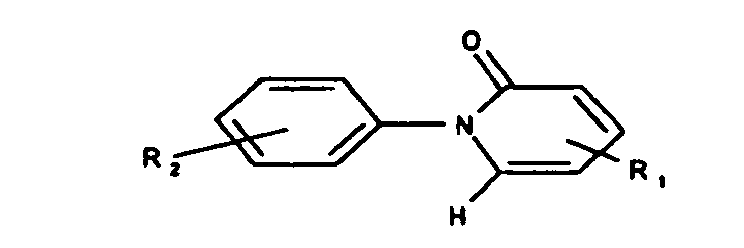
- R1 und R2 bedeuten als (C1-C4)-Alkyl unabhängig voneinander vorzugsweise Methyl, Ethyl, Propyl, Isopropyl, n-Butyl, sek.-Butyl oder t-Butyl. Bedeuten R1 und/oder R2 einen Rest -COOAlkyl(C1-C4), so hat darin der (C1-C4) - Alkylrest eine der vorgehend für R1 und/oder R2 genannten Bedeutungen.
- Bevorzugt sind substituierte Pyridone der allgemeinen Formel (I), worin R1 (C1-C4)-Alkyl und R2 Wasserstoff oder (C1-C4)-Alkyl bedeuten. Besonders bevorzugt ist die Verbindung der Formel (I) worin R1 Methyl und R2 Wasserstoff bedeuten (Pirfenidon).
- Als pharmazeutisch annehmbare Salze der Pyridonverbindungen der allgemeinen Formel (I) sind die für den Fachmann bekannten Salze anzusehen, wie z.B die Alkali- und Erdalkalisalze der mit Carboxyl substituierten Verbindung der Formel (I), vorzugsweise der Salze mit Natrium, Magnesium; oder der Salze der Verbindung der Formel (I), welche kein Carboxyl enthält, mit Oxalsäure, Bernsteinsäure, etc.
- Als Beispiele für Vertreter der Pyridone der Formel (I), welche in den erfindungsgemässen Creme-Zubereitungen als Wirkstoff enthalten sein können, seien die folgenden bevorzugten Verbindungen genannt:
- 5-Methyl-1-p-Tolyl-2-(1H)-Pyridon
- 3-Methyl-1-Phenyl-2-(1H)-Pyridon
- 3-Ethyl-1-Phenyl-2-(1H)-Pyridon
- 4-Isopropyl-1- Phenyl-2-(1H)-Pyridon
- 5-Methyl-1-Phenyl-2-(1H)-Pyridon
- 3-Methyl-1-Carboxyphenyl-2-(1H)-Pyridon
- 5-Carboxy-1-Phenyl-2-(1H)-Pyridon
- 4-Carboxymethyl-1-Phenyl-2-(1H)-Pyridon
- 5-t-Butyl-1-(p-Carboxyethylphenyl)-2-(1H-)Pyridon.
- Bevorzugt ist als Wirkstoff 5-Methyl-1-Phenyl-2-(1H)-Pyridon, genannt Pirfenidon.
- Die substituierten Pyridone sind bekannte Verbindungen und können nach den üblichen, dem Fachmann bekannten, Techniken hergestellt werden, wie sie beispielsweise in
US Patent 3,974,281 beschrieben sind. - Die erfindungsgemässen Cremes sind Öl-in-Wasser Emulsionen, die in der äusseren Phase wässrig sind.
- Als oberflächenaktiver Solubilisator (Lösungsvermittler) eignet sich Solutol HS 15 (Macrogol-15-hydroxystearat von BASF, PEG-660-15-hydroxystearate).
- Als Emulgatoren kommen die folgenden in Frage:
Cetylstearylalkohol, Stearinsäure. - Als Triglyceride kommen mittelkettige und hoch-molekulare Triglyceride in Frage. Mittelkettige Triglyceride sind Glycerinester der Fettsäuren mit nur 6-12 Kohlenstoffatomen, wie z.B. Capryl-Caprinsäuretriglycerid. Hochmolekulare Triglyceride sind Glycerinfettsäureester mit langkettigen Fettsäuren. Sie sind z.B. aus verschiedenen natürlichen Fetten hergestellte Triglyceridgemische. Bevorzugt werden mittelkettige Triglyceride eingesetzt, insbesondere Capryl-Caprinsäuretriglycerid.
- Zu den geeigneten Eindringungsverstärker (penetration enhancers) zählen z.B. Isopropylmyristat, Ölsäure, Natriumlaurylsulfat oder 1,2-Propandiol. Bevorzugt ist 1,2-Propandiol.
- Typische Beispiele für Konservierungsmittel sind Benzylbenzoate, Benzoesäure, Benzylalkohol, Benzalkoniumchlorid, N-Cetyl-N,N,N-Trimethylammoniumbromid (Cetrimid, Fa. Merck), Chlorhexidin, Chlorbutanol, Chlorcresol, Imidurea, die Parabene, wie Methyl-, Ethyl-, Propyl- oder Butylparaben, Natriummethylparaben, Natriumpropylparaben, Kaliumsorbat, Natriumbenzoat, Natriumpropionat, Phenol, Phenoxyethanol, Phenylethylalkohol, Phenylmercuriacetat, Phenylmercuriborat, Phenylmercurinitrate, Sorbinsäure oder Thiomersal (Natriumethylmercurithiosalicylat). Bevorzugt sind Methylparaben, Propylparaben sowie Natriummethylparaben und Natriumpropylparaben.
- Beispiele für Antioxidantien sind Natriummetabisulfit, alpha-Tocopherol, Ascorbinsäure, Maleinsäure, Natriumascorbat, Ascorbylpalmitat, butyliertes Hydroxyanisol, butyliertes Hydroxytoluol, Fumarsäure oder Propylgallat. Bevorzugtes Antioxidant ist Natriummetabisulfit.
- Als pH-regulierendes Mittel kommen z.B. Natriumhydroxid, Salzsäure, Puffersubstanzen, wie z.B. Natriumdihydrogenphosphat oder Dinatriumhydrogenphosphat, in Frage.
- Die Creme-Zubereitungen können ferner weitere Hilfs- und Zusatzstoffe enthalten, wie z.B. Fettungsmittel, Lösungsmittel, Konsistenzgeber oder Hydrotrope, zur Verbesserung des Fliessverhaltens. Dabei können von den vorgehend angegebenen Additiven bzw. Zusatzstoffen jeweils einzelne oder auch mehrere Stoffe derselben Gruppe im Gemisch anwesend sein.
- Als Fettungsmittel eignen sich z.B. Ölsäuredecylester, hydriertes Ricinusöl, leichtes Mineralöl, Mineralöl, Polyethylenglykol, Natriumlaurylsulfat.
- Als Lösungsmittel kommen Maiskeimöl, Baumwollsaatöl, Erdnussöl, Sesamöl, Sojabohnenöl, Ethyloleat, Glycerin, Isopropylmyristat, Isopropylpalmitat, Polyethylenglykol oder Polypropylenglykol.
- Als Konsistenzgeber eignen sich beispielsweise Cetylalkohol, Cetylesterwachs, hydriertes Ricinusöl, mikrokristalline Wachse, nichtionische Emulgatorwachse, Bienenwachs, Paraffin oder Stearylalkohol.
- Geeignete Hydrotope sind Alkohole, wie beispielsweise Ethanol, Isopropylalkohol oder Polyole, wie z.B. Glycerin.
- Typische Formulierungen der erfindungsgemässen Creme-Zubereitungen enthalten
- (a) 3-7 Gew.-% Wirkstoff
- (b) 3-30 Gew.-% Emulgator
- (c) 5-65 Gew.-% oberflächenaktiver Solubilisator
- (d) 5-30 Gew.-%Triglycerid
- (e) 2-20 Gew.-% Penetrationsverstärker
- (f) 2-20 Gew,-% Fettungsmittel
- (g) 3-30 Gew.-% Konsistenzgeber
- (h) 0,01-3 Gew.-% Konservierungsmittel
- (i) 0,1-5 Gew.-% Antioxidationsmittel
- (j) 1-50 Gew.-% Lösungsmittel
- (k) gereinigte Wasser ad 100 Gew.-% (d.h.20-80 Gew.-% Wasser, insbesondere 15.9-75.9 Gew.-%)
- Bevorzugte Creme-Zubereitungen der Erfindung enthalten
- 3-7 Gew.-% Wirkstoff
- 5-12,5 Gew.-% Cetylstearylalkohol
- 10-45 Gew.-% Macrogol-15-hydroxystearat
- 7-20 Gew.-% mittelkettiges Triglycerid
- 3-10 Gew.-% Propandiol
- 3-10 Gew,-% Ölsäuredecylester
- 5-12,5 Gew.-% Stearinsäure
- 0,02-3 Gew.-% Natriummethylparaben und Natriumpropylparaben
- 0,2-3 Gew.-% Natriummetabisulfit
- 1-50 Gew.-% Lösungsmittel
- Gereinigtes Wasser ad 100 Gew.-%.
- Die Cremes werden dadurch zubereitet, dass man gleichzeitig, in separaten Vorrichtungen, die lipophilen Bestandteile zum Zusammenschmelzen bringt und die Schmelze auf 60-80°C erwärmt, und die wässrige Phase ebenfalls auf die gleiche Temperatur erwärmt. Anschliessend wird die wässrige Phase in die ölige Phase eingearbeitet, die Mischung homogen emulgiert und bis zur halbfesten Creme gerührt. Der pH-Wert wird vorzugsweise auf 5-7,5 eingestellt.
- Die erfindungsgemässen topischen Creme-Zubereitungen eignen sich für die Behandlung oder Prophylaxe von Hauterkrankungen, wie sie in
WO 00/16775 - Die erfindungsgemässen Zubereitungen liefern pharmazeutisch wirksame und kosmetisch ansprechende Cremes. Sie weisen gute chemische und physikalische Stabilität auf, sowohl nach der Herstellung, nach 3-6 Monaten als auch nach längerer Lagerung, so dass es weder zur Phasentrennung noch zur Auskristallisation des Wirkstoffs kommt.
- Die folgenden Beispiele illustrieren die Erfindung.
- Eine hydrophile Salbe gemäss USP 23 (United States Pharmacopoeia) wurde zubereitet:
Hilfsstoffe Mengenanteil Polypropylenglykol 12,0 g Stearylalkohol 25,0 g Weisses Vaselin 25,0 g Methylparaben 0,025 g Propylparaben 0,015 g Natriumlaurylsulfat 10,0 g Gereinigtes Wasser 27,9 g - In diese Salbengrundlage wurde Pirfenidon, in den Mengen 3,5; 5,0 und 10 Gew-%, nach der konventionellen Technik, wie sie in USP 23 geschrieben ist, folgendermassen eingearbeitet:
- Stearylalkohol und weisses Vaselin wurden im Damfbad geschmolzen und auf etwa 75°C erwärmt. Die übrigen Bestandteile, inklusive Pirfenidon, wurden hinzugefügt, nachdem sie in Wasser gelöst und ebenfalls auf 75°C erwärmt wurden. Das Gemisch wurde bis zum Festwerden gerührt. Die fertige Salbe wurde anschliessend in kleine Kunststofftuben mit Gewinde abgefüllt und mit einem Schraubendeckel verschlossen.
- Die Stabilitätsvorprüfung zeigte, dass die Salbe physikalisch stabil war, bevor sie der kompletten Stabilitätsprüfung, inkl. der Ermittlung chemischen und physikalisch-chemischen Parametern, unterzogen wurde.
- Nach 6 monatiger Lagerung unter Standardbedingungen (25°C ± 2°C, 59% rh ± 5%; "rh" steht für "relative humidity", relative Luftfeuchtigkeit) entstand in der Salbenzubereitung eine Phasentrennung, die Emulsion wurde durch Koaleszenz inhomogen (d.h. es kam zum Zusammenfliessen der Tröpfchen, "Gerinnen"). Ausserdem hat der Wirkstoff sich während der Lagerung auskristallisiert, und zwar in allen drei Konzentrationsproben mit jeweils 3,5 Gew.-%, 5 Gew.-% und 10 Gew.-% Pirfenidon. Ein Teil der Salben wies ferner einen so hohen Viskositätsverlust auf, dass sie sich verflüssigten.
- Die nach USP 23 zubereitete Salbenformulierung mit Pirfenidon zeigt somit unzureichende Stabilität sowohl bezüglich der Salbenformulierung selbst als auch bezüglich des Wirkstoffes und ist für pharmazeutische Anwendung ungeeignet.
- Eine Creme wurde nach der folgenden Rezeptur zubereitet:
Bestandteile Mengenanteil Pirfenidon 5,0 g Propylenglykol 5,0 g Ölsäuredecylester 5,0 g Mittelkettiges Triglycerid 10,0 g Diisopropyladipat 5,0 g Stearinsäure 5,0 g Cetylstearylalkohol 5,0 g Polyoxyethylen-40-stearat 2,5 g Sorbitanmonostearat 2,5 g Natriummethylparaben 0,2 g Natriumpropylparaben 0,2 g Gereinigtes Wasser 54,6 g - Die folgenden Bestandteile wurden im Dampfbad geschmolzen und unter langsamen Rühren auf 80°C erwärmt: Ölsäuredecylester, mittelkettiges Triglycerid, Diisopropyladipat, Stearinsäure, Cetylstearylalkohol, Polyoxyethylen-40-stearat und Sorbitan-monostearat. Die restlichen Bestandteile, inkl. Pirfenidon, wurden in Wasser gelöst und ebenfalls auf 80°C erwärmt. Die heisse wässrige Lösung wurde unter kräftigem Rühren zu der Schmelze gegeben und unter Rühren auf 30°C abgekühlt. Die fertige Creme wurde in Kunststofftuben mit Gewinde abgefüllt und mit Schraubendeckel verschlossen. Ein Teil wurde in Tuben abgefüllt. Stabilitätsprüfungen wurden, wie in Vergleichsbeispiel 1 beschrieben, durchgeführt.
- Die Zubereitung war vor Beginn der Prüfungen homogen, d.h. stabil. Nach 6 Monaten Lagerung unter Standardbedingungen (25°C ± 2°C, 60% rh ± 5%), wies die Creme folgende Eigenschaften auf:
- Der Pirfenidongehalt der Probe blieb unverändert, d.h. sie blieb chemisch stabil.
- Die Probe enthielt auskristallisiertes Pirfenidon.
- Die scharfkantigen Körner des auskristallisierten Wirkstoffs verursachten unannehmbare Kratzspuren beim Auftragen auf die Haut.
- Die Creme-Zubereitung erwies sich durch diese Eigenschaft als ungeeignet für pharmazeutische Anwendungen und somit nicht zulassungsfähig bei den Gesundheitsbehörden.
- Eine erfindungsgemässe Creme wurde nach der folgenden Rezeptur zubereitet:
Bestandteile Mengenanteil Pirfenidon 500 g Solutol HS 15 2500 g Polypropylenglykol 500 g Ölsäuredecylester 500 g Mittelkettiges Triglycerid 1000 g Stearinsäure 750 g Cetylstearylalkohol 750 g Natriummethylparaben 20 g Natriumpropylparaben 10 g Gereinigtes Wasser 3470 g - Die Creme-Zubereitung wurde wie folgt hergestellt: Solutol HS 15 (Macrogol-15-hydroxystearat von BASF; ein nichtionischer Solubilisator) wurde im Wasserbad bei 75°C geschmolzen. Das Pirfenidon wurde unter Rühren in das geschmolzene Solutol HS 15 gegeben, bis eine klare Lösung entstand. Zu dieser Lösung wurden die Bestandteile Polypropylenglykol, Ölsäuredecylester, mittelkettiges Triglycerid, Stearinsäure und Cetylstearylalkohol gegeben, und das Rühren wurde bei 75°C fortgesetzt.
- Natriummethylparaben und Natriumpropylparaben wurden in 3470 g gereinigtem Wasser bei 70°C gelöst. Die fetthaltige Schmelze und die wässrige Lösung wurden bei den genannten Temperaturen zusammen gemischt, kurz unter Vakuum gesetzt, und während 15 Minuten bei 70°C gerührt. Das Gemisch wurde an-schliessend unter Rühren auf 45°C abgekühlt, bei dieser Temperatur während 5 Minuten homogenisiert und weiter auf Raumtemperatur abgekühlt (≤ 25°C). Die erhaltene Creme wurde in Tuben abgefüllt. Es wurde eine Creme mit den folgenden Eigenschaften erhalten:
Erscheinungsbild: weiss bis farblos, homogen; keine Kristalle pH (potentiometrisch): 6,2 Viskosität: 38900 mPa.s (Rotationstyp-Viskosimeter, Schergeschwindigkeit 11,8/s bei 20°C) Gehalt an Pirfenidon (HPLC): Wertes 101,2 % des theoretischen Gehalt an Verunreinigungen und Zersetzungsprodukten: (HPLC, 100% Methode) < 0,1 % - Zu Beginn lag eine homogene Creme vor. Die eine Hälfte der Proben wurde bei Standardbedingungen (25°C ± 2°C, 60% rh ± 5%) gelagert, die zweite Hälfte bei 31°C ± 2°C, 70% rh ± 5%. Die Lagerung erfolgte während 6 Monaten.
- Die Proben aus beiden Lagerbedingungen waren nach 6 Monaten immer noch frei von Kristallen. Der pH-Wert, die Viskosität, der Wirkstoffgehalt und die Zersetzungsprodukte wiesen nur die üblichen Abweichungen auf, die im Schwank-ungsbereich der Analysemethode liegen.
- Die Zubereitung des Beispiels 1 erwies sich damit als stabil und kann als eine pharmazeutisch akzeptable Formulierung eingesetzt werden.
- Analog Beispiel 1 wurde die folgende Creme-Formulierung zubereitet:
Bestandteile Mengenanteil Pirfenidon 5,0 g Solutol HS 15 10,0 g Polypropylenglykol 8,0 g Ölsäuredecylester 3,0 g Mittelkettiges Triglycerid 2,0 g Stearylsäure 10,0 g Cetylstearylalkohol 10,0 g Natriummethylparaben 0,2 g Natriumpropylparaben 0,2 g Gereinigtes Wasser 51,6 g - Es wurde eine Creme mit den folgenden Eigenschaften erhalten:
Erscheinungsbild: weiss, homogen; keine Kristalle pH (potentiometrisch): 6,4 viskosität: 47020 mPa.s (Rotationstyp-Viskosimeter, Schergeschwindigkeit 11,8/s bei 20°C) Gehalt an Pirfenidon (HPLC): 100,8 % des theoretischen Wertes Gehalt an Verunreinigungen und Zersetzungsprodukten: < 0,1 % (HPLC, 100% Methode) - Zu Beginn lag eine homogene Creme vor. Die eine Hälfte der Proben wurde nun bei Standardbedingungen (25°C ± 2°C, 60% rh ± 5%) gelagert, die zweite Hälfte bei 31°C ± 2°C, 70% rh ± 5%. Die Lagerung erfolgte während 6 Monaten.
- Die Proben aus beiden Lagerbedingungen waren nach 6 Monaten immer noch frei von Kristallen. Der pH-Wert, die Viskosität, der Wirkstoffgehalt und die Zersetzungsprodukte wiesen nur die üblichen Abweichungen auf, die im Schwank-ungsbereich der Analysemethode liegen.
- Die Creme-Zubereitung des Beispiels 2 ist stabil und kann als eine pharmazeutisch akzeptable Formulierung eingesetzt werden.
- Analog Beispiel 1 wurde die folgende Creme-Formulierung zubereitet:
Bestandteile Mengenanteil Pirfenidon 5,0 g Solutol HS 15 22,0 g Polypropylenglykol 3,0 g Ölsäuredecylester 12,0 g Mittelkettiges Triglycerid 9,0 g Stearinsäure 4,5 g Cetylstearylalkohol 4,5 g Natriummethylparaben 0,2 g Natriumpropylparaben 0,1 g Natriummetabisulfit 1,0 g Gereinigtes Wasser 39,7 g - Bei der Herstellung der Creme wurde Natriummetabisulfit zusammen mit Natriummethylparaben und Natriumpropylparaben in Wasser bei 70°C gelöst. Ansonsten wurde wie in Beispiel 1 verfahren.
- Es wurde eine Creme mit den folgenden Eigenschaften erhalten:
Erscheinungsbild: weiss, homogen; keine Kristalle pH (potentiometrisch): 6,3 Viskosität: 41256 mPa.s (Rotationstyp-Viskosimeter, Schergeschwindigkeit 11,8/s bei 20°C) Gehalt an Pirfenidon (HPLC): 99,7 % des theoretischen Wertes Gehalt an Verunreinigungen und Zersetzungsprodukten: < 0,1 % (HPLC, 100% Methode) - Zu Beginn lag eine homogene Creme vor. Die eine Hälfte der Proben wurde nun bei Standardbedingungen (25°C ± 2°C, 60% rh ± 5%) gelagert, die zweite Hälfte bei 31°C ± 2°C, 70% rh ± 5%. Die Lagerung erfolgte während 6 Monaten.
- Die Proben aus beiden Lagerbedingungen waren nach 6 Monaten immer noch frei von Kristallen. Der pH-Wert, die Viskosität, der Wirkstoffgehalt und die Zersetzungsprodukte wiesen nur die üblichen Abweichungen auf, die im Schwankungsbereich der Analysemethode liegen.
- Die Creme-Zubereitung aus Beispiel 3 ist stabil und für pharmazeutische Anwendung geeignet.
Claims (19)
- Pharmazeutische Creme-Zubereitung für topische Anwendung in Form einer Öl-in-Wasser Emulsion, zur Behandlung und/oder Vorbeugung von Hauterkrankungen, dadurch gekennzeichnet, dass diese in der lipophilen Phase die folgenden Bestandteile enthält:(i) als Wirkstoff eine gegebenenfalls substituierte 1-Phenyl-2-(1H)-Pyridonverbindung, oder ein pharmazeutisch annehmbares Salz davon,(ii) Macrogol-15-hydroxystearat als oberflächenaktiven Solubilisator,(iii) mindestens einen Emulgator, ausgewählt aus Cetyl-stearylalkohol und Stearinsäure, sowie(iv) gegebenenfalls weitere an sich bekannte Trägermaterialien und Additive ausgewählt aus der Gruppe enthaltend Triglyceride, Penetrationsverstärker, Konservierungsmittel und Antioxidationsmittel.
- Zubereitung nach Anspruch 1, dadurch gekennzeichnet, dass diese die ölige Phase in einem Bereich von 20-80 Gew.-% und die wässerige Phase in einem Bereich von 80-20 Gew.-%, bezogen auf das Gesamtgewicht der erfindungsgemässen Zubereitung, enthält.
- Zubereitung nach Anspruch 1, dadurch gekennzeichnet, dass diese die ölige Phase in einem Bereich von 24.1-84.1 Gew.-% und die wässerige Phase in einem Bereich von 75.9-15.9 Gew.-%; vorzugsweise die ölige Phase in einem Bereich von 37.2-65 Gew.-% und die wässerige Phase in einem Bereich von 35-62.8 Gew.-%, bezogen auf das Gesamtgewicht der erfindungsgemässen Zubereitung, enthält.
- Zubereitung nach einem der Ansprüche 1-3, dadurch gekennzeichnet, dass diese den Wirkstoff in einer Menge von 0.5-9 Gew.-%, und vorzugsweise in einer Menge von 3-7 Gew.-%, bezogen auf das Gesamtgewicht der Zubereitung, enthält.
- Zubereitung nach einem der Ansprüche 1-4, dadurch gekennzeichnet, dass diese den oberflächenaktiven Solubilisator in einer Konzentration von 5-65 Gew.-%, und vorzugsweise in einer Konzentration von 10-45 Gew.-%, bezogen auf das Gesamtgewicht der Zubereitung, enthält.
- Zubereitung nach einem der Ansprüche 1-5, dadurch gekennzeichnet, dass diese den Emulgator in einer Konzentration von 3-30 Gew.-%, und vorzugsweise in einer Konzentration von 5-12.5 Gew.-%, bezogen auf das Gesamtgewicht der Zubereitung, enthält.
- Zubereitung nach einem der Ansprüche 1-6, dadurch gekennzeichnet, dass diese als Wirkstoff ein substituiertes Pyridon der allgemeinen Formel (I):

- Zubereitung nach Anspruch 7, dadurch gekennzeichnet, dass R1 und R2 als (C1-C4)-Alkyl unabhängig voneinander Methyl, Ethyl, Propyl, Isopropyl, n-Butyl, sek.-Butyl oder t-Butyl bedeuten und soweit R1 und/oder R2 einen Rest -COOAlkyl (C1-C4) bedeuten, darin der (C1-C4)-Alkylrest eine der vorgehend für R1 und/oder R2 genannten Bedeutungen hat.
- Zubereitung nach Anspruch 7, dadurch gekennzeichnet, dass diese als Wirkstoff eine Verbindung der Formel (I) enthält, worin R1 (C1-C4)-Alkyl und R2 Wasserstoff oder (C1-C4)-Alkyl, vorzugsweise worin R1 Methyl und R2 Wasserstoff bedeuten.
- Zubereitung nach einem der Ansprüche 1-9, dadurch gekennzeichnet, dass der Wirkstoff als pharmazeutisch annehmbares Salz als Alkali- und Erdalkalisalz der mit Carboxyl substituierten Verbindung der Formel (I), vorzugsweise als Natriumsalz oder Magnesiumsalz; oder als Salz der Verbindung der Formel (I), welche kein Carboxyl enthält, mit Oxalsäure oder Bernsteinsäure.
- Zubereitung nach einem der Ansprüche 1-10, dadurch gekennzeichnet, dass als Wirkstoff eine der folgenden Verbindungen enthält:5-Methyl-1-p-Tolyl-2-(1H)-Pyridon3-Methyl-1-Phenyl-2-(1H)-Pyridon3-Ethyl-1-Phenyl-2-(1H)-Pyridon4-Isopropyl-1-Phenyl-2-(1H)-Pyridon5-Methyl-1-Phenyl-2-(1H)-Pyridon3-Methyl-1-Carboxyphenyl-2-(1H)-Pyridon5-Carboxy-1-Phenyl-2-(1H)-Pyridon4-Carboxymethyl-1-Phenyl-2-(1H)-Pyridon5-t-Butyl-1-(p-Carboxyethylphenyl)-2-(1H-)Pyridon.
- Zubereitung nach einem der Ansprüche 1-11, dadurch gekennzeichnet, dass das Triglycerid ausgewählt ist aus der Gruppe enthaltend mittelkettige und hochmolekulare Triglyceride, vorzugsweise mittelkettige Triglyceride als Glycerinester der Fettsäuren mit 6-12 Kohlenstoffatomen, vorzugsweise Capryl-Caprinsäuretriglycerid.
- Zubereitung nach einem der Ansprüche 1-12, dadurch gekennzeichnet, dass der Eindringungsverstärker ausgewählt ist aus der Gruppe enthaltend Isopropylmyristat, Ölsäure, Natriumlaurylsulfat oder 1,2-Propandiol, vorzugsweise 1,2-Propandiol.
- Zubereitung nach einem der Ansprüche 1-13, dadurch gekennzeichnet, dass diese im weiteren Fettungsmittel, Lösungsmittel, Konsistenzgeber und/oder Hydrotrope enthalten.
- Zubereitung nach einem der Ansprüche 1-14, dadurch gekennzeichnet, dass diese die folgenden Komponenten enthält:(a) 3-7 Gew.-% Wirkstoff(b) 3-30 Gew.-% Emulgator(c) 5-65 Gew.-% oberflächenaktiver Solubilisator(d) 5-30 Gew.-%Triglycerid(e) 2-20 Gew.-% Penetrationsverstärker(f) 2-20 Gew,-% Fettungsmittel(g) 3-30 Gew.-% Konsistenzgeber(h) 0,01-3 Gew.-% Konservierungsmittel(i) 0,1-5 Gew.-% Antioxidationsmittel(k) 1-50 Gew.-% Lösungsmittel(l) gereinigtes Wasser ad 100 Gew.-% d.h. 20-80 Gew.-% Wasser, insbesondere 15.9-75.9 Gew.-%.
- Zubereitung nach einem der Ansprüche 1-15, dadurch gekennzeichnet, dass die folgenden Komponenten enthält:- 3-7 Gew.-% Wirkstoff- 5-12,5 Gew.-% Cetylstearylalkohol- 10-45 Gew.-% Macrogol-15-hydroxystearat- 7-20 Gew.-% mittelkettiges Triglycerid- 3-10 Gew.-% Propandiol- 3-10 Gew,-% Ölsäuredecylester- 5-12,5 Gew.-% Stearinsäure- 0,02-3 Gew.-% Natriummethylparaben und Natriumpropylparaben- 0,2-3 Gew.-% Natriummetabisulfit- 1-50 Gew.-% Lösungsmittel- Gereinigtes Wasser ad 100 Gew.-%.
- Zubereitung nach einem der Ansprüche 1-16 enthaltend Pirfenidon, Cetylstearylalkohol, Macrogol-15-hydroxystearat, mittelkettiges Triglycerid, Polypropylenglykol, Ölsäure-decylester, Stearinsäure, Natriummethylparaben, Natrium-propylparaben und Wasser.
- Verfahren zur Herstellung einer Zubereitung nach einem der Ansprüche 1-17, dadurch gekennzeichnet, dass man in separaten Vorrichtungen, die lipophilen Bestandteile zum Zusammenschmelzen bringt und die Schmelze auf 60-80°C erwärmt, und die wässrige Phase auf dieselbe Temperatur erwärmt; anschliessend die wässrige Phase in die ölige Phase eingearbeitet, die Mischung homogen emulgiert und bis zur halbfesten Creme rührt, wobei der pH-Wert gegebenfalls auf 5-7,5 eingestellt wird.
- Verwendung der Zubereitung nach einem der Ansprüche 1-18 zur Herstellung einer Creme für die topische Behandlung oder Prophylaxe von Hauterkrankungen, vorzugsweise für die Behandlung und Prophylaxe von Hauterkrankungen fibrotischer Natur, insbesondere fibröse Läsionen, multiple Warzen, Kontaktdermatitis, Keloide, sowie zur Förderung der Heilung von Brandwunden und zur postoperativen Wundversorgung.
Applications Claiming Priority (3)
| Application Number | Priority Date | Filing Date | Title |
|---|---|---|---|
| CH155602 | 2002-09-13 | ||
| CH01556/02A CH696420A5 (de) | 2002-09-13 | 2002-09-13 | Neue stabile Zubereitungen von Alkyl-, Phenyl-Pyridonen für topische Anwendung. |
| PCT/CH2003/000615 WO2004024152A1 (de) | 2002-09-13 | 2003-09-11 | Stabile creme-zubereitungen von phenyl-pyridonverbindungen für topische anwendung |
Publications (2)
| Publication Number | Publication Date |
|---|---|
| EP1539155A1 EP1539155A1 (de) | 2005-06-15 |
| EP1539155B1 true EP1539155B1 (de) | 2008-04-02 |
Family
ID=31983663
Family Applications (1)
| Application Number | Title | Priority Date | Filing Date |
|---|---|---|---|
| EP03794750A Expired - Lifetime EP1539155B1 (de) | 2002-09-13 | 2003-09-11 | Stabile creme-zubereitungen von phenyl-pyridonverbindungen für topische anwendung |
Country Status (7)
| Country | Link |
|---|---|
| US (1) | US20060039931A1 (de) |
| EP (1) | EP1539155B1 (de) |
| JP (1) | JP2006503026A (de) |
| AT (1) | ATE390924T1 (de) |
| CH (1) | CH696420A5 (de) |
| DE (1) | DE50309547D1 (de) |
| WO (1) | WO2004024152A1 (de) |
Families Citing this family (20)
| Publication number | Priority date | Publication date | Assignee | Title |
|---|---|---|---|---|
| JP4542743B2 (ja) * | 2002-12-26 | 2010-09-15 | Kdl株式会社 | ピリドン誘導体の溶液状医薬組成物 |
| US7825133B2 (en) * | 2003-11-14 | 2010-11-02 | Shanghai Genomics, Inc. | Derivatives of pyridone and the use of them |
| US8080560B2 (en) * | 2004-12-17 | 2011-12-20 | 3M Innovative Properties Company | Immune response modifier formulations containing oleic acid and methods |
| AP2007004244A0 (en) | 2005-05-10 | 2007-12-31 | Intermune Inc | Method of modulating stress-activated protein kinase system |
| WO2008147169A2 (es) * | 2007-05-29 | 2008-12-04 | Cell Therapy Technology, S.A. De C.V. | Microemolsion conteniendo pirfenidona |
| MX2007009796A (es) | 2007-08-14 | 2009-02-25 | Cell Therapy And Technology S | Gel conteniendo pirfenidona. |
| EP2209458B1 (de) | 2007-11-14 | 2018-06-20 | Obagi Cosmeceuticals LLC | Zusammensetzungen zur hautbehandlung |
| EP2296653B1 (de) | 2008-06-03 | 2016-01-27 | Intermune, Inc. | Verbindungen und verfahren zur behandlung von entzündungserkrankungen und fibrotischen erkrankungen |
| MX2011007675A (es) | 2011-07-19 | 2012-07-11 | Cell Therapy And Technology S A De C V | Procedimiento para la fabricacion de una composicion farmaceutica en forma de tabletas de liberacion prolongada conteniendo pirfenidona y su aplicacion en la regresion de la insuficiencia renal cronica, contractura capsular mamaria y fibrosis hepatica humanas. |
| JP6247223B2 (ja) * | 2011-12-08 | 2017-12-13 | ライジェル ファーマシューティカルズ, インコーポレイテッド | 化合物を投与するための局所用製剤 |
| MX346763B (es) | 2012-03-28 | 2017-03-31 | Cell Therapy And Tech S A De C V | Composición tópica semisólida conteniendo pirfenidona y dialil óxido de disulfuro modificado (odd-m) para eliminar o prevenir el acné. |
| US10045935B2 (en) | 2012-07-31 | 2018-08-14 | Egis Pharmaceuticals Plc | Transdermal formulation containing COX inhibitors |
| MX356551B (es) | 2012-08-23 | 2018-06-04 | Grupo Medifarma S A De C V Star | Composición antiséptica, antiseborreica y exfoliante para eliminar o prevenir el acné. |
| AR092742A1 (es) | 2012-10-02 | 2015-04-29 | Intermune Inc | Piridinonas antifibroticas |
| RU2692485C2 (ru) | 2014-04-02 | 2019-06-25 | Интермьюн, Инк. | Противофиброзные пиридиноны |
| MX366086B (es) * | 2017-08-15 | 2019-06-27 | Cell Therapy And Tech S A De C V | Composicion topica semisolida conteniendo un agente antimicrobiano y pirfenidona para el tratamiento de daños cronicos de la piel. |
| MX368750B (es) | 2018-08-31 | 2019-10-15 | Cell Therapy And Tech S A De C V | Composiciones farmaceuticas semisolidas de base oleosa conteniendo pirfenidona para su aplicacion en la reparacion tisular. |
| CN116887810A (zh) * | 2020-12-16 | 2023-10-13 | 希普拉有限公司 | 吡非尼酮的局部组合物 |
| CN113308020A (zh) * | 2021-04-22 | 2021-08-27 | 长春工业大学 | 一种水性抗氧剂乳液及其制备方法和应用 |
| CN117396188A (zh) * | 2021-06-01 | 2024-01-12 | 西可斯拉制药公司 | 6-乙氧基-7-甲氧基-2-(2-甲基硫基苯基)-3,1-苯并噁嗪-4-酮的水包油乳液 |
Family Cites Families (2)
| Publication number | Priority date | Publication date | Assignee | Title |
|---|---|---|---|---|
| US4931285A (en) * | 1988-04-28 | 1990-06-05 | Alza Corporation | Aqueous based pharmaceutical coating composition for dosage forms |
| WO2000016775A1 (en) * | 1998-09-18 | 2000-03-30 | Mepha Ag | Topical formulation of alkyl-, phenyl-pyridone |
-
2002
- 2002-09-13 CH CH01556/02A patent/CH696420A5/de not_active IP Right Cessation
-
2003
- 2003-09-11 US US10/527,555 patent/US20060039931A1/en not_active Abandoned
- 2003-09-11 WO PCT/CH2003/000615 patent/WO2004024152A1/de not_active Ceased
- 2003-09-11 EP EP03794750A patent/EP1539155B1/de not_active Expired - Lifetime
- 2003-09-11 AT AT03794750T patent/ATE390924T1/de not_active IP Right Cessation
- 2003-09-11 JP JP2004534925A patent/JP2006503026A/ja active Pending
- 2003-09-11 DE DE50309547T patent/DE50309547D1/de not_active Expired - Fee Related
Also Published As
| Publication number | Publication date |
|---|---|
| EP1539155A1 (de) | 2005-06-15 |
| CH696420A5 (de) | 2007-06-15 |
| WO2004024152A1 (de) | 2004-03-25 |
| ATE390924T1 (de) | 2008-04-15 |
| DE50309547D1 (de) | 2008-05-15 |
| JP2006503026A (ja) | 2006-01-26 |
| US20060039931A1 (en) | 2006-02-23 |
Similar Documents
| Publication | Publication Date | Title |
|---|---|---|
| EP1539155A1 (de) | Stabile creme-zubereitungen von phenyl-pyridonverbindungen für topische anwendung | |
| DE69925407T2 (de) | Präparat zur perkutan Verabreichung enthaltend Donepezil Hydrochlorid | |
| DE69525957T2 (de) | Verwendung eines ungesättigten Fettalkohols | |
| DE69325450T2 (de) | Potenzierung von antimikrobiellen wirkungen | |
| DE69926843T2 (de) | Aktives vitamin-d3 enthaltende lotionen in form von emulsionen | |
| DE69708284T2 (de) | Wässrige suspension von 9-hydroxyrisperidon-fettsäureester | |
| DE3780091T2 (de) | Behandlung von pilzinfektionen. | |
| US6492395B1 (en) | Topical formulation of alkyl-, phenyl-pyridone | |
| DD298352A5 (de) | Tretinoin enthaltende zubereitung und verfahren zu ihrer herstellung | |
| DE1934334B2 (de) | Wasserfreies Präparat auf Basis gesättigter Fettalkohole und Glykollösungsmittel | |
| DE68907312T2 (de) | Bunazosin oder seine Salze enthaltende pharmazeutische Zubereitungen zur perkutanen Verabreichung. | |
| DE3641491A1 (de) | Arzneimittel mit antitumorwirkung | |
| DE69300054T2 (de) | Stabile Azelastinhydrochlorid-Zubereitung. | |
| DE69425552T2 (de) | Emulsion auf der basis von 1-alpha,24-dihydroxy-vitamin d3 | |
| DE60109530T2 (de) | Amorphe Mupirocin enthaltende Arzneimittel | |
| DE4013696A1 (de) | Salze des azelastins mit verbesserter loeslichkeit | |
| DE2601489A1 (de) | Tretinoin enthaltende gelpraeparate | |
| DE69618586T2 (de) | Tiagabinhydrochlorid enthaltendes arzneimittel und verfahren zu dessen herstellung | |
| DE3540175C2 (de) | Dithranolhaltige pharmazeutische Zubereitung | |
| EP0453603B1 (de) | Piroxicam enthaltende pharmazeutische Zusammensetzung zur topischen Anwendung | |
| DE69402259T2 (de) | Zusammensetzungen enthaltend 8-Hydroxychinolin zur Behandlung hyperproliferativer Hautkrankheiten | |
| DE69800804T2 (de) | Halbfeste pharmazeutische zubereitungen enthaltend dexketoprofen-trometamol | |
| DE2241667C3 (de) | Stabiles pharmazeutisches Mittel in Form einer wässrigen oralen anwendbaren Suspension | |
| DE602005003138T3 (de) | Zusammensetzung in sprayform mit einer kombination aus clobetasolpropionat und calcitriol, einer alkoholphase und ölphase | |
| EP2142169B1 (de) | Wässrige pharmazeutische zubereitung |
Legal Events
| Date | Code | Title | Description |
|---|---|---|---|
| PUAI | Public reference made under article 153(3) epc to a published international application that has entered the european phase |
Free format text: ORIGINAL CODE: 0009012 |
|
| 17P | Request for examination filed |
Effective date: 20050413 |
|
| AK | Designated contracting states |
Kind code of ref document: A1 Designated state(s): AT BE BG CH CY CZ DE DK EE ES FI FR GB GR HU IE IT LI LU MC NL PT RO SE SI SK TR |
|
| 17Q | First examination report despatched |
Effective date: 20050818 |
|
| GRAP | Despatch of communication of intention to grant a patent |
Free format text: ORIGINAL CODE: EPIDOSNIGR1 |
|
| GRAS | Grant fee paid |
Free format text: ORIGINAL CODE: EPIDOSNIGR3 |
|
| GRAA | (expected) grant |
Free format text: ORIGINAL CODE: 0009210 |
|
| AK | Designated contracting states |
Kind code of ref document: B1 Designated state(s): AT BE BG CH CY CZ DE DK EE ES FI FR GB GR HU IE IT LI LU MC NL PT RO SE SI SK TR |
|
| REG | Reference to a national code |
Ref country code: GB Ref legal event code: FG4D Free format text: NOT ENGLISH |
|
| REG | Reference to a national code |
Ref country code: CH Ref legal event code: EP Ref country code: IE Ref legal event code: FG4D Free format text: LANGUAGE OF EP DOCUMENT: GERMAN |
|
| REF | Corresponds to: |
Ref document number: 50309547 Country of ref document: DE Date of ref document: 20080515 Kind code of ref document: P |
|
| REG | Reference to a national code |
Ref country code: CH Ref legal event code: NV Representative=s name: BRAUNPAT BRAUN EDER AG |
|
| PG25 | Lapsed in a contracting state [announced via postgrant information from national office to epo] |
Ref country code: SI Free format text: LAPSE BECAUSE OF FAILURE TO SUBMIT A TRANSLATION OF THE DESCRIPTION OR TO PAY THE FEE WITHIN THE PRESCRIBED TIME-LIMIT Effective date: 20080402 |
|
| NLV1 | Nl: lapsed or annulled due to failure to fulfill the requirements of art. 29p and 29m of the patents act | ||
| REG | Reference to a national code |
Ref country code: IE Ref legal event code: FD4D |
|
| PG25 | Lapsed in a contracting state [announced via postgrant information from national office to epo] |
Ref country code: FI Free format text: LAPSE BECAUSE OF FAILURE TO SUBMIT A TRANSLATION OF THE DESCRIPTION OR TO PAY THE FEE WITHIN THE PRESCRIBED TIME-LIMIT Effective date: 20080402 Ref country code: BG Free format text: LAPSE BECAUSE OF FAILURE TO SUBMIT A TRANSLATION OF THE DESCRIPTION OR TO PAY THE FEE WITHIN THE PRESCRIBED TIME-LIMIT Effective date: 20080702 Ref country code: NL Free format text: LAPSE BECAUSE OF FAILURE TO SUBMIT A TRANSLATION OF THE DESCRIPTION OR TO PAY THE FEE WITHIN THE PRESCRIBED TIME-LIMIT Effective date: 20080402 Ref country code: ES Free format text: LAPSE BECAUSE OF FAILURE TO SUBMIT A TRANSLATION OF THE DESCRIPTION OR TO PAY THE FEE WITHIN THE PRESCRIBED TIME-LIMIT Effective date: 20080713 Ref country code: PT Free format text: LAPSE BECAUSE OF FAILURE TO SUBMIT A TRANSLATION OF THE DESCRIPTION OR TO PAY THE FEE WITHIN THE PRESCRIBED TIME-LIMIT Effective date: 20080903 |
|
| EN | Fr: translation not filed | ||
| PG25 | Lapsed in a contracting state [announced via postgrant information from national office to epo] |
Ref country code: IE Free format text: LAPSE BECAUSE OF FAILURE TO SUBMIT A TRANSLATION OF THE DESCRIPTION OR TO PAY THE FEE WITHIN THE PRESCRIBED TIME-LIMIT Effective date: 20080402 Ref country code: CZ Free format text: LAPSE BECAUSE OF FAILURE TO SUBMIT A TRANSLATION OF THE DESCRIPTION OR TO PAY THE FEE WITHIN THE PRESCRIBED TIME-LIMIT Effective date: 20080402 Ref country code: DK Free format text: LAPSE BECAUSE OF FAILURE TO SUBMIT A TRANSLATION OF THE DESCRIPTION OR TO PAY THE FEE WITHIN THE PRESCRIBED TIME-LIMIT Effective date: 20080402 Ref country code: SE Free format text: LAPSE BECAUSE OF FAILURE TO SUBMIT A TRANSLATION OF THE DESCRIPTION OR TO PAY THE FEE WITHIN THE PRESCRIBED TIME-LIMIT Effective date: 20080702 |
|
| PGFP | Annual fee paid to national office [announced via postgrant information from national office to epo] |
Ref country code: CH Payment date: 20081002 Year of fee payment: 6 |
|
| PLBE | No opposition filed within time limit |
Free format text: ORIGINAL CODE: 0009261 |
|
| STAA | Information on the status of an ep patent application or granted ep patent |
Free format text: STATUS: NO OPPOSITION FILED WITHIN TIME LIMIT |
|
| PG25 | Lapsed in a contracting state [announced via postgrant information from national office to epo] |
Ref country code: RO Free format text: LAPSE BECAUSE OF FAILURE TO SUBMIT A TRANSLATION OF THE DESCRIPTION OR TO PAY THE FEE WITHIN THE PRESCRIBED TIME-LIMIT Effective date: 20080402 Ref country code: SK Free format text: LAPSE BECAUSE OF FAILURE TO SUBMIT A TRANSLATION OF THE DESCRIPTION OR TO PAY THE FEE WITHIN THE PRESCRIBED TIME-LIMIT Effective date: 20080402 |
|
| 26N | No opposition filed |
Effective date: 20090106 |
|
| BERE | Be: lapsed |
Owner name: MEPHA A.G. Effective date: 20080930 |
|
| PG25 | Lapsed in a contracting state [announced via postgrant information from national office to epo] |
Ref country code: EE Free format text: LAPSE BECAUSE OF FAILURE TO SUBMIT A TRANSLATION OF THE DESCRIPTION OR TO PAY THE FEE WITHIN THE PRESCRIBED TIME-LIMIT Effective date: 20080402 Ref country code: MC Free format text: LAPSE BECAUSE OF NON-PAYMENT OF DUE FEES Effective date: 20080930 |
|
| GBPC | Gb: european patent ceased through non-payment of renewal fee |
Effective date: 20080911 |
|
| PG25 | Lapsed in a contracting state [announced via postgrant information from national office to epo] |
Ref country code: BE Free format text: LAPSE BECAUSE OF NON-PAYMENT OF DUE FEES Effective date: 20080930 |
|
| PG25 | Lapsed in a contracting state [announced via postgrant information from national office to epo] |
Ref country code: DE Free format text: LAPSE BECAUSE OF NON-PAYMENT OF DUE FEES Effective date: 20090401 Ref country code: IT Free format text: LAPSE BECAUSE OF FAILURE TO SUBMIT A TRANSLATION OF THE DESCRIPTION OR TO PAY THE FEE WITHIN THE PRESCRIBED TIME-LIMIT Effective date: 20080402 |
|
| PG25 | Lapsed in a contracting state [announced via postgrant information from national office to epo] |
Ref country code: CY Free format text: LAPSE BECAUSE OF FAILURE TO SUBMIT A TRANSLATION OF THE DESCRIPTION OR TO PAY THE FEE WITHIN THE PRESCRIBED TIME-LIMIT Effective date: 20080402 |
|
| PG25 | Lapsed in a contracting state [announced via postgrant information from national office to epo] |
Ref country code: AT Free format text: LAPSE BECAUSE OF NON-PAYMENT OF DUE FEES Effective date: 20080911 |
|
| PG25 | Lapsed in a contracting state [announced via postgrant information from national office to epo] |
Ref country code: GB Free format text: LAPSE BECAUSE OF NON-PAYMENT OF DUE FEES Effective date: 20080911 |
|
| REG | Reference to a national code |
Ref country code: CH Ref legal event code: PL |
|
| PG25 | Lapsed in a contracting state [announced via postgrant information from national office to epo] |
Ref country code: HU Free format text: LAPSE BECAUSE OF FAILURE TO SUBMIT A TRANSLATION OF THE DESCRIPTION OR TO PAY THE FEE WITHIN THE PRESCRIBED TIME-LIMIT Effective date: 20081003 Ref country code: LU Free format text: LAPSE BECAUSE OF NON-PAYMENT OF DUE FEES Effective date: 20080911 |
|
| PG25 | Lapsed in a contracting state [announced via postgrant information from national office to epo] |
Ref country code: TR Free format text: LAPSE BECAUSE OF FAILURE TO SUBMIT A TRANSLATION OF THE DESCRIPTION OR TO PAY THE FEE WITHIN THE PRESCRIBED TIME-LIMIT Effective date: 20080402 |
|
| PG25 | Lapsed in a contracting state [announced via postgrant information from national office to epo] |
Ref country code: CH Free format text: LAPSE BECAUSE OF NON-PAYMENT OF DUE FEES Effective date: 20090930 Ref country code: LI Free format text: LAPSE BECAUSE OF NON-PAYMENT OF DUE FEES Effective date: 20090930 Ref country code: GR Free format text: LAPSE BECAUSE OF FAILURE TO SUBMIT A TRANSLATION OF THE DESCRIPTION OR TO PAY THE FEE WITHIN THE PRESCRIBED TIME-LIMIT Effective date: 20080703 |
|
| PG25 | Lapsed in a contracting state [announced via postgrant information from national office to epo] |
Ref country code: FR Free format text: LAPSE BECAUSE OF FAILURE TO SUBMIT A TRANSLATION OF THE DESCRIPTION OR TO PAY THE FEE WITHIN THE PRESCRIBED TIME-LIMIT Effective date: 20090123 |