EP0447567B1 - Korrosionsbeständiger magnet vom tm-b-re-typ und dessen herstellungsverfahren - Google Patents
Korrosionsbeständiger magnet vom tm-b-re-typ und dessen herstellungsverfahren Download PDFInfo
- Publication number
- EP0447567B1 EP0447567B1 EP90914967A EP90914967A EP0447567B1 EP 0447567 B1 EP0447567 B1 EP 0447567B1 EP 90914967 A EP90914967 A EP 90914967A EP 90914967 A EP90914967 A EP 90914967A EP 0447567 B1 EP0447567 B1 EP 0447567B1
- Authority
- EP
- European Patent Office
- Prior art keywords
- phase
- re2tm14b
- corrosion
- magnet
- rare earth
- Prior art date
- Legal status (The legal status is an assumption and is not a legal conclusion. Google has not performed a legal analysis and makes no representation as to the accuracy of the status listed.)
- Expired - Lifetime
Links
Images

Classifications
-
- H—ELECTRICITY
- H01—ELECTRIC ELEMENTS
- H01F—MAGNETS; INDUCTANCES; TRANSFORMERS; SELECTION OF MATERIALS FOR THEIR MAGNETIC PROPERTIES
- H01F1/00—Magnets or magnetic bodies characterised by the magnetic materials therefor; Selection of materials for their magnetic properties
- H01F1/01—Magnets or magnetic bodies characterised by the magnetic materials therefor; Selection of materials for their magnetic properties of inorganic materials
- H01F1/03—Magnets or magnetic bodies characterised by the magnetic materials therefor; Selection of materials for their magnetic properties of inorganic materials characterised by their coercivity
- H01F1/032—Magnets or magnetic bodies characterised by the magnetic materials therefor; Selection of materials for their magnetic properties of inorganic materials characterised by their coercivity of hard-magnetic materials
- H01F1/04—Magnets or magnetic bodies characterised by the magnetic materials therefor; Selection of materials for their magnetic properties of inorganic materials characterised by their coercivity of hard-magnetic materials metals or alloys
- H01F1/047—Alloys characterised by their composition
- H01F1/053—Alloys characterised by their composition containing rare earth metals
- H01F1/055—Alloys characterised by their composition containing rare earth metals and magnetic transition metals, e.g. SmCo5
- H01F1/057—Alloys characterised by their composition containing rare earth metals and magnetic transition metals, e.g. SmCo5 and IIIa elements, e.g. Nd2Fe14B
- H01F1/0571—Alloys characterised by their composition containing rare earth metals and magnetic transition metals, e.g. SmCo5 and IIIa elements, e.g. Nd2Fe14B in the form of particles, e.g. rapid quenched powders or ribbon flakes
- H01F1/0575—Alloys characterised by their composition containing rare earth metals and magnetic transition metals, e.g. SmCo5 and IIIa elements, e.g. Nd2Fe14B in the form of particles, e.g. rapid quenched powders or ribbon flakes pressed, sintered or bonded together
- H01F1/0577—Alloys characterised by their composition containing rare earth metals and magnetic transition metals, e.g. SmCo5 and IIIa elements, e.g. Nd2Fe14B in the form of particles, e.g. rapid quenched powders or ribbon flakes pressed, sintered or bonded together sintered
-
- C—CHEMISTRY; METALLURGY
- C22—METALLURGY; FERROUS OR NON-FERROUS ALLOYS; TREATMENT OF ALLOYS OR NON-FERROUS METALS
- C22C—ALLOYS
- C22C19/00—Alloys based on nickel or cobalt
- C22C19/07—Alloys based on nickel or cobalt based on cobalt
Definitions
- This invention relates to rare earth metal-transition metal boron series magnets having not only excellent magnetic properties but also improved corrosion resistance and temperature-dependent properties and a method of producing the same.
- EP-A-261579 refers to a rare earth metal-iron-boron permanent magnet and a method for producing same.
- Rare earth metal-iron-boron magnets are known for their good magnetic properties.
- this conventional material has a problem in that it rusts easily in ordinary environments.
- the unsatisfactory corroison resistance is one of the most significant properties of said conventional RE-Fe-B magnets for commerical use.
- EP-A-261579 page 28, lines 1 through 8, as well as in the subsequent Table 25, which indicates that anti-corrosion tests with the conventional magnet were effected after nickel platings and Zn-chromating surface treatments were provided after copper plating was applied as a base plating. Obviously, the conventional magnets would have failed in the corrison tests without having a protective coating provided thereon.
- Alnico magnets As a typical permanent magnet manufactured at the present, there are mentioned Alnico magnets, ferrite magnets, rare earth metal magnets and the like.
- the Alnico magnets are manufactured from the old time, but their demand is lowering in accordance with the development of cheap ferrite magnets and rare earth metal magnets having higher magnetic properties.
- the ferrite magnets are chemically stable and low in the cost because oxides are used as a main starting material, so that they are the main current as a magnet material even at the present, but they have a drawback that maximum energy product is small.
- Sm-Co series magnets having a combination of magnetic isotropy inherent to rare earth metal ion and magnetic moment inherent to transition metal element have been developed, whereby the conventional value of maximum energy product is largely increased.
- the Sm-Co series magnet is mainly composed of resourceless Sm and Co, so that it is obliged to become expensive.
- Nd-Fe-B series magnets contain greater amounts of a light rare earth element such as Nd having very high activity or the like and a corrosive Fe as a main component, so that the corrosion resistance is poor and hence the magnetic properties are degraded to damage the reliability as an industrial material.
- Such magnets are excellent in the corrosion resistance and high in the Curie point, so that the reliability as a magnet material is largely increased.
- the invention is concerned with rare earth metal-transition metal series magnets of two phase structure further developed from the above magnet.
- magnets having excellent magnetic properties through two alloying process in which rare earth rich phase and rare earth poor phase are mixed and sintered at liquid phase state have previously been proposed as Nd series magnet of two phase structure (Japanese Patent laid open No. 63-93841 and No. 63-164403).
- Nd series magnet of two phase structure Japanese Patent laid open No. 63-93841 and No. 63-164403
- the magnetic properties are improved, but there is still remained a problem on the corrosion resistance.
- the invention is to advantageously solve the aforementioned problems and to propose rare earth metal-transition metal series magnets of two phase structure being excellent in not only the magnetic properties but also the corrosion resistance and a method of advantageously producing the same.
- the inventors have made various metallographical studies on the above magnet using high resolution electron microscope or the like, and confirmed that this magnet contains Nd2(Fe, Co, Ni)14B phase having a large saturated magnetic flux density, and intergranular phases surrounding crystal grains of the above phase and developing a strong coercive force such as Nd2(Fe, Co, Ni)17, Nd(Fe, Co, Ni)5, Nd2(Fe, Co, Ni)7, Nd(Fe, Co, Ni)4B and Nd(Fe, Co, Ni)12B6 and further Nd 1-x TM x of CrB structure (TM is mainly Ni) and the like.
- TM is mainly Ni
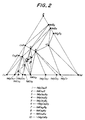
- Nd-Fe-B ternary phase diagram is shown in Fig. 1 (N. F. Chaban, Yu. B. Kuzma, N. S. Bilonizhko, O. O. Kachmar and N. U. Petrov, Akad Nauk, SSSR, SetA, Fiz.-Mat. Tekh, Nauki No. 10 (1979) 873), and Nd-Co-B ternary phase diagram is shown in Fig. 2 (N. S. Bilonizhko and Yu. B. Kuzma, Izv. Akad. Nauk SSSR Neorg.
- Nd2Fe14B phase and Nd2Co14B phase are misinterpreted as Nd2Fe9B phase and Nd2Co9B phase, so that they are corrected in Figs. 1 and 2).
- a phase of number 1 is Nd2Fe14B phase, and NdFe4B4 phase (phase of number 2), Nd phase, Nd2Fe17 phase and Fe phase appear as a composition near thereto.
- Nd2Co17 phase, NdCo5 phase, Nd2Co7 phase, NdCo4B phase (phase of number 2) and NdCo12B6 phase (phase of number 7) appear in a magnet prepare from a composition near to Nd2Co14B phase of number 1, and Nd phase does not naturally appear at an equilibrium state.
- Nd phase is not only a point of causing rust but also a magnetically useless phase, so that it should be eliminated.
- an object of the invention to provide permanent magnets having excellent magnetic properties and corrosion resistance by using magnetically useful two phases, i.e. RE2TM14B phase having a high residual magnetic flux density and a low melting point RE-TM phase or RE-TM-B phase enhancing the sinterability and possessing a cleaning action against grain boundary of main phase and further forming an electrochemically noble composition as a starting material to prepare a two phase magnet.
- magnetically useful two phases i.e. RE2TM14B phase having a high residual magnetic flux density and a low melting point RE-TM phase or RE-TM-B phase enhancing the sinterability and possessing a cleaning action against grain boundary of main phase and further forming an electrochemically noble composition as a starting material to prepare a two phase magnet.
- the invention lies in a corrosion-resistant rare earth metal-transition metal-boron series permanent magnet having a rusted surface area ratio of 5% or less after a 48 hour exposure test in air at a temperature of 70°C and a humidity of 95%, consisting essentially of RE: not less than 10 at% but not more than 25 at%, where RE is one or more of Y, Sc and lanthanides , B: not less than 2 at% but not more than 20 at% and the remainder being substantially TM, TM is one or more of Fe, Co and Ni , whose metallographic structure being comprised of a phase of RE2TM14B having Nd2Fe14B structure and a phase of RE1TM1 intermetallic compound (wherein TM is Ni) with CrB structure.
- the invention lies in a method of producing a corrosion-resistant rare earth metal-transition metal-boron series permanent magnet as claimed in claim 1, which comprises subjecting a mixture of powder composed of RE2TM14B-type phase (TM is one or more of Fe, Co and Ni) and a powder composed of RE1TM1 intermetallic compound (wherein TM is Ni) to a compression molding and then sintering it, wherein a ratio of RE2TM14B to RE1TM1 intermetallic compound phase is about 95:5 to 40:60 as a formula unit.
- TM is one or more of Fe, Co and Ni
- RE1TM1 intermetallic compound wherein TM is Ni
- the intergranular phase electrochemically more noble than the main phase in order to more improve the corrosion resistance, it is effective to make the intergranular phase electrochemically more noble than the main phase, so that it is preferable that a ratio of Ni and/or Co in TM of the low melting point RE-TM and RE-TM-B series phases is higher than that in RE2TM14B phase.
- the increase of Ni ratio is effective to the improvement of corrosion resistance and the reduction cf cost.
- a ratio of RE2TM14B intermetallic compound phase to RE-TM, RE-TM-B series intermetallic compound phase is about 95:5 to 40:60 as a formula unit. Because, when this ratio is outside the above range, there is caused a disadvantage of bringing about considerable degradation of coercive force and saturated magnetic flux density.
- the term "formula unit" used herein corresponds to a case that Nd2Fe14B is considered as one molecule (this is called as formula in case of solid).
- the particle size of each of the above powders to be mixed is desirable to be about 0.5-5 ⁇ m for handling easiness and homogeneous mixing.
- RE1TM1 A typical composition of RE-TM series intermetallic compound phase (inclusive of eutectic structure, same as above) is RE1TM1.
- powder composed mainly of the above RE2TM14B, RE-TM series and RE-TM-B series intermetallic compound phases can be obtained as follows.
- constitutional elements are weighed so as to have a given composition and shaped into an ingot by arc melting or high frequency melting under vacuum or in an inert gas atmosphere. Then, the ingot is held at a temperature of 600-1000°C under vacuum or in an inert gas atmosphere for 1-30 days to form a single phase of intermetallic compound.
- the intermetallic compound phase has frequently a solid solution range to a certain extent ( ⁇ 20%), so that the starting composition is allowed to have a composition width in accordance therewith.
- the single phase of the intermetallic compound is roughly ground by means of a hammer mill and then finely divided into a particle size of 0.5-5 ⁇ m by using a jet mill or an attritor .
- hydrogen brittleness is previously carried out within a temperature range of room temperature to about 350°C for several hours before the grinding with a hammer mill, whereby the subsequent pulverization is made easy.
- powder composed mainly of the previously prepared intermetallic compound having a composition of RE2TM14B is mixed with at least one powder composed mainly of the previously prepared RE-TM series intermetallic compound , pressed and sintered, whereby high magnetic properties and high corrosion resistance can simultaneously be provided.
- Nd and Pr are desirable as RE from viewpoints of magnitude of magnetic moment and magnetic coupling with TM atm as well as the cost, but it is needless to say that the other RE or a combination of Nd, Pr therewith may be used.
- TM one or more of Fe, Co and Ni is sufficient, and particularly it is preferable to increase the ratio of Ni from a viewpoint of high corrosion resistance of the magnet.
- RE2TM14B phase bears the saturated magnetic flux density of the magnet, so that the ratios of Fe, Co and Ni in TM are desirable to be not less than 10 at% but less than 73 at% in Fe, not less than 7 at% but not more than 50 at% in Co and not less than 5 at% but not more than 30 at% in Ni.
- the corrosion resistance of the permanent magnet according to the invention is superior to that of the conventional RE-TM-B magnet, so that the above phase can naturally be used as a main phase in accordance with the use purpose of the magnet.
- light rare earth element such as La, Ce, Pr, Nd or the like is advantageously adaptable importantly considering the cost, and middle to heavy rare earth elements from Sm to Lu and Y, Sc and the like are adaptable for more enhancing the corrosion resistance.
- TM the presence of Ni is effective to improve the corrosion resistance, so that according to the invention Ni is necessarily contained as TM.
- the effect of the invention is not lost even when a part of RE and TM is replaced with at least one of Mg, Al, Si, Ti, V, Cr, Mn, Cu, Ag, Au, Cd, Rh, Pd, Ir, Pt, Zn, Ga, Ge, Zr, Nb, Mo, In, Sn, Hf, Ta and W in an amount up to 8 at% of a full magnet.
- the production method there may be carried out a method wherein a mixture of powder of RE2TM14B composition and powder composed mainly of low melting point RE-TM series and/or RE-TM-B series intermetallic compound phases is placed in an iron pipe under vacuum and then sintered while hot rolling as a method of producing large size magnets in addition to the method in which the above powder mixture is subjected to compression molding and then sintered.
- An alloy button was prepared by arc melting neodymium, transition metal and boron at an atomic ratio of 2:14:1, which was subjected to a normalizing treatment in a vacuum furnace at 950°C for 7 days and further to rough grinding and fine pulverization, whereby fine powder having a particle size of few microns was obtained.
- the ratios of Fe, Co, Ni in the transition metal were varied to produce a plurality of alloy powders.
- powder having a ratio of neodymium or (neodymium + dysprosium) to nickel of 1:1 was prepared.
- the normalizing treatment conditions were 680°C and 5 days.
- powders selected from the above two groups were mixed at a mixing ratio shown in Table 1, pressed while applying a magnetic field of 15 kOe, sintered at 1000°C under vacuum for 2 hours and then quenched to room temperature.
- the magnetic properties and corrosion property of the thus obtained samples were measured to obtain results shown in Table 1. Moreover, the corrosion property was evaluated by exposing the sample to an environment at a temperature of 70°C and a humidity of 95% for 48 hours and measuring a rusted area ratio on the surface of the sample.
- the rare earth metal-transition metal series magnets of two phase structure according to the invention considerably improve not only the magnetic properties but also corrosion resistance as compared with those obtained by melting the full composition from the first as in the conventional technique.
Landscapes
- Chemical & Material Sciences (AREA)
- Engineering & Computer Science (AREA)
- Crystallography & Structural Chemistry (AREA)
- Inorganic Chemistry (AREA)
- Power Engineering (AREA)
- Materials Engineering (AREA)
- Mechanical Engineering (AREA)
- Metallurgy (AREA)
- Organic Chemistry (AREA)
- Hard Magnetic Materials (AREA)
- Powder Metallurgy (AREA)
- Manufacturing Cores, Coils, And Magnets (AREA)
Claims (4)
- Korrosionsbeständiger Dauermagnet der Seltenerdmetalle-Übergangsmetalle-Elemente der Borgruppe mit einem rostigen Oberflächenbereich von 5% oder weniger nach einem 48 stündigen Aussetzen in Luft, bei einer Temperatur von 70°C und einer Feuchtigkeit von 95%, im wesentlichen bestehend aus einem Seltenerdmetall (RE): nicht weniger als 10 Atom.-%, jedoch nicht mehr als 25 Atom-%, wobei RE ein oder mehrere Element(e) gewählt aus Y, Sc und Lanthaniden ist, B: nicht weniger als zwei Atom.-%, jedoch nicht mehr als 20 Atom.-% und wobei der Rest im wesentlichen TM ist, wobei TM ein oder mehrere Element(e) gewählt aus Fe, Co oder Ni ist, deren metallographische Struktur eine RE₂TMI4B-Phase umfaßt, mit einer Nd₂Fe₁₄B-Struktur und eine Phase aus einer intermetallischen RE₁Ni-verbindunq mit CrB-Struktur.
- Korrosionsbeständiger Dauermagnet der Metalle der Seltenerd-metalle-Übergangsmetalle-Elemente der Borgruppe gemäß Anspruch 1, wobei ein Teil des RE und des TM durch nicht weniger als acht Atom.-% wenigstens eines aus Mg, Al, Si, Ti, V, Cr, Mn, Cu, Ag, Au, Cd, Rh, Pd, Ir, Pt, Zn, Ga, Ge, Zr, Nb, Mo, In, Sn, Hf, Ta und W ersetzt wird.
- Verfahren zur Herstellung eines korrosionsbeständigen Dauermagneten der Seltenerdmetalle-Übergangsmetalle-Elemente der Borgruppe nach Anspruch 1, umfassend das Unterwerfen einer Mischung eines Pulvers bestehend einer Phase vom RE₂TM₁₄B-Typ, wobei TM ein oder mehrere Element(e) gewählt aus Fe, Co und Ni ist, und eines Pulvers bestehend aus einer intermetallischen RE₁TM₁-Verbindung (wobei TM Ni ist) einem Kompressionsformen und einem anschließenden Sintern, wobei ein Verhältnis von RE₂TM₁₄B zu RE₁TM₁ intermetallischer Verbindungsphase bei ungefähr 95': 5 bis 40 : 60 als eine Formeleinheit liegt.
- Verfahren nach Anspruch 3, wobei ein Teil des RE und TM durch wenigstens ein Element gewählt aus Mg, Al, Si, Ti, V, Cr, Mn, Cu, Ag, Au, Cd, Rh, Pd, Ir, Pt, Zn, Ga, Ge, Zr, Nb, Mo, In, Sn, Hf, Ta und W in einer Menge bis zu acht Atom-% eines ganzen Magneten zu ersetzt wird.
Applications Claiming Priority (7)
| Application Number | Priority Date | Filing Date | Title |
|---|---|---|---|
| JP26394689 | 1989-10-12 | ||
| JP263946/89 | 1989-10-12 | ||
| JP33502889 | 1989-12-26 | ||
| JP335028/89 | 1989-12-26 | ||
| JP2269635A JP2675430B2 (ja) | 1989-10-12 | 1990-10-09 | 耐蝕性希土類―遷移金属系磁石およびその製造方法 |
| JP269635/90 | 1990-10-09 | ||
| PCT/JP1990/001315 WO1991006107A1 (en) | 1989-10-12 | 1990-10-11 | Corrosion-resistant, rare earth-transition metal magnet and method of production thereof |
Publications (3)
| Publication Number | Publication Date |
|---|---|
| EP0447567A1 EP0447567A1 (de) | 1991-09-25 |
| EP0447567A4 EP0447567A4 (en) | 1992-05-20 |
| EP0447567B1 true EP0447567B1 (de) | 1996-05-29 |
Family
ID=27335262
Family Applications (1)
| Application Number | Title | Priority Date | Filing Date |
|---|---|---|---|
| EP90914967A Expired - Lifetime EP0447567B1 (de) | 1989-10-12 | 1990-10-11 | Korrosionsbeständiger magnet vom tm-b-re-typ und dessen herstellungsverfahren |
Country Status (6)
| Country | Link |
|---|---|
| EP (1) | EP0447567B1 (de) |
| JP (1) | JP2675430B2 (de) |
| KR (1) | KR960013029B1 (de) |
| CA (1) | CA2044171C (de) |
| DE (1) | DE69027201T2 (de) |
| WO (1) | WO1991006107A1 (de) |
Families Citing this family (8)
| Publication number | Priority date | Publication date | Assignee | Title |
|---|---|---|---|---|
| DE69202515T2 (de) * | 1991-06-04 | 1995-09-21 | Shinetsu Chemical Co | Verfahren zur Herstellung von zweiphasigen Dauermagneten auf der Basis von Seltenen Erden. |
| US5405455A (en) * | 1991-06-04 | 1995-04-11 | Shin-Etsu Chemical Co. Ltd. | Rare earth-based permanent magnet |
| JP2782024B2 (ja) * | 1992-01-29 | 1998-07-30 | 住友特殊金属株式会社 | R−Fe−B系永久磁石用原料粉末の製造方法 |
| US5387291A (en) * | 1992-03-19 | 1995-02-07 | Sumitomo Special Metals Co., Ltd. | Process for producing alloy powder material for R-Fe-B permanent magnets and alloy powder for adjusting the composition therefor |
| CN1044940C (zh) * | 1992-08-13 | 1999-09-01 | Ybm麦格奈克斯公司 | 基于钕铁硼的生产永久磁铁的方法 |
| EP0583041B1 (de) * | 1992-08-13 | 1997-02-05 | Koninklijke Philips Electronics N.V. | Verfahren zum Herstellen eines Dauermagneten auf Basis von NdFeB |
| US5482575A (en) * | 1992-12-08 | 1996-01-09 | Ugimag Sa | Fe-Re-B type magnetic powder, sintered magnets and preparation method thereof |
| US7485193B2 (en) | 2004-06-22 | 2009-02-03 | Shin-Etsu Chemical Co., Ltd | R-FE-B based rare earth permanent magnet material |
Citations (1)
| Publication number | Priority date | Publication date | Assignee | Title |
|---|---|---|---|---|
| JPS6393841A (ja) * | 1986-10-04 | 1988-04-25 | Shin Etsu Chem Co Ltd | 希土類永久磁石合金用組成物 |
Family Cites Families (6)
| Publication number | Priority date | Publication date | Assignee | Title |
|---|---|---|---|---|
| EP0261579B1 (de) * | 1986-09-16 | 1993-01-07 | Tokin Corporation | Verfahren zur Herstellung eines Seltenerd-Eisen-Bor-Dauermagneten mit Hilfe eines abgeschreckten Legierungspuders |
| JP2700643B2 (ja) * | 1987-04-11 | 1998-01-21 | 株式会社トーキン | 耐酸化性に優れた希土類永久磁石の製造方法 |
| JPS63127505A (ja) * | 1986-11-17 | 1988-05-31 | Taiyo Yuden Co Ltd | 磁石及びその製造方法 |
| JPH063763B2 (ja) * | 1986-12-26 | 1994-01-12 | 信越化学工業株式会社 | 希土類永久磁石の製造方法 |
| JP2948223B2 (ja) * | 1987-03-31 | 1999-09-13 | 住友特殊金属 株式会社 | 耐食性のすぐれた高性能永久磁石及びその製造方法 |
| US5015307A (en) * | 1987-10-08 | 1991-05-14 | Kawasaki Steel Corporation | Corrosion resistant rare earth metal magnet |
-
1990
- 1990-10-09 JP JP2269635A patent/JP2675430B2/ja not_active Expired - Lifetime
- 1990-10-11 KR KR1019910700606A patent/KR960013029B1/ko not_active Expired - Fee Related
- 1990-10-11 EP EP90914967A patent/EP0447567B1/de not_active Expired - Lifetime
- 1990-10-11 WO PCT/JP1990/001315 patent/WO1991006107A1/ja not_active Ceased
- 1990-10-11 DE DE69027201T patent/DE69027201T2/de not_active Expired - Fee Related
- 1990-10-11 CA CA002044171A patent/CA2044171C/en not_active Expired - Fee Related
Patent Citations (1)
| Publication number | Priority date | Publication date | Assignee | Title |
|---|---|---|---|---|
| JPS6393841A (ja) * | 1986-10-04 | 1988-04-25 | Shin Etsu Chem Co Ltd | 希土類永久磁石合金用組成物 |
Also Published As
| Publication number | Publication date |
|---|---|
| WO1991006107A1 (en) | 1991-05-02 |
| CA2044171C (en) | 2000-12-12 |
| CA2044171A1 (en) | 1991-04-13 |
| KR960013029B1 (ko) | 1996-09-25 |
| EP0447567A4 (en) | 1992-05-20 |
| DE69027201D1 (de) | 1996-07-04 |
| EP0447567A1 (de) | 1991-09-25 |
| JPH03250607A (ja) | 1991-11-08 |
| DE69027201T2 (de) | 1996-10-10 |
| KR920701999A (ko) | 1992-08-12 |
| JP2675430B2 (ja) | 1997-11-12 |
Similar Documents
| Publication | Publication Date | Title |
|---|---|---|
| EP1970924B1 (de) | Seltenerd-Dauermagnete und deren Herstellung | |
| US7618497B2 (en) | R-T-B based rare earth permanent magnet and method for production thereof | |
| EP0134305B2 (de) | Permanentmagnet | |
| JP2751109B2 (ja) | 熱安定性の良好な焼結型永久磁石 | |
| EP0311049B1 (de) | Korrosionswiderstandsfähiger Seltenerdmetallmagnet | |
| JPWO2004081954A1 (ja) | R−t−b系焼結磁石およびその製造方法 | |
| EP0249973B1 (de) | Dauermagnet-Material und Verfahren zur Herstellung | |
| US5447578A (en) | Corrosion-resistant rare earth metal-transition metal series magnets and method of producing the same | |
| JP4179973B2 (ja) | 焼結磁石の製造方法 | |
| JP2018174314A (ja) | R−t−b系焼結磁石 | |
| EP0447567A1 (de) | Korrosionsbeständiger magnet vom tm-b-re-typ und dessen herstellungsverfahren | |
| EP4130300A1 (de) | Anisotroper seltenerd-sintermagnet und verfahren zum produzieren desselben | |
| Shimotomai et al. | Corrosion-resistance Nd-TM-B magnet | |
| Rodewald et al. | Topology of Nd-Fe-B magnets with a high energy density | |
| JP2610798B2 (ja) | 永久磁石材料 | |
| JPH0547533A (ja) | 焼結永久磁石およびその製造方法 | |
| JP2720039B2 (ja) | 耐食性のすぐれた希土類磁石材料 | |
| KR100204344B1 (ko) | 자기적 이방성 및 내식성이 우수한 희토류-철-코발트-붕소계 영구자석분말 및 접합자석 | |
| JP3247460B2 (ja) | 希土類磁石用原料粉末の製造方法 | |
| JPH0644526B2 (ja) | 希土類磁石の製造方法 | |
| JP4547840B2 (ja) | 永久磁石およびその製造方法 | |
| JP3202830B2 (ja) | 希土類焼結磁石およびその製造方法 | |
| JPH1068052A (ja) | 耐食性の良好なr−tm−b系焼結磁性合金 | |
| JP3642781B2 (ja) | R−t−b系永久磁石 | |
| JP3641477B2 (ja) | R−t−b系永久磁石 |
Legal Events
| Date | Code | Title | Description |
|---|---|---|---|
| PUAI | Public reference made under article 153(3) epc to a published international application that has entered the european phase |
Free format text: ORIGINAL CODE: 0009012 |
|
| 17P | Request for examination filed |
Effective date: 19910610 |
|
| AK | Designated contracting states |
Kind code of ref document: A1 Designated state(s): DE FR GB |
|
| A4 | Supplementary search report drawn up and despatched |
Effective date: 19920331 |
|
| AK | Designated contracting states |
Kind code of ref document: A4 Designated state(s): DE FR GB |
|
| 17Q | First examination report despatched |
Effective date: 19930405 |
|
| GRAH | Despatch of communication of intention to grant a patent |
Free format text: ORIGINAL CODE: EPIDOS IGRA |
|
| GRAA | (expected) grant |
Free format text: ORIGINAL CODE: 0009210 |
|
| AK | Designated contracting states |
Kind code of ref document: B1 Designated state(s): DE FR GB |
|
| REF | Corresponds to: |
Ref document number: 69027201 Country of ref document: DE Date of ref document: 19960704 |
|
| ET | Fr: translation filed | ||
| PLBE | No opposition filed within time limit |
Free format text: ORIGINAL CODE: 0009261 |
|
| STAA | Information on the status of an ep patent application or granted ep patent |
Free format text: STATUS: NO OPPOSITION FILED WITHIN TIME LIMIT |
|
| 26N | No opposition filed | ||
| PGFP | Annual fee paid to national office [announced via postgrant information from national office to epo] |
Ref country code: DE Payment date: 20001002 Year of fee payment: 11 |
|
| PGFP | Annual fee paid to national office [announced via postgrant information from national office to epo] |
Ref country code: FR Payment date: 20001010 Year of fee payment: 11 |
|
| PGFP | Annual fee paid to national office [announced via postgrant information from national office to epo] |
Ref country code: GB Payment date: 20001011 Year of fee payment: 11 |
|
| PG25 | Lapsed in a contracting state [announced via postgrant information from national office to epo] |
Ref country code: GB Free format text: LAPSE BECAUSE OF NON-PAYMENT OF DUE FEES Effective date: 20011011 |
|
| REG | Reference to a national code |
Ref country code: GB Ref legal event code: IF02 |
|
| GBPC | Gb: european patent ceased through non-payment of renewal fee |
Effective date: 20011011 |
|
| PG25 | Lapsed in a contracting state [announced via postgrant information from national office to epo] |
Ref country code: FR Free format text: LAPSE BECAUSE OF NON-PAYMENT OF DUE FEES Effective date: 20020628 |
|
| PG25 | Lapsed in a contracting state [announced via postgrant information from national office to epo] |
Ref country code: DE Free format text: LAPSE BECAUSE OF NON-PAYMENT OF DUE FEES Effective date: 20020702 |
|
| REG | Reference to a national code |
Ref country code: FR Ref legal event code: ST |