EP0443543B1 - Neue Milchsäurebakterien, antibakterielle Verbindungen aus diesen Bakterien hergestellt, diese Bakterien enthaltende fermentierte Milchstarter und Verfahren zur Herstellung fermentierter Milch unter Verwendung dieses Initiators - Google Patents
Neue Milchsäurebakterien, antibakterielle Verbindungen aus diesen Bakterien hergestellt, diese Bakterien enthaltende fermentierte Milchstarter und Verfahren zur Herstellung fermentierter Milch unter Verwendung dieses Initiators Download PDFInfo
- Publication number
- EP0443543B1 EP0443543B1 EP91102425A EP91102425A EP0443543B1 EP 0443543 B1 EP0443543 B1 EP 0443543B1 EP 91102425 A EP91102425 A EP 91102425A EP 91102425 A EP91102425 A EP 91102425A EP 0443543 B1 EP0443543 B1 EP 0443543B1
- Authority
- EP
- European Patent Office
- Prior art keywords
- lactic acid
- bacteria
- substance
- fermented milk
- starter
- Prior art date
- Legal status (The legal status is an assumption and is not a legal conclusion. Google has not performed a legal analysis and makes no representation as to the accuracy of the status listed.)
- Expired - Lifetime
Links
Images

Classifications
-
- A—HUMAN NECESSITIES
- A23—FOODS OR FOODSTUFFS; TREATMENT THEREOF, NOT COVERED BY OTHER CLASSES
- A23C—DAIRY PRODUCTS, e.g. MILK, BUTTER OR CHEESE; MILK OR CHEESE SUBSTITUTES; PREPARATION THEREOF
- A23C9/00—Milk preparations; Milk powder or milk powder preparations
- A23C9/12—Fermented milk preparations; Treatment using microorganisms or enzymes
- A23C9/123—Fermented milk preparations; Treatment using microorganisms or enzymes using only microorganisms of the genus lactobacteriaceae; Yoghurt
- A23C9/1234—Fermented milk preparations; Treatment using microorganisms or enzymes using only microorganisms of the genus lactobacteriaceae; Yoghurt characterised by using a Lactobacillus sp. other than Lactobacillus Bulgaricus, including Bificlobacterium sp.
-
- A—HUMAN NECESSITIES
- A23—FOODS OR FOODSTUFFS; TREATMENT THEREOF, NOT COVERED BY OTHER CLASSES
- A23C—DAIRY PRODUCTS, e.g. MILK, BUTTER OR CHEESE; MILK OR CHEESE SUBSTITUTES; PREPARATION THEREOF
- A23C9/00—Milk preparations; Milk powder or milk powder preparations
- A23C9/12—Fermented milk preparations; Treatment using microorganisms or enzymes
- A23C9/123—Fermented milk preparations; Treatment using microorganisms or enzymes using only microorganisms of the genus lactobacteriaceae; Yoghurt
- A23C9/1238—Fermented milk preparations; Treatment using microorganisms or enzymes using only microorganisms of the genus lactobacteriaceae; Yoghurt using specific L. bulgaricus or S. thermophilus microorganisms; using entrapped or encapsulated yoghurt bacteria; Physical or chemical treatment of L. bulgaricus or S. thermophilus cultures; Fermentation only with L. bulgaricus or only with S. thermophilus
-
- C—CHEMISTRY; METALLURGY
- C07—ORGANIC CHEMISTRY
- C07K—PEPTIDES
- C07K14/00—Peptides having more than 20 amino acids; Gastrins; Somatostatins; Melanotropins; Derivatives thereof
- C07K14/195—Peptides having more than 20 amino acids; Gastrins; Somatostatins; Melanotropins; Derivatives thereof from bacteria
- C07K14/315—Peptides having more than 20 amino acids; Gastrins; Somatostatins; Melanotropins; Derivatives thereof from bacteria from Streptococcus (G), e.g. Enterococci
-
- C—CHEMISTRY; METALLURGY
- C07—ORGANIC CHEMISTRY
- C07K—PEPTIDES
- C07K4/00—Peptides having up to 20 amino acids in an undefined or only partially defined sequence; Derivatives thereof
- C07K4/04—Peptides having up to 20 amino acids in an undefined or only partially defined sequence; Derivatives thereof from bacteria
-
- C—CHEMISTRY; METALLURGY
- C12—BIOCHEMISTRY; BEER; SPIRITS; WINE; VINEGAR; MICROBIOLOGY; ENZYMOLOGY; MUTATION OR GENETIC ENGINEERING
- C12N—MICROORGANISMS OR ENZYMES; COMPOSITIONS THEREOF; PROPAGATING, PRESERVING, OR MAINTAINING MICROORGANISMS; MUTATION OR GENETIC ENGINEERING; CULTURE MEDIA
- C12N1/00—Microorganisms; Compositions thereof; Processes of propagating, maintaining or preserving microorganisms or compositions thereof; Processes of preparing or isolating a composition containing a microorganism; Culture media therefor
- C12N1/20—Bacteria; Culture media therefor
- C12N1/205—Bacterial isolates
-
- A—HUMAN NECESSITIES
- A23—FOODS OR FOODSTUFFS; TREATMENT THEREOF, NOT COVERED BY OTHER CLASSES
- A23V—INDEXING SCHEME RELATING TO FOODS, FOODSTUFFS OR NON-ALCOHOLIC BEVERAGES AND LACTIC OR PROPIONIC ACID BACTERIA USED IN FOODSTUFFS OR FOOD PREPARATION
- A23V2400/00—Lactic or propionic acid bacteria
- A23V2400/21—Streptococcus, lactococcus
- A23V2400/245—Salivarius
-
- C—CHEMISTRY; METALLURGY
- C12—BIOCHEMISTRY; BEER; SPIRITS; WINE; VINEGAR; MICROBIOLOGY; ENZYMOLOGY; MUTATION OR GENETIC ENGINEERING
- C12R—INDEXING SCHEME ASSOCIATED WITH SUBCLASSES C12C - C12Q, RELATING TO MICROORGANISMS
- C12R2001/00—Microorganisms ; Processes using microorganisms
- C12R2001/01—Bacteria or Actinomycetales ; using bacteria or Actinomycetales
- C12R2001/46—Streptococcus ; Enterococcus; Lactococcus
-
- Y—GENERAL TAGGING OF NEW TECHNOLOGICAL DEVELOPMENTS; GENERAL TAGGING OF CROSS-SECTIONAL TECHNOLOGIES SPANNING OVER SEVERAL SECTIONS OF THE IPC; TECHNICAL SUBJECTS COVERED BY FORMER USPC CROSS-REFERENCE ART COLLECTIONS [XRACs] AND DIGESTS
- Y10—TECHNICAL SUBJECTS COVERED BY FORMER USPC
- Y10S—TECHNICAL SUBJECTS COVERED BY FORMER USPC CROSS-REFERENCE ART COLLECTIONS [XRACs] AND DIGESTS
- Y10S435/00—Chemistry: molecular biology and microbiology
- Y10S435/8215—Microorganisms
- Y10S435/822—Microorganisms using bacteria or actinomycetales
- Y10S435/886—Streptomyces
Definitions
- the present invention relates to novel lactic acid bacteria belonging to the genus Streptococcus salivarius subsp. thermophilus and variants thereof.
- This invention is also concerned with a novel antibacterial substance produced by the above lactic acid bacteria or any one of the above variants.
- the present invention pertains to fermented milk starters comprising the above lactic acid bacteria or any one of the above variants and also to processes for producing fermented milk whose acidity increase during storage or transportation is reduced, said processes making use of any one of the fermentation starters.
- thermophilic bacteria are found in milk and milk products. They are lactic acid bacteria useful as starters for yogurt or cheese. Among these, some thermophilic bacteria are known to produce a low molecular, antibacterial substance having a molecular weight not higher than 700 [Pulusani, S.R., et al., "Journal of Food Science", 44 , 575 (1979)]. However, there have not been known yet any thermophilic bacteria which produces a high-molecular, antibacterial substance composed of a protein or peptide or a conjugate thereof as in the present invention.
- thermophilic bacteria as used herein is a generic term for the known bacteria which belong to the genus Streptococcus salivarius subsp. thermophilus.
- antibacterial substances as employed herein does not mean the known low-molecular compounds having antibacterial activities such as organic acids - for example, lactic acid - and hydrogen peroxide but is a generic term for substances composed of a peptide, a protein or a conjugate thereof and having antibacterial activities.
- antibacterial substances produced by lactic acid bacteria are used to enhance the storability of foods or to avoid deterioration in quality of foods due to their contamination by saprophytes, as typified by nisin produced by certain Lactococcus lactis subsp. lactis (formerly, Streptococcus lactis subsp. lactis ).
- yogurt which features the inclusion of viable cells therein is accompanied by the taste- and flavor-related drawback that its acidity increases during its storage and distribution period and its sour taste becomes stronger.
- a variety of methods have heretofore been attempted with a view toward preventing an acidity increase during storage of yogurt. These methods were however all impractical because they were unable to bring about sufficient effects, rendered the production process extremely complex and cumbersome, or resulted in a very high production cost.
- Fermented foods such as yogurt contain viable cells therein as described above. These viable cells remain active during storage so that they may deteriorate the taste and flavor of such fermented foods during their storage.
- Yogurt contains Lactobacillus delbrueckii subsp. bulgaricus as principal starter bacteria together with one or more thermophilic bacteria.
- the former bacteria are a primary cause for acidity increase at least during the storage and distribution period. It is hence possible to effectively avoid deterioration in quality due to acidity increase during the storage and distribution period if the growth of the former bacteria can be suppressed and the production of the acid by the bacteria strain can be minimized directly.
- thermophilic bacteria which can serve as starters for fermented foods
- thermophilic bacteria which inhibit the growth of such starters.
- the present inventors then succeeded in isolating and identifying the thermophilic bacteria.
- thermophilic bacteria so isolated has revealed that this bacteria are novel and produce an antibacterial substance, leading to completion of the present invention.
- An object of the present invention is to provide novel lactic acid bacteria which produce an antibacterial substance.
- Another object of the present invention is to provide the antibacterial substance produced by the novel lactic acid bacteria.
- a further object of the present invention is to provide a starter for fermented milk, said starter comprising the novel lactic acid bacteria.
- a still further object of the present invention is to provide a process for producing fermented milk by using such a starter, said fermented milk featuring reduced acidity increase during its storage or transportation.
- thermophilus a novel lactic acid bacteria isolated from milk and belonging to the genus Streptococcus salivarius subsp. thermophilus.
- an antibacterial substance available from a precipitate of ammonium sulfate fractionation by culturing the lactic acid bacteria in a liquid culture medium and then subjecting the resultant culture to ammonium sulfate fractionation.
- a starter for fermented milk comprising the above lactic acid bacteria.
- novel lactic acid bacteria according to the present invention was isolated from milk in the following manner.
- Fresh milk was added to the concentration of 5% in a 10% (w/w) reconstituted skim milk medium which had been pasteurized at 115°C for 15 minutes, followed by incubation at 40-45°C until coagulation. After coagulation was repeated twice to three times in the similar manner, an inoculating loopful of the resultant culture was collected, smeared on the agar medium [1.0% (w/w) soytone, 0.5% (w/w) yeast extract, 1.0% (w/w) lactose, 1.0% (w/w) sodium succinate, 0.2% (w/w) potassium dihydrogenphosphate, 0.2% (w/w) dipotassium hydrogenphosphate, 1.5% (w/w) agar powder; pH 6.8; hereinafter abbreviated as "SYL agar medium"] proposed by Irie et al.
- strains were isolated. Using as test bacteria Lactobacillus helveticus subsp. jugurti which is used as a starter for fermented milk, the thus-isolated strains were tested by cup method in which SYL agar medium was used. The strains which exhibited antibacterial activities were selected.
- the antibacterial activities were tested by a broth dilution method in which the culture medium [1.0% (w/w) soytone, 0.5% (w/w) yeast extract, 1.0% (w/w) lactose, 1.0% (w/w) sodium succinate, 0.2% (w/w) potassium dihydrogenphosphate, 0.2% (w/w) dipotassium hydrogenphosphate; pH 6.8; hereinafter abbreviated as "SYL medium”] proposed by Irie et al. in "Journal of Japanese Society of Agricultural Chemistry", 45 , 423 (1971)].
- SYL medium proposed by Irie et al. in "Journal of Japanese Society of Agricultural Chemistry", 45 , 423 (1971)].
- the above bacteria were classified in accordance with Bergey's Manual of Systematic Bacteriology, Vol. 2 (compiled jointly by P.H.A. Sneath, N.S. Mair, M.E. Sharpe and J.G. Holt, pp1069-1070, William & Wilkins, Baltimore U.S.A., 1986).
- the bacteria was identified as bacteria belonging to the genus Streptococcus salivarius subsp. thermophilus and, in view of the production of the antibacterial substance, as a novel strain different from the conventional bacteria.
- the present inventors therefore named this bacteria as Streptococcus salivarius subsp. thermophilus SBT 1277, and deposited December 11, 1989 with Fermentation Research Institute, Agency of Industrial Science and Technology, Ministry of International Trade and Industry, Government of Japan, to which the deposit number FERM P-11155 was allotted. The deposit of the bacteria was then transferred to international deposit, so that FERM BP-3234 was allotted.
- This bacteria can be transformed by general transformation treatment, for example, radiation such as ultraviolet rays or a chemical reagent such as N-methyl-N'-nitro-N-nitrosoguanine (NTG).
- radiation such as ultraviolet rays or a chemical reagent such as N-methyl-N'-nitro-N-nitrosoguanine (NTG).
- NTG N-methyl-N'-nitro-N-nitrosoguanine
- This invention also relates to the antibacterial substance produced by the above lactic acid bacteria according to the present invention or by any one of the above variants of the present invention.
- the antibacterial substance according to the present invention is a peptide or protein or a conjugate thereof, which can be obtained from a precipitate fractionated with ammonium sulfate at 30-70% saturation by culturing the lactic acid bacteria or variant in SYL medium, for example, at 30°C for 24 hours and subjecting the resultant culture to ammonium sulfate fractionation.
- the antibacterial spectrum of the antibacterial substance according to the present invention is shown in Table 1.
- the antibacterial substance shows antibacterial activities against gram-positive bacteria only and has a narrow antibacterial spectrum, so that the antibacterial substance exhibits properties of typical bacteriocins.
- the antibacterial spectrum of Table 1 was prepared by the following method.
- the antibacterial substance of the present invention shows different properties in heat treatment, trypsin digestability and phospholipase D digestability compared with the conventionally-known bacteriocins produced by streptococci. Accordingly, the antibacterial substance of the present invention can be undoubtedly judged as a novel substance.
- the heat treatment test, the trypsin digestability test and the phospholipase D digestability test were conducted by the following methods.
- the precipitate fractionated with ammonium sulfate was dissolved in a buffer of pH 8.0 and then heated for 30 minutes in a boiling bath. After the solution was cooled, the antibacterial substance was determined "resistant” or “sensitive” depending on the "presence” or “absence” of an inhibited zone in accordance with the cup method* in which Lactobacillus helveticus subsp. jugurti was used as an indicator strain of an antibacterial test.
- a cup cylinder is placed on an agar plate in which Lactobacillus helveticus subsp. jugurti has been mixed and diluted in advance (inoculum size: 1%).
- a sample 100 ⁇ l is placed in the cup cylinder, followed by incubation at 37°C for 16 hours. The diameter of an inhibited zone is then measured.
- the antibacterial substance according to the present invention can be obtained by the process described above. It is a peptide or protein or a conjugate thereof, is digested by trypsin but not by phospholipase D, and exhibits stability even after heated at 100°C and pH 8.0 for 30 minutes.
- mixtures comprising the antibacterial substance are also embraced by the present invention.
- exemplary mixtures which comprise the antibacterial substance include culture media, cultures and supernatants thereof, and the like.
- the antibacterial substance of the present invention and mixtures comprising the same can be used as preservatives for beverages, foods, feed and the like, if necessary, after application of sterilization treatment.
- This invention also relates to starters for fermented milk, said starters comprising the lactic acid bacteria of the present invention or any one of the variants of the present invention and also to fermented milk obtained using such starters.
- the above lactic acid bacteria is inoculated to and cultured in sterilized skim milk.
- the resultant culture is used as a starter for fermented milk.
- lactic acid bacteria heretofore employed as a starter for yogurt for example, thermophilic bacteria, Lactobacillus delbrueckii subsp. bulgaricus, Lactobacillus helveticus subsp. jugurti or Bifidobacteria breve subsp. breve makes it possible to inhibit the growth of the bacteria by the antibacterial substance produced by the starter.
- thermophilic bacteria and Lactobacillus delbrueckii subsp. bulgaricus which are commonly employed as starters for fermented milk, the growth of the latter bacteria as cause for quality deterioration during a storage and distribution period can be suppressed. It is therefore possible to improve the quality of fermented milk.
- strain of the lactic acid bacteria and its variants according to the present invention can be used not only as starters for yogurt but also as fermentation regulators, for example, to improve the quality of milk products such as sour milk beverages and fermented milk.
- the starters according to the present invention which are suited for use in the production of fermented milk, can also be used as such fermentation regulators.
- Illustrative of the fermented milk which can be produced by the process of the present invention include yogurt (both hard-type and soft-type) and sour milk beverages.
- yogurt both hard-type and soft-type
- sour milk beverages Upon production of fermented milk in the present invention, the lactic acid bacteria of the present invention and one of the above-described conventional lactic acid bacteria - which have been employed for the production of fermented milk - are inoculated as starters either individually and successively or in combination to a raw material for fermented milk, followed by fermentation.
- the raw material for the fermented milk, the amounts of the starters and the conditions for the fermentation can chosen as in the conventional processes.
- SYL medium 50 l was sterilized at 121°C for 15 minutes and then cooled to 30°C.
- a precultured broth (500 ml) of the lactic acid bacteria according to the present invention was inoculated to the medium, followed by incubation at 30°C for 24 hours. After the incubation, the resultant culture was cooled to 4°C. Cells were collected at 3,000 rpm by a centrifugator, whereby the lactic acid bacteria of the present invention was obtained (yield: 1,174 g as wet cells).
- SYL medium (16 l) was sterilized at 121°C for 15 minutes and then cooled to 30°C.
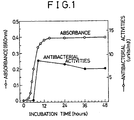
- a relationship between culture time and the antibacterial activities of a culture can be expressed as shown in FIG. 1.
- the antibacterial activities abruptly increased after 6 hours of incubation and reached a maximum around 8 hours of incubation. This behavior was slower compared with the absorbance at the wavelength of 660 nm, which indicated the amount of cells.
- the lactic acid bacteria of the present invention which had been cultured in SYL medium, was smeared in the form of a line by an inoculating loop on each of the agar plates, and was then cultured at 30°C for 24 hours to allow it to produce the antibacterial substance.
- the agar plates were exposed for 1 hour to ultraviolet rays from an ultraviolet sterilization lamp, so that the bacteria thus smeared was sterilized.
- Mixtures of 0.1 ml of test bacteria cultured in Elliker medium and Elliker soft agar medium [a culture medium obtained by adjusting the concentration of agar of Elliker agar medium to 0.7% (w/w)] cooled to 45°C subsequent to its melting were placed as a layer over the agar plates, respectively.
- test bacteria consisted of 45 thermophilic bacteria strains used as starters for fermented milk and 27 Lactobacillus delbrueckii subsp. bulgaricus strains. The thus-overlayed agar plates were incubated at 37°C for 24 hours, followed by the determination of the presence or absence of an inhibited band. As a result, such an inhibited band was observed on 43 thermophilic bacteria strains and 7 Lactobacillus delbrueckii subsp. bulgaricus strains.
- the lactic acid bacteria of the present invention were inoculated in pasteurized skim milk and was then cultured to provide Starter A for fermented milk.
- a mixed starter of commercial thermophilic bacteria and Lactobacillus delbrueckii subsp. bulgaricus were inoculated in pasteurized skim milk and was then cultured to provide Starter B for fermented milk.
- Both the starters were inoculated to the concentration of 1.5%, each, to the same pasteurized yogurt mix (pasteurized milk enriched with powdered skim milk), followed by incubation at 42°C until the lactic acid acidity reached 0.8%.
- the culture was immediately cooled, whereby the culture containing the lactic acid bacteria of this invention was obtained as yogurt.
- the yogurt of this example was free from an acidity increase after its production, thereby permitting stable storage.
- Streptococcus salivarius subsp. thermophilus SBT 1277 according to the present invention and Lactobacillus delbrueckii subsp. bulgaricus SBT-2118B (MRC-32-RO) were inoculated to the concentration of 1.5%, each, to a yogurt mix which consisted of fresh milk, powdered skim milk and sugar, followed by incubation at 42°C until the acidity reached 0.75% so that yogurt was obtained.
- the yogurt was refrigerated at 10°C and stored for 14 days. The acidity increase during the storage period is plotted in FIG. 2.
- the present invention provides novel lactic acid bacteria belonging to the genus Streptococcus salivarius subsp. thermophilus.
- the novel lactic acid bacteria according to the present invention produce an antibacterial substance of the bacteriocin type. This antibacterial substance can be used as a preservative for beverages, foods, feed and the like.
- fermented milk can be produced using the lactic acid bacteria of the present invention as a starter.
- its use as a starter for yogurt can suppress production of the acid during the storage and transportation of the resultant yogurt, thereby making it possible to prevent quality reduction of the yogurt due to excessive production of the acid.
Landscapes
- Chemical & Material Sciences (AREA)
- Life Sciences & Earth Sciences (AREA)
- Health & Medical Sciences (AREA)
- Organic Chemistry (AREA)
- Engineering & Computer Science (AREA)
- Genetics & Genomics (AREA)
- Biochemistry (AREA)
- General Health & Medical Sciences (AREA)
- Medicinal Chemistry (AREA)
- Microbiology (AREA)
- Wood Science & Technology (AREA)
- Biophysics (AREA)
- Food Science & Technology (AREA)
- Molecular Biology (AREA)
- Proteomics, Peptides & Aminoacids (AREA)
- Biotechnology (AREA)
- Zoology (AREA)
- Polymers & Plastics (AREA)
- Bioinformatics & Cheminformatics (AREA)
- Virology (AREA)
- Biomedical Technology (AREA)
- Tropical Medicine & Parasitology (AREA)
- General Engineering & Computer Science (AREA)
- Gastroenterology & Hepatology (AREA)
- Dairy Products (AREA)
- Micro-Organisms Or Cultivation Processes Thereof (AREA)
- Agricultural Chemicals And Associated Chemicals (AREA)
- Peptides Or Proteins (AREA)
- Preparation Of Compounds By Using Micro-Organisms (AREA)
Claims (6)
- Milchsäurebakterien, Streptococcus salivarius subsp. thermophilus, SBT 1277 (FERM BP3234) oder eine Variante derselben,
dadurch gekennzeichnet, daß die Bakterien oder die Variante eine antibakterielle Substanz erzeugen, die die folgenden Eigenschaften aufweist:(a) die Substanz ist ein Peptid oder Protein oder ein Konjugat derselben,(b) die Substanz wird durch Trypsin digeriert,(c) die Substanz wird nicht durch Phospholipase D digeriert und(d) die Substanz weist thermische Stabilität selbst nach Erhitzen bei pH 8.0 und 100°C über 30 Minuten auf. - Eine antibakterielle Substanz, die als Präzipitat durch Züchten der Milchsäurebakterien, Streptococcus salivarius subsp. thermophilus SBT 1277 (FERM BP3234) oder eine Variante derselben mit den gleichen Eigenschaften gemäß Anspruch 1 in SYL-Medium und Fraktionieren der entstehenden Kultur mit Ammoniumsulfat bei 30-70% Sättigung erhältlich ist, oder ein Gemisch, das diese Substanz umfaßt, wobei diese Substanz die folgenden Eigenschaften aufweist:(a) die Substanz ist ein Peptid oder Protein oder ein Konjugat derselben;(b) die Substanz wird durch Trypsin digeriert,(c) die Substanz wird nicht durch Phospholipase D digeriert und(d) die Substanz weist thermische Stabilität selbst nach Erhitzen bei pH 8.0 und 100°C über 30 Minuten auf.
- Ein fermentierter Milchstarter, der die Milchsäurebakterien, Streptococcus salivarius subsp. thermophilus SBT 1277 (FERM BP3234) oder eine Variante derselben mit den gleichen Eigenschaften gemäß Anspruch 1 umfaßt.
- Ein Verfahren zur Herstellung fermentierter Milch, deren Aziditätsanstieg während der Lagerung oder des Transports reduziert ist, das umfaßt, daß Rohmilch mit einem fermentierten Milchstarter, der Milchsäurebakterien enthält, die zur Bildung von Milchsäure bei der Herstellung von fermentierter Milch verwendet werden, und mit dem fermentierten Milchstarter nach Anspruch 3 beimpft wird und dann der erstere und der letztere Starter gezüchtet werden.
- Das Verfahren nach Anspruch 4, bei dem die zur Bildung von Milchsäure verwendeten Milchsäurebakterien ein Milchsäurebakterium oder mehrere Milchsäurebakterien umfassen, die aus der Gruppe ausgewählt sind, die aus Lactobacillus delbrueckii subsp. bulgaricus, Lactobacillus helveticus subsp. jugurti und Bifidobacteria breve subsp. breve besteht.
- Das Verfahren nach Anspruch 4 oder Anspruch 5, bei dem die fermentierte Milch ein Milchsäurefermentationsgetränk ist.
Applications Claiming Priority (4)
| Application Number | Priority Date | Filing Date | Title |
|---|---|---|---|
| JP4406790 | 1990-02-23 | ||
| JP44067/90 | 1990-02-23 | ||
| JP3041443A JPH0732702B2 (ja) | 1990-02-23 | 1991-01-26 | 新規乳酸菌、その産生する抗菌物質、この乳酸菌を含有する発酵乳用スターター及びそれを用いた発酵乳の製造方法 |
| JP41443/91 | 1991-01-26 |
Publications (3)
| Publication Number | Publication Date |
|---|---|
| EP0443543A2 EP0443543A2 (de) | 1991-08-28 |
| EP0443543A3 EP0443543A3 (en) | 1992-05-13 |
| EP0443543B1 true EP0443543B1 (de) | 1996-05-01 |
Family
ID=26381062
Family Applications (1)
| Application Number | Title | Priority Date | Filing Date |
|---|---|---|---|
| EP91102425A Expired - Lifetime EP0443543B1 (de) | 1990-02-23 | 1991-02-20 | Neue Milchsäurebakterien, antibakterielle Verbindungen aus diesen Bakterien hergestellt, diese Bakterien enthaltende fermentierte Milchstarter und Verfahren zur Herstellung fermentierter Milch unter Verwendung dieses Initiators |
Country Status (5)
| Country | Link |
|---|---|
| US (2) | US5338682A (de) |
| EP (1) | EP0443543B1 (de) |
| JP (1) | JPH0732702B2 (de) |
| DE (1) | DE69119110T2 (de) |
| NZ (1) | NZ237156A (de) |
Cited By (1)
| Publication number | Priority date | Publication date | Assignee | Title |
|---|---|---|---|---|
| RU2172324C2 (ru) * | 1995-08-07 | 2001-08-20 | Сосьете Де Продюи Нестле С.А. | Бактериоцин, способ его получения, штамм micrococcus varians, нуклеотидный фрагмент, сигнальный пептид |
Families Citing this family (41)
| Publication number | Priority date | Publication date | Assignee | Title |
|---|---|---|---|---|
| NL9201089A (nl) * | 1992-06-19 | 1994-01-17 | Stichting Nl I Zuivelonderzoek | Werkwijze voor de bereiding van een gefermenteerd melkprodukt. |
| RU2031586C1 (ru) * | 1993-02-05 | 1995-03-27 | Тамара Георгиевна Извекова | Биологически активный кисломолочный продукт "ацидолакт-наринэ" и способ его получения |
| PL179275B1 (pl) * | 1993-02-11 | 2000-08-31 | Dsm Nv | Sposób wykrywania zwiazków przeciwbakteryjnychi zestaw do wykrywania zwiazków przeciwbakteryjnych PL PL |
| DE69428854T2 (de) * | 1993-09-03 | 2002-04-11 | Societe Des Produits Nestle S.A., Vevey | Bacteriocine aus Streptococcus thermophilus |
| US5676985A (en) * | 1994-10-12 | 1997-10-14 | Hsc Research And Development Limited Partnership | Antifreeze polypeptide-expressing microorganisms useful in fermentation and freezing of foods |
| US5518102A (en) * | 1994-11-07 | 1996-05-21 | Candid Logic Inc. | Diverter |
| US6297042B1 (en) | 1995-05-15 | 2001-10-02 | University Of Kentucky Research Foundation | Cheese making with bacteriophage resistant bacteria |
| AU6682796A (en) | 1995-07-21 | 1997-02-18 | New York University | Type ii phospholipase a2 and its use in killing gram-positive bacteria |
| CA2310105C (en) * | 1997-11-17 | 2007-07-10 | Vivolac Cultures Corporation | Method for preparing dairy starter cultures |
| CA2281101A1 (en) * | 1998-08-31 | 2000-02-29 | Kraft Foods, Inc. | Stabilization of mayonnaise spreads using whey from nisin-producing cultures |
| CA2281052A1 (en) * | 1998-08-31 | 2000-02-29 | Kraft Foods, Inc. | Stabilization of fermented dairy compositions using whey from nisin producing cultures |
| CA2281056A1 (en) * | 1998-08-31 | 2000-02-29 | Kraft Foods, Inc. | Stabilization of cream cheese compositions using nisin-producing cultures |
| CA2281102A1 (en) | 1998-08-31 | 2000-02-29 | Kraft Foods, Inc. | Stabilization of cooked meat compositions using whey from nisin-producing cultures |
| US6368641B1 (en) | 2000-04-28 | 2002-04-09 | Hartz International Inc. | Lactic acid bacteria and food products |
| FR2811333B1 (fr) * | 2000-07-04 | 2003-01-10 | Gervais Danone Sa | Microorganismes ayant une action modulatrice de la glycosylation de surface des cellules intestinales et methode de selection desdits microorganismes |
| US7300787B2 (en) * | 2002-07-05 | 2007-11-27 | Archer-Daniels-Midland Company | Lactobacillus strains and use thereof in fermentation for L-lactic acid production |
| MXPA06013253A (es) * | 2004-05-14 | 2007-02-28 | Agtech Products Inc | Metodo y composicion para reducir la enfermedad de e. coli disease y mejorar el rendimiento utilizando bacilos. |
| IES20050294A2 (en) * | 2005-05-10 | 2006-10-04 | Lifestyle Foods Ltd | An apparatus for producing and handling a flowing substance |
| FR2888468B1 (fr) * | 2005-07-13 | 2010-08-27 | Gervais Danone Sa | Produits alimentaires fermentes contenant des souches probiotiques, et leur procede de preparation |
| US7754469B2 (en) * | 2005-11-30 | 2010-07-13 | Agtech Products, Inc | Microorganisms and methods for treating poultry |
| TWI491362B (zh) | 2006-12-01 | 2015-07-11 | Meiji Co Ltd | 發酵乳之製造方法及發酵乳 |
| EP1972207B1 (de) * | 2007-03-21 | 2018-02-28 | Nestec S.A. | Sicherheitssystem für pulverförmige Ernährungszusammensetzungen |
| WO2008146049A1 (en) * | 2007-05-29 | 2008-12-04 | Nina Chanishvili | Method for producing and storage of starter for a yogurt-like fermented milk product 'matsoni' |
| US8021654B2 (en) * | 2008-03-14 | 2011-09-20 | Danisco A/S | Methods of treating pigs with Bacillus strains |
| WO2009146205A1 (en) | 2008-04-17 | 2009-12-03 | Agtech Products, Inc. | Bacillus strains useful for animal odor control |
| US20110189343A1 (en) * | 2008-06-26 | 2011-08-04 | Hideo Hasegawa | Nano-sized lactic acid bacteria |
| CA2729402A1 (en) * | 2008-06-30 | 2010-01-07 | Meiji Dairies Corporation | Process for manufacturing fermented milk and fermented milk |
| US8540981B1 (en) | 2008-07-07 | 2013-09-24 | Dupont Nutrition Biosciences Aps | Bacillus strains useful against calf pathogens and scours |
| EP2401922B1 (de) | 2009-02-25 | 2013-04-24 | Meiji Co., Ltd. | Kultivierte milch mit geringem laktosegehalt und verfahren zu ihrer herstellung |
| JP5505909B2 (ja) | 2009-03-30 | 2014-05-28 | 株式会社明治 | 乳酸菌の培養方法および発酵乳の製造方法 |
| EP2606739A4 (de) | 2010-08-21 | 2015-10-07 | Meiji Co Ltd | Fermentierte milch mit geringem lactosegehalt und verfahren zu ihrer herstellung |
| CN103338647B (zh) | 2011-03-04 | 2015-09-09 | 株式会社明治 | 味道改善的发酵乳及其制造方法 |
| US8557234B1 (en) | 2011-05-18 | 2013-10-15 | Dupont Nutrition Biosciences Aps | Methods of controlling pit foam |
| PL2748300T3 (pl) | 2011-08-24 | 2019-05-31 | Dupont Nutrition Biosci Aps | Szczepy Bacillus wytwarzające enzym |
| AU2013265387A1 (en) * | 2012-05-21 | 2014-11-27 | Dupont Nutrition Biosciences Aps | Strains of lactobacillus with antifungal properties |
| NZ704190A (en) | 2012-08-22 | 2018-04-27 | Kraft Foods Group Brands Llc | Processed cheese with cultured dairy components and method of manufacturing |
| JP7032309B2 (ja) * | 2016-04-14 | 2022-03-08 | 株式会社明治 | 発酵乳の製造方法 |
| US11174288B2 (en) | 2016-12-06 | 2021-11-16 | Northeastern University | Heparin-binding cationic peptide self-assembling peptide amphiphiles useful against drug-resistant bacteria |
| JP7606276B2 (ja) * | 2017-03-22 | 2024-12-25 | 雪印メグミルク株式会社 | 脂質代謝改善用組成物 |
| EP3482636A1 (de) * | 2017-11-10 | 2019-05-15 | Tetra Laval Holdings & Finance S.A. | Herstellung fermentierter milchprodukte zur ungekühlten distribution |
| CN114794466B (zh) * | 2022-04-08 | 2023-07-21 | 广州正明后生元科技有限公司 | 一种后生元及其精制方法 |
Family Cites Families (11)
| Publication number | Priority date | Publication date | Assignee | Title |
|---|---|---|---|---|
| US4034115A (en) * | 1975-07-29 | 1977-07-05 | Roberts James Gorden | Multi-curdled milk product and the process for the preparation thereof |
| JPS52117492A (en) * | 1975-12-11 | 1977-10-01 | Hayashibara Biochem Lab Inc | Preparation of water-insoluble glucan |
| JPS5283966A (en) * | 1975-12-31 | 1977-07-13 | Hayashibara Biochem Lab | Process for removing sucrose from succharide mixture |
| US4339464A (en) * | 1978-02-24 | 1982-07-13 | Microlife Technics, Inc. | Stabilizer producing Streptococcus thermophilus |
| JPS615022A (ja) * | 1984-06-19 | 1986-01-10 | Advance Res & Dev Co Ltd | 腸内細菌叢改善剤 |
| JPS62239A (ja) * | 1985-06-26 | 1987-01-06 | Meiji Milk Prod Co Ltd | 醗酵乳、乳酸菌飲料及びその製造法 |
| JPS637743A (ja) * | 1986-06-30 | 1988-01-13 | Norihisa Minegishi | ヨ−グルト風豆乳の製造方法 |
| JPS6391092A (ja) * | 1986-10-07 | 1988-04-21 | Yakult Honsha Co Ltd | オリゴ糖の製造法 |
| JPH0779616B2 (ja) * | 1987-07-28 | 1995-08-30 | 三菱化学株式会社 | ▲醗▼酵乳 |
| US4855147A (en) * | 1987-09-17 | 1989-08-08 | Kagome Kabushiki Kaisha | Beverages by lactic acid fermentation and methods of producing same |
| JP2518663B2 (ja) * | 1987-12-24 | 1996-07-24 | 株式会社ヤクルト本社 | ガラクトオリゴ糖含有加工乳の製造法 |
-
1991
- 1991-01-26 JP JP3041443A patent/JPH0732702B2/ja not_active Expired - Lifetime
- 1991-02-19 NZ NZ237156A patent/NZ237156A/en unknown
- 1991-02-20 EP EP91102425A patent/EP0443543B1/de not_active Expired - Lifetime
- 1991-02-20 DE DE69119110T patent/DE69119110T2/de not_active Expired - Fee Related
-
1992
- 1992-07-27 US US07/919,458 patent/US5338682A/en not_active Expired - Fee Related
- 1992-12-07 US US07/987,082 patent/US5482723A/en not_active Expired - Fee Related
Non-Patent Citations (2)
| Title |
|---|
| CHEMICAL ABSTRACTS, vol. 112, no. 1, 01 January 1990, Columbus, OH (US); H. ARIGA et al., p. 638, no. 6353v/ * |
| CHEMICAL ABSTRACTS, vol. 95, no. 24, 14 December 1981, Columbus, OH (US); J.R. TAGG et al., p. 263, no. 217378a/ * |
Cited By (1)
| Publication number | Priority date | Publication date | Assignee | Title |
|---|---|---|---|---|
| RU2172324C2 (ru) * | 1995-08-07 | 2001-08-20 | Сосьете Де Продюи Нестле С.А. | Бактериоцин, способ его получения, штамм micrococcus varians, нуклеотидный фрагмент, сигнальный пептид |
Also Published As
| Publication number | Publication date |
|---|---|
| US5482723A (en) | 1996-01-09 |
| JPH04211360A (ja) | 1992-08-03 |
| EP0443543A2 (de) | 1991-08-28 |
| NZ237156A (en) | 1992-08-26 |
| JPH0732702B2 (ja) | 1995-04-12 |
| DE69119110T2 (de) | 1997-01-23 |
| EP0443543A3 (en) | 1992-05-13 |
| US5338682A (en) | 1994-08-16 |
| DE69119110D1 (de) | 1996-06-05 |
Similar Documents
| Publication | Publication Date | Title |
|---|---|---|
| EP0443543B1 (de) | Neue Milchsäurebakterien, antibakterielle Verbindungen aus diesen Bakterien hergestellt, diese Bakterien enthaltende fermentierte Milchstarter und Verfahren zur Herstellung fermentierter Milch unter Verwendung dieses Initiators | |
| US5527505A (en) | Process for the manufacture of fermented milk | |
| EP0576780A2 (de) | Mikroorganismus-Stamm, bakterielles Präparat dieses Stammes, Verwendung dieses Stammes und dieses Präparates, um Hefe und Schimmel zu bekämpfen | |
| Benkerroum et al. | Development and use of a selective medium for isolation of Leuconostoc spp. from vegetables and dairy products | |
| CA2201326C (fr) | Souche de streptococcus thermophilus, procede de fermentation mettant en oeuvre cette souche et produit obtenu | |
| US8470583B1 (en) | Lactobacillus strain and bacteriocin | |
| KR100500875B1 (ko) | 비피더스균 발효유 및 그의 제조법 | |
| AU648463B2 (en) | Yogurt product containing bacteriocin | |
| EP0698348B1 (de) | Hemmung von Clostridia mit Milchsäurebakterien | |
| KR100413335B1 (ko) | 항균 펩타이드 물질을 생산하는 유산균 락토코커스 락티스bh5(케이씨씨엠 10275) | |
| EP0137869B1 (de) | Abgeleitete Nisin produzierende Mikroorganismen, Verfahren zur Herstellung und Verwendung und so erhaltene Produkte | |
| US4734361A (en) | Low temperature-sensitive variant of lactobacillus bulgaricus and a selection method therefor | |
| EP1449915B1 (de) | Bifidobacterium longum | |
| Keller et al. | Degradation of aspartame in yogurt related to microbial growth | |
| JP2589553B2 (ja) | 発酵乳の製造方法 | |
| KR100338393B1 (ko) | 젓갈 유래 박테리오신 생산균주 및 이로부터 박테리오신생산방법 | |
| JPH04271777A (ja) | 低生酸性乳酸菌、スターター、これを用いた発酵乳及びその製造法 | |
| JPS63208527A (ja) | 抗微生物剤 | |
| JP3783187B2 (ja) | 新規なラクトバチラス属乳酸菌およびその培養物 | |
| RU1839185C (ru) | Штамм бактерий LACTOBACILLUS ACIDOPHILUS, используемый в составе бактериальных заквасок дл кисломолочных продуктов | |
| JP2001335597A (ja) | 新規バクテリオシン及びその製造方法 | |
| Brankova et al. | Antimicrobial Activity of Lactic Acid Bacteria Against Intestinal and Food-Borne Pathogens |
Legal Events
| Date | Code | Title | Description |
|---|---|---|---|
| PUAI | Public reference made under article 153(3) epc to a published international application that has entered the european phase |
Free format text: ORIGINAL CODE: 0009012 |
|
| AK | Designated contracting states |
Kind code of ref document: A2 Designated state(s): DE FR NL |
|
| PUAL | Search report despatched |
Free format text: ORIGINAL CODE: 0009013 |
|
| AK | Designated contracting states |
Kind code of ref document: A3 Designated state(s): DE FR NL |
|
| 17P | Request for examination filed |
Effective date: 19920907 |
|
| RAP1 | Party data changed (applicant data changed or rights of an application transferred) |
Owner name: SNOW BRAND MILK PRODUCTS CO., LTD. |
|
| 17Q | First examination report despatched |
Effective date: 19941011 |
|
| GRAH | Despatch of communication of intention to grant a patent |
Free format text: ORIGINAL CODE: EPIDOS IGRA |
|
| GRAA | (expected) grant |
Free format text: ORIGINAL CODE: 0009210 |
|
| AK | Designated contracting states |
Kind code of ref document: B1 Designated state(s): DE FR NL |
|
| REF | Corresponds to: |
Ref document number: 69119110 Country of ref document: DE Date of ref document: 19960605 |
|
| ET | Fr: translation filed | ||
| PLBE | No opposition filed within time limit |
Free format text: ORIGINAL CODE: 0009261 |
|
| STAA | Information on the status of an ep patent application or granted ep patent |
Free format text: STATUS: NO OPPOSITION FILED WITHIN TIME LIMIT |
|
| 26N | No opposition filed | ||
| PGFP | Annual fee paid to national office [announced via postgrant information from national office to epo] |
Ref country code: FR Payment date: 20010112 Year of fee payment: 11 |
|
| PGFP | Annual fee paid to national office [announced via postgrant information from national office to epo] |
Ref country code: NL Payment date: 20010228 Year of fee payment: 11 |
|
| PGFP | Annual fee paid to national office [announced via postgrant information from national office to epo] |
Ref country code: DE Payment date: 20010408 Year of fee payment: 11 |
|
| PG25 | Lapsed in a contracting state [announced via postgrant information from national office to epo] |
Ref country code: NL Free format text: LAPSE BECAUSE OF NON-PAYMENT OF DUE FEES Effective date: 20020901 |
|
| PG25 | Lapsed in a contracting state [announced via postgrant information from national office to epo] |
Ref country code: DE Free format text: LAPSE BECAUSE OF NON-PAYMENT OF DUE FEES Effective date: 20020903 |
|
| PG25 | Lapsed in a contracting state [announced via postgrant information from national office to epo] |
Ref country code: FR Free format text: LAPSE BECAUSE OF NON-PAYMENT OF DUE FEES Effective date: 20021031 |
|
| NLV4 | Nl: lapsed or anulled due to non-payment of the annual fee |
Effective date: 20020901 |
|
| REG | Reference to a national code |
Ref country code: FR Ref legal event code: ST |