EP0442844B1 - Verfahren zum Färben von Wolle mit Reaktivfarbstoffen - Google Patents
Verfahren zum Färben von Wolle mit Reaktivfarbstoffen Download PDFInfo
- Publication number
- EP0442844B1 EP0442844B1 EP91810078A EP91810078A EP0442844B1 EP 0442844 B1 EP0442844 B1 EP 0442844B1 EP 91810078 A EP91810078 A EP 91810078A EP 91810078 A EP91810078 A EP 91810078A EP 0442844 B1 EP0442844 B1 EP 0442844B1
- Authority
- EP
- European Patent Office
- Prior art keywords
- component
- hydrogen
- formula
- compound
- process according
- Prior art date
- Legal status (The legal status is an assumption and is not a legal conclusion. Google has not performed a legal analysis and makes no representation as to the accuracy of the status listed.)
- Expired - Lifetime
Links
Classifications
-
- D—TEXTILES; PAPER
- D06—TREATMENT OF TEXTILES OR THE LIKE; LAUNDERING; FLEXIBLE MATERIALS NOT OTHERWISE PROVIDED FOR
- D06P—DYEING OR PRINTING TEXTILES; DYEING LEATHER, FURS OR SOLID MACROMOLECULAR SUBSTANCES IN ANY FORM
- D06P3/00—Special processes of dyeing or printing textiles, or dyeing leather, furs, or solid macromolecular substances in any form, classified according to the material treated
- D06P3/02—Material containing basic nitrogen
- D06P3/04—Material containing basic nitrogen containing amide groups
- D06P3/14—Wool
-
- D—TEXTILES; PAPER
- D06—TREATMENT OF TEXTILES OR THE LIKE; LAUNDERING; FLEXIBLE MATERIALS NOT OTHERWISE PROVIDED FOR
- D06P—DYEING OR PRINTING TEXTILES; DYEING LEATHER, FURS OR SOLID MACROMOLECULAR SUBSTANCES IN ANY FORM
- D06P1/00—General processes of dyeing or printing textiles, or general processes of dyeing leather, furs, or solid macromolecular substances in any form, classified according to the dyes, pigments, or auxiliary substances employed
- D06P1/44—General processes of dyeing or printing textiles, or general processes of dyeing leather, furs, or solid macromolecular substances in any form, classified according to the dyes, pigments, or auxiliary substances employed using insoluble pigments or auxiliary substances, e.g. binders
- D06P1/60—General processes of dyeing or printing textiles, or general processes of dyeing leather, furs, or solid macromolecular substances in any form, classified according to the dyes, pigments, or auxiliary substances employed using insoluble pigments or auxiliary substances, e.g. binders using compositions containing polyethers
- D06P1/607—Nitrogen-containing polyethers or their quaternary derivatives
- D06P1/6076—Nitrogen-containing polyethers or their quaternary derivatives addition products of amines and alkylene oxides or oxiranes
-
- D—TEXTILES; PAPER
- D06—TREATMENT OF TEXTILES OR THE LIKE; LAUNDERING; FLEXIBLE MATERIALS NOT OTHERWISE PROVIDED FOR
- D06P—DYEING OR PRINTING TEXTILES; DYEING LEATHER, FURS OR SOLID MACROMOLECULAR SUBSTANCES IN ANY FORM
- D06P3/00—Special processes of dyeing or printing textiles, or dyeing leather, furs, or solid macromolecular substances in any form, classified according to the material treated
- D06P3/02—Material containing basic nitrogen
- D06P3/04—Material containing basic nitrogen containing amide groups
- D06P3/14—Wool
- D06P3/148—Wool using reactive dyes
-
- Y—GENERAL TAGGING OF NEW TECHNOLOGICAL DEVELOPMENTS; GENERAL TAGGING OF CROSS-SECTIONAL TECHNOLOGIES SPANNING OVER SEVERAL SECTIONS OF THE IPC; TECHNICAL SUBJECTS COVERED BY FORMER USPC CROSS-REFERENCE ART COLLECTIONS [XRACs] AND DIGESTS
- Y10—TECHNICAL SUBJECTS COVERED BY FORMER USPC
- Y10S—TECHNICAL SUBJECTS COVERED BY FORMER USPC CROSS-REFERENCE ART COLLECTIONS [XRACs] AND DIGESTS
- Y10S516/00—Colloid systems and wetting agents; subcombinations thereof; processes of
- Y10S516/01—Wetting, emulsifying, dispersing, or stabilizing agents
- Y10S516/07—Organic amine, amide, or n-base containing
-
- Y—GENERAL TAGGING OF NEW TECHNOLOGICAL DEVELOPMENTS; GENERAL TAGGING OF CROSS-SECTIONAL TECHNOLOGIES SPANNING OVER SEVERAL SECTIONS OF THE IPC; TECHNICAL SUBJECTS COVERED BY FORMER USPC CROSS-REFERENCE ART COLLECTIONS [XRACs] AND DIGESTS
- Y10—TECHNICAL SUBJECTS COVERED BY FORMER USPC
- Y10S—TECHNICAL SUBJECTS COVERED BY FORMER USPC CROSS-REFERENCE ART COLLECTIONS [XRACs] AND DIGESTS
- Y10S8/00—Bleaching and dyeing; fluid treatment and chemical modification of textiles and fibers
- Y10S8/916—Natural fiber dyeing
- Y10S8/917—Wool or silk
Definitions
- the present invention relates to a new method for fiber and flat level dyeing of wool with reactive dyes, the material dyed by the new method and a means for carrying out the method.
- the present method is particularly suitable for producing light to medium shades.
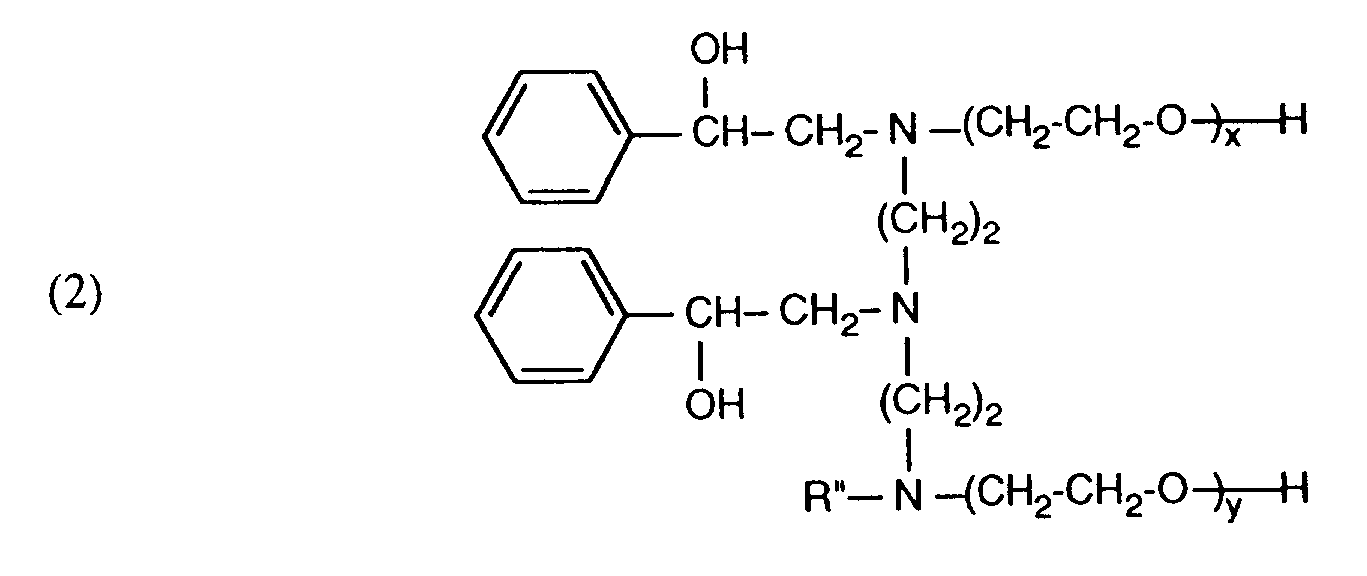
- auxiliary mixture as component (c) can be a nonionic compound of the formula wherein R "is an alkyl or alkenyl radical having 12 to 22 carbon atoms and x and y are integers, the sum of x and y being 80 to 140.
- auxiliary mixtures which comprise a compound of the formula (3a) as component (a) and a compound of the formula (4b) as component (b) or auxiliary mixtures which comprise a compound of the formula (3b) as component (a) and as a component (b) contain a compound of formula (4a).
- M in the formulas (1), (3) and (4) denotes hydrogen, alkali metal, such as sodium, potassium and in particular ammonium.
- the radicals Q, Q ', Q 1 and Q' 1 and A 8 , A ' 8 , A 1 ⁇ and A 2 8 in the formulas (1) and (3) are derived from quaternizing agents , QC 1 to C 4 -Alkyl, -CH 2 -CO-NH 2 , or is.
- quaternizing agents are e.g. Acetyl bromides, ethyl bromides, ethylene chlorohydrin, ethylene bromohydrin, epichlorohydrin, epibromohydrin, dimethyl sulfate, diethyl sulfate and especially chloroacetamide.
- the aliphatic radicals R 1 , R 2 , R 3 , R 4 , R 5 and R 6 in the formulas (1), (3) and (4) are alkyl or alkenyl radicals having 12 to 24, preferably 16 to 22, carbon atoms Consideration. Examples include: the n-dodecyl, myristyl, n-hexadecyl, n-heptadecyl, n-octadecyl, arachidyl, behenyl, dodecenyl, hexadecenyl, oleyl and octadecenyl radical.
- the compounds of components (a), (b) and (c) are e.g. known (in part) from US-A-4,444,564.
- the compounds of component (a) according to formula (1a) are prepared by adding 2 to 15 moles of ethylene oxide to aliphatic amines which have an aliphatic radical with 12 to 24 carbon atoms and optionally the adduct in the acidic monoester and optionally the acidic one Monoesters converted into the alkali or ammonium salts or reacting the adduct with one of the quaternizing agents mentioned above.
- the connections of component (b) correspond Chend formula (1 b) are prepared by adding 25 to 200 mol of ethylene oxide onto aliphatic amines which have an aliphatic radical with 12 to 24 carbon atoms, and optionally the adduct in the acidic ester and optionally the acidic ester in the alkali or Converted ammonium salts or reacted the adduct with one of the quaternizing agents mentioned above.
- the compounds of formula (2) are prepared by adding 80 to 140 moles of ethylene oxide to a compound of formula where R "has the meaning given under formula (2).
- the amines which are required as starting materials for the preparation of the compounds of the formulas (1), (3) and (4) can have saturated or unsaturated, branched or unbranched hydrocarbon radicals having 12 to 24, preferably 16 to 22, carbon atoms.
- the amines can be chemically uniform or in the form of mixtures.
- the amine mixtures used are preferably those which arise when natural fats or oils, such as tallow fat, soybean or coconut oil, are converted into the corresponding amines.
- Dodecylamine, hexadecylamine, octadecylamine, arachidylamine, behenylamine and octadecenylamine may be mentioned as amines.
- Tallow fatty amine is a mixture of approx. 30% hexadecylamine, 25% octadecylamine and 45% octadecenylamine.
- Both the ethylene oxide addition and the esterification can be carried out according to methods known per se.
- sulfuric acid or its functional derivatives such as e.g. Chlorosulfonic acid and especially sulfamic acid.
- the esterification is generally carried out by simply mixing the reactants with heating, advantageously to a temperature between 50 and 100 ° C.
- the free acids can then be converted into the alkali metal or ammonium salts by adding bases such as ammonia, sodium or potassium hydroxide in a conventional manner.
- An auxiliary mixture comprising 10 to 80 parts, preferably 20 to 70 parts of component (a), 5 to 70 parts, preferably 5 to 50 parts of component (b) and 0 to 70, preferably 0 to 50, is used for the process according to the invention
- Parts of the compound of component (c) and ad contains 100 parts of water.
- auxiliary mixture consisting of components (a), (b) and optionally (c) are added to the dyebath range from 0.5 to 4 percent by weight, based on the fiber material to be dyed. 1 to 2 percent by weight of the auxiliary mixture, based on the fiber material, is preferably used.
- the weight ratio of components (a) and (b) is between 1: 5 and 10: 1, preferably between 1: 2 and 5: 1.
- Wool can be considered as the fiber material that can be dyed according to the invention.
- the fiber material can be in various forms. Examples include: flake, sliver, yarn, fabric, knitwear or carpets.
- the wool can be finished normally or without felt.
- dyes This class of dyes is referred to in the Color Index 3rd edition 1971 as "reactive dyes". These are predominantly those dyes which contain at least one group which is reactive with polyhydroxyl fibers (cellulose fibers) or polyamide fibers, in particular wool, a precursor for this or a substituent which is reactive with polyhydroxyl fibers or polyamide fibers.
- Suitable bases for the reactive dyes are, in particular, those from the series of mono-, dis- or polyazo dyes including formazan dyes and anthraquinone, xanthene, nitro, triphenylmethane, naphthoquinonimine, dioxazine and phthalocyanine dyes, the azo and phthalocyanine dyes can be both metal-free and metal-containing.
- Reactive groups and precursors which form such reactive groups include, for example, epoxy groups, the ethyleneimide group, the vinyl grouping in vinylsulfone or in acrylic acid residues and the ⁇ -sulfatoethylsulfone group, the ⁇ -chloroethylsulfone group or the ⁇ -dialkylaminoethylsulfone group.
- the reactive substituents in reactive dyes are those which are easily removable and leave an electrophilic residue.
- substituents are 1 or 2 halogen atoms in an aliphatic acyl radical, e.g. in the ⁇ -position or a- and ⁇ -position of a propionyl radical or in the a- and / or ⁇ -position of an acrylic acid radical, or 1 to 3 halogen atoms on the following ring system into consideration: pyridazine, pyrimidine, pyridazone, triazine, quinoxaline or phthalazine.
- Dyes with two or more identical or different reactive groups can also be used.
- Preferred reactive dyes contain chloroacetyl, bromoacrylic or dibromopropionyl as reactive substituents.
- the reactive dyes can be acidic, salt-forming substituents, e.g. Contain carboxylic acid groups, sulfuric acid and phosphonic acid ester groups, phosphonic acid groups or preferably sulfonic acid groups.
- Reactive dyes with at least one sulfonic acid group are preferred, in particular reactive dyes with an azo or anthraquinone base which preferably has two to three sulfonic acid groups.
- Mixtures of reactive dyes can also be used, it being possible to produce bichromatic or trichromatic dyes.
- the coloring takes place after the pull-out procedure.
- the amount of dyes added to the dye liquor depends on the desired color strength. In general, amounts of 0.01 to 10 percent by weight, preferably 0.01 to 2 percent by weight, based on the fiber material used, have proven successful.
- the liquor ratio can be chosen within a wide range e.g. 1: 3 to 1: 100, preferably 1: 8 to 1:30.
- the dye baths can contain mineral acids, e.g. Sulfuric acid or phosphoric acid, organic acids, suitably contain aliphatic carboxylic acids such as formic acid, acetic acid, oxalic acid or citric acid and / or salts such as ammonium acetate, ammonium sulfate or sodium acetate.
- mineral acids e.g. Sulfuric acid or phosphoric acid
- organic acids suitably contain aliphatic carboxylic acids such as formic acid, acetic acid, oxalic acid or citric acid and / or salts such as ammonium acetate, ammonium sulfate or sodium acetate.
- the acids are used primarily to adjust the pH of the liquors used according to the invention, which is between 4 and 5.
- the dye liquors can also contain other additives, e.g. Wool protection, dispersing and wetting agents as well as defoamers included.
- the usual dyeing apparatuses such as, for example, open baths, combed, strand yarn or packing apparatuses, jiggers, paddle apparatuses, tree dyeing apparatuses, circulation or jet dyeing apparatuses or reel runners can be used.
- the dyeing is advantageously carried out at a temperature in the range from 60 to 120 ° C., preferably from 70 to 105 ° C.
- the dyeing time is within the usual range and is generally 20 to 120 minutes.
- the dyeing process can be followed by an alkaline after-treatment, e.g. with aqueous ammonia, alkali metal hydroxides, alkali metal carbonates, bicarbonates or hexamethylenetetraamine.
- the pH of the dye baths containing alkali is expediently 7.5 to 9, preferably 8 to 8.5.
- the dyeing of the fiber material is expediently carried out in such a way that the material to be dyed with an aqueous liquor which contains the acid, the auxiliary mixture of components (a) and (b) and, if appropriate, component (c) and a temperature of 30 to 60 ° C, treated briefly and adding the reactive dye to the same bath.
- the temperature is then slowly increased in order to dye in a range from 80 to 100 ° C. and for 20 to 90 minutes, preferably 30 to 60 minutes.
- the material to be dyed is then treated for a further 10 to 20 minutes at 70 to 90 ° C. after the addition of alkalis, preferably sodium hydrogen carbonate or sodium carbonate. Finally, the colored material is pulled out and rinsed, acidified and dried as usual.
- the dyeing process according to the invention gives fiber and flat dyeings, especially in light to medium shades with good light and wet fastness properties.
- the pH of the liquor is 4.5.
- the 12 mg of the dye of the formula 24 mg of the dye of the formula and 44 mg of the dye of the formula contains, the dyebath is kept at 40 ° for about 5 minutes and then heated to 60 at a rate of 1 ° / min and held at 60 ° for 20 minutes. The mixture is then heated to 98 at 1 ° / min and dyed for 30 minutes. After the liquor has cooled to 70, it is rinsed as usual. A fiber-uniform and flat-level dyeing with good fastness properties is obtained.
- EXAMPLE 3 The procedure is as described in Example 1 with the difference that 0.2 g of the adduct of 34 moles of ethylene oxide and 1 mole of a C 2 oC 22 fatty amine is used instead of auxiliary B 2 . A fiber- and flat-level dyeing with good fastness properties is obtained.
- EXAMPLE 4 The procedure is as described in Example 1, with the difference that, instead of auxiliary B 2, 0.2 g of the quaternized adduct of 34 mol of ethylene oxide and 1 mol of a C 2 oC 22 fatty amine is used. A fiber- and flat-level dyeing with good fastness properties is obtained.
- EXAMPLE 5 The procedure is as described in Example 1, with the difference that 0.2 g of the adduct of 30 mol of ethylene oxide and 1 mol of tallow fatty amine is used instead of B 2 . A fiber- and flat-level dyeing with good fastness properties is obtained.
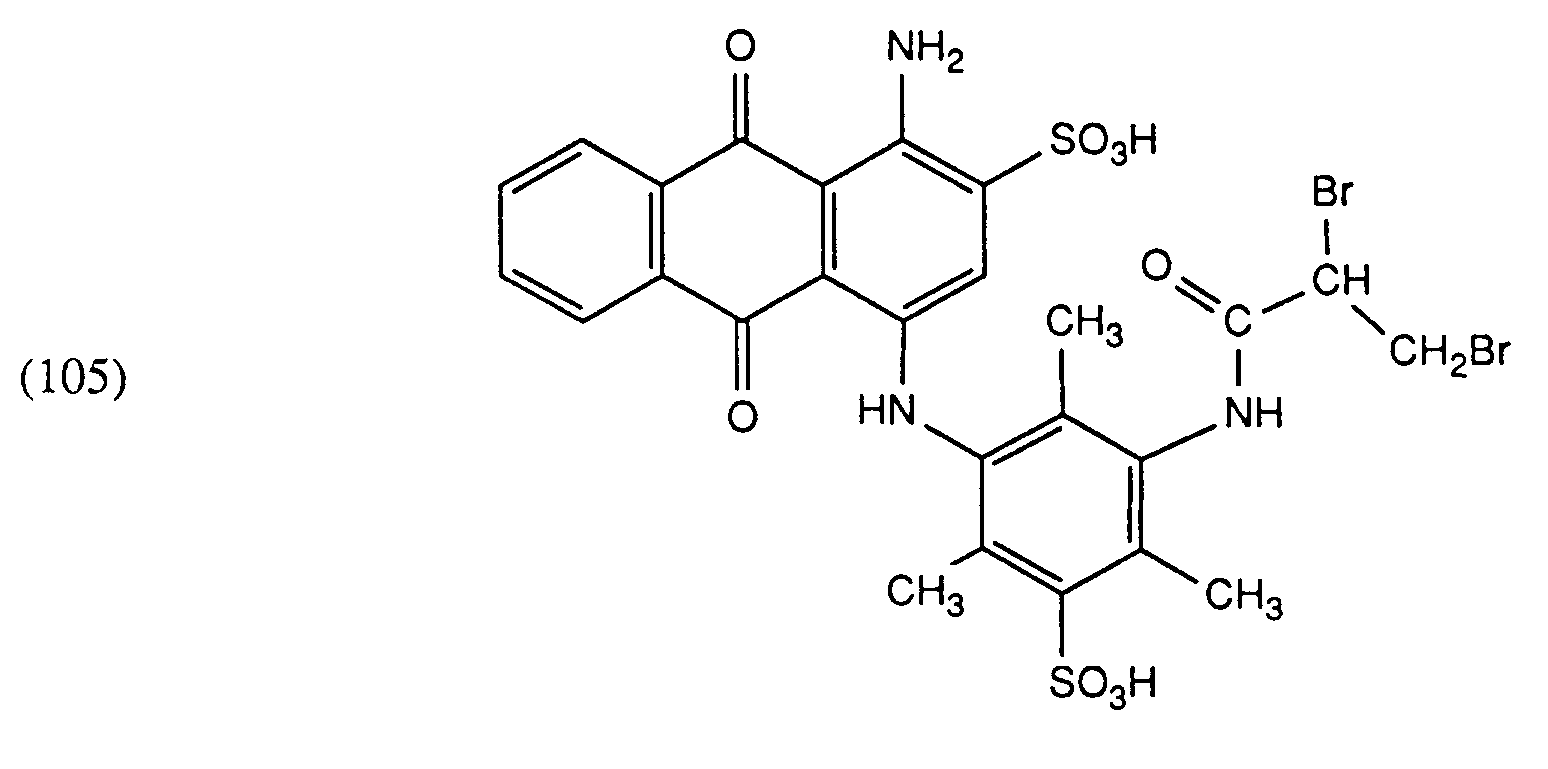
- EXAMPLE 9 The procedure is as described in Example 2, with the difference that, instead of the dye mixture, 80 mg of the dye of the formula is used.
- EXAMPLE 10 The procedure is as described in Example 9, with the difference that instead of 80 mg of the dye of the formula (105), 80 mg of the dye of the formula starts.
- EXAMPLE 11 The procedure is as described in Example 9, with the difference that instead of 80 mg of the dye of the formula (105), 200 mg of the dye of the formula used.
- EXAMPLE 12 The procedure is as described in Example 9, with the difference that instead of 80 mg of the dye of the formula (105), 320 mg of the dye of the formula used.
- EXAMPLE 13 The procedure is as described in Example 9, with the difference that instead of 80 mg of the dye of the formula (105), 100 mg of the dye of the formula used.
Landscapes
- Engineering & Computer Science (AREA)
- Textile Engineering (AREA)
- Coloring (AREA)
Description
- Die vorliegende Erfindung betrifft ein neues Verfahren zum faser- und flächenegalen Färben von Wolle mit Reaktivfarbstoffen, das nach dem neuen Verfahren gefärbte Material und ein Mittel zur Ausführung des Verfahrens.
- Aus der US-A-4 444 564 ist es bekannt, Fasern aus natürlichen Polyamiden im faserschonenden pH-Bereich zu färben. Allerdings können mit diesem Verfahren mit Reaktivfarbstoffen nur dunkle Farbtöne zufriedenstellend hergestellt werden.
- Ueberraschenderweise wurde nun ein neues Verfahren gefunden, das es ermöglicht, auch Wolle mit Reaktivfarbstoffen im faserschonenden pH-Bereich faser- und flächenegal besonders in hellen bis mittleren Farbtönen herzustellen.
- Gegenstand der vorliegenden Erfindung ist somit ein Verfahren zum faser- und flächenegalen Färben von Wolle mit Reaktivfarbstoffen in Gegenwart eines Hilfsmittelgemisches, das dadurch gekennzeichnet ist, dass man zum Färben dieser Materialien eine wässrige Flotte verwendet, welche mindestens einen Reaktivfarbstoff und ein Hilfsmittelgemisch enthaltend als Komponente (a) mindestens eine Verbindung der Formel


- R1 und R2 unabhängig voneinander einen aliphatischen Rest mit 12 bis 24 C-Atomen, Q und Q' unabhängig voneinander C1 bis C4-Alkyl, -CH2-CO-NH2,


- Z1, Z2, Z'1 und Z'2 unabhängig voneinander Wasserstoff, S03M oder P03M, wobei M Wasserstoff, Alkalimetall oder Ammonium, t1 0 oder 1 und t2 0 oder 1 bedeuten, wobei wenn t1 0 ist, Z1 und Z2 Wasserstoff oder von Z1 und Z2 der eine Rest Wasserstoff und der andere S03M oder P03M bedeutet, und wenn t2 0 ist, Z'1 und Z'2 Wasserstoff oder von Z'1 und Z'2 der eine Rest Wasserstoff und der andere S03M oder P03M bedeutet, mi, ni, p1 und q1 ganze Zahlen bedeuten, wobei die Summe von (m1 + n1) 2 bis 15 und (p1 + q1) 25 bis 200 ist, und die Färbung unabhängig von der Farbtiefe bei einem pH-Wert von 4,0 bis 5,0 fertigstellt.
- Das vorliegende Verfahren eignet sich besonders zur Herstellung von hellen bis mittleren Farbtönen.
- Bevorzugt sind Hilfsmittelgemisch-Komponenten der Formeln (1a) und (1b), bei denen die Summe (m1 + n1) 5 bis 12 und (p1 + q1) 25 bis 100 bedeuten.
- Zusätzlich kann das Hilfsmittelgemisch als Komponente (c) eine nichtionogene Verbindung der Formel

- Bevorzugt kommen Hilfsmittelgemische zum Einsatz, die als Komponente (a) eine Verbindung der Formel


- R3 und R4 unabhängig voneinander einen aliphatischen Rest mit 12 bis 24 C-Atomen,
- Q1 und Q'1 unabhängig voneinander C1 bis C4-Alkyl oder -CH2-CO-NH2,
- Z3, Z4, Z'3 und Z'4 unabhängig voneinander Wasserstoff oder S03M,
- M Wasserstoff, Alkalimetall oder Ammonium,
- m2, n2, p2 und q2 ganze Zahlen bedeuten, wobei die Summe von (m2 +n2) 5 bis 12 und (p2 + q2) 25 bis 100 ist und
- A1 8 und A2 8 ein Anion bedeuten.
- Ein weiteres bevorzugtes Hilfsmittelgemisch enthält als Komponente (a) eine Verbindung der Formel


- R5 und R6 unabhängig voneinander einen aliphatischen Rest mit 12 bis 24 C-Atomen,
- Z5 und Z6 Wasserstoff oder von Z5 und Z6 der eine Rest Wasserstoff und der andere S03 M,
- Z'5 und Z'6 unabhängig voneinander Wasserstoff oder S03M,
- M Wasserstoff, Alkalimetall oder Ammonium und
- m3, n3, p3 und q3 ganze Zahlen bedeuten, wobei die Summe von (m3 + n3) 5 bis 12 und (p3 +q3) 25 bis 100 ist.
- Weiterhin bevorzugt sind Hilfsmittelgemische, die als Komponente (a) eine Verbindung der Formel (3a) und als Komponente (b) eine Verbindung der Formel (4b) oder Hilfsmittelgemische, die als Komponente (a) eine Verbindung der Formel (3b) und als Komponente (b) eine Verbindung der Formel (4a) enthalten.
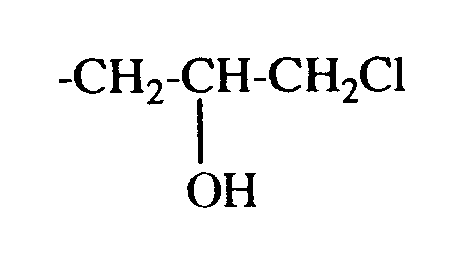
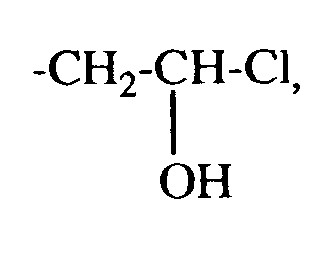
- M in den Formeln (1), (3) und (4) bedeutet Wasserstoff, Alkalimetall, wie z.B. Natrium, Kalium und insbesondere Ammonium. Die Reste Q, Q', Q1 und Q'1 sowie A8, A'8, A1 ⊖ und A2 8 in den Formeln (1) und (3) leiten sich von Quaternierungsmitteln ab, wobei Q C1 bis C4-Alkyl, -CH2-CO-NH2,


- Als Beispiele solcher Quaternierungsmittel kommen z.B. Acetylbromide, Ethylbromide, Ethylenchlorhydrin, Ethylenbromhydrin, Epichlorhydrin, Epibromhydrin, Dimethylsulfat, Diethylsulfat und insbesondere Chloracetamid in Betracht.
- Als aliphatische Reste R1, R2, R3, R4, R5 und R6 in den Formeln (1), (3) und (4) kommen Alkyl- oder Alkenylreste mit 12 bis 24, vorzugsweise 16 bis 22 Kohlenstoffatomen in Betracht. Als Beispiele seien genannt: der n-Dodecyl-, Myristyl-, n-Hexadecyl-, n-Heptadecyl-, n-Octadecyl-, Arachidyl-, Behenyl-, Dodecenyl-, Hexadecenyl-, Oleyl- und Octadecenylrest.
- Die Verbindungen der Komponenten (a), (b) und (c) sind z.B. (teilweise) aus der US-A-4 444 564 bekannt.
- Die Verbindungen der Komponente (a) entsprechend Formel (1a) werden hergestellt, indem man 2 bis 15 Mol Ethylenoxid an aliphatische Amine, die einen aliphatischen Rest mit 12 bis 24 Kohlenstoffatomen aufweisen, anlagert und gegebenenfalls das Anlagerungsprodukt in den sauren Monoester und gegebenenfalls den sauren Monoester in die Alkali- oder Ammoniumsalze überführt oder das Anlagerungsprodukt mit einem der oben genannten Quaternierungsmittel umsetzt. Die Verbindungen der Komponente (b) entsprechend Formel (1 b) werden hergestellt, indem man 25 bis 200 Mol Ethylenoxid an aliphatische Amine, die einen aliphatischen Rest mit 12 bis 24 Kohlenstoffatomen aufweisen, anlagert und gegebenenfalls das Anlagerungsprodukt in den sauren Ester und gegebenenfalls den sauren Ester in die Alkali- oder Ammoniumsalze überführt oder das Anlagerungsprodukt mit einem der oben genannten Quaternierungsmittel umsetzt.
- Die Verbindungen der Formel (2) werden hergestellt, indem man 80 bis 140 Mol Ethylenoxid an eine Verbindung der Formel

- Die Amine, die als Ausgangsstoffe für die Herstellung der Verbindungen der Formeln (1), (3) und (4) benötigt werden, können gesättigte oder ungesättigte, verzweigte oder unverzweigte Kohlenwasserstoffreste mit 12 bis 24, vorzugsweise 16 bis 22 Kohlenstoffatomen aufweisen. Die Amine können chemisch einheitlich sein oder in Form von Gemischen vorliegen. Als Amingemische werden vorzugsweise solche herangezogen, wie sie bei der Ueberführung von natürlichen Fetten oder Oelen wie z.B. Talgfett, Soja- oder Kokosöl in die entsprechenden Amine entstehen. Als Amine seien im einzelnen Dodecylamin, Hexadecylamin, Octadecylamin, Arachidylamin, Behenylamin und Octadecenylamin genannt. Bevorzugt ist ein Gemisch aus C18 bis C22-Fettaminen und Tälgfettamin. Talgfettamin ist ein Gemisch aus ca. 30 % Hexadecylamin, 25 % Octadecylamin und 45 % Octadecenylamin.
- Sowohl die Ethylenoxidanlagerung als auch die Veresterung können nach an sich bekannten Methoden durchgeführt werden. Zur Veresterung können Schwefelsäure oder deren funktionelle Derivate wie z.B. Chlorsulfonsäure und insbesondere Sulfaminsäure dienen.
- Die Veresterung wird in der Regel durch einfaches Vermischen der Reaktionspartner unter Erwärmen, zweckmässig auf eine Temperatur zwischen 50 und 100°C, durchgeführt. Die freien Säuren können anschliessend in die Alkalimetall- oder Ammoniumsalze übergeführt werden, indem auf übliche Weise Basen wie z.B. Ammoniak, Natrium- oder Kaliumhydroxid zugegeben werden.
- Für das erfindungsgemässe Verfahren verwendet man ein Hilfsmittelgemisch, das 10 bis 80 Teile, vorzugsweise 20 bis 70 Teile der Komponente (a), 5 bis 70 Teile, vorzugsweise 5 bis 50 Teile der Komponente (b) und 0 bis 70, vorzugsweise 0 bis 50 Teile der Verbindung der Komponente (c) und ad 100 Teile Wasser enthält.
- Die Einsatzmengen, in denen das Hilfsmittelgemisch bestehend aus den Komponenten (a), (b) und gegebenenfalls (c) dem Färbebad zugesetzt wird, bewegen sich zwischen 0,5 und 4 Gewichtsprozent, bezogen auf das zu färbende Fasermaterial. Vorzugsweise verwendet man 1 bis 2 Gewichtsprozent des Hilfsmittelgemisches, bezogen auf das Fasermaterial.
- Das Gewichtsverhältnis der Komponenten (a) und (b) liegt zwischen 1:5 und 10:1, vorzugsweise zwischen 1:2 und 5:1.
- Als Fasermaterial, das erfindungsgemäss gefärbt werden kann, kommt Wolle in Betracht. Das Fasermaterial kann dabei in den verschiedenen Aufmachungen vorliegen. Beispielsweise kommen in Betracht: Flocke, Kammzug, Garn, Gewebe, Maschenware oder Teppiche. Die Wolle kann normal oder filzfrei ausgerüstet sein.
- Für das Färben von normaler Wolle bzw. von filzfrei ausgerüsteter Wolle nach dem vorliegenden Verfahren kommen als Reaktivfarbstoffe die unter diesem Begriff bekannten organischen Farbstoffe - unabhängig von der Art ihrer reaktiven Gruppe - in Betracht.
- Diese Farbstoffklasse wird im Colour Index 3. Auflage 1971 als "Reaktive Dyes" bezeichnet. Es handelt sich dabei vorwiegend um solche Farbstoffe, die mindestens eine mit Polyhydroxylfasern (Cellulosefasern) oder Polyamidfasern, besonders Wolle, reaktionsfähige Gruppe, eine Vorstufe hierfür oder einen mit Polyhydroxylfasern oder Polyamidfasern reaktionsfähigen Substituenten enthalten.
- Als Grundkörper der Reaktivfarbstoffe eignen sich besonders solche aus der Reihe der Mono-, Dis-oder Polyazofarbstoffe einschliesslich der Formazanfarbstoffe sowie der Anthrachinon-, Xanthen-, Nitro-, Triphenylmethan-, Naphthochinonimin-, Dioxazin- und Phthalocyaninfarbstoffe, wobei die Azo- und Phthalocyaninfarbstoffe sowohl metallfrei als auch metallhaltig sein können.
- Als reaktionsfähige Gruppen und Vorstufen, die solche reaktionsfähige Gruppen bilden, seien beispielsweise Epoxygruppen, die Ethylenimidgruppe, die Vinylgruppierung in Vinylsulfon- oder im Acrylsäurerest sowie die β-Sulfatoethylsulfongruppe, die β-Chlorethylsulfongruppe oder die β-Dialkylaminoethylsulfongruppe genannt.
- Als reaktionsfähige Substituenten in Reaktivfarbstoffen dienen solche, die leicht abspaltbar sind und einen elektrophilen Rest hinterlassen.
- Als solche Substituenten kommen beispielsweise 1 oder 2 Halogenatome in einem aliphatischen Acylrest z.B. in ß-Stellung oder a- und ß-Stellung eines Propionylrestes oder in a- und/oder ß-Stellung eines Acrylsäurerestes, oder 1 bis 3 Halogenatome an folgenden Ringsystem in Betracht: Pyridazin, Pyrimidin, Pyridazon, Triazin, Chinoxalin oder Phthalazin.
- Es können auch Farbstoffe mit zwei oder mehreren gleich- oder verschiedenartigen Reaktivgruppen verwendet werden.
- Bevorzugte Reaktivfarbstoffe enthalten als reaktionsfähige Substituenten Chloracetyl, Bromacryl oder Dibrompropionyl.
- Die Reaktivfarbstoffe können saure, salzbildende Substituenten, wie z.B. Carbonsäuregruppen, Schwefelsäure- und Phosphonsäureestergruppen, Phosphonsäuregruppen oder vorzugsweise Sulfonsäuregruppen enthalten.
- Bevorzugt sind Reaktivfarbstoffe mit mindestens einer Sulfonsäuregruppe, insbesondere Reaktivfarbstoffe mit einem Azo- oder Anthrachinongrundkörper, welcher vorzugsweise zwei bis drei Sulfonsäuregruppen aufweist.
- Es können auch Mischungen von Reaktivfarbstoffen eingesetzt werden, wobei Bichromie- oder Trichromiefärbungen erzeugt werden können.
- Die Färbung erfolgt nach dem Ausziehverfahren. Die Menge der der Färbeflotte zugesetzten Farbstoffe richtet sich nach der gewünschten Farbstärke. Im allgemeinen haben sich Mengen von 0,01 bis 10 Gewichtsprozent, vorzugsweise 0,01 bis 2 Gewichtsprozent, bezogen auf das eingesetzte Fasermaterial, bewährt.
- Das Flottenverhältnis kann innerhalb eines weiten Bereiches gewählt werden z.B. 1:3 bis 1:100, vorzugsweise 1:8 bis 1:30.
- Die Färbebäder können Mineralsäuren, wie z.B. Schwefelsäure oder Phosphorsäure, organische Säuren, zweckmässig aliphatische Carbonsäuren wie Ameisensäure, Essigsäure, Oxalsäure oder Zitronensäure und/oder Salze wie Ammoniumacetat, Ammoniumsulfat oder Natriumacetat enthalten. Die Säuren dienen vor allem der Einstellung des pH-Wertes der erfindungsgemäss verwendeten Flotten, der zwischen 4 und 5 liegt.
- Die Färbeflotten können auch weitere Zusätze, wie z.B. Wollschutz-, Dispergier- und Netzmittel sowie auch Entschäumer enthalten.
- Besondere Vorrichtungen sind beim erfindungsgemässen Verfahren nicht erforderlich. Es können die üblichen Färbeapparaturen, wie beispielsweise offene Bäder, Kammzug-, Stranggarn- oder Packapparate, Jigger-, Paddelapparate, Baumfärbeapparate, Zirkulations- oder Düsenfärbeapparate oder Haspelkufen verwendet werden.
- Das Färben erfolgt mit Vorteil bei einer Temperatur im Bereich von 60 bis 120°C, vorzugsweise 70 bis 105° C. Die Färbedauer hält sich im üblichen Rahmen und beträgt in der Regel 20 bis 120 Minuten.
- Nach Beendigung der Färbung kann dem Färbeprozess eine alkalische Nachbehandlung, wie z.B. mit wässerigem Ammoniak, Alkalimetallhydroxiden, Alkalimetallcarbonaten, -hydrogencarbonaten oder Hexamethylentetraamin angeschlossen werden. Der pH-Wert der Alkali enthaltenden Färbebäder beträgt zweckmässigerweise 7,5 bis 9, vorzugsweise 8 bis 8,5.
- Das Färben des Fasermaterials wird zweckmässig so durchgeführt, dass man das Färbegut mit einer wässerigen Flotte, die die Säure, das Hilfsmittelgemisch aus den Komponenten (a) und (b) und gegebenenfalls der Komponente (c) enthält und eine Temperatur von 30 bis 60 ° C aufweist, kurz behandelt und dem gleichen Bade den Reaktivfarbstoff zusetzt. Hierauf steigert man die Temperatur langsam, um in einem Bereich von 80 bis 100° C und während 20 bis 90 Minuten, vorzugsweise 30 bis 60 Minuten zu färben. Anschliessend wird das Färbegut bei Bedarf nach Zusatz von Alkalien, vorzugsweise Natriumhydrogencarbonat oder Natriumcarbonat noch 10 bis 20 Minuten bei 70 bis 90° C behandelt. Am Schluss wird das gefärbte Material herausgezogen und wie üblich gespült, abgesäuert und getrocknet.
- Gegenstand der vorliegenden Erfindung ist ferner das Färbereihilfsgemisch, welches als Komponente (a) 10 bis 80 Teile der Verbindung der Formel
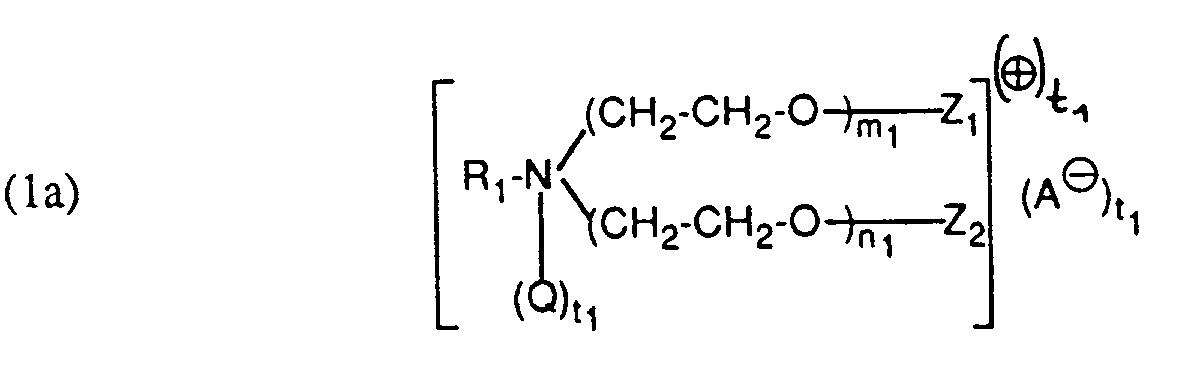

- R1 und R2 unabhängig voneinander einen aliphatischen Rest mit 12 bis 24 C-Atomen,
- Q und Q' unabhängig voneinander C1 bis C4-Alkyl, -CH2-CO-NH2,
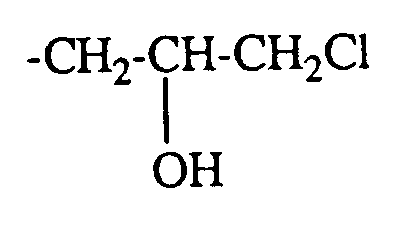
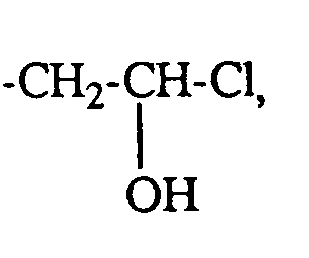
- A⊖ und A'⊖ ein Anion,
- Z1, Z2, Z'1 und Z'2 unabhängig voneinander Wasserstoff, S03M oder P03M, wobei M Wasserstoff, Alkalimetall oder Ammonium, t1 0 oder 1 und t2 0 oder 1 bedeuten, wobei wenn t1 0 ist, Z1 und Z2 Wasserstoff oder von Z1 und Z2 der eine Rest Wasserstoff und der andere S03M oder P03M bedeutet, und wenn t2 0 ist, Z'1 und Z'2 Wasserstoff oder von Z'1 und Z'2 der eine Rest Wasserstoff und der andere S03M oder P03M bedeutet, mi, ni, p1 und q1 ganze Zahlen bedeuten, wobei die Summe von (m1 + n1) 2 bis 15 und (p1 + q1) 25 bis 200 ist, und als Komponente (c) 0 bis 70 Teile der Verbindung der Formel (2)

- Man erhält nach dem erfindungsgemässen Färbeverfahren faser- und flächenegale Färbungen, besonders in hellen bis mittleren Farbtönen mit guten Licht- und Nassechtheiten.
- Die nachfolgenden Beispiele veranschaulichen die Erfindung. Darin sind die Teile Gewichtsteile und Prozente Gewichtsprozente. Die Temperaturen sind in ° C angegeben.
- Beispiel 1: 40 g Wollgewebe werden in einem Zirkulationsapparat nach der Baumfärbemethode während 10 Minuten bei 40 ° vorbehandelt. Die Flotte besteht aus
- 4 g Natriumsulfat sicc.
- 0,8 g Natriumacetat
- 2 g 80%-ige Essigsäure
- 800 ml Wasser
- 0,4 g des Hilfsmittelgemisches A1 bestehend aus
- a) 50 Teilen des mit Chloracetamid quaternisiertes Anlagerungsproduktes von 7 Mol Ethylenoxid an 1 Mol Talgfettamin und
- b) 50 Teilen des Ammoniumsalzes des sauren Schwefelsäuremonoesters des Anlagerungsproduktes von 7 Mol Ethylenoxid an 1 Mol Talgfettamin und
- 0,2 g des Hilfsmittels B2 bestehend aus dem Anlagerungsprodukt aus 40 Mol Ethylenoxid an 1 Mol eines C2o-C22-Fettamins.
- Der pH-Wert der Flotte beträgt 4,5.
- Nach Zugabe einer Lösung, die 12 mg des Farbstoffes der Formel


- Beispiel 2: Man verfährt wie in Beispiel 1 beschrieben mit dem Unterschied, dass anstelle des Hilfsmittels B2
- 0,4 g des Hilfsmittelgemisches Bi, bestehend aus
- a) 25,2 Teilen des Ammoniumsalzes des sauren Schwefelsäureesters des Anlagerungsproduktes von 8 Mol Ethylenoxid an 1 Mol Talgfettamin
- b) 21,3 Teilen des mit Dimethylsulfat quaterniertem Anlagerungsproduktes von 34 Mol Ethylenoxid an ein Mol eines C2o-22-Fettamins und
- c) 7,0 Teilen der Verbindung der Formel

- Beispiel 3: Man verfährt wie in Beispiel 1 beschrieben mit dem Unterschied, dass anstelle des Hilfsmittels B2 0,2 g des Anlagerungsproduktes von 34 Mol Ethylenoxid an 1 Mol eines C2o-C22-Fettamins eingesetzt wird. Man erhält eine faser- und flächenegale Färbung mit guten Echtheitseigenschaften.
- Beispiel 4: Man verfährt wie in Beispiel 1 beschrieben mit dem Unterschied, dass anstelle des Hilfsmittels B2 0,2 g des quaternierten Anlagerungsproduktes von 34 Mol Ethylenoxid an 1 Mol eines C2o-C22-Fettamins eingesetzt wird. Man erhält eine faser- und flächenegale Färbung mit guten Echtheitseigenschaften.
- Beispiel 5: Man verfährt wie in Beispiel 1 beschrieben mit dem Unterschied, dass anstelle von B2 0,2 g des Anlagerungsproduktes von 30 Mol Ethylenoxid an 1 Mol Talgfettamin eingesetzt wird. Man erhält eine faser- und flächenegale Färbung mit guten Echtheitseigenschaften.
- Beispiel 6: 1 kg Wollkammgarn in Form einer Kreuzspule wird in einem Zirkulationsapparat mit 9 I Wasser von 40 °,
- 100 g Natriumsulfat
- 9 g Ammoniumacetat
- 37 ml 80%-ige Essigsäure
- 9 g eines nichtionogenen Netzmittels auf der Basis von 2-Ethylhexanol
- 10 g des Hilfsmittelgemisches A1
- 10 g des Hilfsmittelgemisches B1
- 15 Minuten vorbehandelt. Der pH-Wert der Flotte beträgt 4,65. Nach Zugabe einer Lösung, die 0,3 g des Farbstoffes der Formel (101), 0,6 g des Farbstoffes der Formel (102) und 1,1 g des Farbstoffes der Formel (103) enthält, wird mit einer Aufheizrate von 1 ° /min auf 60° erwärmt und 20 Minuten bei 60° gehalten. Anschliessend wird mit 1 °/min erwärmt und 30 Minuten gefärbt. Nach Abkühlen der Flotte auf 70 wird wie üblich gespült. Bei Bedarf kann zur Verbesserung der Echtheitseigenschaften eine alkalische Nachbehandlung beispielsweise mit Ammoniak, Natriumcarbonat oder Natriumhydrogencarbonat angeschlossen werden. Man erhält faser- und flächenegale Färbungen mit ausgezeichneten Echtheitseigenschaften.
- Beispiel 7: Man verfährt wie in Beispiel 7, mit dem Unterschied, dass man eine Farbstofflösung, bestehend aus
- 4 g des Farbstoffes der Formel (101)
- 6 g des Farbstoffes der Formel (102) und
- 4 g des Farbstoffes der Formel (103)
- einsetzt.
- Beispiel 8: Man verfährt wie in Beispiel 6 mit dem Unterschied, dass man anstelle der Hilfsmittelgemischkombinationen aus A1 und B1 30 g des Hilfsmittelgemisches C1 verwendet, das folgende Zusammensetzung aufweist:
- a) 5 Teile des mit Dimethylsulfat quaternierten Anlagerungsproduktes von 34 Mol Ethylenoxid an 1 Mol eines C2o-22-Fettamins
- b) 2 Teile der Verbindung der Formel (104)
- c) 20 Teile des mit Chloracetamid quaternierten Anlagerungsproduktes von 7 Mol Ethylenoxid an 1 Mol Talgfettamin
- d) 20 Teile des Ammoniumsalzes des sauren Schwefelsäuremonoesters des Anlagerungsproduktes von 7 Mol Ethylenoxid an 1 Mol Talgfettamin und
- e) 2 Teile des Anlagerungsproduktes von 80 Mol Ethylenoxid an 1 Mol Oleylalkohol. Man erhält eine faser- und flächenegale Färbung mit guten Echtheitseigenschaften.
- Beispiel 9: Man verfährt wie in Beispiel 2 beschrieben mit dem Unterschied, dass an Stelle der Farbstoffmischung 80 mg des Farbstoffes der Formel
- Beispiel 10: Man verfährt wie in Beispiel 9 beschrieben mit dem Unterschied, dass man anstelle von 80 mg des Farbstoffs der Formel (105) 80 mg des Farbstoffes der Formel
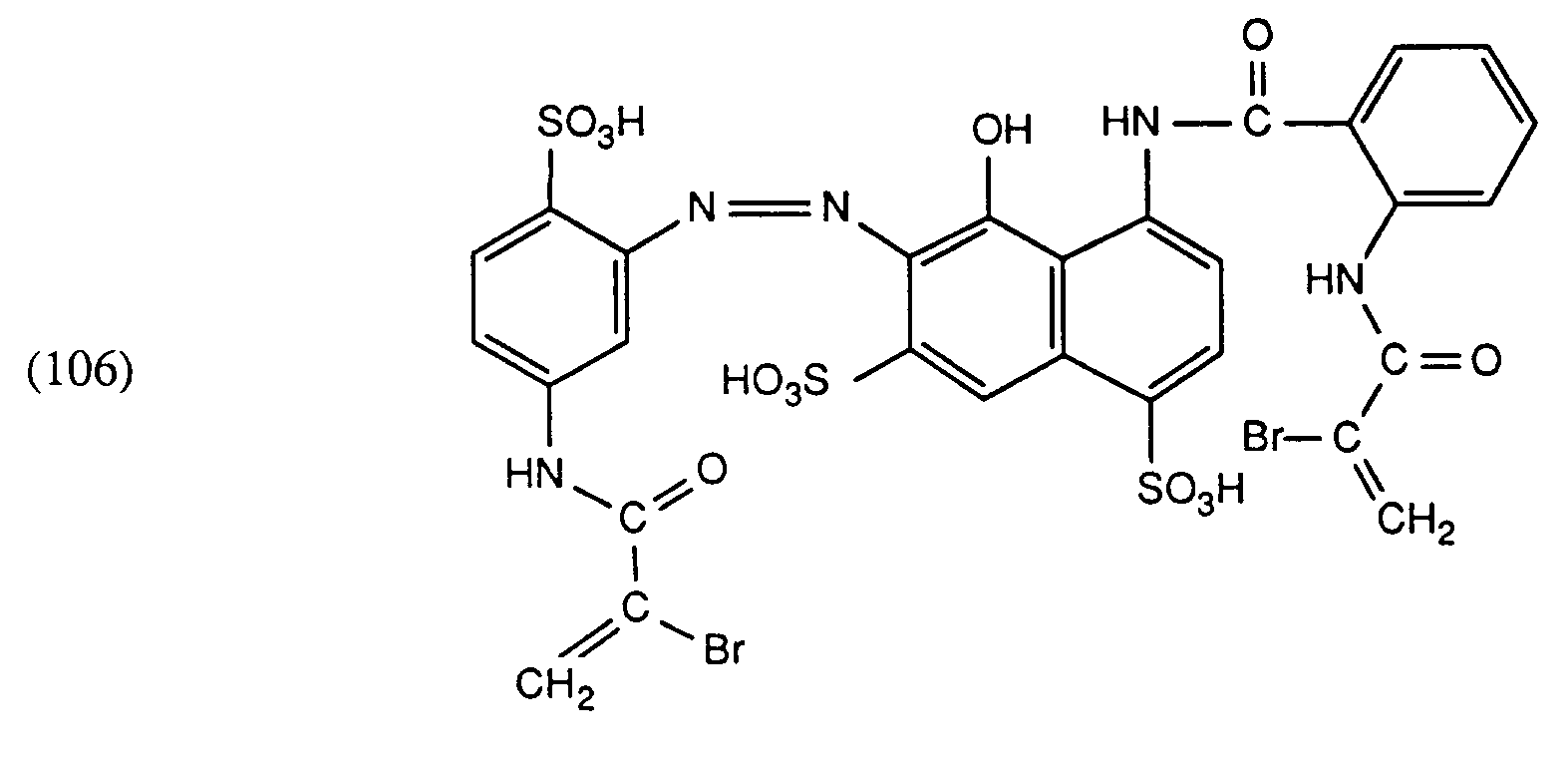
- Beispiel 11: Man verfährt wie in Beispiel 9 beschrieben mit dem Unterschied, dass man anstelle von 80 mg des Farbstoffs der Formel (105) 200 mg des Farbstoffes der Formel

- Beispiel 12: Man verfährt wie in Beispiel 9 beschrieben mit dem Unterschied, dass man anstelle von 80 mg des Farbstoffs der Formel (105) 320 mg des Farbstoffs der Formel
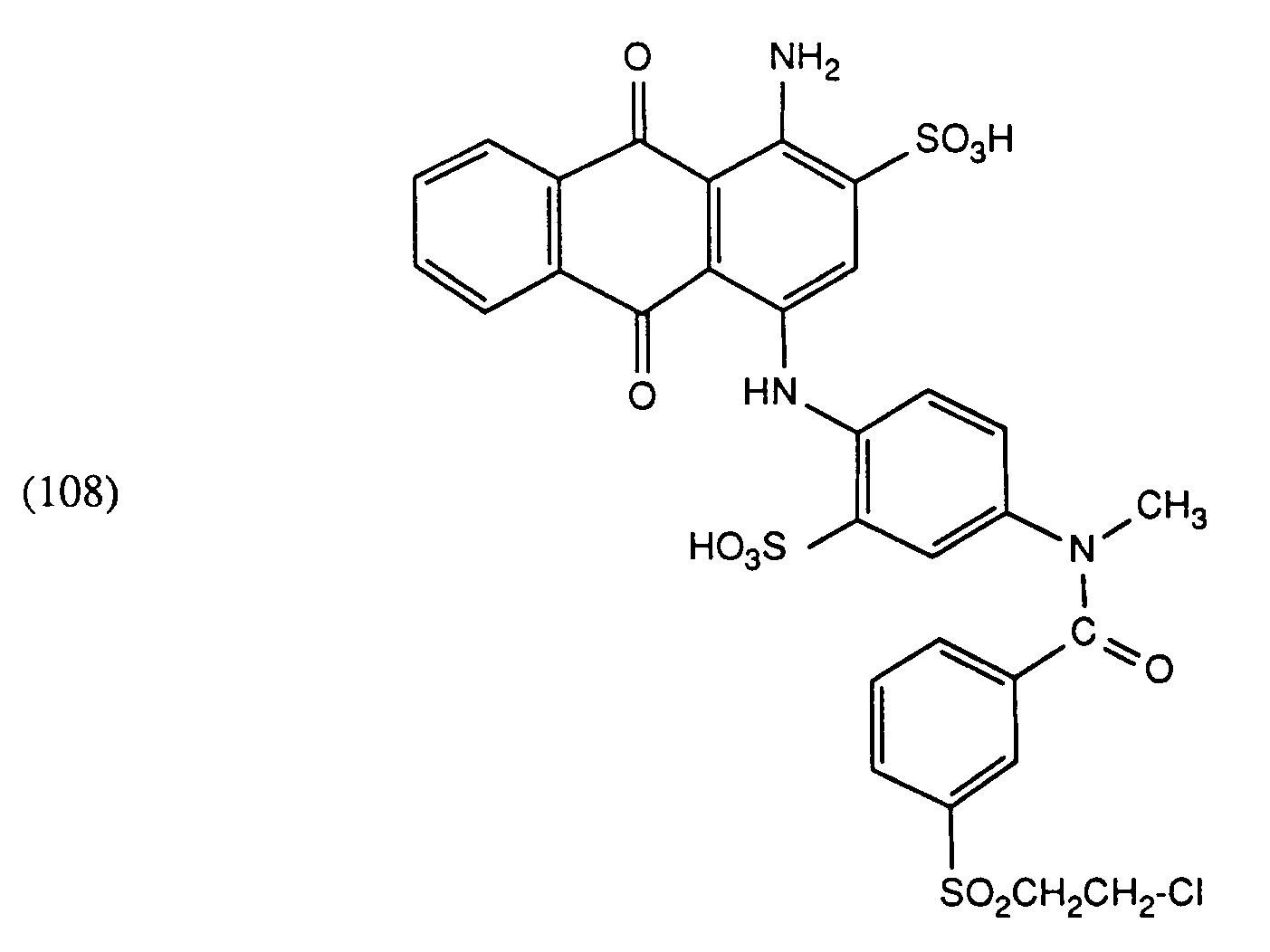
- Beispiel 13: Man verfährt wie in Beispiel 9 beschrieben mit dem Unterschied, dass man anstelle von 80 mg des Farbstoffs der Formel (105) 100 mg des Farbstoffes der Formel

Claims (15)




verwendet.


Applications Claiming Priority (2)
| Application Number | Priority Date | Filing Date | Title |
|---|---|---|---|
| CH477/90 | 1990-02-14 | ||
| CH47790 | 1990-02-14 |
Publications (3)
| Publication Number | Publication Date |
|---|---|
| EP0442844A1 EP0442844A1 (de) | 1991-08-21 |
| EP0442844B1 true EP0442844B1 (de) | 1995-02-01 |
| EP0442844B2 EP0442844B2 (de) | 1998-01-21 |
Family
ID=4187901
Family Applications (1)
| Application Number | Title | Priority Date | Filing Date |
|---|---|---|---|
| EP91810078A Expired - Lifetime EP0442844B2 (de) | 1990-02-14 | 1991-02-05 | Verfahren zum Färben von Wolle mit Reaktivfarbstoffen |
Country Status (9)
| Country | Link |
|---|---|
| US (1) | US5145486A (de) |
| EP (1) | EP0442844B2 (de) |
| JP (1) | JPH04214476A (de) |
| KR (1) | KR910015749A (de) |
| AU (1) | AU638793B2 (de) |
| CA (1) | CA2036224A1 (de) |
| DE (1) | DE59104446D1 (de) |
| ES (1) | ES2067902T5 (de) |
| NZ (1) | NZ237087A (de) |
Families Citing this family (7)
| Publication number | Priority date | Publication date | Assignee | Title |
|---|---|---|---|---|
| EP0548013A1 (de) * | 1991-12-16 | 1993-06-23 | Ciba-Geigy Ag | Verfahren zum Färben von Wolle mit Hilfe einer Niedertemperaturplasma- oder Corona-Vorbehandlung |
| IT1261839B (it) * | 1992-08-03 | 1996-06-03 | Sandoz Ag | Procedimento per la produzione di effetti speciali di coloritura su prodotti tessili e miscele di coloranti impiegate. |
| EP0636743B1 (de) * | 1993-07-28 | 1999-12-29 | Ciba SC Holding AG | Verfahren zum Färben von wollhaltigen Fasermaterialien |
| DE19848894A1 (de) * | 1998-10-23 | 2000-04-27 | Bayer Ag | Phosphorsäureester |
| CN100449054C (zh) * | 2003-06-26 | 2009-01-07 | 西巴特殊化学品控股有限公司 | 环糊精或环糊精衍生物的含水液体组合物及使用该组合物的方法 |
| EP1777337A1 (de) * | 2005-10-07 | 2007-04-25 | Clariant International Ltd. | Verfahren zum Färben von Polyamidfasern |
| DE102008058921A1 (de) * | 2008-11-25 | 2010-05-27 | Henkel Ag & Co. Kgaa | Neue Färbemittel |
Family Cites Families (7)
| Publication number | Priority date | Publication date | Assignee | Title |
|---|---|---|---|---|
| US3919283A (en) * | 1965-03-18 | 1975-11-11 | Ciba Geigy Ag | Sulfate derivatives of polyglycol compounds |
| DE2847913B1 (de) * | 1978-11-04 | 1980-02-07 | Hoechst Ag | Verfahren zum Faerben von Wolle mit Reaktivfarbstoffen |
| DE3363011D1 (en) * | 1982-03-12 | 1986-05-22 | Ciba Geigy Ag | Process for dyeing fibrous material from natural polyamides |
| FR2574791A1 (fr) * | 1984-12-14 | 1986-06-20 | Sandoz Sa | Sulfates d'amines grasses, leur preparation et leur utilisation comme produits auxiliaires |
| EP0312493B1 (de) * | 1987-10-14 | 1992-07-15 | Ciba-Geigy Ag | Verfahren zum Färben von natürlichen Polyamidfasern mit Reaktivfarbstoffen |
| EP0414631A1 (de) * | 1989-02-22 | 1991-02-27 | Ciba-Geigy Ag | Hilfsmittelgemisch und seine Verwendung beim Färben von Polyesterfasermaterialien |
| EP0417040A1 (de) * | 1989-09-06 | 1991-03-13 | Ciba-Geigy Ag | Verfahren zum Färben von Wolle |
-
1991
- 1991-02-05 DE DE59104446T patent/DE59104446D1/de not_active Expired - Fee Related
- 1991-02-05 ES ES91810078T patent/ES2067902T5/es not_active Expired - Lifetime
- 1991-02-05 EP EP91810078A patent/EP0442844B2/de not_active Expired - Lifetime
- 1991-02-11 US US07/654,139 patent/US5145486A/en not_active Expired - Fee Related
- 1991-02-12 NZ NZ237087A patent/NZ237087A/xx unknown
- 1991-02-12 CA CA002036224A patent/CA2036224A1/en not_active Abandoned
- 1991-02-12 KR KR1019910002313A patent/KR910015749A/ko not_active Withdrawn
- 1991-02-12 AU AU70994/91A patent/AU638793B2/en not_active Ceased
- 1991-02-14 JP JP3020240A patent/JPH04214476A/ja active Pending
Also Published As
| Publication number | Publication date |
|---|---|
| CA2036224A1 (en) | 1991-08-15 |
| EP0442844A1 (de) | 1991-08-21 |
| US5145486A (en) | 1992-09-08 |
| JPH04214476A (ja) | 1992-08-05 |
| NZ237087A (en) | 1993-04-28 |
| EP0442844B2 (de) | 1998-01-21 |
| DE59104446D1 (de) | 1995-03-16 |
| ES2067902T3 (es) | 1995-04-01 |
| AU638793B2 (en) | 1993-07-08 |
| KR910015749A (ko) | 1991-09-30 |
| ES2067902T5 (es) | 1998-04-16 |
| AU7099491A (en) | 1991-08-15 |
Similar Documents
| Publication | Publication Date | Title |
|---|---|---|
| EP0089004B1 (de) | Verfahren zum Färben von Fasermaterial aus natürlichen Polyamiden | |
| EP0074923B1 (de) | Färbereihilfsmittel und seine Verwendung beim Färben oder Bedrucken von synthetischen Polyamidfasermaterialien | |
| DE1940178A1 (de) | AEthansulfonsaeurederivate | |
| EP0135198A2 (de) | Verfahren zum Färben von Fasermaterial aus synthetischen Polyamiden | |
| EP0197005B1 (de) | Maleinsäure- oder Phthalsäurehalbester von alkoxylierten Fettaminen | |
| EP0309405B1 (de) | Verfahren zum Färben oder Bedrucken von Fasermaterial aus natürlichen oder synthetischen Polyamiden mit Reaktivfarbstoffen | |
| EP0442844B2 (de) | Verfahren zum Färben von Wolle mit Reaktivfarbstoffen | |
| EP0312493B1 (de) | Verfahren zum Färben von natürlichen Polyamidfasern mit Reaktivfarbstoffen | |
| DE1924765B2 (de) | Polyoxyalkylierte Amine und deren Verwendung beim Färben mit Reaktivfarbstoffen | |
| EP0235088B1 (de) | Maleinsäure- oder Phthalsäurehalbester von alkoxylierten Fettaminen | |
| EP0745720B1 (de) | Die Verwendung von Hilfsmittelzubereitungen beim Färben von Wolle | |
| EP0163608B1 (de) | Verfahren zum Färben von Fasermaterial aus natürlichen oder synthetischen Polyamiden mit 1:1-Metallkomplexfarbstoffen | |
| EP0225282B1 (de) | Verfahren zur Nachbehandlung von gefärbtem Cellulosefasermaterial | |
| EP0593392B1 (de) | Verfahren zum Färben von natürlichen und synthetischen Polyamidfasermaterialien mit Farbstoffmischungen | |
| EP0302013A1 (de) | Verfahren zum Färben von textilen Flächengebilden aus Polyamiden | |
| EP0203890B1 (de) | Verfahren zum Färben von Fasermaterial aus natürlichen Polyamiden mit Farbstoffmischungen | |
| EP0474594B1 (de) | Verfahren zum Färben von Wolle und deren Mischungen mit anderen Fasern mit Reaktivfarbstoffen | |
| EP0040780A1 (de) | Verfahren zum Bedrucken von synthetischem hydrophobem Fasermaterial | |
| EP0264346B1 (de) | Verfahren zum Färben von Fasermaterial aus natürlichen oder synthetischen Polyamiden mit 1:1-Metallkomplexfarbstoffen | |
| DE2841800C2 (de) | ||
| EP1123300A1 (de) | Phosphorsäureester | |
| DE1568258C3 (de) | Verwendung von amphoteren Polyglykolverbindungen als Egalisiermittel | |
| DE2405057C3 (de) | Verfahren zum Klotzfärben oder Bedrucken von Textilmischmaterial aus Cellulose- und Polyesterfasern | |
| DE1901165A1 (de) | N-Alkyl-aminoalkansulfonsaeuren | |
| DE1901411A1 (de) | Verfahren zum kontinuierlichen Faerben von Polyester-Textilmaterialien |
Legal Events
| Date | Code | Title | Description |
|---|---|---|---|
| PUAI | Public reference made under article 153(3) epc to a published international application that has entered the european phase |
Free format text: ORIGINAL CODE: 0009012 |
|
| 17P | Request for examination filed |
Effective date: 19910207 |
|
| AK | Designated contracting states |
Kind code of ref document: A1 Designated state(s): BE CH DE ES FR GB IT LI |
|
| 17Q | First examination report despatched |
Effective date: 19930622 |
|
| GRAA | (expected) grant |
Free format text: ORIGINAL CODE: 0009210 |
|
| AK | Designated contracting states |
Kind code of ref document: B1 Designated state(s): BE CH DE ES FR GB IT LI |
|
| ET | Fr: translation filed | ||
| REF | Corresponds to: |
Ref document number: 59104446 Country of ref document: DE Date of ref document: 19950316 |
|
| REG | Reference to a national code |
Ref country code: ES Ref legal event code: FG2A Ref document number: 2067902 Country of ref document: ES Kind code of ref document: T3 |
|
| ITF | It: translation for a ep patent filed | ||
| GBT | Gb: translation of ep patent filed (gb section 77(6)(a)/1977) |
Effective date: 19950314 |
|
| PLBI | Opposition filed |
Free format text: ORIGINAL CODE: 0009260 |
|
| 26 | Opposition filed |
Opponent name: BAYER AG, LEVERKUSEN KONZERNVERWALTUNG RP PATENTE Effective date: 19951027 |
|
| PLBF | Reply of patent proprietor to notice(s) of opposition |
Free format text: ORIGINAL CODE: EPIDOS OBSO |
|
| ITTA | It: last paid annual fee | ||
| PLBF | Reply of patent proprietor to notice(s) of opposition |
Free format text: ORIGINAL CODE: EPIDOS OBSO |
|
| PLBF | Reply of patent proprietor to notice(s) of opposition |
Free format text: ORIGINAL CODE: EPIDOS OBSO |
|
| PLBF | Reply of patent proprietor to notice(s) of opposition |
Free format text: ORIGINAL CODE: EPIDOS OBSO |
|
| REG | Reference to a national code |
Ref country code: CH Ref legal event code: PUE Owner name: CIBA-GEIGY AG TRANSFER- CIBA SC HOLDING AG |
|
| BECN | Be: change of holder's name |
Effective date: 19961129 |
|
| PGFP | Annual fee paid to national office [announced via postgrant information from national office to epo] |
Ref country code: ES Payment date: 19970214 Year of fee payment: 7 |
|
| REG | Reference to a national code |
Ref country code: FR Ref legal event code: TP Ref country code: CH Ref legal event code: PFA Free format text: CIBA SC HOLDING AG TRANSFER- CIBA SPECIALTY CHEMICALS HOLDING INC. |
|
| RAP2 | Party data changed (patent owner data changed or rights of a patent transferred) |
Owner name: CIBA SPECIALTY CHEMICALS HOLDING INC. |
|
| PLAW | Interlocutory decision in opposition |
Free format text: ORIGINAL CODE: EPIDOS IDOP |
|
| REG | Reference to a national code |
Ref country code: GB Ref legal event code: 732E |
|
| PLAW | Interlocutory decision in opposition |
Free format text: ORIGINAL CODE: EPIDOS IDOP |
|
| PUAH | Patent maintained in amended form |
Free format text: ORIGINAL CODE: 0009272 |
|
| PGFP | Annual fee paid to national office [announced via postgrant information from national office to epo] |
Ref country code: FR Payment date: 19971223 Year of fee payment: 8 |
|
| PGFP | Annual fee paid to national office [announced via postgrant information from national office to epo] |
Ref country code: DE Payment date: 19980108 Year of fee payment: 8 Ref country code: CH Payment date: 19980108 Year of fee payment: 8 |
|
| 27A | Patent maintained in amended form |
Effective date: 19980121 |
|
| AK | Designated contracting states |
Kind code of ref document: B2 Designated state(s): BE CH DE ES FR GB IT LI |
|
| PGFP | Annual fee paid to national office [announced via postgrant information from national office to epo] |
Ref country code: GB Payment date: 19980121 Year of fee payment: 8 |
|
| REG | Reference to a national code |
Ref country code: CH Ref legal event code: AEN Free format text: AUFRECHTERHALTUNG DES PATENTES IN GEAENDERTER FORM |
|
| ITF | It: translation for a ep patent filed | ||
| GBTA | Gb: translation of amended ep patent filed (gb section 77(6)(b)/1977) | ||
| REG | Reference to a national code |
Ref country code: FR Ref legal event code: CD |
|
| ET3 | Fr: translation filed ** decision concerning opposition | ||
| PGFP | Annual fee paid to national office [announced via postgrant information from national office to epo] |
Ref country code: BE Payment date: 19980403 Year of fee payment: 8 |
|
| REG | Reference to a national code |
Ref country code: ES Ref legal event code: DC2A Kind code of ref document: T5 Effective date: 19980310 |
|
| REG | Reference to a national code |
Ref country code: ES Ref legal event code: PC2A |
|
| PG25 | Lapsed in a contracting state [announced via postgrant information from national office to epo] |
Ref country code: GB Free format text: LAPSE BECAUSE OF NON-PAYMENT OF DUE FEES Effective date: 19990205 |
|
| PG25 | Lapsed in a contracting state [announced via postgrant information from national office to epo] |
Ref country code: ES Free format text: LAPSE BECAUSE OF NON-PAYMENT OF DUE FEES Effective date: 19990206 |
|
| PG25 | Lapsed in a contracting state [announced via postgrant information from national office to epo] |
Ref country code: LI Free format text: LAPSE BECAUSE OF NON-PAYMENT OF DUE FEES Effective date: 19990228 Ref country code: CH Free format text: LAPSE BECAUSE OF NON-PAYMENT OF DUE FEES Effective date: 19990228 Ref country code: BE Free format text: LAPSE BECAUSE OF NON-PAYMENT OF DUE FEES Effective date: 19990228 |
|
| BERE | Be: lapsed |
Owner name: CIBA SPECIALTY CHEMICALS HOLDING INC. Effective date: 19990228 |
|
| GBPC | Gb: european patent ceased through non-payment of renewal fee |
Effective date: 19990205 |
|
| REG | Reference to a national code |
Ref country code: CH Ref legal event code: PL |
|
| PG25 | Lapsed in a contracting state [announced via postgrant information from national office to epo] |
Ref country code: FR Free format text: LAPSE BECAUSE OF NON-PAYMENT OF DUE FEES Effective date: 19991029 |
|
| PG25 | Lapsed in a contracting state [announced via postgrant information from national office to epo] |
Ref country code: DE Free format text: LAPSE BECAUSE OF NON-PAYMENT OF DUE FEES Effective date: 19991201 |
|
| REG | Reference to a national code |
Ref country code: FR Ref legal event code: ST |
|
| REG | Reference to a national code |
Ref country code: ES Ref legal event code: FD2A Effective date: 20010503 |
|
| PG25 | Lapsed in a contracting state [announced via postgrant information from national office to epo] |
Ref country code: IT Free format text: LAPSE BECAUSE OF NON-PAYMENT OF DUE FEES;WARNING: LAPSES OF ITALIAN PATENTS WITH EFFECTIVE DATE BEFORE 2007 MAY HAVE OCCURRED AT ANY TIME BEFORE 2007. THE CORRECT EFFECTIVE DATE MAY BE DIFFERENT FROM THE ONE RECORDED. Effective date: 20050205 |