EP0442073B1 - Polycyclische 3-Aryl-pyrrolidin-2,4,-dion-Derivate - Google Patents
Polycyclische 3-Aryl-pyrrolidin-2,4,-dion-Derivate Download PDFInfo
- Publication number
- EP0442073B1 EP0442073B1 EP90123777A EP90123777A EP0442073B1 EP 0442073 B1 EP0442073 B1 EP 0442073B1 EP 90123777 A EP90123777 A EP 90123777A EP 90123777 A EP90123777 A EP 90123777A EP 0442073 B1 EP0442073 B1 EP 0442073B1
- Authority
- EP
- European Patent Office
- Prior art keywords
- alkyl
- alkoxy
- halogen
- optionally substituted
- formula
- Prior art date
- Legal status (The legal status is an assumption and is not a legal conclusion. Google has not performed a legal analysis and makes no representation as to the accuracy of the status listed.)
- Expired - Lifetime
Links
- 125000003367 polycyclic group Chemical group 0.000 title claims description 14
- -1 C1-C20-halogenoalkyl Chemical group 0.000 claims description 113
- 229910052736 halogen Inorganic materials 0.000 claims description 111
- 150000002367 halogens Chemical class 0.000 claims description 109
- 150000001875 compounds Chemical class 0.000 claims description 76
- 238000000034 method Methods 0.000 claims description 61
- 230000008569 process Effects 0.000 claims description 47
- ZAMOUSCENKQFHK-UHFFFAOYSA-N Chlorine atom Chemical group [Cl] ZAMOUSCENKQFHK-UHFFFAOYSA-N 0.000 claims description 46
- 125000004169 (C1-C6) alkyl group Chemical group 0.000 claims description 43
- 239000000460 chlorine Chemical group 0.000 claims description 40
- 229910052801 chlorine Inorganic materials 0.000 claims description 40
- 125000001997 phenyl group Chemical group [H]C1=C([H])C([H])=C(*)C([H])=C1[H] 0.000 claims description 36
- 239000003085 diluting agent Substances 0.000 claims description 35
- 239000002253 acid Substances 0.000 claims description 33
- 239000011737 fluorine Substances 0.000 claims description 33
- 229910052731 fluorine Inorganic materials 0.000 claims description 33
- WKBOTKDWSSQWDR-UHFFFAOYSA-N Bromine atom Chemical group [Br] WKBOTKDWSSQWDR-UHFFFAOYSA-N 0.000 claims description 32
- 125000001495 ethyl group Chemical group [H]C([H])([H])C([H])([H])* 0.000 claims description 32
- GDTBXPJZTBHREO-UHFFFAOYSA-N bromine Chemical group BrBr GDTBXPJZTBHREO-UHFFFAOYSA-N 0.000 claims description 29
- 229910052794 bromium Inorganic materials 0.000 claims description 29
- 125000000229 (C1-C4)alkoxy group Chemical group 0.000 claims description 27
- 239000001301 oxygen Substances 0.000 claims description 27
- 229910052760 oxygen Inorganic materials 0.000 claims description 27
- 239000001257 hydrogen Substances 0.000 claims description 26
- 229910052739 hydrogen Inorganic materials 0.000 claims description 26
- PXGOKWXKJXAPGV-UHFFFAOYSA-N Fluorine Chemical compound FF PXGOKWXKJXAPGV-UHFFFAOYSA-N 0.000 claims description 25
- UFHFLCQGNIYNRP-UHFFFAOYSA-N Hydrogen Chemical compound [H][H] UFHFLCQGNIYNRP-UHFFFAOYSA-N 0.000 claims description 25
- 125000001153 fluoro group Chemical group F* 0.000 claims description 25
- 239000011230 binding agent Substances 0.000 claims description 24
- 125000000449 nitro group Chemical group [O-][N+](*)=O 0.000 claims description 23
- 125000004191 (C1-C6) alkoxy group Chemical group 0.000 claims description 21
- NINIDFKCEFEMDL-UHFFFAOYSA-N Sulfur Chemical compound [S] NINIDFKCEFEMDL-UHFFFAOYSA-N 0.000 claims description 21
- 125000003837 (C1-C20) alkyl group Chemical class 0.000 claims description 20
- QVGXLLKOCUKJST-UHFFFAOYSA-N atomic oxygen Chemical compound [O] QVGXLLKOCUKJST-UHFFFAOYSA-N 0.000 claims description 20
- 241000196324 Embryophyta Species 0.000 claims description 18
- 125000001797 benzyl group Chemical group [H]C1=C([H])C([H])=C(C([H])=C1[H])C([H])([H])* 0.000 claims description 18
- 125000001449 isopropyl group Chemical group [H]C([H])([H])C([H])(*)C([H])([H])[H] 0.000 claims description 18
- QGJOPFRUJISHPQ-UHFFFAOYSA-N Carbon disulfide Chemical compound S=C=S QGJOPFRUJISHPQ-UHFFFAOYSA-N 0.000 claims description 17
- 125000002496 methyl group Chemical group [H]C([H])([H])* 0.000 claims description 17
- 238000002360 preparation method Methods 0.000 claims description 16
- 150000002431 hydrogen Chemical class 0.000 claims description 15
- 125000001436 propyl group Chemical group [H]C([*])([H])C([H])([H])C([H])([H])[H] 0.000 claims description 15
- 125000003860 C1-C20 alkoxy group Chemical group 0.000 claims description 12
- 125000002924 primary amino group Chemical group [H]N([H])* 0.000 claims description 12
- 125000002023 trifluoromethyl group Chemical group FC(F)(F)* 0.000 claims description 12
- QGZKDVFQNNGYKY-UHFFFAOYSA-O Ammonium Chemical compound [NH4+] QGZKDVFQNNGYKY-UHFFFAOYSA-O 0.000 claims description 11
- 125000004093 cyano group Chemical group *C#N 0.000 claims description 9
- 125000000753 cycloalkyl group Chemical group 0.000 claims description 9
- 229910021645 metal ion Inorganic materials 0.000 claims description 9
- 125000000951 phenoxy group Chemical group [H]C1=C([H])C([H])=C(O*)C([H])=C1[H] 0.000 claims description 9
- 125000003356 phenylsulfanyl group Chemical group [*]SC1=C([H])C([H])=C([H])C([H])=C1[H] 0.000 claims description 9
- 125000003226 pyrazolyl group Chemical group 0.000 claims description 9
- 125000000714 pyrimidinyl group Chemical group 0.000 claims description 9
- 125000000335 thiazolyl group Chemical group 0.000 claims description 9
- 125000000217 alkyl group Chemical group 0.000 claims description 8
- 150000001244 carboxylic acid anhydrides Chemical class 0.000 claims description 8
- 150000002148 esters Chemical class 0.000 claims description 8
- 125000004076 pyridyl group Chemical group 0.000 claims description 8
- 150000004692 metal hydroxides Chemical class 0.000 claims description 7
- 125000000008 (C1-C10) alkyl group Chemical group 0.000 claims description 6
- 125000006274 (C1-C3)alkoxy group Chemical group 0.000 claims description 6
- 125000003358 C2-C20 alkenyl group Chemical class 0.000 claims description 6
- 125000004648 C2-C8 alkenyl group Chemical group 0.000 claims description 6
- 125000000484 butyl group Chemical group [H]C([*])([H])C([H])([H])C([H])([H])C([H])([H])[H] 0.000 claims description 6
- 125000001301 ethoxy group Chemical group [H]C([H])([H])C([H])([H])O* 0.000 claims description 6
- 125000000959 isobutyl group Chemical group [H]C([H])([H])C([H])(C([H])([H])[H])C([H])([H])* 0.000 claims description 6
- 125000006273 (C1-C3) alkyl group Chemical group 0.000 claims description 5
- 125000006527 (C1-C5) alkyl group Chemical group 0.000 claims description 5
- 241000239223 Arachnida Species 0.000 claims description 5
- 150000004820 halides Chemical class 0.000 claims description 5
- 239000004009 herbicide Substances 0.000 claims description 5
- 125000000876 trifluoromethoxy group Chemical group FC(F)(F)O* 0.000 claims description 5
- 239000004606 Fillers/Extenders Substances 0.000 claims description 4
- 241000238631 Hexapoda Species 0.000 claims description 4
- 230000000895 acaricidal effect Effects 0.000 claims description 4
- 150000001350 alkyl halides Chemical class 0.000 claims description 4
- 150000002085 enols Chemical class 0.000 claims description 4
- 230000000749 insecticidal effect Effects 0.000 claims description 4
- 125000000956 methoxy group Chemical group [H]C([H])([H])O* 0.000 claims description 4
- 125000000027 (C1-C10) alkoxy group Chemical group 0.000 claims description 3
- 125000004455 (C1-C3) alkylthio group Chemical group 0.000 claims description 3
- 125000004890 (C1-C6) alkylamino group Chemical group 0.000 claims description 3
- 125000006700 (C1-C6) alkylthio group Chemical group 0.000 claims description 3
- CKDWPUIZGOQOOM-UHFFFAOYSA-N Carbamyl chloride Chemical class NC(Cl)=O CKDWPUIZGOQOOM-UHFFFAOYSA-N 0.000 claims description 3
- 150000001412 amines Chemical class 0.000 claims description 3
- NBYQXBYMEUOBON-UHFFFAOYSA-N carbamothioyl chloride Chemical class NC(Cl)=S NBYQXBYMEUOBON-UHFFFAOYSA-N 0.000 claims description 3
- 239000003054 catalyst Substances 0.000 claims description 3
- 239000012948 isocyanate Substances 0.000 claims description 3
- 150000002513 isocyanates Chemical class 0.000 claims description 3
- 229910000000 metal hydroxide Inorganic materials 0.000 claims description 3
- 125000004209 (C1-C8) alkyl group Chemical group 0.000 claims description 2
- 238000009833 condensation Methods 0.000 claims description 2
- 230000005494 condensation Effects 0.000 claims description 2
- PNDPGZBMCMUPRI-UHFFFAOYSA-N iodine Chemical compound II PNDPGZBMCMUPRI-UHFFFAOYSA-N 0.000 claims description 2
- 150000003018 phosphorus compounds Chemical class 0.000 claims description 2
- YBBRCQOCSYXUOC-UHFFFAOYSA-N sulfuryl dichloride Chemical class ClS(Cl)(=O)=O YBBRCQOCSYXUOC-UHFFFAOYSA-N 0.000 claims description 2
- 239000004094 surface-active agent Substances 0.000 claims description 2
- 229910052725 zinc Inorganic materials 0.000 claims description 2
- 239000005864 Sulphur Substances 0.000 claims 4
- 125000006413 ring segment Chemical group 0.000 claims 3
- 150000007970 thio esters Chemical class 0.000 claims 1
- ZMXDDKWLCZADIW-UHFFFAOYSA-N N,N-Dimethylformamide Chemical compound CN(C)C=O ZMXDDKWLCZADIW-UHFFFAOYSA-N 0.000 description 38
- 238000006243 chemical reaction Methods 0.000 description 32
- YXFVVABEGXRONW-UHFFFAOYSA-N Toluene Chemical compound CC1=CC=CC=C1 YXFVVABEGXRONW-UHFFFAOYSA-N 0.000 description 30
- 239000000203 mixture Substances 0.000 description 29
- YMWUJEATGCHHMB-UHFFFAOYSA-N Dichloromethane Chemical compound ClCCl YMWUJEATGCHHMB-UHFFFAOYSA-N 0.000 description 24
- HEMHJVSKTPXQMS-UHFFFAOYSA-M Sodium hydroxide Chemical compound [OH-].[Na+] HEMHJVSKTPXQMS-UHFFFAOYSA-M 0.000 description 21
- XLYOFNOQVPJJNP-UHFFFAOYSA-N water Substances O XLYOFNOQVPJJNP-UHFFFAOYSA-N 0.000 description 21
- CSCPPACGZOOCGX-UHFFFAOYSA-N Acetone Chemical compound CC(C)=O CSCPPACGZOOCGX-UHFFFAOYSA-N 0.000 description 20
- 239000003995 emulsifying agent Substances 0.000 description 19
- RTZKZFJDLAIYFH-UHFFFAOYSA-N Diethyl ether Chemical compound CCOCC RTZKZFJDLAIYFH-UHFFFAOYSA-N 0.000 description 18
- WYURNTSHIVDZCO-UHFFFAOYSA-N Tetrahydrofuran Chemical compound C1CCOC1 WYURNTSHIVDZCO-UHFFFAOYSA-N 0.000 description 18
- ZMANZCXQSJIPKH-UHFFFAOYSA-N Triethylamine Chemical compound CCN(CC)CC ZMANZCXQSJIPKH-UHFFFAOYSA-N 0.000 description 18
- BWHMMNNQKKPAPP-UHFFFAOYSA-L potassium carbonate Chemical compound [K+].[K+].[O-]C([O-])=O BWHMMNNQKKPAPP-UHFFFAOYSA-L 0.000 description 18
- 0 CC(CC1)C(CNCI)C(O*(C*)=I)=C(C(C(*)C=C2*)C=CC2(C)N)C1=O Chemical compound CC(CC1)C(CNCI)C(O*(C*)=I)=C(C(C(*)C=C2*)C=CC2(C)N)C1=O 0.000 description 17
- 229910001868 water Inorganic materials 0.000 description 17
- IAZDPXIOMUYVGZ-UHFFFAOYSA-N Dimethylsulphoxide Chemical compound CS(C)=O IAZDPXIOMUYVGZ-UHFFFAOYSA-N 0.000 description 16
- JUJWROOIHBZHMG-UHFFFAOYSA-N Pyridine Chemical compound C1=CC=NC=C1 JUJWROOIHBZHMG-UHFFFAOYSA-N 0.000 description 16
- CDBYLPFSWZWCQE-UHFFFAOYSA-L Sodium Carbonate Chemical compound [Na+].[Na+].[O-]C([O-])=O CDBYLPFSWZWCQE-UHFFFAOYSA-L 0.000 description 16
- 239000007858 starting material Substances 0.000 description 16
- 239000002904 solvent Substances 0.000 description 13
- QMMFVYPAHWMCMS-UHFFFAOYSA-N Dimethyl sulfide Chemical compound CSC QMMFVYPAHWMCMS-UHFFFAOYSA-N 0.000 description 12
- VEXZGXHMUGYJMC-UHFFFAOYSA-N Hydrochloric acid Chemical compound Cl VEXZGXHMUGYJMC-UHFFFAOYSA-N 0.000 description 12
- KEAYESYHFKHZAL-UHFFFAOYSA-N Sodium Chemical compound [Na] KEAYESYHFKHZAL-UHFFFAOYSA-N 0.000 description 11
- 150000002170 ethers Chemical class 0.000 description 11
- 239000012312 sodium hydride Substances 0.000 description 11
- 229910000104 sodium hydride Inorganic materials 0.000 description 11
- 238000012360 testing method Methods 0.000 description 10
- UHOVQNZJYSORNB-UHFFFAOYSA-N Benzene Chemical compound C1=CC=CC=C1 UHOVQNZJYSORNB-UHFFFAOYSA-N 0.000 description 9
- LFQSCWFLJHTTHZ-UHFFFAOYSA-N Ethanol Chemical compound CCO LFQSCWFLJHTTHZ-UHFFFAOYSA-N 0.000 description 9
- 229910000027 potassium carbonate Inorganic materials 0.000 description 9
- YLQBMQCUIZJEEH-UHFFFAOYSA-N tetrahydrofuran Natural products C=1C=COC=1 YLQBMQCUIZJEEH-UHFFFAOYSA-N 0.000 description 9
- VTYYLEPIZMXCLO-UHFFFAOYSA-L Calcium carbonate Chemical compound [Ca+2].[O-]C([O-])=O VTYYLEPIZMXCLO-UHFFFAOYSA-L 0.000 description 8
- BZLVMXJERCGZMT-UHFFFAOYSA-N Methyl tert-butyl ether Chemical compound COC(C)(C)C BZLVMXJERCGZMT-UHFFFAOYSA-N 0.000 description 8
- 229940077464 ammonium ion Drugs 0.000 description 8
- 239000002585 base Substances 0.000 description 8
- 239000003795 chemical substances by application Substances 0.000 description 8
- 238000012545 processing Methods 0.000 description 8
- UMJSCPRVCHMLSP-UHFFFAOYSA-N pyridine Natural products COC1=CC=CN=C1 UMJSCPRVCHMLSP-UHFFFAOYSA-N 0.000 description 8
- 229910000029 sodium carbonate Inorganic materials 0.000 description 8
- MYMOFIZGZYHOMD-UHFFFAOYSA-N Dioxygen Chemical compound O=O MYMOFIZGZYHOMD-UHFFFAOYSA-N 0.000 description 7
- VYPSYNLAJGMNEJ-UHFFFAOYSA-N Silicium dioxide Chemical compound O=[Si]=O VYPSYNLAJGMNEJ-UHFFFAOYSA-N 0.000 description 7
- 239000013543 active substance Substances 0.000 description 7
- 150000003839 salts Chemical class 0.000 description 7
- XEKOWRVHYACXOJ-UHFFFAOYSA-N Ethyl acetate Chemical compound CCOC(C)=O XEKOWRVHYACXOJ-UHFFFAOYSA-N 0.000 description 6
- 150000001298 alcohols Chemical class 0.000 description 6
- CODNYICXDISAEA-UHFFFAOYSA-N bromine monochloride Chemical compound BrCl CODNYICXDISAEA-UHFFFAOYSA-N 0.000 description 6
- 239000012141 concentrate Substances 0.000 description 6
- 230000000694 effects Effects 0.000 description 6
- 238000004519 manufacturing process Methods 0.000 description 6
- 229910052717 sulfur Inorganic materials 0.000 description 6
- 239000011593 sulfur Substances 0.000 description 6
- CXWXQJXEFPUFDZ-UHFFFAOYSA-N tetralin Chemical compound C1=CC=C2CCCCC2=C1 CXWXQJXEFPUFDZ-UHFFFAOYSA-N 0.000 description 6
- 241000238876 Acari Species 0.000 description 5
- 239000004480 active ingredient Substances 0.000 description 5
- 150000001340 alkali metals Chemical class 0.000 description 5
- 125000002877 alkyl aryl group Chemical group 0.000 description 5
- 150000001408 amides Chemical class 0.000 description 5
- 239000008187 granular material Substances 0.000 description 5
- 239000003960 organic solvent Substances 0.000 description 5
- 229920000151 polyglycol Polymers 0.000 description 5
- 239000010695 polyglycol Substances 0.000 description 5
- LPNYRYFBWFDTMA-UHFFFAOYSA-N potassium tert-butoxide Chemical compound [K+].CC(C)(C)[O-] LPNYRYFBWFDTMA-UHFFFAOYSA-N 0.000 description 5
- 239000000843 powder Substances 0.000 description 5
- 239000000047 product Substances 0.000 description 5
- 150000003457 sulfones Chemical class 0.000 description 5
- 150000003462 sulfoxides Chemical class 0.000 description 5
- RFFLAFLAYFXFSW-UHFFFAOYSA-N 1,2-dichlorobenzene Chemical compound ClC1=CC=CC=C1Cl RFFLAFLAYFXFSW-UHFFFAOYSA-N 0.000 description 4
- RYHBNJHYFVUHQT-UHFFFAOYSA-N 1,4-Dioxane Chemical compound C1COCCO1 RYHBNJHYFVUHQT-UHFFFAOYSA-N 0.000 description 4
- SYBYTAAJFKOIEJ-UHFFFAOYSA-N 3-Methylbutan-2-one Chemical compound CC(C)C(C)=O SYBYTAAJFKOIEJ-UHFFFAOYSA-N 0.000 description 4
- VRQQIOLPJVLMPR-UHFFFAOYSA-N 3-oxoundecanal Chemical compound CCCCCCCCC(=O)CC=O VRQQIOLPJVLMPR-UHFFFAOYSA-N 0.000 description 4
- HEDRZPFGACZZDS-UHFFFAOYSA-N Chloroform Chemical compound ClC(Cl)Cl HEDRZPFGACZZDS-UHFFFAOYSA-N 0.000 description 4
- JLTDJTHDQAWBAV-UHFFFAOYSA-N N,N-dimethylaniline Chemical compound CN(C)C1=CC=CC=C1 JLTDJTHDQAWBAV-UHFFFAOYSA-N 0.000 description 4
- CTQNGGLPUBDAKN-UHFFFAOYSA-N O-Xylene Chemical compound CC1=CC=CC=C1C CTQNGGLPUBDAKN-UHFFFAOYSA-N 0.000 description 4
- PMZURENOXWZQFD-UHFFFAOYSA-L Sodium Sulfate Chemical compound [Na+].[Na+].[O-]S([O-])(=O)=O PMZURENOXWZQFD-UHFFFAOYSA-L 0.000 description 4
- 229910052783 alkali metal Inorganic materials 0.000 description 4
- 229910052784 alkaline earth metal Inorganic materials 0.000 description 4
- 229910000019 calcium carbonate Inorganic materials 0.000 description 4
- 239000000969 carrier Substances 0.000 description 4
- FZFAMSAMCHXGEF-UHFFFAOYSA-N chloro formate Chemical compound ClOC=O FZFAMSAMCHXGEF-UHFFFAOYSA-N 0.000 description 4
- MVPPADPHJFYWMZ-UHFFFAOYSA-N chlorobenzene Chemical compound ClC1=CC=CC=C1 MVPPADPHJFYWMZ-UHFFFAOYSA-N 0.000 description 4
- 230000006378 damage Effects 0.000 description 4
- 238000011161 development Methods 0.000 description 4
- 238000002474 experimental method Methods 0.000 description 4
- 229930195733 hydrocarbon Natural products 0.000 description 4
- 150000007529 inorganic bases Chemical class 0.000 description 4
- VLKZOEOYAKHREP-UHFFFAOYSA-N n-Hexane Chemical compound CCCCCC VLKZOEOYAKHREP-UHFFFAOYSA-N 0.000 description 4
- 150000007530 organic bases Chemical class 0.000 description 4
- 239000003495 polar organic solvent Substances 0.000 description 4
- 239000002798 polar solvent Substances 0.000 description 4
- 229910052938 sodium sulfate Inorganic materials 0.000 description 4
- 235000011152 sodium sulphate Nutrition 0.000 description 4
- 239000000126 substance Substances 0.000 description 4
- 239000008096 xylene Substances 0.000 description 4
- 125000006677 (C1-C3) haloalkoxy group Chemical group 0.000 description 3
- 125000000171 (C1-C6) haloalkyl group Chemical group 0.000 description 3
- ZWEHNKRNPOVVGH-UHFFFAOYSA-N 2-Butanone Chemical compound CCC(C)=O ZWEHNKRNPOVVGH-UHFFFAOYSA-N 0.000 description 3
- WFDIJRYMOXRFFG-UHFFFAOYSA-N Acetic anhydride Chemical compound CC(=O)OC(C)=O WFDIJRYMOXRFFG-UHFFFAOYSA-N 0.000 description 3
- WEVYAHXRMPXWCK-UHFFFAOYSA-N Acetonitrile Chemical compound CC#N WEVYAHXRMPXWCK-UHFFFAOYSA-N 0.000 description 3
- BDAGIHXWWSANSR-UHFFFAOYSA-N Formic acid Chemical class OC=O BDAGIHXWWSANSR-UHFFFAOYSA-N 0.000 description 3
- OKKJLVBELUTLKV-UHFFFAOYSA-N Methanol Chemical compound OC OKKJLVBELUTLKV-UHFFFAOYSA-N 0.000 description 3
- 241000358422 Nephotettix cincticeps Species 0.000 description 3
- KWYUFKZDYYNOTN-UHFFFAOYSA-M Potassium hydroxide Chemical compound [OH-].[K+] KWYUFKZDYYNOTN-UHFFFAOYSA-M 0.000 description 3
- 239000000370 acceptor Substances 0.000 description 3
- 229910000287 alkaline earth metal oxide Inorganic materials 0.000 description 3
- 125000004429 atom Chemical group 0.000 description 3
- HTZCNXWZYVXIMZ-UHFFFAOYSA-M benzyl(triethyl)azanium;chloride Chemical compound [Cl-].CC[N+](CC)(CC)CC1=CC=CC=C1 HTZCNXWZYVXIMZ-UHFFFAOYSA-M 0.000 description 3
- BRPQOXSCLDDYGP-UHFFFAOYSA-N calcium oxide Chemical compound [O-2].[Ca+2] BRPQOXSCLDDYGP-UHFFFAOYSA-N 0.000 description 3
- 239000000292 calcium oxide Substances 0.000 description 3
- ODINCKMPIJJUCX-UHFFFAOYSA-N calcium oxide Inorganic materials [Ca]=O ODINCKMPIJJUCX-UHFFFAOYSA-N 0.000 description 3
- 150000004649 carbonic acid derivatives Chemical class 0.000 description 3
- 150000001733 carboxylic acid esters Chemical class 0.000 description 3
- AOGYCOYQMAVAFD-UHFFFAOYSA-N chlorocarbonic acid Chemical class OC(Cl)=O AOGYCOYQMAVAFD-UHFFFAOYSA-N 0.000 description 3
- 229940125890 compound Ia Drugs 0.000 description 3
- 150000008282 halocarbons Chemical class 0.000 description 3
- 150000002430 hydrocarbons Chemical class 0.000 description 3
- 239000002917 insecticide Substances 0.000 description 3
- 150000002576 ketones Chemical class 0.000 description 3
- 239000007788 liquid Substances 0.000 description 3
- 239000000395 magnesium oxide Substances 0.000 description 3
- CPLXHLVBOLITMK-UHFFFAOYSA-N magnesium oxide Inorganic materials [Mg]=O CPLXHLVBOLITMK-UHFFFAOYSA-N 0.000 description 3
- 238000002844 melting Methods 0.000 description 3
- 230000008018 melting Effects 0.000 description 3
- 150000002825 nitriles Chemical class 0.000 description 3
- 239000011435 rock Substances 0.000 description 3
- 239000000741 silica gel Substances 0.000 description 3
- 229910002027 silica gel Inorganic materials 0.000 description 3
- 239000007787 solid Substances 0.000 description 3
- 238000003756 stirring Methods 0.000 description 3
- HXJUTPCZVOIRIF-UHFFFAOYSA-N sulfolane Chemical compound O=S1(=O)CCCC1 HXJUTPCZVOIRIF-UHFFFAOYSA-N 0.000 description 3
- 125000004434 sulfur atom Chemical group 0.000 description 3
- 125000004765 (C1-C4) haloalkyl group Chemical group 0.000 description 2
- 125000004737 (C1-C6) haloalkoxy group Chemical group 0.000 description 2
- VZAWCLCJGSBATP-UHFFFAOYSA-N 1-cycloundecyl-1,2-diazacycloundecane Chemical compound C1CCCCCCCCCC1N1NCCCCCCCCC1 VZAWCLCJGSBATP-UHFFFAOYSA-N 0.000 description 2
- 241001143309 Acanthoscelides obtectus Species 0.000 description 2
- NLXLAEXVIDQMFP-UHFFFAOYSA-N Ammonia chloride Chemical compound [NH4+].[Cl-] NLXLAEXVIDQMFP-UHFFFAOYSA-N 0.000 description 2
- 235000005781 Avena Nutrition 0.000 description 2
- 244000075850 Avena orientalis Species 0.000 description 2
- CURLTUGMZLYLDI-UHFFFAOYSA-N Carbon dioxide Chemical compound O=C=O CURLTUGMZLYLDI-UHFFFAOYSA-N 0.000 description 2
- 241000254137 Cicadidae Species 0.000 description 2
- XDTMQSROBMDMFD-UHFFFAOYSA-N Cyclohexane Chemical compound C1CCCCC1 XDTMQSROBMDMFD-UHFFFAOYSA-N 0.000 description 2
- LCGLNKUTAGEVQW-UHFFFAOYSA-N Dimethyl ether Chemical compound COC LCGLNKUTAGEVQW-UHFFFAOYSA-N 0.000 description 2
- YIIMEMSDCNDGTB-UHFFFAOYSA-N Dimethylcarbamoyl chloride Chemical compound CN(C)C(Cl)=O YIIMEMSDCNDGTB-UHFFFAOYSA-N 0.000 description 2
- 241000255925 Diptera Species 0.000 description 2
- LYCAIKOWRPUZTN-UHFFFAOYSA-N Ethylene glycol Chemical compound OCCO LYCAIKOWRPUZTN-UHFFFAOYSA-N 0.000 description 2
- 241000258937 Hemiptera Species 0.000 description 2
- 241000257303 Hymenoptera Species 0.000 description 2
- XEEYBQQBJWHFJM-UHFFFAOYSA-N Iron Chemical class [Fe] XEEYBQQBJWHFJM-UHFFFAOYSA-N 0.000 description 2
- UQSXHKLRYXJYBZ-UHFFFAOYSA-N Iron oxide Chemical compound [Fe]=O UQSXHKLRYXJYBZ-UHFFFAOYSA-N 0.000 description 2
- KFZMGEQAYNKOFK-UHFFFAOYSA-N Isopropanol Chemical compound CC(C)O KFZMGEQAYNKOFK-UHFFFAOYSA-N 0.000 description 2
- FYYHWMGAXLPEAU-UHFFFAOYSA-N Magnesium Chemical compound [Mg] FYYHWMGAXLPEAU-UHFFFAOYSA-N 0.000 description 2
- LRHPLDYGYMQRHN-UHFFFAOYSA-N N-Butanol Chemical compound CCCCO LRHPLDYGYMQRHN-UHFFFAOYSA-N 0.000 description 2
- 240000007594 Oryza sativa Species 0.000 description 2
- 235000007164 Oryza sativa Nutrition 0.000 description 2
- 241000209117 Panicum Species 0.000 description 2
- 235000006443 Panicum miliaceum subsp. miliaceum Nutrition 0.000 description 2
- 235000009037 Panicum miliaceum subsp. ruderale Nutrition 0.000 description 2
- 244000046052 Phaseolus vulgaris Species 0.000 description 2
- 241001674048 Phthiraptera Species 0.000 description 2
- 229920003171 Poly (ethylene oxide) Polymers 0.000 description 2
- ATUOYWHBWRKTHZ-UHFFFAOYSA-N Propane Chemical compound CCC ATUOYWHBWRKTHZ-UHFFFAOYSA-N 0.000 description 2
- 241001105129 Ptinus Species 0.000 description 2
- 241001481703 Rhipicephalus <genus> Species 0.000 description 2
- 238000003436 Schotten-Baumann reaction Methods 0.000 description 2
- 241000258242 Siphonaptera Species 0.000 description 2
- WQDUMFSSJAZKTM-UHFFFAOYSA-N Sodium methoxide Chemical compound [Na+].[O-]C WQDUMFSSJAZKTM-UHFFFAOYSA-N 0.000 description 2
- 235000011684 Sorghum saccharatum Nutrition 0.000 description 2
- 244000062793 Sorghum vulgare Species 0.000 description 2
- 241001454295 Tetranychidae Species 0.000 description 2
- 241001454294 Tetranychus Species 0.000 description 2
- 241000209140 Triticum Species 0.000 description 2
- 235000021307 Triticum Nutrition 0.000 description 2
- 239000000642 acaricide Substances 0.000 description 2
- 230000009471 action Effects 0.000 description 2
- 125000004442 acylamino group Chemical group 0.000 description 2
- 150000001338 aliphatic hydrocarbons Chemical class 0.000 description 2
- WLJVXDMOQOGPHL-UHFFFAOYSA-N benzyl-alpha-carboxylic acid Natural products OC(=O)CC1=CC=CC=C1 WLJVXDMOQOGPHL-UHFFFAOYSA-N 0.000 description 2
- 150000001732 carboxylic acid derivatives Chemical class 0.000 description 2
- 238000002425 crystallisation Methods 0.000 description 2
- 230000008025 crystallization Effects 0.000 description 2
- JHIVVAPYMSGYDF-UHFFFAOYSA-N cyclohexanone Chemical compound O=C1CCCCC1 JHIVVAPYMSGYDF-UHFFFAOYSA-N 0.000 description 2
- 238000007598 dipping method Methods 0.000 description 2
- 239000002270 dispersing agent Substances 0.000 description 2
- 238000004821 distillation Methods 0.000 description 2
- SNRUBQQJIBEYMU-UHFFFAOYSA-N dodecane Chemical compound CCCCCCCCCCCC SNRUBQQJIBEYMU-UHFFFAOYSA-N 0.000 description 2
- 239000000975 dye Substances 0.000 description 2
- 125000003754 ethoxycarbonyl group Chemical group C(=O)(OCC)* 0.000 description 2
- RIFGWPKJUGCATF-UHFFFAOYSA-N ethyl chloroformate Chemical compound CCOC(Cl)=O RIFGWPKJUGCATF-UHFFFAOYSA-N 0.000 description 2
- 125000004494 ethyl ester group Chemical group 0.000 description 2
- 239000003502 gasoline Substances 0.000 description 2
- 230000002363 herbicidal effect Effects 0.000 description 2
- 150000004679 hydroxides Chemical class 0.000 description 2
- 230000001965 increasing effect Effects 0.000 description 2
- 239000000543 intermediate Substances 0.000 description 2
- 229910052740 iodine Inorganic materials 0.000 description 2
- INQOMBQAUSQDDS-UHFFFAOYSA-N iodomethane Chemical compound IC INQOMBQAUSQDDS-UHFFFAOYSA-N 0.000 description 2
- 229910052751 metal Inorganic materials 0.000 description 2
- 239000002184 metal Substances 0.000 description 2
- QARBMVPHQWIHKH-UHFFFAOYSA-N methanesulfonyl chloride Chemical compound CS(Cl)(=O)=O QARBMVPHQWIHKH-UHFFFAOYSA-N 0.000 description 2
- XKBGEWXEAPTVCK-UHFFFAOYSA-M methyltrioctylammonium chloride Chemical compound [Cl-].CCCCCCCC[N+](C)(CCCCCCCC)CCCCCCCC XKBGEWXEAPTVCK-UHFFFAOYSA-M 0.000 description 2
- 239000003921 oil Substances 0.000 description 2
- 235000019198 oils Nutrition 0.000 description 2
- 239000003444 phase transfer catalyst Substances 0.000 description 2
- 229960003424 phenylacetic acid Drugs 0.000 description 2
- 239000003279 phenylacetic acid Substances 0.000 description 2
- 239000002244 precipitate Substances 0.000 description 2
- 239000011541 reaction mixture Substances 0.000 description 2
- 239000000725 suspension Substances 0.000 description 2
- 125000000999 tert-butyl group Chemical group [H]C([H])([H])C(*)(C([H])([H])[H])C([H])([H])[H] 0.000 description 2
- 150000003512 tertiary amines Chemical class 0.000 description 2
- VZGDMQKNWNREIO-UHFFFAOYSA-N tetrachloromethane Chemical compound ClC(Cl)(Cl)Cl VZGDMQKNWNREIO-UHFFFAOYSA-N 0.000 description 2
- LTMJJNPVAMLQGV-PWNYCUMCSA-N (-)-(2R,3R)-2,3-dihydroxybutanamide Chemical compound C[C@@H](O)[C@@H](O)C(N)=O LTMJJNPVAMLQGV-PWNYCUMCSA-N 0.000 description 1
- 125000004767 (C1-C4) haloalkoxy group Chemical group 0.000 description 1
- DURPTKYDGMDSBL-UHFFFAOYSA-N 1-butoxybutane Chemical compound CCCCOCCCC DURPTKYDGMDSBL-UHFFFAOYSA-N 0.000 description 1
- YCWRLBFFWYMHAQ-UHFFFAOYSA-N 1-phenylpyrrolidine-2,4-dione Chemical compound O=C1CC(=O)CN1C1=CC=CC=C1 YCWRLBFFWYMHAQ-UHFFFAOYSA-N 0.000 description 1
- JVSFQJZRHXAUGT-UHFFFAOYSA-N 2,2-dimethylpropanoyl chloride Chemical compound CC(C)(C)C(Cl)=O JVSFQJZRHXAUGT-UHFFFAOYSA-N 0.000 description 1
- 125000004201 2,4-dichlorophenyl group Chemical group [H]C1=C([H])C(*)=C(Cl)C([H])=C1Cl 0.000 description 1
- XGLVDUUYFKXKPL-UHFFFAOYSA-N 2-(2-methoxyethoxy)-n,n-bis[2-(2-methoxyethoxy)ethyl]ethanamine Chemical compound COCCOCCN(CCOCCOC)CCOCCOC XGLVDUUYFKXKPL-UHFFFAOYSA-N 0.000 description 1
- CSDQQAQKBAQLLE-UHFFFAOYSA-N 4-(4-chlorophenyl)-4,5,6,7-tetrahydrothieno[3,2-c]pyridine Chemical compound C1=CC(Cl)=CC=C1C1C(C=CS2)=C2CCN1 CSDQQAQKBAQLLE-UHFFFAOYSA-N 0.000 description 1
- ZCYVEMRRCGMTRW-UHFFFAOYSA-N 7553-56-2 Chemical compound [I] ZCYVEMRRCGMTRW-UHFFFAOYSA-N 0.000 description 1
- HBAQYPYDRFILMT-UHFFFAOYSA-N 8-[3-(1-cyclopropylpyrazol-4-yl)-1H-pyrazolo[4,3-d]pyrimidin-5-yl]-3-methyl-3,8-diazabicyclo[3.2.1]octan-2-one Chemical class C1(CC1)N1N=CC(=C1)C1=NNC2=C1N=C(N=C2)N1C2C(N(CC1CC2)C)=O HBAQYPYDRFILMT-UHFFFAOYSA-N 0.000 description 1
- 244000215068 Acacia senegal Species 0.000 description 1
- 241000934064 Acarus siro Species 0.000 description 1
- 241000238818 Acheta domesticus Species 0.000 description 1
- 241000256111 Aedes <genus> Species 0.000 description 1
- 241000902874 Agelastica alni Species 0.000 description 1
- 241001136265 Agriotes Species 0.000 description 1
- 241000209136 Agropyron Species 0.000 description 1
- 241000743339 Agrostis Species 0.000 description 1
- 241000218473 Agrotis Species 0.000 description 1
- RGCKGOZRHPZPFP-UHFFFAOYSA-N Alizarin Natural products C1=CC=C2C(=O)C3=C(O)C(O)=CC=C3C(=O)C2=C1 RGCKGOZRHPZPFP-UHFFFAOYSA-N 0.000 description 1
- 241000234282 Allium Species 0.000 description 1
- 241000743985 Alopecurus Species 0.000 description 1
- 241000238679 Amblyomma Species 0.000 description 1
- 241001398046 Amphimallon solstitiale Species 0.000 description 1
- 244000099147 Ananas comosus Species 0.000 description 1
- 235000007119 Ananas comosus Nutrition 0.000 description 1
- 241000411449 Anobium punctatum Species 0.000 description 1
- 241000256186 Anopheles <genus> Species 0.000 description 1
- 241001427556 Anoplura Species 0.000 description 1
- 241001640910 Anthrenus Species 0.000 description 1
- 241001414828 Aonidiella aurantii Species 0.000 description 1
- 241001666377 Apera Species 0.000 description 1
- 241001425390 Aphis fabae Species 0.000 description 1
- 241001600408 Aphis gossypii Species 0.000 description 1
- 241001095118 Aphis pomi Species 0.000 description 1
- 241001480748 Argas Species 0.000 description 1
- 241000722809 Armadillidium vulgare Species 0.000 description 1
- 235000005340 Asparagus officinalis Nutrition 0.000 description 1
- 241000387321 Aspidiotus nerii Species 0.000 description 1
- IJGRMHOSHXDMSA-UHFFFAOYSA-N Atomic nitrogen Chemical compound N#N IJGRMHOSHXDMSA-UHFFFAOYSA-N 0.000 description 1
- 241000131286 Attagenus Species 0.000 description 1
- 241001490249 Bactrocera oleae Species 0.000 description 1
- 241000254127 Bemisia tabaci Species 0.000 description 1
- 241001142392 Bibio Species 0.000 description 1
- LSNNMFCWUKXFEE-UHFFFAOYSA-M Bisulfite Chemical compound OS([O-])=O LSNNMFCWUKXFEE-UHFFFAOYSA-M 0.000 description 1
- 241001573716 Blaniulus guttulatus Species 0.000 description 1
- 241000238662 Blatta orientalis Species 0.000 description 1
- 241000238657 Blattella germanica Species 0.000 description 1
- ZOXJGFHDIHLPTG-UHFFFAOYSA-N Boron Chemical compound [B] ZOXJGFHDIHLPTG-UHFFFAOYSA-N 0.000 description 1
- 241000611157 Brachiaria Species 0.000 description 1
- 241000339490 Brachyachne Species 0.000 description 1
- 241001444260 Brassicogethes aeneus Species 0.000 description 1
- 241000982105 Brevicoryne brassicae Species 0.000 description 1
- CPELXLSAUQHCOX-UHFFFAOYSA-M Bromide Chemical compound [Br-] CPELXLSAUQHCOX-UHFFFAOYSA-M 0.000 description 1
- 241000209200 Bromus Species 0.000 description 1
- 241000398201 Bryobia praetiosa Species 0.000 description 1
- 241001517925 Bucculatrix Species 0.000 description 1
- 241001491790 Bupalus piniaria Species 0.000 description 1
- 229910021532 Calcite Inorganic materials 0.000 description 1
- 241000257163 Calliphora vicina Species 0.000 description 1
- 239000004215 Carbon black (E152) Substances 0.000 description 1
- 229920002134 Carboxymethyl cellulose Polymers 0.000 description 1
- 241001221118 Cecidophyopsis ribis Species 0.000 description 1
- 241000255579 Ceratitis capitata Species 0.000 description 1
- 241001098608 Ceratophyllus Species 0.000 description 1
- 241000426499 Chilo Species 0.000 description 1
- 241000258920 Chilopoda Species 0.000 description 1
- VEXZGXHMUGYJMC-UHFFFAOYSA-M Chloride anion Chemical compound [Cl-] VEXZGXHMUGYJMC-UHFFFAOYSA-M 0.000 description 1
- 241001327638 Cimex lectularius Species 0.000 description 1
- 241000207199 Citrus Species 0.000 description 1
- 244000060011 Cocos nucifera Species 0.000 description 1
- 235000013162 Cocos nucifera Nutrition 0.000 description 1
- 240000007154 Coffea arabica Species 0.000 description 1
- 241000254173 Coleoptera Species 0.000 description 1
- 241001427559 Collembola Species 0.000 description 1
- 241000683561 Conoderus Species 0.000 description 1
- RYGMFSIKBFXOCR-UHFFFAOYSA-N Copper Chemical compound [Cu] RYGMFSIKBFXOCR-UHFFFAOYSA-N 0.000 description 1
- 241001212534 Cosmopolites sordidus Species 0.000 description 1
- 241000500845 Costelytra zealandica Species 0.000 description 1
- 229920000742 Cotton Polymers 0.000 description 1
- 241001094916 Cryptomyzus ribis Species 0.000 description 1
- 241000256054 Culex <genus> Species 0.000 description 1
- 241000692095 Cuterebra Species 0.000 description 1
- NOTFZGFABLVTIG-UHFFFAOYSA-N Cyclohexylethyl acetate Chemical compound CC(=O)OCCC1CCCCC1 NOTFZGFABLVTIG-UHFFFAOYSA-N 0.000 description 1
- 241001635274 Cydia pomonella Species 0.000 description 1
- 241000234653 Cyperus Species 0.000 description 1
- 241000320605 Dactyloctenium Species 0.000 description 1
- 241001481695 Dermanyssus gallinae Species 0.000 description 1
- 241001124144 Dermaptera Species 0.000 description 1
- 241001641895 Dermestes Species 0.000 description 1
- 241000489975 Diabrotica Species 0.000 description 1
- 235000017896 Digitaria Nutrition 0.000 description 1
- 241001303487 Digitaria <clam> Species 0.000 description 1
- XTHFKEDIFFGKHM-UHFFFAOYSA-N Dimethoxyethane Chemical compound COCCOC XTHFKEDIFFGKHM-UHFFFAOYSA-N 0.000 description 1
- 241000258963 Diplopoda Species 0.000 description 1
- 241000511318 Diprion Species 0.000 description 1
- 241000255601 Drosophila melanogaster Species 0.000 description 1
- 241001425477 Dysdercus Species 0.000 description 1
- 241000353522 Earias insulana Species 0.000 description 1
- 241000192043 Echinochloa Species 0.000 description 1
- 235000001950 Elaeis guineensis Nutrition 0.000 description 1
- 244000127993 Elaeis melanococca Species 0.000 description 1
- 241000209215 Eleusine Species 0.000 description 1
- 235000007351 Eleusine Nutrition 0.000 description 1
- 241000122098 Ephestia kuehniella Species 0.000 description 1
- 241000917107 Eriosoma lanigerum Species 0.000 description 1
- 241000483001 Euproctis chrysorrhoea Species 0.000 description 1
- 241000515838 Eurygaster Species 0.000 description 1
- 241000239245 Euscelis Species 0.000 description 1
- 241001585293 Euxoa Species 0.000 description 1
- 241000371383 Fannia Species 0.000 description 1
- 241000233488 Feltia Species 0.000 description 1
- 241000234642 Festuca Species 0.000 description 1
- 241001290564 Fimbristylis Species 0.000 description 1
- 241000720914 Forficula auricularia Species 0.000 description 1
- 241000255896 Galleria mellonella Species 0.000 description 1
- 241001660203 Gasterophilus Species 0.000 description 1
- 241000723283 Geophilus carpophagus Species 0.000 description 1
- 244000068988 Glycine max Species 0.000 description 1
- 235000010469 Glycine max Nutrition 0.000 description 1
- 241000219146 Gossypium Species 0.000 description 1
- 241001243091 Gryllotalpa Species 0.000 description 1
- 229920000084 Gum arabic Polymers 0.000 description 1
- 241000790933 Haematopinus Species 0.000 description 1
- 241000256257 Heliothis Species 0.000 description 1
- 241001659688 Hercinothrips femoralis Species 0.000 description 1
- 241001466007 Heteroptera Species 0.000 description 1
- 241001201623 Hofmannophila pseudospretella Species 0.000 description 1
- 241001417351 Hoplocampa Species 0.000 description 1
- 241000209219 Hordeum Species 0.000 description 1
- 241001480803 Hyalomma Species 0.000 description 1
- 241001251909 Hyalopterus pruni Species 0.000 description 1
- 241000832180 Hylotrupes bajulus Species 0.000 description 1
- 241001508566 Hypera postica Species 0.000 description 1
- 241000257176 Hypoderma <fly> Species 0.000 description 1
- DGAQECJNVWCQMB-PUAWFVPOSA-M Ilexoside XXIX Chemical compound C[C@@H]1CC[C@@]2(CC[C@@]3(C(=CC[C@H]4[C@]3(CC[C@@H]5[C@@]4(CC[C@@H](C5(C)C)OS(=O)(=O)[O-])C)C)[C@@H]2[C@]1(C)O)C)C(=O)O[C@H]6[C@@H]([C@H]([C@@H]([C@H](O6)CO)O)O)O.[Na+] DGAQECJNVWCQMB-PUAWFVPOSA-M 0.000 description 1
- 241001495069 Ischnocera Species 0.000 description 1
- 241001149911 Isopoda Species 0.000 description 1
- 241000256602 Isoptera Species 0.000 description 1
- 241000238681 Ixodes Species 0.000 description 1
- 239000005909 Kieselgur Substances 0.000 description 1
- 241001470017 Laodelphax striatella Species 0.000 description 1
- 241000256686 Lasius <genus> Species 0.000 description 1
- 241000238866 Latrodectus mactans Species 0.000 description 1
- 241000255777 Lepidoptera Species 0.000 description 1
- 241000500881 Lepisma Species 0.000 description 1
- 241000258916 Leptinotarsa decemlineata Species 0.000 description 1
- 241001113970 Linognathus Species 0.000 description 1
- 241000254025 Locusta migratoria migratorioides Species 0.000 description 1
- 241000209082 Lolium Species 0.000 description 1
- 241000257162 Lucilia <blowfly> Species 0.000 description 1
- 241001177134 Lyctus Species 0.000 description 1
- 241000721696 Lymantria Species 0.000 description 1
- 241000255685 Malacosoma neustria Species 0.000 description 1
- 241000555303 Mamestra brassicae Species 0.000 description 1
- 241001415015 Melanoplus differentialis Species 0.000 description 1
- 241000254099 Melolontha melolontha Species 0.000 description 1
- 241001465754 Metazoa Species 0.000 description 1
- NTIZESTWPVYFNL-UHFFFAOYSA-N Methyl isobutyl ketone Chemical compound CC(C)CC(C)=O NTIZESTWPVYFNL-UHFFFAOYSA-N 0.000 description 1
- UIHCLUNTQKBZGK-UHFFFAOYSA-N Methyl isobutyl ketone Natural products CCC(C)C(C)=O UIHCLUNTQKBZGK-UHFFFAOYSA-N 0.000 description 1
- ZOKXTWBITQBERF-UHFFFAOYSA-N Molybdenum Chemical compound [Mo] ZOKXTWBITQBERF-UHFFFAOYSA-N 0.000 description 1
- 235000003990 Monochoria hastata Nutrition 0.000 description 1
- 240000000178 Monochoria vaginalis Species 0.000 description 1
- 241000952627 Monomorium pharaonis Species 0.000 description 1
- 240000005561 Musa balbisiana Species 0.000 description 1
- 235000018290 Musa x paradisiaca Nutrition 0.000 description 1
- 241000257229 Musca <genus> Species 0.000 description 1
- 241000721623 Myzus Species 0.000 description 1
- JGFZNNIVVJXRND-UHFFFAOYSA-N N,N-Diisopropylethylamine (DIPEA) Chemical compound CCN(C(C)C)C(C)C JGFZNNIVVJXRND-UHFFFAOYSA-N 0.000 description 1
- SECXISVLQFMRJM-UHFFFAOYSA-N N-Methylpyrrolidone Chemical compound CN1CCCC1=O SECXISVLQFMRJM-UHFFFAOYSA-N 0.000 description 1
- 241000359016 Nephotettix Species 0.000 description 1
- 244000061176 Nicotiana tabacum Species 0.000 description 1
- 235000002637 Nicotiana tabacum Nutrition 0.000 description 1
- 241001556089 Nilaparvata lugens Species 0.000 description 1
- 241000384103 Oniscus asellus Species 0.000 description 1
- 241000963703 Onychiurus armatus Species 0.000 description 1
- 241001491877 Operophtera brumata Species 0.000 description 1
- 241000238887 Ornithodoros Species 0.000 description 1
- 241000238814 Orthoptera Species 0.000 description 1
- 241000209094 Oryza Species 0.000 description 1
- 241000975417 Oscinella frit Species 0.000 description 1
- 241001147398 Ostrinia nubilalis Species 0.000 description 1
- 208000002193 Pain Diseases 0.000 description 1
- 241000486438 Panolis flammea Species 0.000 description 1
- 241000488585 Panonychus Species 0.000 description 1
- 241001450657 Parthenolecanium corni Species 0.000 description 1
- 241000721451 Pectinophora gossypiella Species 0.000 description 1
- 241000517306 Pediculus humanus corporis Species 0.000 description 1
- 241000721454 Pemphigus Species 0.000 description 1
- 241000238675 Periplaneta americana Species 0.000 description 1
- 241001608567 Phaedon cochleariae Species 0.000 description 1
- 235000010627 Phaseolus vulgaris Nutrition 0.000 description 1
- 241000746981 Phleum Species 0.000 description 1
- 241001525654 Phyllocnistis citrella Species 0.000 description 1
- 241000497192 Phyllocoptruta oleivora Species 0.000 description 1
- 241001517955 Phyllonorycter blancardella Species 0.000 description 1
- 241000255972 Pieris <butterfly> Species 0.000 description 1
- 241000690748 Piesma Species 0.000 description 1
- 241000500437 Plutella xylostella Species 0.000 description 1
- 241000209048 Poa Species 0.000 description 1
- 239000004372 Polyvinyl alcohol Substances 0.000 description 1
- 241000908127 Porcellio scaber Species 0.000 description 1
- ZLMJMSJWJFRBEC-UHFFFAOYSA-N Potassium Chemical compound [K] ZLMJMSJWJFRBEC-UHFFFAOYSA-N 0.000 description 1
- 241000722234 Pseudococcus Species 0.000 description 1
- 241001649229 Psoroptes Species 0.000 description 1
- 241000526145 Psylla Species 0.000 description 1
- 241001160824 Psylliodes Species 0.000 description 1
- 241001509970 Reticulitermes <genus> Species 0.000 description 1
- 241000722249 Rhodnius prolixus Species 0.000 description 1
- 241001510236 Rhyparobia maderae Species 0.000 description 1
- 241000318997 Rhyzopertha dominica Species 0.000 description 1
- 241000209051 Saccharum Species 0.000 description 1
- 240000009132 Sagittaria sagittifolia Species 0.000 description 1
- 241000316887 Saissetia oleae Species 0.000 description 1
- 241000253973 Schistocerca gregaria Species 0.000 description 1
- 241000522594 Scorpio maurus Species 0.000 description 1
- 241001157779 Scutigera Species 0.000 description 1
- 241001313237 Scutigerella immaculata Species 0.000 description 1
- 241000209056 Secale Species 0.000 description 1
- 239000004113 Sepiolite Substances 0.000 description 1
- 235000005775 Setaria Nutrition 0.000 description 1
- 241000232088 Setaria <nematode> Species 0.000 description 1
- 241000180219 Sitobion avenae Species 0.000 description 1
- 241000254181 Sitophilus Species 0.000 description 1
- 244000273618 Sphenoclea zeylanica Species 0.000 description 1
- 235000017967 Sphenoclea zeylanica Nutrition 0.000 description 1
- 241000256248 Spodoptera Species 0.000 description 1
- 241000256247 Spodoptera exigua Species 0.000 description 1
- 241000985245 Spodoptera litura Species 0.000 description 1
- 241001494139 Stomoxys Species 0.000 description 1
- LSNNMFCWUKXFEE-UHFFFAOYSA-N Sulfurous acid Chemical compound OS(O)=O LSNNMFCWUKXFEE-UHFFFAOYSA-N 0.000 description 1
- 241000883295 Symphyla Species 0.000 description 1
- 241000255626 Tabanus <genus> Species 0.000 description 1
- 241000254109 Tenebrio molitor Species 0.000 description 1
- 241001065719 Tetranychus ludeni Species 0.000 description 1
- 241001454293 Tetranychus urticae Species 0.000 description 1
- 244000269722 Thea sinensis Species 0.000 description 1
- 244000299461 Theobroma cacao Species 0.000 description 1
- 235000009470 Theobroma cacao Nutrition 0.000 description 1
- 241000339374 Thrips tabaci Species 0.000 description 1
- 241001414989 Thysanoptera Species 0.000 description 1
- 241000130771 Tinea pellionella Species 0.000 description 1
- 241000333690 Tineola bisselliella Species 0.000 description 1
- 241000511627 Tipula paludosa Species 0.000 description 1
- GWEVSGVZZGPLCZ-UHFFFAOYSA-N Titan oxide Chemical compound O=[Ti]=O GWEVSGVZZGPLCZ-UHFFFAOYSA-N 0.000 description 1
- 241001238451 Tortrix viridana Species 0.000 description 1
- 241000018137 Trialeurodes vaporariorum Species 0.000 description 1
- 241001414833 Triatoma Species 0.000 description 1
- 241000254086 Tribolium <beetle> Species 0.000 description 1
- 241001259047 Trichodectes Species 0.000 description 1
- 241000255993 Trichoplusia ni Species 0.000 description 1
- 241000267823 Trogoderma Species 0.000 description 1
- BZHJMEDXRYGGRV-UHFFFAOYSA-N Vinyl chloride Chemical class ClC=C BZHJMEDXRYGGRV-UHFFFAOYSA-N 0.000 description 1
- 241001274788 Viteus vitifoliae Species 0.000 description 1
- 235000013447 Xanthosoma atrovirens Nutrition 0.000 description 1
- 240000001781 Xanthosoma sagittifolium Species 0.000 description 1
- 241000353223 Xenopsylla cheopis Species 0.000 description 1
- 241001466337 Yponomeuta Species 0.000 description 1
- 241000209149 Zea Species 0.000 description 1
- 240000008042 Zea mays Species 0.000 description 1
- 235000005824 Zea mays ssp. parviglumis Nutrition 0.000 description 1
- 235000002017 Zea mays subsp mays Nutrition 0.000 description 1
- HCHKCACWOHOZIP-UHFFFAOYSA-N Zinc Chemical compound [Zn] HCHKCACWOHOZIP-UHFFFAOYSA-N 0.000 description 1
- 241001414985 Zygentoma Species 0.000 description 1
- UKLDJPRMSDWDSL-UHFFFAOYSA-L [dibutyl(dodecanoyloxy)stannyl] dodecanoate Chemical compound CCCCCCCCCCCC(=O)O[Sn](CCCC)(CCCC)OC(=O)CCCCCCCCCCC UKLDJPRMSDWDSL-UHFFFAOYSA-L 0.000 description 1
- 239000000205 acacia gum Substances 0.000 description 1
- 235000010489 acacia gum Nutrition 0.000 description 1
- WETWJCDKMRHUPV-UHFFFAOYSA-N acetyl chloride Chemical compound CC(Cl)=O WETWJCDKMRHUPV-UHFFFAOYSA-N 0.000 description 1
- 239000012346 acetyl chloride Substances 0.000 description 1
- AZIKVVZGWOGKSU-UHFFFAOYSA-N acetyl chloride;1,3,5-trimethylbenzene Chemical compound CC(Cl)=O.CC1=CC(C)=CC(C)=C1 AZIKVVZGWOGKSU-UHFFFAOYSA-N 0.000 description 1
- 239000000654 additive Substances 0.000 description 1
- 239000000853 adhesive Substances 0.000 description 1
- 239000000443 aerosol Substances 0.000 description 1
- 244000193174 agave Species 0.000 description 1
- HFVAFDPGUJEFBQ-UHFFFAOYSA-M alizarin red S Chemical compound [Na+].O=C1C2=CC=CC=C2C(=O)C2=C1C=C(S([O-])(=O)=O)C(O)=C2O HFVAFDPGUJEFBQ-UHFFFAOYSA-M 0.000 description 1
- 239000003513 alkali Substances 0.000 description 1
- 229910000272 alkali metal oxide Inorganic materials 0.000 description 1
- 150000001342 alkaline earth metals Chemical class 0.000 description 1
- 125000003282 alkyl amino group Chemical group 0.000 description 1
- 150000008055 alkyl aryl sulfonates Chemical class 0.000 description 1
- 150000008051 alkyl sulfates Chemical class 0.000 description 1
- 229940045714 alkyl sulfonate alkylating agent Drugs 0.000 description 1
- 150000008052 alkyl sulfonates Chemical class 0.000 description 1
- PNEYBMLMFCGWSK-UHFFFAOYSA-N aluminium oxide Inorganic materials [O-2].[O-2].[O-2].[Al+3].[Al+3] PNEYBMLMFCGWSK-UHFFFAOYSA-N 0.000 description 1
- 150000001413 amino acids Chemical class 0.000 description 1
- 235000019270 ammonium chloride Nutrition 0.000 description 1
- 244000000054 animal parasite Species 0.000 description 1
- 125000000129 anionic group Chemical group 0.000 description 1
- 229960000892 attapulgite Drugs 0.000 description 1
- 239000005667 attractant Substances 0.000 description 1
- ZUDYPQRUOYEARG-UHFFFAOYSA-L barium(2+);dihydroxide;octahydrate Chemical compound O.O.O.O.O.O.O.O.[OH-].[OH-].[Ba+2] ZUDYPQRUOYEARG-UHFFFAOYSA-L 0.000 description 1
- 235000021028 berry Nutrition 0.000 description 1
- 230000004071 biological effect Effects 0.000 description 1
- 230000015572 biosynthetic process Effects 0.000 description 1
- 239000008280 blood Substances 0.000 description 1
- 238000009835 boiling Methods 0.000 description 1
- 229910052796 boron Inorganic materials 0.000 description 1
- 244000309464 bull Species 0.000 description 1
- 239000001273 butane Substances 0.000 description 1
- 150000004657 carbamic acid derivatives Chemical class 0.000 description 1
- 239000001569 carbon dioxide Substances 0.000 description 1
- 229910002092 carbon dioxide Inorganic materials 0.000 description 1
- 239000001768 carboxy methyl cellulose Substances 0.000 description 1
- 235000010948 carboxy methyl cellulose Nutrition 0.000 description 1
- 239000008112 carboxymethyl-cellulose Substances 0.000 description 1
- 239000007795 chemical reaction product Substances 0.000 description 1
- 150000008280 chlorinated hydrocarbons Chemical class 0.000 description 1
- 150000008422 chlorobenzenes Chemical class 0.000 description 1
- LRYSUGTXBIPBGB-UHFFFAOYSA-N chloromethanedithioic acid Chemical class SC(Cl)=S LRYSUGTXBIPBGB-UHFFFAOYSA-N 0.000 description 1
- 238000011097 chromatography purification Methods 0.000 description 1
- 235000020971 citrus fruits Nutrition 0.000 description 1
- 238000004140 cleaning Methods 0.000 description 1
- 239000008199 coating composition Substances 0.000 description 1
- 239000010941 cobalt Substances 0.000 description 1
- 229910017052 cobalt Inorganic materials 0.000 description 1
- GUTLYIVDDKVIGB-UHFFFAOYSA-N cobalt atom Chemical compound [Co] GUTLYIVDDKVIGB-UHFFFAOYSA-N 0.000 description 1
- 235000016213 coffee Nutrition 0.000 description 1
- 235000013353 coffee beverage Nutrition 0.000 description 1
- 238000001816 cooling Methods 0.000 description 1
- 229910052802 copper Inorganic materials 0.000 description 1
- 239000010949 copper Substances 0.000 description 1
- 235000005822 corn Nutrition 0.000 description 1
- 244000038559 crop plants Species 0.000 description 1
- 239000002837 defoliant Substances 0.000 description 1
- 239000002274 desiccant Substances 0.000 description 1
- GUJOJGAPFQRJSV-UHFFFAOYSA-N dialuminum;dioxosilane;oxygen(2-);hydrate Chemical compound O.[O-2].[O-2].[O-2].[Al+3].[Al+3].O=[Si]=O.O=[Si]=O.O=[Si]=O.O=[Si]=O GUJOJGAPFQRJSV-UHFFFAOYSA-N 0.000 description 1
- 239000012975 dibutyltin dilaurate Substances 0.000 description 1
- 235000014113 dietary fatty acids Nutrition 0.000 description 1
- MTHSVFCYNBDYFN-UHFFFAOYSA-N diethylene glycol Chemical compound OCCOCCO MTHSVFCYNBDYFN-UHFFFAOYSA-N 0.000 description 1
- 239000010459 dolomite Substances 0.000 description 1
- 229910000514 dolomite Inorganic materials 0.000 description 1
- 244000078703 ectoparasite Species 0.000 description 1
- 229920001971 elastomer Polymers 0.000 description 1
- 239000000839 emulsion Substances 0.000 description 1
- 238000005538 encapsulation Methods 0.000 description 1
- 244000079386 endoparasite Species 0.000 description 1
- 230000012173 estrus Effects 0.000 description 1
- QRROIJDVEGPJDH-UHFFFAOYSA-N ethyl 7,8-dihydro-1h-isoquinoline-2-carboxylate Chemical compound C1=CN(C(=O)OCC)CC2=C1C=CCC2 QRROIJDVEGPJDH-UHFFFAOYSA-N 0.000 description 1
- WUDNUHPRLBTKOJ-UHFFFAOYSA-N ethyl isocyanate Chemical compound CCN=C=O WUDNUHPRLBTKOJ-UHFFFAOYSA-N 0.000 description 1
- 239000000194 fatty acid Substances 0.000 description 1
- 229930195729 fatty acid Natural products 0.000 description 1
- 230000002349 favourable effect Effects 0.000 description 1
- 239000000706 filtrate Substances 0.000 description 1
- 238000001914 filtration Methods 0.000 description 1
- 235000013312 flour Nutrition 0.000 description 1
- 239000006260 foam Substances 0.000 description 1
- 235000019253 formic acid Nutrition 0.000 description 1
- 239000000446 fuel Substances 0.000 description 1
- 239000000417 fungicide Substances 0.000 description 1
- 239000007789 gas Substances 0.000 description 1
- 210000004209 hair Anatomy 0.000 description 1
- 230000009931 harmful effect Effects 0.000 description 1
- 150000004678 hydrides Chemical class 0.000 description 1
- 230000007062 hydrolysis Effects 0.000 description 1
- 238000006460 hydrolysis reaction Methods 0.000 description 1
- WGCNASOHLSPBMP-UHFFFAOYSA-N hydroxyacetaldehyde Natural products OCC=O WGCNASOHLSPBMP-UHFFFAOYSA-N 0.000 description 1
- 239000005457 ice water Substances 0.000 description 1
- 239000012442 inert solvent Substances 0.000 description 1
- 229910052500 inorganic mineral Inorganic materials 0.000 description 1
- 239000001023 inorganic pigment Substances 0.000 description 1
- 239000011630 iodine Substances 0.000 description 1
- 229910052742 iron Inorganic materials 0.000 description 1
- 229920000126 latex Polymers 0.000 description 1
- 239000010985 leather Substances 0.000 description 1
- 239000000787 lecithin Substances 0.000 description 1
- 229920005610 lignin Polymers 0.000 description 1
- AXZKOIWUVFPNLO-UHFFFAOYSA-N magnesium;oxygen(2-) Chemical compound [O-2].[Mg+2] AXZKOIWUVFPNLO-UHFFFAOYSA-N 0.000 description 1
- WPBNNNQJVZRUHP-UHFFFAOYSA-L manganese(2+);methyl n-[[2-(methoxycarbonylcarbamothioylamino)phenyl]carbamothioyl]carbamate;n-[2-(sulfidocarbothioylamino)ethyl]carbamodithioate Chemical class [Mn+2].[S-]C(=S)NCCNC([S-])=S.COC(=O)NC(=S)NC1=CC=CC=C1NC(=S)NC(=O)OC WPBNNNQJVZRUHP-UHFFFAOYSA-L 0.000 description 1
- 239000004579 marble Substances 0.000 description 1
- 239000000463 material Substances 0.000 description 1
- 229920000609 methyl cellulose Polymers 0.000 description 1
- 239000001923 methylcellulose Substances 0.000 description 1
- 235000010981 methylcellulose Nutrition 0.000 description 1
- 244000005700 microbiome Species 0.000 description 1
- 239000002480 mineral oil Substances 0.000 description 1
- 239000003595 mist Substances 0.000 description 1
- 238000002156 mixing Methods 0.000 description 1
- 229910052750 molybdenum Inorganic materials 0.000 description 1
- 239000011733 molybdenum Substances 0.000 description 1
- 229910052901 montmorillonite Inorganic materials 0.000 description 1
- IJDNQMDRQITEOD-UHFFFAOYSA-N n-butane Chemical compound CCCC IJDNQMDRQITEOD-UHFFFAOYSA-N 0.000 description 1
- OFBQJSOFQDEBGM-UHFFFAOYSA-N n-pentane Natural products CCCCC OFBQJSOFQDEBGM-UHFFFAOYSA-N 0.000 description 1
- 229940042880 natural phospholipid Drugs 0.000 description 1
- 229920005615 natural polymer Polymers 0.000 description 1
- 230000001069 nematicidal effect Effects 0.000 description 1
- JCXJVPUVTGWSNB-UHFFFAOYSA-N nitrogen dioxide Inorganic materials O=[N]=O JCXJVPUVTGWSNB-UHFFFAOYSA-N 0.000 description 1
- 235000015097 nutrients Nutrition 0.000 description 1
- 235000014571 nuts Nutrition 0.000 description 1
- HXFVUECWGARNTL-UHFFFAOYSA-N o-methyl chloromethanethioate Chemical compound COC(Cl)=S HXFVUECWGARNTL-UHFFFAOYSA-N 0.000 description 1
- 239000011368 organic material Substances 0.000 description 1
- TWNQGVIAIRXVLR-UHFFFAOYSA-N oxo(oxoalumanyloxy)alumane Chemical compound O=[Al]O[Al]=O TWNQGVIAIRXVLR-UHFFFAOYSA-N 0.000 description 1
- 229910052625 palygorskite Inorganic materials 0.000 description 1
- 230000003071 parasitic effect Effects 0.000 description 1
- 239000006072 paste Substances 0.000 description 1
- 239000003208 petroleum Substances 0.000 description 1
- 150000003904 phospholipids Chemical class 0.000 description 1
- 150000003014 phosphoric acid esters Chemical class 0.000 description 1
- 229910052698 phosphorus Inorganic materials 0.000 description 1
- 239000011574 phosphorus Substances 0.000 description 1
- 239000001007 phthalocyanine dye Substances 0.000 description 1
- 239000011118 polyvinyl acetate Substances 0.000 description 1
- 229920002689 polyvinyl acetate Polymers 0.000 description 1
- 229920002451 polyvinyl alcohol Polymers 0.000 description 1
- 239000011591 potassium Substances 0.000 description 1
- 229910052700 potassium Inorganic materials 0.000 description 1
- 239000001294 propane Substances 0.000 description 1
- 239000003380 propellant Substances 0.000 description 1
- 230000004224 protection Effects 0.000 description 1
- 239000003531 protein hydrolysate Substances 0.000 description 1
- 239000008262 pumice Substances 0.000 description 1
- 238000000746 purification Methods 0.000 description 1
- 239000010453 quartz Substances 0.000 description 1
- 150000003242 quaternary ammonium salts Chemical class 0.000 description 1
- 238000010992 reflux Methods 0.000 description 1
- 235000009566 rice Nutrition 0.000 description 1
- 239000005060 rubber Substances 0.000 description 1
- 230000009183 running Effects 0.000 description 1
- 229910052624 sepiolite Inorganic materials 0.000 description 1
- 235000019355 sepiolite Nutrition 0.000 description 1
- 150000004760 silicates Chemical class 0.000 description 1
- 239000000377 silicon dioxide Substances 0.000 description 1
- 230000000391 smoking effect Effects 0.000 description 1
- 239000011734 sodium Substances 0.000 description 1
- 229910052708 sodium Inorganic materials 0.000 description 1
- ODZPKZBBUMBTMG-UHFFFAOYSA-N sodium amide Chemical compound [NH2-].[Na+] ODZPKZBBUMBTMG-UHFFFAOYSA-N 0.000 description 1
- QDRKDTQENPPHOJ-UHFFFAOYSA-N sodium ethoxide Chemical compound [Na+].CC[O-] QDRKDTQENPPHOJ-UHFFFAOYSA-N 0.000 description 1
- 239000002689 soil Substances 0.000 description 1
- 239000000243 solution Substances 0.000 description 1
- 241000894007 species Species 0.000 description 1
- 239000007921 spray Substances 0.000 description 1
- 235000000346 sugar Nutrition 0.000 description 1
- 229920001059 synthetic polymer Polymers 0.000 description 1
- 239000000454 talc Substances 0.000 description 1
- 229910052623 talc Inorganic materials 0.000 description 1
- 235000013616 tea Nutrition 0.000 description 1
- QBVXKDJEZKEASM-UHFFFAOYSA-M tetraoctylammonium bromide Chemical compound [Br-].CCCCCCCC[N+](CCCCCCCC)(CCCCCCCC)CCCCCCCC QBVXKDJEZKEASM-UHFFFAOYSA-M 0.000 description 1
- 238000004809 thin layer chromatography Methods 0.000 description 1
- 150000003568 thioethers Chemical class 0.000 description 1
- 150000003606 tin compounds Chemical class 0.000 description 1
- OGIDPMRJRNCKJF-UHFFFAOYSA-N titanium oxide Inorganic materials [Ti]=O OGIDPMRJRNCKJF-UHFFFAOYSA-N 0.000 description 1
- 230000001988 toxicity Effects 0.000 description 1
- 231100000419 toxicity Toxicity 0.000 description 1
- 238000012546 transfer Methods 0.000 description 1
- 235000015112 vegetable and seed oil Nutrition 0.000 description 1
- 239000008158 vegetable oil Substances 0.000 description 1
- 239000000052 vinegar Substances 0.000 description 1
- 235000021419 vinegar Nutrition 0.000 description 1
- 239000003039 volatile agent Substances 0.000 description 1
- 238000005406 washing Methods 0.000 description 1
- 239000002699 waste material Substances 0.000 description 1
- 235000014101 wine Nutrition 0.000 description 1
- 239000011701 zinc Substances 0.000 description 1
Classifications
-
- C—CHEMISTRY; METALLURGY
- C07—ORGANIC CHEMISTRY
- C07D—HETEROCYCLIC COMPOUNDS
- C07D471/00—Heterocyclic compounds containing nitrogen atoms as the only ring hetero atoms in the condensed system, at least one ring being a six-membered ring with one nitrogen atom, not provided for by groups C07D451/00 - C07D463/00
- C07D471/02—Heterocyclic compounds containing nitrogen atoms as the only ring hetero atoms in the condensed system, at least one ring being a six-membered ring with one nitrogen atom, not provided for by groups C07D451/00 - C07D463/00 in which the condensed system contains two hetero rings
- C07D471/04—Ortho-condensed systems
-
- A—HUMAN NECESSITIES
- A01—AGRICULTURE; FORESTRY; ANIMAL HUSBANDRY; HUNTING; TRAPPING; FISHING
- A01N—PRESERVATION OF BODIES OF HUMANS OR ANIMALS OR PLANTS OR PARTS THEREOF; BIOCIDES, e.g. AS DISINFECTANTS, AS PESTICIDES OR AS HERBICIDES; PEST REPELLANTS OR ATTRACTANTS; PLANT GROWTH REGULATORS
- A01N43/00—Biocides, pest repellants or attractants, or plant growth regulators containing heterocyclic compounds
- A01N43/90—Biocides, pest repellants or attractants, or plant growth regulators containing heterocyclic compounds having two or more relevant hetero rings, condensed among themselves or with a common carbocyclic ring system
-
- A—HUMAN NECESSITIES
- A01—AGRICULTURE; FORESTRY; ANIMAL HUSBANDRY; HUNTING; TRAPPING; FISHING
- A01N—PRESERVATION OF BODIES OF HUMANS OR ANIMALS OR PLANTS OR PARTS THEREOF; BIOCIDES, e.g. AS DISINFECTANTS, AS PESTICIDES OR AS HERBICIDES; PEST REPELLANTS OR ATTRACTANTS; PLANT GROWTH REGULATORS
- A01N47/00—Biocides, pest repellants or attractants, or plant growth regulators containing organic compounds containing a carbon atom not being member of a ring and having no bond to a carbon or hydrogen atom, e.g. derivatives of carbonic acid
- A01N47/02—Biocides, pest repellants or attractants, or plant growth regulators containing organic compounds containing a carbon atom not being member of a ring and having no bond to a carbon or hydrogen atom, e.g. derivatives of carbonic acid the carbon atom having no bond to a nitrogen atom
- A01N47/06—Biocides, pest repellants or attractants, or plant growth regulators containing organic compounds containing a carbon atom not being member of a ring and having no bond to a carbon or hydrogen atom, e.g. derivatives of carbonic acid the carbon atom having no bond to a nitrogen atom containing —O—CO—O— groups; Thio analogues thereof
-
- A—HUMAN NECESSITIES
- A01—AGRICULTURE; FORESTRY; ANIMAL HUSBANDRY; HUNTING; TRAPPING; FISHING
- A01N—PRESERVATION OF BODIES OF HUMANS OR ANIMALS OR PLANTS OR PARTS THEREOF; BIOCIDES, e.g. AS DISINFECTANTS, AS PESTICIDES OR AS HERBICIDES; PEST REPELLANTS OR ATTRACTANTS; PLANT GROWTH REGULATORS
- A01N47/00—Biocides, pest repellants or attractants, or plant growth regulators containing organic compounds containing a carbon atom not being member of a ring and having no bond to a carbon or hydrogen atom, e.g. derivatives of carbonic acid
- A01N47/08—Biocides, pest repellants or attractants, or plant growth regulators containing organic compounds containing a carbon atom not being member of a ring and having no bond to a carbon or hydrogen atom, e.g. derivatives of carbonic acid the carbon atom having one or more single bonds to nitrogen atoms
- A01N47/10—Carbamic acid derivatives, i.e. containing the group —O—CO—N<; Thio analogues thereof
- A01N47/16—Carbamic acid derivatives, i.e. containing the group —O—CO—N<; Thio analogues thereof the nitrogen atom being part of a heterocyclic ring
-
- A—HUMAN NECESSITIES
- A01—AGRICULTURE; FORESTRY; ANIMAL HUSBANDRY; HUNTING; TRAPPING; FISHING
- A01N—PRESERVATION OF BODIES OF HUMANS OR ANIMALS OR PLANTS OR PARTS THEREOF; BIOCIDES, e.g. AS DISINFECTANTS, AS PESTICIDES OR AS HERBICIDES; PEST REPELLANTS OR ATTRACTANTS; PLANT GROWTH REGULATORS
- A01N47/00—Biocides, pest repellants or attractants, or plant growth regulators containing organic compounds containing a carbon atom not being member of a ring and having no bond to a carbon or hydrogen atom, e.g. derivatives of carbonic acid
- A01N47/08—Biocides, pest repellants or attractants, or plant growth regulators containing organic compounds containing a carbon atom not being member of a ring and having no bond to a carbon or hydrogen atom, e.g. derivatives of carbonic acid the carbon atom having one or more single bonds to nitrogen atoms
- A01N47/10—Carbamic acid derivatives, i.e. containing the group —O—CO—N<; Thio analogues thereof
- A01N47/18—Carbamic acid derivatives, i.e. containing the group —O—CO—N<; Thio analogues thereof containing a —O—CO—N< group, or a thio analogue thereof, directly attached to a heterocyclic or cycloaliphatic ring
-
- A—HUMAN NECESSITIES
- A01—AGRICULTURE; FORESTRY; ANIMAL HUSBANDRY; HUNTING; TRAPPING; FISHING
- A01N—PRESERVATION OF BODIES OF HUMANS OR ANIMALS OR PLANTS OR PARTS THEREOF; BIOCIDES, e.g. AS DISINFECTANTS, AS PESTICIDES OR AS HERBICIDES; PEST REPELLANTS OR ATTRACTANTS; PLANT GROWTH REGULATORS
- A01N57/00—Biocides, pest repellants or attractants, or plant growth regulators containing organic phosphorus compounds
- A01N57/10—Biocides, pest repellants or attractants, or plant growth regulators containing organic phosphorus compounds having phosphorus-to-oxygen bonds or phosphorus-to-sulfur bonds
- A01N57/16—Biocides, pest repellants or attractants, or plant growth regulators containing organic phosphorus compounds having phosphorus-to-oxygen bonds or phosphorus-to-sulfur bonds containing heterocyclic radicals
-
- A—HUMAN NECESSITIES
- A01—AGRICULTURE; FORESTRY; ANIMAL HUSBANDRY; HUNTING; TRAPPING; FISHING
- A01N—PRESERVATION OF BODIES OF HUMANS OR ANIMALS OR PLANTS OR PARTS THEREOF; BIOCIDES, e.g. AS DISINFECTANTS, AS PESTICIDES OR AS HERBICIDES; PEST REPELLANTS OR ATTRACTANTS; PLANT GROWTH REGULATORS
- A01N57/00—Biocides, pest repellants or attractants, or plant growth regulators containing organic phosphorus compounds
- A01N57/18—Biocides, pest repellants or attractants, or plant growth regulators containing organic phosphorus compounds having phosphorus-to-carbon bonds
- A01N57/24—Biocides, pest repellants or attractants, or plant growth regulators containing organic phosphorus compounds having phosphorus-to-carbon bonds containing heterocyclic radicals
-
- C—CHEMISTRY; METALLURGY
- C07—ORGANIC CHEMISTRY
- C07D—HETEROCYCLIC COMPOUNDS
- C07D471/00—Heterocyclic compounds containing nitrogen atoms as the only ring hetero atoms in the condensed system, at least one ring being a six-membered ring with one nitrogen atom, not provided for by groups C07D451/00 - C07D463/00
- C07D471/12—Heterocyclic compounds containing nitrogen atoms as the only ring hetero atoms in the condensed system, at least one ring being a six-membered ring with one nitrogen atom, not provided for by groups C07D451/00 - C07D463/00 in which the condensed system contains three hetero rings
- C07D471/14—Ortho-condensed systems
-
- C—CHEMISTRY; METALLURGY
- C07—ORGANIC CHEMISTRY
- C07D—HETEROCYCLIC COMPOUNDS
- C07D487/00—Heterocyclic compounds containing nitrogen atoms as the only ring hetero atoms in the condensed system, not provided for by groups C07D451/00 - C07D477/00
- C07D487/02—Heterocyclic compounds containing nitrogen atoms as the only ring hetero atoms in the condensed system, not provided for by groups C07D451/00 - C07D477/00 in which the condensed system contains two hetero rings
- C07D487/04—Ortho-condensed systems
-
- C—CHEMISTRY; METALLURGY
- C07—ORGANIC CHEMISTRY
- C07D—HETEROCYCLIC COMPOUNDS
- C07D487/00—Heterocyclic compounds containing nitrogen atoms as the only ring hetero atoms in the condensed system, not provided for by groups C07D451/00 - C07D477/00
- C07D487/02—Heterocyclic compounds containing nitrogen atoms as the only ring hetero atoms in the condensed system, not provided for by groups C07D451/00 - C07D477/00 in which the condensed system contains two hetero rings
- C07D487/08—Bridged systems
-
- C—CHEMISTRY; METALLURGY
- C07—ORGANIC CHEMISTRY
- C07D—HETEROCYCLIC COMPOUNDS
- C07D487/00—Heterocyclic compounds containing nitrogen atoms as the only ring hetero atoms in the condensed system, not provided for by groups C07D451/00 - C07D477/00
- C07D487/12—Heterocyclic compounds containing nitrogen atoms as the only ring hetero atoms in the condensed system, not provided for by groups C07D451/00 - C07D477/00 in which the condensed system contains three hetero rings
- C07D487/14—Ortho-condensed systems
-
- C—CHEMISTRY; METALLURGY
- C07—ORGANIC CHEMISTRY
- C07F—ACYCLIC, CARBOCYCLIC OR HETEROCYCLIC COMPOUNDS CONTAINING ELEMENTS OTHER THAN CARBON, HYDROGEN, HALOGEN, OXYGEN, NITROGEN, SULFUR, SELENIUM OR TELLURIUM
- C07F9/00—Compounds containing elements of Groups 5 or 15 of the Periodic Table
- C07F9/02—Phosphorus compounds
- C07F9/547—Heterocyclic compounds, e.g. containing phosphorus as a ring hetero atom
- C07F9/6561—Heterocyclic compounds, e.g. containing phosphorus as a ring hetero atom containing systems of two or more relevant hetero rings condensed among themselves or condensed with a common carbocyclic ring or ring system, with or without other non-condensed hetero rings
Definitions
- the invention relates to new polycyclic 3-aryl-pyrrolidine-2,4-dione derivatives, several processes for their preparation and their use as insecticides, acaricides and herbicides.
- EP-A 0 262 399 discloses similarly structured compounds (3-aryl-pyrrolidine-2,4-diones), of which no herbicidal, insecticidal or acaricidal activity has been disclosed.
- the compounds of the formula (Ia) - (If) are generally obtained as a mixture of stereoisomers. They can be used both in the form of their diastereomer mixtures and as pure diastereomers or enantiomers.
- the process (A) is characterized in that compounds of the formula (II) in which A, X, Y, Z, n and R8 have the meaning given above are subjected to intramolecular condensation in the presence of bases.
- All inert organic solvents can be used as diluents in process (A) according to the invention.
- Hydrocarbons such as toluene and xylene are preferably usable, furthermore ethers such as dibutyl ether, tetrahydrofuran, dioxane, glycol dimethyl ether and diglycol dimethyl ether, and also polar solvents such as dimethyl sulfoxide, sulfolane, dimethylformamide and N-methyl-pyrrolidone.
- All conventional proton acceptors can be used as bases (deprotonating agents) when carrying out process (A) according to the invention.
- Alkali metal and alkaline earth metal oxides, hydroxides and carbonates such as sodium hydroxide, potassium hydroxide, magnesium oxide, calcium oxide, sodium carbonate, potassium carbonate and calcium carbonate, sodium carbonate, potassium carbonate and calcium carbonate, which can also be used in the presence of phase transfer catalysts such as triethylbenzylammonium chloride, tetrabidylammonium bromide, are preferably used.
- Adogen 464 or TDA 1 can be used.
- Alkali metals such as sodium or potassium can also be used.
- alkali metal and alkaline earth metal amides and hydrides such as sodium amide, sodium hydride and calcium hydride, and also alkali metal alcoholates, such as sodium methylate, sodium ethylate and potassium tert-butoxide, can also be used.
- Adogen 464 methyltrialkyl (C8-C10) ammonium chloride
- TDA 1 tris (methoxyethoxyethyl) amine
- reaction temperatures can be varied within a substantial range. In general, temperatures between 0 ° C and 250 ° C, preferably between 50 ° C and 150 ° C.
- Process (A) according to the invention is generally carried out under normal pressure.
- reaction components of the formulas (II) and the deprotonating bases are generally employed in approximately equimolar amounts. However, it is also possible to use one or the other component in a larger excess (up to 3 moles).
- the process (B ⁇ ) is characterized in that compounds of the formula (Ia) are reacted with carboxylic acid halides of the formula (III).
- All solvents which are inert towards these compounds can be used as diluents in process (B ⁇ ) according to the invention when the acid halides are used.
- Hydrocarbons such as gasoline, benzene, toluene, xylene and tetralin are preferably usable, furthermore halogenated hydrocarbons such as methylene chloride, chloroform, carbon tetrachloride, chlorobenzene and o-dichlorobenzene, also ketones such as acetone and methylisopropyl ketone, furthermore ethers such as diethyl ether, tetrahydrofuran and dioxane, in addition carboxylic acid esters, such as ethyl acetate, and also strongly polar solvents, such as dimethyl sulfoxide and sulfolane. If the hydrolysis stability of the acid halide permits, the reaction can also be carried out in the presence of water.
- Tertiary amines such as triethylamine, pyridine, diazabiyclooctane (DABCO), diazabicycloundecane (DBU), diazabicyclonones (DBN), Hüning base and N, N-dimethylaniline, and also alkaline earth metal oxides, such as magnesium and calcium oxide, and also alkali metal and alkaline earth metal, are preferably usable metal carbonates such as sodium carbonate, potassium carbonate and calcium carbonate.
- DABCO diazabiyclooctane
- DBU diazabicycloundecane
- DBN diazabicyclonones
- Hüning base and N N-dimethylaniline
- alkaline earth metal oxides such as magnesium and calcium oxide
- alkali metal and alkaline earth metal are preferably usable metal carbonates such as sodium carbonate, potassium carbonate and calcium carbonate.
- reaction temperatures can also be varied within a substantial range in the process (B ⁇ ) according to the invention, even when using carboxylic acid halides. In general, temperatures between -20 ° C and + 150 ° C, preferably between 0 ° C and 100 ° C.
- the starting materials of the formula (Ia) and the carboxylic acid halide of the formula (III) are generally used in approximately equivalent amounts. However, it is also possible to use the carboxylic anhydride in a larger excess (up to 5 mol). The processing takes place according to usual methods.
- the process (B ⁇ ) is characterized in that compounds of the formula (Ia) are reacted with carboxylic acid hydrides of the formula (IV).
- the diluents which can preferably be used are those which are also preferred when using acid halides. Otherwise, an excess of carboxylic acid hydride can also act as a diluent.
- reaction temperatures can also be obtained using carboxylic anhydrides can be varied within a wide range. In general, temperatures between -20 ° C and + 150 ° C, preferably between 0 ° C and 100 ° C.
- the starting materials of the formula (Ia) and the carboxylic anhydride of the formula (IV) are generally used in approximately equivalent amounts. However, it is also possible to use the carboxylic anhydride in a larger excess (up to 5 mol). The processing takes place according to usual methods.
- the general procedure is to remove the diluent and excess carboxylic anhydride and the carboxylic acid formed by distillation or by washing with an organic solvent or with water.
- Process (C) is characterized in that compounds of the formula (Ia) are reacted with chloroformates or chloroformate thiol esters of the formula (V).
- chloroformate or chloroformate thiol ester are suitable as acid binders for the reaction according to process (C) according to the invention.
- Tertiary amines such as triethylamine, pyridine, DABCO, DBC, DBA, Hunig base and N, N-dimethylaniline, are preferably usable.
- alkaline earth metal oxides such as magnesium and calcium oxide, and also alkali and alkaline earth metal carbonates, such as sodium carbonate, potassium carbonate and calcium carbonate.
- All solvents which are inert to these compounds can be used as diluents in process (C) according to the invention when using the chloroformate or chloroformate thiolester.
- Hydrocarbons such as gasoline, benzene, toluene, xylene and tetralin are preferably usable, furthermore halogenated hydrocarbons such as methylene chloride, chloroform, hydrocarbon tetrachloride, chlorobenzene and o-dichlorobenzene, also ketones such as acetone and methylisopropyl ketone, furthermore ethers such as diethyl ether, tetrahydrofuran and dioxane in addition carboxylic acid esters, such as ethyl acetate, and also strongly polar solvents, such as dimethyl sulfoxide and sulfolane.
- reaction temperatures when carrying out process (C) according to the invention can be varied within a substantial range. If one works in the presence of a diluent and an acid binder, the reaction temperatures are generally between -20 ° C and + 100 ° C, preferably between 0 ° C and 50 ° C.
- Process (C) according to the invention is generally carried out under normal pressure.
- the starting materials of the formula (Ia) and the corresponding chloroformate or chloroformate thiol ester of the formula (V) are generally used in approximately equivalent amounts. However, it is also possible to use one or the other component in a larger excess (up to 2 mol). The processing then takes place according to customary methods. The general procedure is to remove the precipitated salts and to concentrate the remaining reaction mixture by stripping off the diluent.
- inert polar organic solvents such as ethers, amides, alcohols, sulfones, sulfoxides, are suitable as diluents which may be added.
- Dimethyl sulfoxide, tetrahydrofuran, dimethylformamide, dimethyl sulfide are preferably used.
- customary inorganic or organic bases are suitable, for example sodium hydroxide, sodium carbonate, potassium carbonate, pyridine, triethylamine.
- the reaction can be carried out at atmospheric pressure or under elevated pressure, preferably at atmospheric pressure.
- the processing takes place according to usual methods.
- the equimolar amount or an excess of carbon disulfide is added per mole of starting compound of the formula (II).
- the process is preferably carried out at temperatures from 0 to 50 ° C. and in particular at 20 to 30 ° C.
- the further reaction with the alkyl halide of the formula (VIII) is preferably carried out at 0 to 70 ° C. and in particular at 20 to 50 ° C.
- at least the equimolar amount of alkyl halide is used.
- the processing is again carried out using customary methods.
- inert polar organic solvents such as ethers, amides, nitriles, alcohols, sulfones, sulfoxides are suitable as diluents which may be added.
- Dimethyl sulfoxide, tetrahydrofuran, dimethylformamide, dimethyl sulfide are preferably used.
- the enolate salt of compound Ia is represented by the addition of strong deprotonating agents (such as sodium hydride or potassium tertiary butoxide), the further addition of acid binders can be dispensed with.
- strong deprotonating agents such as sodium hydride or potassium tertiary butoxide
- customary inorganic or organic bases are suitable, for example sodium hydroxide, sodium carbonate, potassium carbonate, pyridine.
- the reaction can be carried out at atmospheric pressure or under elevated pressure, preferably at atmospheric pressure.
- the processing takes place according to usual methods.
- Production method E can optionally be carried out under phase transfer conditions (W.J. Spillane et. Al .; J. Chem. Soc., Perkin Trans I, (3) 677-9 (1982)).
- phase transfer conditions W.J. Spillane et. Al .; J. Chem. Soc., Perkin Trans I, (3) 677-9 (1982).
- sulfonic acid chloride VIII preferably 0.5 mol at 0 ° to 150 ° C., preferably at 20 to 70 ° C., are reacted per mole of starting compound of the formula a).
- All quaternary ammonium salts can be used as phase transfer catalysts, preferably tetraoctylammonium bromide and benzyltriethylammonium chloride.
- all non-polar inert solvents can be used as organic solvents; benzene and toluene are preferably used.
- Possible diluents added are all inert, polar organic solvents such as ethers, amides, nitriles, alcohols, sulfides, sulfones, sulfoxides etc.
- Acetonitrile, dimethyl sulfoxide, tetrahydrofuran, dimethylformamide, dimethyl sulfide are preferably used.
- Possible acid binders which are added are customary inorganic or organic bases, such as hydroxides, carbonates. Examples include sodium hydroxide, sodium carbonate, potassium carbonate, pyridine.
- the reaction can be carried out under normal pressure or under elevated pressure, preferably under normal pressure.
- the processing takes place according to the usual methods of organic chemistry.
- the end products obtained are preferably purified by crystallization, chromatographic purification or by so-called “distillation", i.e. Removal of volatiles in vacuo.
- Possible diluents added are all inert organic solvents, such as ethers, amides, nitriles, sulfones, sulfoxides.
- catalysts can be added to accelerate the reaction.
- Organic tin compounds such as e.g. Dibutyltin dilaurate can be used. It is preferably carried out at normal pressure.
- inert polar organic solvents such as ethers, amides, alcohols, sulfones, sulfoxides, are suitable as optionally added diluents.
- Dimethyl sulfoxide, tetrahydrofuran, dimethylformamide, dimethyl sulfide are preferably used.
- the enolate salt of compound Ia is prepared by adding strong deprotonating agents (such as sodium hydride or potassium tertiary butoxide), the further addition of acid binders can be dispensed with.
- strong deprotonating agents such as sodium hydride or potassium tertiary butoxide
- customary inorganic or organic bases are suitable, for example sodium hydroxide, sodium carbonate, potassium carbonate, pyridine.
- the reaction can be carried out under normal pressure or under elevated pressure, preferably under normal pressure.
- the processing takes place according to usual methods.
- Process (H) is characterized in that compounds of the formula (Ia) are reacted with metal hydroxides (XII) or amines (XIII).
- Diluents which can be used in the process according to the invention are preferably ethers such as tetrahydrofuran, dioxane, diethyl ether or alcohols such as methanol, ethanol, isopropanol, but also water.
- Process (H) according to the invention is generally carried out under normal pressure.
- the reaction temperatures are generally between -20 ° C and 100 ° C, preferably between 0 ° C and 50 ° C.
- the starting materials of the formula (Ia) or (XII) or (XIII) are generally used in approximately equimolar amounts. However, it is also possible to use one or the other component in a larger excess (up to 2 mol).
- the general procedure is to concentrate the reaction mixture by stripping off the diluent.
- the cleaning is carried out by boiling with methyl tert-butyl ether / n-hexane. In this way, 19.43 g ( ⁇ 71.1% of theory) of 1-aza-12- (2,4,6-trimethylphenyl) -tricyclo- (8.3.0 1.10 , 0 4.9 ) -tridecane 4,6,8-triene-11,13-dione with melting point 78 ° C.
- the mixture is stirred into 35 ml of 1% NaOH, extracted three times with methylene chloride, washed once with 15% hydrochloric acid, dried over sodium sulfate and evaporated.
- the active substances are suitable for combating animal pests, in particular insects and arachnids, which occur in agriculture, in forests, in the protection of stored goods and materials, and in the hygiene sector. They are effective against normally sensitive and resistant species as well as against all or individual stages of development.
- the pests mentioned above include: From the order of the Isopoda, for example, Oniscus asellus, Armadillidium vulgare, Porcellio scaber. From the order of the Diplopoda, for example, Blaniulus guttulatus. From the order of the Chilopoda, for example, Geophilus carpophagus and Scutigera spec.
- Symphyla for example, Scutigerella immaculata.
- Thysanura for example Lepisma saccharina.
- Collembola for example Onychiurus armatus.
- Orthoptera for example Blatta orientalis, Periplaneta americana, Leucophaea maderae, Blattella germanica, Acheta domesticus, Gryllotalpa spp., Locusta migratoria migratorioides, Melanoplus differentialis, Schistocerca gregaria.
- Dermaptera for example, Forficula auricularia.
- Thysanoptera for example Hercinothrips femoralis, Thrips tabaci.
- Heteroptera for example Eurygaster spp., Dysdercus intermedius, Piesma quadrata, Cimex lectularius, Rhodnius prolixus, Triatoma spp.
- From the order of the Homoptera for example, Aleurodes brassicae, Bemisia tabaci, Trialeurodes vaporariorum, Aphis gossypii, Brevicoryne brassicae, Cryptomyzus ribis, Doralis fabae, Doralis pomi, Eriosoma lanigerum, Hyalopterus arundinis, Macrosiphum avenae, Rhodophorosum, Myzus sppas spp., Euscelis bilobatus, Nephotettix cincticeps, Lecanium corni, Saissetia oleae, Laodelphax striatellus, Nilaparvata lugens, Aonidiella aurantii, Aspidiotus hederae, Pseudococcus spp.
- Psylla spp From the order of the Lepidoptera, for example Pectinophora gossypiella, Bupalus piniarius, Cheimatobia brumata, Lithocolletis blancardella, Hyponomeuta padella, Plutella maculipennis, Malacosoma neustria, Euproctis chrysorrhoea, Lymantria spp.
- Bucculatrix thurberiella Phyllocnistis citrella, Agrotis spp., Euxoa spp., Feltia spp., Earias insulana, Heliothis spp., Laphygma exigua, Mamestra brassicae, Panolis flammea, Prodenia litura, Spodoptera spp., Trichoplusia ni, Carpocapsa pomonella, Pieris spp., Chilo spp., Pyrausta nubilalis, Ephestia kuehniella, Galleria mellonella, Tineola bisselliella, Tinea pellionella, Hofmannophila pseudospretella, Cacoecone podana, Chorella , Tortrix viridana.
- Siphonaptera for example Xenopsylla cheopis, Ceratophyllus spp ..
- Arachnida for example Scorpio maurus, Latrodectus mactans.
- Acarina e.g. Acarus siro, Argas spp., Ornithodoros spp., Dermanyssus gallinae, Eriophyes ribis, Phyllocoptruta oleivora, Boophilus spp., Rhipicephalus spp., Amblyomma spp., Hyalomma spp., Ixodes spp., Psoroptes spp.,. Chori ., Tarsonemus spp., Bryobia praetiosa, Panonychus spp., Tetranychus spp ..
- the active compounds according to the invention act not only against plant, hygiene and stored product pests, but also in the veterinary sector against animal parasites (ectoparasites and endoparasites) such as tick ticks, leather ticks, predatory mites, running mites, flies (stinging and licking), parasitic fly larvae, lice, Hair lice, featherlings, fleas and endoparasitic worms.
- animal parasites ectoparasites and endoparasites
- tick ticks such as tick ticks, leather ticks, predatory mites, running mites, flies (stinging and licking), parasitic fly larvae, lice, Hair lice, featherlings, fleas and endoparasitic worms.
- the active compounds according to the invention can furthermore be used as defoliants, desiccants, haulm killers and in particular as weed killers. Weeds in the broadest sense are all plants that grow in places where they are undesirable. Whether the substances according to the invention act as total or selective herbicides depends essentially on the amount used.
- the active compounds according to the invention can be used, for example, in the following plants: Monocotyledon weeds of the genera: Echinochloa, Setaria, Panicum, Digitaria, Phleum, Poa, Festuca, Eleusine, Brachiaria, Lolium, Bromus, Avena, Cyperus, Sorghum, Agropyron, Cynodon, Monochoria, Fimbristylis, Sagittaria, Iochasumirumum, Scalumumum, Scalumumum , Sphenoclea, Dactyloctenium, Agrostis, Alopecurus, Apera.
- the compounds are suitable for total weed control, e.g. on industrial and track systems and on paths and squares with and without tree cover.
- the compounds for weed control in permanent crops e.g. Forests, ornamental trees, fruit, wine, citrus, nut, banana, coffee, tea, rubber, oil palm, cocoa, berry fruit and hop plants and for selective weed control in annual crops.
- the active compounds according to the invention show good compatibility with important crop plants, such as. As wheat, cotton, soybeans, citrus fruits and sugar beets, and can therefore be used as selective weed control agents.
- the active ingredients can be converted into the customary formulations, such as solutions, emulsions, suspensions, powders, foams, pastes, granules, aerosols, natural and synthetic substances impregnated with active ingredients, Fine encapsulation in polymeric substances and in coating compositions for seeds, also in formulations with fuel sets, such as smoking cartridges, cans, spirals, etc., as well as ULV cold and warm mist formulations.
- customary formulations such as solutions, emulsions, suspensions, powders, foams, pastes, granules, aerosols, natural and synthetic substances impregnated with active ingredients, Fine encapsulation in polymeric substances and in coating compositions for seeds, also in formulations with fuel sets, such as smoking cartridges, cans, spirals, etc., as well as ULV cold and warm mist formulations.
- formulations are prepared in a known manner, for example by mixing the active ingredients with extenders, that is to say liquid solvents, pressurized liquefied gases and / or solid carriers, if appropriate using surface-active agents, that is to say emulsifiers and / or dispersants and / or foam-generating agents. If water is used as an extender, organic solvents can, for example, also be used as auxiliary solvents.
- extenders that is to say liquid solvents, pressurized liquefied gases and / or solid carriers, if appropriate using surface-active agents, that is to say emulsifiers and / or dispersants and / or foam-generating agents.
- surface-active agents that is to say emulsifiers and / or dispersants and / or foam-generating agents.
- organic solvents can, for example, also be used as auxiliary solvents.
- liquid solvents aromatics, such as xylene, toluene, or alkylnaphthalenes, chlorinated aromatics or chlorinated aliphatic hydrocarbons, such as chlorobenzenes, chlorethylenes or methylene chloride, aliphatic hydrocarbons, such as cyclohexane or paraffins, for example petroleum fractions, alcohols, such as butanol or glycol as well as their ethers and esters, ketones such as acetone, methyl ethyl ketone, methyl isobutyl ketone or cyclohexanone, strongly polar solvents such as dimethylformamide and dimethyl sulfoxide, and water;
- Liquefied gaseous extenders or carriers mean liquids which are gaseous at normal temperature and under normal pressure, for example aerosol propellants, such as halogenated hydrocarbons and butane, propane, nitrogen and carbon dioxide; come as solid carriers in question: for example natural rock powder,
- Adhesives such as carboxymethyl cellulose, natural and synthetic polymers in the form of powders, granules or latices, such as gum arabic, polyvinyl alcohol, polyvinyl acetate, and also natural phospholipids, such as cephalins and lecithins, and synthetic phospholipids can be used in the formulations.
- Other additives can be mineral and vegetable oils.
- Dyes such as inorganic pigments, for example iron oxide, titanium oxide, ferrocyan blue and organic dyes such as alizarin, azo and metal phthalocyanine dyes and trace nutrients such as salts of iron, manganese, boron, copper, cobalt, molybdenum and zinc are used,
- the formulations generally contain between 0.1 and 95 percent by weight of active compound, preferably between 0.5 and 90%.
- the active compounds according to the invention can be present in their commercially available formulations and in the use forms prepared from these formulations in a mixture with other active compounds, such as insecticides, attractants, sterilants, acaricides, nematicidal herbicides or fungicides.
- Insecticides include, for example, phosphoric acid esters, carbamates, carboxylic acid esters, chlorinated hydrocarbons, phenylureas, substances produced by microorganisms, etc.
- the active compounds according to the invention can furthermore be present in their commercially available formulations and in the use forms prepared from these formulations in a mixture with synergists.
- Synergists are compounds through which the action of the active ingredients is increased without the added synergist itself having to be active.
- the active substance content of the use forms prepared from the commercially available formulations can vary within wide ranges.
- the active substance concentration of the use forms can be from 0.0000001 to 95% by weight of active compound, preferably between 0.0001 and 1% by weight.
- the application takes place in a customary manner adapted to the application forms.
- Bean plants Phaseolus vulgaris
- Bean plants which are severely affected by all stages of development of the common spider mite or bean spider mite (Tetranychus urticae)
- the kill is determined in%. 100% means that all spider mites have been killed; 0% means that no spider mites have been killed. (6), (12), (22), (25), (47), (48).
- Rice seedlings (Oryza sativa) are treated by dipping into the active ingredient preparation of the desired concentration and populated with larvae of the green rice leafhopper (Nephotettix cincticeps) while the seedlings are still moist.
- the kill is determined in%. 100% means that all cicadas have been killed; 0% means that no cicadas have been killed.
- Seeds of the test plants are sown in normal soil and watered with the active compound preparation after 24 hours.
- the amount of water per unit area is expediently kept constant.
- the concentration of active substance in the preparation is irrelevant, the only decisive factor is the amount of active substance applied per unit area.
- the following compounds of the preparation examples show superior activity compared to the prior art: (6), (10), (12), (22), (49).
- Test plants which have a height of 5-15 cm are sprayed with the active substance preparation in such a way that the desired amounts of active substance are applied per unit area.
- the concentration of the spray liquor is chosen so that the particular amounts of active compound desired are applied in 2000 l of water / ha.
Landscapes
- Chemical & Material Sciences (AREA)
- Life Sciences & Earth Sciences (AREA)
- Organic Chemistry (AREA)
- General Health & Medical Sciences (AREA)
- Health & Medical Sciences (AREA)
- Environmental Sciences (AREA)
- Agronomy & Crop Science (AREA)
- Engineering & Computer Science (AREA)
- Wood Science & Technology (AREA)
- Zoology (AREA)
- Plant Pathology (AREA)
- Pest Control & Pesticides (AREA)
- Dentistry (AREA)
- Biochemistry (AREA)
- Molecular Biology (AREA)
- Nitrogen Condensed Heterocyclic Rings (AREA)
- Agricultural Chemicals And Associated Chemicals (AREA)
- Indole Compounds (AREA)
- Plural Heterocyclic Compounds (AREA)
- Heterocyclic Carbon Compounds Containing A Hetero Ring Having Oxygen Or Sulfur (AREA)
Description
- Die Erfindung betrifft neue polycyclische 3-Aryl-pyrrolidin-2,4-dion-Derivate, mehrere Verfahren zu ihrer Herstellung und ihre Verwendung als Insektizide, Akarizide und Herbizide.
- Von 3-Acyl-pyrrolidin-2,4-dionen sind pharmazeutische Eigenschaften vorbeschrieben (S. Suzuki et. al. Chem. Pharm. Bull. 15 1120 (1967)). Weiterhin wurden N-Phenylpyrrolidin-2,4-dione von R. Schmierer und H. Mildenberger Liebigs Ann. Chem. 1985 1095 synthetisiert. Eine biologische Wirksamkeit dieser Verbindungen wurde nicht beschrieben.
- In EP-A 0 262 399 werden ähnlich strukturierte Verbindungen (3-Aryl-pyrrolidin-2,4-dione) offenbart, von denen jedoch keine herbizide, insektizide oder akarizide Wirkung bekannt geworden ist.
- Es wurden nun neue polycyclische 3-Arylpyrrolidin-2,4-dion-Derivate der Formel (I)

gefunden,
in welcher die Gruppierung
eine der folgenden Bedeutungen 1 bis 29 annimmt:

- X
- für C₁-C₆-Alkyl, Halogen oder C₁-C₆-Alkoxy steht,
- Y
- für Wasserstoff, C₁-C₆-Alkyl, Halogen, C₁-C₆-Alkoxy, C₁-C₃-Halogenalkyl steht,
- Z
- für C₁-C₆-Alkyl, Halogen, C₁-C₆-Alkoxy steht,
- n
- für eine Zahl von 0 bis 3 steht,
- G
- für Wasserstoff (a) oder für die Gruppen
-CO-R¹, (b)

steht, - E
- für ein Metallionäquivalent oder ein Ammoniumion steht,
- L und M
- für Sauerstoff und/oder Schwefel steht,
- R¹
- für gegebenenfalls durch Halogen substituiertes: C₁-C₂₀-Alkyl, C₂-C₂₀-Alkenyl, C₁-C₈-Alkoxy-C₂-C₈-alkyl, C₁-C₈-Alkylthio-C₂-C₈-alkyl, C₁-C₈-Polyalkoxyl-C₂-C₈-alkyl oder Cycloalkyl mit 3-8 Ringatomen, das durch Sauerstoff- und/oder Schwefelatome unterbrochen sein kann, steht,
für gegebenenfalls durch Halogen, Nitro, C₁-C₆-Alkyl, C₁-C₆-Alkoxy, C₁-C₆-Halogenalkyl, C₁-C₆-Halogenalkoxy substituiertes Phenyl;
für gegebenenfalls durch Halogen, C₁-C₆-Alkyl, C₁-C₆-Alkoxy, C₁-C₆-Halogenalkyl, C₁-C₆-Halogenalkoxy substituiertes Phenyl-C₁-C₆-alkyl steht,
für gegebenenfalls durch Halogen und/oder C₁-C₆-Alkyl substituiertes Pyridyl, Pyrimidyl, Thiazolyl oder Pyrazolyl steht,
für gegebenenfalls durch Halogen und C₁-C₆-Alkyl-substituiertes Phenoxy-C₁-C₆-alkyl steht,
für gegebenenfalls durch Halogen, Amino und C₁-C₆-Alkyl-substituiertes Pyridyloxy-C₁-C₆-alkyl, Pyrimidyloxy-C₁-C₆-alkyl oder Thiazolyloxy-C₁-C₆-alkyl steht, - R²
- für gegebenenfalls durch Halogen substituiertes C₁-C₂₀-Alkyl, C₂-C₂₀-Alkenyl, C₁-C₈-Alkoxy-C₂-C₈-alkyl, C₁-C₈-Polyalkoxy-C₂-C₈-alkyl steht,
für gegebenenfalls durch Halogen, Nitro, C₁-C₆-Alkyl, C₁-C₆-Alkoxy, C₁-C₆-Halogenalkyl substituiertes Phenyl oder Benzyl steht, - R³, R⁴ und R⁵
- unabhängig voneinander für gegebenenfalls durch Halogen substituiertes C₁-C₈-Alkyl, C₁-C₈-Alkoxy, C₁-C₈-Alkylamino, Di-(C₁-C₈)-Alkylamino, C₁-C₈-Alkylthio, C₂-C₅-Alkenylthio, C₂-C₅-Alkinylthio, C₃-C₇-Cycloalkylthio, für gegebenenfalls durch Halogen, Nitro, Cyano, C₁-C₄-Alkoxy, C₁-C₄-Halogenalkoxy, C₁-C₄-Alkylthio, C₁-C₄-Halogenalkylthio, C₁-C₄-Alkyl, C₁-C₄-Halogenalkyl substituiertes Phenyl, Phenoxy oder Phenylthio stehen,
- R⁶ und R⁷
- unabhängig voneinander für gegebenenfalls durch Halogen substituiertes C₁-C₂₀-Alkyl, C₁-C₂₀-Alkoxy, C₂-C₈-Alkenyl, C₁-C₂₀-Alkoxy-C₁-C₂₀-alkyl, für gegebenenfalls durch Halogen, C₁-C₂₀-Halogenalkyl, C₁-C₂₀-Alkyl oder C₁-C₂₀-Alkoxy substituiertes Phenyl, für gegebenenfalls durch Halogen, C₁-C₂₀-Alkyl, C₁-C₂₀-Halogenalkyl oder C₁-C₂₀-Alkoxy substituiertes Benzyl steht oder zusammen für einen gegebenenfalls durch Sauerstoff unterbrochenen C₂-C₆-Alkylenring stehen.
- R⁹
- für Wasserstoff, Halogen oder gegebenenfalls durch Halogen substituiertes C₁-C₂-Alkyl oder C₁-C₂-Alkoxy steht,
- R¹⁰
- für C₁-C₇-Alkoxy, Amino, C₁-C₄-Alkylamino, C₁-C₄-Dialkylamino steht.
- Unter Einbeziehung der verschiedenen Bedeutungen (a), (b), (c), (d), (e), (f) und (g) der Gruppe G der allgemeinen Formel (I) ergeben sich folgende hauptsächlichen Strukturen (Ia) bis (Ig):


worin
A, E, L, M, X, Y, Zn, R¹, R², R³, R⁴, R⁵, R⁶ und R⁷ die oben angebenenen Bedeutungen besitzen. - Aufgrund eines oder mehrerer Chiralitätszentren, fallen die Verbindungen der Formel (Ia)-(If) im allgemeinen als Stereoisomerengemisch an. Sie können sowohl in Form ihrer Diastereomerengemische als auch als reine Diastereomere oder Enantiomere verwendet werden.
- Weiterhin wurde gefunden, daß man 3-Aryl-pyrrolidon-2,4-dione bzw. deren Enole der Formel (Ia)
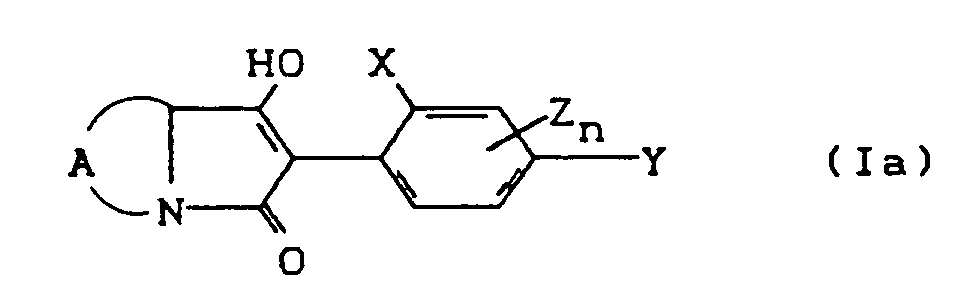
in welcher - A, X, Y, Z und n
- die oben angegebene Bedeutung haben,
- (A)
N-Acylaminosäureester der Formel (II)
- A, X, Y, Z und n
- die oben angegebene Bedeutung haben
- R⁸
- für Alkyl steht,
- (B)
Außerdem wurde gefunden, daß man Verbindungen der Formel (Ib)
- A, X, Y, Z, R¹ und n
- die oben angegebene Bedeutung haben,

- A, X, Y, Z und n
- die oben angegebene Bedeutung haben,
- α) mit Säurehalogeniden der allgemeinen Formel (III)

- R¹
- die oben angegebene Bedeutung hat
- Hal
- für Halogen, insbesondere Chlor und Brom steht,
- β) mit Carbonsäureanhydriden der allgemeinen Formel (IV)
R¹-CO-O-CO-R¹ (IV)
in welcher- R¹
- die oben angegebene Bedeutung hat,
gegebenenfalls in Gegenwart eines Verdünnungsmittels und gegebenenfalls in Gegenwart eines Säurebindemittels,
- (C)
Ferner wurde gefunden, daß man Verbindungen der Formel (Ic)
- A, X, Y, Z, R² und n
- die oben angegebene Bedeutung haben,
- L
- für Sauerstoff
- M
- für Sauerstoff oder Schwefel steht,

- A, X, Y, Z und n
- die oben angegebene Bedeutung haben
R²-M-CO-Cl (V)
in welcher- R² und M
- die oben angegebene Bedeutung haben,
- D) Ferner wurde gefunden, daß man Verbindungen der Formel (Ic)

- A, R², X, Y, Z und n
- die oben angegebene Bedeutung haben,
- L
- für Schwefel
- M
- für Sauerstoff oder Schwefel steht,

- A, X, Y, Z und n
- die oben angegebene Bedeutung haben
- α) mit Chlormonothioameisensäureestern oder Chlordithioameisensäureestern der allgemeinen Formel (VI)

- M und R²
- die oben angegebene Bedeutung haben
oder - β) mit Schwefelkohlenstoff und anschließend mit Alkylhalogeniden der allgemeinen Formel (VII)
R²-Hal (VII)
in welcher- R²
- die oben angegebene Bedeutung hat
- Hal
- für Chlor, Brom, Jod
- E) Außerdem wurde gefunden, daß man Verbindungen der Formel (Id)
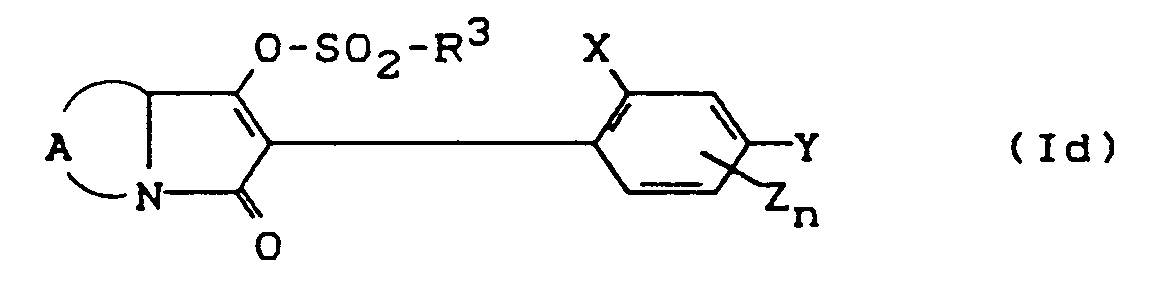
- A, X, Y, Z, R³ und n
- die oben angegebene Bedeutung haben,

- A, X, Y, Z und n
- die oben angegebene Bedeutung haben,
R³-SO₂-Cl (VIII)
in welcher- R³
- die oben angegebene Bedeutung hat
gegebenenfalls in Gegenwart eines Verdünnungsmittels und gegebenenfalls in Gegenwart eines Säurebindemittels,
- F) Weiterhin wurde gefunden, daß man 3-Aryl-pyrrolidin-2,4-dione der Formel (Ie)

- A, L, X, Y, Z, R⁴, R⁵ und n
- die oben angegebene Bedeutung haben,
3-Aryl-pyrrolidin-2,4-dione der Formel (Ia) bzw. deren Enole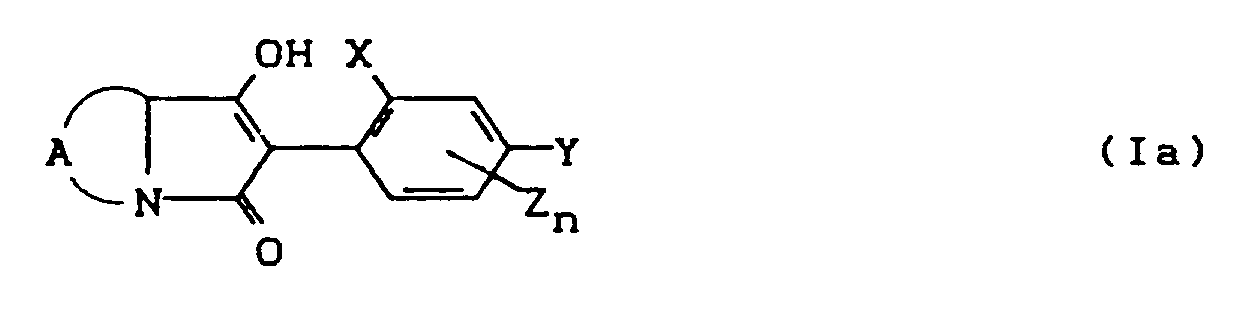
- A, X, Y, Z und n
- die oben angegebene Bedeutung haben

- L, R⁴ und R⁵
- die oben angegebene Bedeutung haben
- Hal
- für Halogen, insbesondere Chlor und Brom steht,
- G) Ferner wurde gefunden, daß man Verbindungen der Formel (If)

- A, L, X, Y, Z, R⁶, R⁷ und n
- die oben angegebene Bedeutung haben,

- A, X, Y, Z und n
- die oben angegebene Bedeutung haben
- α) mit Isocyanaten der allgemeinen Formel (X)
R⁶-N=C=O (X)
in welcher- R⁶
- die oben angegebene Bedeutung hat
- β) mit Carbamidsäurechloriden oder Thiocarbamidsäurechloriden der allgemeinen Formel (XI)

- L, R⁶ und R⁷
- die oben angegebene Bedeutung haben,
- H) Weiterhin wurde gefunden, daß man Verbindungen der Formel (Ig)

- X, Y, Z, A und n
- die oben angegebene Bedeutung haben,
erhält, wenn man Verbindungen der Formel (Ia)
- X, Y, Z, A, und n
- die oben angegebene Bedeutung haben,
MesOHt (XII)

- Me
- für ein- oder zweiwertige Metallionen
- s und t
- für die Zahl 1 und 2 und
- R⁵, R⁶ und R⁷
- unabhängig voneinander für Wasserstoff und Alkyl
gegebenenfalls in Gegenwart eines Verdünnungsmittels, umsetzt. - Weiterhin wurde gefunden, daß sich die neuen polycyclischen 3-Arylpyrrolidin-2,4-dion-Derivate der Formel (I) durch hervorragende insektizide, akarizide und herbizide Wirkungen auszeichnen.
- Bevorzugt sind polycyclische 3-Arylpyrrolidin-2,4-dion-Derivate der Formel (I)
in welcher die Gruppierung
eine der folgenden Bedeutungen 1 bis 29 annimmt:

- X
- für C₁-C₄-Alkyl, Halogen, C₁-C₄-Alkoxy steht,
- Y
- für Wasserstoff, C₁-C₄-Alkyl, Halogen, C₁-C₄-Alkoxy, C₁-C₂-Halogenalkyl steht,
- Z
- für C₁-C₄-Alkyl, Halogen, C₁-C₄-Alkoxy steht,
- n
- für eine Zahl von 0-3 steht,
- G
- für Wasserstoff (a) oder für die Gruppen
-CO-R¹, (b)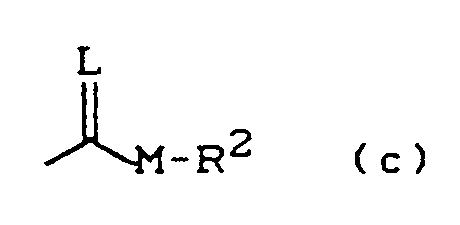

in welchen - E
- für ein Metallionäquivalent oder ein Ammoniumion steht
- L und M
- jeweils für Sauerstoff und/oder Schwefel steht,
- R¹
- für gegebenenfalls durch Halogen substituiertes C₁-C₁₆-Alkyl, C₂-C₁₆-Alkenyl, C₁-C₆-Alkoxy-C₂-C₆-alkyl, C₁-C₁₆-Alkylthio-C₂-C₆-alkyl, C₁.C₆-Polyalkoxy-C₂-C₆-alkyl und Cycloalkyl mit 3-7 Ringatomen, das durch 1-2 Sauerstoff- und/oder Schwefelatome unterbrochen sein kann steht,
für gegebenenfalls durch Halogen, Nitro, C₁-C₄-Alkyl, C₁-C₄-Alkoxy, C₁-C₃-Halogenalkyl, C₁-C₃-Halogenalkoxy substituierets Phenyl steht,
für gegebenenfalls durch Halogen, C₁-C₄-Alkyl, C₁-C₄-Alkoxy, C₁-C₃-Halogenalkyl, C₁-C₃-Halogenalkoxy substituiertes Phenyl-C₁-C₄-alkyl steht,
für gegebenenfalls durch Halogen- und C₁-C₆-Alkyl-substituiertes Pyridyl, Pyrimidyl, Thiazolyl oder Pyrazolyl steht,
für gegebenenfalls durch Halogen- und C₁-C₄-Alkyl-substituiertes Phenoxy-C₁-C₅-alkyl steht,
für gegebenenfalls durch Halogen, Amino und C₁-C₄-Alkyl substituiertes Pyridyloxy-C₁-C₅-alkyl, Pyrimidyloxy-C₁-C₅-alkyl oder Thiazolyloxy-C₁-C₅-alkyl steht, - R²
- für gegebenenfalls durch Halogen substituiertes: C₁-C₁₆-Alkyl, C₂-C₁₆-Alkenyl, C₁-C₁₆-Alkox-C₂-C₆-alkyl, C₁-C₆-Polyalkoxy-C₂-C₆-alkyl steht,
für gegebenenfalls durch Halogen, Nitro, C₁-C₄-Alkyl, C₁-C₃-Alkoxy, C₁-C₃-Halogenalkyl substituiertes Phenyl oder Benzyl steht, - R³, R⁴ und R⁵
- unabhängig voneinander für gegebenenfalls durch Halogen substituiertes C₁-C₆-Alkyl, C₁-C₆-Alkoxy, C₁-C₆-Alkylamino, Di-(C₁-C₆)-Alkylamino, C₁-C₆-Alkylthio, C₃-C₄-Alkenylthio, C₂-C₄-Alkinylthio, C₃-C₆-Cycloalkylthio, für gegebenenfalls durch Fluor, Chlor, Brom, Nitro, Cyano, C₁-C₃-Alkoxy, C₁-C₃-Halogenalkoxy, C₁-C₃-Alkylthio, C₁-C₃ -Halogenalkylthio, C₁-C₃-Alkyl, C₁-C₃-Halogenalkyl substiutiertes Phenyl, Phenoxy oder Phenylthio stehen,
- R⁶ und R⁷
- unabhängig voneinander für gegebenenfalls durch Halogen substituiertes C₁-C₂₀-Alkyl, C₁-C₂₀-Alkoxy, C₂-C₈-Alkenyl, C₁-C₂₀-Alkoxy-C₁-C₂₀-alkyl, für gegebenenfalls durch Halogen, C₁-C₅-Halogenalkyl, C₁-C₅-Alkyl oder C₁-C₅-Alkoxy substituiertes Phenyl, für gegebenenfalls durch Halogen, C₁-C₅-Alkyl, C₁-C₅-Halogenalkyl oder C₁-C₅-Alkoxy substituiertes Benzyl steht,
- R⁹
- für Wasserstoff, Halogen oder gegebenenfalls durch Halogen substituiertes C₁-C₂-Alkyl oder C₁-C₂-Alkoxy steht,
- R¹⁰
- für C₁-C₇-Alkoxy, Amino, C₁-C₄-Alkylamino, C₁-C₄-Dialkylamino steht.
- Besonders bevorzugt sind Verbindungen der Formel (I)
in welcher die Gruppierung
eine der folgenden Bedeutungen 1 bis 29 annimmt:

- X
- für Methyl, Ethyl, Propyl, i-Propyl, Fluor, Chlor, Brom, Methoxy und Ethoxy steht,
- Y
- für Wasserstoff, Methyl, Ethyl, Propyl, i-Propyl, Butyl, i-Butyl, tert.-Butyl, Fluor, Chlor, Brom, Methoxy, Ethoxy und Trifluormethyl steht,
- Z
- für Methyl, Ethyl, i-Propyl, Butyl, i-Butyl, tert.-Butyl, Fluor, Chlor, Brom, Methoxy und Ethoxy steht,
- n
- für eine Zahl von 0-3 steht,
- G
- für Wasserstoff (a) oder für die Gruppen
-CO-R¹, (b)

steht, - E
- für ein Metallionäquivalent oder ein Ammoniumion steht,
- L und M
- für Sauerstoff und/oder Schwefel steht,
- R¹
- für gegebenenfalls durch Fluor oder Chlor substituiertes C₁-C₁₄-Alkyl, C₂-C₁₄-Alkenyl, C₁-C₄-Alkoxy-C₂-C₆-alkyl, C₁-C₄-Alkylthio-C₂-C₆-alkyl, C₁-C₄-Polyalkoxy-C₂-C₄-alkyl und Cycloalkyl mit 3-6 Ringatomen, das durch 1-2 Sauerstoff- und/oder Schwefelatome unterbrochen sein kann, steht,
für gegebenenfalls durch Fluor, Chlor, Brom, Methyl, Ethyl, Propyl, i-Propyl, Methoxy, Ethoxy, Trifluormethyl, Trifluormethoxy, Nitro-substituiertes Phenyl steht,
für gegebenenfalls durch Fluor, Chlor, Brom, Methyl, Ethyl, Propyl, i-Propyl, Methoxy, Ethoxy, Trifluormethyl, Trifluormethoxy-substituiertes Phenyl-C₁-C₃-alkyl steht,
für gegebenenfalls durch Fluor, Chlor, Brom, Methyl, Ethyl-substituiertes Pyridyl, Pyrimidyl, Thiazolyl und Pyrazolyl steht,
für gegebenenfalls durch Fluor, Chlor, Methyl, Ethyl-substituiertes Phenoxy-C₁-C₄-alkyl steht,
für gegebenenfalls durch Fluor, Chlor, Amino, Methyl-, Ethyl, substituiertes Pyridyloxy-C₁-C₄-alkyl, Pyrimidyloxy-C₁-C₄-alkyl und Thiazolyloxy-C₁ -C₄-alkyl steht, - R²
- für gegebenenfalls durch Fluor oder Chlor substituiertes C₁-C₁₄-Alkyl, C₂-C₁₄-Alkenyl, C₁-C₄-Alkoxy-C₂-C₆-alkyl, C₁-C₄-Polyalkoxy-C₂-C₆-alkyl steht,
oder für gegebenenfalls durch Fluor, Chlor, Nitro, Methyl, Ethyl, Propyl, i-Propyl, Methoxy, Ethoxy, Trifluormethyl substituiertes Phenyl oder Benzyl steht, - R³, R⁴ und R⁵
- unabhängig voneinander für gegebenenfalls durch Fluor oder Chlor substituiertes C₁-C₄-Alkyl, C₁-C₄-Alkoxy, C₁-C₄-Alkylamino, Di-(C₁-C₄-Alkyl)-amino, C₁-C₄-Alkylthio, für gegebenenfalls durch Fluor, Chlor, Brom, Nitro, Cyano, C₁-C₂-Alkoxy, C₁-C₄-Fluoralkoxy, C₁-C₂-Chloralkoxy, C₁-C₂-Alkylthio, C₁-C₂-Fluoralkylthio, C₁-C₂-Chloralkylthio, C₁-C₃-Alkyl substituiertes Phenyl, Phenoxy oder Phenylthio stehen,
- R⁶ und R⁷
- unabhängig voneinander für gegebenenfalls durch Fluor, Chlor, Brom substituiertes C₁-C₁₀-Alkyl, C₁-C₁₀-Alkoxy, C₁-C₁₀-Alkoxy-(C₁-C₁₀)alkyl, für gegebenenfalls durch Fluor, Chlor, Brom, C₁-C₂₀-Halogenalkyl, C₁-C₂₀-Alkyl oder C₁-C₄-Alkoxy substituiertes Phenyl, für gegebenenfalls durch Fluor, Chlor, Brom, C₁-C₄-Alkyl, C₁-C₄-Halogenalkyl oder C₁-C₄-Alkoxy substituiertes Benzyl steht,
- R⁹
- für Wasserstoff, Halogen oder gegebenenfalls durch Halogen substituiertes C₁-C₂-Alkyl oder C₁-C₂-Alkoxy steht,
- R¹⁰
- für Methoxy, Ethoxy, Propoxy, iso-Propoxy, Butoxy, iso-Butoxy, sec.-Butoxy, tert.-Butoxy, Phenoxy, Benzyloxy, Amino, C₁-C₂-Alkylamino, C₁-C₂-Dialkylamino steht.
- Verwendet man gemäß Verfahren (A) N-2,6-Dichlorphenylacetyl-perhydrochinolin-2-carbonsäureethylester, so kann der Verlauf des erfindungsgemäßen Verfahrens durch folgendes Reaktionsschema wiedergegeben werden:

Verwendet man gemäß Verfahren (B) (Variante α) 10-(2,4,6 Trimethylphenyl)-1-aza-tricyclo(6,3,01.8,02.6)-undecan-9,11-dion und Pivaloylchlorid als Ausgangsstoff, so kann der Verlauf des erfindungsgemäßen Verfahrens durch folgendes Reaktionsschema wiedergegeben werden.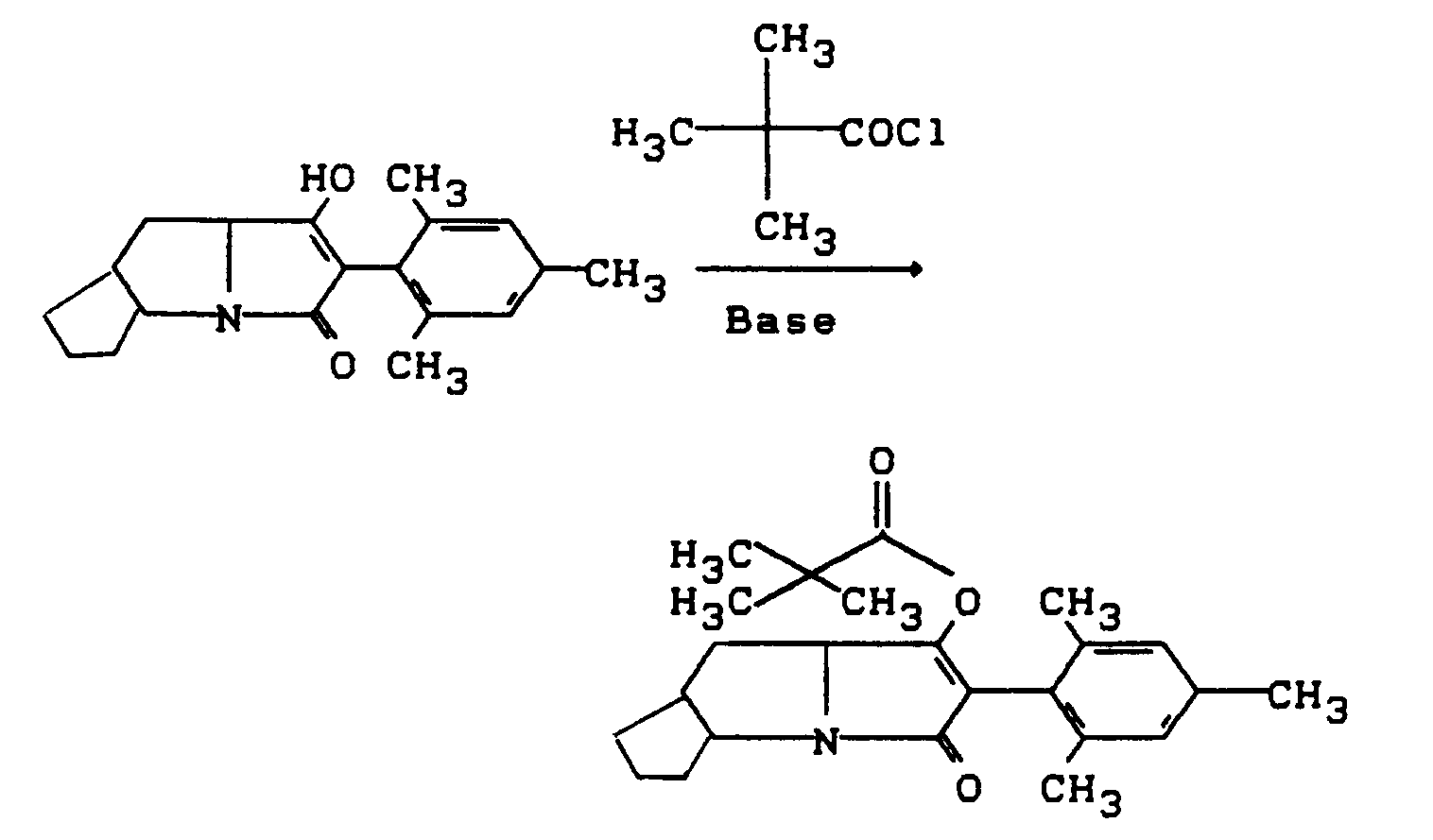
Verwendet man gemäß Verfahren B (Variante β) 12-(2,4,5-Trimethylphenyl)-1-aza-tricyclo-(8,3,01.10,03.8)-tridecan-11,13-dion und Acetanhydrid als Ausgangsverbindungen, so kann der Verlauf des erfindungsgemäßen Verfahrens durch folgendes Reaktionsschema wiedergegeben werden.
Verwendet man gemäß Verfahren C 12-(2,4-Dichlorphenyl)-1-aza-tricyclo-(8,3,01.10,02.7)-tridecan-11,13-dion und Chlorameisensäureethoxyethylester als Ausgangsverbindungen, so kann der Verlauf des erfindungsgemäßen Verfahrens durch folgendes Reaktionsschema wiedergegeben werden.
Verwendet man gemäß Verfahren (Dα) 11-(2,4,6-Trimethylphenyl)-1-aza-tricyclo-(7,3,01.9,03.8)-dodecan-10,12-dion und Chlormonothioameisensäuremethylester als Ausgangsprodukte, so kann der Reaktionsverlauf wie folgt wiedergegeben werden:
Verwendet man gemäß Verfahren (Dβ) 11-(2,4,6-Trimethylphenyl)-1-aza-tricyclo-(7,3,01.8,02.7)-dodecan-10,12-dion, Schwefelkohlenstoff und Methyliodid als Ausgangskomponenten, so kann der Reaktionsverlauf wie folgt wiedergegeben werden:
Verwendet man gemäß Verfahren (E) 10-(2,4,6-Trimethylphenyl)-1-aza-tricyclo-(6,3,01.8,02.6)-undecan-9,11-dion und Methansulfonsäurechlorid als Ausgangsprodukt, so kann der Reaktionsverlauf durch folgendes Reaktionsschema wiedergegeben werden: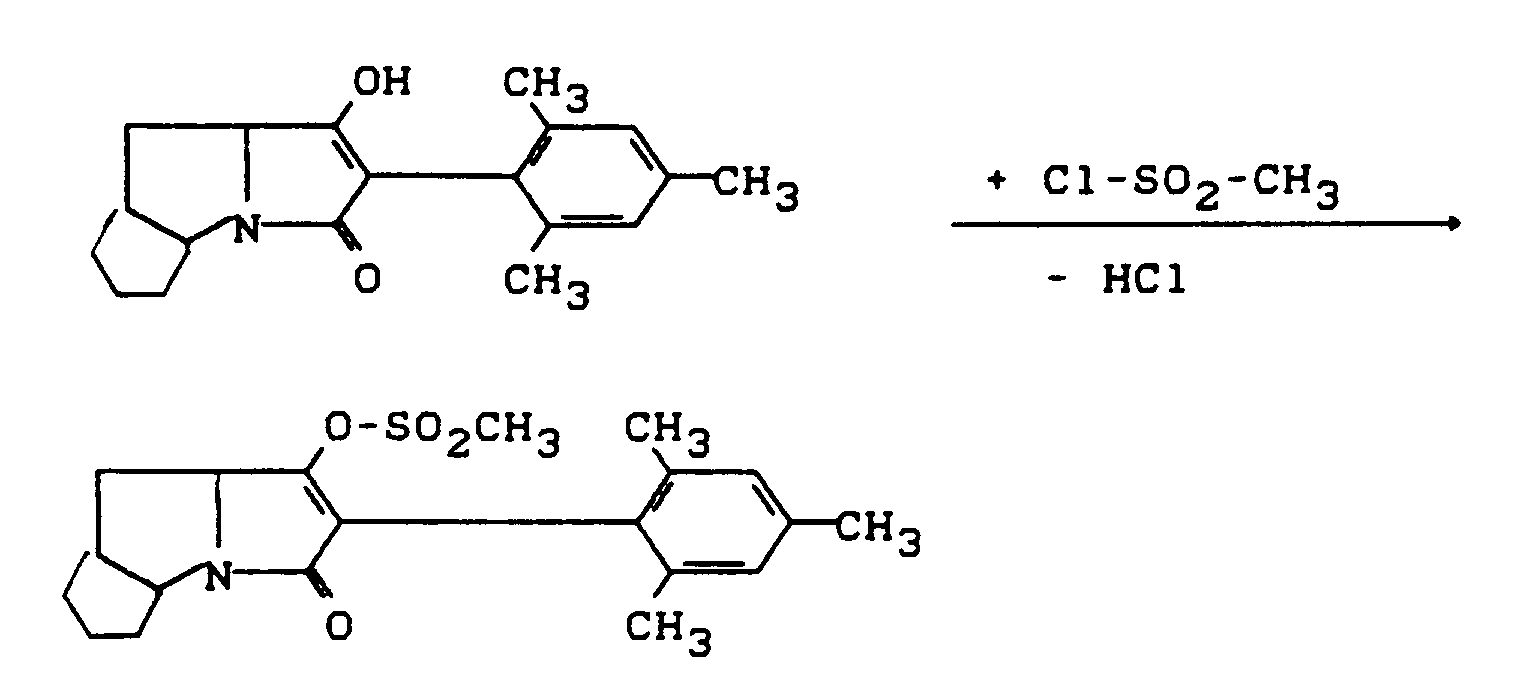
Verwendet man gemäß Verfahren (F) 10-(2,4,6-Trimethylphenyl)-1,4-diaza-(4-N-ethoxycarbonyl)-tricyclo-(6,3,01.8,0,2.6)-undecan-9,11-dion und Methanthiophosphonsäurechlorid-(2,2,2-trifluorethylester) als Ausgangsprodukte, so kann der Reaktionsverlauf durch folgendes Reaktionsschema wiedergegeben werden:
Verwendet man gemäß Verfahren (Gα) 10-(2,4,6-Trimethylphenyl)-1-aza-tricyclo-(6,3,01.8,02.6)-undecan-9,11-dion und Ethylisocyanat als Ausgangsprodukte, so kann der Reaktionsverlauf durch folgendes Reaktionsschema wiedergegeben werden:
Verwendet man gemäß Verfahren (Gβ) 11-(2,4,6-Trimethylphenyl)-1-aza-tricyclo-(7,3,01.9,02.7)-dodecan-10,12- dion und Dimethylcarbamidsäurechlorid als Ausgangsprodukte, so kann der Reaktionsverlauf durch folgendes Schema wiedergegeben werden: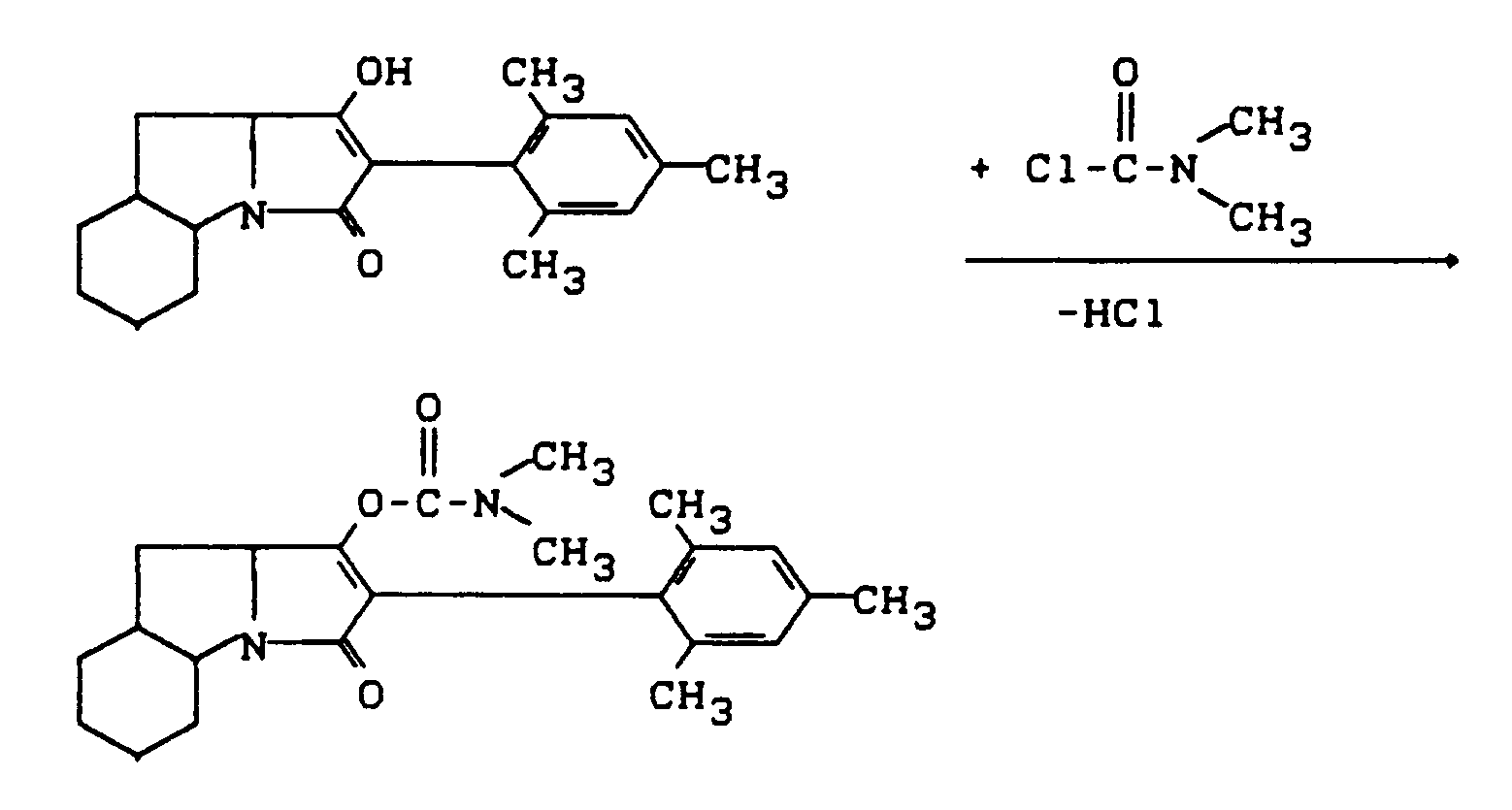
Verwendet man gemäß Verfahren (H) 10-(2,4,6-Trimethylphenyl)-1-aza-tricyclo-(6,3,01.8,02.6)-undecan-9,11-dion und NaOH als Komponenten, so kann der Verlauf des erfindungsgemäßen Verfahrens durch folgendes Reaktionsschema wiedergegeben werden:
Die bei dem obigen Verfahren (A) als Ausgangsstoffe benötigten Verbindungen der Formel (II)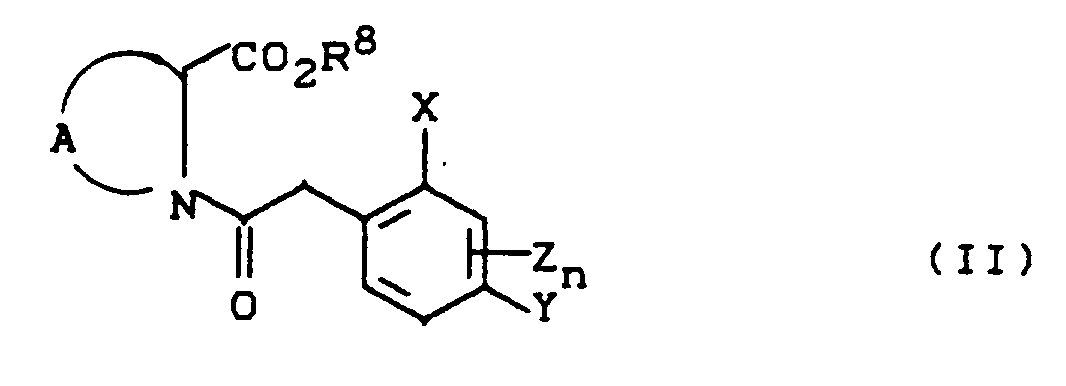
in welcher
A, X, Y, Z, n und R⁸ die oben angegebene Bedeutung haben sind bekannt oder lassen sich nach im Prinzip bekannten Methoden in einfacher Weise herstellen. So erhält man z.B. Acyl-aminosäureester der Formel (II), wenn man - a) Aminosäureester der Formel (XIV)

- R¹¹
- für Wasserstoff (XIVa) oder Alkyl (XIVb) steht
- A
- die oben angegebene Bedeutung hat,

- X, Y, Z und n
- die oben angegebene Bedeutung haben und
- Hal
- für Chlor oder Brom steht,
oder wenn man Acylaminosäuren der Formel (IIa),
- A, X, Y, Z und n
- die oben angegebene Bedeutung haben
- R¹¹
- für Wasserstoff steht,
Verbindungen der Formel (IIa) sind beispielsweise aus den Phenylessigsäurehalogeniden der Formel (XV) und Aminosäuren der Formel XIV a) nach Schotten-Baumann (Organikum 9. Auflage 446 (1970) VEB Deutscher Verlag der Wissenschaften, Berlin) erhältlich. - Beispielhaft seien folgende Verbindungen der Formel (II) genannt:
- 1. 2-Aza-bicyclo-(3,3,0)-octan-N-(2,4-dichlorphenylacetyl)-3-carbonsäureethylester
- 2. 2-Aza-bicyclo-(3,3,0)-octan-N-(2,6-dichlorphenylacetyl)-3-carbonsäureethylester
- 3. 2-Aza-bicyclo-(3,3,0)-octan-N-(2,4,6-trichlorphenylacetyl-3-carbonsäureethylester
- 4. 2-Aza-bicyclo-(3,3,0)-octan-N-(2,4-dimethylphenylacetyl)-3-carbonsäureethylester
- 5. 2-Aza-bicyclo-(3,3,0)-octan-N-(2,6-dimethylphenylacetyl)-3-carbonsäureethylester
- 6. 2-Aza-bicyclo-(3,3,0)-octan-N-(2,4,6-trimethylphenylacetyl)-3-carbonsäureethylester
- 7. 7-Aza-bicyclo-(4,3,0)-nonan-N-(2,4,6-trimethylphenylacetyl)-8-carbonsäureethylester
- 8. 8-Aza-bicyclo-(5,3,0)-decan-N-(2,4,6-trimethylphenylacetyl)-9-carbonsäureethylester
- 9. 3-Aza-bicyclo-(3,3,0)-octan-N-(2,4,6-trimethylphenylacetyl)-2-carbonsäureethylester
- 10. 3-Aza-bicyclo(3,3,0)-octan-7-en-N-(2,4,6-trimethylphenylacetyl)-3-carbonsäureethylester
- 11. Indolin-N-(2,4,6-trimethylphenyl-acetyl)-2-carbonsäureethylester
- 12. 9-Aza-bicyclo-(4,3,0)-non-2-en-N-(2,4,6-trimethylphenyl-acetyl)-8-carbonsäureethylester
- 13. 8-Aza-bicyclo-(4,3,0)-nonan-N-(2,4,6-trimethylphenyl-acetyl)-7-carbonsäureethylester
- 14. 7-Aza-tricyclo-(4,3,12.5,01.6)-decan-N-(2,4,6-trimethylphenyl-acetyl)-8-carbonsäureethylester
- 15. 1,2-Dihydrochinolin-N-(2,4,6-trimethylphenylacetyl-2-carbonsäureethylester
- 16. 1,2,3,4-Tetrahydrochinolin-N-(2,4,6-trimethylphenylacetyl-2-carbonsäureethylester
- 17. Perhydrochinolin-N-(2,4,6-trimethylphenyl-acetyl)-2-carbonsäureethylester
- 18. 1,2-Dihydroisochinolin-N-(2,4,6-trimethylphenylacetyl)-2-carbonsäureethylester
- 19. 1,2,7,8-Tetrahydroisochinolin-N-(2,4,6-trimethylphenyl-acetyl-2-carbonsäureethylester
- 20. Perhydroisochinolin-N-(2,4,6-trimethylphenylacetyl)-2-carbonsäureethylester
- 21. Perhydroindol-N-(2,4,6-trimethylphenyl-acetyl)-2-carbonsäureethylester
- 22. 2,7-Diaza-7-(ethoxycarbonyl)-bicyclo-(3,3,0)-octan-N-(2,4,6-trimethylphenyl-acetyl)-3-carbonsäureethylester
- 23. 10-Aza-tricyclo-(7,3,01.9,03.8)-dodecan-(2,4,6-trimethylphenyl-acetyl)-11-carbonsäureethylester
- 24. 10-Aza-tricyclo-(7,3,01.9,02.7)-dodecan-(2,4,6-trimethylphenyl-acetyl)-11-carbonsäureethylester.
- Verbindungen der Formel XIV, in welcher
- A, B und R¹¹
- die oben angegebene Bedeutung haben sind bekannt oder nach literaturbekannten Verfahren erhältlich (Henning, R., Urbach, H., Tetrahedron Lett. 24, 5339-5342 (1983); EP-A-52 870; US-A-4 291 163; EP-A-173-199 ; Urbach, H. Henning, R. Tetrahedron Lett. 26, 1839-1842 (1985).
- Das Verfahren (A) ist dadurch gekennzeichnet, daß Verbindungen der Formel (II) in welcher A, X, Y, Z, n und R⁸ die oben angegebene Bedeutung haben, in Gegenwart von Basen einer intramolekularen Kondensation unterwirft.
- Als Verdünnungsmittel können bei dem erfindungsgemäßen Verfahren (A) alle inerten organischen Solventien eingesetzt werden. Vorzugsweise verwendbar sind Kohlenwasserstoffe, wie Toluol und Xylol, ferner Ether, wie Dibutylether, Tetrahydrofuran, Dioxan, Glykoldimethylether und Diglykoldimethylether, außerdem polare Lösungsmittel, wie Dimethylsulfoxid, Sulfolan, Dimethylformamid und N-Methyl-pyrrolidon.
- Als Basen (Deprotonierungsmittel) können bei der Durchführung des erfindungsgemäßen Verfahrens (A) alle üblichen Protonenakzeptoren eingesetzt werden. Vorzugsweise verwendbar sind Alkalimetall- und Erdalkalimetalloxide, -hydroxide und -carbonate, wie Natriumhydroxid, Kaliumhydroxid, Magnesiumoxid, Calciumoxid, Natriumcarbonat, Kaliumcarbonat und Calciumcarbonat, Natriumcarbonat, Kaliumcarbonat und Calciumcarbonat, die auch in Gegenwart von Phasentransferkatalysatoren wie z.B. Triethylbenzylammoniumchlorid, Tetrabutylammoniumbromid, Adogen 464 oder TDA 1 eingesetzt werden können. Weiterhin können Alkalimetalle wie Natrium oder Kalium verwendet werden. Ferner sind Alkalimetall- und Erdalkalimetallamide und -hydride, wie Natriumamid, Natriumhydrid und Calciumhydrid, und außerdem auch Alkalimetall-alkoholate, wie Natrium-methylat, Natrium-ethylat und Kalium-tert.-butylat einsetzbar.
Adogen 464 = Methyltrialkyl(C₈-C₁₀)ammoniumchlorid
TDA 1 = Tris-(methoxyethoxyethyl)-amin - Die Reaktionstemperaturen können bei der Durchführung des erfindungsgemäßen Verfahrens (A) innerhalb eines größeren Bereiches variiert werden. Im allgemeinen arbeitet man bei Temperaturen zwischen 0°C und 250°C, vorzugsweise zwischen 50°C und 150°C.
- Das erfindungsgemäße Verfahren (A) wird im allgemeinen unter Normaldruck durchgeführt.
- Bei der Durchführung des erfindungsgemäßen Verfahrens (A) setzt man die Reaktionskomponenten der Formeln (II) und die deprotonierenden Basen im allgemeinen in etwa äquimolaren Mengen ein. Es ist jedoch auch möglich, die eine oder andere Komponente in einem größeren Überschuß (bis zu 3 Mol) zu verwenden.
- Das Verfahren (Bα) ist dadurch gekennzeichnet, daß man Verbindungen der Formel (Ia) mit Carbonsäurehalogeniden der Formel (III) umsetzt.
- Als Verdünnungsmittel können bei dem erfindungsgemäßen Verfahren (Bα) bei Verwendung der Säurehalogenide alle gegenüber diesen Verbindungen inerten Solventien eingesetzt werden. Vorzugsweise verwendbar sind Kohlenwasserstoffe, wie Benzin, Benzol, Toluol, Xylol und Tetralin, ferner Halogenkohlenwasserstoffe, wie Methylenchlorid, Chloroform, Tetrachlorkohlenstoff, Chlorbenzol und o-Dichlorbenzol, außerdem Ketone, wie Aceton und Methylisopropylketon, weiterhin Ether, wie Diethylether, Tetrahydrofuran und Dioxan, darüberhinaus Carbonsäureester, wie Ethylacetat, und auch stark polare Solventien, wie Dimethylsulfoxid und Sulfolan. Wenn die Hydrolysestabilität des Säurehalogenids es zuläßt, kann die Umsetzung auch in Gegenwart von Wasser durchgeführt werden.
- Verwendet man die entsprechenden Carbonsäurehalogenide so kommen als Säurebindemittel bei der Umsetzung nach dem erfindungsgemäßen Verfahren (Bα) alle üblichen Säureakzeptoren in Betracht. Vorzugsweise verwendbar sind tertiäre Amine, wie Triethylamin, Pyridin, Diazabiyclooctan (DABCO), Diazabicycloundecan (DBU), Diazabicyclononen (DBN), Hüning-Base und N,N-Dimethylanilin, ferner Erdalkalimetalloxide, wie Magnesium- und Calciumoxid, außerdem Alkali- und Erdalkali-metall-carbonate, wie Natriumcarbonat, Kaliumcarbonat und Calciumcarbonat.
- Die Reaktionstemperaturen können auch bei dem erfindungsgemäßen Verfahren (Bα) auch bei der Verwendung von Carbonsäurehalogeniden innerhalb eines größeren Bereiches variiert werden. Im allgemeinen arbeitet man bei Temperaturen zwischen -20°C und +150°C, vorzugsweise zwischen 0°C und 100°C.
- Bei der Durchführung des erfindungsgemäßen Verfahrens (Bα) werden die Ausgangsstoffe der Formel (Ia) und das Carbonsäurehalogenid der Formel (III) im allgemeinen in angenähert äquivalenten Mengen verwendet. Es ist jedoch auch möglich, das Carbonsäureanhydrid in einem größeren Überschuß (bis zu 5 Mol) einzusetzen. Die Aufarbeitung erfolgt nach üblichen Methoden.
- Das Verfahren (Bβ) ist dadurch gekennzeichnet, daß man Verbindungen der Formel (Ia) mit Carbonsäurehydriden der Formel (IV) umsetzt.
- Verwendet man bei dem erfindungsgemäßen Verfahren (Bβ) als Reaktionskomponente der Formel (IV) Carbonsäureanhydride, so können als Verdünnungsmittel vorzugsweise diejenigen Verdünnungsmittel verwendet werden, die auch bei der Verwendung von Säurehalogeniden vorzugsweise in Betracht kommen. Im übrigen kann auch ein im Überschuß eingesetztes Carbonsäurehydrid gleichzeitig als Verdünnungsmittel fungieren.
- Die Reaktionstemperaturen können bei dem erfindungsgemäßen Verfahren (Bβ) auch bei der Verwendung von Carbonsäureanhydriden innerhalb eines größeren Bereiches variiert werden. Im allgemeinen arbeitet man bei Temperaturen zwischen -20°C und +150°C, vorzugsweise zwischen 0°C und 100°C.
- Bei der Durchführung des erfindungsgemäßen Verfahrens werden die Ausgangsstoffe der Formel (Ia) und das Carbonsäureanhydrid der Formel (IV) im allgemeinen in angenähert äquivalenten Mengen verwendet. Es ist jedoch auch möglich, das Carbonsäureanhydrid in einem größeren Überschuß (bis zu 5 Mol) einzusetzen. Die Aufarbeitung erfolgt nach üblichen Methoden.
- Im allgemeinen geht man so vor, daß man Verdünnungsmittel und im Überschuß vorhandenes Carbonsäureanhydrid sowie die entstehende Carbonsäure durch Destillation oder durch Waschen mit einem organischen Lösungsmittel oder mit Wasser entfernt.
- Das Verfahren (C) ist dadurch gekennzeichnet, daß man Verbindungen der Formel (Ia) mit Chlorameisensäureestern oder Chlorameisensäurethiolestern der Formel (V) umsetzt.
- Verwendet man die entsprechenden Chlorameisensäureester bzw. Chlorameisensäurethiolester so kommen als Säurebindemittel bei der Umsetzung nach dem erfindungsgemäßen Verfahren (C) alle üblichen Säureakzeptoren in Betracht. Vorzugsweise verwendbar sind tertiäre Amine, wie Triethylamin, Pyridin, DABCO, DBC, DBA, Hünig-Base und N,N-Dimethyl-anilin, ferner Erdalkalimetalloxide, wie Magnesium- und Calcium-oxid, außerdem Alkali- und Erdalkalimetall-carbonate, wie Natriumcarbonat, Kaliumcarbonat und Calciumcarbonat.
- Als Verdünnungsmittel können bei dem erfindungsgemäßen Verfahren (C) bei Verwendung der Chlorameisensäureester bzw. Chlorameisensäurethiolester alle gegenüber diesen Verbindungen inerten Solventien eingesetzt werden. Vorzugsweise verwendbar sind Kohlenwasserstoffe, wie Benzin, Benzol, Toluol, Xylol und Tetralin, ferner Halogenkohlenwasserstoffe, wie Methylenchlorid, Chloroform, Tetrachlorkohlenwasserstoff, Chlorbenzol und o-Dichlorbenzol, außerdem Ketone, wie Aceton und Methylisopropylketon, weiterhin Ether, wie Diethylether, Tetrahydrofuran und Dioxan, darüberhinaus Carbonsäureester, wie Ethylacetat, und auch stark polare Solventien, wie Dimethylsulfoxid und Sulfolan.
- Bei Verwendung der Chlorameisensäureester bzw. Chlorameisensäurethiolester als Carbonsäure-Derivate der Formel (V) können die Reaktionstemperaturen bei der Durchführung des erfindungsgemäßen Verfahrens (C) innerhalb eines größeren Bereiches variiert werden. Arbeitet man in Gegenwart eines Verdünnungsmittels und eines Säurebindemittels, so liegen die Reaktionstemperaturen im allgemeinen zwischen -20°C und +100°C, vorzugsweise zwischen 0°C und 50°C.
- Das erfindungsgemäße Verfahren (C) wird im allgemeinen unter Normaldruck durchgeführt.
- Bei der Durchführung des erfindungsgemäßen Verfahrens (C) werden die Ausgangsstoffe der Formel (Ia) und der entsprechende Chlorameisensäureester bzw. Chlorameisensäurethiolester der Formel (V) im allgemeinen in angenähert äquivalenten Mengen verwendet. Es ist jedoch auch möglich, die eine oder andere Komponente in einem größeren Überschuß (bis zu 2 Mol) einzusetzen. Die Aufarbeitung erfolgt dann nach üblichen Methoden. Im allgemeinen geht man so vor, daß man ausgefallene Salze entfernt und das verbleibende Reaktionsgemisch durch Abziehen des Verdünnungsmittels einengt.
- Beim Herstellungsverfahren Dα setzt man pro Mol Ausgangsverbindung der Formel (Ia) ca. 1 Mol Chlormonothioameisensäureester bzw. Chlordithioameisensäureester der Formel (VII) bei 0 bis 120°C, vorzugsweise bei 20 bis 60°C um.
- Als gegebenenfalls zugesetzte Verdünnungsmittel kommen alle inerten polaren organischen Lösungsmittel in Frage, wie Ether, Amide, Alkohole, Sulfone, Sulfoxide.
- Vorzugsweise werden Dimethylsulfoxid, Tetrahydrofuran, Dimethylformamid, Dimethylsulfid eingesetzt.
- Stellt man in einer bevorzugten Ausführungsform durch Zusatz von starken Deprotonierungsmitteln wie z.B. Natriumhydrid oder Kaliumtertiärbutylat das Enolatsalz der Verbindung Ia dar, kann auf den weiteren Zusatz von Säurebindemitteln verzichtet werden.
- Werden Säurebindemittel eingesetzt, so kommen übliche anorganische oder organische Basen in Frage, beispielhaft seien Natriumhydroxid, Natriumcarbonat, Kaliumcarbonat, Pyridin, Triethylamin aufgeführt.
- Die Reaktion kann bei Normaldruck oder unter erhöhtem Druck durchgeführt werden, vorzugsweise wird bei Normaldruck gearbeitet. Die Aufarbeitung geschieht nach üblichen Methoden.
- Beim Herstellungsverfahren Dβ setzt man pro Mol Ausgangsverbindung der Formel (II) die äquimolare Menge bzw. einen Überschuß Schwefelkohlenstoff zu. Man arbeitet hierbei vorzugsweise bei Temperaturen von 0 bis 50°C und insbesondere bei 20 bis 30°C.
- Oft ist es zweckmäßig zunächst aus der Verbindung der Formel (II) durch Zusatz eines Deprotonierungsmittels (wie z.B. Kaliumtertiärbutylat oder Natriumhydrid) das entsprechende Salz herzustellen. Man setzt die Verbindung (II) solange mit Schwefelkohlenstoff um bis die Bildung der Zwischenverbindung abgeschlossen ist, z.B. nach mehrstündigem Rühren bei Raumtemperatur.
- Die weitere Umsetzung mit dem Alkylhalogenid der Formel (VIII) erfolgt vorzugsweise bei 0 bis 70°C und insbesondere bei 20 bis 50°C. Hierbei wird mindestens die äquimolare Menge Alkylhalogenid eingesetzt.
- Man arbeitet bei Normaldruck oder unter erhöhtem Druck, vorzugsweise bei Normaldruck.
- Die Aufarbeitung erfolgt wiederum nach üblichen Methoden.
- Beim Herstellungsverfahren E) setzt man pro Mol Ausgangsverbindung der Formel (Ia) ca. 1 Mol Sulfonsäurechlorid (VIII) bei 0 bis 150°C, vorzugsweise bei 20 bis 70°C um.
- Als gegebenenfalls zugesetzte Verdünnungsmittel kommen alle inerten polaren organischen Lösungsmittel in Frage wie Ether, Amide, Nitrile, Alkohole, Sulfone, Sulfoxide.
- Vorzugsweise werden Dimethylsulfoxid, Tetrahydrofuran, Dimethylformamid, Dimethylsulfid eingesetzt.
- Stellt man in einer bevorzugten Ausführungsform durch Zusatz von starken Deprotonierungsmitteln (wie z.B. Natriumhydrid oder Kaliumtertiärbutylat) das Enolatsalz der Verbindung Ia dar, kann auf den weitern Zusatz von Säurebindemitteln verzichtet werden.
- Werden Säurebindemittel eingesetzt, so kommen übliche anorganische oder organische Basen in Frage, beispielhaft seien Natriumhydroxid, Natriumcarbonat, Kaliumcarbonat, Pyridin aufgeführt.
- Die Reaktion kann bei Normaldruck oder unter erhöhtem Druck durchgeführt werden, vorzugsweise wird bei Normaldruck gearbeitet. Die Aufarbeitung geschieht nach üblichen Methoden.
- Beim Herstellungsverfahren E kann gegebenenfalls unter Phasen-Transfer-Bedingungen gearbeitet werden (W.J. Spillane et. al.; J. Chem. Soc., Perkin Trans I, (3) 677-9 (1982)). In diesem Fall setzt man pro Mol Ausgangsverbindung der Formel a) 0,3 bis 1,5 mol Sulfonsäurechlorid VIII, bevorzugt 0,5 mol bei 0° bis 150°C, vorzugsweise bei 20 bis 70°C um.
- Als Phasen-Transfer-Katalysatoren können alle quartären Ammoniumsalze verwendet werden, vorzugsweise Tetraoctylammoniumbromid und Benzyltriethylammoniumchlorid. Als organische Lösungsmittel können in diesem Fall alle unpolaren inerten Lösungsmittel dienen, bevorzugt werden Benzol und Toluol eingesetzt.
- Beim Herstellungsverfahren F) setzt man zum Erhalt von Verbindungen der Struktur (Ie) auf 1 Mol der Verbindung (Ia), 1 bis 2, vorzugsweise 1 bis 1,3 Mol der Phosphorverbindung der Formel (IX) bei Temperaturen zwischen -40°C und 150°C, vorzugsweise zwischen -10 und 110°C um.
- Als gegebenenfalls zugesetzte Verdünnungsmittel kommen aller inerten, polaren organischen Lösungsmittel in Frage wie Ether, Amide, Nitrile, Alkohole, Sulfide, Sulfone, Sulfoxide etc.
- Vorzugsweise werden Acetonitril, Dimethylsulfoxid, Tetrahydrofuran, Dimethylformamid, Dimethylsulfid eingesetzt.
- Als gegebenenfalls zugesetzte Säurebindemittel kommen übliche anorganische oder organische Basen in Frage wie Hydroxide, Carbonate. Beispielhaft seien Natriumhydroxid, Natriumcarbonat, Kaliumcarbonat, Pyridin aufgeführt.
- Die Umsetzung kann bei Normaldruck oder unter erhöhtem Druck durchgeführt werden, vorzugsweise wird bei Normaldruck gearbeitet. Die Aufarbeitung geschieht nach üblichen Methoden der organischen Chemie. Die Reinigung der anfallenden Endprodukte geschieht vorzugsweise durch Kristallisation, chromatographische Reinigung oder durch sogenanntes "Andestillieren", d.h. Entfernung der flüchtigen Bestandteile im Vakuum.
- Beim Herstellungsverfahren Gα setzt man pro Mol Ausgangsverbindung der Formel Ia ca. 1 Mol Isocyanat der Formel (X) bei 0 bis 100°C, vorzugsweise bei 20 bis 50°C um.
- Als gegebenenfalls zugesetzte Verdünnungsmittel kommen alle inerten organischen Lösungsmittel in Frage, wie Ether, Amide, Nitrile, Sulfone, Sulfoxide.
- Gegebenenfalls können Katalysatoren zur Beschleunigung der Reaktion zugesetzt werden. Als Katalysatoren können sehr vorteilhaft zinnorganische Verbindungen, wie z.B. Dibutylzinndilaurat eingesetzt werden, Es wird vorzugsweise bei Normaldruck gearbeitet.
- Beim Herstellungsverfahren Gβ setzt man pro Mol Ausgangsverbindung der Formel (Ia) ca. 1 Mol Carbamidsäurechlorid bzw. Thiocarbamidsäurechlorid der Formel (XI) bei 0 bis 150°C, vorzugsweise bei 20 bis 70°C um.
- Als gegebenenfalls zugesetzte Verdünnungsmittel kommen aller inerten polaren organischen Lösungsmittel in Frage wie Ether, Amide, Alkohole, Sulfone, Sulfoxide.
- Vorzugsweise werden Dimethylsulfoxid, Tetrahydrofuran, Dimethylformamid, Dimethylsulfid eingesetzt.
- Stellt man in einer bevorzugten Ausführungsform durch Zusatz von starken Deprotonierungsmitteln (wie z.B. Natriumhydrid oder Kaliumtertiärbutylat) das Enolatsalz der Verbindung Ia dar, kann auf den weiteren Zusatz von Säurebindemitteln verzichtet werden.
- Werden Säurebindemittel eingesetzt, so kommen übliche anorganische oder organische Basen in Frage, beispielhaft seien Natriumhydroxid, Natriumcarbonat, Kaliumcarbonat, Pyridin aufgeführt.
- Die Reaktion kann bei Normaldruck oder unter erhöhtem Druck durchgeführt werden, vorzugswiese wird bei Normaldruck gearbeitet. Die Aufarbeitung geschieht nach üblichen Methoden.
- Das Verfahren (H) ist dadurch gekennzeichnet, daß man Verbindungen der Formel (Ia) mit Metallhydroxiden (XII) oder Aminen (XIII) umsetzt.
- Als Verdünnungsmittel können bei dem erfindungsgemäßen Verfahren vorzugsweise Ether wie Tetrahydrofuran, Dioxan, Diethylether oder aber Alkohole wie Methanol, Ethanol, Isopropanol, aber auch Wasser eingesetzt werden. Das erfindungsgemäße Verfahren (H) wird im allgemeinen unter Normaldruck durchgeführt. Die Reaktionstemperaturen liegen im allgemeinen zwischen -20°C und 100°C, vorzugsweise zwischen 0°C und 50°C.
- Bei der Durchführung des erfindungsgemäßen Verfahrens (H) werden die Ausgangsstoffe der Formel (Ia) bzw. (XII) oder (XIII) im allgemeinen in angenähert äquimolaren Mengen verwendet. Es ist jedoch auch möglich, die eine oder andere Komponente in einem größeren Überschuß (bis zu 2 Mol) einzusetzen. Im allgemeinen geht man so vor, daß man das Reaktionsgemisch durch Abziehen des Verdünnungsmittel einengt.
-

- 3,6 g (0,12 Mol) Natriumhydrid (80%ige Suspension) werden in 60 ml abs. Toluol vorgelegt. Unter Rückfluß werden 30,9 g (0,085 Mol) 1.2.7.8-Tetrahydroisochinolin-N-(2,4,6-trimethylphenyl-acetyl)-2-carbonsäureethylester gelöst in 90 ml abs. Toluol zugetropft und unter Dünnschicht-Chromatographie-Kontrolle weitergerührt. Nach Beendigung der Reaktion wird überschüssiges Natriumhydrid mit Ethanol vernichtet und der Ansatz einrotiert. Den Rückstand nimmt man in Wasser auf, säuert mit konzentrierter Salzsäure bei 0-20°C an, saugt ab und trocknet im Vakuum über P₂O₅. Die Reinigung erfolgt durch Auskochen mit Methyl-tert.-butyl-Ether/n-Hexan. Auf diese Weise erhält man 19,43 g (≙ 71,1 % der Theorie) 1-Aza-12-(2,4,6-trimethylphenyl)-tricyclo-(8,3,01.10,04.9)-tridecan-4,6,8-trien-11,13-dion vom Schmelzpunkt 78°C.
- Analog wurden erhalten:
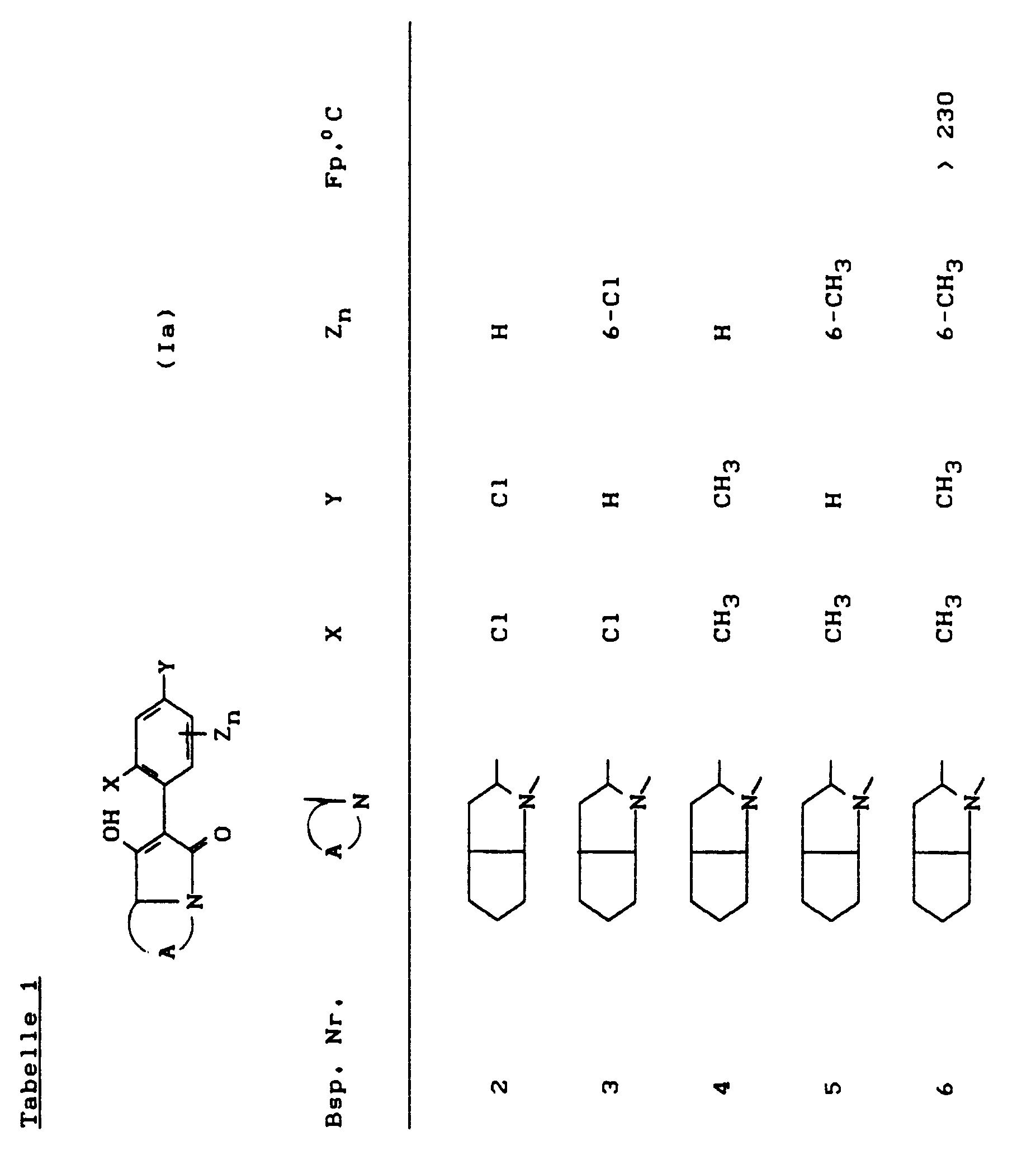

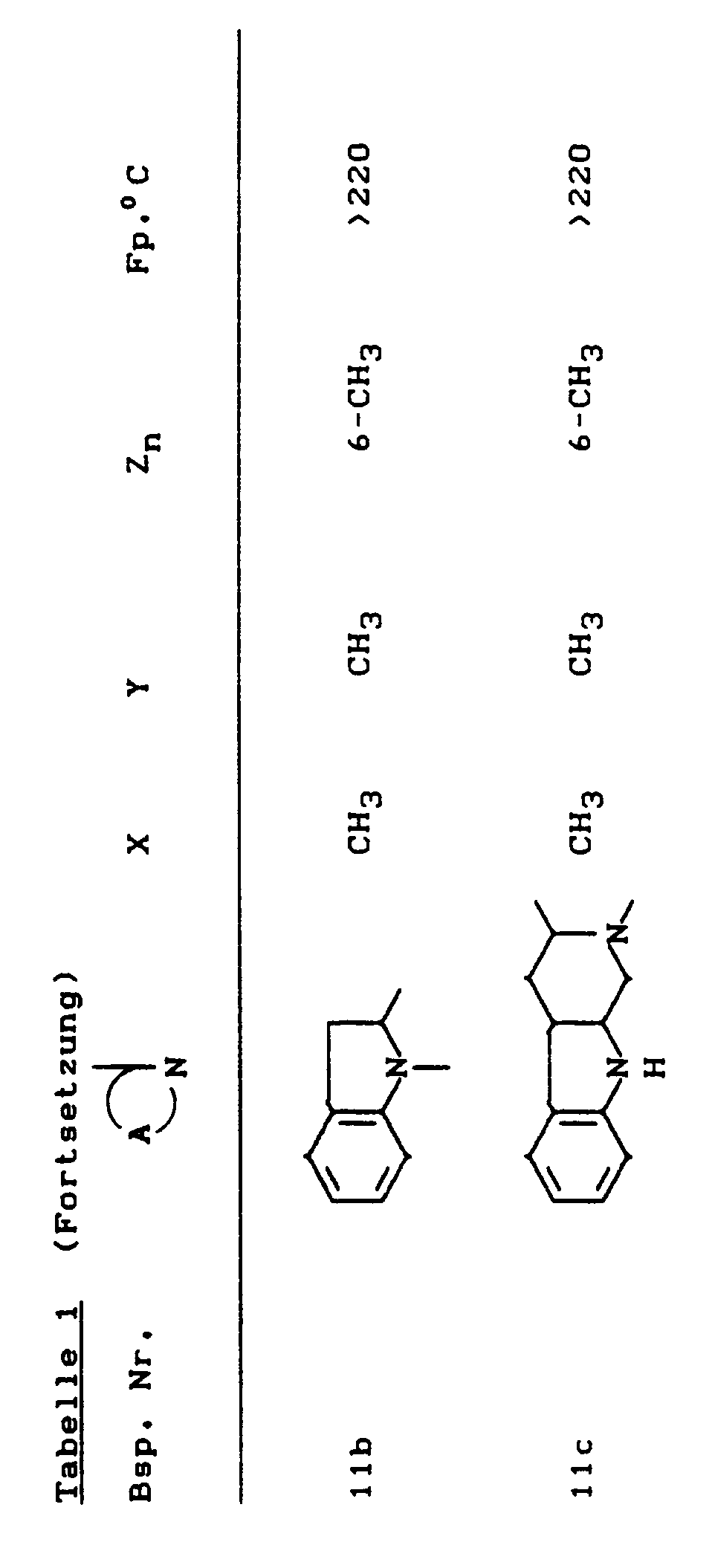
-

- 5,95 g (20 mmol) 1-Aza-tricyclo-(6,3,01.8`,02.6)-10-(2,4,6-trimethylphenyl)-undecan-9,11-dion suspendiert in 70 ml Methyl-tert.-butyl-Ether werden mit 1,63 ml absolutem Pyridin und 3,4 ml (20 mmol) Hünig-Base versetzt. Bei 0-10°C tropft man 1,5 ml (20 mmol) Acetylchlorid in 5 ml Methyl-tert.-butyl-Ether zu, rührt 15 Minuten nach, filtriert den Niederschlag ab, rotiert im Vakuum ein und chromatographiert den Rückstand an Kieselgel mit Cyclohexan-Essigester 1:1. Nach Kristallisation aus n-Hexan erhielt man 4,7 g (= 69,2 % der Theorie) 1-Aza-9-acetoxytricyclo-(6,3,01.8,02.6)-10-(2,4,6-(trimethylphenyl)-9-undecan-11-on vom Schmelzpunkt 100°C.
- Analog erhält man


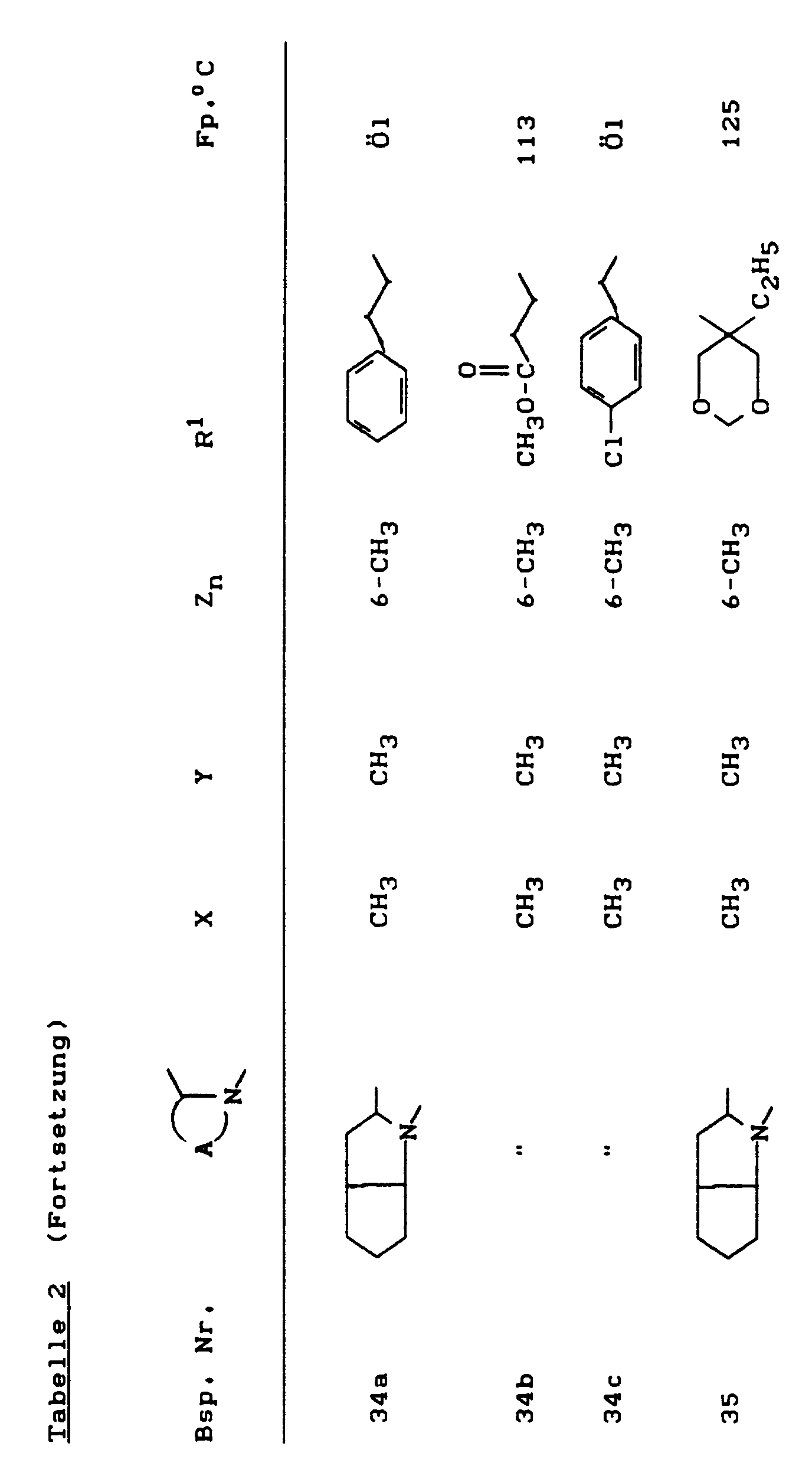


-

- 5,95 g (20 mmol) 1-Aza-tricyclo-(6,3,01.8,02.6)-10-(2,4,6-trimethylphenyl)-undecan-9,11-dion suspendiert in 70 ml Methyl-tert.-butyl-Ether werden mit 1,63 ml absolutem Pyridin und 3,4 ml (20 mmol) Hünig-Base versetzt. Bei 0-10°C tropft man 2 ml (20 mmol) Chlorameisensäureethylester in 5 ml Methyl-tert.-butyl-Ether zu, rührt 15 Minuten nach, filtriert den Niederschlag ab, rotiert im Vakuum ein und chromatographiert den Rückstand an Kieselgel mit Cyclohexan-Essigester 1:1. Man erhält 6,1 g (=82,5 % der Theorie) 1-Aza-9-ethoxycarbonyloxy-tricyclo-(6,3,01.8,02.6)-10-(2,4,6-trimethylphenyl)-9-undecan-11-on als gelbes Öl.
- Analog erhält man:


-

- 2,97 g 1-Aza-tricyclo-(6.3.01.802.6)-10-(2,4,6-trimethylphenyl)-undecan-9.11-dion und 20 ml absolutes Dimethylformamid werden mit 0,3 g Natriumhydrid (80%ig) versetzt. Nach Beendigung der Wasserstoffentwicklung kühlt man auf 10°C ab und gibt 1,5 ml (0,014 mol)

zu. Dann läßt man einige Stunden rühren, nimmt in 100 ml Wasser auf, extrahiert dreimal mit Methylenchlorid und wäscht einmal mit 40 ml 5%iger Salzsäure, trocknet mit Natriumsulfat und dampft ein. - Ausbeute 2,73 g (71% d. Th.) der Titelverbindung
Fp: 112°C. -

- 2,97 g 0,01 mol) 1-Aza-tricyclo-(6.3.01.802.6)-10-(2,4,6-trimethylphenyl)-undecan-9.11-dion und 20 ml absolutes Dimethylformamid werden mit 0,3 g Natriumhydrid (80%ig) versetzt. Wenn die Wasserstoffentwicklung beendet ist, gibt man 3 ml (0,01 mol) Schwefelkohlenstoff zu und läßt 3 Stunden bei Raumtemperatur rühren. Weiterhin gibt man 3 ml (0,05 mol) Methyljodid zu und läßt einige Stunden bei Raumtemperatur rühren. Schließlich nimmt man in 100 ml Wasser auf, extrahiert dreimal mit Methylenchlorid, trocknet über Natriumsulfat und dampft ein.
- Ausbeute 1,77 g der Titelverbindung (46% d. Th.)
Fp: 90-91°C.


-

- 3,56 g 1-Aza-tricyclo-(6.3.01.802.6)-10-(2,4,6-trimethylphenyl)-undecan-9.11-dion und 20 ml absolutes Dimethylformamid versetzt man mit 0,3 g Natriumhydrid (80%ig). Nach Beendigung der Wasserstoffentwicklung kühlt man auf 10°C ab, gibt 1,6 g (0,014 mol) Methansulfonsäurechlorid hinzu und läßt eine Stunde bei Raumtemperatur rühren. Man rührt in 100 ml Wasser ein, extrahiert dreimal mit Methylenchlorid, wäscht einmal mit 40 ml 5%iger Salzsäure, trocknet über Natriumsulfat und dampft ein. Ausbeute: 2,80 g (75% d. Th.) der Titelverbindung.
Fp: 149°C.

-

- 6,5 g (0,034 mol) der Verbindung
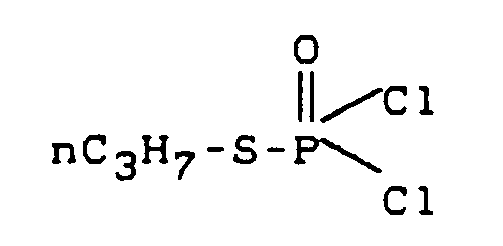
werden in 100 ml Toluol vorgelegt und mit 5,2 ml (0,037 mol) Triethylamin versetzt. Danach werden bei -5° bis 0°C 1,6 g Ethanol (0,034 mol) in 10 ml Toluol zugetropft. Man läßt 2 Stunden bei Raumtemperatur nachrühren. Dann werden 5,2 ml Triethylamin zugetropft und 10 g 1-Aza-tricyclo-(6.3-01.8, 02.6)-10-(2,4,6-trimethylphenyl)-undecan-9.11-dion zugegeben und in üblicher Art und Weise aufgearbeitet. Die Reinigung erfolgt durch Abfiltrieren über eine Kieselgelfritte (Toluol:Aceton 8:2). - Ausbeute: 8,20 g der Titelverbindung (52% d. Th.)
n

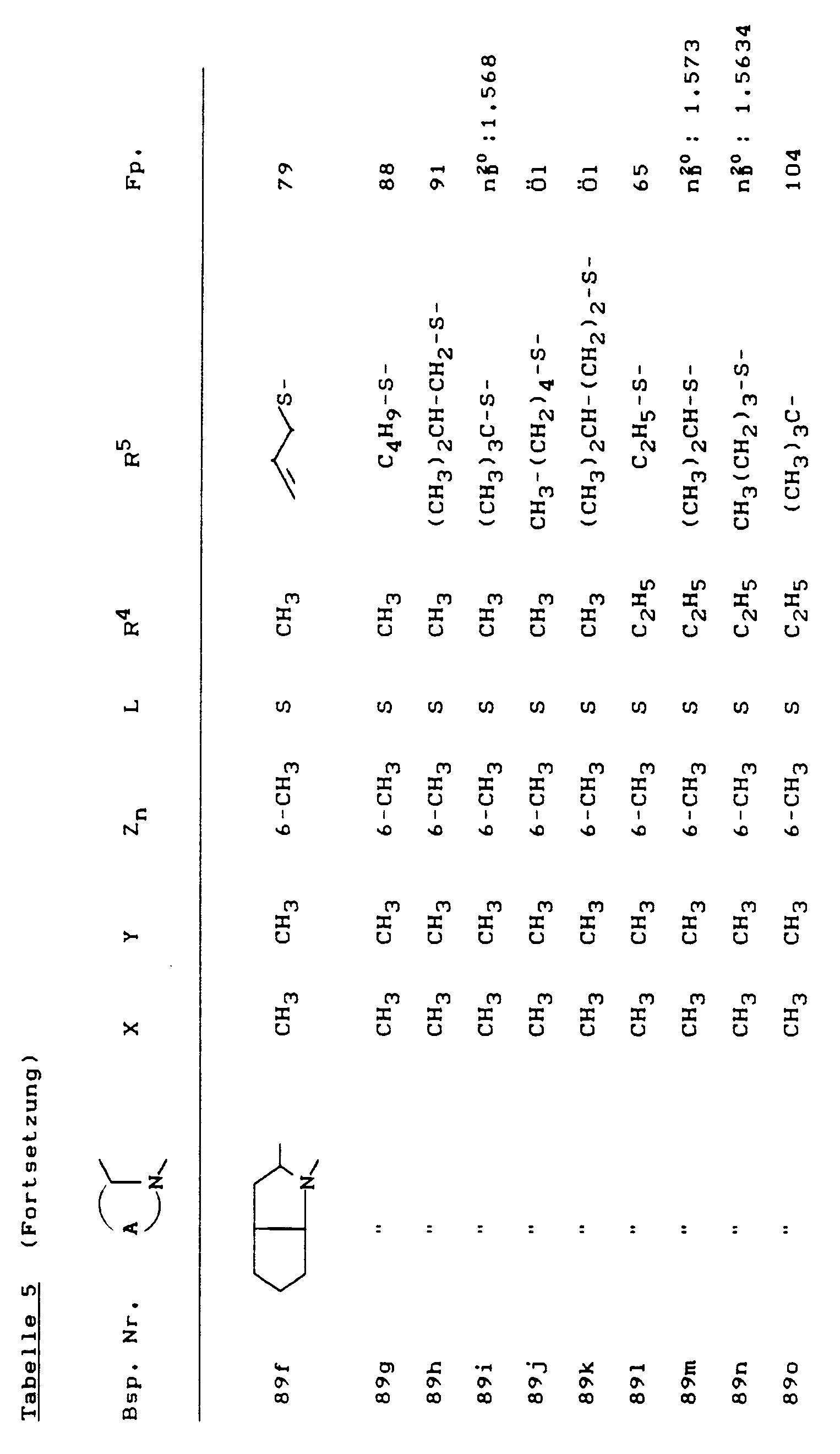
-
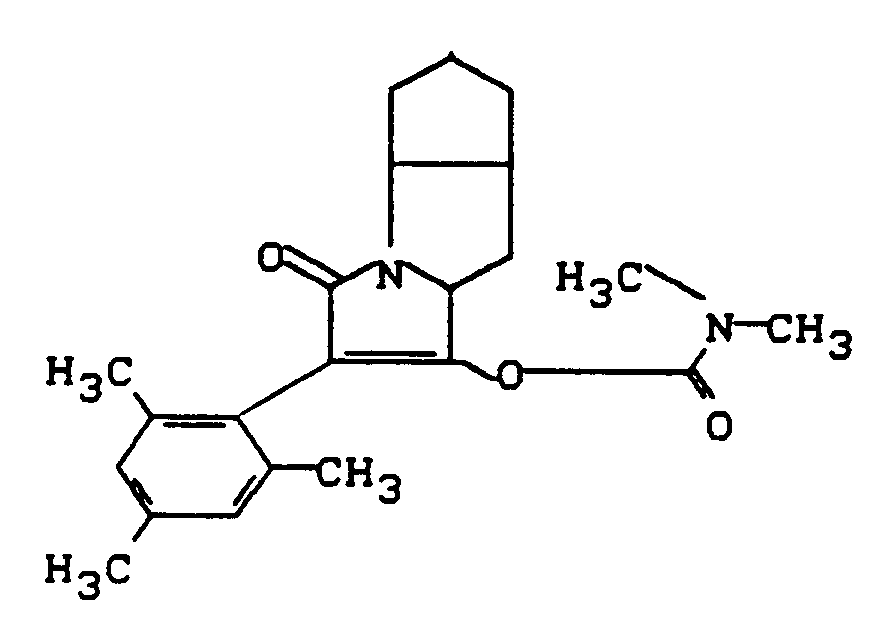
- 3,56 g 1-Aza-tricyclo-(6.3.01.8,02.6)-10-(2,4,6-trimethylphenyl)-undecan-9.11-dion und 15 ml absolutes Dimethylformamid werden mit 0,3 g Natriumhydrid (80%ig) versetzt. Nach Beendigung der Wasserstoffentwicklung kühlt man auf 10°C ab und gibt 1,6 g N,N-Dimethylcarbamidsäurechlorid zu. Anschließend läßt man 1 Stunde bei 80°C rühren.
- Man rührt in 35 ml 1%iger NaOH ein, extrahiert dreimal mit Methylenchlorid, wäscht einmal mit 15%iger Salzsäure, trocknet über Natriumsulfat und dampft ein.
- Ausbeute: 1,37 g (39% d. Th.) der Titelverbindung.
Fp: 149°C
-

- 7,41 g (20 mmol) 1,4-Diaza-4-N-(ethoxycarbonyl)-tricyclo-(6,3,01.8,02.6)-10-(2,4,6-trimethylphenyl)-undecan-9,11-dion werden in 100 ml Wasser mit 15,78 g (50 mmol) Bariumhydroxid-octahydrat 10 Stunden lang unter Rückfluß erhitzt. Nach dem Abkühlen werden portionsweise 6,9 g (50 mmol) Kaliumcarbonat zugefügt. Nach 15 Minuten saugt man ab, wäscht mit 20 ml Wasser nach und stellt das Filtrat mit 1N Salzsäure auf pH 7 ein. Man saugt erneut ab und trocknet im Vakuum. Auf diese Weise erhält man 5,18 g (= 86,9 % der Theorie) des inneren Salzes obiger Struktur vom Schmelzpunkt > 230°C als farbloses Pulver.

-

- 17,4 g (85 mmol) 1,2,7,8-Tetrahydroisochinolin-2-carbonsäureethylester werden in 130 ml absolutem Tetrahydrofuran vorgelegt, mit 11,9 ml (85 mmol) Triethylamin versetzt und bei 0 bis 10°C 16,7 g (85 mmol) Mesitylenessigsäurechlorid hinzugetropft. Nach 30 Minuten rührt man in 400 ml Eiswasser und 100 ml 1N Salzsäure ein, extrahiert mit Methylenchlorid, trocknet und rotiert im Vakuum ein. Man erhält 30,9 g (= 99,5 % der Theorie) 1,2,7,8-Tetrahydroisochinolin-N-(2,4,6-trimethylphenylacetyl)-2-carbonsäureethylester als gelbes Öl.


- Die Wirkstoffe eignen sich bei guter Pflanzenverträglichkeit und günstiger Warmblütertoxizität zur Bekämpfung von tierischen Schädlingen, insbesondere Insekten und Spinnentieren die in der Landwirtschaft, in Forsten, im Vorrats- und Materialschutz sowie auf dem Hygienesektor vorkommen. Sie sind gegen normal sensible und resistente Arten sowie gegen alle oder einzelne Entwicklungsstadien wirksam. Zu den oben erwähnten Schädlingen gehören:
Aus der Ordnung der Isopoda z.B. Oniscus asellus, Armadillidium vulgare, Porcellio scaber.
Aus der Ordnung der Diplopoda z.B. Blaniulus guttulatus.
Aus der Ordnung der Chilopoda z.B. Geophilus carpophagus, Scutigera spec.
Aus der Ordnung der Symphyla z.B. Scutigerella immaculata.
Aus der Ordnung der Thysanura z.B. Lepisma saccharina.
Aus der Ordnung der Collembola z.B. Onychiurus armatus. - Aus der Ordnung der Orthoptera z.B. Blatta orientalis, Periplaneta americana, Leucophaea maderae, Blattella germanica, Acheta domesticus, Gryllotalpa spp., Locusta migratoria migratorioides, Melanoplus differentialis, Schistocerca gregaria.
Aus der Ordnung der Dermaptera z.B. Forficula auricularia. - Aus der Ordnung der Isoptera z.B. Reticulitermes spp.. Aus der Ordnung der Anoplura z.B. Phylloxera vastatrix, Pemphigus spp., Pediculus humanus corporis, Haematopinus spp., Linognathus spp.
Aus der Ordnung der Mallophaga z.B. Trichodectes spp., Damalinea spp. - Aus der Ordnung der Thysanoptera z.B. Hercinothrips femoralis, Thrips tabaci.
Aus der Ordnung der Heteroptera z.B. Eurygaster spp., Dysdercus intermedius, Piesma quadrata, Cimex lectularius, Rhodnius prolixus, Triatoma spp.
Aus der Ordnung der Homoptera z.B. Aleurodes brassicae, Bemisia tabaci, Trialeurodes vaporariorum, Aphis gossypii, Brevicoryne brassicae, Cryptomyzus ribis, Doralis fabae, Doralis pomi, Eriosoma lanigerum, Hyalopterus arundinis, Macrosiphum avenae, Myzus spp., Phorodon humuli, Rhopalosiphum padi, Empoasca spp., Euscelis bilobatus, Nephotettix cincticeps, Lecanium corni, Saissetia oleae, Laodelphax striatellus, Nilaparvata lugens, Aonidiella aurantii, Aspidiotus hederae, Pseudococcus spp. Psylla spp.
Aus der Ordnung der Lepidoptera z.B. Pectinophora gossypiella, Bupalus piniarius, Cheimatobia brumata, Lithocolletis blancardella, Hyponomeuta padella, Plutella maculipennis, Malacosoma neustria, Euproctis chrysorrhoea, Lymantria spp. Bucculatrix thurberiella, Phyllocnistis citrella, Agrotis spp., Euxoa spp., Feltia spp., Earias insulana, Heliothis spp., Laphygma exigua, Mamestra brassicae, Panolis flammea, Prodenia litura, Spodoptera spp., Trichoplusia ni, Carpocapsa pomonella, Pieris spp., Chilo spp., Pyrausta nubilalis, Ephestia kuehniella, Galleria mellonella, Tineola bisselliella, Tinea pellionella, Hofmannophila pseudospretella, Cacoecia podana, Capua reticulana, Choristoneura fumiferana, Clysia ambiguella, Homona magnanima, Tortrix viridana. - Aus der Ordnung der Coleoptera z.B. Anobium punctatum, Rhizopertha dominica, Bruchidius obtectus, Acanthoscelides obtectus, Hylotrupes bajulus, Agelastica alni, Leptinotarsa decemlineata, Phaedon cochleariae, Diabrotica spp., Psylliodes chrysocephala, Epilachna varivestis, Atomaria spp., Oryzaephilus surinamensis, Anthonomus spp., Sitophilus spp., Otiorrhynchus sulcatus, Cosmopolites sordidus, Ceuthorrhynchus assimilis, Hypera postica, Dermestes spp., Trogoderma spp., Anthrenus spp., Attagenus spp., Lyctus spp., Meligethes aeneus, Ptinus spp., Niptus hololeucus, Gibbium psylloides, Tribolium spp., Tenebrio molitor, Agriotes spp., Conoderus spp., Melolontha melolontha, Amphimallon solstitialis, Costelytra zealandica.
Aus der Ordnung der Hymenoptera z.B. Diprion spp., Hoplocampa spp., Lasius spp., Monomorium pharaonis, Vespa spp. - Aus der Ordnung der Diptera z.B. Aedes spp., Anopheles spp., Culex spp., Drosophila melanogaster, Musca spp., Fannia spp., Calliphora erythrocephala, Lucilia spp., Chrysomyia spp., Cuterebra spp., Gastrophilus spp., Hyppobosca spp., Stomoxys spp., Oestrus spp., Hypoderma spp., Tabanus spp., Tannia spp., Bibio hortulanus, Oscinella frit, Phorbia spp., Pegomyia hyoscyami, Ceratitis capitata, Dacus oleae, Tipula paludosa.
- Aus der Ordnung der Siphonaptera z.B. Xenopsylla cheopis, Ceratophyllus spp..
Aus der Ordnung der Arachnida z.B. Scorpio maurus, Latrodectus mactans. - Aus der Ordnung der Acarina z.B. Acarus siro, Argas spp., Ornithodoros spp., Dermanyssus gallinae, Eriophyes ribis, Phyllocoptruta oleivora, Boophilus spp., Rhipicephalus spp., Amblyomma spp., Hyalomma spp., Ixodes spp., Psoroptes spp., Chorioptes spp., Sarcoptes spp., Tarsonemus spp., Bryobia praetiosa, Panonychus spp., Tetranychus spp..
- Die erfindungsgemäßen Wirkstoffe wirken nicht nur gegen Pflanzen-, Hygiene- und Vorratsschädlinge, sondern auch auf dem veterinärmedizinischen Sektor gegen tierische Parasiten (Ektoparasiten und Endoparasiten) wie Schildzecken, Lederzecken, Räubemilben, Laufmilben, Fliegen (stechend und leckend), parasitierende Fliegenlarven, Läuse, Haarlinge, Federlinge, Flöhe und endoparasitisch lebende Würmer.
- Die erfindungsgemäßen Wirkstoffe können weiterhin als Defoliants, Desiccants, Krautabtötungsmittel und insbesondere als Unkrautvernichtungsmittel verwendet werden. Unter Unkraut im weitesten Sinne sind alle Pflanzen zu verstehen, die an Orten aufwachsen, wo sie unerwünscht sind. Ob die erfindungsgemäßen Stoffe als totale oder selektive Herbizide wirken, hängt im wesentlichen von der angewendeten Menge ab.
- Charakteristisch für die erfindungsgemäßen Verbindungen ist, daß sie eine selektive Wirksamkeit gegen monokotyle Unkräuter im Vor- und Nachlaufverfahren (Pre- und Post-emergence) bei guter Kulturflanzenverträglichkeit aufweisen.
- Die erfindungsgemäßen Wirkstoffe können z.B. bei den folgenden Pflanzen verwendet werden:
Monokotyle Unkräuter der Gattungen: Echinochloa, Setaria, Panicum, Digitaria, Phleum, Poa, Festuca, Eleusine, Brachiaria, Lolium, Bromus, Avena, Cyperus, Sorghum, Agropyron, Cynodon, Monochoria, Fimbristylis, Sagittaria, Eleocharis, Scirpus, Paspalum, Ischaemum, Sphenoclea, Dactyloctenium, Agrostis, Alopecurus, Apera. - Monokotyle Kulturen der Gattungen: Oryza, Zea, Triticum, Hordeum, Avena, Secale, Sorghum, Panicum, Saccharum, Ananas, Asparagus, Allium.
- Die Verwendung der erfindungsgemäßen Wirkstoffe ist jedoch keineswegs auf diese Gattungen beschränkt, sondern erstreckt sich in gleicher Weise auch auf andere Pflanzen.
- Die Verbindungen eignen sich in Abhängigkeit von der Konzentration zur Totalunkrautbekämpfung z.B. auf Industrie- und Gleisanlagen und auf Wegen und Plätzen mit und ohne Baumbewuchs. Ebenso können die Verbindungen zur Unkrautbekämpfung in Dauerkulturen, z.B. Forst, Ziergehölz-, Obst-, Wein-, Citrus-, Nuß-, Bananen-, Kaffee-, Tee-, Gummi-, Ölpalm-, Kakao-, Beerenfrucht- und Hopfenanlagen und zur selektiven Unkrautbekämpfung in einjährigen Kulturen eingesetzt werden.
- Dabei zeigen die erfindungsgemäßen Wirkstoffe neben einer hervorragenden Wirkung gegen Schadpflanzen gute Verträglichkeit gegenüber wichtigen Kulturpflanzen, wie z. B. Weizen, Baumwolle, Sojabohnen, Citrusfrüchten und Zuckerrüben, und können daher als selektive Unkrautbekämpfungsmittel eingesetzt werden.
- Die Wirkstoffe können in die üblichen Formulierungen übergeführt werden, wie Lösungen, Emulsionen, Suspensionen, Pulver, Schäume, Pasten, Granulate, Aerosole, Wirkstoff-imprägnierte Natur- und synthetische Stoffe, Feinstverkapselungen in polymeren Stoffen und in Hüllmassen für Saatgut, ferner in Formulierungen mit Brennsätzen, wie Räucherpatronen, -dosen, -spiralen u.ä., sowie ULV-Kalt- und Warmnebel-Formulierungen.
- Diese Formulierungen werden in bekannter Weise hergestellt, z.B. durch Vermischen der Wirkstoffe mit Streckmitteln, also flüssigen Lösungsmitteln, unter Druck stehenden verflüssigten Gasen und/oder festen Trägerstoffen, gegebenenfalls unter Verwendung von oberflächenaktiven Mitteln, also Emulgiermitteln und/oder Dispergiermitteln und/oder schaumerzeugenden Mitteln. Im Falle der Benutzung von Wasser als Streckmittel können z.B. auch organische Lösungsmittel als Hilfslösungsmittel verwendet werden. Als flüssige Lösungsmittel kommen im wesentlichen in Frage: Aromaten, wie Xylol, Toluol, oder Alkylnaphthaline, chlorierte Aromaten oder chlorierte aliphatische Kohlenwasserstoffe, wie Chlorbenzole, Chlorethylene oder Methylenchlorid, aliphatische Kohlenwasserstoffe, wie Cyclohexan oder Paraffine, z.B. Erdölfraktionen, Alkohole, wie Butanol oder Glycol sowie deren Ether und Ester, Ketone, wie Aceton, Methylethylketon, Methylisobutylketon oder Cyclohexanon, stark polare Lösungsmittel, wie Dimethylformamid und Dimethylsulfoxid, sowie Wasser; mit verflüssigten gasförmigen Streckmitteln oder Trägerstoffen sind solche Flüssigkeiten gemeint, welche bei normaler Temperatur und unter Normaldruck gasförmig sind, z.B. Aerosol-Treibgas, wie Halogenkohlenwasserstoffe sowie Butan, Propan, Stickstoff und Kohlendioxid; als feste Trägerstoffe kommen in Frage: z.B. natürliche Gesteinsmehle, wie Kaoline, Tonerden, Talkum, Kreide, Quarz, Attapulgit, Montmorillonit oder Diatomeenerde und synthetische Gesteinsmehle, wie hochdisperse Kieselsäure, Aluminiumoxid und Silikate; als feste Trägerstoffe für Granulate kommen in Frage: z.B. gebrochene und fraktionierte natürliche Gesteine wie Calcit, Marmor, Bims, Sepiolith, Dolomit sowie synthetische Granulate aus anorganischen und organischen Mehlen sowie Granulate aus organischem Material wie Sägemehl, Kokosnußschalen, Maiskolben und Tabakstengel; als Emulgier und/oder schaumerzeugende Mittel kommen in Frage: z.B. nichtionogene und anionische Emulgatoren, wie Polyoxyethylen-Fettsäure-Ester, Polyoxyethylen-Fettalkohol-Ether, z.B. Alkylarylpolyglykol-Ether, Alkylsulfonate, Alkylsulfate, Arylsulfonate sowie Eiweißhydrolysate; als Dispergiermittel kommen in Frage: z.B. Lignin-Sulfitablaugen und Methylcellulose.
- Es können in den Formulierungen Haftmittel wie Carboxymethylcellulose, natürliche und synthetische pulverige, körnige oder latexförmige Polymere verwendet werden, wie Gummiarabicum, Polyvinylalkohol, Polyvinylacetat, sowie natürliche Phospholipide, wie Kephaline und Lecithine, und synthetische Phospholipide. Weitere Additive können mineralische und vegetabile Öle sein.
- Es können Farbstoffe wie anorganische Pigmente, z.B. Eisenoxid, Titanoxid, Ferrocyanblau und organische Farbstoffe, wie Alizarin-, Azo- und Metallphthalocyaninfarbstoffe und Spurennährstoffe wie Salze von Eisen, Mangan, Bor, Kupfer, Kobalt, Molybdän und Zink verwendet werden,
- Die Formulierungen enthalten im allgemeinen zwischen 0,1 und 95 Gewichtsprozent Wirkstoff, vorzugsweise zwischen 0,5 und 90 %.
- Die erfindungsgemäßen Wirkstoffe können in ihren handelsüblichen Formulierungen sowie in den aus diesen Formulierungen bereiteten Anwendungsformen in Mischung mit anderen Wirkstoffen, wie Insektiziden, Lockstoffen, Sterilantien, Akariziden, Nematiziden Herbiziden oder Fungiziden vorliegen. Zu den Insektiziden zählen beispielsweise Phosphorsäureester, Carbamate, Carbonsäureester, chlorierte Kohlenwasserstoffe, Phenylharnstoffe, durch Mikroorganismen hergestellte Stoffe u.a.
- Die erfindungsgemäßen Wirkstoffe können ferner in ihren handelsüblichen Formulierungen sowie in den aus diesen Formulierungen bereiteten Anwendungsformen in Mischung mit Synergisten vorliegen. Synergisten sind Verbindungen, durch die die Wirkung der Wirkstoffe gesteigert wird, ohne daß der zugesetzte Synergist selbst aktiv wirksam sein muß.
- Der Wirkstoffgehalt der aus den handelsüblichen Formulierungen bereiteten Anwendungsformen kann in weiten Bereichen variieren, Die Wirkstoffkonzentration der Anwendungsformen kann von 0,0000001 bis zu 95 Gew.-% Wirkstoff, vorzugsweise zwischen 0,0001 und 1 Gew.-% liegen.
- Die Anwendung geschieht in einer den Anwendungsformen angepaßten üblichen Weise.
-
- Lösungsmittel:
- 3 Gewichtsteile Dimethylformamid
- Emulgator:
- 1 Gewichtsteil Alkylarylpolyglykolether
- Bohnenpflanzen (Phaseolus vulgaris), die stark von allen Entwicklungsstadien der gemeinen Spinnmilbe oder Bohnenspinnmilbe (Tetranychus urticae) befallen sind, werden durch Tauchen in die Wirkstoffzubereitung der gewünschten Konzentration behandelt.
- Nach der gewünschten Zeit wird die Abtötung in % bestimmt. Dabei bedeutet 100 %, daß alle Spinnmilben abgetötet wurden; 0 % bedeutet, daß keine Spinnmilben abgetötet wurden. (6), (12), (22), (25), (47), (48).
-
- Lösungsmittel:
- 7 Gewichtsteile Dimethylformamid
- Emulgator:
- 1 Gewichtsteile Alkylarylpolyglykolether
- Reiskeimlinge (Oryza sativa) werden durch Tauchen in die Wirkstoffzubereitung der gewünschten Konzentration behandelt und mit Larven der Grünen Reiszikade (Nephotettix cincticeps) besetzt, solange die Keimlinge noch feucht sind.
- Nach der gewünschten Zeit wird die Abtötung in % bestimmt. Dabei bedeute 100 %, daß alle Zikaden abgetötet wurden; 0 % bedeutet, daß keine Zikaden abgetötet wurden.
- Bei diesem Test zeigen z.B. die folgenden Verbindungen der Herstellungsbeispiele überlegene Wirksamkeit gegenüber dem Stand der Technik: (6), (12), (22), (25), (47), (48), (49).
-
- Lösungsmittel:
- 5 Gewichtsteile Aceton
- Emulgator:
- 1 Gewichtsteil Alkylarylpolyglykolether
- Samen der Testpflanzen werden in normalen Boden ausgesät und nach 24 Stunden mit der Wirkstoffzubereitung begossen. Dabei hält man die Wassermenge pro Flächeneinheit zweckmäßigerweise konstant. Die Wirkstoffkonzentration in der Zubereitung spielt keine Rolle, entscheidend ist nur die Aufwandmenge des Wirkstoffs pro Flächeneinheit. Nach drei Wochen wird der Schädigungsgrad der Pflanzen bonitiert in % Schädigung im Vergleich zur Entwicklung der unbehandelten Kontrolle, Es bedeuten:
0 % = keine Wirkung (wie unbehandelte Kontrolle)
100 % = totale Vernichtung
Bei diesem Test zeigen z.B. die folgenden Verbindungen der Herstellungsbeispiele überlegene Wirksamkeit gegenüber dem Stand der Technik: (6), (10), (12), (22), (49). -
- Lösungsmittel:
- 5 Gewichtsteile Aceton
- Emulgator:
- 1 Gewichtsteil Alkylarylpolyglykolether
- Mit der Wirkstoffzubereitung spritzt man Testpflanzen, welche eine Höhe von 5-15 cm haben so, daß die jeweils gewünschten Wirkstoffmengen pro Flächeneiheit ausgebracht werden. Die Konzentration der Spritzbrühe wird so gewählt, daß in 2000 l Wasser/ha die jeweils gewünschten Wirkstoffmengen ausgebracht werden. Nach drei Wochen wird der Schädigungsgrad der Pflanzen bonitiert in % Schädigung im Vergleich zur Entwicklung der unbehandelten Kontrolle.
Es bedeuten:
0 % = Keine Wirkung (wie unbehandelte Kontrole)
100 % = totale Vernichtung. - Bei diesem Test zeigen z.B. die folgenden Verbindungen der Herstellungsbeispiele überlegene Wirksamkeit gegenüber dem Stand der Technik: (6), (10), (12), (22), (49).
Zur Herstellung einer zweckmäßigen Wirkstoffzubereitung vermischt man 1 Gewichtsteil Wirkstoff mit der angegebenen Menge Lösungsmittel und der angegebenen Menge Emulgator und verdünnt das Konzentrat mit Wasser auf die gewünschte Konzentration.
Zur Herstellung einer zweckmäßigen Wirkstoffzubereitung vermischt man 1 Gewichtsteil Wirkstoff mit der angegebenen Menge Lösungsmittel und der angegebenen Menge Emulgator und verdünnt das Konzentrat mit Wasser auf die gewünschte Konzentration.
Zur Herstellung einer zweckmäßigen Wirkstoffzubereitung vermischt man 1 Gewichtsteil Wirkstoff mit der angegebenen Menge Lösungsmittel, gibt die angegebene Menge Emulgator zu und verdünnt das Konzentrat mit Wasser auf die gewünschte Konzentration.
Zur Herstellung einer zweckmäßigen Wirkstoffzubereitung wurde 1 Gewichtsteil Wirkstoff mit der angegebenen Menge Lösungsmittel vermischt, die angegebene Menge Emulgator zugegeben und das Konzentrat anschließend mit Wasser auf die gewünschte Konzentration verdünnt.
Claims (9)
- Polycyclische 3-Arylpyrrolidin-2,4-dion-Derivate der Formel (I)

die Gruppierung

 X für C₁-C₆-Alkyl, Halogen oder C₁-C₆-Alkoxy steht,Y für Wasserstoff, C₁-C₆-Alkyl, Halogen, C₁-C₆-Alkoxy, C₁-C₃-Halogenalkyl steht,Z für C₁-C₆-Alkyl, Halogen, C₁-C₆-Alkoxy steht,n für eine Zahl von 0-3 steht,G für Wasserstoff (a) oder für die Gruppenin welchen
-CO-R¹, (b)

steht,E für ein Metallionäquivalent oder ein Ammoniumion steht,L und M für Sauerstoff und/oder Schwefel steht,R¹ für gegebenenfalls durch Halogen substituiertes C₁-C₂₀-Alkyl, C₂-C₂₀-Alkenyl, C₁-C₈-Alkoxy-C₂-C₈-alkyl, C₁-C₈-Alkylthio-C₂-C₈-alkyl, C₁-C₈-Polyalkoxyl-C₂-C₈-alkyl oder Cycloalkyl mit 3-8 Ringatomen, das durch Sauerstoffund/oder Schwefelatome unterbrochen sein kann, steht,
für gegebenenfalls durch Halogen, Nitro, C₁-C₆-Alkyl, C₁-C₆-Alkoxy, C₁-C₆-Halogenalkyl, C₁-C₆-Halogenalkoxy substituiertes Phenyl;
für gegebenenfalls durch Halogen, C₁-C₆-Alkyl, C₁-C₆-Alkoxy, C₁-C₆-Halogenalkyl, C₁-C₆-Halogenalkoxy substituiertes Phenyl-C₁-C₆-alkyl steht,
für gegebenenfalls durch Halogen und/oder C₁-C₆-Alkyl substituiertes Pyridyl, Pyrimidyl, Thiazolyl oder Pyrazolyl steht,
für gegebenenfalls durch Halogen und/oder C₁-C₆-Alkyl substituiertes Phenoxy-C₁-C₆-alkyl steht,
für gegebenenfalls durch Halogen, Amino und C₁-C₆-Alkyl substituiertes Pyridyloxy-C₁-C₆-alkyl, Pyrimidyloxy-C₁-C₆-alkyl oder Thiazolyloxy-C₁-C₆-alkyl steht,R² für gegebenenfalls durch Halogen substituiertes C₁-C₂₀-Alkyl, C₂-C₂₀-Alkenyl, C₁-C₈-Alkoxy-C₂-C₈-alkyl, C₁-C₈-Polyalkoxy-C₂-C₈-alkyl steht,
für gegebenenfalls durch Halogen, Nitro, C₁-C₆-Alkyl, C₁-C₆-Alkoxy, C₁-C₆-Halogenalkylsubstituiertes Phenyl oder Benzyl steht,R³, R⁴ und R⁵ unabhängig voneinander für gegebenenfalls durch Halogen substituiertes C₁-C₈-Alkyl, C₁-C₈-Alkoxy, C₁-C₈-Alkylamino, Di-(C₁-C₈)-Alkylamino, C₁-C₈-Alkylthio, C₂-C₅-Alkenylthio, C₂-C₅-Alkinylthio, C₃-C₇-Cycloalkylthio, für gegebenenfalls durch Halogen, Nitro, Cyano, C₁-C₄-Alkoxy, C₁-C₄-Halogenalkoxy, C₁-C₄-Alkylthio, C₁-C₄-Halogenalkylthio, C₁-C₄-Alkyl, C₁-C₄-Halogenalkyl substituiertes Phenyl, Phenoxy oder Phenylthio stehen,R⁶ und R⁷ unabhängig voneinander für gegebenenfalls durch Halogen substituiertes C₁-C₂₀-Alkyl, C₁-C₂₀-Alkoxy, C₂-C₈-Alkenyl, C₁-C₂₀-Alkoxy-C₁-C₂₀-alkyl, für gegebenenfalls durch Halogen, C₁-C₂₀-Halogenalkyl, C₁-C₂₀-Alkyl oder C₁-C₂₀-Alkoxy substituiertes Phenyl, für gegebenenfalls durch Halogen, C₁-C₂₀-Alkyl, C₁-C₂₀-Halogenalkyl oder C₁-C₂₀-Alkoxy substituiertes Benzyl steht oder zusammen für einen gegebenenfalls durch Sauerstoff unterbrochenen C₂-C₆-Alkylenring stehen,R⁹ für Wasserstoff, Halogen oder gegebenenfalls durch Halogen substituiertes C₁-C₂-Alkyl oder C₁-C₂-Alkoxy steht,R¹⁰ für C₁-C₇-Alkoxy, Amino, C₁-C₄-Alkylamino, C₁-C₄-Dialkylamino steht. - Polycyclische 3-Arylpyrrolidin-2,4-dion-Derivate der Formel (I) gemäß Anspruch 1, dadurch gekennzeichnet, daß es sich um eine der folgenden Strukturen (Ia) bis (Ig) handelt:


A, E, L, M, X, Y, Zn, R¹, R², R³, R⁴, R⁵, R⁶ und R⁷ die in Anspruch 1 angegebenen Bedeutungen besitzen. - Polycyclische 3-Arylpyrrolidin-2,4-dion-Derivate der Formel (I) gemäß Anspruch 1, dadurch gekennzeichnet, daß die Gruppierung
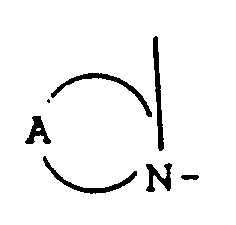


 X für C₁-C₄-Alkyl, Halogen, C₁-C₄-Alkoxy steht,Y für Wasserstoff, C₁-C₄-Alkyl, Halogen, C₁-C₄-Alkoxy, C₁-C₂-Halogenalkyl steht,Z für C₁-C₄-Alkyl, Halogen, C₁-C₄-Alkoxy steht,n für eine Zahl von 0-3 steht,G für Wasserstoff (a) oder für die Gruppenin welchen
-CO-R¹, (b)

steht,E für ein Metallionäquivalent oder ein Ammoniumion stehtL und M jeweils für Sauerstoff und/oder Schwefel steht,R¹ für gegebenenfalls durch Halogen substituiertes C₁-C₁₆-Alkyl, C₂-C₁₆-Alkenyl, C₁-C₆-Alkoxy-C₂-C₆-alkyl, C₁-C₁₆-Alkylthio-C₂-C₆-alkyl, C₁.C₆-Polyalkoxy-C₂-C₆-alkyl und Cycloalkyl mit 3-7 Ringatomen, das durch 1-2 Sauerstoff- und/oder Schwefelatome unterbrochen sein kann, steht,
für gegebenenfalls durch Halogen, Nitro, C₁-C₄-Alkyl, C₁-C₄-Alkoxy, C₁-C₃-Halogenalkyl, C₁-C₃-Halogenalkoxy substituiertes Phenyl steht,
für gegebenenfalls durch Halogen, C₁-C₄-Alkyl, C₁-C₄-Alkoxy, C₁-C₃-Halogenalkyl, C₁-C₃-Halogenalkoxy substituierets Phenyl-C₁-C₄-alkyl steht,
für gegebenenfalls durch Halogen und C₁-C₆-Alkyl substituiertes Pyridyl, Pyrimidyl, Thiazolyl oder Pyrazolyl steht,
für gegebenenfalls durch Halogen und C₁-C₄-Alkyl substituiertes Phenoxy-C₁-C₅-alkyl steht,
für gegebenenfalls durch Halogen, Amino, C₁-C₄-Alkyl-substituiertes Pyridyloxy-C₁-C₅-alkyl, Pyrimidyloxy-C₁-C₅-alkyl oder Thiazolyloxy-C₁-C₅-alkyl steht,R² für gegebenenfalls durch Halogen substituiertes C₁-C₁₆-Alkyl, C₂-C₁₆-Alkenyl, C₁-C₁₆-Alkox-C₂-C₆-alkyl, C₁-C₆-Polyalkoxy-C₂-C₆-alkyl steht,
für gegebenenfalls durch Halogen, Nitro, C₁-C₄-Alkyl, C₁-C₃-Alkoxy, C₁-C₃-Halogenalkylsubstituiertes Phenyl oder Benzyl steht,R³, R⁴ und R⁵ unabhängig voneinander für gegebenenfalls durch Halogen substituiertes C₁-C₆-Alkyl, C₁-C₆-Alkoxy, C₁-C₆-Alkylamino, Di-(C₁-C₆)-Alkylamino, C₁-C₆-Alkylthio, C₃-C₄-Alkenylthio, C₂-C₄-Alkinylthio, C₃-C₆-Cycloalkylthio, für gegebenenfalls durch Fluor, Chlor, Brom, Nitro, Cyano, C₁-C₃-Alkoxy, C₁-C₃-Halogenalkoxy, C₁-C₃-Alkylthio, C₁-C₃-Halogenalkylthio, C₁-C₃-Alkyl, C₁-C₃-Halogenalkyl substiutiertes Phenyl, Phenoxy oder Phenylthio stehen,R⁶ und R⁷ unabhängig voneinander für gegebenenfalls durch Halogen substituiertes C₁-C₂₀-Alkyl, C₁-C₂₀-Alkoxy, C₂-C₈-Alkenyl, C₁-C₂₀-Alkoxy-C₁-C₂₀-alkyl, für gegebenenfalls durch Halogen, C₁-C₅-Halogenalkyl, C₁-C₅-Alkyl oder C₁-C₅-Alkoxy substituiertes Phenyl, für gegebenenfalls durch Halogen, C₁-C₅-Alkyl, C₁-C₅-Halogenalkyl oder C₁-C₅-Alkoxy substituiertes Benzyl steht,R⁹ für Wasserstoff, Halogen oder gegebenenfalls durch Halogen substituiertes C₁-C₂-Alkyl oder C₁-C₂-Alkoxy steht,R¹⁰ für C₁-C₇-Alkoxy, Amino, C₁-C₄-Alkylamino, C₁-C₄-Dialkylamino steht. - Polycyclische 3-Arylpyrrolidin-2,4-dion-Derivate der Formel (I) gemäß Anspruch 1, dadurch gekennzeichnet, daß die Gruppierung


 X für Methyl, Ethyl, Propyl, i-Propyl, Fluor, Chlor, Brom, Methoxy und Ethoxy steht,Y für Wasserstoff, Methyl, Ethyl, Propyl, i-Propyl, Butyl, i-Butyl, tert.-Butyl, Fluor, Chlor, Brom, Methoxy, Ethoxy und Trifluormethyl steht,Z für Methyl, Ethyl, i-Propyl, Butyl, i-Butyl, tert.-Butyl, Fluor, Chlor, Brom, Methoxy und Ethoxy steht,n für eine Zahl von 0-3 steht,G für Wasserstoff (a) oder für die Gruppenin welchen
-CO-R¹, (b)
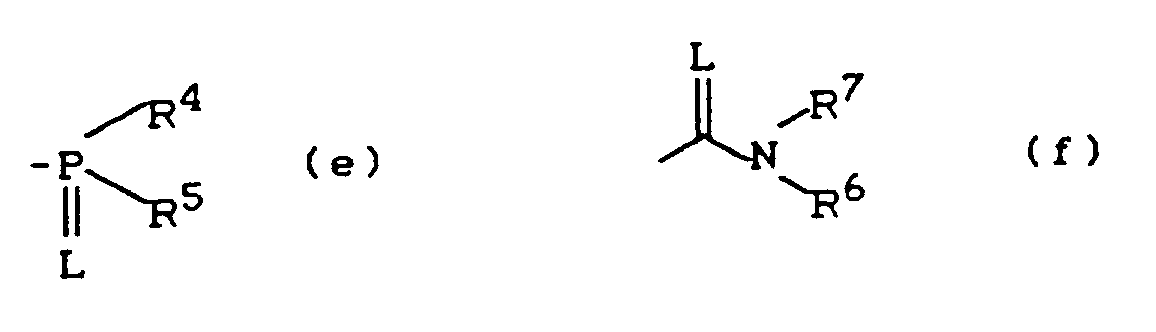 E für ein Metallionäquivalent oder ein Ammoniumion steht,L und H für Sauerstoff und/oder Schwefel steht,R¹ für gegebenenfalls durch Fluor oder Chlor substituiertes C₁-C₁₄-Alkyl, C₂-C₁₄-Alkenyl, C₁-C₄-Alkoxy-C₂-C₆-alkyl, C₁-C₄-Alkylthio-C₂-C₆-alkyl, C₁-C₄-Polyalkoxyl-C₂-C₄-alkyl und Cycloalkyl mit 3-6 Ringatomen, das durch 1-2 Sauerstoff- und/oder Schwefelatome unterbrochen sein kann, steht,
für gegebenenfalls durch Fluor, Chlor, Brom, Methyl, Ethyl, Propyl, i-Propyl, Methoxy, Ethoxy, Trifluormethyl, Trifluormethoxy, Nitro-substituiertes Phenyl steht,
für gegebenenfalls durch Fluor, Chlor, Brom, Methyl, Ethyl, Propyl, i-Propyl, Methoxy, Ethoxy, Trifluormethyl, Trifluormethoxy substituiertes Phenyl-C₁-C₃-alkyl steht,
für gegebenenfalls durch Fluor, Chlor, Brom, Methyl, Ethyl substituiertes Pyridyl, Pyrimidyl, Thiazolyl oder Pyrazolyl steht,
für gegebenenfalls durch Fluor, Chlor, Methyl, Ethyl substituiertes Phenoxy-C₁-C₄-alkyl steht,
für gegebenenfalls durch Fluor, Chlor, Amino, Methyl, Ethyl, substituiertes Pyridyloxy-C₁-C₄-alkyl, Pyrimidyloxy-C₁-C₄-alkyl oder Thiazolyloxy-C₁ -C₄-alkyl steht,R² für gegebenenfalls durch Fluor oder Chlor substituiertes C₁-C₁₄-Alkyl, C₂-C₁₄-Alkenyl, C₁-C₄-Alkoxy-C₂-C₆-alkyl, C₁-C₄-Polyalkoxy-C₂-C₆-alkyl steht,
oder für gegebenenfalls durch Fluor, Chlor, Nitro, Methyl, Ethyl, Propyl, i-Propyl, Methoxy, Ethoxy, Trifluormethyl substituiertes Phenyl oder Benzyl steht,R³, R⁴ und R⁵ unabhängig voneinander für gegebenenfalls durch Fluor oder Chlor substituiertes C₁-C₄-Alkyl, C₁-C₄-Alkoxy, C₁-C₄-Alkylamino, Di-(C₁-C₄-Alkyl)-amino, C₁-C₄-Alkylthio, für gegebenenfalls durch Fluor, Chlor, Brom, Nitro, Cyano, C₁-C₂-Alkoxy, C₁-C₄-Fluoralkoxy, C₁-C₂-Chloralkoxy, C₁-C₂-Alkylthio, C₁-C₂-Fluoralkylthio, C₁-C₂-Chloralkylthio, C₁-C₃-Alkyl substituiertes Phenyl, Phenoxy oder Phenylthio stehen,R⁶ und R⁷ unabhängig voneinander für gegebenenfalls durch Fluor, Chlor, Brom substituiertes C₁-C₁₀-Alkyl, C₁-C₁₀-Alkoxy, C₁-C₁₀-Alkoxy-(C₁-C₁₀)alkyl, für gegebenenfalls durch Fluor, Chlor, Brom C₁-C₂₀-Halogenalkyl, C₁-C₂₀-Alkyl oder C₁-C₄-Alkoxy substituiertes Phenyl, für gegebenenfalls durch Fluor, Chlor, Brom, C₁-C₄-Alkyl, C₁-C₄-Halogenalkyl oder C₁-C₄-Alkoxy substituiertes Benzyl steht,R⁹ für Wasserstoff, Halogen oder gegebenenfalls durch Halogen substituiertes C₁-C₂-Alkyl oder C₁-C₂-Alkoxy steht,R¹⁰ für Methoxy, Ethoxy, Propoxy, iso-Propoxy, Butoxy, iso-Butoxy, sek.-Butoxy, tert.-Butoxy, Phenoxy, Benzyloxy, Amino, C₁-C₂-Alkylamino, C₁-C₂-Dialkylamino steht. - Verfahren zur Herstellung von polycyclischen 3-Arylpyrrolidin-2,4-dion-Derivaten der Formel (I) gemäß Anspruch 1
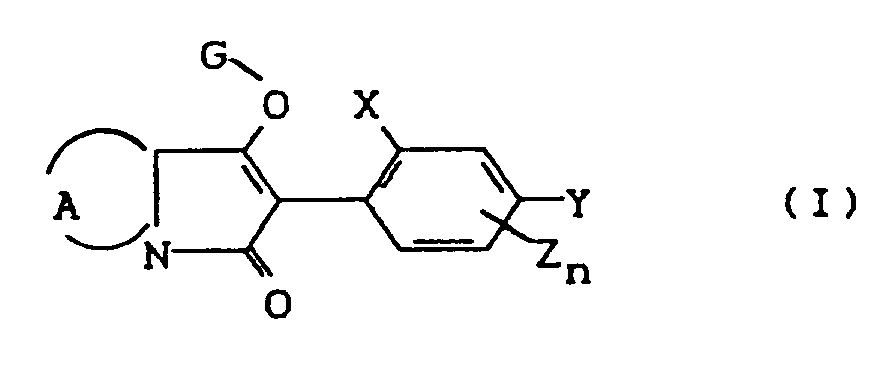 A, G, X, Y, Z und n die in Anspruch 1 angegebene Bedeutung habendadurch gekennzeichnet, daß man zum Erhalt von 3-Aryl-pyrrolidin-2,4-dionen bzw. deren Enolen der Formel (Ia)
 A, X, Y, Z und n die oben angegebene Bedeutung haben,(A)
N-Acylaminosäureester der Formel (II) A, Y, Z und n die oben angegebene Bedeutung habenundR⁸ für Alkyl steht,in Gegenwart eines Verdünnungsmittels und in Gegenwart einer Base intramolekular kondensiert.(B)
oder daß man zum Erhalt von Verbindungen der Formel (Ib) A, X, Y, Z, R¹ und n die oben angegebene Bedeutung haben,Verbindungen der Formel (Ia),
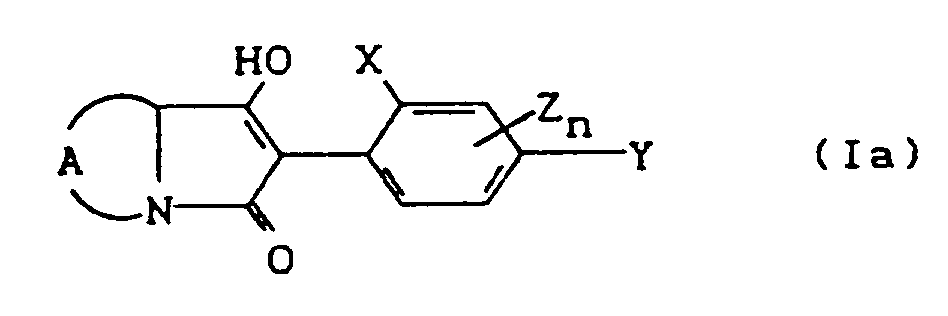 A, X, Y, Z und n die oben angegebene Bedeutung haben,α) mit Säurehalogeniden der allgemeinen Formel (III)
 R¹ die oben angegebene Bedeutung hatundHal für Halogen, insbesondere Chlor und Brom steht,gegebenenfalls in Gegenwart eines Verdünnungsmittels und gegebenenfalls in Gegenwart eines Säurebindemittels umsetzt oderβ) mit Carbonsäureanhydriden der allgemeinen Formel (IV)
R¹-CO-O-CO-R¹ (IV)
in welcherR¹ die oben angegebene Bedeutung hat,umsetzt,
gegebenenfalls in Gegenwart eines Verdünnungsmittels und gegebenenfalls in Gegenwart eines Säurebindemittels,(C)
oder daß man zum Erhalt von Verbindungen der Formel (Ic) A, X, Y, Z, R² und n die oben angegebene Bedeutung haben,L für SauerstoffundM für Sauerstoff oder Schwefel steht,Verbindungen der Formel (Ia)
 A, X, Y, Z und n die oben angegebene Bedeutung haben,mit Chlorameisensäureester oder Chlorameisensäurethiolester der allgemeinen Formel (V)
R²-M-CO-Cl (V)
in welcherR² und M die oben angegebene Bedeutung haben,gegebenenfals in Gegenwart eines Verdünnungsmittels und gegebenenfalls in Gegenwart eines Säurebindemittels umsetzt,(D)
oder daß man zum Erhalt von Verbindungen der Formel (Ic) A, R², X, Y, Z und n die oben angegebene Bedeutung haben,L für SchwefelundM für Sauerstoff oder Schwefel steht,Verbindungen der Formel (Ia)
 A, X, Y, Z und n die oben angegebene Bedeutung haben,α) mit Chlormonothioameisensäureestern oder Chlordithioameisensäureestern der allgemeinen Formel (VI)
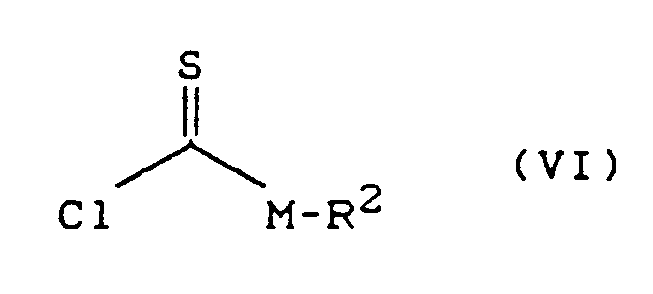 M und R² die oben angegebene Bedeutung haben,gegebenenfalls in Gegenwart eines Verdünnungsmittels und gegebenenfalls in Gegenwart eines Säurebindemittels umsetzt,
oderβ) mit Schwefelkohlenstoff und anschließend mit Alkylhalogeniden der allgemeinen Formel (VII)
R²-Hal (VII)
in welcherR² die oben angegebene Bedeutung hatundHal für Chlor, Brom, Jodsteht, umsetzt,(E)
oder daß man zum Erhalt von Verbindungen der Formel (Id) A, X, Y, Z, R³ und n die oben angegebene Bedeutung haben,Verbindungen der Formel (Ia)
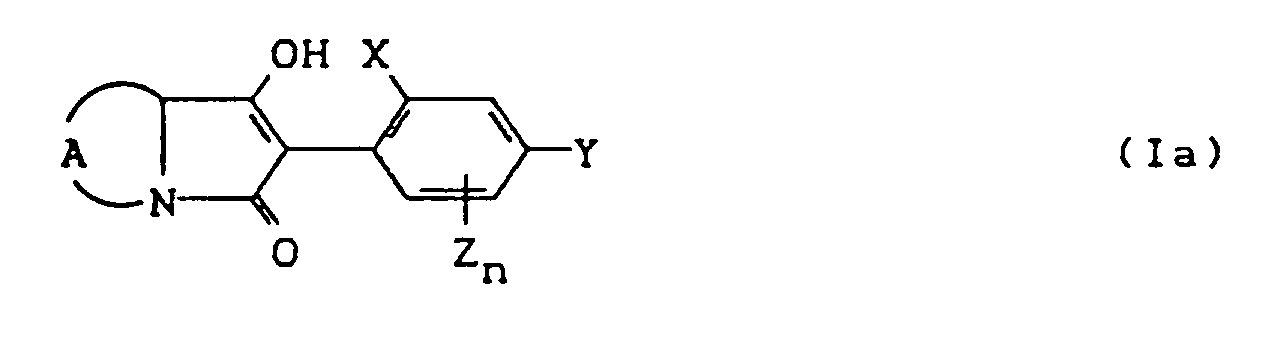 A, X, Y, Z und n die oben angegebene Bedeutung haben,mit Sulfonsäurechloriden der allgemeinen Formel (VIII)
R³-SO₂-Cl (VIII)
in welcherR³ die oben angegebene Bedeutung hatumsetzt,
gegebenenfalls in Gegenwart eines Verdünnungsmittels und gegebenenfalls in Gegenwart eines Säurebindemittels,(F)
oder daß man zum Erhalt von 3-Aryl-pyrrolidin-2,4-dionen der Formel (Ie) A, L, X, Y, Z, R⁴, R⁵ und n die oben angegebene Bedeutung haben,3-Aryl-pyrrolidin-2,4-dione der Formel (Ia) bzw. deren Enole der Formel
 A, X, Y, Z und n die oben angegebene Bedeutung habenmit Phosphorverbindungen der allgemeinen Formel (IX)
 L, R⁴ und R⁵ die oben angegebene Bedeutung habenundHal für Halogen, insbesondere Chlor und Brom steht,gegebenenfalls in Gegenwart eines Verdünnungsmittels und gegebenenfalls in Gegenwart eines Säurebindemittels umsetzt,(G)
oder daß man zum Erhalt von Verbindungen der Formel (If) A, L, X, Y, Z, R⁶, R⁷ und n die oben angegebene Bedeutung haben,Verbindungen der Formel (Ia),
 A, X, Y, Z und n die oben angegebene Bedeutung haben,α) mit Isocyanaten der allgemeinen Formel (X)oder
R⁶-N=C=O (X)
in welcherR⁶ die oben angegebene Bedeutung hat,gegebenenfalls in Gegenwart eines Verdünnungsmittels und gegebenenfalls in Gegenwart eines Katalysators, umsetzt,β) mit Carbamidsäurechloriden oder Thiocarbamidsäurechloriden der allgemeinen Formel (XI)umsetzt, L, R⁶ und R⁷ die oben angegebene Bedeutung haben,gegebenenfalls in Gegenwart eines Verdünnungsmittels und gegebenenfalls in Gegenwart eines Säurebindemittels,(H)
oder daß man zum Erhalt von Verbindungen der Formel (Ig)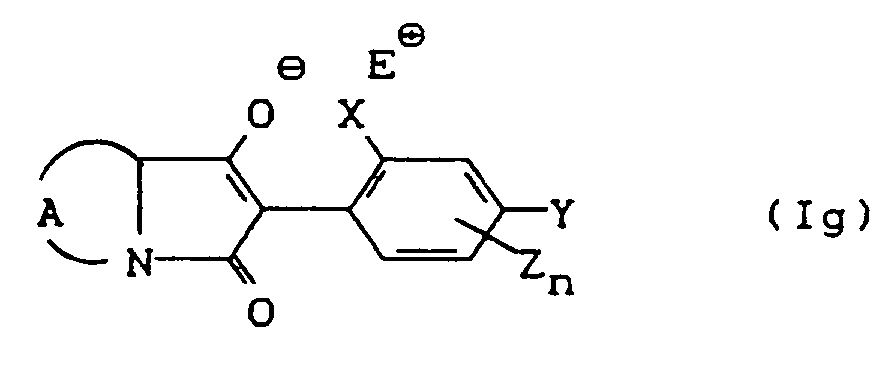 X, Y, Z, A und n die oben angegebene Bedeutung haben,Verbindungen der Formel (Ia)
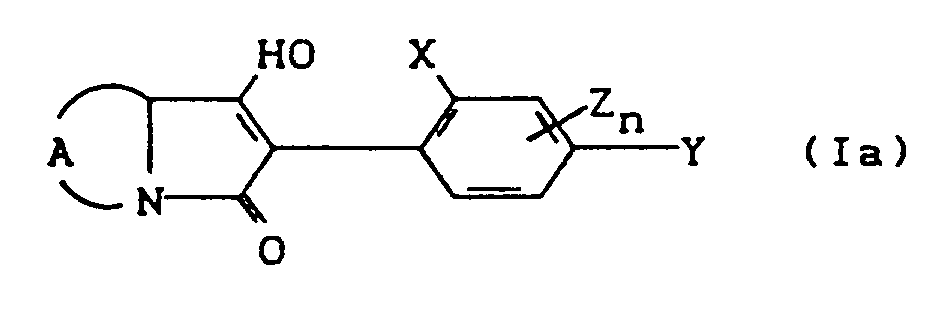 X, Y, Z A, und n die oben angegebene Bedeutung haben,mit Metallhydroxiden oder Aminen der allgemeinen Formeln (XII) und (XIII)
MesOHt (XII)
 Me für ein- oder zweiwertige Metallionens und t für die Zahl 1 und 2 undR⁵, R⁶ und R⁷ unabhängig voneinander für Wasserstoff und Alkylstehen,
gegebenenfalls in Gegenwart eines Verdünnungsmittels, umsetzt. - Insektizide, akarizide und herbizide Mittel, gekennzeichnet durch einen Gehalt an mindestens einem polycyclischen 3-Arylpyrrolidin-2,4-dion-Derivat der Formel (I) gemäß Anspruch 1.
- Verfahren zur Bekämpfung von Insekten, Spinnentieren und/oder Unkräutern, dadurch gekennzeichnet, daß man polycyclische 3-Arylpyrrolidin-2,4-dion-Derivate der Formel (I) gemäß Anspruch 1 auf Insekten, Spinnentiere und/oder Unkräuter und/oder deren Lebensraum einwirken läßt.
- Verwendung von poycyclischen 3-Arylpyrrolidin-2,4-dion-Derivaten der Formel (I) gemäß Anspruch 1 zur Bekämpfung von Insekten, Spinnentieren und/oder Unkräutern.
- Verfahren zur Herstellung von insektiziden, akariziden und herbiziden Mitteln, dadurch gekennzeichnet, daß man polycyclische 3-Arylpyrrolidin-2,4-dion-Derivate der Formel (I) gemäß Anspruch 1, mit Streckmitteln und/oder oberflächenaktiven Mitteln vermischt.
Applications Claiming Priority (4)
| Application Number | Priority Date | Filing Date | Title |
|---|---|---|---|
| DE4004321 | 1990-02-13 | ||
| DE4004321 | 1990-02-13 | ||
| DE4032090A DE4032090A1 (de) | 1990-02-13 | 1990-10-10 | Polycyclische 3-aryl-pyrrolidin-2,4-dion-derivate |
| DE4032090 | 1990-10-10 |
Publications (3)
| Publication Number | Publication Date |
|---|---|
| EP0442073A2 EP0442073A2 (de) | 1991-08-21 |
| EP0442073A3 EP0442073A3 (en) | 1992-03-11 |
| EP0442073B1 true EP0442073B1 (de) | 1995-01-25 |
Family
ID=25890039
Family Applications (1)
| Application Number | Title | Priority Date | Filing Date |
|---|---|---|---|
| EP90123777A Expired - Lifetime EP0442073B1 (de) | 1990-02-13 | 1990-12-11 | Polycyclische 3-Aryl-pyrrolidin-2,4,-dion-Derivate |
Country Status (7)
| Country | Link |
|---|---|
| US (1) | US5225434A (de) |
| EP (1) | EP0442073B1 (de) |
| JP (1) | JP3154732B2 (de) |
| KR (1) | KR910015581A (de) |
| BR (1) | BR9100582A (de) |
| DE (2) | DE4032090A1 (de) |
| ES (1) | ES2066944T3 (de) |
Cited By (2)
| Publication number | Priority date | Publication date | Assignee | Title |
|---|---|---|---|---|
| US8507537B2 (en) | 2006-10-25 | 2013-08-13 | Bayer Cropscience Ag | Trifluromethoxyphenyl-substituted tetramic acid derivatives pesticides and/or herbicides |
| US9204640B2 (en) | 2011-03-01 | 2015-12-08 | Bayer Intellectual Property Gmbh | 2-acyloxy-pyrrolin-4-ones |
Families Citing this family (70)
| Publication number | Priority date | Publication date | Assignee | Title |
|---|---|---|---|---|
| AU672578B2 (en) * | 1991-03-19 | 1996-10-10 | Novartis Ag | Novel herbicidally, acaricidally and insecticidally active compounds |
| DE4121365A1 (de) * | 1991-06-28 | 1993-01-14 | Bayer Ag | Substituierte 1-h-3-aryl-pyrrolidin-2,4-dion-derivate |
| KR960003611B1 (ko) * | 1992-07-23 | 1996-03-20 | 재단법인 한국화학연구소 | 신규한 디아자비시클로 알켄 유도체 및 그의 제조방법 |
| AU666040B2 (en) * | 1992-10-28 | 1996-01-25 | Bayer Aktiengesellschaft | Substituted 1-H-3-aryl-pyrrolidine-2,4-dione derivatives |
| ATE177093T1 (de) * | 1993-07-05 | 1999-03-15 | Bayer Ag | Substituierte aryl-ketoenolheterocyclen |
| CN1131417A (zh) * | 1993-08-05 | 1996-09-18 | 拜尔公司 | 取代的4-氨基甲酰基-吡咯啉-2-酮衍生物和4-氨基甲酰基-二氢呋喃-2-酮衍生物及其作为农药的用途 |
| DE19538960A1 (de) * | 1995-10-19 | 1997-04-24 | Bayer Ag | 4a,5a,8a,8b-Tetrahydro-6H-pyrrolo [3',4':4,5] furo [3,2-b] pyridin-6,8(7H)-dion Derivate zur Bekämpfung von Endoparasiten, Verfahren zu ihrer Herstellung |
| WO1997036868A1 (de) | 1996-04-02 | 1997-10-09 | Bayer Aktiengesellschaft | Substituierte phenylketoenole als schädlingsbekämpfungsmittel und herbizide |
| US6133296A (en) * | 1996-05-10 | 2000-10-17 | Bayer Aktiengesellschaft | Substituted pyridyl keto enols |
| DK1277749T3 (da) | 1996-08-05 | 2007-01-29 | Bayer Cropscience Ag | 2- og 2,5-substituerede phenylketoenoler |
| DE19808261A1 (de) | 1998-02-27 | 1999-10-28 | Bayer Ag | Arylphenylsubstituierte cyclische Ketoenole |
| DE19818732A1 (de) * | 1998-04-27 | 1999-10-28 | Bayer Ag | Arylphenylsubstituierte cyclische Ketoenole |
| DE19935963A1 (de) | 1999-07-30 | 2001-02-01 | Bayer Ag | Biphenylsubstituierte cyclische Ketoenole |
| DE10016544A1 (de) | 2000-04-03 | 2001-10-11 | Bayer Ag | C2-phenylsubstituierte Ketoenole |
| AR029677A1 (es) * | 2000-06-29 | 2003-07-10 | Bayer Ag | Combinaciones de compuestos activos con propiedades insecticidas y acaricidas |
| DE10042736A1 (de) | 2000-08-31 | 2002-03-14 | Bayer Ag | Wirkstoffkombinationen mit insektiziden und akariziden Eigenschaften |
| DE10043610A1 (de) * | 2000-09-05 | 2002-03-14 | Bayer Ag | Wirkstoffkombinationen mit insektiziden und akariziden Eigenschaften |
| DE10049804A1 (de) * | 2000-10-09 | 2002-04-18 | Bayer Ag | Wirkstoffkombinationen mit fungiziden und akariziden Eigenschaften |
| DE10055941A1 (de) | 2000-11-10 | 2002-05-23 | Bayer Ag | Wirkstoffkombinationen mit insektiziden und akariziden Eigenschaften |
| DE10062422A1 (de) * | 2000-12-14 | 2002-06-20 | Bayer Ag | Verwendung von Acetyl-CoA Carboxylase zum Identifizieren von insektizid wirksamen Verwendung |
| DE10139465A1 (de) * | 2001-08-10 | 2003-02-20 | Bayer Cropscience Ag | Selektive Herbizide auf Basis von substituierten, cayclischen Ketoenolen und Safenern |
| DE10301804A1 (de) * | 2003-01-20 | 2004-07-29 | Bayer Cropscience Ag | 2,4-Dihalogen-6-(C2-C3-alkyl)-phenyl substituierte Tetramsäure-Derivate |
| DE10311300A1 (de) | 2003-03-14 | 2004-09-23 | Bayer Cropscience Ag | 2,4,6-Phenylsubstituierte cyclische Ketoenole |
| DE10326386A1 (de) | 2003-06-12 | 2004-12-30 | Bayer Cropscience Ag | N-Heterocyclyl-phenylsubstituierte cyclische Ketoenole |
| DE10330724A1 (de) | 2003-07-08 | 2005-01-27 | Bayer Cropscience Ag | Wirkstoffkombinationen mit insektiziden und akariziden Eigenschaften |
| DE10351647A1 (de) * | 2003-11-05 | 2005-06-09 | Bayer Cropscience Ag | 2-Halogen-6-alkyl-phenyl substituierte Tetramsäure-Derivate |
| DE10354628A1 (de) | 2003-11-22 | 2005-06-16 | Bayer Cropscience Ag | 2-Ethyl-4,6-dimethyl-phenyl-substituierte Tetramsäure-Derivate |
| DE10354629A1 (de) | 2003-11-22 | 2005-06-30 | Bayer Cropscience Ag | 2-Ethyl-4,6-dimethyl-phenyl substituierte spirocyclische Tetramsäure-Derivate |
| AU2004294259C1 (en) | 2003-12-04 | 2014-07-10 | Bayer Cropscience Aktiengesellschaft | Active substance combination having insecticidal and acaricidal properties |
| DE102004014620A1 (de) * | 2004-03-25 | 2005-10-06 | Bayer Cropscience Ag | 2,4,6-phenylsubstituierte cyclische Ketoenole |
| DE102004044827A1 (de) | 2004-09-16 | 2006-03-23 | Bayer Cropscience Ag | Jod-phenylsubstituierte cyclische Ketoenole |
| DE102004053192A1 (de) * | 2004-11-04 | 2006-05-11 | Bayer Cropscience Ag | 2-Alkoxy-6-alkyl-phenyl substituierte spirocyclische Tetramsäure-Derivate |
| DE102004053191A1 (de) | 2004-11-04 | 2006-05-11 | Bayer Cropscience Ag | 2,6-Diethyl-4-methyl-phenyl substituierte Tetramsäure-Derivate |
| DE102005008021A1 (de) * | 2005-02-22 | 2006-08-24 | Bayer Cropscience Ag | Spiroketal-substituierte cyclische Ketoenole |
| DE102005059469A1 (de) | 2005-12-13 | 2007-06-14 | Bayer Cropscience Ag | Insektizide Zusammensetzungen mit verbesserter Wirkung |
| DE102006007882A1 (de) | 2006-02-21 | 2007-08-30 | Bayer Cropscience Ag | Cycloalkyl-phenylsubstituierte cyclische Ketoenole |
| DE102006018828A1 (de) * | 2006-04-22 | 2007-10-25 | Bayer Cropscience Ag | Alkoxyalkyl-substituierte cyclische Ketoenole |
| DE102006025874A1 (de) | 2006-06-02 | 2007-12-06 | Bayer Cropscience Ag | Alkoxyalkyl-substituierte cyclische Ketoenole |
| DE102006027731A1 (de) | 2006-06-16 | 2007-12-20 | Bayer Cropscience Ag | Wirkstoffkombinationen mit insektiziden und akariziden Eigenschaften |
| DE102006057036A1 (de) | 2006-12-04 | 2008-06-05 | Bayer Cropscience Ag | Biphenylsubstituierte spirocyclische Ketoenole |
| DE102006057037A1 (de) | 2006-12-04 | 2008-06-05 | Bayer Cropscience Ag | cis-Alkoxyspirocyclische biphenylsubstituierte Tetramsäure-Derivate |
| DE102007009957A1 (de) | 2006-12-27 | 2008-07-03 | Bayer Cropscience Ag | Verfahren zur verbesserten Nutzung des Produktionsptentials transgener Pflanzen |
| EP2014169A1 (de) | 2007-07-09 | 2009-01-14 | Bayer CropScience AG | Wasserlösliche Konzentrate von 3-(2-Alkoxy-4-chlor-6-alkyl-phenyl)-substituierten Tetramaten und ihren korrespondierenden Enolen |
| EP2020413A1 (de) | 2007-08-02 | 2009-02-04 | Bayer CropScience AG | Oxaspirocyclische-spiro-substituierte Tetram- und Tetronsäure-Derivate |
| EP2039248A1 (de) * | 2007-09-21 | 2009-03-25 | Bayer CropScience AG | Wirkstoffkombinationen mit insektiziden und akariziden Eigenschaften |
| EP2045240A1 (de) | 2007-09-25 | 2009-04-08 | Bayer CropScience AG | Halogenalkoxyspirocyclische Tetram- und Tetronsäure-Derivate |
| EP2103615A1 (de) | 2008-03-19 | 2009-09-23 | Bayer CropScience AG | 4'4'-Dioxaspiro-spirocyclisch substituierte Tetramate |
| EP2127522A1 (de) | 2008-05-29 | 2009-12-02 | Bayer CropScience AG | Wirkstoffkombinationen mit insektiziden und akariziden Eigenschaften |
| US8389443B2 (en) | 2008-12-02 | 2013-03-05 | Bayer Cropscience Ag | Geminal alkoxy/alkylspirocyclic substituted tetramate derivatives |
| US8846946B2 (en) | 2008-12-02 | 2014-09-30 | Bayer Cropscience Ag | Germinal alkoxy/alkylspirocyclic substituted tetramate derivatives |
| AR075126A1 (es) | 2009-01-29 | 2011-03-09 | Bayer Cropscience Ag | Metodo para el mejor uso del potencial de produccion de plantas transgenicas |
| PL2406216T3 (pl) | 2009-03-11 | 2017-09-29 | Bayer Intellectual Property Gmbh | Ketoenole podstawione halogenoalkilometylenoksyfenylem |
| DE102009028001A1 (de) | 2009-07-24 | 2011-01-27 | Bayer Cropscience Ag | Wirkstoffkombinationen mit insektiziden und akariziden Eigenschaften |
| EP2534133B1 (de) | 2010-02-10 | 2018-09-05 | Bayer CropScience Aktiengesellschaft | Biphenylsubstituierte cyclische ketoenole |
| WO2011098443A1 (de) | 2010-02-10 | 2011-08-18 | Bayer Cropscience Ag | Spiroheterocyclisch-substituierte tetramsäure-derivate |
| DE102010008642A1 (de) | 2010-02-15 | 2011-08-18 | Bayer Schering Pharma Aktiengesellschaft, 13353 | Zyklische Ketoenole zur Therapie |
| DE102010008644A1 (de) | 2010-02-15 | 2011-08-18 | Bayer Schering Pharma Aktiengesellschaft, 13353 | Zyklische Ketoenole zur Therapie |
| DE102010008643A1 (de) | 2010-02-15 | 2011-08-18 | Bayer Schering Pharma Aktiengesellschaft, 13353 | Zyklische Ketoenole zur Therapie |
| CN102939007B (zh) | 2010-04-20 | 2015-09-02 | 拜耳知识产权有限责任公司 | 基于螺杂环取代的特特拉姆酸衍生物的具有改善活性的杀虫和/或除草组合物 |
| DE102011011040A1 (de) | 2011-02-08 | 2012-08-09 | Bayer Pharma Aktiengesellschaft | (5s,8s)-3-(4'-Chlor-3'-fluor-4-methylbiphenyl-3-yl)-4-hydroxy-8-methoxy-1-azaspiro[4.5]dec-3-en-2-on (Verbindung A) zur Therapie |
| WO2012110518A1 (de) | 2011-02-17 | 2012-08-23 | Bayer Pharma Aktiengesellschaft | Substituierte 3-(biphenyl-3-yl)-8,8-difluor-4-hydroxy-1-azaspiro[4.5]dec-3-en-2-one zur therapie |
| DE102011080405A1 (de) | 2011-08-04 | 2013-02-07 | Bayer Pharma AG | Substituierte 3-(Biphenyl-3-yl)-8,8-difluor-4-hydroxy-1-azaspiro[4.5]dec-3-en-2-one zur Therapie |
| DE102011080406A1 (de) | 2011-08-04 | 2013-02-07 | Bayer Pharma AG | Substituierte 3-(Biphenyl-3-yl)-4-hydroxy-8-methoxy-1-azaspiro8[4.5]dec-3-en-2-one |
| AU2013211636B2 (en) | 2012-01-26 | 2016-09-29 | Bayer Intellectual Property Gmbh | Phenyl-substituted ketoenols for controlling fish parasites |
| KR101816442B1 (ko) * | 2016-09-28 | 2018-01-09 | 경상대학교산학협력단 | 캐리오란-1-올을 포함하는 항균용 조성물 |
| WO2019197617A1 (de) | 2018-04-13 | 2019-10-17 | Bayer Cropscience Aktiengesellschaft | Verwendung von tetramsäurederivaten zur bekämpfung von tierischen schädlingen durch angiessen, tröpfchenapplikation. pflanzlochbehandlung oder furchenapplikation |
| MX2020010686A (es) | 2018-04-13 | 2020-11-06 | Bayer Cropscience Ag | Uso de derivados del acido tetramico para el control de plagas por riego o aplicacion de gotas. |
| WO2019197652A1 (de) | 2018-04-13 | 2019-10-17 | Bayer Aktiengesellschaft | Feststoff-formulierung insektizider mischungen |
| MX2020010794A (es) | 2018-04-13 | 2020-10-28 | Bayer Cropscience Ag | Uso de derivados del acido tetramico para combatir insectos especiales. |
| WO2019197620A1 (de) | 2018-04-13 | 2019-10-17 | Bayer Cropscience Aktiengesellschaft | Verwendung von tetramsäurederivaten zur bekämpfung von speziellen insekten |
Family Cites Families (2)
| Publication number | Priority date | Publication date | Assignee | Title |
|---|---|---|---|---|
| US4925868A (en) * | 1986-08-29 | 1990-05-15 | Takeda Chemical Industries, Ltd. | 4-Hydroxy-3-pyrrolin-2-ones and treatment of circulatory disorders therewith |
| US4985063A (en) * | 1988-08-20 | 1991-01-15 | Bayer Aktiengesellschaft | 3-aryl-pyrrolidine-2,4-diones |
-
1990
- 1990-10-10 DE DE4032090A patent/DE4032090A1/de not_active Withdrawn
- 1990-12-11 ES ES90123777T patent/ES2066944T3/es not_active Expired - Lifetime
- 1990-12-11 DE DE59008361T patent/DE59008361D1/de not_active Expired - Fee Related
- 1990-12-11 EP EP90123777A patent/EP0442073B1/de not_active Expired - Lifetime
-
1991
- 1991-02-06 US US07/651,679 patent/US5225434A/en not_active Expired - Lifetime
- 1991-02-07 JP JP03661891A patent/JP3154732B2/ja not_active Expired - Fee Related
- 1991-02-08 BR BR919100582A patent/BR9100582A/pt not_active IP Right Cessation
- 1991-02-12 KR KR1019910002317A patent/KR910015581A/ko not_active Ceased
Cited By (2)
| Publication number | Priority date | Publication date | Assignee | Title |
|---|---|---|---|---|
| US8507537B2 (en) | 2006-10-25 | 2013-08-13 | Bayer Cropscience Ag | Trifluromethoxyphenyl-substituted tetramic acid derivatives pesticides and/or herbicides |
| US9204640B2 (en) | 2011-03-01 | 2015-12-08 | Bayer Intellectual Property Gmbh | 2-acyloxy-pyrrolin-4-ones |
Also Published As
| Publication number | Publication date |
|---|---|
| JPH04211082A (ja) | 1992-08-03 |
| EP0442073A2 (de) | 1991-08-21 |
| ES2066944T3 (es) | 1995-03-16 |
| DE4032090A1 (de) | 1991-08-14 |
| JP3154732B2 (ja) | 2001-04-09 |
| DE59008361D1 (de) | 1995-03-09 |
| KR910015581A (ko) | 1991-09-30 |
| BR9100582A (pt) | 1991-10-29 |
| US5225434A (en) | 1993-07-06 |
| EP0442073A3 (en) | 1992-03-11 |
Similar Documents
| Publication | Publication Date | Title |
|---|---|---|
| EP0613885B1 (de) | Substituierte 1-H-3-Phenyl-5-cycloalkylpyrrolidin-2,4-dione, ihre Herstellung und ihre Verwendung als Schädlingsbekämpfungsmittel und Herbizide | |
| EP0528156B1 (de) | 3-Aryl-4-hydroxy-delta3-dihydrofuranon- und 3-Aryl-4-hydroxy-delta3-dihydrothiophenon-Derivate | |
| EP0521334B1 (de) | Substituierte 1-H-3-Aryl-pyrrolidin-2,4-dion-Derivate, deren Herstellung und deren Verwendung als Insektizide, Akarizide und Herbizide | |
| EP0415211B1 (de) | 3-Aryl-pyrrolidin-2,4-dion-derivate | |
| EP0442073A2 (de) | Polycyclische 3-Aryl-pyrrolidin-2,4,-dion-Derivate | |
| EP0355599B1 (de) | 3-Aryl-pyrrolidin-2,4-dione | |
| EP0508126B1 (de) | 3-Hydroxy-4-aryl-5-oxo-pyrazolin Derivate | |
| EP0377893B1 (de) | 3-Aryl-pyrrolidin-2,4-dion-Derivate | |
| EP0613884B1 (de) | Dialkyl-1-H-3-(2,4-dimethylphenyl)-pyrrolidin-2,4-dione, ihre Herstellung und ihre Verwendung als Schädlingsbekämpfungsmittel und Herbizide | |
| JP3435671B2 (ja) | 置換1−h−3−アリール−ピロリジン−2,4−ジオン誘導体 | |
| EP0706527A1 (de) | Substituierte spiroheterocyclische 1h-3-aryl-pyrrolidin-2,4-dion-derivate, verfahren zu deren herstellung und deren verwendung als schädlingsbekämpfungsmittel | |
| DE3913682A1 (de) | 3-aryl-pyrrolidin-2,4-dione | |
| EP0373425A2 (de) | Substituierte Pyridazinone, Verfahren zu ihrer Herstellung und ihre Verwendung als Schädlingsbekämpfungsmittel | |
| EP0591806A1 (de) | Substituierte 2-Arylpyrrole | |
| EP0501129B1 (de) | Substituierte bicyclische 3-Aryl-pyrrolidin-2,4-dion-Derivate | |
| DE4326909A1 (de) | Substituierte 1-H-3-Aryl-pyrrolidin-2,4-dion-Derivate | |
| DE4337853A1 (de) | 3-Aryl-4-hydroxy-DELTA·3·-dihydrofuranon-Derivate | |
| EP0515941A1 (de) | Substituierte 2-Arylpyrrole | |
| DE4415334A1 (de) | Substituierte spirocyclische 1H-3-Aryl-pyrrolidin-2,4-dion-Derivate | |
| WO1993024484A1 (de) | Substituierte 2-arylpyrrole | |
| EP0316734A2 (de) | Furazanylharnstoffe | |
| WO1995000506A1 (de) | Substituierte pyridylpyrrole und ihre verwendung zur bekämpfung von tierischen schädlingen | |
| DE3624468A1 (de) | 1,3,2-oxathiaphosphorinan-2-sulfide | |
| DE4325132A1 (de) | Substituierte 2-Aryl-trifluormethylpyrrole | |
| EP0507142A2 (de) | O-Halogencyclobutyl-S-alkyl-(di) thiophosphorsäureesteramide, Verfahren zu ihrer Herstellung und ihre Verwendung als Schädlingsbekämpfungsmittel |
Legal Events
| Date | Code | Title | Description |
|---|---|---|---|
| PUAI | Public reference made under article 153(3) epc to a published international application that has entered the european phase |
Free format text: ORIGINAL CODE: 0009012 |
|
| 17P | Request for examination filed |
Effective date: 19901211 |
|
| AK | Designated contracting states |
Kind code of ref document: A2 Designated state(s): BE CH DE ES FR GB IT LI NL |
|
| PUAL | Search report despatched |
Free format text: ORIGINAL CODE: 0009013 |
|
| AK | Designated contracting states |
Kind code of ref document: A3 Designated state(s): BE CH DE ES FR GB IT LI NL |
|
| 17Q | First examination report despatched |
Effective date: 19940308 |
|
| GRAA | (expected) grant |
Free format text: ORIGINAL CODE: 0009210 |
|
| AK | Designated contracting states |
Kind code of ref document: B1 Designated state(s): BE CH DE ES FR GB IT LI NL |
|
| GBT | Gb: translation of ep patent filed (gb section 77(6)(a)/1977) |
Effective date: 19950202 |
|
| REF | Corresponds to: |
Ref document number: 59008361 Country of ref document: DE Date of ref document: 19950309 |
|
| ITF | It: translation for a ep patent filed | ||
| REG | Reference to a national code |
Ref country code: ES Ref legal event code: FG2A Ref document number: 2066944 Country of ref document: ES Kind code of ref document: T3 |
|
| ET | Fr: translation filed | ||
| PLBE | No opposition filed within time limit |
Free format text: ORIGINAL CODE: 0009261 |
|
| STAA | Information on the status of an ep patent application or granted ep patent |
Free format text: STATUS: NO OPPOSITION FILED WITHIN TIME LIMIT |
|
| 26N | No opposition filed | ||
| PGFP | Annual fee paid to national office [announced via postgrant information from national office to epo] |
Ref country code: GB Payment date: 19971202 Year of fee payment: 8 |
|
| PGFP | Annual fee paid to national office [announced via postgrant information from national office to epo] |
Ref country code: BE Payment date: 19971230 Year of fee payment: 8 |
|
| PGFP | Annual fee paid to national office [announced via postgrant information from national office to epo] |
Ref country code: NL Payment date: 19971231 Year of fee payment: 8 |
|
| PG25 | Lapsed in a contracting state [announced via postgrant information from national office to epo] |
Ref country code: GB Free format text: LAPSE BECAUSE OF NON-PAYMENT OF DUE FEES Effective date: 19981211 |
|
| PG25 | Lapsed in a contracting state [announced via postgrant information from national office to epo] |
Ref country code: BE Free format text: LAPSE BECAUSE OF NON-PAYMENT OF DUE FEES Effective date: 19981231 |
|
| BERE | Be: lapsed |
Owner name: BAYER A.G. Effective date: 19981231 |
|
| PG25 | Lapsed in a contracting state [announced via postgrant information from national office to epo] |
Ref country code: NL Free format text: LAPSE BECAUSE OF NON-PAYMENT OF DUE FEES Effective date: 19990701 |
|
| GBPC | Gb: european patent ceased through non-payment of renewal fee |
Effective date: 19981211 |
|
| NLV4 | Nl: lapsed or anulled due to non-payment of the annual fee |
Effective date: 19990701 |
|
| REG | Reference to a national code |
Ref country code: CH Ref legal event code: PFA Owner name: BAYER AKTIENGESELLSCHAFT Free format text: BAYER AKTIENGESELLSCHAFT# #D-51368 LEVERKUSEN (DE) -TRANSFER TO- BAYER AKTIENGESELLSCHAFT# #D-51368 LEVERKUSEN (DE) |
|
| PGFP | Annual fee paid to national office [announced via postgrant information from national office to epo] |
Ref country code: CH Payment date: 20071213 Year of fee payment: 18 |
|
| PGFP | Annual fee paid to national office [announced via postgrant information from national office to epo] |
Ref country code: ES Payment date: 20080118 Year of fee payment: 18 Ref country code: FR Payment date: 20071210 Year of fee payment: 18 |
|
| PGFP | Annual fee paid to national office [announced via postgrant information from national office to epo] |
Ref country code: IT Payment date: 20071228 Year of fee payment: 18 Ref country code: DE Payment date: 20071201 Year of fee payment: 18 |
|
| REG | Reference to a national code |
Ref country code: CH Ref legal event code: PL |
|
| REG | Reference to a national code |
Ref country code: FR Ref legal event code: ST Effective date: 20090831 |
|
| PG25 | Lapsed in a contracting state [announced via postgrant information from national office to epo] |
Ref country code: CH Free format text: LAPSE BECAUSE OF NON-PAYMENT OF DUE FEES Effective date: 20081231 Ref country code: LI Free format text: LAPSE BECAUSE OF NON-PAYMENT OF DUE FEES Effective date: 20081231 Ref country code: DE Free format text: LAPSE BECAUSE OF NON-PAYMENT OF DUE FEES Effective date: 20090701 |
|
| REG | Reference to a national code |
Ref country code: ES Ref legal event code: FD2A Effective date: 20081212 |
|
| PG25 | Lapsed in a contracting state [announced via postgrant information from national office to epo] |
Ref country code: FR Free format text: LAPSE BECAUSE OF NON-PAYMENT OF DUE FEES Effective date: 20081231 Ref country code: ES Free format text: LAPSE BECAUSE OF NON-PAYMENT OF DUE FEES Effective date: 20081212 |
|
| PG25 | Lapsed in a contracting state [announced via postgrant information from national office to epo] |
Ref country code: IT Free format text: LAPSE BECAUSE OF NON-PAYMENT OF DUE FEES Effective date: 20081211 |