EP0428962A2 - Fassadenfuss für ein Pfostenprofil - Google Patents
Fassadenfuss für ein Pfostenprofil Download PDFInfo
- Publication number
- EP0428962A2 EP0428962A2 EP90121555A EP90121555A EP0428962A2 EP 0428962 A2 EP0428962 A2 EP 0428962A2 EP 90121555 A EP90121555 A EP 90121555A EP 90121555 A EP90121555 A EP 90121555A EP 0428962 A2 EP0428962 A2 EP 0428962A2
- Authority
- EP
- European Patent Office
- Prior art keywords
- facade
- base plate
- receiving shoe
- base
- fastening screw
- Prior art date
- Legal status (The legal status is an assumption and is not a legal conclusion. Google has not performed a legal analysis and makes no representation as to the accuracy of the status listed.)
- Granted
Links
Images

Classifications
-
- E—FIXED CONSTRUCTIONS
- E04—BUILDING
- E04B—GENERAL BUILDING CONSTRUCTIONS; WALLS, e.g. PARTITIONS; ROOFS; FLOORS; CEILINGS; INSULATION OR OTHER PROTECTION OF BUILDINGS
- E04B2/00—Walls, e.g. partitions, for buildings; Wall construction with regard to insulation; Connections specially adapted to walls
- E04B2/88—Curtain walls
- E04B2/96—Curtain walls comprising panels attached to the structure through mullions or transoms
Definitions
- the invention relates to a facade base for a post profile, which forms the framework of a building facade with other post and rung profiles.
- the invention has for its object to design a facade base for a post profile so that it is adjustable in three dimensions in a wide range.
- a facade foot which has a base plate and a height-adjustable receptacle between the vertical guide tracks of the base plate for the lower end of the post profile and in each case a through hole provided in the base plate between an end face and a guide track for a fastening screw with a substantially has a larger diameter than the diameter of the fastening screw and at least one adjustment plate assigned to the push-through hole, through which the shaft of the fastening screw is guided and on which the head of the fastening screw is supported.
- the post profile defined in the receiving shoe can be aligned in the vertical direction by means of an adjusting screw.
- the base plate is also designed so that it is adjustable in relation to its fastening screws in its longitudinal direction and in a direction transverse to it.
- the facade base according to the invention is structurally simple, so that the assembly, the fixing of the post profile in the receiving shoe and the adjustment in the dimensions mentioned can be carried out without difficulty.
- the post profile which is generally designed as a hollow chamber profile, has anchoring grooves on the outside for sealing professionals and a fastening groove, e.g. a screw groove for cover profiles. Between these anchoring or fastening grooves, grooves or grooves are arranged for draining off the leachate.
- the post profile is arranged and fixed in the receiving shoe or in the facade base so that the parts carrying the leachate are outside the facade base and the leachate e.g. can be derived from the respective post profile from the area of the facade base by means of a film.
- the facade base 1 has a base plate 2 with vertical guideways 3 and a receiving shoe 4.
- This receiving shoe 4 for the lower end 5 of a post profile 6 is U-shaped in vertical section and is equipped with side cheeks 7 which carry guide pieces 8 on the outside.
- these guide pieces are formed in one piece with the side cheeks and engage in the guide tracks 3, which are delimited by vertical webs 9, which are integral with the base plate 2.
- a set screw 13 is used, which is supported with its head 14 on the base plate 2 and extends with its shaft through a hole in the base 10 and in a bar 15 integral with the base and into the Interior of the receiving shoe protrudes.
- the threaded shaft of the adjusting screw is equipped with a lock nut 16, through which the upper stroke end of the receiving shoe is determined in cooperation with a spacer tube 17, which surrounds the threaded shaft and is supported on the base 10.
- the post profile 6 is fixed by two bolts 18 which extend parallel to one another, the bolts being guided through the side cheeks 7 of the receiving shoe.
- the bolts can be designed as threaded bolts or as thread-free bolts.
- FIGS. 2 and 3 thread-free bolts 18 show a head 19 on one side and a pin on the other side.
- the height adjustment of the receiving shoe 4 takes place by means of a nut 20 on which the base 10 or the last 15 is supported.
- the post profile has a screw groove 21 in the center for fixing cover profiles and anchoring grooves 22 for sealing strips adjacent to the longitudinal edges. Between the central screw groove and an anchoring groove for a sealing strip there is a channel 23 for leachate in the post profile, this channel being delimited by a bottom 24.
- this floor is offset from the outer boundary surface 25 of the facade base to the outside, so that at the lower end of the post profile, a film 24 engaging behind the floor can be provided, through which the leachate can be drained.
- an adjustment plate 27 and a base plate 28 are provided for adjusting the facade base in the direction of the longitudinal axis 26 and in the transverse direction. Furthermore, a bore 30 is arranged in the area of the base plate between a front end 29 and the guideway 3, the diameter of which is a multiple of the diameter of the fastening screw 31.
- the base plate 28 extends in the direction of the longitudinal axis 26 of the facade foot over the area of the base plate 2 between a face bar 32 and the webs 9 delimiting the guideways.
- the base plate has edge strips 33 which extend in the longitudinal direction and surround the longitudinal edges of the base plate 2, so that the reason plate 28 is positively fixed on the base plate 2.
- the base plate 28 is also provided with a bore 34a which is aligned with the bore 30 in the base plate 2.
- the upper boundary surface of the base plate has corrugations or serrations 34b extending in the longitudinal direction of the facade base, into which corrugations or serrations 35 provided on the underside of the adjustment plate 27 engage.
- the adjustment plate has a cylindrical socket 36 on the underside for pushing through the shaft of the fastening screw 31.
- This nozzle engages in the bores 34a and.
- the facade base can be moved in the direction of the longitudinal axis 26. It is also possible to disengage the corrugations 34b and 35, i.e. raise the adjustment plate 27 and make an adjustment transversely to the longitudinal axis 26.
- the upper boundary surface of the base plate 2 with a corrugation or toothing extending in the longitudinal direction of the base plate in an area adjacent to the through hole 30 and to place the adjustment plate 21 on this profiled surface.
Landscapes
- Engineering & Computer Science (AREA)
- Architecture (AREA)
- Electromagnetism (AREA)
- Civil Engineering (AREA)
- Structural Engineering (AREA)
- Physics & Mathematics (AREA)
- Finishing Walls (AREA)
- Orthopedics, Nursing, And Contraception (AREA)
- Ladders (AREA)
- Rod-Shaped Construction Members (AREA)
- Load-Bearing And Curtain Walls (AREA)
- Steps, Ramps, And Handrails (AREA)
- Floor Finish (AREA)
- Buildings Adapted To Withstand Abnormal External Influences (AREA)
Abstract
Description
- Die Erfindung bezieht sich auf einen Fassadenfuß für ein Pfostenprofil, das mit weiteren Pfosten- und Sprossenprofilen das Rahmenwerk einer Gebäudefassade bildet.
- Bei der Erstellung der Fassade ist es wichtig, daß die Pfostenprofile mit einfachen Mitteln zueinander ausgerichtet werden können.
- Der Erfindung liegt die Aufgabe zugrunde, einen Fassadenfuß für ein Pfostenprofil so zu gestalten, daß er in drei Dimensionen in einem weiten Bereich verstellbar ist.
- Diese Aufgabe wird nach der Erfindung durch einen Fassadenfuß gelöst, der eine Bodenplatte und einen zwischen vertikalen Führungsbahnen der Bodenplatte höhenverstellbar angeordneten Aufnahmeschuh für das untere Ende des Pfostenprofils und jeweils eine in der Bodenplatte zwischen einer Stirnseite und einer Führungsbahn vorgesehene Durchsteckbohrung für eine Befestigungsschraube mit einem wesentlich größeren Durchmesser als der Durchmesser der Befestigungsschraube und mindestens eine der Durchsteckbohrung zugeordnete Verstellplatte aufweist, durch die der Schaft der Befestigungsschraube geführt ist und an der sich der Kopf der Befestigungsschraube abstützt.
- Das in dem Aufnahmeschuh festgelegte Pfostenprofil kann mittels einer Stellschraube in vertikaler Richtung ausgerichtet werden.
- Die Bodenplatte ist ferner so gestaltet, daß sie gegenüber ihren Befestigungsschrauben in ihrer Längsrichtung und in einer quer dazu laufenden Richtung verstellbar ist.
- Der erfindungsgemäße Fassadenfuß ist konstruktiv einfach aufgebaut, so daß die Montage, die Festlegung des Pfostenprofils im Aufnahmeschuh und die Verstellung in den genannten Dimensionen ohne Schwierigkeiten durchführbar sind.
- Das Pfostenprofil, das im allgemeinen als Hohlkammerprofil ausgeführt wird, weist an der Stirnaußenseite Verankerungsnuten für Dichtungsprofiie sowie eine Befestigungssnut, z.B. eine Schraubnut für Abdeckprofile auf. Zwischen diesen Verankerungs- bzw. Befestigungsnuten sind Rinnen oder Nuten zum Abführen des Sickerwassers angeordnet.
- Das Pfostenprofil wird im Aufnahmeschuh bzw. im Fassadenfuß so angeordnet und festgelegt, daß die das Sickerwasser führenden Teile außerhalb des Fassadenfußes liegen und das Sickerwasser z.B. mittels einer Folie von dem jeweiligen Pfostenprofil aus dem Bereich des Fassadenfußes abgeleitet werden kann.
- Weitere Merkmale der Erfindung ergeben sich aus den Unteransprüchen. Ein Ausführungsbeispiel des erfindungsgemäßen Fassadenfußes ist in den Zeichnungen dargestellt und wird im folgenden beschrieben. Es zeigen:
- Fig. 1 den Fassadenfuß in perspektivischer Darstellung,
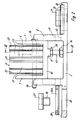
- Fig. 2 den Fassadenfuß mit eingesetztem Pfostenprofil im Aufriß und auf der linken Seite teilweise demontiert und geschnitten, sowie
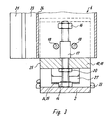
- Fig. 3 einen Schnitt nach der Linie III-III in Fig. 2.
- Der Fassadenfuß 1 weist eine Bodenplatte 2 mit vertikalen Führungsbahnen 3 und einen Aufnahmeschuh 4 auf. Dieser Aufnahmeschuh 4 für das untere Ende 5 eines Pfostenprofils 6 ist im Vertikalschnitt U-förmig ausgebildet und ist mit Seitenwangen 7 ausgestattet, die an der Außenseite Führungsstücke 8 tragen. Diese Führungsstücke sind in dem dargestellten Ausführungsbeispiel einstückig mit den Seitenwangen ausgebildet und greifen in die Führungsbahnen 3 ein, die durch vertikale Stege 9 begrenzt werden, die mit der Bodenplatte 2 einstückig sind.
- Insbesondere aus der Fig. 2 ergibt sich, daß die Führungsstücke 8 den Boden 10 des Aufnahmeschuhs nach unten überragen. Hierdurch wird erreicht, daß die untere Begrenzungsfläche 11 sich in der unteren Endstellung des Aufnahmeschuhs an eine Anschlagfläche 12 der Bodenplatte 2 legt. Durch die erwähnte Gestaltung der Führungsstücke 8 wird somit durch diese Führungsstücke die untere Endstellung des Aufnahmeschuhs bestimmt.
- Zur Höhenverstellung des Aufnahmeschuhs 4 gegenüber der Bodenplatte 2 wird eine Stellschraube 13 verwendet, die sich mit ihrem Kopf 14 an der Grundplatte 2 abstützt und sich mit ihrem Schaft durch eine Bohrung im Boden 10 und in einer mit dem Boden einstückigen Leiste 15 erstreckt und in den Innenraum des Aufnahmeschuhs ragt. Am freien Ende ist der Gewindeschaft der Stellschraube mit einer Kontermutter 16 ausgerüstet, durch die im Zusammenwirken mit einem Distanzrohr 17, das den Gewindeschaft umschließt und sich am Boden 10 abstützt, das obere Hubende des Aufnahmeschuhs bestimmt wird.
- Im Aufnahmeschuh wird das Pfostenprofil 6 durch zwei parallel zueinander sich erstreckende Bolzen 18 festgelegt, wobei die Bolzen durch die Seitenwangen 7 des Aufnahmeschuhs geführt werden. Die Bolzen können als Gewindebolzen oder als gewindefreie Bolzen ausgeführt werden.
- Beim Ausführungsbeispiel nach der Fig. 1 sind als Schrauben ausgebildete Gewindebolzen vorgesehen, während die Fig. 2 und 3 gewindefreie Bolzen 18 zeigen, die auf der einen Seite einen Kopf 19 aufweisen und auf der anderen Seite durch einen Splint festgelegt werden.
- Die Höhenverstellung des Aufnahmeschuhs 4 erfolgt mittels einer Mutter 20, auf der sich der Boden 10 bzw. die Leiste 15 abstützt.
- Aus der Fig. 3 ergibt sich, daß das Pfostenprofil aus dem Aufnahmeschuh 4 an der Vorderseite herausragt.
- An der vorderen Stirnseite weist das Pfostenprofil mittig eine Schraubnut 21 zum Festlegen von Abdeckprofilen und benachbart den Längsrändern Verankerungsnuten 22 für Dichtungsleisten auf. Zwischen der mittigen Schraubnut und einer Verankerungsnut für eine Dichtungsleiste ist bei dem Pfostenprofil jeweils eine Rinne 23 für Sickerwasser vorhanden, wobei diese Rinne durch einen Boden 24 begrenzt wird.
- Aus der Fig. 3 ergibt sich, daß dieser Boden gegenüber der äußeren Begrenzungsfläche 25 des Fassadenfußes nach außen versetzt ist, so daß am unteren Ende des Pfostenprofils eine den Boden 24 hintergreifende Folie vorgesehen werden kann, über die das Sickerwasser abgeführt werden kann.
- Zur Verstellung des Fassadenfußes in Richtung der Längsachse 26 und in Querrichtung dazu sind in dem Ausführungsbeispiel eine Verstellplatte 27 und eine Grundplatte 28 vorgesehen. Ferner ist in dem Bereich der Bodenplatte zwischen einem Stirnende 29 und der Führungsbahn 3 eine Bohrung 30 angeordnet, deren Durchmesser ein Mehrfaches des Durchmessers der Befestigungsschraube 31 ist.
- Die Grundplatte 28 erstreckt sich in Richtung der Längsachse 26 des Fassadenfußes über den Bereich der Bodenplatte 2 zwischen einer Stirnleiste 32 und den die Führungsbahnen begrenzenden Stegen 9. Die Grundplatte weist in Längsrichtung sich erstreckende Randleisten 33 auf, die die Längsränder der Bodenplatte 2 umgreifen, so daß die Grund platte 28 auf der Bodenplatte 2 formschlüssig festgelegt ist. Die Grundplatte 28 ist ferner mit einer Bohrung 34a versehen, die mit der Bohrung 30 in der Bodenplatte 2 fluchtet.
- Die obere Begrenzungsfläche der Grundplatte weist in Längsrichtung des Fassadenfußes sich erstreckende Riffelungen oder Verzahnungen 34b auf, in die an der Unterseite der Verstellplatte 27 vorgesehene Riffelungen oder Verzahnungen 35 eingreifen.
- Aus der Fig. 2 folgt, daß die Verstellplatte an der Unterseite einen zylindrischen Stutzen 36 zum Durchstecken des Schaftes der Befestigungsschraube 31 aufweist. Dieser Stutzen greift in die Bohrungen 34a und ein. Bei gelösten Befestigungsschrauben 31 kann der Fassadenfuß in Richtung der Längsachse 26 verschoben werden. Ferner besteht die Möglichkeit, die Riffelungen 34b und 35 außer Eingriff zu bringen, d.h. die Verstellplatte 27 anzuheben und eine Verstellung quer zur Längsachse 26 vorzunehmen.
- In Abwandlung der in den Zeichnungen dargestellten Ausführung ist es auch möglich, die obere Begrenzungsfläche der Bodenplatte 2 in einem an die Durchsteckbohrung 30 angrenzenden Bereich mit einer in Längsrichtung der Bodenplatte sich erstreckenden Riffelung oder Verzahnung zu versehen und auf diese profilierte Fläche die Verstellplatte 21 aufzusetzen.
-
- 1 Fassadenfuß
- 2 Bodenplatte
- 3 Führungsbahn
- 4 Aufnahmeschuh
- 5 unteres Ende
- 6 Pfostenprofil
- 7 Seitenwange
- 8 Führungsstück
- 9 Steg
- 10 Boden
- 11 Begrenzungsfläche
- 12 Anschlagfläche
- 13 Stellschraube
- 14 Kopf
- 15 Leiste
- 16 Kontermutter
- 17 Distanzrohr
- 18 Bolzen
- 19 Kopf
- 20 Mutter
- 21 Schraubnut
- 22 Verankerungsnut
- 23 Rinne
- 24 Boden
- 25 Begrenzungsfläche
- 26 Längsachse
- 27 Verstellplatte
- 28 Grundplatte
- 29 Stirnende
- 30 Bohrung
- 31 Befestigungsschraube
- 32 Stirnleiste
- 33 Randleiste
- 34a Bohrung
- 34b Riffelung
- 35 Verzahnung
- 36 Stutzen
Claims (11)
Priority Applications (1)
| Application Number | Priority Date | Filing Date | Title |
|---|---|---|---|
| AT90121555T ATE91314T1 (de) | 1989-11-24 | 1990-11-10 | Fassadenfuss fuer ein pfostenprofil. |
Applications Claiming Priority (2)
| Application Number | Priority Date | Filing Date | Title |
|---|---|---|---|
| DE3938871 | 1989-11-24 | ||
| DE3938871A DE3938871A1 (de) | 1989-11-24 | 1989-11-24 | Fassadenfuss fuer ein pfostenprofil |
Publications (3)
| Publication Number | Publication Date |
|---|---|
| EP0428962A2 true EP0428962A2 (de) | 1991-05-29 |
| EP0428962A3 EP0428962A3 (en) | 1992-03-25 |
| EP0428962B1 EP0428962B1 (de) | 1993-07-07 |
Family
ID=6394080
Family Applications (1)
| Application Number | Title | Priority Date | Filing Date |
|---|---|---|---|
| EP90121555A Expired - Lifetime EP0428962B1 (de) | 1989-11-24 | 1990-11-10 | Fassadenfuss für ein Pfostenprofil |
Country Status (8)
| Country | Link |
|---|---|
| EP (1) | EP0428962B1 (de) |
| AT (1) | ATE91314T1 (de) |
| DE (2) | DE3938871A1 (de) |
| DK (1) | DK0428962T3 (de) |
| ES (1) | ES2043218T3 (de) |
| FI (1) | FI92948C (de) |
| NO (1) | NO177760C (de) |
| PT (1) | PT95979B (de) |
Cited By (8)
| Publication number | Priority date | Publication date | Assignee | Title |
|---|---|---|---|---|
| FR2694952A1 (fr) * | 1992-08-18 | 1994-02-25 | Aluvar Sa | Système pour la fixation d'un raidisseur de mur-rideau sur un élément de construction. |
| NL1028915C2 (nl) * | 2005-04-29 | 2006-10-31 | Hendriks Aluminium Geveltechni | Anker voor het verankeren van een gevelprofieldeel. |
| AT504064B1 (de) * | 2006-08-10 | 2008-05-15 | Mwt Micro Wood Technology Gmbh | Auflagevorrichtung für einen fertigbauteil |
| WO2014076526A1 (en) * | 2012-11-19 | 2014-05-22 | Universita' Deglii Studi Di Padova | Wall base structure for light buildings |
| CN111236506A (zh) * | 2020-01-20 | 2020-06-05 | 福建省兴岩建设集团有限公司 | 一种干挂幕墙用短悬臂干挂装置 |
| CN111997245A (zh) * | 2020-08-13 | 2020-11-27 | 浙江大东吴建筑科技有限公司 | 一种插入式轻钢外挂墙板连接节点 |
| WO2021109373A1 (zh) * | 2019-12-05 | 2021-06-10 | 上海江河幕墙系统工程有限公司 | 一种三维可调的幕墙支座 |
| DE102020132669A1 (de) | 2020-12-08 | 2022-06-09 | Raico Bautechnik Gmbh | Befestigungseinrichtung und Verfahren zur Ausrichtung und Fixierung eines Pfostenprofils einer Pfosten-Riegel-Konstruktion |
Families Citing this family (7)
| Publication number | Priority date | Publication date | Assignee | Title |
|---|---|---|---|---|
| DE20022089U1 (de) | 2000-12-30 | 2001-04-26 | Weitzmann, Eugen, 01920 Steina | Giebelanker u.dgl. |
| DE20106025U1 (de) | 2001-04-06 | 2001-06-28 | Waidelich, Hans, 72226 Simmersfeld | Verankerungselement zur Verankerung von Bauelementen |
| DE10236552B4 (de) * | 2002-08-08 | 2004-07-22 | Hilti Ag | Verbindungselement für ein Montagesystem |
| CN105350692A (zh) * | 2015-12-01 | 2016-02-24 | 深圳市三鑫幕墙工程有限公司 | 单元幕墙多角度侧挂装置 |
| CN105350691A (zh) * | 2015-12-01 | 2016-02-24 | 深圳市三鑫幕墙工程有限公司 | 幕墙侧挂装置 |
| CN109469234B (zh) * | 2018-11-15 | 2020-04-03 | 北京江河幕墙系统工程有限公司 | 一种坐式全玻幕墙顶底连接系统及其安装方法 |
| DE102019133978A1 (de) * | 2019-12-11 | 2021-06-17 | Mepa - Pauli Und Menden Gmbh | Befestigungsanordnung zur befestigung eines vorwandgestells einer sanitärinstallation |
Family Cites Families (2)
| Publication number | Priority date | Publication date | Assignee | Title |
|---|---|---|---|---|
| US2914145A (en) * | 1955-01-26 | 1959-11-24 | Benson Russell Richard | Curtain wall framing |
| DE2639552C2 (de) * | 1976-09-02 | 1986-09-11 | Haase, Walter, 2072 Jersbek | Halterung für eine Bauwerksverkleidung |
-
1989
- 1989-11-24 DE DE3938871A patent/DE3938871A1/de not_active Withdrawn
-
1990
- 1990-11-10 EP EP90121555A patent/EP0428962B1/de not_active Expired - Lifetime
- 1990-11-10 AT AT90121555T patent/ATE91314T1/de not_active IP Right Cessation
- 1990-11-10 DK DK90121555.8T patent/DK0428962T3/da active
- 1990-11-10 DE DE9090121555T patent/DE59001914D1/de not_active Expired - Fee Related
- 1990-11-10 ES ES90121555T patent/ES2043218T3/es not_active Expired - Lifetime
- 1990-11-23 FI FI905794A patent/FI92948C/fi not_active IP Right Cessation
- 1990-11-23 NO NO905082A patent/NO177760C/no unknown
- 1990-11-23 PT PT95979A patent/PT95979B/pt not_active IP Right Cessation
Cited By (12)
| Publication number | Priority date | Publication date | Assignee | Title |
|---|---|---|---|---|
| FR2694952A1 (fr) * | 1992-08-18 | 1994-02-25 | Aluvar Sa | Système pour la fixation d'un raidisseur de mur-rideau sur un élément de construction. |
| EP0586320A1 (de) * | 1992-08-18 | 1994-03-09 | Alain Costa | System zum Befestigen eines Versteifungselementes einer Vorhangfassade an einem Konstruktionselement |
| NL1028915C2 (nl) * | 2005-04-29 | 2006-10-31 | Hendriks Aluminium Geveltechni | Anker voor het verankeren van een gevelprofieldeel. |
| AT504064B1 (de) * | 2006-08-10 | 2008-05-15 | Mwt Micro Wood Technology Gmbh | Auflagevorrichtung für einen fertigbauteil |
| WO2014076526A1 (en) * | 2012-11-19 | 2014-05-22 | Universita' Deglii Studi Di Padova | Wall base structure for light buildings |
| US9556610B2 (en) | 2012-11-19 | 2017-01-31 | Universita' Degli Studi Di Padova | Wall base structure for light buildings |
| CN104968868B (zh) * | 2012-11-19 | 2017-05-10 | 帕多瓦大学 | 用于轻型建筑物的墙体基座结构 |
| WO2021109373A1 (zh) * | 2019-12-05 | 2021-06-10 | 上海江河幕墙系统工程有限公司 | 一种三维可调的幕墙支座 |
| CN111236506A (zh) * | 2020-01-20 | 2020-06-05 | 福建省兴岩建设集团有限公司 | 一种干挂幕墙用短悬臂干挂装置 |
| CN111997245A (zh) * | 2020-08-13 | 2020-11-27 | 浙江大东吴建筑科技有限公司 | 一种插入式轻钢外挂墙板连接节点 |
| DE102020132669A1 (de) | 2020-12-08 | 2022-06-09 | Raico Bautechnik Gmbh | Befestigungseinrichtung und Verfahren zur Ausrichtung und Fixierung eines Pfostenprofils einer Pfosten-Riegel-Konstruktion |
| EP4012131A1 (de) | 2020-12-08 | 2022-06-15 | Raico Bautechnik GmbH | Befestigungseinrichtung und verfahren zur ausrichtung und fixierung eines pfostenprofils einer pfosten-riegel-konstruktion |
Also Published As
| Publication number | Publication date |
|---|---|
| NO905082L (no) | 1991-05-27 |
| PT95979B (pt) | 1998-07-31 |
| FI92948B (fi) | 1994-10-14 |
| DE3938871A1 (de) | 1991-05-29 |
| NO177760C (no) | 1995-11-15 |
| NO177760B (no) | 1995-08-07 |
| EP0428962A3 (en) | 1992-03-25 |
| EP0428962B1 (de) | 1993-07-07 |
| FI905794A7 (fi) | 1991-05-25 |
| NO905082D0 (no) | 1990-11-23 |
| ATE91314T1 (de) | 1993-07-15 |
| FI92948C (fi) | 1995-01-25 |
| PT95979A (pt) | 1992-08-31 |
| DE59001914D1 (de) | 1993-08-12 |
| ES2043218T3 (es) | 1993-12-16 |
| DK0428962T3 (da) | 1993-12-13 |
| FI905794A0 (fi) | 1990-11-23 |
Similar Documents
| Publication | Publication Date | Title |
|---|---|---|
| DE69705662T2 (de) | Rollvorrichtung für Schiebetüren, Fenster oder ähnliches | |
| EP0428962A2 (de) | Fassadenfuss für ein Pfostenprofil | |
| DE3343066A1 (de) | Moebel mit hoehen- und/oder neigungsverstellbarer tischplatte | |
| EP0729003A2 (de) | Umfangsdichtung eines Plattenwärme-übertragers | |
| DE202015106963U1 (de) | Glasgeländer-Halteanordnung und Keil-Profilteil zur Verwendung in einer solchen Anordnung | |
| EP0392341B1 (de) | Festverglastes Holz/Metall Fenster | |
| CH649802A5 (en) | Panel-securing means for facade or roof structures | |
| EP0687784B1 (de) | Hochbauentwässerungsrinne | |
| DE3529877C1 (en) | Apparatus for bridging expansion joints | |
| DE4210575A1 (de) | Unterkonstruktion für Glasdächer und Glasfassaden | |
| DE19511206C2 (de) | Hochbauentwässerungsrinne | |
| DE10150707C5 (de) | Vorrichtung zur Aufnahme eines Lauforgans | |
| DE10150709A1 (de) | Markise | |
| DE4332437C2 (de) | Tisch und Tischsystem | |
| DE4424916C2 (de) | Verbundprofil | |
| EP0687790B1 (de) | Linearverbinder für hohle Abstandsprofile eines Mehrscheibenisolierglases | |
| EP0877125B1 (de) | Rahmen für die Montage von Sanitärartikeln | |
| EP0383213B1 (de) | Konsolenhalter | |
| DE8803370U1 (de) | Befestigungsvorrichtung für Fassaden-Bekleidungsplatten | |
| DE3518200C1 (de) | Treppenschalung | |
| DE3426461C1 (de) | Dichtungsvorrichtung | |
| DE4321415C2 (de) | Vorrichtung und Verfahren zum Verändern der Höhenposition eines Dachstuhls | |
| DE3611827A1 (de) | Haltevorrichtung fuer eine scheibe einer ladentheke | |
| EP1435416A1 (de) | Entwässerungsrinne sowie Verfahren zum Herstellen einer solchen Entwässerungsrinne | |
| DE29514251U1 (de) | Anschlagschiene für Türschwellen |
Legal Events
| Date | Code | Title | Description |
|---|---|---|---|
| PUAI | Public reference made under article 153(3) epc to a published international application that has entered the european phase |
Free format text: ORIGINAL CODE: 0009012 |
|
| AK | Designated contracting states |
Kind code of ref document: A2 Designated state(s): AT BE CH DE DK ES FR GB IT LI LU NL SE |
|
| PUAL | Search report despatched |
Free format text: ORIGINAL CODE: 0009013 |
|
| AK | Designated contracting states |
Kind code of ref document: A3 Designated state(s): AT BE CH DE DK ES FR GB IT LI LU NL SE |
|
| 17P | Request for examination filed |
Effective date: 19920221 |
|
| 17Q | First examination report despatched |
Effective date: 19920917 |
|
| ITF | It: translation for a ep patent filed | ||
| GRAA | (expected) grant |
Free format text: ORIGINAL CODE: 0009210 |
|
| AK | Designated contracting states |
Kind code of ref document: B1 Designated state(s): AT BE CH DE DK ES FR GB IT LI LU NL SE |
|
| REF | Corresponds to: |
Ref document number: 91314 Country of ref document: AT Date of ref document: 19930715 Kind code of ref document: T |
|
| GBT | Gb: translation of ep patent filed (gb section 77(6)(a)/1977) |
Effective date: 19930709 |
|
| REF | Corresponds to: |
Ref document number: 59001914 Country of ref document: DE Date of ref document: 19930812 |
|
| ET | Fr: translation filed | ||
| REG | Reference to a national code |
Ref country code: DK Ref legal event code: T3 |
|
| EPTA | Lu: last paid annual fee | ||
| REG | Reference to a national code |
Ref country code: ES Ref legal event code: FG2A Ref document number: 2043218 Country of ref document: ES Kind code of ref document: T3 |
|
| PLBE | No opposition filed within time limit |
Free format text: ORIGINAL CODE: 0009261 |
|
| STAA | Information on the status of an ep patent application or granted ep patent |
Free format text: STATUS: NO OPPOSITION FILED WITHIN TIME LIMIT |
|
| 26N | No opposition filed | ||
| EAL | Se: european patent in force in sweden |
Ref document number: 90121555.8 |
|
| REG | Reference to a national code |
Ref country code: GB Ref legal event code: IF02 |
|
| PGFP | Annual fee paid to national office [announced via postgrant information from national office to epo] |
Ref country code: LU Payment date: 20021125 Year of fee payment: 13 |
|
| PG25 | Lapsed in a contracting state [announced via postgrant information from national office to epo] |
Ref country code: LU Free format text: LAPSE BECAUSE OF NON-PAYMENT OF DUE FEES Effective date: 20031110 |
|
| PG25 | Lapsed in a contracting state [announced via postgrant information from national office to epo] |
Ref country code: IT Free format text: LAPSE BECAUSE OF NON-PAYMENT OF DUE FEES;WARNING: LAPSES OF ITALIAN PATENTS WITH EFFECTIVE DATE BEFORE 2007 MAY HAVE OCCURRED AT ANY TIME BEFORE 2007. THE CORRECT EFFECTIVE DATE MAY BE DIFFERENT FROM THE ONE RECORDED. Effective date: 20051110 |
|
| PGFP | Annual fee paid to national office [announced via postgrant information from national office to epo] |
Ref country code: NL Payment date: 20051117 Year of fee payment: 16 |
|
| PGFP | Annual fee paid to national office [announced via postgrant information from national office to epo] |
Ref country code: SE Payment date: 20051122 Year of fee payment: 16 Ref country code: ES Payment date: 20051122 Year of fee payment: 16 |
|
| PGFP | Annual fee paid to national office [announced via postgrant information from national office to epo] |
Ref country code: BE Payment date: 20051123 Year of fee payment: 16 |
|
| PGFP | Annual fee paid to national office [announced via postgrant information from national office to epo] |
Ref country code: DK Payment date: 20051124 Year of fee payment: 16 |
|
| PG25 | Lapsed in a contracting state [announced via postgrant information from national office to epo] |
Ref country code: SE Free format text: LAPSE BECAUSE OF NON-PAYMENT OF DUE FEES Effective date: 20061111 |
|
| PGFP | Annual fee paid to national office [announced via postgrant information from national office to epo] |
Ref country code: FR Payment date: 20061117 Year of fee payment: 17 |
|
| PGFP | Annual fee paid to national office [announced via postgrant information from national office to epo] |
Ref country code: AT Payment date: 20061122 Year of fee payment: 17 |
|
| PGFP | Annual fee paid to national office [announced via postgrant information from national office to epo] |
Ref country code: CH Payment date: 20061123 Year of fee payment: 17 Ref country code: GB Payment date: 20061123 Year of fee payment: 17 |
|
| PG25 | Lapsed in a contracting state [announced via postgrant information from national office to epo] |
Ref country code: DK Free format text: LAPSE BECAUSE OF NON-PAYMENT OF DUE FEES Effective date: 20061130 Ref country code: BE Free format text: LAPSE BECAUSE OF NON-PAYMENT OF DUE FEES Effective date: 20061130 |
|
| PGFP | Annual fee paid to national office [announced via postgrant information from national office to epo] |
Ref country code: DE Payment date: 20061222 Year of fee payment: 17 |
|
| PG25 | Lapsed in a contracting state [announced via postgrant information from national office to epo] |
Ref country code: NL Free format text: LAPSE BECAUSE OF NON-PAYMENT OF DUE FEES Effective date: 20070601 |
|
| REG | Reference to a national code |
Ref country code: DK Ref legal event code: EBP |
|
| EUG | Se: european patent has lapsed | ||
| NLV4 | Nl: lapsed or anulled due to non-payment of the annual fee |
Effective date: 20070601 |
|
| BERE | Be: lapsed |
Owner name: *SCHUCO INTERNATIONAL K.G. Effective date: 20061130 |
|
| REG | Reference to a national code |
Ref country code: ES Ref legal event code: FD2A Effective date: 20061111 |
|
| PG25 | Lapsed in a contracting state [announced via postgrant information from national office to epo] |
Ref country code: ES Free format text: LAPSE BECAUSE OF NON-PAYMENT OF DUE FEES Effective date: 20061111 |
|
| GBPC | Gb: european patent ceased through non-payment of renewal fee |
Effective date: 20071110 |
|
| PG25 | Lapsed in a contracting state [announced via postgrant information from national office to epo] |
Ref country code: LI Free format text: LAPSE BECAUSE OF NON-PAYMENT OF DUE FEES Effective date: 20071130 Ref country code: CH Free format text: LAPSE BECAUSE OF NON-PAYMENT OF DUE FEES Effective date: 20071130 |
|
| REG | Reference to a national code |
Ref country code: CH Ref legal event code: PL |
|
| PG25 | Lapsed in a contracting state [announced via postgrant information from national office to epo] |
Ref country code: AT Free format text: LAPSE BECAUSE OF NON-PAYMENT OF DUE FEES Effective date: 20071110 |
|
| PG25 | Lapsed in a contracting state [announced via postgrant information from national office to epo] |
Ref country code: DE Free format text: LAPSE BECAUSE OF NON-PAYMENT OF DUE FEES Effective date: 20080603 |
|
| REG | Reference to a national code |
Ref country code: FR Ref legal event code: ST Effective date: 20080930 |
|
| PG25 | Lapsed in a contracting state [announced via postgrant information from national office to epo] |
Ref country code: GB Free format text: LAPSE BECAUSE OF NON-PAYMENT OF DUE FEES Effective date: 20071110 |
|
| PG25 | Lapsed in a contracting state [announced via postgrant information from national office to epo] |
Ref country code: FR Free format text: LAPSE BECAUSE OF NON-PAYMENT OF DUE FEES Effective date: 20071130 |