EP0421086A2 - Epoxyacrylat-Harze und fotosensitive Harzzusammensetzungen - Google Patents
Epoxyacrylat-Harze und fotosensitive Harzzusammensetzungen Download PDFInfo
- Publication number
- EP0421086A2 EP0421086A2 EP90115190A EP90115190A EP0421086A2 EP 0421086 A2 EP0421086 A2 EP 0421086A2 EP 90115190 A EP90115190 A EP 90115190A EP 90115190 A EP90115190 A EP 90115190A EP 0421086 A2 EP0421086 A2 EP 0421086A2
- Authority
- EP
- European Patent Office
- Prior art keywords
- epoxy acrylate
- photosensitive resin
- general formula
- weight
- acrylate resins
- Prior art date
- Legal status (The legal status is an assumption and is not a legal conclusion. Google has not performed a legal analysis and makes no representation as to the accuracy of the status listed.)
- Granted
Links
Images
Classifications
-
- G—PHYSICS
- G03—PHOTOGRAPHY; CINEMATOGRAPHY; ANALOGOUS TECHNIQUES USING WAVES OTHER THAN OPTICAL WAVES; ELECTROGRAPHY; HOLOGRAPHY
- G03F—PHOTOMECHANICAL PRODUCTION OF TEXTURED OR PATTERNED SURFACES, e.g. FOR PRINTING, FOR PROCESSING OF SEMICONDUCTOR DEVICES; MATERIALS THEREFOR; ORIGINALS THEREFOR; APPARATUS SPECIALLY ADAPTED THEREFOR
- G03F7/00—Photomechanical, e.g. photolithographic, production of textured or patterned surfaces, e.g. printing surfaces; Materials therefor, e.g. comprising photoresists; Apparatus specially adapted therefor
- G03F7/004—Photosensitive materials
- G03F7/038—Macromolecular compounds which are rendered insoluble or differentially wettable
-
- C—CHEMISTRY; METALLURGY
- C08—ORGANIC MACROMOLECULAR COMPOUNDS; THEIR PREPARATION OR CHEMICAL WORKING-UP; COMPOSITIONS BASED THEREON
- C08F—MACROMOLECULAR COMPOUNDS OBTAINED BY REACTIONS ONLY INVOLVING CARBON-TO-CARBON UNSATURATED BONDS
- C08F20/00—Homopolymers and copolymers of compounds having one or more unsaturated aliphatic radicals, each having only one carbon-to-carbon double bond, and only one being terminated by only one carboxyl radical or a salt, anhydride, ester, amide, imide or nitrile thereof
- C08F20/02—Monocarboxylic acids having less than ten carbon atoms, Derivatives thereof
- C08F20/10—Esters
- C08F20/26—Esters containing oxygen in addition to the carboxy oxygen
- C08F20/30—Esters containing oxygen in addition to the carboxy oxygen containing aromatic rings in the alcohol moiety
-
- C—CHEMISTRY; METALLURGY
- C08—ORGANIC MACROMOLECULAR COMPOUNDS; THEIR PREPARATION OR CHEMICAL WORKING-UP; COMPOSITIONS BASED THEREON
- C08F—MACROMOLECULAR COMPOUNDS OBTAINED BY REACTIONS ONLY INVOLVING CARBON-TO-CARBON UNSATURATED BONDS
- C08F299/00—Macromolecular compounds obtained by interreacting polymers involving only carbon-to-carbon unsaturated bond reactions, in the absence of non-macromolecular monomers
- C08F299/02—Macromolecular compounds obtained by interreacting polymers involving only carbon-to-carbon unsaturated bond reactions, in the absence of non-macromolecular monomers from unsaturated polycondensates
- C08F299/026—Macromolecular compounds obtained by interreacting polymers involving only carbon-to-carbon unsaturated bond reactions, in the absence of non-macromolecular monomers from unsaturated polycondensates from the reaction products of polyepoxides and unsaturated monocarboxylic acids, their anhydrides, halogenides or esters with low molecular weight
-
- C—CHEMISTRY; METALLURGY
- C08—ORGANIC MACROMOLECULAR COMPOUNDS; THEIR PREPARATION OR CHEMICAL WORKING-UP; COMPOSITIONS BASED THEREON
- C08G—MACROMOLECULAR COMPOUNDS OBTAINED OTHERWISE THAN BY REACTIONS ONLY INVOLVING UNSATURATED CARBON-TO-CARBON BONDS
- C08G59/00—Polycondensates containing more than one epoxy group per molecule; Macromolecules obtained by polymerising compounds containing more than one epoxy group per molecule using curing agents or catalysts which react with the epoxy groups
- C08G59/14—Polycondensates modified by chemical after-treatment
- C08G59/1433—Polycondensates modified by chemical after-treatment with organic low-molecular-weight compounds
- C08G59/1438—Polycondensates modified by chemical after-treatment with organic low-molecular-weight compounds containing oxygen
- C08G59/1455—Monocarboxylic acids, anhydrides, halides, or low-molecular-weight esters thereof
- C08G59/1461—Unsaturated monoacids
- C08G59/1466—Acrylic or methacrylic acids
-
- C—CHEMISTRY; METALLURGY
- C08—ORGANIC MACROMOLECULAR COMPOUNDS; THEIR PREPARATION OR CHEMICAL WORKING-UP; COMPOSITIONS BASED THEREON
- C08L—COMPOSITIONS OF MACROMOLECULAR COMPOUNDS
- C08L63/00—Compositions of epoxy resins; Compositions of derivatives of epoxy resins
- C08L63/10—Epoxy resins modified by unsaturated compounds
-
- G—PHYSICS
- G03—PHOTOGRAPHY; CINEMATOGRAPHY; ANALOGOUS TECHNIQUES USING WAVES OTHER THAN OPTICAL WAVES; ELECTROGRAPHY; HOLOGRAPHY
- G03F—PHOTOMECHANICAL PRODUCTION OF TEXTURED OR PATTERNED SURFACES, e.g. FOR PRINTING, FOR PROCESSING OF SEMICONDUCTOR DEVICES; MATERIALS THEREFOR; ORIGINALS THEREFOR; APPARATUS SPECIALLY ADAPTED THEREFOR
- G03F7/00—Photomechanical, e.g. photolithographic, production of textured or patterned surfaces, e.g. printing surfaces; Materials therefor, e.g. comprising photoresists; Apparatus specially adapted therefor
- G03F7/0005—Production of optical devices or components in so far as characterised by the lithographic processes or materials used therefor
- G03F7/0007—Filters, e.g. additive colour filters; Components for display devices
-
- G—PHYSICS
- G03—PHOTOGRAPHY; CINEMATOGRAPHY; ANALOGOUS TECHNIQUES USING WAVES OTHER THAN OPTICAL WAVES; ELECTROGRAPHY; HOLOGRAPHY
- G03F—PHOTOMECHANICAL PRODUCTION OF TEXTURED OR PATTERNED SURFACES, e.g. FOR PRINTING, FOR PROCESSING OF SEMICONDUCTOR DEVICES; MATERIALS THEREFOR; ORIGINALS THEREFOR; APPARATUS SPECIALLY ADAPTED THEREFOR
- G03F7/00—Photomechanical, e.g. photolithographic, production of textured or patterned surfaces, e.g. printing surfaces; Materials therefor, e.g. comprising photoresists; Apparatus specially adapted therefor
- G03F7/004—Photosensitive materials
- G03F7/027—Non-macromolecular photopolymerisable compounds having carbon-to-carbon double bonds, e.g. ethylenic compounds
-
- Y—GENERAL TAGGING OF NEW TECHNOLOGICAL DEVELOPMENTS; GENERAL TAGGING OF CROSS-SECTIONAL TECHNOLOGIES SPANNING OVER SEVERAL SECTIONS OF THE IPC; TECHNICAL SUBJECTS COVERED BY FORMER USPC CROSS-REFERENCE ART COLLECTIONS [XRACs] AND DIGESTS
- Y10—TECHNICAL SUBJECTS COVERED BY FORMER USPC
- Y10S—TECHNICAL SUBJECTS COVERED BY FORMER USPC CROSS-REFERENCE ART COLLECTIONS [XRACs] AND DIGESTS
- Y10S525/00—Synthetic resins or natural rubbers -- part of the class 520 series
- Y10S525/922—Polyepoxide polymer having been reacted to yield terminal ethylenic unsaturation
Definitions
- This invention relates to novel epoxy acrylate resins which are heat-resistant, solvent-soluble, and photosensitive and to photosensitive resin compositions containing said epoxy acrylate resins.
- the epoxy acrylate resins of this invention are homopolymerized or copolymerized with a variety of compounds having olefinic double bonds to yield epoxy acrylate polymers of excellent thermal, chemical, and light stability useful for a variety of applications.
- the photosensitive resin compositions of this invention possess properties required for solder resists or electroless plating resists in the fabrication of printed wiring boards and printed circuit boards and are useful for permanent protective masks.
- Epoxy acrylate resins as functional polymers have been used in many areas such as photosensitive materials, optical materials, dental materials, and crosslinking agents for various polymers.
- a demand has arisen for advanced functionality in epoxy acrylate resins such as improved heat and weather resistance and higher refraction.
- the fact, however, is that the known epoxy acrylate resins do not necessarily satisfy such a demand.
- photosensitive resin compositions as plating or etching resists in the precision processing industry, for example, in the manufacture of printed wiring boards.
- photosensitive resin compositions have recently come to be used in the area of permanent masks such as electroless plating masks and solder masks.
- Photosensitive resin compositions useful for permanent masks are disclosed, for instance, in Japan Tokkyo Kokai Koho Nos. 52-117,985 (1977), 54-1,018 (1979), and 53-56,018 (1978). These compositions, however, are mainly composed of polymeric binders and monomers and are unfit for forming protective films of increased thickness for the following reason.
- a photosensitive layer must be made by dissolving or dispersing the compositions in question in an organic solvent such as toluene, ethyl cellosolve, methyl ethyl ketone, and methylene chloride, applying the solution or dispersion to a substrate, and drying the coated substrate.
- an organic solvent such as toluene, ethyl cellosolve, methyl ethyl ketone, and methylene chloride
- Solventless liquid photosensitive resin compositions are proposed for permanent masks in Japan Tokkyo Kokai Koho Nos. 55-127,097 (1980) and 49-107,048 (1974). These compositions, however, are not suitable for forming protective films of increased thickness and higher resolution. They contain epoxy acrylate resins of poor solubility and suffer from a poor developing quality. It is difficult for the compositions to form images of increased thickness and higher resolution by developing with fire-resistant solvents, such as 1,1,1-trichloroethane, which are commonly used in developing photosensitive films for etching and plating (for example, Riston from E. 1. duPont de Nemours Co. and Photec from Hitachi Chemical Co., Ltd.).
- fire-resistant solvents such as 1,1,1-trichloroethane
- phenol novolak epoxy resins are similar in structure to cresol novolak epoxy resins and show excellent heat resistance, but they are not suitable for photosensitive materials on account of their extremely low solubility in 1,1,1-trichloroethane.
- Another object of this invention is to provide photosensitive resin compositions which have overcome the shortcomings of the aforesaid prior art technologies relating to photosensitive resins and are able to form images of increased thickness and higher resolution by development with a fire-resistant compound such as 1,1,1-trichloroethane and form permanent protective masks of excellent heat resistance, alkali resistance, electrical insulation, and mechanical strength.
- a fire-resistant compound such as 1,1,1-trichloroethane
- this invention provides epoxy acrylate resins of the following general formula (I) in which R is hydrogen or a lower alkyl group, R′ is hydrogen or methyl group, and n is an integer from 0 to 20.
- This invention still further provides photosensitive resin compositions which comprise 15 to 90% by weight of the epoxy acrylate resins of the aforesaid general formula (I) and 10 to 85% by weight of at least one compound selected from trifunctional and higher acrylates and epoxy acrylates.
- the epoxy acrylate resins of the aforesaid general formula (I) are used as binder-like components.
- the epoxy acrylate resins in question are obtained by dissolving epoxy resins of the following general formula (III), which results from the aforesaid general formula (I) when both ends are replaced with glycidyl groups and in which R is as defined above, in a solvent such as ethyl cellosolve acetate and allowing them to react with acrylic acid or methacrylic acid at 110 to 120°C in the presence of 2-ethyl-4-imidazole or triethylbenzylammonium chloride as a catalyst.
- the epoxy acrylate resins thus prepared are semisolid or solid depending upon the molecular weight of the feed epoxy resins and all show adhesive properties.
- the aforesaid epoxy acrylate resins or photosensitive resin compositions may be applied directly as liquid or after dilution with an adequate amount of a solvent.
- the solvents useful for this porpose include low-boiling solvents such as acetone, ethyl acetate, tetrahydrofuran, dioxane, chloroform, and carbon tetrachloride and ethyl cellosolve acetate, N,N-dimethylformamide, and N-methylpyrrolidone. They may be used singly or as a mixture of two or more.
- the dihydric alcohol (diol) components in the genral formulas (I) and (II) are generally derived from diols of the following general formula (IV) in which R is as defined above.
- the substituent R here is hydrogen or a lower alkyl group such as methyl and ethyl.
- the diol components vary with the feed diols, which include 9,9-bis(4-hydroxyphenyl)fluorene, 9,9-bis(3-methyl-4-hydroxyphenyl)fluorene, and 9,9-bis(3-ethyl-4-hydroxyphenyl )fluorene.
- the epoxy resins of the general formula (III) are synthesized by a procedure similar to that for common epoxy resins, for example, by melting a diol of the general formula (IV) and a suitable amount of epichlorohydrin in the presence of a basic catalyst under heat to effect the ring-opening polymerization.
- the number n in the desired product can be controlled by changing the ratio of the diol component to epichlorohydrin in the feed. This number can be identified by gel permeation chromatography (GPC).
- the acrylate group to be added to the terminal epoxy group may be photopolymerizable acrylic acid or methacrylic acid. It is advisable to add a thermal polymerization inhibitor such as hydroquinone, p-methylquinoline, and phenothiazine on the order of several ppm based on the resins during the addition reaction.
- a thermal polymerization inhibitor such as hydroquinone, p-methylquinoline, and phenothiazine
- the epoxy acrylate resins of the general formula (I) in 1,1,1-trichloroethane helps to reduce the developing time markedly.
- the unexposed resins are also soluble in the developer and the plugs of resist in small holes with a diameter of 0.4 mm or 0.3 mm can be developed away.
- the epoxy acrylate resins of this invention are highly resistant to chemicals, heat, and fire, and provide resists of good resistance to acids, alkalis, heat in a soldering bath, and fire when applied as photoresists.
- the photosensitive resin compositions of this invention are formulated from 15 to 90% by weight, preferably 20 to 85% by weight, of the epoxy acrylate resins of the aforesaid general formula (I) and 10 to 85% by weight, preferably 15 to 80% by weight, of the unsaturated polyesters having the structural unit of the aforesaid general formula (II) and exhibiting an inherent viscosity of 0.3 to 2.5 dl/g or from 15 to 90% by weight, preferably 20 to 85% by weight, of the epoxy acrylate resins of the general formula (1) and 10 to 85% by weight, preferably 20 to 85% by weight, of one or more compounds selected from trifunctional and higher acrylates and epoxy acrylates.
- the aforesaid photosensitive resin compositions may contain binders, photosensitive compounds, photosensitizers, and the like as needed.
- the formulating ratio above indicates the proportion of each component in by weight based on the total weight of the photosensitive resin compositions less solvent as 100%.
- the epoxy acrylate resins of the aforesaid general formula (I) present problems in photocurability and adhesion to substrates when added in a proportion of 15% by weight or less while they make the solution too viscous for easy handling when added in excess of 90% by weight. It is to be noted that the epoxy acrylate resins of the general formula (I) with n in excess of 20 also become too viscous, causing the same problem of inconvenient handling as encountered in the addition of more than 90% by weight.
- the underlying concept in the photosensitive resin compositions of this invention is to combine the heat resistance and photocurability of the unsaturated polyesters of the aforesaid general formula (II) with the photocurability and improved adhesion to substrates of the epoxy acrylate resins.
- the adhesion between a resist and a copper substrate is not sufficiently strong, the etching or plating solution penetrates into the interface between the resist and the copper substrate, thereby causing the resist to delaminate from the copper substrate.
- the unsaturated polyesters of the general formula (II) to be used in this invention can be prepared by the esterification reaction of acid components containing photopolymerizable carbon-carbon doulbe bonds with diols of the general formula (IV).
- Such acids include fumaric acid and maleic acid.
- a diol of the general formula (IV) is dissolved in an aqueous alkaline solution under heat.
- a caustic alkali such as sodium hydroxide and potassium hydroxide is preferable.
- An adequate amount of such alkali is 1.2 to 2.0 times that of the diol.
- Another raw material, namely an acid component, to be used with the aforesaid diol is fumaric or maleic acid.
- the acid is applied directly as it is or as its acid halide, diester, or acid anhydride and the acid chloride is preferable. It is desirable to apply the acid as a solution in an organic solvent such as 1,2-dichloroethane, chloroform, and 1,1,2,2-tetrachloroethane.
- phase-transfer catalysts include surfactants such as tetraethylammonium chloride and triethylbenzylammonium chloride.
- the usual amount of the catalyst for interfacial polycondensation reactions in general is sufficient here, normally an amount to provide an aqueous solution of 2% by weight or less.
- An excessive addition sometimes undesirably emulsifies the reaction mixture and keeps the degree of polymerization at a low level.
- the reaction temperature is from 10 to 50 °C, preferably from 20 to 30 °C, and the reaction time is 15 to 20 minutes.
- the organic layer is separated from the aqueous layer, washed with a small amount of water, mixed with an organic solvent such as chloroform to lower the viscosity, poured into methanol or acetone, and the precipitates are collected by filtration and dried to yield the unsaturated polyesters of this invention.
- the unsaturated polyesters of this invention should show an inherent viscosity ( ⁇ inh ) 0.3 to 2.5 dl/g, preferably 0.5 to 2.0 dl/g.
- Unsaturated polyesters with an inherent viscosity ( ⁇ inh ) of less than 0.3 dl/g sometimes do not fully manifest their film-forming properties while those with an inherent viscosity in excess of 2.5 dl/g become less easy to work with.
- the inherent viscosity ( ⁇ inh ) is determined at 30 °C on a solution of 0.5 g of the unsaturated polyester in 100 ml of dimethylformamide.
- the proportion of the aforesaid unsaturated polyesters in the photosensitive resin compositions of this invention is 10 to 85% by weight, preferably 15 to 80% by weight.
- a proportion of less than 10% by weight lowers the heat resistance and photocurability while a proportion in excess of 85% by weight raises the degree of crosslinking so high as to cause defects such as cracking and breakage in the cured films.
- a solder resist film obtained from the photosensitive resin compositions of this invention is cured by the irradiation with a light in the selective wavelength range from 200 to 500 nm, preferably from 300 to 450 nm.
- the photosensitive resin compositions of this invention may contain a variety of polyfunctional acrylates as photosensitive components in place of the aforesaid unsaturated polyesters.
- the epoxy acrylate resins constituting the main component of the compositions are bifunctional with each functional group located at the end and it is beneficial to use simultaneously one or more of trifunctional and higher acrylates and epoxy acrylates for further improvement of the surface curability and photosensitivity.
- the trifunctional and higher acrylates and epoxy acrylates useful for this purpose include poly(meth)acrylates of trihydric and higher aliphatic alcohols such as trimethylolpropane tri(meth)acrylate, trimethylolethane tri(meth) acrylate, pentaerythritol tetra(meth)acrylate and novolak epoxy acrylates.
- the proportion of such trifunctional and higher acrylates and epoxy acrylates is set in the range from 10 to 85% by weight, preferably 15 to 80% by weight, of the entire resins in consideration of the heat resistance and adhesion.
- the photosensitive resin compositions of this invention may be used with those photopolymerization initiators which are generally known to be effective for acrylates.
- photopolymerization initiators include biacetyl, benzophenone, benzil, benzoin isobutyl ether, benzil dimethyl ketal, (1-hydroxycyclohexyl) phenyl ketone, 2-hydroxy-2-methylpropiophenone, diethylthioxanthone, ethylanthraquinone, and bis(diethylamino) benzophenone and composites of the preceding compounds with amines such as ethyl (N,N-dimethylamino)benzoate, benzyldimethylamine, triethanolamine, and N,N-dimethylethanolamine.
- the photosensitive resin compositions of this invention are applied to the substrates for the preparation of printed circuit boards, for example, to glass-epoxy resin laminates, dried, irradiated with ultraviolet rays through a specified negative mask, developed by an organic solvent, and baked to form plating resist patterns.
- a photosensitive resin composition obtained in the aforesaid manner is applied to a substrate such as a glass-epoxy resin laminate by spin coating or screen printing or by contact bonding under heat of a dry film prepared from the composition. It is desirable to roughen the surface of the substrate by a solvent or by mechanical abrasion in order to improve the adhesion between the substrate and the film.
- the resist obtained by the application of the aforesaid photosensitive composition to the substrate is liquid, it is prebaked at a given temperature for a given length of time to let the greater part of the solvent to evaporate, then placed in close contact with a nagative mask, and exposed to light.
- a dry resist film that has been stripped of the solvent in advance it is contact-bonded to the substrate, left at room temperature for 20 minutes, and exposed to light through a negative mask put on the cover film of the dry resist film.
- the resist thus exposed is then developed by spraying or ultrasonic treatment with 1,1,1-trichloroethane and the like, washed with water, and dried.
- the plating resist patterns obtained in this manner have a resolution of 60 ⁇ m and produce no change when immersed in an electroless plating bath at pH 12.5 and at a temperature of 70 to 80 °C for 24 hours or more, thus proving their sufficient resistance to an electroless plating bath.
- the resist inside the 0.5-mm or 0.9-mm holes can be developed in a time twice to three times longer than that required for developing the resist on the surface while the developing of the resist inside the 0.3-mm holes takes 4 to 5 times longer. In either case, the patterns on the surface are not affected at all and no loss in the film thickness occurs in the exposed area.
- the photosensitive resin compositions of this invention utilize epoxy acrylate resins as binders and, as a consequence, form nonadhesive solid films or slightly adhesive semisolid films upon evaporation of the solvent. Hence, it becomes possible to apply the compositions in the form of either a solvent type resist or a dry film type resist. Moreover, the diol components used in this invention help to reduce the developing time with a halogen-containing solvent.
- the epoxy acrylate resins of this invention are novel resins with excellent heat resistance, good solubility in solvents, and high photosensitivity and the photosensitive resin compositions of this invention containing said epoxy acrylate resins produce strong adhesion to substrates, show good mechanical and electrical properties, excellent heat and chemical resistance, and high photosensitivity, and are suitable as materials for forming insulation films for multilayer devices and protective films for image sensors and as protective films for solder resists, plating resists, and color filters.
- Sample 1 was mixed with 3% of its weight of Michler's ketone as a photosensitizer and the resulting solution was applied by spin coating to prepare a specimen with a dry film thickness of 50 ⁇ m. The specimen was then exposed to a superhigh-pressure mercury lamp at a quantity of light of 300 mj/cm2.
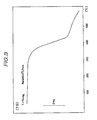
- thermogravimetric analysis was carried out on the aforesaid cured film.
- the temperature for the inception of weight loss was 280 °C.
- the results are shown in Fig. 3.
- the refractive index of the aforesaid cured film was found by an Abbe refractometer to be 1.605.
- a photosensitive resin composition was prepared according to the following procedure.
- An organic solution of the acid component was prepared by dissolving 15.3 g of fumaroyl chloride in 300 ml of 1,2-dichloroethane.
- the polyester thus prepared showed an inherent viscosity ( ⁇ inh ) of 1.0 dl/g and a glass transition temperature of 310 °C.
- a blend of the epoxy acrylate resin (Sample 1) obtained in Example 1 and the aforesaid unsaturated polyester of the general formula (II) was mixed uniformly with benzophenone and Michler's ketone as photosensitizers and ethyl cellosolve acetate as solvent in a three-roll mill to prepare Sample A of photosensitive resin composition.
- Composition of Sample A (% by weight) (a) Epoxy acrylate resin (Sample 1) 60 (b) Unsaturated polyester of the general formula (II) 15 (c) Benzophenone 2 (d) Michler's ketone 3 (e) Ethyl cellosolve acetate 20
- Example B The following photosensitive resin composition (Sample B) was prepared as in Example 3 except using the epoxy acrylate resin (Sample 2) obtained in Example 2.
- Composition of Sample B (% by weight) (a) Epoxy acrylate resin (Sample 2) 55 (b) Unsaturated polyester of the general formula (II) 10 (c) Benzophenone 2 (d) Michler's ketone 3 (e) Ethyl cellosolve acetate 30
- DPHA dipentaerythritol hexaacrylate
- Sample C Composition of Sample C (% by weight) (a) Epoxy acrylate resin (Sample 1) 50 (b) Phenol novolak epoxy acrylate 25 (c) Dipentaerythritol hexaacrylate 5 (d) Irgacure 651 (a product of Ciba-Geigy Japan, Ltd.) 2 (e) Michler's ketone 3 (f) Ethyl cellosolve actate 15
- the following photosensitive resin composition was prepared as in Example 5 except using the epoxy acrylate resin (Sample 2) obtained in Example 2.
- Composition of Sample D (a) Epoxy acrylate resin (Sample 2) 40 (b) Phenol novolak epoxy acrylate 20 (c) Dipentaerythritol hexaacrylate 10 (d) Irgacure 651 (a product of Ciba-Geigy Japan, Ltd.) 2 (e) Michler's ketone 3 (f) Ethyl cellosolve actate 25
- Photosensitive resin compositions (Samples E, F, and G) of Comparative Examples 1 to 3 were prepared using the compounds in the above-mentioned Examples while varying the mixing ratio.
- Comparative Example 1 [Composition of Sample E (% by weight) ] (a) Epoxy acrylate resin (Sample 2) 10 (b) Unsaturated polyester of the general formula (II) 65 (c) Benzophenone 2 (d) Michler's ketone 3 (e) Ethyl cellosolve acetate 20
- Comparative Example 2 [Composition of Sample F (% by weight) ] (a) Epoxy acrylate resin (Sample 2) 70 (b) Unsaturated polyester of the general formula (II) 5 (c) Benzophenone 2 (d) Michler's ketone 3 (e) Ethyl cellosolve acetate 20 Comparative Example 3 [Composition of Sample G (% by weight) ] (a) Epoxy acrylate resin (Sample 2) 5 (b) Phen
- the photoresists of the above-mentioned examples and comparative examples were each applied by a roll coater to a glass-epoxy resin laminate with drilled holes of a diameter of 0.3, 0.4, 0.5, and 0.9 mm, left in a stream of air of 80 °C for 40 minutes, placed in close contact with a negative mask containing line and space patterns of 30 to 200 inm and circular patterns with a diameter of 0.1 to 1.4 mm, and exposed to a superhigh-pressure mercury lamp at a quantity of light of 300 mj/cm2.
- the mask was removed after the exposure, the exposed photoresist was developed with 1,1,1-trichloroethane, washed with water, drained, dried at 80 °C for 20 minutes, and evaluated for the following items. The results are shown in Table 1.
- the developing time was defined as the time required for the complete removal of the resist from the hole of a given diameter for the drilled laminates or as the time required for the development of a 100 ⁇ m-wide line and space pattern for other laminates.
- the degree of resolution was defined as the minimum width of a line and space pattern obtained without deformation or incomplete development when observed under an optical microscope.
- the adhesion was tested by making cross cuts in the resist film and peeling them by a cellophane-backed pressure-sensitive tape.
- the hardness was evaluated by the pencil hardness test.
- the insulation resistance was measured by forming an electrode by etching and applying a voltage of 500 V for 1 minute.
- test specimen was immersed in a soldering bath at 260 ⁇ 5 °C for 60 seconds and observed for changes in appearance and adhesion.
- Samples A to D of the examples can be developed in a shorter time than Samples E to G of the comparative examples and they can also be developed when applied to substrates with small drilled holes.
- Sample E contains an excess of the unsaturated polyester of the general formula (II) and shows poor adhesion to the substrate, although presenting no problem in heat resistance and development.
- Sample F contains less than 10% by weight of the unsaturated polyester of the general formula (II) and suffers cracking and delamination for insufficient heat resistance in a soldering bath.
- Sample G lacks flexibility, shows poor adhesion to the surface of copper, and is not easy to develop on account of the use of more than an adequate quantity of the novo lak epoxy acrylate and dipentaerythritol hexaacrylate (DPHA).
- DPHA dipentaerythritol hexaacrylate
Landscapes
- Chemical & Material Sciences (AREA)
- Health & Medical Sciences (AREA)
- Physics & Mathematics (AREA)
- Medicinal Chemistry (AREA)
- Chemical Kinetics & Catalysis (AREA)
- Polymers & Plastics (AREA)
- Organic Chemistry (AREA)
- General Physics & Mathematics (AREA)
- Spectroscopy & Molecular Physics (AREA)
- Emergency Medicine (AREA)
- General Chemical & Material Sciences (AREA)
- Macromonomer-Based Addition Polymer (AREA)
- Epoxy Resins (AREA)
Applications Claiming Priority (4)
| Application Number | Priority Date | Filing Date | Title |
|---|---|---|---|
| JP259942/89 | 1989-10-06 | ||
| JP25994289 | 1989-10-06 | ||
| JP323829/89 | 1989-12-15 | ||
| JP1-323829A JPH0735426B2 (ja) | 1989-10-06 | 1989-12-15 | 感光性樹脂組成物 |
Publications (3)
| Publication Number | Publication Date |
|---|---|
| EP0421086A2 true EP0421086A2 (de) | 1991-04-10 |
| EP0421086A3 EP0421086A3 (en) | 1991-11-06 |
| EP0421086B1 EP0421086B1 (de) | 1995-01-11 |
Family
ID=26544369
Family Applications (1)
| Application Number | Title | Priority Date | Filing Date |
|---|---|---|---|
| EP90115190A Expired - Lifetime EP0421086B1 (de) | 1989-10-06 | 1990-08-07 | Epoxyacrylat-Harze und fotosensitive Harzzusammensetzungen |
Country Status (3)
| Country | Link |
|---|---|
| US (1) | US5196296A (de) |
| EP (1) | EP0421086B1 (de) |
| DE (1) | DE69015941T2 (de) |
Cited By (7)
| Publication number | Priority date | Publication date | Assignee | Title |
|---|---|---|---|---|
| NL9301664A (nl) * | 1992-09-29 | 1994-04-18 | Toppan Printing Co Ltd | Lichtgevoelige kleursamenstelling, kleurfilter, werkwijze voor het vervaardigen van een kleurfilter en een weergeefinrichting op basis van een vloeibaar kristal. |
| EP0598552A3 (de) * | 1992-11-16 | 1995-02-22 | Sola Int Holdings | Härtbare, polymere Zusammensetzung. |
| EP0571625A4 (en) * | 1990-06-20 | 1995-10-25 | Dainippon Printing Co Ltd | Color filter and method of manufacturing the same |
| EP0646845A4 (de) * | 1992-06-19 | 1995-11-15 | Nippon Steel Corp | Farbfilter, material und harzzusammensetzung dafür. |
| AU665124B2 (en) * | 1992-11-16 | 1995-12-14 | Sola International Holdings Ltd | Cross-linkable polymeric composition |
| EP0704466A3 (de) * | 1994-09-28 | 1997-12-10 | Takeda Chemical Industries, Ltd. | Feinpartikel aus einem Polymer mit hoher Wärmebeständigkeit |
| US5854313A (en) * | 1994-09-28 | 1998-12-29 | Takeda Chemical Industries, Ltd. | Fine particles of high heat resistant polymer and epoxy esters |
Families Citing this family (10)
| Publication number | Priority date | Publication date | Assignee | Title |
|---|---|---|---|---|
| US5880171A (en) * | 1989-05-01 | 1999-03-09 | 2C Optics, Inc. | Fast curing polymeric compositions for ophthalmic lenses and apparatus for preparing lenses |
| US5264323A (en) * | 1992-04-10 | 1993-11-23 | Eastman Kodak Company | Photographic developing solution and use thereof in the high contrast development of nucleated photographic elements |
| US5700850A (en) | 1993-08-05 | 1997-12-23 | Kimberly-Clark Worldwide | Colorant compositions and colorant stabilizers |
| WO1997044372A1 (en) * | 1996-05-23 | 1997-11-27 | Sola International Holdings Ltd. | Uv curable high index vinyl esters |
| TW571177B (en) * | 1998-10-08 | 2004-01-11 | Toppan Printing Co Ltd | Coloring composition and color filter, electrode substrate, and liquid crystal display device using the same |
| US6249034B1 (en) * | 1999-03-29 | 2001-06-19 | Intel Corporation | Microlens formed of negative photoresist |
| JP4558178B2 (ja) | 2000-11-30 | 2010-10-06 | 新日鐵化学株式会社 | 光又は熱硬化性樹脂組成物及びプリント配線基板 |
| SE0300482D0 (sv) * | 2003-02-21 | 2003-02-21 | Amersham Biosciences Ab | Inorganic beads with hierarchical pore structures |
| KR101344792B1 (ko) | 2010-12-17 | 2013-12-24 | 제일모직주식회사 | 하드마스크 조성물, 이를 사용한 패턴 형성 방법 및 상기 패턴을 포함하는 반도체 집적회로 디바이스 |
| CN109312052B (zh) * | 2016-07-28 | 2020-12-22 | 昭和电工株式会社 | 环氧(甲基)丙烯酸酯化合物及含有该环氧(甲基)丙烯酸酯化合物的固化性组合物 |
Family Cites Families (11)
| Publication number | Priority date | Publication date | Assignee | Title |
|---|---|---|---|---|
| JPS5537869B2 (de) * | 1973-02-12 | 1980-09-30 | ||
| US4046564A (en) * | 1975-07-16 | 1977-09-06 | Xerox Corporation | Electrophotographic imaging members with photoconductive layer containing electron acceptor monomers or polymers |
| JPS52117985A (en) * | 1976-03-30 | 1977-10-03 | Hitachi Chem Co Ltd | Photosensitive polymer composition |
| CA1116919A (en) * | 1976-10-27 | 1982-01-26 | Joseph E. Gervay | Flame retardant radiation sensitive element of photopolymerizable composition containing halogen and an acrylonitrile containing polymeric binder |
| JPS541018A (en) * | 1977-06-03 | 1979-01-06 | Hitachi Chemical Co Ltd | Flameeresistant photosensitive resin composition for soler resist use |
| US4264708A (en) * | 1978-03-31 | 1981-04-28 | E. I. Du Pont De Nemours And Company | Radiation sensitive element having a thin photopolymerizable layer |
| FR2435486A1 (fr) * | 1978-09-06 | 1980-04-04 | Lubrizol Corp | Nouveaux polymeres inhibant la formation de mousse et lubrifiants les contenant |
| JPS55127097A (en) * | 1979-03-20 | 1980-10-01 | Matsushita Electric Industrial Co Ltd | Photocurable resin composition and solder resist |
| US4252888A (en) * | 1980-02-26 | 1981-02-24 | Minnesota Mining And Manufacturing Company | Solder mask composition |
| US4322490A (en) * | 1980-11-17 | 1982-03-30 | Eastman Kodak Company | Photopolymerizable compositions featuring improved monomers |
| US4663412A (en) * | 1984-10-31 | 1987-05-05 | Ecoplastics Limited | Fluorene containing compounds and negative photoresist compositions therefrom |
-
1990
- 1990-07-26 US US07/557,846 patent/US5196296A/en not_active Expired - Lifetime
- 1990-08-07 EP EP90115190A patent/EP0421086B1/de not_active Expired - Lifetime
- 1990-08-07 DE DE69015941T patent/DE69015941T2/de not_active Expired - Fee Related
Cited By (9)
| Publication number | Priority date | Publication date | Assignee | Title |
|---|---|---|---|---|
| EP0571625A4 (en) * | 1990-06-20 | 1995-10-25 | Dainippon Printing Co Ltd | Color filter and method of manufacturing the same |
| EP0646845A4 (de) * | 1992-06-19 | 1995-11-15 | Nippon Steel Corp | Farbfilter, material und harzzusammensetzung dafür. |
| US5721076A (en) * | 1992-06-19 | 1998-02-24 | Nippon Steel Corporation | Color filters and materials and resins therefor |
| NL9301664A (nl) * | 1992-09-29 | 1994-04-18 | Toppan Printing Co Ltd | Lichtgevoelige kleursamenstelling, kleurfilter, werkwijze voor het vervaardigen van een kleurfilter en een weergeefinrichting op basis van een vloeibaar kristal. |
| EP0598552A3 (de) * | 1992-11-16 | 1995-02-22 | Sola Int Holdings | Härtbare, polymere Zusammensetzung. |
| AU665124B2 (en) * | 1992-11-16 | 1995-12-14 | Sola International Holdings Ltd | Cross-linkable polymeric composition |
| US5502139A (en) * | 1992-11-16 | 1996-03-26 | Sola International Holdings Ltd. | Cross-linkable polymeric composition |
| EP0704466A3 (de) * | 1994-09-28 | 1997-12-10 | Takeda Chemical Industries, Ltd. | Feinpartikel aus einem Polymer mit hoher Wärmebeständigkeit |
| US5854313A (en) * | 1994-09-28 | 1998-12-29 | Takeda Chemical Industries, Ltd. | Fine particles of high heat resistant polymer and epoxy esters |
Also Published As
| Publication number | Publication date |
|---|---|
| EP0421086B1 (de) | 1995-01-11 |
| DE69015941D1 (de) | 1995-02-23 |
| DE69015941T2 (de) | 1995-08-31 |
| US5196296A (en) | 1993-03-23 |
| EP0421086A3 (en) | 1991-11-06 |
| JPH03205417A (ja) | 1991-09-06 |
Similar Documents
| Publication | Publication Date | Title |
|---|---|---|
| EP0421086B1 (de) | Epoxyacrylat-Harze und fotosensitive Harzzusammensetzungen | |
| JP3148429B2 (ja) | 光重合性不飽和化合物及びアルカリ現像型感光性樹脂組成物 | |
| KR870000679B1 (ko) | 감광성수지조성물 및 감광성수지조성물 적층체 | |
| KR100725432B1 (ko) | 감광성 수지 조성물 및 그 경화물 | |
| KR101041958B1 (ko) | 불포화기 함유 폴리아미드산 수지 및 그것을 이용한 감광성수지 조성물 및 그 경화물 | |
| KR101169618B1 (ko) | 감광성 수지 조성물 그리고 그 경화물 | |
| US4839261A (en) | Photocurable laminate | |
| JPH1143524A (ja) | カリックスアレーン誘導体及びそれを含有する硬化性樹脂組成物 | |
| CN100578359C (zh) | 感光树脂组合物和其固化物 | |
| JP4400926B2 (ja) | 感光性樹脂組成物並びにその硬化物 | |
| KR20140115988A (ko) | 에폭시아크릴레이트 수지, 에폭시아크릴레이트 산무수물 부가체, 경화성 수지 조성물, 알칼리 현상형 감광성 수지 조성물 및 이들의 경화물 | |
| KR101042481B1 (ko) | 테르펜 페놀 단위를 포함하는 폴리에스테르 | |
| JP4738259B2 (ja) | 感光性樹脂組成物、並びにその硬化物 | |
| JP2011102921A (ja) | アダマンタン誘導体を含む感光性組成物 | |
| KR102179484B1 (ko) | 9-페닐아크리딘 고분자 감광제 및 이의 제조 방법과 용도 | |
| CN111978239A (zh) | 化合物及感光树脂组合物 | |
| JPH0693063A (ja) | 感光性樹脂組成物積層体 | |
| JPH0735426B2 (ja) | 感光性樹脂組成物 | |
| JP2002241467A (ja) | エポキシカルボキシレート化合物及びそれを用いた感光性樹脂組成物 | |
| JP2013041115A (ja) | 感光性樹脂組成物 | |
| JP4493441B2 (ja) | 感光性樹脂組成物、およびその硬化物 | |
| JP4502248B2 (ja) | 感光性樹脂組成物及びその硬化物の製造法 | |
| JP2002003571A (ja) | ポリカルボン酸樹脂及びそれを用いた光硬化型樹脂組成物並びにその硬化物 | |
| JPH05155957A (ja) | 光硬化性樹脂組成物 | |
| JP2002006486A (ja) | 感光性樹脂組成物並びにその硬化物 |
Legal Events
| Date | Code | Title | Description |
|---|---|---|---|
| PUAI | Public reference made under article 153(3) epc to a published international application that has entered the european phase |
Free format text: ORIGINAL CODE: 0009012 |
|
| AK | Designated contracting states |
Kind code of ref document: A2 Designated state(s): DE NL |
|
| PUAL | Search report despatched |
Free format text: ORIGINAL CODE: 0009013 |
|
| AK | Designated contracting states |
Kind code of ref document: A3 Designated state(s): DE NL |
|
| 17P | Request for examination filed |
Effective date: 19920319 |
|
| 17Q | First examination report despatched |
Effective date: 19920722 |
|
| GRAA | (expected) grant |
Free format text: ORIGINAL CODE: 0009210 |
|
| AK | Designated contracting states |
Kind code of ref document: B1 Designated state(s): DE NL |
|
| REF | Corresponds to: |
Ref document number: 69015941 Country of ref document: DE Date of ref document: 19950223 |
|
| PLBE | No opposition filed within time limit |
Free format text: ORIGINAL CODE: 0009261 |
|
| 26N | No opposition filed | ||
| NLS | Nl: assignments of ep-patents |
Owner name: NIPPON STEEL CHEMICAL. CO., LTD. |
|
| PGFP | Annual fee paid to national office [announced via postgrant information from national office to epo] |
Ref country code: DE Payment date: 20060803 Year of fee payment: 17 |
|
| PGFP | Annual fee paid to national office [announced via postgrant information from national office to epo] |
Ref country code: NL Payment date: 20060815 Year of fee payment: 17 |
|
| PG25 | Lapsed in a contracting state [announced via postgrant information from national office to epo] |
Ref country code: NL Free format text: LAPSE BECAUSE OF NON-PAYMENT OF DUE FEES Effective date: 20080301 |
|
| NLV4 | Nl: lapsed or anulled due to non-payment of the annual fee |
Effective date: 20080301 |
|
| PG25 | Lapsed in a contracting state [announced via postgrant information from national office to epo] |
Ref country code: DE Free format text: LAPSE BECAUSE OF NON-PAYMENT OF DUE FEES Effective date: 20080301 |