EP0355017B1 - Method for producing a block copolyamide - Google Patents
Method for producing a block copolyamide Download PDFInfo
- Publication number
- EP0355017B1 EP0355017B1 EP89114844A EP89114844A EP0355017B1 EP 0355017 B1 EP0355017 B1 EP 0355017B1 EP 89114844 A EP89114844 A EP 89114844A EP 89114844 A EP89114844 A EP 89114844A EP 0355017 B1 EP0355017 B1 EP 0355017B1
- Authority
- EP
- European Patent Office
- Prior art keywords
- fatty acid
- acid
- prepolymer
- dimerized fatty
- diamine
- Prior art date
- Legal status (The legal status is an assumption and is not a legal conclusion. Google has not performed a legal analysis and makes no representation as to the accuracy of the status listed.)
- Expired - Lifetime
Links
Images
Classifications
-
- C—CHEMISTRY; METALLURGY
- C08—ORGANIC MACROMOLECULAR COMPOUNDS; THEIR PREPARATION OR CHEMICAL WORKING-UP; COMPOSITIONS BASED THEREON
- C08G—MACROMOLECULAR COMPOUNDS OBTAINED OTHERWISE THAN BY REACTIONS ONLY INVOLVING UNSATURATED CARBON-TO-CARBON BONDS
- C08G69/00—Macromolecular compounds obtained by reactions forming a carboxylic amide link in the main chain of the macromolecule
- C08G69/02—Polyamides derived from amino-carboxylic acids or from polyamines and polycarboxylic acids
- C08G69/04—Preparatory processes
-
- C—CHEMISTRY; METALLURGY
- C08—ORGANIC MACROMOLECULAR COMPOUNDS; THEIR PREPARATION OR CHEMICAL WORKING-UP; COMPOSITIONS BASED THEREON
- C08G—MACROMOLECULAR COMPOUNDS OBTAINED OTHERWISE THAN BY REACTIONS ONLY INVOLVING UNSATURATED CARBON-TO-CARBON BONDS
- C08G69/00—Macromolecular compounds obtained by reactions forming a carboxylic amide link in the main chain of the macromolecule
- C08G69/02—Polyamides derived from amino-carboxylic acids or from polyamines and polycarboxylic acids
- C08G69/36—Polyamides derived from amino-carboxylic acids or from polyamines and polycarboxylic acids derived from amino acids, polyamines and polycarboxylic acids
-
- C—CHEMISTRY; METALLURGY
- C08—ORGANIC MACROMOLECULAR COMPOUNDS; THEIR PREPARATION OR CHEMICAL WORKING-UP; COMPOSITIONS BASED THEREON
- C08G—MACROMOLECULAR COMPOUNDS OBTAINED OTHERWISE THAN BY REACTIONS ONLY INVOLVING UNSATURATED CARBON-TO-CARBON BONDS
- C08G69/00—Macromolecular compounds obtained by reactions forming a carboxylic amide link in the main chain of the macromolecule
- C08G69/02—Polyamides derived from amino-carboxylic acids or from polyamines and polycarboxylic acids
- C08G69/26—Polyamides derived from amino-carboxylic acids or from polyamines and polycarboxylic acids derived from polyamines and polycarboxylic acids
- C08G69/34—Polyamides derived from amino-carboxylic acids or from polyamines and polycarboxylic acids derived from polyamines and polycarboxylic acids using polymerised unsaturated fatty acids
Definitions
- the present invention relates to a method for producing a block copolyamide. More particularly, it relates to a method for producing a block copolyamide excellent in various properties such as flexibility, heat resistance and chemical resistance.
- a copolyamide wherein a dimerized fatty acid is used as a copolymer component is known (Japanese Unexamined Patent Publication No. 71191/1979 and FR-A-2 576 904).
- Japanese Unexamined Patent Publication No. 71191/1979 and FR-A-2 576 904 Japanese Unexamined Patent Publication No. 71191/1979 and FR-A-2 576 904
- the amount of the dimerized fatty acid is increased to increase the flexibility, the heat resistance tends to decrease, whereby it has been difficult to simultaneously satisfy the heat resistance and the flexibility. A further improvement has been desired in this respect.
- the present inventors have conducted extensive researches to solve such a problem, and as a result, have found it possible to obtain a block copolyamide having the flexibility improved without impairing the heat resistance intrinsic to a polyamide, by using a prepolymer prepared from a dimerized fatty acid and a diamine and by polycondensing such a prepolymer with a polyamide material other than the prepolymer component or with a prepolymer of such a polyamide material.
- the present invention has been accomplished on the basis of this discovery.
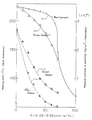
- Figure 1 is a graph showing the relation between the proportions of the starting materials and the melting point and flexural modulus of elasticity of a block copolymer and a random copolymer.
- dimerized fatty acid to be used in the present invention a polymerized fatty acid obtained by polymerizing an unsaturated fatty acid, such as a monobasic fatty acid from natural oil and fat or a synthetic monobasic fatty acid having from 8 to 24 carbon atoms and containing at least one double bond or triple bond.
- an unsaturated fatty acid such as a monobasic fatty acid from natural oil and fat or a synthetic monobasic fatty acid having from 8 to 24 carbon atoms and containing at least one double bond or triple bond.
- a dimer of linolenic acid, linolic acid, oleic acid or tall oil fatty acid may be mentioned.
- polymerized fatty acids usually comprise a dimerized fatty acid as the main component and starting material fatty acids or trimerized fatty acids as additional components.
- the dimerized fatty acid content is preferably at least 70% by weight, more preferably at least 95% by weight and most preferably at least 98% by weight.
- Commercial products are also called dimer acids.
- polymerized fatty acids may be distilled to increase the dimerized fatty acid content before use. In some cases, they may be hydrogenated to lower the degree of unsaturation before use.
- the diamine to be used together with the dimerized fatty acid for the preparation of the prepolymer includes diamines such as ethylenediamine, 1,4-diaminobutane, hexamethylenediamine, nonamethylenediamine, undecamethylenediamine, dodecamethylenediamine, 2,2,4- or 2,4,4-trimethylhexamethylenediamine, bis-(4,4′-aminocyclohexyl)methane and m-xylylenediamine.
- a usual process for the production of a polyamide may be followed, for example, by charging the dimerized fatty acid, the diamine and water to a pressure container, heating them to initiate the reaction and terminating the reaction when a desired number average molecular weight has been reached.
- the number average molecular weight of the prepolymer prepared from the dimerized fatty acid and the diamine is required to be within a range of from 1,000 to 50,000, preferably from 2,000 to 30,000, more preferably from 3,000 to 20,000, as measured by a quantitative analysis of terminal groups.
- terminal groups to be determined by the quantitative analysis of terminal groups, for example, amino groups are measured by dissolving the polyamide in phenol, followed by titration with 0.05N hydrochloric acid, and carboxyl groups are measured by dissolving the polyamide in benzyl alcohol, followed by titration with 0.1N sodium hydroxide, whereupon the sum of the two groups may be taken as the total terminal groups.
- the block copolyamide tends to be hardly formed, and it becomes difficult to obtain a product which simultaneously satisfies the flexibility and the heat resistance.
- the number average molecular weight is higher than the above range, it tends to take a long time for the preparation of the prepolymer from the dimerized fatty acid and the diamine.
- the prepolymer prepared from the above-mentioned dimerized fatty acid and diamine is polycondensed with a polyamide material other than the prepolymer component or a prepolymer thereof.
- the polyamide material used here may be a at least three-membered ring lactam, a polymerizable ⁇ -amino acid or a salt obtained by the reaction of a dibasic acid with a diamine.
- the starting materials for such polyamides include lactams such as ⁇ -caprolactam, enantholactam, capryllactam, lauryllactam, ⁇ -pyrrolidone and ⁇ -piperidone; ⁇ -amino acids such as 6-aminocaproic acid, 7-aminocaproic acid, 9-aminononanoic acid and 11-aminoundecanoic acid; dibasic acids such as adipic acid, glutaric acid, pimelic acid, suberic acid, azelaic acid, sebacic acid, undecadioic acid, dodecadioic acid, hexadecadioic acid, hexadecenedioic acid, eicosane
- the prepolymer prepared from the dimerized fatty acid and the diamine, and the polyamide material other than said prepolymer component or a prepolymer thereof are charged in a polymerization reactor, followed by polymerization in accordance with a usual process for the production of a polyamide.
- the content of the dimerized fatty acid in the block copolyamide is usually from 1 to 80% by weight, preferably from 10 to 70% by weight. If the content is too low, no adequate flexibility tends to be obtained to meet various applications. On the other hand, if the content is too high, the heat resistance tends to be inadequate, such being unsuitable as engineering plastics of general use.
- the block copolyamide of the present invention usually has a number average molecular weight of 15,000 to 40,000 and is a polymer having several prepolymer units formed from the dimerized fatty acid and the diamine, in one molecular chain, as shown in the following structure, although the number of the units varies depending upon the composition of the charged dimerized fatty acid: wherein -CO-D-CO- represents the dimerized fatty acid moiety.
- an amide exchange reaction takes place to some extent, and the prepolymer once formed from the dimerized fatty acid and the diamine may undergo a molecular weight reduction.
- a block copolyamide obtained by controlling such an exchange reaction undergoes little reduction of the melting point, has excellent heat resistance and exhibits superior flexibility as compared with a random copolymer having the same composition.
- the amide exchange reaction can be suppressed by controlling the time under a high pressure condition during the polymerization.
- the feature of the present invention resides in that the copolymerization is carried out with a block unit z of at least 1.5, and x and z are copolymerized as blocks, whereby it is possible to obtain a copolymer having the merits of the two components, which used to be hardly attainable by the conventional copolymerization.
- the numerical value for z is not large enough.
- the block copolyamide produced by the method of the present invention can be molded by various molding methods including injection molding, extrusion molding, blow molding and compression molding.
- tubes such as fuel tubes, brake pipings or exhaust gas parts, pipes, sheets, electric parts such as connectors, gears, valves, oil pans, cooling fans, radiator tanks, cylinder heads, canisters, obtained by extrusion molding or injection molding, are very useful.
- secondly processing such as vapor deposition may be applied to the molded products thus obtained.
- conventional additives including reinforcing materials such as glass fibers or carbon fibers, fillers such as clay, silica, alumina, silica alumina, silica magnesia, glass beads, graphite or gypsum, dyes and pigments, flame retardants, antistatic agents and antioxidants, may be incorporated.
- a dimerized fatty acid (dimer: 98%, monomer: 0.1%, trimer: 1%, Plypol 1009, manufactured by Unichema Co.) and hexamethylenediamine in the respective amounts as identified in Table 1 and water in an amount to make up an aqueous solution containing 75% by weight of a salt of the dimerized fatty acid with the diamine.
- the reaction was conducted for one hour at the internal temperature under the internal pressure as identified in Table 1 to obtain a prepolymer having the number average molecular weight as identified in Table 1.
- This prepolymer was introduced into ⁇ -caprolactam in the amount as identified in Table 1 heated to 250°C, and the reaction was conducted for one hour at an internal temperature of 280°C under an internal pressure of 8 kg/cm2G (i.e. gage pressure). Then, the pressure was reduced to a level as identified in Table 1, and the polycondensation reaction was conducted for one hour.
- prepolymers having low number average molecular weights were prepared by lowering the internal temperature and the internal pressure during the preparation of the prepolymer from the dimerized fatty acid and hexamethylenediamine. By using such prepolymers, polycondensation reactions were conducted in the same manner as in Examples 1 and 2.
- a prepolymer having the number average molecular weight as identified in Table 2 was prepared from a dimerized fatty acid and hexamethylenediamine.
- an aqueous solution containing 50% by weight of a salt (AH salt) of adipic acid with hexamethylenediamine was concentrated under an internal pressure of 2.5 kg/cm2G at an internal temperature of 160°C to a level of from 75 to 80% by weight.
- the above-mentioned prepolymer was introduced, and the reaction was conducted for one hour at an internal temperature of 250°C under an internal pressure of 13 kg/cm2G. Then, in the same manner as in Example 1, a block copolyamide was prepared.
- Example 6 For the comparison with Example 6, a prepolymer having a low number average molecular weight was prepared by lowering the internal temperature and the internal pressure during the preparation of the prepolymer from the dimerized fatty acid and hexamethylenediamine. By using this prepolymer, the polycondensation reaction was conducted in the same manner as in Example 6.
- melting point Tm°C
- a dimerized fatty acid (dimer: 96%, monomer: 1%, trimer: 3%, Enpol #1010, tradename, manufactured by Emery Co.) and hexamethylenediamine in the respective amounts as identified in Table 3 and water in an amount to make up an aqueous solution containing 75% by weight of a salt of the dimerized fatty acid with the diamine.
- the reaction was conducted for one hour at an internal temperature of 240°C under an internal pressure of 13 kg. Then, the pressure was reduced to 50 Torr, and the reaction was conducted under reduced pressure to obtain a prepolymer having the number average molecular weight as identified in Table 3.
- This prepolymer was introduced into ⁇ -caprolactam in the amount as identified in Table 3 heated to 250°C, and 1.5%, based on ⁇ -caprolactam, of water was added thereto. Then, the reaction was conducted for 0.5 hour at an internal temperature of 260°C under an internal pressure of 4 kg/cm2G. Then, the pressure was reduced to a level as identified in Table 3, and the polycondensation reaction was conducted for 2 hours.
- the process of the present invention is industrially very advantageous in that it is thereby possible to produce a block copolyamide which is excellent in various properties such as heat resistance, chemical resistance and flexibility.
Landscapes
- Chemical & Material Sciences (AREA)
- Health & Medical Sciences (AREA)
- Chemical Kinetics & Catalysis (AREA)
- Medicinal Chemistry (AREA)
- Polymers & Plastics (AREA)
- Organic Chemistry (AREA)
- Life Sciences & Earth Sciences (AREA)
- Proteomics, Peptides & Aminoacids (AREA)
- Polyamides (AREA)
- Graft Or Block Polymers (AREA)
Applications Claiming Priority (2)
| Application Number | Priority Date | Filing Date | Title |
|---|---|---|---|
| JP203195/88 | 1988-08-17 | ||
| JP63203195A JPH0641514B2 (ja) | 1988-08-17 | 1988-08-17 | ブロックコポリアミドの製造法 |
Publications (3)
| Publication Number | Publication Date |
|---|---|
| EP0355017A2 EP0355017A2 (en) | 1990-02-21 |
| EP0355017A3 EP0355017A3 (en) | 1990-10-17 |
| EP0355017B1 true EP0355017B1 (en) | 1994-06-15 |
Family
ID=16470038
Family Applications (1)
| Application Number | Title | Priority Date | Filing Date |
|---|---|---|---|
| EP89114844A Expired - Lifetime EP0355017B1 (en) | 1988-08-17 | 1989-08-10 | Method for producing a block copolyamide |
Country Status (5)
| Country | Link |
|---|---|
| US (1) | US5011893A (enExample) |
| EP (1) | EP0355017B1 (enExample) |
| JP (1) | JPH0641514B2 (enExample) |
| KR (1) | KR970006892B1 (enExample) |
| DE (1) | DE68916130T2 (enExample) |
Families Citing this family (21)
| Publication number | Priority date | Publication date | Assignee | Title |
|---|---|---|---|---|
| US5219953A (en) * | 1988-12-02 | 1993-06-15 | Eniricerche S.P.A. | Catalytic preparation of semi-aromatic copolyamides and copolyester-amides |
| EP0519012A1 (en) * | 1990-03-06 | 1992-12-23 | The Dow Chemical Company | Segmented block copolymers |
| EP0445810B1 (en) * | 1990-03-08 | 1996-02-21 | Mitsubishi Chemical Corporation | Polyamide monofilament |
| DE4434899C2 (de) | 1994-09-29 | 1997-12-11 | Inventa Ag | Copolyamide und deren Verwendung |
| US7117817B2 (en) * | 2004-08-03 | 2006-10-10 | Troy Overstreet | Animal feed harvesting and dispensing system |
| CN101056948B (zh) * | 2004-11-19 | 2011-04-13 | 松下电器产业株式会社 | 难燃性树脂组合物及其制造方法以及其成形方法 |
| EP2199344B1 (de) * | 2008-12-17 | 2018-03-21 | Ems-Patent Ag | Xylylenbasierte Polyamide und deren Verwendung |
| WO2011095551A1 (en) * | 2010-02-08 | 2011-08-11 | Dsm Ip Assets B.V. | Fuel part |
| WO2012114396A1 (ja) | 2011-02-24 | 2012-08-30 | パナソニック株式会社 | 外装体およびその製造方法 |
| JP5616972B2 (ja) | 2011-02-24 | 2014-10-29 | パナソニック株式会社 | 外装体およびその製造方法 |
| FR2997953B1 (fr) * | 2012-11-14 | 2016-01-08 | Rhodia Operations | Co-polyamide aliphatique/semi-aromatique bloc |
| CN104910376B (zh) * | 2014-03-10 | 2017-09-12 | 湖南师范大学 | 一种不使用开环剂生产低熔点、高分解温度三元共聚酰胺的配方及制备方法 |
| BR112019004925B8 (pt) * | 2016-09-14 | 2023-03-14 | Basf Se | Uso de um filme agrícola (af) e processo para a produção de um filme agrícola (af) |
| WO2018050488A1 (de) * | 2016-09-14 | 2018-03-22 | Basf Se | Polymerfilm enthaltend ein copolyamid mindestens eines diamins, einer dicarbonsäure und einer dimersäure |
| AU2017326287B2 (en) * | 2016-09-14 | 2021-12-09 | Basf Se | Polymer film comprising a co-polyamide of a diamine, a dimer acid and a lactam |
| PL3656801T3 (pl) * | 2017-04-05 | 2022-03-28 | Advansix Resins & Chemicals Llc | Rozgałęzione kompozycje poliamidowe z terminacją |
| US12703772B2 (en) * | 2019-04-30 | 2026-08-11 | Basf Se | Flame retardant polyamide |
| JP2023538301A (ja) * | 2020-08-13 | 2023-09-07 | アセンド・パフォーマンス・マテリアルズ・オペレーションズ・リミテッド・ライアビリティ・カンパニー | ダイマー酸およびダイマーアミンを含む脂肪族および半芳香族ポリアミド |
| KR102733887B1 (ko) * | 2020-12-24 | 2024-11-22 | 한화솔루션 주식회사 | 다원 공중합에 의한 폴리아마이드 제조 방법, 이에 의해 제조된 폴리아마이드 및 이를 포함하는 조성물 |
| CN113621136B (zh) * | 2021-08-12 | 2022-07-01 | 北京化工大学 | 嵌段共聚制备聚酰胺材料的方法 |
| JP7445356B2 (ja) * | 2022-03-10 | 2024-03-07 | ユニチカ株式会社 | ポリアミドフィルムおよびその製造方法 |
Family Cites Families (4)
| Publication number | Priority date | Publication date | Assignee | Title |
|---|---|---|---|---|
| DE1908754A1 (de) * | 1969-02-18 | 1970-08-20 | Schering Ag | Neue Polyamide |
| GB1598823A (en) * | 1977-02-18 | 1981-09-23 | Unilever Emery | Polyamides |
| FR2576904B1 (fr) * | 1985-02-07 | 1987-02-20 | Rhone Poulenc Spec Chim | Procede de preparation de copolyamides a base d'hexamethylenediamine, d'acide adipique, eventuellement d'au moins un autre diacide carboxylique a chaine courte et d'acide dimere |
| FR2579601B1 (fr) * | 1985-03-28 | 1987-12-11 | Rhone Poulenc Spec Chim | Copolyetheramides techniques souples a basse temperature |
-
1988
- 1988-08-17 JP JP63203195A patent/JPH0641514B2/ja not_active Expired - Fee Related
-
1989
- 1989-08-07 US US07/390,217 patent/US5011893A/en not_active Expired - Fee Related
- 1989-08-10 EP EP89114844A patent/EP0355017B1/en not_active Expired - Lifetime
- 1989-08-10 DE DE68916130T patent/DE68916130T2/de not_active Expired - Fee Related
- 1989-08-17 KR KR1019890011713A patent/KR970006892B1/ko not_active Expired - Fee Related
Also Published As
| Publication number | Publication date |
|---|---|
| US5011893A (en) | 1991-04-30 |
| KR970006892B1 (ko) | 1997-04-30 |
| JPH0253823A (ja) | 1990-02-22 |
| EP0355017A3 (en) | 1990-10-17 |
| EP0355017A2 (en) | 1990-02-21 |
| KR900003242A (ko) | 1990-03-26 |
| DE68916130D1 (de) | 1994-07-21 |
| DE68916130T2 (de) | 1995-01-26 |
| JPH0641514B2 (ja) | 1994-06-01 |
Similar Documents
| Publication | Publication Date | Title |
|---|---|---|
| US5011893A (en) | Method for producing a block copolyamide | |
| JP4346691B2 (ja) | ポリアミド組成物から作られた自動車部品 | |
| US4387184A (en) | Heat stable polyphase polyamide compositions and preparation thereof | |
| EP0039524B2 (en) | Preparation of polytetramethylene adipamide | |
| CN1205251C (zh) | 热塑性共聚酰胺及其组合物 | |
| US5696202A (en) | Transparent, colorless, amorphous polyamides and molded articles | |
| JP6521952B2 (ja) | 脂肪族又は部分芳香族ポリアミドを連続的に製造する方法 | |
| CN100439419C (zh) | 共聚酰胺 | |
| CN113150269A (zh) | 半芳香族聚酰胺共聚物及其制备 | |
| US5824763A (en) | Process for the manufacture of nylon compositions with improved flow | |
| EP0846138B1 (en) | Process for the manufacture of nylon compositions with improved flow | |
| WO2011072026A2 (en) | Salt resistant polyamides | |
| JP7797097B2 (ja) | 半芳香族ポリアミド樹脂、及びその製造方法 | |
| US4864009A (en) | Molding composition consisting of aliphatic/aromatic copolyamide | |
| US4921932A (en) | Polyamide resin | |
| US4212965A (en) | Polyamides with elastomeric character from 5-methylnonamethylene diamine | |
| KR102733887B1 (ko) | 다원 공중합에 의한 폴리아마이드 제조 방법, 이에 의해 제조된 폴리아마이드 및 이를 포함하는 조성물 | |
| JPH08134206A (ja) | 共重合ポリアミド樹脂 | |
| CN112204075A (zh) | 半芳香族聚酰胺树脂及其制造方法 | |
| JP3008482B2 (ja) | ポリアミド樹脂組成物 | |
| JP3562359B2 (ja) | 成形性と機械的性質に優れたナイロン12及びその製造法 | |
| JPH05230205A (ja) | ポリアミド樹脂の製造方法 | |
| JPH09316193A (ja) | ポリアミドの製造方法 | |
| JPH05171036A (ja) | ポリアミド樹脂組成物 | |
| CA1076740A (en) | Polyamides |
Legal Events
| Date | Code | Title | Description |
|---|---|---|---|
| PUAI | Public reference made under article 153(3) epc to a published international application that has entered the european phase |
Free format text: ORIGINAL CODE: 0009012 |
|
| AK | Designated contracting states |
Kind code of ref document: A2 Designated state(s): DE FR GB |
|
| PUAL | Search report despatched |
Free format text: ORIGINAL CODE: 0009013 |
|
| AK | Designated contracting states |
Kind code of ref document: A3 Designated state(s): DE FR GB |
|
| 17P | Request for examination filed |
Effective date: 19901214 |
|
| 17Q | First examination report despatched |
Effective date: 19920724 |
|
| GRAA | (expected) grant |
Free format text: ORIGINAL CODE: 0009210 |
|
| AK | Designated contracting states |
Kind code of ref document: B1 Designated state(s): DE FR GB |
|
| REF | Corresponds to: |
Ref document number: 68916130 Country of ref document: DE Date of ref document: 19940721 |
|
| ET | Fr: translation filed | ||
| RAP2 | Party data changed (patent owner data changed or rights of a patent transferred) |
Owner name: MITSUBISHI CHEMICAL CORPORATION |
|
| PLBE | No opposition filed within time limit |
Free format text: ORIGINAL CODE: 0009261 |
|
| STAA | Information on the status of an ep patent application or granted ep patent |
Free format text: STATUS: NO OPPOSITION FILED WITHIN TIME LIMIT |
|
| 26N | No opposition filed | ||
| PGFP | Annual fee paid to national office [announced via postgrant information from national office to epo] |
Ref country code: FR Payment date: 19990617 Year of fee payment: 11 |
|
| PGFP | Annual fee paid to national office [announced via postgrant information from national office to epo] |
Ref country code: GB Payment date: 19990625 Year of fee payment: 11 |
|
| PGFP | Annual fee paid to national office [announced via postgrant information from national office to epo] |
Ref country code: DE Payment date: 19990930 Year of fee payment: 11 |
|
| PG25 | Lapsed in a contracting state [announced via postgrant information from national office to epo] |
Ref country code: GB Free format text: LAPSE BECAUSE OF NON-PAYMENT OF DUE FEES Effective date: 20000810 |
|
| GBPC | Gb: european patent ceased through non-payment of renewal fee |
Effective date: 20000810 |
|
| PG25 | Lapsed in a contracting state [announced via postgrant information from national office to epo] |
Ref country code: FR Free format text: LAPSE BECAUSE OF NON-PAYMENT OF DUE FEES Effective date: 20010430 |
|
| PG25 | Lapsed in a contracting state [announced via postgrant information from national office to epo] |
Ref country code: DE Free format text: LAPSE BECAUSE OF NON-PAYMENT OF DUE FEES Effective date: 20010501 |
|
| REG | Reference to a national code |
Ref country code: FR Ref legal event code: ST |