EP0349849B1 - Verfahren zur Reinigung von Rohrzucker-Fettsäureestern - Google Patents
Verfahren zur Reinigung von Rohrzucker-Fettsäureestern Download PDFInfo
- Publication number
- EP0349849B1 EP0349849B1 EP89111430A EP89111430A EP0349849B1 EP 0349849 B1 EP0349849 B1 EP 0349849B1 EP 89111430 A EP89111430 A EP 89111430A EP 89111430 A EP89111430 A EP 89111430A EP 0349849 B1 EP0349849 B1 EP 0349849B1
- Authority
- EP
- European Patent Office
- Prior art keywords
- sucrose
- fatty acid
- reaction mixture
- water
- weight
- Prior art date
- Legal status (The legal status is an assumption and is not a legal conclusion. Google has not performed a legal analysis and makes no representation as to the accuracy of the status listed.)
- Expired - Lifetime
Links
- 229930006000 Sucrose Natural products 0.000 title claims description 185
- 239000005720 sucrose Substances 0.000 title claims description 185
- 235000014113 dietary fatty acids Nutrition 0.000 title claims description 99
- 229930195729 fatty acid Natural products 0.000 title claims description 99
- 239000000194 fatty acid Substances 0.000 title claims description 99
- -1 sucrose fatty acid esters Chemical class 0.000 title claims description 72
- 238000000034 method Methods 0.000 title claims description 61
- 230000008569 process Effects 0.000 title claims description 39
- CZMRCDWAGMRECN-UGDNZRGBSA-N Sucrose Chemical compound O[C@H]1[C@H](O)[C@@H](CO)O[C@@]1(CO)O[C@@H]1[C@H](O)[C@@H](O)[C@H](O)[C@@H](CO)O1 CZMRCDWAGMRECN-UGDNZRGBSA-N 0.000 claims description 119
- XLYOFNOQVPJJNP-UHFFFAOYSA-N water Substances O XLYOFNOQVPJJNP-UHFFFAOYSA-N 0.000 claims description 95
- 150000003839 salts Chemical class 0.000 claims description 72
- 239000011541 reaction mixture Substances 0.000 claims description 64
- IAZDPXIOMUYVGZ-UHFFFAOYSA-N Dimethylsulphoxide Chemical compound CS(C)=O IAZDPXIOMUYVGZ-UHFFFAOYSA-N 0.000 claims description 51
- 239000002002 slurry Substances 0.000 claims description 44
- 230000007935 neutral effect Effects 0.000 claims description 42
- 239000002244 precipitate Substances 0.000 claims description 34
- 239000000463 material Substances 0.000 claims description 33
- 239000007810 chemical reaction solvent Substances 0.000 claims description 31
- 238000001223 reverse osmosis Methods 0.000 claims description 31
- 239000003054 catalyst Substances 0.000 claims description 30
- 239000012528 membrane Substances 0.000 claims description 28
- 230000002378 acidificating effect Effects 0.000 claims description 23
- 239000003960 organic solvent Substances 0.000 claims description 21
- 239000002253 acid Substances 0.000 claims description 20
- 239000000344 soap Substances 0.000 claims description 20
- 150000004665 fatty acids Chemical class 0.000 claims description 19
- QTBSBXVTEAMEQO-UHFFFAOYSA-N Acetic acid Chemical compound CC(O)=O QTBSBXVTEAMEQO-UHFFFAOYSA-N 0.000 claims description 18
- 239000008346 aqueous phase Substances 0.000 claims description 17
- 235000019387 fatty acid methyl ester Nutrition 0.000 claims description 17
- 238000001694 spray drying Methods 0.000 claims description 17
- 239000007787 solid Substances 0.000 claims description 16
- VEXZGXHMUGYJMC-UHFFFAOYSA-N Hydrochloric acid Chemical compound Cl VEXZGXHMUGYJMC-UHFFFAOYSA-N 0.000 claims description 14
- 230000015572 biosynthetic process Effects 0.000 claims description 13
- PHZLMBHDXVLRIX-UHFFFAOYSA-M potassium lactate Chemical compound [K+].CC(O)C([O-])=O PHZLMBHDXVLRIX-UHFFFAOYSA-M 0.000 claims description 12
- 239000001521 potassium lactate Substances 0.000 claims description 12
- 235000011085 potassium lactate Nutrition 0.000 claims description 12
- 229960001304 potassium lactate Drugs 0.000 claims description 12
- 238000006243 chemical reaction Methods 0.000 claims description 11
- 150000002148 esters Chemical class 0.000 claims description 11
- JVTAAEKCZFNVCJ-UHFFFAOYSA-N lactic acid Chemical compound CC(O)C(O)=O JVTAAEKCZFNVCJ-UHFFFAOYSA-N 0.000 claims description 10
- 238000003786 synthesis reaction Methods 0.000 claims description 10
- ZMXDDKWLCZADIW-UHFFFAOYSA-N N,N-Dimethylformamide Chemical compound CN(C)C=O ZMXDDKWLCZADIW-UHFFFAOYSA-N 0.000 claims description 9
- 238000006386 neutralization reaction Methods 0.000 claims description 9
- 239000000843 powder Substances 0.000 claims description 9
- FAPWRFPIFSIZLT-UHFFFAOYSA-M Sodium chloride Chemical compound [Na+].[Cl-] FAPWRFPIFSIZLT-UHFFFAOYSA-M 0.000 claims description 6
- QAOWNCQODCNURD-UHFFFAOYSA-N Sulfuric acid Chemical compound OS(O)(=O)=O QAOWNCQODCNURD-UHFFFAOYSA-N 0.000 claims description 6
- 238000005194 fractionation Methods 0.000 claims description 6
- 125000004432 carbon atom Chemical group C* 0.000 claims description 5
- 239000004310 lactic acid Substances 0.000 claims description 5
- 235000014655 lactic acid Nutrition 0.000 claims description 5
- 238000001556 precipitation Methods 0.000 claims description 5
- SCVFZCLFOSHCOH-UHFFFAOYSA-M potassium acetate Chemical compound [K+].CC([O-])=O SCVFZCLFOSHCOH-UHFFFAOYSA-M 0.000 claims description 4
- RSIJVJUOQBWMIM-UHFFFAOYSA-L sodium sulfate decahydrate Chemical compound O.O.O.O.O.O.O.O.O.O.[Na+].[Na+].[O-]S([O-])(=O)=O RSIJVJUOQBWMIM-UHFFFAOYSA-L 0.000 claims description 4
- 239000007788 liquid Substances 0.000 claims description 3
- 239000010446 mirabilite Substances 0.000 claims description 3
- 239000011780 sodium chloride Substances 0.000 claims description 3
- 238000012546 transfer Methods 0.000 claims description 3
- 235000011056 potassium acetate Nutrition 0.000 claims description 2
- 229910020284 Na2SO4.10H2O Inorganic materials 0.000 claims 1
- 239000007791 liquid phase Substances 0.000 claims 1
- 238000010979 pH adjustment Methods 0.000 claims 1
- 239000007921 spray Substances 0.000 claims 1
- 239000007864 aqueous solution Substances 0.000 description 51
- 239000000203 mixture Substances 0.000 description 26
- 238000001035 drying Methods 0.000 description 25
- 238000000746 purification Methods 0.000 description 22
- 239000002904 solvent Substances 0.000 description 22
- 239000000706 filtrate Substances 0.000 description 16
- 239000004615 ingredient Substances 0.000 description 14
- 239000012535 impurity Substances 0.000 description 12
- 239000000047 product Substances 0.000 description 10
- 238000005406 washing Methods 0.000 description 10
- HEMHJVSKTPXQMS-UHFFFAOYSA-M Sodium hydroxide Chemical compound [OH-].[Na+] HEMHJVSKTPXQMS-UHFFFAOYSA-M 0.000 description 9
- 239000012141 concentrate Substances 0.000 description 9
- 238000004519 manufacturing process Methods 0.000 description 9
- 238000005185 salting out Methods 0.000 description 9
- 239000000243 solution Substances 0.000 description 8
- BWHMMNNQKKPAPP-UHFFFAOYSA-L potassium carbonate Chemical compound [K+].[K+].[O-]C([O-])=O BWHMMNNQKKPAPP-UHFFFAOYSA-L 0.000 description 7
- 238000001704 evaporation Methods 0.000 description 6
- 230000008020 evaporation Effects 0.000 description 6
- 238000004880 explosion Methods 0.000 description 6
- 238000010438 heat treatment Methods 0.000 description 6
- QIQXTHQIDYTFRH-UHFFFAOYSA-N octadecanoic acid Chemical compound CCCCCCCCCCCCCCCCCC(O)=O QIQXTHQIDYTFRH-UHFFFAOYSA-N 0.000 description 6
- 239000002245 particle Substances 0.000 description 6
- 230000008859 change Effects 0.000 description 5
- 238000000354 decomposition reaction Methods 0.000 description 5
- 238000005227 gel permeation chromatography Methods 0.000 description 5
- 230000008018 melting Effects 0.000 description 5
- 238000002844 melting Methods 0.000 description 5
- HPEUJPJOZXNMSJ-UHFFFAOYSA-N Methyl stearate Chemical compound CCCCCCCCCCCCCCCCCC(=O)OC HPEUJPJOZXNMSJ-UHFFFAOYSA-N 0.000 description 4
- 239000012043 crude product Substances 0.000 description 4
- 230000002265 prevention Effects 0.000 description 4
- 238000011084 recovery Methods 0.000 description 4
- 238000005507 spraying Methods 0.000 description 4
- 238000001914 filtration Methods 0.000 description 3
- 230000005484 gravity Effects 0.000 description 3
- 239000003595 mist Substances 0.000 description 3
- 239000011148 porous material Substances 0.000 description 3
- XAEFZNCEHLXOMS-UHFFFAOYSA-M potassium benzoate Chemical compound [K+].[O-]C(=O)C1=CC=CC=C1 XAEFZNCEHLXOMS-UHFFFAOYSA-M 0.000 description 3
- 229910000027 potassium carbonate Inorganic materials 0.000 description 3
- 235000015320 potassium carbonate Nutrition 0.000 description 3
- 239000012429 reaction media Substances 0.000 description 3
- MIDXCONKKJTLDX-UHFFFAOYSA-N 3,5-dimethylcyclopentane-1,2-dione Chemical compound CC1CC(C)C(=O)C1=O MIDXCONKKJTLDX-UHFFFAOYSA-N 0.000 description 2
- 235000021355 Stearic acid Nutrition 0.000 description 2
- 239000003513 alkali Substances 0.000 description 2
- 235000013736 caramel Nutrition 0.000 description 2
- 150000001875 compounds Chemical class 0.000 description 2
- 238000001816 cooling Methods 0.000 description 2
- 230000003247 decreasing effect Effects 0.000 description 2
- 230000018044 dehydration Effects 0.000 description 2
- 238000006297 dehydration reaction Methods 0.000 description 2
- 230000002542 deteriorative effect Effects 0.000 description 2
- 239000000428 dust Substances 0.000 description 2
- 238000010828 elution Methods 0.000 description 2
- CAMHHLOGFDZBBG-UHFFFAOYSA-N epoxidized methyl oleate Natural products CCCCCCCCC1OC1CCCCCCCC(=O)OC CAMHHLOGFDZBBG-UHFFFAOYSA-N 0.000 description 2
- 238000002474 experimental method Methods 0.000 description 2
- 235000021588 free fatty acids Nutrition 0.000 description 2
- 229910052500 inorganic mineral Inorganic materials 0.000 description 2
- 239000002609 medium Substances 0.000 description 2
- 150000004702 methyl esters Chemical class 0.000 description 2
- 235000010755 mineral Nutrition 0.000 description 2
- 239000011707 mineral Substances 0.000 description 2
- OQCDKBAXFALNLD-UHFFFAOYSA-N octadecanoic acid Natural products CCCCCCCC(C)CCCCCCCCC(O)=O OQCDKBAXFALNLD-UHFFFAOYSA-N 0.000 description 2
- 150000007524 organic acids Chemical class 0.000 description 2
- 238000010298 pulverizing process Methods 0.000 description 2
- 239000008117 stearic acid Substances 0.000 description 2
- 239000000126 substance Substances 0.000 description 2
- QIZPVNNYFKFJAD-UHFFFAOYSA-N 1-chloro-2-prop-1-ynylbenzene Chemical compound CC#CC1=CC=CC=C1Cl QIZPVNNYFKFJAD-UHFFFAOYSA-N 0.000 description 1
- 229930091371 Fructose Natural products 0.000 description 1
- RFSUNEUAIZKAJO-ARQDHWQXSA-N Fructose Chemical compound OC[C@H]1O[C@](O)(CO)[C@@H](O)[C@@H]1O RFSUNEUAIZKAJO-ARQDHWQXSA-N 0.000 description 1
- 241000233866 Fungi Species 0.000 description 1
- WQZGKKKJIJFFOK-GASJEMHNSA-N Glucose Natural products OC[C@H]1OC(O)[C@H](O)[C@@H](O)[C@@H]1O WQZGKKKJIJFFOK-GASJEMHNSA-N 0.000 description 1
- SECXISVLQFMRJM-UHFFFAOYSA-N N-Methylpyrrolidone Chemical compound CN1CCCC1=O SECXISVLQFMRJM-UHFFFAOYSA-N 0.000 description 1
- 239000007832 Na2SO4 Substances 0.000 description 1
- 239000004952 Polyamide Substances 0.000 description 1
- 239000004721 Polyphenylene oxide Substances 0.000 description 1
- PMZURENOXWZQFD-UHFFFAOYSA-L Sodium Sulfate Chemical compound [Na+].[Na+].[O-]S([O-])(=O)=O PMZURENOXWZQFD-UHFFFAOYSA-L 0.000 description 1
- FOLJTMYCYXSPFQ-CJKAUBRRSA-N [(2r,3s,4s,5r,6r)-6-[(2s,3s,4s,5r)-3,4-dihydroxy-5-(hydroxymethyl)-2-(octadecanoyloxymethyl)oxolan-2-yl]oxy-3,4,5-trihydroxyoxan-2-yl]methyl octadecanoate Chemical compound O[C@@H]1[C@@H](O)[C@H](O)[C@@H](COC(=O)CCCCCCCCCCCCCCCCC)O[C@@H]1O[C@@]1(COC(=O)CCCCCCCCCCCCCCCCC)[C@@H](O)[C@H](O)[C@@H](CO)O1 FOLJTMYCYXSPFQ-CJKAUBRRSA-N 0.000 description 1
- 238000005903 acid hydrolysis reaction Methods 0.000 description 1
- 238000010306 acid treatment Methods 0.000 description 1
- 150000007513 acids Chemical class 0.000 description 1
- 230000002411 adverse Effects 0.000 description 1
- 238000013019 agitation Methods 0.000 description 1
- 239000012736 aqueous medium Substances 0.000 description 1
- 239000002585 base Substances 0.000 description 1
- WQZGKKKJIJFFOK-VFUOTHLCSA-N beta-D-glucose Chemical compound OC[C@H]1O[C@@H](O)[C@H](O)[C@@H](O)[C@@H]1O WQZGKKKJIJFFOK-VFUOTHLCSA-N 0.000 description 1
- 238000007664 blowing Methods 0.000 description 1
- 239000007809 chemical reaction catalyst Substances 0.000 description 1
- 239000000084 colloidal system Substances 0.000 description 1
- 238000010276 construction Methods 0.000 description 1
- 238000011109 contamination Methods 0.000 description 1
- 230000003111 delayed effect Effects 0.000 description 1
- 230000006866 deterioration Effects 0.000 description 1
- 150000005690 diesters Chemical class 0.000 description 1
- 239000006185 dispersion Substances 0.000 description 1
- 238000004090 dissolution Methods 0.000 description 1
- 230000000694 effects Effects 0.000 description 1
- 239000000839 emulsion Substances 0.000 description 1
- 239000010419 fine particle Substances 0.000 description 1
- 230000009969 flowable effect Effects 0.000 description 1
- 238000005187 foaming Methods 0.000 description 1
- 235000013373 food additive Nutrition 0.000 description 1
- 239000002778 food additive Substances 0.000 description 1
- 239000013505 freshwater Substances 0.000 description 1
- 229960002737 fructose Drugs 0.000 description 1
- 239000008103 glucose Substances 0.000 description 1
- 230000036541 health Effects 0.000 description 1
- 230000001771 impaired effect Effects 0.000 description 1
- 238000002955 isolation Methods 0.000 description 1
- 150000002576 ketones Chemical class 0.000 description 1
- 238000005259 measurement Methods 0.000 description 1
- 230000005012 migration Effects 0.000 description 1
- 238000013508 migration Methods 0.000 description 1
- 231100000252 nontoxic Toxicity 0.000 description 1
- 230000003000 nontoxic effect Effects 0.000 description 1
- 229920002647 polyamide Polymers 0.000 description 1
- 229920000570 polyether Polymers 0.000 description 1
- 238000002360 preparation method Methods 0.000 description 1
- 239000002994 raw material Substances 0.000 description 1
- 239000000376 reactant Substances 0.000 description 1
- 229920006395 saturated elastomer Polymers 0.000 description 1
- 229910052938 sodium sulfate Inorganic materials 0.000 description 1
- 235000011152 sodium sulphate Nutrition 0.000 description 1
- 229940035023 sucrose monostearate Drugs 0.000 description 1
- 239000006228 supernatant Substances 0.000 description 1
- 239000004094 surface-active agent Substances 0.000 description 1
- 230000002194 synthesizing effect Effects 0.000 description 1
- 238000005979 thermal decomposition reaction Methods 0.000 description 1
- 150000005691 triesters Chemical class 0.000 description 1
- 238000009834 vaporization Methods 0.000 description 1
- 230000008016 vaporization Effects 0.000 description 1
Images
Classifications
-
- C—CHEMISTRY; METALLURGY
- C07—ORGANIC CHEMISTRY
- C07H—SUGARS; DERIVATIVES THEREOF; NUCLEOSIDES; NUCLEOTIDES; NUCLEIC ACIDS
- C07H13/00—Compounds containing saccharide radicals esterified by carbonic acid or derivatives thereof, or by organic acids, e.g. phosphonic acids
- C07H13/02—Compounds containing saccharide radicals esterified by carbonic acid or derivatives thereof, or by organic acids, e.g. phosphonic acids by carboxylic acids
- C07H13/04—Compounds containing saccharide radicals esterified by carbonic acid or derivatives thereof, or by organic acids, e.g. phosphonic acids by carboxylic acids having the esterifying carboxyl radicals attached to acyclic carbon atoms
- C07H13/06—Fatty acids
Definitions
- the present invention relates to a treatment of a reaction mixture of sucrose and a fatty acid alkyl ester. More particularly, the present invention relates to an industrially useful process for isolating purified sucrose fatty acid esters from the reaction mixture obtained in the synthesis of sucrose fatty acid esters in an organic solvent medium.
- Sucrose fatty acid esters useful as surface active agents are prepared industrially at present by either a solvent process wherein sucrose is reacted with a methyl ester of a higher fatty acid having 8 to 22 carbon atoms in the presence of a suitable catalyst in an organic solvent such as dimethylformamide or dimethylsulfoxide, as disclosed in Japanese Patent Publication Kokoku No. 35-13102; or an aqueous medium process wherein sucrose is formed into a molten mixture with a fatty acid salt (soap) using water without using an organic solvent, and is then reacted with a higher fatty acid methyl ester in the presence of a catalyst, as disclosed in Japanese Patent Publication Kokoku No. 51-14485.
- a solvent process wherein sucrose is reacted with a methyl ester of a higher fatty acid having 8 to 22 carbon atoms in the presence of a suitable catalyst in an organic solvent such as dimethylformamide or dimethylsulfoxide, as disclosed in Japanese Patent Publication Kokoku No
- the obtained reaction mixture contains impurities such as the unreacted sucrose, the unreacted fatty acid methyl ester, residual catalyst, soap, free fatty acid, volatile material, etc. in addition to the desired sucrose fatty acid ester.
- impurities such as the unreacted sucrose, the unreacted fatty acid methyl ester, residual catalyst, soap, free fatty acid, volatile material, etc. in addition to the desired sucrose fatty acid ester.
- impurities at least impurities whose contents exceed the specified amounts must be removed prior to being put on the market.
- removal of the solvent (volatile material) remaining in the product is very important in view of strict regulation, e.g. provision by FDA, U.S.A. according to which allowable content of remaining dimethylsulfoxide in sucrose fatty acid esters is at most 2 p.p.m. [Fed. Regist., 51(214), 40160-1].
- the conversion of sucrose is low.
- the conversion is at most 50 %. Accordingly, recovery of the unreacted sucrose is also important.
- sucrose fatty acid esters to deposit rapidly.
- a neutral salt such as sodium chloride or Glauber's salt
- the monoester which is an effective component in the product is dissolved in an aqueous phase. Consequently, not only the dissolution results in a large loss of the product, but also it is a hindrance particularly to production of sucrose fatty acid esters having a high HLB which are recently in great demand.
- purification solvent a solvent used for purification
- the lower layer contains a large amount of water and, therefore, the unreacted sucrose, which is hydrophilic, and a salt derived from a catalyst used in the synthesis of sucrose fatty acid esters are dissolved in the lower layer.
- the upper layer contains the purification solvent in a large quantity, compounds having a small polarity such as sucrose fatty acid esters, fatty acids and unreacted fatty acid methyl esters are dissolved in the upper layer.
- the solvent used for the reaction such as dimethylsulfoxide is dissolved not only in the lower layer, but also inconveniently in the upper layer. Consequently, it is impossible to completely separate the reaction solvent only by this method.
- the product is contaminated with a trace amount of the reaction solvent, and the removal of such a trace amount of the solvent requires a further large amount of purification solvent.
- the water-containing sucrose fatty acid ester which has been separated from the reaction mixture and to be dried is usually in the form of an aqueous solution when the water content is over 80 % by weight, and in the form of a slurry when the water content is less than 80 % by weight.
- an aqueous solution of a sucrose fatty acid ester shows a peculiar viscosity behavior such that the viscosity rapidly increases from about 40°C, reaches maximum at about 50°C and rapidly drops over 50°C.
- sucrose fatty acid ester due to the property of sucrose fatty acid ester that the softing point or melting point is low (for example, sucrose monostearate having a melting point of about 52°C, and sucrose distearate having a melting point of about 110°C), the sucrose fatty acid ester itself tends to be hydrated at the final stage of evaporation of water. This makes the dehydration more difficult. In addition, it is also a cause which make the drying difficult that the latent heat of evaporation of water is very high (more than 500 kcal/kg H2O) and the evaporation temperature is high.
- sucrose fatty acid acid esters are also not suitable for preparing dry sucrose fatty acid acid esters.
- a flash dryer wherein a slurry is continuously heated, fed to a vacuum chamber and released thereto, various difficulties are encountered when a sufficient drying is desired because of a large latent heat of water.
- the sucrose ester dehydrated and dried under vacuum is in the molten state and, therefore, it requires a pulverization step after taking out of the drier and cooling to less than the melting point to solidify, for instance, by blowing a cold air.
- the document DE-A-1 277 833 discloses a method of purifying sugar esters by removing the organic solvent used in its production and adding water to the residue in which method the sugar ester is melted by heating the residue with the water addition, transformed with its aqueous solution into a homogeneous emulsion by vigorous agitation, and in which the sugar ester is precipitated by the application of heat and by the addition of salts and/or acids to bring the pH to between 4 and 7, the sugar esters then being separated from the reaction mixture.
- the document DE-A-2 041 932 is directed to a process for preparing a sucrose fatty acid ester which is characterized by synthesizing a sucrose fatty acid ester in at least one solvent of dimethylsulfoxide and N-methylpyrrolidone, adjusting the concentration of sucrose disolved in the reaction mixture to 25 to 40 % by weight, extracting the sucrose fatty acid ester with at least one solvent of a ketone with 5 to 9 carbon atoms and an ester with 4 to 14 carbon atoms, and reusing the reaction solvent layer in the next synthesis of sucrose fatty acid ester.
- a further object of the invention is to provide a process for removing a remaining organic solvent used as a reaction medium in the synthesis of sucrose fatty acid esters from the crude product.
- a still further object of the invention is to provide a process for purifying the crude product of sucrose fatty acid esters without using an organic solvent as the purification solvent and without substantial loss of the sucrose fatty acid esters.
- Another object of the invention is to provide a process for preparing a dry powder of a sucrose fatty acid ester having an improved purity with ease and without deteriorating the quality in the drying step, while recovering the unreacted sucrose.
- the present inventors have made experiments about salting out in the purification of crude product using water as the purification medium in order to achieve the following purposes: namely (1) minimizing the amount of sucrose fatty acid esters dissolved in an aqueous phase, and if possible, decreasing it up to zero so as to precipitate the whole of sucrose fatty acid esters, (2) preventing decomposition of unreacted sucrose, (3) separating the reaction solvent from the sucrose fatty acid esters by dissolving the remaining reaction solvent in the aqueous phase, (4) purifying the precipitated sucrose fatty acid esters and forming a dry powder thereof, and (5) efficiently recovering the unreacted sucrose from the filtrate (or supernatant) obtained by removing the above-mentioned precipitate.
- sucrose and a neutral salt are dissolved in an aqueous solution of the reaction mixture, the whole of the sucrose fatty acid esters is precipitated under a combination of proper pH, temperature, concentrations of neutral salt and sucrose, and amount of water, and moreover, surprisingly, the reaction solvent is dissolved in the aqueous phase with the unreacted sucrose.
- the remaining volatile material (remaining reaction solvent) can be transferred completely into the aqueous phase, with substantially preventing the loss of sucrose fatty acid esters, by utilizing the above phenomenon, namely by dissolving the precipitated sucrose fatty acid esters again in water and repeating the precipitation procedure by the addition of an aqueous solution of the neutral salt and sucrose, and that the unreacted sucrose can be efficiently recovered from the reaction mixture by contacting the residual liquid after removal of the above precipitate with an adequate reverse osmosis membrane.
- a process for removing a volatile material from a reaction mixture in synthesis of a sucrose fatty acid ester by a reaction of sucrose and a fatty acid alkyl ester in an organic solvent said reaction mixture containing the unreacted sucrose, the unreacted fatty acid alkyl ester, a catalyst, a soap, a fatty acid and the organic solvent as a volatile material, which comprises adjusting the reaction mixture to a neutral pH region, adding water, a neutral salt and sucrose to the reaction mixture to transfer the volatile material into the aqueous phase with precipitation of the sucrose fatty acid ester, unreacted fatty acid alkyl ester, soap and fatty acid, and separating the resulting precipitate.
- the neutral salt and sucrose accompanied with the precipitated sucrose fatty acid ester can be substantially removed by washing the precipitate with an acidic water having an appropriate pH, whereby purified sucrose fatty acid ester is obtained.
- the present invention provides a process for purifying a sucrose fatty acid ester included in a reaction mixture formed by a reaction of sucrose and a fatty acid alkyl ester in an organic solvent, which comprises adjusting the reaction mixture to a neutral pH region, adding water, a neutral salt and sucrose to the reaction mixture to precipitate the sucrose fatty acid ester, filtering off the resulting precipitate, and washing the precipitate with an acidic water.
- a dry powder of the sucrose fatty acid ester can be obtained without deteriorating the quality by spray-drying an aqueous solution or slurry of the precipitated sucrose fatty acid ester.
- a process for preparing a powder of sucrose fatty acid ester from a reaction mixture formed by a reaction of sucrose and a fatty acid alkyl ester in an organic solvent said reaction mixture containing the sucrose fatty acid ester, unreacted reactants and impurities, which comprises adjusting the reaction mixture to a neutral pH region, adding water, a neutral salt and sucrose to the reaction mixture to precipitate the sucrose fatty acid ester, separating the resulting precipitate from the aqueous phase, washing the precipitate with an acidic water followed by neutralization, spray-drying the precipitate in the form of an aqueous solution or slurry to form a dry powder, and bringing the aqueous phase into contact with a reverse osmosis membrane to recover sucrose.
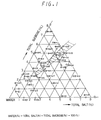
- Fig. 1 is a triangular graph showing the relationship between the amount of each of water, total sucrose and total salt, and the amount of sucrose fatty acid ester dissolved in aqueous phase.
- the process of the present invention is suitable for purification of the reaction mixture obtained in the synthesis of sucrose fatty acid esters (hereinafter referred to as "SE") by a known reaction using an organic solvent as reaction solvent.
- SE sucrose fatty acid esters
- the solvent for example, dimethylsulfoxide is added to a mixture of sucrose and a fatty acid methyl ester in an amount of several times the total amount of sucrose and the fatty acid methyl ester to dissolve them. They are reacted in the presence of an alkaline catalyst such as potassium carbonate (K2CO3) under reduced pressure of 20 to 30 Torrs at a temperature of 80° to 90°C for several hours, whereby the SE is easily produced in a conversion of at least 90 % (based on the fatty acid methyl ester).
- K2CO3 potassium carbonate
- an equivalent amount of an organic acid such as lactic acid or acetic acid, or a mineral acid such as hydrochloric acid or sulfuric acid is added to the reaction mixture.
- the catalyst changes to a corresponding salt, e.g. a potassium salt such as potassium lactate, according to the kind of the acid used in the neutralization.
- reaction solvent e.g. dimethylsulfoxide
- the thus obtained residue has approximately the following composition.
- the proportion of the monoester in the SE is from 10 to 75 % by weight and the proportion of di- and higher esters is from 90 to 25 % by weight.
- the acid radical mainly included in each of the fatty acid methyl ester, soap and fatty acid is usually a saturated acid radical having 16 to 22 carbon atoms common to them.
- water is added in a water/reaction mixture ratio of 5 : 1 to 40 : 1 by weight, preferably 20 : 1 by weight, while the pH is adjusted to 6.2 to 8.2, preferably 7.5.
- the ratio of water to the reaction mixture is less than 5, the viscosity of the obtained aqueous solution is high and the following procedures become difficult. Also, when excess water is added to the reaction mixture such that the weight ratio of water to the reaction mixture exceeds 40, the viscosity of the obtained aqueous solution is low and accordingly the following procedures become easy and also the desired removal of reaction solvent can be made well, but a large energy cost is required in removing water upon recovery of unreacted sucrose, etc., thus the economy is impaired.
- the aqueous solution of the reaction mixture In order to prevent decomposition of the desired SE, it is preferable to adjust the aqueous solution of the reaction mixture to pH of 6.2 to 8.2.
- pH When the pH is more than 8.2, there is a possibility that SE is quantitatively hydrolyzed by an alkali.
- a weak acidic region of less than pH 6.2 there is a fear of acid hydrolysis of SE, for example, when it is exposed to a high temperature over 90°C.
- a neutral salt and sucrose preferably with keeping at a temperature of 50° to 80°C in order to salt out SE rapidly.
- the neutral salt to be added satisfies the following equation (1): wherein the total amount of salts means the sum of the neutral salt to be added and the salt formed by neutralization of the catalyst used in the production of SE, and the total amount of sucrose means the sum of the sucrose to be added and the unreacted sucrose included originally.
- sucrose in an amount satisfying the following equation (2):
- the total amount of salts and the total amount of sucrose satisfy the following equation (3):
- Any of neutral salts can be used so long as they are soluble in water and nontoxic.
- Representative examples of the neutral salt are, for instance, sodium chloride, Glauber's salt (Na2SO4 ⁇ 10H2O), potassium lactate and potassium acetate.
- Fig. 1 is a triangular graph showing the above-mentioned phenomenon in more detail.
- Y (g) is the weight of SE dissolved in an aqueous phase
- X (g) is the weight of SE precipitated
- the weight percentage ( ⁇ %) of SE dissolved in the aqueous phase based on the total SE (X+Y) is shown by the following equation: The change in the value ⁇ under the following conditions is shown in the accompanying drawing.
- Fig. 1 shows the region simultaneously satisfying the equations (1), (2) and (3) which has been discovered by the present inventors.
- sucrose and neutral salt By adding the determined amounts of sucrose and neutral salt to be dissolved in the aqueous solution of the reaction mixture so as to fall within the shaded region, the volatile material (remaining reaction solvent), salt derived from catalyst, neutral salt added and the whole sucrose are dissolved in the aqueous phase with precipitation of approximately the whole amount of SE, whereby they can be completely separated from the precipitated SE.
- the precipitated SE can be recovered by a usual method, for example, by filtration.
- sucrose from the thus treated aqueous solution from which the precipitated SE has been removed, thus which contains sucrose separated with water, the salt derived from catalyst (K2CO3), the neutral salt added for salting out and the volatile material.
- K2CO3 the salt derived from catalyst
- the present inventors have found that utilization of a reverse osmosis membrane is particularly effective for this purpose. After separating the precipitated SE in a usual manner, for example, by filtration, the filtrate is subjected to reverse osmosis.
- substances having a molecular weight less than the fractionation molecular weight of 130 to 200 namely the salt derived from catalyst such as potassium lactate (molecular weight: 128), the neutral salt added, and the volatile component such as dimethylsulfoxide (molecular weight: 78) would pass through fine pores of the reverse osmosis membrane without any problem.
- aqueous sucrose solution which may contain a slight amount of SE
- An aqueous sucrose solution having a higher purity can be obtained by dissolving the concentrate in fresh water again and subjecting the solution to the reverse osmosis treatment in the same manner, and if necessary, further repeating these procedures.
- the temperature of the aqueous solution to be fed to the reverse osmosis is important for obtaining a good result. If the temperature is lower than 40°C, the treating ability is remarkably lowered. Accordingly, it is desirable to select a temperature over 40°C from a practical point of view. On the other hand, it is advisable to conduct the treatment at a temperature below 60°C, since there is a possibility that the heat resistance of the reverse osmosis is changed at a temperature over 60°C.
- the pH of the aqueous solution to be treated is also important, and the pH ranging from 6.2 to 8.2 is preferred because a fear of influence on the quality of sucrose is minimized.
- reverse osmosis membranes have been put on the market from various companies.
- reverse osmosis membranes of a polyamide or a polyether have excellent properties such as durability, heat resistance, acid resistance and alkali resistance, fungus resistance and pressure resistance.
- Such membranes are commercially available, for example, under a trade mark "SU-200" from Toray Engineering Kabushiki Kaisha, which has a fractionation molecular weight of about 200 and is suitable to attain the objects of the invention.
- the treatment of the aqueous solution can be achieved with an industrially acceptable capacity by adjusting the upper limit of the concentration of the solute in the aqueous solution to be supplied to the membrane to about 20 % by weight, preferably about 15 % by weight.
- solute concentration is more than 20 % by weight, it is difficult to pass water, the salt derived from the catalyst and the volatile material through fine pores of the membrane, and accordingly it is obliged to increase a pressure to be applied as the actuation force for reverse osmosis, thus resulting in increase of the area of the reverse osmosis membrane. This is also very uneconomical because of necessity of great electric power.
- the aqueous solution contains the solute in a concentration of not more than about 8-15 % by weight, it is sufficiently possible to industrially isolate sucrose.
- the salt derived from the catalyst, the added neutral salt and the volatile material are sufficiently removed from the aqueous solution.
- the thus obtained aqueous solution containing sucrose can keep a sucrose concentration of about 15 to 20 % by weight. It is economically disadvantageous as well as technical difficulty to obtain the aqueous solution of sucrose with a concentration of more than 20 % by weight by the reverse osmosis means. Accordingly, when it is desired to obtain the aqueous solution of sucrose having a sucrose concentration of more than 20 % by weight, the solution is concentrated by using a usual concentration apparatus such as a multiple effect evaporator to the desirable concentration such as not less than 50 % by weight. Thus recovered sucrose can be reused to the preparation of SE as a raw material or used for other purposes.
- the SE precipitated and separated in the salting out step is in the form of a slurry. It still contains a slight amount of impurities such as the volatile material, salts and sucrose. These impurities can be easily removed by treating the slurry with an acidic water.
- An aqueous slurry or cake of crude SE obtained in the salting out step is washed with an aqueous solution of an acid having a pH of 3.0 to 5.5.
- the acid is not particularly limited.
- the acid are, for instance, a mineral acid such as hydrochloric acid or sulfuric acid, and an organic acid such as acetic acid or lactic acid.
- the acid solution is kept at a temperature of 10° to 40°C.
- the acid solution treatment is effected usually at a temperature of 10° to 40°C, preferably at ordinary temperature.
- the SE cake or slurry is in the form of particles as small as possible so that the impurities are easily released or eluted into water upon washing with acidic water. This can be efficiently attained by conducting the washing in a device having an ability to break into small particles, for example, a mixer (such as "homomixer” made by Tokushu Kiki Kogyo Kabushiki Kisha), a homogenizer, or a colloid mill.
- a mixer such as "homomixer” made by Tokushu Kiki Kogyo Kabushiki Kisha
- homogenizer or a colloid mill.
- the removal of impurities by washing of the SE cake with acidic water can be made more completely by repeating the washing procedure or increasing the amount of acidic water, thus it is possible to obtain a substantially pure SE.
- the thus purified SE containing water is in the form of a slurry, and its pH is on the acid side.
- the slurry is adjusted to a neutral pH region.
- the slurry is neutralized with a base compound such as sodium hydroxide.
- the neutralized slurry is free from unreaced sucrose, sucrose added for salting out, a salt derived from the reaction catalyst, the volatile material and the neutral salt added for salting out. It contains SE, unreacted fatty acid alkyl ester such as methyl ester, a soap and a fatty acid and in many cases, it is composed of 1 to 50 % by weight of the solid matter and 99 to 50 % by weight of water.
- the solid content of the slurry is at most about 40 % by weight.
- an excessively low solid content is undesirable from the viewpoint of energy cost for drying.
- a solid content of not less than 4 % by weight is economical.
- spray drying is utilized in drying the SE slurry.
- This drying means is the optimum for drying the SE slurry having a solid content of 4 to 40 % by weight, and has many advantages as compared with other drying methods.
- a usual vacuum dryer as represented by a so-called agitated vacuum dryer, or a flash dryer
- deterioration of the quality such as rise in acid value of SE product, coloration or caramel formation is unavoidable due to peculiar viscosity characteristic and low softening or melting point of SE, and in the latter case, a risk of dust explosion cannot be disregarded, too.
- the spray drying according to the present invention can solve these problems.
- the wet SE in the form of a slurry is continuously fed to a spray drying tower by a pump, dispersed in the form of mist through a nozzle or by a centrifugal force of a rotary disk, and brought into contact with a dry air stream. Since the surface area of water evaporation is made extremely large by spray drying, dehydration and drying can be completed in a very short time, e.g. in several seconds after spraying.
- the rotary disc type dryer is preferred from the viewpoint of a high viscosit of the slurry.
- the slurry fed to the spray drying tower is kept at a temperature of 40° to 80°C, preferably 40° to 60°C in consideration of quality.
- the number of rotations thereof is from 15,000 to 24,000 r.p.m. when the diameter of the disk is from 5 to 10 cm.
- the air passed through the tower should have a heat energy sufficient to evaporate water included in the slurry, and accordingly when the temperature of the air is low, a large quantity of air is required as a matter of course.
- the temperature of the air can be selected from a range of 10° to 100°C, but in consideration of drying efficiency and prevention of thermal decomposition of the sucrose ester product, the temperature of the air is preferably selected from a range of 60° to 80°C.
- the humidity of the air passed is also important as well as the temperature, and it is economical that the absolute humidity of the air is from 0.008 to 0.05 kg water/kg dry air, especially from 0.01 to 0.04 kg water/kg dry air.
- the solid concentration of the slurry to be fed to the spray drying tower is preferably from 4 to 40 % by weight.
- the viscosity is remarkably increased.
- the size of the mist becomes relatively large, and as much, the drying is delayed and the particles are easy to stick to the wall of the dryer.
- the solid concentration is less than 4 % by weight, mist of fine particles is easy to be formed and the drying becomes easy, but a larger energy is required for drying.
- the parameters such as volume, diameter and height of the spray drying tower is determined on the basis of the above-mentioned spraying conditions. Under appropriate conditions, powder of the sucrose fatty acid ester having a water content of not more than 5 % by weight can be continuously taken out from the lower part of the tower. The obtained dry product is very excellent in quality because of short heat time, and also this drying work does not require many hands.
- the volatile material (reaction solvent) remaining in the reaction mixture containing SE produced by a reaction of sucrose and a fatty acid alkyl ester can be easily removed without using an organic solvent as a purification solvent, while sucrose can be easily recovered in a high purity.
- impurities included in the crude SE from which the volatile material and sucrose have been removed can be easily removed by washing the crude SE with an acidic water, and from the thus purified SE, a dry powder of SE having a high purity can be easily obtained by spray drying without imparing the quality.
- a reaction solvent was distilled away in a usual manner from a reaction mixture formed by a reaction of sucrose and methyl stearate according to the solvent method, and it was neutralized with lactic acid to give a residue having the composition shown in Table 2.
- Table 2 Ingredients Amount (%) (g) SE stearate* 35.2 35.2 Unreacted sucrose 37.5 37.5 Unreacted fatty acid methyl ester (methyl stearate) 1.5 1.5 Potassium lactate 1.2 1.2 Soap 2.1 2.1 Stearic acid 1.3 1.3
- Example 2 The procedure of Example 1 was repeated except that 28.5 g of sucrose and 65.6 g of a 50 % aqueous solution of potassium lactate were added to the aqueous solution of the reaction mixture.
- the composition of the dried precipitate is shown in Table 4.
- Table 4 Ingredients Amount % g SE 79.3 34.9 Unreacted fatty acid methyl ester 3.4 1.5 Soap 4.8 2.1 Fatty acid 3.0 1.3
- the amount of SE included in the filtrate was measured according to GPC to determine the loss of SE.
- the result of GPC indicated that the SE loss was only 0.02 g (0.06 % of that included in the original reaction mixture) and that 95 % of dimethylsulfoxide used as the reaction solvent was transferred into the filtrate.
- Example 1 The procedure of Example 1 was repeated to give a dried cake having the composition shown in Table 3.
- Example 2 The procedure of Example 2 was repeated to give a dried cake having the composition shown in Table 4.
- the filtrate contained a little amount of SE which had a monoester content of 86 % and a higher ester content of 14 %.
- the slurry (weight: 150.8 g, solid content: 25 %) was fed into a spray drying tower with keeping the temperature at 50°C.
- the conditions of spray drying were as follows: Diameter of spray drying tower: 2.0 m Length of true cylindrical portion: 1.5 m Fed air: 360 N m3/hour Diameter of rotary disk: 10 cm Number of rotations of the disk: 24,000 r.p.m. Temperature of air at inlet: 60°C Absolute humidity of air at inlet: 0.023 kg water/kg dry air Feeding velocity of slurry: 1.0 kg/hour
- the powdery SE obtained from the lower part of the spray drying tower had a water content of 1.81 %, a bulk specific gravity of 0.41, no coloration due to heating and a good flowability.
- the drying was continued stably, and there was no troubles such as sticking to the inner surface of the wall of the drying tower.
- the monoester content of the obtained SE was 68 %, thus there was no change compared with that of SE before drying, and also there was no change in acid value.
- Example 5 The slurry (solid content: 25 %) obtained in Example 5 was spray-dried in the same manner as in Example 5 except that the temperature of air at inlet was 40°C and the feeding velocity of slurry was 0.5 kg/hour.
- the obtained powdery SE had a water content of 1.92 %, a bulk specific gravity of 0.42, a good flowability and no coloration due to heating. Also, the monoester content of the obtained SE was 68 %, thus there was no change compared with that of SE before drying, and as to the acid value of the obtained SE, there was no change compared with that of SE before drying.
- the filtrate (1180 kg) obtained in the above procedure was analyzed by GPC and found that SE was not contained therein and 75 % of the reaction solvent was removed into the filtrate.
- the purified precipitate was adjusted to pH 7.4 with sodium hydroxide, and then water was added thereto to give a slurry having a solid content of 35 %.
- To the same spray drying tower as used in Example 5 was fed 91.7 kg of the slurry and the dry-spraying was conducted under the same conditions as in Example 5 except that the temperature of air at inlet was 48°C, the absolute humidity of air at inlet was 0.015 kg water/kg dry air and the feeding velocity of slurry was 0.91 kg/hour.
- the powdery SE obtained from the lower part of the spray drying tower was a white flowable powder and had a water content of 1.74 %, a bulk specific gravity of 0.44 and no coloration due to heating. The drying was continued stably.
- the composition of the obtained powdery SE is shown in Table 8.
- Table 8 Ingredients Amount (%) SE* 86.7 Unreacted fatty acid methyl ester 4.1 Soap 5.7 Fatty acid 3.5 Dimethylsulfoxide (9.4 ppm) Sucrose 0.0 Total 100.0 (Note) * The stearate had a monoester content of 67.2 % and a di- or higher-ester content of 32.8 %
- the aqueous solution was heated at 50° to 52.5°C, and was fed to a reverse osmosis membrane "SU-200" (Toray's trade mark) having a diameter of 4 inches, a length of 1 m and a filtrating area of 8 m2 at a pump pressure of 58.2 kg/cm2G under the following operation conditions.
- Discharge velocity of the aqueous solution passed through the reverse osmosis membrane 3.9 to 2.2 l/minute
- Circulation velocity inside the membrane 19.2 to 20.9 l/minute Feeding time: about 550 minutes
- the concentrate which was not passed through the membrane contained sucrose, the salt derived from the catalyst and the volatile material in amounts of almost all, 46.0 % and 52.0 % of those included in the original reaction mixture, respectively.
- the composition of the concentrate is shown in Table 10.
- the aqueous solution (i.e. filtrate) containing the salt derived from the catalyst and the volatile material, which was passed through the membrane had the composition shown in Table 10.
- the filtrate scarcely contained sucrose, and contained the salt derived from the catalyst and the neutral salt and the volatile material in amounts of 54.0 % and 48.0 % of those included in the original reaction mixture, respectively.
- Example 7 To 1,048 kg of the concentrate (solute concentration: 12.5 %) having the composition shown in Table 10, obtained in Example 7 was added 1,900 kg of water and the thus obtained aqueous solution was fed into the same reverse osmosis membrance as used in Example 7 under the same conditions as in Example 7 to isolate sucrose.
- Example 8 To 1,015.2 kg of the concentrate (solute concentrate: 10.6 %) shown in Table 11, obtained in Example 8 was added 2,200 kg of water and the thus obtained aqueous solution was fed into the same reverse osmosis membrane as used in Example 7 under the same conditions as in Example 7 to isolate sucrose. The results are shown in Table 12.
Landscapes
- Chemical & Material Sciences (AREA)
- Organic Chemistry (AREA)
- Health & Medical Sciences (AREA)
- Life Sciences & Earth Sciences (AREA)
- Engineering & Computer Science (AREA)
- Biochemistry (AREA)
- Biotechnology (AREA)
- General Health & Medical Sciences (AREA)
- Genetics & Genomics (AREA)
- Molecular Biology (AREA)
- Saccharide Compounds (AREA)
Claims (26)
- Verfahren zur Entfernung eines flüchtigen Materials aus einer Reaktionsmischung in der Synthese eines Sucrosefettsäureesters durch eine Reaktion von Sucrose und einem Fettsäurealkylester in einem organischen Lösungsmittel, wobei die Reaktionsmischung Sucrosefettsäureester, nichtumgesetzte Sucrose, nichtumgesetzten Fettsäurealkylester, einen Katalysator, eine Seife, eine Fettsäure und das organische Lösungsmittel als flüchtiges Material enthält, welches umfaßt: Einstellen der Reaktionsmischung auf einen neutralen pH-Bereich, Zugeben von Wasser, einem neutralen Salz und Sucrose zu der Reaktionsmischung, um das flüchtige Material unter Fällung des Sucrosefettsäureesters, des nichtumgesetzten Fettsäurealkylesters, der Seife und der Fettsäure in die wässrige Phase zu überführen, und Abtrennen des resultierenden Niederschlags.
- Verfahren nach Anspruch 1, worin der genannte neutrale Bereich von pH 6,2 bis pH 8,2 ist.
- Verfahren nach Anspruch 1, worin nach der Zugabe des Wassers, des neutralen Salzes und der Sucrose die Reaktionsmischung auf eine Temperatur von 50°C bis 80°C erhitzt wird.
- Verfahren nach Anspruch 1, worin genanntes Wasser zur Reaktionsmischung in einem Wasser/Reaktionsmischung-Verhältnis von 5:1 bis 40:1, bezogen auf das Gewicht, hinzugegeben wird.
- Verfahren nach Anspruch 1, worin das genannte neutrale Salz und die Sucrose in Mengen zur Reaktionsmischung gegeben werden, die den folgenden Gleichungen genügen:

- Verfahren nach Anspruch 1, worin die pH-Einstellung der Reaktionsmischung mit einer Säure durchgeführt wird, die aus der Gruppe ausgewählt ist, die aus Milchsäure, Essigsäure, Salzsäure und Schwefelsäure besteht.
- Verfahren nach Anspruch 1, worin die zu behandelnde genannte Reaktionsmischung im wesentlichen besteht aus: 15,0 bis 92,0 Gewichtsprozent eines Sucrosefettsäureesters, 1,0 bis 80,0 Gewichtsprozent nichtumgesetzter Sucrose, 0,5 bis 10,0 Gewichtsprozent nichtumgesetzter Fettsäuremethylester, 0,05 bis 7,0 Gewichtsprozent eines Katalysators, 1,0 bis 10,0 Gewichtsprozent einer Seife, 0,5 bis 10,0 Gewichtsprozent einer Fettsäure und 5,0 bis 30,0 Gewichtsprozent eines restlichen Reaktionslösungsmittels.
- Verfahren nach Anspruch 1, worin das Fettsäureradikal, das in jedem von Fettsäurealkylester, Seife und Fettsäure hauptsächlich enthalten ist, ein gesättigtes Fettsäureradikal mit 16 bis 22 Kohlenstoffatomen ist, das ihnen gemeinsam ist.
- Verfahren nach Anspruch 1, worin das genannte flüchtige Material Dimethylsulfoxid oder Dimethylformamid ist.
- Verfahren nach Anspruch 1, worin genanntes, der Reaktionsmischung hinzuzusetzendes neutrale Salz ein Salz ist, das aus der Gruppe ausgewählt ist, die aus Natriumchlorid, Glaubersalz (Na₂SO₄·1OH₂O), Kaliumlactat und Kaliumacetat besteht.
- Verfahren nach Anspruch 1, worin genannter Sucrosefettsäureester aus 10 bis 75 Gewichtsprozent Monoester und aus 90 bis 25 Gewichtsprozent Di- und höheren Estern zusammengesetzt ist.
- Verfahren nach Anspruch 1, worin der resultierende Niederschlag mit saurem Wasser gewaschen wird.
- Verfahren nach Anspruch 12, worin der genannte neutrale Bereich von pH 6,2 bis pH 8,2 ist.
- Verfahren nach Anspruch 12, worin nach der Zugabe des Wassers, des neutralen Salzes und der Sucrose die Reaktionsmischung auf eine Temperatur von 50°C bis 80°C erhitzt wird.
- Verfahren nach Anspruch 12, worin genanntes Wasser zur Reaktionsmischung in einem Wasser/Reaktionsmischung-Verhältnis von 5:1 bis 40:1, bezogen auf das Gewicht, hinzugegeben wird.
- Verfahren nach Anspruch 12, worin das genannte neutrale Salz und die Sucrose in Mengen zur Reaktionsmischung gegeben werden, die den folgenden Gleichungen genügen:

- Verfahren nach Anspruch 12, worin genanntes saures Wasser einen pH von 3,0 bis 5,5 hat.
- Verfahren nach Anspruch 12, worin genanntes saures Wasser bei einer Temperatur von 10°C bis 40°C gehalten wird.
- Verfahren nach Anspruch 12, worin genannter, mit dem sauren Wasser gewaschener Niederschlag neutralisiert und in Form einer wässrigen Aufschlämmung sprühgetrocknet wird.
- Verfahren nach Anspruch 19, worin genannte Aufschlämmung einen Festgehalt von 4 bis 40 Gewichtsprozent und einen Wassergehalt von 96 bis 60 Gewichtsprozent aufweist.
- Verfahren nach Anspruch 19, worin genanntes Sprühtrocknen in einem Luftstrom durchgeführt wird, der eine absolute Feuchte von 0,008 bis 0,05 kg Wasser/kg Trockenluft und eine Temperatur von 10 bis 100°C aufweist.
- Verfahren nach Anspruch 19, worin genannte flüssige Phase mit einer Umkehrosmose-Membran in Kontakt gebracht wird, um die Sucrose zurückzugewinnen.
- Verfahren nach Anspruch 22, worin die genannte Umkehrosmose-Membran ein Trennungsmolekulargewicht von 150 bis 200 aufweist.
- Verfahren nach Anspruch 22, worin die genannte, mit der Membran inkontaktzubringende Flüssigkeit bei einer Temperatur von 40°C bis 60°C gehalten wird.
- Verfahren nach Anspruch 22, worin genannte, mit der Membran inkontaktzubringende Flüssigkeit bei einem pH von 6,2 bis 8,2 gehalten wird.
- Verfahren nach Anspruch 1, worin der resultierende Niederschlag mit saurem Wasser gewaschen wird, gefolgt von der Neutralisation, und dann in Form einer wässrigen Aufschlämmung sprühgetrocknet wird, um ein trockenes Pulver zu bilden; und die wässrige Phase wird mit einer Umkehrosmose-Membran in Kontakt gebracht, um die Sucrose zurückzugewinnen.
Applications Claiming Priority (2)
| Application Number | Priority Date | Filing Date | Title |
|---|---|---|---|
| JP158930/88 | 1988-06-27 | ||
| JP63158930A JPH0667953B2 (ja) | 1988-06-27 | 1988-06-27 | 粉末状ショ糖脂肪酸エステルの製造方法 |
Publications (3)
| Publication Number | Publication Date |
|---|---|
| EP0349849A2 EP0349849A2 (de) | 1990-01-10 |
| EP0349849A3 EP0349849A3 (de) | 1991-09-18 |
| EP0349849B1 true EP0349849B1 (de) | 1994-05-11 |
Family
ID=15682447
Family Applications (1)
| Application Number | Title | Priority Date | Filing Date |
|---|---|---|---|
| EP89111430A Expired - Lifetime EP0349849B1 (de) | 1988-06-27 | 1989-06-23 | Verfahren zur Reinigung von Rohrzucker-Fettsäureestern |
Country Status (3)
| Country | Link |
|---|---|
| US (1) | US5011922A (de) |
| EP (1) | EP0349849B1 (de) |
| JP (1) | JPH0667953B2 (de) |
Families Citing this family (15)
| Publication number | Priority date | Publication date | Assignee | Title |
|---|---|---|---|---|
| JPH0667952B2 (ja) * | 1988-06-14 | 1994-08-31 | 第一工業製薬株式会社 | ショ糖脂肪酸エステル合成反応混合物中の未反応糖の回収方法 |
| DE69428502T2 (de) * | 1993-12-24 | 2002-05-23 | Mitsubishi Chemical Corp., Tokio/Tokyo | Verfahren zur Herstellung von Saccharosefettsäureestern |
| FR2787027B1 (fr) * | 1998-12-14 | 2001-01-12 | Oreal | Nanoemulsion a base d'esters gras de sucre ou d'ethers gras de sucre et ses utilisations dans les domaines cosmetique, dermatologique et/ou ophtalmologique |
| US6900310B2 (en) * | 2002-05-28 | 2005-05-31 | The Procter & Gamble Company | Staged synthesis of purified, partially esterified polyol polyester fatty acid compositions |
| US6887947B1 (en) | 2002-05-28 | 2005-05-03 | The Procter & Gamble Company | Synthesis of purified, partially esterified polyol polyester fatty acid compositions |
| US10210216B2 (en) * | 2009-12-18 | 2019-02-19 | Sybase, Inc. | Dynamic attributes for mobile business objects |
| EP2563164B1 (de) * | 2010-03-23 | 2016-06-29 | Virun, Inc. | Nanoemulsionen enthaltend saccharosefettsäureester |
| WO2011162802A1 (en) | 2010-06-21 | 2011-12-29 | Virun, Inc. | Compositions containing non-polar compounds |
| US9351517B2 (en) | 2013-03-15 | 2016-05-31 | Virun, Inc. | Formulations of water-soluble derivatives of vitamin E and compositions containing same |
| HK1220872A1 (zh) | 2013-03-15 | 2017-05-19 | Virun, Inc. | 维生素e水溶性衍生物制剂及包含其的组合物 |
| US9861611B2 (en) | 2014-09-18 | 2018-01-09 | Virun, Inc. | Formulations of water-soluble derivatives of vitamin E and soft gel compositions, concentrates and powders containing same |
| WO2016044813A1 (en) | 2014-09-18 | 2016-03-24 | Virun, Inc. | Pre-spray emulsions and powders containing non-polar compounds |
| WO2016044805A1 (en) | 2014-09-18 | 2016-03-24 | Virun, Inc. | Soft gel compositions and pre-gel concentrates |
| CN106854226B (zh) * | 2016-12-08 | 2023-07-25 | 广西科技师范学院 | 蔗糖脂肪酸酯的精制方法 |
| WO2018174938A1 (en) | 2017-03-23 | 2018-09-27 | Virun, Inc. | Stable dry powders and emulsions containing probiotics and mucoadhesive protein |
Family Cites Families (7)
| Publication number | Priority date | Publication date | Assignee | Title |
|---|---|---|---|---|
| DE1262988B (de) * | 1955-12-12 | 1968-03-14 | Research Corp | Verfahren zur Herstellung von Fettsaeurediestern des Rohrzuckers oder der Raffinose |
| GB809815A (en) * | 1957-02-09 | 1959-03-04 | Distillers Co Yeast Ltd | Recovery of sucrose esters |
| GB890136A (en) * | 1959-01-14 | 1962-02-28 | Drew & Co Inc E F | Improvements in or relating to the preparation of a sugar ester |
| DE1277833B (de) * | 1960-06-18 | 1968-09-19 | Spiess C F & Sohn | Verfahren zur Reinigung von Zuckerestern |
| JPS4835049B1 (de) * | 1969-08-26 | 1973-10-25 | ||
| BE757846A (fr) * | 1969-10-23 | 1971-04-01 | Dai Ichi Kogyo Seiyaku Cy Ltd | Procede de synthese d'esters de saccharose d'acides gras |
| US4168323A (en) * | 1976-06-01 | 1979-09-18 | Kabushiki Kaisha Veno Seiyako Oyo Kenkyujo | Food additive composition and process for preparation thereof |
-
1988
- 1988-06-27 JP JP63158930A patent/JPH0667953B2/ja not_active Expired - Fee Related
-
1989
- 1989-06-23 US US07/371,892 patent/US5011922A/en not_active Expired - Lifetime
- 1989-06-23 EP EP89111430A patent/EP0349849B1/de not_active Expired - Lifetime
Non-Patent Citations (1)
| Title |
|---|
| Reverse osmosis, S. Sourirajan, Logos Press, London 1970 * |
Also Published As
| Publication number | Publication date |
|---|---|
| EP0349849A2 (de) | 1990-01-10 |
| JPH02117691A (ja) | 1990-05-02 |
| JPH0667953B2 (ja) | 1994-08-31 |
| EP0349849A3 (de) | 1991-09-18 |
| US5011922A (en) | 1991-04-30 |
Similar Documents
| Publication | Publication Date | Title |
|---|---|---|
| EP0369339B1 (de) | Verfahren zur Herstellung von Rohrzucker-Fettsäureestern als Pulver | |
| US5011922A (en) | Process for purifying sucrose fatty acid esters | |
| EP0348883B1 (de) | Verfahren zur Reinigung von Rohrzucker-Fettsäureester mit einem hohen hydrophilen-lipophilen Gleichgewichtswert | |
| EP0346845A2 (de) | Verfahren zur Herstellung von Rohrzucker-Fettsäurepolyester | |
| EP0346818B1 (de) | Verfahren zur Rückgewinnung von nichtumgesetztem Rohrzucker von der Reaktionsmischung von Rohrzucker und Fettsäureester | |
| EP0338464B1 (de) | Verfahren zur Reinigung von Rohrzuckerfettsäureestern | |
| US6448455B1 (en) | TMP/Vapor pressure filtration | |
| JP2686966B2 (ja) | ショ糖脂肪酸エステル合成反応混合物中の未反応糖を粉末状として回収する方法 | |
| KR100346882B1 (ko) | 설탕에스테르의정제방법 | |
| JP2688937B2 (ja) | 粉末状ショ糖脂肪酸エステルの製造方法 | |
| JPH02295995A (ja) | 粉末状高hlbショ糖脂肪酸エステルの製造法 | |
| JPH0256493A (ja) | 粉末状ショ糖脂肪酸エステルの製造方法 | |
| JP2648936B2 (ja) | ショ糖脂肪酸エステルの製造方法 | |
| JPH0240392A (ja) | 粉末状ショ糖脂肪酸エステルの製造方法 | |
| JPH0240391A (ja) | 粉末状ショ糖脂肪酸エステルの製造方法 | |
| JPH0256494A (ja) | 粉末状ショ糖脂肪酸エステルの製造方法 | |
| JPH0283388A (ja) | 粉末状高hlbショ糖脂肪酸エステルの製造方法 | |
| JPH01311092A (ja) | 粉末状ショ糖脂肪酸エステルの製造方法 | |
| JPH0667951B2 (ja) | 粉末状ショ糖脂肪酸エステルの製造方法 | |
| JPH0219394A (ja) | 粉末状高hlbショ糖脂肪酸エステルの製造法 | |
| JPH0240390A (ja) | 粉末状高hlbショ糖脂肪酸エステルの製造方法 | |
| JPH0253792A (ja) | ショ糖脂肪酸エステルの精製方法 | |
| KR19990012489A (ko) | 수크로즈 지방산 에스테르의 정제법 | |
| JPH0314595A (ja) | 粉末状高hlbショ糖脂肪酸エステルの製造方法 | |
| JPH0217196A (ja) | 高hlbショ糖脂肪酸エステルの精製法 |
Legal Events
| Date | Code | Title | Description |
|---|---|---|---|
| PUAI | Public reference made under article 153(3) epc to a published international application that has entered the european phase |
Free format text: ORIGINAL CODE: 0009012 |
|
| AK | Designated contracting states |
Kind code of ref document: A2 Designated state(s): FR GB NL |
|
| PUAL | Search report despatched |
Free format text: ORIGINAL CODE: 0009013 |
|
| AK | Designated contracting states |
Kind code of ref document: A3 Designated state(s): FR GB NL |
|
| 17P | Request for examination filed |
Effective date: 19911217 |
|
| 17Q | First examination report despatched |
Effective date: 19920603 |
|
| GRAA | (expected) grant |
Free format text: ORIGINAL CODE: 0009210 |
|
| RIN1 | Information on inventor provided before grant (corrected) |
Inventor name: MATSUMOTO, SHUSAKU Inventor name: HATAKAWA, YOSHIO Inventor name: NAKAJIMA, AKIHIKO |
|
| AK | Designated contracting states |
Kind code of ref document: B1 Designated state(s): FR GB NL |
|
| ET | Fr: translation filed | ||
| PLBE | No opposition filed within time limit |
Free format text: ORIGINAL CODE: 0009261 |
|
| STAA | Information on the status of an ep patent application or granted ep patent |
Free format text: STATUS: NO OPPOSITION FILED WITHIN TIME LIMIT |
|
| 26N | No opposition filed | ||
| REG | Reference to a national code |
Ref country code: GB Ref legal event code: IF02 |
|
| PGFP | Annual fee paid to national office [announced via postgrant information from national office to epo] |
Ref country code: FR Payment date: 20070608 Year of fee payment: 19 |
|
| PGFP | Annual fee paid to national office [announced via postgrant information from national office to epo] |
Ref country code: NL Payment date: 20080603 Year of fee payment: 20 |
|
| PGFP | Annual fee paid to national office [announced via postgrant information from national office to epo] |
Ref country code: GB Payment date: 20080625 Year of fee payment: 20 |
|
| REG | Reference to a national code |
Ref country code: FR Ref legal event code: ST Effective date: 20090228 |
|
| REG | Reference to a national code |
Ref country code: FR Ref legal event code: D3 |
|
| REG | Reference to a national code |
Ref country code: GB Ref legal event code: PE20 Expiry date: 20090622 |
|
| PG25 | Lapsed in a contracting state [announced via postgrant information from national office to epo] |
Ref country code: NL Free format text: LAPSE BECAUSE OF EXPIRATION OF PROTECTION Effective date: 20090623 |
|
| PG25 | Lapsed in a contracting state [announced via postgrant information from national office to epo] |
Ref country code: FR Free format text: LAPSE BECAUSE OF NON-PAYMENT OF DUE FEES Effective date: 20080630 |
|
| NLV7 | Nl: ceased due to reaching the maximum lifetime of a patent |
Effective date: 20090623 |
|
| PG25 | Lapsed in a contracting state [announced via postgrant information from national office to epo] |
Ref country code: GB Free format text: LAPSE BECAUSE OF EXPIRATION OF PROTECTION Effective date: 20090622 |