EP0346881B1 - Verfahren zur Herstellung von Furylpropargylcarbinol und einem Derivat davon - Google Patents
Verfahren zur Herstellung von Furylpropargylcarbinol und einem Derivat davon Download PDFInfo
- Publication number
- EP0346881B1 EP0346881B1 EP89110820A EP89110820A EP0346881B1 EP 0346881 B1 EP0346881 B1 EP 0346881B1 EP 89110820 A EP89110820 A EP 89110820A EP 89110820 A EP89110820 A EP 89110820A EP 0346881 B1 EP0346881 B1 EP 0346881B1
- Authority
- EP
- European Patent Office
- Prior art keywords
- derivative
- producing
- furylpropargylcarbinol
- water
- solvent
- Prior art date
- Legal status (The legal status is an assumption and is not a legal conclusion. Google has not performed a legal analysis and makes no representation as to the accuracy of the status listed.)
- Expired - Lifetime
Links
- 0 CC(C1OC(*)CC1)O Chemical compound CC(C1OC(*)CC1)O 0.000 description 1
- QBUWBMBJVHHDCL-UHFFFAOYSA-N O=CC1OC(I)=CC1 Chemical compound O=CC1OC(I)=CC1 QBUWBMBJVHHDCL-UHFFFAOYSA-N 0.000 description 1
Classifications
-
- C—CHEMISTRY; METALLURGY
- C07—ORGANIC CHEMISTRY
- C07D—HETEROCYCLIC COMPOUNDS
- C07D307/00—Heterocyclic compounds containing five-membered rings having one oxygen atom as the only ring hetero atom
- C07D307/02—Heterocyclic compounds containing five-membered rings having one oxygen atom as the only ring hetero atom not condensed with other rings
- C07D307/34—Heterocyclic compounds containing five-membered rings having one oxygen atom as the only ring hetero atom not condensed with other rings having two or three double bonds between ring members or between ring members and non-ring members
- C07D307/38—Heterocyclic compounds containing five-membered rings having one oxygen atom as the only ring hetero atom not condensed with other rings having two or three double bonds between ring members or between ring members and non-ring members with substituted hydrocarbon radicals attached to ring carbon atoms
- C07D307/40—Radicals substituted by oxygen atoms
- C07D307/42—Singly bound oxygen atoms
Definitions
- the present invention relates to a process for producing furylpropargylcarbinol or a derivative thereof represented by the formula (I): wherein R1 represents a hydrogen atom or a methyl group.
- the furylpropargylcarbinol and a derivative thereof are very important as intermediates of agricultural chemicals, perfumes and medicines, and particularly applicable to an intermediate of prallethrin.
- the present inventors have found a process for producing furylpropargylcarbinol or a derivative thereof represented by the formula (I), using neither propargyl bromide nor propargyl chloride.
- the present invention relates to a process for producing furylpropargylcarbinol or a derivative thereof represented by the formula (I) which comprises subjecting a haloallylfurancarbinol represented by the formula (II): wherein R1 represents a hydrogen atom or a methyl group and R2 represents a chlorine atom, a bromine atom or an iodine atom, to a dehydrohalogenation reaction using a base in a solvent.
- An object of the present invention is to provide a process for producing furylpropargylcarbinol and derivatives thereof being important as intermediates of agricultural chemicals, prefumes and medicines, and particularly applicable as intermediates of prallethrin.
- Another object of the present invention is to provide a novel haloallylfurancarbinol or a derivative thereof represented by the formula (II).
- the base used in the dehydrohalogenation reaction of the present invention includes organolithium compounds such as n-butyllithium, sec-butyllithium, tert-butyllithium, benzyllithium, allyllithium, vinyllithium, phenyllithium, methyllithium and the like; alkali metal amides such as sodium amide, lithium amide, lithium diisopropylamide, lithium dicyclohexylamide, lithium bis(trimethylsilyl)amide and the like; alkali metals such as lithium, sodium, potassium and the like; alkali metal alcoholates such as sodium methoxide, potassium tert-butoxide and the like; alkali metal hydroxides and alkaline earth metal hydroxides such as lithium hydroxide, sodium hydroxide, potassium hydroxide, magnesium hydroxide, calcium hydroxide, barium hydroxide and the like; and alkali metal carbonates and alkaline earth metal carbonates such as lithium carbonate, sodium carbonate, potassium carbon
- the used amount of the base is usually 1-15 parts by mole, preferably 1-10 parts by mole for 1 part by mole of haloallylfurancarbinol.
- the type of the reaction solvent depends upon the type of the base used.
- reaction solvent a hydrophilic aprotic solvent inert to the dehydrohalogenation reaction such as tetrahydrofuran, dioxane or the like, a hydrophobic solvent inert to the dehydrogenation such as n-pentane, n-hexane, n-heptane, benzene, toluene, xylene or the like.
- a hydrophilic aprotic solvent inert to the dehydrohalogenation reaction such as tetrahydrofuran, dioxane or the like
- hydrophobic solvent inert to the dehydrogenation such as n-pentane, n-hexane, n-heptane, benzene, toluene, xylene or the like.
- liquid ammonia is used as the reaction solvent.
- a hydrophobic or hydrophilic ether such as ethyl ether, isopropyl ether, tetrahydrofuran, dioxane, diglyme, triglyme or the like; a hydrophobic hydrocarbon such as n-pentane, n-hexane, n-heptane, benzene, toluene, xylene or the like; an alcohol such as methanol, ethanol, propanol, butanol or the like; a hydrophobic halogenated hydrocarbon such as carbon tetrachloride, chloroform, methylene dichloride, chlorobenzene, dichlorobenzene or the like; an amine such as pyridine, triethylamine or the like; and a polar aprotic solvent such as acetonitrile, dimethylsulfox
- a solvent has no influence on the dehydrohalogenation reaction
- a ketone such as acetone, methyl ethyl ketone, methyl isobutyl ketone or the like.
- reaction solvent a hydroxide or a carbonate of any of an alkali metal or an alkaline earth metal
- the reaction solvent there is used, as the reaction solvent, the one exemplified above in the case of using the alkali metal alcoholate as the base, water, and a mixture of water and said reaction solvent exemplified above.
- a mixture of water and a hydrophobic hydrocarbon such as toluene, xylene, pentane, hexane or the like or a mixture of water and a hydrophobic halogenated hydrocarbon such as monochlorobenzene, dichlorobenzene or the like.
- the above-mentioned solvent can be used alone or in admixture, and the used amount thereof is not particularly critical.
- the used amount is usually 1-20 parts by weight for 1 part by weight of the used haloallylfurancarbinol or the derivative thereof (II).
- the used amount of water is 1-4 parts by weight for 1 part by weight of the used hydroxide or carbonate of any of an alkali metal and an alkaline earth metal.
- a reaction temperature is usually selected from a range of from -70°C to 120°C depending upon the combination of a base and a solvent.
- Reaction time is not particularly critical.
- the end point of the reaction can be considered to be a point of time when the haloallylfurancarbinol or the derivative thereof (II) used as a raw material is entirely expended.
- phase transfer catalyst To the reaction system, if necessary, can be added a phase transfer catalyst.
- the used amount thereof is usually 0.01-5 parts by mole for 1 part by mole of the used haloallylfurancarbinol or the derivative thereof (II).
- the phase transfer catalyst includes organic quarternary ammonium salts such as tetra-n-butylammonium bromide, tetra-n-butylammonium chloride, tetra-n-pentylammonium bromide, tetra-n-pentylammonium iodide, benzyltriethylammonium chloride, benzyltriethylammonium bromide, benzyltripropylammonium chloride, benzyltripropylammonium iodide, cetyltrimethylammonium chloride and the like; organic quaternary phosphonium salts such as tetraphenylphosphonium chloride, tetraphenylphosphonium bromide, tetraphenylphosphonium iodide, benzyltriphenylphosphonium chloride and the like; macrocyclic ethers such as 18-crown-6, 15-c
- the alkali metal hydroxide or the alkaline earth metal hydroxide is used as the base. More preferably is used the alkali metal hydroxide.
- the polar aprotic solvent is used as the reaction solvent.
- the phase transfer catalyst there are preferably used water alone or a mixture of water and any of the hydrophobic hydrocarbon and the hydrophobic halogenated hydrocarbon, too.
- the furylpropargylcarbinol or the derivative thereof (I) can be obtained from the reaction mixture by, for example, the pouring of water, extraction, separation and the like followed by the distillation of an organic phase.
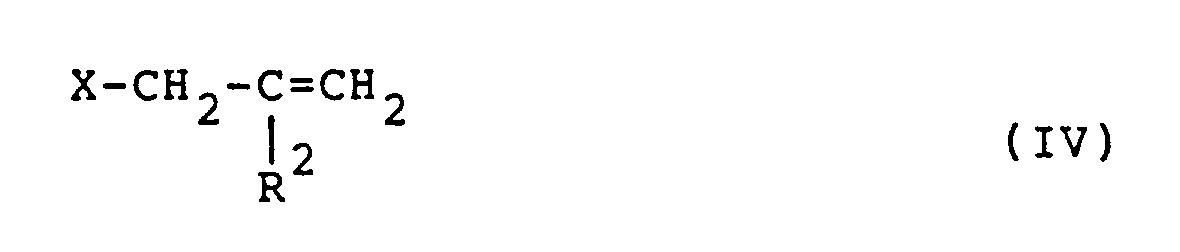
- the haloallylfurancarbinol or the derivative thereof (II) as a raw material of the process of the present invention can be produced by reacting, in the presence of zinc in a solvent, furfural or a derivative thereof represented by the formula (III): wherein R1 represents a hydrogen atom or a methyl group, with an organic dihalide compound represented by the formula (IV): wherein each of X and R2 individually represents a chlorine atom, a bromine atom or an iodine atom.
- the reaction of furfural or a derivative thereof (III) with an organic dihalide compound (IV) is referred to as the haloallylfurancarbinol-producing reaction.
- the organic dihalide compound (IV) includes 2,3-dichloro-1-propene, 2,3-dibromo-1-propene, 2,3-diiodo-1-propene, 2-chloro-3-bromo-1-propene, 2-chloro-3-iodo-1-ropene, 2-bromo-3-chloro-1-propene, 2-bromo-3-iodo-1-propene, 2-iodo-3-chloro-1-propene, 2-iodo-3-bromo-1-propene and the like.
- the used amount of the organic dihalide compound (IV) is usually 1-3 parts by mole for 1 part by mole of furfural or a derivative thereof (III).
- Zinc having various shapes on the market can be used. Zinc powder or zinc particles are preferably used. More preferably, zinc powder is used.
- the used amount of zinc is 0.8-3 parts by weight, preferably 1.1-1.5 parts by weight for 1 part by weight of furfural or a derivative thereof (III).
- halogenated ammoniums such as ammonium chloride, ammonium bromide, ammonium iodide and the like.
- the used amount thereof is 0.15-6 parts by weight for 1 part by weight of furfural or a derivative thereof (III).
- the solvent of the haloallylfurancarbinol-producing reaction there is used water alone or a mixture of water and an organic solvent.
- the organic solvent includes tetrahydrofuran, dioxane, toluene, benzene, monochlorobenzene, ethylene dichloride, a polar aprotic solvent such as acetonitrile, diglyme, dimethylsulfoxide, N,N-dimethylformamide, N-methylpyrrolidone, etc., and the like.
- the solvent when the solvent is a mixture, the solvent should contain water as a main component.
- the content of water in the mixture is preferably 50% by weight or more.
- the amount of water in the solvent is usually 3-24 parts by weight, preferably 4-19 parts by weight for 1 part by weight of furfural or a derivative thereof (III).
- phase transfer catalyst To the reaction of the haloallylfurancarbinol-producing reaction, if necessary, can be added a phase transfer catalyst.
- the used amount thereof is usually 0.05-0.4 parts by weight for 1 part by weight of furfural or a derivative thereof (III).
- the phase transfer catalyst includes the above-mentioned organic quaternary ammonium salts.
- a reaction temperature of the haloallylfurancarbinol-producing reaction is in a range of 0°C-100°C, preferably 15°C-50°C.
- Reaction time of the haloallylfurancarbinol-producing reaction is usually 1-8 hours and, however, it can be shortened by the addition of a small amount of an acid.
- the acid includes acetic acid, hydrochloric acid, sulfuric acid and the like.
- the added amount thereof is preferably 5% by weight or less based on the water contained in the solvent.
- the added amount thereof is preferably 0.1% by weight based on the water contained in the solvent.
- the haloallylfurancarbinol (II) can be obtained from the reaction mixture by, for example, filtration, separation followed by the distillation of an organic phase.
- furylpropargylcarbinol and derivatives thereof represented by the formula (I) can be produced in safety and industrially with advance.
- the content of 2,3-dichloro-1-propene in the organic phase was 71.7% by weight (yield: 95.2%).
- the content of 1,2,3-trichloropropane was 0.2% by weight or less.
- the organic phase was subjected to simple distillation to obtain 170 g of 2,3-dichloro-1-propene having a purity of 93.8%.
- Boiling point 74°C/0.7 mmHg.
- a toluene phase was separated and washed with 60 g of 15%-aqueous sodium hydrogensulfite and subsequently with 50 g of water, and thereafter, toluene was distilled off at 60°C or less.
- the resulting concentrated residue was subjected to simple distillation to obtain 32.0 g of 2′-chloroallyl-5-methylfurylcarbinol.
- Boiling point 84-85°C/0.8 mmHg.
- Boiling point 74°C/0.7 mmHg.
- Example 4 The same dehydrohalogenation reaction and after-treatment were repeated as in Example 4 using the resulting 2-chloroallylfurylcarbinol, except that 40%-aqueous sodium hydroxide was substituted for 40%-aqueous potassium hydroxide. As a result, furylpropargylcarbinol was obtained.
- the toluene phase was washed with 30 g of 7%-aqueous sodium carbonate and subsequently with 50 g of water. Thereafter, toluene was distilled off at 60°C or less. The resulting residue was purified by column chromatography using 100 g of silica gel as a packing and ethyl acetate as an eluent. Thereby, 11.1 g of 2′-bromoallyl-5-methylfurylcarbinol was obtained.
- Example 1 (2) The same dehydrohalogenation reaction and after-treatment were repeated as in Example 1 (2), except that the obtained 2′-bromoallyl-5-methylfurylcarbinol was substituted for 2′-chloroallyl-5-methylfurylcarbinol. As a result, 5-methylfurylpropargylcarbinol was obtained.
- the toluene phase was washed with 30 g of 7%-aqueous sodium carbonate and subsequently with 50 g of water. Toluene was distilled off at 60°C or less. The resulting residue was purified by column chromatography using 100 g of silica gel as a packing and ethyl acetate as an eluent. Thereby, 10.2 g of 2-bromoallylfurylcarbinol was obtained.
- the toluene phase was washed with 30 g of 7%-aqueous sodium carbonate and subsequently with 50 g of water. Toluene was distilled off at 60°C or less. The resulting residue was subjected to simple distillation to obtain 13.2 g of 2′-chloroallyl-5-methylfurylcarbinol (yield: 70.5%).
- Example 1 (2) The same dehydrohalogenation reaction and after-treatment were repeated as in Example 1 (2), using the obtained 2′-chloroallyl-5-methylfurylcarbinol. As a result, 5-methylfurylpropargylcarbinol was obtained.
Landscapes
- Chemical & Material Sciences (AREA)
- Organic Chemistry (AREA)
- Furan Compounds (AREA)
- Low-Molecular Organic Synthesis Reactions Using Catalysts (AREA)
- Plural Heterocyclic Compounds (AREA)
Claims (37)
- Verfahren zur Herstellung von Furylpropargylcarbinol oder eines Derivats desselben der Formel (I)


- Verfahren zur Herstellung von Furylpropargylcarbinol oder eines Derivats desselben nach Anspruch 1, wobei die Base aus einem Alkalimetallhydroxid oder einem Erdalkalimetallhydroxid besteht.
- Verfahren zur Herstellung von Furylpropargylcarbinol oder eines Derivats desselben nach Anspruch 1, wobei das Reaktionslösungsmittel aus einem Gemisch aus Wasser und irgendeinem hydrophoben Kohlenwasserstoff oder hydrophoben halogenierten Kohlenwasserstoff besteht.
- Verfahren zur Herstellung von Furylpropargylcarbinol oder eines Derivats desselben nach Anspruch 1, wobei das Rekationslösungsmittel aus Wasser besteht.
- Verfahren zur Herstellung von Furylpropargylcarbinol oder eines Derivats desselben nach Anspruch 1, wobei das Reaktionslösungsmittel aus einem polaren aprotischen Lösungsmittel besteht.
- Verfahren zur Herstellung von Furylpropargylcarbinol oder eines Derivats desselben nach Anspruch 2, wobei das Reaktionslösungsmittel aus einem Gemisch aus Wasser und irgendeinem hydrophoben Kohlenwasserstoff oder hydrophoben halogenierten Kohlenwasserstoff besteht.
- Verfahren zur Herstellung von Furylpropargylcarbinol oder eines Derivats desselben nach Anspruch 2, wobei das Reaktionlösungsmittel aus Wasser besteht.
- Verfahren zur Herstellung von Furylpropargylcarbinol oder eines Derivats desselben nach Anspruch 2, wobei das Reaktionslösungsmittel aus einem polaren aprotischen Lösungsmittel besteht.
- Verfahren zur Herstellung von Furylpropargylcarbinol oder eines Derivats desselben nach Anspruch 1, wobei die Enthydrohalogenierungsreaktion in Gegenwart eines Phasentransferkatalysators stattfindet.
- Verfahren zur Herstellung von Furylpropargylcarbinol oder eines Derivats desselben nach Anspruch 9, wobei das Reaktionslösungsmittel aus Wasser besteht.
- Verfahren zur Herstellung von Furylpropargvlcarbinol oder eines Derivats desselben nach Anspruch 9, wobei das Reaktionslösungsmittel aus einem Gemisch aus Wasser und irgendeinem hydrophoben Kohlenwasserstoff oder hydrophoben halogenierten Kohlenwasserstoff besteht.
- Verfahren zur Herstellung von Furylpropargylcarbinol oder eines Derivats desselben nach Anspruch 2, wobei die Enthydrohalogenierungsreaktion in Gegenwart eines Phasentransferkatalysators durchgeführt wird.
- Verfahren zur Herstellung von Furylpropargylcarbinol oder eines Derivats desselben nach Anspruch 1, wobei das Halogenallylfurancarbinol oder dessen Derivat nach einem Verfahren, umfassend die Umsetzung von Furfural oder eines Derivats desselben der Formel (III),

- Verfahren zur Herstellung von Furylpropargylcarbinol oder eines Derivats desselben nach Anspruch 13, wobei das Gemisch aus Wasser und einem organischen Lösungsmittel Wasser als Hauptkomponente enthält.
- Verfahren zur Herstellung von Furylpropargylcarbinol oder eines Derivats desselben nach Anspruch 13, wobei die Umsetzung von Furfural oder eines Derivats desselben mit einer organischen Dihalogenidverbindung in Gegenwart einer Säure durchgeführt wird.
- Verfahren zur Herstellung von Furylpropargylcarbinol oder eines Derivats desselben nach Anspruch 14, wobei die Umsetzung von Furfural oder eines Derivats desselben mit einer organischen Dihalogenidverbindung in Gegenwart einer Säure durchgeführt wird.
- Verfahren zur Herstellung von Furylpropargylcarbinol oder eines Derivats desselben nach Anspruch 15, wobei die Säure aus der Gruppe Essigsäure, Chlorwaserstoffsäure und Schwefelsäure ausgewählt wird.
- Verfahren zur Herstellung von Furylpropargylcarbinol oder eines Derivats desselben nach Anspruch 13, wobei die organische Dihalogenidverbindung aus 2,3-Dichlor-1-propen besteht.
- Verfahren zur Herstellung von Furylpropargylcarbinol oder eines Derivats desselben nach Anspruch 14, wobei die organische Dihalogenidverbindung aus 2,3-Dichlor-1-propen besteht.
- Verfahren zur Herstellung von Furylpropargylcarbinol oder eines Derivats desselben nach Anspruch 15, wobei die organische Dihalogenidverbindung aus 2,3-Dichlor-1-propen besteht.
- Verfahren zur Herstellung von Furylpropargylcarbinol oder eines Derivats desselben nach Anspruch 16, wobei die organische Dihalogenidverbindung aus 2,3-Dichlor-1-propen besteht.
- Verfahren zur Herstellung von Furylpropargylcarbinol oder eines Derivats desselben nach Anspruch 17, wobei die organische Dihalogenidverbindung aus 2,3-Dichlor-1-propen besteht.
- Verfahren zur Herstellung von Furylpropargylcarbinol oder eines Derivats desselben nach Anspruch 13, wobei das Halogenallylfurancarbinol aus 2'-Chlorallyl-5-methylfurylcarbinol oder 2-Chlorallylfurylcarbinol besteht.
- Verfahren zur Herstellung von Furylpropargylcarbinol oder eines Derivats desselben nach Anspruch 13, wobei die organische Dihalogenidverbindung aus 2,3-Dibrom-1-propen besteht.
- Verfahren zur Herstellung von Furylpropargylcarbinol oder eines Derivats desselben nach einem der Ansprüche 18 und 24, wobei die Base aus einem Alkalimetallhydroxid oder einem Erdalkalimetallhydroxid besteht.
- Verfahren zur Herstellung von Furylpropargylcarbinol oder eines Derivats desselben nach Anspruch 25, wobei bei dem Verfahren zur Umsetzung von Furfural oder eines Derivats desselben der Formel (III) mit einer organischen Dihalogenidverbindung der Formel (IV) das Lösungsmittel aus einem Gemisch aus Wasser und einem polaren aprotischen Lösungsmittel besteht.
- Verfahren zur Herstellung von Furylpropargylcarbinol oder eines Derivats desselben nach Anspruch 25, wobei bei dem Verfahren zur Umsetzung von Furfural oder eines Derivats desselben der Formel (III) mit einer organischen Dihalogenidverbindung der Formel (IV) das Lösungsmittel aus Wasser besteht.
- Verfahren zur Herstellung von Furylpropargylcarbinol oder eines Derivats desselben nach Anspruch 25, wobei das Lösungsmittel aus einem Gemisch aus Wasser und irgendeinem hydrophoben Kohlenwasserstoff oder hydrophoben halogenierten Kohlenwaserstoff besteht.
- Halogenallylfurancarbinol oder ein Derivat desselben der Formel (II),
 R₁ ein Wasserstoffatom oder eine Methylgruppe undR₂ ein Chlor-, Brom- oder Jodatom.
 - Halogenallylfurancarbinol oder ein Derivat desselben nach Anspruch 29, wobei R₁ für ein Wasserstoffatom steht und R₂ ein Chloratom darstellt.
- Halogenallylfurancarbinol oder ein Derivat desselben nach Anspruch 29, wobei R₁ für eine Methylgruppe steht und R₂ ein Chloratom darstellt.
- Halogenallylfurancarbinol oder ein Derivat desselben nach Anspruch 29, wobei R₁ für ein Wasserstoffatom steht und R₂ ein Bromatom darstellt.
- Halogenallylfurancarbinol oder ein Derivat desselben nach Anspruch 29, wobei R₁ für eine Methylgruppe steht und R₂ ein Bromatom darstellt.
- Verfahren zur Herstellung eines Halogenallylfurancarbinols oder eines Derivats desselben der Formel (II),
 R₁ ein Wasserstoffatom oder eine Methylgruppe undR₂ ein Chlor-, Brom- oder Jodatom,durch Umsetzen von Furfural oder eines Derivats desselben der Formel (III),
mit einer organischen Dihalogenidverbindung der Formel (IV),
- Verfahren zur Herstellung eines Halogenallylfurancarbinols oder eines Derivats desselben nach Anspruch 34, wobei die organische Dihalogenidverbindung aus 2,3-Dichlor-1-propen oder 2,3-Dibrom-1-propen besteht.
- Verfahren zur Herstellung eines Halogenallylfurancarbinols oder eines Derivats desselben nach Anspruch 34, wobei die Umsetzung in Gegenwart einer Säure durchgeführt wird.
- Verfahren zur Herstellung eines Halogenallylfurancarbinols oder eines Derivats desselben nach Anspruch 36, wobei die organische Dihalogenidverbindung aus 2,3-Dichlor-1-propen oder 2,3-Dibrom-1-propen besteht.
Applications Claiming Priority (12)
| Application Number | Priority Date | Filing Date | Title |
|---|---|---|---|
| JP149829/88 | 1988-06-16 | ||
| JP14982988 | 1988-06-16 | ||
| JP167922/88 | 1988-07-05 | ||
| JP16792288 | 1988-07-05 | ||
| JP27391088 | 1988-10-28 | ||
| JP273910/88 | 1988-10-28 | ||
| JP27684988A JP2653138B2 (ja) | 1988-07-05 | 1988-10-31 | ハロアリルフランカルビノール類およびその製法 |
| JP276849/88 | 1988-10-31 | ||
| JP291906/88 | 1988-11-17 | ||
| JP63291906A JP2636382B2 (ja) | 1988-11-17 | 1988-11-17 | 2,3−ジクロル−1−プロペンの製造法 |
| JP55784/89 | 1989-03-07 | ||
| JP5578489A JP2725350B2 (ja) | 1988-06-16 | 1989-03-07 | プロパルギルフランカルビノール類の製造法 |
Publications (2)
| Publication Number | Publication Date |
|---|---|
| EP0346881A1 EP0346881A1 (de) | 1989-12-20 |
| EP0346881B1 true EP0346881B1 (de) | 1993-09-01 |
Family
ID=27550612
Family Applications (1)
| Application Number | Title | Priority Date | Filing Date |
|---|---|---|---|
| EP89110820A Expired - Lifetime EP0346881B1 (de) | 1988-06-16 | 1989-06-14 | Verfahren zur Herstellung von Furylpropargylcarbinol und einem Derivat davon |
Country Status (2)
| Country | Link |
|---|---|
| EP (1) | EP0346881B1 (de) |
| DE (1) | DE68908783T2 (de) |
Families Citing this family (1)
| Publication number | Priority date | Publication date | Assignee | Title |
|---|---|---|---|---|
| JP2867632B2 (ja) * | 1989-12-15 | 1999-03-08 | 住友化学工業株式会社 | フリルプロパルギルカルビノール類の製法 |
Family Cites Families (2)
| Publication number | Priority date | Publication date | Assignee | Title |
|---|---|---|---|---|
| JPS59118780A (ja) * | 1982-12-24 | 1984-07-09 | Sumitomo Chem Co Ltd | フルフリルアルコ−ル類の製造方法 |
| KR940003295B1 (ko) * | 1986-05-28 | 1994-04-20 | 스미또모가가꾸 고오교 가부시끼가이샤 | 푸르푸릴 알코올류의 제조방법 |
-
1989
- 1989-06-14 DE DE89110820T patent/DE68908783T2/de not_active Expired - Lifetime
- 1989-06-14 EP EP89110820A patent/EP0346881B1/de not_active Expired - Lifetime
Non-Patent Citations (4)
| Title |
|---|
| HOUBEN-WEYL: "METHODEN DER ORGANISCHEN CHEMIE" vol. V/2A, Georg Thieme Verlag Stuttgart, 1977, pages 78-104 * |
| JOURNAL OF ORGANIC CHEMISTRY vol. 50, no. 6, 22 March 1985, pages 910-912; C PETRIER et al.:"Allylzine Reagent Additions in Aqueous Media" * |
| PATENT ABSTRACTS OF JAPAN vol 12, no. 248 (C-511)(3095), 13 July 1988 * |
| PATENT ABSTRACTS OF JAPAN vol. 12, no. 242 (C-510)(3089), 8 July 1988. * |
Also Published As
| Publication number | Publication date |
|---|---|
| DE68908783D1 (de) | 1993-10-07 |
| EP0346881A1 (de) | 1989-12-20 |
| DE68908783T2 (de) | 1994-02-03 |
Similar Documents
| Publication | Publication Date | Title |
|---|---|---|
| WO2015180585A1 (en) | Method of producing thiamethoxam | |
| KR100483775B1 (ko) | 아스코르브산의제조방법 | |
| JP2505557B2 (ja) | 2―クロロ―5―メチルピリジンの製造方法 | |
| EP0147472B1 (de) | 4-chlor-4-methyl-5-methylen-1,3-dioxolan-2-on | |
| EP0346881A1 (de) | Verfahren zur Herstellung von Furylpropargylcarbinol und einem Derivat davon | |
| JP2725350B2 (ja) | プロパルギルフランカルビノール類の製造法 | |
| EP0169375B1 (de) | Verfahren zu Herstellung von 2-Tert.-butyl-4,5-dichloro-3(2H)-pyridazinon | |
| US4675447A (en) | Method for preparation of alkylsulfonyl alkylchlorobenzenes | |
| EP0432745B1 (de) | Verfahren zur Herstellung von Furylpropargylcarbinolen | |
| JP2818476B2 (ja) | 塩素化ニコチンアルデヒドの製造法 | |
| US5189186A (en) | Process for producing furylpropargylcarbinol and a derivative thereof | |
| US5239092A (en) | Process for producing furylpropargylcarbinol and derivative thereof | |
| US2944080A (en) | Pentachlorobenzenesulfenyl halides | |
| EP0611758B1 (de) | Verfahren zur Herstellung 4-halo-5(hydroxymethyl)-imidazol Derivate und neue 4-chloro-imidazol Verbindungen | |
| KR910004668B1 (ko) | 6-데메틸-6-데옥시-6-메틸렌-5-옥시테트라 싸이클린 및 이의 IIa-클로로 유도체를 제조하는 방법 | |
| JP3213775B2 (ja) | 2−シアノ−4,6−ジメトキシピリミジンの製造方法 | |
| JP3852491B2 (ja) | 2−シアノピペラジン及びその製造方法 | |
| US4268449A (en) | Method for the preparation of furan-2-carboxylic acid amide and the corresponding furan-2-carboxylic acid | |
| JP3486911B2 (ja) | 5−アミノ−4−クロロ−3−メチルピラゾール塩酸塩の製造方法 | |
| JPH0543535A (ja) | フエニルエーテル誘導体の製造法 | |
| JP2784920B2 (ja) | 1,3−シクロヘキサンジオン誘導体 | |
| US5086172A (en) | Preparation of 2,4,6-tricyano-1,3,5-triazine | |
| JPS5840939B2 (ja) | シクロヘキサンジオン誘導体の製造方法 | |
| US5384409A (en) | Process for producing 5-amino-3-methylpyrazole | |
| JPH0378865B2 (de) |
Legal Events
| Date | Code | Title | Description |
|---|---|---|---|
| PUAI | Public reference made under article 153(3) epc to a published international application that has entered the european phase |
Free format text: ORIGINAL CODE: 0009012 |
|
| AK | Designated contracting states |
Kind code of ref document: A1 Designated state(s): CH DE FR GB IT LI |
|
| 17P | Request for examination filed |
Effective date: 19900425 |
|
| 17Q | First examination report despatched |
Effective date: 19921015 |
|
| ITF | It: translation for a ep patent filed | ||
| GRAA | (expected) grant |
Free format text: ORIGINAL CODE: 0009210 |
|
| AK | Designated contracting states |
Kind code of ref document: B1 Designated state(s): CH DE FR GB IT LI |
|
| REF | Corresponds to: |
Ref document number: 68908783 Country of ref document: DE Date of ref document: 19931007 |
|
| ET | Fr: translation filed | ||
| PLBE | No opposition filed within time limit |
Free format text: ORIGINAL CODE: 0009261 |
|
| STAA | Information on the status of an ep patent application or granted ep patent |
Free format text: STATUS: NO OPPOSITION FILED WITHIN TIME LIMIT |
|
| 26N | No opposition filed | ||
| REG | Reference to a national code |
Ref country code: GB Ref legal event code: IF02 |
|
| REG | Reference to a national code |
Ref country code: CH Ref legal event code: PFA Owner name: SUMITOMO CHEMICAL COMPANY, LIMITED Free format text: SUMITOMO CHEMICAL COMPANY, LIMITED#5-33 KITAHAMA 4-CHOME#CHUO-KU/OSAKA (JP) -TRANSFER TO- SUMITOMO CHEMICAL COMPANY, LIMITED#5-33 KITAHAMA 4-CHOME#CHUO-KU/OSAKA (JP) |
|
| PGFP | Annual fee paid to national office [announced via postgrant information from national office to epo] |
Ref country code: CH Payment date: 20080516 Year of fee payment: 20 |
|
| PGFP | Annual fee paid to national office [announced via postgrant information from national office to epo] |
Ref country code: IT Payment date: 20080530 Year of fee payment: 20 |
|
| PGFP | Annual fee paid to national office [announced via postgrant information from national office to epo] |
Ref country code: DE Payment date: 20080523 Year of fee payment: 20 |
|
| PGFP | Annual fee paid to national office [announced via postgrant information from national office to epo] |
Ref country code: GB Payment date: 20080521 Year of fee payment: 20 |
|
| REG | Reference to a national code |
Ref country code: CH Ref legal event code: PL |
|
| REG | Reference to a national code |
Ref country code: GB Ref legal event code: PE20 Expiry date: 20090613 |
|
| PG25 | Lapsed in a contracting state [announced via postgrant information from national office to epo] |
Ref country code: GB Free format text: LAPSE BECAUSE OF EXPIRATION OF PROTECTION Effective date: 20090613 |
|
| PGFP | Annual fee paid to national office [announced via postgrant information from national office to epo] |
Ref country code: FR Payment date: 20080513 Year of fee payment: 20 |