EP0339389B1 - Diagnose-Hilfsmittel - Google Patents
Diagnose-Hilfsmittel Download PDFInfo
- Publication number
- EP0339389B1 EP0339389B1 EP89106688A EP89106688A EP0339389B1 EP 0339389 B1 EP0339389 B1 EP 0339389B1 EP 89106688 A EP89106688 A EP 89106688A EP 89106688 A EP89106688 A EP 89106688A EP 0339389 B1 EP0339389 B1 EP 0339389B1
- Authority
- EP
- European Patent Office
- Prior art keywords
- accordance
- antigen
- diagnostic tool
- gene technology
- hiv
- Prior art date
- Legal status (The legal status is an assumption and is not a legal conclusion. Google has not performed a legal analysis and makes no representation as to the accuracy of the status listed.)
- Expired - Lifetime
Links
Images


Classifications
-
- G—PHYSICS
- G01—MEASURING; TESTING
- G01N—INVESTIGATING OR ANALYSING MATERIALS BY DETERMINING THEIR CHEMICAL OR PHYSICAL PROPERTIES
- G01N33/00—Investigating or analysing materials by specific methods not covered by groups G01N1/00 - G01N31/00
- G01N33/48—Biological material, e.g. blood, urine; Haemocytometers
- G01N33/50—Chemical analysis of biological material, e.g. blood, urine; Testing involving biospecific ligand binding methods; Immunological testing
- G01N33/53—Immunoassay; Biospecific binding assay; Materials therefor
- G01N33/543—Immunoassay; Biospecific binding assay; Materials therefor with an insoluble carrier for immobilising immunochemicals
- G01N33/54353—Immunoassay; Biospecific binding assay; Materials therefor with an insoluble carrier for immobilising immunochemicals with ligand attached to the carrier via a chemical coupling agent
-
- G—PHYSICS
- G01—MEASURING; TESTING
- G01N—INVESTIGATING OR ANALYSING MATERIALS BY DETERMINING THEIR CHEMICAL OR PHYSICAL PROPERTIES
- G01N33/00—Investigating or analysing materials by specific methods not covered by groups G01N1/00 - G01N31/00
- G01N33/48—Biological material, e.g. blood, urine; Haemocytometers
- G01N33/50—Chemical analysis of biological material, e.g. blood, urine; Testing involving biospecific ligand binding methods; Immunological testing
- G01N33/53—Immunoassay; Biospecific binding assay; Materials therefor
- G01N33/543—Immunoassay; Biospecific binding assay; Materials therefor with an insoluble carrier for immobilising immunochemicals
- G01N33/544—Immunoassay; Biospecific binding assay; Materials therefor with an insoluble carrier for immobilising immunochemicals the carrier being organic
- G01N33/545—Synthetic resin
-
- G—PHYSICS
- G01—MEASURING; TESTING
- G01N—INVESTIGATING OR ANALYSING MATERIALS BY DETERMINING THEIR CHEMICAL OR PHYSICAL PROPERTIES
- G01N33/00—Investigating or analysing materials by specific methods not covered by groups G01N1/00 - G01N31/00
- G01N33/48—Biological material, e.g. blood, urine; Haemocytometers
- G01N33/50—Chemical analysis of biological material, e.g. blood, urine; Testing involving biospecific ligand binding methods; Immunological testing
- G01N33/53—Immunoassay; Biospecific binding assay; Materials therefor
- G01N33/543—Immunoassay; Biospecific binding assay; Materials therefor with an insoluble carrier for immobilising immunochemicals
- G01N33/551—Immunoassay; Biospecific binding assay; Materials therefor with an insoluble carrier for immobilising immunochemicals the carrier being inorganic
- G01N33/553—Metal or metal coated
-
- G—PHYSICS
- G01—MEASURING; TESTING
- G01N—INVESTIGATING OR ANALYSING MATERIALS BY DETERMINING THEIR CHEMICAL OR PHYSICAL PROPERTIES
- G01N33/00—Investigating or analysing materials by specific methods not covered by groups G01N1/00 - G01N31/00
- G01N33/48—Biological material, e.g. blood, urine; Haemocytometers
- G01N33/50—Chemical analysis of biological material, e.g. blood, urine; Testing involving biospecific ligand binding methods; Immunological testing
- G01N33/53—Immunoassay; Biospecific binding assay; Materials therefor
- G01N33/569—Immunoassay; Biospecific binding assay; Materials therefor for microorganisms, e.g. protozoa, bacteria, viruses
- G01N33/56983—Viruses
-
- G—PHYSICS
- G01—MEASURING; TESTING
- G01N—INVESTIGATING OR ANALYSING MATERIALS BY DETERMINING THEIR CHEMICAL OR PHYSICAL PROPERTIES
- G01N33/00—Investigating or analysing materials by specific methods not covered by groups G01N1/00 - G01N31/00
- G01N33/48—Biological material, e.g. blood, urine; Haemocytometers
- G01N33/50—Chemical analysis of biological material, e.g. blood, urine; Testing involving biospecific ligand binding methods; Immunological testing
- G01N33/53—Immunoassay; Biospecific binding assay; Materials therefor
- G01N33/569—Immunoassay; Biospecific binding assay; Materials therefor for microorganisms, e.g. protozoa, bacteria, viruses
- G01N33/56983—Viruses
- G01N33/56988—HIV or HTLV
Definitions
- balls are used which are coated with genetically engineered virus antigen.
- the antibodies react with the virus antigens present on the sphere.
- an anti-human antibody is used after washing, which is provided with a suitable label, in particular with peroxidase. This anti-human antibody binds to the antibody to be searched.
- the genetically engineered virus antigens have been adsorptively bound to the sphere, which means that the type of binding is not predictable, so that the exposure of the epitopes is left to chance.
- the present invention now relates to a diagnostic aid, in particular a solid phase, to which antigens and thus also their epitopes are bound in a well-defined manner (cf. FIG. 1).
- a diagnostic aid in particular a solid phase
- This is in contrast to solid phases, to which antigens and thus also their epitopes are bound by chance by adsorption and partially overlap (see FIG. 2).
- the arrangement of the antigens in a defined manner on the solid phase takes place in that genetically engineered antigens with neighboring histidine groups at the N- or C-terminus via a Nitrilotriacetic acid derivative loaded with metal ions are bound to the solid phase.
- nitrilotriacetic acid derivatives preferably correspond to the formula NH2- (CH2) x -CH (COOH) -N (CH2COO ⁇ ) 2Me2+, wherein x 2, 3 or 4 and Me2+ means a metal ion.
- Co2+, Ni2+, Cu2+ or Zn2+ are preferred as metal ions.
- a spacer group is preferably inserted between the solid phase and the nitrilotriacetic acid derivative.
- the spacer groups correspond to those used in affinity chromatography.
- Suitable solid phases are materials such as those used in affinity and gel chromatography, for example crosslinked dextrans, agarose, in particular in the form known under the trademark Sepharose, or polyacrylamides.
- crosslinked dextrans agarose
- Sepharose in particular in the form known under the trademark Sepharose
- polyacrylamides polyacrylamides.
- the glass spheres usually used in diagnostics are particularly suitable, with those that already have epoxy functions on the surface being particularly preferred.
- the alignment of the protein antigens according to the invention surprisingly significantly improves the determination of various viral antibodies in biological body fluids.
- the diagnostic aids according to the present invention are particularly suitable for the determination of antibodies against HIV I, HIV II, HIV I and HIV II, hepatitis B virus, Rabies virus, HTLV I and HTLV II.
- the genetic engineer knows how to e.g. in E. coli must express the antigens under discussion so that they have adjacent histidine groups at the N or C terminus.
- the invention further relates to the use of the diagnostic aids for detecting antibodies against various viral antigens, in particular HIV I, HIV II, HIV I and HIV II, hepatitis B virus, Rabies virus, HTLV I and HTLV II.
- the copper ion concentration of the resulting spheres of the formula: Eupergit® CB - CH- (OH) -CH2-NH- (CH2) 4CH (COOH) -N- (CH2COO-) 2Cu2+ was about 3.5 nanomoles / sphere.
- the balls were loaded with HIV antigens as described in the next examples.
Landscapes
- Health & Medical Sciences (AREA)
- Life Sciences & Earth Sciences (AREA)
- Immunology (AREA)
- Engineering & Computer Science (AREA)
- Chemical & Material Sciences (AREA)
- Molecular Biology (AREA)
- Biomedical Technology (AREA)
- Hematology (AREA)
- Urology & Nephrology (AREA)
- Food Science & Technology (AREA)
- General Physics & Mathematics (AREA)
- Cell Biology (AREA)
- Biotechnology (AREA)
- Medicinal Chemistry (AREA)
- Physics & Mathematics (AREA)
- Analytical Chemistry (AREA)
- Biochemistry (AREA)
- General Health & Medical Sciences (AREA)
- Microbiology (AREA)
- Pathology (AREA)
- Virology (AREA)
- Tropical Medicine & Parasitology (AREA)
- Inorganic Chemistry (AREA)
- AIDS & HIV (AREA)
- Medicines Containing Antibodies Or Antigens For Use As Internal Diagnostic Agents (AREA)
- Peptides Or Proteins (AREA)
- Measuring Or Testing Involving Enzymes Or Micro-Organisms (AREA)
Description
- Zum Nachweis verschiedener viraler Antikörper, insbesondere zum Nachweis von Antikörpern gegen HIV, werden Kugeln eingesetzt, die mit gentechnologisch hergestelltem Virus-Antigen beschichtet sind. Im Falle, dass Antikörper gegen das fragliche Virus vorhanden sind, reagieren die Antikörper mit den auf der Kugel vorhandenen Virus-Antigenen. Für den Nachweis des Immunkomplexes wird nach Waschen ein Antihumanantikörper eingesetzt, der mit einer geeigneten Markierung versehen ist, insbesondere mit Peroxydase. Dieser Antihumanantikörper bindet an den zu suchenden Antikörper.
- Bislang hat man die gentechnologisch hergestellten Virus-Antigene adsorptiv an die Kugel gebunden, was bedeutet, dass die Art der Bindung nicht vorhersehbar ist, so dass die Exposition der Epitope dem Zufall überlassen ist.
- Die vorliegende Erfindung betrifft nun ein Diagnose-Hilfsmittel, im speziellen eine Festphase, an die Antigene und damit auch deren Epitope in einer wohldefinierter Weise gebunden sind (vgl. Figur 1). Dies im Gegensatz zu Festphasen, an die Antigene und damit auch deren Epitope durch Adsorption rein zufällig gebunden sind und sich teilweise überlappen (vgl. Figur 2). Die Anordnung der Antigene in definierter Weise an die Festphase erfolgt dadurch, dass gentechnologisch hergestellte Antigene mit benachbarten Histidingruppen am N- oder C-Terminus über ein mit Metallionen beladenes Nitrilotriessigsäurederivat an die Festphase gebunden sind.
- Die vorerwähnten Nitrilotriessigsäurederivate entsprechen vorzugsweise der Formel NH₂-(CH₂)x-CH(COOH)-N(CH₂COO⁻)₂Me²⁺, worin x 2, 3 oder 4 und Me²⁺ ein Metallion bedeutet.
- Als Metallionen kommen vorzugsweise Co²⁺, Ni²⁺, Cu²⁺ oder Zn²⁺ in Frage.
- Die obenerwähnten, mit Metallionen beladenen Nitrilotriessigsäurederivate sind in Journal of Chromatography, 4.11 (1987) 177 - 184 beschrieben.
- Vorzugsweise wird eine Spacer-Gruppe zwischen die Festphase und das Nitrilotriessigsäurederivat eingefügt. Die SpacerGruppen entsprechen denjenigen, die in der Affinitätschromatographie verwendet werden.
- Als Festphasen kommen Materialien in Frage, wie sie in der Affinitäts- und Gelchromatographie verwendet werden, beispielsweise vernetzte Dextrane, Agarose insbesondere in der unter dem Warenzeichen Sepharose bekannten Form) oder Polyacrylamide. Besonders geeignet sind jedoch die in der Diagnostik üblicherweise verwendeten Glaskugeln, wobei diejenigen besonders bevorzugt sind, welche bereits Epoxydfunktionen an der Oberfläche aufweisen.
- Durch die erfindungsgemässe Ausrichtung der Proteinantigene, wird die Bestimmung von verschiedenen viralen Antikörpern in biologischen Körperflüssigkeiten überraschenderweise wesentlich verbessert.
- Die Diagnosehilfsmittel gemäss vorliegender Erfindung eignen sich vorzüglich zur Bestimmung von Antikörpern gegen HIV I, HIV II, HIV I und HIV II, Hepatitis B-Virus, Rabies-Virus, HTLV I und HTLV II.
- Dem Gentechnologen ist klar, wie man z.B. in E.coli die zur Diskussion stehenden Antigene exprimieren muss, damit sie benachbarte Histidin-Gruppen am N- oder C-Terminus aufweisen.
- Im weiteren betrifft die Erfindung die Verwendung der Diagnose-Hilfsmittel zum Nachweisen von Antikörpern gegen verschiedene virale Antigene, insbesondere von HIV I, HIV II, HIV I und HIV II, Hepatitis B-Virus, Rabies- Virus, HTLV I und HTLV II.
- Die nachfolgenden Beispiele erläutern die Erfindung:
- Für die Herstellung der Kugeln wurden im Handel erhältliche Kugeln, welche an der Oberfläche bereits Epoxyd-Funktionen haben, verwendet.
- In einem Rundkolben wurden, 1,2 g N-[5-Amino-1-Carboxypentyl]-iminodiessigsäure H₂N(CH₂)₄CH(COOH)-N-(CH₂COOH)₂ gelöst in 25 ml Wasser, 1,3 g Na₂ CO₃ und 100 Eupergit® CB 6200 Kugeln (Röhm Pharma, Darmstadt) gegeben. Das Reaktionsgemisch wurde im Wasserbad bei 55°C während 15 Stunden inkubiert. Anschliessend wurden die Kugeln in eine Chromatographiesäule gefüllt und mit Wasser neutralgewaschen. Anschliessend wurden sie zuerst mit 10 ml CuSO₄·6H₂O (2 Gew.-%) und dann mit 250 ml Wasser gewaschen. Die Kupferionenkonzentration der resultierenden Kugeln der Formel:
Eupergit® CB - CH-(OH)-CH₂-NH-(CH₂)₄CH(COOH)-N-(CH₂COO-)₂Cu²⁺
betrug etwa 3,5 Nanomol/Kugel. - Die Kugeln wurden wie in den nächsten Beispielen beschrieben mit HIV-Antigenen beladen.
- Je 100 Kugeln werden in 15 ml 6 M Guanidin-HCl pH 8 + 0,1 M Natriumphosphat gewaschen (3x). Anschliessend werden die folgenden Antigene in 15 ml des gleichen Puffers gelöst:
- a) 0,26 mg (ENV-80)(GAG-VII)(Hexahis)(Aminosäuresequenz vgl. Zeichnung 2/3)
- b) 0,26 mg (ENV-80)(GAG-VII)(Hexahis) + 0,55 mg (Hexahis)(mDHFR)(ENV-60)(Aminosäuresequenz vgl. Zeichnung 3/3)
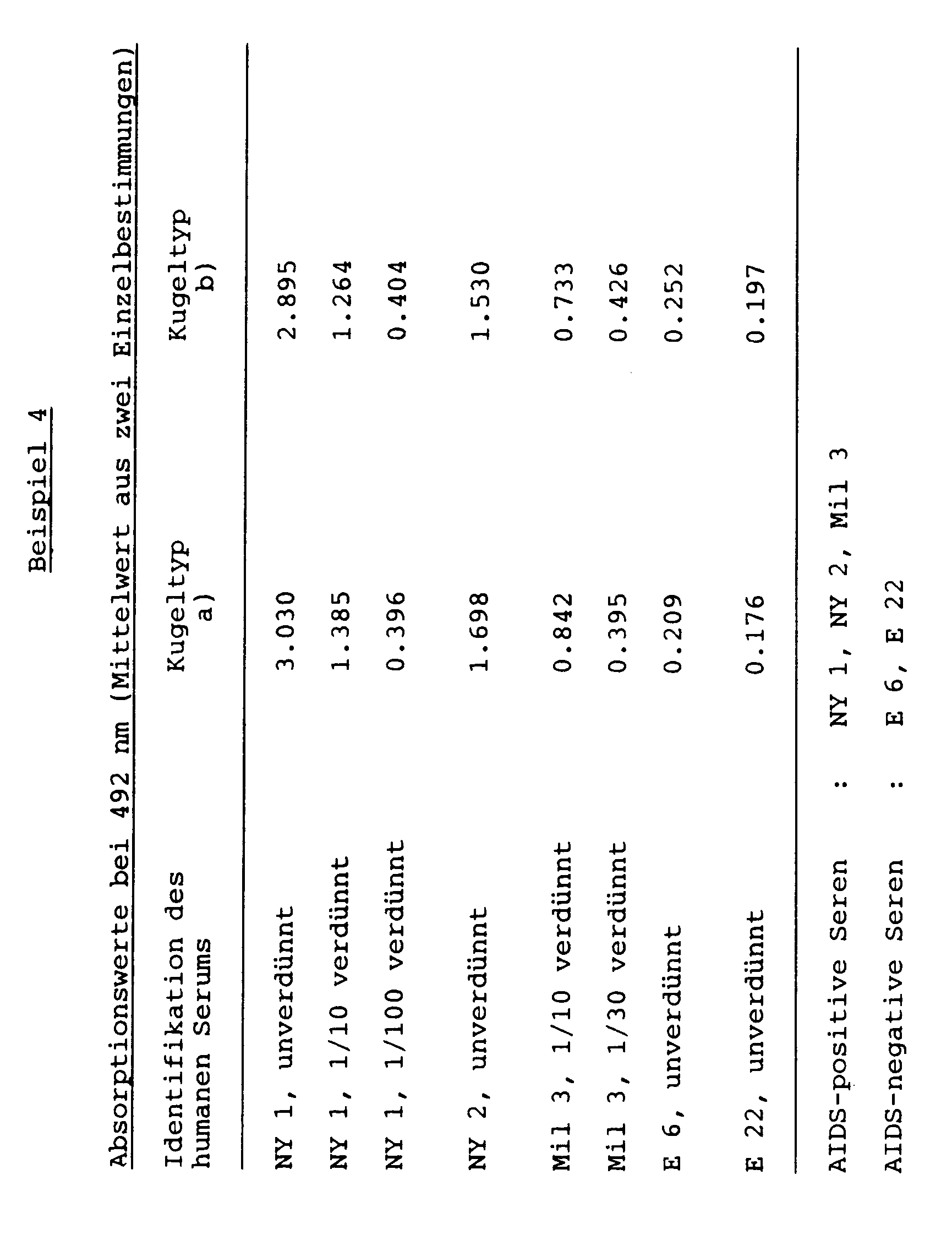
- Für den Test auf AIDS-Antikörper in Humanseren können die Vorschrift sowie sämtliche Reagenzienlösungen des kommerziell erhältlichen Roche-AIDS-Diagnosticakits verwendet werden (vgl. hierzu den Prospekt Anti-HIV (HTLV III/LAV) EIA <Roche> Test, Ausgabe April 1987). Sowohl Kugeltyp a) als auch Kugeltyp b) gemäss Beispiel 2 diskriminiert klar zwischen AIDS-positiven und AIDS-negativen Seren.
Claims (14)
- Diagnosehilfsmittel, dadurch gekennzeichnet, dass an eine Festphase, gegebenenfalls über eine Spacergruppe, über ein mit Metallionen beladenes Nitrilotriessigsäurederivat ein gentechnologisch hergestelltes Antigen mit benachbarten Histidin-Gruppen gebunden ist.
- Diagnosehilfsmittel gemäss Anspruch 1, dadurch gekennzeichnet, dass das mit Metallionen beladene Nitrilotriessigsäurederivat der Formel
NH₂-(CH₂)x-CH(COOH)-N(CH₂COO⁻)₂Me²⁺ I
worin x 2, 3 oder 4 bedeutet und Me²⁺ ein Metallion bedeutet, entspricht. - Diagnosehilfsmittel gemäss Anspruch 1 oder 2, dadurch gekennzeichnet, dass Me²⁺ Co²⁺, Ni²⁺, Cu²⁺ oder Zn²⁺ bedeutet.
- Diagnosehilfsmittel gemäss einem der Ansprüche 1 - 3, dadurch gekennzeichnet, dass die Festphase eine in der Diagnostik übliche Glaskugel darstellt.
- Diagnosehilfsmittel gemäss Anspruche 4, dadurch gekennzeichnet, dass die Kugeln an der Oberfläche Epoxydfunktionen enthalten.
- Diagnosehilfsmittel gemäss einem der Ansprüche 1 - 5, dadurch gekennzeichnet, dass das gentechnologisch hergestellte Antigen ein HIV I-Antigen ist.
- Diagnosehilfsmittel gemäss einem der Ansprüche 1 - 5, dadurch gekennzeichnet, dass das gentechnologisch hergestellte Antigen ein HIV II-Antigen ist.
- Diagnosehilfsmittel gemäss einem der Ansprüche 1 - 5, dadurch gekennzeichnet, dass das gentechnologisch hergestellte Antigen ein HIV I- und HIV II-Antigen ist.
- Diagnosehilfsmittel gemäss einem der Ansprüche 1 - 5, dadurch gekennzeichnet, dass das gentechnologisch hergestellte Antigen ein Hepatitis B-Virus-Antigen ist.
- Diagnosehilfsmittel gemäss einem der Ansprüche 1 - 5, dadurch gekennzeichnet, dass das gentechnologisch hergestellte Antigen ein Rabies-Virus-Antigen ist.
- Diagnosehilfsmittel gemäss einem der Ansprüche 1 - 5, dadurch gekennzeichnet, dass das gentechnologisch hergestellte Antigen ein HTLV I-Antigen ist.
- Diagnosehilfsmittel gemäss einem der Ansprüche 1 - 5, dadurch gekennzeichnet, dass das gentechnologisch hergestellte Antigen ein HTLV II-Antigen ist.
- Verwendung eines Diagnosehilfsmittels gemäss einem der Ansprüche 1 - 12 zum Nachweis von Antikörper gegen virale Antigene.
- Verfahren zum Nachweisen von Antikörpern gegen virale Antigene, dadurch gekennzeichnet, dass man ein Diagnosehilfsmittel gemäss einem der Ansprüche 1 - 12 verwendet.
Priority Applications (1)
| Application Number | Priority Date | Filing Date | Title |
|---|---|---|---|
| AT89106688T ATE94989T1 (de) | 1988-04-25 | 1989-04-14 | Diagnose-hilfsmittel. |
Applications Claiming Priority (4)
| Application Number | Priority Date | Filing Date | Title |
|---|---|---|---|
| CH1537/88 | 1988-04-25 | ||
| CH153788 | 1988-04-25 | ||
| CH163588 | 1988-05-02 | ||
| CH1635/88 | 1988-05-02 |
Publications (2)
| Publication Number | Publication Date |
|---|---|
| EP0339389A1 EP0339389A1 (de) | 1989-11-02 |
| EP0339389B1 true EP0339389B1 (de) | 1993-09-22 |
Family
ID=25687939
Family Applications (1)
| Application Number | Title | Priority Date | Filing Date |
|---|---|---|---|
| EP89106688A Expired - Lifetime EP0339389B1 (de) | 1988-04-25 | 1989-04-14 | Diagnose-Hilfsmittel |
Country Status (4)
| Country | Link |
|---|---|
| EP (1) | EP0339389B1 (de) |
| JP (1) | JPH0758294B2 (de) |
| DE (1) | DE58905660D1 (de) |
| DK (1) | DK174991B1 (de) |
Families Citing this family (7)
| Publication number | Priority date | Publication date | Assignee | Title |
|---|---|---|---|---|
| US5780038A (en) * | 1987-11-16 | 1998-07-14 | Roche Diagnostic Systems, Inc. | HIV-2 envelope polypeptides |
| EP0316695B1 (de) * | 1987-11-16 | 1993-03-31 | F. Hoffmann-La Roche Ag | Rekombinante HIV-2 Polypeptide |
| AU633686B2 (en) * | 1990-01-19 | 1993-02-04 | Boehringer Mannheim Gmbh | Process for enzymatically treating substrates |
| DE4405810A1 (de) | 1994-02-23 | 1995-08-24 | Behringwerke Ag | Von einem Retrovirus aus der HIV-Gruppe abgeleitete Peptide und deren Verwendung |
| DE4433980C2 (de) * | 1994-09-23 | 1996-08-22 | Boehringer Ingelheim Int | Verfahren und Biosensorhit zur Untersuchung der Wechselwirkung von Biomolekülen mittels Oberflächen-Plasma-Resonanz |
| DE19745001A1 (de) * | 1997-10-11 | 1999-05-06 | Evotec Biosystems Ag | Verfahren zur Affinitätsmarkierung von Oligo- oder Polymeren |
| JP5129760B2 (ja) * | 2009-01-05 | 2013-01-30 | 富士フイルム株式会社 | 担体およびその製造方法 |
Family Cites Families (4)
| Publication number | Priority date | Publication date | Assignee | Title |
|---|---|---|---|---|
| US4663277A (en) * | 1983-05-20 | 1987-05-05 | Profile Diagnostic Sciences Inc. | Virus detection method and materials |
| US4707352A (en) * | 1984-01-30 | 1987-11-17 | Enzo Biochem, Inc. | Method of radioactively labeling diagnostic and therapeutic agents containing a chelating group |
| CA1260827A (en) * | 1984-08-31 | 1989-09-26 | Richard C. Siegel | Antibody-metal ion complexes |
| US4837003A (en) * | 1984-09-13 | 1989-06-06 | Mallinckrodt, Inc. | Radiolabeled antibody fragments |
-
1989
- 1989-04-14 DE DE89106688T patent/DE58905660D1/de not_active Expired - Lifetime
- 1989-04-14 EP EP89106688A patent/EP0339389B1/de not_active Expired - Lifetime
- 1989-04-24 JP JP10435689A patent/JPH0758294B2/ja not_active Expired - Lifetime
- 1989-04-24 DK DK197589A patent/DK174991B1/da not_active IP Right Cessation
Non-Patent Citations (1)
| Title |
|---|
| E.Hochuli; et al., Journal of Chromatography, 411 p.177-184 (1987) * |
Also Published As
| Publication number | Publication date |
|---|---|
| JPH01312465A (ja) | 1989-12-18 |
| DK197589D0 (da) | 1989-04-24 |
| JPH0758294B2 (ja) | 1995-06-21 |
| DK174991B1 (da) | 2004-04-13 |
| EP0339389A1 (de) | 1989-11-02 |
| DK197589A (da) | 1989-10-26 |
| DE58905660D1 (de) | 1993-10-28 |
Similar Documents
| Publication | Publication Date | Title |
|---|---|---|
| DE69629127T2 (de) | TRENNMEDIUM FÜR IgG UND PROTEIN A VARIANTE | |
| DE2522086C2 (de) | Reagenz zum Abtrennen und Bestimmen von in biologischen Fluiden vorhandenen AK:Ag-Komplexen | |
| DE2816841A1 (de) | Radioimmunologische bestimmung von prokollagen (typ iii) und prokollagen- peptid (typ iii) | |
| DE2711773A1 (de) | Verfahren zur reinigung und isolierung von hepatitisvirus zur herstellung eines impfstoffes | |
| DE2925565A1 (de) | Inkubations-doppelplatzimmunonachweisverfahren und mittel zur durchfuehrung des verfahrens | |
| DE2707881C2 (de) | Verfahren zum Nachweis von rheumatoiden Faktoren | |
| DE2461811A1 (de) | Immunologisches bestimmungsverfahren | |
| EP0339389A1 (de) | Diagnose-Hilfsmittel | |
| DE2532151C3 (de) | Antisenim zur quantitativen Bestimmung der Abbauprodukte des Fibrins und Fibrinogen« und Verfahren zu seiner Herstellung | |
| EP0014756A1 (de) | Plazentaspezifisches Gewebsprotein PP10 und Verfahren zu seiner Anreicherung | |
| EP0190606B1 (de) | Adsorbens für die Reinigung von Proteinen | |
| DE2707913C2 (de) | Verfahren zum Nachweis von rheumatoiden Faktoren | |
| CH630643A5 (en) | Process for concentrating a placenta-specific glycoprotein. | |
| DE3013724A1 (de) | Neues protein pp (pfeil abwaerts)9(pfeil abwaerts), verfahren zu seiner anreicherung und gewinnung sowieseine verwendung | |
| DE3338480A1 (de) | Neues protein pp(pfeil abwaerts)2(pfeil abwaerts)(pfeil abwaerts)0(pfeil abwaerts), verfahren zu seiner gewinnung sowie seine verwendung | |
| EP0029191A1 (de) | Neues Protein PP11, ein Verfahren zu seiner Gewinnung und seine Verwendung | |
| DE3410694C2 (de) | ||
| DE2907228A1 (de) | Immunochemische bestimmung | |
| CH643860A5 (de) | Leucinreiches 3,1-s-alpha-2-glykoprotein, verfahren zu dessen herstellung sowie dessen verwendung. | |
| EP0282021A2 (de) | Spezifische Antikörper gegen Herzmuskelmyosin-Leichtketten, ihre Herstellung und Verwendung in einem Reagenz zur Bestimmung von Herzmuskelmyosin-Leichtketten | |
| EP0372217B1 (de) | Einschritt-Immuntest zur Bestimmung von antigen-spezifischen Antikörpern aller Immunglobulin-Klassen und dazu geeignetes Mittel | |
| EP0014965A1 (de) | Immunologisches diagnostisches Reagenz zur Bestimmung der Schwangerschaft, Verfahren zu dessen Herstellung sowie dessen Verwendung zur Bestimmung der Schwangerschaft | |
| DE2445677C2 (de) | Hochmolekulares alpha-Globulin und Verfahren zu dessen Herstellung | |
| DE3511199A1 (de) | Verfahren zur immunologischen bestimmung von heparansulfat-proteoglykan, verfahren zur herstellung bzw. reinigung von dafuer geeignetem heparansulfat-proteoglykan aus basalmembran-haltigen geweben | |
| DD285099A5 (de) | Verfahren zur aktivierung von polystyren-festkoerperflaechen |
Legal Events
| Date | Code | Title | Description |
|---|---|---|---|
| PUAI | Public reference made under article 153(3) epc to a published international application that has entered the european phase |
Free format text: ORIGINAL CODE: 0009012 |
|
| 17P | Request for examination filed |
Effective date: 19890414 |
|
| AK | Designated contracting states |
Kind code of ref document: A1 Designated state(s): AT BE CH DE FR GB IT LI NL SE |
|
| 17Q | First examination report despatched |
Effective date: 19910724 |
|
| GRAA | (expected) grant |
Free format text: ORIGINAL CODE: 0009210 |
|
| AK | Designated contracting states |
Kind code of ref document: B1 Designated state(s): AT BE CH DE FR GB IT LI NL SE |
|
| REF | Corresponds to: |
Ref document number: 94989 Country of ref document: AT Date of ref document: 19931015 Kind code of ref document: T |
|
| ITF | It: translation for a ep patent filed | ||
| REF | Corresponds to: |
Ref document number: 58905660 Country of ref document: DE Date of ref document: 19931028 |
|
| GBT | Gb: translation of ep patent filed (gb section 77(6)(a)/1977) |
Effective date: 19931012 |
|
| ET | Fr: translation filed | ||
| PLBE | No opposition filed within time limit |
Free format text: ORIGINAL CODE: 0009261 |
|
| STAA | Information on the status of an ep patent application or granted ep patent |
Free format text: STATUS: NO OPPOSITION FILED WITHIN TIME LIMIT |
|
| 26N | No opposition filed | ||
| EAL | Se: european patent in force in sweden |
Ref document number: 89106688.8 |
|
| REG | Reference to a national code |
Ref country code: GB Ref legal event code: IF02 |
|
| PGFP | Annual fee paid to national office [announced via postgrant information from national office to epo] |
Ref country code: GB Payment date: 20080317 Year of fee payment: 20 |
|
| PGFP | Annual fee paid to national office [announced via postgrant information from national office to epo] |
Ref country code: CH Payment date: 20080425 Year of fee payment: 20 Ref country code: DE Payment date: 20080430 Year of fee payment: 20 |
|
| PGFP | Annual fee paid to national office [announced via postgrant information from national office to epo] |
Ref country code: AT Payment date: 20080318 Year of fee payment: 20 |
|
| PGFP | Annual fee paid to national office [announced via postgrant information from national office to epo] |
Ref country code: IT Payment date: 20080419 Year of fee payment: 20 Ref country code: BE Payment date: 20080507 Year of fee payment: 20 |
|
| PGFP | Annual fee paid to national office [announced via postgrant information from national office to epo] |
Ref country code: NL Payment date: 20080325 Year of fee payment: 20 Ref country code: SE Payment date: 20080404 Year of fee payment: 20 |
|
| PGFP | Annual fee paid to national office [announced via postgrant information from national office to epo] |
Ref country code: FR Payment date: 20080403 Year of fee payment: 20 |
|
| BE20 | Be: patent expired |
Owner name: F. *HOFFMANN-LA ROCHE A.G. Effective date: 20090414 |
|
| REG | Reference to a national code |
Ref country code: CH Ref legal event code: PL |
|
| REG | Reference to a national code |
Ref country code: GB Ref legal event code: PE20 Expiry date: 20090413 |
|
| PG25 | Lapsed in a contracting state [announced via postgrant information from national office to epo] |
Ref country code: NL Free format text: LAPSE BECAUSE OF EXPIRATION OF PROTECTION Effective date: 20090414 |
|
| NLV7 | Nl: ceased due to reaching the maximum lifetime of a patent |
Effective date: 20090414 |
|
| EUG | Se: european patent has lapsed | ||
| PG25 | Lapsed in a contracting state [announced via postgrant information from national office to epo] |
Ref country code: GB Free format text: LAPSE BECAUSE OF EXPIRATION OF PROTECTION Effective date: 20090413 |