EP0338985A2 - Modifizierte Epoxidharze - Google Patents
Modifizierte Epoxidharze Download PDFInfo
- Publication number
- EP0338985A2 EP0338985A2 EP89810277A EP89810277A EP0338985A2 EP 0338985 A2 EP0338985 A2 EP 0338985A2 EP 89810277 A EP89810277 A EP 89810277A EP 89810277 A EP89810277 A EP 89810277A EP 0338985 A2 EP0338985 A2 EP 0338985A2
- Authority
- EP
- European Patent Office
- Prior art keywords
- component
- hydroxyl
- groups
- compositions according
- formula
- Prior art date
- Legal status (The legal status is an assumption and is not a legal conclusion. Google has not performed a legal analysis and makes no representation as to the accuracy of the status listed.)
- Granted
Links
Classifications
-
- C—CHEMISTRY; METALLURGY
- C08—ORGANIC MACROMOLECULAR COMPOUNDS; THEIR PREPARATION OR CHEMICAL WORKING-UP; COMPOSITIONS BASED THEREON
- C08G—MACROMOLECULAR COMPOUNDS OBTAINED OTHERWISE THAN BY REACTIONS ONLY INVOLVING UNSATURATED CARBON-TO-CARBON BONDS
- C08G59/00—Polycondensates containing more than one epoxy group per molecule; Macromolecules obtained by polymerising compounds containing more than one epoxy group per molecule using curing agents or catalysts which react with the epoxy groups
- C08G59/18—Macromolecules obtained by polymerising compounds containing more than one epoxy group per molecule using curing agents or catalysts which react with the epoxy groups ; e.g. general methods of curing
-
- C—CHEMISTRY; METALLURGY
- C08—ORGANIC MACROMOLECULAR COMPOUNDS; THEIR PREPARATION OR CHEMICAL WORKING-UP; COMPOSITIONS BASED THEREON
- C08L—COMPOSITIONS OF MACROMOLECULAR COMPOUNDS
- C08L75/00—Compositions of polyureas or polyurethanes; Compositions of derivatives of such polymers
- C08L75/04—Polyurethanes
- C08L75/14—Polyurethanes having carbon-to-carbon unsaturated bonds
-
- C—CHEMISTRY; METALLURGY
- C08—ORGANIC MACROMOLECULAR COMPOUNDS; THEIR PREPARATION OR CHEMICAL WORKING-UP; COMPOSITIONS BASED THEREON
- C08G—MACROMOLECULAR COMPOUNDS OBTAINED OTHERWISE THAN BY REACTIONS ONLY INVOLVING UNSATURATED CARBON-TO-CARBON BONDS
- C08G18/00—Polymeric products of isocyanates or isothiocyanates
- C08G18/06—Polymeric products of isocyanates or isothiocyanates with compounds having active hydrogen
- C08G18/08—Processes
- C08G18/10—Prepolymer processes involving reaction of isocyanates or isothiocyanates with compounds having active hydrogen in a first reaction step
-
- C—CHEMISTRY; METALLURGY
- C08—ORGANIC MACROMOLECULAR COMPOUNDS; THEIR PREPARATION OR CHEMICAL WORKING-UP; COMPOSITIONS BASED THEREON
- C08G—MACROMOLECULAR COMPOUNDS OBTAINED OTHERWISE THAN BY REACTIONS ONLY INVOLVING UNSATURATED CARBON-TO-CARBON BONDS
- C08G18/00—Polymeric products of isocyanates or isothiocyanates
- C08G18/06—Polymeric products of isocyanates or isothiocyanates with compounds having active hydrogen
- C08G18/08—Processes
- C08G18/10—Prepolymer processes involving reaction of isocyanates or isothiocyanates with compounds having active hydrogen in a first reaction step
- C08G18/12—Prepolymer processes involving reaction of isocyanates or isothiocyanates with compounds having active hydrogen in a first reaction step using two or more compounds having active hydrogen in the first polymerisation step
-
- C—CHEMISTRY; METALLURGY
- C08—ORGANIC MACROMOLECULAR COMPOUNDS; THEIR PREPARATION OR CHEMICAL WORKING-UP; COMPOSITIONS BASED THEREON
- C08G—MACROMOLECULAR COMPOUNDS OBTAINED OTHERWISE THAN BY REACTIONS ONLY INVOLVING UNSATURATED CARBON-TO-CARBON BONDS
- C08G18/00—Polymeric products of isocyanates or isothiocyanates
- C08G18/06—Polymeric products of isocyanates or isothiocyanates with compounds having active hydrogen
- C08G18/28—Polymeric products of isocyanates or isothiocyanates with compounds having active hydrogen characterised by the compounds used containing active hydrogen
- C08G18/40—High-molecular-weight compounds
- C08G18/63—Block or graft polymers obtained by polymerising compounds having carbon-to-carbon double bonds on to polymers
- C08G18/638—Block or graft polymers obtained by polymerising compounds having carbon-to-carbon double bonds on to polymers characterised by the use of compounds having carbon-to-carbon double bonds other than styrene and/or olefinic nitriles
-
- C—CHEMISTRY; METALLURGY
- C08—ORGANIC MACROMOLECULAR COMPOUNDS; THEIR PREPARATION OR CHEMICAL WORKING-UP; COMPOSITIONS BASED THEREON
- C08G—MACROMOLECULAR COMPOUNDS OBTAINED OTHERWISE THAN BY REACTIONS ONLY INVOLVING UNSATURATED CARBON-TO-CARBON BONDS
- C08G18/00—Polymeric products of isocyanates or isothiocyanates
- C08G18/06—Polymeric products of isocyanates or isothiocyanates with compounds having active hydrogen
- C08G18/28—Polymeric products of isocyanates or isothiocyanates with compounds having active hydrogen characterised by the compounds used containing active hydrogen
- C08G18/67—Unsaturated compounds having active hydrogen
- C08G18/69—Polymers of conjugated dienes
-
- C—CHEMISTRY; METALLURGY
- C08—ORGANIC MACROMOLECULAR COMPOUNDS; THEIR PREPARATION OR CHEMICAL WORKING-UP; COMPOSITIONS BASED THEREON
- C08G—MACROMOLECULAR COMPOUNDS OBTAINED OTHERWISE THAN BY REACTIONS ONLY INVOLVING UNSATURATED CARBON-TO-CARBON BONDS
- C08G59/00—Polycondensates containing more than one epoxy group per molecule; Macromolecules obtained by polymerising compounds containing more than one epoxy group per molecule using curing agents or catalysts which react with the epoxy groups
- C08G59/02—Polycondensates containing more than one epoxy group per molecule
-
- C—CHEMISTRY; METALLURGY
- C08—ORGANIC MACROMOLECULAR COMPOUNDS; THEIR PREPARATION OR CHEMICAL WORKING-UP; COMPOSITIONS BASED THEREON
- C08L—COMPOSITIONS OF MACROMOLECULAR COMPOUNDS
- C08L63/00—Compositions of epoxy resins; Compositions of derivatives of epoxy resins
-
- C—CHEMISTRY; METALLURGY
- C08—ORGANIC MACROMOLECULAR COMPOUNDS; THEIR PREPARATION OR CHEMICAL WORKING-UP; COMPOSITIONS BASED THEREON
- C08L—COMPOSITIONS OF MACROMOLECULAR COMPOUNDS
- C08L75/00—Compositions of polyureas or polyurethanes; Compositions of derivatives of such polymers
-
- C—CHEMISTRY; METALLURGY
- C08—ORGANIC MACROMOLECULAR COMPOUNDS; THEIR PREPARATION OR CHEMICAL WORKING-UP; COMPOSITIONS BASED THEREON
- C08L—COMPOSITIONS OF MACROMOLECULAR COMPOUNDS
- C08L9/00—Compositions of homopolymers or copolymers of conjugated diene hydrocarbons
- C08L9/02—Copolymers with acrylonitrile
-
- C—CHEMISTRY; METALLURGY
- C09—DYES; PAINTS; POLISHES; NATURAL RESINS; ADHESIVES; COMPOSITIONS NOT OTHERWISE PROVIDED FOR; APPLICATIONS OF MATERIALS NOT OTHERWISE PROVIDED FOR
- C09J—ADHESIVES; NON-MECHANICAL ASPECTS OF ADHESIVE PROCESSES IN GENERAL; ADHESIVE PROCESSES NOT PROVIDED FOR ELSEWHERE; USE OF MATERIALS AS ADHESIVES
- C09J175/00—Adhesives based on polyureas or polyurethanes; Adhesives based on derivatives of such polymers
- C09J175/04—Polyurethanes
- C09J175/14—Polyurethanes having carbon-to-carbon unsaturated bonds
-
- C—CHEMISTRY; METALLURGY
- C08—ORGANIC MACROMOLECULAR COMPOUNDS; THEIR PREPARATION OR CHEMICAL WORKING-UP; COMPOSITIONS BASED THEREON
- C08L—COMPOSITIONS OF MACROMOLECULAR COMPOUNDS
- C08L2666/00—Composition of polymers characterized by a further compound in the blend, being organic macromolecular compounds, natural resins, waxes or and bituminous materials, non-macromolecular organic substances, inorganic substances or characterized by their function in the composition
- C08L2666/02—Organic macromolecular compounds, natural resins, waxes or and bituminous materials
- C08L2666/14—Macromolecular compounds according to C08L59/00 - C08L87/00; Derivatives thereof
- C08L2666/22—Macromolecular compounds not provided for in C08L2666/16 - C08L2666/20
Definitions
- the present invention relates to combinations of selected diene copolymers and capped urethane prepolymers, mixtures containing these combinations and epoxy resins, the cured products from these mixtures and the use of these mixtures as adhesives or sealants, in particular as structural adhesives.
- the polyurethanes are obtained by reacting prepolymeric diisocyanates with optionally substituted monophenols.
- the mixtures can be used together with polyamine hardeners to produce coatings that are particularly elastic.
- oligourethanes From EP-A-66,167 a process for the production of mercapto group-terminated oligourethanes is known. These oligomers can be used as binders for oxidatively curable coating and sealing compounds or as elasticizing additives for epoxy resins.
- Selected oligourethanes containing mercapto end groups are known from EP-A-231,760.
- the compounds are derived from selected polyalkylene ethers and can be used as sealing compounds or as additives to crosslinkable epoxy resin systems.
- EP-A-30,426 discloses liquid compositions which contain two mutually compatible, each independently curable oligomer of different reactivity. These can also be mixtures of a butadiene / acryinitrii copolymer containing reactive end groups with an isocyanate-terminated prepolymer. In addition, these mixtures can also contain a component, for example an epoxy resin, which reacts with at least one of the liquid oligomers and is deblocked during curing.
- epoxy resins can be modified by adding copolymers based on butadiene / acrylonitrile or by adding adducts of such copolymers to epoxy resins.
- the known modified epoxy resins generally have high impact strength and flexibility after curing. However, the peel strength usually leaves something to be desired. In addition, the tensile shear strength and the glass transition temperature of the hardened mixtures are reduced compared to hardened, unmodified epoxy resins.
- Combinations of impact strength modifiers have now been found which, when mixed with epoxy resins, bring about a significant increase in the peel strength, a reduced tendency to propagate cracks and enable high peel strengths without loss of tensile shear strength.
- these modifiers can also be used to produce elastic products with high peel strength and low glass transition temperature or high-strength products with high glass transition temperature and high peel strength; the high-strength products are characterized by high crack toughness and crack propagation is significantly reduced even with high and shock-like impact loads.
- Component A) is a selected liquid, elastomeric copolymer based on butadiene and preferably contains end groups which are reactive towards epoxy resins.
- This component can be used as such or as an adduct to an epoxy resin, preferably to a bisphenol-based diglycidyl ether.
- liquid copolymer is to be understood as a compound which is flowable at temperatures below 80 ° C. and can be readily mixed with an epoxy resin.
- polar, ethylenically unsaturated comonomers for the production of component A) are acrylic acid, methacrylic acid, esters of acrylic or methacrylic acid, for example the methyl or ethyl esters, amides of acrylic or methacrylic acid, fumaric acid, itaconic acid, maleic acid or their esters or half esters, for example the mono- or dimethyl esters, or maleic or itaconic anhydride; Vinyl esters, for example vinyl acetate, polar styrenes, such as nuclear chlorinated or nuclear brominated styrenes, or especially acrylonitrile or methacrylonitrile.
- component A) may also contain further non-polar, ethylenically unsaturated comonomers.
- examples include ethylene, propylene or, in particular, styrene or substituted styrenes, such as vinyl toluene.
- Component A) can be statistical copolymers, block copolymers or graft copolymers.
- component A The proportion of the comonomers in component A) can vary within wide ranges. This component is selected such that an elastomer phase forms in combination with component B) and optionally an epoxy resin C). These can be homogeneous or heterogeneous systems.
- An elastomer phase can already be present in component A), for example when using a polybutadiene graft copolymer; however, the elastomer phase can also only arise through the selection of suitable components A), B) and optionally C).
- the components are generally chosen such that the difference in the solubility parameters from A) and / or B) to C) is between 0.2 and 1.0, preferably between 0.2 and 0.6, lies. These selection criteria are described, for example, in C.B. Bucknall in "Toughened Plastics", Chapter 2, Applied Science Publishers Ltd., London 1977.
- Preferred components A) are liquid copolymers based on butadiene-acrylonitrile, butadiene-acrylonitrile-styrene graft copolymers (ABS), and butadiene-methyl methacrylate-styrene graft copolymers (MBS).
- Particularly preferred components A) are liquid copolymers which can be obtained by graft copolymerization of polar, ethylenically unsaturated comonomers onto polybutadiene microgels.
- Very particularly preferred components A) are liquid butadiene-acrylonitrile copolymers.
- the molecular weights of these preferred components A) are preferably 500-5000, in particular 1000-3000.
- component A) are butadiene-acrylonitrile copolymers with functional groups reactive towards epoxy resins.
- copolymers examples include carboxyl- or hydroxyl- or amine-containing acrylonitrile-butadiene rubbers, for example, compounds of the type Hycar @ Fa. Goodrich.
- Preferred types of such rubbers contain the structural elements of the following formulas Ila to Ild and the end groups Q.
- R a is hydrogen or methyl
- R b is -COOH, -COOR ° or -CONH 2
- R C is an aliphatic radical, preferably methyl
- Q is selected from the group consisting of -R-COOH, -R- OH and wherein R is an alkylene radical
- the proportion of the residues Ila and Ilb is preferably 5-50% by weight
- the proportion of the residue Ic is preferably 5-50% by weight
- the proportion of the residue Ild is preferably 0-30% by weight, preferred for residues with free carboxyl groups 0-10% by weight, the amounts given being based on the total amount of the residues Ila, Ilb, Ilc and, if appropriate, Ild.
- Component A) is preferably used as an adduct of a butadiene-acrylonitrile copolymer with functional groups reactive towards epoxy resins on an epoxy resin.
- Such adducts are prepared in a manner known per se by heating the reactive acrylonitrile-butadiene rubber and the epoxy resin, optionally with a catalyst, so that a fusible but still curable precondensate is formed.
- the catalyst used is, for example, triphenylphosphine, tertiary amines, quaternary ammonium or phosphonium salts or chromium acetylacetonate.
- Component B) is a selected polyurethane or a selected polyurea. These compounds are derived from special prepolymers and have special end groups bonded via urethane or urea groups.
- an “elastomeric prepolymer residue R 1 ” is understood to mean a residue of a prepolymer terminated with m-isocyanate, amino or hydroxyl groups which, after the capping of these groups, leads to a compound of the formula which, in combination with the diene component A ) and epoxy resins C) after curing gives an elastomer phase or a mixture of elastomer phases. These can be homogeneous or preferably heterogeneous combinations of components A), B) and C).
- the elastomer phase (s) is (are) usually characterized by a glass transition temperature of less than 0 ° C.
- a "prepolymer soluble or dispersible in epoxy resin” means a residue of a prepolymer terminated with m-isocyanate, amino or hydroxyl groups, which after the capping of these groups leads to a compound of the formula which is soluble in an epoxy resin C) or in a combination of an epoxy resin C) and a butadiene copolymer A) or is dispersible without further auxiliaries, such as, for example, emulsifiers; a homogeneous phase is thus formed or at least no macroscopic phase separation of one of components A), B) or C) or of a mixture of said components takes place.
- solubility or dispersibility of B) in the combination of A) and C) is achieved primarily by the selection of suitable prepolymer residues R 1 .
- suitable radicals are given below in the preparation of component B).
- Component B) is preferably a water-insoluble compound of the formula I.
- this is understood to mean a compound which dissolves in water to less than 5% by weight, preferably less than 1% by weight, and which water storage absorbs only a small amount of water, preferably less than 5% by weight, or shows only a slight swelling.
- the prepolymers on which R 1 is based generally have molecular weights (number average) from 150 to 10,000, preferably from 500 to 3,000.
- the average functionality of these prepolymers is at least two, preferably 2 to 3, and particularly preferably 2 to 2.5.
- Elastomeric polyurethanes or polyureas generally contain rigid and flexible portions (hard and soft segments).
- Component B) can be liquid or thermoplastic compounds of the formula. Compounds with a softening temperature of less than 80 ° C., preferably less than 40 ° C., are preferred.
- Suitable components B) can be essentially linear or are branched types. The degree of branching is chosen so that the solubility or dispersibility of the component in question is given in components A) and C). This will generally be the case when component B) is soluble or dispersible in a polar organic solvent or in an epoxy resin.
- the compounds of the formula I can be obtained in different ways.
- R 3 is derived from a selected OH- or NH-acidic component.
- R 3 is unsubstituted or the rest carries inert substituents; Examples include alkyl, alkenyl, alkynyl, alkoxycarbonyl, alkoxy or halogen.
- R 3 is derived from a monophenol, it is preferably mono- or polynuclear carbocyclic-aromatic radicals. Polynuclear residues can be condensed. Binuclear residues are preferably connected to one another via a bridge member. Examples of bridge members are listed below.
- phenols with condensed radicals are hydroxynaphthalenes or anthracenes.
- R 3 is derived from a monophenol
- the group -YR 3 preferably has the structure of the formula V or VI wherein R 7 is Ci-C 2 oalkyl, C 1 -C 20 alkoxy, C 2 -C 20 alkenyl, C 2 -C 6 alkynyl, -CO-OR 8 or halogen, n is 0, 1 or 2, Z is one is a direct CC bond or a bridge member selected from the group consisting of -CR 9 R 10- , -O-, -S-, -SO 2 -, -CO-, -COO-, -CONR 11 - and -SiR 12 R 13 is, R 9 , R 10 and R 11 are independently hydrogen, -CF 3 or C 1 -C 6 alkyl or R 9 and R 10 together with the common C atom are a cycloaliphatic radical with 5-12 C- Form atoms, R 8 is C 1 -C 20 alkyl and R 12 and R 13 are C 1
- phenol radicals of the formulas V or VI in which n is 0 or 1 and R 7 is C 1 -C 6 alkyl, allyl, prop-1-enyl or C 1 -C 6 alkoxy are particularly preferred.
- radicals of the formula VI in which Z is selected from the groups consisting of -CH 2 -, -C (CF 3 ) 2 -, -O-, -SOz-, a direct CC bond and especially -C (CH 3 ) 2 -, and where n is 0.
- Preferred monophenols are phenol, o-, m- or p-cresol, 4-hydroxybiphenyl, 4-hydroxyphenoxy-benzene, 4-hydroxyphenylsulfonyl-benzene, 4-hydroxyphenylmethyl-benzene or 4-hydroxybenzoic acid alkyl esters, for example the methyl or nonylester.
- R 7 is C 1 -C 20 alkyl or C 1 -C 20 alkoxy or R 8 C 1 -C 20 alkyl, it is a straight-chain or branched radical.
- Examples include methyl, ethyl, n-propyl, isopropyl, n-butyl, isobutyl, tert-butyl, n-pentyl, n-hexyl, 2-ethylbutyl, n-heptyl, n-octyl, 2-ethylhexyl, n-nonyl , n-decyl, n-undecyl, n-dodecyl, n-tetradecyl, n-pentadecyl, n-hexadecyl, n-octadecyl or n-eicosyl or the corresponding alkoxy derivatives.
- R 7 is preferably C 1 -C 6 alkyl or C 1 -C 6 alkoxy, particularly preferably straight-chain C 1 -C 6 alkyl or C 1 -C 6 alkoxy and very particularly preferably methyl or methoxy.
- Any C 1 -C 6 alkyl radicals are preferably straight-chain radicals, that is to say methyl, ethyl, n-propyl, n-butyl, n-pentyl or n-hexyl, but very particularly methyl.
- R 7 means, for example, vinyl, allyl, 1-propenyl, 1-butenyl, 1-pentenyl, 1-hexenyl, pentadec-8-enyl, pentadec-8,11-dienyl or pentadec-8,11 , 14-trienyl.
- Vinyl, 1-propenyl and allyl are preferred, very particularly allyl.
- R 7 as C 2 -Cs alkynyl is, for example, ethynyl, propargyl, 1-butynyl, 1-pentynyl or 1-hexynyl. Propargyl is preferred.
- R 7 is halogen, it can be fluorine, chlorine, bromine or iodine. Chlorine or bromine, in particular bromine, are preferred.
- R 9 and R 10 form a cycloaliphatic radical together with the common carbon atom, this is, for example, a cyclopentylidene, cyclohexylidene, cycloheptylidene, cyclooctylidene or cyclododecylidene radical. Cyclohexylidene and cyclododecylidene are preferred.
- the group -YR 3 is generally a lactam from an aliphatic y-, ⁇ - or ⁇ -aminocarboxylic acid; especially a residue of formula VII wherein p is 3 to 5.
- Residues of the formula VII in which p is 5 are preferred.
- R 3 is derived from an aliphatic or cycloaliphatic mercapto alcohol
- the group -YR 3 is generally a radical of the formula VIII -OR 14 -SH (VIII), in which R 14 is C 2 -C 12 alkylene or Cycloalkylene with 5 to 7 ring carbon atoms means.
- the R 14 radicals can optionally be substituted by one to three alkyl or alkoxy groups or interrupted by oxygen or sulfur atoms in the alkylene chain.
- alkylene radicals R 14 are ethylene, trimethylene, tetramethylene, pentamethylene, hexamethylene, heptamethylene, octamethylene, nonamethylene, decamethylene, undecamethylene, dodecamethylene,
- cycloalkylene radicals R 14 are cyclopentylene, cyclohexylene, cycloheptylene or methylcyclohexylene.
- the preferred radical R 14 is ethylene.
- the isocyanate of the formula IIla is either a prepolymer a1) which is derived from an addition of a polyisocyanate, preferably a di- or triisocyanate, very particularly preferably a diisocyanate, to a prepolymeric polyhydroxyl or polysulfhydryl component or to a mixture of these prepolymeric components, optionally in combination with chain extenders (short-chain polyhydroxyl, polysulfhydryl or polyamine compounds), or a prepolymeric polyisocyanate a2) which is derived from a prepolymeric polyamine of the formula IIIb, in particular from a prepolymeric polyetheramine.
- a prepolymer a1 which is derived from an addition of a polyisocyanate, preferably a di- or triisocyanate, very particularly preferably a diisocyanate, to a prepolymeric polyhydroxyl or polysulfhydryl component or to a mixture of these prepolymeric components,
- Prepolymeric components for the production of a1) can be condensation or addition polymers, which can optionally contain grafted-on olefins, wherein said 1-olefins can also have polar groups, such as nitrile, ester or amide groups, in addition to non-polar.
- Examples of such prepolymers are polyesters, polyethers, polythioethers, polyacetals, polyamides, polyesteramides, polyurethanes, polyureas, alkyd resins, polycarbonates or polysiloxanes, provided that these compounds are hydroxyl- or sulfhydryl-terminated, and lead to compounds of the formula which are soluble or dispersible in epoxy resins Give egg elastomer properties as defined above.
- Polyethers or segmented prepolymers containing polyether segments such as polyether amides, polyether urethanes or polyether ureas, are preferred.
- polyurethane chemistry these compounds are known to the person skilled in the field of polyurethane chemistry as structural components for polyurethanes. They can be linear or branched; linear types are preferred.
- Preferred structural components for prepolymers a1) are hydroxyl-terminated prepolymers with average molecular weights (number average) of 150-10000, very particularly 500-3000.
- chain extenders may also be present in the preparation of the prepolymeric polyisocyanates a1).
- Such monomers are preferably difunctional or trifunctional.
- the structural components are to be selected so that an adduct a1) which is soluble or at least swellable in organic solvents is formed.
- the degree of crosslinking when using more highly functional structural components can be regulated in a manner known per se by the type and proportions of these components.
- the degree of crosslinking also allows the elastomer properties to be varied in a manner known per se.
- difunctional prepolymers and trifunctional or higher functional chain extenders when using difunctional prepolymers and trifunctional or higher functional chain extenders, only a small proportion of the higher functional component is used, while when combining difunctional and tri or higher functional prepolymers, a larger amount of the higher functional chain extender can generally be present, without excessive networking.
- degree of crosslinking will also depend on the functionality of the polyiso cyanate.
- diisocyanates are generally used, while when using difunctional hydroxyl- or sulfhydryl-terminated structural components, higher-functional isocyanates are also used.
- prepolymeric components for the preparation of polyisocyanates a1) are hydroxyl-terminated polyethers, in particular those polyethers which lead to water-insoluble compounds of the formula I.
- these include, for example, the polyalkylene ether polyols which, by anionic polymerization, copolymerization or block copolymerization of alkylene oxides, such as ethylene oxide, propylene oxide or butylene oxide, with di- or polyfunctional alcohols, such as 1,4-butanediol, 1,1,1-trimethylolethane, 1,1, 1-trimethylolpropane, 1,2,6-hexanetriol, glycerol, pentaerythritol or sorbitol, or with amines, such as methylamine, ethylenediamine or 1,6-hexylenediamine, the starter components or by cationic polymerization or copolymerization of cyclic ethers, such as tetrahydrofuran, ethylene oxide
- etherate or by polycondensation of water-releasable polyols, such as 1,6-hexanediol, in the presence of acidic etherification catalysts, such as p-toluenesulfonic acid. It is also possible to use oxyalkylation products of phosphoric acid or phosphorous acid with ethylene oxide, propylene oxide, butylene oxide or styrene oxide.
- hydroxyl-terminated polyethers contain grafted 1-olefins, such as acrylonitrile, styrene or acrylic acid esters.
- the weight fraction of the graft component is generally 10-50%, in particular 10-30%, based on the amount of the polyether used.
- prepolymeric components for the preparation of polyisocyanates a1) are hydroxyl-terminated polyester polyols which are derived from di- and / or polycarboxylic acids and di- and / or polyols, preferably from dicarboxylic acids and diols.
- polycondensates examples include the hydroxyl-terminated polyesters which are formed by polycondensation of adipic acid, sebacic acid, azelaic acid, dimer and trimer fatty acids, phthalic acid, isophthalic acid, terephthalic acid, tetrahydrophthalic acid, hexahydrophthalic acid and endomethylene tetrahydrophthalic acid, 1,4-butane-6-propylene, with 6-propanediol -Hexanediol, di-, tri- and tetraethylene glycol, di-, tri- and tetrapropylene glycol, di-, tri- and tetrabutylene glycol, 2,2-dimethylpropane-1,3-diol, 1,1,1-trimethylolpropane, 1,1 , 1-trimethylolethane and 1,2,6-hexanetriol can be obtained.
- prepolymer components for the production of polyisocyanates a1) are hydroxyl-terminated polybutadienes, which are used in particular together with hydroxyl-terminated polyethers to form component a1).
- Suitable prepolymer components for the preparation of polyisocyanates a1) are polymerization products of lactones, for example of s-caprolactones; or polyalkylene thioether polyols, for example the polycondensation products of thiodiglycol with and with diols and / or polyols, such as, for example, 1,6-hexanediol, triethylene glycol, 2,2-dimethyl-1,3-propanediol or 1,1,1-trimethylolpropane.
- Preferred prepolymeric components for the production of polyisocyanates a1) are hydroxyl-terminated polyethers of the polyesters.
- prepolymeric components for the preparation of polyisocyanates a1) are mixtures of hydroxyl-terminated polybutadiene and hydroxyl-terminated polyalkylene glycol or hydroxyl-terminated polyalkylene glycols containing grafted 1-olefins, in particular styrene or acrylic acid derivatives, such as acrylic acid esters or acrylonitrile.
- Very particularly preferred prepolymer components for the preparation of polyisocyanates a1) are hydroxyl-terminated polyethers, in particular dihydroxyl-terminated polyalkylene glycols. Chain extenders for the preparation of the prepolymer structural component for a1) are known per se.
- diols and polyols mentioned above for the preparation of the hydroxyl-terminated polyethers in particular the diols and triols, such as 1,4-butanediol, 1,1,1-trimethylolpropane or hydroquinone (2-hydroxyethyl ether), or also diamines such as diaminoethane, 1,6-diaminohexane, piperazine, 2,5-dimethylpiperazine, 1-amino-3-aminomethyl-3,5,5-trimethylcyclohexane, 4,4'-diaminocyclohexylmethane, 1,4-diaminocyclohexane and 1,2 -Propylenediamine or hydrazine, amino acid hydrazides, hydrazides of semicarbazidocarboxylic acids, bis-hydrazides and bis-semicarbazides.
- diols and triols such as 1,4-butaned
- Short chain diols or triols are preferably used as chain extenders.
- the prepolymeric polyisocyanate a2) can be obtained in a manner known per se from amino-terminated prepolymers of the formula IIIb, in particular from amino-terminated polyethers, by reaction with phosgene or with polyisocyanates, preferably with di- or triisocyanates, particularly preferably with diisocyanates.
- the amino-terminated prepolymers generally contain no further radicals with active hydrogen atoms.
- Prepolymers with terminal amino groups are generally derived from the hydroxyl-terminated condensation or addition polymers described above as the structural component for a1), in particular from polyethers.
- condensation or addition polymers containing secondary hydroxyl groups with ammonia or by reacting said condensation or addition polymers containing primary hydroxyl groups, for example polybutylene glycol, with acrylonitrile, and then hydrogenating these products.
- Prepolymeric, isocyanate-terminated poly-THF can also be prepared according to S. Smith et al. in Macromol. Sci. Chem., A7 (7), 1399-1413 (1973) by breaking off a difunctional living cationic THF polymer with potassium cyanate.
- Aliphatic, cycloaliphatic, aromatic or araliphatic di-, tri- or tetraisocyanates or precursors which can be converted into such isocyanates are generally used as the polyisocyanate for the production of components a1) or a2).
- the aliphatic, cycloaliphatic or araliphatic di- or triisocyanates are preferred, very particularly the aliphatic or cycloaliphatic diisocyanates.
- the preferred aliphatic diisocyanates are generally straight-chain or branched alkylene-a, ro-diisocyanates.
- the alkylene chains can optionally be interrupted by oxygen or sulfur atoms and can optionally contain ethylenically unsaturated bonds.
- ⁇ , ⁇ -Diisocyanates with straight-chain, saturated C 2 -C 12 alkylene radicals are preferred.
- the preferred cycloaliphatic diisocyanates are generally derivatives which are derived from optionally substituted cyclopentanes, cyclohexanes or cycloheptanes. Two such rings can also be connected to one another via a bridge member.
- radicals examples include 1,3- and 1,4-cyclohexylene or dodecahydrodiphenyimethane-4,4'-dlyi.
- di- or triisocyanates which are derived from dimer or trimer fatty acids. These compounds can be obtained in a manner known per se from the fatty acids by rearrangement into the corresponding di- or triisocyanates (Hoffmann, Curtius or Lossen rearrangements).
- Preferred aromatic diisocyanates are derived from mononuclear or dinuclear aromatic radicals. They have, for example, the structures V or VI in which the phenolic OH group is replaced by an NCO group and a second NCO group is bonded to the aromatic nucleus. Examples of aromatic diisocyanate residues are 1,2-, 1,3- or 1,4-phenylene or 4,4'-diphenylmethane.
- araliphatic diisocyanate residues are 1,2- and 1,4-xylylene.
- suitable polyisocyanates are 2,4-diisocyanatotoluene and its technical mixtures with 2,6-diisocyanatotoluene; 2,6-diisocyanatotoluene, 1,5-diisocyanatonaphthalene, 4,4'-diisocyanatodiphenylmethane and technical mixtures of various diisocyanatodiphenylmethanes (for example the 4,4'- and 2,4'-isomers), urethanized 4,4'-diisocyanatodiphenylmethane, carbodiimidized 4 , 4'-diisocyanatodiphenylmethane, the uretdione of 2,4-diisocyanatotoluene, triisocyanatotriphenylmethane, the adduct from diisocyanatotoluene and trimethylolpropane, the trimer of diisocyana
- Component a1) or a2) are prepared in a manner known per se by reacting the hydroxyl-, sulfhydryl- or amino-terminated elastomeric prepolymer component with a polyisocyanate or a mixture of these components. If appropriate, the reactions can be carried out in the presence of a chain extender.
- Component a1) or a2) are prepared in bulk or in solvents which are inert to isocyanates.
- inert solvents examples include esters such as ethyl acetate, butyl acetate, methyl glycol acetate and ethyl glycol acetate; Ketones such as methyl ethyl ketone or methyl isobutyl ketone; Aromatics such as toluene or xylene or halogenated hydrocarbons such as trichloroethane or dichloromethane.
- the prepolymers containing hydroxyl, sulfhydryl or amino groups and the monomers which may be present are optionally set first at 0-25 ° C. and with cooling and later optionally over several hours with heating to preferably 50-120 ° C. in an NCO / OH or NCO / SH or NCO / NH 2 ratio of 1.5-2.5, preferably 1.8-2.2, with the di- or polyisocyanate.
- a chain extension reaction is not desired, then a substantially larger excess of di- or polyisocyanate is usually used, for example an NCO / OH, NCO / SH or NCO / NH 2 ratio of 3-5, and no chain extender, and otherwise proceeds as described for low NCO / OH, NCO / SH or NCO / NH 2 ratios.
- the excess di- or polyisocyanate is optionally removed, for example by thin-layer distillation or by solvent extraction.
- reaction of the hydroxyl-, sulfhydryl- or amino-terminated prepolymers with polyisocyanates is carried out in the presence of known catalysts.
- diazabicyclooctane dibutyltin dilaurate or tin-II-octoate.
- These catalysts are used in the usual amounts, for example in amounts of 0.001-2% by weight, based on the amount of polyisocyanate.
- reaction of the polyisocyanate purple with the H-acidic component IVa takes place in analogy to the reaction of the hydroxyl-, sulfhydryl- or amino-terminated structural component described above with the polyisocyanate.
- the H-acidic component IVa is preferably introduced in an amount such that the free NCO groups are essentially consumed by the reaction.
- phenol-capped compounds of the formula I are to be prepared, then a mixture of one or more monophenols and a small proportion of bisphenols can also be used as the C-H acid component IVa.
- An example of such a mixture is cashew nut oil or nonylphenol / bisphenol A.
- the amounts of starting materials IIIa and IVa are generally chosen so that chain extension takes place via the bisphenol component and an essentially monophenol-capped derivative of the formula I is formed.
- reaction of prepolymeric polyisocyanates IIIa with mercapto alcohols IVa is generally carried out in the presence of Sn-containing catalysts, such as dibutyltin dilaurate or tin II octoate.
- Sn-containing catalysts such as dibutyltin dilaurate or tin II octoate.
- the amino-terminated prepolymers IIIb in process b) or the hydroxyl-terminated prepolymers IIIc in process c) are generally the prepolymeric polyamines or polyhydroxyl compounds which have already been described in process a) and which are used there Preparation of the prepolymeric polyisocyanate components Illa were used.
- the prepolymer chlorocarbonyloxy derivatives IIId in process d) can be obtained from the hydroxyl-terminated prepolymers IIIc by reaction with phosgene.
- the urethanes IVb are derived from lactams H-NR 4- R 5 , in which R 4 and R 5 have the meaning defined above. To prepare these urethanes was capped these lactams in manner known per se with R 6- 0-CO-CI. R 6 has the meaning defined above.
- the components lllb and IVb or IIIc and IVb or IIId and IVd are generally reacted by specifying a stoichiometric ratio of the two components or a slight excess of component IVb or IVd and by heating the mixture, so that practically all free reactive groups of the Component IIIb, IIIc or IIId are capped.
- the reaction is preferably carried out in a solvent. Examples of this are given above.
- the molecular weight (number average) of the compounds of the formula I is usually in the range from 500-50,000, preferably in the range from 500-10,000, very particularly preferably in the range from 500-3000.
- the viscosity of these compounds is usually less than 150,000 mPas, preferably less than 100000 mPas (measured at 80 ° C with the Epprecht viscometer).
- Compounds of the formula I in which component a1) is an adduct of a polyisocyanate with a hydroxyl-terminated prepolymer having an average molecular weight of 150 to 10,000 are particularly preferred.
- This structural component for the production of component a1) is preferably used in combination with chain extenders.
- component b) is a mixture of a monophenol with a smaller amount of a bisphenol, in particular cashew nut oil, are very particularly preferred.
- polyisocyanate for the preparation of component a1) is an aliphatic, cycloaliphatic, aromatic or araliphatic di- or triisocyanate.
- the preparation of component a1) is carried out with a hydroxyl-terminated polyether or polyester in the absence of a chain extender and with an amount of polyisocyanate equivalent or excessive to the OH content, the isocyanate prepolymer is then capped with a monophenol and obtained Polyurethanes of formula IX wherein R 15 is the residue of a monophenol after removal of the phenolic hydroxyl group, r is an integer between 1 and 3, R 16 is the r + 1-valent residue of an aliphatic, cycloaliphatic, aromatic or araliphatic polyisocyanate after removal of the isocyanate groups, R 17 is an m-valent hydroxyl-terminated polyester or polyether residue after removal of the terminal OH groups, with the proviso that the residues R 15 and R 16 can be different within a given molecule.
- compositions containing as component B) compounds of the formula IX are preferred.
- the index m is preferably 2 or 3, very particularly preferably 2.
- the index r is preferably 1.
- Preferred components B) are compounds of the formula IX, in which m is 2 or 3, r is 1, -0-R 15 is a radical of Formula V or VI, R 16 is derived from an aliphatic, cycloaliphatic or aromatic diisocyanate and R 17 is a divalent or trivalent radical of a hydroxyl-terminated polyester or polyether with a molecular weight of 150 to 10,000, in particular 500 to 10,000, after removal of the terminal hydroxyl groups.
- Very particularly preferred components B) are compounds of the formula IX, in which m is 2 or 3, r is 1, -0-R 15 is a radical of the formula V, R 16 is derived from an aliphatic or cycloaliphatic diisocyanate and R 17 is a two - or trivalent radical of a polyalkylene ether polyol with a molecular weight of 1000 to 3000 after removal of the terminal hydroxyl groups.
- the particularly preferred components B) of this last-defined type include those in which m is 2 and R 17 is a structural element of the formula X. wherein s is 3 or 4, x is an integer from about 5 to 90 and the units -C s H 2s -0- can be different within a given structural element of the formula X within the given definitions.
- Examples of structural elements of the formula X are - (CH 2 -CH (CH 3 ) -O) x -CH 2 CH (CH 3 ) -, as well as copolymers containing these structural elements.
- compositions containing compounds of the formula XI as component B) are preferred.
- compositions contain compounds of the formula XI as component B), in which m is 2 or 3, -OR 15 is a radical of the formula V or VI, R 18 is derived from an aliphatic, cycloaliphatic or aromatic diisocyanate and R 19 is a two- or trivalent residue of an amino-terminated polyalkylene ether with a molecular weight of 150 to 10,000 after removal of the terminal amino groups.
- compositions contain compounds of the formula XI as component B), in which m is 2, -OR 15 is a radical of the formula V, t is 0, and R 19 is derived from a divalent amino-terminated polyalkylene ether with a molecular weight of 500 up to 6000.
- compositions contain compounds of the formula XI as component B), in which t is 1, m is 2, -OR 15 is a radical of the formula V, R 18 is the divalent radical of an aliphatic or cycloaliphatic diisocyanate after removal of the isocyanate groups and R 19 is derived from a divalent amino-terminated polyalkylene ether with a molecular weight of 500 to 6000.
- the particularly preferred components B) of these two last-defined types include those in which R 19 is a structural element of the formulas XII, XIII, XIV, XV or XVI wherein y is 5 to 90, preferably 10 to 70, z is 10 to 40, R 20 is a residue of an aliphatic diol after removal of the two OH groups and R 21 is a residue of an aliphatic triol after removal of the three OH groups is.
- compositions according to the invention of A) and B) can be processed with epoxy resins to give cured products with the advantageous properties described above.
- the invention therefore also relates to compositions comprising components A) and B), as defined above, and C) an epoxy resin with at least two 1,2-epoxy groups per molecule; or containing an adduct of components A) and an epoxy resin, and component B) and optionally component C); or containing component A), an adduct of component B) containing free mercapto end groups and an epoxy resin and optionally component C); or containing an adduct of component A) and an epoxy resin, an adduct of component B) containing free mercapto end groups and an epoxy resin, and optionally component C).
- compositions according to the invention can be prepared in a customary manner by mixing the components with the aid of known mixing units, such as stirrers, kneaders or rollers.
- any compound customary in the art of epoxy resins can be used as component C) or for the preparation of the adducts.
- Aliphatic polycarboxylic acids can be used as a compound having at least two carboxyl groups in the molecule.
- examples of these polycarboxylic acids are oxalic acid, succinic acid, glutaric acid, adipic acid, pimelic acid, suberic acid, azelaic acid or dimerized or trimerized linoleic acid.
- cycloaliphatic polycarboxylic acids can also be used, such as, for example, tetrahydrophthalic acid, 4-methyltetrahydrophthalic acid, hexahydrophthalic acid or 4-methylhexahydrophthalic acid.
- Aromatic polycarboxylic acids such as phthalic acid, isophthalic acid or terephthalic acid can also be used.
- Polyglycidyl or poly ( ⁇ -methylglycidyl) ether obtainable by reacting a compound with at least two free alcoholic hydroxyl groups and / or phenolic hydroxyl groups and a suitably substituted epichlorohydrin under alkaline conditions, or in the presence of an acidic catalyst and subsequent alkali treatment.
- Ethers of this type are derived, for example, from acyclic alcohols, such as ethylene glycol, diethylene glycol and higher poly (oxyethylene) glycols, propane-1,2-diol or poly- (oxypropylene) glycols, propane-1,3-diol, butane -1,4-diol, poly- (oxytetramethylene) glycols, pentane-1,5-diol, hexane-1,6-diol, hexanes-2,4,6-triol, glycerin, 1,1,1-trimethylolpropane , Pentaerythritol, sorbitol, and of polyepichlorohydrins.
- acyclic alcohols such as ethylene glycol, diethylene glycol and higher poly (oxyethylene) glycols, propane-1,2-diol or poly- (oxypropylene) glycols, propane-1,3-diol, butane -1
- cycloaliphatic alcohols such as 1,4-cyclohexanedimethanol, bis (4-hydroxycyclohexyl) methane or 2,2-bis (4-hydroxycyclohexyl) propane or they have aromatic nuclei such as N, N-bis - (2-hydroxyethyl) aniline or p, p'-bis (2-hydroxyethylamino) diphenylmethane.
- the epoxy compounds can also be derived from mononuclear phenols, for example from resorcinol or hydroquinone; or they are based on polynuclear phenols such as, for example, bis (4-hydroxyphenyl) methane, 4,4'-dihydroxydiphenyl, bis (4-hydroxyphenyl) sulphone, 1,1,2,2-tetrakis (4-hydroxyphenyl) -ethane, 2,2-bis (4-hydroxyphenyl) propane, 2,2-bis (3,5-dibromo-4-hydroxyphenyl) propane and novolaks obtainable by condensation of aldehydes such as formaldehyde, acetaldehyde, chloral or furfuraldehyde with phenols such as phenol, or with phenols which are essentially substituted by chlorine atoms or C 1 -C e alkyl groups, such as 4-chlorophenol, 2-methylphenol or 4-tert-butylphenol or by condensation with bisphenols, as above described
- Poly (N-glycidyl) compounds obtainable by dehydrochlorination of the reaction products of epichlorohydrin with amines which contain at least two amino hydrogen atoms.
- amines are, for example, aniline, n-butylamine, bis (4-aminophenyl) methane, m-xylylenediamine or bis (4-methylaminophenyl) methane.
- poly (N-glycidyl) compounds also include triglycidyl isocyanurate, N, N'-diglycidyl derivatives of cycloalkylene ureas, such as ethylene urea or 1,3-propylene urea, and diglycidyl derivatives of hydantoins, such as of 5,5-dimethylhydantoin.
- epoxy resins can also be used in which the 1,2-epoxy groups are bonded to different heteroatoms or functional groups; these compounds include, for example, the N, N, O-triglycidyl derivative of 4-aminophenol, the glycidyl ether glycidyl esters of salicylic acid, N-glycidyl-N '- (2-glycidyloxypropyl) -5,5-dimethylhydantoin or 2-glycidyloxy-1, 3-bis (5,5-dimethyl-1-glycidylhydantoin-3-yl) propane.
- these compounds include, for example, the N, N, O-triglycidyl derivative of 4-aminophenol, the glycidyl ether glycidyl esters of salicylic acid, N-glycidyl-N '- (2-glycidyloxypropyl) -5,5-dimethylhydantoin or 2-glycidyloxy-1,
- epoxy resins are polyglycidyl ethers of bisphenols, such as, for example, 2,2-bis (4-hydroxyphenyl) propane or bis (4-hydroxyphenyl) methane, of novolaks, which are formed by reacting formaldehyde with a phenol. or of the aliphatic diols mentioned above, in particular of butane-1,4-diol, and adducts of bisphenol A and glycidylated aliphatic diols.
- the curable compositions according to the invention generally also contain additional hardener D) known to the person skilled in the art, optionally in combination with an accelerator E).
- hardener D examples are aliphatic, cycloaliphatic, aromatic and heterocyclic amines, such as bis (4-aminophenyl) methane, aniline-formaldehyde resins, bis- (4-aminophenyl) sulfone, propane, 1,3-diamine, hexamethylene diamine , Diethylenetriamine, triethylenetetramine, 2,2,4-trimethylhexane-1,6-diamine, m-xylylenediamine, bis (4-aminocyclohexyl) methane, 2,2-bis (4-aminocyclohexyl) propane and 3-aminomethyl 3,5,5-trimethylcyclohexylamine (isophoronediamine); Polyaminoamides, such as those made from aliphatic polyamines and dimerized or trimerized fatty acids; Polyphenols such as resorcinol, hydroquinone, 2,2-bis (4-hydroxyphenyl) propane (bisphenol
- Friedel-Crafts catalysts such as boron trifluoride and boron trichloride and their complexes and chelates, which can be obtained by reacting boron trifluoride with e.g. 1,3-diketones can be obtained; and amidines, preferably dicyandiamide.
- accelerators E) are tertiary amines, their salts or quaternary ammonium compounds, such as benzyldimethylamine, 2,4,6-tris (dimethyaminomethyl) phenoi, 1-methylimidazole, 2-ethyl-4-methylimidazole, 4-aminopyridine, tripentylammonium phenolate or tetramethylammonium chloride ; or alkali metal alcoholates, such as Na alcoholates of 2,4-dihydroxy-3-hydroxymethylpentane; or substituted ureas, such as N- (4-chlorophenyl) -N'N'-dimethylurea or N- (3-chloro-4-methylphenyl) -N'N'-dimethylurea (chlorotoluron).
- benzyldimethylamine 2,4,6-tris (dimethyaminomethyl) phenoi, 1-methylimidazole, 2-ethyl-4-methylimi
- the properties of the hardened end product can be varied depending on the proportion of components A) and B).
- components A) and B) should generally not exceed 60% by weight. Such systems are usually heterogeneous. The lower limit depends on the desired properties, for example the peel strength. As a rule, components A) and B) should make up more than 5% by weight, preferably more than 10% by weight.
- At least 40% by weight, preferably more than 60% by weight, of components A) and B) should be present.
- component A) and / or B) has been modified by forming an adduct with an epoxy resin, a separate component C) is not absolutely necessary.
- component A) is modified preferably by forming an adduct with epoxy resins;
- the weight ratio of A) to B) can be varied within wide limits.
- the preferred range from A) to B) is 50: 1 to 1:50, particularly preferred is 20: 1 to 1:10, very particularly preferred is 5: 1 to 1: 5.
- the proportion of epoxy resin C) in the total amount of A), B) and C) can also be varied within wide limits. Smaller amounts of C), for example 10 to 30% by weight, will generally be used for hardened products with increased flexibility, component C) may also be present as an adduct to A), while larger quantities are generally used for hardened products with high strength Amounts of C), for example 50 to 95% by weight, preferably 60-80% by weight, are used.
- the amount of hardener D) or accelerator E) is generally dependent on the type of hardener and is selected by the person skilled in the art in a manner known per se.
- Thermosetting systems containing components A), B) and C) in combination with primary and / or secondary aromatic amines or with amidines as hardener D) are preferred.
- Dicyandiamide is a particularly preferred hardener.
- 0.1-0.5 mol of the hardener is preferably used for one mole of epoxy groups.
- compositions according to the invention can be cured at lower temperatures or at higher temperatures. Curing temperatures above 80 ° C. are preferred.
- the curing temperatures for hot curing are between 80 and 250 ° C., preferably between 100 and 180 ° C.
- curing can also be carried out in two stages, for example by interrupts the hardening process or, if a hardening agent is used for higher temperatures, allows the hardenable mixture to harden partially at lower temperatures.
- the products obtained are still meltable and soluble precondensates (so-called "B-stage resins") and are suitable e.g. for molding compounds, sinter powder or prepregs.
- reactive curable thinners such as e.g. Styrene oxide, butyl glycidyl ether, 2,2,4-trimethylpentyl glycidyl ether, phenyl glycidyl ether, cresyl glycidyl ether or glycidyl ester of synthetic, highly branched, mainly tertiary aliphatic monocarboxylic acids.
- the mixtures according to the invention can also contain plasticizers, extenders, fillers and reinforcing agents, such as, for example, coal tar, bitumen, textile fibers, glass fibers, asbestos fibers, boron fibers, carbon fibers, mineral silicates, mica, quartz powder, aluminum oxide hydrate, bentonites, kaolin, Silica airgel or metal powder, e.g. Aluminum powder or iron powder, also pigments and dyes, such as carbon black, oxide paints and titanium dioxide, flame retardants, thixotropy agents, flow control agents, such as silicones, waxes and stearates, some of which are also used as mold release agents, adhesion promoters, antioxidants and light stabilizers contain.
- plasticizers such as, for example, coal tar, bitumen, textile fibers, glass fibers, asbestos fibers, boron fibers, carbon fibers, mineral silicates, mica, quartz powder, aluminum oxide hydrate, bentonites, kaolin, Silica airgel or metal powder,
- the hardened products are characterized by the advantageous properties described at the beginning.
- the invention therefore also relates to the products obtainable by curing compositions comprising A), B) and C); Components A) and / or B) can also be used as adducts with epoxy resins.
- the mixtures according to the invention can be used, for example, as adhesives, adhesive films, patches, matrix resins, lacquers or sealing compounds or quite generally for the production of hardened products. They can be used in a formulation adapted to the specific area of application, in the unfilled or filled state, e.g. can be used as paints, coating compositions, lacquers, molding compounds, immersion resins, casting resins, impregnating resins, laminating resins, matrix resins and adhesives. The invention also relates to the use of the mixture according to the invention for the purposes mentioned above.
- T-Peel angular peel strength
- the glass transition temperature (Tg) is determined by means of dynamic mechanical spectroscopy (Du Pont 9000 thermal analysis device) on a 1 hour / 180 ° C. hardened glass fiber prepreg which has been impregnated with the above mixture.
- a mixture of 354 g of dihydroxyl-terminated polypropylene glycol (MW 2000), 1.8 g of trimethylolpropane and 0.1 ml of dibutyltin dilaurate is added to 54.4 g of hexamethylene diisocyanate under nitrogen at 100 ° C. within one hour and stirred for a further 2 hours until a prepolymer is added 2.4% free isocyanate content is formed. Then 32 g of caprolactam are added and the mixture is stirred at 100 ° C. for 3 hours until no free isocyanate can be detected.
- a viscous resin is obtained with the following analysis data: Viscosity (according to Epprecht): 19200 mPas (25 ° C).
Landscapes
- Chemical & Material Sciences (AREA)
- Organic Chemistry (AREA)
- Health & Medical Sciences (AREA)
- Chemical Kinetics & Catalysis (AREA)
- Medicinal Chemistry (AREA)
- Polymers & Plastics (AREA)
- Polyurethanes Or Polyureas (AREA)
- Epoxy Resins (AREA)
- Compositions Of Macromolecular Compounds (AREA)
- Addition Polymer Or Copolymer, Post-Treatments, Or Chemical Modifications (AREA)
Abstract

Description
- Die vorliegende Erfindung betrifft Kombinationen von ausgewählten Dien-Copolymeren und verkappten Urethanpräpolymeren, Gemische enthaltend diese Kombinationen und Epoxidharze, die gehärteten Produkte aus diesen Gemischen und die Verwendung dieser Gemische als Klebstoffe oder Dichtungsmassen, insbesondere als Strukturkleber.
- Aus der DE-A-2, 152,606 sind Gemische aus Epoxidharzen und phenol-verkappten Polyurethanen bekannt. Die Polyurethane werden durch Umsetzung von präpolymeren Diisocyanaten mit gegebenenfalls substituierten Monophenolen erhalten. Die Gemische lassen sich zusammen mit Polyaminhärtern zur Herstellung von Beschichtungen einsetzen, die sich durch besondere Elastizität auszeichnen.
- Aus der EP-A-66,167 ist ein Verfahren zur Herstellung von mercaptogruppenterminierten Oligourethanen bekannt. Diese Oligomeren lassen sich als Bindemittel für oxidativ härtbare Beschichtungs- und Dichtungsmassen oder als elastifizierend wirkende Zusatzmittel für Epoxidharze einsetzen.
- Aus der EP-A-231,760 sind ausgewählte Oligourethane enthaltend Mercaptoendgruppen bekannt. Die Verbundungen leiten sich von ausgewählten Polyalkylenethern ab und lassen sich als Dichtungsmassen oder als Zusätze zu vernetzbaren Epoxidharzsystemen einsetzen.
- Schliesslich sind aus der EP-A-30,426 flüssige Zusammensetzungen bekannt, die zwei miteinander verträgliche, jeweils für sich härtbare Oligomere unterschiedlicher Reaktivität enthalten. Dabei kann es sich unter anderem auch um Gemische aus einem Butadien/Acryinitrii-Copoiymeren enthaltend reaktive Endgruppen mit einem isocyanat-terminierten Präpolymeren handeln. Zusätzlich können diese Gemische noch eine Komponente enthalten, beispielsweise ein Epoxidharz, die mit wenigstens einem der flüssigen Oligomeren reagiert und bei der Härtung deblockiert wird.
- Ferner ist bekannt, dass Epoxidharze durch Zusatz von Copolymeren auf Basis von Butadien/Acrylnitril oder durch Zusatz von Addukten solcher Copolymerer an Epoxidharze modifiziert werden können.
- Die vorbekannten modifizierten Epoxidharze weisen nach der Härtung im allgemeinen eine hohe Schlagzähigkeit und Flexibilität auf. Die Schälfestigkeit lässt aber in der Regel zu wünschen übrig. Ausserdem sind die Zugscherfestigkeit und die Glasübergangstemperatur der gehärteten Mischungen im Vergleich zu gehärteten, nicht modifizierten Epoxidharzen herabgesetzt.
- Es wurden jetzt Kombinationen von Schlagzähigkeits-Modifikatoren gefunden, die im Gemisch mit Epoxidharzen eine signifikante Erhöhung der Schälfestigkeit bewirken, eine verringerte Tendenz zur Rissfortpflanzung aufweisen und hohe Schälfestigkeiten ohne Verlust der Zugscherfestigkeit ermöglichen. Ferner lassen sich mit diesen Modifikatoren, je nach Harzformulierung, elastische Produkte mit hoher Schälfestigkeit und tiefer Glasübergangstemperatur oder hochfeste Produkte mit hoher Glasübergangstemperatur und hoher Schälfestigkeiten herstellen; die hochfesten Produkte zeichnen sich durch hohe Risszähigkeiten aus und die Rissfortpflanzung ist auch bei hoher und schockartiger Schlagbeanspruchung deutlich herabgesetzt.
- Die vorliegende Erfindung betrifft Zusammensetzungen enthaltend
- A) ein flüssiges Copolymeres auf Basis von Butadien, einem polaren, ethylenisch ungesättigten Comonomeren und gegebenenfalls einem weiteren ethylenisch ungesättigten Comonomeren, wobei besagtes Copolymeres gegebenenfalls gegenüber Epoxidharzen reaktive Endgruppen enthält oder über besagte Endgruppen an ein Epoxidharz addiert ist, und
- B) eine Verbindung der Formel

- Komponente A) ist ein ausgewähltes flüssiges, elastomeres Copolymeres auf Butadienbasis und enthält vorzugsweise gegenüber Epoxidharzen reaktive Endgruppen.
- Diese Komponente kann als solche eingesetzt werden oder als Addukt an ein Epoxidharz, vorzugsweise an einen Diglycidylether auf Bisphenolbasis.
- Unter einem "flüssigen Copolymeren" ist im Rahmen dieser Beschreibung eine Verbindung zu verstehen, die bei Temperaturen unterhalb von 80° C fliessfähig ist und sich ohne weiteres mit einem Epoxidharz mischen lässt.
- Beispiele für polare, ethylenisch ungesättigte Comonomere zur Herstellung von Komponente A) sind Acrylsäure, Methacrylsäure, Ester der Acryl- oder Methacrylsäure, beispielsweise die Methyl- oder Ethylester, Amide der Acryl- oder Methacrylsäure, Fumarsäure, Itaconsäure, Maleinsäure oder deren Ester oder Halbester, beispielsweise die Mono- oder Dimethylester, oder Maleinsäure- oder Itaconsäureanhydrid; Vinylester, beispielsweise Vinylacetat, polare Styrole, wie kernchlorierte oder kernbromierte Styrole, oder insbesondere Acrylnitril oder Methacrylnitril.
- Neben polaren ethylenisch ungesättigten Comonomeren kann Komponente A) noch weitere unpolare, ethylenisch ungesättigte Comonomere enthalten. Beispiele dafür sind Ethylen, Propylen oder insbesondere Styrol oder substituierte Styrole, wie Vinyltoluol.
- Bei Komponente A) kann es sich um statistische Copolymere, Block-Copolymere oder um Pfropf-Copolymere handeln.
- Der Anteil der Comonomeren in Komponente A) kann in weiten Bereichen schwanken. Diese Komponente wird so gewählt, dass sich in Kombination mit Komponente B) und gegebenenfalls einem Epoxidharz C) eine Elastomerphase ausbildet. Dabei kann es sich um homogene oder heterogene Systeme handeln.
- Eine Elastomerphase kann bereits in Komponente A) vorhanden sein, beispielsweise bei Verwendung eines Polybutadien-Pfropf-Copolymeren; die Elastomerphase kann aber auch erst durch Auswahl geeigneter Komponenten A), B) und gegebenenfalls C) entstehen.
- Wünscht man heterogene Systeme, so werden die Komponenten in der Regel so gewählt, dass die Differenz der Löslichkeitsparameter von A) und/oder B) zu C) zwischen 0,2 und 1,0, bevorzugt zwischen 0,2 und 0,6, liegt. Diese Auswahlkriterien sind beispielsweise in C.B. Bucknall in "Toughened Plastics", Kapitel 2, Applied Science Publishers Ltd., London 1977 beschrieben.
- Bevorzugte Komponenten A) sind flüssige Copolymere auf Basis von Butadien-Acrylnitril, Butadien-Acryinitril-Styrol Pfropfcopolymere (ABS), und Butadien-Methylmethacrylat-Styrol Propfcopolymere (MBS). Besonders bevorzugte Komponenten A) sind flüssige Copolymere, die erhältlich sind durch Pfropfcopolymerisation von polaren, ethylenisch ungesättigten Comonomeren auf Polybutadienmikrogele.
- Ganz besonders bevorzugte Komponenten A) sind flüssige Butadien-Acrylnitril-Copolymere.
- Die Molekulargewichte dieser bevorzugten Komponenten A) betragen vorzugsweise 500-5000, insbesondere 1000-3000.
- Weitere ganz besonders bevorzugte Komponente A) sind Butadien-Acrylnitril-Copolymere mit gegenüber Epoxidharzen reaktiven funktionellen Gruppen.
- Beispiele für solche Copolymeren sind carboxyl- oder hydroxyl- oder aminhaltige Acrylnitril-Butadien-Kautschuke, beispielsweise Verbindungen vom Typ Hycar@ der Fa. Goodrich.
- Bevorzugte Typen solcher Kautschuke enthalten die Strukturelemente der folgenden Formeln Ila bis Ild und die Endgruppen Q


- Komponente A) wird vorzugsweise als Addukt eines Butadien-Acrylnitril-Copolymeren mit gegenüber Epoxidharzen reaktiven funktionellen Gruppen an ein Epoxidharz eingesetzt.
- Die Herstellung solcher Addukte erfolgt in an sich bekannter Weise durch Erhitzen des reaktiven Acrylnitril-Butadien-Kautschuks und des Epoxidharzes mit gegebenenfalls einem Katalysator, so dass ein schmelzbares aber noch härtbares Vorkondensat entsteht.
- Als Katalysator verwendet man beispielsweise Triphenylphosphin, tertiäre Amine, quaternäre Ammonium-oder Phosphoniumsalze oder Chrom-Acetylacetonat.
- Komponente B) ist ein ausgewähltes Polyurethan oder ein ausgewählter Polyharnstoff. Diese Verbindungen leiten sich von speziellen Präpolymeren ab und besitzen spezielle über Urethan- oder Harnstoffgruppen gebundene Endgruppen.
- Unter einem "elastomeren Präpolymerrest R1" versteht man im Rahmen dieser Beschreibung einen mit m-Isocyanat-, Amino- oder Hydroxylgruppen terminierten Rest eines Präpolymeren, der nach der Verkappung dieser Gruppen zu einer Verbindung der Formel führt, welche in Kombination mit der Dienkomponente A) und Epoxidharzen C) nach der Härtung eine Elastomerphase oder eine Mischung von Elastomerphasen ergibt. Dabei kann es sich um homogene oder bevorzugt um heterogene Kombinationen von Komponenten A), B) und C) handeln. Die Elastomerphase(n) ist (sind) in der Regel durch eine Glasübergangstemperatur von weniger als 0°C gekennzeichnet.
- Unter einem "in Epoxidharen löslichen oder dispergierbaren Präpolymeren" versteht man im Rahmen dieser Beschreibung einen mit m-Isocyanat-, Amino-oder Hydroxylgruppen terminierten Rest eines Präpolymeren, der nach der Verkappung dieser Gruppen zu einer Verbindung der Formel führt, die in einem Epoxidharz C) oder in einer Kombination eines Epoxidharzes C) und eines Butadien-Copolymeren A) löslich oder ohne weitere Hilfsmittel, wie z.B. Emulgatoren, dispergierbar ist; wobei sich also eine homogene Phase ausbildet oder wobei zumindest keine makroskopische Phasenseparation von einer der Komponenten A), B) oder C) oder von einem Gemisch besagter Komponenten stattfindet.
- Im Falle von heterogenen Systemen sollte in der Regel die oben beschriebene Differenz der Löslichkeitsparameter von A) und/oder B) und/oder C) eingehalten werden.
- Die Löslichkeit oder Dispergierbarkeit von B) in der Kombination von A) und C) wird in erster Linie durch die Auswahl geeigneter Präpolymerreste R1 bewerkstelligt. Beispiele für geeignete Reste sind weiter unten bei der Herstellung der Komponente B) gegeben.
- Vorzugsweise handelt es sich bei Komponente B) um eine wasserunlösliche Verbindung der Formel I. Darunter versteht man im Rahmen dieser Beschreibung eine Verbindung, die sich zu weniger als 5 Gew.%, vorzugsweise weniger als 1 Gew.% in Wasser löst, und die bei der Wasserlagerung nur eine geringe Menge Wasser aufnimmt, vorzugsweise weniger als 5 Gew.%, oder dabei lediglich eine geringe Quellung zeigt.
- Die R1 zugrundliegenden Präpolymeren besitzen in der Regel Molekulargewichte (Zahlenmittel) von 150 bis 10000, vorzugsweise von 500 bis 3000.
- Die mittlere Funktionalität dieser Präpolymeren beträgt wenigstens zwei, bevorzugte 2 bis 3, und besonders bevorzugt 2 bis 2,5.
- Der Begriff "elastomeres Polyurethan" oder "elastomerer Polyharnstoff" ist dem Fachmann an sich bekannt (vergl. C. Hepburn: "Polyurethane Elastomers", Applied Science Publishers, London 1982).
- Elastomere Polyurethane oder Polyharnstoffe enthalten im allgemeinen starre und flexible Anteile (Hart- und Weichsegmente).
- Bei Komponente B) kann es sich um flüssige oder um thermoplastische Verbindungen der Formel handeln. Bevorzugt werden Verbindungen mit einer Erweichungstemperatur von weniger als 80° C, bevorzugt weniger als 40° C.
- Geeignete Komponenten B) können im wesentlichen linear sein oder es handelt sich um verzweigte Typen. Der Verzweigungsgrad wird dabei so gewählt, dass die Löslichkeit oder Dispergierbarkeit der betreffenden Komponente in den Komponenten A) und C) gegeben ist. Dies wird in der Regel dann der Fall sein, wenn Komponente B) in einem polaren organischen Lösungsmittel oder in einem Epoxidharz löslich oder dispergierbar ist.
- Die Verbindungen der Formel I lassen sich, je nach der Natur des zugrundeliegenden Präpolymeren oder der Bedeutung der Gruppen X und Y, auf unterschiedlichen Wegen erhalten.
- Verbindungen der Formel I, worin X -NR2- ist und Y -O- bedeutet oder zusammen mit R3 den Rest eines aliphatischen Lactams bildet, lassen sich beispielsweise durch Umsetzung präpolymerer Isocyanate der Formel Illa mit H-aciden Verbindungen der Formel IVa herstellen (Verfahren a)
- R1(̵NCO)m (IIIa),
- H-Y-R3 (IVa);
- Polyharnstoffe der Formel 1 lassen sich ferner durch Umsetzung von präpolymeren Aminen der Formel Illb mit Urethanen der Formel IVb herstellen (Verfahren b)
- R1(̵NR2H)m (Illb),
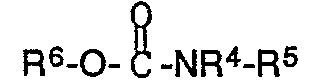
- (lVb);
- Verbindungen der Formel worin X -O- ist und Y und R3 zusammen den Rest eines aliphatischen Lactams darstellen, lassen sich durch Umsetzung von präpolymeren Alkoholen der Formel IIIc mit Urethanen der Formel IVb herstellen (Verfahren c)

- (IVb);
- Verbindungen der Formel I, worin X -O- ist und Y und R3 zusammen den Rest eines aliphatischen Lactams darstellen, lassen sich ferner durch Umsetzung von Chlorcarbonyloxyderivaten der Formel Illd mit H-aciden Verbindungen der Formel IVd herstellen (Verfahren d)

- (IIId),
- (IVd),
- in diesen Formeln IIIa bis IIId und IVa bis IVd besitzen Rl, R2, R3, X, Y und m die weiter oben definierte Bedeutung, R4 und R5 bilden zusammen mit dem gemeinsamen N-Atom den Rest eines aliphatischen Lactams und R6 ist ein als Abgangsgruppe fungierender Rest, beispielsweise Alkyl oder Aryl, insbesondere C1-C6Alkyl oder Phenyl.
- Der Rest R3 leitet sich von einer ausgewählten OH- oder NH-aciden Komponente ab. In der Regel ist R3 unsubstituiert oder der Rest trägt inerte Substituenten; Beispiele dafür sind Alkyl, Alkenyl, Alkinyl, Alkoxycarbonyl, Alkoxy oder Halogen.
- Leitet sich R3 von einem Monophenol ab, so handelt es sich dabei vorzugsweise um ein- oder mehrkernige carbocyclisch-aromatische Reste. Mehrkernige Reste können kondensiert sein. Zweikernige Reste sind bevorzugt über ein Brückenglied miteinander verbunden. Beispiele für Brückenglieder sind weiter unten aufgezählt.
- Beispiele für Phenole mit kondensierten Resten sind Hydroxynaphthaline oder -anthracene.
- Leitet sich R3 von einem Monophenol ab, so besitzt die Gruppierung -Y-R3 vorzugsweise die Struktur der Formel V oder VI

- Besonders bevorzugt sind die Phenolreste der Formeln V oder VI, worin n 0 oder 1 ist und R7 C1-C6Alkyl, Allyl, Prop-1-enyl oder C1-C6Alkoxy bedeutet.
- Von den Phenolresten der Formel VI sind diejenigen besonders bevorzugt, worin die freie Valenz sich in 4-Stellung zur Brücke Z befindet.
- Weiter bevorzugt sind Reste der Formel VI, worin Z ausgewählt wird aus der Gruppen bestehend aus -CH2-, -C(CF3)2-, -O-, -SOz-, einer direkten C-C-Bindung und besonders -C(CH3)2-, und worin n 0 ist. Bevorzugte Monophenole sind Phenol, o-, m- oder p-Kresol, 4-Hydroxybiphenyl, 4-Hydroxyphenoxy-benzol, 4-Hydroxyphenylsulfonyl-benzol, 4-Hydroxyphenylmethyl-benzol oder 4-Hydroxybenzoesäurealkylester, beispielsweise der Methyl- oder Nonylester.
- Bedeutet R7 C1-C20Alkyl bzw. C1-C20Alkoxy oder R8 C1-C20Alkyl, so handelt es sich dabei um einen geradkettigen oder verzweigten Rest.
- Beispiele dafür sind Methyl, Ethyl, n-Propyl, Isopropyl, n-Butyl, Isobutyl, tert.Butyl, n-Pentyl, n-Hexyl, 2-Ethylbutyl, n-Heptyl, n-Octyl, 2-Ethylhexyl, n-Nonyl, n-Decyl, n-Undecyl, n-Dodecyl, n-Tetradecyl, n-Pentadecyl, n-Hexadecyl, n-Octadecyl oder n-Eicosyl bzw. die entsprechenden Alkoxyderivate.
- Vorzugsweise ist R7 C1-C6Alkyl oder C1-C6Alkoxy, besonders bevorzugt geradkettiges C1-C6Alkyl oder C1-C6Alkoxy und ganz besonders bevorzugt Methyl oder Methoxy.
- Bedeuten irgendwelche Reste C1-C6Alkyl, so handelt es sich dabei vorzugsweise um geradkettige Reste, also um Methyl, Ethyl, n-Propyl, n-Butyl, n-Pentyl oder n-Hexyl, ganz besonders jedoch Methyl.
- R7 bedeutet als C2-C20Alkenyl beispielsweise Vinyl, Allyl, 1-Propenyl, 1-Butenyl, 1-Pentenyl, 1-Hexenyl, Pentadec-8-enyl, Pentadec-8,11-dienyl oder Pentadec-8,11,14-trienyl. Bevorzugt werden Vinyl, 1-Propenyl und Allyl, ganz besonders Allyl.
- R7 bedeutet als C2-CsAlkinyl beispielsweise Ethinyl, Propargyl, 1-Butinyl, 1-Pentinyl oder 1-Hexinyl. Bevorzugt wird Propargyl.
- Ist R7 Halogen, so kann es sich dabei um Fluor, Chlor, Brom oder lod handeln. Bevorzugt werden Chlor oder Brom, insbesondere Brom.
- Bilden R9 und R10 zusammen mit dem gemeinsamen C-Atom einen cycloaliphatischen Rest, so handelt es sich dabei beispielsweise um einen Cyclopentyliden-, Cyclohexyliden-, Cycloheptyliden-, Cyclooctyliden- oder Cyclododecylidenrest. Bevorzugt werden Cyclohexyliden und Cyclododecyliden.
- Bilden Y und R3 zusammen den Rest eines aliphatischen Lactams, so handelt es sich bei der Gruppierung -Y-R3 in der Regel um ein Lactam aus einer aliphatischen y-, δ- oder ε-Aminocarbonsäure; insbesondere um einen Rest der Formel VII

- Bevorzugt sind Reste der Formel VII, worin p 5 ist.
- Leitet sich R3 von einem aliphatischen oder cycloaliphatischen Mercaptoalkohol ab, so handelt es sich bei der Gruppierung -Y-R3 in der Regel um einen Rest der Formel VIII -O-R14-SH (VIII), worin R14 C2-C12Alkylen oder Cycloalkylen mit 5 bis 7 Ringkohlenstoffatomen bedeutet.
- Die Reste R14 können gegebenenfalls durch ein bis drei Alkyl- oder Alkoxygruppen substituiert sein oder durch Sauerstoff- oder Schwefelatome in der Alkylenkette unterbrochen sein.
- Beispiele für Alkylenreste R14 sind Ethylen, Trimethylen, Tetramethylen, Pentamethylen, Hexamethylen, Heptamethylen, Octamethylen, Nonamethylen, Decamethylen, Undecamethylen, Dodecamethylen,


- Bei dem Isocyanat der Formel Illa handelt es sich entweder um ein Präpolymeres a1), das sich ableitet von einer Addition eines Polyisocyanats, bevorzugt eines Di- oder Triisocyanats, ganz besonders bevorzugt eines Diisocyanats, an eine präpolymere Polyhydroxyl- oder Polysulfhydrylkomponente oder an ein Gemisch solcher präpolymeren Komponenten gegebenenfalls in Kombination mit Kettenverlängerern (kurzkettigen Polyhydroxyl-, Polysulfhydryl- oder Polyaminverbindungen), oder um ein präpolymeres Polyisocyanat a2), das sich ableitet von einem präpolymeren Polyamin der Formel Illb, insbesondere von einem präpolymeren Polyetheramin.
- Präpolymere Komponenten zur Herstellung von a1) können Kondensations-oder Additionspolymere sein, die gegebenenfalls aufgepfropfte 1-Oiefine enthalten können, wobei besagte 1-Oiefine neben unpolaren auch polare Gruppen, wie Nitril-, Ester- oder Amidgruppen aufweisen können. Beispiele für solche Präpolymere sind Polyester, Polyether, Polythioether, Polyacetale, Polyamide, Polyesteramide, Polyurethane, Polyharnstoffe, Alkydharze, Polycarbonate oder Polysiloxane, sofern diese Verbindungen hydroxyl- oder sulfhydryl-terminiert sind, zu in Epoxidharzen löslichen oder dispergierbaren Verbindungen der Formel führen und diesen Eiastomereigenschaften gemäss der obigen Definition verleihen.
- Bevorzugt sind Polyether oder segmentierte Präpolymere enthaltend Polyethersegmente, wie Polyetheramide, Polyether-urethane oder Polyether-harnstoffe.
- Diese Verbindungen sind dem Fachmann auf dem Gebiet der Polyurethanchemie als Aufbaukomponenten für Polyurethane bekannt. Sie können linear oder verzweigt sein; bevorzugt werden lineare Typen. Bevorzugte Aufbaukomponenten für Präpolymere a1) sind hydroxyl-terminierte Präpolymere mit mittleren Molekulargewichten (Zahlenmittel) von 150-10000, ganz besonders von 500-3000.
- Bei der Herstellung der präpolymeren Polyisocyanate a1) können neben den hydroxyl- oder sulfhydryl-terminierten Präpolymeren auch noch Kettenverlängerer anwesend sein.
- Solche Monomeren sind bevorzugt difunktionell oder trifunktionell.
- Verwendet man tri- oder höherfunktionell hydroxyl- oder sulfhydrylterminierte Präpolymere oder tri- oder höherfunktionelle Kettenverlängerer zur Herstellung der Komponente a1), so sind die Aufbaukomponenten so zu wählen, dass ein in organischen Lösungsmitteln lösliches oder zumindest quellbares Addukt a1) entsteht. Der Vernetzungsgrad bei der Verwendung höherfunktioneller Aufbaukomponenten kann in an sich bekannter Weise durch Art und Mengenverhältnisse dieser Komponenten geregelt werden. Durch den Vernetzungsgrad können auch die Elastomereigenschaften in an sich bekannter Weise variiert werden.
- So wird bei Einsatz von difunktionellen Präpolymeren und tri- oder höherfunktionellen Kettenverlängerern in der Regel nur ein geringer Anteil der höherfunktionellen Komponente eingesetzt, während bei der Kombination von di- und tri oder höherfunktionellen Präpolymeren in der Regel eine grössere Menge des höherfunktionellen Kettenverlängerers anwesend sein kann, ohne dass eine übermässige Vernetzung eintritt. Ferner wird der Vernetzungsgrad auch von der Funktionalität des Polyiso cyanates abhängen. So wird man bei Anwesenheit von tri- oder höherfunktionellen hydroxyl- oder sulfhydryl-terminierten Aufbaukomponenten in der Regel Diisocyanate einsetzen, während man bei der Verwendung von difunktionellen hydroxyl- oder sulfhydryl-terminierten Aufbaukomponenten auch höherfunktionelle Isocyanate verwendet. Beispiele für präpolymere Aufbaukomponenten zur Herstellung von Polyisocyanaten a1) sind hydroxylterminierte Polyether, insbesondere solche Polyether, die zu wasserunlöslichen Verbindungen der Formel I führen. Dazu zählen beispielsweise die Polyalkylenetherpolyole, die durch anionische Polymerisation, Copolymerisation oder Blockcopolymerisation von Alkylenoxiden, wie Ethylenoxid, Propylenoxid oder Butylenoxid, mit di-oder polyfunktionellen Alkoholen, wie 1,4-Butandiol, 1,1,1-Trimethylolethan, 1,1,1-Trimethylolpropan, 1,2,6-Hexantriol, Glycerin, Pentaerithrit oder Sorbit, oder mit Aminen, wie Methylamin, Ethylendiamin oder 1,6-Hexylendiamin, die Starterkomponenten oder durch kationische Polymerisation oder Copolymerisation cyclischer Ether, wie Tetrahydrofuran, Ethylenoxid oder Propylenoxid mit sauren Katalysatoren, wie BF3·Etherat oder durch Polykondensation von unter Wasserabspaltung polykondensierbaren Glykolen, wie 1,6-Hexandiol, in Gegenwart saurer Veretherungskatalysatoren, wie p-Toluolsulfonsäure, erhalten werden. Ferner kann man auch Oxalkylierungsprodukte von Phosphorsäure oder phosphoriger Säure mit Ethylenoxid, Propylenoxid, Butylenoxid oder Styroloxid verwenden.
- Weitere bevorzugte hydroxyl-terminierte Polyether enthalten aufgepfropfte 1-Olefine, wie Acrylnitril, Styrol oder Acrylsäureester. Dabei beträgt der Gewichtsanteil der Pfropfkomponente in der Regel 10-50%, inbesondere 10-30 o/o, bezogen auf die Menge des eingesetzten Polyethers.
- Weitere Beispiele für präpolymere Aufbaukomponenten zur Herstellung von Polyisocyanaten a1) sind hydroxyl-terminierte Polyesterpolyole, die sich von Di- und/oder Polycarbonsäuren und Di- und/oder Polyolen, bevorzugt von Dicarbonsäuren und Diolen ableiten.
- Beispiele für solche Polykondensate sind die hydroxyl-terminierten Polyester, die sich durch Polykondensation von Adipinsäure, Sebazinsäure, Azelainsäure, Dimer- und Trimerfettsäuren, Phthalsäure, Isophthalsäure, Terephthalsäure, Tetrahydrophthalsäure, Hexahydrophthalsäure und Endomethylentetrahydrophthalsäure mit Propylenglykol, 1,4-Butandiol, 1 ,6-Hexandiol, Di-, Tri- und Tetraethylenglykol, Di-, Tri- und Tetrapropylenglykol, Di-, Tri- und Tetrabutylenglykol, 2,2-Dimethylpropan-1,3-diol, 1,1,1-Trimethylolpropan, 1,1,1-Trimethylolethan und 1,2,6-Hexantriol erhalten lassen.
- Weitere geeignete präpolymere Aufbaukomponenten zur Herstellung von Polyisocyanaten a1) sind hydroxyl-terminierte Polybutadiene, die insbesondere zusammen mit hydroxyl-terminierten Polyethern zur Bildung der Komponente a1) eingesetzt werden.
- Weitere Beispiele für geeignete präpolymere Aufbaukomponenten zur Herstellung von Polyisocyanaten a1) sind Polymerisationsprodukte von Lactonen, beispielsweise von s-Caprolactonen; oder Polyalkylenthioetherpolyole, beispielsweise die Polykondensationsprodukte des Thiodiglykols mit sich und mit Diolen und/oder Polyolen, wie beispielsweise 1,6-Hexan-diol, Triethylenglykol, 2,2-Dimethyl-1,3-propandiol oder 1,1,1-Trimethylolpropan.
- Bevorzugte präpolymere Aufbaukomponenten zur Herstellung von Polyisocyanaten a1) sind hydroxyl-terminierte Polyether der Polyester.
- Weitere bevorzugte präpolymere Aufbaukomponenten zur Herstellung von Polyisocyanaten a1) sind Gemische von hydroxyl-terminiertem Polybutadien und hydroxyi-terminiertem Polyalkylenglykol oder hydroxy-terminierte Polyalkylenglykole enthaltend aufgepfropfte 1-Olefine, insbesondere Styrol oder Acrylsäurederivate, wie Acrylsäureester oder Acrylnitril.
- Ganz besonders bevorzugte präpolymere Aufbaukomponenten zur Herstellung von Polyisocyanaten a1) sind hydroxyl-terminierte Polyether, insbesondere dihydroxyl-terminierte Polyalkylenglykole. Kettenverlängerer zur Herstellung von der präpolymeren Aufbaukomponente für a1) sind an sich bekannt. Beispiele dafür sind die weiter oben zur Herstellung der hydroxyl-terminierten Polyether erwähnten Diole und Polyole, insbesondere die Diole und Triole, wie 1,4-Butandiol, 1,1,1-Trimethylolpropan oder Hydrochinon-(2-hydroxyethylether), oder auch Diamine, wie Diaminoethan, 1,6-Diaminohexan, Piperazin, 2,5-Dimethylpiperazin, 1-Amino-3-aminomethyl-3,5,5-trimethylcyclohexan, 4,4'-Diaminocyclohexylmethan, 1,4-Diaminocyclohexan und 1,2-Propylendiamin oder auch Hydrazin, Aminosäurehydrazide, Hydrazide von Semicarbazidocarbonsäuren, Bis-hydrazide und Bis-semicarbazide.
- Vorzugsweise verwendet man kurzkettige Diole oder Triole als Kettenverlängerungsmittel.
- Das präpolymere Polyisocyanat a2) lässt sich in an sich bekannter Weise aus amino-terminierten Präpolymeren der Formel lllb, insbesondere aus amino-terminierten Polyethern durch Umsetzung mit Phosgen oder mit Polyisocyanaten, bevorzugt mit Di- oder Triisocyanaten, besonders bevorzugt mit Diisocyanaten erhalten. Die amino-terminierten Präpolymeren enthalten neben den Aminogruppen im allgemeinen keine weiteren Reste mit aktiven Wasserstoffatomen. Präpolymere mit terminalen Aminogruppen leiten sich im allgemeinen von den weiter oben als Aufbaukomponente für a1) beschriebenen hydroxyl-terminierten Kondensations- oder Additionspolymeren, insbesondere von Polyethern ab.
- Sie lassen sich erhalten, indem man besagte Kondenations- oder Additionspolymere enthaltend sekundäre Hydroxylgruppen mit Ammoniak umsetzt oder indem man besagte Kondensations- oder Additionspolymere enthaltend primäre Hydroxylgruppen, beispielsweise Polybutylenglykol, mit Acrylnitril umsetzt, und diese Produkte anschliessend hydriert.
- Präpolymeres, isocyanat-terminiertes Poly-THF lässt lassen sich auch gemäss S. Smith et al. in Macromol. Sci. Chem., A7(7), 1399-1413 (1973) durch Abbrechen eines difunktionellen lebenden kationischen THF-Polymers mit Kaliumcyanat erhalten.
- Als Polyisocyanat zur Herstellung der Komponenten a1) bzw. a2) verwendet man in der Regel aliphatische, cycloaliphatische, aromatische oder araliphatische Di-, Tri- oder Tetraisocyanate oder in solche Isocyanate überführbare Vorläufer.
- Bevorzugt werden die aliphatischen, cycloaliphatischen oder araliphatischen Di- oder Triisocyanate, ganz besonders die aliphatischen oder cycloaliphatischen Diisocyanate.
- Bei den bevorzugten aliphatischen Diisocyanaten handelt es sich in der Regel um geradkettige oder verzweigte Alkylen-a,ro-diisocyanate. Die Alkylenketten können gegebenenfalls durch Sauerstoff- oder Schwefelatome unterbrochen sein und können gegebenenfalls ethylenisch ungesättigte Bindungen enthalten. Bevorzugt werden α,ω-Diisocyanate mit geradkettigen, gesättigten C2-C12 Alkylenresten.
- Beispiele für solche Reste sind weiter oben bereits für R14 definiert.
- Bei den bevorzugten cycloaliphatischen Diisocyanaten handelt es sich in der Regel um Derivate, die sich von gegebenenfalls substituierten Cyclopentanen, Cyclohexanen oder Cycloheptanen ableiten. Es können auch zwei solcher Ringe über ein Brückenglied miteinander verbunden sein.
- Beispiele für solche Reste sind 1,3- und 1,4-Cyclohexylen oder Dodecahydrodiphenyimethan-4,4'-dlyi.
- Ferner kann man Di- oder Triisocyanate verwenden, die sich von Dimer-oder Trimerfettsäuren ableiten. Diese Verbindungen lassen sich in an sich bekannter Weise aus den Fettsäuren durch Umlagerung in die entsprechenden Di- oder Triisocyanate erhalten (Hoffmann-, Curtius- oder Lossen-Umlagerungen). Bevorzugte aromatische Diisocyanate leiten sich von einkernigen oder zweikernigen aromatischen Resten ab. Sie besitzen beispielsweise die Strukturen V oder VI, bei denen die phenolische OH- Gruppe durch eine NCO-Gruppe ersetzt ist und wobei eine zweite NCO-Gruppe an den aromatischen Kern gebunden ist. Beispiele für aromatische Diisocyanatreste sind 1,2-, 1,3- oder 1,4-Phenylen oder 4,4'-Diphenylmethan.
- Beispiele für araliphatische Diisocyanatreste sind 1,2- und 1,4-Xylylen.
- Spezifische Beispiele für geeignete Polyisocyanate sind 2,4-Diisocyanatotoluol sowie dessen technische Gemische mit 2,6-Diisocyanatotoluol; 2,6-Diisocyanatotoluol, 1,5-Diisocyanatonaphthalin, 4,4'-Diisocyanatodiphenylmethan sowie technische Gemische verschiedener Diisocyanatodiphenylmethane (beispielsweise der 4,4'-und 2,4'-lsomeren), urethanisiertes 4,4'-Diisocyanatodiphenylmethan, carbodiimidisiertes 4,4'-Diisocyanatodiphenylmethan, das Uretdion des 2,4-Diisocyanatotoluols, Triisocyanatotriphenylmethan, das Addukt aus Diisocyanatotoluol und Trimethylolpropan, das Trimerisat aus Diisocyanatotoluol, Diisocyanato-m-xylylen, N,N'-Di-(4-methyl-3-isocyanatophenyl)-harnstoff, Mischtrimerisationsprodukte von Diisocyanatotoluol und 1,6-Diisocyanatohexamethylen, 1,6-Diisocyanatohexan, 3,5,5-Trimethyl-l-isocyanato-3-isocyanatomethylcyclohexan (Isophorondiisocyanat), N,N',N'''-Tri-(6-isocyanatohexyl)-biuret, 2,2,4-Trimethyi-1,6-diisocyanatohexan, 1-Methyl-2,4-diisocyantocyclohexan, Dimeryldiisocyanat, 4,4'-Diisocyanatodicyclohexylmethan, trimeres Isophorondiisocyanat, trimeres Hexandiisocyanat und 2,6-Diisocyanatohexansäuremethylester.
- Die Herstellung der Komponente a1) bzw. a2) erfolgt in an sich bekannter Weise durch Umsetzung der hydroxyl-, sulfhydryl- oder amino-terminierten elastomeren Präpolymerkomponente mit einem Polyisocyanat oder einem Gemisch dieser Komponenten. Die Umsetzungen können gegebenenfalls in Gegenwart eines Kettenverlängerers vorgenommen werden.
- Die Herstellung der Komponente a1) bzw. a2) erfolgt in Substanz oder in gegenüber Isocyanaten inerten Lösungsmitteln.
- Beispiele für inerte Lösungsmittel sind Ester, wie Ethylacetat, Butylacetat, Methylglycolacetat und Ethylglykolacetat; Ketone, wie Methylethylketon oder Methylisobutylketon; Aromaten, wie Toluol oder Xylol oder halogenierte Kohlenwasserstoffe, wie Trichlorethan oder Dichlormethan.
- Nimmt man eine bestimmte zusätzliche Kettenverlängerungsreaktion über Urethan- oder Harnstoffgruppen in Kauf oder ist diese sogar erwünscht, so setzt man die hydroxyl-, sulfhydryl- oder aminogruppenhaltigen Präpolymeren und die gegebenenfalls anwesenden Monomeren gegebenenfalls zunächst bei 0-25°C und unter Kühlung und später gegebenenfalls über mehrere Stunden unter Erwärmung auf vorzugsweise 50-120° C in einem NCO/OH- bzw. NCO/SH- bzw. NCO/NH2-Verhältnis von 1,5-2,5, bevorzugt 1,8-2,2, mit dem Di-oder Polyisocyanat um.
- Ist eine Kettenverlängerungsreaktion nicht erwünscht, so verwendet man in der Regel einen wesentlich grösseren Ueberschuss an Di- oder Polyisocyanat, beispielsweise ein NCO/OH-, NCO/SH- oder NCO/NH2-Verhältnis von 3-5, und keinen Kettenverlängerer, und verfährt ansonsten wie bei niedrigen NCO/OH-, NCO/SH- oder NCO/NH2-Verhältnissen beschrieben. Nach der Reaktion wird gegebenenfalls das überschüssige Di- oder Polyisocyanat entfernt, beispielsweise durch Dünnschichtdestillation oder durch Lösungsmittelextraktion.
- Die Umsetzung der hydroxyl-, sulfhydryl- oder amino-terminierten Präpolymeren mit Polyisocyanaten wird in Gegenwart an sich bekannter Katalysatoren durchgeführt.
- Beispiele dafür sind Diazabicyclooctan, Dibutylzinndilaurat oder Zinn-II-octoat. Diese Katalysatoren werden in den üblichen Mengen eingesetzt, beispielsweise in Mengen von 0,001-2 Gew.-%, bezogen auf die Menge an Polyisocyanat.
- Die Umsetzung des Polyisocyanats lila mit der H-aciden Komponente IVa erfolgt in Analogie zur oben beschriebenen Umsetzung der hydroxyl-, sulfhydryl- oder amino-terminierten Aufbaukomponente mit dem Polyisocyanat.
- Die H-acide Komponente IVa wird dabei bevorzugt in einer solchen Menge vorgelegt, dass die freien NCO-Gruppen im wesentlichen durch die Reaktion verbraucht werden.
- Sollen phenol-verkappte Verbindungen der Formel I hergestellt werden, so lässt sich als C-H acide Komponente IVa auch ein Gemisch aus einem oder mehreren Monophenolen und einem kleinen Anteil an Bisphenolen einsetzen. Ein Beispiel für solch ein Gemisch ist Cashewnussöl oder Nonylphenol/Bisphenol A. Dabei werden die Mengen an Ausgangsprodukten IIIa und IVa in der Regel so gewählt, dass eine Kettenverlängerung über die Bisphenolkomponente abläuft und ein im wesentlichen monophenol-verkapptes Derivat der Formel I entsteht. Es ist aber auch möglich, dass kleine Anteile an freien phenolischen Hydroxylgruppen in dem Gemisch aus Verbindungen der Formel I auftreten.
- Verwendet man beim Verkappen der Präpolymeren einen Ueberschuss an Phenol, dann wird in der Regel das freie Phenol durch Reaktion mit Epoxidharzen umgesetzt.
- Die Umsetzung von präpolymeren Polyisocyanaten IIIa mit Mercaptoalkoholen IVa wird in der Regel in Gegenwart von Sn-haltigen Katalysatoren, wie Dibutylzinndilaurat oder Zinn-II-octoat, durchgeführt.
- Bei den amino-terminierten Präpolymeren Illb in Verfahren b) bzw. den hydroxyl-terminierten Präpolymeren IIIc in Verfahren c) handelt es sich in der Regel um die präpolymeren Polyamine bzw. Polyhydroxylverbindungen, die bereits bei Verfahren a) beschrieben wurden, und die dort zur Herstellung der präpolymeren Polyisocyanatkomponenten Illa eingesetzt wurden.
- Die präpolymeren Chlorcarbonyloxyderivate IIId in Verfahren d) lassen sich aus den hydroxyl-terminierten Präpolymeren IIIc durch Umsetzung mit Phosgen erhalten.
- Die Urethane IVb leiten sich von Lactamen H-NR4-R5 ab, worin R4 und R5 die oben definierte Bedeutung besitzen. Zur Herstellung dieser Urethane verkappt man diese Lactame in an sich bekannter Weise mit R6-0-CO-CI. Dabei besitzt R6 die oben definierte Bedeutung.
- Die Umsetzung der Komponenten lllb und IVb bzw. IIIc und IVb bzw. IIId und IVd erfolgt im allgemeinen durch Vorgabe eines stöchiometrischen Verhältnisses beider Komponenten oder eines geringen Ueberschusses an Komponente IVb oder IVd und durch Erhitzen des Gemisches, so dass praktisch alle freien reaktiven Gruppen der Komponente IIIb, IIIc oder IIId verkappt werden. Die Reaktion wird bevorzugt in einem Lösungsmittel ausgeführt. Beispiele dafür sind weiter oben gegeben.
- Das Molekulargewicht (Zahlenmittel) der Verbindungen der Formel I liegt üblicherweise im Bereich von 500-50'000, vorzugsweise im Bereich von 500-10'000, ganz besonders bevorzugt im Bereich von 500-3000. Die Viskosität dieser Verbindungen beträgt in der Regel weniger als 150000 mPas, vorzugsweise weniger als 100000 mPas (gemessen bei 80°C mit dem Epprecht Viskosimeter).
- Die Strukturen der Verbindungen der Formel I, welche sich von der Umsetzung gemäss Verfahren a), b), c) oder d) ableiten, werden sich, je nach der Funktionalität des Präpolymerrestes R1, unterscheiden.
- In Verfahren a) wird diese Funktionalität beispielsweise durch die Funktionalität der hydroxyl-, sulfhydryl-oder amino-terminierten Präpolymeren, durch gegebenenfalls eingesetzte Kettenverlängerer, die Funktionalität des zur Herstellung von Illa verwendeten Isocyanats und die Mengenverhältnisse der einzelnen Reaktanden bestimmt. Bevorzugte Komponenten B) sind Verbindungen der Formel I, worin X -NH-ist und Y
- -O- bedeutet.
- Ebenfalls bevorzugte Komponente B) sind Verbindungen der Formel 1, die erhältlich sind durch Umsetzung von
- a) einem präpolymeren Polyisocyanat, welches
- a1) ein Addukt eines Polyisocyanats an eine präpolymere Polyhydroxyl-oder Polysulfhydrylverbindung oder an ein Gemisch solcher Verbindungen gegebenenfalls in Kombination mit einem Kettenverlängerer ist, oder
- a2) sich ableitet von einem präpolymeren Polyetheramin, mit
- b) mindestens einem Monophenol.
- Besonders bevorzugt werden Verbindungen der Formel I, worin Komponente a1) ein Addukt eines Polyisocyanats an ein hydroxyl-terminiertes Präpolymeres mit einem mittleren Molekulargewicht von 150 bis 10000 ist.
- Insbesondere bevorzugt werden Verbindungen der Formel worin die Aufbaukomponente zur Herstellung von Komponente a1) ein hydroxyl-terminierter Polyether ist.
- Diese Aufbaukomponente zur Herstellung von Komponente a1) wird vorzugsweise in Kombination mit Kettenverlängern eingesetzt.
- Ganz besonders bevorzugt werden Verbindungen der Formel I, worin Komponente b) ein Gemisch eines Monophenols mit einer kleineren Menge eines Bisphenols, insbesondere Cashewnussöl, ist.
- Ganz besonders bevorzugt werden Verbindungen der Formel 1, worin das Polyisocyanat zur Herstellung von Komponente a1) ein aliphatisches, cycloaliphatisches, aromatisches oder araliphatisches Di- oder Triisocyanat ist.
- In einer bevorzugten Ausführungsform arbeitet man bei der Herstellung der Komponente a1) mit einem hydroxyl-terminierten Polyether oder Polyester in Abwesenheit eines Kettenverlängerers und mit einer dem OH-Gehalt äquivalenten oder überschüssigen Menge an Polyisocyanat, verkappt das Isocyanat-Präpolymere anschliessend mit einem Monophenol und erhält Polyurethane der Formel IX

- Bevorzugt werden Zusammensetzungen enthaltend als Komponente B) Verbindungen der Formel IX.
- Der Index m ist vorzugsweise 2 oder 3, ganz besonders bevorzugt 2. Der Index r ist vorzugsweise 1. Bevorzugte Komponenten B) sind Verbindungen der Formel IX, worin m 2 oder 3 bedeutet, r 1 ist, -0-R15 ein Rest der Formel V oder VI ist, R16 sich ableitet von einem aliphatischen, cycloaliphatischen oder aromatischen Diisocyanat und R17 ein zwei- oder dreiwertiger Rest eines hydroxyl-terminierten Polyesters oder Polyethers mit einem Molekulargewicht von 150 bis 10000, insbesondere 500 bis 10000, nach dem Entfernen der endständigen Hydroxylgruppen ist.
- Ganz besonders bevorzugte Komponenten B) sind Verbindungen der Formel IX, worin m 2 oder 3 bedeutet, r 1 ist, -0-R15 ein Rest der Formel V ist, R16 sich ableitet von einem aliphatischen oder cycloaliphatischen Diisocyanat und R17 ein zwei- oder dreiwertiger Rest eines Polyalkylenetherpolyols mit einem Molekulargewicht von 1000 bis 3000 nach dem Entfernen der endständigen Hydroxylgruppen ist.
- Zu den besonders bevorzugten Komponenten B) dieses zuletzt definierten Typs zählen diejenigen, worin m 2 bedeutet und R17 ein Strukturelement der Formel X ist

- Beispiele für Strukturelemente der Formel X sind -(CH2-CH(CH3)-O)x-CH2CH(CH3)- ,

- Zu den ebenfalls bevorzugten Komponenten B) dieser Erfindung zählen Verbindungen, die erhältlich sind durch Umsetzung von
- a1) einem Addukt einer im wesentlichen äquivalenten Menge eines Diisocyanates mit einem Gemisch aus einem di- oder tri-hydroxyl-terminierten Polyether oder Polyester und weniger als 1 Mol-%, bezogen auf das hydroxyl-terminierte Präpolymere, eines kurzkettigen Diols oder Triols und
- b) einer dem NCO-Gehalt im wesentlichen äquivalenten Menge eines Monophenols. In einer weiteren bevorzugten Ausführungsform arbeitet man bei der Herstellung der Komponente a2) mit einem amino-terminierten Polyalkylenether, setzt diesen in Abwesenheit eines Kettenverlängerers mit einer dem NH2-Gehalt äquivalenten oder überschüssigen menge an Diisocyanat oder mit Phosgen um und verkappt das erhaltene Polvisocyanat mit einem Monophenol IVa. Man erhält so eine Verbindung der Formel XI

- Zusammensetzungen enthaltend Verbindungen der Formel XI als Komponente B) werden bevorzugt.
- Besonders bevorzugte Zusammensetzungen enthalten Verbindungen der Formel XI als Komponente B), worin m 2 oder 3 bedeutet, -O-R15 ein Rest der Formel V oder VI ist, R18 sich ableitet von einem aliphatischen, cycloaliphatischen oder aromatischen Diisocyanat und R19 ein zwei- oder dreiwertiger Rest eines amino-terminierten Polyalkylenethers mit einem Molekulargewicht von 150 bis 10000 nach dem Entfernen der endständigen Aminogruppen ist.
- Ganz besonders bevorzugte Zusammensetzungen enthalten Verbindungen der Formel XI als Komponente B), worin m 2 bedeutet, -O-R15 ein Rest der Formel V ist, t 0 ist, und R19 sich ableitet von einem zweiwertigen amino-terminierten Polyalkylenether mit einem Molekulargewicht von 500 bis 6000.
- Ganz besonders bevorzugte Zusammensetzungen enthalten Verbindungen der Formel XI als Komponente B), worin t 1 ist, m 2 bedeutet, -O-R15 ein Rest der Formel V ist, R18 der zweiwertige Rest eines aliphatischen oder cycloaliphatischen Diisocyanats nach dem Entfernen der Isocyanatgruppen ist und R19 sich ableitet von einem zweiwertigen amino-terminierten Polyalkylenether mit einem Molekulargewicht von 500 bis 6000.
- Zu den besonders bevorzugten Komponenten B) dieser beiden zuletzt definierten Typen zählen diejenigen, worin R19 ein Strukturelement der Formeln XII, XIII, XIV, XV oder XVI ist


- Die erfindungsgemässen Zusammensetzungen aus A) und B) lassen sich mit Epoxidharzen zu gehärteten Produkten mit den weiter oben geschilderten vorteilhaften Eigenschaften verarbeiten.
- Die Erfindung betrifft daher auch Zusammensetzungen enthaltend Komponenten A) und B), wie oben definiert, und C) ein Epoxidharz mit wenigstens zwei 1,2-Epoxidgruppen pro Molekül; oder enthaltend ein Addukt aus Komponenten A) und einem Epoxidharz, sowie Komponente B) und gegebenenfalls Komponente C); oder enthaltend Komponente A), ein Addukt aus Komponente B) enthaltend freie Mercaptoendgruppen und einem Epoxidharz sowie gegebenenfalls Komponente C) ; oder enthaltend ein Addukt aus Komponente A) und einem Epoxidharz, ein Addukt aus Komponente B) enthaltend freie Mercaptoendgruppen und einem Epoxidharz, sowie gegebenenfalls Komponente C).
- Die Herstellung der erfindungsgemässen Zusammensetzungen kann in üblicher Weise durch Vermischen der Komponenten mit Hilfe bekannter Mischaggregate, wie Rührer, Kneter oder Walzen, erfolgen.
- Als Komponente C) oder zur Herstellung der Addukte kann im Prinzip jede in der Technik der Epoxidharze übliche Verbindung eingesetzt werden.
- Beispiele für Epoxidharze sind:
- I) Polyglycidyl- und Poly-(ß-methylglycidyl)-ester erhältlich durch Umsetzung einer Verbindung mit mindestens zwei Carboxylgruppen im Molekül und Epichlorhydrin bzw. β-Methyl-epichlorhydrin. Die Umsetzung erfolgt zweckmässig in der Gegenwart von Basen.
- Als Verbindung mit mindestens zwei Carboxylgruppen im Molekül können aliphatische Polycarbonsäuren verwendet werden. Beispiele für diese Polycarbonsäuren sind Oxalsäure, Bernsteinsäure, Glutarsäure, Adipinsäure, Pimelinsäure, Korksäure, Azelainsäure oder dimerisierte bzw. trimerisierte Linolsäure.
- Es können aber auch cycloaliphatische Polycarbonsäuren eingesetzt werden, wie beispielsweise Tetrahydrophthalsäure, 4-Methyltetrahydrophthalsäure, Hexahydrophthalsäure oder 4-Methylhexahydrophthalsäure.
- Weiterhin können aromatische Polycarbonsäuren Verwendung finden, wie beispielsweise Phthalsäure, Isophthalsäure oder Terephthalsäure.
- II) Polyglycidyl- oder Poly-(ß-methylglycidyl)-ether erhältlich durch Umsetzung einer Verbindung mit mindestens zwei freien alkoholischen Hydroxygruppen und/oder phenolischen Hydroxygruppen und einem geeignet substituierten Epichlorhydrin unter alkalischen Bedingungen, oder in Anwesenheit eines sauren Katalysators und anschliessender Alkalibehandlung.
- Ether dieses Typs leiten sich beispielsweise ab von acyclischen Alkoholen, wie Ethylenglykol, Diethylenglycol und höheren Poly-(oxyethylen)-glycolen, Propan-1,2-diol oder Poly-(oxypropylen)-glycolen, Propan-1,3-diol, Butan-1,4-diol, Poly-(oxytetramethylen)-glycolen, Pentan-1,5-diol, Hexan-1,6-diol, Hexane-2,4,6-triol, Glyzerin, 1,1,1-Trimethylolpropan, Pentaerythrit, Sorbit, sowie von Polyepichlorhydrinen.
- Sie leiten sich aber auch beispielsweise ab von cycloaliphatischen Alkoholen wie 1,4-Cyclohexandimethanol, Bis-(4-hydroxycyclohexyl)-methan oder 2,2-Bis(4-hydroxycyclohexyl)-propan oder sie besitzen aromatische Kerne wie N,N-Bis-(2-hydroxyethyl)-anilin oder p,p'-Bis-(2-hydroxyethylamino)-diphenylmethan.
- Die Epoxidverbindungen können sich auch von einkernigen Phenolen ableiten wie beispielsweise von Resorcin oder Hydrochinon; oder sie basieren auf mehrkernigen Phenolen wie beispielsweise Bis-(4-hydroxyphenyl)-methan, 4,4'-Dihydroxydiphenyl, Bis-(4-hydroxyphenyl)-sulphon, 1,1,2,2-Tetrakis-(4-hydroxyphenyl)-ethan, 2,2-Bis-(4-hydroxyphenyl)-propan, 2,2-Bis-(3,5-dibrom-4-hydroxyphenyl)-propan sowie von Novolaken erhältlich durch Kondensation von Aldehyden wie Formaldehyd, Acetaldehyd, Chloral oder Furfuraldehyd mit Phenolen wie Phenol, oder mit Phenolen, die im Kern mit Chloratomen oder C1-CeAlkylgruppen substituiert sind, wie beispielsweise 4-Chlorphenol, 2-Methylphenol oder 4-tert.Butylphenol oder durch Kondensation mit Bisphenolen, so wie oben beschrieben.
- 111) Poly-(N-glycidyl) Verbindungen erhältlich durch Dehydrochlorierung der Reaktionsprodukte von Epichlorhydrin mit Aminen, die mindestens zwei Aminowasserstoffatome enthalten. Bei diesen Aminen handelt es sich zum Beispiel um Anilin, n-Butylamin, Bis-(4-aminophenyl)-methan, m-Xylylendiamin oder Bis-(4-methylaminophenyl)-methan.
- Zu den Poly-(N-glycidyl) Verbindungen zählen aber auch Triglycidylisocyanurat, N,N'-Diglycidylderivate von Cycloalkylenharnstoffen, wie Ethylenharnstoff oder 1,3-Propylenharnstoff, und Diglycidylderivate von Hydantoinen, wie von 5,5-Dimethylhydantoin.
-
- IV) Poly-(S-glycidyl) Verbindungen, beispielsweise Di-S-glycidylderivate, die sich von Dithiolen, wie beispielsweise Ethan-1,2-dithiol oder Bis-(4-merkaptomethylphenyl)-ether ableiten.
- V) Cycloaliphatische Epoxidharze, beispielsweise Bis-(2,3-epoxycyclopentyl)-ether, 2,3-Epoxicyclopentylglycidylether, 1,2-Bis-(2,3-epoxycyclopentyloxy)-ethan oder 3,4-Epoxycyclohexylmethyl-3',4'-epoxycyclohex- ancarboxylat.
- Es lassen sich aber auch Epoxidharze verwenden, bei denen die 1,2-Epoxidgruppen an unterschiedliche Heteroatome bzw. funktionelle Gruppen gebunden sind; zu diesen Verbindungen zählen beispielsweise das N,N,O-Triglycidylderivat des 4-Aminophenols, der Glycidylether-glycidylester der Salicylsäure, N-Glycidyl-N'-(2-glycidyloxypropyl)-5,5-dimethylhydantoin oder 2-Glycidyloxy-1,3-bis-(5,5-dimethyl-1-glycidylhydantoin-3-yl)-propan.
- Besonders bevorzugt als Epoxidharze werden Polyglycidylether von Bisphenolen, wie beispielsweise von 2,2-Bis-(4-hydroxyphenyl)-propan oder Bis-(4-hydroxyphenyl)-methan, von Novolaken, die durch Umsetzung von Formaldehyd mit einem Phenol gebildet werden, oder von den oben erwähnten aliphatischen Diolen, insbesondere von Butan-1,4-diol, sowie Addukte von Bisphenol A und glycidylisierten aliphatischen Diolen. Die erfindungsgemässen härtbaren Zusammensetzungen enthalten in der Regel noch zusätzliche dem Fachmann bekannte Härter D), gegebenenfalls in Kombination mit einem Beschleuniger E).
- Beispiele für Härter D) sind aliphatische, cycloaliphatische, aromatische und heterocyclische Amine, wie Bis-(4-aminophenyl)-methan, Anilin-Formaldehyd-Harze, Bis-(4-aminophenyl)-sulfon, Propan 1,3-diamin, Hexamethylendiamin, Diethylentriamin, Triethylentetramin, 2,2,4-Trimethylhexan-1,6-diamin, m-Xylylendiamin, Bis-(4-aminocyclohexyl)methan, 2,2-Bis-(4-aminocyclohexyl)-propan und 3-Aminomethyl-3,5,5-trimethylcyclohexylamin (Isophorondiamin); Polyaminoamide, wie beispielsweise solche aus aliphatischen Polyaminen und dimerisierten oder trimerisierten Fettsäuren; Polyphenole, wie Resorcin, Hydrochinon, 2,2-Bis(4-hydroxyphenyl)propan (Bisphenol A) und Phenol-Aldehyd-Harze; Polythiole, wie die im Handel unter der Bezeichnung "Thiokole®" erhältlichen Polythiole; Polycarbonsäure und ihre Anhydride, wie z.B. Phthalsäureanhydrid, Tetrahydrophthalsäureanhydrid, Hexahydrophthalsäureanhydrid, Hexachlorendomethylentetrahydrophthals- äureanhydrid, Pyromellitsäuredianhydrid, Benzophenon-3,3',4,4'-tetracarbonsäuredianhydrid, die Säuren der zuvorgenannten Ankatalytisch wirkende Härtungsmittel verwendet werden, wie beispielsweise tertiäre Amine [z.B. 2,4,6-Tris-(dimethylaminoethyl)phenol]; Imidazole oder Mannichbasen; Alkalimetallalkoholate (z.B. Na-Alkoholat von 2,4-Dihydroxy-3-hydroxymethylpentan); Zinnsalze von Alkansäuren (z.B. Zinnoctanoat); Friedel-Crafts-Katalysatoren, wie Bortrifluorid und Bortrichlorid und ihre Komplexe und Chelate, die durch Umsetzung von Bortrifluorid mit z.B. 1,3-Diketonen erhalten werden; sowie Amidine, vorzugsweise Dicyandiamid.
- Beispiele für Beschleuniger E) sind tertiäre Amine, deren Salze oder quaternäre Ammoniumverbindungen, wie Benzyldimethylamin, 2,4,6-Tris-(dimethyiaminomethyi)phenoi, 1-Methylimidazol, 2-Ethyl-4-methylimidazol, 4-Aminopyridin, Tripentylammoniumphenolat oder Tetramethylammoniumchlorid; oder Alkalimetallalkoholate, wie Na-Alkoholate von 2,4-Dihydroxy-3-hydroxymethylpentan; oder substituierte Harnstoffe, wie N-(4-Chlorphenyl)-N'N'-dimethylharnstoff oder N-(3-Chlor-4-methylphenyl)-N'N'-dimethylhamstoff (Chlortoluron).
- Je nach Anteil der Komponenten A) und B) lassen sich die Eigenschaften des gehärteten Endproduktes variieren.
- Die folgenden Prozentangaben beziehen sich jeweils auf das Gesamtgewicht der Komponenten A), B) und C).
- Wünscht man Produkte mit hoher Festigkeit, hoher Glasübergangstemperatur, hoher Schälfestigkeit, hoher Schlagzähigkeit und hoher Rissfortpflanzungsbeständigkeit (Risszähigkeit), so sollte der Anteil der Komponenten A) und B) in der Regel 60 Gew.% nicht überschreiten. Solche Systeme sind in der Regel heterogen. Die untere Grenze richtet sich nach den gewünschten Eigenschaften, beispielsweise der Schälfestigkeit. In der Regel sollten Komponenten A) und B) mehr als 5 Gew.%, bevorzugt mehr als 10 Gew.%, ausmachen.
- Wünscht man hingegen Produkte mit einer möglichst hohen Flexibilität, so sollten wenigstens 40 Gew.%, bevorzugt mehr als 60 Gew.%, an Komponenten A) und B) vorliegen.
- Wenn Komponente A) und/oder B) durch Adduktbildung mit einem Epoxidharz modifiziert worden ist, so ist eine separate Komponente C) nicht unbedingt erforderlich.
- Bei hochflexiblen Systemen modifiziert man Komponente A) bevorzugt durch Adduktbildung mit Epoxidharzen; besonders bevorzugt werden Addukte von flüssigen Acrylnitril-Butadien-Copolymeren mit gegenüber Epoxidharzen reaktiven Gruppen an Glycidylether von aliphatischen Diolen, wie 1,4-Butandiol oder 1,6-Hexandiol.
- Das Gewichtsverhältnis von A) zu B) kann in weiten Grenzen variiert werden. Bevorzugter Bereich von A) zu B) ist 50:1 bis 1:50, besonders bevorzugt ist 20:1 bis 1:10, ganz besonders bevorzugt ist 5:1 bis 1:5. Der Anteil des Epoxidharzes C) an der Gesamtmenge aus A), B) und C) kann ebenfalls in weiten Grenzen variiert werden. Für gehärtete Produkte mit einer erhöhten Flexibilität wird man im allgemeinen geringere Mengen von C), beispielsweise 10 bis 30 Gew.% einsetzen, wobei Komponente C) auch als Addukt an A) vorliegen kann, während für gehärtete Produkte mit einer hohen Festigkeit im allgemeinen grössere Mengen an C), beispielsweise 50 bis 95 Gew.%, bevorzugt 60-80 Gew.%, eingesetzt werden.
- Die Menge an Härter D) bzw. an Beschleuniger E) ist im allgemeinen abhängig vom Härtertyp und wird vom Fachmann in an sich bekannter Weise ausgewählt.
- Bevorzugt sind hitzehärtbare Systeme enthaltend Komponente A), B) und C) in Kombination mit primären und/oder sekundären aromatischen Aminen oder mit Amidinen als Härter D).
- Besonders bevorzugter Härter ist Dicyandiamid. In diesem Fall setzt man auf ein Mol Epoxidgruppen vorzugsweise 0,1-0,5 Mol des Härters ein.
- Die Härtung der erfindungsgemässen Zusammensetzungen kann bei tieferen Temperaturen oder bei höheren Temperaturen vorgenommen werden. Bevorzugt sind Härtungstemperaturen über 80°C.
- Im allgemeinen liegen die Härtungstemperaturen bei der Heisshärtung zwischen 80 und 250° C, bevorzugt zwischen 100 und 180° C. Die Härtung kann gewünschtenfalls auch in zwei Stufen vorgenommen werden, indem man z.B. den Härtungsvorgang unterbricht oder, falls man ein Härtungsmittel für höhere Temperaturen einsetzt, die härtbare Mischung bei tieferen Temperaturen teilweise härten lässt. Die dabei erhaltenen Produkte sind noch schmelzbare und lösliche Präkondensate (sogenannte "B-Stufenharze") und eignen sich z.B. für Pressmassen, Sinterpulver oder Prepregs.
- Gewünschtenfalls kann man den härtbaren Gemischen zur weiteren Herabsetzung der Viskosität reaktive Verdünner, wie z.B. Styroloxid, Butylglycidylether, 2,2,4-Trimethylpentylglycidylether, Phenylglycidylether, Kresylglycidylether oder Glycidylester von synthetischen, hochverzweigten, in der Hauptsache tertiären aliphatischen Monocarbonsäuren, zusetzen.
- Als weitere übliche Zusätze können die erfindungsgemässen Gemische ferner Weichmacher, Streck-, Füll-und Verstärkungsmittel, wie beispielsweise Steinkohlenteer, Bitumen, Textilfasern, Glasfasern, Asbestfasern, Borfasern, Kohlenstoff-Fasern, mineralische Silikate, Glimmer, Quarzmehl, Aluminiumoxidhydrat, Bentonite, Kaolin, Kieselsäureaerogel oder Metallpulver, z.B. Aluminiumpulver oder Eisenpulver, ferner Pigmente und Farbstoffe, wie Russ, Oxidfarben und Titandioxid, Flammschutzmittel, Thixotropiemittel, Verlaufmittel ("flow control agents"), wie Silicone, Wachse und Stearate, die zum Teil auch als Formtrennmittel Anwendung finden, Haftvermittler, Antioxidantien und Lichtschutzmittel enthalten.
- Die gehärteten Produkte zeichnen sich durch die anfangs geschilderten vorteilhaften Eigenschaften aus.
- Die Erfindung betrifft daher auch die Produkte erhältlich durch Härtung von Zusammensetzungen enthaltend A), B) und C); dabei können Komponenten A) und/oder B) auch als Addukte an Epoxidharze eingesetzt werden.
- Die erfindungsgemässen Gemische lassen sich beispielsweise als Klebstoffe, Klebefilme, Patches, Matrixharze, Lacke oder Dichtungsmassen oder ganz allgemein zur Herstellung von gehärteten Produkten verwenden. Sie können in jeweils dem speziellen Anwendungsgebiet angepasster Formulierung, in ungefülltem oder gefülltem Zustand, z.B. als Anstrichmittel, Beschichtungsmassen, Lacke, Pressmassen, Tauchharze, Giessharze, Imprägnierharze, Laminierharze, Matrixharze und Klebemittel verwendet werden. Die Erfindung betrifft auch die Verwendung der erfindungsgemässen Gemisch für die oben erwähnten Zwecke.
- Die folgenden Beispiele erläutern die Erfindung. Dabei bedeuten Mengenangaben Gewichtsteile, falls keine anderen Angaben vorliegen.
- Allgemeine Arbeitsvorschrift:
- Auf einem Dreiwalzenstuhl werden die in Tabelle beschriebenen Mischungen, welche die unter Teil B beschriebenen Präpolymere enthalten, hergestellt und zur Verklebung von entfettetem, sandgestrahltem, 1,5 mm-dickem Aluminium und von entfettetem 1,5 mm-dickem Stahl eingesetzt, wobei die Prüfkörper mit einer Ueberlappung von 2,5 x 1,25 cm2 30 Minuten bei 180°C gehärtet werden. Mit diesen Substraten wird die Zugscherfestigkeit (N/mm2) bestimmt.
- Ferner wird die Winkelschälfestigkeit ("T-Peel") auf 0,8 mm dickem entfettetem Stahl gemessen, wobei mit der gleichen Mischung 1 Stunde bei 180°C erhärtet wird.
- Die Glasübergangstemperatur (Tg) wird mittels dynamisch-mechanischer Spektroskopie (Du Pont 9000 Thermoanalyse-Gerät) an einem 1 Stunde/180°C gehärteten Glasfaserprepreg, der mit der obigen Mischung imprägniert wurde, bestimmt.
- In einem Planschliffkolben mit Rührer, Stickstoffeinleitung und Rückflusskühler werden 730 g Bisphenol A-diglycidether (Epoxidgehalt 5,4 Val/kg), 200 g-carboxylterminiertes Acrylnitril/Butadien Copolymer (26% Acrylnitrilgehalt, Säurezahl 32 mg KOH/g), 64 g Bisphenol A und 5 g Triphenylphosphin 3 Stunden bei 130°C erhitzt bis sich ein viskoses Epoxidharz mit einem Epoxidgehalt von 3,3 Val/kg mit einer Viskosität nach Epprecht von 130 000 mPas (40°C) gebildet hat.
- Unter Stickstoff gibt man innerhalb einer Stunde bei 100°C eine Mischung aus 354 g trockenem dihydroxyl-terminiertem Polypropylenglykol (MW = 2000), 1,8 g Trimethylolpropan und 0,1 ml Dibutylzinndilaurat zu 88,8 g Isophorondiisocyanat. Nach zweistündigem Rühren bei 100°C gibt man 48 g p-Kresol zu und rührt weitere 3 Stunden bei 100°C bis kein freies Isocyanat mehr nachweisbar ist. Man erhält ein viskoses Harz mit den folgenden Analysendaten:
- Viskosität (nach Epprecht): 120320 mPas (25°C),
- Mn = 2750, Mw/Mn = 2,3 (GPC).
- Unter Stickstoff gibt man zu 54,4 g Hexamethylendiisocyanat innerhalb von 1 Stunde bei 60°C eine Mischung aus 354 g trockenem dihydroxylterminiertem Polypropylenglykol (MW = 2000) und 0,1 ml Dibutylzinndilaurat. Dann setzt man 1,8 g Trimethylolpropan zu, rührt 1 Stunde bei 100°C bis ein Isocyanatgehalt von 2,7 % erreicht ist, und lässt dann 3 Stunden bei 100°C mit 31,1 g p-Kresol reagieren bis kein freies Isocyanat mehr nachweisbar ist. Man erhält ein viskoses Harz mit den folgenden Analysendaten: Viskosität (nach Epprecht): 133120 mPas (25°C);
- Molekulargewicht (GPC): Mn = 4660 (Mw/Mn = 3,5).
- Unter Stickstoff gibt man zu 56,3 g Toluylendiisocyanatisomerengemisch eine Mischung aus 354 g trockenem dihydroxylterminiertem Polypropylenglykol und 0,1 ml Dibutylzinndilaurat innerhalb 1 Stunde bei 100°C und rührt nach Zugabe von 1,8 g Trimethylolpropan eine Stunde bei 100°C bis ein Isocyanatgehalt von 2,6 % erreicht ist. Dann gibt man 30 g p-Kresol zu, rührt 3 Stunden bei 100°C bis kein freies Isocyanat mehr nachweisbar ist und isoliert ein viskoses Harz mit den folgenden Analysendaten:
- Viskosität (nach Epprecht): 184320 mPas (25°C);
- Molekulargewicht (GPC): Mn = 2850, Mw/Mn = 5,6.
- Unter Stickstoff gibt man zu 54,4 g Hexamethylendiisocyanat innerhalb einer Stunde bei 100°C 354 g trockenes dihydroxylterminiertes Polytetrahydrofuran (MW = 2000) enthaltend 0,1 ml Dibutylzinndilaurat, setzt 1,8 g Trimethylolpropan zu und rührt eine weitere Stunde bei 100°C bis ein Isocyanatgehalt von 2,8 % erreicht ist. Dann lässt man 3 Stunden bei 100°C mit 32,3 g p-Kresol reagieren bis kein freies Isocyanat mehr nachweisbar ist und erhält ein viskoses Harz mit den folgenden Analysendaten:
- Viskosität (nach Epprecht): 14080 mPas (80°C);
- Molekulargewicht (GPC): Mn = 2200, Mw/Mn = 9,9.
- Unter Stickstoff gibt man zu 54,4 g Hexamethylendiisocyanat innerhalb von 1 Stunde bei 100°C 354 g trockenes dihydroxylterminiertes Polypropylenglykol (MW = 2000) enthaltend 0,1 ml Dibutylzinndilaurat, setzt dann 1,8 g Trimethylolpropan zu und rührt eine Stunde bis ein Isocyanatgehalt von 2,6 % erreicht ist. Dann lässt man 3 Stunden bei 100°C mit 34,4 g Hydrochinonmonomethylether reagieren bis kein freies Isocyanat mehr nachweisbar ist und erhält ein viskoses Harz mit den folgenden Analysendaten:
- Viskosität (nach Epprecht): 60160 mPas (25°C);
- Molekulargewicht (GPC): Mn = 4840, Mw/Mn = 3,3.
- Unter Stickstoff gibt man zu 88,1 g Isophorondiisocyanat bei 100°C innerhalb 1 Stunde unter Rühren eine Mischung aus 354 g dihydroxylterminiertem Polypropylenglykol (MW = 2000), 1,8 g Trimethylolpropan und 0,1 ml Dibutylzinndilaurat. Nach 2stündigem Rühren bei 100°C gibt man 32 g Mercaptoethanol zu und rührt 20 Stunden bei 100°C bis kein freies Isocyanat mehr nachweisbar ist. Man erhält ein viskoses Harz mit folgenden Analysendaten:
- Viskosität (nach Epprecht): 204800 mPas (25° C);
- Molekulargewicht (GPC): Mn = 1690, Mw/Mn = 6,7.
- Man erhitzt eine Mischung aus 105 g Präpolymer 6 und 130 g eines Tetraglycidethers des 2,2,6,6-Tetrahydroxymethylcyclohexan-1-ols (Epoxidgehalt 7,4 Val/kg) vier Stunden bei 60°C und erhält ein Epoxidharz mit den folgenden Analysendaten:
- Epoxidgehalt: 4,1 Val/kg;
- Viskosität (nach Epprecht): 10560 mPas (80°C).
- Man erhitzt eine Mischung aus 105 g Präpolymer 6 und 70 g eines Bisphenol A-diglycidethers (Epoxidgehalt 5,4 Val/kg) vier Stunden bei 60°C und erhält ein Epoxidharz mit den folgenden Analysendaten: Epoxidgehalt: 2,2 Val/kg;
- Viskosität (nach Epprecht): 174080 mPas (25°C).
- Unter Stickstoff wird innerhalb einer Stunde bei 100°C zu 54,4 g Hexamethylendiisocyanat eine Mischung aus 354 g dihydroxylterminiertem Polypropylenglykol (MW = 2000), 1,8 g Trimethylolpropan und 0,1 ml Dibutylzinndilaurat gegeben und weitere 2 Stunden gerührt bis ein Präpolymer mit 2,4 % freiem Isocyanatgehalt gebildet ist. Dann gibt man 32 g Caprolactam zu und rührt 3 Stunden bei 100°C bis kein freies Isocyanat mehr nachweisbar ist. Man erhält ein viskoses Harz mit den folgenden Analysendaten: Viskosität (nach Epprecht): 19200 mPas (25°C).
- Unter Stickstoff wird innerhalb von einer Stunde bei 100°C zu 88,8 g Isophorondiisocyanat eine Mischung aus 354 g dihydroxylterminiertem Polytetrahydrofuran (MW = 2000), 1,8 Trimethylolpropan und 0,1 ml Dibutylzinndilaurat gegeben und weitere zwei Stunden gerührt. Dann gibt man 32 g Caprolactam zu und rührt 3 Stunden bis kein freies Isocyanat mehr nachweisbar ist. Man erhält 460 g eines viskosen Harzes mit den folgenden Analysendaten:
- Viskosität (nach Epprecht): 28160 mPas (40°C).
- Unter Stickstoff gibt man innerhalb von 30 Minuten zu 33,6 g Hexamethylendiisocyanat eine Mischung aus 200 g diaminoterminiertem Polypropylenglykol des Molekulargewichts 2000 (Jeffamine® D2000 der Firma Texaco) und 23,7 g p-Kresol. Dann erhitzt man auf 100°C, gibt 0,1 ml Dibutylzinndilaurat zu und rührt 3 Stunden bei 100°C. Man erhält ein viskoses isocyanatfreies Harz mit den folgenden Analysendaten: Viskosität nach Epprecht: η25 = 420000 mPas;
- Molekulargewicht (GPC): Mn = 1800, Mw/Mn = 9,0.
- Unter Stickstoff gibt man zu 54,4 g Hexamethylendiisocyanat innerhalb 1 Stunde bei 100°C eine Mischung aus 354 g trockenem dihydroxylterminiertem Polypropylenglykol (Mn = 2000) und 0,3 ml Dibutylzinndilaurat. Nach Zusatz von 1,8 g Trimethylolpropan rührt man 3 Stunden bei 100°C bis ein Isocyanatgehalt von 2,2 o/o erreicht ist, dann versetzt man bei 100°C mit 120 g Cashewnut-öl (Phenolgehalt 3,4 Val/kg) und rührt weitere 3 Stunden bei 100°C bis sich ein isocyanatfreies viskoses Harz mit den folgenden Analysendaten gebildet hat: Viskosität η25 = 33280 mPas.
- Unter Stickstoff legt man 88 g isophorondiisocyanat vor, gibt unter Rühren innerhalb 1 Stunde bei 100°C eine Mischung aus 50 g hydroxylterminiertem Polybutadien (ARCO RD 45 HT) und 0,1 ml Dibutylzinndilaurat zu, rührt 1 Stunde bei 100°C, gibt dann 250 g trockenes dihydroxylterminiertes Polybutylenglykol (Mn = 2000) innerhalb 1 Stunde zu und rührt 2 Stunden. Zu diesem isocyanathaltigen Präpolymer gibt man nun 23,8 g Hydrochinonmonomethylether und rührt 3 Stunden bei 100°C. Man erhält ein viskoses isocyanatfreies Harz mit den folgenden Analysedaten:
- Viskosität nach Epprecht: η40 = 207360 mPas;
- Molekulargewicht (GPC): Mn = 3370, Mw>Mn = 6,2.
- Die Resultate der unter A. beschriebenen Tests und die Zusammensetzung der Klebstoffe findet man in der folgenden Tabelle I.

Claims (17)


Applications Claiming Priority (2)
| Application Number | Priority Date | Filing Date | Title |
|---|---|---|---|
| CH1415/88 | 1988-04-18 | ||
| CH141588 | 1988-04-18 |
Publications (3)
| Publication Number | Publication Date |
|---|---|
| EP0338985A2 true EP0338985A2 (de) | 1989-10-25 |
| EP0338985A3 EP0338985A3 (de) | 1991-04-24 |
| EP0338985B1 EP0338985B1 (de) | 1994-05-18 |
Family
ID=4209915
Family Applications (1)
| Application Number | Title | Priority Date | Filing Date |
|---|---|---|---|
| EP89810277A Expired - Lifetime EP0338985B1 (de) | 1988-04-18 | 1989-04-11 | Modifizierte Epoxidharze |
Country Status (6)
| Country | Link |
|---|---|
| EP (1) | EP0338985B1 (de) |
| JP (1) | JP2724744B2 (de) |
| KR (1) | KR970011633B1 (de) |
| BR (1) | BR8901802A (de) |
| CA (1) | CA1334700C (de) |
| DE (1) | DE58907670D1 (de) |
Cited By (22)
| Publication number | Priority date | Publication date | Assignee | Title |
|---|---|---|---|---|
| EP0982333A1 (de) * | 1998-08-27 | 2000-03-01 | Elf Atochem S.A. | Polyurethanzusammensetzungen auf Basis von hydroxyliertem Polybutadien und einem Imidazol-Derivat als Katalysator |
| WO2000037554A1 (de) * | 1998-12-19 | 2000-06-29 | Henkel Teroson Gmbh | Schlagfeste epoxidharz-zusammensetzungen |
| EP1602702A1 (de) * | 2004-06-01 | 2005-12-07 | Dow Global Technologies Inc. | Epoxidharzklebstoffzusammensetzung |
| EP1916269A1 (de) * | 2006-10-24 | 2008-04-30 | Sika Technology AG | Blockierte Polyurethanprepolymere und hitzehärtende Epoxidharzzusammensetzungen |
| WO2008113845A1 (de) | 2007-03-20 | 2008-09-25 | Sika Technology Ag | Epoxidgruppen terminierte polymer, deren zusammensetzungen und deren verwendung als schlagzähigkeitsmodifikatoren |
| EP2110397A1 (de) | 2008-04-16 | 2009-10-21 | Sika Technology AG | Auf amphiphilen Block-Copolymer basierendes Polyurethan-Polymer und dessen Verwendung als Schlagzähigkeitsmodifikator |
| EP2113525A1 (de) | 2008-04-30 | 2009-11-04 | Sika Technology AG | Aktivator für Epoxidharzzusammensetzungen |
| EP2128182A1 (de) | 2008-05-28 | 2009-12-02 | Sika Technology AG | Hitzehärtende Epoxidharzzusammensetzung enthaltend einen Beschleuniger mit Heteroatomen |
| EP1930355A3 (de) * | 2006-12-08 | 2010-01-06 | Bayer MaterialScience LLC | Neuartige Polyetherpolyole basierend auf Acajou-Nussschalenflüssigkeit, Verfahren zur Herstellung dieser Polyetherpolyole, aus diesen Polyetherpolyolen hergestellte flexible Schaumstoffe und Verfahren zur Herstellung dieser Schaumstoffe |
| EP2145924A1 (de) | 2008-07-18 | 2010-01-20 | Sika Technology AG | Auf amphiphilen Block-Copolymer basierende Reaktionsprodukte und deren Verwendung als Schlagzähigkeitsmodifikator |
| EP2145908A1 (de) | 2008-07-17 | 2010-01-20 | Sika Technology AG | Haftvermittlerverbindungen für beölten Stahl |
| EP2182025A1 (de) | 2008-10-31 | 2010-05-05 | Sika Technology AG | Hitzehärtende Epoxidharzzusammensetzungen einsetzbar als Rohbauklebstoff oder Strukturschaum |
| US7786214B2 (en) | 2002-05-03 | 2010-08-31 | Sika Technology Ag | Composition of epoxy resin, epoxy adduct, urea derivative thixotropic agent and curing agent |
| US7902298B2 (en) | 2006-04-06 | 2011-03-08 | Henkel Ag & Co. Kgaa | Bonding agents and sealants based on liquid rubbers |
| EP2436712A1 (de) | 2010-10-01 | 2012-04-04 | Sika Technology AG | Schlagzähigkeitsmodifikatoren für Epoxidharzzusammensetzungen |
| EP1728825B2 (de) † | 2005-06-02 | 2013-10-23 | Dow Global Technologies LLC | Schlagzähmodifizierter Strukturklebstoff auf Epoxid Basis |
| US8859695B2 (en) | 2008-04-30 | 2014-10-14 | Sika Technology Ag | Activator for epoxy resin compositions |
| WO2015164031A1 (en) * | 2014-04-22 | 2015-10-29 | Dow Global Technologies Llc | Polyurethane-acrylate epoxy adhesive |
| US9284447B2 (en) | 2008-08-27 | 2016-03-15 | Sika Technology Ag | Silane/urea compound as a heat-activated curing agent for epoxide resin compositions |
| DE102015100563B4 (de) | 2015-01-15 | 2019-07-25 | Schill + Seilacher "Struktol" Gmbh | Polyester für flexibilisierte Epoxidharze und deren Verwendung |
| WO2020249741A1 (en) * | 2019-06-14 | 2020-12-17 | Sika Technology Ag | Toughened two-component epoxy composition |
| CN115066450A (zh) * | 2020-02-19 | 2022-09-16 | 科思创有限公司 | 增韧封端预聚物 |
Families Citing this family (13)
| Publication number | Priority date | Publication date | Assignee | Title |
|---|---|---|---|---|
| ES2221909T3 (es) | 2000-04-10 | 2005-01-16 | Henkel Kommanditgesellschaft Auf Aktien | Composiciones de resina epoxi resilientes. |
| EP1431325A1 (de) | 2002-12-17 | 2004-06-23 | Sika Technology AG | Hitze-härtbare Epoxidharzzusammensetzung mit verbesserter Tieftemperatur-Schlagzähigkeit |
| EP1498441A1 (de) | 2003-07-16 | 2005-01-19 | Sika Technology AG | Hitzehärtende Zusammensetzungen mit Tieftemperatur-Schlagzähigkeitsmodifikatoren |
| EP1741734A1 (de) | 2005-07-05 | 2007-01-10 | Sika Technology AG | Tieftemperaturschlagzähe hitze-härtbare Epoxidharzzusammensetzung mit Epoxidfestharzen |
| ES2691528T3 (es) | 2006-07-31 | 2018-11-27 | Henkel Ag & Co. Kgaa | Composiciones adhesivas basadas en resina epoxi curable |
| CN101547990B (zh) | 2006-10-06 | 2012-09-05 | 汉高股份及两合公司 | 可泵送的耐洗掉的环氧膏状粘合剂 |
| EP1916272A1 (de) | 2006-10-24 | 2008-04-30 | Sika Technology AG | Hitzehärtende Epoxidharzzusammensetzung enthaltend ein blockiertes und ein epoxidterminiertes Polyurethanprepolymer |
| EP1916270A1 (de) | 2006-10-24 | 2008-04-30 | Sika Technology AG | Hitzehärtende Epoxidharzzusammensetzung mit blockiertem Polyurethanprepolymer |
| EP1916285A1 (de) | 2006-10-24 | 2008-04-30 | Sika Technology AG | Derivatisiertes Epoxid-Festharz und dessen Verwendungen |
| WO2009015149A1 (en) | 2007-07-23 | 2009-01-29 | Dow Global Technologies Inc. | Two part polyurethane curable composition having substantially consistent g-modulus across the range of use temperatures |
| EP2318448B1 (de) | 2008-08-22 | 2018-08-22 | Dow Global Technologies LLC | Haftzusammensetzung, die zur verbindung massiger teile mit strukturen angepasst ist |
| KR101727345B1 (ko) | 2009-09-11 | 2017-04-14 | 쓰리엠 이노베이티브 프로퍼티즈 컴파니 | 경화성 및 경화된 접착제 조성물 |
| JP5784134B2 (ja) | 2010-11-12 | 2015-09-24 | スリーエム イノベイティブ プロパティズ カンパニー | 硬化性組成物 |
Family Cites Families (4)
| Publication number | Priority date | Publication date | Assignee | Title |
|---|---|---|---|---|
| FR2053561A5 (en) * | 1969-07-09 | 1971-04-16 | Dow Chemical Co | Polyurethanes containing thiol groups |
| BE790295A (fr) * | 1971-10-22 | 1973-04-19 | Bayer Ag | Matieres plastiques elastifiees |
| GB2071129A (en) * | 1979-08-22 | 1981-09-16 | Lingner & Fischer Gmbh | Non-aqueous gel adhesives |
| DE3121384A1 (de) * | 1981-05-29 | 1983-01-27 | Bayer Ag, 5090 Leverkusen | Verfahren zur herstellung von mercaptogruppen aufweisenden oligourethanen, sowie ihre verwendung als bindemittel fuer oxidativ haertbare beschichtungs- und dichtungsmassen bzw. als zusatzmittel fuer epoxidharze |
-
1989
- 1989-04-11 EP EP89810277A patent/EP0338985B1/de not_active Expired - Lifetime
- 1989-04-11 DE DE58907670T patent/DE58907670D1/de not_active Expired - Lifetime
- 1989-04-14 CA CA000596722A patent/CA1334700C/en not_active Expired - Lifetime
- 1989-04-14 BR BR898901802A patent/BR8901802A/pt not_active IP Right Cessation
- 1989-04-18 JP JP1098633A patent/JP2724744B2/ja not_active Expired - Lifetime
- 1989-04-18 KR KR1019890005199A patent/KR970011633B1/ko not_active Expired - Lifetime
Cited By (35)
| Publication number | Priority date | Publication date | Assignee | Title |
|---|---|---|---|---|
| EP0982333A1 (de) * | 1998-08-27 | 2000-03-01 | Elf Atochem S.A. | Polyurethanzusammensetzungen auf Basis von hydroxyliertem Polybutadien und einem Imidazol-Derivat als Katalysator |
| FR2782723A1 (fr) * | 1998-08-27 | 2000-03-03 | Atochem Elf Sa | Formulations polyurethane a base de polybutadiene hydroxyle catalysees par un derive de l'imidazole |
| WO2000037554A1 (de) * | 1998-12-19 | 2000-06-29 | Henkel Teroson Gmbh | Schlagfeste epoxidharz-zusammensetzungen |
| US6776869B1 (en) | 1998-12-19 | 2004-08-17 | Henkel-Teroson Gmbh | Impact-resistant epoxide resin compositions |
| US7786214B2 (en) | 2002-05-03 | 2010-08-31 | Sika Technology Ag | Composition of epoxy resin, epoxy adduct, urea derivative thixotropic agent and curing agent |
| EP1602702A1 (de) * | 2004-06-01 | 2005-12-07 | Dow Global Technologies Inc. | Epoxidharzklebstoffzusammensetzung |
| WO2005118734A1 (en) * | 2004-06-01 | 2005-12-15 | Dow Global Technologies Inc. | Epoxy adhesive composition |
| CN101040025B (zh) * | 2004-06-01 | 2011-06-29 | 陶氏环球技术公司 | 环氧粘合剂组合物 |
| EP1728825B2 (de) † | 2005-06-02 | 2013-10-23 | Dow Global Technologies LLC | Schlagzähmodifizierter Strukturklebstoff auf Epoxid Basis |
| US7902298B2 (en) | 2006-04-06 | 2011-03-08 | Henkel Ag & Co. Kgaa | Bonding agents and sealants based on liquid rubbers |
| WO2008049857A1 (de) * | 2006-10-24 | 2008-05-02 | Sika Technology Ag | Blockierte polyurethanprepolymere und hitzehärtende epoxidharzzusammensetzungen |
| EP1916269A1 (de) * | 2006-10-24 | 2008-04-30 | Sika Technology AG | Blockierte Polyurethanprepolymere und hitzehärtende Epoxidharzzusammensetzungen |
| EP1930355A3 (de) * | 2006-12-08 | 2010-01-06 | Bayer MaterialScience LLC | Neuartige Polyetherpolyole basierend auf Acajou-Nussschalenflüssigkeit, Verfahren zur Herstellung dieser Polyetherpolyole, aus diesen Polyetherpolyolen hergestellte flexible Schaumstoffe und Verfahren zur Herstellung dieser Schaumstoffe |
| WO2008113845A1 (de) | 2007-03-20 | 2008-09-25 | Sika Technology Ag | Epoxidgruppen terminierte polymer, deren zusammensetzungen und deren verwendung als schlagzähigkeitsmodifikatoren |
| EP2110397A1 (de) | 2008-04-16 | 2009-10-21 | Sika Technology AG | Auf amphiphilen Block-Copolymer basierendes Polyurethan-Polymer und dessen Verwendung als Schlagzähigkeitsmodifikator |
| US8829122B2 (en) | 2008-04-16 | 2014-09-09 | Sika Technology Ag | Polyurethane polymer based on an amphiphilic block copolymer and its use as impact modifier |
| EP2113525A1 (de) | 2008-04-30 | 2009-11-04 | Sika Technology AG | Aktivator für Epoxidharzzusammensetzungen |
| US8859695B2 (en) | 2008-04-30 | 2014-10-14 | Sika Technology Ag | Activator for epoxy resin compositions |
| EP2128182A1 (de) | 2008-05-28 | 2009-12-02 | Sika Technology AG | Hitzehärtende Epoxidharzzusammensetzung enthaltend einen Beschleuniger mit Heteroatomen |
| US8608899B2 (en) | 2008-05-28 | 2013-12-17 | Sika Technology Ag | Heat-curing epoxy resin composition comprising an accelerator having heteroatoms |
| EP2145908A1 (de) | 2008-07-17 | 2010-01-20 | Sika Technology AG | Haftvermittlerverbindungen für beölten Stahl |
| EP2145924A1 (de) | 2008-07-18 | 2010-01-20 | Sika Technology AG | Auf amphiphilen Block-Copolymer basierende Reaktionsprodukte und deren Verwendung als Schlagzähigkeitsmodifikator |
| US9284447B2 (en) | 2008-08-27 | 2016-03-15 | Sika Technology Ag | Silane/urea compound as a heat-activated curing agent for epoxide resin compositions |
| US9187592B2 (en) | 2008-10-31 | 2015-11-17 | Sika Technology Ag | Hot-curing epoxy resin compositions that can be used as bodyshell adhesive or structural foam |
| EP2182025A1 (de) | 2008-10-31 | 2010-05-05 | Sika Technology AG | Hitzehärtende Epoxidharzzusammensetzungen einsetzbar als Rohbauklebstoff oder Strukturschaum |
| EP2436712A1 (de) | 2010-10-01 | 2012-04-04 | Sika Technology AG | Schlagzähigkeitsmodifikatoren für Epoxidharzzusammensetzungen |
| WO2012042058A1 (de) | 2010-10-01 | 2012-04-05 | Sika Technology Ag | Schlagzähigkeitsmodifikatoren für epoxidharzzusammensetzungen |
| WO2015164031A1 (en) * | 2014-04-22 | 2015-10-29 | Dow Global Technologies Llc | Polyurethane-acrylate epoxy adhesive |
| US10066136B2 (en) | 2014-04-22 | 2018-09-04 | Dow Global Technologies Llc | Polyurethane-acrylate epoxy adhesive |
| DE102015100563B4 (de) | 2015-01-15 | 2019-07-25 | Schill + Seilacher "Struktol" Gmbh | Polyester für flexibilisierte Epoxidharze und deren Verwendung |
| WO2020249741A1 (en) * | 2019-06-14 | 2020-12-17 | Sika Technology Ag | Toughened two-component epoxy composition |
| CN113966356A (zh) * | 2019-06-14 | 2022-01-21 | Sika技术股份公司 | 增韧的双组分环氧组合物 |
| CN113966356B (zh) * | 2019-06-14 | 2023-10-13 | Sika技术股份公司 | 增韧的双组分环氧组合物 |
| US12286530B2 (en) | 2019-06-14 | 2025-04-29 | Sika Technology Ag | Toughened two-component epoxy composition |
| CN115066450A (zh) * | 2020-02-19 | 2022-09-16 | 科思创有限公司 | 增韧封端预聚物 |
Also Published As
| Publication number | Publication date |
|---|---|
| JPH0211616A (ja) | 1990-01-16 |
| EP0338985B1 (de) | 1994-05-18 |
| EP0338985A3 (de) | 1991-04-24 |
| KR970011633B1 (ko) | 1997-07-12 |
| DE58907670D1 (de) | 1994-06-23 |
| BR8901802A (pt) | 1989-11-28 |
| CA1334700C (en) | 1995-03-07 |
| JP2724744B2 (ja) | 1998-03-09 |
| KR900016362A (ko) | 1990-11-13 |
Similar Documents
| Publication | Publication Date | Title |
|---|---|---|
| EP0338985B1 (de) | Modifizierte Epoxidharze | |
| EP0308664B1 (de) | Modifizierte Epoxidharze | |
| US5278257A (en) | Phenol-terminated polyurethane or polyurea(urethane) with epoxy resin | |
| EP2060592B1 (de) | Hitzehärtende Epoxidharzzusammensetzung enthaltend nichtaromatische Harnstoffe als Beschleuniger | |
| EP0307666A1 (de) | Phenol-terminierte Polyurethane oder Polyharnstoffe und Epoxidharze enthaltend diese Verbindungen | |
| DE2152606C3 (de) | Härtbare Kunststoffmischungen | |
| EP2084203B1 (de) | Hitzehärtende epoxidharzzusammensetzung mit blockiertem polyurethanprepolymer | |
| DE2056080A1 (de) | Hartbare Epoxyharzzubereitungen | |
| EP3265499B1 (de) | Verbesserte tieftemperaturschlagzähigkeit in ptmeg basierenden polyurethan-schlagzähigkeitsmodifikatoren | |
| EP2285862A1 (de) | Hitzehärtende epoxidharzzusammensetzung enthaltend einen beschleuniger mit heteroatomen | |
| EP0254177A2 (de) | Feuchtigkeitshärtende, lagerstabile Einkomponenten-Polyurethansysteme und deren Verwendung | |
| EP1916272A1 (de) | Hitzehärtende Epoxidharzzusammensetzung enthaltend ein blockiertes und ein epoxidterminiertes Polyurethanprepolymer | |
| EP1741734A1 (de) | Tieftemperaturschlagzähe hitze-härtbare Epoxidharzzusammensetzung mit Epoxidfestharzen | |
| EP3677611A1 (de) | Hitzehärtende epoxidharzzusammensetzung mit tiefer aushärtungstemperatur und guter lagerstabilität | |
| CN107646043A (zh) | 用于环氧粘合剂的封闭的聚氨酯增韧剂 | |
| DE19816570A1 (de) | Reaktivsysteme und ihre Verwendung zur Herstellung von Beschichtungen, Klebstoffen, Dichtungsmassen, Vergußmassen oder Formteilen | |
| EP0358603B1 (de) | Mit Blockpolymeren und Polyurethanen bzw. Polyharnstoffen modifizierte Epoxidharze. | |
| WO2017121826A1 (de) | Einkomponentiger hitzehärtender epoxidklebstoff mit verbesserter haftung | |
| CN101595180A (zh) | 具有改进的外观、防腐耐性和挠性的阴极电沉积涂料组合物 | |
| KR20220109975A (ko) | 에폭시 화합물, 이를 포함하는 에폭시 수지 조성물 및 이를 포함하는 일액형 에폭시 접착제 조성물 | |
| EP0045892B1 (de) | Verfahren zur Herstellung von Oxazolin-2-on-Ringe aufweisenden Kunststoffvorläufern und ihre Verwendung zur Herstellung von hochmolekularen Kunststoffen | |
| EP1204691A1 (de) | Lösemittelfreie, raumtemperaturhärtende reaktivsysteme und ihre verwendung zur herstellung von klebstoffen, dichtungsmassen, vergussmassen, formteilen oder beschichtungen | |
| DE19841542A1 (de) | Feste oxazolinterminierte, urethangruppenhaltige Polyaddionsverbindungen, ein Verfahren zu ihrer Herstellung sowie deren Verwendung | |
| EP0050780B1 (de) | Isocyanato-oxazolinone, ein Verfahren zur Herstellung von Oxazolin-2-on-Ringe aufweisenden Kunststoffvorläufern und deren Verwendung zur Herstellung von hochmolekularen Kunststoffen | |
| EP0048369A2 (de) | Neue Di- und Polyamine und ihre Verwendung |
Legal Events
| Date | Code | Title | Description |
|---|---|---|---|
| PUAI | Public reference made under article 153(3) epc to a published international application that has entered the european phase |
Free format text: ORIGINAL CODE: 0009012 |
|
| 17P | Request for examination filed |
Effective date: 19890413 |
|
| AK | Designated contracting states |
Kind code of ref document: A2 Designated state(s): BE CH DE FR GB IT LI NL SE |
|
| PUAL | Search report despatched |
Free format text: ORIGINAL CODE: 0009013 |
|
| AK | Designated contracting states |
Kind code of ref document: A3 Designated state(s): BE CH DE FR GB IT LI NL SE |
|
| 17Q | First examination report despatched |
Effective date: 19930305 |
|
| GRAA | (expected) grant |
Free format text: ORIGINAL CODE: 0009210 |
|
| AK | Designated contracting states |
Kind code of ref document: B1 Designated state(s): BE CH DE FR GB IT LI NL SE |
|
| REF | Corresponds to: |
Ref document number: 58907670 Country of ref document: DE Date of ref document: 19940623 |
|
| ITF | It: translation for a ep patent filed | ||
| GBT | Gb: translation of ep patent filed (gb section 77(6)(a)/1977) |
Effective date: 19940629 |
|
| ET | Fr: translation filed | ||
| EAL | Se: european patent in force in sweden |
Ref document number: 89810277.7 |
|
| PLBE | No opposition filed within time limit |
Free format text: ORIGINAL CODE: 0009261 |
|
| STAA | Information on the status of an ep patent application or granted ep patent |
Free format text: STATUS: NO OPPOSITION FILED WITHIN TIME LIMIT |
|
| 26N | No opposition filed | ||
| REG | Reference to a national code |
Ref country code: CH Ref legal event code: PUE Owner name: CIBA-GEIGY AG TRANSFER- CIBA SC HOLDING AG |
|
| BECN | Be: change of holder's name |
Effective date: 19961129 |
|
| NLS | Nl: assignments of ep-patents |
Owner name: CIBA SC HOLDING AG |
|
| REG | Reference to a national code |
Ref country code: CH Ref legal event code: PFA Free format text: CIBA SC HOLDING AG TRANSFER- CIBA SPECIALTY CHEMICALS HOLDING INC. |
|
| REG | Reference to a national code |
Ref country code: GB Ref legal event code: 732E |
|
| NLT1 | Nl: modifications of names registered in virtue of documents presented to the patent office pursuant to art. 16 a, paragraph 1 |
Owner name: CIBA SPECIALTY CHEMICALS HOLDING INC. |
|
| REG | Reference to a national code |
Ref country code: FR Ref legal event code: TP |
|
| REG | Reference to a national code |
Ref country code: CH Ref legal event code: PUE Owner name: CIBA SPECIALTY CHEMICALS HOLDING INC. TRANSFER- VA |
|
| REG | Reference to a national code |
Ref country code: GB Ref legal event code: 732E |
|
| NLS | Nl: assignments of ep-patents |
Owner name: VANTICO AG |
|
| REG | Reference to a national code |
Ref country code: GB Ref legal event code: IF02 |
|
| REG | Reference to a national code |
Ref country code: FR Ref legal event code: TP |
|
| REG | Reference to a national code |
Ref country code: GB Ref legal event code: 746 Effective date: 20030116 |
|
| PGFP | Annual fee paid to national office [announced via postgrant information from national office to epo] |
Ref country code: SE Payment date: 20030404 Year of fee payment: 15 |
|
| PGFP | Annual fee paid to national office [announced via postgrant information from national office to epo] |
Ref country code: NL Payment date: 20030429 Year of fee payment: 15 |
|
| PG25 | Lapsed in a contracting state [announced via postgrant information from national office to epo] |
Ref country code: SE Free format text: LAPSE BECAUSE OF NON-PAYMENT OF DUE FEES Effective date: 20040412 |
|
| PG25 | Lapsed in a contracting state [announced via postgrant information from national office to epo] |
Ref country code: NL Free format text: LAPSE BECAUSE OF NON-PAYMENT OF DUE FEES Effective date: 20041101 |
|
| EUG | Se: european patent has lapsed | ||
| NLV4 | Nl: lapsed or anulled due to non-payment of the annual fee |
Effective date: 20041101 |
|
| PGFP | Annual fee paid to national office [announced via postgrant information from national office to epo] |
Ref country code: CH Payment date: 20070413 Year of fee payment: 19 |
|
| PGFP | Annual fee paid to national office [announced via postgrant information from national office to epo] |
Ref country code: BE Payment date: 20070502 Year of fee payment: 19 |
|
| PGFP | Annual fee paid to national office [announced via postgrant information from national office to epo] |
Ref country code: GB Payment date: 20070426 Year of fee payment: 19 |
|
| PGFP | Annual fee paid to national office [announced via postgrant information from national office to epo] |
Ref country code: DE Payment date: 20080430 Year of fee payment: 20 |
|
| PGFP | Annual fee paid to national office [announced via postgrant information from national office to epo] |
Ref country code: IT Payment date: 20080419 Year of fee payment: 20 |
|
| BERE | Be: lapsed |
Owner name: VANTICO A.G. Effective date: 20080430 |
|
| PGFP | Annual fee paid to national office [announced via postgrant information from national office to epo] |
Ref country code: FR Payment date: 20080403 Year of fee payment: 20 |
|
| REG | Reference to a national code |
Ref country code: CH Ref legal event code: PL |
|
| GBPC | Gb: european patent ceased through non-payment of renewal fee |
Effective date: 20080411 |
|
| PG25 | Lapsed in a contracting state [announced via postgrant information from national office to epo] |
Ref country code: LI Free format text: LAPSE BECAUSE OF NON-PAYMENT OF DUE FEES Effective date: 20080430 Ref country code: CH Free format text: LAPSE BECAUSE OF NON-PAYMENT OF DUE FEES Effective date: 20080430 |
|
| PG25 | Lapsed in a contracting state [announced via postgrant information from national office to epo] |
Ref country code: BE Free format text: LAPSE BECAUSE OF NON-PAYMENT OF DUE FEES Effective date: 20080430 |
|
| PG25 | Lapsed in a contracting state [announced via postgrant information from national office to epo] |
Ref country code: GB Free format text: LAPSE BECAUSE OF NON-PAYMENT OF DUE FEES Effective date: 20080411 |