EP0337983A1 - Türverriegelung - Google Patents
Türverriegelung Download PDFInfo
- Publication number
- EP0337983A1 EP0337983A1 EP89890109A EP89890109A EP0337983A1 EP 0337983 A1 EP0337983 A1 EP 0337983A1 EP 89890109 A EP89890109 A EP 89890109A EP 89890109 A EP89890109 A EP 89890109A EP 0337983 A1 EP0337983 A1 EP 0337983A1
- Authority
- EP
- European Patent Office
- Prior art keywords
- latch
- door
- bolt
- door lock
- lock according
- Prior art date
- Legal status (The legal status is an assumption and is not a legal conclusion. Google has not performed a legal analysis and makes no representation as to the accuracy of the status listed.)
- Granted
Links
- 230000000903 blocking effect Effects 0.000 abstract 1
- 230000000694 effects Effects 0.000 abstract 1
- 210000000056 organ Anatomy 0.000 description 1
Images

Classifications
-
- E—FIXED CONSTRUCTIONS
- E05—LOCKS; KEYS; WINDOW OR DOOR FITTINGS; SAFES
- E05B—LOCKS; ACCESSORIES THEREFOR; HANDCUFFS
- E05B81/00—Power-actuated vehicle locks
- E05B81/02—Power-actuated vehicle locks characterised by the type of actuators used
- E05B81/10—Hydraulic or pneumatic
-
- E—FIXED CONSTRUCTIONS
- E05—LOCKS; KEYS; WINDOW OR DOOR FITTINGS; SAFES
- E05B—LOCKS; ACCESSORIES THEREFOR; HANDCUFFS
- E05B81/00—Power-actuated vehicle locks
- E05B81/12—Power-actuated vehicle locks characterised by the function or purpose of the powered actuators
- E05B81/14—Power-actuated vehicle locks characterised by the function or purpose of the powered actuators operating on bolt detents, e.g. for unlatching the bolt
-
- E—FIXED CONSTRUCTIONS
- E05—LOCKS; KEYS; WINDOW OR DOOR FITTINGS; SAFES
- E05B—LOCKS; ACCESSORIES THEREFOR; HANDCUFFS
- E05B81/00—Power-actuated vehicle locks
- E05B81/54—Electrical circuits
- E05B81/64—Monitoring or sensing, e.g. by using switches or sensors
- E05B81/66—Monitoring or sensing, e.g. by using switches or sensors the bolt position, i.e. the latching status
- E05B81/68—Monitoring or sensing, e.g. by using switches or sensors the bolt position, i.e. the latching status by sensing the position of the detent
Definitions
- the invention relates to a door lock, in particular for vehicle doors, in which a preferably bolt-shaped bolt on the door leaf interacts with a pivotally attached latch on the door frame, which has a groove receiving the bolt and is under the action of a spring, the tension of which is determined by the closing of the Door occurring pivoting movement of the latch increased, the bolt arranged in the door leaf and the pivot axis of the latch being directed essentially parallel to both the door leaf and the door frame part carrying the latch. Furthermore, it is known that at least one catch is provided on the latch which can be pivoted by means of a pneumatic locking cylinder, into which a pawl which can be released by means of a pneumatic locking cylinder engages in the end region of the door closing movement.
- a catch groove is provided, the direction of which, seen parallel to the axis of rotation of the trap, is substantially perpendicular to the direction of the groove in the trap when the door is closed, optionally with at least one catch on the trap pivotable by means of a pneumatic locking cylinder is provided, in which a pawl detachable by means of a pneumatic locking cylinder engages in the end region of the door closing movement.
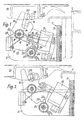
- FIG. 1 to 3 show a section along the line I - I in Fig. 5, etc. three phases of the door locking
- Fig. 4 shows a section along the line IV - IV in Fig. 5
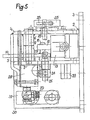
- Fig. 5 is a side view.
- a console designated as a whole by 2, which has a base plate 3 and two plates 4, 5 which are parallel to one another and perpendicular to it.
- the plate 4 is welded to a sleeve 6, in which a pin 7 is inserted and the lower end 8 of which is mounted in the lower plate 5.
- This has an arm 10a, onto which a bolt 11 is welded, which is articulated to the piston rod 12 of a pneumatic cylinder 13.
- This cylinder is pivotally mounted on the plates 4 and 5 by means of a pin 14.
- a compressed air line is connected to the cylinder 13 at 15.
- a torsion spring 16 is provided which surrounds the hub 9 and is supported at one end on a pin 17 and at the other end on a groove 18 of the latch 10. This spring tries to turn the latch in the direction of its opening pivot.
- the pin 17 forms a stop for this pivoting movement.
- the trap has a groove 19 which cooperates with a cylindrical bolt 20 of the door 21. Furthermore, two shoulders 22, 23 are featured on the trap see to which a pawl 24 can put on. This sits on a shaft 25 and is surrounded by a torsion spring 26 which pivots the pawl towards the latch 10.
- the shaft 25 carries an arm 26, which faces a pneumatic locking cylinder 28 with a shoulder 27. This is connected at 29 to a compressed air line, not shown.
- the console 2 has a vertical plate 30 which is welded to the base plate 3.
- the shaft 25 extends through the plate 4 upwards and carries a cam 33 there, which is indicated by dashed lines in FIGS. 1 to 3. It actuates the swivel arm 34 of a switch 35, which indicates the position of the locking link 24.
- Fig. 1 the locking device is shown in the open position of the door. If the door is closed, the bolt 20 runs onto the flank of the groove 19 of the latch 10 and pivots against the force of the torsion spring 16. The joint between the pin 11 and the piston rod 12 reaches the other side of the connecting plane E 1 and the locking cylinder 13 acted upon with compressed air now acts on the bolt 20 with the opposite flank of the groove 19 and supports the door closing movement in its end region.
- the bolt 32 of the door leaf enters the catch groove 31.
- the catch groove 31 and the bolt 32 prevent movement of the door leaf perpendicular to the catch groove.
- the latch 10 prevents a movement of the bolt 20 and thus of the door leaf 21 parallel to the catch groove 31 through its groove 19, since the direction of the grooves 19 and 31 are perpendicular to each other in the closed position of the door shown in the drawing.
- a Bowden cable 39 anchored at 38 which is connected to the end 40 of the arm 26 and which allows the arm 26 to be brought into the dashed position 37 by hand, serves as the emergency actuation device.
- Characteristic of the invention is the arrangement of the elements, such as catch groove 31, locking cylinder 28, latch 10 and pawl 24 and switch 35 in different levels. This results in a compact design. This arrangement of the elements does not have to match the arrangement shown.
- the pivot axis of the latch 10, the bolt 20 and the bolt 32 for the catch groove 31 will be substantially vertical.
- An exact vertical arrangement is not advisable if e.g. the door leaf is not flat and therefore deviates at least in part from the vertical direction. If the lock is arranged in the area of this part of the door leaf, the parts mentioned above will also deviate from the vertical direction.
Landscapes
- Lock And Its Accessories (AREA)
Abstract
Description
- Die Erfindung betrifft eine Türverriegelung, insbesondere für Fahrzeugtüren, bei der ein vorzugsweise bolzenförmiger Riegel am Türblatt mit einer am Türrahmen schwenkbar angebrachten Falle zusammenwirkt, die eine den Riegel aufnehmende Nut aufweist und unter der Wirkung einer Feder steht, deren Spannung sich durch die beim Schließen der Tür auftretenden Schwenkbewegung der Falle erhöht, wobei der im Türblatt angeordnete Riegel und die Schwenkachse der Falle im wesentlichen parallel sowohl zum Türblatt als auch zu dem die Falle tragenden Türrahmenteil gerichtet sind. Ferner ist es bekannt, daß an der mittels eines pneumatischen Zuhaltezylinders verschwenkbaren Falle zumindest eine Rast vorgesehen ist, in die eine mittels eines pneumatischen Sperrzylinders lösbare Sperrklinke im Endbereich der Türschließbewegung eingreift.
- Es hat sich gezeigt, daß Türverriegelungen dieser Art hohen Beanspruchungen nicht immer gewachsen sind, weshalb es das Ziel der Erfindung ist, eine robuste Türverriegelung zu schaffen, die mit hoher Sicherheit auch außergewöhnlich auftretende starke Kräfte aufnehmen kann.
- Erfindungsgemäß wird dies dadurch erreicht, daß eine Fangnut vorgesehen ist, deren Richtung, parallel zur Drehachse der Falle gesehen, bei geschlossener Tür im wesentlichen senkrecht zur Richtung der Nut in der Falle steht, wobei gegebenenfalls an der mittels eines pneumatischen Zuhaltezylinders verschwenkbaren Falle zumindest eine Rast vorgesehen ist, in die eine mittels eines pneumatischen Sperryzylinders lösbare Sperrklinke im Endbereich der Türschließbewegung eingreift.
- In der Zeichnung ist der Gegenstand der Erfindung in einer beispielsweisen Ausführungsform dargestellt. Es zeigen die Fig. 1 bis 3 einen Schnitt nach der Linie I - I in Fig. 5, u.zw. drei Phasen der Türverriegelung, Fig. 4 einen Schnitt nach der Linie IV - IV in Fig. 5, die Fig. 5 eine Seitenansicht.
- Am Türrahmen 1 ist eine in ihrer Gesamtheit mit 2 bezeichnete Konsole vorgesehen, die eine Grundplatte 3 und zwei dazu senkrecht stehende zueinander parallele Platten 4, 5 aufweist. Die Platte 4 ist mit einer Hülse 6 verschweißt, in der ein Zapfen 7 eingesetzt ist und dessen unteres Ende 8 in der unteren Platte 5 gelagert ist. Auf diesem Zapfen sitzt eine Nabe 9, welche die Falle 10 trägt. Diese weist einen Arm 10a auf, auf den ein Bolzen 11 aufgeschweißt ist, der gelenkig mit der Kolbenstange 12 eines pneumatischen Zylinders 13 verbunden ist. Dieser Zylinder ist mittels eines Stiftes 14 schwenkbar an den Platten 4 und 5 gelagert. Eine nicht dargestellte Druckluftleitung ist bei 15 an den Zylinder 13 angeschlossen. Weiters ist eine Drehfeder 16 vorgesehen, die die Nabe 9 umschließt und sich mit dem einen Ende an einem Stift 17 und mit dem anderen Ende an einer Nut 18 der Falle 10 abstützt. Diese Feder versucht, die Falle in Richtung ihrer Öffnungs-Verschwenkung zu verdrehen. Der Stift 17 bildet hiebei einen Anschlag für diese Schwenkbewegung.
- Die Anordnung der Falle und des Zuhaltezylinders 13 ist nun so getroffen, daß das Gelenk zwischen dem Bolzen 11 und der Kolbenstange 12 einen Abstand von der die Achsen der Welle 8 und des Stiftes 14 verbindenden Ebene E₁ aufweist, sodaß bei Beaufschlagung des Zuhaltezylinders 13 die Falle 10 am Anschlag 17 gehalten wird.
- Die Falle weist eine Nut 19 auf, die mit einem zylindrischen Riegel 20 der Türe 21 zusammenwirkt. Weiters sind an der Falle zwei Schultern 22, 23 vorge sehen, an die sich eine Sperrklinke 24 anlegen kann. Diese sitzt auf einer Welle 25 und ist von einer Drehfeder 26 umgeben, die die Sperrklinke zur Falle 10 hin verschwenkt.
- Wie aus Fig. 4 hervorgeht, trägt die Welle 25 einen Arm 26, der mit einer Schulter 27 einem pneumatischen Sperryzylinder 28 gegenübersteht. Dieser ist bei 29 an eine nicht dargestellte Druckluftleitung angeschlossen.
- Die Konsole 2 weist eine vertikale Platte 30 auf, die mit der Grundplatte 3 verschweißt ist. An der Platte 30 ist ein Fanghaken mit einer Fangnut 31 angeschraubt, die mit einem Bolzen 32 im Türblatt 21 zusammenwirkt.
- Die Welle 25 erstreckt sich durch die Platte 4 nach oben und trägt dort eine Nocke 33, die in den Fig. 1 bis 3 strichliert angedeutet ist. Sie betätigt den Schwenkarm 34 eines Schalters 35, der die Lage der Sperrlinke 24 anzeigt.
- In Fig. 1 ist die Verriegelungsvorrichtung in der Offenstellung der Tür dargestellt. Wird die Türe geschlossen, so läuft der Riegel 20 auf die Flanke der Nut 19 der Falle 10 auf und verschwenkt diese entgegen der Kraft der Drehfeder 16. Hiebei gelangt das Gelenk zwischen dem Stift 11 und der Kolbenstange 12 auf die andere Seite der Verbindungsebene E₁ und der mit Druckluft beaufschlagte Zuhaltezylinder 13 wirkt nun mit der gegenüberliegenden Flanke der Nut 19 auf den Riegel 20 ein und unterstützt die Türschließbewegung in deren Endbereich.
- Zugleich ist der Sperryzylinder 28 drucklos, sodaß die Sperrklinke 24 unter der Wirkung der Drehfeder 26 einrasten kann und sich an die Schulter 22 der Falle 10 anlegt. Diese Lage der Vorverriegelung der Tür ist in Fig. 2 dargestellt.
- Infolge der weiteren Türschließbewegung bewirkt der in Fig. 3 als strichpunktierte Linie angedeutete Zuhaltezylinder 13 eine weitere Verschwenkung der Falle 10, wobei zuletzt die Sperrklinke 24 neuerlich einrastet und nunmehr der Schulter 23 der Falle 10 gegenübersteht. In dieser Lage der Sperrklinke 24 weist die Stirnfläche 27 Abstand A gegenüber der Kolbenstange 36 des Sperrzylinders 28 auf. Gleichzeitig bewirkt die Nocke 33 eine Bewegung des Hebels 34 des Schalters 35, der die Erreichung der Geschlossenlage des Türflügels 21 anzeigt.
- Bei der Schließbewegung tritt der Bolzen 32 des Türflügels in die Fangnut 31 ein. Wie aus einem Vergleich der Fig. 3 und 4 hervorgeht, verhindert die Fangnut 31 und der Bolzen 32 eine Bewegung des Türblattes senkrecht zur Fangnut. Darüberhinaus verhindert die Falle 10 durch ihre Nut 19 eine Bewegung des Riegels 20 und damit des Türblattes 21 parallel zur Fangnut 31, da die Richtung der Nuten 19 und 31 in der in der Zeichnung dargestellten Geschlossenstellung der Türe senkrecht zueinander stehen.
- Dadurch, daß die auftretenden, auf das Türblatt 21 wirksamen Kräfte auf zwei Organe aufgeteilt sind, nämlich, auf die Falle 10 und den Riegel 20 bzw. die Fangnut 31 und Bolzen 32, ist eine überaus kräftige Verriegelung vorhanden. Hinzu kommt noch, daß der Riegel 20 und der Bolzen 32, in ihrer Höhenlage zueinander versetzt, im Türblatt jeweils an ihren beiden Enden verankert werden können und sowohl die Welle 8 der Falle 10 als auch die Welle 25 der Sperrklinke 24 beiderseits gelagert sind, sodaß die Falle und der Sperrriegel auch großen Kräften und Momenten standhalten.
- Beim Öffnen der Türe wird der Zuhaltezylinder 13 gelüftet und der Sperrzylinder 28 beaufschlagt. Seine als Stempel ausgebildete Kolbenstange 36 trifft auf die Fläche 27 des Armes 26 und verschwenkt diesen in die in Fig. 4 strichlierte Lage 37, in der die Sperr klinke 24 außer Eingriff mit den Schultern 22, 23 der Falle 10 und in die in Fig. 1 dargestellte Lage gelangt. Die Falle 10 kann nunmehr im Sinne der Drehfeder 16 verschwenkt werden. Nach Erreichen der in Fig. 1 gezeigten Endlage der Falle 10 wird der Zuhaltezylinder 13 beaufschlagt, sodaß die Falle 10 in ihrer Offenstellung gehalten wird.
- Als Notbetätigungsvorrichtung dient ein bei 38 verankerter Bowdenzug 39, der mit dem Ende 40 des Armes 26 verbunden ist und der es gestattet, von Hand aus den Arm 26 in die strichlierte Lage 37 zu bringen.
- Charakteristisch für die Erfindung ist die Anordnung der Elemente, wie Fangnut 31, Sperryzylinder 28, Falle 10 und Sperrklinke 24 sowie Schalter 35 in verschiedenen Ebenen. Dadurch wird eine gedrängte Bauart erreicht. Diese Anordnung der Elemente muß nicht mit der dargestellten Anordnung übereinstimmen.
- Im allgemeinen werden die Schwenkachse der Falle 10, des Riegels 20 und des Bolzens 32 für die Fangnut 31 im wesentlichen vertikal verlaufen. Eine genau lotrechte Anordnung ist dann nicht zweckmäßig, wenn z.B. das Türblatt nicht eben ausgebildet ist und daher wenigstens zum Teil von der vertikalen Richtung abweicht. Wird die Verriegelung im Bereich dieses Teils des Türblattes angeordnet, so werden auch die vorstehend genannten Teile von der lotrechten Richtung abweichen.
Claims (9)
Applications Claiming Priority (2)
| Application Number | Priority Date | Filing Date | Title |
|---|---|---|---|
| AT0097188A AT393711B (de) | 1988-04-14 | 1988-04-14 | Tuerverriegelung |
| AT971/88 | 1988-04-14 |
Publications (2)
| Publication Number | Publication Date |
|---|---|
| EP0337983A1 true EP0337983A1 (de) | 1989-10-18 |
| EP0337983B1 EP0337983B1 (de) | 1993-03-03 |
Family
ID=3504007
Family Applications (1)
| Application Number | Title | Priority Date | Filing Date |
|---|---|---|---|
| EP89890109A Expired - Lifetime EP0337983B1 (de) | 1988-04-14 | 1989-04-14 | Türverriegelung |
Country Status (3)
| Country | Link |
|---|---|
| EP (1) | EP0337983B1 (de) |
| AT (1) | AT393711B (de) |
| DE (1) | DE58903627D1 (de) |
Cited By (3)
| Publication number | Priority date | Publication date | Assignee | Title |
|---|---|---|---|---|
| EP0965711A1 (de) * | 1998-06-16 | 1999-12-22 | Dura Convertible Systems GmbH | Verschlussvorrichtung für Kraftfahrzeugverdecke |
| CN105464488A (zh) * | 2016-01-06 | 2016-04-06 | 南京海龙电气科技有限公司 | 塞拉门的门锁装置 |
| CN113550666A (zh) * | 2021-08-30 | 2021-10-26 | 中国第一汽车股份有限公司 | 一种汽车自吸合门锁及其控制方法 |
Families Citing this family (1)
| Publication number | Priority date | Publication date | Assignee | Title |
|---|---|---|---|---|
| CN105464483B (zh) * | 2016-01-06 | 2017-12-19 | 南京海龙电气科技有限公司 | 一种轨道交通拉塞门的门锁及其拉塞门 |
Citations (3)
| Publication number | Priority date | Publication date | Assignee | Title |
|---|---|---|---|---|
| US3942828A (en) * | 1974-04-18 | 1976-03-09 | R. Alkan & Cie | Electromechanical device cum manual control of safety outfit boxes on aircrafts |
| DE1919148B2 (de) * | 1969-04-15 | 1977-11-17 | Pfeiffer, Hans Walter, 5970 Plettenberg | Pneumatisch oder hydraulisch betaetigbare schliesshilfe fuer einen fahrzeug- tuerverschluss mit drehfalle |
| GB2048365A (en) * | 1979-04-07 | 1980-12-10 | Mitsui Mining & Smelting Co | Automobile door locking apparatus |
-
1988
- 1988-04-14 AT AT0097188A patent/AT393711B/de not_active IP Right Cessation
-
1989
- 1989-04-14 DE DE8989890109T patent/DE58903627D1/de not_active Expired - Lifetime
- 1989-04-14 EP EP89890109A patent/EP0337983B1/de not_active Expired - Lifetime
Patent Citations (3)
| Publication number | Priority date | Publication date | Assignee | Title |
|---|---|---|---|---|
| DE1919148B2 (de) * | 1969-04-15 | 1977-11-17 | Pfeiffer, Hans Walter, 5970 Plettenberg | Pneumatisch oder hydraulisch betaetigbare schliesshilfe fuer einen fahrzeug- tuerverschluss mit drehfalle |
| US3942828A (en) * | 1974-04-18 | 1976-03-09 | R. Alkan & Cie | Electromechanical device cum manual control of safety outfit boxes on aircrafts |
| GB2048365A (en) * | 1979-04-07 | 1980-12-10 | Mitsui Mining & Smelting Co | Automobile door locking apparatus |
Cited By (6)
| Publication number | Priority date | Publication date | Assignee | Title |
|---|---|---|---|---|
| EP0965711A1 (de) * | 1998-06-16 | 1999-12-22 | Dura Convertible Systems GmbH | Verschlussvorrichtung für Kraftfahrzeugverdecke |
| US6213534B1 (en) | 1998-06-16 | 2001-04-10 | Dura Convertible Systems Gmbh | Closure mechanism for the tops of vehicles |
| CN105464488A (zh) * | 2016-01-06 | 2016-04-06 | 南京海龙电气科技有限公司 | 塞拉门的门锁装置 |
| CN105464488B (zh) * | 2016-01-06 | 2018-05-18 | 南京海龙电气科技有限公司 | 塞拉门的门锁装置 |
| CN113550666A (zh) * | 2021-08-30 | 2021-10-26 | 中国第一汽车股份有限公司 | 一种汽车自吸合门锁及其控制方法 |
| CN113550666B (zh) * | 2021-08-30 | 2022-08-16 | 中国第一汽车股份有限公司 | 一种汽车自吸合门锁及其控制方法 |
Also Published As
| Publication number | Publication date |
|---|---|
| ATA97188A (de) | 1991-05-15 |
| EP0337983B1 (de) | 1993-03-03 |
| DE58903627D1 (de) | 1993-04-08 |
| AT393711B (de) | 1991-12-10 |
Similar Documents
| Publication | Publication Date | Title |
|---|---|---|
| DE3447748C2 (de) | ||
| DE2920581C3 (de) | Zusatzverriegelung, insbesondere Mittelverriegelung, für Fenster, Türen od.dgl. | |
| DE3142959C2 (de) | Treibstangenverschluß für Türen | |
| DE2639641C2 (de) | Bedienungsmechanismus für einen in einem Schaltschrank eingebauten elektrischen Schalter | |
| DE3400753C2 (de) | Außenschwingtür für Fahrzeuge und ihre Betätigungsvorrichtung | |
| DE4109852A1 (de) | Vorrichtung zum auf- und zumachen, insbesondere von vorzugsweise nach aussen zu oeffnenden ausstellfenstern | |
| EP1373668B1 (de) | Sicherungsvorrichtung | |
| EP0858541A2 (de) | Verriegelungsvorrichtung | |
| EP0337983B1 (de) | Türverriegelung | |
| DE4242877C2 (de) | Verschließeinrichtung für Türflügel von Gebäudetüren | |
| DE3935990C2 (de) | ||
| DE202007015667U1 (de) | Gebäudeabschluss mit Panik-Entriegelungselement in einbruchhemmender Ausführung | |
| EP1970508A2 (de) | Vorrichtung zur Arretierung eines schwenkbaren Bauteiles eines Kraftfahrzeuges | |
| DE3920498C2 (de) | Mehrfachverriegelung | |
| DE19906232B4 (de) | Vorrichtung zum Ver- und Entriegeln eines Standflügels | |
| DE19832356C2 (de) | Kantenriegelbeschlag | |
| DE3519229A1 (de) | Tuerschloss | |
| EP0505350A1 (de) | Drehscheiben-Schliessfolge- und Verriegelungseinrichtung | |
| DE1264990B (de) | Tuerverschluss, insbesondere fuer Kraftwagen | |
| DE10108494C2 (de) | Vorrichtung zum Anziehen einer Tür oder eines Fensters an den Blendrahmen | |
| CH661090A5 (de) | Vorrichtung zum sichern von gegeneinander beweglichen teilen. | |
| EP3626918B1 (de) | Beschlag für ein fenster, fenster | |
| DE3205486C2 (de) | ||
| DE2758521C2 (de) | Treibstangenverschluß und Abdrückvorrichtung an einer waagerecht verschiebbaren Tür | |
| DE3137393A1 (de) | "fangvorrichtung fuer kraftbetaetigte tore" |
Legal Events
| Date | Code | Title | Description |
|---|---|---|---|
| PUAI | Public reference made under article 153(3) epc to a published international application that has entered the european phase |
Free format text: ORIGINAL CODE: 0009012 |
|
| AK | Designated contracting states |
Kind code of ref document: A1 Designated state(s): BE DE FR GB IT |
|
| 17P | Request for examination filed |
Effective date: 19891130 |
|
| 17Q | First examination report despatched |
Effective date: 19910723 |
|
| GRAA | (expected) grant |
Free format text: ORIGINAL CODE: 0009210 |
|
| AK | Designated contracting states |
Kind code of ref document: B1 Designated state(s): BE DE FR GB IT |
|
| REF | Corresponds to: |
Ref document number: 58903627 Country of ref document: DE Date of ref document: 19930408 |
|
| ITF | It: translation for a ep patent filed | ||
| ET | Fr: translation filed | ||
| GBT | Gb: translation of ep patent filed (gb section 77(6)(a)/1977) |
Effective date: 19930602 |
|
| PLBE | No opposition filed within time limit |
Free format text: ORIGINAL CODE: 0009261 |
|
| STAA | Information on the status of an ep patent application or granted ep patent |
Free format text: STATUS: NO OPPOSITION FILED WITHIN TIME LIMIT |
|
| 26N | No opposition filed | ||
| PGFP | Annual fee paid to national office [announced via postgrant information from national office to epo] |
Ref country code: FR Payment date: 19980318 Year of fee payment: 10 |
|
| PGFP | Annual fee paid to national office [announced via postgrant information from national office to epo] |
Ref country code: BE Payment date: 19980402 Year of fee payment: 10 |
|
| PG25 | Lapsed in a contracting state [announced via postgrant information from national office to epo] |
Ref country code: BE Free format text: LAPSE BECAUSE OF NON-PAYMENT OF DUE FEES Effective date: 19990430 |
|
| BERE | Be: lapsed |
Owner name: INDUSTRIE-EINRICHTUNGEN FERTIGUNGS-A.G. IFE Effective date: 19990430 |
|
| PG25 | Lapsed in a contracting state [announced via postgrant information from national office to epo] |
Ref country code: FR Free format text: LAPSE BECAUSE OF NON-PAYMENT OF DUE FEES Effective date: 19991231 |
|
| REG | Reference to a national code |
Ref country code: FR Ref legal event code: ST |
|
| REG | Reference to a national code |
Ref country code: GB Ref legal event code: IF02 |
|
| PGFP | Annual fee paid to national office [announced via postgrant information from national office to epo] |
Ref country code: GB Payment date: 20020412 Year of fee payment: 14 |
|
| PG25 | Lapsed in a contracting state [announced via postgrant information from national office to epo] |
Ref country code: GB Free format text: LAPSE BECAUSE OF NON-PAYMENT OF DUE FEES Effective date: 20030414 |
|
| GBPC | Gb: european patent ceased through non-payment of renewal fee |
Effective date: 20030414 |
|
| PG25 | Lapsed in a contracting state [announced via postgrant information from national office to epo] |
Ref country code: IT Free format text: LAPSE BECAUSE OF NON-PAYMENT OF DUE FEES;WARNING: LAPSES OF ITALIAN PATENTS WITH EFFECTIVE DATE BEFORE 2007 MAY HAVE OCCURRED AT ANY TIME BEFORE 2007. THE CORRECT EFFECTIVE DATE MAY BE DIFFERENT FROM THE ONE RECORDED. Effective date: 20050414 |
|
| PGFP | Annual fee paid to national office [announced via postgrant information from national office to epo] |
Ref country code: DE Payment date: 20080627 Year of fee payment: 20 |