EP0336108B1 - Flüssig-kristalline Bischlorkohlensäureester, Verfahren zu ihrer Herstellung und aus ihnen hergestellte flüssigkristalline N-Alkyl-Polyurethane - Google Patents
Flüssig-kristalline Bischlorkohlensäureester, Verfahren zu ihrer Herstellung und aus ihnen hergestellte flüssigkristalline N-Alkyl-Polyurethane Download PDFInfo
- Publication number
- EP0336108B1 EP0336108B1 EP89103539A EP89103539A EP0336108B1 EP 0336108 B1 EP0336108 B1 EP 0336108B1 EP 89103539 A EP89103539 A EP 89103539A EP 89103539 A EP89103539 A EP 89103539A EP 0336108 B1 EP0336108 B1 EP 0336108B1
- Authority
- EP
- European Patent Office
- Prior art keywords
- formula
- esters
- alkyl
- group
- polyurethanes
- Prior art date
- Legal status (The legal status is an assumption and is not a legal conclusion. Google has not performed a legal analysis and makes no representation as to the accuracy of the status listed.)
- Expired - Lifetime
Links
- 150000002148 esters Chemical class 0.000 title claims description 14
- 229920002635 polyurethane Polymers 0.000 title claims description 14
- 239000004814 polyurethane Substances 0.000 title claims description 14
- 238000000034 method Methods 0.000 title claims description 5
- 239000004973 liquid crystal related substance Substances 0.000 title 2
- 239000002253 acid Substances 0.000 claims description 19
- OQBPCYUKFSJTDU-UHFFFAOYSA-N 4-Hydroxyphenyl-4-hydroxybenzoate Chemical class C1=CC(O)=CC=C1OC(=O)C1=CC=C(O)C=C1 OQBPCYUKFSJTDU-UHFFFAOYSA-N 0.000 claims description 10
- YGYAWVDWMABLBF-UHFFFAOYSA-N Phosgene Chemical class ClC(Cl)=O YGYAWVDWMABLBF-UHFFFAOYSA-N 0.000 claims description 10
- 125000004178 (C1-C4) alkyl group Chemical group 0.000 claims description 7
- 150000004985 diamines Chemical group 0.000 claims description 7
- 239000011230 binding agent Substances 0.000 claims description 6
- 239000001257 hydrogen Substances 0.000 claims description 5
- 229910052739 hydrogen Inorganic materials 0.000 claims description 5
- 125000004435 hydrogen atom Chemical group [H]* 0.000 claims description 5
- QVGXLLKOCUKJST-UHFFFAOYSA-N atomic oxygen Chemical compound [O] QVGXLLKOCUKJST-UHFFFAOYSA-N 0.000 claims description 4
- 125000005843 halogen group Chemical group 0.000 claims description 4
- 239000001301 oxygen Substances 0.000 claims description 4
- 229910052760 oxygen Inorganic materials 0.000 claims description 4
- 125000004169 (C1-C6) alkyl group Chemical group 0.000 claims description 3
- XUIMIQQOPSSXEZ-UHFFFAOYSA-N Silicon Chemical group [Si] XUIMIQQOPSSXEZ-UHFFFAOYSA-N 0.000 claims description 3
- 150000001338 aliphatic hydrocarbons Chemical class 0.000 claims description 3
- 150000004945 aromatic hydrocarbons Chemical class 0.000 claims description 3
- 125000000217 alkyl group Chemical group 0.000 claims description 2
- 238000005227 gel permeation chromatography Methods 0.000 claims description 2
- 238000004519 manufacturing process Methods 0.000 claims description 2
- 150000002989 phenols Chemical class 0.000 claims description 2
- 125000000816 ethylene group Chemical group [H]C([H])([*:1])C([H])([H])[*:2] 0.000 claims 1
- YMWUJEATGCHHMB-UHFFFAOYSA-N Dichloromethane Chemical compound ClCCl YMWUJEATGCHHMB-UHFFFAOYSA-N 0.000 description 12
- ZMANZCXQSJIPKH-UHFFFAOYSA-N Triethylamine Chemical compound CCN(CC)CC ZMANZCXQSJIPKH-UHFFFAOYSA-N 0.000 description 9
- YXFVVABEGXRONW-UHFFFAOYSA-N Toluene Chemical compound CC1=CC=CC=C1 YXFVVABEGXRONW-UHFFFAOYSA-N 0.000 description 6
- 239000002904 solvent Substances 0.000 description 6
- XLYOFNOQVPJJNP-UHFFFAOYSA-N water Substances O XLYOFNOQVPJJNP-UHFFFAOYSA-N 0.000 description 6
- UIIMBOGNXHQVGW-UHFFFAOYSA-M Sodium bicarbonate Chemical compound [Na+].OC([O-])=O UIIMBOGNXHQVGW-UHFFFAOYSA-M 0.000 description 4
- 239000000203 mixture Substances 0.000 description 4
- 229960003506 piperazine hexahydrate Drugs 0.000 description 4
- AVRVZRUEXIEGMP-UHFFFAOYSA-N piperazine;hexahydrate Chemical compound O.O.O.O.O.O.C1CNCCN1 AVRVZRUEXIEGMP-UHFFFAOYSA-N 0.000 description 4
- 239000011541 reaction mixture Substances 0.000 description 4
- HEMHJVSKTPXQMS-UHFFFAOYSA-M Sodium hydroxide Chemical compound [OH-].[Na+] HEMHJVSKTPXQMS-UHFFFAOYSA-M 0.000 description 3
- 125000002947 alkylene group Chemical group 0.000 description 3
- 150000001875 compounds Chemical class 0.000 description 3
- -1 dimethylaniline Chemical class 0.000 description 3
- 229910052757 nitrogen Inorganic materials 0.000 description 3
- 150000007530 organic bases Chemical class 0.000 description 3
- 239000012074 organic phase Substances 0.000 description 3
- 239000003960 organic solvent Substances 0.000 description 3
- 229920003023 plastic Polymers 0.000 description 3
- 239000004033 plastic Substances 0.000 description 3
- 229920000642 polymer Polymers 0.000 description 3
- 238000002360 preparation method Methods 0.000 description 3
- 125000004203 4-hydroxyphenyl group Chemical group [H]OC1=C([H])C([H])=C(*)C([H])=C1[H] 0.000 description 2
- IJGRMHOSHXDMSA-UHFFFAOYSA-N Atomic nitrogen Chemical compound N#N IJGRMHOSHXDMSA-UHFFFAOYSA-N 0.000 description 2
- VGGSQFUCUMXWEO-UHFFFAOYSA-N Ethene Chemical compound C=C VGGSQFUCUMXWEO-UHFFFAOYSA-N 0.000 description 2
- VEXZGXHMUGYJMC-UHFFFAOYSA-N Hydrochloric acid Chemical compound Cl VEXZGXHMUGYJMC-UHFFFAOYSA-N 0.000 description 2
- JLTDJTHDQAWBAV-UHFFFAOYSA-N N,N-dimethylaniline Chemical compound CN(C)C1=CC=CC=C1 JLTDJTHDQAWBAV-UHFFFAOYSA-N 0.000 description 2
- GLUUGHFHXGJENI-UHFFFAOYSA-N Piperazine Chemical compound C1CNCCN1 GLUUGHFHXGJENI-UHFFFAOYSA-N 0.000 description 2
- IISBACLAFKSPIT-UHFFFAOYSA-N bisphenol A Chemical compound C=1C=C(O)C=CC=1C(C)(C)C1=CC=C(O)C=C1 IISBACLAFKSPIT-UHFFFAOYSA-N 0.000 description 2
- AOGYCOYQMAVAFD-UHFFFAOYSA-N chlorocarbonic acid Chemical class OC(Cl)=O AOGYCOYQMAVAFD-UHFFFAOYSA-N 0.000 description 2
- 150000007529 inorganic bases Chemical class 0.000 description 2
- 125000002496 methyl group Chemical group [H]C([H])([H])* 0.000 description 2
- 239000002985 plastic film Substances 0.000 description 2
- 229920000768 polyamine Polymers 0.000 description 2
- 229920001296 polysiloxane Polymers 0.000 description 2
- 229910000030 sodium bicarbonate Inorganic materials 0.000 description 2
- 235000017557 sodium bicarbonate Nutrition 0.000 description 2
- 239000007787 solid Substances 0.000 description 2
- WSLDOOZREJYCGB-UHFFFAOYSA-N 1,2-Dichloroethane Chemical compound ClCCCl WSLDOOZREJYCGB-UHFFFAOYSA-N 0.000 description 1
- QOHFBFUMUDLXEW-UHFFFAOYSA-N 1-n,5-n-dimethylnaphthalene-1,5-diamine Chemical compound C1=CC=C2C(NC)=CC=CC2=C1NC QOHFBFUMUDLXEW-UHFFFAOYSA-N 0.000 description 1
- KLDXJTOLSGUMSJ-UHFFFAOYSA-N 2,3,3a,5,6,6a-hexahydrofuro[3,2-b]furan-3,6-diol Chemical class OC1COC2C(O)COC21 KLDXJTOLSGUMSJ-UHFFFAOYSA-N 0.000 description 1
- NSMWYRLQHIXVAP-UHFFFAOYSA-N 2,5-dimethylpiperazine Chemical compound CC1CNC(C)CN1 NSMWYRLQHIXVAP-UHFFFAOYSA-N 0.000 description 1
- VWGKEVWFBOUAND-UHFFFAOYSA-N 4,4'-thiodiphenol Chemical compound C1=CC(O)=CC=C1SC1=CC=C(O)C=C1 VWGKEVWFBOUAND-UHFFFAOYSA-N 0.000 description 1
- 150000005168 4-hydroxybenzoic acids Chemical class 0.000 description 1
- SDDLEVPIDBLVHC-UHFFFAOYSA-N Bisphenol Z Chemical compound C1=CC(O)=CC=C1C1(C=2C=CC(O)=CC=2)CCCCC1 SDDLEVPIDBLVHC-UHFFFAOYSA-N 0.000 description 1
- WKBOTKDWSSQWDR-UHFFFAOYSA-N Bromine atom Chemical group [Br] WKBOTKDWSSQWDR-UHFFFAOYSA-N 0.000 description 1
- KZBUYRJDOAKODT-UHFFFAOYSA-N Chlorine Chemical compound ClCl KZBUYRJDOAKODT-UHFFFAOYSA-N 0.000 description 1
- XDTMQSROBMDMFD-UHFFFAOYSA-N Cyclohexane Chemical compound C1CCCCC1 XDTMQSROBMDMFD-UHFFFAOYSA-N 0.000 description 1
- 239000005977 Ethylene Substances 0.000 description 1
- PIICEJLVQHRZGT-UHFFFAOYSA-N Ethylenediamine Chemical compound NCCN PIICEJLVQHRZGT-UHFFFAOYSA-N 0.000 description 1
- 101500021084 Locusta migratoria 5 kDa peptide Proteins 0.000 description 1
- NINIDFKCEFEMDL-UHFFFAOYSA-N Sulfur Chemical compound [S] NINIDFKCEFEMDL-UHFFFAOYSA-N 0.000 description 1
- 150000007513 acids Chemical class 0.000 description 1
- XAGFODPZIPBFFR-UHFFFAOYSA-N aluminium Chemical compound [Al] XAGFODPZIPBFFR-UHFFFAOYSA-N 0.000 description 1
- 229910052782 aluminium Inorganic materials 0.000 description 1
- 125000005708 carbonyloxy group Chemical group [*:2]OC([*:1])=O 0.000 description 1
- 239000000460 chlorine Substances 0.000 description 1
- 229910052801 chlorine Inorganic materials 0.000 description 1
- 238000005352 clarification Methods 0.000 description 1
- 239000013078 crystal Substances 0.000 description 1
- 239000012153 distilled water Substances 0.000 description 1
- 238000001035 drying Methods 0.000 description 1
- 239000000945 filler Substances 0.000 description 1
- 229920002457 flexible plastic Polymers 0.000 description 1
- 150000002605 large molecules Chemical class 0.000 description 1
- 239000007788 liquid Substances 0.000 description 1
- 239000000155 melt Substances 0.000 description 1
- 238000002844 melting Methods 0.000 description 1
- 230000008018 melting Effects 0.000 description 1
- 125000000250 methylamino group Chemical group [H]N(*)C([H])([H])[H] 0.000 description 1
- 238000000465 moulding Methods 0.000 description 1
- KVKFRMCSXWQSNT-UHFFFAOYSA-N n,n'-dimethylethane-1,2-diamine Chemical compound CNCCNC KVKFRMCSXWQSNT-UHFFFAOYSA-N 0.000 description 1
- 230000007935 neutral effect Effects 0.000 description 1
- 239000012071 phase Substances 0.000 description 1
- 125000000843 phenylene group Chemical group C1(=C(C=CC=C1)*)* 0.000 description 1
- 229960005141 piperazine Drugs 0.000 description 1
- 229920006255 plastic film Polymers 0.000 description 1
- 230000010287 polarization Effects 0.000 description 1
- 229920001451 polypropylene glycol Polymers 0.000 description 1
- AOHJOMMDDJHIJH-UHFFFAOYSA-N propylenediamine Chemical compound CC(N)CN AOHJOMMDDJHIJH-UHFFFAOYSA-N 0.000 description 1
- 238000001953 recrystallisation Methods 0.000 description 1
- 239000007858 starting material Substances 0.000 description 1
- 238000003756 stirring Methods 0.000 description 1
- 239000000126 substance Substances 0.000 description 1
- 150000003457 sulfones Chemical class 0.000 description 1
- 229910052717 sulfur Inorganic materials 0.000 description 1
- 239000011593 sulfur Substances 0.000 description 1
- 239000000725 suspension Substances 0.000 description 1
- 230000008646 thermal stress Effects 0.000 description 1
- 238000005406 washing Methods 0.000 description 1
Classifications
-
- C—CHEMISTRY; METALLURGY
- C08—ORGANIC MACROMOLECULAR COMPOUNDS; THEIR PREPARATION OR CHEMICAL WORKING-UP; COMPOSITIONS BASED THEREON
- C08G—MACROMOLECULAR COMPOUNDS OBTAINED OTHERWISE THAN BY REACTIONS ONLY INVOLVING UNSATURATED CARBON-TO-CARBON BONDS
- C08G71/00—Macromolecular compounds obtained by reactions forming a ureide or urethane link, otherwise, than from isocyanate radicals in the main chain of the macromolecule
- C08G71/04—Polyurethanes
-
- C—CHEMISTRY; METALLURGY
- C08—ORGANIC MACROMOLECULAR COMPOUNDS; THEIR PREPARATION OR CHEMICAL WORKING-UP; COMPOSITIONS BASED THEREON
- C08G—MACROMOLECULAR COMPOUNDS OBTAINED OTHERWISE THAN BY REACTIONS ONLY INVOLVING UNSATURATED CARBON-TO-CARBON BONDS
- C08G64/00—Macromolecular compounds obtained by reactions forming a carbonic ester link in the main chain of the macromolecule
- C08G64/04—Aromatic polycarbonates
- C08G64/06—Aromatic polycarbonates not containing aliphatic unsaturation
-
- C—CHEMISTRY; METALLURGY
- C08—ORGANIC MACROMOLECULAR COMPOUNDS; THEIR PREPARATION OR CHEMICAL WORKING-UP; COMPOSITIONS BASED THEREON
- C08G—MACROMOLECULAR COMPOUNDS OBTAINED OTHERWISE THAN BY REACTIONS ONLY INVOLVING UNSATURATED CARBON-TO-CARBON BONDS
- C08G64/00—Macromolecular compounds obtained by reactions forming a carbonic ester link in the main chain of the macromolecule
- C08G64/04—Aromatic polycarbonates
- C08G64/06—Aromatic polycarbonates not containing aliphatic unsaturation
- C08G64/08—Aromatic polycarbonates not containing aliphatic unsaturation containing atoms other than carbon, hydrogen or oxygen
- C08G64/10—Aromatic polycarbonates not containing aliphatic unsaturation containing atoms other than carbon, hydrogen or oxygen containing halogens
-
- C—CHEMISTRY; METALLURGY
- C09—DYES; PAINTS; POLISHES; NATURAL RESINS; ADHESIVES; COMPOSITIONS NOT OTHERWISE PROVIDED FOR; APPLICATIONS OF MATERIALS NOT OTHERWISE PROVIDED FOR
- C09K—MATERIALS FOR MISCELLANEOUS APPLICATIONS, NOT PROVIDED FOR ELSEWHERE
- C09K19/00—Liquid crystal materials
- C09K19/04—Liquid crystal materials characterised by the chemical structure of the liquid crystal components, e.g. by a specific unit
- C09K19/06—Non-steroidal liquid crystal compounds
- C09K19/08—Non-steroidal liquid crystal compounds containing at least two non-condensed rings
- C09K19/10—Non-steroidal liquid crystal compounds containing at least two non-condensed rings containing at least two benzene rings
- C09K19/20—Non-steroidal liquid crystal compounds containing at least two non-condensed rings containing at least two benzene rings linked by a chain containing carbon and oxygen atoms as chain links, e.g. esters or ethers
- C09K19/2007—Non-steroidal liquid crystal compounds containing at least two non-condensed rings containing at least two benzene rings linked by a chain containing carbon and oxygen atoms as chain links, e.g. esters or ethers the chain containing -COO- or -OCO- groups
-
- C—CHEMISTRY; METALLURGY
- C09—DYES; PAINTS; POLISHES; NATURAL RESINS; ADHESIVES; COMPOSITIONS NOT OTHERWISE PROVIDED FOR; APPLICATIONS OF MATERIALS NOT OTHERWISE PROVIDED FOR
- C09K—MATERIALS FOR MISCELLANEOUS APPLICATIONS, NOT PROVIDED FOR ELSEWHERE
- C09K19/00—Liquid crystal materials
- C09K19/04—Liquid crystal materials characterised by the chemical structure of the liquid crystal components, e.g. by a specific unit
- C09K19/06—Non-steroidal liquid crystal compounds
- C09K19/08—Non-steroidal liquid crystal compounds containing at least two non-condensed rings
- C09K19/10—Non-steroidal liquid crystal compounds containing at least two non-condensed rings containing at least two benzene rings
- C09K19/20—Non-steroidal liquid crystal compounds containing at least two non-condensed rings containing at least two benzene rings linked by a chain containing carbon and oxygen atoms as chain links, e.g. esters or ethers
- C09K19/2007—Non-steroidal liquid crystal compounds containing at least two non-condensed rings containing at least two benzene rings linked by a chain containing carbon and oxygen atoms as chain links, e.g. esters or ethers the chain containing -COO- or -OCO- groups
- C09K2019/2035—Ph-COO-Ph
Definitions
- the invention relates to new, liquid-crystalline bis-chlorocarbonic acid esters of 4-hydroxyphenyl esters of 4-hydroxibenzoic acids, their preparation and the liquid-crystalline N-alkyl polyurethanes produced from them.
- Bischlorkohlen Textreester are already from the most diverse bis-hydroxy compounds, for example from 2,2-bis (4-hydroxyphenyl) propane, 1,1-bis (4-hydroxyphenyl) cyclohexane, bis (4-hydroxyphenyl) sulfide and from hexahydrofuro (3,2-b) furan-3,6-diols known (see e.g. Makromol. Chem. 57 1-11, 1962 and EP-B-0 025 937).
- bischlorocarbonic acid esters which are derived from 4-hydroxyphenyl esters of 4-hydroxybenzoic acids, have particularly advantageous properties. It was found that these bischlorocarbonic acid esters as such are liquid-crystalline and that they also have this property on them transferred by reaction with secondary diamines or dihydroxy compounds available N-alkyl polyurethanes.
- N-alkyl polyurethanes which can be obtained with the help of the bischlorocarbonic acid esters of the 4-hydroxybenzoic acid (4'-hydroxyphenyl) esters, not only have the advantages of the N-alkyl polyurethanes, such as high heat resistance, but also, thanks to their LC properties, an improved one Flow behavior in the melt and thus improved processability, in particular into thin-walled molded parts, increased heat resistance and an increased modulus of elasticity, furthermore excellent chemical resistance, high flame resistance and good filler compatibility.
- N-alkyl polyurethanes obtained from the bischlorocarbonic acid esters of 4-hydroxybenzoic acid (4'-hydroxyphenyl) esters are of great practical interest for polyurethanes which are to be used for moldings which are subject to high mechanical and thermal stress.
- polyurethanes obtainable from said chlorocarbonic acid esters, polymers are accessible which permit use in areas in which the use of plastics was previously unthinkable.
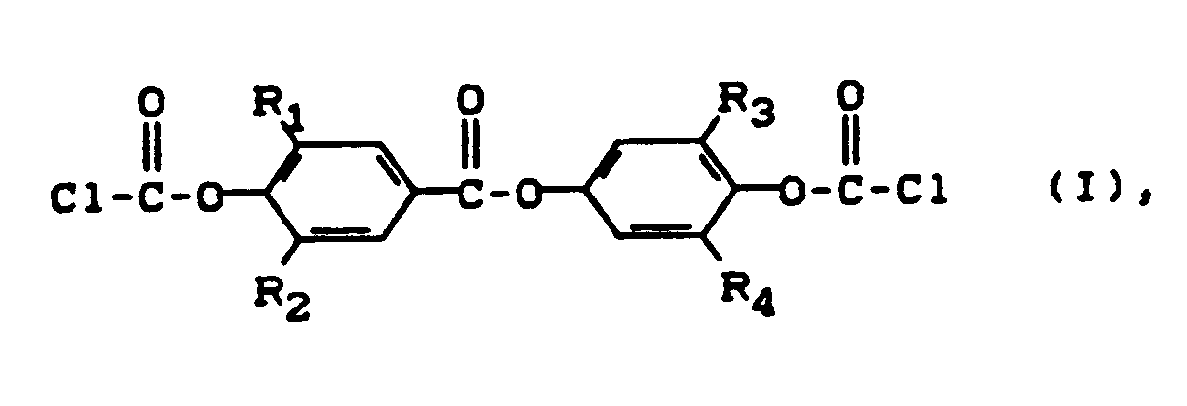
- the invention therefore relates to bischlorocarbonate of 4-hydroxybenzoic acid (4'-hydroxyphenyl) esters of the formula in the R1, R2, R3 and R4 independently represent hydrogen, a halogen atom, preferably a chlorine or bromine atom, or a C1-C6-alkyl, preferably a C1-C4-alkyl group.
- the invention further relates to a method for producing the bischlorocarbonic acid ester of the formula (I). which is characterized in that 4-hydroxybenzoic acid (4'-hydroxyphenyl) ester of the formula in the R1, R2, R3 and R4 have the meaning given under formula (I), in the presence of acid-binding agents with phosgene, in a manner known per se for the reaction of phosgene with phenols.
- the reaction can be carried out in water-immiscible organic solvents such as toluene or methylene chloride, which are inert under the reaction conditions, using acid binders, e.g. organic bases such as dimethylaniline, or using acid-binding agents which are insoluble in these solvents or immiscible with these solvents, such as NaHCO 3 or aqueous sodium hydroxide solution.
- acid binders e.g. organic bases such as dimethylaniline
- acid-binding agents which are insoluble in these solvents or immiscible with these solvents, such as NaHCO 3 or aqueous sodium hydroxide solution.
- the invention further relates to the polyurethanes which are used in the reaction of the liquid-crystalline bischlorocarbonic acid esters of the formula (I) with secondary diamines of the formula HX-A-XH (III) are included in the X represents an -N (R) group, in the R is a C1-C4-alkyl group, preferably a methyl group, or together with the R of the second -N (R) group forms an ethylene radical which is optionally substituted by a C1-C4-alkyl group, and A is a, optionally interrupted by oxygen and / or silicon atoms and / or an N (C1-C4-alkyl) group, divalent radical of an aliphatic hydrocarbon, preferably an ⁇ , ⁇ -alkylene radical, or the divalent radical of an aromatic hydrocarbon , with the proviso that A on average has a molecular weight M which is ⁇ 600 and is preferably in the range from 28 to 600.
- polyurethanes according to the invention are of structural units of the formula featured, in the R1, R2, R3 and R4 which under formula (I) and X and A have the meaning given under formula (III).
- the proportion by weight of the structural units the total weight of the polymers is 25 to 90% by weight, preferably 30 to 85% by weight.
- reaction of the bischlorocarbonic acid esters of the formula (I) according to the invention with the diamines of the formula (III) is preferably carried out in an organic solvent which is inert under the reaction conditions and is immiscible with water in the presence of acid binders at temperatures from -10 to + 20 ° C.
- Suitable acid binders are inorganic bases such as NaHCO3, organic bases such as triethylamine and also mixtures of inorganic and organic bases.
- Organic solvents which are inert under the reaction conditions include, in particular, aliphatic chlorinated hydrocarbons such as methylene chloride and ethylene chloride.
- the two-phase methylene chloride / water system is preferably used.
- the polymer After working up the reaction mixtures by separating the organic phase, removing the monomolecular compounds in the organic phase by washing with water, drying and removing the solvent, the polymer is obtained in the form of a transparent solid with plastic properties.
- Examples of A which may be mentioned as divalent radicals of aromatic hydrocarbons are: The phenylene-1,4 and naphthylene-1,5 residues; furthermore radicals in which 2 or more phenylene groups in the 1,4-position are linked to one another via oxygen, sulfur, a sulfone, a carbonyloxy or an alkylene group. Examples of such residues are
- reaction solution 150 g of phosgene are slowly introduced at 0 ° C. into the suspension of 100 g of 4-hydroxybenzoic acid (4′-hydroxyphenyl) ester in 500 ml of toluene.
- the reaction mixture is cooled to -5 ° C. and 121 g of dimethylaniline are added dropwise at this temperature. After reacting for 30 minutes, the reaction mixture is allowed to come to room temperature and is stirred for a further 3 hours at this temperature. After the excess phosgene has been blown out using nitrogen, the reaction solution is washed first with 10% hydrochloric acid and then several times with distilled water. The solution is dried and freed from the solvent. The remaining solid is purified by recrystallization from cyclohexane.
- Example 2 Under the conditions described in Example 2, 8.27 g of the bischlorocarbonic acid ester obtained in Example 1 are mixed with 4.55 g of piperazine hexahydrate and 3.13 g an ⁇ , ⁇ -bis (methylamino) polypropylene glycol using 4 g NaHCO3 and 2 g triethylamine.
- the polarization microscopic examination shows a melting point of 160 ° C and liquid-crystalline properties in the temperature range of 210-335 ° C.
Landscapes
- Chemical & Material Sciences (AREA)
- Organic Chemistry (AREA)
- Health & Medical Sciences (AREA)
- Chemical Kinetics & Catalysis (AREA)
- Medicinal Chemistry (AREA)
- Polymers & Plastics (AREA)
- Crystallography & Structural Chemistry (AREA)
- Engineering & Computer Science (AREA)
- Materials Engineering (AREA)
- Polyesters Or Polycarbonates (AREA)
- Organic Low-Molecular-Weight Compounds And Preparation Thereof (AREA)
- Polyurethanes Or Polyureas (AREA)
- Liquid Crystal Substances (AREA)
Description
- Die Erfindung betrifft neue, flüssig-kristalline Bis-chlorkohlensäureester von 4-Hydroxyphenyl-estern von 4-Hydroxibenzoesäuren, ihre Herstellung und die aus ihnen hergestellten flüssig-kristallinen N-Alkyl-Polyurethane.
- Bischlorkohlensäureester sind bereits von den verschiedensten Bishydroxyverbindungen, z.B. vom 2,2-Bis-(4-hydroxyphenyl)-propan, 1,1-Bis-(4-hydroxyphenyl)-cyclohexan, Bis-(4-hydroxyphenyl)-sulfid und von Hexahydrofuro(3,2-b)furan-3,6-diolen bekannt (siehe z.B. Makromol. Chem. 57 1-11, 1962 u. EP-B-0 025 937).
- Es wurde nun gefunden, daß die Bischlorkohlensäureester, die sich von 4-Hydroxyphenyl-estern der 4-Hydroxybenzoesäuren ableiten, besonders vorteilhafte Eigenschaften aufweisen. Es wurde gefunden, daß diese Bischlorkohlensäureester bereits als solche flüssig-kristallin sind und daß sie diese Eigenschaft auch auf die aus ihnen durch Umsetzung mit disekundären Diaminen oder Dihydroxyverbindungen erhältlichen N-Alkyl-Polyurethane übertragen.
- Diese mit Hilfe der Bischlorkohlensäureester der 4-Hydroxybenzoesäure-(4′-hydroxyphenyl)-ester erhältlichen N-Alkyl-Polyurethane weisen nicht nur die Vorteile der N-Alkyl-Polyurethane, wie hohe Wärmebeständigkeit auf, sondern dank ihrer LC-Eigenschaften zusätzlich ein verbessertes Fließverhalten in der Schmelze und damit eine verbesserte Verarbeitbarkeit, insbesondere zu dünnwandigen Formteilen, eine erhöhte Wärmeformbeständigkeit und einen erhöhten Elastizitätsmodul, ferner eine ausgezeichnete Chemikalienresistenz, eine hohe Flammwidrigkeit und eine gute Füllstoffverträglichkeit.
- Diese vorstehend für die aus den Bischlorkohlensäureestern der 4-Hydroxybenzoesäure-(4′-hydroxyphenyl)-ester erhältlichen N-Alkyl-Polyurethane beschriebenen Eigenschaftsbilder sind von großem praktischen Interesse für Polyurethane, die für mechanisch und thermisch hoch beanspruchte Formteile verwendet werden sollen. Mit Hilfe der aus den besagten Chlorkohlensäureestern erhältlichen Polyurethane werden Polymere zugänglich, die eine Verwendung in Bereichen gestatten, in denen bislang eine Nutzung von Kunststoffen undenkbar war.
- Die Erfindung betrifft daher Bischlorkohlensäureester von 4-Hydroxybenzoesäure-(4′-hydroxyphenyl)-estern der Formel

in der
R₁, R₂, R₃ und R₄ unabhängig voneinander für Wasserstoff, ein Halogenatom, vorzugsweise ein Chlor- oder Bromatom, oder eine C₁-C₆-Alkyl-, vorzugsweise eine C₁-C₄-Alkylgruppe stehen. - Die Erfindung betrifft ferner ein Verfahren zur Herstellung der Bischlorkohlensäureester der Formel (I). das dadurch gekennzeichnet ist, daß man 4-Hydroxybenzoesäure-(4′-hydroxyphenyl)-ester der formel

in der
R₁, R₂, R₃ und R₄ die unter Formel (I) angegebene Bedeutung haben,
in Gegenwart von säurebindenden Mitteln mit Phosgen, in für die Umsetzung von Phosgen mit Phenolen an sich bekannter Weise, umsetzt. - Die Umsetzung kann in unter den Reaktionsbedingungen inerten, mit Wasser nicht mischbaren organischen Lösungsmitteln wie Toluol oder Methylenchlorid, unter Verwendung in diesen Lösungsmitteln löslicher Säurebindemittel, z.B. organischen Basen wie Dimethylanilin, oder unter Verwendung von in diesen Lösungsmitteln unlöslichen oder mit diesen Lösungsmitteln nicht mischbaren Säurebindemitteln, wie NaHCO₃ oder wäßriger Natronlauge, vorgenommen werden. Überraschenderweise erhält man bei der Umsetzung der 4-Hydroxybenzoesäure-(4′-hydroxyphenyl)-ester der Formel (II) mit Phosgen, obwohl diese Ester nicht flüssig-kristallin sind, Bischlorkohlensäureester mit LC-Eigenschaften.
- Die als Ausgangsverbindung für die Herstellung der erfindungsgemäßen Bischlorkohlensäureester der formel (I) benötigten 4-Hydroxybenzoesäure-(4′-hydroxyphenyl)-ester der Formel (II) und deren Herstellung sind in der DE-OS 3 622 611 beschrieben oder sind nach dem in dieser Veröffentlichtung beschriebenen Verfahren erhältlich.
- Die Erfindung betrifft ferner die Polyurethane, die bei der Umsetzung der flüssig-kristallinen Bischlorkohlensäureester der Formel (I) mit disekundären Diaminen der Formel
HX-A-XH (III)
enthalten werden, in der
X für eine -N(R)-Gruppe steht,
in der
R eine C₁-C₄-Alkylgruppe, vorzugsweise eine Methylgruppe ist, oder zusammen mit dem R der zweiten -N(R)-Gruppe einen gegebenenfalls durch eine C₁-C₄-Alkylgruppe substituierten Ethylenrest bildet, und
A einen, gegebenenfalls durch Sauerstoff- und/oder Silizium-Atome und/oder eine N(C₁-C₄-Alkyl)-Gruppe unterbrochenen zweiwertigen Rest eines aliphatischen Kohlenwasserstoffs, vorzugsweise eines α,ω-Alkylenrestes, oder der zweiwertige Rest eines aromatischen Kohlenwasserstoffs ist, mit der Maßgabe, daß A im Mittel ein MolekulargewichtM aufweist, das <600 ist und vorzugsweise im Bereich von 28 bis 600 liegt. - Die erfindungsgemäßen Polyurethane sind durch Struktureinheiten der Formel

gekennzeichnet,
in der
R₁, R₂, R₃ und R₄ die unter Formel (I) und
X und A die unter Formel (III) angegebene Bedeutung haben. - Wesentlich für die LC-Eigenschaften der durch die Struktureinheiten der Formel (IV) gekennzeichneten Polyurethane ist, daß der Gewichtsanteil der Struktureinheiten

am Gesamtgewicht der Polymere 25 bis 90 Gew.-%, vorzugsweise 30 bis 85 Gew.-%, beträgt. Für das Erreichen möglichst hoher Molekulargewichte ist es vorteilhaft, die erfindungsgemäßen Chlorkohlensäureester der Formel (I) und die Diamine der Formel (III) in einem Molverhältnis von etwa 1:1 einzusetzen. - Die Umsetzung der erfindungsgemäßen Bischlorkohlensäureester der Formel (I) mit den Diaminen der Formel (III) wird vorzugsweise in einem unter den Reaktionsbedingungen inerten, mit Wasser nicht mischbaren organischen Lösungsmittel in Gegenwart von Säurebindemitteln bei Temperaturen von -10 bis +20° C durchgeführt.
- Als Säurebindemittel kommen anorganische Basen wie NaHCO₃, organische Basen wie Triethylamin und auch Gemische von anorganischen und organischen Basen in Betracht. Als unter den Reaktionsbedingungen inerte organische Lösungsmittel seien vor allem aliphatische Chlorkohlenwasserstoffe wie Methylenchlorid und Ethylenchlorid genannt.
- Vorzugsweise wird in dem 2-Phasen-System Methylenchlorid/Wasser gearbeitet.
- Nach dem Aufarbeiten der Reaktionsmischungen durch Abtrennen der organischen Phase, Entfernen der in der organischen Phase befindlichen monomolekularen Verbindungen durch Auswaschen mit Wasser, Trocknen und Entfernen des Lösungsmittels wird das Polymer in Form eines durchsichtigen Feststoffs mit Kunststoffeigenschaften erhalten.
- Für A seien als zweiwertige Reste aliphatischer Kohlenwasserstoffe, deren C-Kette gegebenenfalls durch Sauerstoff- und/oder Siliziumatome und/oder durch -N(Alkyl)-Gruppen unterbrochen sein kann, beispielsweise genannt: C₂-C₄-Alkylenreste, wie der Ethylen-, Propylen-1,3- und der Butylen-1,4-Rest; die Reste von Alkylen =polyaminen der Formel

in der
R₅ Wasserstoff oder Methyl ist,
X die unter Formel (III) angegebene Bedeutung hat und
x für eine ganze Zahl von 10 bis 40 steht;
und Reste von Polysiloxanen der Formel
in der
n für 0 oder 1 steht und
y, wenn n = 0 ist, eine ganze Zahl von 5 bis 25 und wenn n = 1 ist, eine ganze Zahl von 10 bis 40 bedeutet. - Aus der Forderung, das A im Mittel ein Molekulargewicht
M aufweisen soll, das <600 ist und vorzugsweise im Bereich von 28 bis 600 liegt, folgt, daß sich von Resten hochmolekularer Alkylen =polyamine der Formeln (V) und (VI) ableitende disekundäre Diamine der Formel (III) nur im Gemisch mit niedermolekularen disekundären Diaminen der Formel (III) eingesetzt werden können und daß der Anteil der hochmolekularen Verbindungen der Formel (III) in diesem Gemisch so bemessen ist, daß das Molekulargewicht von A im Mittel im Bereich von 28 bis 600 liegt. - Für A seien als zweiwertige Reste aromatischer Kohlenwasserstoffe beispielsweise genannt:
Der Phenylen-1,4- und der Naphthylen-1,5-Rest; ferner Reste, in denen 2 oder mehrere Phenylen-Gruppen in 1,4-Stellung über Sauerstoff, Schwefel, eine Sulfon-, eine Carbonyloxy- oder eine Alkylengruppe miteinander verknüpft sind. Beispiele für solche Reste sind


- Als Vertreter für die Verbindungen der Formel (III) seien beispielsweise genannt:
Ethylendiamin, Propylendiamin, Piperazin, 2,5-Dimethylpiperazin, N,N′-Dimethylethylendiamin, N,N′,N˝-Trimethyl-diethylentriamin und N,N′-Dimethyl-1,5-diaminonaphthalin. - In die Suspension von 100 g 4-Hydroxybenzoesäure-(4′-hydroxyphenyl)-ester in 500 ml Toluol werden bei 0° C langsam 150 g Phosgen eingeleitet. Das Reaktionsgemisch wird auf -5° C abgekühlt und bei dieser Temperatur tropfenweise mit 121 g Dimethylanilin versetzt. Nach 30-minütigem Nachreagieren läßt man das Reaktionsgemisch auf Raumtemperatur kommen und rührt noch 3 Stunden bei dieser Temperatur nach. Nach dem Ausblasen des überschüssigen Phosgens mittels Stickstoff wird die Reaktionslösung zunächst mit 10 %iger Salzsäure, anschließend mehrmals mit destilliertem Wasser gewaschen. Die Lösung wird getrocknet und vom Lösungsmittel befreit. Der zurückbleibende Feststoff wird durch Umkristallisieren aus Cyclohexan gereinigt.
- Es werden 118,6 g (= 76,8 % der Theorie) Bischlorkohlensäureester in Form farbloser Kristalle erhalten.
Fp.: 125-128° C
Klärpunkt: 120° C monotrop flüssig-kristallin - 8,27 g des gemäß Beispiel 1 erhaltenen Bischlorkohlensäureesters werden in 250 ml Methylenchlorid gelöst. Die Lösung wird auf 0° C vorgekühlt und unter intensivem Rühren zu einer ebenfalls auf 0° C gekühlten Lösung von 4,8 g Piperazinhexahydrat, 3,11 g NaHCO₃ und 2 g Triethylamin in 250 ml Wasser gegeben. Das Reaktionsgemisch wird noch 1 Stunde bei 0° C gerührt. Anschließend wird die organische Phase abgetrennt, mit Wasser neutral gewaschen, getrocknet und abschließend vom Lösungsmittel befreit. Der flüssige Rückstand wird auf ein Aluminiumblech gegossen und bildet dort, nach dem Abdampfen der letzten Lösungsmittelreste einen festen, leicht trüben Film mit Kunststoffeigenschaften. Die Untersuchung des Films unter dem Polarisationsmikroskop zeigt, daß er im Temperaturbereich 256-300° C flüssig-kristalline Eigenschaften aufweist. Der Staudinger-Index beträgt 144,5 cm³/g; die gelchromatographische Molekulargewichtsbestimmung ergab ein Molekulargewicht von 60 000.
- Es wird wie in Beispiel 2 beschrieben verfahren, nur wird anstelle der 4,8 g Piperazinhexahydrat ein Gemisch aus 4,55 g Piperazinhexahydrat und 1,8 g eines α,ω-Bis-methylamino-polysiloxans der Formel
CH₃NH-(CH₂)₂-O-[Si(CH₃)₂-O-]29,5-(CH₂)₂-NHCH₃
verwendet. - Es wird ein leicht trüber, sehr flexibler Kunststoff-Film erhalten.
- Die Untersuchung des Films unter dem Polarisationsmikroskop zeigt, daß er im Bereich von 250 bis 300° C flüssig-kristalline Eigenschaften aufweist. Der Staudinger-Index beträgt 138,5 cm³/g, das gelchromatographisch bestimmte Molekulargewicht 84 000.
- Unter den in Beispiel 2 beschriebenen Bedingungen werden 8,27 g des gemäß Beispiel 1 erhaltenen Bischlorkohlensäureesters mit 4,55 g Piperazinhexahydrat und 3,13 g eines α,ω-Bis-(methylamino)-polypropylenglykols unter Verwendung von 4 g NaHCO₃ und 2 g Triethylamin umgesetzt.
- Es wird ein fester, sehr flexibler und elastischer Kunststoff-Film erhalten.
- Die polarisationsmikroskopische Untersuchung ergibt einen Schmelzpunkt von 160° C und flüssig-kristalline Eigenschaften im Temperaturbereich von 210-335° C.
Claims (5)
R₁, R₂, R₃ und R₄ unabhängig voneinander für Wasserstoff, ein Halogenatom oder eine C₁-C₆-Alkylgruppe stehen.

R₁, R₂, R₃ und R₄ unabhängig voneinander für Wasserstoff, ein Halogenatom oder eine C₁-C₆- Alkylgruppe stehen,
dadurch geennzeichnet, daß man 4-Hydroxybenzoesäure-(4′-hydroxyphenyl)-ester der Formel

R₁, R₂, R₃ und R₄ die unter Formel (I) angegebene Bedeutung haben,
in Gegenwart von säurebindenden Mitteln mit Phosgen, in für die Umsetzung von Phosgen mit Phenolen an sich bekannter Weise, umsetzt.

R₁, R₂, R₃ und R₄ unabhängig voneinander für Wasserstoff, ein Halogenatom oder eine C₁-C₆-Alkylgruppe stehen, X für eine -N(R)-Gruppe steht, in der
R eine C₁-C₄-Alkylgruppe ist, oder zusammen mit dem R der zweiten -N(R)-Gruppe einen gegebenenfalls durch eine C₁-C₄-Alkylgruppe substituierten Ethylenrest bildet, und
A einen, gegebenenfalls durch Sauerstoff- und/oder Silizium-Atome und/oder eine N(C₁-C₄-Alkyl)-Gruppe unterbrochen zweiwertigen Rest eines aliphatischen Kohlenwasserstoffs oder der zweiwertige Rest eines aromatischen Kohlenwasserstoffs ist, mit der Maßgabe, daß A im Mittel ein Molekulargewicht
4.Polyurethane gemäß Anspruch 3, dadurch gekennzeichnet, daß sie durch Umsetzung von Bischlorkohlensäureestem der 4-Hydroxybenzoesäure-(4′-hydroxyphenyl)-ester der Formel

R₁, R₂, R₃ und R₄ die in Anspruch 3 angegebene Bedeutung haben, mit disenkundären Diaminen der Formel
HX-A-XH (III)
erhalten werden, in der auch X und -A- die in Anspruch 3 angegebene Bedeutung haben.
Applications Claiming Priority (2)
| Application Number | Priority Date | Filing Date | Title |
|---|---|---|---|
| DE3808274A DE3808274A1 (de) | 1988-03-12 | 1988-03-12 | Fluessig-kristalline bischlorkohlensaeureester, verfahren zu ihrer herstellung und aus ihnen hergestellte fluessig-kristalline n-alkyl-polyurethane und polycarbonate |
| DE3808274 | 1988-03-12 |
Publications (2)
| Publication Number | Publication Date |
|---|---|
| EP0336108A1 EP0336108A1 (de) | 1989-10-11 |
| EP0336108B1 true EP0336108B1 (de) | 1992-06-03 |
Family
ID=6349557
Family Applications (1)
| Application Number | Title | Priority Date | Filing Date |
|---|---|---|---|
| EP89103539A Expired - Lifetime EP0336108B1 (de) | 1988-03-12 | 1989-03-01 | Flüssig-kristalline Bischlorkohlensäureester, Verfahren zu ihrer Herstellung und aus ihnen hergestellte flüssigkristalline N-Alkyl-Polyurethane |
Country Status (4)
| Country | Link |
|---|---|
| US (2) | US4980441A (de) |
| EP (1) | EP0336108B1 (de) |
| JP (1) | JPH01275631A (de) |
| DE (2) | DE3808274A1 (de) |
Families Citing this family (4)
| Publication number | Priority date | Publication date | Assignee | Title |
|---|---|---|---|---|
| US5495037A (en) * | 1994-09-09 | 1996-02-27 | National Science Council | Liquid crystalline polymer having a polysiloxane backbone |
| JP5897789B2 (ja) * | 2009-06-26 | 2016-03-30 | 中央化成品株式会社 | ビスクロロホーメート化合物の製造方法 |
| WO2010150888A1 (ja) | 2009-06-26 | 2010-12-29 | 出光興産株式会社 | ビスクロロホーメート化合物の製造方法、低量体数ポリカーボネートオリゴマー、及びビスクロロホーメート化合物含有溶液 |
| JP6953694B2 (ja) * | 2016-09-23 | 2021-10-27 | 三菱ケミカル株式会社 | 電子写真感光体、電子写真カートリッジおよび画像形成装置 |
Family Cites Families (12)
| Publication number | Priority date | Publication date | Assignee | Title |
|---|---|---|---|---|
| US2731445A (en) * | 1953-03-30 | 1956-01-17 | Du Pont | Polyurethanes from piperazines |
| US3211776A (en) * | 1963-01-22 | 1965-10-12 | Du Pont | Catalytic process for preparing aromatic chloroformates |
| US3391111A (en) * | 1964-12-30 | 1968-07-02 | Du Pont | Polyurethanes prepared from halogen substituted bisphenols |
| BE756665A (fr) * | 1969-09-27 | 1971-03-01 | Bayer Ag | Procede de preparation de poly-n-alcoylurethanes aromatiques |
| DE2009494C3 (de) * | 1970-02-28 | 1979-12-06 | Bayer Ag, 5090 Leverkusen | Verfahren zur Herstellung hxxochmolekularer linearer aromatischer Polyestercarbonate und deren Verwendung |
| US3729447A (en) * | 1970-02-28 | 1973-04-24 | Bayer Ag | Flameproof high molecular aromatic polyester-carbonates |
| DE2123175C3 (de) * | 1970-06-15 | 1979-12-13 | Veb Werk Fuer Fernsehelektronik, Ddr 1160 Berlin-Oberschoeneweide | Verwendung von nematischen kristallinflüssigen Verbindungen |
| JPS49130373A (de) * | 1973-04-20 | 1974-12-13 | ||
| US4222910A (en) * | 1977-11-10 | 1980-09-16 | Teijin Chemicals, Ltd. | Fire-retardant polycarbonate composition |
| US4487917A (en) * | 1983-12-21 | 1984-12-11 | General Electric Company | Copolyester-carbonate resins exhibiting improved processability |
| US4647398A (en) * | 1984-02-03 | 1987-03-03 | Chisso Corporation | Liquid-crystalline carbonic acid esters and liquid crystal compositions containing same |
| JPS6268815A (ja) * | 1985-09-20 | 1987-03-28 | Toray Ind Inc | 熱可塑性ポリエステルの製造方法 |
-
1988
- 1988-03-12 DE DE3808274A patent/DE3808274A1/de not_active Withdrawn
-
1989
- 1989-02-27 US US07/315,859 patent/US4980441A/en not_active Expired - Fee Related
- 1989-03-01 EP EP89103539A patent/EP0336108B1/de not_active Expired - Lifetime
- 1989-03-01 DE DE8989103539T patent/DE58901566D1/de not_active Expired - Lifetime
- 1989-03-07 JP JP1053062A patent/JPH01275631A/ja active Pending
-
1990
- 1990-06-26 US US07/544,265 patent/US5144055A/en not_active Expired - Fee Related
Also Published As
| Publication number | Publication date |
|---|---|
| EP0336108A1 (de) | 1989-10-11 |
| US5144055A (en) | 1992-09-01 |
| US4980441A (en) | 1990-12-25 |
| DE58901566D1 (de) | 1992-07-09 |
| DE3808274A1 (de) | 1989-09-21 |
| JPH01275631A (ja) | 1989-11-06 |
Similar Documents
| Publication | Publication Date | Title |
|---|---|---|
| EP0140133B1 (de) | Flüssig-kristalline Phasen bildende Polymere | |
| EP0090282B1 (de) | Polymere mit mesogenen Gruppen und Farbstoffresten in den Seitenketten | |
| DE2145176C2 (de) | Lineare Poly(oxyperfluoralkylen)verbindungen und deren Verwendung | |
| DE3752264T2 (de) | Flüssigkristallines Polymer | |
| WO1997000600A2 (de) | Polymerisierbare flüssigkristalline verbindungen | |
| EP0041496A1 (de) | Verfahren zur Herstellung aromatischer Polyester | |
| DE3514549C2 (de) | Siloxanimiddiole | |
| DE3689778T2 (de) | Verfahren zur Herstellung von siloxan- und carbonatenthaltenden Blockcopolymeren. | |
| DE1544837B2 (de) | Verfahren zur herstellung von formkoerpern auf der basis von aethyleniminverbindungen | |
| EP0336108A1 (de) | Flüssig-kristalline Bischlorkohlensäureester, Verfahren zu ihrer Herstellung und aus ihnen hergestellte flüssigkristalline N-Alkyl-Polyurethane | |
| EP0001823A2 (de) | Verwendung von Borsäureestern zum Stabilisieren von phosphitfreien Polycarbonaten und die erhaltenen stabilisierten Polycarbonatformmassen | |
| DE2255639C3 (de) | Ester der phosphorigen Säure | |
| DE2852785A1 (de) | Anthranilsaeureester von oxyalkylierten carbonsaeureamiden | |
| DE4022218A1 (de) | Organopolysiloxan-polymere und verfahren zu ihrer herstellung | |
| WO1998059005A2 (de) | Verwendung von jod-phenyl-carbonat-haltigen polycarbonaten zur herstellung von speziellen formteilen | |
| EP0354347A2 (de) | Flüssig-kristalline Verbindungen, ihre Herstellung und Verwendung als Modifikatoren für Polycarbonate, Polyestercarbonate und Polyester | |
| EP0137309B1 (de) | Mehrcyclische Kohlensäureester und neue Copolymere erhältlich aus diesen mehrcyclischen Kohlensäureestern und monocyclischen Carbonaten | |
| DE1169665B (de) | Verfahren zur Herstellung von klaren, durch-sichtigen Polyamiden | |
| EP0096799A2 (de) | Phosphorhaltige Polyarylenester und Verfahren zu ihrer Herstellung | |
| EP0303891A2 (de) | Neue aromatische Polyester, Verfahren zu deren Herstellung sowie deren Verwendung zur Herstellung von molekular verstärkten Polymeren | |
| DE3880651T2 (de) | In der schmelze verarbeitbare aromatische polyesteramide mit 2,2'-substituierten biphenylenradikalen. | |
| DE2052378C3 (de) | Halogenhaltige hochmolekulare aromatische Polyestercarbonate, Verfahren zu ihrer Herstellung und ihre Verwendung | |
| DE1221448B (de) | Verfahren zur Herstellung von Copolymerisaten | |
| DE69527315T2 (de) | Isomaleimide und davon abgeleitete polymere | |
| DE2009494C3 (de) | Verfahren zur Herstellung hxxochmolekularer linearer aromatischer Polyestercarbonate und deren Verwendung |
Legal Events
| Date | Code | Title | Description |
|---|---|---|---|
| PUAI | Public reference made under article 153(3) epc to a published international application that has entered the european phase |
Free format text: ORIGINAL CODE: 0009012 |
|
| 17P | Request for examination filed |
Effective date: 19890301 |
|
| AK | Designated contracting states |
Kind code of ref document: A1 Designated state(s): DE FR GB IT NL |
|
| 17Q | First examination report despatched |
Effective date: 19910514 |
|
| GRAA | (expected) grant |
Free format text: ORIGINAL CODE: 0009210 |
|
| AK | Designated contracting states |
Kind code of ref document: B1 Designated state(s): DE FR GB IT NL |
|
| ITF | It: translation for a ep patent filed | ||
| REF | Corresponds to: |
Ref document number: 58901566 Country of ref document: DE Date of ref document: 19920709 |
|
| ET | Fr: translation filed | ||
| GBT | Gb: translation of ep patent filed (gb section 77(6)(a)/1977) | ||
| PGFP | Annual fee paid to national office [announced via postgrant information from national office to epo] |
Ref country code: DE Payment date: 19930211 Year of fee payment: 5 |
|
| PGFP | Annual fee paid to national office [announced via postgrant information from national office to epo] |
Ref country code: FR Payment date: 19930225 Year of fee payment: 5 |
|
| PGFP | Annual fee paid to national office [announced via postgrant information from national office to epo] |
Ref country code: NL Payment date: 19930331 Year of fee payment: 5 |
|
| PLBE | No opposition filed within time limit |
Free format text: ORIGINAL CODE: 0009261 |
|
| STAA | Information on the status of an ep patent application or granted ep patent |
Free format text: STATUS: NO OPPOSITION FILED WITHIN TIME LIMIT |
|
| 26N | No opposition filed | ||
| PGFP | Annual fee paid to national office [announced via postgrant information from national office to epo] |
Ref country code: GB Payment date: 19940221 Year of fee payment: 6 |
|
| PG25 | Lapsed in a contracting state [announced via postgrant information from national office to epo] |
Ref country code: NL Effective date: 19941001 |
|
| NLV4 | Nl: lapsed or anulled due to non-payment of the annual fee | ||
| PG25 | Lapsed in a contracting state [announced via postgrant information from national office to epo] |
Ref country code: FR Effective date: 19941130 |
|
| PG25 | Lapsed in a contracting state [announced via postgrant information from national office to epo] |
Ref country code: DE Effective date: 19941201 |
|
| REG | Reference to a national code |
Ref country code: FR Ref legal event code: ST |
|
| PG25 | Lapsed in a contracting state [announced via postgrant information from national office to epo] |
Ref country code: GB Effective date: 19950301 |
|
| GBPC | Gb: european patent ceased through non-payment of renewal fee |
Effective date: 19950301 |
|
| PG25 | Lapsed in a contracting state [announced via postgrant information from national office to epo] |
Ref country code: IT Free format text: LAPSE BECAUSE OF NON-PAYMENT OF DUE FEES;WARNING: LAPSES OF ITALIAN PATENTS WITH EFFECTIVE DATE BEFORE 2007 MAY HAVE OCCURRED AT ANY TIME BEFORE 2007. THE CORRECT EFFECTIVE DATE MAY BE DIFFERENT FROM THE ONE RECORDED. Effective date: 20050301 |