EP0096799A2 - Phosphorhaltige Polyarylenester und Verfahren zu ihrer Herstellung - Google Patents
Phosphorhaltige Polyarylenester und Verfahren zu ihrer Herstellung Download PDFInfo
- Publication number
- EP0096799A2 EP0096799A2 EP83105363A EP83105363A EP0096799A2 EP 0096799 A2 EP0096799 A2 EP 0096799A2 EP 83105363 A EP83105363 A EP 83105363A EP 83105363 A EP83105363 A EP 83105363A EP 0096799 A2 EP0096799 A2 EP 0096799A2
- Authority
- EP
- European Patent Office
- Prior art keywords
- phosphorus
- groups
- polyarylene esters
- containing polyarylene
- aromatic
- Prior art date
- Legal status (The legal status is an assumption and is not a legal conclusion. Google has not performed a legal analysis and makes no representation as to the accuracy of the status listed.)
- Granted
Links
Classifications
-
- C—CHEMISTRY; METALLURGY
- C08—ORGANIC MACROMOLECULAR COMPOUNDS; THEIR PREPARATION OR CHEMICAL WORKING-UP; COMPOSITIONS BASED THEREON
- C08G—MACROMOLECULAR COMPOUNDS OBTAINED OTHERWISE THAN BY REACTIONS ONLY INVOLVING UNSATURATED CARBON-TO-CARBON BONDS
- C08G63/00—Macromolecular compounds obtained by reactions forming a carboxylic ester link in the main chain of the macromolecule
- C08G63/68—Polyesters containing atoms other than carbon, hydrogen and oxygen
- C08G63/692—Polyesters containing atoms other than carbon, hydrogen and oxygen containing phosphorus
- C08G63/6924—Polyesters containing atoms other than carbon, hydrogen and oxygen containing phosphorus derived from polycarboxylic acids and polyhydroxy compounds
- C08G63/6926—Dicarboxylic acids and dihydroxy compounds
-
- C—CHEMISTRY; METALLURGY
- C07—ORGANIC CHEMISTRY
- C07F—ACYCLIC, CARBOCYCLIC OR HETEROCYCLIC COMPOUNDS CONTAINING ELEMENTS OTHER THAN CARBON, HYDROGEN, HALOGEN, OXYGEN, NITROGEN, SULFUR, SELENIUM OR TELLURIUM
- C07F9/00—Compounds containing elements of Groups 5 or 15 of the Periodic Table
- C07F9/02—Phosphorus compounds
- C07F9/28—Phosphorus compounds with one or more P—C bonds
- C07F9/50—Organo-phosphines
- C07F9/53—Organo-phosphine oxides; Organo-phosphine thioxides
- C07F9/5325—Aromatic phosphine oxides or thioxides (P-C aromatic linkage)
Definitions
- the invention relates to phosphorus-containing polyarylene esters, which are of interest as highly temperature-resistant and flame-retardant thermoplastics.
- polyester phosphonates which belong to the same class of plastics in terms of their properties. However, due to the content of phosphonic ester groups, they are relatively easily hydrolytically cleavable.
- Phosphorus-containing polyarylene esters are described in JP-OS 81 65020 and in a work by H. Kondo et al. (- 588 European Polymer Journal, 17 1981, p 583 vol.) Described. They contain the phosphorus atoms in 5- or 6-membered ring structures that strongly stiffen the polymer molecule. This leads to high softening temperatures which require processing close to the decomposition temperature.
- the melting temperature of a co-condensate in which about 30% of groups A are replaced by residues of bisphenol A, is only about 250 ° C. This reduction in the melting temperature, which is desirable but not yet sufficient for processability, must be bought with a reduction in the phosphorus content by 28%.
- the melting temperature of phosphorus-containing polyarylene esters should be reduced further without simultaneously reducing the phosphorus content.
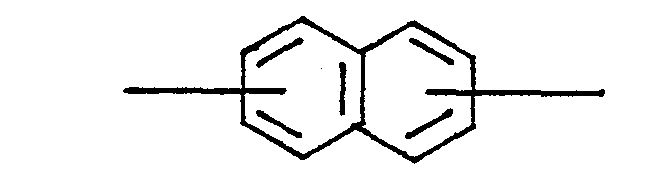
- Amorphous, thermoplastically processable plastics without partially crystalline areas with glass transition temperatures not exceeding 200 ° C are sought. This goal is achieved in that the links B from at least two different or bridged aromatic residues exist.
- the polyarylene esters according to the invention are distinguished from those which each contain only one type of group A and B by a markedly reduced tendency to crystallize. This is due to a disruption of the crystalline structure, which in turn is due to a reduced periodicity of the chain structure.
- the new polyarylene esters can be molded in the thermoplastic state below their thermal decomposition temperature in the temperature range from about 200 to 380 ° C to films, fibers, profiles or other shaped articles which are characterized by good self-extinguishing properties.
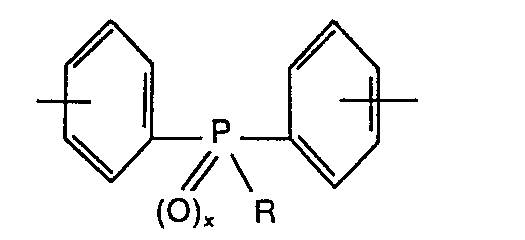
- R which is involved in the construction of the polyarylene esters according to the invention consists at least in part of compounds of the structure
- R can be, for example, a methyl, chloromethyl, benzyl or phenyl group. Methyl and phenyl are preferred.
- the aromatic radicals de., Compound can optionally carry further substituents, such as fused aromatic ring systems, methyl groups or halogen atoms, in particular bromine or chlorine.
- the phenolic hydroxyl groups are preferably in the p-position to the phosphorate cm.
- the oxidized form of the compound, for which x 1, is preferred.
- Some of the phosphorus-containing groups A can be replaced by the phosphorus-free groups mentioned for B. This reduces the phosphorus content of the polyarylene ester, but at the same time further reduces the tendency to crystallize.
- the proportion of phosphorus-free groups A is limited in that the phosphorus content is not less than 1% by weight. may be. It is preferably over 2% by weight; as a rule even over 4 and in particular at 5 to 7 wt .-%.
- the proportion of phosphorus-containing groups A is preferably above 50 mol%, in particular above 70 mol% of the total of groups A.
- the Schotten-Baumann reaction between the bisphenols HO-A-OH and the dicarboxylic acid dichlorides ClCO-B-COCl in the presence of an at least equivalent amount of a base in a suitable solvent is particularly useful.
- suitable solvents are aliphatic chlorinated hydrocarbons, such as methylene chloride, chloroform, tetrachlorethylene, tetrachloroethane, or aromatic hydrocarbons, such as toluene.
- bases for example sodium or potassium hydroxide, pyridine and triethylamine can be used be applied.
- the reaction temperature is, for example, between 0 and 150 ° C, preferably 20 to 100 ° C.
- the starting compounds are used in the highest possible purity.
- monofunctional impurities that participate in the reaction but have a chain-breaking effect are said to be absent.
- the molar ratio of the bisphenols to the total of the dicarboxylic acid derivatives must be very close to 1: 1, which is generally known from the chemistry of the polycondensation reactions.
- the molecular weight of the polyarylene esters is preferably not less than 10,000, preferably in the range from 20,000 to 80,000. To achieve these molecular weights, condensation times of 0.1 to 10 hours are required.
- the plastic properties, especially the strength values of the products, can often be further improved by post-condensation for 10 to 90 minutes at 250 to 350 ° C, if necessary in vacuo.
- the resulting linear macromolecules usually contain hydroxyl or carboxyl groups as Ehd groups, which can, if desired, be etherified or esterified subsequently. Targeted small amounts of monofunctional phenols or carboxylic acids can also be added to form end groups.
- the resulting polymer molecules usually remain dissolved during the condensation, while the hydrochloride of the base precipitates and can be filtered off.
- the polymer can e.g. by precipitation with a non-solvent or by evaporation of the solvent.
- Example 3 Analogously to Example 3, 0.05 mol of oxibis (p-phenylene carbonyl chloride) was used instead of the iso / terephthalic acid dichloride mixture.
- the polyester was first precipitated from petroleum spirit, then from methanol / water.
Landscapes
- Chemical & Material Sciences (AREA)
- Organic Chemistry (AREA)
- Health & Medical Sciences (AREA)
- Chemical Kinetics & Catalysis (AREA)
- Medicinal Chemistry (AREA)
- Polymers & Plastics (AREA)
- Life Sciences & Earth Sciences (AREA)
- Biochemistry (AREA)
- General Health & Medical Sciences (AREA)
- Molecular Biology (AREA)
- Polyesters Or Polycarbonates (AREA)
Abstract
Description
- Die Erfindung betrifft phosphorhaltige Polyarylenester, die als hoch temperaturbeständige und schwerbrennbare thermoplastische Kunststoffe von Interesse sind.
- Aus der DE-OS 29 25 206 sind Polyesterphosphonate bekannt, die hinsichtlich ihrer Eigenschaften zur gleichen Kunststoffklasse gehören. Sie sind jedoch durch den Gehalt an Phosphonestergruppen verhältnismäßig leicht hydrolytisch spaltbar.
- Phosphorhaltige Polyarylenester sind in JP-OS 81 65020 und in einer Arbeit von H. Kondo et al. (European Polymer Journal, Vol. 17, 1981, S. 583 - 588) beschrieben. Sie enthalten die Phosphoratome in 5- oder 6-gliedrigen Ringstrukturen, die das Polymermolekül stark versteifen. Dies führt zu hohen Erweichungstemperaturen, die die Verarbeitung nahe an der Zersetzungstemperatur erforderlich machen.
- S. Hashimoto et al. (Kobunshi Kagaku, Eng. Ed., Vol.2, Nr.9, 1973, S. 826 - 834) haben phosphorhaltige Polyarylenester der Struktur


- Die Schmelztemperatur von phosphorhaltigen Polyarylenestern sollte weiter vermindert werden, ohne gleichzeitig den Phosphorgehalt herabzusetzen. Angestrebt werden amorphe, thermoplastisch verarbeitbare Kunststoffe ohne teilkristalline Bereiche mit Glastemperaturen nicht über 200°C. Dieses Ziel wird erfindungsgemäß dadurch erreicht, daß die Glieder B aus wenigstens zwei verschiedenen oder aus verbrückten aromatischen Resten bestehen. Erfindungsgegenstand sind daher Phosphorhaltige Polyarylenester der Struktur




- Einer der erfindungsgemäßen Polyarylenester z.B.


- Die erfindungsgemäßen Polyarylenester zeichnen sich gegenüber denen, die jeweils nur eine Art von Gruppen A und B enthalten, durch eine deutlich verminderte Kristallisationsneigung aus. Dies ist auf eine Störung des kristallinen Gefüges zurückzuführen, die wiederum auf einer verminderten Periodizität des Kettenaufbaus beruht.
- Die neuen Polyarylenester können im thermoplastischen Zustand unterhalb ihrer thermischen Zersetzungstemperatur im Temperatur bereich von etwa 200 bis 380°C zu Folien, Fasern, Profilen oder sonstigen Formkörpern verformt werden, die sich durch gute Selbstlöscheigenschaften auszeichnen.
- das am Aufbau der erfindungsgemäßen Polyarylenester beteiligt ist, besteht wenigstens zum Teil aus Verbindungen der Struktur

- Ein Teil der phosphorhaltigen Gruppen A kann durch die für B genannten phosphorfreien Gruppen ersetzt sein. Dadurch wird zwar der Phosphorgehalt des Polyarylenesters vermindert, aber gleichzeitig die Kristallisationsneigung noch weiter herabgesetzt. Der Anteil der phosphorfreien Gruppen A ist dadurch begrenzt, daß der Phosphorgehalt nicht weniger als 1 Gew.-% betragen darf. Er liegt vorzugsweise über 2 Gew.-%; im Regelfall sogar über 4 und insbesondere bei 5 bis 7 Gew.-%. Vorzugsweise liegt der Anteil der phosphorhaltigen Gruppen A über 50 Mol-%, insbesondere über 70 Mol-% der Gesamtheit der Gruppen A.
- die den Polyarylenestern formal zugrundeliegen und die für deren vorteilhafte Eigenschaften wesentlich sind, sind entweder über Brückenglieder R' verbundene mehrkernige aromatische Dicarbonsäuren oder, wenn sie nicht diesen Aufbau haben, stets Gemische von zwei oder mehr der anderen formelmäßig bezeichneten Carbonsäuren. Der schmelztemperatursenkende Effekt wird im allgemeinen schon mit zwei verschiedenen Säuren der zuletzt genannten Art voll erreicht. Der Effekt wird durch deutliche Strukturunterschiede zwischen den beteiligten Gruppen B gefördert. So ist z.B. das Gemisch aus Terephthalsäure und Isophthalsäure sehr wirksam. Der Anteil jeder beteiligten Art von Resten B soll vorzugsweise nicht unter 10 Mol-%, bezogen auf die Gesamtheit der Reste B, liegen. Anteile von 25 bis 75 Gew.-% sind bevorzugt, insbesondere das Verhältnis 50 : 50.
- erfolgt grundsätzlich nach der im Anspruch 2 angegebenen Arbeitsweise. Besonders zweckmäßig ist die Schotten-Baumann'sche Reaktion zwischen den Bisphenolen HO-A-OH und den Dicarbonsäuredichloriden ClCO-B-COCl in Gegenwart einer wenigstens äquivalenten Menge einer Base in einem geeigneten Lösungsmittel. Als Lösungsmittel eignen sich z.B. aliphatische Chlorkohlenwasserstoffe, wie Methylenchlorid, Chloroform, Tetrachloräthylen, Tetrachloräthan, oder aromatische Kohlenwasserstoffe, wie Toluol. Als Basen können z.B. Natrium-oder Kaliumhydroxyd, Pyridin und Triäthylamin verwendet werden. Die Reaktionstemperatur liegt beispielsweise zwischen 0 und 150°C, vorzugsweise bei 20 bis 100°C.
- Um ein hohes Molekulargewicht und damit gute Kunststoffeigenschaften zu erreichen, werden die Ausgangsverbindungen in möglichst hoher Reinheit eingesetzt. Insbesondere sollen monofunktionelle Verunreinigungen fehlen, die an der Reaktion teilnehmen, aber kettenabbrechend wirken. Aus dem gleichen Grund muß das Molverhältnis der Bisphenole zu der Gesamtheit der Dicarbonsäurederivate sehr nahe bei 1 : 1 liegen, was aus der Chemie der Polykondensationsreaktionen allgemein bekannt ist. Das Molekulargewicht der Polyarylenester liegt vorzugsweise nicht unter 10.000, vorzugsweise im Bereich von 20.000 bis 80.000. Um diese Molekulargewichte zu erreichen, sind Kondensationszeiten von 0,1 bis 10 Stunden erforderlich. Häufig lassen sich die Kunststoffeigenschaften, vor allem die Festigkeitswerte der Produkte, durch eine Nachkondensation von 10 bis 90 min Dauer bei 250 bis 350°C, gegebenenfalls im Vakuum, weiter verbessern. Die entstehenden linearen Makromoleküle enthalten in der Regel Hydroxyl- bzw. Carboxylgruppen als Ehdgruppen, die gewünschtenfalls nachträglich veräthert bzw. verestert werden können. Man kann auch gezielte kleine Mengen monofunktioneller Phenole oder Carbonsäuren zur Bildung von Endgruppen zusetzen.
- Die entstehenden Polymermoleküle bleiben im Regelfall bei der Kondensation gelöst, während das Hydrochlorid der Base ausfällt und abfiltriert werden kann. Das Polymerisat kann z.B. durch Ausfällung mit einem Nichtlöser oder durch Verdampfen des Lösungsmittels gewonnen werden.
- Weitere Möglichkeiten zur Synthese der neuen Polyarylenester sind die literaturbekannten Kondensationsverfahren, z.B. die Schmelzkondensation durch Ümsetzung der entsprechenden Bis- phenol-diacetate und Dicarbonsäuren oder Umsetzung der Bisphenole mit Dicarbonsäurediphenylestern. Nachteilig ist bei diesen Methoden das lange Erhitzen der Kondensationsansätze auf hohe Temperaturen, die 350°C während 10 Stunden erreichen können, sowie die Notwendigkeit, aus den hochviskosen Reaktionsgemischen die bei der Kondensation abgespaltenen niedermolekularen Verbindungen abzudestillieren.
- 0,015 Mol Dihydroxy-triphenylphosphinoxid, 0,035 Mol Bisphenol 0 (Dihydroxy-diphenyläther) und 2,4 Mol Pyridin wurden in 500 ml Tetrachloräthylen gelöst und bei 100°C mit 0,025 Mol Terephthalsäuredichlorid und 0,025 Mol Isophthalsäuredichlorid (gelöst in 500 ml Tetrachloräthylen) umgesetzt. Nach einer Stunde wurden 2 Mol-% des obigen Bisphenol-Gemisches (bezogen auf die anfänglich eingesetzte Menge) und nach 15 min 5 Mol-% (bezogen.auf die anfängliche Menge der Säurechloride) Benzoylchlorid zugegeben. Das Reaktionsgemisch wird in 10 1 Methanol eingetragen, der ausgefallene Polyester abgetrennt, mit Wasser chloridfrei gewaschen und getrocknet.
- Analog Beispiel 1 wurden 0,035 Mol Bisphenol A (2,2-Di-[4-hydroxyphenyl]-propan) statt Bisphenol 0 eingesetzt.
- Zu 0,05 Mol Dihydroxy-triphenylphosphinoxid, gelöst in 0,32 Mol Pyridin und 100 ml Methylenchlorid wurde innerhalb einer Stunde bei Raumtemperatur eine Lösung von 0,025 Mol Terephthalsäuredichlorid und 0,025 Mol Isophthalsäuredichlorid zugetropft; anschließend wurde zwei Stunden bei Raumtemperatur nachgerührt. Danach wurden zur Umsetzung von etwa noch vorhandenen Säurechlorid-Endgruppen weitere 2 Mol-% Dihydroxy-triphenylphosphin oxid (bezogen auf die anfänglich eingesetzte Menge) und zwecks Acetylierung der phenolischen Hydroxylengruppen nach 10 min 5 Mol-% Acetylchlorid (bezogen auf die anfängliche Menge der Säurechloride) zugesetzt. Der entstandene Polyester wurde in einem Methanol/Wasser-Gemisch ausgefällt, mit salzsaurem Wasser, danach mit destilliertem Wasser gewaschen und getrocknet.
- Analog Beispiel 3 wurden 0,05 Mol Oxibis-(p-phenylencarbonyl- chlorid) statt des Iso/Terephthalsäuredichlorid-Gemisches eingesetzt. Der Polyester wurde zunächst aus Petroleumbenzin, anschließend aus Methanol/Wasser gefällt.

Claims (3)


dadurch gekennzeichnet,
daß die Glieder B aus wenigstens zwei verschiedenen Resten der Gruppe


Applications Claiming Priority (2)
| Application Number | Priority Date | Filing Date | Title |
|---|---|---|---|
| DE3222571 | 1982-06-16 | ||
| DE19823222571 DE3222571A1 (de) | 1982-06-16 | 1982-06-16 | Phosphorhaltige polyarylenester und verfahren zu ihrer herstellung |
Publications (3)
| Publication Number | Publication Date |
|---|---|
| EP0096799A2 true EP0096799A2 (de) | 1983-12-28 |
| EP0096799A3 EP0096799A3 (en) | 1984-04-04 |
| EP0096799B1 EP0096799B1 (de) | 1986-08-06 |
Family
ID=6166166
Family Applications (1)
| Application Number | Title | Priority Date | Filing Date |
|---|---|---|---|
| EP83105363A Expired EP0096799B1 (de) | 1982-06-16 | 1983-05-31 | Phosphorhaltige Polyarylenester und Verfahren zu ihrer Herstellung |
Country Status (4)
| Country | Link |
|---|---|
| US (1) | US4463159A (de) |
| EP (1) | EP0096799B1 (de) |
| JP (1) | JPS596218A (de) |
| DE (2) | DE3222571A1 (de) |
Cited By (1)
| Publication number | Priority date | Publication date | Assignee | Title |
|---|---|---|---|---|
| EP0664296A1 (de) * | 1994-01-20 | 1995-07-26 | GREAT LAKES CHEMICAL ITALIA S.r.l. | Reaktive flammverzögernde Additive, die Phosphinoxid-Gruppen enthalten |
Families Citing this family (7)
| Publication number | Priority date | Publication date | Assignee | Title |
|---|---|---|---|---|
| DE3425282A1 (de) * | 1984-07-10 | 1986-01-16 | Röhm GmbH, 6100 Darmstadt | Verfahren zur herstellung aromatischer phosphorverbindungen |
| US4680370A (en) * | 1985-09-30 | 1987-07-14 | The Dow Chemical Company | Branched polycarbonate composition from tris(hydroxyaryl)phosphorus compound |
| KR970003950B1 (en) * | 1993-07-06 | 1997-03-24 | Kumho Petrochemical Co Ltd | Wholly aromatic polyester and method for manufacturing the same |
| US6153212A (en) * | 1998-10-02 | 2000-11-28 | Guilford Pharmaceuticals Inc. | Biodegradable terephthalate polyester-poly (phosphonate) compositions, articles, and methods of using the same |
| WO2008134474A2 (en) | 2007-04-27 | 2008-11-06 | The Board Of Trustees Of The University Of Illinois | Compositions and methods including cell death inducers and procaspase activation |
| CA2651395A1 (en) | 2006-05-19 | 2007-11-29 | Board Of Trustees Of The University Of Illinois | Phosphorous containing compounds including triphenylmethylphosphonate esters for the treatment of melanoma and other cancers |
| CN106946812B (zh) | 2009-02-09 | 2020-10-09 | 伊利诺伊大学评议会 | 作为个性化抗癌药的胱天蛋白酶原活化化合物的设计、合成和评价 |
Family Cites Families (9)
| Publication number | Priority date | Publication date | Assignee | Title |
|---|---|---|---|---|
| US3847866A (en) * | 1965-07-12 | 1974-11-12 | H Bredereck | Bis-(p-hydroxyphenyl)alkylphosphonic acid esters |
| US3993623A (en) * | 1975-05-05 | 1976-11-23 | Monsanto Company | Polymers made flame retardant with condensation products of phosphine oxides |
| US4087408A (en) * | 1976-12-15 | 1978-05-02 | Monsanto Company | Bromine and phosphorus containing polyester |
| FR2379560A1 (fr) * | 1977-02-03 | 1978-09-01 | Rhone Poulenc Textile | Copolyesters conformables a inflammabilite reduite |
| US4123420A (en) * | 1977-10-28 | 1978-10-31 | Unitika Ltd. | Aromatic copolyester composition containing phosphorus compounds |
| US4278785A (en) * | 1979-06-04 | 1981-07-14 | Hooker Chemicals & Plastics Corp. | Polyester composition, process therefor and molded articles therefrom |
| US4255555A (en) * | 1979-06-04 | 1981-03-10 | Hooker Chemicals & Plastics Corp. | Transesterification process for preparation of linear polyesters |
| DE2925206A1 (de) * | 1979-06-22 | 1981-01-29 | Bayer Ag | Aromatische polyesterphosphonate, verfahren zu ihrer herstellung und ihre verwendung zur herstellung thermoplastischer formkoerper |
| JPS5665020A (en) * | 1979-10-30 | 1981-06-02 | Masaaki Yokoyama | Polyester having phenoxaphosphine ring and production thereof |
-
1982
- 1982-06-16 DE DE19823222571 patent/DE3222571A1/de not_active Withdrawn
-
1983
- 1983-05-31 EP EP83105363A patent/EP0096799B1/de not_active Expired
- 1983-05-31 DE DE8383105363T patent/DE3365120D1/de not_active Expired
- 1983-05-31 US US06/499,526 patent/US4463159A/en not_active Expired - Fee Related
- 1983-06-10 JP JP58102936A patent/JPS596218A/ja active Pending
Cited By (2)
| Publication number | Priority date | Publication date | Assignee | Title |
|---|---|---|---|---|
| EP0664296A1 (de) * | 1994-01-20 | 1995-07-26 | GREAT LAKES CHEMICAL ITALIA S.r.l. | Reaktive flammverzögernde Additive, die Phosphinoxid-Gruppen enthalten |
| US5500285A (en) * | 1994-01-20 | 1996-03-19 | Great Lakes Chemical Italia S.R.L. | Reactive flame retardant additives containing phosphino oxide moieties |
Also Published As
| Publication number | Publication date |
|---|---|
| EP0096799A3 (en) | 1984-04-04 |
| JPS596218A (ja) | 1984-01-13 |
| US4463159A (en) | 1984-07-31 |
| DE3365120D1 (en) | 1986-09-11 |
| EP0096799B1 (de) | 1986-08-06 |
| DE3222571A1 (de) | 1983-12-22 |
Similar Documents
| Publication | Publication Date | Title |
|---|---|---|
| DE69125846T2 (de) | Hyperverzweigte polyester | |
| DE3382700T2 (de) | Verwendung eines amorphen aromatischen thermoplastischen Polymeren. | |
| DE3587432T2 (de) | Aus der Schmelze verarbeitbare, optisch anisotrope Polymere. | |
| DE2646218A1 (de) | Neue phosphor-enthaltende verbindungen | |
| DE2549529A1 (de) | Aromatische polyaethersulfone | |
| EP0301409A2 (de) | Thermoplastisch verarbeitbare Polyarylenether mit 9,9-Bis-(4'-hydroxyphenyl)fluoren | |
| DE3687900T2 (de) | Tetrahalogenphthalsaeureester als flammschutzmittel fuer polyphenylenetherharze. | |
| EP0212478A2 (de) | Schnellkristallisierende Polyphenylensulfidmassen | |
| EP0096799B1 (de) | Phosphorhaltige Polyarylenester und Verfahren zu ihrer Herstellung | |
| DE2739843A1 (de) | Verfahren zur herstellung von hoehermolekularen phosphorsaeure- bzw. phosphonsaeurearylestern | |
| DE2840960C2 (de) | ||
| EP0103731B1 (de) | Phosphorhaltige Polyarylenester und Verfahren zu ihrer Herstellung | |
| EP0023248A1 (de) | Formmasse aus einem hochmolekularen linearen Polyester | |
| EP0205124A1 (de) | Verfahren zur Herstellung phosphorhaltiger Polyarylenäther | |
| EP0206099B1 (de) | Phosphorhaltige Polyarylenäther und Verfahren zu ihrer Herstellung | |
| EP0064971A2 (de) | Hochmolekularer aromatischer Polyester, Verfahren zur Herstellung von Folien aus diesen Polyestern und Folie aus diesen Polyestern, ein elektrischer Leiter mit einer Isolierung aus diesen Polyestern und Verfahren zur Herstellung solcher Isolierungen | |
| EP0329029A2 (de) | Hochtemperaturbeständige aromatische Polyether | |
| EP0424640A1 (de) | Verfahren zur Herstellung eines thermoplastisch verarbeitbaren, aromatischen Polyamids | |
| DE2453450C2 (de) | Neue, flammwidrige, thermoplastische Polyester | |
| EP0054808A1 (de) | Thermoplastische Blockcopolyester, Verfahren zu ihrer Herstellung und ihre Verwendung zur Herstellung von Formkörpern | |
| DE2009494C3 (de) | Verfahren zur Herstellung hxxochmolekularer linearer aromatischer Polyestercarbonate und deren Verwendung | |
| DE3727254A1 (de) | Neue aromatische polyester, verfahren zu deren herstellung sowie deren verwendung zur herstellung von molekular verstaerkten polymeren | |
| DE2720844A1 (de) | Thermoplastische polyester | |
| DE1133133B (de) | Verfahren zur Herstellung linearer thermoplastischer Polykondensate aus Diorganosilandiolen und aromatischen Dioxyverbindungen | |
| EP0226142B1 (de) | Neue aromatische Polyester, Verfahren zu deren Herstellung sowie deren Verwendung zur Herstellung von molekular verstärkten Polymeren |
Legal Events
| Date | Code | Title | Description |
|---|---|---|---|
| PUAI | Public reference made under article 153(3) epc to a published international application that has entered the european phase |
Free format text: ORIGINAL CODE: 0009012 |
|
| AK | Designated contracting states |
Designated state(s): DE FR GB IT NL |
|
| PUAL | Search report despatched |
Free format text: ORIGINAL CODE: 0009013 |
|
| AK | Designated contracting states |
Designated state(s): DE FR GB IT NL |
|
| 17P | Request for examination filed |
Effective date: 19840616 |
|
| GRAA | (expected) grant |
Free format text: ORIGINAL CODE: 0009210 |
|
| AK | Designated contracting states |
Kind code of ref document: B1 Designated state(s): DE FR GB IT NL |
|
| ITF | It: translation for a ep patent filed | ||
| REF | Corresponds to: |
Ref document number: 3365120 Country of ref document: DE Date of ref document: 19860911 |
|
| ET | Fr: translation filed | ||
| PLBE | No opposition filed within time limit |
Free format text: ORIGINAL CODE: 0009261 |
|
| 26N | No opposition filed | ||
| PGFP | Annual fee paid to national office [announced via postgrant information from national office to epo] |
Ref country code: FR Payment date: 19930518 Year of fee payment: 11 |
|
| PGFP | Annual fee paid to national office [announced via postgrant information from national office to epo] |
Ref country code: GB Payment date: 19930521 Year of fee payment: 11 |
|
| PGFP | Annual fee paid to national office [announced via postgrant information from national office to epo] |
Ref country code: DE Payment date: 19930525 Year of fee payment: 11 |
|
| ITTA | It: last paid annual fee | ||
| PGFP | Annual fee paid to national office [announced via postgrant information from national office to epo] |
Ref country code: NL Payment date: 19930531 Year of fee payment: 11 |
|
| PG25 | Lapsed in a contracting state [announced via postgrant information from national office to epo] |
Ref country code: GB Effective date: 19940531 |
|
| PG25 | Lapsed in a contracting state [announced via postgrant information from national office to epo] |
Ref country code: NL Effective date: 19941201 |
|
| NLV4 | Nl: lapsed or anulled due to non-payment of the annual fee | ||
| GBPC | Gb: european patent ceased through non-payment of renewal fee |
Effective date: 19940531 |
|
| PG25 | Lapsed in a contracting state [announced via postgrant information from national office to epo] |
Ref country code: FR Effective date: 19950131 |
|
| PG25 | Lapsed in a contracting state [announced via postgrant information from national office to epo] |
Ref country code: DE Effective date: 19950201 |
|
| REG | Reference to a national code |
Ref country code: FR Ref legal event code: ST |