EP0334313B1 - Particules mousse en résine de propylène et article en mousse formée - Google Patents
Particules mousse en résine de propylène et article en mousse formée Download PDFInfo
- Publication number
- EP0334313B1 EP0334313B1 EP89105116A EP89105116A EP0334313B1 EP 0334313 B1 EP0334313 B1 EP 0334313B1 EP 89105116 A EP89105116 A EP 89105116A EP 89105116 A EP89105116 A EP 89105116A EP 0334313 B1 EP0334313 B1 EP 0334313B1
- Authority
- EP
- European Patent Office
- Prior art keywords
- propylene
- foamed
- particles
- foamed particles
- random copolymer
- Prior art date
- Legal status (The legal status is an assumption and is not a legal conclusion. Google has not performed a legal analysis and makes no representation as to the accuracy of the status listed.)
- Expired - Lifetime
Links
- 239000002245 particle Substances 0.000 title claims description 126
- 229920005989 resin Polymers 0.000 title claims description 50
- 239000011347 resin Substances 0.000 title claims description 50
- QQONPFPTGQHPMA-UHFFFAOYSA-N propylene Natural products CC=C QQONPFPTGQHPMA-UHFFFAOYSA-N 0.000 title claims description 29
- 125000004805 propylene group Chemical group [H]C([H])([H])C([H])([*:1])C([H])([H])[*:2] 0.000 title claims description 29
- VXNZUUAINFGPBY-UHFFFAOYSA-N 1-Butene Chemical compound CCC=C VXNZUUAINFGPBY-UHFFFAOYSA-N 0.000 claims description 60
- 229920005604 random copolymer Polymers 0.000 claims description 41
- 239000011162 core material Substances 0.000 claims description 34
- 238000002425 crystallisation Methods 0.000 claims description 14
- 230000008025 crystallization Effects 0.000 claims description 14
- 238000010521 absorption reaction Methods 0.000 claims description 13
- 238000007906 compression Methods 0.000 claims description 11
- 230000006835 compression Effects 0.000 claims description 11
- 238000000034 method Methods 0.000 description 27
- 238000010438 heat treatment Methods 0.000 description 20
- 239000006185 dispersion Substances 0.000 description 18
- 238000011049 filling Methods 0.000 description 17
- XLYOFNOQVPJJNP-UHFFFAOYSA-N water Substances O XLYOFNOQVPJJNP-UHFFFAOYSA-N 0.000 description 17
- 229920005674 ethylene-propylene random copolymer Polymers 0.000 description 14
- 239000004604 Blowing Agent Substances 0.000 description 12
- IJGRMHOSHXDMSA-UHFFFAOYSA-N Atomic nitrogen Chemical compound N#N IJGRMHOSHXDMSA-UHFFFAOYSA-N 0.000 description 11
- 229920001577 copolymer Polymers 0.000 description 10
- 238000000465 moulding Methods 0.000 description 10
- VGGSQFUCUMXWEO-UHFFFAOYSA-N Ethene Chemical compound C=C VGGSQFUCUMXWEO-UHFFFAOYSA-N 0.000 description 9
- 239000005977 Ethylene Substances 0.000 description 9
- 238000005187 foaming Methods 0.000 description 8
- 238000002844 melting Methods 0.000 description 8
- 230000008018 melting Effects 0.000 description 8
- -1 propylene, ethylene Chemical group 0.000 description 7
- LIKMAJRDDDTEIG-UHFFFAOYSA-N 1-hexene Chemical compound CCCCC=C LIKMAJRDDDTEIG-UHFFFAOYSA-N 0.000 description 6
- 239000007789 gas Substances 0.000 description 6
- 239000000463 material Substances 0.000 description 6
- 229910001873 dinitrogen Inorganic materials 0.000 description 5
- 239000012467 final product Substances 0.000 description 5
- 239000004793 Polystyrene Substances 0.000 description 4
- 238000005520 cutting process Methods 0.000 description 4
- GVGUFUZHNYFZLC-UHFFFAOYSA-N dodecyl benzenesulfonate;sodium Chemical compound [Na].CCCCCCCCCCCCOS(=O)(=O)C1=CC=CC=C1 GVGUFUZHNYFZLC-UHFFFAOYSA-N 0.000 description 4
- 229910001872 inorganic gas Inorganic materials 0.000 description 4
- NNPPMTNAJDCUHE-UHFFFAOYSA-N isobutane Chemical compound CC(C)C NNPPMTNAJDCUHE-UHFFFAOYSA-N 0.000 description 4
- 229920002223 polystyrene Polymers 0.000 description 4
- 229920001384 propylene homopolymer Polymers 0.000 description 4
- 239000011734 sodium Substances 0.000 description 4
- 229910052708 sodium Inorganic materials 0.000 description 4
- 229940080264 sodium dodecylbenzenesulfonate Drugs 0.000 description 4
- QORWJWZARLRLPR-UHFFFAOYSA-H tricalcium bis(phosphate) Chemical compound [Ca+2].[Ca+2].[Ca+2].[O-]P([O-])([O-])=O.[O-]P([O-])([O-])=O QORWJWZARLRLPR-UHFFFAOYSA-H 0.000 description 4
- WSSSPWUEQFSQQG-UHFFFAOYSA-N 4-methyl-1-pentene Chemical compound CC(C)CC=C WSSSPWUEQFSQQG-UHFFFAOYSA-N 0.000 description 3
- YMWUJEATGCHHMB-UHFFFAOYSA-N Dichloromethane Chemical compound ClCCl YMWUJEATGCHHMB-UHFFFAOYSA-N 0.000 description 3
- 230000000903 blocking effect Effects 0.000 description 3
- 229920006026 co-polymeric resin Polymers 0.000 description 3
- 230000000052 comparative effect Effects 0.000 description 3
- 230000000694 effects Effects 0.000 description 3
- 229920005676 ethylene-propylene block copolymer Polymers 0.000 description 3
- VLKZOEOYAKHREP-UHFFFAOYSA-N n-Hexane Chemical compound CCCCCC VLKZOEOYAKHREP-UHFFFAOYSA-N 0.000 description 3
- OFBQJSOFQDEBGM-UHFFFAOYSA-N n-pentane Natural products CCCCC OFBQJSOFQDEBGM-UHFFFAOYSA-N 0.000 description 3
- 229910052757 nitrogen Inorganic materials 0.000 description 3
- 230000035882 stress Effects 0.000 description 3
- 239000000375 suspending agent Substances 0.000 description 3
- 229920001897 terpolymer Polymers 0.000 description 3
- XKRFYHLGVUSROY-UHFFFAOYSA-N Argon Chemical compound [Ar] XKRFYHLGVUSROY-UHFFFAOYSA-N 0.000 description 2
- VTYYLEPIZMXCLO-UHFFFAOYSA-L Calcium carbonate Chemical compound [Ca+2].[O-]C([O-])=O VTYYLEPIZMXCLO-UHFFFAOYSA-L 0.000 description 2
- DGAQECJNVWCQMB-PUAWFVPOSA-M Ilexoside XXIX Chemical compound C[C@@H]1CC[C@@]2(CC[C@@]3(C(=CC[C@H]4[C@]3(CC[C@@H]5[C@@]4(CC[C@@H](C5(C)C)OS(=O)(=O)[O-])C)C)[C@@H]2[C@]1(C)O)C)C(=O)O[C@H]6[C@@H]([C@H]([C@@H]([C@H](O6)CO)O)O)O.[Na+] DGAQECJNVWCQMB-PUAWFVPOSA-M 0.000 description 2
- IMNFDUFMRHMDMM-UHFFFAOYSA-N N-Heptane Chemical compound CCCCCCC IMNFDUFMRHMDMM-UHFFFAOYSA-N 0.000 description 2
- NBIIXXVUZAFLBC-UHFFFAOYSA-N Phosphoric acid Chemical compound OP(O)(O)=O NBIIXXVUZAFLBC-UHFFFAOYSA-N 0.000 description 2
- 229920005830 Polyurethane Foam Polymers 0.000 description 2
- ATUOYWHBWRKTHZ-UHFFFAOYSA-N Propane Chemical compound CCC ATUOYWHBWRKTHZ-UHFFFAOYSA-N 0.000 description 2
- VYPSYNLAJGMNEJ-UHFFFAOYSA-N Silicium dioxide Chemical compound O=[Si]=O VYPSYNLAJGMNEJ-UHFFFAOYSA-N 0.000 description 2
- 239000003570 air Substances 0.000 description 2
- JUNWLZAGQLJVLR-UHFFFAOYSA-J calcium diphosphate Chemical compound [Ca+2].[Ca+2].[O-]P([O-])(=O)OP([O-])([O-])=O JUNWLZAGQLJVLR-UHFFFAOYSA-J 0.000 description 2
- 229940043256 calcium pyrophosphate Drugs 0.000 description 2
- 229920003020 cross-linked polyethylene Polymers 0.000 description 2
- 239000004703 cross-linked polyethylene Substances 0.000 description 2
- 235000019821 dicalcium diphosphate Nutrition 0.000 description 2
- 239000002270 dispersing agent Substances 0.000 description 2
- 239000011810 insulating material Substances 0.000 description 2
- 239000001282 iso-butane Substances 0.000 description 2
- 229920001684 low density polyethylene Polymers 0.000 description 2
- 239000004702 low-density polyethylene Substances 0.000 description 2
- 238000004519 manufacturing process Methods 0.000 description 2
- 239000000155 melt Substances 0.000 description 2
- 238000004806 packaging method and process Methods 0.000 description 2
- YWAKXRMUMFPDSH-UHFFFAOYSA-N pentene Chemical compound CCCC=C YWAKXRMUMFPDSH-UHFFFAOYSA-N 0.000 description 2
- 239000011496 polyurethane foam Substances 0.000 description 2
- 238000011084 recovery Methods 0.000 description 2
- 238000003756 stirring Methods 0.000 description 2
- 229920002134 Carboxymethyl cellulose Polymers 0.000 description 1
- 239000004338 Dichlorodifluoromethane Substances 0.000 description 1
- 229920000181 Ethylene propylene rubber Polymers 0.000 description 1
- 238000004566 IR spectroscopy Methods 0.000 description 1
- 239000004743 Polypropylene Substances 0.000 description 1
- 239000004372 Polyvinyl alcohol Substances 0.000 description 1
- GWEVSGVZZGPLCZ-UHFFFAOYSA-N Titan oxide Chemical compound O=[Ti]=O GWEVSGVZZGPLCZ-UHFFFAOYSA-N 0.000 description 1
- 229910021536 Zeolite Inorganic materials 0.000 description 1
- 239000000654 additive Substances 0.000 description 1
- 230000032683 aging Effects 0.000 description 1
- 150000001338 aliphatic hydrocarbons Chemical class 0.000 description 1
- 229910000147 aluminium phosphate Inorganic materials 0.000 description 1
- 125000000129 anionic group Chemical group 0.000 description 1
- 239000002216 antistatic agent Substances 0.000 description 1
- 229910052786 argon Inorganic materials 0.000 description 1
- 229920001400 block copolymer Polymers 0.000 description 1
- 238000009835 boiling Methods 0.000 description 1
- 239000001273 butane Substances 0.000 description 1
- 229910000019 calcium carbonate Inorganic materials 0.000 description 1
- AXCZMVOFGPJBDE-UHFFFAOYSA-L calcium dihydroxide Chemical compound [OH-].[OH-].[Ca+2] AXCZMVOFGPJBDE-UHFFFAOYSA-L 0.000 description 1
- 239000000920 calcium hydroxide Substances 0.000 description 1
- 229910001861 calcium hydroxide Inorganic materials 0.000 description 1
- 239000001768 carboxy methyl cellulose Substances 0.000 description 1
- 235000010948 carboxy methyl cellulose Nutrition 0.000 description 1
- 239000008112 carboxymethyl-cellulose Substances 0.000 description 1
- 238000006243 chemical reaction Methods 0.000 description 1
- NEHMKBQYUWJMIP-NJFSPNSNSA-N chloro(114C)methane Chemical compound [14CH3]Cl NEHMKBQYUWJMIP-NJFSPNSNSA-N 0.000 description 1
- HRYZWHHZPQKTII-UHFFFAOYSA-N chloroethane Chemical compound CCCl HRYZWHHZPQKTII-UHFFFAOYSA-N 0.000 description 1
- 239000000084 colloidal system Substances 0.000 description 1
- 238000000748 compression moulding Methods 0.000 description 1
- 238000012669 compression test Methods 0.000 description 1
- 239000000470 constituent Substances 0.000 description 1
- 238000001816 cooling Methods 0.000 description 1
- 239000013078 crystal Substances 0.000 description 1
- PXBRQCKWGAHEHS-UHFFFAOYSA-N dichlorodifluoromethane Chemical compound FC(F)(Cl)Cl PXBRQCKWGAHEHS-UHFFFAOYSA-N 0.000 description 1
- 235000019404 dichlorodifluoromethane Nutrition 0.000 description 1
- HNPSIPDUKPIQMN-UHFFFAOYSA-N dioxosilane;oxo(oxoalumanyloxy)alumane Chemical compound O=[Si]=O.O=[Al]O[Al]=O HNPSIPDUKPIQMN-UHFFFAOYSA-N 0.000 description 1
- 229960003750 ethyl chloride Drugs 0.000 description 1
- 229920006242 ethylene acrylic acid copolymer Polymers 0.000 description 1
- 239000005038 ethylene vinyl acetate Substances 0.000 description 1
- 229920006244 ethylene-ethyl acrylate Polymers 0.000 description 1
- 229920006225 ethylene-methyl acrylate Polymers 0.000 description 1
- 239000000945 filler Substances 0.000 description 1
- 239000010419 fine particle Substances 0.000 description 1
- 239000006260 foam Substances 0.000 description 1
- 230000004927 fusion Effects 0.000 description 1
- 238000005469 granulation Methods 0.000 description 1
- 230000003179 granulation Effects 0.000 description 1
- 150000008282 halocarbons Chemical class 0.000 description 1
- 239000012760 heat stabilizer Substances 0.000 description 1
- 239000001307 helium Substances 0.000 description 1
- 229910052734 helium Inorganic materials 0.000 description 1
- SWQJXJOGLNCZEY-UHFFFAOYSA-N helium atom Chemical compound [He] SWQJXJOGLNCZEY-UHFFFAOYSA-N 0.000 description 1
- 229920001903 high density polyethylene Polymers 0.000 description 1
- 238000005470 impregnation Methods 0.000 description 1
- 239000011256 inorganic filler Substances 0.000 description 1
- 229910003475 inorganic filler Inorganic materials 0.000 description 1
- 239000007788 liquid Substances 0.000 description 1
- 239000000314 lubricant Substances 0.000 description 1
- ZLNQQNXFFQJAID-UHFFFAOYSA-L magnesium carbonate Chemical compound [Mg+2].[O-]C([O-])=O ZLNQQNXFFQJAID-UHFFFAOYSA-L 0.000 description 1
- 239000001095 magnesium carbonate Substances 0.000 description 1
- 229910000021 magnesium carbonate Inorganic materials 0.000 description 1
- 238000005259 measurement Methods 0.000 description 1
- 229920001179 medium density polyethylene Polymers 0.000 description 1
- 229940073584 methylene chloride Drugs 0.000 description 1
- IJDNQMDRQITEOD-UHFFFAOYSA-N n-butane Chemical compound CCCC IJDNQMDRQITEOD-UHFFFAOYSA-N 0.000 description 1
- JRZJOMJEPLMPRA-UHFFFAOYSA-N olefin Natural products CCCCCCCC=C JRZJOMJEPLMPRA-UHFFFAOYSA-N 0.000 description 1
- 150000002894 organic compounds Chemical class 0.000 description 1
- TWNQGVIAIRXVLR-UHFFFAOYSA-N oxo(oxoalumanyloxy)alumane Chemical compound O=[Al]O[Al]=O TWNQGVIAIRXVLR-UHFFFAOYSA-N 0.000 description 1
- 230000000704 physical effect Effects 0.000 description 1
- 239000000049 pigment Substances 0.000 description 1
- 229920003023 plastic Polymers 0.000 description 1
- 239000004033 plastic Substances 0.000 description 1
- 229920001200 poly(ethylene-vinyl acetate) Polymers 0.000 description 1
- 229920000642 polymer Polymers 0.000 description 1
- 229920005672 polyolefin resin Polymers 0.000 description 1
- 229920001155 polypropylene Polymers 0.000 description 1
- 229920002451 polyvinyl alcohol Polymers 0.000 description 1
- 229920000036 polyvinylpyrrolidone Polymers 0.000 description 1
- 239000001267 polyvinylpyrrolidone Substances 0.000 description 1
- 238000002360 preparation method Methods 0.000 description 1
- 239000001294 propane Substances 0.000 description 1
- 229920005653 propylene-ethylene copolymer Polymers 0.000 description 1
- 230000001681 protective effect Effects 0.000 description 1
- 238000010298 pulverizing process Methods 0.000 description 1
- 239000000377 silicon dioxide Substances 0.000 description 1
- 238000005507 spraying Methods 0.000 description 1
- 239000000126 substance Substances 0.000 description 1
- 239000004094 surface-active agent Substances 0.000 description 1
- 239000000454 talc Substances 0.000 description 1
- 229910052623 talc Inorganic materials 0.000 description 1
- OGIDPMRJRNCKJF-UHFFFAOYSA-N titanium oxide Inorganic materials [Ti]=O OGIDPMRJRNCKJF-UHFFFAOYSA-N 0.000 description 1
- CYRMSUTZVYGINF-UHFFFAOYSA-N trichlorofluoromethane Chemical compound FC(Cl)(Cl)Cl CYRMSUTZVYGINF-UHFFFAOYSA-N 0.000 description 1
- 229940029284 trichlorofluoromethane Drugs 0.000 description 1
- 238000005303 weighing Methods 0.000 description 1
- 239000010457 zeolite Substances 0.000 description 1
- 239000004711 α-olefin Substances 0.000 description 1
Images
Classifications
-
- C—CHEMISTRY; METALLURGY
- C08—ORGANIC MACROMOLECULAR COMPOUNDS; THEIR PREPARATION OR CHEMICAL WORKING-UP; COMPOSITIONS BASED THEREON
- C08J—WORKING-UP; GENERAL PROCESSES OF COMPOUNDING; AFTER-TREATMENT NOT COVERED BY SUBCLASSES C08B, C08C, C08F, C08G or C08H
- C08J9/00—Working-up of macromolecular substances to porous or cellular articles or materials; After-treatment thereof
- C08J9/22—After-treatment of expandable particles; Forming foamed products
-
- B—PERFORMING OPERATIONS; TRANSPORTING
- B60—VEHICLES IN GENERAL
- B60R—VEHICLES, VEHICLE FITTINGS, OR VEHICLE PARTS, NOT OTHERWISE PROVIDED FOR
- B60R19/00—Wheel guards; Radiator guards, e.g. grilles; Obstruction removers; Fittings damping bouncing force in collisions
- B60R19/02—Bumpers, i.e. impact receiving or absorbing members for protecting vehicles or fending off blows from other vehicles or objects
- B60R19/03—Bumpers, i.e. impact receiving or absorbing members for protecting vehicles or fending off blows from other vehicles or objects characterised by material, e.g. composite
-
- B—PERFORMING OPERATIONS; TRANSPORTING
- B60—VEHICLES IN GENERAL
- B60R—VEHICLES, VEHICLE FITTINGS, OR VEHICLE PARTS, NOT OTHERWISE PROVIDED FOR
- B60R19/00—Wheel guards; Radiator guards, e.g. grilles; Obstruction removers; Fittings damping bouncing force in collisions
- B60R19/02—Bumpers, i.e. impact receiving or absorbing members for protecting vehicles or fending off blows from other vehicles or objects
- B60R19/18—Bumpers, i.e. impact receiving or absorbing members for protecting vehicles or fending off blows from other vehicles or objects characterised by the cross-section; Means within the bumper to absorb impact
- B60R19/22—Bumpers, i.e. impact receiving or absorbing members for protecting vehicles or fending off blows from other vehicles or objects characterised by the cross-section; Means within the bumper to absorb impact containing mainly cellular material, e.g. solid foam
-
- C—CHEMISTRY; METALLURGY
- C08—ORGANIC MACROMOLECULAR COMPOUNDS; THEIR PREPARATION OR CHEMICAL WORKING-UP; COMPOSITIONS BASED THEREON
- C08L—COMPOSITIONS OF MACROMOLECULAR COMPOUNDS
- C08L23/00—Compositions of homopolymers or copolymers of unsaturated aliphatic hydrocarbons having only one carbon-to-carbon double bond; Compositions of derivatives of such polymers
- C08L23/02—Compositions of homopolymers or copolymers of unsaturated aliphatic hydrocarbons having only one carbon-to-carbon double bond; Compositions of derivatives of such polymers not modified by chemical after-treatment
- C08L23/10—Homopolymers or copolymers of propene
-
- C—CHEMISTRY; METALLURGY
- C08—ORGANIC MACROMOLECULAR COMPOUNDS; THEIR PREPARATION OR CHEMICAL WORKING-UP; COMPOSITIONS BASED THEREON
- C08J—WORKING-UP; GENERAL PROCESSES OF COMPOUNDING; AFTER-TREATMENT NOT COVERED BY SUBCLASSES C08B, C08C, C08F, C08G or C08H
- C08J2323/00—Characterised by the use of homopolymers or copolymers of unsaturated aliphatic hydrocarbons having only one carbon-to-carbon double bond; Derivatives of such polymers
- C08J2323/02—Characterised by the use of homopolymers or copolymers of unsaturated aliphatic hydrocarbons having only one carbon-to-carbon double bond; Derivatives of such polymers not modified by chemical after treatment
- C08J2323/10—Homopolymers or copolymers of propene
-
- Y—GENERAL TAGGING OF NEW TECHNOLOGICAL DEVELOPMENTS; GENERAL TAGGING OF CROSS-SECTIONAL TECHNOLOGIES SPANNING OVER SEVERAL SECTIONS OF THE IPC; TECHNICAL SUBJECTS COVERED BY FORMER USPC CROSS-REFERENCE ART COLLECTIONS [XRACs] AND DIGESTS
- Y10—TECHNICAL SUBJECTS COVERED BY FORMER USPC
- Y10T—TECHNICAL SUBJECTS COVERED BY FORMER US CLASSIFICATION
- Y10T428/00—Stock material or miscellaneous articles
- Y10T428/23—Sheet including cover or casing
- Y10T428/233—Foamed or expanded material encased
-
- Y—GENERAL TAGGING OF NEW TECHNOLOGICAL DEVELOPMENTS; GENERAL TAGGING OF CROSS-SECTIONAL TECHNOLOGIES SPANNING OVER SEVERAL SECTIONS OF THE IPC; TECHNICAL SUBJECTS COVERED BY FORMER USPC CROSS-REFERENCE ART COLLECTIONS [XRACs] AND DIGESTS
- Y10—TECHNICAL SUBJECTS COVERED BY FORMER USPC
- Y10T—TECHNICAL SUBJECTS COVERED BY FORMER US CLASSIFICATION
- Y10T428/00—Stock material or miscellaneous articles
- Y10T428/29—Coated or structually defined flake, particle, cell, strand, strand portion, rod, filament, macroscopic fiber or mass thereof
- Y10T428/2982—Particulate matter [e.g., sphere, flake, etc.]
Definitions
- This invention relates to foamed particles of a propylene copolymer resin and a foamed mold article.
- the foamed mold article obtained by filling the foamed particles of the present invention into the cavity of a mold having a steam holes and then heating the foamed particles with steam to melt-adhere the foamed particles to each other is excellent in heat resistance, impact resistance, and strength, particularly mechanical strength, due to the strong adhesion among the foamed particles.
- the foamed mold article is therefore useful as a lagging material for hot-spring pipings or solar water heaters, a heat-insulating material for use in walls, floors or the like, and a cushioning material such as packaging fitment for refrigerators or TV sets and a core material for automobile bumpers.
- Polystyrene foamed mold articles are being used as a heat-insulating material, a packaging fitment and cushioning material in various fields.
- the polystyrene foamed mold article has disadvantages that its recovery of compression strain is low, and that it is poor in heat resistance, which is 70 to 80°C at the highest, and in oil resistance and impact resistance.
- the foamed particles composed of a propylene homopolymer as a base resin should be molded, with high-pressure steam, i.e., high-temperature steam, applied thereto so as to complete the melt-adhesion of the foamed particles.
- high-pressure steam i.e., high-temperature steam
- the above-mentioned preliminarily foamed particles are advantageous in that they can be molded at a lower steam pressure than that for foamed particles composed of such a base resin as a propylene homopolymer or an ethylene-propylene block copolymer.
- a bumper core material composed of a foamed mold article whose base resin is an ethylene-propylene random copolymer having an ethylene content of from 1 to 12% by weight and which has a density of from 0.03 to 0.065 g/cm3 is superior in light weight properties to polyurethane foams, superior in dimensional recovery and heat resistance to polystyrene foamed mold articles, and superior in heat resistance and strength to crosslinked polyethylene foamed mold articles. For this reason, there has recently been a growing demand for this foamed mold article as a bumper core material.
- Foamed particles of a propylene resin are produced by the process which comprises dispersing propylene resin particles into water in a closed vessel, feeding a volatile organic blowing agent into the closed vessel, heating the dispersion to a temperature above the softening point of the propylene resin particles while the pressure within the closed vessel is being kept at the vapor pressure of the blowing agent or a higher pressure, maintaining that temperature and pressure for a certain period of time, and then opening a discharge port provided in the closed vessel below the water level to release, together with the water, the propylene resin particles impregnated with the volatile blowing agent into an atmosphere having a lower pressure than that within the vessel (refer to the Japanese Patent Publications as mentioned hereinbefore).
- an ethylene-propylene random copolymer can also be advantageously used as a raw resin. That is, in the case where foamed particles having a certain expansion rate are to be produced from an ethylene-propylene random copolymer having a lower melting point, a propylene homopolymer and an ethylene-propylene block copolymer, separately, with the filling ratio (the ratio of the total volume of the contents such as the water, resin, etc.
- the heating temperature for the ethylene-propylene random copolymer having a lower melting point can be low and, hence, the inner pressure of the closed vessel can also be low as compared with those for the other two polymers, so that a closed vessel designed to have a lower pressure resistance can be employed for the ethylene-propyelne random copolymer.
- an ethylene-propylene random copolymer having a higher ethylene content is preferred, from the viewpoint of easy foaming and molding, to an ethylene-propylene random copolymer with a lower ethylene content.
- a foamed mold article such as, for example, a bumper core material as disclosed in the aforementioned JP-A-58-221745
- the expansion rate of the intended foamed mold article should be lowered as described in the aforementioned JP-A-60-189660, or an ethylene-propylene random copolymer having a low ethylene content should be employed as a base resin.
- foamed mold article is for use as a bumper core material; it is not preferable to lower the expansion rate, i.e., to increase the density, of the mold article (bumper core material) from the viewpoint of automobile design, because it results in an increased weight of the bumper core material.
- a foamed mold article having a lower density is preferred over others if the former has the same strength as those of the latter.
- the pressure resistance of the closed vessel to be used for preparing foamed particles from the base resin should be increased and the operating temperature also increased, as mentioned before, so as to cope with the high melting point of the base resin. Further, where the thus-prepared foamed particles are subjected to molding, the molding machine should be modified to increase its mold clamping force and there are other economical disadvantages related to equipment and service.
- the sizes of the cells of the foamed particles obtained from such ethylene-propylene random copolymer are so small that the mutual melt-adhesion of the foamed particles at the time of molding is not good.
- JP-A-60-110734 disclosed preliminarily foamed particles of a propylene-1-butene random copolymer having a 1-butene content of from 15 to 40 mol% (19 to 47% by weight) and a heat of crystallization of from 20.9 to 62.8 J/g (5 to 15 cal/g).
- the above-mentioned preliminarily foamed particles are molded into a foamed mold article by a process which comprises imparting an elevated pressure to the inside of the preliminarily foamed particles with pressurized air, filling the resulting particles into a cavity of a mold, and applying heat to the particles in the cavity of a mold to take place secondary foaming.
- the purpose of the use of the propylene-1-butene random copolymer in this process is to effect the heating at a lower temperature, and there is no description therein teaching or suggesting a method of improving the mechanical strength of the foamed mold article.
- this propylene-1-butene random copolymer having a 1-butene content of from 15 to 40 mol% has a low crystallinity as apparent from its heat of crystallization as low as 20.9 to 62.8 J/g (5 to 15 cal/g), the molding can be effected at a lower temperature. However, the thus-obtained foamed mold article shows little improvement in compressive strength.
- EP-A1-0 159 476 discloses a prefoamed cross-linked propylene/1-butene random copolymer having a heat of crystallization of 10 to 19 cal/g.
- an object of the present invention to provide foamed particles which can be produced by means of conventional equipments at a relatively low temperature or pressure, and which can be molded, by the application of heat for melt-adhesion by means of conventional equipments at a relatively low temperature or pressure, into a foamed mold article having an excellent compressive strength.
- Another object of this invention is to provide a bumper core material for use in automobile bumpers, which is excellent in strength, energy-absorbing properties and heat resistance.
- the temperature for the foaming of a raw resin and the steam pressure (temperature) for the molding of foamed particles can be lowered and also the compressive strength of the resulting foamed mold article can be improved, by the use of a non-crosslinked propylene-1-butene random copolymer, as a base resin, which has a 1-butene content of from 3 to 12% by weight, preferably from 4 to 10% by weight and, hence, has a high crystallinity.
- non-crosslinked foamed particles of a propylene resin which comprises, as a base resin, a random copolymer of propylene and 1-butene, said random copolymer having a 1-butene content of from 3 to 12 % by weight and a heat of crystallization of from 71.2 to 121.4 J/g (17 to 29 cal/g).
- ⁇ -Olefin copolymerizable with propylene include 1-butene, ethylene, 1-hexene, 1-pentene and many others. However, it is presumed that 1-butene assumes a similar crystalline state in the copolymer as that of propylene and, hence, such crystalline states are highly stable.
- This propylene-1-butene random copolymer has a heat of crystallization of from 71.2 to 121.4 J/g (17 to 29 cal/g), preferably from 71.2 to 104.7 J/g (17 to 25 cal/g).
- the foamed particles prepared from this random copolymer usually has a bulk density of from 0.015 to 0.090 g/cm3, preferably from 0.030 to 0.070 g/cm3.
- the invention comprises a bumper core material for use in automobile bumpers which is composed of a non-crosslinked foamed mold article of a random copolymer of propylene and 1-butene, said random copolymer having a 1-butene content of from 3 to 12 % by weight, a heat of crystallization of from 17 to 29 cal/g, said foamed mold article having a density of from 0.02 to 0.08 g/cm3, a compression stress at 50 % compression as measured at 20°C of 0.25 to 0.98 MPa (2.5 to 10 kg/cm2), and an energy absorption efficiency as measured at 20°C of 60 to 90 %, the ratio (E80/E20) of the amount of the energy absorption of said foamed mold article as measured at 80°C (E80) to the amount of the enery absorption of said foamed mold article as measured at 20°C (E20) being 0.5 to 0.9.
- a bumper core material for use in automobile bumpers which is composed of a non-crosslinked
- the bumper core material of the present invention is a mold article- obtained by molding foamed particles of a propylene resin which comprises propylene as the principal constituent and 1-butene, with the 1-butene content being 3 to 12% by weight.
- a propylene resin for use in making the bumper core material there may be employed a random copolymer of 1-butene and propylene; a random terpolymer of 1-butene, ethylene and propylene, with the 1-butene content and ethylene content being 3 to 12% by weight and 0.5 to 5% by weight, respectively; a terpolymer of 1-butene, 4-methylpentene-1 and propylene, with the 1-butene content and 4-methylpentene-1 content being 3 to 12% by weight and 0.5 to 5% by weight, respectively; a random terpolymer of 1-butene, 1-hexene and propylene; a quadripolymer of 1-butene, propylene, ethylene and 4-methylpentene-1 or 1-
- the propylene-1-butene random copolymer for use in making the bumper core material preferably has a crystallinity of 40 to 90% and a heat of crystallization of from 71.2 to 117.2 J/g (17 to 28 cal/g).
- the 1-butene contents of these propylene-1-butene random copolymers were determined by infrared spectrophotometry using samples prepared by applying a pressure of 0.20 MPaG (2 kg/cm2G) on the copolymer particles at 190°C for 1 minute by means of a hot press to obtain 0.5 mm-thick sheets, and then leaving the sheets for a day at 20°C.
- the heat of crystallization of the copolymer was determined by means of a differential scanning calorimeter (DSC). That is, using the DSC, a sample weighing 3 to 8 mg was molten at 240°C, and then cooled to 30°C at a rate of 10°C/min. From the area of the crystallization peak on the resulting DSC chart, the heat energy released from the copolymer when the molten copolymer crystallized was calculated.
- DSC differential scanning calorimeter
- the 1-butene content of the copolymer is from 3 to 12% by weight, preferably from 4 to 10% by weight.
- a copolymer having a 1-butene content below 3% by weight is disadvantageous in that the preparation of foamed particles from such a copolymer and the melt-adhesion of the foamed particles by heat should be effected at a too high temperature or pressure, because such a copolymer has a high melting point and the foamed particles prepared therefrom have very small cells.
- a copolymer having a 1-butene content above 12% by weight is not good because it gives a foamed mold article having poor compressive strength and heat resistance.
- other polyolefin resins can be blended with the propylene-1-butene random copolymer in an amount not exceeding 50% by weight based on the total amount.
- a propylene homopolymer an ethylene-propylene random copolymer, an ethylene-propylene block copolymer, an ethylene-propylene rubber, an ethylene-propylene-1-butene random copolymer, a high-pressure low-density polyethylene, a straight-chain low-density polyethylene, medium- and high-density polyethylenes, an ethylene-vinyl acetate copolymer, an ethylene-methyl acrylate copolymer, an ethylene-ethyl acrylate copolymer, an ethylene-acrylic acid copolymer, etc.
- the propylene resin may contain an inorganic filler such as zeolite, silica, talc or the like, a pigment, a heat stabilizer, a dye, a lubricant and an antistatic agent.
- the content of such fillers and additives in the propylene resin should be 5% by weight or less, preferably 2% by weight or less, based on the amount of the resin in order to attain good melt-adhesion when the foamed particles to be obtained from the propylene resin are molded by steam-heating the foamed particles to melt-adhere to each other.
- the weight of each particle of the propylene-1-butene random copolymer is from 0.01 to 20 mg, preferably from 0.1 to 10 mg.
- the granulation can be done any of the strand-cutting method, the underwater cutting method, the sheet-cutting method, the freeze-pulverization method, the melt spraying method and the like. A suitable method may be selected taking into consideration production efficiency, economical efficiency, moldability and quality. Regranulation may also be possible.
- Foamed particles of the propylene-1-butene random copolymer may be according to the methods as described in the aforementioned Japanese Patent Publications.
- foamed particles are produced by a process which comprises dispersing particles of a propylene-1-butene random copolymer in water in a closed vessel, feeding a volatile blowing agent into the closed vessel, heating the dispersion to a temperature not lower than the softening point of the resin particles but not exceeding the temperature 20°C higher than the melting point of the resin particles, and then opening a discharge port provided in the closed vessel below the water level to release the aqueous dispersion containing the resin particles impregnated with the blowing agent into an atmosphere having a lower pressure than that within the closed vessel (e.g., the atmosphere).
- the release of the dispersion be facilitated by heightening the pressure within the closed vessel by introducing air or nitrogen gas.
- volatile blowing agent to be used examples include organic compounds having boiling points not exceeding 80°C, such as aliphatic hydrocarbons, e.g., propane, butane, pentane, hexane, heptane, etc.; and halogenated hydrocarbons, e.g., trichlorofluoromethane, dichlorodifluoromethane, dichlorotetrafluoromethane, methyl chloride, ethyl chloride, methylene chloride, etc. They may be used either alone or in combination of two or more thereof.
- aliphatic hydrocarbons e.g., propane, butane, pentane, hexane, heptane, etc.
- halogenated hydrocarbons e.g., trichlorofluoromethane, dichlorodifluoromethane, dichlorotetrafluoromethane, methyl chloride, ethyl chloride, methylene chloride
- the amount of the volatile blowing agent depends upon the kind thereof and the desired bulk density of the intended resin foamed particles. However, it is usually in the range of from 10 to 50 parts by weight per 100 parts by weight of the resin particles.
- inorganic suspending agents such as aluminum oxide, titanium oxide, calcium carbonate, basic magnesium carbonate, calcium tertiary phosphate, calcium pyrophosphate, etc.
- water-soluble polymeric protective colloids such as polyvinyl alcohol, carboxymethyl cellulose, N-polyvinylpyrrol
- calcium tertiary phosphate having a particle size of 0.01 to 0.8 ⁇ m as an inorganic suspending agent and sodium dodecylbenzenesulfonate as an auxiliary suspending agent.
- Such calcium tertiary phosphate fine particles can be prepared by reacting from 0.60 to 0.67 mole of phosphoric acid per mole of calcium hydroxide in water.
- the amount of water to be used as a dispersing medium may be in the range of from 150 to 1,000 parts by weight, preferably from 200 to 500 parts by weight, per 100 parts by weight of the resin particles. If the amount of water is less than 150 parts by weight, blocking of the resin particles may occur during the application of heat and pressure. If it exceeds 1,000 parts by weight, the productivity of foamed particles is reduced and, hence, not economically efficient.
- Resin foamed particles according to the present invention can be prepared as follows.
- the propylene-1-butene random copolymer resin particles are dispersed in water by a dispersing agent in a closed vessel, and a gaseous or liquid blowing agent is fed to the aqueous dispersion.
- the dispersion in the closed vessel is then heated to a temperature not lower than the softening point of the resin but not higher than the temperature 20°C higher than the melting point. The pressure within the vessel rises upon this heating, whereby the blowing agent is impregnated into the copolymer resin particles.
- the copolymer resin particles are released together with the water from the closed vessel through a discharge port, e.g., a slit or a nozzle, provided in the lower portion of the closed vessel into a zone kept at a lower pressure than that in the closed vessel, generally at atmospheric pressure.
- a discharge port e.g., a slit or a nozzle
- an inorganic gas such as nitrogen, helium, air, etc.
- the introduction of the inorganic gas may be effected either before or after the heating of the dispersion.
- This introduction of an inorganic gas, such as air, nitrogen, argon, etc., into the closed vessel serves to facilitate' impregnation of a blowing agent into the resin particles and to produce propylene-1-butene random copolymer foamed particles having a low bluk density.
- an inorganic gas such as air, nitrogen, argon, etc.
- a suitable heating temperature for the dispersion can be decided as follows. That is, the propylene-1-butene random copolymer resin particles are assayed for a peak of crystal fusion temperature (so-called melting point) by means of a differential scanning calorimeter. Then, the heating temperature is selected from the range between the lower limit set at the temperature about 20°C lower than the peak temperature and the upper limit set at the temperature about 20°C higher than the peak temperature, and is preferably 3 to 15°C lower than the peak temperature.
- the time for the heating of the dispersion in a closed vessel is varied depending upon the pressure applied on the dispersion, the temperature at which the dispersion is being heated and a desired expansion rate. However, it is usually from 30 minutes to 12 hours, and preferably from 1 to 3 hours.
- the resulting foamed particles released into the atmosphere are dried, or aged, in a chamber at 30 to 65°C to remove the water which is adhering to the surfaces of the foamed particles.
- the dried foamed particles are then molded into a cushioning material, e.g., a bumper core material, a container, etc.
- the thus-obtained foamed mold articles of a propylene-1-butene random copolymer, e.g., a bumper core material show excellent melt-adhesion among the foamed particles and high mechanical strength.
- the bumper core material for use in automobile bumpers according to the present invention has a density of from 0.02 to 0.08 g/cm3, preferably from 0.030 to 0.075 g/cm3. If the density is below 0.02 g/cm3, the energy-absorbing properties are poor, while if it exceeds 0.08 g/cm3, such a bumper core material has no merit in light weight as compared with other materials such as that composed of a propylene-ethylene copolymer.
- the bumper core materials are required to have:
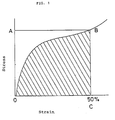
- the bumper core material of the present invention has the following specific properties as derived from the stress-strain curve shown in Fig. 1, which is obtained by cutting out a test piece having a length of 80 mm, a width of 80 mm and a thickness of 50 mm, and compressing it at a speed of 20 mm/min:
- the bumper core material of the present invention has a higher strength that that of the conventional bumper core material composed of a foamed ethylene-propylene random copolymer.
- the bumper core material of the present invention therefore has advantages that (a) the thickness of the bumper core material can be reduced under a restriction that bumper core materials should have the same density, and that (b) the bumper core material having a lower density can be employed under a restriction that bumper core materials should have the same thickness, thereby enabling bumper core materials to be light-weight. Further, the bumper core material of the present invention shows sufficient energy absorbing properties even at high temperatures.
- Foamed particles were prepared using propylene-1-butene random copolymer particles having a 1-butene content of 6.0% by weight, a melt flow rate (MFR) as measured at 230°C of 8.5 9/10 min, a heat of crystallization of 82.0 J/g (19.6 cal/g) and an average particle weight of about 1 mg.
- MFR melt flow rate
- the resulting dispersion in the autoclave was heated to 132°C over a period of 1 hour, and then maintained at that temperature for 45 minutes. At the end of this 45-minute heating, the inner pressure of the autoclave was 2.35 MPaG (24 kg/cm2G).
- the valve of the discharge nozzle provided at the bottom of the autoclave was opened, and the heated dispersion was jetted therethrough into the atmosphere over a period of about 2 seconds to effect foaming
- the inner pressure of the autoclave was about 0.98 MPaG (10 kg/cm2G) the moment the final portion of the dispersion was released from the autoclave. During the release, the temperature of the autoclave was maintained at 132°C.
- the thus-obtained foamed particles of the propylene-1-butene random copolymer had a bulk density of 30 kg/m3, a particle diameter of 3.3 mm and a foamed cell diameter of 150 ⁇ m. No blocking of the foamed particles was observed.
- foamed particles were dried by leaving them in a chamber at 40°C for 2 days.
- the resulting dried foamed particles were filled into a cavity of a mold having steam holes, and then compressed to decrease their volume by 50%.
- steam under a pressure of 0.29 MPaG (3 kg/cm2G) was introduced to the mold to melt-adhere the foamed particles to each other.
- the resulting melt-adhered particles therefore were cooled with water for 10 seconds, and then allowed to cool for 30 seconds.
- the mold was opened to obtain a foamed mold article having a density of 60 kg/m3, a width of 150 mm, a length of 300 mm and a thickness of 125 mm.
- the compressive strength of thus-obtained foamed mold article was measured according to the following method, and was found to be 0.62 MPa (6.3 kg/cm2).
- test piece having a density of 60 kg/m3 and a size of 50 mm ⁇ 50 mm ⁇ 50 mm was compressed at a compression speed of 10 mm/min, and the load at 50% compression was measured. This measurement was made at 20°C.
- Example 1 Using particles of each of the resin as shown in Table 1, the same procedures as in Example 1 were repeated except that the temperature of the autoclave was varied so as to obtain foamed particles having a bulk density of 30 kg/m3 (accordingly, the inner pressure of the autoclave also varied) and the steam pressure was properly selected so as to melt-adhere the foamed particles to each other. Thus, foamed mold articles each having a density of 60 kg/m3 were obtained.
- the foaming temperature indicates the temperature of the autoclave before the heated dispersion is released from it.
- the temperature of the autoclave was selected so as to obtain foamed particles having a bulk density of 30 kg/m3, with the raw materials-introducing conditions (filling ratio) as in Example 1 kept unchanged.
- the molding temperature indicates the minimum steam pressure needed to obtain a foamed mold article of good quality.
- Foamed particles were prepared using propylene-1-butene random copolymer particles having a 1-butene content of 5.2% by weight, an MFR as measured at 230°C of 9.7 g/10 min, a heat of crystallization of 94.6 J/g (22.6 cal/g) and an average particle weight of about 1 mg.
- the valve of the discharge nozzle provided at the bottom of the autoclave was opened, and the heated dispersion was jetted therethrough into the atmosphere over a period of about 2 seconds to effect foaming.
- the inner pressure of the autoclave was about 0.98 MPaG (10 kg/cm2G) the moment the final portion of the dispersion was released from the autoclave. During the release, the temperature of the autoclave was maintained at 140°C.
- the thus-obtained foamed particles of the propylene-1-butene random copolymer had a bulk density of 30 kg/m3, a particle diameter of 3.3 mm and a foamed cell diameter of 150 ⁇ m. No blocking of the foamed particles was observed.
- foamed particles were dried by leaving them in a chamber at 40°C for 2 days.
- the resulting dried foamed particles were filled into a cavity of a mold having steam holes, and then compressed to decrease their volume by 50%.
- steam under a pressure of 0.29 MPaG (3.0 kg/cm2G) was introduced to the mold to melt-adhere the foamed particles to each other.
- the resulting melt-adhered particles were cooled with water for 10 seconds, and then allowed to cool for 30 seconds.
- the mold article was taken out of the mold, thus obtaining a bumper core material having a density of 0.062 g/cm3, a length of 1500 mm, a width of 200 mm and a thickness of 150 mm.
- a test piece having a length of 80 mm, a width of 80 mm and a thickness of 50 mm was cut out of the thus-obtained bumper core material, and subjected to a compression test to obtain a stress-strain curve as measured at 20°C and that for 80°C. From the two stress-strain curves, there were obtained the stress at 50% strain, the energy absorption efficiencies, the amounts of energy absorption, and the ratio of the amount of energy absorption at 80°C to the amount of energy absorption at 20°C.
Landscapes
- Chemical & Material Sciences (AREA)
- Engineering & Computer Science (AREA)
- Health & Medical Sciences (AREA)
- Chemical Kinetics & Catalysis (AREA)
- Medicinal Chemistry (AREA)
- Polymers & Plastics (AREA)
- Organic Chemistry (AREA)
- Materials Engineering (AREA)
- Mechanical Engineering (AREA)
- Manufacture Of Porous Articles, And Recovery And Treatment Of Waste Products (AREA)
Claims (3)
- Particules expansées non réticulées d'une résine de propylène qui comprend comme résine de base un copolymère statistique de propylène et de 1-butène, ledit copolymère statistique ayant une teneur en 1-butène de 3 à 12% en poids et une chaleur de cristallisation de 71,2 à 121,4 J/g (17 à 29 cal/g).
- Un article moulé expansé composé de particules d'un copolymère statistique de propylène et de 1-butène selon la revendication 1, ledit article ayant une densité de 0,015 à 0,09 g/cm³.
- Un matériau pour noyau d'amortisseur à utiliser dans les pare-chocs d'automobiles qui est composé d'un article moulé expansé non réticulé d'un copolymère statistique de propylène et de 1-butène, ledit copolymère statistique ayant une teneur en 1-butène de 3 à 12% en poids, une chaleur de cristallisation de 17 à 29 cal/g, ledit article moulé expansé ayant une densité de 0,02 à 0,08 g/cm³, une contrainte de compression à 50% mesurée à 20°C, de 0,25 à 0,98 MPa (2,5 à 10 kg/cm²) et un rendement d'absorption de l'énergie mesuré à 20°C de 60 à 90%, le rapport (E₈₀/E₂₀) de la quantité d'énergie absorbée par ledit article moulé expansé mesurée à 80°C (E₈₀) à la quantité d'énergie absorbée par ledit article moulé expansé mesurée à 20°C (E₂₀) étant de 0,5 à 0,9.
Applications Claiming Priority (4)
| Application Number | Priority Date | Filing Date | Title |
|---|---|---|---|
| JP63070186A JPH0768402B2 (ja) | 1988-03-24 | 1988-03-24 | プロピレン系樹脂発泡粒子および発泡成形体 |
| JP70186/88 | 1988-03-24 | ||
| JP311685/88 | 1988-12-09 | ||
| JP63311685A JP2675373B2 (ja) | 1988-12-09 | 1988-12-09 | 自動車用バンパー芯材 |
Publications (3)
| Publication Number | Publication Date |
|---|---|
| EP0334313A2 EP0334313A2 (fr) | 1989-09-27 |
| EP0334313A3 EP0334313A3 (en) | 1990-09-19 |
| EP0334313B1 true EP0334313B1 (fr) | 1994-01-05 |
Family
ID=26411344
Family Applications (1)
| Application Number | Title | Priority Date | Filing Date |
|---|---|---|---|
| EP89105116A Expired - Lifetime EP0334313B1 (fr) | 1988-03-24 | 1989-03-22 | Particules mousse en résine de propylène et article en mousse formée |
Country Status (4)
| Country | Link |
|---|---|
| US (2) | US4908393A (fr) |
| EP (1) | EP0334313B1 (fr) |
| KR (1) | KR970010470B1 (fr) |
| DE (1) | DE68911963T2 (fr) |
Families Citing this family (18)
| Publication number | Priority date | Publication date | Assignee | Title |
|---|---|---|---|---|
| CA2030754C (fr) * | 1989-11-24 | 1997-06-03 | Kazuo Turugai | Procede de fabrication de particules de resine synthetique pre-expansee |
| US5389320A (en) * | 1991-10-28 | 1995-02-14 | General Electric Company | Method of making expandable polyphenylene ether and polyolefin blend |
| JP3204424B2 (ja) † | 1993-02-18 | 2001-09-04 | 三菱化学フォームプラスティック株式会社 | ポリプロピレン系樹脂発泡粒子 |
| DE4319587A1 (de) * | 1993-06-14 | 1994-12-15 | Huels Chemische Werke Ag | Verfahren zur Herstellung vorgeschäumter Polyolefin-Partikel |
| DE19542734A1 (de) * | 1995-11-16 | 1997-05-22 | Huels Chemische Werke Ag | Verfahren zur Ausrüstung von polyolefinischem Partikelschaum |
| EP0918066B1 (fr) * | 1996-08-12 | 2004-02-18 | JSP Corporation | Materiau absorbant les chocs |
| JP4442777B2 (ja) * | 1998-02-03 | 2010-03-31 | 株式会社ジェイエスピー | ポリカーボネート樹脂発泡粒子成形体よりなる自動車用エネルギー吸収材 |
| SG77671A1 (en) * | 1998-03-23 | 2001-01-16 | Jsp Corp | Foamed and expanded beads of polypropylene resin for molding |
| DE19950420A1 (de) * | 1999-10-20 | 2001-04-26 | Basf Ag | Partikelförmige, expandierbare Olefinpolymerisate |
| US6956067B2 (en) * | 2000-09-20 | 2005-10-18 | Jsp Corporation | Expanded polypropylene resin bead and process of producing same |
| WO2003037971A2 (fr) * | 2001-11-01 | 2003-05-08 | Jsp Corporation | Procede de production d'objets moules expanses a partir de grains de resine de polypropylene expanse et procede de production de grains de resine de polypropylene expanse |
| CN100402264C (zh) * | 2002-03-19 | 2008-07-16 | 株式会社Jsp | 复合发泡聚丙烯树脂模制品及其制备方法 |
| AU2003235907B2 (en) * | 2002-05-13 | 2008-10-09 | Jsp Corporation | Expandable polypropylene resin particle and molded object obtained therefrom by in-mold molding |
| JP5219375B2 (ja) * | 2005-01-12 | 2013-06-26 | 株式会社カネカ | ポリプロピレン系樹脂予備発泡粒子、及び型内発泡成形体 |
| WO2010113471A1 (fr) | 2009-04-02 | 2010-10-07 | 株式会社カネカ | Particules de résine de copolymère de polypropylène expansibles |
| JP5732399B2 (ja) | 2009-10-06 | 2015-06-10 | 株式会社カネカ | ポリプロピレン系樹脂発泡粒子およびポリプロピレン系樹脂型内発泡成形体 |
| US8889750B2 (en) | 2011-02-02 | 2014-11-18 | Kaneka Corporation | Expanded polypropylene resin particles, and polypropylene resin in-mold-expanded molding |
| JP6757668B2 (ja) | 2014-10-15 | 2020-09-23 | 株式会社カネカ | ポリプロピレン系樹脂発泡粒子、ポリプロピレン系樹脂型内発泡成形体およびその製造方法 |
Family Cites Families (19)
| Publication number | Priority date | Publication date | Assignee | Title |
|---|---|---|---|---|
| US32780A (en) * | 1861-07-09 | Steering- apparatus | ||
| US4108934A (en) * | 1976-03-23 | 1978-08-22 | The Dow Chemical Company | Molding expandable thermoplastic resins |
| US4186068A (en) * | 1977-01-07 | 1980-01-29 | The Dow Chemical Company | Foamed radiation-crosslinked high density polyethylenes |
| JPS58221745A (ja) * | 1982-06-19 | 1983-12-23 | Japan Styrene Paper Co Ltd | 自動車のバンパ−用芯材 |
| JPS60110734A (ja) * | 1983-11-21 | 1985-06-17 | Japan Styrene Paper Co Ltd | 無架橋ポリプロピレン系樹脂予備発泡粒子 |
| JPS60123540A (ja) * | 1983-12-07 | 1985-07-02 | Japan Styrene Paper Co Ltd | 無架橋ポリプロピレン系樹脂予備発泡粒子 |
| JPS60168632A (ja) * | 1984-02-13 | 1985-09-02 | Japan Styrene Paper Co Ltd | 架橋ポリプロピレン系樹脂発泡成型体 |
| JPS60189660A (ja) | 1984-03-08 | 1985-09-27 | Japan Styrene Paper Co Ltd | 自動車バンパ−用芯材 |
| US4704239A (en) * | 1984-04-28 | 1987-11-03 | Japan Styrene Paper Corp. | Process for the production of expanded particles of a polymeric material |
| JPS60235849A (ja) * | 1984-05-08 | 1985-11-22 | Japan Styrene Paper Co Ltd | ポリプロピレン系樹脂予備発泡粒子 |
| JPS6146744A (ja) * | 1984-08-14 | 1986-03-07 | Kanegafuchi Chem Ind Co Ltd | 自動車バンパー用芯材の製造方法 |
| JPS61115940A (ja) * | 1984-11-09 | 1986-06-03 | Mitsubishi Yuka Badische Kk | ポリプロピレン発泡体粒子 |
| JPS61179236A (ja) * | 1985-02-04 | 1986-08-11 | Japan Styrene Paper Co Ltd | エネルギ−吸収材 |
| US4689351A (en) * | 1985-10-08 | 1987-08-25 | Mitsubishi Yuka Badische Co., Ltd. | Process for producing foamed particles of propylene copolymer resin |
| JPS62177038A (ja) * | 1986-01-30 | 1987-08-03 | Kanegafuchi Chem Ind Co Ltd | 熱可塑性樹脂予備発泡粒子の製造方法 |
| JPH0660258B2 (ja) * | 1986-06-26 | 1994-08-10 | 鐘淵化学工業株式会社 | 熱可塑性樹脂粒子の予備発泡方法 |
| CA1280549C (fr) * | 1986-05-27 | 1991-02-19 | Kyoichi Nakamura | Particules pre-expansees de resine propylene |
| CA1279081C (fr) * | 1986-07-22 | 1991-01-15 | Hiroyuki Kuramochi | Materiau de noyau pour pare-chocs de vehicules automobiles |
| JPH0730201B2 (ja) * | 1988-05-19 | 1995-04-05 | 鐘淵化学工業株式会社 | ポリオレフィン系樹脂予備発泡粒子の後処理法 |
-
1989
- 1989-03-09 US US07/321,217 patent/US4908393A/en not_active Expired - Lifetime
- 1989-03-22 KR KR1019890003553A patent/KR970010470B1/ko not_active Expired - Lifetime
- 1989-03-22 DE DE68911963T patent/DE68911963T2/de not_active Expired - Fee Related
- 1989-03-22 EP EP89105116A patent/EP0334313B1/fr not_active Expired - Lifetime
- 1989-12-06 US US07/446,671 patent/US5032620A/en not_active Expired - Lifetime
Also Published As
| Publication number | Publication date |
|---|---|
| DE68911963T2 (de) | 1994-06-09 |
| US5032620A (en) | 1991-07-16 |
| EP0334313A2 (fr) | 1989-09-27 |
| EP0334313A3 (en) | 1990-09-19 |
| KR890014644A (ko) | 1989-10-25 |
| DE68911963D1 (de) | 1994-02-17 |
| US4908393A (en) | 1990-03-13 |
| KR970010470B1 (ko) | 1997-06-26 |
Similar Documents
| Publication | Publication Date | Title |
|---|---|---|
| EP0334313B1 (fr) | Particules mousse en résine de propylène et article en mousse formée | |
| EP0224265B1 (fr) | Procédé de production d'un article moulé sous forme de mousse à base de résine de polypropylène | |
| US4626555A (en) | Polypropylene foamed particles | |
| US4689351A (en) | Process for producing foamed particles of propylene copolymer resin | |
| EP0263989B1 (fr) | Procédé pour préparer des articles formés en mousse de polypropylène | |
| US4948817A (en) | Pre-foamed particles of uncrosslinked, linear low-density polyethylene and production method thereof | |
| US4596833A (en) | Polypropylene foamed particles | |
| US4602047A (en) | Process for producing foamed particles of polyolefin resin | |
| EP0279455B1 (fr) | Procédé de fabrication d'articles moulés en mousse à partir de résines en polyéthylène à basse densité linéaire | |
| JP3692760B2 (ja) | ポリプロピレン系樹脂型内発泡成形体の製造方法 | |
| JP3858517B2 (ja) | ポリプロピレン系樹脂予備発泡粒子、およびその予備発泡粒子と型内発泡成形体の製造法 | |
| EP0928806A1 (fr) | Perles expansées | |
| EP0924244B1 (fr) | Particules préexpansées de LLDPE non réticulé | |
| EP0317995B1 (fr) | Procédé pour préparer des articles en mousse de propylène | |
| JP2675373B2 (ja) | 自動車用バンパー芯材 | |
| JPH0768402B2 (ja) | プロピレン系樹脂発泡粒子および発泡成形体 | |
| JP3461583B2 (ja) | ポリプロピレン系樹脂型内発泡成形体の製造方法 | |
| JP2790791B2 (ja) | ポリプロピレン系樹脂型内発泡成形体の製造方法 | |
| JP3126449B2 (ja) | ポリオレフィン系樹脂発泡粒子 | |
| JP3248967B2 (ja) | 防水・防油性ポリオレフィン系樹脂発泡成形体およびその製造法 | |
| JPH059327A (ja) | ポリオレフイン系樹脂発泡粒子 | |
| JP2000319437A (ja) | ポリプロピレン系樹脂発泡粒子及びその型内発泡成形体 |
Legal Events
| Date | Code | Title | Description |
|---|---|---|---|
| PUAI | Public reference made under article 153(3) epc to a published international application that has entered the european phase |
Free format text: ORIGINAL CODE: 0009012 |
|
| AK | Designated contracting states |
Kind code of ref document: A2 Designated state(s): BE DE FR GB |
|
| RAP1 | Party data changed (applicant data changed or rights of an application transferred) |
Owner name: MITSUBISHI YUKA BADISCHE CO., LTD. |
|
| RIN1 | Information on inventor provided before grant (corrected) |
Inventor name: SAITO, MASANORI C/O MITSUBISHI Y. BADISCHE CO.LTD Inventor name: TANAKA, MASANORI C/O MITSUBISHI Y. BADISCHE CO.LT Inventor name: GOTOH, TOSHIHIRO C/OMITSUBISCHI Y. B. CO., LTD. Inventor name: YAGI, TOSHIO C/O MITSUBISCHI YUKA BADISCHE CO.LTD Inventor name: MATHUNO, SHIGEKI C/O MITSUBISHI Y. BADISCHE CO.LT Inventor name: ARAI, MASAKAZU C/O MITSUBISHI YUKA BADISCHE CO.LTD Inventor name: ENDO, HIROSHI C/O MITSUBISCHI YUKA BADISCHE CO.LT |
|
| PUAL | Search report despatched |
Free format text: ORIGINAL CODE: 0009013 |
|
| AK | Designated contracting states |
Kind code of ref document: A3 Designated state(s): BE DE FR GB |
|
| 17P | Request for examination filed |
Effective date: 19910204 |
|
| 17Q | First examination report despatched |
Effective date: 19920701 |
|
| GRAA | (expected) grant |
Free format text: ORIGINAL CODE: 0009210 |
|
| AK | Designated contracting states |
Kind code of ref document: B1 Designated state(s): BE DE FR GB |
|
| REF | Corresponds to: |
Ref document number: 68911963 Country of ref document: DE Date of ref document: 19940217 |
|
| ET | Fr: translation filed | ||
| PLBI | Opposition filed |
Free format text: ORIGINAL CODE: 0009260 |
|
| 26 | Opposition filed |
Opponent name: KANEGAFUCHI KAGAKU KOGYO K.K. Effective date: 19941005 |
|
| PLBO | Opposition rejected |
Free format text: ORIGINAL CODE: EPIDOS REJO |
|
| PLBN | Opposition rejected |
Free format text: ORIGINAL CODE: 0009273 |
|
| STAA | Information on the status of an ep patent application or granted ep patent |
Free format text: STATUS: OPPOSITION REJECTED |
|
| 27O | Opposition rejected |
Effective date: 19970916 |
|
| REG | Reference to a national code |
Ref country code: GB Ref legal event code: IF02 |
|
| PGFP | Annual fee paid to national office [announced via postgrant information from national office to epo] |
Ref country code: GB Payment date: 20060322 Year of fee payment: 18 |
|
| PGFP | Annual fee paid to national office [announced via postgrant information from national office to epo] |
Ref country code: BE Payment date: 20060509 Year of fee payment: 18 |
|
| PGFP | Annual fee paid to national office [announced via postgrant information from national office to epo] |
Ref country code: DE Payment date: 20070315 Year of fee payment: 19 |
|
| GBPC | Gb: european patent ceased through non-payment of renewal fee |
Effective date: 20070322 |
|
| BERE | Be: lapsed |
Owner name: *MITSUBISHI YUKA BADISCHE CO. LTD Effective date: 20070331 |
|
| PG25 | Lapsed in a contracting state [announced via postgrant information from national office to epo] |
Ref country code: BE Free format text: LAPSE BECAUSE OF NON-PAYMENT OF DUE FEES Effective date: 20070331 |
|
| PG25 | Lapsed in a contracting state [announced via postgrant information from national office to epo] |
Ref country code: GB Free format text: LAPSE BECAUSE OF NON-PAYMENT OF DUE FEES Effective date: 20070322 |
|
| PLAB | Opposition data, opponent's data or that of the opponent's representative modified |
Free format text: ORIGINAL CODE: 0009299OPPO |
|
| PGFP | Annual fee paid to national office [announced via postgrant information from national office to epo] |
Ref country code: FR Payment date: 20080311 Year of fee payment: 20 |
|
| PG25 | Lapsed in a contracting state [announced via postgrant information from national office to epo] |
Ref country code: DE Free format text: LAPSE BECAUSE OF NON-PAYMENT OF DUE FEES Effective date: 20081001 |