EP0323096A2 - Herstellung von Gegenständen aus gebundenem und aus Einzelteilen bestehendem Material sowie Binderzusammensetzungen für die Verwendung darin - Google Patents
Herstellung von Gegenständen aus gebundenem und aus Einzelteilen bestehendem Material sowie Binderzusammensetzungen für die Verwendung darin Download PDFInfo
- Publication number
- EP0323096A2 EP0323096A2 EP88312007A EP88312007A EP0323096A2 EP 0323096 A2 EP0323096 A2 EP 0323096A2 EP 88312007 A EP88312007 A EP 88312007A EP 88312007 A EP88312007 A EP 88312007A EP 0323096 A2 EP0323096 A2 EP 0323096A2
- Authority
- EP
- European Patent Office
- Prior art keywords
- process according
- phenol
- resin
- binder
- charac
- Prior art date
- Legal status (The legal status is an assumption and is not a legal conclusion. Google has not performed a legal analysis and makes no representation as to the accuracy of the status listed.)
- Granted
Links
Images

Classifications
-
- B—PERFORMING OPERATIONS; TRANSPORTING
- B22—CASTING; POWDER METALLURGY
- B22C—FOUNDRY MOULDING
- B22C1/00—Compositions of refractory mould or core materials; Grain structures thereof; Chemical or physical features in the formation or manufacture of moulds
-
- C—CHEMISTRY; METALLURGY
- C08—ORGANIC MACROMOLECULAR COMPOUNDS; THEIR PREPARATION OR CHEMICAL WORKING-UP; COMPOSITIONS BASED THEREON
- C08K—Use of inorganic or non-macromolecular organic substances as compounding ingredients
- C08K3/00—Use of inorganic substances as compounding ingredients
- C08K3/38—Boron-containing compounds
-
- B—PERFORMING OPERATIONS; TRANSPORTING
- B22—CASTING; POWDER METALLURGY
- B22C—FOUNDRY MOULDING
- B22C1/00—Compositions of refractory mould or core materials; Grain structures thereof; Chemical or physical features in the formation or manufacture of moulds
- B22C1/16—Compositions of refractory mould or core materials; Grain structures thereof; Chemical or physical features in the formation or manufacture of moulds characterised by the use of binding agents; Mixtures of binding agents
- B22C1/20—Compositions of refractory mould or core materials; Grain structures thereof; Chemical or physical features in the formation or manufacture of moulds characterised by the use of binding agents; Mixtures of binding agents of organic agents
- B22C1/22—Compositions of refractory mould or core materials; Grain structures thereof; Chemical or physical features in the formation or manufacture of moulds characterised by the use of binding agents; Mixtures of binding agents of organic agents of resins or rosins
- B22C1/2233—Compositions of refractory mould or core materials; Grain structures thereof; Chemical or physical features in the formation or manufacture of moulds characterised by the use of binding agents; Mixtures of binding agents of organic agents of resins or rosins obtained otherwise than by reactions only involving carbon-to-carbon unsaturated bonds
- B22C1/2246—Condensation polymers of aldehydes and ketones
- B22C1/2253—Condensation polymers of aldehydes and ketones with phenols
-
- C—CHEMISTRY; METALLURGY
- C08—ORGANIC MACROMOLECULAR COMPOUNDS; THEIR PREPARATION OR CHEMICAL WORKING-UP; COMPOSITIONS BASED THEREON
- C08G—MACROMOLECULAR COMPOUNDS OBTAINED OTHERWISE THAN BY REACTIONS ONLY INVOLVING UNSATURATED CARBON-TO-CARBON BONDS
- C08G16/00—Condensation polymers of aldehydes or ketones with monomers not provided for in the groups C08G4/00 - C08G14/00
- C08G16/02—Condensation polymers of aldehydes or ketones with monomers not provided for in the groups C08G4/00 - C08G14/00 of aldehydes
- C08G16/0212—Condensation polymers of aldehydes or ketones with monomers not provided for in the groups C08G4/00 - C08G14/00 of aldehydes with acyclic or carbocyclic organic compounds
- C08G16/0218—Condensation polymers of aldehydes or ketones with monomers not provided for in the groups C08G4/00 - C08G14/00 of aldehydes with acyclic or carbocyclic organic compounds containing atoms other than carbon and hydrogen
-
- C—CHEMISTRY; METALLURGY
- C08—ORGANIC MACROMOLECULAR COMPOUNDS; THEIR PREPARATION OR CHEMICAL WORKING-UP; COMPOSITIONS BASED THEREON
- C08G—MACROMOLECULAR COMPOUNDS OBTAINED OTHERWISE THAN BY REACTIONS ONLY INVOLVING UNSATURATED CARBON-TO-CARBON BONDS
- C08G8/00—Condensation polymers of aldehydes or ketones with phenols only
- C08G8/28—Chemically modified polycondensates
-
- C—CHEMISTRY; METALLURGY
- C08—ORGANIC MACROMOLECULAR COMPOUNDS; THEIR PREPARATION OR CHEMICAL WORKING-UP; COMPOSITIONS BASED THEREON
- C08K—Use of inorganic or non-macromolecular organic substances as compounding ingredients
- C08K3/00—Use of inorganic substances as compounding ingredients
- C08K3/18—Oxygen-containing compounds, e.g. metal carbonyls
- C08K3/24—Acids; Salts thereof
-
- C—CHEMISTRY; METALLURGY
- C08—ORGANIC MACROMOLECULAR COMPOUNDS; THEIR PREPARATION OR CHEMICAL WORKING-UP; COMPOSITIONS BASED THEREON
- C08K—Use of inorganic or non-macromolecular organic substances as compounding ingredients
- C08K5/00—Use of organic ingredients
- C08K5/54—Silicon-containing compounds
Definitions
- This invention relates to the production of articles of bonded particulate material and binder compositions for use therein.
- a binder composition comprising an alkaline aqueous solution of a resol of phenol-aldehyde resin and an oxyanion capable of forming a stable complex with the resin the amount of alkali present in the solution being sufficient to substantially prevent stable complex formation between the resin and the oxyanion.
- a process for the production of an article of bonded particulate material comprising forming to a desired shape a mixture of particulate material and a binder composition comprising an alkaline aqueous solution of a resol phenol-aldehyde resin and an oxyanion capable of forming a stable complex with the resin and passing carbon dioxide gas through the formed shape so as to cause the oxyanion to form a stable complex with the resin and thereby to cure the resin.
- the oxyanions present in the binder composition act as cross-linking agents for the resin by forming complexes with adjacent resol phenol-aldehyde chains and the cross-linking action of the oxyanions is promoted by the carbon dioxide gas which is passed through the article formed of particulate material and the binder composition.
- the exact mechanism by which the carbon dioxide promotes curing of the resin is not certain but the carbon dioxide forms carbonic acid by reaction with water in the binder composition, thus lowering the pH of the binder and the oxyanions form stable complexes with the resin molecules at the reduced pH.
- the alkalinity of the binder composition must be such that the oxyanions remain largely in the uncomplexed state. Complexing and hence curing of the resin on the passage of carbon dioxide takes place when the pH is reduced.
- the preferred resol phenol-aldehyde resin is one which contains predominantly molecules in which adjacent phenolic residues are linked together by methylene groups forming bridges between the ortho and para positions because such molecules have a large number of sites for complexing with the oxyanions.
- Molecules in which the phenolic residues are linked by ortho-ortho methylene bridges have very few sites for complexing with oxyanions, (in the case of a linear molecule only one site at each end), and it is therefore desirable that such molecules are absent, or that they are present in the resin in relatively small numbers.
- Resins containing molecules having phenolic residues linked by a combination of ortho-para methylene bridges and ortho-ortho may be used but are less preferred.
- the phenol which is used to produce the resol phenol-aldehyde resin is preferably one which produces a condensation product when reacted with an aldehyde having the highest possible number of ortho-methylol groups.
- the preferred phenol is phenol itself.
- Substituted phenols such as p-cresol or m-cresol, or phenolic compounds such as p-phenol sulphonic acids may be used, either on their own or in a combination with phenol, but these produce resins which give inferior results compared to the results given by resins produced from phenol itself.
- P-cresol for example, can only form phenol-aldehyde molecules in which the phenolic residues are linked by ortho-ortho methylene bridges and the molecules can therefore only complex with the oxyanions at their ends.
- the aldehyde may be for example, formaldehyde, butyraldehyde, glyoxal or furfuraldehyde. Formaldehyde is preferred.
- the resol phenol-aldehyde resin is preferably produced by the condensation of the phenol and the aldehyde in the presence of a base catalyst which may be for example ammonium hydroxide or an alkali metal hydroxide such as sodium hydroxide or potassium hydroxide.
- a base catalyst which may be for example ammonium hydroxide or an alkali metal hydroxide such as sodium hydroxide or potassium hydroxide.
- Alkali metal hydroxide catalysts are preferred because they produce a resin in which the phenolic residues are linked predominantly by ortho-para or para-para methylene bridges and from which phenolic residues linked by ortho-ortho methylene bridges are essentially absent.
- catalysts such as zinc acetate
- catalysts such as zinc acetate are less desirable because they yield resins having a mixed bridging structure containing ortho-ortho benzylic ether bridges and ortho-para methylene bridges, and hence a reduced capacity for complexing with the oxyanions.
- the mole ratio of aldehyde (expressed as formaldehyde) to phenol in the resin may be in the range of from 1:1 to 3:1 but is preferably in the range from 1.6:1 to 2.5:1.
- the resol phenol-aldehyde resin used in the process and binder composition of the invention preferably has an intrinsic viscosity in the range of from 4.0 to 7.5 cm3.g ⁇ 1 more preferably in the range of from 4.5 to 7.0 cm3.g ⁇ 1.
- the viscosity of a liquid is its resistance to flow and when measured by flow of the liquid through a capillary the viscosity is given by the formula. where is the viscosity and t is the time taken for a volume V to pass through a capillary of length 1 and radius r at an external pressure P.
- the viscosity is directly proportional to the flow time.
- solution is the viscosity of the resin solution
- solvent is the viscosity of the solvent used to dissolve the resin
- ts is the flow time of the resin solution and to is the flow time of the solvent.
- the specific viscosity of the resin is dependent on its concentration according to the formula where c is the concentration of the resin in the solution, A and B are constants and o is the intrinsic viscosity.
- the resol phenol-aldehyde resin is made alkaline by the addition of, for example, sodium hydroxide or potassium hydroxide, which is conveniently added as an aqueous solution.
- the preferred alkali is potassium hydroxide because it results in a binder composition having a lower viscosity for a given degree of polymerisation of the resin compared to sodium hydroxide and the performance of the binder composition is superior.
- the molar ratio of the total alkali present in the binder (expresssed as hydroxyl ions) to phenol is referably in the range of 0.5:1 to 3.0:1, more preferably 1.5:1 to 2.5:1.
- the total alkali includes any alkali used as catalyst in the synthesis of the resin, any additional alkali which may be added during the synthesis and alkali added after synthesis of the resin and during manufacture of the binder.
- Suitable oxyanions for use in the process and binder composition of the invention include borate, stannate and aluminate ions. Borate ions are preferred.
- the oxyanion may be introduced into the binder composition by the addition of for example alkali metal oxyanion salts such as sodium tetraborate decahydrate, potassium tetraborate tetrahydrate, sodium metaborate, sodium pentaborate, sodium stannate trihydrate or sodium aluminate, or an ammonium oxyanion salt such as ammonium borate.
- alkali metal oxyanion salts such as sodium tetraborate decahydrate, potassium tetraborate tetrahydrate, sodium metaborate, sodium pentaborate, sodium stannate trihydrate or sodium aluminate
- an ammonium oxyanion salt such as ammonium borate.
- Borate ions may also be introduced by the addition of boric acid or they may be formed by reaction between added boric oxide and alkali in the binder solution.
- the mole ratio of oxyanions (expressed as boron, tin etc.) to phenol is preferably in the range of from 0.1:1 to 1:1.
- the mole ratio of boron to phenol is more preferably in the range of from 0.3:1 to 0.6:1.
- the binder composition preferably also contains a silane such as gamma-aminopropyltriethoxysilane, phenol trimethoxysilane or gammaglycidoxypropyltrimethoxysilane usually in an amount of 0.2% to 1.0% by weight.
- a silane such as gamma-aminopropyltriethoxysilane, phenol trimethoxysilane or gammaglycidoxypropyltrimethoxysilane usually in an amount of 0.2% to 1.0% by weight.
- an additional solvent such as methanol or ethanol may be included in the binder composition.
- Phenol is melted and formaldehyde (as paraformaldehyde) and the alkali metal hydroxide catalyst solution are then added.
- a resol phenol-formaldehyde is then produced by polymerisation of the phenol and formaldehyde in two or more heating stages over a range of temperatures from about 60°C to about 95°C.
- the degree of polymerisation of the resin is monitored by measuring the viscosity of a diluted sample of the resin towards the end of the process.
- the final resin is cooled, alkali is added as alkali metal hydroxide solution and the oxyanions are added.
- the binder composition obtained is finally cooled and the silane added.
- the particulate refractory material may be selected from any such materials known for that use.
- suitable materials include silica, olivine, chromite and zircon sands.
- the quantity of binder composition used will usually be from 1% to 10% by weight, preferively 1.5% to 5% by weight based on the weight of the particulate refractory material.
- foundry moulds and cores may be produced, ready for use in metal casting, in a very short time.
- the resins were maintained at 85°C for sufficient time for each of them to reach the same viscosity range of 4000 - 6000 cps at 25°C measured using Paint Research Association Bubble Viscosity Tubes on a 25 g sample diluted with 15 g of 50% w/w potassium hydroxide solution.
- Resin 1A was maintained at 85°C for 320 minutes, resin 1B for 280 minutes, resin 1C for 240 minutes, resin 1D for 170 minutes and resin 1E for 150 minutes.
- the base resins were used to produce a series of binders of different alkalinity as shown in Table 2 below.
- the binders were tested as binders for foundry sand using the following procedure:-
- the binder was mixed with 2.0 kg of Chelford 60 sand (AFS Fineness No. 55) and the mixture was used to prepare standard AFS 50 mm x 50 mm diameter cylindrical cores.
- the quantity of binder used was such that a constant mass (22.72 g) of base resin was deposited on 2 kg of sand.
- the cores were hardened by the passage of carbon dioxide gas for various times at a temperature of 20 - 25°C, a 0.35 kg/cm2 line pressure and a 6.0 litres per minute flow rate. The compression strength of the hardened cores was measured immediately after gassing on a Ridsdale Universal Compression tester.
- Series 2A had the same composition as Resin 1C of Example 1 and series 2C had the same composition as Resin 1D of Example 1.
- Series 2B had the following composition:- phenol 800.00 g 91% w/w paraformaldehyde 642.20 g 50% w/w sodium hydroxide solution 40.85 g F:P molar ratio 2.3:1 OH ⁇ :P molar ratio 0.06:1 water in starting composition 5.2% w/w
- the intrinsic viscosity of each of the resins was determined using the following procedure.
- a suspended level Ubbelholde dilution viscometer was used to measure the viscosity of the solutions. Prior to use and before changing samples the viscometer was soaked overnight in concentrated nitric acid, thoroughly washed with filtered distilled water, then with methanol and finally with acetone. The viscometer was then allowed to dry.
- the viscometer was submerged in a water bath maintained at 23.80°C ⁇ 0.1°C.
- a chrome-aluminel thermocouple placed inside the viscometer and connected to a chart recorder was used to determine when the temperature of the resin solution had reached the temperature of the water bath and to ensure that during a viscosity measurement the temperature did not vary by more than 0.1°C.
- the 2.3:1 and 2.5:1 F:P molar ratio resin samples were diluted with 2 cm3 of methanol each time the sample was diluted and further measurements were made.
- the 1.6:1 F:P molar ratio resins it was found that at low concentrations the solutions began to exhibit polyelectrolyte behaviour. So that the viscometer measurements could be used to produce an accurate value of the specific viscosity, a restricted concentration range was therefore used and each time a sample was diluted 1 cm3 of methanol was used instead of 2 cm3.
- each of the binders was tested using the procedure described in Example 1.
- the quantity of binder used was such that a constant mass (22.72 g) of base resin was deposited on 2 kg sand, and cores were gassed for 30, 60 and 120 seconds with carbon dioxide.
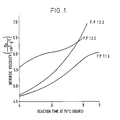
- reaction times at step 5 of 4 to 9 hours correspond to intrinsic viscosities of the resin of about 4.7 to 7.5 cm3.g ⁇ 1 and reaction times at step 5 of 5 to 8 hours correspond to intrinsic viscosities of about 5.0 to 6.5 cm3.g ⁇ 1.
- a base resin of the same composition as the series 2B resin of Example 2 was synthesised.
- the base resin was synthesised using the procedure described in Example 1 and was maintained at a temperature of 85°C at step 7 for 190 minutes.
- the viscosity of the base resin was in the range 4000 - 6000 cps at 25°C measured using the procedure described in Example 1.
- the base resin was used to produce a series of binders of different levels of alkalinity as shown in Table 6 below.
- Table 6 Binder Mass/g Base Resin 50% w/w KOH Borax Al102 Silane 3A 25 15 5.0 0.39 3B 25 20 5.0 0.39 3C 25 25 5.0 0.39 3D 25 30 5.0 0.39 3E 25 35 5.0 0.39 3F 25 40 5.0 0.39 3G 25 45 5.0 0.39 3H 25 50 5.0 0.39
- each of the binders was tested using the procedure described in Example 1. In each case the quantity of binder used was such that a constant mass (22.72 g) of base resin was deposited on 2 kg sand and the cores were gassed for 120 seconds.
- Binders 3A and 3B were very viscous and formed very "dry" mixtures with sand with the result that the test cores had compression strengths which were too low for any reading to be recorded on the equipment used.
- Binders of the same composition as binders 3A and 3B were therefore prepared from a similar base resin and further diluted with water, methanol and/or 50% w/w aqueous potassium hydroxide.
- the binders were tested using the procedure described in Example 1. In each case the quantity of binder used was 59.4 g so that 22.72 g base resin were deposited on 2 kg of Chelford 60 sand.
- Dilution with water gave compression strengths which were approximately 75 - 90% of those obtained when diluting with 50% w/w KOH solution.
- Dilution with methanol gave more viscous binders than those diluted with water.
- the compression strengths were 60 - 90% of those obtained when diluting with 50% w/w KOH solution.
- Example 3 The base resin of Example 3 was used to produce a series of binders of different borate ion contents using the procedure described in Example 1.
- the composition of the binders is shown in Table 9 below. TABLE 9 Binder Mass/g Base Resin 50% KOH Borax Al102 Silane 4 A 25 35 0 0.39 4 B 25 35 2 0.39 4 C 25 35 3 0.39 4 D 25 35 4 0.39 4 E 25 35 5 0.39 4 F 25 35 6 0.39 4 G 25 35 7 0.39 4 H 25 35 8 0.39 4 I 25 35 10 0.39
- borate ions were added as sodium tetraborate decahydrate.
- the binders were tested as described in Example 1 and as in Example 1, the quantity of binder used was such that 22.72 g of base resin were deposited on 2 kg of sand.
- Binder Boron phenol Molar Ratio Mass deposited on 2 kg CHELFORD 60 sand Compression Strength/kg cm ⁇ 2 Gassing Period 120 s 4 A 0.00:1 54.88 g 0 4 B 0.15:1 56.70 g 9.7 4 C 0.22:1 57.61 g 14.3 4 D 0.29:1 58.52 g 17.0 4 E 0.36:1 59.43 g 19.0 4 F 0.44:1 60.34 g 18.4 4 G 0.51:1 61.24 g 18.1 4 H 0.59:1 62.16 g 17.3 4 I 0.73:1 63.97 g 16.6
- the binder containing no borate ions did not cure on gassing with carbon dioxide.
- the optimum compression strengths were achieved using binders containing a molar ratio of B:P of about 0.3:1 to about 0.6:1.
- Example 3 The base resin of Example 3 was used to produce a series of binders of different silane contents using the procedure described in Example 1.
- the composition of the binders is shown in Table 11 below. TABLE 11 Binder Mass/g Base Resin 50% KOH Borax Al102 Silane 5 A 25 35 5.0 0.00 5 B 25 35 5.0 0.15 5 C 25 35 5.0 0.39 5 D 25 35 5.0 0.45 5 E 25 35 5.0 0.60
- the binders were tested as described in Example 1 and as in Example 1, the quantity of binder used was such that 22.72 g of base resin were deposited on 2 kg of sand. Three series of tests were carried out for gassing times of 30 seconds, 60 seconds and 120 seconds.
- the base resin of Example 3 was used to prepare two binder compositions containing borate ions from two different sources, borax (sodium tetraborate decahydrate) and potassium tetraborate tetrahydrate.
- the composition of the binders is shown in Table 13 below. TABLE 13 BINDER 6A BINDER 6B Source of Borate ion Na2B4O7.10 H2O K2B4O7.4H2O Formula Weight 381.37 305.5 Resin 25g 25g 50% KOH 35g 35g Borate ion source 5.5g 4.41g Silane (Al102) 0.39g 0.39g
- the binders were tested as described in Example 1 and as in Example 1, the quantity of binder used was such that 22.72 g of base resin were deposited on 2 kg of sand. In each case the quantity of the borate source was such that 0.058 moles of boron were deposited on 2 kg of sand. Thus in each case the same amount of boron was available for complexing.
- binders Two series of binders were prepared using the base resin of Example 3, one series containing various amounts of boric acid and the other various amounts of sodium metaborate tetrahydrate. Each binder contained the same amount of potassium hydroxide and the same amount of A1102 silane.
- Binder Mass/g B P Molar Ratio Base Resin 50% KOH Sodium Metaborate Tetrahydrate Al102 Silane 7A 25 35 3.0 0.39 0.15:1 7B 25 35 4.0 0.39 0.20:1 7C 25 35 5.0 0.39 0.25:1 7D 25 35 6.0 0.39 0.30:1 7E 25 35 7.0 0.39 0.35:1 7F 25 35 8.0 0.39 0.40:1 TABLE 16 Binder Mass/g B:P Molar Ratio Base Resin 50% KOH Boric Acid Al102 Silane 7G 25 35 1.0 0.39 0.11:1 7H 25 35 2.0 0.39 0.23:1 7I 25 35 3.0 0.39 0.34:1 7J 25 35 4.0 0.39 0.45:1 7K 25 35 5.0 0.39 0.56:1 7L 25 35 6.0 0.39 0.68:1
- the binders were tested as described in Example 1 and as in Example 1, the quantity of binder used was such that 22.72 g of base resin were deposited on 2 kg of sand.
- Example 3 The base resin of Example 3 was used to prepare two series of binder compositions, one series containing sodium stannate dihydrate as the source of oxyanions and the other sodium aluminate (Fison technical grade). Two binders containing no oxyanion were also prepared for comparison.
- the binders were tested as described in Example 1 and as in Example 1, the quantity of binder used was such that 22.72 g of base resin were deposited on 2 kg of sand.
- a resol p-cresol-formaldehyde resin was prepared having a formaldehyde:p-cresol (F:P) molar ratio of 1.5:1. Only low F:p-cresol molar ratios are possible because the para position on the benzene ring in p-cresol is blocked.
- F:P formaldehyde:p-cresol
- the resin had the following composition:- p-cresol 800 g 91% w/w paraformaldehyde 366.3 g 50% w/w sodium hydroxide solution 40.85 g F:p-cresol molar ratio 1.5:1 OH ⁇ :p-cresol molar ratio 0.07:1 water in starting composition 4.4% w/w
- Example 1 The procedure used was that described in Example 1 and at step 7 the resin was maintained at 85°C for 300 minutes.
- the viscosity of the resin measured as described in Example 1 was in the range of 3500 - 5000 cps at 25°C.
- the binders were tested as described in Example 1.
- the quantity of binder used was such that 22.72 g of base resin were deposited on 2 kg of Chelford 60 sand and the cores were gassed for 120 seconds with carbon dioxide.
- Example 9 when compared with Example 4 shows that although useful binders can be obtained from substituted phenols such as p-cresol the properties of the binders are inferior to those of similar binders obtained from phenol due to the fact that the p-cresol-formaldehyde resins contain only ortho-ortho linkages and the molecules can only complex with borate ions at their ends.
- a resol phenol-formaldehyde having the following composition was prepared using zinc acetate dihydrate as catalyst:- Phenol 800 g 91% w/w paraformaldehyde 642.2 g zinc acetate dihydrate 111.9 g water 6.1 g molar F:P ratio 2.3:1 molar zinc acetate:P ratio 0.06:1 % water in starting composition 5.3 w/w
- Example 1 The procedure used was as described in Example 1 as far as step 5. Thereafter the resin was heated to 90°C at a rate of 1°C per minute and maintained at 90°C for 270 minutes.
- the viscosity of the base resin obtained was in the range 3000 - 5000 cps at 25°C.
- the binders were tested as described in Example 1.
- the quantity of binder used was such that 22.72 g of base resin were deposited on 2 kg of Chelford 60 sand, and the cores were gassed for 120 seconds with carbon dioxide.
- Example 9 when compared with Example 4 shows that although useful binders can be obtained using zinc acetate catalysed resol phenol-formaldehyde resins the properties of the binders are inferior to those of similar binders obtained using alkali catalysed resol phenol-formaldehyde resins due to the reduced capacity in the zinc acetate catalysed resins for complexing with borate ions.
Landscapes
- Chemical & Material Sciences (AREA)
- Chemical Kinetics & Catalysis (AREA)
- Medicinal Chemistry (AREA)
- Polymers & Plastics (AREA)
- Organic Chemistry (AREA)
- Health & Medical Sciences (AREA)
- Engineering & Computer Science (AREA)
- Materials Engineering (AREA)
- Mechanical Engineering (AREA)
- General Chemical & Material Sciences (AREA)
- Mold Materials And Core Materials (AREA)
- Compositions Of Macromolecular Compounds (AREA)
- Manufacture Of Macromolecular Shaped Articles (AREA)
- Compositions Of Oxide Ceramics (AREA)
- Adhesives Or Adhesive Processes (AREA)
- Curing Cements, Concrete, And Artificial Stone (AREA)
- Phenolic Resins Or Amino Resins (AREA)
- Adhesive Tapes (AREA)
Priority Applications (1)
| Application Number | Priority Date | Filing Date | Title |
|---|---|---|---|
| AT88312007T ATE79312T1 (de) | 1987-12-24 | 1988-12-19 | Herstellung von gegenstaenden aus gebundenem und aus einzelteilen bestehendem material sowie binderzusammensetzungen fuer die verwendung darin. |
Applications Claiming Priority (4)
| Application Number | Priority Date | Filing Date | Title |
|---|---|---|---|
| GB878730159A GB8730159D0 (en) | 1987-12-24 | 1987-12-24 | Binder compositions |
| GB8730159 | 1987-12-24 | ||
| GB888816106A GB8816106D0 (en) | 1988-07-06 | 1988-07-06 | Binder compositions |
| GB8816106 | 1988-07-06 |
Publications (4)
| Publication Number | Publication Date |
|---|---|
| EP0323096A2 true EP0323096A2 (de) | 1989-07-05 |
| EP0323096A3 EP0323096A3 (en) | 1990-06-13 |
| EP0323096B1 EP0323096B1 (de) | 1992-08-12 |
| EP0323096B2 EP0323096B2 (de) | 1999-02-24 |
Family
ID=26293245
Family Applications (1)
| Application Number | Title | Priority Date | Filing Date |
|---|---|---|---|
| EP88312007A Expired - Lifetime EP0323096B2 (de) | 1987-12-24 | 1988-12-19 | Herstellung von Gegenständen aus gebundenem und aus Einzelteilen bestehendem Material sowie Binderzusammensetzungen für die Verwendung darin |
Country Status (18)
| Country | Link |
|---|---|
| US (2) | US4977209A (de) |
| EP (1) | EP0323096B2 (de) |
| JP (1) | JPH01224263A (de) |
| KR (1) | KR930012260B1 (de) |
| AU (1) | AU605943B2 (de) |
| BR (1) | BR8806853A (de) |
| CA (1) | CA1332256C (de) |
| DE (2) | DE323096T1 (de) |
| DK (1) | DK166782B1 (de) |
| ES (1) | ES2029218T5 (de) |
| FI (1) | FI97811C (de) |
| GR (2) | GR3005626T3 (de) |
| MX (1) | MX169174B (de) |
| NO (1) | NO172173C (de) |
| NZ (1) | NZ227395A (de) |
| PT (1) | PT89335B (de) |
| SG (1) | SG100192G (de) |
| ZW (1) | ZW17488A1 (de) |
Cited By (12)
| Publication number | Priority date | Publication date | Assignee | Title |
|---|---|---|---|---|
| GB2253627A (en) * | 1991-03-13 | 1992-09-16 | Foseco Int | Alkaline resol phenol-aldehyde resin binder compositions |
| US5198478A (en) * | 1991-03-13 | 1993-03-30 | Foseco International Limited | Alkaline resol phenol-aldehyde resin binder compositions |
| EP0508566A3 (en) * | 1991-03-13 | 1993-04-14 | Foseco International Limited | Alkaline resol phenol-aldehyde resin binder compositions |
| EP0503758A3 (en) * | 1991-03-13 | 1993-04-28 | Foseco International Limited | Alkaline resol phenol-aldehyde resin binder compositions |
| EP0556955A1 (de) * | 1992-02-15 | 1993-08-25 | Foseco International Limited | Alkalisches Resol-Phenol-Aldehyd-Harz-Bindemittel |
| WO1997013827A1 (en) * | 1995-10-11 | 1997-04-17 | Ashland Inc. | Briquetting of mineral fines |
| WO2001012709A1 (de) * | 1999-08-12 | 2001-02-22 | Ashland-Südchemie-Kernfest GmbH | Aluminium- und borhaltiges bindemittelsystem auf resolbasis |
| WO2008000436A1 (de) * | 2006-06-28 | 2008-01-03 | H.K.O. Isolier-Und Textiltechnik Gmbh | Faserteil und verfahren zu seinem herstellung |
| EP2052798A1 (de) | 2008-11-25 | 2009-04-29 | Hüttenes-Albertus Chemische-Werke GmbH | Alkalinresolphenol-Aldehydharzbindungszusammensetzungen |
| DE102011078112A1 (de) | 2011-06-27 | 2012-12-27 | Hüttenes-Albertus Chemische Werke GmbH | Verwendung von organischen Farbstoffsystemen in Gießerei-Formstoffen |
| WO2015165436A1 (de) * | 2014-05-02 | 2015-11-05 | Ask Chemicals Gmbh | Formstoffmischung enthaltend resole und amorphes siliciumdioxid, aus diesen hergestellte formen und kerne und verfahren zu deren herstellung |
| US10144053B2 (en) | 2014-05-02 | 2018-12-04 | Ask Chemicals Gmbh | Method for the layer-wise building of bodies comprising refractory mold base material and resoles, and molds or cores manufactured according to said method |
Families Citing this family (21)
| Publication number | Priority date | Publication date | Assignee | Title |
|---|---|---|---|---|
| US5162393A (en) * | 1991-04-25 | 1992-11-10 | Foseco International Limited | Production of foundry sand moulds and cores |
| JP2723376B2 (ja) * | 1991-05-16 | 1998-03-09 | 花王株式会社 | 鋳物砂用粘結組成物及び鋳型の製造方法 |
| JP2804419B2 (ja) * | 1993-03-30 | 1998-09-24 | 住友デュレズ株式会社 | 鋳型用粘結剤組成物 |
| US5290843A (en) * | 1993-04-29 | 1994-03-01 | Georgia-Pacific Resins, Inc. | Phenolic resins for reinforced composites |
| CA2101765C (en) * | 1993-05-17 | 1999-03-16 | Earl K. Phillips | Method for bonding lignocellulosic material with phenol-formaldehyde resin and carbon dioxide |
| AU1078797A (en) * | 1995-11-21 | 1997-06-11 | Ashland Inc. | Cold-box process for preparing foundry shapes |
| JP4615350B2 (ja) * | 2005-04-07 | 2011-01-19 | 花王株式会社 | 鋳型の製造方法 |
| KR100947964B1 (ko) * | 2007-12-03 | 2010-03-15 | (주)신명에이치에이 | 탄산가스 경화형 점결제 조성물 및 이를 이용한 조형방법 |
| RU2512517C2 (ru) | 2008-01-31 | 2014-04-10 | ЭШЛЭНД ЛАЙСЕНСИНГ ЭНД ИНТЕЛЛЕКТЧУАЛ ПРОПЕРТИ ЭлЭлСи | Композиции, содержащие определенные металлоцены, и их применение |
| EP2416907A4 (de) * | 2009-04-07 | 2013-10-02 | Ashland Licensing & Intellectu | Alkali-phenol-resol-harzzusammensetzung und ihre verwendung |
| US8056604B2 (en) * | 2009-09-04 | 2011-11-15 | Ask Chemicals L.P. | Process for preparing a test casting and test casting prepared by the process |
| US20110139309A1 (en) * | 2009-12-16 | 2011-06-16 | Showman Ralph E | Foundry mixes contaiing carbonate salts and their uses |
| US20120199309A1 (en) | 2011-02-04 | 2012-08-09 | Ask Chemicals L.P. | Sand additives for molds/cores for metal casting |
| SE539117C2 (sv) | 2011-07-24 | 2017-04-11 | Vattenbaserade bindemedelskompositioner | |
| CN102632191B (zh) * | 2012-05-08 | 2015-06-10 | 邦尼化工(天津)有限公司 | 一种酸固化粘结剂及其制备方法 |
| EP2692460B1 (de) | 2012-07-30 | 2015-02-25 | Hüttenes-Albertus Chemische-Werke GmbH | Teilchenförmige Feuerfestmaterialzusammensetzungen zur Verwendung bei der Herstellung von Gussformen und -kernen, Verfahren zu ihrer Herstellung und entsprechende Verwendungen |
| DE102016211970A1 (de) | 2016-06-30 | 2018-01-18 | HÜTTENES-ALBERTUS Chemische Werke Gesellschaft mit beschränkter Haftung | Wässrige alkalische Bindemittelzusammensetzung zur Aushärtung mit Kohlendioxidgas sowie deren Verwendung, eine entsprechende Formstoffmischung zur Herstellung eines Gießereiformkörpers, ein entsprechender Gießereiformkörper sowie ein Verfahren zur Herstellung eines Gießereiformkörpers |
| DE102016211971A1 (de) | 2016-06-30 | 2018-01-04 | HÜTTENES-ALBERTUS Chemische Werke Gesellschaft mit beschränkter Haftung | Wässrige alkalische Bindemittelzusammensetzung zur Aushärtung mit Kohlendioxidgas sowie deren Verwendung, eine entsprechende Formstoffmischung zur Herstellung eines Gießereiformkörpers, ein entsprechender Gießereiformkörper sowie ein Verfahren zur Herstellung eines Gießereiformkörpers |
| DE102016123661A1 (de) | 2016-12-07 | 2018-06-07 | Ask Chemicals Gmbh | Alkalische Resolbinder mit verbesserter Fließfähigkeit |
| DE102019135605A1 (de) | 2019-12-20 | 2021-06-24 | Ask Chemicals Gmbh | Verfahren zum schichtweisen Aufbau von Körpern umfassend feuerfesten Formgrundstoff und Resole, nach diesem Verfahren hergestellte dreidimensionale Körper sowie ein Bindemittel für den 3-dimensionalen Aufbau von Körpern |
| JP7846590B2 (ja) * | 2021-09-02 | 2026-04-15 | 花王株式会社 | 鋳型造型用粘結剤組成物 |
Family Cites Families (8)
| Publication number | Priority date | Publication date | Assignee | Title |
|---|---|---|---|---|
| US2889241A (en) * | 1954-12-13 | 1959-06-02 | Reichhold Chemicals Inc | Phenolic resin composition and means for controlling viscosity of same |
| GB857109A (en) * | 1957-07-16 | 1960-12-29 | Walther & Cie Ag | Improvements in or relating to the hardening of moulds and cores |
| US3083183A (en) * | 1960-03-03 | 1963-03-26 | Borden Co | Process for producing phenolic resins using zinc borates as condensing agents |
| DE2727794A1 (de) * | 1977-06-21 | 1979-01-18 | Daimler Benz Ag | Verfahren und einrichtung zum katalytischen aushaerten von kunstharzgebundenen sandformkoerpern |
| JPS5568153A (en) * | 1978-11-13 | 1980-05-22 | Hitachi Chem Co Ltd | Carbon dioxide curing mold binder |
| DE3133431A1 (de) * | 1980-11-27 | 1982-07-01 | Sintokogio, Ltd., Nagoya, Aichi | Verfahren zur herstellung einer giessform |
| JPS606302A (ja) * | 1983-06-20 | 1985-01-14 | Toho Kaihatsu Eng Kk | プラスチツクケ−スのマ−ク削除装置 |
| DE3411827A1 (de) * | 1984-03-30 | 1985-10-10 | Rütgerswerke AG, 6000 Frankfurt | Haertbare formmassen und ihre verwendung |
-
1988
- 1988-12-06 US US07/280,313 patent/US4977209A/en not_active Expired - Lifetime
- 1988-12-06 AU AU26601/88A patent/AU605943B2/en not_active Expired
- 1988-12-07 ZW ZW174/88A patent/ZW17488A1/xx unknown
- 1988-12-09 CA CA000585433A patent/CA1332256C/en not_active Expired - Lifetime
- 1988-12-19 JP JP63321860A patent/JPH01224263A/ja active Granted
- 1988-12-19 NO NO885628A patent/NO172173C/no unknown
- 1988-12-19 EP EP88312007A patent/EP0323096B2/de not_active Expired - Lifetime
- 1988-12-19 DE DE198888312007T patent/DE323096T1/de active Pending
- 1988-12-19 DE DE3873718T patent/DE3873718T3/de not_active Expired - Lifetime
- 1988-12-19 ES ES88312007T patent/ES2029218T5/es not_active Expired - Lifetime
- 1988-12-20 NZ NZ227395A patent/NZ227395A/xx unknown
- 1988-12-22 MX MX014306A patent/MX169174B/es unknown
- 1988-12-23 PT PT89335A patent/PT89335B/pt not_active IP Right Cessation
- 1988-12-23 FI FI885975A patent/FI97811C/fi not_active IP Right Cessation
- 1988-12-23 DK DK721388A patent/DK166782B1/da not_active IP Right Cessation
- 1988-12-23 BR BR888806853A patent/BR8806853A/pt not_active IP Right Cessation
- 1988-12-24 KR KR1019880017431A patent/KR930012260B1/ko not_active Expired - Lifetime
-
1989
- 1989-09-29 US US07/409,724 patent/US4985489A/en not_active Expired - Lifetime
-
1992
- 1992-09-07 GR GR920401954T patent/GR3005626T3/el unknown
- 1992-10-02 SG SG1001/92A patent/SG100192G/en unknown
-
1999
- 1999-05-21 GR GR990401385T patent/GR3030299T3/el unknown
Cited By (21)
| Publication number | Priority date | Publication date | Assignee | Title |
|---|---|---|---|---|
| GB2253627A (en) * | 1991-03-13 | 1992-09-16 | Foseco Int | Alkaline resol phenol-aldehyde resin binder compositions |
| US5198478A (en) * | 1991-03-13 | 1993-03-30 | Foseco International Limited | Alkaline resol phenol-aldehyde resin binder compositions |
| EP0508566A3 (en) * | 1991-03-13 | 1993-04-14 | Foseco International Limited | Alkaline resol phenol-aldehyde resin binder compositions |
| EP0503759A3 (en) * | 1991-03-13 | 1993-04-28 | Foseco International Limited | Alkaline resol phenol-aldehyde resin binder compositions |
| EP0503758A3 (en) * | 1991-03-13 | 1993-04-28 | Foseco International Limited | Alkaline resol phenol-aldehyde resin binder compositions |
| US5294648A (en) * | 1991-03-13 | 1994-03-15 | Foseco International Limited | Alkaline resol phenol-aldehyde resin binder composition |
| GB2253627B (en) * | 1991-03-13 | 1994-06-01 | Foseco Int | Alkaline resol phenol-aldehyde resin binder compositions |
| EP0556955A1 (de) * | 1992-02-15 | 1993-08-25 | Foseco International Limited | Alkalisches Resol-Phenol-Aldehyd-Harz-Bindemittel |
| WO1997013827A1 (en) * | 1995-10-11 | 1997-04-17 | Ashland Inc. | Briquetting of mineral fines |
| DE19938043A1 (de) * | 1999-08-12 | 2001-02-22 | Ashland Suedchemie Kernfest | Aluminiumhaltiges Bindemittelsystem auf Resolbasis |
| WO2001012709A1 (de) * | 1999-08-12 | 2001-02-22 | Ashland-Südchemie-Kernfest GmbH | Aluminium- und borhaltiges bindemittelsystem auf resolbasis |
| DE19938043C2 (de) * | 1999-08-12 | 2001-12-06 | Ashland Suedchemie Kernfest | Aluminiumhaltiges Bindemittelsystem auf Resolbasis, Verfahren zur Herstellung und Verwendung sowie Formmasse |
| WO2008000436A1 (de) * | 2006-06-28 | 2008-01-03 | H.K.O. Isolier-Und Textiltechnik Gmbh | Faserteil und verfahren zu seinem herstellung |
| EP2052798A1 (de) | 2008-11-25 | 2009-04-29 | Hüttenes-Albertus Chemische-Werke GmbH | Alkalinresolphenol-Aldehydharzbindungszusammensetzungen |
| DE112009003561T5 (de) | 2008-11-25 | 2012-09-13 | Hüttenes-Albertus Chemische Werke GmbH | Alkalische Phenol-Aldehyd-Resolharz-Bindemittelzusammensetzungen |
| DE102011078112A1 (de) | 2011-06-27 | 2012-12-27 | Hüttenes-Albertus Chemische Werke GmbH | Verwendung von organischen Farbstoffsystemen in Gießerei-Formstoffen |
| DE102011078112B4 (de) | 2011-06-27 | 2018-05-17 | Hüttenes-Albertus Chemische Werke GmbH | Verwendung von organischen Farbstoffsystemen in Gießerei-Formstoffen, Gießerei-Formstoffe und deren Verwendung, Gießerei-Sandkerne sowie Gießerei-Sandkerne und Verfahren zu ihrer Herstellung |
| WO2015165436A1 (de) * | 2014-05-02 | 2015-11-05 | Ask Chemicals Gmbh | Formstoffmischung enthaltend resole und amorphes siliciumdioxid, aus diesen hergestellte formen und kerne und verfahren zu deren herstellung |
| DE102014106177A1 (de) | 2014-05-02 | 2015-11-05 | Ask Chemicals Gmbh | Formstoffmischung enthaltend Resole und amorphes Siliciumdioxid, aus diesen hergestellte Formen und Kerne und Verfahren zu deren Herstellung |
| US9889498B2 (en) | 2014-05-02 | 2018-02-13 | Ask Chemicals Gmbh | Mould material mixture containing resols and amorphous silicon dioxide, moulds and cores produced therefrom and method for the production thereof |
| US10144053B2 (en) | 2014-05-02 | 2018-12-04 | Ask Chemicals Gmbh | Method for the layer-wise building of bodies comprising refractory mold base material and resoles, and molds or cores manufactured according to said method |
Also Published As
Similar Documents
| Publication | Publication Date | Title |
|---|---|---|
| EP0323096B2 (de) | Herstellung von Gegenständen aus gebundenem und aus Einzelteilen bestehendem Material sowie Binderzusammensetzungen für die Verwendung darin | |
| EP0085512B1 (de) | Giessereiformen- und Kerne | |
| USRE32812E (en) | Foundry moulds and cores | |
| EP0388145B1 (de) | Phenolharzzusammensetzungen | |
| US3551365A (en) | Composite cross - linking agent/resin former compositions and cold-setting and heat - setting resins prepared therefrom | |
| EP0162562B1 (de) | Herstellung von Giessformen und Kernen | |
| US4336179A (en) | Resin binders for foundry sand cores and molds | |
| US4480068A (en) | High temperature resistant binders | |
| AU619390B2 (en) | Alkaline benzylic ether phenolic resin binders | |
| KR20020034175A (ko) | 알루미늄 및 붕소 함유 레졸 기재 결합제 | |
| JPS6236777B2 (de) | ||
| US4929648A (en) | Alkaline phenolic resole resin binders | |
| US4083817A (en) | Blends of furan-aldehyde resins with phenolic resins and molded articles produced therefrom | |
| US4055528A (en) | Phenol-formaldehyde resin for foundry applications | |
| USRE34228E (en) | Alkaline benzylic ether phenolic resin binders | |
| US4971132A (en) | Alkaline phenolic resole resin binders | |
| KR20190025686A (ko) | 이산화탄소 가스로 경화하기 위한 수성 알칼리성 바인더 조성물 및 이의 용도, 주물 주형을 생산하기 위한 상응하는 성형 혼합물, 상응하는 주물 주형 및 주물 주형의 생산 방법 | |
| WO2000050186A1 (en) | No-bake ester cured molding mixes | |
| JP2023036551A (ja) | 鋳型造型用粘結剤組成物 | |
| JPH06114493A (ja) | 鋳物砂用粘結剤及び鋳型の製造方法 | |
| NZ232869A (en) | Methylolated phenolic novolak resin composition and its use in foundry moulding compositions |
Legal Events
| Date | Code | Title | Description |
|---|---|---|---|
| PUAI | Public reference made under article 153(3) epc to a published international application that has entered the european phase |
Free format text: ORIGINAL CODE: 0009012 |
|
| AK | Designated contracting states |
Kind code of ref document: A2 Designated state(s): AT BE CH DE ES FR GB GR IT LI NL SE |
|
| PUAL | Search report despatched |
Free format text: ORIGINAL CODE: 0009013 |
|
| AK | Designated contracting states |
Kind code of ref document: A3 Designated state(s): AT BE CH DE ES FR GB GR IT LI NL SE |
|
| 17P | Request for examination filed |
Effective date: 19900430 |
|
| 17Q | First examination report despatched |
Effective date: 19910923 |
|
| EL | Fr: translation of claims filed | ||
| DET | De: translation of patent claims | ||
| GRAA | (expected) grant |
Free format text: ORIGINAL CODE: 0009210 |
|
| AK | Designated contracting states |
Kind code of ref document: B1 Designated state(s): AT BE CH DE ES FR GB GR IT LI NL SE |
|
| REF | Corresponds to: |
Ref document number: 79312 Country of ref document: AT Date of ref document: 19920815 Kind code of ref document: T |
|
| REF | Corresponds to: |
Ref document number: 3873718 Country of ref document: DE Date of ref document: 19920917 |
|
| ITF | It: translation for a ep patent filed | ||
| ET | Fr: translation filed | ||
| REG | Reference to a national code |
Ref country code: GR Ref legal event code: FG4A Free format text: 3005626 |
|
| REG | Reference to a national code |
Ref country code: ES Ref legal event code: FG2A Ref document number: 2029218 Country of ref document: ES Kind code of ref document: T3 |
|
| PLBI | Opposition filed |
Free format text: ORIGINAL CODE: 0009260 |
|
| 26 | Opposition filed |
Opponent name: ASHLAND OIL, INC. Effective date: 19930511 |
|
| NLR1 | Nl: opposition has been filed with the epo |
Opponent name: ASHLAND OIL, INC. |
|
| EAL | Se: european patent in force in sweden |
Ref document number: 88312007.3 |
|
| APAC | Appeal dossier modified |
Free format text: ORIGINAL CODE: EPIDOS NOAPO |
|
| APAC | Appeal dossier modified |
Free format text: ORIGINAL CODE: EPIDOS NOAPO |
|
| APAE | Appeal reference modified |
Free format text: ORIGINAL CODE: EPIDOS REFNO |
|
| APAE | Appeal reference modified |
Free format text: ORIGINAL CODE: EPIDOS REFNO |
|
| APAC | Appeal dossier modified |
Free format text: ORIGINAL CODE: EPIDOS NOAPO |
|
| PLAW | Interlocutory decision in opposition |
Free format text: ORIGINAL CODE: EPIDOS IDOP |
|
| PUAH | Patent maintained in amended form |
Free format text: ORIGINAL CODE: 0009272 |
|
| STAA | Information on the status of an ep patent application or granted ep patent |
Free format text: STATUS: PATENT MAINTAINED AS AMENDED |
|
| 27A | Patent maintained in amended form |
Effective date: 19990224 |
|
| AK | Designated contracting states |
Kind code of ref document: B2 Designated state(s): AT BE CH DE ES FR GB GR IT LI NL SE |
|
| REG | Reference to a national code |
Ref country code: CH Ref legal event code: AEN Free format text: AUFRECHTERHALTUNG DES PATENTES IN GEAENDERTER FORM |
|
| NLR2 | Nl: decision of opposition | ||
| ITF | It: translation for a ep patent filed | ||
| PG25 | Lapsed in a contracting state [announced via postgrant information from national office to epo] |
Ref country code: GR Free format text: THE PATENT HAS BEEN ANNULLED BY A DECISION OF A NATIONAL AUTHORITY Effective date: 19990521 |
|
| ET3 | Fr: translation filed ** decision concerning opposition | ||
| NLR3 | Nl: receipt of modified translations in the netherlands language after an opposition procedure | ||
| REG | Reference to a national code |
Ref country code: ES Ref legal event code: DC2A Kind code of ref document: T5 Effective date: 19990709 |
|
| REG | Reference to a national code |
Ref country code: GB Ref legal event code: IF02 |
|
| APAH | Appeal reference modified |
Free format text: ORIGINAL CODE: EPIDOSCREFNO |
|
| PGFP | Annual fee paid to national office [announced via postgrant information from national office to epo] |
Ref country code: NL Payment date: 20071125 Year of fee payment: 20 |
|
| PGFP | Annual fee paid to national office [announced via postgrant information from national office to epo] |
Ref country code: CH Payment date: 20071213 Year of fee payment: 20 Ref country code: AT Payment date: 20071212 Year of fee payment: 20 |
|
| PGFP | Annual fee paid to national office [announced via postgrant information from national office to epo] |
Ref country code: SE Payment date: 20071205 Year of fee payment: 20 |
|
| PGFP | Annual fee paid to national office [announced via postgrant information from national office to epo] |
Ref country code: GB Payment date: 20071219 Year of fee payment: 20 Ref country code: ES Payment date: 20080118 Year of fee payment: 20 Ref country code: FR Payment date: 20071210 Year of fee payment: 20 |
|
| PGFP | Annual fee paid to national office [announced via postgrant information from national office to epo] |
Ref country code: IT Payment date: 20071228 Year of fee payment: 20 Ref country code: GR Payment date: 20071116 Year of fee payment: 20 Ref country code: DE Payment date: 20071213 Year of fee payment: 20 |
|
| PGFP | Annual fee paid to national office [announced via postgrant information from national office to epo] |
Ref country code: BE Payment date: 20080314 Year of fee payment: 20 |
|
| BE20 | Be: patent expired |
Owner name: *FOSECO INTERNATIONAL LTD Effective date: 20081219 |
|
| REG | Reference to a national code |
Ref country code: CH Ref legal event code: PL |
|
| REG | Reference to a national code |
Ref country code: GB Ref legal event code: PE20 Expiry date: 20081218 |
|
| PG25 | Lapsed in a contracting state [announced via postgrant information from national office to epo] |
Ref country code: NL Free format text: LAPSE BECAUSE OF EXPIRATION OF PROTECTION Effective date: 20081219 |
|
| EUG | Se: european patent has lapsed | ||
| REG | Reference to a national code |
Ref country code: ES Ref legal event code: FD2A Effective date: 20081220 |
|
| PG25 | Lapsed in a contracting state [announced via postgrant information from national office to epo] |
Ref country code: ES Free format text: LAPSE BECAUSE OF EXPIRATION OF PROTECTION Effective date: 20081220 |
|
| PG25 | Lapsed in a contracting state [announced via postgrant information from national office to epo] |
Ref country code: GB Free format text: LAPSE BECAUSE OF EXPIRATION OF PROTECTION Effective date: 20081218 |