EP0306916B1 - Wärmeempfindliches Aufzeichnungsmaterial - Google Patents
Wärmeempfindliches Aufzeichnungsmaterial Download PDFInfo
- Publication number
- EP0306916B1 EP0306916B1 EP88114606A EP88114606A EP0306916B1 EP 0306916 B1 EP0306916 B1 EP 0306916B1 EP 88114606 A EP88114606 A EP 88114606A EP 88114606 A EP88114606 A EP 88114606A EP 0306916 B1 EP0306916 B1 EP 0306916B1
- Authority
- EP
- European Patent Office
- Prior art keywords
- heat sensitive
- sensitive recording
- compound
- chemical formula
- recording material
- Prior art date
- Legal status (The legal status is an assumption and is not a legal conclusion. Google has not performed a legal analysis and makes no representation as to the accuracy of the status listed.)
- Expired - Lifetime
Links
Classifications
-
- B—PERFORMING OPERATIONS; TRANSPORTING
- B41—PRINTING; LINING MACHINES; TYPEWRITERS; STAMPS
- B41M—PRINTING, DUPLICATING, MARKING, OR COPYING PROCESSES; COLOUR PRINTING
- B41M5/00—Duplicating or marking methods; Sheet materials for use therein
- B41M5/26—Thermography ; Marking by high energetic means, e.g. laser otherwise than by burning, and characterised by the material used
- B41M5/30—Thermography ; Marking by high energetic means, e.g. laser otherwise than by burning, and characterised by the material used using chemical colour formers
- B41M5/333—Colour developing components therefor, e.g. acidic compounds
- B41M5/3333—Non-macromolecular compounds
- B41M5/3335—Compounds containing phenolic or carboxylic acid groups or metal salts thereof
- B41M5/3336—Sulfur compounds, e.g. sulfones, sulfides, sulfonamides
-
- B—PERFORMING OPERATIONS; TRANSPORTING
- B41—PRINTING; LINING MACHINES; TYPEWRITERS; STAMPS
- B41M—PRINTING, DUPLICATING, MARKING, OR COPYING PROCESSES; COLOUR PRINTING
- B41M5/00—Duplicating or marking methods; Sheet materials for use therein
- B41M5/26—Thermography ; Marking by high energetic means, e.g. laser otherwise than by burning, and characterised by the material used
- B41M5/30—Thermography ; Marking by high energetic means, e.g. laser otherwise than by burning, and characterised by the material used using chemical colour formers
- B41M5/337—Additives; Binders
- B41M5/3375—Non-macromolecular compounds
Definitions
- This invention relates to a heat-sensitive recording material, and particularly to a heat-sensitive recording material improved in heat-responsibility and image-storability. Further, this invention relates also to a heat-sensitive recording sheet having, as its main constitutional elements, a leuco dye and a color developing agent capable of developing a color from said leuco dye upon heating, and particularly to a heat-sensitive recording sheet which can be printed at a high speed and is prevented from the deterioration in the white area and the colored area and thereby is suitable for use as an adhesive label.
- a heat-sensitive recording material is generally prepared by providing, on a support, a heat-sensitive recording layer comprising an electron donative dye precursor, usually colorless or light-colored, and an electron attractive color developing agent as its main ingredients.
- a heat-sensitive recording layer comprising an electron donative dye precursor, usually colorless or light-colored, and an electron attractive color developing agent as its main ingredients.
- thermal head, thermal pen, laser beam or the like it can react instantaneously to form a record image, as is disclosed in Japanese Patent Publication 43-4,160, Japanese Patent Publication 45-14,039, etc.
- This type of heat-sensitive recording material is advantageous in that a record can be made thereon by the use of a relatively simple apparatus, and it is utilized in extensive fields such as recorder for measurements, facsimile, printer, computer terminals, labels, automatic ticket vending machine, and the like.
- urea, phthalic anhydride and acetanilide were disclosed in Japanese Patent Publication 43-4,160; natural and synthetic waxes such as bees wax, carnauba wax, paraffin wax and the like were disclosed in Japanese Patent Publication 48-19,231; and salicylic acid, monobenzyl phthalate and the like were disclosed in Japanese Patent Publication 49-17,748.
- a heat-sensitive recording paper prepared by providing, on the surface of a support, a colorless or light-colored leuco dye as a dye precursor and a color developing agent capable of developing a color from said leuco dye upon heating is used also in the field of adhesive label and the like.
- Such heat-sensitive recording papers for adhesive label are usually printed by the use of a thermal head.
- this method of printing is advantageous in that the apparatus is compact and the printed letters are more beautiful.
- this type of heat sensitive recording paper has a problem that the printed area (image area) disappears when its recording layer is contacted with a plastic film involving a plasticizer such as dioctyl adipate (DOA), dioctyl phthalate (DOP) or the like.
- DOA dioctyl adipate
- DOP dioctyl phthalate
- the foods are usually introduced into a plastic tray (e.g. polystyrene sheet), the whole are wrapped with a stretchable film made of, for example, soft polyvinyl chloride and then an adhesive label printed by means of weighing printer is applied thereonto.
- a plastic tray e.g. polystyrene sheet
- a stretchable film made of, for example, soft polyvinyl chloride
- an adhesive label printed by means of weighing printer is applied thereonto.
- the plasticizer in the wrapping film migrates into the adhesive label contacted therewith, and the printed area (image area) on the label disappear with time to make an important trouble in selling the articles.
- a product prepared by providing, on a support, a heat sensitive color-forming layer comprising a color-forming agent constituted of a leuco dye and a color developing agent capable of developing a color from said leuco dye upon heating, constituted of an organic acid or a phenolic compound, and providing a protective water-soluble polymer layer on said heat-sensitive color forming layer.
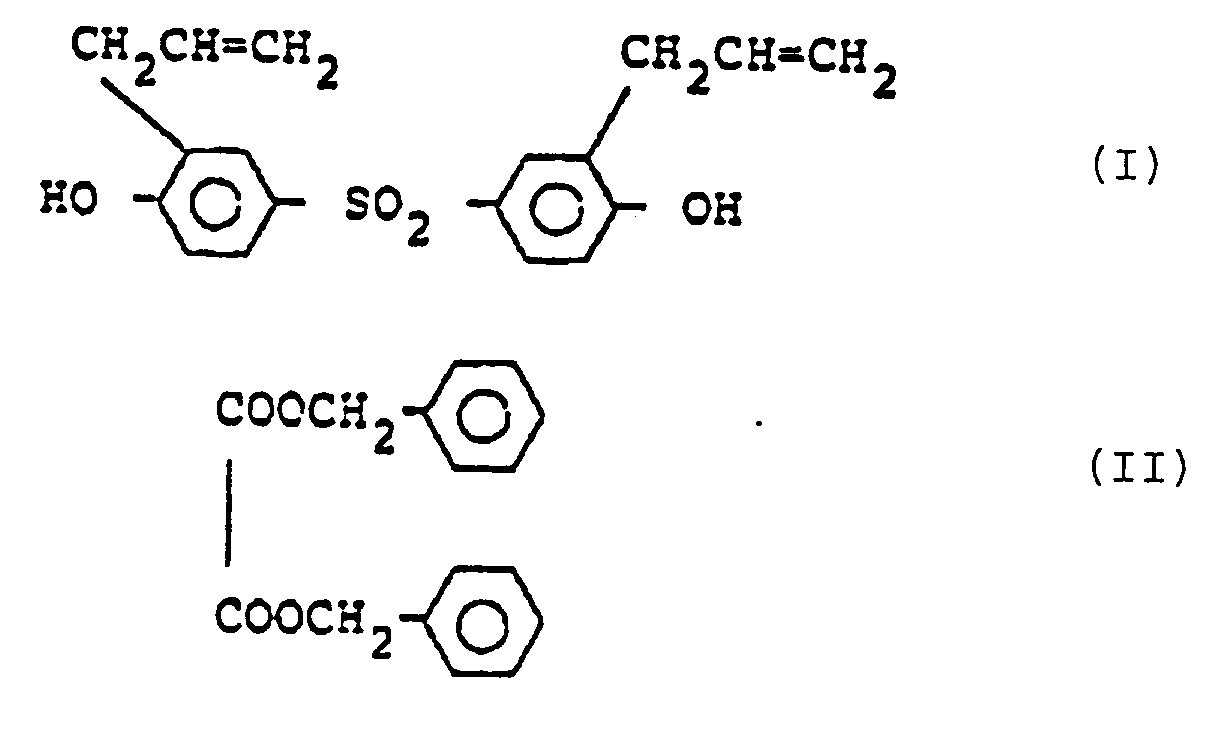
- the first aspect of the present invention is directed to a heat sensitive recording material excellent in heat responsibility and image storability comprising a dye precursor which is colorless or light-colored in the ordinary state and a color developing agent capable of reacting upon heating to develop a color from said dye precursor, wherein said color developing agent is constituted of a compound having the following chemical formula (I) and a compound having the following chemical formula (II):
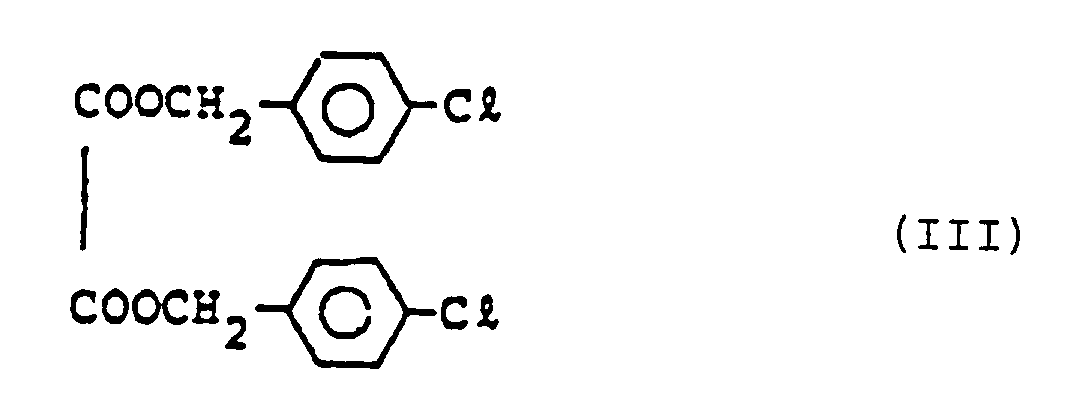
- thermosensitive recording material comprising a compound of the following chemical formula (III) (di-p-chlorobenzyl oxalate): in addition to the above-mentioned compounds of chemical formulas (I) and (II).
- the second aspect of the present invention is directed to a heat-sensitive recording sheet prepared by providing a heat sensitive recording layer comprising a colorless or light-colored leuco dye, a color developing agent capable of reacting with said leuco dye upon heating to develop a color and a sensitizer and providing a protective layer of a macromolecular compound (polymer) on said heat sensitive recording layer, wherein one member selected from 3-dibutylamino-6-methyl-7-anilinofluoran and 3-dibutylamino-7-o-chloroanilinofluoran is used as said lecuo dye, bis-(3-allyl-4-hydroxyphenyl) sulfone which is a compound represented by the above-mentioned chemical formula (I) is used as said color developing agent, and dibenzyl oxalate which is a compound represented by the above-mentioned chemical formula (II) is used as said sensitizer.
- a heat sensitive recording layer comprising a colorless or light-
- a heat sensitive paper using compound (II) is superior in sensitizing effect to heat sensitive papers using other hitherto known sensitizing additives (sensitizers), even when BPA is used as color developing agent.
- heat sensitive paper using compound (II) is so deteriorated in image storability as to be practically unusable.
- a bisphenol sulfone type color developing agent it has been difficult to improve image storability and realize a high sensitivity exceeding that of BPA system, though the decrease in image storability can barely be prevented, unless the combination of the present invention is employed.
- the compounds of chemical formulas (II) and (III) are used in the following amounts.
- 10 to 30 parts by weight of compound (II) and 20 to 40 parts by weight of compound (III) are used and particularly 15 to 25 parts by weight of compound (II) and 25 to 35 parts by weight of compound (III) are used.
- the total amount of compound (II) and compound (III) is 40 to 55 parts by weight.
- a heat sensitive recording sheet which is so excellent in heat responsibility as to be capable of coping with high-speed and electricity-saving tendencies of printing machine, shows no coloration of ground or retains whiteness of ground even if stored at high temperature (70°C) and has an excellent storability of colored area in the presence of plasticizer or the like, although the reason for this fact is unknown.
- the amount of the compounds of chemical formulas (I) and (II) used in the second aspect of the present invention are in the above-mentioned ranges, and their amounts should be particularly in the ranges suitable for using the product as a sheet.
- the dye precursor triphenylmethane type, fluoran type, diphenylmethane type, thaizine type and spiropyran type of compounds and the like can be referred to.
- Their examples include Crystal Violet Lactone, 3-diethylamino-7-methylfluoran, 3-diethylamino-6-chloro-7-methylfluoran, 3-diethylamino-6-methyl-7-chlorofluoran, 3-diethylamino-7-anilinofluoran, 3-diethylamino-7-(2-chloroanilino)-fluoran, 3-dibutylamino-7-(2-chloroanilino)-fluoran, 3-diethylamino-7-(3-chloroanilino)-fluoran, 3-diethylamino-6-methyl-7-anilinofluoran, 3-(N-ethyl-p-toluidino)-6-methyl-7-anilinofluoran, 3-
- the leuco dyes which can be used in the second aspect of the present invention include 3-dibutylamino-6-methyl-7-anilinofluoran and 3-dibutylamino-7-o-chloroanilinofluoran.
- the binders usable in the invention include water-soluble binders such as starches, hydroxyethyl cellulose, methyl cellulose, carboxymethyl cellulose, gelatin, casein, polyvinyl alcohol, modified polyvinyl alcohol, styrene-maleic anhydride copolymer, ethylene-maleic anhydride copolymer and the like, and latex type water-insoluble binders such as styrene-butadiene copolymer, acrylonitrile-butadiene copolymer, methyl acrylate-butadiene copolymer and the like.
- water-soluble binders such as starches, hydroxyethyl cellulose, methyl cellulose, carboxymethyl cellulose, gelatin, casein, polyvinyl alcohol, modified polyvinyl alcohol, styrene-maleic anhydride copolymer, ethylene-maleic anhydride copolymer and the like
- latex type water-insoluble binders such as
- an undercoat layer may be provided between the heat sensitive color-forming layer and the support, if desired.
- water-soluble polymers are generally preferred. That is, single substance or combination of two or more substances selected from polymers such as alginic acid salts, hydroxyethyl cellulose, methyl cellulose, carboxymethyl cellulose and polyvinyl alcohol is preferable.
- film-forming polymer emulsion such as acryl type latex, vinyl type acrylic resin, vinyl acetate-ethylene copolymer, silicone-acrylate resin, styrene-butadiene type latex and the like is also attempted, and its result is successful.
- the coating fluid was applied to a base paper having a basis weight of 55 g/m2 so that the amount of coating (solid) came to 4.0 g/m2, after which it was dried and treated with super calender to prepare a heat sensitive recording material.
- a heat sensitive recording material was prepared by repeating the procedure of Example 1, except that the compound of chemical formula (II) was replaced with p-benzyldiphenyl.
- Example 1 the heat sensitive recording material of Example 1 (the first aspect of the invention) is superior to those of Comparative Example 1 to 4 in heat responsibility and image stability.
- a stirred mixture consisting of 100 g of fired kaolinite and 200 g of 10% aqueous solution of polyvinyl alcohol was applied onto a base paper having a basis weight of 42 g/m2 so that the amount of coating came to 5 g/m2 after dryness, after which it was dried to prepare a support.
- the support thus obtained was coated with the above-mentioned coating fluid and dried, so that the amount of coating (solid) came to 4.0 g/m2. It was treated with super calender to prepare a heat sensitive recording material.
- a heat sensitive recording material was prepared by repeating the procedure of Example 2, except that the compound of chemical formula (II) was used in an amount of 20 g and the compound of chemical formula (III) was used in an amount of 20 g.
- a heat sensitive recording material was prepared by repeating the procedure of Example 2, except that the compound of chemical formula (II) was used in an amount of 15 g and the compound of chemical formula (III) was used in an amount of 30 g.
- a heat sensitive recording material was prepared by repeating the procedure of Example 2, except that the compound of chemical formula (II) was used alone in stead of using the combination of compounds (II) and (III).
- a heat sensitive recording material was prepared by repeating the procedure of Example 2, except that the compound of chemical formula (III) was used alone in stead of using the combination of compounds (II) and (III).
- a heat sensitive recording material was prepared by repeating the procedure of Example 2, except that the compound of chemical formula (I) used in Example 2 was replaced with Bisphenol A and the combination of compounds (II) and (III) was replaced with 2-benzyloxynaphthalene.
- the heat sensitive recording materials obtained in Examples 2 to 5 and Comparative Examples 5 and 6 were printed by means of G3FAX testing machine and optical densities of the images formed thereon were compared.
- the testing machine was TH-PMD manufactured by Okura Denki K. K., and its dot density was 8 dots/mm.
- the thermal head had a head resistance of 185 ⁇ .
- the head voltage was 11 V, and electricity was carried for 0.5 ms.
- the optical density of image was measured with Macbeth RD-514 reflection densitometer. Further, printed samples were allowed to stand in a thermostatted room (60°C) for 24 hours, and then percentage of residual image (%) was measured.
- Static color-forming property was evaluated by tightly contacting a thermal block having a temperature of 85°C with a heat sensitive paper under a load of 200 g/cm2 for a period of 3 seconds and measuring the optical density of colored area.
- a smaller numerical value means a smaller extent of ground fogging due to thermal inertia of head.
- Fluid A and fluid B were prepared by pulverizing and dispersing the mixtures of the following formulations by means of ball mill until the mean particle diameter reached 1 to 3 ⁇ m: Fluid A: 3-Dibutylamino-6-methyl-7-anilinofluoran 1 part by wt. 10% solution of polyvinyl alcohol 1.5 Water 2.5 Fluid B: Bis-(3-allyl-4-hydroxyphenyl) sulfone 2 Dibenzyl oxalate 2 Calcium carbonate 3 10% solution of polyvinyl alcohol 10.5 Water 17.5
- a coating fluid was prepared.
- the coating fluid was applied to one side of a high quality paper having a basis weight of 50 g/m2 and dried to form a heat sensitive color-forming layer having a coating weight of 5 g/m2. Then, it was calendered so that the Bekk smoothness reached 100 seconds or more, to prepare a heat sensitive recording paper.
- a protective layer-forming fluid having the following formulation: Fluid C: 10% solution of polyvinyl alcohol 10 parts by wt. 20% acrylic resin 5 30% zinc stearate 2 was coated and dried to form a protective layer having a coating weight of 3 g/m2 and calendered so that Bekk smoothness reached 300 seconds or more. Then, onto the backside of this heat sensitive recording paper, a silicone resin-coated peelable paper having an acrylic adhesive layer (coating weight 20 g/m2) on its silicone resin surface was applied through intermediation of the adhesive layer. Then, the whole was cut into an appropriate size to obtain a heat sensitive adhesive label.
- Fluid C 10% solution of polyvinyl alcohol 10 parts by wt. 20% acrylic resin 5 30% zinc stearate 2 was coated and dried to form a protective layer having a coating weight of 3 g/m2 and calendered so that Bekk smoothness reached 300 seconds or more.
- a silicone resin-coated peelable paper having an acrylic adhesive layer (coating weight 20 g/m2) on its silicone resin surface
- a heat sensitive adhesive label was prepared by repeating the procedure of Example 6, except that the dye 3-dibutylamino-6-methyl-7-anilinofluoran used in Example 6 was replaced with 3-dibutylamino-7-o-chloroanilinofluoran.
- a heat sensitive adhesive label was prepared by repeating the procedure of Example 6, except that the dye 3-dibutylamino-6-methyl-7-anilinofluoran used in Example 6 was replaced with 3-(N-methyl-N-cyclohexylamino)-6-methyl-7-anilinofluoran.
- a heat sensitive adhesive label was prepared by repeating the procedure of Example 6, except that the dye 3-dibutylamino-6-methyl-7-anilinofluoran used in Example 6 was replaced with 3-diethylamino-6-methyl-7-anilinofluoran.
- a heat sensitive adhesive label was prepared by repeating the procedure of Example 6, except that the dye 3-dibutylamino-6-methyl-7-anilinofluoran used in Example 6 was replaced with 3-(N-ethyl-N-isopentyl)-amino-6-methyl-7-anilinofluoran.
- a heat sensitive adhesive label was prepared by repeating the procedure of Example 6, except that the color developing agent bis-(3-allyl-4-hydroxyphenyl) sulfone used in Example 6 was replaced with Bisphenol A.
- a heat sensitive adhesive label was prepared by repeating the procedure of Example 7, except that the color developing agent bis-(3-allyl-4-hydroxyphenyl) sulfone used in Example 7 was replaced with Bisphenol A.
- a heat sensitive adhesive label was prepared by repeating the procedure of Example 6, except that the sensitizer dibenzyl oxalate used in Example 6 was replaced with stearic acid amide.
- a heat sensitive adhesive label was prepared by repeating the procedure of Example 6, except that the sensitizer dibenzyl oxalate used in Example 7 was replaced with stearic acid amide.
- the nine heat sensitive adhesive labels obtained above were examined for heat responsibility, ground fogging and plasticizer resistance.
- a greater numerical value means a better result.
Landscapes
- Chemical & Material Sciences (AREA)
- Chemical Kinetics & Catalysis (AREA)
- General Chemical & Material Sciences (AREA)
- Physics & Mathematics (AREA)
- Optics & Photonics (AREA)
- Heat Sensitive Colour Forming Recording (AREA)
Claims (8)
- Hitzeempfindliches Aufzeichnungsmateriai, umfassend einen Farbstoff-Vorläufer, der im Normalzustand farblos oder leicht gefärbt ist, und einen Farbentwickler, der in der Lage ist, mit diesem Farbstoff-Vorläufer bei Erhitzen unter Entwicklung einer Farbe zu reagieren, worin dieser Farbentwickler eine Kombination einer Verbindung der folgenden chemischen Formel (I) und einer Verbindung der folgenden chemischen Formel (II) ist:
- Hitzeempfindliches Aufzeichnungsmaterial gemäss Anspruch 1, worin die Menge der Verbindung der chemischen Formel (I) und die Menge der Verbindung der chemischen Formel (II) jeweils 5 Gew.% oder mehr, bezogen auf das Gewicht des Farbstoff-Vorläufers, betragen.
- Hitzeempfindliches Aufzeichnungsmaterial gemäss Anspruch 1, welches zusätzlich eine Verbindung der folgenden chemischen Formel (III):
- Hitzeempfindliches Aufzeichnungsmaterial gemäss Anspruch 3, worin die Menge der Verbindung der chemischen Formel (II) 10 bis 30 Gew.-Teile beträgt, die Menge der Verbindung der chemischen Formel (III) 20 bis 40 Gew.-Teile beträgt, beide pro 40 Gew.-Teile des Farbentwicklers der chemischen Formel (I), und die Gesamtmenge der Verbindungen der chemischen Formeln (II) und (III) 30 bis 70 Gew.-Teile auf derselben Basis wie oben beträgt.
- Hitzeempfindliches Aufzeichnungsmaterial gemäss Anspruch 1, worin dieses Aufzeichnungsmaterial ein hitzeempfindliches Aufzeichnungsblatt ist, hergestellt, indem man auf einem Träger eine hitzeempfindliche Aufzeichnungsschicht, umfassend einen farblosen oder leicht gefärbten Leuko-Farbstoff als Farbstoff-Vorläufer, einen Farbentwickler, der in der Lage ist, mit diesem Leuko-Farbstoff bei Erhitzen unter Entwicklung einer Farbe zu reagieren, und einen Sensibilisator, vorsieht, und eine Schutzschicht aus einem Polymer auf dieser hitzeempfindlichen Aufzeichnungsschicht vorsieht, und wobei ein Vertreter, ausgewählt aus 3-Dibutylamino-6-methyl-7-anilinofluoran und 3-Dibutylamino-7-o-chloranilinofluoran als besagter Leuko-Farbstoff verwendet wird, Bis(3-allyl-4-hydroxyphenyl)sulfon (Verbindung der chemischen Formel (I)) als der Farbentwickler verwendet wird, und Dibenzyloxalat (Verbindung der chemischen Formel (II)) als der Sensibilisator verwendet wird.
- Hitzeempfindliches Aufzeichnungsmaterial gemäss Anspruch 5, worin eine Unterschicht zwischen der hitzeempfindlichen farbbildenden Schicht und dem Träger vorgesehen ist.
- Hitzeempfindliches Aufzeichnungsmaterial gemäss Anspruch 5, worin das Polymer als Schutzschicht ein wasserlösliches Polymer ist.
- Hitzeempfindliches Aufzeichnungsmaterial gemäss Anspruch 5, worin ein oder mehrere Vertreter, ausgewählt aus einem Hydrophobiermittel, einem ultravioletten Absorber und einem Entformungsmittel, zusätzlich umfasst sind.
Applications Claiming Priority (6)
| Application Number | Priority Date | Filing Date | Title |
|---|---|---|---|
| JP225665/87 | 1987-09-08 | ||
| JP62225665A JPH0764121B2 (ja) | 1987-09-08 | 1987-09-08 | 感熱記録材料 |
| JP62310321A JPH0796336B2 (ja) | 1987-12-07 | 1987-12-07 | 感熱記録シート |
| JP310321/87 | 1987-12-07 | ||
| JP63002344A JP2528923B2 (ja) | 1988-01-08 | 1988-01-08 | 感熱記録材料 |
| JP2344/88 | 1988-01-08 |
Publications (3)
| Publication Number | Publication Date |
|---|---|
| EP0306916A2 EP0306916A2 (de) | 1989-03-15 |
| EP0306916A3 EP0306916A3 (en) | 1990-08-01 |
| EP0306916B1 true EP0306916B1 (de) | 1993-06-23 |
Family
ID=27275311
Family Applications (1)
| Application Number | Title | Priority Date | Filing Date |
|---|---|---|---|
| EP88114606A Expired - Lifetime EP0306916B1 (de) | 1987-09-08 | 1988-09-07 | Wärmeempfindliches Aufzeichnungsmaterial |
Country Status (3)
| Country | Link |
|---|---|
| US (1) | US4999332A (de) |
| EP (1) | EP0306916B1 (de) |
| DE (1) | DE3881990T2 (de) |
Families Citing this family (9)
| Publication number | Priority date | Publication date | Assignee | Title |
|---|---|---|---|---|
| JP2730977B2 (ja) * | 1989-06-02 | 1998-03-25 | 三菱製紙株式会社 | 感熱記録紙 |
| US5116804A (en) * | 1989-06-09 | 1992-05-26 | Ricoh Company, Ltd. | Thermosensitive recording material |
| US5098882A (en) * | 1989-08-24 | 1992-03-24 | Daio Paper Corporation | Heat-sensitive recording medium |
| JPH03215087A (ja) * | 1990-01-19 | 1991-09-20 | Mitsubishi Paper Mills Ltd | 感熱記録材料 |
| JPH03218891A (ja) * | 1990-01-24 | 1991-09-26 | Kanzaki Paper Mfg Co Ltd | 感熱記録体 |
| DE4012186C1 (de) * | 1990-04-14 | 1991-05-16 | Renker Gmbh & Co Kg, 5160 Dueren, De | |
| US5371058A (en) * | 1992-06-10 | 1994-12-06 | Alfred Doi | Ultraviolet protective coatings for application to heat sensitive record materials and other photodegradable printed matter |
| JP3265638B2 (ja) * | 1992-09-22 | 2002-03-11 | 大日本インキ化学工業株式会社 | 発色性能向上剤及びこれを用いた感熱記録体 |
| US5955398A (en) * | 1997-04-25 | 1999-09-21 | Appleton Papers Inc. | Thermally-responsive record material |
Family Cites Families (3)
| Publication number | Priority date | Publication date | Assignee | Title |
|---|---|---|---|---|
| GB2154236B (en) * | 1984-02-14 | 1987-05-20 | Nippon Kayaku Kk | Bis (3-allyl 4-hydroxyphenyl) sulfone |
| JPS6189090A (ja) * | 1984-10-08 | 1986-05-07 | Nikka Chem Ind Co Ltd | 感熱記録材料 |
| CA1263919A (en) * | 1986-05-16 | 1989-12-19 | Shingo Araki | Thermosensitive recording sheet |
-
1988
- 1988-09-07 EP EP88114606A patent/EP0306916B1/de not_active Expired - Lifetime
- 1988-09-07 DE DE88114606T patent/DE3881990T2/de not_active Expired - Lifetime
- 1988-09-08 US US07/241,849 patent/US4999332A/en not_active Expired - Lifetime
Also Published As
| Publication number | Publication date |
|---|---|
| DE3881990T2 (de) | 1993-11-25 |
| EP0306916A3 (en) | 1990-08-01 |
| EP0306916A2 (de) | 1989-03-15 |
| DE3881990D1 (de) | 1993-07-29 |
| US4999332A (en) | 1991-03-12 |
Similar Documents
| Publication | Publication Date | Title |
|---|---|---|
| US4874740A (en) | Thermosensitive recording material | |
| EP0306916B1 (de) | Wärmeempfindliches Aufzeichnungsmaterial | |
| JPS6147292A (ja) | 感熱記録紙 | |
| US5955398A (en) | Thermally-responsive record material | |
| EP0535788B1 (de) | Wärmeempfindliches Aufzeichnungsmaterial | |
| EP0514807B1 (de) | Wärmeempfindliches Aufzeichnungsmaterial | |
| EP0361463B1 (de) | Wärmeempfindliche Aufzeichnungsmaterialien | |
| EP0509783B1 (de) | Wärmeempfindliches Aufzeichnungsmaterial | |
| JP2003182238A (ja) | 感熱記録材料 | |
| JPH04269584A (ja) | 感熱記録体 | |
| JPS61199988A (ja) | 感熱記録材料 | |
| JPH029684A (ja) | 感熱記録シート | |
| JPH04113888A (ja) | 感熱記録体 | |
| JPH02117889A (ja) | 感熱記録体 | |
| JPS61199987A (ja) | 感熱記録材料 | |
| JPH0229380A (ja) | 感熱記録体 | |
| JPH0281670A (ja) | 感熱記録体 | |
| JPH04270681A (ja) | 感熱記録体 | |
| JPH03173689A (ja) | 感熱記録体 | |
| JPH06127124A (ja) | 感熱記録材料 | |
| JPH0281669A (ja) | 感熱記録体 | |
| JPS61233585A (ja) | 感熱記録材料 | |
| JPS61233586A (ja) | 感熱記録材料 | |
| JPH0761127A (ja) | 感熱記録体 | |
| JPH04286686A (ja) | 感熱記録体 |
Legal Events
| Date | Code | Title | Description |
|---|---|---|---|
| PUAI | Public reference made under article 153(3) epc to a published international application that has entered the european phase |
Free format text: ORIGINAL CODE: 0009012 |
|
| 17P | Request for examination filed |
Effective date: 19880907 |
|
| AK | Designated contracting states |
Kind code of ref document: A2 Designated state(s): DE FR GB IT |
|
| PUAL | Search report despatched |
Free format text: ORIGINAL CODE: 0009013 |
|
| AK | Designated contracting states |
Kind code of ref document: A3 Designated state(s): DE FR GB IT |
|
| 17Q | First examination report despatched |
Effective date: 19920831 |
|
| GRAA | (expected) grant |
Free format text: ORIGINAL CODE: 0009210 |
|
| AK | Designated contracting states |
Kind code of ref document: B1 Designated state(s): DE FR GB IT |
|
| ITF | It: translation for a ep patent filed | ||
| REF | Corresponds to: |
Ref document number: 3881990 Country of ref document: DE Date of ref document: 19930729 |
|
| ET | Fr: translation filed | ||
| PLBE | No opposition filed within time limit |
Free format text: ORIGINAL CODE: 0009261 |
|
| STAA | Information on the status of an ep patent application or granted ep patent |
Free format text: STATUS: NO OPPOSITION FILED WITHIN TIME LIMIT |
|
| 26N | No opposition filed | ||
| PGFP | Annual fee paid to national office [announced via postgrant information from national office to epo] |
Ref country code: FR Payment date: 19990709 Year of fee payment: 12 |
|
| PGFP | Annual fee paid to national office [announced via postgrant information from national office to epo] |
Ref country code: GB Payment date: 19990901 Year of fee payment: 12 |
|
| PG25 | Lapsed in a contracting state [announced via postgrant information from national office to epo] |
Ref country code: GB Free format text: LAPSE BECAUSE OF NON-PAYMENT OF DUE FEES Effective date: 20000907 |
|
| GBPC | Gb: european patent ceased through non-payment of renewal fee |
Effective date: 20000907 |
|
| PG25 | Lapsed in a contracting state [announced via postgrant information from national office to epo] |
Ref country code: FR Free format text: LAPSE BECAUSE OF NON-PAYMENT OF DUE FEES Effective date: 20010531 |
|
| REG | Reference to a national code |
Ref country code: FR Ref legal event code: ST |
|
| PG25 | Lapsed in a contracting state [announced via postgrant information from national office to epo] |
Ref country code: IT Free format text: LAPSE BECAUSE OF NON-PAYMENT OF DUE FEES Effective date: 20050907 |
|
| PGFP | Annual fee paid to national office [announced via postgrant information from national office to epo] |
Ref country code: DE Payment date: 20070830 Year of fee payment: 20 |