EP0303370A2 - Abstandhalter für Bauelemente auf gedruckten Schaltungen - Google Patents
Abstandhalter für Bauelemente auf gedruckten Schaltungen Download PDFInfo
- Publication number
- EP0303370A2 EP0303370A2 EP88306917A EP88306917A EP0303370A2 EP 0303370 A2 EP0303370 A2 EP 0303370A2 EP 88306917 A EP88306917 A EP 88306917A EP 88306917 A EP88306917 A EP 88306917A EP 0303370 A2 EP0303370 A2 EP 0303370A2
- Authority
- EP
- European Patent Office
- Prior art keywords
- disposed
- component
- hole
- lead
- circuit board
- Prior art date
- Legal status (The legal status is an assumption and is not a legal conclusion. Google has not performed a legal analysis and makes no representation as to the accuracy of the status listed.)
- Withdrawn
Links
Images

Classifications
-
- H—ELECTRICITY
- H05—ELECTRIC TECHNIQUES NOT OTHERWISE PROVIDED FOR
- H05K—PRINTED CIRCUITS; CASINGS OR CONSTRUCTIONAL DETAILS OF ELECTRIC APPARATUS; MANUFACTURE OF ASSEMBLAGES OF ELECTRICAL COMPONENTS
- H05K3/00—Apparatus or processes for manufacturing printed circuits
- H05K3/30—Assembling printed circuits with electric components, e.g. with resistors
- H05K3/306—Assembling printed circuits with electric components, e.g. with resistors with lead-in-hole components
-
- H—ELECTRICITY
- H05—ELECTRIC TECHNIQUES NOT OTHERWISE PROVIDED FOR
- H05K—PRINTED CIRCUITS; CASINGS OR CONSTRUCTIONAL DETAILS OF ELECTRIC APPARATUS; MANUFACTURE OF ASSEMBLAGES OF ELECTRICAL COMPONENTS
- H05K2201/00—Indexing scheme relating to printed circuits covered by H05K1/00
- H05K2201/10—Details of components or other objects attached to or integrated in a printed circuit board
- H05K2201/10613—Details of electrical connections of non-printed components, e.g. special leads
- H05K2201/10621—Components characterised by their electrical contacts
- H05K2201/10651—Component having two leads, e.g. resistor, capacitor
-
- H—ELECTRICITY
- H05—ELECTRIC TECHNIQUES NOT OTHERWISE PROVIDED FOR
- H05K—PRINTED CIRCUITS; CASINGS OR CONSTRUCTIONAL DETAILS OF ELECTRIC APPARATUS; MANUFACTURE OF ASSEMBLAGES OF ELECTRICAL COMPONENTS
- H05K2201/00—Indexing scheme relating to printed circuits covered by H05K1/00
- H05K2201/10—Details of components or other objects attached to or integrated in a printed circuit board
- H05K2201/10613—Details of electrical connections of non-printed components, e.g. special leads
- H05K2201/10742—Details of leads
- H05K2201/1075—Shape details
- H05K2201/10757—Bent leads
-
- H—ELECTRICITY
- H05—ELECTRIC TECHNIQUES NOT OTHERWISE PROVIDED FOR
- H05K—PRINTED CIRCUITS; CASINGS OR CONSTRUCTIONAL DETAILS OF ELECTRIC APPARATUS; MANUFACTURE OF ASSEMBLAGES OF ELECTRICAL COMPONENTS
- H05K2201/00—Indexing scheme relating to printed circuits covered by H05K1/00
- H05K2201/20—Details of printed circuits not provided for in H05K2201/01 - H05K2201/10
- H05K2201/2036—Permanent spacer or stand-off in a printed circuit or printed circuit assembly
-
- H—ELECTRICITY
- H05—ELECTRIC TECHNIQUES NOT OTHERWISE PROVIDED FOR
- H05K—PRINTED CIRCUITS; CASINGS OR CONSTRUCTIONAL DETAILS OF ELECTRIC APPARATUS; MANUFACTURE OF ASSEMBLAGES OF ELECTRICAL COMPONENTS
- H05K3/00—Apparatus or processes for manufacturing printed circuits
- H05K3/0058—Laminating printed circuit boards onto other substrates, e.g. metallic substrates
-
- H—ELECTRICITY
- H05—ELECTRIC TECHNIQUES NOT OTHERWISE PROVIDED FOR
- H05K—PRINTED CIRCUITS; CASINGS OR CONSTRUCTIONAL DETAILS OF ELECTRIC APPARATUS; MANUFACTURE OF ASSEMBLAGES OF ELECTRICAL COMPONENTS
- H05K3/00—Apparatus or processes for manufacturing printed circuits
- H05K3/30—Assembling printed circuits with electric components, e.g. with resistors
- H05K3/32—Assembling printed circuits with electric components, e.g. with resistors electrically connecting electric components or wires to printed circuits
- H05K3/34—Assembling printed circuits with electric components, e.g. with resistors electrically connecting electric components or wires to printed circuits by soldering
- H05K3/3447—Lead-in-hole components
Definitions
- the present invention relates to circuit board assemblies and more particularly to circuit board assemblies having relatively small components mounted thereon.
- circuit boards such as printed circuit boards (PCB's) often have individual components such as resistors, diodes, and capacitors mounted thereon.
- the components lie flat on the upper surface of the printed circuit board with the leads thereof extending outward from the component horizontally to the PCB, making a 90 degree downward bend and extending through solder plated holes in the printed circuit board.
- Such bend is often referred to as a "stress bend”.
- the leads are typically soldered in the solder plated through holes. While such arrangement is satisfactory in some applications, often the solder which secures the lead within the through holes flows or "wicks" up the component lead through the solder plated printed circuit board through hole and into the stress bend of the lead.
- the solder is generally less flexible than the lead itself.
- a substrate is provided with a component disposed over a surface of the substrate, the component comprising a lead disposed through a hole in the substrate.
- a member is disposed between the component and the surface of the substrate, the lead being disposed through the member.
- a printed circuit board having a first hole disposed therethrough with the walls of said first hole comprising electrically conducting material.
- An electrically insulating member having a second hole disposed therethrough is disposed on the printed circuit board with the first and second holes being in substantial alignment, the walls of the second hole comprising electrically insulating material.
- a component is disposed on the member, the component having a lead comprising a stress bend portion and an end portion, the end portion of the lead being disposed through the first and second holes.
- the end portion of the component lead may be soldered to the walls of the first hole with the solder being substantially prevented from “wicking" up the component lead to the stress bend portion of the lead by the electrically insulating member, and specifically by the electrically insulated walls of the second hole of such member.
- a circuit board assembly 10 in accordance with a preferred embodiment of the present invention is shown to comprise circuit board 12, here a printed circuit board (PCB) over which are disposed insulating spacer member 14 and a plurality, here eight, of components 16a-16h.
- PCB printed circuit board
- an integrated circuit package 18 is also disposed on PCB 12, as shown.
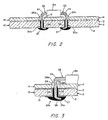
- Components 16a-16h are disposed on an upper surface of insulating spacer member 14, as shown in FIG. 2 for representative component 16a.
- Integrated circuit 18 is here disposed directly on an upper surface of PCB 12 through an opening 20 disposed in insulating spacer member 14, as shown in FIG. 1.
- Printed circuit board 12 is here a conventional circuit board having a thickness of about 0.063 inches and provided with a plurality of through holes disposed therein from upper surface 13 to lower surface 15 thereof for receiving the leads of components 16a-16h and integrated circuit 18.
- a pair of holes 30a are disposed through PCB 12 for receiving the leads 22 of component 16a, as shown in FIG. 2.
- Component 16a may comprise, for example, a resistor, glass diode or capacitor, and here is preferably a small diameter device, such as a conventional 1/8 watt resistor (the diameter of which is about 0.062 inches), for reasons to be explained.
- Component 16a here has a pair of leads 22, each lead having a length of approximately 0.14 inches and comprising a first portion 24 which comprises a stress bend and a second or end portion 26 which is secured by solder 27 within through hole 30a and also to lower surface 15 of PCB 12 (FIG. 3). That is, each lead 22 here extends horizontally outward from component 16a generally parallel to PCB 12 and is bent substantially 90 degrees downward through stress bend 24 to pass through hole 30a in PCB 12, with end portion 26 of such lead 22 being secured to PCB 12 by solder 27. As is known, stress bend 24 typically is disposed a minimum of two lead diameters from the component.
- the diameter of leads 22 is substantially 0.015 inches in accordance with the aforementioned relatively small, 1/8 watt resistor. It is here noted that typically the diameter of PCB holes 30a is about 0.031 inches and thus it is noted that PCB holes 30a are substantially larger than component leads 22.
- Spacer member 14 here comprises electrically insulating material, such as commercially available G-10 material, although other suitable insulating material may be substituted therefor. Spacer member 14 is disposed on upper surface 13 of PCB 12 between components 16a-16h and PCB upper surface 13, with components 16a-16h being disposed on an upper surface 17 of spacer member 14. Spacer member 14 is secured to the upper surface 13 of PCB 12 by any appropriate means, such as by epoxying spacer member 14 to PCB 12.
- Spacer member 14 may be provided with any suitable thickness, the limits of such thickness being determined on the one hand by the amount of spacing desired between component 16a and PCB upper surface 13 to substantially prevent wicking of solder 27 into lead stress bend portion 24, as will be discussed, the thickness of spacer member 14 being limited on the other hand by any restrictions on the height of components above PCB 12 imposed in a given application.
- the thickness of spacer member 14 is between 0.02 and 0.062 inches and preferably between 0.040 and 0.062 inches. Most preferably, here insulating spacer member 14 has a thickness of about 0.05 inches.
- spacer member 14 has a plurality of pairs of holes 28a-28h disposed therethrough for components 16a-16h, respectively.
- spacer member 14 Also disposed in spacer member 14 is an opening 20 within which integrated circuit 18 is here disposed to lie directly on upper surface 13 of PCB 12.
- through holes 28a for component 16a are disposed in overlaying relationship with through holes 30a of PCB 12, as shown.
- spacer member through hole pairs 28a-28h are aligned with corresponding PCB through hole pairs.
- spacer member through holes 28a-28h are slightly larger (here by about 0.01 inches) than the diameter of the PCB holes (for example, holes 30a) to thereby allow some play in the alignment of spacer member through holes 28a-28h over such PCB through holes.
- each lead 22 of component 16a is disposed through spacer member through hole 28a and PCB through hole 30a and is secured within PCB through hole 30a and to the lower surface 15 of PCB 12 by solder 27.
- each PCB 12 through hole (for example, holes 30a) are conventionally metallized with solder plating 32 to facilitate securing component leads 22 within such holes 30a by solder 27.
- Solder plating 32 may also be coupled via printed circuitry (not shown) on PCB 12 to similarly solder plated PCB through holes for components 16b-16h and integrated circuit 18 to thereby provide electrical coupling between component 16a and such other components 16b-16h or integrated circuit 18.
- the walls of the PCB through holes comprise electrically conductive material.
- walls 29 of spacer member through holes 28a-28h are not solder plated or otherwise metallized and thus comprise electrcially insulating material (such as the aforementioned G-10 material).
- walls 29 of spacer member 14 through holes 28a for example, comprise non-electrically conducting material.
- end portion 26 of lead 22 is soldered to solder plating 32 within PCB through hole 30a and to PCB lower surface 15 with solder 27. Due to the size differential between PCB hole 30a and lead 22, sufficient space exists between lead 22 and solder plating 32 for such solder to flow through PCB hole 30a and up lead 22 to thereby produce a solder wick 34, as shown. As discussed, if solder wick 34 becomes disposed in lead stress bend 24 portion, when printed circuit board assembly 10 is subjected to mechanical forces, such solder wick 34 would substantially impede stress bend portion 24 of component lead 22 from flexing.
- solder connection 27 possibly would crack and become dislodged from either lead 22 or solder plating 32, thereby impairing or breaking the electrical connection between lead 22 and solder plating 32 and possibly producing an electrical malfunction in printed circuit board assembly 10.
- the aforementioned military standards prohibit the presence of solder in sterss bends, requiring labor intensive rework of solder connections found to have solder disposed in component stress bends.
- Such "wicking" of solder 27 into stress bend 24 is substantially prevented from occurring in the present invention by the presence of insulating spacer member 14 between component 16a (for example) and PCB 12, and hence between the stress bend portion 24 of lead 22 and solder plated PCB through hole 30a.
- the walls 29 of spacer member 14 through holes 28a comprise electrically insulating material (such as G-10 material) rather than electrically conductive material (such as solder plating 32). It has been found that solder 27 tends to flow up those portions of lead 22 which are adjacent to other electrically conductive material (such as solder plating 32 along the walls of PCB through holes 30a). However, solder wicking is found to be substantially prevented for portions of lead 22 disposed adjacent to electrically insulating material (such as walls 29 of spacer member through holes 28a).
- the electrically insulating walls 29 of the through holes (such as through hole 28a) of spacer member 14 are found to substantially prevent solder 27 from wicking above through hole 28a, and hence above upper surface 17 of spacer member 14, thereby substantially preventing solder wick 34 from becoming disposed within the stress bend 24 portion of component lead 22.
- component lead stress bend portion 24 is free to flex in response to mechanical forces without placing additional stress on solder connection 27, thereby maintaining the electrical connection between component lead 22 and solder plating 32.
- the aforementioned military standards are complied with, thereby substantially reducing the amount of rework required for such solder connections.
- PCB 12 is here about 0.063 inches thick and component leads 22 are about 0.14 inches in length, thereby limiting the maximum thickness of insulating spacer member 14.
- the thickness of insulating spacer member 14 (0.05 inches) is selected to be substantially equal to the thickness of PCB 12 (0.063 inches), thereby providing maximum spacing between component 16a and PCB upper surface 13 while allowing a sufficient portion of component lead end portion 26 to extend through PCB hole 30a.
- components 16a-16h typically have leads with regions 26a of end portions 26 which are pre-tinned to facilitate a solder connection thereto.
- the spacing between such components 16a-16h and PCB upper surface 13 provided by insulating spacer member 14 makes it more likely that such pre-timed lead end portion 26a will be disposed adjacent to solder plating 32 to thus facilitate an electrical connection with solder 27 between component lead end portion 26 and solder plating 32.
- integrated circuit 18 is here disposed directly on upper surface 13 of printed circuit board 12 through an opening 20 disposed in insulating spacer member 14.
- the leads (not numbered) of integrated circuit packages such as package 18 do not include stress bends; therefore, such typical inte grated circuit package 18 need not be mounted on insulating spacer member 14.
- insulating spacer member 14 may be cut out or relieved in the area of such component.
- insulating spacer member 14 rather than comprising a single member disposed between a plurality of components (16a-16h) and a circuit board, may alternately comprise a plurality of individual spacer members disposed between such circuit board and corresponding individual components 16a-16h and the leads 22 thereof.
- insulating spacer member 14 may alternately comprise a plurality of individual spacer members disposed between such circuit board and corresponding individual components 16a-16h and the leads 22 thereof.
Landscapes
- Engineering & Computer Science (AREA)
- Manufacturing & Machinery (AREA)
- Microelectronics & Electronic Packaging (AREA)
- Structures For Mounting Electric Components On Printed Circuit Boards (AREA)
Applications Claiming Priority (2)
| Application Number | Priority Date | Filing Date | Title |
|---|---|---|---|
| US8550887A | 1987-08-14 | 1987-08-14 | |
| US85508 | 1998-05-27 |
Publications (2)
| Publication Number | Publication Date |
|---|---|
| EP0303370A2 true EP0303370A2 (de) | 1989-02-15 |
| EP0303370A3 EP0303370A3 (de) | 1990-05-16 |
Family
ID=22192081
Family Applications (1)
| Application Number | Title | Priority Date | Filing Date |
|---|---|---|---|
| EP88306917A Withdrawn EP0303370A3 (de) | 1987-08-14 | 1988-07-27 | Abstandhalter für Bauelemente auf gedruckten Schaltungen |
Country Status (2)
| Country | Link |
|---|---|
| EP (1) | EP0303370A3 (de) |
| JP (1) | JPS6467994A (de) |
Cited By (2)
| Publication number | Priority date | Publication date | Assignee | Title |
|---|---|---|---|---|
| WO2016005130A1 (de) * | 2014-07-07 | 2016-01-14 | Conti Temic Microelectronic Gmbh | Elektronische komponente und verfahren zur herstellung einer elektronischen komponente |
| CN121696481A (zh) * | 2025-12-09 | 2026-03-20 | 陕西飞机工业有限责任公司 | 提高拉脱力的直插式耳机插座焊接方法及焊接结构 |
Families Citing this family (1)
| Publication number | Priority date | Publication date | Assignee | Title |
|---|---|---|---|---|
| CN110572954A (zh) * | 2019-09-11 | 2019-12-13 | 苏州汇川技术有限公司 | 引脚装配导向件及电路板组件 |
Family Cites Families (3)
| Publication number | Priority date | Publication date | Assignee | Title |
|---|---|---|---|---|
| DE2344555C2 (de) * | 1973-09-04 | 1982-03-11 | Siemens AG, 1000 Berlin und 8000 München | Schutzvorrichtung für ein elektrisches Bauelement |
| GB2141879B (en) * | 1983-06-01 | 1988-03-09 | Ferranti Plc | Manufacture of printed circuit boards |
| FR2551618B1 (fr) * | 1983-09-02 | 1989-12-01 | Inf Milit Spatiale Aeronaut | Procede de fabrication d'un circuit imprime a couches enterrees et circuit imprime obtenu par un tel procede |
-
1988
- 1988-07-27 EP EP88306917A patent/EP0303370A3/de not_active Withdrawn
- 1988-08-15 JP JP20304788A patent/JPS6467994A/ja active Pending
Cited By (2)
| Publication number | Priority date | Publication date | Assignee | Title |
|---|---|---|---|---|
| WO2016005130A1 (de) * | 2014-07-07 | 2016-01-14 | Conti Temic Microelectronic Gmbh | Elektronische komponente und verfahren zur herstellung einer elektronischen komponente |
| CN121696481A (zh) * | 2025-12-09 | 2026-03-20 | 陕西飞机工业有限责任公司 | 提高拉脱力的直插式耳机插座焊接方法及焊接结构 |
Also Published As
| Publication number | Publication date |
|---|---|
| EP0303370A3 (de) | 1990-05-16 |
| JPS6467994A (en) | 1989-03-14 |
Similar Documents
| Publication | Publication Date | Title |
|---|---|---|
| KR900002363Y1 (ko) | 다층 프린트 기판의 접지구조체 | |
| US6609914B2 (en) | High speed and density circular connector for board-to-board interconnection systems | |
| JPS6231836B2 (de) | ||
| US4807087A (en) | Single-in-line type semiconductor device | |
| US6280205B1 (en) | Surface-mounted type connector and method for producing circuit device including the same | |
| US4272140A (en) | Arrangement for mounting dual-in-line packaged integrated circuits to thick/thin film circuits | |
| US6796807B2 (en) | Adapter for surface mount devices to through hole applications | |
| JPS60136396A (ja) | 接続端子を備えた膜回路 | |
| US6409523B1 (en) | Terminal legs of connectors | |
| SE469151B (sv) | Skaermad rfi-genomfoering | |
| US20020146921A1 (en) | Pin connector | |
| WO1989005570A1 (en) | Mounting substrate for leadless ceramic chip carrier | |
| JPH08186339A (ja) | 配線基板 | |
| JP2002203624A (ja) | カードエッジコネクタ | |
| CA2202576C (en) | Electronic circuit assembly | |
| JP2001326443A (ja) | 電気部品の実装方法 | |
| JP2564401B2 (ja) | インレット型ノイズフィルタ | |
| JPS62128593A (ja) | 部品の取付構造 | |
| KR0117816Y1 (ko) | 하이브리드 ic용 리드프레임 | |
| JPH05251612A (ja) | ハイブリッドic | |
| JP2508680Y2 (ja) | 誘電体フィルタ | |
| EP0303370A3 (de) | Abstandhalter für Bauelemente auf gedruckten Schaltungen | |
| JPH08195540A (ja) | 電気回路装置 | |
| JPS62243393A (ja) | プリント基板 | |
| JPH07212000A (ja) | 電子回路基板 |
Legal Events
| Date | Code | Title | Description |
|---|---|---|---|
| PUAI | Public reference made under article 153(3) epc to a published international application that has entered the european phase |
Free format text: ORIGINAL CODE: 0009012 |
|
| AK | Designated contracting states |
Kind code of ref document: A2 Designated state(s): DE GB NL |
|
| PUAL | Search report despatched |
Free format text: ORIGINAL CODE: 0009013 |
|
| AK | Designated contracting states |
Kind code of ref document: A3 Designated state(s): DE GB NL |
|
| STAA | Information on the status of an ep patent application or granted ep patent |
Free format text: STATUS: THE APPLICATION IS DEEMED TO BE WITHDRAWN |
|
| 18D | Application deemed to be withdrawn |
Effective date: 19901117 |