EP0266461B1 - Methods for the detection and quantitation of immunological substances - Google Patents
Methods for the detection and quantitation of immunological substances Download PDFInfo
- Publication number
- EP0266461B1 EP0266461B1 EP86308568A EP86308568A EP0266461B1 EP 0266461 B1 EP0266461 B1 EP 0266461B1 EP 86308568 A EP86308568 A EP 86308568A EP 86308568 A EP86308568 A EP 86308568A EP 0266461 B1 EP0266461 B1 EP 0266461B1
- Authority
- EP
- European Patent Office
- Prior art keywords
- radiation
- speckle
- affixed
- pattern
- immunological
- Prior art date
- Legal status (The legal status is an assumption and is not a legal conclusion. Google has not performed a legal analysis and makes no representation as to the accuracy of the status listed.)
- Expired
Links
- 239000000126 substance Substances 0.000 title claims abstract description 68
- 238000000034 method Methods 0.000 title claims abstract description 58
- 230000001900 immune effect Effects 0.000 title claims abstract description 39
- 238000001514 detection method Methods 0.000 title claims description 31
- 230000005855 radiation Effects 0.000 claims abstract description 88
- 230000001427 coherent effect Effects 0.000 claims abstract description 39
- 239000000463 material Substances 0.000 claims abstract description 17
- 239000000376 reactant Substances 0.000 claims abstract description 14
- 230000004069 differentiation Effects 0.000 claims abstract description 8
- 230000008859 change Effects 0.000 claims description 15
- 238000006243 chemical reaction Methods 0.000 claims description 8
- 102000004169 proteins and genes Human genes 0.000 claims description 7
- 108090000623 proteins and genes Proteins 0.000 claims description 7
- 239000000427 antigen Substances 0.000 claims description 6
- 102000036639 antigens Human genes 0.000 claims description 6
- 108091007433 antigens Proteins 0.000 claims description 6
- 210000002966 serum Anatomy 0.000 claims description 5
- 238000001429 visible spectrum Methods 0.000 claims description 5
- 241000282414 Homo sapiens Species 0.000 claims description 4
- 239000013566 allergen Substances 0.000 claims description 4
- 239000007787 solid Substances 0.000 claims description 4
- 241001465754 Metazoa Species 0.000 claims description 3
- 239000007788 liquid Substances 0.000 claims description 3
- XLYOFNOQVPJJNP-UHFFFAOYSA-N water Substances O XLYOFNOQVPJJNP-UHFFFAOYSA-N 0.000 claims description 3
- -1 antibody Proteins 0.000 claims 1
- 238000001035 drying Methods 0.000 claims 1
- 238000005406 washing Methods 0.000 claims 1
- 238000005259 measurement Methods 0.000 abstract description 9
- 238000004458 analytical method Methods 0.000 abstract description 7
- 238000001914 filtration Methods 0.000 description 9
- 238000012545 processing Methods 0.000 description 7
- 230000000875 corresponding effect Effects 0.000 description 6
- 238000012360 testing method Methods 0.000 description 6
- 235000019592 roughness Nutrition 0.000 description 5
- 210000004027 cell Anatomy 0.000 description 4
- 239000011859 microparticle Substances 0.000 description 4
- 238000013459 approach Methods 0.000 description 3
- 238000003556 assay Methods 0.000 description 3
- 238000009739 binding Methods 0.000 description 3
- 230000005540 biological transmission Effects 0.000 description 3
- 230000015572 biosynthetic process Effects 0.000 description 3
- 150000001875 compounds Chemical class 0.000 description 3
- 230000000694 effects Effects 0.000 description 3
- 239000012530 fluid Substances 0.000 description 3
- 239000003446 ligand Substances 0.000 description 3
- 230000000737 periodic effect Effects 0.000 description 3
- 230000008569 process Effects 0.000 description 3
- 238000004451 qualitative analysis Methods 0.000 description 3
- 238000004445 quantitative analysis Methods 0.000 description 3
- 230000004044 response Effects 0.000 description 3
- 230000035945 sensitivity Effects 0.000 description 3
- 241000700605 Viruses Species 0.000 description 2
- 230000003190 augmentative effect Effects 0.000 description 2
- 230000002596 correlated effect Effects 0.000 description 2
- 230000004907 flux Effects 0.000 description 2
- 210000000987 immune system Anatomy 0.000 description 2
- 239000000203 mixture Substances 0.000 description 2
- 230000003287 optical effect Effects 0.000 description 2
- 238000003909 pattern recognition Methods 0.000 description 2
- 230000010287 polarization Effects 0.000 description 2
- 241000282412 Homo Species 0.000 description 1
- 206010020751 Hypersensitivity Diseases 0.000 description 1
- XQFRJNBWHJMXHO-RRKCRQDMSA-N IDUR Chemical compound C1[C@H](O)[C@@H](CO)O[C@H]1N1C(=O)NC(=O)C(I)=C1 XQFRJNBWHJMXHO-RRKCRQDMSA-N 0.000 description 1
- 108060003951 Immunoglobulin Proteins 0.000 description 1
- 235000003403 Limnocharis flava Nutrition 0.000 description 1
- 244000278243 Limnocharis flava Species 0.000 description 1
- 208000005647 Mumps Diseases 0.000 description 1
- 206010028980 Neoplasm Diseases 0.000 description 1
- 238000005162 X-ray Laue diffraction Methods 0.000 description 1
- 230000009471 action Effects 0.000 description 1
- 230000002009 allergenic effect Effects 0.000 description 1
- 230000007815 allergy Effects 0.000 description 1
- 230000005875 antibody response Effects 0.000 description 1
- 230000000890 antigenic effect Effects 0.000 description 1
- 230000001580 bacterial effect Effects 0.000 description 1
- 230000008901 benefit Effects 0.000 description 1
- 238000004364 calculation method Methods 0.000 description 1
- 201000011510 cancer Diseases 0.000 description 1
- 231100000357 carcinogen Toxicity 0.000 description 1
- 239000003183 carcinogenic agent Substances 0.000 description 1
- 125000003636 chemical group Chemical group 0.000 description 1
- 238000007705 chemical test Methods 0.000 description 1
- 238000011161 development Methods 0.000 description 1
- 238000003745 diagnosis Methods 0.000 description 1
- 201000010099 disease Diseases 0.000 description 1
- 231100000676 disease causative agent Toxicity 0.000 description 1
- 208000037265 diseases, disorders, signs and symptoms Diseases 0.000 description 1
- 239000003651 drinking water Substances 0.000 description 1
- 235000020188 drinking water Nutrition 0.000 description 1
- 239000003814 drug Substances 0.000 description 1
- 229940079593 drug Drugs 0.000 description 1
- 230000005670 electromagnetic radiation Effects 0.000 description 1
- 230000007613 environmental effect Effects 0.000 description 1
- 230000003628 erosive effect Effects 0.000 description 1
- 239000007789 gas Substances 0.000 description 1
- 230000036541 health Effects 0.000 description 1
- 208000006454 hepatitis Diseases 0.000 description 1
- 231100000283 hepatitis Toxicity 0.000 description 1
- 230000028993 immune response Effects 0.000 description 1
- 102000018358 immunoglobulin Human genes 0.000 description 1
- 238000004519 manufacturing process Methods 0.000 description 1
- 238000000465 moulding Methods 0.000 description 1
- 208000010805 mumps infectious disease Diseases 0.000 description 1
- 230000008520 organization Effects 0.000 description 1
- 239000002245 particle Substances 0.000 description 1
- 230000002093 peripheral effect Effects 0.000 description 1
- 238000003127 radioimmunoassay Methods 0.000 description 1
- 230000000284 resting effect Effects 0.000 description 1
- 241000894007 species Species 0.000 description 1
- 230000000638 stimulation Effects 0.000 description 1
- 238000010998 test method Methods 0.000 description 1
- 238000007669 thermal treatment Methods 0.000 description 1
Images
Classifications
-
- G—PHYSICS
- G01—MEASURING; TESTING
- G01N—INVESTIGATING OR ANALYSING MATERIALS BY DETERMINING THEIR CHEMICAL OR PHYSICAL PROPERTIES
- G01N21/00—Investigating or analysing materials by the use of optical means, i.e. using sub-millimetre waves, infrared, visible or ultraviolet light
- G01N21/17—Systems in which incident light is modified in accordance with the properties of the material investigated
- G01N21/47—Scattering, i.e. diffuse reflection
-
- G—PHYSICS
- G01—MEASURING; TESTING
- G01N—INVESTIGATING OR ANALYSING MATERIALS BY DETERMINING THEIR CHEMICAL OR PHYSICAL PROPERTIES
- G01N33/00—Investigating or analysing materials by specific methods not covered by groups G01N1/00 - G01N31/00
- G01N33/48—Biological material, e.g. blood, urine; Haemocytometers
- G01N33/50—Chemical analysis of biological material, e.g. blood, urine; Testing involving biospecific ligand binding methods; Immunological testing
- G01N33/53—Immunoassay; Biospecific binding assay; Materials therefor
- G01N33/543—Immunoassay; Biospecific binding assay; Materials therefor with an insoluble carrier for immobilising immunochemicals
- G01N33/54366—Apparatus specially adapted for solid-phase testing
- G01N33/54373—Apparatus specially adapted for solid-phase testing involving physiochemical end-point determination, e.g. wave-guides, FETS, gratings
-
- G—PHYSICS
- G01—MEASURING; TESTING
- G01N—INVESTIGATING OR ANALYSING MATERIALS BY DETERMINING THEIR CHEMICAL OR PHYSICAL PROPERTIES
- G01N21/00—Investigating or analysing materials by the use of optical means, i.e. using sub-millimetre waves, infrared, visible or ultraviolet light
- G01N21/17—Systems in which incident light is modified in accordance with the properties of the material investigated
- G01N21/47—Scattering, i.e. diffuse reflection
- G01N21/4788—Diffraction
- G01N2021/479—Speckle
-
- Y—GENERAL TAGGING OF NEW TECHNOLOGICAL DEVELOPMENTS; GENERAL TAGGING OF CROSS-SECTIONAL TECHNOLOGIES SPANNING OVER SEVERAL SECTIONS OF THE IPC; TECHNICAL SUBJECTS COVERED BY FORMER USPC CROSS-REFERENCE ART COLLECTIONS [XRACs] AND DIGESTS
- Y10—TECHNICAL SUBJECTS COVERED BY FORMER USPC
- Y10S—TECHNICAL SUBJECTS COVERED BY FORMER USPC CROSS-REFERENCE ART COLLECTIONS [XRACs] AND DIGESTS
- Y10S436/00—Chemistry: analytical and immunological testing
- Y10S436/805—Optical property
-
- Y—GENERAL TAGGING OF NEW TECHNOLOGICAL DEVELOPMENTS; GENERAL TAGGING OF CROSS-SECTIONAL TECHNOLOGIES SPANNING OVER SEVERAL SECTIONS OF THE IPC; TECHNICAL SUBJECTS COVERED BY FORMER USPC CROSS-REFERENCE ART COLLECTIONS [XRACs] AND DIGESTS
- Y10—TECHNICAL SUBJECTS COVERED BY FORMER USPC
- Y10S—TECHNICAL SUBJECTS COVERED BY FORMER USPC CROSS-REFERENCE ART COLLECTIONS [XRACs] AND DIGESTS
- Y10S436/00—Chemistry: analytical and immunological testing
- Y10S436/807—Apparatus included in process claim, e.g. physical support structures
Definitions
- the detection and quantitation of relatively small amounts of specific immunological substances such as immunoglobulin IgE is especially important for the diagnosis and for the treatment of allergenic reaction of certain individuals.
- immunoglobulin IgE is especially important for the diagnosis and for the treatment of allergenic reaction of certain individuals.
- immunoglobulin IgE is especially important for the diagnosis and for the treatment of allergenic reaction of certain individuals.
- immunoglobulin IgE is present at extremely low levels in human serum. Accordingly, the detection and quantitation of certain types of IgE and their association with particular allergens can be well correlated with specific allergies experienced by the serum donor.
- viruses are generally believed to be complex molecules of DNA surrounded by a protein sheath and, as such, are said to represent the very smallest of life forms. They are thought to be the causative agents of many diseases such as hepatitis, herpes, mumps, polyomyolitis, among other, and have already been identified with various types of cancer. The importance of detecting such viruses, at an early stage, of course, cannot be overstated.
- Radioimmunoassay techniques do have very broad ranges of applicability for chemical substances of biological origin.
- EP-A-0167335 discloses a method of detecting a binding reaction between a ligand and an anti-ligand wherein a predetermined pattern of antiligand is formed on a surface, the surface subsequently being reacted with ligand and then irradiated such that the incident radiation undergoes Bragg scattering. The scattered intensity is then detected, giving an indication of the binding reaction which has occurred.
- a similar technique is described in EP-A-0112721, wherein a material capable of binding a species to be assayed is coated onto a pre-formed surface which is preferably a grating.
- This invention relates to improved methods and unique instrumentation for the detection and for the quantitation of chemical substances and has particular application for the detection and for the quantitation of immunological substances.
- the inventive method comprises the steps of a) affixing to a surface a reactant material known to interact and to bind to, or to have a relatively high affinity for, the immunological substance to be detected, the substance being present in at least one medium; b) impinging the affixed surface with a source of coherent radiation; c) measuring a speckle pattern of radiation scattered from the affixed surface; d) reacting the affixed surface with at least one medium containing the immunological substance; e) impinging the reacted affixed surface with substantially the same coherent radiation at substantially the same aspect and orientation utilized to perform step b); f) measuring a speckle pattern of radiation scattered from the reacted affixed surface, the pattern of scattered radiation resulting from the change in incident radiation associated wih its change of direction, change of frequency, change of intensity or change of polarisation; and g) comparing the speckle patterns of radiation derived from steps b) and f) to determine any differentiations therebetween.
- the inventive apparatus comprises in
- the scattering of coherent light from a surface therefore results in the formation of speckled patterns which may be observed by any conventional means, such as the naked eye or projected on to a screen.
- the degree of speckle is preferably quantitatively measured by suitable measurement means such as a photometric detector or the like.
- detection means by which the relative change of speckle pattern may be observed and regular low frequency features detected on a background of relatively higher frequency speckle, such as by spatial filtering may be utilized to compare the foregoing measured patterns and thereby determine any differentiations therebetween.
- the inventive method and instrumentation is utilized in conjunction with a solid support surface such as a transparent vial or test tube comprising a diffuser at a base portion thereof.
- a solid support surface such as a transparent vial or test tube comprising a diffuser at a base portion thereof.
- a variety of complex internal reflections permit the exposure of the affixed surface to the coherent radiation and a portion of such radiation is transmitted through and out of an open portion of the tube.
- the escaping radiation from the tube is directed towards a lens and aperture means depending upon the degree of frequency filtering desired.
- the foregoing embodiment permits spatial filtering of high or low frequency features of the speckle pattern whose visibility may be augmented by pattern recognition procedures, rotating grids and masks, as well as other known type of signal processing and enhancement techniques.
- each resolution cell of the image corresponding to the size of the pixel, will yield a digital value for storage in for instance, a computer memory means characteristic of the photon flux incident upon the pixel during the time of measurement.
- means for periodic rotation of the affixed surface is provided to preferably rotate the surface co-axially with the incident coherent radi ation source producing a rotation of the scatter pattern.
- the pattern may be analyzed by appropriate analysis methods and averaged over time and/or orientation to enhance precision of the final analytical determination.
- the unique instrumentation therefore provides a complete system for convenient, precise, quantitative measurement of immunological substances sought to be detected.
- the inventive methods and instrumentation accordingly provide an extremely sensitive, yet relatively rapid means, for quantitative and qualitative analysis which has application to a broad range of biological fields.
- the present invention describes a unique approach for detection procedures and various instrumentation implementation thereof based on the use of coherent radiation.
- the speckle phenomenon is usually observed when a laser beam is reflected off of a surface. Since the incident laser wave front is coherent, each reflected contribution is highly coherent with respect to all others. Upon observing the reflected light, one observes a speckled appearance of the illuminated surface. This is believed to occur due to the interferences between wavelets originating from different parts of the surface.
- a source of coherent radiation such as a laser
- the laser light is said, therefore, to have a very large coherence length.
- the scattering of the coherent light from a surface therefore results in the formation of speckled patterns whi ch may be observed by the naked eye or projected on to a screen.
- the degree of speckle or mottled appearance is proportional to the inherent roughness of the surface examined, as well as the angle of incident of the light, the angle of observation of the scattered or transmitted light and the wave length and polarization of the incident light.
- any change in the surface properties that affect its roughness or regularity will produce an associated change in the speckle pattern produced, though these changes may be relatively slight.
- the adherence to or erosion from a surface, for instance, resulting from chemical reaction will affect the resultant pattern produced by the reacted surface.
- the present invention provides unique methods and instrumentation for the detection and for the quantitation of immunological substances, for instance, present in a gaseous, fluid or solid medium, or combination thereof.
- the inventive method comprises the steps of: a) affixing to a surface a reactant material known to interact with, to bind to, or to have a relatively high affinity for, the immunological substance to be detected, the substance being present in at least one medium; b) impinging the affixed surface with a source of coherent radiation; c) measuring a pattern of radiation scattered from the affixed surface; d) reacting the affixed surface with at least one medium containing the immunological substance; e) impinging the reacted affixed surface with substantially the same coherent radiation at substantially the same aspect and orientation utilized to perform step b); f) measuring a pattern of radiation scattered from the reacted affixed surface; and g) comparing the patterns of radiation derived from steps b) and f) to determine any differentiations therebetween.
- the inventive methods and unique instrumentation thereby provide an extremely sensitive, yet relatively rapid, means for quantitative and qualitative analyses which is applicable to a broad range of biological fields.
- immunological substance refers generally to any form of native or complex protein or a mixture of compounds having specific affinities for other chemical groups or compounds solely generated by the triggering effect of the immune system.
- substances include, but are not limited to, native and/or complex proteins found on cell surface, for instance, antibodies, antigens and allergens.
- antibody refers generally to a resultant protein produced in the immune system of an animal in response to stimulation by the introduction of a foreign protein.
- antigen refers generally to a substance or part of a substance that stimulates an immune response and subsequent production of antibodies specific thereto.
- allergen refers generally to a substance producing an antibody response in man or other animal life including mono and poly clonal antibodies.
- radiation refers generally to electromagnetic radiation such as light, x-rays, infra red and/or other electromagnetic waves.
- scattering refers generally to the phenomena connected with the changing of an incident radiation associated with but not limited to its change of direction, frequency, intensity and/or polarization.
- surface refers generally to any interface separating two media and/or phases.
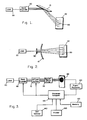
- FIG. 1 there is depicted in schematic form one illustrative embodiment for performing a method for the detection and quantitation of an immunological substance, for instance antibodies present in a liquid medium such as human serum.
- an immunological substance for instance antibodies present in a liquid medium such as human serum.
- a surface 10, such as microscope slide or the like, has afixed thereto an immunological substance, for instance, an antigen.
- the affixation may be accomplished by any known means such as by thermal treatment or chemical treatment, among others.
- the prepared surface 10 (hereinafter referred to as "the affixed suface") now carrying a reactant material known to interact and to bind to an immunological substance to be detected is initially impinged with means for supplying coherent radiation such as laser source 20.
- means for supplying coherent radiation such as laser source 20.
- means 30, such as a beam expander which enlarges the area of the affixed surface 10 impinged by the coherent radiation thereby commensurately increasing the area of the affixed surface 10 qualitatively and quantitatively examined.
- the use of means for modifying the coherent radiation prior to impingement is optional and clearly not mandatory in accordance with the present invention. For instance, where a relatively small selected portion of the affixed surface 10 is to be analyzed, no expansion of the laser beam is required.
- the coherent radiation may be modified by any desired means such as with a beam diffuser, beam filter or other known modifying means.
- a portion of the radiation is scattered and directed to detection means 40 such as screen, producing a speckle pattern 50 displayed thereon.
- the relative roughness of the surface of screen 40 itself may contribute to the speckle observed.
- this contribution will be a small constant fraction of the total speckle pattern produced thereon, and will not interfere with accuracy and precision of the instant methodology.
- detection means 40 may alternatively be utilized to observe the speckle pattern 50 corresponding to the character of the affixed surface 10. For instance, by placing the eye at the screen position and looking toward the illuminated affixed surface 10, the speckle 50 is readily observed.
- the speckle pattern 50 accordingly is preferably quantitatively measured by suitable measurement means such as a photometric detector or the like.
- the affixed surface 10, for instance, carrying the antigen is reacted with the fluid medium or media to be tested.
- the excess fluid is discarded.
- the now “reacted affixed surface” may optionally be treated, for instance, incubated, washed, dried or further conventionally treated, as called for by the specific substance sought to be detected. It should be understood, however, that such subsequent treatment may not be required depending upon the substances used and the sensitivity of the assay to be performed in accordance with the present invention.
- the reacted affixed surface is again impinged with substantially the same coherent radiation at substantially the same aspect and orientation utilized for previously measuring the affixed surface 10.
- a resultant speckle pattern has been produced having a relatively high degree of striated organization in addition to remnants of the surviving speckle pattern. It is believed that the degree of organized striation may be correlated as a direct measure of the amount of antibodies which have combined with surface affixed antigen.
- FIG. 2 there is illustrated a second embodiment method in accordance with the present invention wherein a reactant material known to interact and to bind to or to have a relatively high affinity for a substance to be detected is affixed to surface 10.
- the surface 10 in this embodied form is of the type having prescribed transmission characteristics and may preferably be transparent.
- the affixed surface 10 is impinged with coherent radiation such as derived from laser source 20.
- coherent radiation such as derived from laser source 20.
- the laser beam optionally is modified by a beam diffuser 30, for instance, a lens of relatively short focal length commensurate with the area to be impinged.
- the resultant pattern of coherent radiation transmitted through the affixed surface is appropriately measured as previously described. Thereafter, the affixed surface is reacted with at least one medium to be tested possessing the immunological substance to be detected.
- the reacted affixed surface is again impinged with substantially the same coherent radiation at substantially the same aspect and orientation previously utilized, and the pattern of radiation produced is again measured. Thereafter, the measured patterns of radiations are compared to determine any differentiations therebetween.
- Figure 3 illustrates yet another embodiment of the present invention providing a complete system for qualitative and quantitative analysis of the immunological substance to be detected.
- coherent radiation derived for example, from a laser source 20 produces a beam which is expanded by suitable means such as a beam expander 30 and impinged on the affixed surface 10.
- Spatial filtering optics 70 provide a resultant signal which is detected, for instance, by photometric detector means 80.
- the photometric detector means 80 is preferably connected with a suitable signal amplifier means 90 which amplifies the derived photometric signal. Thereafter, the amplified signal is fed to a signal processor 100 for transmission in digital form and fed to a central processing unit 110, for instance a suitable microprocessor unit.
- a memory means 120 Preferably incorporated with the central processing unit 110 is a memory means 120, an output printer means 130, and a cathod ray tube (CRT) terminal 140 providing user and program control for the system.
- the affixed surface 10 may be reoriented appropriately for impingement and measurement by programmed means incorporated into the central processing unit 110.
- Spatial filtering optics 70 may also be programmed by the central processing unit 110.
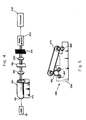
- the inventive method and instrumentation is utilized in conjunction with a cylindrical surface such as a transparent vial or test tube 150 composed of suitable material.
- a transparent vial or test tube 150 composed of suitable material.
- suitable material are disclosed for instance in U.S. Patent No. 3,720,760, issued on March 13 , 1973 to Bennich et al.
- the tube 150 comprises a diffuser 160 at the base portion thereof.
- a small diffuser or button which may be formed during molding of the vial.
- the diffuser 160 acts as a very short focal length lens to couple a substantial portion of incident laser light into the interior of the tube, much in the form of a wave guide.
- the tube 150 is preferably held by holding means 170 to position and center the longitudinal axis of the tube 150 in the path of the laser beam axis.
- a variety of complex internal reflections permit the exposure of the affixed surface 150 ⁇ to the coherent radiation, a portion of such radiation being transmitted through and out of the open portion of the tube 150.
- the escaping radiation from the tube 150 is directed toward a first lens means 180.
- an aperture means 190 is positioned to select the central portion of the beam (if high frequency is desired) or to block the central portion of the beam (if low frequency is desired).
- a second lens means 200 is positioned at a distance from the screen 210 substantially equal to its focal length. Accoringly, an image is produced upon a photo detector means 220 transmitting the derived signal from the incident image to a processor unit means 230.
- the foregoing embodiment permits spatial filtering of high or low frequency features of the speckle pattern, which is readily appreciated by those skilled in the art. Since the speckle pattern will generally correspond to higher frequency components, any regular structure appearing after the surface has reacted will be of lower frequency whose visibility may be augmented by the aforementioned or other known means, including, but not limited to, pattern recognition procedures, rotating grids and masks, as well as other type of signal processing and enhancement techniques.
- each resolution cell of the image corresponding to the size of the pixel, will yield a digital value for storage in a computer memory means characteristic of the photon flux incident upon the pixel during the time of measurement.
- Another set of pixel values may be generated and stored digitally.
- Analysis and comparision of such complex scatter patterns of radiation and interference of coherent radiation from a prepared surface may be enhanced by examining the various features of the pattern produced at different orientations to the incident source of radiation.
- Figure 5 illustrates means for examining the affixed surface and reacted affixed surface at differnt orientations to the incident source.
- means 240 providing periodic rotation of the surface (in this case a tube 150) and co-axially aligned with the incident laser beam and photodetector or digital detector array.
- the tube 150 is mounted on support means 150 with its peripheral surface resting on cylindrical bearings 260 permitting free rotation.
- a friction belt 270 for instance composed of rubber or the like, is positioned contiguous against the outer surface of the tube 150 to provide an additional contact point.
- Motor means 280 drives the belt 270 against the external surface of the tube 150 resulting in rotation of the tube 150 and corresponding rotation of the scatter pattern eminating from the open end of the tube 150.
- the scatter pattern may be accordingly analyzed by the aforedescribed analysis methods and averaged over time and/or orientation.
- the precision of the final comparison of patterns of radiation to determine any differentiations therebetween may thus be conveniently enhanced in accordance with yet another feature of the present invention.
- the inventive system may use radiation in the non-visible spectrum, such as x-rays, ultraviolet and infra red radiation.
- the medium or media containing the chemical substance to be detected may be a liquid such as water, a mixture of gases such as air, or may be a solid such as earth. Accordingly, a full range of detection possibilities having a very broad range of applicability for chemical substances of biological origin based on the use of coherent radiation is comprehended.
- the present invention fulfills the significant need for a sensitive yet relatively rapid detection and quantitation technique which has application to a broad range of biological fields.
Landscapes
- Health & Medical Sciences (AREA)
- Immunology (AREA)
- Life Sciences & Earth Sciences (AREA)
- Chemical & Material Sciences (AREA)
- Engineering & Computer Science (AREA)
- Biochemistry (AREA)
- Hematology (AREA)
- General Physics & Mathematics (AREA)
- Physics & Mathematics (AREA)
- Pathology (AREA)
- Analytical Chemistry (AREA)
- Biomedical Technology (AREA)
- Urology & Nephrology (AREA)
- Molecular Biology (AREA)
- General Health & Medical Sciences (AREA)
- Microbiology (AREA)
- Cell Biology (AREA)
- Biotechnology (AREA)
- Food Science & Technology (AREA)
- Medicinal Chemistry (AREA)
- Investigating Or Analysing Materials By Optical Means (AREA)
- Investigating Or Analysing Biological Materials (AREA)
Priority Applications (4)
| Application Number | Priority Date | Filing Date | Title |
|---|---|---|---|
| US06/433,732 US4621063A (en) | 1982-10-12 | 1982-10-12 | Methods for the detection and quantitation of immunological substances |
| EP86308568A EP0266461B1 (en) | 1986-11-03 | 1986-11-03 | Methods for the detection and quantitation of immunological substances |
| DE8686308568T DE3686888T2 (de) | 1986-11-03 | 1986-11-03 | Verfahren zum nachweis und zur quantitativbestimmung von immunologischen stoffen. |
| AT86308568T ATE81208T1 (de) | 1986-11-03 | 1986-11-03 | Verfahren zum nachweis und zur quantitativbestimmung von immunologischen stoffen. |
Applications Claiming Priority (1)
| Application Number | Priority Date | Filing Date | Title |
|---|---|---|---|
| EP86308568A EP0266461B1 (en) | 1986-11-03 | 1986-11-03 | Methods for the detection and quantitation of immunological substances |
Publications (2)
| Publication Number | Publication Date |
|---|---|
| EP0266461A1 EP0266461A1 (en) | 1988-05-11 |
| EP0266461B1 true EP0266461B1 (en) | 1992-09-30 |
Family
ID=8196201
Family Applications (1)
| Application Number | Title | Priority Date | Filing Date |
|---|---|---|---|
| EP86308568A Expired EP0266461B1 (en) | 1982-10-12 | 1986-11-03 | Methods for the detection and quantitation of immunological substances |
Country Status (4)
| Country | Link |
|---|---|
| US (1) | US4621063A (OSRAM) |
| EP (1) | EP0266461B1 (OSRAM) |
| AT (1) | ATE81208T1 (OSRAM) |
| DE (1) | DE3686888T2 (OSRAM) |
Families Citing this family (27)
| Publication number | Priority date | Publication date | Assignee | Title |
|---|---|---|---|---|
| US4647544A (en) * | 1984-06-25 | 1987-03-03 | Nicoli David F | Immunoassay using optical interference detection |
| US4737464A (en) * | 1985-09-26 | 1988-04-12 | Molecular Devices Corporation | Solid-state optical assay imaging apparatus |
| US5730937A (en) * | 1986-06-05 | 1998-03-24 | Pardikes; Dennis G. | Module for automatically controlling a polymer processing system |
| US5403552A (en) * | 1986-06-05 | 1995-04-04 | Pardikes; Dennis | Module for automatically controlling a polymer processing system |
| IL85137A (en) * | 1987-01-21 | 1992-02-16 | Ares Serono Res & Dev Ltd | Method of assaying for a ligand using surface plasmon resonance effect |
| CA1305921C (en) * | 1987-01-30 | 1992-08-04 | Eric K. Gustafson | Diffraction immunoassay and reagents |
| US4928153A (en) * | 1987-04-06 | 1990-05-22 | Kms Fusion, Inc. | Optical measurement of particle concentration |
| US5089387A (en) * | 1988-07-07 | 1992-02-18 | Adeza Biomedical Corporation | Dna probe diffraction assay and reagents |
| JPH02108968A (ja) * | 1988-10-19 | 1990-04-20 | Hitachi Ltd | 免疫分析方法 |
| US5268305A (en) * | 1989-06-15 | 1993-12-07 | Biocircuits Corporation | Multi-optical detection system |
| IL98150A0 (en) * | 1990-05-17 | 1992-08-18 | Adeza Biomedical Corp | Highly reflective biogratings and method for theirhighly reflective biogratings and method production |
| US5196350A (en) * | 1991-05-29 | 1993-03-23 | Omnigene, Inc. | Ligand assay using interference modulation |
| JPH08503552A (ja) * | 1991-05-29 | 1996-04-16 | オムニジェネ・インコーポレーテッド | 干渉モジュレーションを用いたリガンド検定 |
| US5225890A (en) * | 1991-10-28 | 1993-07-06 | Gencorp Inc. | Surface inspection apparatus and method |
| US5453841A (en) * | 1993-05-03 | 1995-09-26 | The United States Of America As Represented By The Secretary Of Commerce | Method for the dynamic measurement of the progress of a chemical reaction of an electrochemical interface |
| US5701176A (en) * | 1995-07-28 | 1997-12-23 | Precision Detectors, Inc. | High temperature light scattering measurement device comprising a rigid extension tube |
| WO1997008554A1 (en) * | 1995-08-22 | 1997-03-06 | Philips Electronics N.V. | Method and device for investigating non-linear optical behavior of a layer formed from first and second reactants e.g. antibody and antigen |
| US20040106167A1 (en) * | 1999-05-03 | 2004-06-03 | Icf Technologies, Inc. | Methods for evaluating sterilization procedures using a biological indicator |
| US7326562B2 (en) * | 1999-05-03 | 2008-02-05 | Icf Technologies, Inc. | Biological indicator system to detect effectiveness of sterilization |
| US6942989B2 (en) | 1999-05-03 | 2005-09-13 | Icf Technologies, Inc. | Methods, compositions and kits for biological indicator of sterilization |
| JP2001304816A (ja) * | 2000-04-26 | 2001-10-31 | Kenichiro Kobayashi | レーザ反射光による粒状斑点模様を利用した移動量測定方式とその装置 |
| JP2002162355A (ja) * | 2000-11-27 | 2002-06-07 | Hiroyuki Konno | レーザ反射光による粒状斑点模様の直接撮像方法とその装置 |
| WO2002078906A2 (en) * | 2001-03-29 | 2002-10-10 | Cellect Technologies Corp. | Methods devices and systems for sorting and separating particles |
| WO2006046183A1 (en) * | 2004-10-27 | 2006-05-04 | Koninklijke Philips Electronics N.V. | Optical identifier comprising an identification layer and a sensor layer |
| WO2007030748A2 (en) * | 2005-09-09 | 2007-03-15 | The University Of Chicago | Methods and compositions for diagnosis and immunotherapy of pollen allergy |
| DE102009057078B4 (de) * | 2009-12-04 | 2013-03-14 | Abb Ag | Photometrischer Gasanalysator |
| US10012589B2 (en) * | 2013-08-16 | 2018-07-03 | The General Hospital Corporation | Portable diffraction-based imaging and diagnostic systems and methods |
Family Cites Families (13)
| Publication number | Priority date | Publication date | Assignee | Title |
|---|---|---|---|---|
| US3720760A (en) * | 1968-09-06 | 1973-03-13 | Pharmacia Ab | Method for determining the presence of reagin-immunoglobulins(reagin-ig)directed against certain allergens,in aqueous samples |
| US3804521A (en) * | 1972-02-22 | 1974-04-16 | Itek Corp | Optical device for measuring surface roughness |
| US3905767A (en) * | 1974-01-30 | 1975-09-16 | Miles Lab | Process for qualitative analysis or quantitation of antigens or antibodies |
| US4011044A (en) * | 1976-07-06 | 1977-03-08 | General Electric Company | Use of laser speckle patterns for measurement of electrophoretic mobilities |
| US4208185A (en) * | 1976-08-16 | 1980-06-17 | Mitsubishi Chemical Industries Limited | Method and apparatus for the measurement of antigens and antibodies |
| JPS5925460B2 (ja) * | 1978-05-19 | 1984-06-18 | 株式会社日立製作所 | ネフェロメトリック・イムノアッセイ法及び装置 |
| DE3135196A1 (de) * | 1981-09-05 | 1983-03-17 | Merck Patent Gmbh, 6100 Darmstadt | Verfahren, mittel und vorrichtung zur bestimmung biologischer komponenten |
| EP0112721B1 (en) * | 1982-12-21 | 1988-05-18 | Ares-Serono N.V. | Assay technique |
| US4487839A (en) * | 1983-01-05 | 1984-12-11 | Ortho Diagnostic Systems Inc. | Immunoassay methods employing patterns for the detection of soluble and cell surface antigens |
| JP2527933B2 (ja) * | 1984-06-13 | 1996-08-28 | ユニリ−バ−・ナ−ムロ−ゼ・ベンノ−トシヤ−プ | 特異的反応性サンプルの収集及び試験デバイス並びにその製造方法 |
| US4647544A (en) * | 1984-06-25 | 1987-03-03 | Nicoli David F | Immunoassay using optical interference detection |
| GB8423204D0 (en) * | 1984-09-14 | 1984-10-17 | Comtech Res Unit | Assay technique and equipment |
| DE3481644D1 (de) * | 1984-12-10 | 1990-04-19 | Prutec Ltd | Verfahren zum optischen nachweis von parametern von substanzen in einem fluessigen analyt. |
-
1982
- 1982-10-12 US US06/433,732 patent/US4621063A/en not_active Expired - Fee Related
-
1986
- 1986-11-03 EP EP86308568A patent/EP0266461B1/en not_active Expired
- 1986-11-03 DE DE8686308568T patent/DE3686888T2/de not_active Expired - Fee Related
- 1986-11-03 AT AT86308568T patent/ATE81208T1/de not_active IP Right Cessation
Also Published As
| Publication number | Publication date |
|---|---|
| DE3686888D1 (OSRAM) | 1992-11-05 |
| US4621063A (en) | 1986-11-04 |
| ATE81208T1 (de) | 1992-10-15 |
| DE3686888T2 (de) | 1993-03-04 |
| EP0266461A1 (en) | 1988-05-11 |
Similar Documents
| Publication | Publication Date | Title |
|---|---|---|
| EP0266461B1 (en) | Methods for the detection and quantitation of immunological substances | |
| US5434667A (en) | Characterization of particles by modulated dynamic light scattering | |
| US4446239A (en) | Light scattering immunoassay involving particles with selective frequency band apparatus | |
| DE69228325T2 (de) | Ligandentest unter verwendung von interferenzmodulation | |
| US4174952A (en) | Immunoassay by light scattering intensity anisotropy measurements | |
| JP3352092B2 (ja) | 分子特性解析の方法及び装置 | |
| JP4201058B2 (ja) | 中間統計データに基づいて試料を特徴付けする方法 | |
| US4250394A (en) | Apparatus for determining immunochemical substances | |
| EP0118894A2 (en) | Particle reagent size distribution measurements for immunoassay | |
| JP2009282046A (ja) | 光の回折に基づく検定のための方法および装置 | |
| Abidi | Introduction to FTIR microspectroscopy | |
| US10794808B2 (en) | System and methods for analyzing particles in a fluid | |
| JPS5990053A (ja) | 抗原−抗体反応 | |
| US4213764A (en) | Method for determining immunochemical substances | |
| US4828388A (en) | Method of measuring concentration of substances | |
| CA1288336C (en) | Methods and instrumentation for the detection and quantitation of immunological substances | |
| US20030013083A1 (en) | Particle analysis as a detection system for particle-enhanced assays | |
| JPS6128866A (ja) | 光強度ゆらぎを用いる免疫反応の測定方法および装置 | |
| JPS62116263A (ja) | 直線偏光の多重散乱を用いる免疫反応の測定方法および装置 | |
| GB1600069A (en) | Method for the measurement of antigens and antibodies | |
| JPS6259841A (ja) | 直線偏光を用いる免疫反応の測定方法および装置 | |
| JPS61173138A (ja) | 光強度ゆらぎによる免疫反応測定方法 | |
| JPS61173139A (ja) | 光強度ゆらぎによる免疫反応測定方法 | |
| JPH042906B2 (OSRAM) | ||
| AU3145393A (en) | Ligand assay using interference modulation |
Legal Events
| Date | Code | Title | Description |
|---|---|---|---|
| PUAI | Public reference made under article 153(3) epc to a published international application that has entered the european phase |
Free format text: ORIGINAL CODE: 0009012 |
|
| AK | Designated contracting states |
Kind code of ref document: A1 Designated state(s): AT BE CH DE ES FR GB GR IT LI LU NL SE |
|
| 17P | Request for examination filed |
Effective date: 19881108 |
|
| 17Q | First examination report despatched |
Effective date: 19901108 |
|
| GRAA | (expected) grant |
Free format text: ORIGINAL CODE: 0009210 |
|
| AK | Designated contracting states |
Kind code of ref document: B1 Designated state(s): AT BE CH DE ES FR GB GR IT LI LU NL SE |
|
| PG25 | Lapsed in a contracting state [announced via postgrant information from national office to epo] |
Ref country code: SE Effective date: 19920930 Ref country code: NL Effective date: 19920930 Ref country code: GR Free format text: LAPSE BECAUSE OF FAILURE TO SUBMIT A TRANSLATION OF THE DESCRIPTION OR TO PAY THE FEE WITHIN THE PRESCRIBED TIME-LIMIT Effective date: 19920930 Ref country code: AT Effective date: 19920930 |
|
| REF | Corresponds to: |
Ref document number: 81208 Country of ref document: AT Date of ref document: 19921015 Kind code of ref document: T |
|
| REF | Corresponds to: |
Ref document number: 3686888 Country of ref document: DE Date of ref document: 19921105 |
|
| ITF | It: translation for a ep patent filed | ||
| PG25 | Lapsed in a contracting state [announced via postgrant information from national office to epo] |
Ref country code: LU Free format text: LAPSE BECAUSE OF NON-PAYMENT OF DUE FEES Effective date: 19921130 |
|
| PG25 | Lapsed in a contracting state [announced via postgrant information from national office to epo] |
Ref country code: ES Free format text: LAPSE BECAUSE OF FAILURE TO SUBMIT A TRANSLATION OF THE DESCRIPTION OR TO PAY THE FEE WITHIN THE PRESCRIBED TIME-LIMIT Effective date: 19930110 |
|
| ET | Fr: translation filed | ||
| NLV1 | Nl: lapsed or annulled due to failure to fulfill the requirements of art. 29p and 29m of the patents act | ||
| PLBE | No opposition filed within time limit |
Free format text: ORIGINAL CODE: 0009261 |
|
| STAA | Information on the status of an ep patent application or granted ep patent |
Free format text: STATUS: NO OPPOSITION FILED WITHIN TIME LIMIT |
|
| 26N | No opposition filed | ||
| PGFP | Annual fee paid to national office [announced via postgrant information from national office to epo] |
Ref country code: GB Payment date: 19960329 Year of fee payment: 10 |
|
| PGFP | Annual fee paid to national office [announced via postgrant information from national office to epo] |
Ref country code: FR Payment date: 19960410 Year of fee payment: 10 |
|
| PGFP | Annual fee paid to national office [announced via postgrant information from national office to epo] |
Ref country code: DE Payment date: 19960418 Year of fee payment: 10 |
|
| PGFP | Annual fee paid to national office [announced via postgrant information from national office to epo] |
Ref country code: CH Payment date: 19960424 Year of fee payment: 10 |
|
| PGFP | Annual fee paid to national office [announced via postgrant information from national office to epo] |
Ref country code: BE Payment date: 19960510 Year of fee payment: 10 |
|
| PG25 | Lapsed in a contracting state [announced via postgrant information from national office to epo] |
Ref country code: GB Effective date: 19961103 |
|
| PG25 | Lapsed in a contracting state [announced via postgrant information from national office to epo] |
Ref country code: LI Effective date: 19961130 Ref country code: CH Effective date: 19961130 Ref country code: BE Effective date: 19961130 |
|
| BERE | Be: lapsed |
Owner name: THE CENTER FOR IMMUNOLOGICAL STUDIES Effective date: 19961130 |
|
| GBPC | Gb: european patent ceased through non-payment of renewal fee |
Effective date: 19961103 |
|
| REG | Reference to a national code |
Ref country code: CH Ref legal event code: PL |
|
| PG25 | Lapsed in a contracting state [announced via postgrant information from national office to epo] |
Ref country code: FR Effective date: 19970731 |
|
| PG25 | Lapsed in a contracting state [announced via postgrant information from national office to epo] |
Ref country code: DE Effective date: 19970801 |
|
| REG | Reference to a national code |
Ref country code: FR Ref legal event code: ST |
|
| PG25 | Lapsed in a contracting state [announced via postgrant information from national office to epo] |
Ref country code: IT Free format text: LAPSE BECAUSE OF NON-PAYMENT OF DUE FEES;WARNING: LAPSES OF ITALIAN PATENTS WITH EFFECTIVE DATE BEFORE 2007 MAY HAVE OCCURRED AT ANY TIME BEFORE 2007. THE CORRECT EFFECTIVE DATE MAY BE DIFFERENT FROM THE ONE RECORDED. Effective date: 20051103 |