EP0257615A2 - Ein neues Makrolid-Antibiotikum, ein mikrobiologisches Verfahren zu seiner Herstellung und seine Verwendung als Arzneimittel - Google Patents
Ein neues Makrolid-Antibiotikum, ein mikrobiologisches Verfahren zu seiner Herstellung und seine Verwendung als Arzneimittel Download PDFInfo
- Publication number
- EP0257615A2 EP0257615A2 EP87112298A EP87112298A EP0257615A2 EP 0257615 A2 EP0257615 A2 EP 0257615A2 EP 87112298 A EP87112298 A EP 87112298A EP 87112298 A EP87112298 A EP 87112298A EP 0257615 A2 EP0257615 A2 EP 0257615A2
- Authority
- EP
- European Patent Office
- Prior art keywords
- compound
- mycelium
- culture filtrate
- extracted
- swalpamycin
- Prior art date
- Legal status (The legal status is an assumption and is not a legal conclusion. Google has not performed a legal analysis and makes no representation as to the accuracy of the status listed.)
- Granted
Links
- 239000003814 drug Substances 0.000 title claims abstract description 9
- 238000000034 method Methods 0.000 title claims description 20
- 238000002360 preparation method Methods 0.000 title claims description 7
- 239000003120 macrolide antibiotic agent Substances 0.000 title abstract description 31
- 230000002906 microbiologic effect Effects 0.000 title description 2
- 241000187747 Streptomyces Species 0.000 claims abstract description 10
- 241000186361 Actinobacteria <class> Species 0.000 claims abstract description 4
- CSCPPACGZOOCGX-UHFFFAOYSA-N Acetone Chemical compound CC(C)=O CSCPPACGZOOCGX-UHFFFAOYSA-N 0.000 claims description 35
- 150000001875 compounds Chemical class 0.000 claims description 25
- 238000000855 fermentation Methods 0.000 claims description 25
- 230000004151 fermentation Effects 0.000 claims description 25
- 244000005700 microbiome Species 0.000 claims description 25
- XLYOFNOQVPJJNP-UHFFFAOYSA-N water Substances O XLYOFNOQVPJJNP-UHFFFAOYSA-N 0.000 claims description 21
- 239000000706 filtrate Substances 0.000 claims description 19
- 239000000284 extract Substances 0.000 claims description 17
- 239000002904 solvent Substances 0.000 claims description 15
- OKTJSMMVPCPJKN-UHFFFAOYSA-N Carbon Chemical compound [C] OKTJSMMVPCPJKN-UHFFFAOYSA-N 0.000 claims description 13
- IJGRMHOSHXDMSA-UHFFFAOYSA-N Atomic nitrogen Chemical compound N#N IJGRMHOSHXDMSA-UHFFFAOYSA-N 0.000 claims description 12
- 235000015097 nutrients Nutrition 0.000 claims description 12
- 241000187180 Streptomyces sp. Species 0.000 claims description 11
- 150000003839 salts Chemical class 0.000 claims description 10
- 229910052799 carbon Inorganic materials 0.000 claims description 9
- 239000003960 organic solvent Substances 0.000 claims description 8
- 241000192125 Firmicutes Species 0.000 claims description 6
- 238000004519 manufacturing process Methods 0.000 claims description 6
- 229910052757 nitrogen Inorganic materials 0.000 claims description 6
- 238000004809 thin layer chromatography Methods 0.000 claims description 6
- 241000204031 Mycoplasma Species 0.000 claims description 4
- 238000001179 sorption measurement Methods 0.000 claims description 4
- 239000011573 trace mineral Substances 0.000 claims description 4
- 235000013619 trace mineral Nutrition 0.000 claims description 4
- 238000004587 chromatography analysis Methods 0.000 claims description 3
- 238000000605 extraction Methods 0.000 claims description 3
- 238000010898 silica gel chromatography Methods 0.000 claims description 3
- 239000008346 aqueous phase Substances 0.000 claims 2
- AAUZLHJDJNJJDM-UHFFFAOYSA-N 15-[(5-hydroxy-3,4-dimethoxy-6-methyloxan-2-yl)oxymethyl]-6-[(6-hydroxy-4,9-dimethyl-2-oxo-1,3,8-trioxaspiro[4.5]decan-7-yl)oxy]-5,7,9,16-tetramethyl-1-oxacyclohexadeca-3,11,13-triene-2,10-dione Chemical compound COC1C(OC)C(O)C(C)OC1OCC1C(C)OC(=O)C=CC(C)C(OC2C(C3(C(OC(=O)O3)C)CC(C)O2)O)C(C)CC(C)C(=O)C=CC=C1 AAUZLHJDJNJJDM-UHFFFAOYSA-N 0.000 abstract description 86
- 241001430197 Mollicutes Species 0.000 abstract description 4
- 208000015181 infectious disease Diseases 0.000 abstract description 3
- 241000894006 Bacteria Species 0.000 abstract description 2
- OKKJLVBELUTLKV-UHFFFAOYSA-N Methanol Chemical compound OC OKKJLVBELUTLKV-UHFFFAOYSA-N 0.000 description 51
- XEKOWRVHYACXOJ-UHFFFAOYSA-N Ethyl acetate Chemical compound CCOC(C)=O XEKOWRVHYACXOJ-UHFFFAOYSA-N 0.000 description 30
- 241000186359 Mycobacterium Species 0.000 description 28
- 229920001817 Agar Polymers 0.000 description 25
- 239000008272 agar Substances 0.000 description 24
- 235000010419 agar Nutrition 0.000 description 24
- HEDRZPFGACZZDS-UHFFFAOYSA-N Chloroform Chemical compound ClC(Cl)Cl HEDRZPFGACZZDS-UHFFFAOYSA-N 0.000 description 20
- KLGADJPDTCIJLO-LJUCOGSUSA-N Chalcomycin Chemical compound O[C@@H]1[C@@H](OC)C[C@@H](C)O[C@H]1O[C@@H]1[C@@H](C)/C=C/C(=O)O[C@H](C)[C@@H](CO[C@H]2[C@@H]([C@H](OC)[C@H](O)[C@@H](C)O2)OC)[C@H]2O[C@@H]2/C=C/C(=O)[C@@](C)(O)C[C@@H]1C KLGADJPDTCIJLO-LJUCOGSUSA-N 0.000 description 18
- IJESDYFOSZHYNR-UHFFFAOYSA-N chalcomycin Natural products COC1CC(C)OC(OC2CCC(C)(O)C(=O)C=CC3OC3C(COC4OC(C)C(O)C(OC)C4OC)C(C)OC(=O)C=CC2)C1O IJESDYFOSZHYNR-UHFFFAOYSA-N 0.000 description 18
- 239000002609 medium Substances 0.000 description 15
- 235000010633 broth Nutrition 0.000 description 14
- 239000000203 mixture Substances 0.000 description 14
- VYPSYNLAJGMNEJ-UHFFFAOYSA-N Silicium dioxide Chemical compound O=[Si]=O VYPSYNLAJGMNEJ-UHFFFAOYSA-N 0.000 description 13
- 239000000741 silica gel Substances 0.000 description 12
- 229910002027 silica gel Inorganic materials 0.000 description 12
- 239000003242 anti bacterial agent Substances 0.000 description 11
- 229940088710 antibiotic agent Drugs 0.000 description 11
- 239000000049 pigment Substances 0.000 description 11
- 235000002639 sodium chloride Nutrition 0.000 description 11
- WQZGKKKJIJFFOK-GASJEMHNSA-N Glucose Natural products OC[C@H]1OC(O)[C@H](O)[C@@H](O)[C@@H]1O WQZGKKKJIJFFOK-GASJEMHNSA-N 0.000 description 10
- 239000008103 glucose Substances 0.000 description 10
- 235000001727 glucose Nutrition 0.000 description 10
- -1 Cirramycine Chemical compound 0.000 description 9
- YMWUJEATGCHHMB-UHFFFAOYSA-N Dichloromethane Chemical compound ClCCl YMWUJEATGCHHMB-UHFFFAOYSA-N 0.000 description 9
- 230000003115 biocidal effect Effects 0.000 description 9
- ULGZDMOVFRHVEP-RWJQBGPGSA-N Erythromycin Chemical compound O([C@@H]1[C@@H](C)C(=O)O[C@@H]([C@@]([C@H](O)[C@@H](C)C(=O)[C@H](C)C[C@@](C)(O)[C@H](O[C@H]2[C@@H]([C@H](C[C@@H](C)O2)N(C)C)O)[C@H]1C)(C)O)CC)[C@H]1C[C@@](C)(OC)[C@@H](O)[C@H](C)O1 ULGZDMOVFRHVEP-RWJQBGPGSA-N 0.000 description 8
- 229940041514 candida albicans extract Drugs 0.000 description 7
- 239000012153 distilled water Substances 0.000 description 7
- 239000012138 yeast extract Substances 0.000 description 7
- LFQSCWFLJHTTHZ-UHFFFAOYSA-N Ethanol Chemical compound CCO LFQSCWFLJHTTHZ-UHFFFAOYSA-N 0.000 description 6
- PEDCQBHIVMGVHV-UHFFFAOYSA-N Glycerine Chemical compound OCC(O)CO PEDCQBHIVMGVHV-UHFFFAOYSA-N 0.000 description 6
- XEEYBQQBJWHFJM-UHFFFAOYSA-N Iron Chemical compound [Fe] XEEYBQQBJWHFJM-UHFFFAOYSA-N 0.000 description 6
- LRHPLDYGYMQRHN-UHFFFAOYSA-N N-Butanol Chemical compound CCCCO LRHPLDYGYMQRHN-UHFFFAOYSA-N 0.000 description 6
- 239000001888 Peptone Substances 0.000 description 6
- 108010080698 Peptones Proteins 0.000 description 6
- 241000191967 Staphylococcus aureus Species 0.000 description 6
- 229920002472 Starch Polymers 0.000 description 6
- 230000015572 biosynthetic process Effects 0.000 description 6
- 239000003795 chemical substances by application Substances 0.000 description 6
- 235000019319 peptone Nutrition 0.000 description 6
- 239000002689 soil Substances 0.000 description 6
- 235000019698 starch Nutrition 0.000 description 6
- 239000008107 starch Substances 0.000 description 6
- 239000000725 suspension Substances 0.000 description 6
- 229930006000 Sucrose Natural products 0.000 description 5
- CZMRCDWAGMRECN-UGDNZRGBSA-N Sucrose Chemical compound O[C@H]1[C@H](O)[C@@H](CO)O[C@@]1(CO)O[C@@H]1[C@H](O)[C@@H](O)[C@H](O)[C@@H](CO)O1 CZMRCDWAGMRECN-UGDNZRGBSA-N 0.000 description 5
- 239000001963 growth medium Substances 0.000 description 5
- 238000002955 isolation Methods 0.000 description 5
- 229940041033 macrolides Drugs 0.000 description 5
- 239000013587 production medium Substances 0.000 description 5
- 229960004793 sucrose Drugs 0.000 description 5
- 238000012360 testing method Methods 0.000 description 5
- RZLRMVZBGPHYJA-XXJPCBNGSA-N (1s,2e,5s,8s,9s,10e,14r,15r,16s)-5-hydroxy-15-[[(2r,3r,4r,5r,6r)-5-hydroxy-3,4-dimethoxy-6-methyloxan-2-yl]oxymethyl]-8-[(2s,3r,4s,6r)-3-hydroxy-4-methoxy-6-methyloxan-2-yl]oxy-5,9,14-trimethyl-13,17-dioxabicyclo[14.1.0]heptadeca-2,10-diene-4,12-dione Chemical compound O[C@@H]1[C@@H](OC)C[C@@H](C)O[C@H]1O[C@@H]1[C@@H](C)/C=C/C(=O)O[C@H](C)[C@@H](CO[C@H]2[C@@H]([C@H](OC)[C@H](O)[C@@H](C)O2)OC)[C@@H]2O[C@H]2/C=C/C(=O)[C@@](C)(O)CC1 RZLRMVZBGPHYJA-XXJPCBNGSA-N 0.000 description 4
- DKPFZGUDAPQIHT-UHFFFAOYSA-N Butyl acetate Natural products CCCCOC(C)=O DKPFZGUDAPQIHT-UHFFFAOYSA-N 0.000 description 4
- RZLRMVZBGPHYJA-UHFFFAOYSA-N Cynanformoside B Natural products OC1C(OC)CC(C)OC1OC1C(C)C=CC(=O)OC(C)C(COC2C(C(OC)C(O)C(C)O2)OC)C2OC2C=CC(=O)C(C)(O)CC1 RZLRMVZBGPHYJA-UHFFFAOYSA-N 0.000 description 4
- FBPFZTCFMRRESA-KVTDHHQDSA-N D-Mannitol Chemical compound OC[C@@H](O)[C@@H](O)[C@H](O)[C@H](O)CO FBPFZTCFMRRESA-KVTDHHQDSA-N 0.000 description 4
- 229920001353 Dextrin Polymers 0.000 description 4
- 239000004375 Dextrin Substances 0.000 description 4
- RTZKZFJDLAIYFH-UHFFFAOYSA-N Diethyl ether Chemical compound CCOCC RTZKZFJDLAIYFH-UHFFFAOYSA-N 0.000 description 4
- GUBGYTABKSRVRQ-QKKXKWKRSA-N Lactose Natural products OC[C@H]1O[C@@H](O[C@H]2[C@H](O)[C@@H](O)C(O)O[C@@H]2CO)[C@H](O)[C@@H](O)[C@H]1O GUBGYTABKSRVRQ-QKKXKWKRSA-N 0.000 description 4
- 229930189396 Mycinamycin Natural products 0.000 description 4
- IMNFDUFMRHMDMM-UHFFFAOYSA-N N-Heptane Chemical compound CCCCCCC IMNFDUFMRHMDMM-UHFFFAOYSA-N 0.000 description 4
- VXVAFQMBYKUOIZ-UHFFFAOYSA-N Neutramycin Natural products COC(=O)C=CC#CC#CCO VXVAFQMBYKUOIZ-UHFFFAOYSA-N 0.000 description 4
- SRBFZHDQGSBBOR-UHFFFAOYSA-N beta-D-Pyranose-Lyxose Natural products OC1COC(O)C(O)C1O SRBFZHDQGSBBOR-UHFFFAOYSA-N 0.000 description 4
- 230000000975 bioactive effect Effects 0.000 description 4
- 230000001488 breeding effect Effects 0.000 description 4
- 210000004027 cell Anatomy 0.000 description 4
- 239000000287 crude extract Substances 0.000 description 4
- 238000010227 cup method (microbiological evaluation) Methods 0.000 description 4
- 235000019425 dextrin Nutrition 0.000 description 4
- 229960003276 erythromycin Drugs 0.000 description 4
- 230000005764 inhibitory process Effects 0.000 description 4
- 229950003438 neutramycin Drugs 0.000 description 4
- 238000000746 purification Methods 0.000 description 4
- 238000011218 seed culture Methods 0.000 description 4
- 239000000243 solution Substances 0.000 description 4
- 238000004611 spectroscopical analysis Methods 0.000 description 4
- 101000610640 Homo sapiens U4/U6 small nuclear ribonucleoprotein Prp3 Proteins 0.000 description 3
- ZMXDDKWLCZADIW-UHFFFAOYSA-N N,N-Dimethylformamide Chemical compound CN(C)C=O ZMXDDKWLCZADIW-UHFFFAOYSA-N 0.000 description 3
- 101001110823 Saccharomyces cerevisiae (strain ATCC 204508 / S288c) 60S ribosomal protein L6-A Proteins 0.000 description 3
- 101000712176 Saccharomyces cerevisiae (strain ATCC 204508 / S288c) 60S ribosomal protein L6-B Proteins 0.000 description 3
- 235000019764 Soybean Meal Nutrition 0.000 description 3
- 239000004182 Tylosin Substances 0.000 description 3
- 229930194936 Tylosin Natural products 0.000 description 3
- 102100040374 U4/U6 small nuclear ribonucleoprotein Prp3 Human genes 0.000 description 3
- 239000004480 active ingredient Substances 0.000 description 3
- 239000003463 adsorbent Substances 0.000 description 3
- 235000015278 beef Nutrition 0.000 description 3
- 238000009395 breeding Methods 0.000 description 3
- 229910000019 calcium carbonate Inorganic materials 0.000 description 3
- 239000003085 diluting agent Substances 0.000 description 3
- 239000002024 ethyl acetate extract Substances 0.000 description 3
- 238000012262 fermentative production Methods 0.000 description 3
- 235000011187 glycerol Nutrition 0.000 description 3
- 238000004128 high performance liquid chromatography Methods 0.000 description 3
- 239000002054 inoculum Substances 0.000 description 3
- 229910052742 iron Inorganic materials 0.000 description 3
- 239000007788 liquid Substances 0.000 description 3
- VLKZOEOYAKHREP-UHFFFAOYSA-N n-Hexane Chemical compound CCCCCC VLKZOEOYAKHREP-UHFFFAOYSA-N 0.000 description 3
- 230000007935 neutral effect Effects 0.000 description 3
- 239000000047 product Substances 0.000 description 3
- FAPWRFPIFSIZLT-UHFFFAOYSA-M sodium chloride Inorganic materials [Na+].[Cl-] FAPWRFPIFSIZLT-UHFFFAOYSA-M 0.000 description 3
- 239000004455 soybean meal Substances 0.000 description 3
- 238000003756 stirring Methods 0.000 description 3
- 239000000126 substance Substances 0.000 description 3
- WBPYTXDJUQJLPQ-VMXQISHHSA-N tylosin Chemical compound O([C@@H]1[C@@H](C)O[C@H]([C@@H]([C@H]1N(C)C)O)O[C@@H]1[C@@H](C)[C@H](O)CC(=O)O[C@@H]([C@H](/C=C(\C)/C=C/C(=O)[C@H](C)C[C@@H]1CC=O)CO[C@H]1[C@@H]([C@H](OC)[C@H](O)[C@@H](C)O1)OC)CC)[C@H]1C[C@@](C)(O)[C@@H](O)[C@H](C)O1 WBPYTXDJUQJLPQ-VMXQISHHSA-N 0.000 description 3
- 229960004059 tylosin Drugs 0.000 description 3
- 235000019375 tylosin Nutrition 0.000 description 3
- OWEGMIWEEQEYGQ-UHFFFAOYSA-N 100676-05-9 Natural products OC1C(O)C(O)C(CO)OC1OCC1C(O)C(O)C(O)C(OC2C(OC(O)C(O)C2O)CO)O1 OWEGMIWEEQEYGQ-UHFFFAOYSA-N 0.000 description 2
- ZWEHNKRNPOVVGH-UHFFFAOYSA-N 2-Butanone Chemical compound CCC(C)=O ZWEHNKRNPOVVGH-UHFFFAOYSA-N 0.000 description 2
- KZXDKUWSAVUSKI-JQIJEIRASA-N 2-[(14e)-9-[5-(4,5-dihydroxy-4,6-dimethyloxan-2-yl)oxy-4-(dimethylamino)-6-methyloxan-2-yl]oxy-3-ethyl-7-hydroxy-2-[(5-hydroxy-3,4-dimethoxy-6-methyloxan-2-yl)oxymethyl]-8,12,16-trimethyl-5,13-dioxo-4,17-dioxabicyclo[14.1.0]heptadec-14-en-10-yl]acetaldehy Chemical compound O=CCC1CC(C)C(=O)\C=C\C2(C)OC2C(COC2C(C(OC)C(O)C(C)O2)OC)C(CC)OC(=O)CC(O)C(C)C1OC(OC1C)CC(N(C)C)C1OC1CC(C)(O)C(O)C(C)O1 KZXDKUWSAVUSKI-JQIJEIRASA-N 0.000 description 2
- RMZNXRYIFGTWPF-UHFFFAOYSA-N 2-nitrosoacetic acid Chemical compound OC(=O)CN=O RMZNXRYIFGTWPF-UHFFFAOYSA-N 0.000 description 2
- TWCMVXMQHSVIOJ-UHFFFAOYSA-N Aglycone of yadanzioside D Natural products COC(=O)C12OCC34C(CC5C(=CC(O)C(O)C5(C)C3C(O)C1O)C)OC(=O)C(OC(=O)C)C24 TWCMVXMQHSVIOJ-UHFFFAOYSA-N 0.000 description 2
- 229930191212 Aldgamycin Natural products 0.000 description 2
- GUBGYTABKSRVRQ-XLOQQCSPSA-N Alpha-Lactose Chemical compound O[C@@H]1[C@@H](O)[C@@H](O)[C@@H](CO)O[C@H]1O[C@@H]1[C@@H](CO)O[C@H](O)[C@H](O)[C@H]1O GUBGYTABKSRVRQ-XLOQQCSPSA-N 0.000 description 2
- YERYDTDNBAJCQO-UHFFFAOYSA-N Angolamycin Natural products CCC1OC(=O)CC(O)C(C)C(OCCC(C(OCCC(C)(O)C(O)C(C)OC)C(C)OC)N(C)C)C(CC=O)CC(C)C(=O)C=CC2(C)OC2C1COC3OC(C)C(O)C(OC)C3OC YERYDTDNBAJCQO-UHFFFAOYSA-N 0.000 description 2
- DCXYFEDJOCDNAF-UHFFFAOYSA-N Asparagine Natural products OC(=O)C(N)CC(N)=O DCXYFEDJOCDNAF-UHFFFAOYSA-N 0.000 description 2
- PLMKQQMDOMTZGG-UHFFFAOYSA-N Astrantiagenin E-methylester Natural products CC12CCC(O)C(C)(CO)C1CCC1(C)C2CC=C2C3CC(C)(C)CCC3(C(=O)OC)CCC21C PLMKQQMDOMTZGG-UHFFFAOYSA-N 0.000 description 2
- GUBGYTABKSRVRQ-CUHNMECISA-N D-Cellobiose Chemical compound O[C@@H]1[C@@H](O)[C@H](O)[C@@H](CO)O[C@H]1O[C@@H]1[C@@H](CO)OC(O)[C@H](O)[C@H]1O GUBGYTABKSRVRQ-CUHNMECISA-N 0.000 description 2
- RFSUNEUAIZKAJO-VRPWFDPXSA-N D-Fructose Natural products OC[C@H]1OC(O)(CO)[C@@H](O)[C@@H]1O RFSUNEUAIZKAJO-VRPWFDPXSA-N 0.000 description 2
- SHZGCJCMOBCMKK-UHFFFAOYSA-N D-mannomethylose Natural products CC1OC(O)C(O)C(O)C1O SHZGCJCMOBCMKK-UHFFFAOYSA-N 0.000 description 2
- WQZGKKKJIJFFOK-QTVWNMPRSA-N D-mannopyranose Chemical compound OC[C@H]1OC(O)[C@@H](O)[C@@H](O)[C@@H]1O WQZGKKKJIJFFOK-QTVWNMPRSA-N 0.000 description 2
- CZMRCDWAGMRECN-FBXJDJJESA-N D-sucrose Chemical compound O[C@@H]1[C@@H](O)[C@H](CO)O[C@]1(CO)O[C@H]1[C@@H](O)[C@H](O)[C@@H](O)[C@H](CO)O1 CZMRCDWAGMRECN-FBXJDJJESA-N 0.000 description 2
- SRBFZHDQGSBBOR-IOVATXLUSA-N D-xylopyranose Chemical compound O[C@@H]1COC(O)[C@H](O)[C@H]1O SRBFZHDQGSBBOR-IOVATXLUSA-N 0.000 description 2
- IAZDPXIOMUYVGZ-UHFFFAOYSA-N Dimethylsulphoxide Chemical compound CS(C)=O IAZDPXIOMUYVGZ-UHFFFAOYSA-N 0.000 description 2
- RFSUNEUAIZKAJO-ARQDHWQXSA-N Fructose Chemical compound OC[C@H]1O[C@](O)(CO)[C@@H](O)[C@@H]1O RFSUNEUAIZKAJO-ARQDHWQXSA-N 0.000 description 2
- 108010010803 Gelatin Proteins 0.000 description 2
- KFZMGEQAYNKOFK-UHFFFAOYSA-N Isopropanol Chemical compound CC(C)O KFZMGEQAYNKOFK-UHFFFAOYSA-N 0.000 description 2
- SRBFZHDQGSBBOR-HWQSCIPKSA-N L-arabinopyranose Chemical compound O[C@H]1COC(O)[C@H](O)[C@H]1O SRBFZHDQGSBBOR-HWQSCIPKSA-N 0.000 description 2
- DCXYFEDJOCDNAF-REOHCLBHSA-N L-asparagine Chemical compound OC(=O)[C@@H](N)CC(N)=O DCXYFEDJOCDNAF-REOHCLBHSA-N 0.000 description 2
- SHZGCJCMOBCMKK-JFNONXLTSA-N L-rhamnopyranose Chemical compound C[C@@H]1OC(O)[C@H](O)[C@H](O)[C@H]1O SHZGCJCMOBCMKK-JFNONXLTSA-N 0.000 description 2
- PNNNRSAQSRJVSB-UHFFFAOYSA-N L-rhamnose Natural products CC(O)C(O)C(O)C(O)C=O PNNNRSAQSRJVSB-UHFFFAOYSA-N 0.000 description 2
- OUYCCCASQSFEME-QMMMGPOBSA-N L-tyrosine Chemical compound OC(=O)[C@@H](N)CC1=CC=C(O)C=C1 OUYCCCASQSFEME-QMMMGPOBSA-N 0.000 description 2
- CSNNHWWHGAXBCP-UHFFFAOYSA-L Magnesium sulfate Chemical compound [Mg+2].[O-][S+2]([O-])([O-])[O-] CSNNHWWHGAXBCP-UHFFFAOYSA-L 0.000 description 2
- GUBGYTABKSRVRQ-PICCSMPSSA-N Maltose Natural products O[C@@H]1[C@@H](O)[C@H](O)[C@@H](CO)O[C@@H]1O[C@@H]1[C@@H](CO)OC(O)[C@H](O)[C@H]1O GUBGYTABKSRVRQ-PICCSMPSSA-N 0.000 description 2
- 241000544912 Melanoides Species 0.000 description 2
- 241000191938 Micrococcus luteus Species 0.000 description 2
- 239000004104 Oleandomycin Substances 0.000 description 2
- RZPAKFUAFGMUPI-UHFFFAOYSA-N Oleandomycin Natural products O1C(C)C(O)C(OC)CC1OC1C(C)C(=O)OC(C)C(C)C(O)C(C)C(=O)C2(OC2)CC(C)C(OC2C(C(CC(C)O2)N(C)C)O)C1C RZPAKFUAFGMUPI-UHFFFAOYSA-N 0.000 description 2
- MUPFEKGTMRGPLJ-RMMQSMQOSA-N Raffinose Natural products O(C[C@H]1[C@@H](O)[C@H](O)[C@@H](O)[C@@H](O[C@@]2(CO)[C@H](O)[C@@H](O)[C@@H](CO)O2)O1)[C@@H]1[C@H](O)[C@@H](O)[C@@H](O)[C@@H](CO)O1 MUPFEKGTMRGPLJ-RMMQSMQOSA-N 0.000 description 2
- CZMRCDWAGMRECN-UHFFFAOYSA-N Rohrzucker Natural products OCC1OC(CO)(OC2OC(CO)C(O)C(O)C2O)C(O)C1O CZMRCDWAGMRECN-UHFFFAOYSA-N 0.000 description 2
- 108091006629 SLC13A2 Proteins 0.000 description 2
- NGFMICBWJRZIBI-JZRPKSSGSA-N Salicin Natural products O([C@H]1[C@H](O)[C@@H](O)[C@@H](O)[C@H](CO)O1)c1c(CO)cccc1 NGFMICBWJRZIBI-JZRPKSSGSA-N 0.000 description 2
- 239000004187 Spiramycin Substances 0.000 description 2
- 241000193996 Streptococcus pyogenes Species 0.000 description 2
- 241000187760 Streptomyces albogriseolus Species 0.000 description 2
- 241000186992 Streptomyces bikiniensis Species 0.000 description 2
- 241000187218 Streptomyces goshikiensis Species 0.000 description 2
- 241000187419 Streptomyces rimosus Species 0.000 description 2
- MUPFEKGTMRGPLJ-UHFFFAOYSA-N UNPD196149 Natural products OC1C(O)C(CO)OC1(CO)OC1C(O)C(O)C(O)C(COC2C(C(O)C(O)C(CO)O2)O)O1 MUPFEKGTMRGPLJ-UHFFFAOYSA-N 0.000 description 2
- 240000008042 Zea mays Species 0.000 description 2
- 235000005824 Zea mays ssp. parviglumis Nutrition 0.000 description 2
- 235000002017 Zea mays subsp mays Nutrition 0.000 description 2
- 239000002253 acid Substances 0.000 description 2
- 238000005273 aeration Methods 0.000 description 2
- NGFMICBWJRZIBI-UHFFFAOYSA-N alpha-salicin Natural products OC1C(O)C(O)C(CO)OC1OC1=CC=CC=C1CO NGFMICBWJRZIBI-UHFFFAOYSA-N 0.000 description 2
- 235000019730 animal feed additive Nutrition 0.000 description 2
- 239000004599 antimicrobial Substances 0.000 description 2
- 229960001230 asparagine Drugs 0.000 description 2
- 235000009582 asparagine Nutrition 0.000 description 2
- GUBGYTABKSRVRQ-QUYVBRFLSA-N beta-maltose Chemical compound OC[C@H]1O[C@H](O[C@H]2[C@H](O)[C@@H](O)[C@H](O)O[C@@H]2CO)[C@H](O)[C@@H](O)[C@@H]1O GUBGYTABKSRVRQ-QUYVBRFLSA-N 0.000 description 2
- OSGAYBCDTDRGGQ-UHFFFAOYSA-L calcium sulfate Chemical compound [Ca+2].[O-]S([O-])(=O)=O OSGAYBCDTDRGGQ-UHFFFAOYSA-L 0.000 description 2
- 239000002775 capsule Substances 0.000 description 2
- 239000005018 casein Substances 0.000 description 2
- BECPQYXYKAMYBN-UHFFFAOYSA-N casein, tech. Chemical compound NCCCCC(C(O)=O)N=C(O)C(CC(O)=O)N=C(O)C(CCC(O)=N)N=C(O)C(CC(C)C)N=C(O)C(CCC(O)=O)N=C(O)C(CC(O)=O)N=C(O)C(CCC(O)=O)N=C(O)C(C(C)O)N=C(O)C(CCC(O)=N)N=C(O)C(CCC(O)=N)N=C(O)C(CCC(O)=N)N=C(O)C(CCC(O)=O)N=C(O)C(CCC(O)=O)N=C(O)C(COP(O)(O)=O)N=C(O)C(CCC(O)=N)N=C(O)C(N)CC1=CC=CC=C1 BECPQYXYKAMYBN-UHFFFAOYSA-N 0.000 description 2
- 235000021240 caseins Nutrition 0.000 description 2
- 239000001913 cellulose Substances 0.000 description 2
- 229920002678 cellulose Polymers 0.000 description 2
- 238000009614 chemical analysis method Methods 0.000 description 2
- 238000004440 column chromatography Methods 0.000 description 2
- 235000005822 corn Nutrition 0.000 description 2
- 239000012531 culture fluid Substances 0.000 description 2
- AIUDWMLXCFRVDR-UHFFFAOYSA-N dimethyl 2-(3-ethyl-3-methylpentyl)propanedioate Chemical class CCC(C)(CC)CCC(C(=O)OC)C(=O)OC AIUDWMLXCFRVDR-UHFFFAOYSA-N 0.000 description 2
- 230000000694 effects Effects 0.000 description 2
- 239000003480 eluent Substances 0.000 description 2
- 210000002196 fr. b Anatomy 0.000 description 2
- 210000003918 fraction a Anatomy 0.000 description 2
- 229930182830 galactose Natural products 0.000 description 2
- 239000008273 gelatin Substances 0.000 description 2
- 229920000159 gelatin Polymers 0.000 description 2
- 235000019322 gelatine Nutrition 0.000 description 2
- 235000011852 gelatine desserts Nutrition 0.000 description 2
- 239000011521 glass Substances 0.000 description 2
- 150000002337 glycosamines Chemical group 0.000 description 2
- FUZZWVXGSFPDMH-UHFFFAOYSA-M hexanoate Chemical compound CCCCCC([O-])=O FUZZWVXGSFPDMH-UHFFFAOYSA-M 0.000 description 2
- PFOARMALXZGCHY-UHFFFAOYSA-N homoegonol Natural products C1=C(OC)C(OC)=CC=C1C1=CC2=CC(CCCO)=CC(OC)=C2O1 PFOARMALXZGCHY-UHFFFAOYSA-N 0.000 description 2
- 239000008101 lactose Substances 0.000 description 2
- 230000014759 maintenance of location Effects 0.000 description 2
- HUKYPYXOBINMND-UHFFFAOYSA-N methymycin Natural products CC1CC(C)C(=O)C=CC(O)(C)C(CC)OC(=O)C(C)C1OC1C(O)C(N(C)C)CC(C)O1 HUKYPYXOBINMND-UHFFFAOYSA-N 0.000 description 2
- 235000013379 molasses Nutrition 0.000 description 2
- 229960002351 oleandomycin Drugs 0.000 description 2
- RZPAKFUAFGMUPI-KGIGTXTPSA-N oleandomycin Chemical compound O1[C@@H](C)[C@H](O)[C@@H](OC)C[C@@H]1O[C@@H]1[C@@H](C)C(=O)O[C@H](C)[C@H](C)[C@H](O)[C@@H](C)C(=O)[C@]2(OC2)C[C@H](C)[C@H](O[C@H]2[C@@H]([C@H](C[C@@H](C)O2)N(C)C)O)[C@H]1C RZPAKFUAFGMUPI-KGIGTXTPSA-N 0.000 description 2
- 235000019367 oleandomycin Nutrition 0.000 description 2
- TWNQGVIAIRXVLR-UHFFFAOYSA-N oxo(oxoalumanyloxy)alumane Chemical compound O=[Al]O[Al]=O TWNQGVIAIRXVLR-UHFFFAOYSA-N 0.000 description 2
- 238000007911 parenteral administration Methods 0.000 description 2
- 239000003208 petroleum Substances 0.000 description 2
- 230000001766 physiological effect Effects 0.000 description 2
- 239000002244 precipitate Substances 0.000 description 2
- 238000012746 preparative thin layer chromatography Methods 0.000 description 2
- BDERNNFJNOPAEC-UHFFFAOYSA-N propan-1-ol Chemical compound CCCO BDERNNFJNOPAEC-UHFFFAOYSA-N 0.000 description 2
- MUPFEKGTMRGPLJ-ZQSKZDJDSA-N raffinose Chemical compound O[C@H]1[C@H](O)[C@@H](CO)O[C@@]1(CO)O[C@@H]1[C@H](O)[C@@H](O)[C@H](O)[C@@H](CO[C@@H]2[C@@H]([C@@H](O)[C@@H](O)[C@@H](CO)O2)O)O1 MUPFEKGTMRGPLJ-ZQSKZDJDSA-N 0.000 description 2
- IUPCWCLVECYZRV-ZRDIBKRKSA-N rosamicin Chemical compound O=CCC1CC(C)C(=O)\C=C\C2(C)OC2C(C)C(CC)OC(=O)CC(O)C(C)C1OC1OC(C)CC(N(C)C)C1O IUPCWCLVECYZRV-ZRDIBKRKSA-N 0.000 description 2
- NGFMICBWJRZIBI-UJPOAAIJSA-N salicin Chemical compound O[C@@H]1[C@@H](O)[C@H](O)[C@@H](CO)O[C@H]1OC1=CC=CC=C1CO NGFMICBWJRZIBI-UJPOAAIJSA-N 0.000 description 2
- 229940120668 salicin Drugs 0.000 description 2
- 239000011780 sodium chloride Substances 0.000 description 2
- HEMHJVSKTPXQMS-UHFFFAOYSA-M sodium hydroxide Inorganic materials [OH-].[Na+] HEMHJVSKTPXQMS-UHFFFAOYSA-M 0.000 description 2
- 235000019372 spiramycin Nutrition 0.000 description 2
- 229930191512 spiramycin Natural products 0.000 description 2
- 239000003826 tablet Substances 0.000 description 2
- OUYCCCASQSFEME-UHFFFAOYSA-N tyrosine Natural products OC(=O)C(N)CC1=CC=C(O)C=C1 OUYCCCASQSFEME-UHFFFAOYSA-N 0.000 description 2
- UKIDUMMXBQMTKO-UHFFFAOYSA-N 1-methyl-1-nitro-2-nitrosoguanidine Chemical compound [O-][N+](=O)N(C)C(=N)NN=O UKIDUMMXBQMTKO-UHFFFAOYSA-N 0.000 description 1
- DZGHWPQKGWXOHD-NHLONWFASA-N 10-deoxymethymycin Chemical compound C[C@H]1C[C@@H](C)C(=O)\C=C\[C@@H](C)[C@@H](CC)OC(=O)[C@H](C)[C@H]1O[C@H]1[C@H](O)[C@@H](N(C)C)C[C@@H](C)O1 DZGHWPQKGWXOHD-NHLONWFASA-N 0.000 description 1
- ACTOXUHEUCPTEW-BWHGAVFKSA-N 2-[(4r,5s,6s,7r,9r,10r,11e,13e,16r)-6-[(2s,3r,4r,5s,6r)-5-[(2s,4r,5s,6s)-4,5-dihydroxy-4,6-dimethyloxan-2-yl]oxy-4-(dimethylamino)-3-hydroxy-6-methyloxan-2-yl]oxy-10-[(2s,5s,6r)-5-(dimethylamino)-6-methyloxan-2-yl]oxy-4-hydroxy-5-methoxy-9,16-dimethyl-2-o Chemical compound O([C@H]1/C=C/C=C/C[C@@H](C)OC(=O)C[C@@H](O)[C@@H]([C@H]([C@@H](CC=O)C[C@H]1C)O[C@H]1[C@@H]([C@H]([C@H](O[C@@H]2O[C@@H](C)[C@H](O)[C@](C)(O)C2)[C@@H](C)O1)N(C)C)O)OC)[C@@H]1CC[C@H](N(C)C)[C@@H](C)O1 ACTOXUHEUCPTEW-BWHGAVFKSA-N 0.000 description 1
- 241000203809 Actinomycetales Species 0.000 description 1
- 241000416162 Astragalus gummifer Species 0.000 description 1
- 241000193830 Bacillus <bacterium> Species 0.000 description 1
- 241000606124 Bacteroides fragilis Species 0.000 description 1
- OYPRJOBELJOOCE-UHFFFAOYSA-N Calcium Chemical class [Ca] OYPRJOBELJOOCE-UHFFFAOYSA-N 0.000 description 1
- 229930188120 Carbomycin Natural products 0.000 description 1
- 229930186147 Cephalosporin Chemical class 0.000 description 1
- 241000606153 Chlamydia trachomatis Species 0.000 description 1
- 241000193449 Clostridium tetani Species 0.000 description 1
- 208000035473 Communicable disease Diseases 0.000 description 1
- RYGMFSIKBFXOCR-UHFFFAOYSA-N Copper Chemical compound [Cu] RYGMFSIKBFXOCR-UHFFFAOYSA-N 0.000 description 1
- 241000194032 Enterococcus faecalis Species 0.000 description 1
- 241000206672 Gelidium Species 0.000 description 1
- DGAQECJNVWCQMB-PUAWFVPOSA-M Ilexoside XXIX Chemical class C[C@@H]1CC[C@@]2(CC[C@@]3(C(=CC[C@H]4[C@]3(CC[C@@H]5[C@@]4(CC[C@@H](C5(C)C)OS(=O)(=O)[O-])C)C)[C@@H]2[C@]1(C)O)C)C(=O)O[C@H]6[C@@H]([C@H]([C@@H]([C@H](O6)CO)O)O)O.[Na+] DGAQECJNVWCQMB-PUAWFVPOSA-M 0.000 description 1
- 229930193789 Kujimycin Natural products 0.000 description 1
- JQMACDQCTNFQMM-QAOHEUSVSA-N Lankamycin Chemical compound O[C@@H]1[C@@H](OC)C[C@@H](C)O[C@H]1O[C@@H]1[C@@H](C)[C@H](O[C@@H]2O[C@@H](C)[C@@H](OC(C)=O)[C@](C)(OC)C2)[C@@H](C)C(=O)O[C@H]([C@@H](C)[C@H](C)O)[C@H](C)[C@H](OC(C)=O)[C@@H](C)C(=O)[C@@](C)(O)C[C@@H]1C JQMACDQCTNFQMM-QAOHEUSVSA-N 0.000 description 1
- JQMACDQCTNFQMM-UHFFFAOYSA-N Lankamycin Natural products OC1C(OC)CC(C)OC1OC1C(C)C(OC2OC(C)C(OC(C)=O)C(C)(OC)C2)C(C)C(=O)OC(C(C)C(C)O)C(C)C(OC(C)=O)C(C)C(=O)C(C)(O)CC1C JQMACDQCTNFQMM-UHFFFAOYSA-N 0.000 description 1
- 241000589248 Legionella Species 0.000 description 1
- 208000007764 Legionnaires' Disease Diseases 0.000 description 1
- FYYHWMGAXLPEAU-UHFFFAOYSA-N Magnesium Chemical class [Mg] FYYHWMGAXLPEAU-UHFFFAOYSA-N 0.000 description 1
- 229930184158 Maridomycin Natural products 0.000 description 1
- 238000003820 Medium-pressure liquid chromatography Methods 0.000 description 1
- 241001465754 Metazoa Species 0.000 description 1
- NTIZESTWPVYFNL-UHFFFAOYSA-N Methyl isobutyl ketone Chemical compound CC(C)CC(C)=O NTIZESTWPVYFNL-UHFFFAOYSA-N 0.000 description 1
- UIHCLUNTQKBZGK-UHFFFAOYSA-N Methyl isobutyl ketone Natural products CCC(C)C(C)=O UIHCLUNTQKBZGK-UHFFFAOYSA-N 0.000 description 1
- 241001134671 Micromonospora griseorubida Species 0.000 description 1
- DMUAPQTXSSNEDD-QALJCMCCSA-N Midecamycin Chemical compound C1[C@](O)(C)[C@@H](OC(=O)CC)[C@H](C)O[C@H]1O[C@H]1[C@H](N(C)C)[C@@H](O)[C@H](O[C@@H]2[C@H]([C@H](OC(=O)CC)CC(=O)O[C@H](C)C/C=C/C=C/[C@H](O)[C@H](C)C[C@@H]2CC=O)OC)O[C@@H]1C DMUAPQTXSSNEDD-QALJCMCCSA-N 0.000 description 1
- 241001148547 Mycoplasma gallinarum Species 0.000 description 1
- 241000202946 Mycoplasma pulmonis Species 0.000 description 1
- GXCLVBGFBYZDAG-UHFFFAOYSA-N N-[2-(1H-indol-3-yl)ethyl]-N-methylprop-2-en-1-amine Chemical compound CN(CCC1=CNC2=C1C=CC=C2)CC=C GXCLVBGFBYZDAG-UHFFFAOYSA-N 0.000 description 1
- 238000005481 NMR spectroscopy Methods 0.000 description 1
- 229910002651 NO3 Inorganic materials 0.000 description 1
- UEIVQYHYALXCBD-UHFFFAOYSA-N Neomethymycin Natural products CC1CC(C)C(=O)C=CC(C)C(C(O)C)OC(=O)C(C)C1OC1C(O)C(N(C)C)CC(C)O1 UEIVQYHYALXCBD-UHFFFAOYSA-N 0.000 description 1
- NHNBFGGVMKEFGY-UHFFFAOYSA-N Nitrate Chemical compound [O-][N+]([O-])=O NHNBFGGVMKEFGY-UHFFFAOYSA-N 0.000 description 1
- 229930182555 Penicillin Natural products 0.000 description 1
- OAICVXFJPJFONN-UHFFFAOYSA-N Phosphorus Chemical class [P] OAICVXFJPJFONN-UHFFFAOYSA-N 0.000 description 1
- UZQBOFAUUTZOQE-UHFFFAOYSA-N Pikromycin Natural products CC1CC(C)C(=O)C=CC(O)(C)C(CC)OC(=O)C(C)C(=O)C(C)C1OC1C(O)C(N(C)C)CC(C)O1 UZQBOFAUUTZOQE-UHFFFAOYSA-N 0.000 description 1
- ZLMJMSJWJFRBEC-UHFFFAOYSA-N Potassium Chemical class [K] ZLMJMSJWJFRBEC-UHFFFAOYSA-N 0.000 description 1
- 241000606701 Rickettsia Species 0.000 description 1
- 240000004808 Saccharomyces cerevisiae Species 0.000 description 1
- 241000589973 Spirochaeta Species 0.000 description 1
- 241000193998 Streptococcus pneumoniae Species 0.000 description 1
- 241000187389 Streptomyces lavendulae Species 0.000 description 1
- 241000204060 Streptomycetaceae Species 0.000 description 1
- NINIDFKCEFEMDL-UHFFFAOYSA-N Sulfur Chemical class [S] NINIDFKCEFEMDL-UHFFFAOYSA-N 0.000 description 1
- 241000223996 Toxoplasma Species 0.000 description 1
- 229920001615 Tragacanth Polymers 0.000 description 1
- DZGHWPQKGWXOHD-QDDCPWOZSA-N YC-17 Natural products C[C@H]1C[C@@H](C)C(=O)C=C[C@@H](C)[C@@H](CC)OC(=O)[C@H](C)[C@H]1O[C@H]1[C@H](O)[C@@H](N(C)C)C[C@@H](C)O1 DZGHWPQKGWXOHD-QDDCPWOZSA-N 0.000 description 1
- HCHKCACWOHOZIP-UHFFFAOYSA-N Zinc Chemical compound [Zn] HCHKCACWOHOZIP-UHFFFAOYSA-N 0.000 description 1
- OFBDKNBXULFDFN-FSNMLSSTSA-N [(2s,3s,4r,6s)-6-[(2r,3s,4r,5r,6s)-4-(dimethylamino)-5-hydroxy-6-[[(1s,3r,7r,8s,9s,10r,12r,13r,14e,16s)-13-hydroxy-8-methoxy-3,12-dimethyl-5-oxo-10-(2-oxoethyl)-7-propanoyl-4,17-dioxabicyclo[14.1.0]heptadec-14-en-9-yl]oxy]-2-methyloxan-3-yl]oxy-4-hydroxy- Chemical compound C1[C@](O)(C)[C@@H](OC(=O)CC)[C@H](C)O[C@H]1O[C@H]1[C@H](N(C)C)[C@@H](O)[C@H](O[C@@H]2[C@H]([C@@H](CC(=O)O[C@H](C)C[C@@H]3O[C@H]3/C=C/[C@H](O)[C@H](C)C[C@@H]2CC=O)C(=O)CC)OC)O[C@@H]1C OFBDKNBXULFDFN-FSNMLSSTSA-N 0.000 description 1
- FQVHOULQCKDUCY-OGHXVOSASA-N [(2s,3s,4r,6s)-6-[(2r,3s,4r,5r,6s)-6-[[(1s,3r,7r,8s,9s,10r,12r,14e,16s)-7-acetyloxy-8-methoxy-3,12-dimethyl-5,13-dioxo-10-(2-oxoethyl)-4,17-dioxabicyclo[14.1.0]heptadec-14-en-9-yl]oxy]-4-(dimethylamino)-5-hydroxy-2-methyloxan-3-yl]oxy-4-hydroxy-2,4-dimeth Chemical compound O([C@@H]1[C@@H](C)O[C@H]([C@@H]([C@H]1N(C)C)O)O[C@H]1[C@@H](CC=O)C[C@@H](C)C(=O)/C=C/[C@@H]2O[C@H]2C[C@@H](C)OC(=O)C[C@H]([C@@H]1OC)OC(C)=O)[C@H]1C[C@@](C)(O)[C@@H](OC(=O)CC(C)C)[C@H](C)O1 FQVHOULQCKDUCY-OGHXVOSASA-N 0.000 description 1
- 238000010521 absorption reaction Methods 0.000 description 1
- 238000000862 absorption spectrum Methods 0.000 description 1
- 239000013543 active substance Substances 0.000 description 1
- 238000005377 adsorption chromatography Methods 0.000 description 1
- WQZGKKKJIJFFOK-PHYPRBDBSA-N alpha-D-galactose Chemical compound OC[C@H]1O[C@H](O)[C@H](O)[C@@H](O)[C@H]1O WQZGKKKJIJFFOK-PHYPRBDBSA-N 0.000 description 1
- 229940126575 aminoglycoside Drugs 0.000 description 1
- BFNBIHQBYMNNAN-UHFFFAOYSA-N ammonium sulfate Chemical compound N.N.OS(O)(=O)=O BFNBIHQBYMNNAN-UHFFFAOYSA-N 0.000 description 1
- 229910052921 ammonium sulfate Inorganic materials 0.000 description 1
- 235000011130 ammonium sulphate Nutrition 0.000 description 1
- 230000000844 anti-bacterial effect Effects 0.000 description 1
- 230000000845 anti-microbial effect Effects 0.000 description 1
- 244000052616 bacterial pathogen Species 0.000 description 1
- 230000037396 body weight Effects 0.000 description 1
- 239000011575 calcium Chemical class 0.000 description 1
- 235000001465 calcium Nutrition 0.000 description 1
- 229910052791 calcium Inorganic materials 0.000 description 1
- 235000011132 calcium sulphate Nutrition 0.000 description 1
- 238000001460 carbon-13 nuclear magnetic resonance spectrum Methods 0.000 description 1
- 239000000969 carrier Substances 0.000 description 1
- 229940124587 cephalosporin Drugs 0.000 description 1
- 150000001780 cephalosporins Chemical class 0.000 description 1
- 229940038705 chlamydia trachomatis Drugs 0.000 description 1
- WIIZWVCIJKGZOK-RKDXNWHRSA-N chloramphenicol Chemical compound ClC(Cl)C(=O)N[C@H](CO)[C@H](O)C1=CC=C([N+]([O-])=O)C=C1 WIIZWVCIJKGZOK-RKDXNWHRSA-N 0.000 description 1
- 239000002026 chloroform extract Substances 0.000 description 1
- 238000004140 cleaning Methods 0.000 description 1
- 239000010941 cobalt Substances 0.000 description 1
- 229910017052 cobalt Inorganic materials 0.000 description 1
- GUTLYIVDDKVIGB-UHFFFAOYSA-N cobalt atom Chemical compound [Co] GUTLYIVDDKVIGB-UHFFFAOYSA-N 0.000 description 1
- 239000003086 colorant Substances 0.000 description 1
- 238000007796 conventional method Methods 0.000 description 1
- 229910052802 copper Inorganic materials 0.000 description 1
- 239000010949 copper Substances 0.000 description 1
- JZCCFEFSEZPSOG-UHFFFAOYSA-L copper(II) sulfate pentahydrate Chemical compound O.O.O.O.O.[Cu+2].[O-]S([O-])(=O)=O JZCCFEFSEZPSOG-UHFFFAOYSA-L 0.000 description 1
- 238000004185 countercurrent chromatography Methods 0.000 description 1
- 238000012258 culturing Methods 0.000 description 1
- 239000013530 defoamer Substances 0.000 description 1
- 238000001212 derivatisation Methods 0.000 description 1
- 238000001514 detection method Methods 0.000 description 1
- 229910000396 dipotassium phosphate Inorganic materials 0.000 description 1
- 239000008298 dragée Substances 0.000 description 1
- 238000010828 elution Methods 0.000 description 1
- 239000003995 emulsifying agent Substances 0.000 description 1
- 239000000945 filler Substances 0.000 description 1
- 238000011049 filling Methods 0.000 description 1
- 239000012847 fine chemical Substances 0.000 description 1
- 150000002256 galaktoses Chemical class 0.000 description 1
- 238000002523 gelfiltration Methods 0.000 description 1
- 238000000338 in vitro Methods 0.000 description 1
- 238000002329 infrared spectrum Methods 0.000 description 1
- 230000002401 inhibitory effect Effects 0.000 description 1
- 229910052500 inorganic mineral Inorganic materials 0.000 description 1
- 229910017053 inorganic salt Inorganic materials 0.000 description 1
- 229960000367 inositol Drugs 0.000 description 1
- 150000002576 ketones Chemical class 0.000 description 1
- 150000002596 lactones Chemical group 0.000 description 1
- 238000004811 liquid chromatography Methods 0.000 description 1
- 239000000314 lubricant Substances 0.000 description 1
- 239000011777 magnesium Chemical class 0.000 description 1
- 229910052749 magnesium Inorganic materials 0.000 description 1
- 229910052943 magnesium sulfate Inorganic materials 0.000 description 1
- 235000019341 magnesium sulphate Nutrition 0.000 description 1
- WPBNNNQJVZRUHP-UHFFFAOYSA-L manganese(2+);methyl n-[[2-(methoxycarbonylcarbamothioylamino)phenyl]carbamothioyl]carbamate;n-[2-(sulfidocarbothioylamino)ethyl]carbamodithioate Chemical compound [Mn+2].[S-]C(=S)NCCNC([S-])=S.COC(=O)NC(=S)NC1=CC=CC=C1NC(=S)NC(=O)OC WPBNNNQJVZRUHP-UHFFFAOYSA-L 0.000 description 1
- 235000010355 mannitol Nutrition 0.000 description 1
- 239000000463 material Substances 0.000 description 1
- 238000005259 measurement Methods 0.000 description 1
- 229940126601 medicinal product Drugs 0.000 description 1
- 239000000155 melt Substances 0.000 description 1
- XELZGAJCZANUQH-UHFFFAOYSA-N methyl 1-acetylthieno[3,2-c]pyrazole-5-carboxylate Chemical compound CC(=O)N1N=CC2=C1C=C(C(=O)OC)S2 XELZGAJCZANUQH-UHFFFAOYSA-N 0.000 description 1
- HUKYPYXOBINMND-HYUJHOPRSA-N methymycin Chemical compound C[C@H]1C[C@@H](C)C(=O)\C=C\[C@@](O)(C)[C@@H](CC)OC(=O)[C@H](C)[C@H]1O[C@H]1[C@H](O)[C@@H](N(C)C)C[C@@H](C)O1 HUKYPYXOBINMND-HYUJHOPRSA-N 0.000 description 1
- 230000000813 microbial effect Effects 0.000 description 1
- 244000000010 microbial pathogen Species 0.000 description 1
- 229960002757 midecamycin Drugs 0.000 description 1
- 235000010755 mineral Nutrition 0.000 description 1
- 239000011707 mineral Substances 0.000 description 1
- 230000000877 morphologic effect Effects 0.000 description 1
- 239000003471 mutagenic agent Substances 0.000 description 1
- 231100000707 mutagenic chemical Toxicity 0.000 description 1
- 230000003505 mutagenic effect Effects 0.000 description 1
- OXFYAOOMMKGGAI-JLTOUBQASA-N narbomycin Chemical compound C[C@H]1C[C@@H](C)C(=O)\C=C\[C@@H](C)[C@@H](CC)OC(=O)[C@H](C)C(=O)[C@H](C)[C@H]1O[C@H]1[C@H](O)[C@@H](N(C)C)C[C@@H](C)O1 OXFYAOOMMKGGAI-JLTOUBQASA-N 0.000 description 1
- OXFYAOOMMKGGAI-UHFFFAOYSA-N narbomycin Natural products CC1CC(C)C(=O)C=CC(C)C(CC)OC(=O)C(C)C(=O)C(C)C1OC1C(O)C(N(C)C)CC(C)O1 OXFYAOOMMKGGAI-UHFFFAOYSA-N 0.000 description 1
- UEIVQYHYALXCBD-OTUJEKPESA-N neomethymycin Chemical compound C[C@H]1C[C@@H](C)C(=O)\C=C\[C@@H](C)[C@@H]([C@H](O)C)OC(=O)[C@H](C)[C@H]1O[C@H]1[C@H](O)[C@@H](N(C)C)C[C@@H](C)O1 UEIVQYHYALXCBD-OTUJEKPESA-N 0.000 description 1
- 238000000655 nuclear magnetic resonance spectrum Methods 0.000 description 1
- 239000006916 nutrient agar Substances 0.000 description 1
- 239000006877 oatmeal agar Substances 0.000 description 1
- 239000003921 oil Substances 0.000 description 1
- 235000019198 oils Nutrition 0.000 description 1
- 230000003287 optical effect Effects 0.000 description 1
- 150000002960 penicillins Chemical class 0.000 description 1
- 229940066779 peptones Drugs 0.000 description 1
- 239000000825 pharmaceutical preparation Substances 0.000 description 1
- 239000011574 phosphorus Chemical class 0.000 description 1
- 229910052698 phosphorus Inorganic materials 0.000 description 1
- UZQBOFAUUTZOQE-VSLWXVDYSA-N pikromycin Chemical compound C[C@H]1C[C@@H](C)C(=O)\C=C\[C@@](O)(C)[C@@H](CC)OC(=O)[C@H](C)C(=O)[C@H](C)[C@H]1O[C@H]1[C@H](O)[C@@H](N(C)C)C[C@@H](C)O1 UZQBOFAUUTZOQE-VSLWXVDYSA-N 0.000 description 1
- 229920000151 polyglycol Polymers 0.000 description 1
- 239000010695 polyglycol Substances 0.000 description 1
- 239000011591 potassium Chemical class 0.000 description 1
- 229910052700 potassium Inorganic materials 0.000 description 1
- 239000000843 powder Substances 0.000 description 1
- 238000002953 preparative HPLC Methods 0.000 description 1
- 238000000425 proton nuclear magnetic resonance spectrum Methods 0.000 description 1
- 238000012552 review Methods 0.000 description 1
- 238000000926 separation method Methods 0.000 description 1
- 235000020183 skimmed milk Nutrition 0.000 description 1
- 229910052708 sodium Inorganic materials 0.000 description 1
- 239000011734 sodium Substances 0.000 description 1
- 210000002023 somite Anatomy 0.000 description 1
- 238000001228 spectrum Methods 0.000 description 1
- 238000010183 spectrum analysis Methods 0.000 description 1
- 229960001294 spiramycin Drugs 0.000 description 1
- ACTOXUHEUCPTEW-UHFFFAOYSA-N spiramycins Chemical class CC1CC(CC=O)C(OC2C(C(C(OC3OC(C)C(O)C(C)(O)C3)C(C)O2)N(C)C)O)C(OC)C(O)CC(=O)OC(C)CC=CC=CC1OC1CCC(N(C)C)C(C)O1 ACTOXUHEUCPTEW-UHFFFAOYSA-N 0.000 description 1
- 230000002269 spontaneous effect Effects 0.000 description 1
- 239000000758 substrate Substances 0.000 description 1
- 239000011593 sulfur Chemical class 0.000 description 1
- 229910052717 sulfur Chemical class 0.000 description 1
- 239000006228 supernatant Substances 0.000 description 1
- 238000003786 synthesis reaction Methods 0.000 description 1
- 239000000454 talc Substances 0.000 description 1
- 229910052623 talc Inorganic materials 0.000 description 1
- 235000012222 talc Nutrition 0.000 description 1
- DKVBOUDTNWVDEP-NJCHZNEYSA-N teicoplanin aglycone Chemical compound N([C@H](C(N[C@@H](C1=CC(O)=CC(O)=C1C=1C(O)=CC=C2C=1)C(O)=O)=O)[C@H](O)C1=CC=C(C(=C1)Cl)OC=1C=C3C=C(C=1O)OC1=CC=C(C=C1Cl)C[C@H](C(=O)N1)NC([C@H](N)C=4C=C(O5)C(O)=CC=4)=O)C(=O)[C@@H]2NC(=O)[C@@H]3NC(=O)[C@@H]1C1=CC5=CC(O)=C1 DKVBOUDTNWVDEP-NJCHZNEYSA-N 0.000 description 1
- 230000001225 therapeutic effect Effects 0.000 description 1
- 239000000196 tragacanth Substances 0.000 description 1
- 235000010487 tragacanth Nutrition 0.000 description 1
- 229940116362 tragacanth Drugs 0.000 description 1
- 238000002255 vaccination Methods 0.000 description 1
- 229960005486 vaccine Drugs 0.000 description 1
- 238000009423 ventilation Methods 0.000 description 1
- 239000003643 water by type Substances 0.000 description 1
- 239000011701 zinc Substances 0.000 description 1
- 229910052725 zinc Inorganic materials 0.000 description 1
Images


Classifications
-
- C—CHEMISTRY; METALLURGY
- C12—BIOCHEMISTRY; BEER; SPIRITS; WINE; VINEGAR; MICROBIOLOGY; ENZYMOLOGY; MUTATION OR GENETIC ENGINEERING
- C12P—FERMENTATION OR ENZYME-USING PROCESSES TO SYNTHESISE A DESIRED CHEMICAL COMPOUND OR COMPOSITION OR TO SEPARATE OPTICAL ISOMERS FROM A RACEMIC MIXTURE
- C12P17/00—Preparation of heterocyclic carbon compounds with only O, N, S, Se or Te as ring hetero atoms
- C12P17/02—Oxygen as only ring hetero atoms
-
- C—CHEMISTRY; METALLURGY
- C07—ORGANIC CHEMISTRY
- C07H—SUGARS; DERIVATIVES THEREOF; NUCLEOSIDES; NUCLEOTIDES; NUCLEIC ACIDS
- C07H17/00—Compounds containing heterocyclic radicals directly attached to hetero atoms of saccharide radicals
- C07H17/04—Heterocyclic radicals containing only oxygen as ring hetero atoms
- C07H17/08—Hetero rings containing eight or more ring members, e.g. erythromycins
-
- C—CHEMISTRY; METALLURGY
- C12—BIOCHEMISTRY; BEER; SPIRITS; WINE; VINEGAR; MICROBIOLOGY; ENZYMOLOGY; MUTATION OR GENETIC ENGINEERING
- C12N—MICROORGANISMS OR ENZYMES; COMPOSITIONS THEREOF; PROPAGATING, PRESERVING, OR MAINTAINING MICROORGANISMS; MUTATION OR GENETIC ENGINEERING; CULTURE MEDIA
- C12N1/00—Microorganisms, e.g. protozoa; Compositions thereof; Processes of propagating, maintaining or preserving microorganisms or compositions thereof; Processes of preparing or isolating a composition containing a microorganism; Culture media therefor
- C12N1/20—Bacteria; Culture media therefor
- C12N1/205—Bacterial isolates
-
- C—CHEMISTRY; METALLURGY
- C12—BIOCHEMISTRY; BEER; SPIRITS; WINE; VINEGAR; MICROBIOLOGY; ENZYMOLOGY; MUTATION OR GENETIC ENGINEERING
- C12P—FERMENTATION OR ENZYME-USING PROCESSES TO SYNTHESISE A DESIRED CHEMICAL COMPOUND OR COMPOSITION OR TO SEPARATE OPTICAL ISOMERS FROM A RACEMIC MIXTURE
- C12P19/00—Preparation of compounds containing saccharide radicals
- C12P19/44—Preparation of O-glycosides, e.g. glucosides
- C12P19/60—Preparation of O-glycosides, e.g. glucosides having an oxygen of the saccharide radical directly bound to a non-saccharide heterocyclic ring or a condensed ring system containing a non-saccharide heterocyclic ring, e.g. coumermycin, novobiocin
- C12P19/62—Preparation of O-glycosides, e.g. glucosides having an oxygen of the saccharide radical directly bound to a non-saccharide heterocyclic ring or a condensed ring system containing a non-saccharide heterocyclic ring, e.g. coumermycin, novobiocin the hetero ring having eight or more ring members and only oxygen as ring hetero atoms, e.g. erythromycin, spiramycin, nystatin
-
- C—CHEMISTRY; METALLURGY
- C12—BIOCHEMISTRY; BEER; SPIRITS; WINE; VINEGAR; MICROBIOLOGY; ENZYMOLOGY; MUTATION OR GENETIC ENGINEERING
- C12R—INDEXING SCHEME ASSOCIATED WITH SUBCLASSES C12C - C12Q, RELATING TO MICROORGANISMS
- C12R2001/00—Microorganisms ; Processes using microorganisms
- C12R2001/01—Bacteria or Actinomycetales ; using bacteria or Actinomycetales
- C12R2001/465—Streptomyces
Definitions
- the present invention relates to the macrolide antibiotic swalpamycin, a microbiological process for its production, using the microorganism strain Streptomyces species Y-84.30967 (DSM 3740) and its use as a medicament and animal feed additive.
- Streptomyces species, culture number HIL Y-84,30967, hereinafter referred to as Str. Sp. Y-84,30967 was isolated from a soil sample collected from Pune, Maharashtra (India). Variants and mutants of this strain can be obtained in a known manner using a mutagen such as N-methyl-N-nitro-N'-nitrosoguanidine or by ultraviolet light.
- the microorganism Str. Sp. Y-84,30967 belongs to the order Actinomycetales, family Streptomycetaceae and genus Streptomyces. Some Streptomyces species are known to produce macrolide-type antibiotics and these have been described in the literature (T. Osono, Y. Oka, S.
- Str. Sp. Y-84,30967 is considered a new strain because it differs from the known strains in some of its morphological breeding and physiological properties, as will be apparent from the description below. Another reason for this is that it produces a new macrolide antibiotic, referred to here as swalpamycin, and a new macrolide aglycon, called swalpanolide, as indicated in the description below.
- Macrolide antibiotics are important in medicine as antimicrobial agents against a broad spectrum of gram-positive bacteria and mycoplasmas.
- Various macrolide antibiotics have been described so far, e.g. Erythromycin, leukomycin, oleandomycin, spiramycin and midecamycin, which are used clinically, and tylosin, which is used in animal practice.
- Macrolide subgroup differs from chalcomycin, neutramycin, the aldgamycins and mycinamycins, as can be seen from the HPLC chromatogram (see FIG. 1), physicochemical and spectroscopic properties (see FIGS. 2-5).
- the present invention therefore relates to the macrolide antibiotic swalpamycin of the formula I. and the macrolide aglycone swalpanolide of the formula II
- This invention further relates to a process for the preparation of the macrolide antibiotic swalpamycin of the formula I and the macrolide glycon swalpanolide of the formula II and chalcomycin.
- the process is characterized in that Str. Sp. Y-84,30967 (DSM 3740) is grown under aerobic conditions at a temperature between 18 ° and 37 ° in an aqueous, assimilable carbon and nitrogen sources and nutrient medium containing vital mineral salts at a pH between 6 and 9 until the medium has a substantial antiobitical Has activity, and the fermentation product from the medium wins.
- the novel antibiotic according to the invention is active against a number of pathogenic microorganisms, including gram-positive bacteria and mycoplasmas, and can accordingly be used in human and veterinary medicine.
- Swalpamycin is particularly suitable as a therapeutic medicament for the treatment of gram-positive bacteria and mycoplasmas, for example Staphylococcus aureus, Streptococcus pyogenes, Diplococcus pneumoniae, Legionella pneumoniae, Rickettsia strains, Spirochaeta, Toxoplasma, Clostridium tetani, Bacteroides fragilis, Mycobacterium, Mycobacterium, Mycobacterium, Mycobacterium, Mycobacterium, Mycobacterium, Mycobacterium, Mycobacterium, Mycobacterium, Mycobacterium, Mycobacterium, Mycobacterium, Mycobacterium, Mycobacterium, Mycobacterium, Mycobacterium, Mycobacterium, Mycobacterium, Mycobacterium, Mycobacter
- the new antibiotic according to the invention is active against strains which are resistant to different antibiotics, including erythromycin. It can also be used as an animal feed additive. Swalpamycin can be used in any biologically available form either alone or in combination with chalcomycin.
- the strain Streptomyces sp. Y-84,30967 is obtained from a soil sample by culturing at a pH of 6.5 to 8.5 in a nutrient medium consisting of carbon and nitrogen sources, inorganic nutrient salts and solidifying agents.
- a nutrient medium consisting of carbon and nitrogen sources, inorganic nutrient salts and solidifying agents.
- Possible sources of carbon are glucose, starch, dextrin, glycerin, cane sugar and molasses.
- the possible nitrogen sources are peptone, yeast extract, beef extract, malt extract and casein.
- the solidifying agent can be agar, for example.
- Inorganic nutrient salts include salts of sodium, potassium, magnesium, calcium, phosphorus and sulfur.
- the microorganism according to the invention extends colorless aerial mycelia from branched substrate mycelia. Spore chains are formed in spirals over the aerial mycelia. Neither turbulence nor spore tubes can be observed.
- the breeding properties of the microorganism on various agar media can be described as follows:
- the optimum temperature range for the growth of the microorganism according to the invention is 25 ° C to 35 ° C.
- the microorganism liquefies gelatin in a glucose / peptone / gelatin medium, hydrolyzes starch in a starch / inorganic salt agar and causes skimmed milk to clot.
- a melanoid pigment can be observed in tyrosine stock, peptone / yeast extract / iron agar and trypton / yeast extract broth.
- Mycinamycins are known to be from Micromonospora griseorubida sp. nov educated.
- Streptomyces lavedulae and Streptomyces goshikiensis belong to the red series and Streptomyces rimosus to the white series, while the microorganism according to the invention is classified in the gray series.
- Streptomyces albogriseolus can be derived from Streptomyces sp. Differentiate Y-84,30967 due to the formation of melanoid pigment.
- the microorganism according to the invention shows clear differences from Streptomyces bikiniensis in the assimilation picture for carbon sources.
- microorganism according to the invention forms chalcomycin during fermentation and a new macrolide antibiotic called swalpamycin, of formula I, which contains a new 16-membered macrolide glyconone.
- swalpamycin of formula I
- microorganism strain was deposited on May 20, 1986 with the "German Collection of Microorganisms" (D-3400 Göttingen) under the entry number DSM 3740.
- this invention is not restricted to the specific microorganism defined above, but includes all those spontaneous and artificial mutants derived from said microorganism which are capable of the new antibiotic swalpamycin or the new macrolide glycon swalpanolide to build.
- the process for the preparation of compounds belonging to the class of macrolide antibiotics is characterized in that Str. Sp. Y-84.30967 (DSM 3740) at a pH between 6.0 and 7.0 and a temperature between 20 and 40 ° C under aerobic conditions in a nutrient medium containing carbon and nitrogen sources, inorganic nutrient salts and trace elements and cultivated the compounds the culture broths and the mycelium in a known manner described below.
- the carbon sources are glucose, starch, dextrin, glycerin, cane sugar, molasses and oil, soybean meal, yeast extract, beef extract, malt extract, corn steep liquor, peptones and casein, as inorganic nutrient salts sodium chloride, magnesium sulfate, ammonium sulfate and calcium sulfate .
- Iron, manganese, copper, zinc and cobalt can be used as trace elements.
- Str. Sp. Y-84, 30967 (DSM 3740) at 25-30 ° C, particularly preferably at 27 ° C and pH 6.5.
- the fermentation is stopped after 40-45 hours, giving the highest yields of the compounds.
- the fermentation is preferably carried out as submerged fermentation.
- the progress of the fermentation and the formation of the antibiotic macrolide compounds can be followed by the antibacterial activity of the culture fluid and the mycelium against Staphylococcus aureus 209 P.
- Swalpamycin can be obtained from the filtrate at pH 6.0-7.5, preferably pH 6.5, as a mixture with chalcomycin using conventional methods such as extraction with water-immiscible solvents such as chloroform, methylene chloride, n-butanol, ethyl acetate or butyl acetate win, with ethyl acetate being preferred as the water-immiscible solvent.
- water-immiscible solvents such as chloroform, methylene chloride, n-butanol, ethyl acetate or butyl acetate win, with ethyl acetate being preferred as the water-immiscible solvent.
- the antibiotic complex can be extracted from the mycelium or whole culture broth by extracting the mycelial cake with an organic solvent e.g. a ketone, preferably acetone, can be obtained.
- an organic solvent e.g. a ketone, preferably acetone
- the acetone extract is concentrated, the aqueous layer is adjusted to pH 6.0-7.5, preferably pH 6.5, and extracted with water-immiscible organic solvents such as chloroform, methylene chloride, n-butanol, ethyl acetate or butyl acetate, ethyl acetate is preferred as the solvent.
- the ethyl acetate extracts of the mycelium and the culture filtrate can be combined or worked up separately.
- Another method for obtaining swalpamycin from the culture broth is based on adsorption.
- column chromatography or liquid chromatography etc. are applied to the liquid substance, for example the culture filtrate or the solvent extract containing the compound according to the invention, using suitable adsorbents such as activated carbon, ®Diaion HP-20, @XAD 4, aluminum oxide, silica gel or @Sephadex LH-20 .
- suitable adsorbents such as activated carbon, ®Diaion HP-20, @XAD 4, aluminum oxide, silica gel or @Sephadex LH-20 .
- the compound of the invention is eluted from the adsorbents using suitable mobile phases such as chloroform, methanol or acetone alone or in combination with one another or with water, and the eluates are evaporated to dryness.
- the compounds according to the invention can be obtained and purified from the above-mentioned solvent extracts containing swalpamycin and chalcomycin or from the concentrated eluate by various methods.
- adsorption and elution processes with activated carbon, ®Amberlit, @XAD-4 and 7 (Röhm and Haas Co.) or ®Diaion HP-20 (Mitsubishi Chemical Industries) gel filtration with ®Sephadex LH-20 can be used for extraction and purification (Pharmacia Fine Chemicals AB) and equivalent products, as well as adsorption chromatography on aluminum oxide and silica gel etc.
- Thin-layer chromatography, medium-pressure and high-performance liquid chromatography with suitable adsorbents such as silica gel and silanized silica gel C18 with suitable solvent systems are also suitable.
- Countercurrent chromatography with a particular solvent system can also serve the stated purpose.
- Swalpamycin is a colorless amorphous powder that is soluble in methanol, ethanol, n-propanol, isopropanol, n-butanol, ethyl acetate, n-butyl acetate, acetone, ethyl methyl ketone, methyl isobutyl ketone, methylene chloride, chloroform, dimethyl formamide and dimethyl sulfoxide.
- Swalpamycin is sparingly soluble or insoluble in hexane, petroleum ether (40-60 °) and water.
- the 1 H and 13 C nuclear magnetic resonance spectra were determined in CDCl 3 with a Fourier transform nuclear magnetic resonance spectrometer Jeol Fx-90 at 90 MHz and 22.5 MHz with Me 4 Si as the internal standard.
- Swalpamycin shows an antimicrobial spectrum against bacteria, mycoplasma and actionomycetes in agar plate tests in the laboratory. In vitro, it has an action against sensitive and resistant strains of Staphylococcus aureus and Streptococcus faecalis as well as strains of Bacillus substilis, Sarcina lutea, Streptococcus pyogenes, Micrococcus luteus, Mycoplasma gallinarum and Mycoplasma pulmonis. The minimum inhibitory concentration (MIC) of swalpamycin against various microorganisms was determined. The results can be found in Table 1 below:
- Swalpamycin is thus effective against gram positive bacteria including erythromycin resistant strains and mycoplasma and can be used to treat infections caused by the above pathogenic bacteria.
- the compound according to the invention can also be used in combination with other active substances, for example from the series of penicillins, cephalosporins or aminoglycosides.
- the compound of formula I and its physiologically acceptable acid addition salts can be administered orally, intramuscularly or intravenously.
- Medicinal products containing swalpamycin as an active ingredient can be manufactured. by reacting the compounds of formula I with one or more pharmacologically acceptable carriers or diluents, e.g. Fillers, emulsifiers, lubricants, taste correctives, colorants or buffer substances are mixed and brought into a suitable galenical preparation form, such as tablets, dragees, capsules, or a suspension or solution suitable for parenteral administration.
- pharmacologically acceptable carriers or diluents e.g. Fillers, emulsifiers, lubricants, taste correctives, colorants or buffer substances are mixed and brought into a suitable galenical preparation form, such as tablets, dragees, capsules, or a suspension or solution suitable for parenteral administration.
- tragacanth As a carrier or diluent, tragacanth, milk sugar, talc, agar-agar, polyglycols, ethanol and water may be mentioned, for example. Suspensions or solutions in water are preferred for parenteral administration. It is also possible to apply the active ingredients as such without a carrier or diluent in a suitable form, for example in capsules.
- Suitable doses of the compound of formula I or its physiologically acceptable acid addition salts are about 0.4 to 20 g / day, preferably 0.5 to 4 g / day for an adult of about 60 kg body weight.
- Single or generally multiple doses can be administered, the single dose containing the active ingredient in an amount of approximately 50 to 1000 mg, preferably approximately 100 to 500 mg.
- the media were sterilized at 121 ° C for 1/2 hour.
- the inoculated petri dish is incubated at 30 ° C for two weeks and Streptomyces sp. Y-84,30967 isolated from the growing microorganisms.
- Streptomyces sp. Y-84, 30967 is kept on yeast malt agar of the following composition:
- the medium is distributed into test tubes and sterilized at 121 ° C for 30 minutes.
- the glasses are cooled in an inclined position.
- a slant agar is inoculated with the culture and incubated at 28 ° C for 10-15 days, at which time good growth and spore formation are observed.
- a spore suspension from a slanted agar in distilled water is used to inoculate 5 500 ml Erlenmeyer flasks containing 100 ml of vaccine culture medium or a 5 I suction bottle containing 1 I of the same inoculum culture medium.
- the above medium is distributed in amounts of 100 ml each over 500 ml Erlenmeyer flasks or 1 l each in 5 l suction bottles and sterilized at 121 ° C for 30 minutes.
- the flasks / bottles are cooled, inoculated with the spore suspension and 72 hours at 27 ° C ( ⁇ 1 ° C) on a rotating shaker with 38 mm deflection at 240 RPM. shaken.
- the product grown in this way is used to inoculate two 15 l glass fermentation vessels, each containing 10 l of 8-10 vol.% Inoculum culture medium, in order to produce the second inoculum culture stage.
- the fermentation is carried out at 27 ° C ( ⁇ 1 ° C) with stirring at 180-200 U.p.M. and an aeration volume of 6-7 liters / min. carried out over a period of 24 hours.
- the well-grown second seed culture stage thus obtained is used to inoculate the production medium.
- Desmophen @ is added to the contents of the fermentation vessel as a defoamer.
- 280 l of the above medium are placed in a 390 l fermentation vessel and sterilized by indirect and direct steam for 28 minutes at 121 ° C.
- the fermentation vessel is cooled and inoculated with the second seed culture stage (7% by volume).
- the fermentation takes place at 27 ° C ( ⁇ 1 ° C) with stirring at 100-200 U.p.M. for a period of 40-45 hours.
- the ventilation speed is 170 liters per minute.
- the diameter of the zone of inhibition against Staphylococcus aureus 209P is 16 mm when testing the culture filtrate according to the agar cup method (6 mm diameter) at a pH of the culture fluid in the range from 6.4 to 6.8.
- the separated cell volume is 28-30% by volume.
- the harvested culture broth containing the antibiotic complex is centrifuged to separate the mycelium, and the culture liquid is further processed as described in Example 6.
- the fermentation vessel is cooled and inoculated with the second seed culture stage (9% by volume).
- the fermentation takes place at 27 ° C ( ⁇ 1 ° C) with stirring at 80-90 U.p.M. with an aeration speed of 60-70 liters per minute.
- the pH of the culture broth is 6.45 and the diameter of the zone of inhibition against Staphylococcus aureus 209P is 15 mm when testing the culture filtrate using the agar cup method (6 mm diameter).
- the separated cell volume is 18-24% by volume.
- the culture broth is processed as in Example 7.
- the pH of the culture broth is 6.75 and the separated cell volume is 22% by volume.
- the diameter of the zone of inhibition against Staphylococcus aureus 209P is 15 mm when testing the culture filtrate according to the agar cup method (6 mm).
- the harvested culture broth is processed as in Example 6.
- the pH of the culture broth is 6.5 and the separated cell volume is 27% by volume, and the culture filtrate shows 16 mm activity (diameter of the zone of inhibition) when tested according to the agar cup method (6 mm diameter).
- the harvested culture broth is processed as in Example 7.
- the fermentation broth obtained in Example 2 is centrifuged for separation into mycelium and culture filtrate.
- the resulting culture filtrate (232 I) is adjusted to pH 6.5 with 2N HCl if necessary and extracted twice with 120 ethyl acetate each.
- the aqueous layers are discarded and the combined ethyl acetate extracts are evaporated to dryness in vacuo.
- the amount of the crude extract obtained is 165 g.
- the mycelium (14.5 kg) is extracted twice with 45 1 acetone each. To remove the acetone, the combined extracts are evaporated in vacuo.
- the aqueous layer thus obtained is adjusted to pH 6.5 with 2-NaOH, mixed with 20 l of water and extracted three times with 20 l of ethyl acetate.
- the aqueous layers are discarded and the combined extracts are evaporated to dryness in vacuo. You get about 110 g of raw extract.
- the crude extracts from the culture filtrate and the mycelium are combined (275 g), dissolved in 1 l of 10% aqueous methanol and treated four times with 1 l of heptane each.
- the heptane layer is discarded and the aqueous layer is concentrated under reduced pressure.
- the aqueous layer is extracted twice with 500 ml of chloroform.
- the chloroform extract thus obtained is concentrated under reduced pressure, which gives 110 g of the compound containing the antibiotic mixture.
- the swalpamycin is identified by chemical analysis and spectroscopic methods.
- the dried raw extracts (20 g) from the culture filtrate and the mycelium are combined and by repeated column chromatography on silica gel (sieve size 100-200) with an eluent consisting of chloroform with an increasing proportion of methanol, namely up to 10% methanol, cleaned.
- 2 g of bioactive fractions are obtained.
- These 2 g bioactive mixture are rubbed with petroleum ether (40-60 °), which gives 1.5 g oily inactive residue and 360 mg bioactive precipitate.
- This precipitate is dissolved in a small volume of methanol and passed through an oSephadex LH-20 column (70 x 3.5 cm), the fractions being eluted with methanol in each case.
- the swalpamycin is identified by chemical analysis and spectroscopic methods.
Landscapes
- Chemical & Material Sciences (AREA)
- Organic Chemistry (AREA)
- Life Sciences & Earth Sciences (AREA)
- Engineering & Computer Science (AREA)
- Health & Medical Sciences (AREA)
- Zoology (AREA)
- Wood Science & Technology (AREA)
- Biotechnology (AREA)
- Genetics & Genomics (AREA)
- Biochemistry (AREA)
- General Health & Medical Sciences (AREA)
- Bioinformatics & Cheminformatics (AREA)
- Microbiology (AREA)
- General Engineering & Computer Science (AREA)
- Chemical Kinetics & Catalysis (AREA)
- General Chemical & Material Sciences (AREA)
- Virology (AREA)
- Medicinal Chemistry (AREA)
- Tropical Medicine & Parasitology (AREA)
- Molecular Biology (AREA)
- Biomedical Technology (AREA)
- Preparation Of Compounds By Using Micro-Organisms (AREA)
- Pharmaceuticals Containing Other Organic And Inorganic Compounds (AREA)
- Medicines Containing Material From Animals Or Micro-Organisms (AREA)
- Saccharide Compounds (AREA)
- Micro-Organisms Or Cultivation Processes Thereof (AREA)
- Nitrogen And Oxygen Or Sulfur-Condensed Heterocyclic Ring Systems (AREA)
Abstract
Description
- Die vorliegende Erfindung betrifft das Makrolid-Antibiotikum Swalpamycin, ein mikrobiologisches Verfahren zu seiner Herstellung, mit Hilfe des Mikroorganismus-Stammes Streptomyces species Y-84,30967 (DSM 3740) und seine Verwendung als Arzneimittel und Tierfutterzusatz.
- Die Streptomyces-Art, Kulturnummer HIL Y-84,30967, im folgenden als Str. sp. Y-84,30967 bezeichnet, wurde aus einer bei Pune, Maharashtra (Indien) gesammelten Bodenprobe isoliert. Varianten und Mutanten dieses Stammes sind in bekannter Weise unter Verwendung eines Mutagens wie N-Methyl-N-nitro-N'- nitrosoguanidin oder durch ultraviolettes Licht erhältlich. Der Mikroorganismus Str. sp. Y-84,30967 gehört zur Ordnung Actinomycetales, Familie Streptomycetaceae und Gattung Streptomyces. Von einigen Streptomyces-Arten ist es bekannt, daß sie Antibiotika vom Makrolidtyp produzieren, und diese sind in der Literatur beschrieben (T. Osono, Y. Oka, S. Watanabe, Y. Numazaki, K. Moriyama, H. lshida, K. Suzuke, Y. Okami und H. Umezawa: J. Antibiotics 20, 174 (1967); S. Omura, Y. Hironaki und T. Hata: J. Antibitiotics 23, 511 (1970); I. Haupt, H. Fricke, J. Cerna und I. Rychlik: J. Antibiotics 29, 1314 (1976); S. Omura und H. Tanaka in "Macrolide Antibiotics [Makrolidantibiotika]", S. 3-35, S. Omura (Herausgeber), Academic Press, Orlando, Florida, USA (1984).
- Str. sp. Y-84,30967 wird als ein neuer Stamm angesehen, da er sich in einigen seiner morphologischen Züchtungs-und physiologischen Eigenschaften von den bekannten Stämmen unterscheidet, wie aus der nachfolgenden Beschreibung ersichtlich ist. Ein weiterer Grund dafür ist, daß er ein neues, hier als Swalpamycin bezeichnetes Makrolidantibiotikum und ein neues, Swalpanolid genanntes Makrolidaglykon produziert, wie in der nachfolgenden Beschreibung angegeben.
- Makrolidantibiotika sind in der Medizin als antimikrobielle Mittel gegen ein breites Spektrum grampositiver Bakterien und Mycoplasmen von Bedeutung. Bisher wurden verschiedene Makrolidantibiotika beschrieben, z.B. Erythromycin, Leukomycin, Oleandomycin, Spiramycin und Midecamycin, die klinisch eingesetzt werden, sowie Tylosin, das in der Tierpraxis Anwendung findet.
- Makrolide sind in einer Anzahl Übersichtsartikeln beschrieben (Z. Vankek und J. Majer in "Antibiotics", Band 2, S. 154-188; D. Gottlieb und P.D. Shaw (Herausgeber), Springer, New York (1967); D. Vasquez in "Antibiotics", Band 3, S. 459-479; J.W. Corcoran und F.E. Hahn (Herausgeber), Springer, New York; J. Berdy in "CRC Handbook of Antibiotic Compounds", Band 2, S, 39-156, CRC Press, Boca Raton, Florida (1980)).
- Weiter findet sich eine Zusamenfassung der Makrolidantibiotika in "Index of Antibiotics from Actinomycetes", Hamao Umezawa (Hauptherausgeber), Band t, S. 114, 123,135, 171, 172, 207, 223, 275, 373, 382-384, 604-606, 640-641 un 669, Univ. Park Press, State College, Pennsylvania, USA; (1967), und Band II, S. 254, 255, 287-289, 305, 357-362, 481, 483, 508, 509, 523-537, 549-550, 573-579, 630-635, 639-641, 809-823 und 1013-1014, Univ. Park Press, Baltimore, USA, (1978).
- Das von S. Omura herausgegebene und bei Academic Press, Orlando, Florida, USA, (1984), verlegte Buch "Macrolide Antibiotics - Chemistry, Biology and Practice" enthält eine umfassende Übersicht der Makrolidantibiotika, ihrer Biosynthese, chemische Derivatisierung, chemischen Synthese und ihrer Rolle in der Klinik und Veterinärpraxis.
- Die Makrolidantibiotika werden nach der Größe des das Aglykon bildenden makrocyclischen Lactonrings in 3 Hauptgruppen eingeteilt (A.K. Mallams in "Macrolides", S. 156, M. Grayson (Herausgeber), Wiley, New York, (1982)). Die erste Gruppe stellt die Methymycin, Neomethymycin und YC-17 umfassende Gruppe 12-gliedriger Makrolide dar. Die zweite Gruppe besteht aus den 14-gliedrigen Makroliden, deren wichtige Mitglieder Erythromycin, Oleandomycin, Lankamycin, Kujimycin, Megalocycin, Pikromycin und Narbomycin sind. Bei der dritten Gruppe handelt es sich um die 16-gliedrigen Makrolide, die man unterteilen kann in
- a) die basischen, mindestens einen Aminozuckerrest enthaltenden Makrolidantibiotika, wobei diese Untergruppe eine große Anzahl Antibiotika umfaßt, zu denen als Vertreter und wissenschaftlich wichtige Verbindungen Angolamycin, Leukomycine, Spiramycine, Maridomycine, Carbomycine, Cirramycine, Rosamycin, Macinamycine, M-4365 G1 und G2 sowie Tylosin zählen;
- b) die neutralen, keine Aminozucker enthaltenden Makrolidantibiotika. Als Mitglieder dieser Untergruppe werden Chalcomycin (P.W.K. Woo u.a., J. Amer. Chem. Soc. 84, 880; 1512; 1066 (1962), Neutramycin (D.V. Lefemine u.a., Antimicrob. Agents Chemother., s. 41 (1961); Aldgamycine (M.P. Kunstmann u.a., Antimicrob. Agents Chemother., S. 87 (1964) und einige Mycinamycine (K. Kinoshita u.a.: J. Antibiotics, 38 , 522-526 (1985)) angeführt. Wie aus der nachfolgenden näheren Beschreibung der Erfindung ersichtlich, gehört das erfindungsgemäße Swalpamycin zu dieser neutralen
- Makroliduntergruppe, unterscheidet sich aber von Chalcomycin, Neutramycin, den Aldgamycinen und Mycinamycinen, wie aus dem HPLC-Chromatogramm (siehe Fig. 1), physikalisch-chemischen und spektroskopischen Eigenschaften (siehe Fig. 2-5) erkennbar ist.
- Gegenstand der vorliegenden Erfindung ist daher das Makrolidantibiotikum Swalpamycin der Formel I


- Gegenstand dieser Erfindung ist ferner ein Verfahren zur Herstellung des Makrolidantibiotikums Swalpamycin der Formel I und des Makrolidaglykons Swalpanolid der Formel II sowie von Chalcomycin. Das Verfahren ist dadurch gekennzeichnet, daß man Str. sp. Y-84,30967 (DSM 3740) unter aeroben Bedingungen bei einer Temperatur zwischen 18° und 37° in einem wäßrigen, assimilierbaren Kohlenstoff-und Stickstoffquellen sowie lebenswichtige Mineralsalze enthaltenden Nährmedium bei einem pH zwischen 6 und 9 züchtet, bis das Medium eine wesentliche antiobitische Aktivität aufweist, und das Fermentationsprodukt aus dem Medium gewinnt.
- Das erfindungsgemäße neue Antibiotikum ist gegen eine Anzahl pathogener Mikroorganismen einschließlich grampositiver Bakterien und Mycoplasmen aktiv und demgemäß in der Human-und Tiermedizin verwendbar. Insbesondere eignet sich Swalpamycin als therapeutisches Arzneimittel zur Behandlung von durch grampostive Bakterien und Mycoplasmen, beispielsweise Staphylococcus aureus, Streptococcus pyogenes, Diplococcus pneumoniae, Legionella pneumoniae, Rickettsia-Stämme, Spirochaeta, Toxoplasma, Clostridium tetani, Bacteroides fragilis, Mycobacterium kansaii, Mycoplasma gallinarum, Mycoplasma pneumoniae, Chlamydia trachomatis usw., verursachten Infektionskrankheiten. Ferner ist das neue erfindungsgemäße Antibiotikum gegen Stämme aktiv, die gegen unterschiedliche Antibiotika einschließlich Erythromycin resistent sind. Es ist auch als Tierfutterzusatz verwendbar. Swalpamycin läßt sich in jeglicher biologisch verfügbarer Form entweder für sich oder mit Chalcomycin kombiniert einsetzen.
- Der Stamm Streptomyces sp. Y-84,30967 wird aus einer Bodenprobe durch Züchten bei einem pH von 6,5 bis 8,5 in einem Nährmedium gewonnen, das aus Kohlenstoff-und Stickstoffquellen, anorganischen Nährsalzen und Verfestigungsmittein, besteht. Als Kohlenstoffquellen kommen Glucose, Stärke, Dextrin, Glycerin, Rohrzucker und Melasse in Frage. Die in Betracht kommenden Stickstoffquellen sind Pepton, Hefeextrakt, Rindfleischextrakt, Malzextrakt und Casein. Das Verfestigungsmittel kann beispielsweise Agar sein. Zu anorganischen Nährsalzen zählen Salze des Natriums, Kaliums, Magnesiums, Calciums, Phosphors und Schwefels.
- Der erfindungsgemäß Mikroorganismus verlängert farblose Luftmycelien aus verzweigten Substratmycelien. Sporenketten werden in Spiralen über den Luftmycelien gebildet. Weder Verwirbelungen noch Sporenschläuche sind zu beobachten. Die Züchtungseigenschaften des Mikroorganismus auf verschiedenen Agarmedien lassen sich wie folgt beschreiben:
-
- 1. Hefeextrakt/Malzextrakt-Agar Wachstum : reichlich Luftmycel : reichlich, weiß bis rosagrau, pulverig Unterseite : hellbraun lösliches Pigment : negativ
- 2. Hafermehl-Agar Wachstum : reichlich Luftmycel reichlich, weiß bis grau bis hellbraun, pulverig Unterseite : hellgelb lösliches Pigment : negativ
- 3. Anorganische Salze/Stärke-Agar Wachstum : reichlich Luftmycel :reichlich, grau bis bräunlich grau, pulverig Unterseite : hellbraun lösliches Pigment : negativ
- 4. Glycerin/Asparagin-Agar Wachstum : gut Luftmycel : schwach, weiß, pulverig Unterseite : hellgelb lösliches Pigment : negativ
- 5. Pepton/Hefeextrakt/Eisen-Agar Wachstum : mäßig Luftmycel : negativ Unterseite : dunkelbraun bis schwarz lösliches Pigment : bräunlich schwarz
- 6. Tyrosin-Agar Wachstum : gut Luftmycel : gut, weiß bis rosagrau, pulverig Unterseite : bräunlich schwarz lösliches Pigment : hellbraun
- 7. Rohrzucker/Nitrat-Agar Wachstum : schwach Luftmycel : spärlich, weiß, pulverig Unterseite : hellbraun lösliches Pigment : negativ
- 8. Glucose/Asparagin-Agar Wachstum : mäßig Luftmycel : schwach, weiß bis graubraun, pulverig Unterseite : hellgelb lösliches Pigment : negativ
- 9. Nähr-Agar Wachstum : mäßig Luftmycel : negativ Unterseite : hellbraun lösliches Pigment : negativ
- Der für das Wachstum des erfindungsgemäßen Mikroorganismus optimale Temperaturbereich liegt bei 25 °C bis 35 °C. Der Mikroorganismus verflüssigt Gelatine in einem Glucose/Pepton/Gelatinemedium, hydrolysiert Stärke in einem Stärke/anorganische Salze-Agar und bringt Magermilch zum Gerinnen.
- Die Bildung eines Melanoidpigments ist in Tyrosinager, Pepton/Hefeextrakt/Eisen-Agar und Trypton/Hefeextraktbrühe zu beobachten.
- Das Assimilationsbild dieses Mikroorganismus für Kohlenstoffquellen der Formel I ist wie folgt (in Medium nach Pridham-Gottlieb):
- Positive: D-Clucose, L-Arabinose, D-Xylose, 1-Inosit, D-Mannit, D-Fructose, Raffinose, Galaktose, Maltose, Cellobiose, Na-Glutamat, Mannose, Lactose.
- Schwach positiv: Rohrzucker
- Negativ: Rhamnose, Cellulose, Salicin, Dulcit.
- Hinsichtlich der Bildung der bekannten 16-gliedrigen neutralen Makrolidantibiotika wie Chalcomycin, Neutramycin, den Aldgamycinen, Mycinamycinen und Bandamycinen sind die folgenden bekannten Mikroorganismen mit Str. sp. Y-84,30967 zu vergleichen: Streptomyces bikiniensis, Streptomyces albogriseolus, Streptomyces rimosus, Streptomyces goshikiensis und Streptomyces lavendulae.
- Mycinamycine werden bekanntlich von Micromonospora griseorubida sp. nov. gebildet.
- Die veröffentlichten Angaben über die Züchtungs-und physiologischen Eigenschaften dieser bekannten Mikroorganismen zeigen deutliche Unterschiede zwischen dem erfindungsgemäßen Mikroorganismus und den oben erwähnten bekannten Mikroorganismen. Beispielsweise gehören Streptomyces lavedulae und Streptomyces goshikiensis zur roten Serie und Streptomyces rimosus zur weißen Serie, während der erfindungsgemäße Mikroorganismus in der grauen Serie einzustufen ist. Streptomyces albogriseolus läßt sich von Streptomyces sp. Y-84,30967 auf Grund der Bildung von melanoidem Pigment differenzieren. Der erfindungsgemäße Mikroorganismus zeigt deutliche Unterschiede zu Streptomyces bikiniensis im Assimilationsbild für Kohlenstoffquellen. Ferner bildet der erfindungsgemäße Mikroorganismus bei der Fermentation Chalcomycin und ein als Swalpamycin bezeichnetes neues Makrolidantibiotikum, der Formel I das ein neues 16-gliedriges Makrolidaglykon enthält. Auf Grundlage der obigen Beobachtungen wird geschlossen, daß der erfindungsgemäße Mikroorganismus eine neue Art Streptomyces darstellt.
- Der Mikroorganismus-Stamm wurde am 20. Mai 1986 bei der "Deutsche Sammlung von Mikroorganismen" (D-3400 Göttingen) unter der Eingangsnummer DSM 3740 hinterlegt.
- Est ist für den Fachmann klar, daß diese Erfindung nicht auf den speziellen, oben definierten Mikroorganismus beschränkt ist, sondern alle solche spontanen und künstlichen, von besagtem Mikroorganismus abgeleiteten Mutanten einschließt, die dazu befähigt sind, das neue Antibiotikum Swalpamycin bzw. das neue Makrolidaglykon Swalpanolid zu bilden.
- Das Verfahren zur Herstellung von zur Klasse der Makrolidantibiotika gehörenden Verbindungen, ist dadurch gekennzeichnet, daß man Str. sp. Y-84,30967 (DSM 3740) bei einem pH zwischen 6,0 und 7,0 und einer Temperatur zwischen 20 und 40 °C unter aeroben Bedingungen in einem Kohlenstoff-und Stickstoffquellen, anorganische Nährsalze und Spurenelemente enthaltenden Nährmedium kultiviert und die Verbindungen aus den Kulturbrühen und dem Mycel in bekannter, im folgenden beschriebener Weise gewinnt.
- Für das Nährmedium zur Herstellung der neuen Antibiotika kommen als Kohlenstoffquellen Glucose, Stärke, Dextrin, Glycerin, Rohrzucker, Melasse und Öl, Sojabohnenmehl, Hefeextrakt, Rindfleischextrakt, Malzextrakt, Maisquellwasser, Peptone und Casein, als anorganische Nährsalze Natriumchlorid, Magnesiumsulfat, Ammoniumsulfat und Calciumcarbonat infrage. Eisen, Mangan, Kupfer, Zink und Kobalt können als Spurenelemente verwendet werden.
- Vorzugsweise wird Str. sp. Y-84, 30967 (DSM 3740) bei 25-30 °C, besonders bevorzugt bei 27 °C und pH 6,5 kultiviert. Die Fermentation wird nach 40-45 Stunden abgebrochen, wobei man die höchsten Ausbeuten der Verbindungen erhält. Vorzugsweise erfolgt die Fermentation als Submersfermentation. Der Fortschritt der Fermentation und die Bildung der antibiotischen Makrolidverbindungen läßt sich durch die antibakerielle Wirksamkeit der Kulturflüssigkeit und des Mycels gegen Staphylococcus aureus 209 P verfolgen.
- Swalpamycin kann man aus dem Filtrat bei pH 6,0-7,5, vorzugsweise pH 6,5, als Gemisch mit Chalcomycin unter Anwendung herkömmlicher Methoden wie Extraktion mit nicht mit Wasser mischbaren Lösungsmitteln wie Chloroform, Methylenchlorid, n-Butanol, Essigester oder Butylacetat gewinnen, wobei Essigester als das mit Wasser nicht mischbare Lösungsmittel bevorzugt wird.
- Der antibiotische Komplex kann aus dem Mycel oder der Gesamtkulturbrühe durch Extraktion des Mycelkuchens mit einem organischen Lösungsmittel z.B. einem Keton vorzugsweise Aceton, gewonnen werden. Dabei wird der Acetonextrakt eingeengt, die wäßrige Schicht auf pH 6,0-7,5, vorzugsweise pH 6,5, eingestellt und mit nicht mit Wasser mischbaren organischen Lösungsmitteln wie Chloroform, Methylenchlorid, n-Butanol, Essigester oder Butylacetat extrahiert, wobei Essigester als Lösungsmittel bevorzugt wird. Die Essigesterextrakte des Mycels und des Kulturfiltrats kann man vereinigen oder getrennt aufarbeiten.
- Eine weitere Methode zur Gewinnung von Swalpamycin aus der Kulturbrühe beruht auf Adsorption. Dazu wendet man auf die flüssige Substanz, beispielsweise das Kulturfiltrat oder den die erfindungsgemäße Verbindung enthaltenden Lösungsmittelextrakt Säulenchromatographie oder Flüssigkeitschromatographie usw. unter Verwendung geeigneter Adsorptionsmittel wie Aktivkohle, ®Diaion HP-20, @XAD 4, Aluminiumoxid, Kieselgel oder @Sephadex LH-20 an. Die erfindungsgemäße Verbindung wird aus den Adsorptionsmitteln unter Verwendung geeigneter mobiler Phasen wie Chloroform, Methanol oder Aceton für sich oder in Kombination miteinander oder mit Wasser eluiert, und die Eluate werden zur Trockne eingedampft.
- Aus dem oben erwähnten Swalpamycin und Chalcomycin enthaltenden Lösungsmittelextrakten bzw. dem eingeengten Eluat können die erfindungsgemäßen Verbindungen nach verschiedenen Methoden gewonnen und gereinigt werden. Beispielsweise kann man zur Gewinnung und Reinigung zweckmäßig Adsorptions-und Elutionsverfahren mit Aktivkohle, ®Amberlit, @XAD-4 und 7 (Röhm und Haas Co.) oder ®Diaion HP-20 (Mitsubishi Chemical Industries), Gelfiltration mit ®Sephadex LH-20 (Pharmacia Fine Chemicals AB) und gleichwertigen Proukten sowie Adsorptionschromatographie auf Aluminiumoxid und Kieselgel usw. kombinieren. Ferner kommen Dünnschichtchromatographie, Mitteldruck-und Hochleistungsflüssigkeitschromatographie mit geeigneten Adsorptionsmitteln wie Kieselgel und silanisiertem Kieselgel C18 mit geeigneten Lösungsmittelsystemen in Frage. Weiterhin kann Gegenstromchromatographie mit einem bestimmten Lösungsmittelsystem den besagten Zweck erfüllen.
- Swalpamycin ist ein farbloses amorphes Pulver, das in Methanol Äthanol, n-Propanol, Isopropanol, n-Butanol, Essigester, n-Butylacetat, Aceton, Äthylmethylketon, Methylisobutylketon, Methylenchlorid, Chloroform, Dimethylformamid und Dimethylsufloxyd löslich ist. Swalpamycin ist schwer löslich oder unlöslich in Hexan, Petroläther (40-60°) und Wasser.
- In den unten angeführten Dünnschichtchromatographiesystemen (DC) zeigen Swalpamycin und Chalcomycin die folgenden Werte:
- DC-Platte: Fertigplatte Kieselgel (Artikel Nr. 5554 von E. Merck, Darmstadt)

- Bei der in Fig. 1 gezeigten analytischen Hochleistungsflüssigkeitschromatographie (HPLC) zeigen Swalpamycin und Chalcomycin die folgenden Retentionszeiten:
- Säulenfüllung : @Lichrosorb RP18
- Durchflußgeschwindigkeit : 1 ml/min
- Nachweis : bei 216 nm
- Lösungsmittel : MeOH:H20 (7:3) Retentionszeit
- Swalpamycin : 5,7 min
- Chalcomycin : 5,0 min Swalpamycin schmilzt bei 126-129 °C und besitzt einen optischen Drehwert von

- Die spektroskopischen Daten für Swalpamycin sind wie unten angeführt:
- 1. UV νmax in Methanol: siehe beigefügte Fig..2. Zur Bestimmung der UV-Absorptionsmaxima des Swalpamycins wurde eine Lösung mit einer Konzentration von 0,2 g/I verwendet. Das Absorptionsspektrum wurde im Bereich 200 bis 800 nm gemessen.
- 2. Das IR-Spektrum (KBr-Tablette) wurde mit einem IR-Spektrometer Perkin Eimer P.E.521 bestimmt - siehe beigefügte Fig. 3.
- Die 1H-und 13C-Kernresonanzspektren wurden in CDCl3 mit einem Fouriertransform-Kernresonanzspektrometer Jeol Fx-90 bei 90 MHz bzw. 22,5 MHz mit Me4Si als innerem Standard bestimmt.
- 3. 1H-NMR-Spektrum - siehe beigefügte Fig. 4.
- 4. 13C-NMR-Spektrum - siehe beigefügte Fig. 5.
- 5. Die massenspektrographischen Untersuchungen wurden am silylierten Derivat des Swalpamycins mit Elektronenstoßionisierung untersucht, und- die Summenformel für jeden Peak, einschließlich des M'-Peaks wurde durch Hochauflösungsmassenmessungen bestimmt.
- Dabei ergaben sich das Molekulargewicht und die Summenformel wie folgt:
- Swalpamycin - Molekulargewicht : 724
- -Summenformel :C37H56O14
- Aus den oben beschriebenen, zur Verfügung stehenden Daten wird auf die in den oben angeführten Formeln I und II gezeigten Konstitutionen für Swalpamycin bzw. Swalpanolid geschlossen.
- Swalpamycin weist bei Agarplattentests im Laboratorium ein antimikrobielles Spektrum gegen Bakterien, Mycoplasma und Aktionomyceten auf. In vitro besitzt es eine Wirkung gegen empfindliche und resistente Stämme von Staphylococcus aureus und Streptococcus faecalis sowie Stämme von Bacillus substilis, Sarcina lutea, Streptococcus pyogenes, Micrococcus luteus, Mycoplasma gallinarum and Mycoplasma pulmonis. Die minimale Hemmkonzentration (MHK) von Swalpamycin gegen verschiedene Mikroorganismen wurde bestimmt. Die Ergebnisse finden sich in der nachfolgenden Tabelle 1:

- Swalpamycin ist somit gegen grampositive Bakterien einschließlich Erythromycin-resistenter Stämme und Mycoplasma wirksam und kann zur Behandlung von durch die obigen pathogenen Bakterien verursachten Infektionen verwendet werden.
- Die nachfolgenden Beispiele erläutern die Erfindung:
- Die Erfindung betrifft somit auch Arzneipräparate zur Behandlung von mikrobiellen Infektionen, die durch einen Gehalt an der Verbindung der Formel I charakterisiert ist.
- Die erfindungsgemäße Verbindung kann auch in Kombination mit anderen Wirstoffen, beispielsweise aus der Reihe der Penicilline, Cephalosporine oder Aminoglykoside zur Anwendung kommen.
- Die Verbindung der Formel I und ihre physiologisch verträglichen Säureadditionssalze können oral, intramuskulär oder intravenös verabfolgt werden. Arzneipräparate, die Swalpamycin als Wirkstoff enthalten, können hergestellt. werden, indem man die Verbindungen der Formel I mit einem oder mehreren pharmakologisch verträglichen Trägerstoffen oder Verdünnungsmitteln, wie z.B. Füllstoffen, Emulgatoren, Gleitstoffen, Geschmackskorrigentien, Farbstoffen oder Puffersubstanzen vermischt und in eine geeignete galenische Zubereitungsform bringt, wie beispielsweise Tabletten, Dragees, Kapseln, oder eine zur parenteralen Applikation geeignete Suspension oder Lösung.
- Als Träger-oder Verdünnungsmittel seien beispielsweise erwähnt Traganth, Milchzucker, Talkum, Agar-Agar, Polyglykole, Äthanol und Wasser. Für die parenterale Applikation kommen vorzugsweise Suspensionen oder Lösungen in Wasser in Betracht. Es ist auch möglich, die Wirkstoffe als solche ohne Träger-oder Verdünnungsmittel in geeigneter Form, beispielsweise in Kapseln, zu applizieren.
- Geeignete Dosen der Verbindung der Formel I oder ihrer physiologisch verträglichen Säureadditionssalze liegen bei etwa 0,4 bis 20 g/Tag, vorzugsweise bei 0,5 bis 4 g/Tag für einen Erwachsenen von etwa 60 kg Körpergewicht.
- Es können Einzel-oder im allgemeinen Mehrfachdosen verabreicht werden, wobei die Einzeldosis den Wirkstoff in einer Menge vn etwa 50 bis 1000 mg, vorzugsweise von etwa 100 bis 500 mg enthalten kann.
-


- Man suspendiert ein Gramm Boden in destilliertem Wasser unter gutem Schütteln. Man läßt den Boden sich absetzen und verwendet die überstehende Flüssigkeit jeweils zur Impfung eines der oben erwähnten Isoliermedien.
- Man beimpft 50 ml eine der oben erwähnten Isoliernährmedien enthaltende Petrischalen mit je ein ml Bodensuspension.
- Die beimpfte Petrischale wird zwei Wochen lang bei 30 °C inkubiert und Streptomyces sp. Y-84,30967 aus den wachsenden Mikroorganismen isoliert.
- Streptomyces sp. Y-84, 30967 wird auf Hefe-Malzagar der folgenden Zusammensetzung gehalten:

- Das Medium wird auf Reagenzgläser verteilt und 30 Minuten lang bei 121 °C sterilisiert. Zur Schrägagarpräparierung werden die Gläser in Schrägstellung abgekühlt. Ein Schrägagar wird jeweils mit der Kultur beimpft und 10-15 Tage lang bei 28 °C inkubiert, zu welcher Zeit man gutes Wachstum und Sporenbildung beobachtet. Eine Sporensuspension aus einem Schrägagar in destilliertem Wasser wird dazu verwendet, 5 je 100 ml lmpfkulturmedlum enthaltende 500 ml-Erlenmeyerkolben bzw. eine 1 I desselben Impfkulturmediums enthaltende 5 I-Saugflasche zu beimpfen.
- Zusammensetzung des Impfkulturmediums

- Das obige Medium wird in Mengen von je 100 ml über 500 ml-Erlenmeyerkolben oder je 1 I in 5 I-Saugflaschen verteilt und 30 Minuten lang bei 121 °C sterilisiert. Die Kolben/Flaschen werden abgekühlt, mit der Sporensuspension beimpft und 72 Stunden lang bei 27 °C (± 1 °C) auf einer rotierenden Schüttelmaschine mit 38 mm Ausschlag bei 240 U.p.M. geschüttelt. Das so gewachsene Produkt wird dazu verwendet, zwei je 10 I 8-10 vol.%-iges Impfkulturmedium enthaltende 15 I-Glasfermentationsgefäße zur Herstellung der zweiten Impfkulturstufe zu beimpfen. Die Fermentation wird bei 27 °C (± 1 °C) unter Rühren bei 180-200 U.p.M. und einer Belüftungsmenge von 6-7 Liter/Min. über einen Zeitraum von 24 Stunden durchgeführt. Die so erhaltene, gut gewachsene zweite Impfkulturstufe wird zur Beimpfung des Produktionsmediums verwendet.
- Zusammensetzung des Produktionsmediums

- Als Entschäumer wird dem Inhalt des Fermentationsgefäßes 0,025 % Desmophen@ zugesetzt.
- Man gibt 280 I des obigen Mediums in ein 390 I-Fermentationsgefäß und sterilisiert mittels indirektem und direktem Dampf 28 Minuten lang bei 121 °C. Das Fermentationsgefäß wird abgekühlt und mit der zweiten Impfkulturstufe (7 Vol.-%) beimpft. Die Fermentation erfolgt bei 27 °C (± 1 °C) unter Rühren bei 100-200 U.p.M. für einen Zeitraum von 40-45 Stunden. Die Belüftungsgeschwindigkeit beträgt 170 Liter pro Minute. Bei Beendigung der Fermentation nach 40-45 Stunden beträgt der Durchmesser der Hemmzone gegen Staphylococcus aureus 209P 16 mm bei der Prüfung des Kulturfiltrats nach der Agarnäpfchenmethode (6 mm Durchmesser) bei einem pH der Kulturflüssigkeit im Bereich von 6,4 bis 6,8.
- Das abgeschiedene Zellvolumen beträgt 28-30 Vol.-%.
- Die geerntete, den Antibiotikumkomplex enthaltende Kulturbrühe wird zur Abtrennung des Mycels zentrifugiert, und die Kulturflüssigkeit wird wie in Beispiel 6 beschrieben weiter verarbeitet.
- Kultivierung von Streptomyces sp. Y-84,30967 zur fermentativen Herstellung von Swalpamycin
- Man verfährt wie in Beispiel 2 mit den folgenden Unterschieden:
- Zusammensetzung des Agarmediums

- Zusammensetzung des Produktionsmediums Glucose ... 20,0 g Sojabohnenmehl ... 10,0 g CaC03 ... 0,2 g CoCl3.6H2O ... 0,1 g Destilliertes Wasser ... 1 Liter pH ... 7,0
- 100 I des obigen Mediums werden in einem 150 I-Fermentationsgefäß vorgelegt und mittels direktem und indirektem Dampf 28 Minuten lang bei 121 °C sterilisiert.
- Das Fermentationsgefäß wird abgekühlt und mit der zweiten Impfkulturstufe (9 Vo.-%) beimpft. Die Fermentation erfolgt bei 27 °C (± 1 °C) unter Rühren bei 80-90 U.p.M. mit einer Belüftungsgeschwindigkeit von 60-70 Litern pro Minute. Bei Beendigung der Fermentation nach 40-43 Stunden beträgt der pH der Kulturbrühe 6,45 und der Durchmesser der Hemmzone gegen Staphylococcus aureus 209P 15 mm bei der Prüfung des Kulturfiltrats nach der Agarnäpfchenmethode (6 mm Durchmeser). Das abgeschiedene Zellvolumen beträgt 18-24 Vol.-%. Die Kulturbrühe wird wie in Beispiel 7 verarbeitet.
- Kultivierung von Steptomyces sp. Y-84,30967 zur Herstellung von Swalpamycin
- Man verfährt wie in Beispiel 2 mit den folgenden Unterschieden:
- Zusammensetzung des Agarmediums Hafermehl -20,0 g Agar -15,0 g FeS04.7H20 -0,1 g ZnS04.7H20 -0,1 mg MnC12.4H20 -0,1 mg Destilliertes Wasser -1 Liter pH -7,2
- Zusammensetzung des Impfkulturmediums Stärke -30,0 g Rohrzucker -10,0 g Glucose -10,0 g Sojapepton -15,0 g Maisquellwasser -10,0 g K2HP04 -3,0 g NaCI -1,0 g CaC03 -3,0 g CuSO4.5H2O -7,0 mg FeS04.7H20 -1,0 mg MnCl2.4H2O -8,0 mg ZnS04.7H20 -2,0 mg Destilliertes Wasser -1 Liter pH -7,2 Zusammensetzung des Produktionsmediums Dextrin -20,0 g Sojabohnenmehl -10,0 g Hefeextrakt -2,0 g FeS04.7H20 -0,1 g Destilliertes Wasser -1 Liter
- pH -6,5
- Beim Abernten des Fermentationsgefäßes nach 49 Stunden beträgt der pH der Kulturbrühe 6,75 und das abgeschiedene Zellvolumen 22 Vol.-%. Der Durchmesser der Hemmzone gegen Staphylococcus aureus 209P ist 15 mm bei der Prüfung des Kulturfiltrats nach der Agarnäpfchenmethode (6 mm).
- Die geerntete Kulturbrühe wird wie in Beispiel 6 weiterverarbeitet.
- Kultivierung von Streptomyces sp. Y-84-30967 zur fermentativen Herstellung von Swalpamycin
- Man verfährt wie in Beispiel 3 mit den folgenden Unterschieden:
- Zusammensetzung der Produktionsmediums Pepton -10,0 g Rindfleischextrakt -5,0 g Glucose -20,0 g NaC1 -5,0 g CaC03 -3,0 g Destilliertes Wasser -1 Liter pH -6,5
- Beim Abernten des Fermentationsgefäßes nach 46 Stunden beträgt der pH der Kulturbrühe 6,5 und das abgeschiedene Zellvolumen 27 Vol.-%, und das Kulturfiltrat zeigt 16 mm Aktivität (Durchmesser der Hemmzone) bei der Prüfung nach der Agarnäpfchenmethode (6 mm Durchmesser).
- Die geernetete Kulturbrühe wird wie in Beispiel 7 weiterverarbeitet.
- Die in Beispiel 2 erhaltene Fermentationsbrühe wird zur Trennung in Mycel und Kulturfiltrat zentrifugiert. Das dabei erhaltene Kulturfiltrat (232 I) wird nötigenfalls mit 2 n-HCL auf pH 6,5 eingestellt und zweimal mit je 120 Essigester extrahiert. Die wäßrigen Schichten werden verworfen und die vereinigten Essigesterextrakte im Vakumm zur Trockne eingedampft. Die Menge des dabei erhaltenen rohen Extrakts beträgt 165 g. Das Mycel (14,5 kg) wird zweimal mit je 45 1 Aceton extrahiert. Zur Entfernung des Acetons werden die vereinigten Extrakte im Vakuum eingedampft. Die so erhaltene wäßrige Schicht wird mit 2-NaOH auf pH 6,5 eingestellt, mit 20 I Wasser versetzt und dreimal mit je 20 I Essigester extrahiert. Die wäßrigen Schichten werden verworfen und die vereinigten Extrakte im Vakuum zur Trockne eingedampft. Dabei erhält man ca. 110 g rohen Extrakt. Die rohen Extrakte aus dem Kulturfiltrat und dem Mycel werden vereinigt (275 g), in 1 I 10 %igem wäßrigen Methanol aufgelöst und viermal mit je 1 I Heptan weiterbehandelt. Die Heptanschicht wird verworfen und die wäßrige Schicht bei vermindertem Druck eingeengt. Nach Entfernung des Methanols extrahiert man die wäßrige Schicht zweimal mit je 500 ml Chloroform. Der so erhaltene Chloroformextrakt wird bei vermindertem Druck eingeengt, was 110 g der das Antibiotikumgemisch enthaltenden Verbindung liefert.
- Diese 110 g werden zweimal nacheinander auf eine 3,5 kg Kieselgel (Siebgröße 300-400 mesh) enthaltende Säule aufgegeben und mit einem aus Chloroform:Methanol (97:3) bestehenden Lösungsmittelsystem eluiert. Auf diese Weise erhält man 6 g aktive Fraktion A und 80 g aktive Fraktion B. Die Fraktion B wird weiter durch wiederholte Kieselgelchromatographie (2,4 kg Kieselgel, Siebgröße 100-200 mesh) zu 9 g halbreinem Chalcomycin und weiteren aktiven Fraktionen gereinigt.
- 1 g halbreines Chalcomycin wird durch präparative Dünnschichtchromatographie (0,5 mm dicke Kieselgelplatten) zu 70 mg reinem Chalcomycin gereinigt. Das Chalcomycin wird durch seine physikalisch-chemischen Eigenschaften und spektroskopische Analyse identifiziert. Zur weiteren Reinigung wird die Fraktion A auf eine 600 g Kieselgel RP18 enthaltende Säule aufgegeben und mit einem aus Methanol:Wasser (7:3) bestehenden Lösungsmittelsystem eluiert, wobei man 85 mg halbreines Swalpamycin erhält. Dessen weitere Reinigung wird durch präparative Dünnschichtchromatographie (0,5 mm dicke Kieselgelplatten) in einem Gemisch aus Chloroform und Methanol (90:10) und nachfolgende präparative Hochleistungsflüssigkeitschromatographie auf einer ®µ-Bondapak C18-Säule (Waters) mit Methanol:Wasser (7:3) als Eluiermittel bei einer Durchflußgeschwindigkeit von 1 mi/Minute unter Verwendung eines UV-Detektors bei 280 nm erreicht. Dabei erhält man 23 mg reines Swalpamycin.
- Das Swalpamycin wird durch chemische Analyse und spektroskopische Methoden identifiziert.
- Ungefähr 62 Liter der gemäß Beispiel 3 erhaltenen Fermentationsbrühe werden zur Trennung des Mycels und Kulturfiltrats zentrifugiert. Das Filtrat aus der Brühe wird zweimal mit je 30 Litern Essigester extrahiert. Die Essigesterextrakte werden vereinigt und im Rotationsverdampfer zur Trockne eigedampft, was 12 g rohen Extrakt liefert. Das Mycel wird zweimal mit je 6 Litern Aceton extrahiert. Die Acetonextrakte werden vereinigt, und nach Entfernung des Acetons wird die dabei erhaltene wäßrige Schicht mit 10 Litern Essigester extrahiert. Die Essigesterschicht wird zur Trockne eingedampft, was 8 g rohen Extrakt liefert.
- Die getrockneten rohen Extrakte (20 g) aus dem Kulturfiltrat und dem Mycel werden vereinigt und durch wiederholte Säulenchromatographie über Kieselgel (Siebgröße 100-200) mit einem Eluiermittel, das aus Chloroform mit steigendem Anteil an Methanol, und zwar bis zu 10 % Methanol besteht, gereinigt. Nach dieser Methode erhält man 2 g bioaktive Fraktionen. Diese 2 g bioaktives Gemisch werden mit Petroläther (40-60°) angerieben, was 1,5 g öligen inaktiven Rückstand und 360 mg bioaktiven Niederschlag liefert. Dieser Niederschlag wird in einem kleinen Volumen Methanol gelöst und durch eine oSephadex LH-20-Säule (70 x 3,5 cm) geschickt, wobei die Fraktionen jeweils mit Methanol eluiert werden. Dabei gewinnt man ungefär 260 mg halbreines Antibiotikumgemisch, und dieses wird durch Dünnschichtchromatographie (0,5 mm dicke Kieselgelplatte) in einem aus 10 % Methanol in Chloroform bestehenden Lösungsmittelsystem weitergereinigt. Auf diese Weise erhält man 150 mg durch Chromatographie, Spektralanalyse und seine physikalisch-chemischen Eigenschaften identifiziertes Chalcomycin, 10 mg bioaktives Material und 12 mg Swalpamycin.
- Das Swalpamycin wird durch chemische Analyse und spektroskopische Methoden identifiziert.
Claims (7)

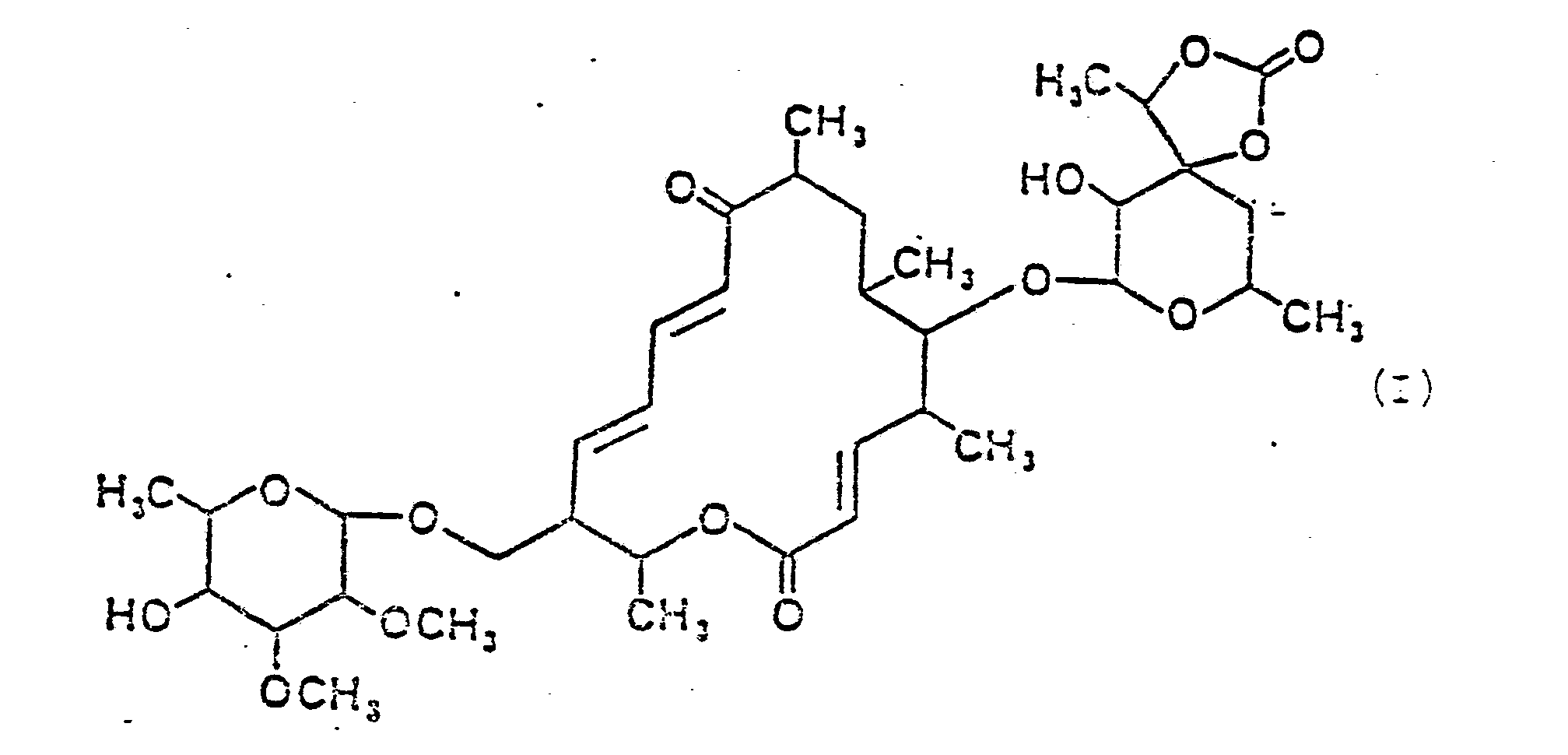
Priority Applications (1)
| Application Number | Priority Date | Filing Date | Title |
|---|---|---|---|
| AT87112298T ATE70065T1 (de) | 1986-08-27 | 1987-08-25 | Ein neues makrolid-antibiotikum, ein mikrobiologisches verfahren zu seiner herstellung und seine verwendung als arzneimittel. |
Applications Claiming Priority (2)
| Application Number | Priority Date | Filing Date | Title |
|---|---|---|---|
| DE3629063 | 1986-08-27 | ||
| DE3629063 | 1986-08-27 |
Publications (3)
| Publication Number | Publication Date |
|---|---|
| EP0257615A2 true EP0257615A2 (de) | 1988-03-02 |
| EP0257615A3 EP0257615A3 (en) | 1988-11-09 |
| EP0257615B1 EP0257615B1 (de) | 1991-12-04 |
Family
ID=6308254
Family Applications (1)
| Application Number | Title | Priority Date | Filing Date |
|---|---|---|---|
| EP87112298A Expired - Lifetime EP0257615B1 (de) | 1986-08-27 | 1987-08-25 | Ein neues Makrolid-Antibiotikum, ein mikrobiologisches Verfahren zu seiner Herstellung und seine Verwendung als Arzneimittel |
Country Status (14)
| Country | Link |
|---|---|
| US (1) | US4988677A (de) |
| EP (1) | EP0257615B1 (de) |
| JP (1) | JPS6368596A (de) |
| KR (1) | KR880003010A (de) |
| AT (2) | ATE70065T1 (de) |
| AU (1) | AU601474B2 (de) |
| DE (1) | DE3774963D1 (de) |
| DK (1) | DK445987A (de) |
| ES (1) | ES2038634T3 (de) |
| GR (1) | GR3003852T3 (de) |
| HU (1) | HU199168B (de) |
| IL (1) | IL83626A (de) |
| PT (1) | PT85590B (de) |
| ZA (1) | ZA876350B (de) |
Cited By (1)
| Publication number | Priority date | Publication date | Assignee | Title |
|---|---|---|---|---|
| WO2005118777A3 (fr) * | 2004-05-26 | 2006-05-04 | Toulouse Inst Nat Polytech | Nouvelle souche saccharothrix et ses antibiotiques derives, notamment mutactimycines et aldgamycines |
Families Citing this family (1)
| Publication number | Priority date | Publication date | Assignee | Title |
|---|---|---|---|---|
| US5486630A (en) * | 1994-09-14 | 1996-01-23 | Cheil Foods & Chemicals Inc. | Legionella specific antibiotic |
Family Cites Families (2)
| Publication number | Priority date | Publication date | Assignee | Title |
|---|---|---|---|---|
| JPS62103098A (ja) * | 1985-05-13 | 1987-05-13 | Microbial Chem Res Found | タイロシン誘導体 |
| US4835141A (en) * | 1986-12-05 | 1989-05-30 | Pfizer Inc. | Neutral macrolide antibiotics from Streptomyces |
-
1987
- 1987-08-24 IL IL83626A patent/IL83626A/xx not_active IP Right Cessation
- 1987-08-25 US US07/089,238 patent/US4988677A/en not_active Expired - Fee Related
- 1987-08-25 DE DE8787112298T patent/DE3774963D1/de not_active Expired - Fee Related
- 1987-08-25 EP EP87112298A patent/EP0257615B1/de not_active Expired - Lifetime
- 1987-08-25 AT AT87112298T patent/ATE70065T1/de not_active IP Right Cessation
- 1987-08-25 ES ES198787112298T patent/ES2038634T3/es not_active Expired - Lifetime
- 1987-08-26 ZA ZA876350A patent/ZA876350B/xx unknown
- 1987-08-26 PT PT85590A patent/PT85590B/pt not_active IP Right Cessation
- 1987-08-26 AU AU77432/87A patent/AU601474B2/en not_active Ceased
- 1987-08-26 JP JP62210361A patent/JPS6368596A/ja active Pending
- 1987-08-26 DK DK445987A patent/DK445987A/da not_active Application Discontinuation
- 1987-08-27 HU HU873778A patent/HU199168B/hu not_active IP Right Cessation
- 1987-08-27 KR KR870009377A patent/KR880003010A/ko not_active Ceased
- 1987-10-08 AT AT0260687A patent/AT389319B/de not_active IP Right Cessation
-
1992
- 1992-02-20 GR GR910402135T patent/GR3003852T3/el unknown
Non-Patent Citations (3)
| Title |
|---|
| THE JOURNAL OF ANTIBIOTICS, Band 29, Nr. 4, April 1976, Seite 76-22, Japan Antibiotics Research Association, Tokyo, JP; "Aldagamycin F" * |
| THE JOURNAL OF ANTIBIOTICS, Band 38, Nr. 4, April 1985, Seiten 522-523, Japan Antibiotics Research Association, Tokyo, JP; K. KINOSHITA et al.: "Mycinamicins, new macrolide antibiotics VIII. Chemical degradation and absolute configuration of mycinamincins" * |
| THE JOURNAL OF ANTIBIOTICS, Band 51, Nr. 10, Oktober 1987, Seiten 1368-1374, Japan Antibiotics Research Association, Tokyo, JP; S. CHATTERJEE et al.: "Swalpamycin, a new macrolide antibiotic II. Structure elucidation" * |
Cited By (2)
| Publication number | Priority date | Publication date | Assignee | Title |
|---|---|---|---|---|
| WO2005118777A3 (fr) * | 2004-05-26 | 2006-05-04 | Toulouse Inst Nat Polytech | Nouvelle souche saccharothrix et ses antibiotiques derives, notamment mutactimycines et aldgamycines |
| EP2202293A3 (de) * | 2004-05-26 | 2010-12-08 | Institute National Polytechnique de Toulouse | Neue aktive Mutactimycin- und Aldgamycin-Verbindungen zum therapeutischen Einsatz |
Also Published As
| Publication number | Publication date |
|---|---|
| ZA876350B (en) | 1988-02-29 |
| HUT46075A (en) | 1988-09-28 |
| IL83626A0 (en) | 1988-01-31 |
| DK445987D0 (da) | 1987-08-26 |
| AT389319B (de) | 1989-11-27 |
| JPS6368596A (ja) | 1988-03-28 |
| AU7743287A (en) | 1988-03-03 |
| US4988677A (en) | 1991-01-29 |
| DE3774963D1 (de) | 1992-01-16 |
| ATA260687A (de) | 1989-04-15 |
| DK445987A (da) | 1988-02-28 |
| PT85590A (de) | 1987-09-01 |
| AU601474B2 (en) | 1990-09-13 |
| ES2038634T3 (es) | 1993-08-01 |
| IL83626A (en) | 1993-07-08 |
| ATE70065T1 (de) | 1991-12-15 |
| KR880003010A (ko) | 1988-05-13 |
| GR3003852T3 (de) | 1993-03-16 |
| PT85590B (pt) | 1990-05-31 |
| EP0257615A3 (en) | 1988-11-09 |
| EP0257615B1 (de) | 1991-12-04 |
| HU199168B (en) | 1990-01-29 |
Similar Documents
| Publication | Publication Date | Title |
|---|---|---|
| DE69422526T2 (de) | Polyzyklische antiparasitäre derivate, verfahren und stamm zu ihrer herstellung und ihrer verwendung | |
| DE2435160A1 (de) | Fortimicin a, verfahren zu seiner herstellung, mikroorganismen zur durchfuehrung des verfahrens und arzneimittel | |
| DE3887820T2 (de) | Antibiotika, Benanomicine A und B und Dexylosylbenanomicin B, ihre Herstellung und Verwendung. | |
| CH630957A5 (de) | Verfahren zur herstellung von neuen antibiotischen verbindungen auf basis eines bohemsaeurekomplexes. | |
| EP0131181B1 (de) | Anthracyclin-Derivate, ein mikrobiologisches Verfahren zu ihrer Herstellung und ihre Verwendung als Cytostatika | |
| DE2813021A1 (de) | Antibiotikum ka-6606 | |
| US3773925A (en) | Partricin | |
| DE2904186C2 (de) | Anthracyclin-Glykoside, Verfahren zu deren Herstellung und diese Verbindungen enthaltende pharmazeutische Zusammensetzungen | |
| US4539203A (en) | CL-1577D And CL-1577E antibiotic/antitumor compounds, their production and use | |
| DE3012565A1 (de) | Antitumor-antibakterielle mittel | |
| DE3234203C2 (de) | ||
| DE3418023C2 (de) | ||
| EP0257615B1 (de) | Ein neues Makrolid-Antibiotikum, ein mikrobiologisches Verfahren zu seiner Herstellung und seine Verwendung als Arzneimittel | |
| DE2839668C2 (de) | ||
| CH634853A5 (de) | Schwefelhaltige metabolite, ihre herstellung und verwendung in arznei- und futtermitteln. | |
| EP0167954B1 (de) | 1-Hydroxy-Cytorhodine, ein mikrobiologisches Verfahren zu ihrer Herstellung und ihre Verwendung als Cytostatika | |
| DE68918071T2 (de) | Antibiotikum A80915 und Verfahren zu seiner Herstellung. | |
| DE2725163C2 (de) | ||
| DE69204733T2 (de) | Antibiotikverbindungen und ihre Herstellung. | |
| DE69013809T2 (de) | Antibiotikum. | |
| EP0182208B1 (de) | Urdamycine, Verfahren und Streptomyceten-Stamm zu ihrer Herstellung und ihre Verwendung | |
| EP0259778B1 (de) | Antibiotisch wirksames Gentisinsäurederivat | |
| DE2946793C2 (de) | 4-O-Desmethyl-11-desoxy-anthracyclinglycoside, Verfahren zu deren Herstellung sowie diese Verbindungen enthaltende pharmazeutische Zusammensetzungen | |
| EP0848064B1 (de) | Neues Antibiotikum, Feglymycin, Verfahren zu seiner Herstellung und Verwendung | |
| DE2830856A1 (de) | Neue antibiotisch wirksame verbindungen, verfahren zu deren herstellung und arzneimittel |
Legal Events
| Date | Code | Title | Description |
|---|---|---|---|
| PUAI | Public reference made under article 153(3) epc to a published international application that has entered the european phase |
Free format text: ORIGINAL CODE: 0009012 |
|
| AK | Designated contracting states |
Kind code of ref document: A2 Designated state(s): AT BE CH DE ES FR GB GR IT LI LU NL SE |
|
| PUAL | Search report despatched |
Free format text: ORIGINAL CODE: 0009013 |
|
| AK | Designated contracting states |
Kind code of ref document: A3 Designated state(s): AT BE CH DE ES FR GB GR IT LI LU NL SE |
|
| 17P | Request for examination filed |
Effective date: 19890508 |
|
| 17Q | First examination report despatched |
Effective date: 19901219 |
|
| GRAA | (expected) grant |
Free format text: ORIGINAL CODE: 0009210 |
|
| AK | Designated contracting states |
Kind code of ref document: B1 Designated state(s): AT BE CH DE ES FR GB GR IT LI LU NL SE |
|
| REF | Corresponds to: |
Ref document number: 70065 Country of ref document: AT Date of ref document: 19911215 Kind code of ref document: T |
|
| ITF | It: translation for a ep patent filed | ||
| REF | Corresponds to: |
Ref document number: 3774963 Country of ref document: DE Date of ref document: 19920116 |
|
| ET | Fr: translation filed | ||
| GBT | Gb: translation of ep patent filed (gb section 77(6)(a)/1977) | ||
| PLBE | No opposition filed within time limit |
Free format text: ORIGINAL CODE: 0009261 |
|
| STAA | Information on the status of an ep patent application or granted ep patent |
Free format text: STATUS: NO OPPOSITION FILED WITHIN TIME LIMIT |
|
| PGFP | Annual fee paid to national office [announced via postgrant information from national office to epo] |
Ref country code: DE Payment date: 19921015 Year of fee payment: 6 |
|
| 26N | No opposition filed | ||
| REG | Reference to a national code |
Ref country code: GR Ref legal event code: FG4A Free format text: 3003852 |
|
| PGFP | Annual fee paid to national office [announced via postgrant information from national office to epo] |
Ref country code: FR Payment date: 19930715 Year of fee payment: 7 |
|
| PGFP | Annual fee paid to national office [announced via postgrant information from national office to epo] |
Ref country code: CH Payment date: 19930719 Year of fee payment: 7 |
|
| PGFP | Annual fee paid to national office [announced via postgrant information from national office to epo] |
Ref country code: SE Payment date: 19930721 Year of fee payment: 7 |
|
| PGFP | Annual fee paid to national office [announced via postgrant information from national office to epo] |
Ref country code: GB Payment date: 19930722 Year of fee payment: 7 |
|
| PGFP | Annual fee paid to national office [announced via postgrant information from national office to epo] |
Ref country code: AT Payment date: 19930723 Year of fee payment: 7 |
|
| REG | Reference to a national code |
Ref country code: ES Ref legal event code: FG2A Ref document number: 2038634 Country of ref document: ES Kind code of ref document: T3 |
|
| PGFP | Annual fee paid to national office [announced via postgrant information from national office to epo] |
Ref country code: BE Payment date: 19930810 Year of fee payment: 7 |
|
| PGFP | Annual fee paid to national office [announced via postgrant information from national office to epo] |
Ref country code: ES Payment date: 19930811 Year of fee payment: 7 |
|
| PGFP | Annual fee paid to national office [announced via postgrant information from national office to epo] |
Ref country code: LU Payment date: 19930825 Year of fee payment: 7 |
|
| PGFP | Annual fee paid to national office [announced via postgrant information from national office to epo] |
Ref country code: NL Payment date: 19930831 Year of fee payment: 7 Ref country code: GR Payment date: 19930831 Year of fee payment: 7 |
|
| EPTA | Lu: last paid annual fee | ||
| PG25 | Lapsed in a contracting state [announced via postgrant information from national office to epo] |
Ref country code: DE Effective date: 19940503 |
|
| PG25 | Lapsed in a contracting state [announced via postgrant information from national office to epo] |
Ref country code: LU Free format text: LAPSE BECAUSE OF NON-PAYMENT OF DUE FEES Effective date: 19940825 Ref country code: GB Effective date: 19940825 Ref country code: AT Effective date: 19940825 |
|
| PG25 | Lapsed in a contracting state [announced via postgrant information from national office to epo] |
Ref country code: SE Effective date: 19940826 Ref country code: ES Free format text: LAPSE BECAUSE OF EXPIRATION OF PROTECTION Effective date: 19940826 |
|
| PG25 | Lapsed in a contracting state [announced via postgrant information from national office to epo] |
Ref country code: LI Effective date: 19940831 Ref country code: CH Effective date: 19940831 Ref country code: BE Effective date: 19940831 |
|
| EAL | Se: european patent in force in sweden |
Ref document number: 87112298.2 |
|
| BERE | Be: lapsed |
Owner name: HOECHST A.G. Effective date: 19940831 |
|
| PG25 | Lapsed in a contracting state [announced via postgrant information from national office to epo] |
Ref country code: GR Free format text: THE PATENT HAS BEEN ANNULLED BY A DECISION OF A NATIONAL AUTHORITY Effective date: 19950228 |
|
| PG25 | Lapsed in a contracting state [announced via postgrant information from national office to epo] |
Ref country code: NL Effective date: 19950301 |
|
| NLV4 | Nl: lapsed or anulled due to non-payment of the annual fee | ||
| GBPC | Gb: european patent ceased through non-payment of renewal fee |
Effective date: 19940825 |
|
| PG25 | Lapsed in a contracting state [announced via postgrant information from national office to epo] |
Ref country code: FR Effective date: 19950428 |
|
| REG | Reference to a national code |
Ref country code: CH Ref legal event code: PL Ref country code: GR Ref legal event code: MM2A Free format text: 3003852 |
|
| EUG | Se: european patent has lapsed |
Ref document number: 87112298.2 |
|
| REG | Reference to a national code |
Ref country code: FR Ref legal event code: ST |
|
| REG | Reference to a national code |
Ref country code: ES Ref legal event code: FD2A Effective date: 19990601 |
|
| PG25 | Lapsed in a contracting state [announced via postgrant information from national office to epo] |
Ref country code: IT Free format text: LAPSE BECAUSE OF NON-PAYMENT OF DUE FEES;WARNING: LAPSES OF ITALIAN PATENTS WITH EFFECTIVE DATE BEFORE 2007 MAY HAVE OCCURRED AT ANY TIME BEFORE 2007. THE CORRECT EFFECTIVE DATE MAY BE DIFFERENT FROM THE ONE RECORDED. Effective date: 20050825 |