EP0246599B1 - Verfahren zur Herstellung eines Olefinpolymers - Google Patents
Verfahren zur Herstellung eines Olefinpolymers Download PDFInfo
- Publication number
- EP0246599B1 EP0246599B1 EP87107215A EP87107215A EP0246599B1 EP 0246599 B1 EP0246599 B1 EP 0246599B1 EP 87107215 A EP87107215 A EP 87107215A EP 87107215 A EP87107215 A EP 87107215A EP 0246599 B1 EP0246599 B1 EP 0246599B1
- Authority
- EP
- European Patent Office
- Prior art keywords
- compound
- titanium
- solid catalyst
- catalyst component
- formula
- Prior art date
- Legal status (The legal status is an assumption and is not a legal conclusion. Google has not performed a legal analysis and makes no representation as to the accuracy of the status listed.)
- Expired - Lifetime
Links
Classifications
-
- C—CHEMISTRY; METALLURGY
- C08—ORGANIC MACROMOLECULAR COMPOUNDS; THEIR PREPARATION OR CHEMICAL WORKING-UP; COMPOSITIONS BASED THEREON
- C08F—MACROMOLECULAR COMPOUNDS OBTAINED BY REACTIONS ONLY INVOLVING CARBON-TO-CARBON UNSATURATED BONDS
- C08F4/00—Polymerisation catalysts
- C08F4/06—Metallic compounds other than hydrides and other than metallo-organic compounds; Boron halide or aluminium halide complexes with organic compounds containing oxygen
- C08F4/16—Metallic compounds other than hydrides and other than metallo-organic compounds; Boron halide or aluminium halide complexes with organic compounds containing oxygen of silicon, germanium, tin, lead, titanium, zirconium or hafnium
-
- C—CHEMISTRY; METALLURGY
- C08—ORGANIC MACROMOLECULAR COMPOUNDS; THEIR PREPARATION OR CHEMICAL WORKING-UP; COMPOSITIONS BASED THEREON
- C08F—MACROMOLECULAR COMPOUNDS OBTAINED BY REACTIONS ONLY INVOLVING CARBON-TO-CARBON UNSATURATED BONDS
- C08F10/00—Homopolymers and copolymers of unsaturated aliphatic hydrocarbons having only one carbon-to-carbon double bond
-
- Y—GENERAL TAGGING OF NEW TECHNOLOGICAL DEVELOPMENTS; GENERAL TAGGING OF CROSS-SECTIONAL TECHNOLOGIES SPANNING OVER SEVERAL SECTIONS OF THE IPC; TECHNICAL SUBJECTS COVERED BY FORMER USPC CROSS-REFERENCE ART COLLECTIONS [XRACs] AND DIGESTS
- Y10—TECHNICAL SUBJECTS COVERED BY FORMER USPC
- Y10S—TECHNICAL SUBJECTS COVERED BY FORMER USPC CROSS-REFERENCE ART COLLECTIONS [XRACs] AND DIGESTS
- Y10S526/00—Synthetic resins or natural rubbers -- part of the class 520 series
- Y10S526/909—Polymerization characterized by particle size of product
Definitions
- the present invention relates to a method for producing an olefin polymer by polymerizing or copolymerizing an a-olefin having at least 3 carbon atoms by means of a novel solid catalyst component. More particularly, the present invention relates to a method for the polymerization of an a-olefin such as propylene, butene-1, 4-methylpentene-1 or 3-methylbutene-1 by means of a catalyst comprising a novel carrier, including a catalyst component, an organic metal compound of a metal of Groups I-III and, if necessary, an electron donative compound, which is capable of providing a polymer having excellent stereo regularity and granularity with high polymerization activities.
- an a-olefin such as propylene, butene-1, 4-methylpentene-1 or 3-methylbutene-1
- a catalyst comprising a novel carrier, including a catalyst component, an organic metal compound of a metal of Groups I-III and, if necessary, an electron donative compound,
- Japanese Unexamined Patent Publication No. 12119-1980 relates to a method for polymerizing ethylene in good yield, characterized by using a solid material obtained by contacting and reacting a magnesium alkoxide, a halogen-containing tetravalent titanium compound and an alcohol as solid catalyst components, followed by reacting the solid catalyst components with a titanium halide in the presence of an alkoxy-containing silicon compound.
- FR-A-2 453 868 relates to a method of polymerizing ethylene in good yield characterized by using a solid material obtained by contacting and reacting a magnesium alkoxide, a halogen-containing silicon compound of the formula and an alcohol as solid catalyst components, followed by reacting the solid catalyst components with a titanium halide in the presence of a silicone compound of the formula
- the present inventors have conducted extensive research on the method for the preparation of a titanium-containing solid catalyst wherein the carrier represented by the formula I is used, and on the method for polymerization by means of such a catalyst, and have finally arrived at the present invention.
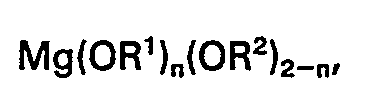
- the present invention provides a method for producing an olefin polymer, which comprises polymerizing or copolymerizing an olefin having at least 3 carbon atoms in the presence of a catalyst comprising (a) a titanium-containing solid catalyst component and (b) an organic metal compound of a metal of Groups I ⁇ III of the Periodic Table, said solid catalyst component (a) being obtained by treating (A) a magnesium compound of the formula wherein each of R 1 and R 2 is an alkyl group, an aryl group or an aralkyl group, and n is 2 ⁇ n ⁇ 0, with three compounds i.e. (B) an ester as an electron donative compound, (C) a silicon compound of the formula Si(OR 3 ) 4 wherein OR 3 is an alkoxy group or an aryloxy group and (D) a titanium compound.
- a catalyst comprising (a) a titanium-containing solid catalyst component and (b) an organic metal compound of a metal of Groups I ⁇ III of the Periodic Table,
- halogen-containing magnesium is hygroscopic or reactive with moisture, and therefore, it is highly advantageous to use the carrier of the formula I from the standpoint of the production of the catalyst.
- the present invention provides a method for producing an olefin polymer, which comprises polymerizing or copolymerizing an olefin by using a titanium-containing catalyst which comprises (a) a solid catalyst component obtained by treating (A) the magnesium compound of the formula I with three compounds i.e. (B) an electron donative compound, (C) a silicon compound of the formula Si(OR 3 ) 4 and (D) a titanium compound, and (b) an organic metal compound of a metal of Groups I-III of the Periodic Table, as essential components, and which may further contain (c) an electron donative compound.
- a titanium-containing catalyst which comprises (a) a solid catalyst component obtained by treating (A) the magnesium compound of the formula I with three compounds i.e. (B) an electron donative compound, (C) a silicon compound of the formula Si(OR 3 ) 4 and (D) a titanium compound, and (b) an organic metal compound of a metal of Groups I-III of the Periodic Table, as essential components, and
- magnesium compound (A) of the formula I to be used in the present invention include a dialkoxymagnesium, a diaryloxymagnesium, a diaralkyloxymagnesium and an alkoxyaryloxymagnesium, such as
- the electron donative compound (B) includes, for example an ester of carboxylic acid such as ethyl acetate, methyl propionate, ethyl acrylate, ethyl oleate, ethyl stearate, ethyl phenylacetate, methyl benzoate, ethyl benzoate, propyl benzoate, butyl benzoate, methyl toluylate, ethyl toluylate, propyl toluylate, butyl toluylate, methyl ethylbenzoate, ethyl ethylbenzoate, ethyl xylenecar- boxylate, methyl anisate, ethyl anisate, methyl ethoxybenzoate, ethyl ethoxybenzoate, ethyl ethoxybenzoate or ethyl cinnamate; and a cyclic ester such
- Particularly preferred is an ester of carboxylic acid, and more preferred is an aromatic ester.
- the silicon compound (C) is a compound represented of the formula Si(OR 3 ) 4 wherein R 3 is an alkyl group, an aryl group or an aralkyl group. Specifically, it includes tetramethoxysilane, tetraethoxysilane, tetrapropoxysilane, tetrabutoxysilane, tetra(2-ethylhexoxy)silane, tetraphenoxysilane, tetra(p-methylphenoxy)silane and tet- ra(benzyloxy)silane.
- the titanium compound (D) includes titanium tetrachloride, titanium tetrabromide and titanium tetraiodide and a titanium halide-alcoholate compound.
- the components (A), (B), (C) and (D) may be contacted in the presence or absence of a hydrocarbon solvent.
- the amounts of the respective components used for the process for the production of the catalyst, by molar ratios, are usually as follows.
- Titanium compound
- the amounts of the respective components are adjusted so that the titanium content in the resulting product will be usually within a range of from 0.1 to 10% by weight, preferably from 0.5 to 5% by weight.
- the reaction in the presence or absence of an inert hydrocarbon solvent is conducted usually at a temperature of from room temperature to 200°C, preferably from 60 to 150°C for a period of from 0.5 to 4 hours.
- the component (A) may be treated with the components (B), (C) and (D) in any optional order. It is preferred to employ a method wherein the treatment of the component (A) with the components (B) to (D) is followed by further treatment with the components (B) to (D). For example, it is preferred to employ a method wherein a process comprising contacting the components (A), (B), (C) and (D), then washing them with an inert hydrocarbon solvent, contacting and mixing thereto additional components (B), (C) and (D), or additional components (B) and (D), under heating and washing the mixture with an inert hydrocarbon solvent, is repeated at least once.
- the order of the reaction of the components (A) to (D) is optional, as mentioned above.
- particularly preferred is a method wherein the magnesium compound (A) is first reacted with the silicon compound (C), followed by the treatment with the electron donative compound (B) and the titanium compound (D).
- the components (A) and (C) are first reacted in the presence or absence of an inert hydrocarbon solvent.
- the reaction temperature is usually within a range of from 60 to 200°C, preferably from 100 to 150°C.
- the reaction time is usually with the range of from 0.5 to 4 hours.
- the compound of the formula R 7 OH includes an alcohol such as ethanol, butanol, hexanol, 2-ethylhexanol or benzylalcohol, and a phenol such as phenol, cresol, xylenol or butylphenol.
- the heat reaction product thus obtained is then treated with a halogen-containing titanium compound (D) and an electron donative compound (B) in the presence or absence of an inert hydrocarbon solvent, to obtain a solid catalyst component (a).
- the treatment with components (B) and (D) may be conducted by a method wherein the above heat reaction product is treated with the components (B) and (D), or a method wherein the reaction product is treated first with the component (D) and then with the component (B), or a method wherein the reaction product is treated first with the component (B) and then with the component (D). It is also possible to employ a method wherein the reaction for the production of the above-mentioned heat reaction product is conducted in the presence of the component (B), and the product is then treated with the component (D). Further, it is preferred to repeat the treating steps with the components (B) and (D) at least twice.
- the treatment of the heat reaction product with the components (B) and (D) may be conducted in the presence or absence of an inert solvent.
- the treating temperature is usually within a range of from room temperature to 200°C, preferably from 50 to 200°C, more preferably from 60 to 150°C.
- the heat reaction product is preferably contacted with the components (B) and (D) usually at a temperature of from -70 to 50°C, preferably from -30 to 30°C.
- the reaction product thus obtained is then washed with an inert hydrocarbon solvent to remove the components soluble in the solvent.
- an inert hydrocarbon solvent By using a catalyst system obtained by mixing the catalytic component (a) thus obtained, with (b) an organic metal compound of a metal of Groups I-III, and if necessary, (c) an electron donative compound, an olefin is polymerized or copolymerized to obtain a polyolefin.
- the organic metal compound [Component (b)] of a metal of Groups I-III of the Periodic Table to be used in this catalyst system includes compounds represented by the formula AIR 7 n X 3-n , wherein R 7 is a hydrocarbon group having from 1 to 20 carbon atoms, particularly an aliphatic hydrocarbon group, X is a haiogen atom, and n is a number of 2 to 3.
- Specific examples..of such organic aluminum compounds include triethylaluminum, tripropylaluminum, triisobuty- laluminum, trihexylaluminum, trioctylaluminum, monovinyldiethylaluminum and diethy- laluminum monochloride.
- Preferred is a trialky- laluminum or its mixture with a dialkylaluminum monohalide.
- the component (B) used for the preparation of the solid catalyst component (a) may be employed.
- an ester Particularly preferred is an aromatic ester.
- the molar ratio of titanium in the catalyst component (a):the aluminum compound of the component (b):the electron donative compound of the component (c) is selected to be 1:3-500:0-100, preferably 1:20-200:3-50.
- the olefin may be ethylene, propylene, butene-1, 3-methylbutene-1 or 4-methylpentene-1.
- An a-olefin having at least 3 carbon atoms is preferred. Particularly preferred is a propylene.
- the polymerization may be homopolymerization, or random or block copolymerization.
- the polymerization reaction is preferably conducted in a slurry polymerization system by using as the solvent, hexane, heptane, cyclohexane, benzene, toluene, pentane, butane or a mixture thereof, or a liquefied form of the a-olefin to be polymerized.
- the polymerization can be conducted also in a vapor phase.
- the temperature is usually within a range of from 50 to 100°C, preferably from 60 to 90°C.
- the pressure is not critical and is usually selected within a range of from atmospheric pressure to 100 bar (100 atm).
- hydrogen may be present as a molecular weight controlling agent in the polymerization system, whereby a polymer having a melt flow index (MFI, measured in accordance with ASTM D-1238) of from 50 to 0.1 can readily be prepared.
- MFI melt flow index
- Other techniques commonly employed for the polymerization or copolymerization of an a-olefin, may be applicable to the method of the present invention.
- the a-olefin may be pretreated by using the three components (a), (b) and (c) or the two components (a) and (b) of the above-mentioned catalyst.
- a polymer of an a-olefin having excellent stereo regularity and granularity can be prepared at a high polymerization activity, and thus, the present invention is very useful from the industrial point of view.
- the polymerization activity (represented by K) is the amount (g) of the polymer produced per hour, per an a-olefin pressure of 1 kg/cm 2 and per 1 g of the solid catalyst component (a) or titanium
- the catalyst efficiency (represented by CE) is the amount (g) of the polymer produced per 1 g of the solid catalyst component (a) or titanium.
- the isotactic index (represented by II) is the residual amount (% by weight) after the extraction with boiling n-heptane for 6 hours by means of an improved Soxhlet extractor. Non-crystalline polymer is soluble in boiling n-heptane, and therefore, II indicates the yield of the crystalline polymer.
- the bulk density represented by pB with a unit of g/cc
- the melt flow index (represented by MFI) was measured in accordance with ASTM-D-1238.
- the particle size distribution of the polymer was measured by means of standard sieves manufactured by Mitamura Riken Inc.
- the catalyst efficiency CE was 980 kg-PP/g-Ti (22,500 g-PP/ g-cat.), and the polymerization activity K was 32,600/g-Ti (750/g-cat.).
- the bulk density pB was 0.43 g/cc, II was 96.5%, and MFI was 6.0.
- the particle size distribution of the polymer was measured, and it was found that the content of fine powder of 100 um or less was 0.3% by weight based on the total amount.
- Example 1(B) Into the same type of an autoclave as used in Example 1(B), 1.0 mmol oftriethylaluminum and 0.3 mmol of methyl p-methylbenzoate were introduced under an argon atmosphere at room temperature, and H 2 was introduced at room temperature to a level of 1 bar (1.0 kg/cm 2 ). Then, 700 g of liquefied propylene was added thereto, the mixture was heated under stirring, and 20 mg of the above solid catalyst was added at 70°C to initiate polymerization. The reaction system was maintained at 70°C for 1 hour, and then excess propylene was purged to obtain 380 g of polypropylene as white powder.
- the catalyst efficiency CE was 830 kg-PP/g-Ti (19,000 g-PP/g-cat.) and the polymerization activity K was 27,500/g-Ti (633/g-cat.).
- the bulk density pB was 0.42 g/cc, II was 93.0%, and MFI was 7.9.
- a solid catalyst was prepared in the same manner as in Example 1(A) except that 4.5 g of tetraethoxysilane was used as a silicon compound in Example 1(A).
- the amount of Ti supported on the catalyst was 2.2% by weight.
- a solid catalyst was prepared in the same manner as in Example 1(A) except that 14 g of tetrabutoxysilane was used as a silicon compound in Example 1 (A).
- the amount of Ti supported on the catalyst was 2.5% by weight.
- a solid catalyst was prepared in the same manner as in Example 1(A) except that 9.2 g of phenyl trichlorosilane was used as a silicon compound in Example 1 (A).
- the particle size distribution of the polymer was measured, and it was found that the content of fine powder of 100 ⁇ m or less was 8.0% by weight of the total amount.
- Example 1(A) Into the same type of a flask as used in Example 1(A), 5 g of commercially available Mg(OC 2 H 5 ) 2 was introduced under a nitrogen atmosphere, and 83 g of TiC1 4 , 8.7 g of tetraphenoxysilane and 1.3 g of ethyl benzoate were added thereto at room temperature. The mixture was gradually heated under stirring, and when the temperature reached 110°C, the mixture was maintained at the same temperature for 2 hours. Then, the mixture was thoroughly washed with purified toluene to obtain a solid catalyst. The amount of Ti supported on the catalyst was 3.5% by weight.
- the content of fine powder of 100 ⁇ m or less was 0.3% by weight of the total amount.
- a solid catalyst was prepared in the same manner as in Example 1(A) except that tetraphenoxysilane was not employed in Example 1(A).
- the amount of Ti supported on the catalyst was 2.8% by weight.
- the content of fine powder of 100 ⁇ m or less was 9.2% by weight of the total amount.
- the particle size distribution of the polymer was narrow, and it was found that the content of powder having a particle size of from 400 to 150 ⁇ m was 92% by weight based on the total amount, and the content of fine powder of 100 pm or less was 0.5% by weight.
- a solid catalyst component was prepared in the same manner as in Example 6(1) except that 7.5 g of Mg(OC 4 H 9 ) 2 was used as a magnesium compound, and the amount of purified toluene added after the reaction was changed to 62 mi.
- the Ti content in this catalyst component was 2.7% by weight.
- the particle size distribution of the polymer thus obtained was measured, and it was found that the content of powder having a particle size of from 600 to 250 pm was 91 % based on the total amount, and the content of fine powder of 100 pm or less was 0.1 % by weight.
- a solid catalyst component was prepared in the same manner as in Example 6(1) except that 7.0 g of tetrabutoxysilane and 8.7 g of tetraphenoxysilane were used as silicon compounds, and the amount of the TiCl 4 added for the first time was changed to 25 g. The Ti content was 2.9% by weight.
- the particle size distribution of the polymer thus obtained was measured, and it was found that the content of powder having a particle size of from 700 to 300 ⁇ m was 92% by weight based on the total amount, and the content of fine powder of 100 pm or less was 0.1%.
- Example 6(1) In the same manner as in Example 6(1), 5 g of commercially available Mg(OC 2 H 5 ) 2 was introduced into a flask, and a toluene solution of 8.8 g of tetraphenoxysilane and 6.5 g of n-butanol were added. The mixture was gradually heated, and reacted at 100°C for 1 hour, and then at 130°C for 1 hour. During the reaction, distillation of ethanol was observed. The reaction product thus obtained was a white solid slurry.
- the particle size distribution of the polymer thus obtained was measured, and it was found that the content of powder having a particle size of from 300 to 100 pm was 97% by weight based on the total amount, and the content of fine powder of 100 pm or less was 1.1 % by weight.
- a solid catalyst component was prepared in the same manner as in Example 9 except that 7.0 g of tetrabutoxysilane and 8.8 g of tetraphenoxysilane were used as silicon compounds, and the amount of purified toluene added was changed to 65 ml.
- the Ti content in the solid catalyst component thus obtained was 2.8% by weight.
- the particle size distribution of the polymer thus obtained was measured, and it was found that the content of powder having a particle size of from 400 to 200 ⁇ m was 92% by weight based on the total amount, and the content of fine powder of 100 ⁇ m or less was 0.1% by weight.
- a white solid slurry reaction product was prepared in the same manner as in Example 9 by using 5 g of commercially available Mg(OC 2 H 5 ) 2 , 7.0 g of tetrabutoxysilane, 4.6 g of tetraethoxysilane, and 8.2 g of phenol. To this reaction product, 62 ml of purified toluene was added. Then, the mixture was cooled to -20°C, and 25 g of TiCl 4 was added thereto to obtain a uniform solution. After the addition, the mixture was gradually heated to 80°C over a period of 1 hour. During the heating, formation of solid particles was observed.
- the particle size distribution of the polymer thus obtained was measured, and it was found that the content of powder having particle size of from 400 to 150 ⁇ m was 94% by weight based on the total amount, and the content of fine powder of 100 um or less was 0.2% by weight.
- Example 6(1 ) a white solid slurry reaction product of a magnesium compound and a silicon compound was obtained.
- a solid catalyst component was prepared in the same manner as in Example 6(1) except that the amount of purified toluene added was changed to 73 ml, and 32 g of a Ti compound represented by the formula Ti(OBu) 0.5 Cl 3.5 was used instead of TiC1 4 .
- the Ti content in this catalyst component was 2.5% by weight.
- the particle size distribution of the polymer thus obtained was measured, and it was found that the content of powder having a particle size of from 300 to 150 ⁇ m was 96% by weight based on the total amount, and the content of fine powder of 100 pm or less was 0.3% by weight.
Landscapes
- Chemical & Material Sciences (AREA)
- Health & Medical Sciences (AREA)
- Chemical Kinetics & Catalysis (AREA)
- Medicinal Chemistry (AREA)
- Polymers & Plastics (AREA)
- Organic Chemistry (AREA)
- Engineering & Computer Science (AREA)
- Materials Engineering (AREA)
- Transition And Organic Metals Composition Catalysts For Addition Polymerization (AREA)
- Addition Polymer Or Copolymer, Post-Treatments, Or Chemical Modifications (AREA)
Claims (10)

Applications Claiming Priority (2)
| Application Number | Priority Date | Filing Date | Title |
|---|---|---|---|
| JP11673286 | 1986-05-21 | ||
| JP116732/86 | 1986-05-21 |
Publications (2)
| Publication Number | Publication Date |
|---|---|
| EP0246599A1 EP0246599A1 (de) | 1987-11-25 |
| EP0246599B1 true EP0246599B1 (de) | 1991-01-30 |
Family
ID=14694418
Family Applications (1)
| Application Number | Title | Priority Date | Filing Date |
|---|---|---|---|
| EP87107215A Expired - Lifetime EP0246599B1 (de) | 1986-05-21 | 1987-05-18 | Verfahren zur Herstellung eines Olefinpolymers |
Country Status (7)
| Country | Link |
|---|---|
| US (1) | US4883848A (de) |
| EP (1) | EP0246599B1 (de) |
| JP (1) | JPH0788409B2 (de) |
| KR (1) | KR940001512B1 (de) |
| BR (1) | BR8702619A (de) |
| DE (1) | DE3767762D1 (de) |
| FI (1) | FI92836C (de) |
Families Citing this family (7)
| Publication number | Priority date | Publication date | Assignee | Title |
|---|---|---|---|---|
| FR2623812B1 (fr) * | 1987-11-30 | 1992-02-21 | Bp Chimie Sa | Catalyseur de polymerisation d'olefines de type ziegler natta et procede de preparation a partir de dialcoxyde de magnesium |
| DE68923669T2 (de) * | 1988-08-31 | 1996-01-25 | Mitsubishi Chem Corp | Verfahren zur Herstellung eines Propylenblockcopolymers. |
| IT1241062B (it) * | 1990-01-10 | 1993-12-29 | Himont Inc | Componenti e catalizzatori per la polimerizzazione di olefine |
| JPH08333416A (ja) * | 1995-06-07 | 1996-12-17 | Sumitomo Chem Co Ltd | α−オレフィン重合用触媒ならびにα−オレフィン重合体の製造方法 |
| KR100640275B1 (ko) * | 2004-10-14 | 2006-11-01 | 대한유화공업 주식회사 | 에틸렌 중합 및/또는 에틸렌 공중합용 고체 촉매의 제조방법 |
| ITBO20050076A1 (it) * | 2005-02-17 | 2006-08-18 | Metal Work Srl | Struttura per il supporto di elementi a definire una parete |
| KR101123523B1 (ko) * | 2009-11-09 | 2012-03-12 | 삼성토탈 주식회사 | 프로필렌 중합용 고체촉매의 제조 방법 |
Family Cites Families (7)
| Publication number | Priority date | Publication date | Assignee | Title |
|---|---|---|---|---|
| JPS5812888B2 (ja) * | 1976-08-27 | 1983-03-10 | 三井化学株式会社 | ポリオレフインの製造方法 |
| JPS55106204A (en) * | 1979-02-10 | 1980-08-14 | Idemitsu Kosan Co Ltd | Polymerization method of ethylene |
| JPS55149307A (en) * | 1979-04-09 | 1980-11-20 | Idemitsu Kosan Co Ltd | Ethylene polymerizing method |
| JPS5763309A (en) * | 1980-10-03 | 1982-04-16 | Idemitsu Kosan Co Ltd | Polymerization of alpha-olefin |
| JPS5883006A (ja) * | 1981-11-13 | 1983-05-18 | Mitsui Petrochem Ind Ltd | オレフインの重合方法 |
| US4451688A (en) * | 1981-12-03 | 1984-05-29 | Nippon Oil Company, Limited | Process for preparing polyolefins |
| JPS59182806A (ja) * | 1983-04-01 | 1984-10-17 | Mitsubishi Chem Ind Ltd | オレフイン重合体の製造方法 |
-
1987
- 1987-05-18 DE DE8787107215T patent/DE3767762D1/de not_active Expired - Lifetime
- 1987-05-18 EP EP87107215A patent/EP0246599B1/de not_active Expired - Lifetime
- 1987-05-19 JP JP62122336A patent/JPH0788409B2/ja not_active Expired - Fee Related
- 1987-05-20 KR KR1019870005010A patent/KR940001512B1/ko not_active Expired - Fee Related
- 1987-05-20 FI FI872219A patent/FI92836C/fi not_active IP Right Cessation
- 1987-05-21 BR BR8702619A patent/BR8702619A/pt not_active IP Right Cessation
-
1989
- 1989-03-06 US US07/320,859 patent/US4883848A/en not_active Expired - Lifetime
Also Published As
| Publication number | Publication date |
|---|---|
| FI872219A0 (fi) | 1987-05-20 |
| KR940001512B1 (ko) | 1994-02-23 |
| FI92836B (fi) | 1994-09-30 |
| FI92836C (fi) | 1995-01-10 |
| US4883848A (en) | 1989-11-28 |
| JPS63108008A (ja) | 1988-05-12 |
| EP0246599A1 (de) | 1987-11-25 |
| DE3767762D1 (de) | 1991-03-07 |
| JPH0788409B2 (ja) | 1995-09-27 |
| KR870011155A (ko) | 1987-12-21 |
| FI872219L (fi) | 1987-11-22 |
| BR8702619A (pt) | 1988-02-23 |
Similar Documents
| Publication | Publication Date | Title |
|---|---|---|
| EP0268274B1 (de) | Verfahren zur Herstellung von Olefinpolymeren | |
| US4115319A (en) | Catalysts and catalyst components for polymerizing olefins | |
| EP0347442B1 (de) | Auf modifizierte silika basierender katalysator | |
| US5143883A (en) | Modified silica based catalyst | |
| US4511669A (en) | High efficiency catalysts for varying olefin polymer molecular weight distribution | |
| US4883848A (en) | Method for producing an olefin polymer | |
| US7022797B2 (en) | Polymerization process | |
| US5229476A (en) | Method for producing a stereospecific polyolefin | |
| EP0357135B1 (de) | Feste Katalysatorbestandteile für die Olefinpolymerisation und Verfahren zu deren Herstellung | |
| JP3537534B2 (ja) | オレフィン重合用固体触媒成分、オレフィン重合用触媒およびオレフィン重合体の製造法 | |
| JPH059215A (ja) | ポリオレフインの製造方法 | |
| EP0177689B1 (de) | Verfahren zur Polymerisation oder Mischpolymerisation von Äthylen | |
| US5432139A (en) | Catalyst formulation and polymerization process | |
| EP0430154A2 (de) | Katalysator für Olefinpolymerisation, Verfahren zur Herstellung und Anwendung | |
| JP2778130B2 (ja) | オレフィン重合体の製造方法 | |
| AU606250B2 (en) | Modified silica based catalyst | |
| JP3403732B2 (ja) | オレフィン重合用触媒 | |
| JP3354026B2 (ja) | オレフィン重合用固体触媒成分、オレフィン重合用触媒およびオレフィン重合体の製造方法 | |
| JPH0333102A (ja) | α―オレフイン重合用触媒 | |
| JPS6067505A (ja) | ポリオレフインの製造方法 | |
| JPH0333105A (ja) | α―オレフイン重合用触媒 | |
| JPH0480209A (ja) | α―オレフィン重合用触媒成分 | |
| JPH05247127A (ja) | オレフィン重合用触媒および当該触媒を用いたオレフィン重合体の製造方法 | |
| JPH0780949B2 (ja) | オレフィン重合体の製造方法 | |
| JPH08176226A (ja) | オレフィン重合用固体触媒成分、オレフィン重合用触媒およびオレフィン重合体の製造方法 |
Legal Events
| Date | Code | Title | Description |
|---|---|---|---|
| PUAI | Public reference made under article 153(3) epc to a published international application that has entered the european phase |
Free format text: ORIGINAL CODE: 0009012 |
|
| AK | Designated contracting states |
Kind code of ref document: A1 Designated state(s): DE FR GB NL |
|
| 17P | Request for examination filed |
Effective date: 19880516 |
|
| RAP1 | Party data changed (applicant data changed or rights of an application transferred) |
Owner name: MITSUBISHI KASEI CORPORATION |
|
| 17Q | First examination report despatched |
Effective date: 19890608 |
|
| GRAA | (expected) grant |
Free format text: ORIGINAL CODE: 0009210 |
|
| AK | Designated contracting states |
Kind code of ref document: B1 Designated state(s): DE FR GB NL |
|
| REF | Corresponds to: |
Ref document number: 3767762 Country of ref document: DE Date of ref document: 19910307 |
|
| ET | Fr: translation filed | ||
| PLBE | No opposition filed within time limit |
Free format text: ORIGINAL CODE: 0009261 |
|
| STAA | Information on the status of an ep patent application or granted ep patent |
Free format text: STATUS: NO OPPOSITION FILED WITHIN TIME LIMIT |
|
| 26N | No opposition filed | ||
| REG | Reference to a national code |
Ref country code: GB Ref legal event code: IF02 |
|
| PGFP | Annual fee paid to national office [announced via postgrant information from national office to epo] |
Ref country code: FR Payment date: 20030508 Year of fee payment: 17 |
|
| PGFP | Annual fee paid to national office [announced via postgrant information from national office to epo] |
Ref country code: GB Payment date: 20030514 Year of fee payment: 17 |
|
| PGFP | Annual fee paid to national office [announced via postgrant information from national office to epo] |
Ref country code: DE Payment date: 20030529 Year of fee payment: 17 |
|
| PGFP | Annual fee paid to national office [announced via postgrant information from national office to epo] |
Ref country code: NL Payment date: 20030530 Year of fee payment: 17 |
|
| PG25 | Lapsed in a contracting state [announced via postgrant information from national office to epo] |
Ref country code: GB Free format text: LAPSE BECAUSE OF NON-PAYMENT OF DUE FEES Effective date: 20040518 |
|
| PG25 | Lapsed in a contracting state [announced via postgrant information from national office to epo] |
Ref country code: NL Free format text: LAPSE BECAUSE OF NON-PAYMENT OF DUE FEES Effective date: 20041201 Ref country code: DE Free format text: LAPSE BECAUSE OF NON-PAYMENT OF DUE FEES Effective date: 20041201 |
|
| GBPC | Gb: european patent ceased through non-payment of renewal fee |
Effective date: 20040518 |
|
| PG25 | Lapsed in a contracting state [announced via postgrant information from national office to epo] |
Ref country code: FR Free format text: LAPSE BECAUSE OF NON-PAYMENT OF DUE FEES Effective date: 20050131 |
|
| NLV4 | Nl: lapsed or anulled due to non-payment of the annual fee |
Effective date: 20041201 |
|
| REG | Reference to a national code |
Ref country code: FR Ref legal event code: ST |