EP0245025B1 - Antwortsystem eines Endgeräts auf einen ankommenden Anruf - Google Patents
Antwortsystem eines Endgeräts auf einen ankommenden Anruf Download PDFInfo
- Publication number
- EP0245025B1 EP0245025B1 EP87303848A EP87303848A EP0245025B1 EP 0245025 B1 EP0245025 B1 EP 0245025B1 EP 87303848 A EP87303848 A EP 87303848A EP 87303848 A EP87303848 A EP 87303848A EP 0245025 B1 EP0245025 B1 EP 0245025B1
- Authority
- EP
- European Patent Office
- Prior art keywords
- terminal
- time
- call
- message
- response
- Prior art date
- Legal status (The legal status is an assumption and is not a legal conclusion. Google has not performed a legal analysis and makes no representation as to the accuracy of the status listed.)
- Expired - Lifetime
Links
- 230000004044 response Effects 0.000 title claims description 27
- 238000004891 communication Methods 0.000 claims description 29
- 230000005540 biological transmission Effects 0.000 claims description 3
- 230000002035 prolonged effect Effects 0.000 claims 1
- 230000011664 signaling Effects 0.000 description 23
- 238000000034 method Methods 0.000 description 6
- 238000010586 diagram Methods 0.000 description 4
- 238000010276 construction Methods 0.000 description 2
- 230000003111 delayed effect Effects 0.000 description 2
- 230000010365 information processing Effects 0.000 description 2
- 230000002159 abnormal effect Effects 0.000 description 1
- 238000001514 detection method Methods 0.000 description 1
- 239000000284 extract Substances 0.000 description 1
- 238000012423 maintenance Methods 0.000 description 1
Images



Classifications
-
- H—ELECTRICITY
- H04—ELECTRIC COMMUNICATION TECHNIQUE
- H04Q—SELECTING
- H04Q5/00—Selecting arrangements wherein two or more subscriber stations are connected by the same line to the exchange
-
- H—ELECTRICITY
- H04—ELECTRIC COMMUNICATION TECHNIQUE
- H04Q—SELECTING
- H04Q11/00—Selecting arrangements for multiplex systems
- H04Q11/04—Selecting arrangements for multiplex systems for time-division multiplexing
- H04Q11/0428—Integrated services digital network, i.e. systems for transmission of different types of digitised signals, e.g. speech, data, telecentral, television signals
Definitions
- the present invention relates to a communication terminal which is connected to a communication network and, more particularly, to a system for a communication terminal having an interface which conforms to The Comotti Consultatif International Telecommunicationgraphiqe et Téléphonique (CCITT) Recommendations, I. series, to respond to an incoming call.
- CITT Comotti Consultatif International Telecommunicationgraphiqe et Telecommunicationphonique
- the CCITT named a network for offering a digital communication service Integrated Service Digital Network (ISDN) and, in 1984, gave Recommendations, I. series (Redbook) on basic ISDN items.
- I. series Recommendations on basic ISDN items.
- SETUP call accept message
- a terminal on receipt of a call accept message (SETUP) from a network, a terminal compares the values of its own attributes with those of the service attributes of the call which are contained in the SETUP message so as to decide whether or not to respond to the call and, only when it has decided to respond, sends a respond message CONNect (CONN) to the network.
- CONNect CONN
- a message sent from a network to a terminal for connection is called a SETUP message.
- the SETUP includes various kinds of information elements such as protocol discriminator, call reference, message type, bearer capability, channel identification, progress indicator, terminal capabilities, display, keypad, signal, switchhook, calling party number, calling party subaddress, called party number, called party subaddress, transit network selection, low layer compatibility, high layer compatibility, user-user information (CCITT Q.931).
- the bearer capability, low layer compatibility, high layer compatibility and user-user information are used for compatibility checking which the terminal performs for deciding whether it may answer a call arrived.
- These information elements other than the bearer capability are omitted, as the case may be.
- the terminal has therein a classified table of those contents of the above-stated information elements with which it is compatible, and their items, i.e., attributes as well as their values.
- the terminal decides whether it may accept an incoming call by comparing the contents of a call message arrived with those stored therein.
- a customer premises 20 which is incorporated in an ISDN network 10 includes a point-multipoint bus 22 which is connected to the network 10 via a network termination (NT) 21, that a plurality of terminals (TE) 23, 24, ..., and 2n are present on the bus 22, and that the terminals 23, 24, ..., and 2n share a single subscriber number and have no sub-address.
- NT network termination
- TE terminals
- TE terminals
- a problem with such a prior art response system is that should a particular one of the multiple terminals always return a CONN message before the others, all incoming calls would arrive at that particular terminal and, therefore, a calling user would be incapable of communicating with a desired terminal even though it might repeat origination of a call a number of times.
- German Patent No. 3431420 there is proposed an arrangement in which subscriber terminals are provided with delay means which can be adjusted either to have a random delay time distribution, or manually, in order to provide better utilization of the subscriber terminals.
- a feature of an embodiment to be described is the provision of a communication terminal having a response system to an incoming call which allows a caller to communicate with a desired terminal without fail.
- a further feature of an embodiment to be described is the provision of a response system of a communication terminal to an incoming call which varies the period of time by which the return of a CONN message is delayed, every time the terminal receives a message, so that CONN messages from a plurality of terminals are prevented from conflicting, i.e., the CONN messages are received by a network at different time points.
- a response system of a terminal to an incoming call in a particular embodiment includes means for storing a calling party number and attribute values of a call originated by the calling party when that call is not meant for the terminal, and means for delaying a timing for sending a response message in response to a subsequent incoming call which bears the same calling party number and the same attribute values.
- a terminal equipment (TE) 30 to which the present invention is applied generally comprises a first processing means 31 which is made up of a Layer 1 controller for matching an interface adapted for physical connection and for performing electrical control for bit transmission, and a Layer 2 controller for deciding whether a link is normally usable through, for example, error detection and parity check; a second processing means 32 to which are assigned Layer 3 processing such as state display information processing associated with call origination, response, disconnection and others, and selection control information processing associated with dial enabling, process display, dial number, communication class and others; an annex response processing means 33 details of which will be described later, and a user application means 34 which include a user application and an operation/maintenance application.
- a first processing means 31 which is made up of a Layer 1 controller for matching an interface adapted for physical connection and for performing electrical control for bit transmission, and a Layer 2 controller for deciding whether a link is normally usable through, for example, error detection and parity check
- a second processing means 32 to which are assigned Layer 3 processing such as state
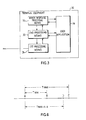
- the annex response processing means 33 includes a signalling means 41, a register 42, and a timing generator 43.
- the signalling means 41 is connected to a signalling section of a digital access signalling system of a communication network via a signalling input/output terminal SG (SGI and SGO), while being connected to the user application 34 of the TE 30 via an application terminal AP (AP1 and AP2). Further, the signalling means 41 is connected to a count-up terminal TCE of the timing generator 43 via a count-up terminal SCE.
- the timing generator 43 is connected to a count start terminal SCS of the signalling means 41 via a count start terminal TCS, and to a control output terminal CO of the register 42 via a control input terminal CI.
- the register 42 is connected to the user application 34 via a state input terminal ST, and to a number-information output terminal SAD of the signalling means 41 via a number-information input terminal RAD.
- the signalling input terminal SGI of the signalling means 41 is connected to a SETUP message comparator (SMC) 411.
- the output of the SMC 411 is delivered via the count start terminal SCS.
- the input terminal SGI is also connected to a calling party number and attribute value extractor (CAE) 412.
- CAE calling party number and attribute value extractor
- the output of the CAE 412 is delivered via the number-information output terminal SAD.
- the signalling input terminal SGI is connected to the application terminal AP1.
- the count-up terminal SCE is connected to an input terminal C of a CONN message transmission delay means (RDC) 413.
- the RDC 413 also has an input terminal A connecting to the application terminal AP2, and an output terminal B connecting to the signalling output terminal SGO.
- the register 42 includes a memory (MEM) 421, and a register command and waiting time subtracter (RS) 422.
- the RAD is connected to an input terminal MI of the MEM 421 while the state input terminal ST is connected to an input terminal RSI of the RS 422.
- the RS 422 has an output terminal RSO connecting to a control input terminal MC of the MEM 421.
- An output terminal MO of the MEM 421 is connected to the control output terminal CO of the register 42.
- a SETUP message from a network is applied to the signalling means 41 via the signalling input terminal SGI.
- the contents of the message are reported to the user application 44, Fig. 3, via the application terminal AP1.
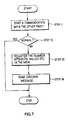
- the signalling means 41 delivers a count start command to the count start terminal TCS of the timing generator 43 via the count start terminal SCS (Fig. 7, STEP 1). This is represented by a time A in Fig. 6, i.e., a SETUP message receipt time.
- the CAE 412 of the signalling means 41 extracts the calling party number and attribute values of the call from the SETUP message and, then, feed them to the number-information input terminal RAD of the register 42 via the number-information output terminal SAD.
- the user application 34 Analyzing the contents of the SETUP message, the user application 34 performs compatibility checking, i.e., it compares "bearer capability” and, if necessary, "low layer compatibility", “high layer compatibility” and "user-user” information elements with those of the own terminal 30 (STEP 2). When decided that the call is compatible with the TE 30 (STEP 3), the user application 34 delivers a respond command to the application terminal AP2.
- the calling party number and the attribute values of the call extracted from the present message by the CAE 412 are applied to the MEM 421 of the register 42 via the terminal MI to be compared with those which were stored at the end of the last call arrival, whereby whether a call of the same contents and originated by the same calling party has ever been erroneously received is decided (STEP 4).
- the MEM 421 delivers a waiting-time set signal n to the input terminal CI of the timing generator 43 via the terminal MO and CO.
- the waiting-time set signal n is incremented by one every time a SETUP message which bears the number of the same calling party number and the same attribute values arrives at the TE 30, while being reset to zero when the TE 30 has actually accepted a call.
- the timing generator 43 When no waiting-time set signal n arrives at the timing generator 43, i.e., when the signal n is zero, the timing generator 43 immediately sends a count-up signal to the terminal SCE of the signalling section 41 via the count-up terminal TCE.
- the RDC 413 of the signalling means 41 When the RDC 413 of the signalling means 41 receives on its terminal A a response signal which is applied to the means 41 from the user application 34 via the terminal AP2 and, at the same time, on its terminal C a count end signal which is delivered to the means 41 from the timing generator 43 via the terminal SCE, the RDC 413 returns a CONN message to the network 10 via the terminals B and SGO (STEP 6).
- a time B is the shortest possible response time
- the interval between the time A and the time B is the shortest response interval T MIN .
- the timing generator 43 executes waiting time processing by one of two predetermined methods as follows.
- the first method is incrementing the waiting time T W every time an incompatible call arrives and, thereby, delaying a response until a maximum period of time T MAX which the network 10 allows expires.
- T W T MIN + n ⁇ ⁇ ⁇ ⁇ T MAX (1) where ⁇ is representative of a unit change of the response interval.
- the timing generator 43 counts time according to the equation (1) on the basis of the waiting-time set signal n which is fed from the MEM 421 and, on the expiry of the waiting time T W , feeds a count-up signal from its count-up terminal TCE to the terminal SCE of the signalling means 41.
- the timing generator 43 delivers a count-up signal via its count-up terminal TCE to the terminal SCE of the signalling means 41 at a time when the period of time elapsed since the count start time A of Fig. 6 reaches the equation (2), e.g., a time D.
- the RDC 413 When the response command from the user application 34 is fed to the input terminal A of the RDC 413 of the signalling means 41 and the count-up signal is fed to the input terminal C, the RDC 413 returns a CONN message from its output terminal B to the network 10 via the signalling output terminal SGO (STEP 6).
- the TE 30 when the TE 30 is to accept a call for the first time, it will return a CONN message on the expiry of the minimum period of time T MIN .
- a call received is not meant for the terminal TE, even though the calling party may call again indicating the same attribute values, a CONN message for that call is delayed and, hence, any other terminal which is returning a CONN message is allowed to accept the call.
- processing subsequent to the start of a communication is executed as follows. After the start of a communication with the other party (STEP 11), whether the communication is normal is determined (STEP 12). If the communication is normal, it is continued without interruption. If the communication is abnormal, the number, attribute values and others of the calling party which were extracted by the CAE 412 and stored into the MEM 421 at the beginning of the communication, as previously stated, are registered in the MEM 421 according to a command given by the user application 34 via the terminal ST (STEP 13). Further, the user application 34 delivers a DISConnect message send command to the second processing means 32, Fig. 3, so as to clear the call. This second processing means 32 and the first processing means 31 execute the processing of the Layers 1 to 3, whereby a DISConnect message is sent to clear the call.
Landscapes
- Engineering & Computer Science (AREA)
- Computer Networks & Wireless Communication (AREA)
- Communication Control (AREA)
Claims (2)
- Endgerät zur Abgabe einer Antwort auf einen ankommenden Anruf, mit mehreren Kommunikationsendgeräten (23, 24, 25, ..., 2n), die sich eine einzige Teilnehmernummer teilen, und jeweils eine Einrichtung (33) aufweisen zum Zurücksenden einer Antwortnachricht, wenn die Attributwerte des Endgerätes und die in einer empfangenen Nachricht enthaltenen Attributwerte, die die Teilnehmernummer des entsprechenden Kommunikationsendgerätes trägt, untereinander identisch sind, dadurch gekennzeichnet, daß jedes Kommunikationsendgerät (23, 24, 25, ..., 2n) eine Einrichtung (421) zum Speichern mindestens einer Nummer eines rufenden Teilnehmers und der Attributwerte eines Rufs, der von einem anrufenden Teilnehmer herrührt und durch das zugehörige Kommunikationsendgerät empfangen wird, wenn der Anruf nicht für das betreffende Endgerät gedacht ist, sowie eine Einrichtung (43, 413) aufweist, um den Absendezeitpunkt für eine Antwortnachricht jedesmal dann, wenn ein Anruf, der die gleiche Nummer des anrufenden Teilnehmers und die gleichen Attributwerte trägt, empfangen wird, bis zu einem Zeitraum zu verzögern, der durch das Kommunikationsendgerät bestimmt wird.
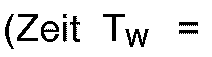
- Antwortsystem eines Endgeräts auf einen ankommenden Anruf, mit mehreren Kommunikationsendgeräten (23, 24, 25, ..., 2n), die sich eine einzige Teilnehmernummer teilen, wobei jedes Endgerät eine Einrichtung (33) aufweist zum Rücksenden einer Antwortnachricht, wenn Attributwerte des Endgeräts und Attributwerte, die in einer empfangenen Nachricht enthalten sind, die die Teilnehmernummer des Kommunikationsendgerätes trägt, untereinander identisch sind, wobei das Antwortsystem dadurch gekennzeichnet ist, daß jedes Endgerät ferner eine Einrichtung (43, 413) aufweist, um die Antworteinrichtung (33) zu einem Zeitpunkt D zu aktivieren, wenn ein Zeitraum

Applications Claiming Priority (2)
| Application Number | Priority Date | Filing Date | Title |
|---|---|---|---|
| JP61105682A JPH0685538B2 (ja) | 1986-05-07 | 1986-05-07 | 通信端末着信応答方式 |
| JP105682/86 | 1986-05-07 |
Publications (3)
| Publication Number | Publication Date |
|---|---|
| EP0245025A2 EP0245025A2 (de) | 1987-11-11 |
| EP0245025A3 EP0245025A3 (en) | 1989-05-31 |
| EP0245025B1 true EP0245025B1 (de) | 1993-01-07 |
Family
ID=14414187
Family Applications (1)
| Application Number | Title | Priority Date | Filing Date |
|---|---|---|---|
| EP87303848A Expired - Lifetime EP0245025B1 (de) | 1986-05-07 | 1987-04-29 | Antwortsystem eines Endgeräts auf einen ankommenden Anruf |
Country Status (5)
| Country | Link |
|---|---|
| US (1) | US4975900A (de) |
| EP (1) | EP0245025B1 (de) |
| JP (1) | JPH0685538B2 (de) |
| CA (1) | CA1288153C (de) |
| DE (1) | DE3783387T2 (de) |
Families Citing this family (11)
| Publication number | Priority date | Publication date | Assignee | Title |
|---|---|---|---|---|
| JP2785835B2 (ja) * | 1989-11-20 | 1998-08-13 | 富士通株式会社 | 通信端末装置および該装置を用いる通信端末システム |
| JPH03214841A (ja) * | 1990-01-19 | 1991-09-20 | Fujitsu Ltd | パケット通信手順によるモデムプール方式 |
| JPH03289732A (ja) * | 1990-03-16 | 1991-12-19 | Fujitsu Ltd | 複数端末における着信処理方式及び端末 |
| DE69121609T2 (de) * | 1990-03-16 | 1997-01-23 | Matsushita Graphic Communic | Verfahren und Terminaleinrichtung zur Verarbeitung ankommender Meldungen |
| JPH057272A (ja) * | 1991-03-11 | 1993-01-14 | Fuji Xerox Co Ltd | フアクシミリ装置 |
| JP2538132B2 (ja) * | 1991-03-20 | 1996-09-25 | 松下電送株式会社 | 通信制御方法及びisdn用端末アダプタ装置 |
| JP2971625B2 (ja) * | 1991-07-04 | 1999-11-08 | 株式会社東芝 | 電子交換機における切断理由設定方式 |
| US5388095A (en) * | 1993-08-06 | 1995-02-07 | Telefonaktiebolaget L M Ericsson | Representing subscribers in a multiple interface environment switching system |
| JP3419868B2 (ja) * | 1993-12-28 | 2003-06-23 | 富士通株式会社 | 信号送信方式 |
| DE69516634T2 (de) * | 1994-11-04 | 2000-09-21 | Canon Information Systems, Inc. | Intelligente Wiederprogrammierung eines Flash-Speichers |
| JPH118884A (ja) * | 1997-06-18 | 1999-01-12 | Toshiba Corp | メッセージ通信方法および装置 |
Family Cites Families (7)
| Publication number | Priority date | Publication date | Assignee | Title |
|---|---|---|---|---|
| US4379946A (en) * | 1980-06-05 | 1983-04-12 | Nippon Telegraph & Telephone Public Corporation | Signalling system and signal control equipment for multi-address calling |
| JPS59154829A (ja) * | 1983-02-24 | 1984-09-03 | Oki Electric Ind Co Ltd | Avmシステムの信号伝送方式 |
| JPS611153A (ja) * | 1984-05-17 | 1986-01-07 | Fujitsu Ltd | 複数コ−ル同時着信制御方法 |
| DE3431420C1 (de) * | 1984-08-27 | 1985-10-24 | Telefonbau Und Normalzeit Gmbh, 6000 Frankfurt | Verfahren zum Erreichen einer gleichmäßigen Auslastung oder gezielten Benutzung von an digitalen Anschlußleitungen betriebenen Fernmelde-Endgeräten |
| JP2550937B2 (ja) * | 1985-03-04 | 1996-11-06 | 国際電信電話株式会社 | Isdn加入者系端末制御方式 |
| JPS6224746A (ja) * | 1985-07-25 | 1987-02-02 | Oki Electric Ind Co Ltd | 端末制御方式 |
| US4873716A (en) * | 1988-12-27 | 1989-10-10 | American Telephone And Telegraph Company, At&T Bell Laboratories | Path allocation arrangement for multi-terminal groups |
-
1986
- 1986-05-07 JP JP61105682A patent/JPH0685538B2/ja not_active Expired - Lifetime
-
1987
- 1987-04-29 EP EP87303848A patent/EP0245025B1/de not_active Expired - Lifetime
- 1987-04-29 DE DE8787303848T patent/DE3783387T2/de not_active Expired - Fee Related
- 1987-05-07 CA CA000536570A patent/CA1288153C/en not_active Expired - Lifetime
-
1989
- 1989-08-01 US US07/388,146 patent/US4975900A/en not_active Expired - Lifetime
Also Published As
| Publication number | Publication date |
|---|---|
| EP0245025A2 (de) | 1987-11-11 |
| US4975900A (en) | 1990-12-04 |
| DE3783387T2 (de) | 1993-05-06 |
| DE3783387D1 (de) | 1993-02-18 |
| EP0245025A3 (en) | 1989-05-31 |
| JPH0685538B2 (ja) | 1994-10-26 |
| CA1288153C (en) | 1991-08-27 |
| JPS62261252A (ja) | 1987-11-13 |
Similar Documents
| Publication | Publication Date | Title |
|---|---|---|
| US4958153A (en) | Method and apparatus for priority control of incoming calls at ISDN terminals | |
| EP0323083B1 (de) | Kommunikationsendgerät | |
| US5208806A (en) | Isdn terminal equipment operating with circuit switching mode and packet switching mode | |
| EP0245025B1 (de) | Antwortsystem eines Endgeräts auf einen ankommenden Anruf | |
| US5305313A (en) | Electronic switching system for use in connection to an ISDN and method of setting communication disconnection reasons | |
| EP0331531B1 (de) | Telefonapparat und Steuerungsverfahren dafür | |
| JP3252760B2 (ja) | Cug呼制御方法 | |
| JP3149262B2 (ja) | Isdn端末装置の通信方法 | |
| JP2751193B2 (ja) | Isdn端末着呼優先権制御方法およびその装置 | |
| JPH02156763A (ja) | Isdnにおける着呼応答制御方式 | |
| JPH01209858A (ja) | 着呼制御方式 | |
| JP3169235B2 (ja) | Isdn端末装置およびその呼設定制御方法 | |
| JP2739526B2 (ja) | 遠隔端末保守制御方式 | |
| EP1006705A1 (de) | Fernsprechnebenstellenanlage und Verfahren zum Aufbau einer Verbindung | |
| JP2794349B2 (ja) | 着信制御方式 | |
| JP2922541B2 (ja) | メッセージ伝送方式 | |
| JP2534007B2 (ja) | 着信制御装置および着信制御方法 | |
| JPH0371748A (ja) | 非同期転送モード通信装置 | |
| KR20030057047A (ko) | 사설교환기의 착신호 자동 분배방법 | |
| JPH0522473A (ja) | Isdn端末装置 | |
| JPH05244265A (ja) | 通信システム | |
| JPH0468760A (ja) | ファクシミリ装置 | |
| JPH01177773A (ja) | ファクシミリ装置 | |
| JPS63284960A (ja) | 通信端末着信応答方式 | |
| JPH09294200A (ja) | 通信システム |
Legal Events
| Date | Code | Title | Description |
|---|---|---|---|
| PUAI | Public reference made under article 153(3) epc to a published international application that has entered the european phase |
Free format text: ORIGINAL CODE: 0009012 |
|
| 17P | Request for examination filed |
Effective date: 19870512 |
|
| AK | Designated contracting states |
Kind code of ref document: A2 Designated state(s): DE FR GB SE |
|
| PUAL | Search report despatched |
Free format text: ORIGINAL CODE: 0009013 |
|
| AK | Designated contracting states |
Kind code of ref document: A3 Designated state(s): DE FR GB SE |
|
| 17Q | First examination report despatched |
Effective date: 19910612 |
|
| GRAA | (expected) grant |
Free format text: ORIGINAL CODE: 0009210 |
|
| AK | Designated contracting states |
Kind code of ref document: B1 Designated state(s): DE FR GB SE |
|
| REF | Corresponds to: |
Ref document number: 3783387 Country of ref document: DE Date of ref document: 19930218 |
|
| ET | Fr: translation filed | ||
| PLBE | No opposition filed within time limit |
Free format text: ORIGINAL CODE: 0009261 |
|
| STAA | Information on the status of an ep patent application or granted ep patent |
Free format text: STATUS: NO OPPOSITION FILED WITHIN TIME LIMIT |
|
| 26N | No opposition filed | ||
| EAL | Se: european patent in force in sweden |
Ref document number: 87303848.3 |
|
| REG | Reference to a national code |
Ref country code: GB Ref legal event code: IF02 |
|
| PGFP | Annual fee paid to national office [announced via postgrant information from national office to epo] |
Ref country code: FR Payment date: 20020410 Year of fee payment: 16 |
|
| PGFP | Annual fee paid to national office [announced via postgrant information from national office to epo] |
Ref country code: SE Payment date: 20020417 Year of fee payment: 16 |
|
| PGFP | Annual fee paid to national office [announced via postgrant information from national office to epo] |
Ref country code: GB Payment date: 20020424 Year of fee payment: 16 |
|
| PGFP | Annual fee paid to national office [announced via postgrant information from national office to epo] |
Ref country code: DE Payment date: 20020508 Year of fee payment: 16 |
|
| PG25 | Lapsed in a contracting state [announced via postgrant information from national office to epo] |
Ref country code: GB Free format text: LAPSE BECAUSE OF NON-PAYMENT OF DUE FEES Effective date: 20030429 |
|
| PG25 | Lapsed in a contracting state [announced via postgrant information from national office to epo] |
Ref country code: SE Free format text: LAPSE BECAUSE OF NON-PAYMENT OF DUE FEES Effective date: 20030430 |
|
| PG25 | Lapsed in a contracting state [announced via postgrant information from national office to epo] |
Ref country code: DE Free format text: LAPSE BECAUSE OF NON-PAYMENT OF DUE FEES Effective date: 20031101 |
|
| EUG | Se: european patent has lapsed | ||
| GBPC | Gb: european patent ceased through non-payment of renewal fee | ||
| PG25 | Lapsed in a contracting state [announced via postgrant information from national office to epo] |
Ref country code: FR Free format text: LAPSE BECAUSE OF NON-PAYMENT OF DUE FEES Effective date: 20031231 |
|
| REG | Reference to a national code |
Ref country code: FR Ref legal event code: ST |