EP0241710B1 - Guar-Mehl - Google Patents
Guar-Mehl Download PDFInfo
- Publication number
- EP0241710B1 EP0241710B1 EP87103517A EP87103517A EP0241710B1 EP 0241710 B1 EP0241710 B1 EP 0241710B1 EP 87103517 A EP87103517 A EP 87103517A EP 87103517 A EP87103517 A EP 87103517A EP 0241710 B1 EP0241710 B1 EP 0241710B1
- Authority
- EP
- European Patent Office
- Prior art keywords
- guar
- flour
- guar flour
- weight
- water
- Prior art date
- Legal status (The legal status is an assumption and is not a legal conclusion. Google has not performed a legal analysis and makes no representation as to the accuracy of the status listed.)
- Expired - Lifetime
Links
Classifications
-
- C—CHEMISTRY; METALLURGY
- C08—ORGANIC MACROMOLECULAR COMPOUNDS; THEIR PREPARATION OR CHEMICAL WORKING-UP; COMPOSITIONS BASED THEREON
- C08B—POLYSACCHARIDES; DERIVATIVES THEREOF
- C08B37/00—Preparation of polysaccharides not provided for in groups C08B1/00 - C08B35/00; Derivatives thereof
-
- A—HUMAN NECESSITIES
- A61—MEDICAL OR VETERINARY SCIENCE; HYGIENE
- A61K—PREPARATIONS FOR MEDICAL, DENTAL OR TOILETRY PURPOSES
- A61K47/00—Medicinal preparations characterised by the non-active ingredients used, e.g. carriers or inert additives; Targeting or modifying agents chemically bound to the active ingredient
- A61K47/30—Macromolecular organic or inorganic compounds, e.g. inorganic polyphosphates
- A61K47/36—Polysaccharides; Derivatives thereof, e.g. gums, starch, alginate, dextrin, hyaluronic acid, chitosan, inulin, agar or pectin
-
- A—HUMAN NECESSITIES
- A23—FOODS OR FOODSTUFFS; TREATMENT THEREOF, NOT COVERED BY OTHER CLASSES
- A23L—FOODS, FOODSTUFFS OR NON-ALCOHOLIC BEVERAGES, NOT OTHERWISE PROVIDED FOR; PREPARATION OR TREATMENT THEREOF
- A23L29/00—Foods or foodstuffs containing additives; Preparation or treatment thereof
- A23L29/20—Foods or foodstuffs containing additives; Preparation or treatment thereof containing gelling or thickening agents
- A23L29/206—Foods or foodstuffs containing additives; Preparation or treatment thereof containing gelling or thickening agents of vegetable origin
- A23L29/238—Foods or foodstuffs containing additives; Preparation or treatment thereof containing gelling or thickening agents of vegetable origin from seeds, e.g. locust bean gum or guar gum
-
- A—HUMAN NECESSITIES
- A61—MEDICAL OR VETERINARY SCIENCE; HYGIENE
- A61K—PREPARATIONS FOR MEDICAL, DENTAL OR TOILETRY PURPOSES
- A61K31/00—Medicinal preparations containing organic active ingredients
- A61K31/70—Carbohydrates; Sugars; Derivatives thereof
- A61K31/715—Polysaccharides, i.e. having more than five saccharide radicals attached to each other by glycosidic linkages; Derivatives thereof, e.g. ethers, esters
-
- C—CHEMISTRY; METALLURGY
- C08—ORGANIC MACROMOLECULAR COMPOUNDS; THEIR PREPARATION OR CHEMICAL WORKING-UP; COMPOSITIONS BASED THEREON
- C08L—COMPOSITIONS OF MACROMOLECULAR COMPOUNDS
- C08L5/00—Compositions of polysaccharides or of their derivatives not provided for in groups C08L1/00 or C08L3/00
- C08L5/14—Hemicellulose; Derivatives thereof
Definitions
- the invention relates to an orally administered medicament, in particular for delaying glucose absorption, for lowering blood cholesterol levels, for reducing premature feeling of hunger and for regulating intestinal peristalsis in humans, and for an orally administered contrast medium.
- Swelling agents are usually naturally occurring or semi-synthetic swellable, non-digestible polysaccharides. You keep the contents of the intestine supple, increase its viscosity and water content. Added to this is the increased peristalsis due to the intestinal filling. Examples of swelling agents are methyl cellulose, carboxymethyl cellulose, agar agar and guar flour.
- Guar flour has the ability to swell quickly in water. Even small amounts of guar flour with water result in large volumes of jelly. Guar flour is a natural product, namely a polysaccharide, which consists of approximately two parts of mannose and one part of galactose. Guar flour is not enzymatically hydrolyzed after oral intake and is therefore not absorbed. It is known to be well tolerated.
- EP-A-0 080 673 describes guar flour tablets which are to be administered orally and which are produced, inter alia, from guar flour with a grain size of 60 to 500 ⁇ m.
- GB-A-2 030 583 describes using granules made from guar flour, the particles of which have a particle size of up to 95% by weight and a grain size of 100 to 1000 ⁇ m. Due to their particle size, these granules are easily suspendable in water, but only swell to a viscous gel after a few minutes, so that they can be drunk.
- Guar is also used as a dietary and food additive, particularly in terms of a) and b).
- guar As a drug or food additive is the high dose required. Daily doses of at least 10 g guar are usually necessary both for delaying glucose absorption and for lowering cholesterol levels.
- Guar is usually supplied as white to yellowish, largely tasteless flour. This flour cannot be taken in a dry state as it would stick the mouth, throat and esophagus. Stirred with a little water, the flour results in a stiff jelly that cannot be swallowed either. In addition, the commercially available guar flours tend to form lumps unless they are stirred very intensively. A sufficiently thin solution that can be drunk is only obtained when stirred into a very large amount of water.
- the object of the invention is therefore to bring guar flour into such a form that, in particular, also allows older and less resilient patients to take amounts of about 3 to 5 g several times a day.
- Large and difficult-to-swallow medicinal forms, such as capsules, should not be chosen, nor should the guar flour be drunk in too large quantities of liquid, form lumps or have unpleasant taste properties or be disruptive to the patient due to its consistency.
- the described advantageous properties of the guar flour are to be retained.
- the invention therefore relates to an orally administered medicament which is distinguished by the fact that it contains physically and chemically unchanged loose guar flour, the grain size of which is 90-100% by weight in the range from 50 to 1500 ⁇ m.
- the invention furthermore relates to medicaments to be administered orally for delaying glucose absorption and for lowering blood cholesterol levels and for reducing premature feeling of hunger and for regulating intestinal peristalsis in humans, each of which is characterized by a content of physically and chemically unchanged loose guar flour, the grain size of which Mark 90-100% by weight in the range of 50 - 1500 ⁇ m.
- Another object of the invention is an oral contrast medium which is characterized by an admixture of physically and chemically unchanged guar flour, the grain size of which is 90-100% by weight in the range of 50-1500 ⁇ m.
- the invention represents a surprisingly simple solution to the problem that has been dealt with for years.
- pure guar flour is used without the use of additives, which can be taken comfortably, risk-free and pleasantly with a little water.
- the basis of the invention is the observation that the fine fraction (grains ⁇ 100 ⁇ m) of the common guar flours, even if their quantitative fraction is very small, is responsible for the extremely rapid gelation of the slurries of the usual guar flours.
- 4g of ordinary guar flour - introduced in 150 to 200 ml of water - becomes inextricably viscous within 10 to 30 seconds.
- Another major disadvantage of the common guar flours is the almost inevitable formation of lumps of unswollen flour, enclosed in an impermeable gelatin layer. These lumps make it even more difficult to take the already highly viscous jelly.
- the proportion of fine particles is sieved off so that the remaining guar flour consists, for example, of> 95% particles of 100 ⁇ m to 500 ⁇ m in size
- a homogeneous, sufficiently fluid suspension is obtained .
- the corresponding selected flour is extremely wettable, it immediately sinks into the liquid, is easy to stir, does not form lumps and contains no particles that are noticeable in the mouth. It remains thin enough for at least five minutes to be drunk at room temperature.
- the flour described is largely tasteless, in fruit juices or other liquids it takes on its taste intact.
- An agent produced according to the invention contains, for example, chemically unchanged guar flour without any additives, characterized by a proportion of> 90%, preferably> 98% guar particles with a grain diameter of 50 ⁇ m to 1500 ⁇ m, preferably 100 to 500 ⁇ m.
- the dosage can be done, for example, using a measuring spoon from a storage container, or more precisely and more hygienically by packaging the individual dose in individual containers.
- the single dose is approx. 3 to 6 g, preferably 4 g of pure guar flour. 2 to 5 single doses are taken per day.
- the flour is mixed with a corresponding volume of aqueous liquid, preferably 100 to 200 ml / 4 g of flour each and drunk within about 0 to 20, preferably 0 to 5 minutes after complete mixing.
- the flour itself can be added flavorings and aromas, foaming agents such as NaHC0 3 and citric acid, vitamins, minerals and in particular drugs, the absorption of which is to be delayed.
- foaming agents such as NaHC0 3 and citric acid
- vitamins, minerals and in particular drugs the absorption of which is to be delayed.
- the latter variant is particularly valuable if the patient's illnesses require simultaneous treatment with guar and a drug that normally either has high blood levels (e.g. oral antidiabetic drugs) or a short half-life (e.g. lipid-lowering agent).
- the guar flour used according to the invention can be administered orally to lower the blood cholesterol level or to regulate the intestinal peristalsis.
- guar preparation In the case of diagnostic examinations of the stomach or intestine, uniform filling of the lumen or wall fittings may be desirable. In this case too, the use of the guar preparation described is useful, in particular because of its good dispersibility and pleasant taste. The miscibility with contrast media of various types is flawless. The desired high viscosities in the stomach and intestines are achieved by swelling the larger guar particles as well. In the case of osmotically active contrast agents, the addition of sufficient amounts of guar can significantly reduce their diarrhea-inducing effect.
- the addition of the substances mentioned, in particular also the taste-determining substances, can be done very well by the choice of the liquid (e.g. fruit juices) in which the guar flour is suspended. In this way, the choice of flavor is left to the patient.
- the liquid e.g. fruit juices
- Aqueous suspensions in which the content of the guar flour is at least 2% by weight are preferred.
- the grain size fractions required according to the invention are obtained from conventional guar flours by customary separation processes, for example by sieving.
- 3g guar flour, grain size> 98% by weight> 100 ⁇ m ⁇ 500 ⁇ m, are mixed uniformly with 50 mg vitamin C, 20 mg MgC0 3 and 20 mg NaHC0 3 and packed in a bag. The entire contents of the bag are stirred into 100 ml of cold water and soon drunk.
- guar flour 4 g of guar flour, grain size> 98% by weight> 100 ⁇ m ⁇ 500 ⁇ m, are evenly mixed with 3.5 mg of glibenclamide as an anti-diabetic agent and filled into a bag. The entire contents of the bag are suspended in 150 ml of water and soon drunk.
- GLUCOTARDO guar flour compressed into tablets with the addition of silica gel to tablets
- GUAREM® guar granules with additives
- the swellability was assessed on the basis of the viscosity of a 1% preparation in water after a limited swell time.
- the guar flour is first stirred in the respective volume of water at 18 ° C.
- the approximately homogeneous suspension is then introduced after about 30 seconds into a 110 ml cylindrical storage container with a diameter of about 15 mm and with an attached cylindrical tube of 20 mm in length and an opening of 5 mm in diameter.
- the outlet opening is opened exactly one minute after the guar material has come into contact with the water.
- the time for the leakage of 10 and 30 ml is then measured. In a second attempt, the outlet opening is only released after a five minute swelling time.
- the preparation GU-052 according to the invention is fully swellable and thus fulfills an essential requirement for good effectiveness. This applies in particular to the application options, which are concerned with delaying undesired rapid absorption (e.g. glucose in diabetics).
Landscapes
- Health & Medical Sciences (AREA)
- Chemical & Material Sciences (AREA)
- Life Sciences & Earth Sciences (AREA)
- Medicinal Chemistry (AREA)
- General Health & Medical Sciences (AREA)
- Veterinary Medicine (AREA)
- Polymers & Plastics (AREA)
- Public Health (AREA)
- Pharmacology & Pharmacy (AREA)
- Epidemiology (AREA)
- Animal Behavior & Ethology (AREA)
- Molecular Biology (AREA)
- Organic Chemistry (AREA)
- Chemical Kinetics & Catalysis (AREA)
- Engineering & Computer Science (AREA)
- Nutrition Science (AREA)
- Food Science & Technology (AREA)
- Dispersion Chemistry (AREA)
- Inorganic Chemistry (AREA)
- Biochemistry (AREA)
- Materials Engineering (AREA)
- Medicinal Preparation (AREA)
- Pharmaceuticals Containing Other Organic And Inorganic Compounds (AREA)
- Polysaccharides And Polysaccharide Derivatives (AREA)
- Noodles (AREA)
- Medicines Containing Antibodies Or Antigens For Use As Internal Diagnostic Agents (AREA)
- Cereal-Derived Products (AREA)
- Compositions Of Macromolecular Compounds (AREA)
- Jellies, Jams, And Syrups (AREA)
Description
- Die Erfindung betrifft ein oral zu verabfolgendes Arzneimittel, insbesondere zur Verzögerung der Glucoseabsorption, zur Senkung des Blutcholesterinspiegels, zur Verringerung eines vorzeitigen Hungergefühls und zur Regulierung der intestinalen Peristaltik beim Menschen sowie ein oral zu verabfolgendes Kontrastmittel.
- Quellmittel sind in der Regel natürlich vorkommende oder halbsynthetische quellfähige, nicht verdauliche Polysaccharide. Sie erhalten den Darminhalt geschmeidig, erhöhen dessen Viskosität und Wassergehalt. Hinzu kommt die durch die Darmfüllung gesteigerte Peristaltik. Beispiele für Quellmittel sind Methylcellulose, Carboxymethylcellulose, Agar-Agar und Guar-Mehl.
- Bei allen Quellmitteln ist darauf zu achten, daß genügend Wasser aufgenommen wird, da sonst der Darminhalt verklebt und Ileusgefahr besteht.
- Guar-Mehl hat die Fähigkeit, in Wasser rasch aufzuquellen. Bereits geringe Mengen an Guar-Mehl ergeben mit Wasser große Volumina Gallerte. Guar-Mehl ist ein Naturprodukt, und zwar ein Polysaccharid, welches zu etwa zwei Teilen aus Mannose und zu einem Teil aus Galaktose besteht. Guar-Mehl wird nach oraler Einnahme nicht enzymatisch hydrolysiert und daher auch nicht resorbiert. Es ist als gut verträglich bekannt.
- In der EP-A-0 080 673 sind oral zu verabfolgende Guar-Mehl Tabletten beschrieben, die unter anderem aus Guar-Mehl einer Korngröße von 60 bis 500 um hergestellt sind. Die GB-A-2 030 583 beschreibt unter Verwendung von aus Guar-Mehl hergestellte Granulate, deren Partikel bis zu 95 Gew.-% eine Korngröße von 100 bis 1000 um haben. Diese Granulate sind, aufgrund ihrer Partikelgröße, im Wasser leicht suspendierbar, quellen aber erst nach einigen Minuten zu einem viskosen Gel durch, so daß sie getrunken werden können.
- Beide Literaturquellen weisen sowohl auf das Quellvermögen der entsprechenden Guar-Tabletten bzw. Guar-Granulate als auch auf die Verwendung von Guar als Verdickungsmittel für Appreturen und zur Senkung des Cholesterin- und Glukose-Blutspiegels hin.
- In der Medizin hat Guar aus mehreren Gründen Verwendung gefunden:
- a) Es verzögert die Resorption von Nährstoffen, insbesondere von Glucose, wenn es vor den Mahlzeiten eingenommen wird, wie in Lembcke,B.; Ebert,R.; Ptok,M; Caspary,W.F.; Crentzfeldt,W.; Schicha,H.; Emrich,D.; Role of gastrointestinal transit in the delay of absorption by viscous fibre (guar); Hepatogastroenterol. 31,4; 183-186 (1984) gezeigt wurde.
- b) Ferner senkt es den Blutcholesteringehalt, wie in Bosello,O.; Caminacini,L.; Zocca,l.; Garbin,U.; Ferrari,F.; Davoli,A.; Effects of guar gum on plasma lipoproteins and apolipoproteins C-II and C-III in patients affected by familial combined hyperlipoproteinemia; The American Journ. of Clinical Nutrition 40, 6; 1165-1174 (1984) dargestellt wurde.
- c) Es wirkt appetithemmend
- d) Es reguliert die Darmperistaltik.
- Insbesondere unter den Gesichtspunkten a) und b) wird Guar auch als Diätetikum und Nahrungsmittelzusatz eingesetzt.
- Ein Problem bei der Verwendung von Guar als Arnzeimittel bzw. Nahrungsmittelzusatz ist die erforderliche hohe Dosis. Sowohl für die Glucoseresorptionsverzögerung als auch für die Senkung des Cholesterinspiegels sind üblicherweise Tagesdosen von mindestens 10g Guar notwendig.
- Guar wird normalerweise als weißes bis gelbliches, weitgehend geschmacksneutrales Mehl zur Verfügung gestellt. Dieses Mehl kann nicht in trockenem Zustand eingenommen werden, da es Mund, Rachen und Speiseröhre verkleben würde. Mit wenig Wasser angerührt, ergibt das Mehl eine steife Gallerte, die ebenfalls nicht geschluckt werden kann. Darüber hinaus neigen die handelsüblichen Guar-Mehle zur Klumpenbildung, sofern sie nicht sehr intensiv gerührt werden. Erst beim Einrühren in eine sehr große Menge an Wasser wird eine hinreichend dünnflüssige Lösung erhalten, die getrunken werden kann.
- Beim handelsüblichen Guar-Mehl besteht aufgrund des nach der Einnahme sofort einsetzenden Quellvorganges sogar eine erhebliche Erstickungsgefahr. Das naheliegende Aufschwemmen und Verdünnen des Guar-Mehls zu einer trinkbaren Lösung kommt auch nicht in Betracht, weil Guar innerhalb von Sekunden so stark quillt, daß beispielsweise zur Einnahme von 4g Guar-Mehl mindestens 400 ml Wasser erforderlich wären. Dieses Problem wurde bislang durch den Zusatz von Hilfsstoffen (Gelatine, Stärke, Puffermittel, Kieselgel) gelöst. Diese Hilfsmittel verbesserten zwar die Einnehmbarkeit des Guar-Mehls, schufen jedoch einige Probleme:
- a) Die ohnehin hohe Dosis an Guar wird durch die therapeutisch unwirksamen und teilweise sogar unerwünschten Hilfsstoffe noch erhöht.
- b) Die Hilfsstoffe treten in Wechselwirkung mit dem Guar-Mehl und können die erwünschte Quellbarkeit des Guar im Darm verringern. Eine vollständige Quellbarkeit des Guar ist jedoch Voraussetzung für die erwünschte pharmakologische Wirkung.
- c) Die Zubereitungen erhalten grundsätzlich einen partikulären Charakter, d.h. es werden makroskopische Guar-Teilchen mit einem Durchmesser von 1 mm bis >1 cm verabreicht. Diese Teilchen müssen entweder in Wasser suspendiert oder in Tablettenform eingenommen werden.
- Bedingt durch die hohe Dosis ist die täglich mehrfache Einnahme von zahlreichen oder großen Guar-Tabletten oder großen Mengen trockenen Granulats mit Wasser gerade älteren Menschen kaum zuzumuten. Bei allen partikelhaltigen Medien kommt hinzu, daß sich angequollene Teile im Mund festsetzen, womit besonders bei Trägern von Zahnersatz Probleme auftreten. Ein weiterer Nachteil partikelhaltiger Suspensionen ist es, daß die Guar-Partikel entweder an der Oberfläche schwimmen oder rasch sedimentieren, so daß dem Patienten weniger als eine Minute Zeit bleibt, um eine einigermaßen homogene Suspension nach raschem Umrühren zu trinken. Die Folge ist eine Verweigerung des Medikamentes oder jedenfalls dessen unregelmäßiger Gebrauch.
- Aufgabe der Erfindung ist es somit, Guar-Mehl in eine derartige Form zu bringen, die es insbesondere auch älteren und wenig belastbaren Patienten erlaubt, mehrmals täglich Mengen in der Größe von etwa 3 bis 5 g einzunehmen. Dabei sollten weder große und schwer zu schluckende Arzneiformen, wie beispielsweise Kapseln, gewählt werden, noch sollte das Guar-Mehl in zu großen Flüssigkeitsmengen getrunken werden müssen, Klumpen bilden oder unangenehme Geschmackseigenschaften aufweisen oder aufgrund seiner Konsistenz für den Patienten störend sein. Andererseits sollen die geschilderten vorteilhaften Eigenschaften des Guar-Mehls erhalten bleiben.
- Gegenstand der Erfindung ist daher ein oral zu verabfolgendes Arzneimittel, welches sich dadurch auszeichnet, daß es einen Gehalt an physikalisch und chemisch unverändertem losen Guarmehl, dessen Korngröße zu 90-100 Gew.-% im Bereich von 50 - 1500 um liegt, aufweist.
- Weiterhin sind Gegenstände der Erfindung oral zu verabfolgende Arzneimittel zur Verzögerung der Glucoseabsorption und zur Senkung des Blutcholesterinspiegels sowie zur Verringerung eines vorzeitigen Hungergefühls und zur Regulierung der intestinalen Peristaltik beim Menschen, die sich jeweils durch einen Gehalt an physikalisch und chemisch unverändertem losen Guarmehl, dessen Korngröße zu 90-100 Gew.- % im Bereich von 50 - 1500 um liegt, auszeichnen.
- Ein weiterer Gegenstand der Erfindung ist ein oral zu verabfolgendes Kontrastmittel, welches durch eine Beimengung an physikalisch und chemisch unverändertem Guar-Mehl, dessen Korngröße zu 90-100 Gew.- % im Bereich von 50-1500 um liegt, gekennzeichnet ist.
- Die Erfindung stellt eine überraschend einfache Lösung des seit Jahren bearbeiteten Problems dar. Im Ergebnis wird ohne Verwendung von Zusatzstoffen ein reines Guar-Mehl eingesetzt, das mit wenig Wasser bequem, risikolos und angenehm eingenommen werden kann.
- Da keine besonderen Vorkehrungen zur Verminderung oder Verzögerung der Quellfähigkeit von Guar notwendig sind, besteht auch keinerlei Risiko, daß das Guar nach der Einnahme nicht vollständig durchquillt.
- Grundlage der Erfindung ist die Beobachtung, daß der Feinanteil (Körner «100 um) der gebräuchlichen Guar-Mehle, auch wenn ihr mengenmäßiger Anteil sehr gering ist, für das äußerst rasche Gelieren der Aufschwemmungen der üblichen Guar-Mehle verantwortlich ist. Dadurch werden beispielsweise 4g gewöhnliches Guar-Mehl - eingebracht in 150 bis 200 ml Wasser - binnen 10 bis 30 Sekunden untrinkbar viskos. Ein weiterer wesentlicher Nachteil der gebräuchlichen Guar-Mehle ist die fast unvermeidliche Bildung von Klumpen unverquollenen Mehls, eingeschlossen in eine undurchlässige Gallerte-Schicht. Diese Klumpen erschweren zusätzlich die Einnahme der ohnehin hochviskosen Gallerte. Siebt man den Anteil an Feinpartikeln ab, so daß das verbleibende Guar-Mehl beispielsweise zu >95% aus Partikeln der Größe 100 um bis 500 um besteht, erhält man nach Einrühren von 4g Mehl in 100 bis 200 ml Wasser eine homogene, hinreichend dünnflüssige Suspension. Das entsprechende ausgewählte Mehl ist ausgezeichnet benetzbar, es sinkt sofort in der Flüssigkeit unter, läßt sich leicht umrühren, bildet dabei keine Klumpen und enthält keine im Mund spürbaren Partikel. Es bleibt bei Zimmertemperatur für mindestens fünf Minuten dünnflüssig genug, um getrunken zu werden. In Wasser angerührt ist das beschriebene Mehl weitgehend geschmacksneutral, in Fruchtsäften oder anderen Flüssigkeiten nimmt es deren Geschmack unverfälscht an.
- Ein erfindungsgemäß hergestelltes Mittel enthält beispielsweise chemisch unverändertes Guar-Mehl ohne jegliche Zusätze, charakterisiert durch einen Anteil von >90%, bevorzugt >98% Guar-Partikeln mit einem Korndurchmesser von 50 um bis 1500 um, vorzugsweise 100 bis 500 um. Die Dosierung kann beispielsweise über einen Meßlöffel aus einem Vorratsbehälter oder genauer und hygienisch einwandfreier durch Abpackung der Einzeldosis in Einzelbehältnisse erfolgen. Die Einzeldosis beträgt ca. 3 bis 6 g, vorzugsweise 4g reines Guar-Mehl. Es werden 2 bis 5 Einzeldosen/Tag eingenommen. Das Mehl wird mit einem entsprechenden Volumen wässriger Flüssigkeit, vorzugsweise 100 bis 200 ml/je 4g Mehl gemischt und innerhalb von ca. 0 bis 20, vorzugsweise 0 bis 5 Minuten nach dem vollständigen Mischen getrunken.
- Dem Mehl selbst können Geschmacks- und Aromastoffe, Mittel zum Aufschäumen, wie NaHC03 sowie Zitronensäure, Vitamine, Mineralstoffe und insbesondere Arzneistoffe zugesetzt werden, deren Resorption zeitlich verzögert werden soll. Letztere Variante ist besonders dann wertvoll, wenn die Erkrankungen des Patienten eine gleichzeitige Behandlung mit Guar und einem Arzneistoff erfordern, der normalerweise entweder zu hohe Blutspiegel erreicht (z.B. orale Antidiabetika) oder eine zu kurze Halbwertszeit aufweist (z.B. Lipidsenker).
- Ferner kann das erfindungsgemäß eingesetzte Guar-Mehl oral verabfolgt werden zur Senkung des Blutcholesterinspiegels oder zur Regulierung der Darmperistaltik.
- Bei diagnostischen Untersuchungen des Magens oder Darms kann eine gleichmäßige Füllung des Lumens oder ein Wandbeschlag erwünscht sein. Auch in diesem Fall ist die Anwendung der beschriebenen Guar-Zubereitung von Nutzen, insbesondere wegen ihrer guten Dispergierbarkeit und des angenehmen Geschmacks. Die Mischbarkeit mit Kontrastmitteln verschiedener Art ist einwandfrei gegeben. Im Magen und Darm werden die erwünschten hohen Viskositäten durch vollständige Quellung auch der größeren Guar-Partikel erreicht. Im Falle osmotisch aktiver Kontrastmittel kann der Zusatz von ausreichenden Mengen Guar deren Diarrhoe auslösende Wirkung deutlich vermindern.
- Der Zusatz der genannten Stoffe, insbesondere auch der geschmacksbestimmenden Stoffe, kann sehr gut durch die Wahl der Flüssigkeit (z.B. Fruchtsäfte), in der das Guar-Mehl suspendiert wird, erfolgen. Auf diese Weise bleibt die Wahl der Geschmacksrichtung dem Patienten überlassen.
- Bevorzugt sind wässrige Suspensionen, in denen der Gehalt des Guar-Mehls mindestens 2 Gew.-% beträgt. Die erfindungsgemäß erforderlichen Korngrößenfraktionen werden durch übliche Trennvorgänge, beispielsweise durch Sieben, aus im Handel befindlichen Guar-Mehlen erhalten.
- 4g Guar-Mehl, Korngröße >98% >100 um <500 um, abgepackt in Beuteln. Der Beutelinhalt wird in 150 ml Wasser bei Raumtemperatur suspendiert und bald danach getrunken.
- Ca. 6g Guar-Mehl, Korngröße 95 Gew.-% >200 um <1000 um, werden mit einem Meßlöffel aus einem Vorratsbehälter entnommen und in 200 ml gasfreier Orangenlimonade suspendiert und binnen fünf Minuten getrunken.
- 4g Guar-Mehl, Korngröße 90 Gew.-% >50 <500 um, werden in Aluminiumfolie einzeln abgepackt. Der gesamte Inhalt einer Einzelpackung wird zu 150 ml kaltem (ca. 10°C) Wasser hinzugegeben und rasch getrunken.
- 4g Guar-Mehl, Korngröße 98 Gew.-% >100 um <1500 um, werden in 150 ml frisch gepreßtem kalten Fruchtsaft (Orange, Apfel) suspendiert und bald darauf getrunken.
- 3g Guar-Mehl, Korngröße >98 Gew.-% >100 um <500 um, werden gleichmäßig mit 50 mg Vitamin C, 20 mg MgC03 und 20 mg NaHC03 gemischt und in einen Beutel verpackt. Der gesamte Beutelinhalt wird in 100 ml kaltes Wasser eingerührt und bald getrunken.
- 4g Guar-Mehl, Korngröße >98 Gew.-% >100 um <500 um, werden mit 3,5 mg Glibenclamid als antidiabetisch wirkendem Mittel gleichmäßig vermengt und in einen Beutel abgefüllt. Der gesamte Beutelinhalt wird in 150 ml Wasser suspendiert und bald getrunken.
- 4g Guar-Mehl, Korngröße >98 Gew.-% >100 um <500 um, werden mit 50 mg Magnesiumpyridoxalphosphatglutamat (I) und 5 mg MgC03 (II) gleichmäßig vermischt, indem die 1%-ige (I) bzw. 0,1%-ige (II) Lösung von 1 und II in 80%-igem Ethanol auf das Guar-Mehl aufgezogen und der Alkohol unter vorsichtigem Rühren bei 40 °C abgezogen wird. Der Rückstand wird unter vermindertem Druck auf einen Wassergehalt von <5% getrocknet. Die gesamte Zubereitung wird in Aluminiumbeutel verpackt. Der Inhalt der Beutel ist in 150 ml Wasser einzurühren und innerhalb von ca. 5 Minuten zu trinken.
- 8g Guar-Mehl,Korngröße 95 Gew.-% >50 <250 um, werden mit einer 10g Jod enthaltenden Menge Natrium-Methylglucaminamidotrizoat (10:66) vermischt und in aluminiumbeschichteten Beuteln abgepackt. Unmittelbar vor Gebrauch wird der Beutelinhalt in 1 Liter Wasser eingerührt und langsam getrunken. Die Untersuchung erfolgt mit der Computertomographie kurz nach oder maximal 16 Stunden nach Aufnahme der Zubereitung. Gegebenenfalls können kurz vor der Untersuchung nochmals 500 ml bis 1000 ml eingenommen werden.
- In den Vergleich einbezogen wurden die für die Anwendung als Arzneimittel zugelassenen Präparate GLUCOTARDO (unter Zusatz von Kieselgel zu Tabletten verpreßtes Guar-Mehl) der Firma Boehringer Mannheim, und GUAREM® (Guar-Granulat mit Hilfsstoff-Zusatz) der Fa. Lääketehdas Remeda, Finnland, die gewöhnlichen Guarmehle Müggenburg, DIAGUAR-63 und DIAGUAR-250 sowie ein Präparat (GU-052) entsprechend Beispiel 1 der vorliegenden Erfindung.
- Als Bewertungskriterien galten "gute Einnehmbarkeit" sowie "vollständige Quellbarkeit". Die Zielkriterien für die Einnehmbarkeit waren:
- - keine Erhöhung der Dosis durch Hilfsstoffe
- - keine Tabletten oder Partikel
- - für Suspensionen eine gleichmäßige Verteilung in Wasser, ohne daß das Material an der Oberfläche verharrt oder rasch sedimentiert oder gar verklumpt
- - ein neutraler Geschmack
- - Trinkbarkeit, die als Fließfähigkeit unter den in Tabelle 1 definierten Bedingungen objektiviert wurde.
- Die Quellfähigkeit wurde anhand der Viskosität einer 1%-igen Zubereitung in Wasser nach begrenzter Quellzeit beurteilt.
- Das Guar-Mehl wird zunächst in dem jeweiligen Volumen Wasser bei 18°C gerührt. Sodann wird die möglichst homogene Suspension nach etwa 30 Sekunden in einen 110 ml fassenden zylindrischen Vorratsbehälter mit einem Durchmesser von etwa 15 mm und mit einem angesetzten zylindrischen Rohr von 20 mm Länge und einer Öffnung von 5 mm im Durchmesser eingegeben. Die Auslauföffnung wird nach genau einer Minute, nachdem das Guar-Material mit dem Wasser in Berührung gekommen ist, freigegeben. Anschließend wird die Zeit für den Auslauf von 10 und 30 ml gemessen. In einem zweiten Versuch wird die Auslauföffnung erst nach fünf Minuten Quellzeit freigegeben.
- Bewertung: Solange die Guar-Suspension aus dem Behälter ausläuft, wird sie als trinkfähig angesehen.
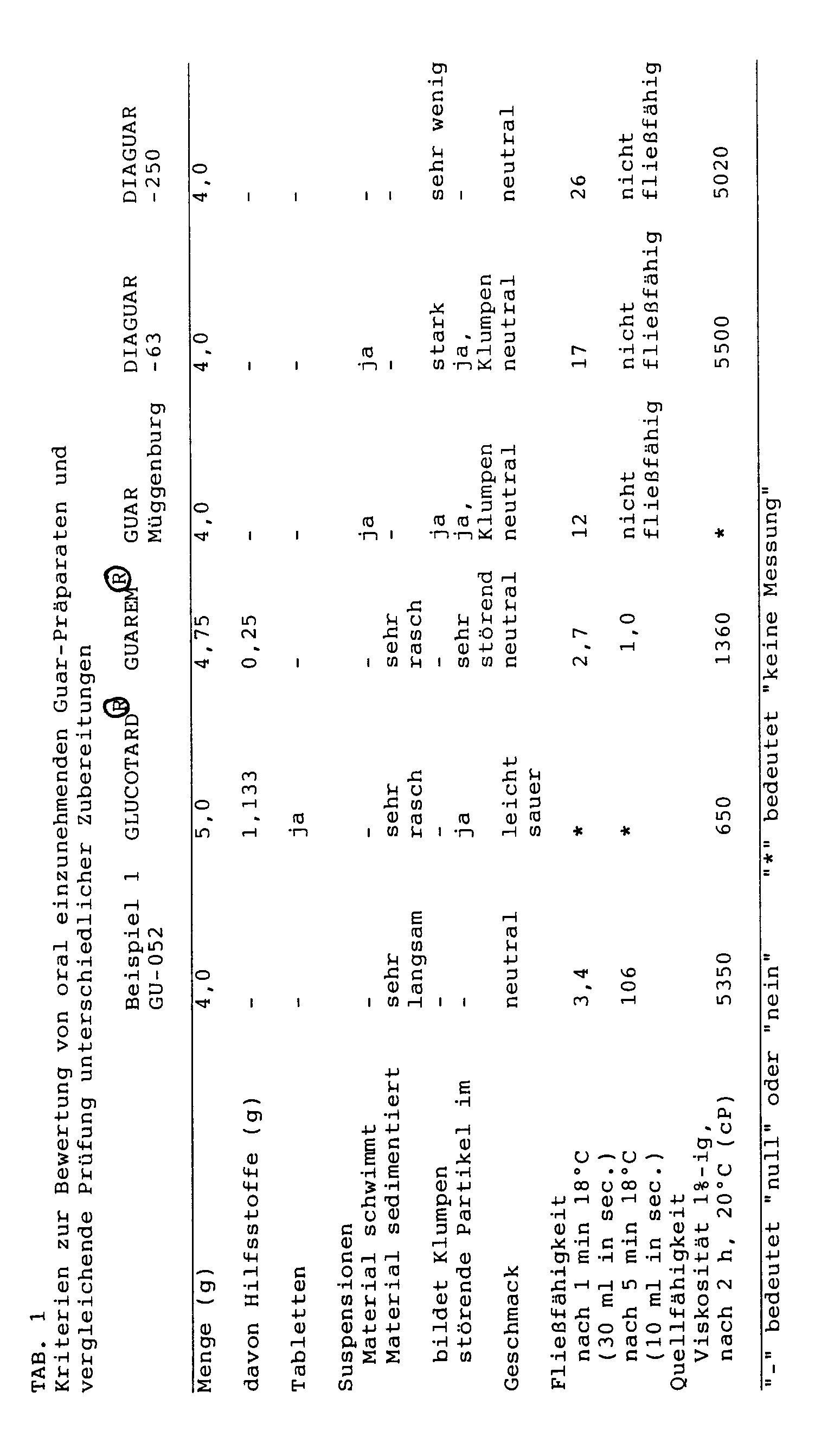
- Das erfindungsgemäße Präparat GU-052 entspricht den Zielkriterien am besten. Es enthält keine Hilfsstoffe und keine spürbaren Partikel, ist klumpenfrei in Wasser suspendierbar, schwimmt und sedimentiert nicht, ist geschmacklich neutral und bleibt, suspendiert in 200 ml (=einer Tasse) Wasser, für mindestens 5 Minuten leicht trinkbar.
- Das erfindungsgemäße Präparat GU-052 ist im Gegensatz zu den Präparaten GLUCOTARDO und GUAREMO voll quellfähig und erfüllt damit eine essentielle Anforderung für eine gute Wirksamkeit. Dies betrifft insbesondere die Anwendungsmöglichkeiten, bei denen es um die Verzögerung einer unerwünscht raschen Resorption geht (z.B. Glucose beim Diabetiker).
Claims (4)
Priority Applications (1)
| Application Number | Priority Date | Filing Date | Title |
|---|---|---|---|
| AT87103517T ATE77555T1 (de) | 1986-04-18 | 1987-03-11 | Guar-mehl. |
Applications Claiming Priority (2)
| Application Number | Priority Date | Filing Date | Title |
|---|---|---|---|
| DE3613219 | 1986-04-18 | ||
| DE19863613219 DE3613219A1 (de) | 1986-04-18 | 1986-04-18 | Guar-mehl |
Publications (3)
| Publication Number | Publication Date |
|---|---|
| EP0241710A2 EP0241710A2 (de) | 1987-10-21 |
| EP0241710A3 EP0241710A3 (en) | 1988-08-31 |
| EP0241710B1 true EP0241710B1 (de) | 1992-06-24 |
Family
ID=6299039
Family Applications (1)
| Application Number | Title | Priority Date | Filing Date |
|---|---|---|---|
| EP87103517A Expired - Lifetime EP0241710B1 (de) | 1986-04-18 | 1987-03-11 | Guar-Mehl |
Country Status (13)
| Country | Link |
|---|---|
| US (1) | US5010061A (de) |
| EP (1) | EP0241710B1 (de) |
| JP (1) | JPS62259552A (de) |
| KR (1) | KR950013774B1 (de) |
| AT (1) | ATE77555T1 (de) |
| CA (1) | CA1288354C (de) |
| DE (2) | DE3613219A1 (de) |
| DK (1) | DK169387A (de) |
| EG (1) | EG18337A (de) |
| ES (1) | ES2033709T3 (de) |
| GR (1) | GR3005765T3 (de) |
| NO (1) | NO871620L (de) |
| ZA (1) | ZA871889B (de) |
Families Citing this family (8)
| Publication number | Priority date | Publication date | Assignee | Title |
|---|---|---|---|---|
| EP0316146A1 (de) * | 1987-11-10 | 1989-05-17 | Hauser-Kuhrts, Inc. | Trinkbare Pulvermischung zur Senkung des Blutcholesterinspiegels |
| DE4025912A1 (de) * | 1990-08-16 | 1992-02-20 | Werner Ratjen | Mittel zur oralen einnahme |
| DE4029592C2 (de) * | 1990-09-19 | 1994-07-14 | Stockhausen Chem Fab Gmbh | Quellmittel und Absorptionsmittel auf Polymerbasis mit verbesserter Abbaubarkeit und verbesserter Absorption von Wasser, wäßrigen Lösungen und Körperflüssigkeiten sowie ihre Verwendung zur Herstellung von Hygieneartikeln und zur Bodenverbesserung |
| US5993860A (en) * | 1993-06-17 | 1999-11-30 | Venture Lending | NSADI delivery employing a powdered hydrocolloid gum obtainable from higher plants |
| CH691026A5 (de) * | 1995-09-28 | 2001-04-12 | Meyhall Chemical Ag Rhone Poul | Verfahren zur Herstellung von reinem Guarkernmehl. |
| USRE39125E1 (en) * | 2000-03-13 | 2006-06-13 | Ryukakusan Co. Ltd | Swallowing-assistive drink |
| DE50214914D1 (de) * | 2001-12-06 | 2011-03-31 | Schuette Reichel Gbr | Mittel zur behandlung von übergewicht in kombination mit weiteren indikationen |
| AU2004281184C1 (en) * | 2003-10-16 | 2012-01-12 | Techcom Group, Llc | Reduced digestible carbohydrate food having reduced blood glucose response |
Family Cites Families (14)
| Publication number | Priority date | Publication date | Assignee | Title |
|---|---|---|---|---|
| US2662882A (en) * | 1947-08-09 | 1953-12-15 | Gen Mills Inc | Process of preparing a hydrophilic colloid |
| GB853378A (en) * | 1958-03-12 | 1960-11-09 | Gen Mills Inc | Gum-containing masses |
| US3313800A (en) * | 1965-06-09 | 1967-04-11 | American Cyanamid Co | Product and process for preparing dispersible gums |
| US3700612A (en) * | 1971-06-23 | 1972-10-24 | Tenneco Chem | Aqueous surface-coating compositions containing hydroxyalkyl ethers of galactomannan gums as thickeners |
| GB2021948A (en) * | 1978-05-30 | 1979-12-12 | Speywood Lab Ltd | Water miscible gum composition and its preparation and use |
| EP0007619B1 (de) * | 1978-07-25 | 1983-06-22 | The Wellcome Foundation Limited | Gellierungsinhibitor enthaltendes Galaktomannan Polysaccharidgummi-Präparat |
| GB2030583A (en) * | 1978-10-02 | 1980-04-10 | Speywood Lab Ltd | Gum Granulates and their Preparation and Use |
| US4269975A (en) * | 1980-03-10 | 1981-05-26 | National Starch And Chemical Corporation | Preparation of guar gum |
| DE3139920A1 (de) * | 1981-10-08 | 1983-04-28 | Nittner, Erich, Dr., 8280 Kreuzlingen | "mittel in granulatform auf basis von polysaccharid-gummen, verfahren zu seiner herstellung und verwendung" |
| DE3263932D1 (en) * | 1981-11-28 | 1985-07-04 | Boehringer Mannheim Gmbh | Guar gum preparation forms for oral administration |
| US4576932A (en) * | 1983-01-11 | 1986-03-18 | Also Laboratori S.A.S. | Dietary supplement and method |
| US4520017A (en) * | 1983-02-04 | 1985-05-28 | Tunc Deger C | Method of reducing nutrient absorption |
| CH652930A5 (de) * | 1983-03-25 | 1985-12-13 | Wheli Inter Ag | Polysaccharid-agglomerat. |
| GB8426529D0 (en) * | 1984-10-19 | 1984-11-28 | Allied Colloids Ltd | Dry polymers |
-
1986
- 1986-04-18 DE DE19863613219 patent/DE3613219A1/de active Granted
-
1987
- 1987-03-11 AT AT87103517T patent/ATE77555T1/de not_active IP Right Cessation
- 1987-03-11 EP EP87103517A patent/EP0241710B1/de not_active Expired - Lifetime
- 1987-03-11 ES ES198787103517T patent/ES2033709T3/es not_active Expired - Lifetime
- 1987-03-11 DE DE8787103517T patent/DE3779947D1/de not_active Expired - Lifetime
- 1987-03-16 ZA ZA871889A patent/ZA871889B/xx unknown
- 1987-04-02 DK DK169387A patent/DK169387A/da not_active Application Discontinuation
- 1987-04-13 KR KR1019870003521A patent/KR950013774B1/ko not_active Expired - Fee Related
- 1987-04-15 NO NO871620A patent/NO871620L/no unknown
- 1987-04-15 EG EG213/87A patent/EG18337A/xx active
- 1987-04-16 CA CA000534996A patent/CA1288354C/en not_active Expired - Lifetime
- 1987-04-18 JP JP62094326A patent/JPS62259552A/ja active Pending
-
1990
- 1990-08-06 US US07/564,673 patent/US5010061A/en not_active Expired - Fee Related
-
1992
- 1992-09-23 GR GR920402100T patent/GR3005765T3/el unknown
Also Published As
| Publication number | Publication date |
|---|---|
| DK169387D0 (da) | 1987-04-02 |
| ATE77555T1 (de) | 1992-07-15 |
| ZA871889B (en) | 1987-09-03 |
| NO871620D0 (no) | 1987-04-15 |
| EG18337A (en) | 1992-09-30 |
| EP0241710A2 (de) | 1987-10-21 |
| DE3613219C2 (de) | 1992-04-16 |
| DE3779947D1 (de) | 1992-07-30 |
| EP0241710A3 (en) | 1988-08-31 |
| DE3613219A1 (de) | 1987-10-22 |
| NO871620L (no) | 1987-10-19 |
| GR3005765T3 (de) | 1993-06-07 |
| DK169387A (da) | 1987-10-19 |
| JPS62259552A (ja) | 1987-11-11 |
| ES2033709T3 (es) | 1993-04-01 |
| KR950013774B1 (ko) | 1995-11-15 |
| CA1288354C (en) | 1991-09-03 |
| US5010061A (en) | 1991-04-23 |
| KR870010082A (ko) | 1987-11-30 |
Similar Documents
| Publication | Publication Date | Title |
|---|---|---|
| DE69511451T2 (de) | Orale Verabreichungsformen von Azithromycin zur Vermeidung von Interaktionen mit der Nahrung | |
| DE60210604T3 (de) | Polymer-kontrolliertes induziertes viskoses ballaststoffsystem und dessen verwendungen | |
| DE1617374C2 (de) | Verfahren zum Herstellen eines pharmazeutischen Präparates mit verzögerter analgetischer Wirkung | |
| DE2813480C2 (de) | Arzneimittel-Depotpräparat vom Mehrfacheinheitsdosen-Typ | |
| DE60023873T2 (de) | Mittel zur behandlung von erkrankungen der speiseröhre | |
| DE69326350T3 (de) | Pharmazeutische formulierung | |
| DE60026459T2 (de) | Simethicon enthaltendes Abführmittel | |
| DE2907215A1 (de) | Feste depotarzneimittelpraeparate und verfahren zu deren herstellung | |
| CH660111A5 (de) | Diaet-faserprodukt. | |
| DE69816328T2 (de) | Polystyrolsulfonate-enthaltende gel-präparation | |
| DE3613219C2 (de) | ||
| DE2821015A1 (de) | Diaetetisches praeparat | |
| DE2344090A1 (de) | Cholestyramin-koazervat | |
| PT91852B (pt) | Processo para a preparacao de produtos contendo psyllium | |
| EP1663273B1 (de) | Pulverfoermige zusammensetzung zur verwendung als laxativum | |
| DE69331699T2 (de) | Zuckerfreie celluloseäther trockenmischungen als ballastabführmittel | |
| DE69629359T2 (de) | Trimebutinhaltiges arzneimittel und verfahren | |
| AU7121594A (en) | Dietary supplement based on soluble dietary fibers | |
| DE69201077T2 (de) | Alginsäure enthaltende Arzneisuspension. | |
| JPH09278661A (ja) | 懸濁液剤 | |
| CA2098199C (en) | Psyllium and cholestyramine compositions with improved palatability | |
| JP2001316274A (ja) | 経管栄養剤およびその製造方法 | |
| DE20315266U1 (de) | Pulverförmige Zusammensetzung zur Verwendung als Laxativum | |
| JPH0692319B2 (ja) | 止瀉剤含有内用懸濁剤 | |
| DE1904562A1 (de) | 5ss-Glycochloansaeure oder 5ss-Taurocholansaeure enthaltende Arzneimittel |
Legal Events
| Date | Code | Title | Description |
|---|---|---|---|
| PUAI | Public reference made under article 153(3) epc to a published international application that has entered the european phase |
Free format text: ORIGINAL CODE: 0009012 |
|
| AK | Designated contracting states |
Kind code of ref document: A2 Designated state(s): AT BE CH DE ES FR GB GR IT LI LU NL SE |
|
| 17P | Request for examination filed |
Effective date: 19880218 |
|
| PUAL | Search report despatched |
Free format text: ORIGINAL CODE: 0009013 |
|
| AK | Designated contracting states |
Kind code of ref document: A3 Designated state(s): AT BE CH DE ES FR GB GR IT LI LU NL SE |
|
| 17Q | First examination report despatched |
Effective date: 19891227 |
|
| GRAA | (expected) grant |
Free format text: ORIGINAL CODE: 0009210 |
|
| AK | Designated contracting states |
Kind code of ref document: B1 Designated state(s): AT BE CH DE ES FR GB GR IT LI LU NL SE |
|
| REF | Corresponds to: |
Ref document number: 77555 Country of ref document: AT Date of ref document: 19920715 Kind code of ref document: T |
|
| REF | Corresponds to: |
Ref document number: 3779947 Country of ref document: DE Date of ref document: 19920730 |
|
| GBT | Gb: translation of ep patent filed (gb section 77(6)(a)/1977) | ||
| RAP2 | Party data changed (patent owner data changed or rights of a patent transferred) |
Owner name: STEIGERWALD ARZNEIMITTELWERK GMBH |
|
| ET | Fr: translation filed | ||
| ITF | It: translation for a ep patent filed | ||
| PLBI | Opposition filed |
Free format text: ORIGINAL CODE: 0009260 |
|
| REG | Reference to a national code |
Ref country code: GR Ref legal event code: FG4A Free format text: 3005765 |
|
| REG | Reference to a national code |
Ref country code: ES Ref legal event code: FG2A Ref document number: 2033709 Country of ref document: ES Kind code of ref document: T3 |
|
| 26 | Opposition filed |
Opponent name: BOEHRINGER MANNHEIM GMBH Effective date: 19930309 |
|
| NLR1 | Nl: opposition has been filed with the epo |
Opponent name: BOEHRINGER MANNHEIM GMBH |
|
| EPTA | Lu: last paid annual fee | ||
| PLBN | Opposition rejected |
Free format text: ORIGINAL CODE: 0009273 |
|
| STAA | Information on the status of an ep patent application or granted ep patent |
Free format text: STATUS: OPPOSITION REJECTED |
|
| EAL | Se: european patent in force in sweden |
Ref document number: 87103517.6 |
|
| 27O | Opposition rejected |
Effective date: 19941009 |
|
| NLR2 | Nl: decision of opposition | ||
| PGFP | Annual fee paid to national office [announced via postgrant information from national office to epo] |
Ref country code: BE Payment date: 20000112 Year of fee payment: 14 Ref country code: AT Payment date: 20000112 Year of fee payment: 14 |
|
| PGFP | Annual fee paid to national office [announced via postgrant information from national office to epo] |
Ref country code: SE Payment date: 20000113 Year of fee payment: 14 Ref country code: FR Payment date: 20000113 Year of fee payment: 14 Ref country code: CH Payment date: 20000113 Year of fee payment: 14 |
|
| PGFP | Annual fee paid to national office [announced via postgrant information from national office to epo] |
Ref country code: GB Payment date: 20000114 Year of fee payment: 14 |
|
| PGFP | Annual fee paid to national office [announced via postgrant information from national office to epo] |
Ref country code: LU Payment date: 20000210 Year of fee payment: 14 |
|
| PGFP | Annual fee paid to national office [announced via postgrant information from national office to epo] |
Ref country code: ES Payment date: 20000308 Year of fee payment: 14 |
|
| PGFP | Annual fee paid to national office [announced via postgrant information from national office to epo] |
Ref country code: NL Payment date: 20000323 Year of fee payment: 14 |
|
| PGFP | Annual fee paid to national office [announced via postgrant information from national office to epo] |
Ref country code: GR Payment date: 20000331 Year of fee payment: 14 |
|
| PG25 | Lapsed in a contracting state [announced via postgrant information from national office to epo] |
Ref country code: LU Free format text: LAPSE BECAUSE OF NON-PAYMENT OF DUE FEES Effective date: 20010311 Ref country code: GB Free format text: LAPSE BECAUSE OF NON-PAYMENT OF DUE FEES Effective date: 20010311 Ref country code: AT Free format text: LAPSE BECAUSE OF NON-PAYMENT OF DUE FEES Effective date: 20010311 |
|
| PG25 | Lapsed in a contracting state [announced via postgrant information from national office to epo] |
Ref country code: SE Free format text: LAPSE BECAUSE OF NON-PAYMENT OF DUE FEES Effective date: 20010312 Ref country code: ES Free format text: LAPSE BECAUSE OF NON-PAYMENT OF DUE FEES Effective date: 20010312 |
|
| PG25 | Lapsed in a contracting state [announced via postgrant information from national office to epo] |
Ref country code: LI Free format text: LAPSE BECAUSE OF NON-PAYMENT OF DUE FEES Effective date: 20010331 Ref country code: GR Free format text: LAPSE BECAUSE OF NON-PAYMENT OF DUE FEES Effective date: 20010331 Ref country code: CH Free format text: LAPSE BECAUSE OF NON-PAYMENT OF DUE FEES Effective date: 20010331 Ref country code: BE Free format text: LAPSE BECAUSE OF NON-PAYMENT OF DUE FEES Effective date: 20010331 |
|
| BERE | Be: lapsed |
Owner name: STEIGERWALD ARZNEIMITTELWERK G.M.B.H. Effective date: 20010331 |
|
| PG25 | Lapsed in a contracting state [announced via postgrant information from national office to epo] |
Ref country code: NL Free format text: LAPSE BECAUSE OF NON-PAYMENT OF DUE FEES Effective date: 20011001 |
|
| GBPC | Gb: european patent ceased through non-payment of renewal fee |
Effective date: 20010311 |
|
| EUG | Se: european patent has lapsed |
Ref document number: 87103517.6 |
|
| REG | Reference to a national code |
Ref country code: CH Ref legal event code: PL |
|
| PG25 | Lapsed in a contracting state [announced via postgrant information from national office to epo] |
Ref country code: FR Free format text: LAPSE BECAUSE OF NON-PAYMENT OF DUE FEES Effective date: 20011130 |
|
| NLV4 | Nl: lapsed or anulled due to non-payment of the annual fee |
Effective date: 20011001 |
|
| PGFP | Annual fee paid to national office [announced via postgrant information from national office to epo] |
Ref country code: DE Payment date: 20011227 Year of fee payment: 16 |
|
| REG | Reference to a national code |
Ref country code: FR Ref legal event code: ST |
|
| REG | Reference to a national code |
Ref country code: ES Ref legal event code: FD2A Effective date: 20030203 |
|
| PG25 | Lapsed in a contracting state [announced via postgrant information from national office to epo] |
Ref country code: DE Free format text: LAPSE BECAUSE OF NON-PAYMENT OF DUE FEES Effective date: 20031001 |
|
| PG25 | Lapsed in a contracting state [announced via postgrant information from national office to epo] |
Ref country code: IT Free format text: LAPSE BECAUSE OF NON-PAYMENT OF DUE FEES;WARNING: LAPSES OF ITALIAN PATENTS WITH EFFECTIVE DATE BEFORE 2007 MAY HAVE OCCURRED AT ANY TIME BEFORE 2007. THE CORRECT EFFECTIVE DATE MAY BE DIFFERENT FROM THE ONE RECORDED. Effective date: 20050311 |