EP0230489B1 - Temperature controlling method for polymerization reactors - Google Patents
Temperature controlling method for polymerization reactors Download PDFInfo
- Publication number
- EP0230489B1 EP0230489B1 EP86100759A EP86100759A EP0230489B1 EP 0230489 B1 EP0230489 B1 EP 0230489B1 EP 86100759 A EP86100759 A EP 86100759A EP 86100759 A EP86100759 A EP 86100759A EP 0230489 B1 EP0230489 B1 EP 0230489B1
- Authority
- EP
- European Patent Office
- Prior art keywords
- condenser
- cooling water
- controller
- temperature
- reactor
- Prior art date
- Legal status (The legal status is an assumption and is not a legal conclusion. Google has not performed a legal analysis and makes no representation as to the accuracy of the status listed.)
- Expired
Links
Images

Classifications
-
- C—CHEMISTRY; METALLURGY
- C08—ORGANIC MACROMOLECULAR COMPOUNDS; THEIR PREPARATION OR CHEMICAL WORKING-UP; COMPOSITIONS BASED THEREON
- C08F—MACROMOLECULAR COMPOUNDS OBTAINED BY REACTIONS ONLY INVOLVING CARBON-TO-CARBON UNSATURATED BONDS
- C08F2/00—Processes of polymerisation
-
- B—PERFORMING OPERATIONS; TRANSPORTING
- B01—PHYSICAL OR CHEMICAL PROCESSES OR APPARATUS IN GENERAL
- B01J—CHEMICAL OR PHYSICAL PROCESSES, e.g. CATALYSIS OR COLLOID CHEMISTRY; THEIR RELEVANT APPARATUS
- B01J19/00—Chemical, physical or physico-chemical processes in general; Their relevant apparatus
- B01J19/18—Stationary reactors having moving elements inside
-
- B—PERFORMING OPERATIONS; TRANSPORTING
- B01—PHYSICAL OR CHEMICAL PROCESSES OR APPARATUS IN GENERAL
- B01J—CHEMICAL OR PHYSICAL PROCESSES, e.g. CATALYSIS OR COLLOID CHEMISTRY; THEIR RELEVANT APPARATUS
- B01J2208/00—Processes carried out in the presence of solid particles; Reactors therefor
- B01J2208/00008—Controlling the process
- B01J2208/00017—Controlling the temperature
-
- B—PERFORMING OPERATIONS; TRANSPORTING
- B01—PHYSICAL OR CHEMICAL PROCESSES OR APPARATUS IN GENERAL
- B01J—CHEMICAL OR PHYSICAL PROCESSES, e.g. CATALYSIS OR COLLOID CHEMISTRY; THEIR RELEVANT APPARATUS
- B01J2208/00—Processes carried out in the presence of solid particles; Reactors therefor
- B01J2208/00008—Controlling the process
- B01J2208/00017—Controlling the temperature
- B01J2208/00026—Controlling or regulating the heat exchange system
- B01J2208/00035—Controlling or regulating the heat exchange system involving measured parameters
- B01J2208/00044—Temperature measurement
- B01J2208/00053—Temperature measurement of the heat exchange medium
-
- B—PERFORMING OPERATIONS; TRANSPORTING
- B01—PHYSICAL OR CHEMICAL PROCESSES OR APPARATUS IN GENERAL
- B01J—CHEMICAL OR PHYSICAL PROCESSES, e.g. CATALYSIS OR COLLOID CHEMISTRY; THEIR RELEVANT APPARATUS
- B01J2208/00—Processes carried out in the presence of solid particles; Reactors therefor
- B01J2208/00008—Controlling the process
- B01J2208/00017—Controlling the temperature
- B01J2208/00026—Controlling or regulating the heat exchange system
- B01J2208/00035—Controlling or regulating the heat exchange system involving measured parameters
- B01J2208/00044—Temperature measurement
- B01J2208/00061—Temperature measurement of the reactants
-
- C—CHEMISTRY; METALLURGY
- C08—ORGANIC MACROMOLECULAR COMPOUNDS; THEIR PREPARATION OR CHEMICAL WORKING-UP; COMPOSITIONS BASED THEREON
- C08F—MACROMOLECULAR COMPOUNDS OBTAINED BY REACTIONS ONLY INVOLVING CARBON-TO-CARBON UNSATURATED BONDS
- C08F2/00—Processes of polymerisation
- C08F2/01—Processes of polymerisation characterised by special features of the polymerisation apparatus used
-
- C—CHEMISTRY; METALLURGY
- C08—ORGANIC MACROMOLECULAR COMPOUNDS; THEIR PREPARATION OR CHEMICAL WORKING-UP; COMPOSITIONS BASED THEREON
- C08F—MACROMOLECULAR COMPOUNDS OBTAINED BY REACTIONS ONLY INVOLVING CARBON-TO-CARBON UNSATURATED BONDS
- C08F2/00—Processes of polymerisation
- C08F2/12—Polymerisation in non-solvents
- C08F2/16—Aqueous medium
- C08F2/18—Suspension polymerisation
- C08F2/20—Suspension polymerisation with the aid of macromolecular dispersing agents
Definitions
- a reflux condenser attracts attention from the standpoints of improvement in productivity by increase in cooling capacity as well as saving in energy, and recently, it is frequently employed in particularly large-sized polymerization reactors. But, the well-known cooling method has a problem that the overall heat-transfer coefficient of reflux condensers lowers with the progress of polymerization to result in the reduction of heat-removing capacity and reduction of the stability of polymerization temperature control.
- the overall heat-transfer coefficient of the condenser is generally not less than 500 kcal/m 2 ⁇ hr ⁇ °C. In practical polymerization, however, the coefficient was as low as 100 to 150 kcal/m 2. hr. ° C, so that very uneconomical large- scale equipments were required.
- Non-condensable gases in the reactor for example air present from before the polymerization, and CO, C0 2 and N 2 generated by decomposition of a polymerization initiator, are carried to the surface of heat-transfer tubes of the condenser together with condensable vapors or gases such as the monomer, etc., and concentrated thereat.
- An object of the present invention is to reduce the size of the condenser and besides stably control the polymerization temperature.
- a method for controlling the temperature of a liquid-phase polymerization carried out in a reaction vessel including a reflux condenser characterized in that said control is achieved by using the amount of heat removed by the reflux condenser as a control variable, and intermittently purging a portion of the unreacted monomer from the reflux condenser for a period of from 0.5 seconds to 5 minutes every 1 minute to 30 minutes.
- the heat-transfer coefficient of a condenser can be doubled or raised even more when compared with the conventional methods. Accordingly, the size of the condenser can be reduced to a half or less, and the control becomes more stable. Consequently, a rise in the productivity of polymerization and a reduction in cost can be attained.
- the present invention relates to a temperature controlling method for liquid-phase polymerization reactors equipped with a reflux condenser (hereinafter referred simply to as condenser).
- the condensable vapors or gases from the reactor are intermittently purged (released) at the portion of the condenser opposite to the reactor in such a manner that the shortpass of the fresh condensable vapors or gases is not raised.
- a controlling method useful in this case is to measure the flow rate of cooling water (F) as well as the inlet temperature (T 2 ) and outlet temperature (Ts) of the cooling water, calculate the heat amount removed by the condenser according to the equation;
- Fig. 1 is one example of the present invention illustrating the control of a condenser set up in a polymerization reactor.
- (1) is a polymerization reactor
- (2) is a reflux condenser
- (3) and (4) are a cooling water controlling valve
- (5) is an unreacted gas discharging valve
- (6) is an unreacted gas recovering apparatus
- (7) is a cooling water tower
- (8) is a cooling water supplying pump
- (9) and (10) are a cooling water circulating pump.
- the temperature in the reactor may be controlled by setting the set value of the reactor jacket temperature controller (TRC/6) at the output of the reactor temperature controller (TRC/1), in other word the temperature may be controlled by the cascade control between the TRC/1 and QRC/5. Moreover it may be controlled by setting the set value of the condenser-removed heat amount controller (QRC/5) at the output of TRC/1, or setting both set values of TRC/6 and QRC/5 at the output of TRC/1.
- TRC/6 reactor jacket temperature controller
- QRC/5 condenser-removed heat amount controller
- TRC/3 condenser cooling water outlet temperature controller
- TRC/2 condenser cooling water inlet temperature controller
- FRC/4 condenser cooling water flow rate controller
- controllability is largely improved by employing the cascade-type controlling method in which the set value of TRC/2, TRC/3 or FRC/4 is set at the output of QRC/5 and in turn said valve (3) is adjusted with the output of TRC/2, TRC/3 or FRC/4.
- the number of purges and the rate of purged vapor it is preferred to minimize the amount of vapor purged so far as there is no hindrance to obtaining heat-transfer coefficients necessary for heat removal.
- the heat amount removed by the condenser is checked every 1 to 30 minutes.
- the purge time is from 0.5 second to 5 minutes. Purge times less than 0.5 seconde cause the shortage of purge because of the valve response time, and ones more than 5 minutes have a fear of the control becoming unstable.
- the rate of purged gas is preferably within a range of 10 to 500 kg/hr per unit volume (m 3 ) of polymerization reactor.
- Rates less than 10 kg/ M 3- hr have little effect, and ones more than 500 kg/m 3- hr have a fear of the purge line being blocked with the reaction product because of foaming. Consequently, rates within a range of 100 to 200 kg/ M 3- hr are particularly preferred.
- the method for the control of polymerization reactors according to the present invention may be applied to any liquid-phase reaction system.
- Such system includes for example emulsion polymerization of butadiene, suspension or emulsion homo- or co-polymerization of vinyl chloride, emulsion polymerization of vinylidene chloride, block, suspension or emulsion polymerization of styrene or acrylic monomer, and the like.
- condensable vapor or gas means vapor or gas which can be condensed at a reflux condenser set up to remove the heat of polymerization generated by liquid-phase polymerization. For example, there are given the vapor of a monomer itself; when the polymerization is solution polymerization, the vapor of the solvent; and the vapor of a boiling agent added to the system independently of the reaction.
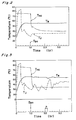
- a 80°C hot water was passed through a 70 m2 condenser set up to a 30 m 3 polymerization reactor, and then 13000 kg of deionized water, 7.8 kg of di-2-ethylhexyl peroxydicarbonate and 230 liters of a 3% aqueous solution of partially saponified polyvinyl alcohol were added. After deaerating the polymerization reactor for 15 minutes with stirring, 13000 kg of a vinyl chloride monomer was added, and the mixture was heated to 58 ° C to start polymerization. The temperature in the reactor was controlled by setting the set value of the reactor jacket temperature controller at the output of the reactor temperature controller.
- the monomer was purged at a rate of 3600 kg/hr for 5 seconds every ten minutes at the top of the condenser. At that time, the temperature in the reactor was stabilized, the controllability was good and the heat-transfer coefficient of the condenser was 500 to 700 kcal/m 2. hr. ° C. The total amount of the gas purged until completion of polymerization was about 180 kg.
- Example 2 Polymerization was started in the same manner as in Example 1.
- the reactor jacket cooling water controller was constant-value controlled at 35°C, and then according to the cascade-type controlling method in which the set value of the condenser-removed heat amount controller was set at the output of the reactor temperature controller and the set value of the condenser cooling water flow rate controller was set at the output of the condenser-removed heat amount controller, the cooling water controlling valve was adjusted with the output of the condenser cooling water flow rate controller.
- the setting and reading of the condenser-removed heat amount controller were checked every 2 minutes, and when the reading did not reach the setting, the monomer gas was purged at a rate of 5400 kg/hr for 2 minutes. At that time, the temperature in reactor was much stabilized, the controllability was good and the heat-transfer coefficient of the condenser was 400 to 600 kcal/m 2 ⁇ hr ⁇ °C. The total amount of the gas purged until completion of polymerization was about 60 kg.
- Example 2 Polymerization was started in the same manner as in Example 1.
- the reactor jacket cooling water controller was constant-value controlled at 35 ° C, and then according to the cascade-type controlling method in which the set value of the condenser-removed heat amount controller was set at the output of the reactor temperature controller and the set value of the condenser cooling water inlet temperature controller was set at the output of the condenser-removed heat amount controller, the cooling water controlling valve was adjusted with the output of the condenser cooling water inlet temperature controller.
- Polymerization was carried out in the same manner as in Example 3, during which the setting and reading of condenser-removed heat amount were compared with each other every 20 minutes, and when the reading did not reach the setting, the monomer was purged for 4 minutes at a rate of 450 kg/hr. As a result, the temperature in reactor was stabilized, and the heat-transfer coefficient of the condenser was 300 to 400 kcal/m 2- hr-IC. The total amount of the gas purged until completion of polymerization was about 300 kg.
- Example 2 Polymerization was started in the same manner as in Example 1. At the point when the conversion reached 5%, cooling water was gradually passed through the condenser, and the condenser cooling water outlet temperature was controlled at 35 ° C. After cooling water was passed through the condenser, continuous purge was carried out at a rate of about 500 kg/hr. As a result, the heat-transfer coefficient was 300 to 400 kcal/m 2 ⁇ hr ⁇ °C, and the amount of the gas required to purge was as large as about 3000 kg.
Landscapes
- Chemical & Material Sciences (AREA)
- Organic Chemistry (AREA)
- Chemical Kinetics & Catalysis (AREA)
- Health & Medical Sciences (AREA)
- Medicinal Chemistry (AREA)
- Polymers & Plastics (AREA)
- Polymerisation Methods In General (AREA)
- Physical Or Chemical Processes And Apparatus (AREA)
Priority Applications (1)
| Application Number | Priority Date | Filing Date | Title |
|---|---|---|---|
| DE8686100759T DE3663671D1 (en) | 1986-01-21 | 1986-01-21 | Temperature controlling method for polymerization reactors |
Applications Claiming Priority (1)
| Application Number | Priority Date | Filing Date | Title |
|---|---|---|---|
| JP59158433A JPS6136301A (ja) | 1984-07-27 | 1984-07-27 | 重合反応缶内の温度制御方法 |
Publications (2)
| Publication Number | Publication Date |
|---|---|
| EP0230489A1 EP0230489A1 (en) | 1987-08-05 |
| EP0230489B1 true EP0230489B1 (en) | 1989-05-31 |
Family
ID=15671652
Family Applications (1)
| Application Number | Title | Priority Date | Filing Date |
|---|---|---|---|
| EP86100759A Expired EP0230489B1 (en) | 1984-07-27 | 1986-01-21 | Temperature controlling method for polymerization reactors |
Country Status (4)
| Country | Link |
|---|---|
| US (1) | US4752640A (https=) |
| EP (1) | EP0230489B1 (https=) |
| JP (1) | JPS6136301A (https=) |
| KR (1) | KR930001350B1 (https=) |
Families Citing this family (14)
| Publication number | Priority date | Publication date | Assignee | Title |
|---|---|---|---|---|
| JPH066607B2 (ja) * | 1988-08-19 | 1994-01-26 | 鐘淵化学工業株式会社 | 塩化ビニル系樹脂の製造方法 |
| JPH03287602A (ja) * | 1990-04-05 | 1991-12-18 | Shin Etsu Chem Co Ltd | 泡センサーを備えた重合器およびそれを使用する水性媒体における重合方法 |
| EP0659476A1 (en) * | 1993-12-27 | 1995-06-28 | Shin-Etsu Chemical Co., Ltd. | Polymerization apparatus and method of producing vinyl chloride polymer by using the same |
| EP0661093B1 (en) * | 1993-12-28 | 1998-07-22 | Shin-Etsu Chemical Co., Ltd. | Polymerization apparatus effective in preventing polymer scale deposition and process of producing polymer using the same |
| AU693221B2 (en) * | 1994-09-12 | 1998-06-25 | Mitsubishi Chemical Corporation | Method for producing poly (vinyl chloride) |
| DE69501137T2 (de) * | 1994-09-14 | 1998-04-09 | Shinetsu Chemical Co | Verfahren zur Herstellung von einem Vinyl-Chlorid-Typ Polymer |
| EP0701863B1 (en) * | 1994-09-14 | 1999-07-14 | Shin-Etsu Chemical Co., Ltd. | Polymerization apparatus and a method for producing polymer using the same |
| DE60228011D1 (de) * | 2001-03-30 | 2008-09-18 | Kuraray Co | Verfahren zur Herstellung eines Ethylen-Vinylacetat Copolymeren und Vorrichtung zu seiner Herstellung |
| JP2003246808A (ja) * | 2002-02-26 | 2003-09-05 | Shin Etsu Chem Co Ltd | 塩化ビニル系重合体の製造方法 |
| KR100623850B1 (ko) * | 2004-10-08 | 2006-09-19 | 주식회사 엘지화학 | 고무질 라텍스의 제조 방법 |
| KR100783295B1 (ko) * | 2006-04-10 | 2007-12-10 | 주식회사 엘지화학 | 중합 반응계에서 개시제 조절에 의한 최적화 방법 |
| WO2011061076A1 (de) * | 2009-11-17 | 2011-05-26 | Basf Se | Verfahren zur herstellung von pfropfcopolymeren auf basis von polyethern |
| CN107456941B (zh) * | 2017-09-20 | 2018-09-25 | 安徽省福泰精细化工有限责任公司 | 一种便于温度调节的化工反应釜 |
| WO2019242911A1 (en) * | 2018-06-19 | 2019-12-26 | Societe Des Produits Nestle S.A. | Recirculation flow-loop batch reactor with external heat exchanger |
Family Cites Families (7)
| Publication number | Priority date | Publication date | Assignee | Title |
|---|---|---|---|---|
| DE1495145B2 (de) * | 1963-10-10 | 1971-05-06 | Badische Anilin & Soda Fabrik AG, 6700 Ludwigshafen | Verfahren zum abfuehren der reaktionswaerme bei der polymerisation in dispersion bzw loesung |
| JPS491950A (https=) * | 1972-04-25 | 1974-01-09 | ||
| JPS493396A (https=) * | 1972-05-02 | 1974-01-12 | ||
| DE2504659C3 (de) * | 1975-02-05 | 1988-02-11 | Hüls AG, 4370 Marl | Verfahren zum geregelten Abführen der Reaktionswärme bei Polymerisationsreaktionen in Dispersion bzw. Lösung |
| US4024329A (en) * | 1975-07-03 | 1977-05-17 | The Dow Chemical Company | Method for removing heat from a chemical reaction |
| GB2069369B (en) * | 1981-02-06 | 1984-04-18 | Sumitomo Chemical Co | Method and apparatus for removal of heat from an olefin polymerization reactor |
| JPS5845961A (ja) * | 1981-09-14 | 1983-03-17 | Konishiroku Photo Ind Co Ltd | チヤンネルミス検知器 |
-
1984
- 1984-07-27 JP JP59158433A patent/JPS6136301A/ja active Granted
-
1985
- 1985-07-23 US US06/758,140 patent/US4752640A/en not_active Expired - Fee Related
- 1985-07-27 KR KR1019850005421A patent/KR930001350B1/ko not_active Expired - Lifetime
-
1986
- 1986-01-21 EP EP86100759A patent/EP0230489B1/en not_active Expired
Also Published As
| Publication number | Publication date |
|---|---|
| KR930001350B1 (ko) | 1993-02-27 |
| EP0230489A1 (en) | 1987-08-05 |
| KR860001127A (ko) | 1986-02-22 |
| JPH0481601B2 (https=) | 1992-12-24 |
| US4752640A (en) | 1988-06-21 |
| JPS6136301A (ja) | 1986-02-21 |
Similar Documents
| Publication | Publication Date | Title |
|---|---|---|
| EP0230489B1 (en) | Temperature controlling method for polymerization reactors | |
| US4153774A (en) | Manufacture of high pressure polyethylene | |
| EP1642638B1 (en) | Method for continuous polymerizing | |
| EP0136559B1 (en) | Process for continuous production of ethylene-vinyl acetate copolymer | |
| CA2529803C (en) | Polymerization process involving the dosing initiators | |
| CA2646954C (en) | Continuous process for the production of vinyl chloride (co)polymers | |
| US4526656A (en) | Monomeric vinyl chloride stripping tower | |
| US5756602A (en) | Method for controlling reaction temperature | |
| JP4295196B2 (ja) | 連続重合の停止方法 | |
| EP0452748B1 (en) | Process for polymerizing a monomer | |
| JP3201131B2 (ja) | 重合反応缶内温度の制御方法 | |
| JPS6213408A (ja) | オレフイン重合用ル−プ反応器 | |
| JP3886856B2 (ja) | 塩化ビニル系重合体の製造方法 | |
| SU1678816A1 (ru) | Способ автоматического управлени процессом получени винилацетата на основе этилена | |
| US4247686A (en) | Process for removing VCM from polyvinyl chloride | |
| TEMENG et al. | Closed-loop control of a seeded continuous emulsion polymerization reactor system | |
| JPS5919574B2 (ja) | 塩化ビニル系単量体の懸濁重合法 | |
| KR20230161353A (ko) | 염화비닐계 중합체의 제조방법 | |
| JPH09136907A (ja) | 2重管式還流凝縮器およびそれを用いた塩化ビニル系樹脂の製法 | |
| CN111164107A (zh) | 采用外部冷却的聚合方法 | |
| CN1007984B (zh) | 聚合反应器控制温度的方法 | |
| JPS627923B2 (https=) | ||
| JP3465353B2 (ja) | 重合反応方法 | |
| JPH0124162B2 (https=) | ||
| JPS6114161B2 (https=) |
Legal Events
| Date | Code | Title | Description |
|---|---|---|---|
| PUAI | Public reference made under article 153(3) epc to a published international application that has entered the european phase |
Free format text: ORIGINAL CODE: 0009012 |
|
| 17P | Request for examination filed |
Effective date: 19870316 |
|
| AK | Designated contracting states |
Kind code of ref document: A1 Designated state(s): BE DE GB |
|
| 17Q | First examination report despatched |
Effective date: 19871217 |
|
| GRAA | (expected) grant |
Free format text: ORIGINAL CODE: 0009210 |
|
| AK | Designated contracting states |
Kind code of ref document: B1 Designated state(s): BE DE GB |
|
| REF | Corresponds to: |
Ref document number: 3663671 Country of ref document: DE Date of ref document: 19890706 |
|
| PLBE | No opposition filed within time limit |
Free format text: ORIGINAL CODE: 0009261 |
|
| STAA | Information on the status of an ep patent application or granted ep patent |
Free format text: STATUS: NO OPPOSITION FILED WITHIN TIME LIMIT |
|
| 26N | No opposition filed | ||
| PGFP | Annual fee paid to national office [announced via postgrant information from national office to epo] |
Ref country code: GB Payment date: 19920110 Year of fee payment: 7 |
|
| PGFP | Annual fee paid to national office [announced via postgrant information from national office to epo] |
Ref country code: DE Payment date: 19920228 Year of fee payment: 7 |
|
| PGFP | Annual fee paid to national office [announced via postgrant information from national office to epo] |
Ref country code: BE Payment date: 19920309 Year of fee payment: 7 |
|
| PG25 | Lapsed in a contracting state [announced via postgrant information from national office to epo] |
Ref country code: GB Effective date: 19930121 |
|
| PG25 | Lapsed in a contracting state [announced via postgrant information from national office to epo] |
Ref country code: BE Effective date: 19930131 |
|
| BERE | Be: lapsed |
Owner name: KANEGAFUCHI CHEMICAL INDUSTRY CO. LTD Effective date: 19930131 |
|
| GBPC | Gb: european patent ceased through non-payment of renewal fee |
Effective date: 19930121 |
|
| PG25 | Lapsed in a contracting state [announced via postgrant information from national office to epo] |
Ref country code: DE Effective date: 19931001 |