EP0222789B1 - Composition thermoplastique comprenant un copolymere a base d'ethylene et d'anhydride maleique, et articles industriels obtenus a partir d'une telle composition - Google Patents
Composition thermoplastique comprenant un copolymere a base d'ethylene et d'anhydride maleique, et articles industriels obtenus a partir d'une telle composition Download PDFInfo
- Publication number
- EP0222789B1 EP0222789B1 EP19860902429 EP86902429A EP0222789B1 EP 0222789 B1 EP0222789 B1 EP 0222789B1 EP 19860902429 EP19860902429 EP 19860902429 EP 86902429 A EP86902429 A EP 86902429A EP 0222789 B1 EP0222789 B1 EP 0222789B1
- Authority
- EP
- European Patent Office
- Prior art keywords
- ethylene
- parts
- weight
- copolymer
- composition
- Prior art date
- Legal status (The legal status is an assumption and is not a legal conclusion. Google has not performed a legal analysis and makes no representation as to the accuracy of the status listed.)
- Expired - Lifetime
Links
Classifications
-
- C—CHEMISTRY; METALLURGY
- C08—ORGANIC MACROMOLECULAR COMPOUNDS; THEIR PREPARATION OR CHEMICAL WORKING-UP; COMPOSITIONS BASED THEREON
- C08L—COMPOSITIONS OF MACROMOLECULAR COMPOUNDS
- C08L23/00—Compositions of homopolymers or copolymers of unsaturated aliphatic hydrocarbons having only one carbon-to-carbon double bond; Compositions of derivatives of such polymers
- C08L23/02—Compositions of homopolymers or copolymers of unsaturated aliphatic hydrocarbons having only one carbon-to-carbon double bond; Compositions of derivatives of such polymers not modified by chemical after-treatment
- C08L23/04—Homopolymers or copolymers of ethene
- C08L23/08—Copolymers of ethene
- C08L23/0807—Copolymers of ethene with unsaturated hydrocarbons only containing four or more carbon atoms
- C08L23/0815—Copolymers of ethene with unsaturated hydrocarbons only containing four or more carbon atoms with aliphatic 1-olefins containing one carbon-to-carbon double bond
-
- C—CHEMISTRY; METALLURGY
- C08—ORGANIC MACROMOLECULAR COMPOUNDS; THEIR PREPARATION OR CHEMICAL WORKING-UP; COMPOSITIONS BASED THEREON
- C08K—Use of inorganic or non-macromolecular organic substances as compounding ingredients
- C08K3/00—Use of inorganic substances as compounding ingredients
- C08K3/01—Use of inorganic substances as compounding ingredients characterized by their specific function
- C08K3/013—Fillers, pigments or reinforcing additives
-
- C—CHEMISTRY; METALLURGY
- C08—ORGANIC MACROMOLECULAR COMPOUNDS; THEIR PREPARATION OR CHEMICAL WORKING-UP; COMPOSITIONS BASED THEREON
- C08L—COMPOSITIONS OF MACROMOLECULAR COMPOUNDS
- C08L23/00—Compositions of homopolymers or copolymers of unsaturated aliphatic hydrocarbons having only one carbon-to-carbon double bond; Compositions of derivatives of such polymers
- C08L23/02—Compositions of homopolymers or copolymers of unsaturated aliphatic hydrocarbons having only one carbon-to-carbon double bond; Compositions of derivatives of such polymers not modified by chemical after-treatment
- C08L23/04—Homopolymers or copolymers of ethene
-
- C—CHEMISTRY; METALLURGY
- C08—ORGANIC MACROMOLECULAR COMPOUNDS; THEIR PREPARATION OR CHEMICAL WORKING-UP; COMPOSITIONS BASED THEREON
- C08L—COMPOSITIONS OF MACROMOLECULAR COMPOUNDS
- C08L23/00—Compositions of homopolymers or copolymers of unsaturated aliphatic hydrocarbons having only one carbon-to-carbon double bond; Compositions of derivatives of such polymers
- C08L23/02—Compositions of homopolymers or copolymers of unsaturated aliphatic hydrocarbons having only one carbon-to-carbon double bond; Compositions of derivatives of such polymers not modified by chemical after-treatment
- C08L23/04—Homopolymers or copolymers of ethene
- C08L23/06—Polyethylene
-
- C—CHEMISTRY; METALLURGY
- C08—ORGANIC MACROMOLECULAR COMPOUNDS; THEIR PREPARATION OR CHEMICAL WORKING-UP; COMPOSITIONS BASED THEREON
- C08L—COMPOSITIONS OF MACROMOLECULAR COMPOUNDS
- C08L23/00—Compositions of homopolymers or copolymers of unsaturated aliphatic hydrocarbons having only one carbon-to-carbon double bond; Compositions of derivatives of such polymers
- C08L23/02—Compositions of homopolymers or copolymers of unsaturated aliphatic hydrocarbons having only one carbon-to-carbon double bond; Compositions of derivatives of such polymers not modified by chemical after-treatment
- C08L23/04—Homopolymers or copolymers of ethene
- C08L23/08—Copolymers of ethene
-
- C—CHEMISTRY; METALLURGY
- C08—ORGANIC MACROMOLECULAR COMPOUNDS; THEIR PREPARATION OR CHEMICAL WORKING-UP; COMPOSITIONS BASED THEREON
- C08L—COMPOSITIONS OF MACROMOLECULAR COMPOUNDS
- C08L23/00—Compositions of homopolymers or copolymers of unsaturated aliphatic hydrocarbons having only one carbon-to-carbon double bond; Compositions of derivatives of such polymers
- C08L23/02—Compositions of homopolymers or copolymers of unsaturated aliphatic hydrocarbons having only one carbon-to-carbon double bond; Compositions of derivatives of such polymers not modified by chemical after-treatment
- C08L23/04—Homopolymers or copolymers of ethene
- C08L23/08—Copolymers of ethene
- C08L23/0846—Copolymers of ethene with unsaturated hydrocarbons containing atoms other than carbon or hydrogen
- C08L23/0869—Copolymers of ethene with unsaturated hydrocarbons containing atoms other than carbon or hydrogen with unsaturated acids, e.g. [meth]acrylic acid; with unsaturated esters, e.g. [meth]acrylic acid esters
-
- C—CHEMISTRY; METALLURGY
- C08—ORGANIC MACROMOLECULAR COMPOUNDS; THEIR PREPARATION OR CHEMICAL WORKING-UP; COMPOSITIONS BASED THEREON
- C08L—COMPOSITIONS OF MACROMOLECULAR COMPOUNDS
- C08L35/00—Compositions of homopolymers or copolymers of compounds having one or more unsaturated aliphatic radicals, each having only one carbon-to-carbon double bond, and at least one being terminated by a carboxyl radical, and containing at least one other carboxyl radical in the molecule, or of salts, anhydrides, esters, amides, imides or nitriles thereof; Compositions of derivatives of such polymers
-
- C—CHEMISTRY; METALLURGY
- C08—ORGANIC MACROMOLECULAR COMPOUNDS; THEIR PREPARATION OR CHEMICAL WORKING-UP; COMPOSITIONS BASED THEREON
- C08L—COMPOSITIONS OF MACROMOLECULAR COMPOUNDS
- C08L51/00—Compositions of graft polymers in which the grafted component is obtained by reactions only involving carbon-to-carbon unsaturated bonds; Compositions of derivatives of such polymers
- C08L51/06—Compositions of graft polymers in which the grafted component is obtained by reactions only involving carbon-to-carbon unsaturated bonds; Compositions of derivatives of such polymers grafted on to homopolymers or copolymers of aliphatic hydrocarbons containing only one carbon-to-carbon double bond
-
- C—CHEMISTRY; METALLURGY
- C09—DYES; PAINTS; POLISHES; NATURAL RESINS; ADHESIVES; COMPOSITIONS NOT OTHERWISE PROVIDED FOR; APPLICATIONS OF MATERIALS NOT OTHERWISE PROVIDED FOR
- C09D—COATING COMPOSITIONS, e.g. PAINTS, VARNISHES OR LACQUERS; FILLING PASTES; CHEMICAL PAINT OR INK REMOVERS; INKS; CORRECTING FLUIDS; WOODSTAINS; PASTES OR SOLIDS FOR COLOURING OR PRINTING; USE OF MATERIALS THEREFOR
- C09D123/00—Coating compositions based on homopolymers or copolymers of unsaturated aliphatic hydrocarbons having only one carbon-to-carbon double bond; Coating compositions based on derivatives of such polymers
- C09D123/02—Coating compositions based on homopolymers or copolymers of unsaturated aliphatic hydrocarbons having only one carbon-to-carbon double bond; Coating compositions based on derivatives of such polymers not modified by chemical after-treatment
- C09D123/04—Homopolymers or copolymers of ethene
- C09D123/08—Copolymers of ethene
- C09D123/0846—Copolymers of ethene with unsaturated hydrocarbons containing other atoms than carbon or hydrogen atoms
- C09D123/0869—Acids or derivatives thereof
-
- C—CHEMISTRY; METALLURGY
- C08—ORGANIC MACROMOLECULAR COMPOUNDS; THEIR PREPARATION OR CHEMICAL WORKING-UP; COMPOSITIONS BASED THEREON
- C08L—COMPOSITIONS OF MACROMOLECULAR COMPOUNDS
- C08L2205/00—Polymer mixtures characterised by other features
- C08L2205/02—Polymer mixtures characterised by other features containing two or more polymers of the same C08L -group
-
- C—CHEMISTRY; METALLURGY
- C08—ORGANIC MACROMOLECULAR COMPOUNDS; THEIR PREPARATION OR CHEMICAL WORKING-UP; COMPOSITIONS BASED THEREON
- C08L—COMPOSITIONS OF MACROMOLECULAR COMPOUNDS
- C08L2314/00—Polymer mixtures characterised by way of preparation
- C08L2314/02—Ziegler natta catalyst
-
- Y—GENERAL TAGGING OF NEW TECHNOLOGICAL DEVELOPMENTS; GENERAL TAGGING OF CROSS-SECTIONAL TECHNOLOGIES SPANNING OVER SEVERAL SECTIONS OF THE IPC; TECHNICAL SUBJECTS COVERED BY FORMER USPC CROSS-REFERENCE ART COLLECTIONS [XRACs] AND DIGESTS
- Y10—TECHNICAL SUBJECTS COVERED BY FORMER USPC
- Y10T—TECHNICAL SUBJECTS COVERED BY FORMER US CLASSIFICATION
- Y10T428/00—Stock material or miscellaneous articles
- Y10T428/26—Web or sheet containing structurally defined element or component, the element or component having a specified physical dimension
- Y10T428/263—Coating layer not in excess of 5 mils thick or equivalent
- Y10T428/264—Up to 3 mils
- Y10T428/265—1 mil or less
-
- Y—GENERAL TAGGING OF NEW TECHNOLOGICAL DEVELOPMENTS; GENERAL TAGGING OF CROSS-SECTIONAL TECHNOLOGIES SPANNING OVER SEVERAL SECTIONS OF THE IPC; TECHNICAL SUBJECTS COVERED BY FORMER USPC CROSS-REFERENCE ART COLLECTIONS [XRACs] AND DIGESTS
- Y10—TECHNICAL SUBJECTS COVERED BY FORMER USPC
- Y10T—TECHNICAL SUBJECTS COVERED BY FORMER US CLASSIFICATION
- Y10T428/00—Stock material or miscellaneous articles
- Y10T428/26—Web or sheet containing structurally defined element or component, the element or component having a specified physical dimension
- Y10T428/266—Web or sheet containing structurally defined element or component, the element or component having a specified physical dimension of base or substrate
-
- Y—GENERAL TAGGING OF NEW TECHNOLOGICAL DEVELOPMENTS; GENERAL TAGGING OF CROSS-SECTIONAL TECHNOLOGIES SPANNING OVER SEVERAL SECTIONS OF THE IPC; TECHNICAL SUBJECTS COVERED BY FORMER USPC CROSS-REFERENCE ART COLLECTIONS [XRACs] AND DIGESTS
- Y10—TECHNICAL SUBJECTS COVERED BY FORMER USPC
- Y10T—TECHNICAL SUBJECTS COVERED BY FORMER US CLASSIFICATION
- Y10T428/00—Stock material or miscellaneous articles
- Y10T428/31504—Composite [nonstructural laminate]
- Y10T428/31511—Of epoxy ether
- Y10T428/31515—As intermediate layer
- Y10T428/31522—Next to metal
-
- Y—GENERAL TAGGING OF NEW TECHNOLOGICAL DEVELOPMENTS; GENERAL TAGGING OF CROSS-SECTIONAL TECHNOLOGIES SPANNING OVER SEVERAL SECTIONS OF THE IPC; TECHNICAL SUBJECTS COVERED BY FORMER USPC CROSS-REFERENCE ART COLLECTIONS [XRACs] AND DIGESTS
- Y10—TECHNICAL SUBJECTS COVERED BY FORMER USPC
- Y10T—TECHNICAL SUBJECTS COVERED BY FORMER US CLASSIFICATION
- Y10T428/00—Stock material or miscellaneous articles
- Y10T428/31504—Composite [nonstructural laminate]
- Y10T428/31678—Of metal
- Y10T428/31692—Next to addition polymer from unsaturated monomers
-
- Y—GENERAL TAGGING OF NEW TECHNOLOGICAL DEVELOPMENTS; GENERAL TAGGING OF CROSS-SECTIONAL TECHNOLOGIES SPANNING OVER SEVERAL SECTIONS OF THE IPC; TECHNICAL SUBJECTS COVERED BY FORMER USPC CROSS-REFERENCE ART COLLECTIONS [XRACs] AND DIGESTS
- Y10—TECHNICAL SUBJECTS COVERED BY FORMER USPC
- Y10T—TECHNICAL SUBJECTS COVERED BY FORMER US CLASSIFICATION
- Y10T428/00—Stock material or miscellaneous articles
- Y10T428/31504—Composite [nonstructural laminate]
- Y10T428/31678—Of metal
- Y10T428/31692—Next to addition polymer from unsaturated monomers
- Y10T428/31699—Ester, halide or nitrile of addition polymer
-
- Y—GENERAL TAGGING OF NEW TECHNOLOGICAL DEVELOPMENTS; GENERAL TAGGING OF CROSS-SECTIONAL TECHNOLOGIES SPANNING OVER SEVERAL SECTIONS OF THE IPC; TECHNICAL SUBJECTS COVERED BY FORMER USPC CROSS-REFERENCE ART COLLECTIONS [XRACs] AND DIGESTS
- Y10—TECHNICAL SUBJECTS COVERED BY FORMER USPC
- Y10T—TECHNICAL SUBJECTS COVERED BY FORMER US CLASSIFICATION
- Y10T428/00—Stock material or miscellaneous articles
- Y10T428/31504—Composite [nonstructural laminate]
- Y10T428/31855—Of addition polymer from unsaturated monomers
- Y10T428/31909—Next to second addition polymer from unsaturated monomers
- Y10T428/31913—Monoolefin polymer
-
- Y—GENERAL TAGGING OF NEW TECHNOLOGICAL DEVELOPMENTS; GENERAL TAGGING OF CROSS-SECTIONAL TECHNOLOGIES SPANNING OVER SEVERAL SECTIONS OF THE IPC; TECHNICAL SUBJECTS COVERED BY FORMER USPC CROSS-REFERENCE ART COLLECTIONS [XRACs] AND DIGESTS
- Y10—TECHNICAL SUBJECTS COVERED BY FORMER USPC
- Y10T—TECHNICAL SUBJECTS COVERED BY FORMER US CLASSIFICATION
- Y10T428/00—Stock material or miscellaneous articles
- Y10T428/31504—Composite [nonstructural laminate]
- Y10T428/31855—Of addition polymer from unsaturated monomers
- Y10T428/31909—Next to second addition polymer from unsaturated monomers
- Y10T428/31928—Ester, halide or nitrile of addition polymer
Definitions
- This composition is intended in particular for the manufacture of films having good adhesion properties. It can also contain mineral fillers and lead to the manufacture of industrial articles having improved impact resistance.
- Document EP-A-104097 discloses a composition comprising from 25 to 95% by weight of a radical polymer of ethylene which may be a homopolymer of ethylene or a copolymer of ethylene and small amounts of at least one monomer copolymerizable with ethylene, and from 5 to 75% by weight of a copolymer of ethylene and alpha-olefin comprising at least 4 carbon atoms, with a density between 0.905 and 0.940.
- a radical polymer of ethylene which may be a homopolymer of ethylene or a copolymer of ethylene and small amounts of at least one monomer copolymerizable with ethylene, and from 5 to 75% by weight of a copolymer of ethylene and alpha-olefin comprising at least 4 carbon atoms, with a density between 0.905 and 0.940.
- the mineral filler can be chosen from talc, mica, glass, silica, magnesium oxides, calcium, zinc, titanium or antimony, magnesium or calcium carbonates, magnesium sulfates, calcium or barium.
- the crystalline organic material can be a copolymer (having a melt index of 3 to 500) preferably comprising from 75 to 90% by weight of ethylene. Such a composition is intended for crimping the hair and, consequently, must have on the one hand an ability to curl the hair in a relatively short time at the usual crimping temperature, and on the other hand physical properties allowing the users domestic workers to use it safely.
- the present invention aims to improve the impact resistance, in particular when cold, so as to allow the manufacture of industrial articles liable to be subjected to impacts.
- the present invention aims at developing films retaining most of the favorable properties of ethylene polymers and also having remarkable adhesion properties on various substrates.
- ethylene-based polymer or copolymer (A) is meant an ethylene homopolymer obtained by radical polymerization, or else a copolymer of ethylene and at least one alpha-olefin having at least 3 atoms of carbon obtained in the presence of catalysts of the Ziegler type, or alternatively a radical copolymer of ethylene and small amounts of at least one polar comonomer such as in particular vinyl acetate, alkyl (meth) acrylates, the alkyl group has 1 to 6 carbon atoms or carbon monoxide.
- the homopolymers or copolymers obtained by radical route generally have a density of between 0.910 and 0.935.
- the degree of crystallinity of the polymer (A) is advantageously at least equal to 30% in particular with a view to obtaining a composition having satisfactory behavior at temperature.
- the copolymer (B) can be obtained, for example under high pressure and at high temperature by terpolymerization, for example under the conditions described in the documents FR-A-2,498,609, FR-A-2,569,411 and FR-A- 2,569,412, or by grafting maleic anhydride onto a copolymer of ethylene and at least one ester of (meth) acrylic acid.
- the melt index of the copolymer (B), measured under standard conditions (190 ° C., load of 2.16 kg) of standard ASTM 1238, is advantageously between 0.5 and 200 dg / min.
- compositions according to the invention those which, per 100 parts by weight, comprise from 67 to 93 parts of the polymer (A) and from 7 to 33 parts of the copolymer (B) may also comprise at least one mineral filler in the right amount up to 100 parts by weight per 100 parts by weight of the mixture of polymers (A) and (B).
- This filler can in particular be chosen from glass fibers, glass beads, mica, talc, clays, aluminates and silicates, for example calcium, alumina, alumina hydrate, black of carbon, carbon or boron fibers, asbestos, oxide, hydroxide, carbonate and magnesium or calcium sulfate, iron oxides, antimony, zinc, titanium dioxide, barium sulfate, bentonite, diatomaceous earth, kaolin, silica, quartz, feldspar.
- glass fibers glass beads, mica, talc, clays, aluminates and silicates, for example calcium, alumina, alumina hydrate, black of carbon, carbon or boron fibers, asbestos, oxide, hydroxide, carbonate and magnesium or calcium sulfate, iron oxides, antimony, zinc, titanium dioxide, barium sulfate, bentonite, diatomaceous earth, kaolin, silica, quartz, feldspar.
- compositions according to the invention those which, per 100 parts by weight, comprise from 1 to 67 parts by weight of polymer (A) and from 33 to 99 parts by weight of copolymer (B) are more particularly intended to be transformed in movies.
- the ratio of the standard melt index of the copolymer (B) to the standard melt index of the polymer (A) is advantageously between 1 and 400.
- the second subject of the invention is industrial articles comprising at least one product obtained by transformation of a composition as described above.
- They may in particular be films having adhesion properties (in this case the melt index of the copolymer (B) will preferably be chosen between 0.5 and 30 dg / min.) Or else molded filled articles having an improved impact resistance which makes them particularly advantageous for any application requiring this quality, in particular in the automotive sector and for the manufacture of household and industrial articles.
- the films obtained by extrusion-blowing of said compositions (of thickness generally between 15 and 200 ⁇ m) can be used for bonding which must withstand repeated exposures at temperatures by example between 110 ° and 130 ° C. They can be subjected to subsequent treatments, for example of the Corona type.
- thermoplastic materials such as free radical low density polyethylene, high density polyethylene, polypropylene, a polyamide or an ethylene-hydrolyzed vinyl acetate copolymer.
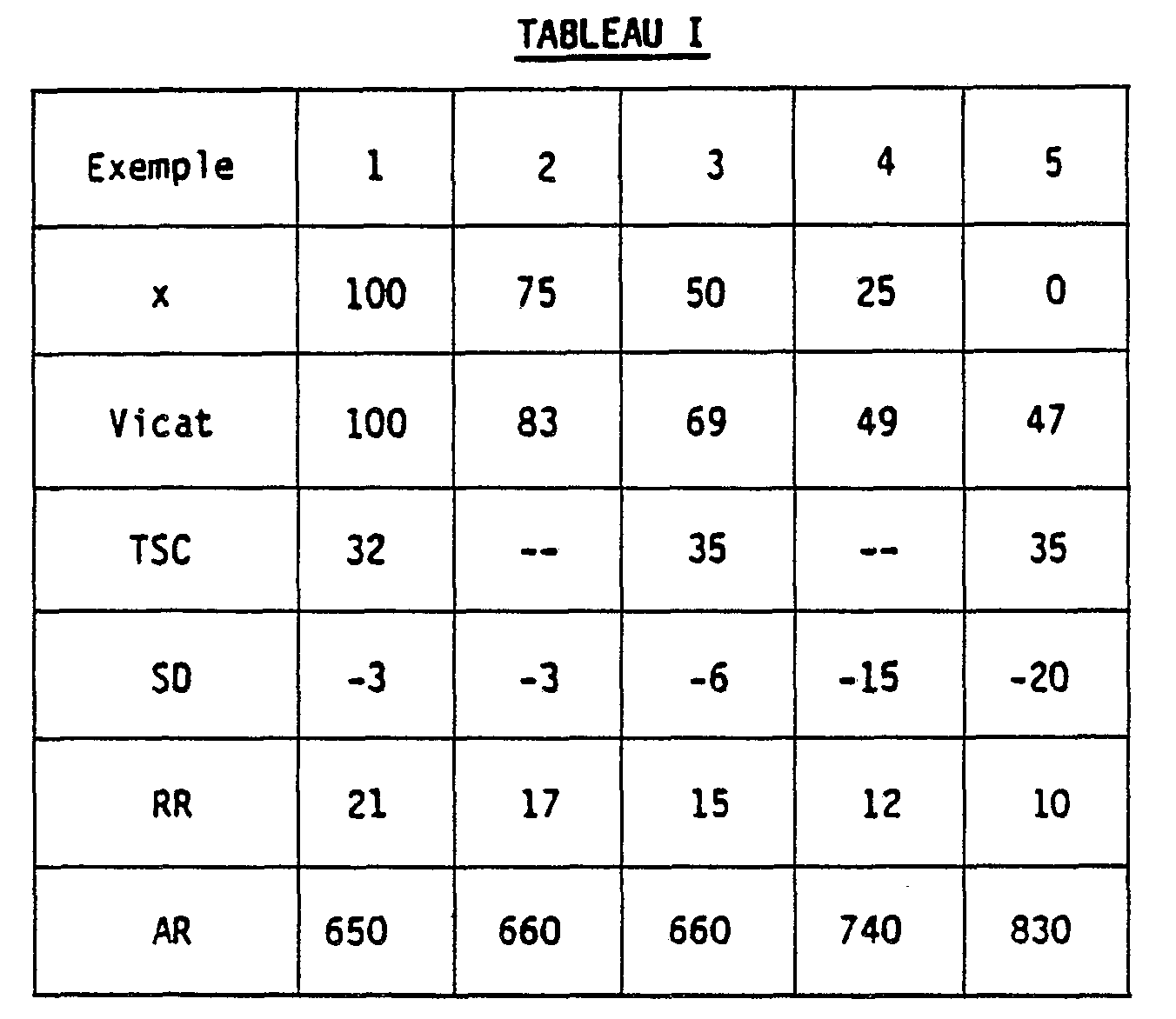
- the characteristics of the compositions obtained are shown in Table I.
- the Vicat temperature is measured according to standard ASTM D 1525 and expressed in degrees Celsius.
- SD is the dimensional stability measured at 115 ° C according to standard ASTM D 1204 and expressed in%.
- RR is the breaking strength expressed in MPa and AR the elongation at break expressed in%, these two quantities being determined according to standard ASTM D 638.
- TSC is the critical surface tension expressed in dynes / cm and determined according to standard ASTM D 2578.
- Examples 1 and 5 are comparative.
- a film (of the same thickness) of the polymer (A 1 ) alone leads to a peeling force between film and foam of 2 N / 5 cm.
- the Vicat temperature as well as the melting temperature F (expressed in degrees Celsius) of the composition are given in Table II below. Examples 6 and 8 are comparative.
- Example 7 The composition of Example 7 is transformed into a 50 ⁇ m film by extrusion blow molding. This film is used for heat sealing at 145 ° C by calendering the polyurethane-polyether foam and the polypropylene fabric. ,
- the composition is extruded through a flat die into a 35 ⁇ m thick film which is coated at 297 ° C. on an aluminum sheet traveling at a speed of 100 m / min.
- the adhesion of the composition to the substrate is measured by the peeling force in the longitudinal direction FPL expressed in N / 15 mm and determined according to standard ASTM D 903-49 (width of the polymer strip: 15 mm instead of 25 mm). The results are reported in Table III, Examples 9 and 13 being given for comparison.
- the preparation is carried out by mixing on a calender at a temperature of 180 ° C for 15 minutes. From this mixture, 4 mm thick plates are molded by compression at 180 ° C. which are then cut into bars of dimensions 4 ⁇ 6 ⁇ 50 mm. The Charpy impact resistance measured on these bars is equal to 7.8 kJ / m 2 at -30 ° C.
- the Charpy impact resistance of the composition measured as in Example 14, is equal to 55 kJ / m 2 at -30 ° C.
Landscapes
- Chemical & Material Sciences (AREA)
- Organic Chemistry (AREA)
- Health & Medical Sciences (AREA)
- Chemical Kinetics & Catalysis (AREA)
- Medicinal Chemistry (AREA)
- Polymers & Plastics (AREA)
- Life Sciences & Earth Sciences (AREA)
- Engineering & Computer Science (AREA)
- Materials Engineering (AREA)
- Wood Science & Technology (AREA)
- Compositions Of Macromolecular Compounds (AREA)
- Laminated Bodies (AREA)
- Manufacture Of Macromolecular Shaped Articles (AREA)
Abstract
Description
- Cette composition est destinée en particulier à la fabrication de films présentant de bonnes propriétés d'adhérence. Elle peut en outre contenir des charges minérales et conduire à la fabrication d'articles industriels présentant une résistance au choc améliorée.
- On connaît par le document EP-A-104097 une composition comprenant de 25 à 95% en poids d'un polymère radicalaire de l'éthylène pouvant être un homopolymère de l'éthylène ou un copolymère de l'éthylène et de faibles quantités d'au moins un monomère copolymérisable avec l'éthylène, et de 5 à 75% en poids d'un copolymère d'éthylène et d'alpha-oléfine comprenant au moins 4 atomes de carbone, de densité comprise entre 0,905 et 0,940.
- Les compositions de polymères renforcées par des charges minérales sont déjà connues et sont couramment utilisées industriellement; elles permettent de rendre plus rigides les polymères de base. Ainsi le document GB-A-1.359.173 décrit une composition moulable comprenant, pour 100 parties en poids:
- 60 à 90 parties en poids d'un homopolymère d'éthylène ayant une densité d'au moins 0,94 et un indice de fluidité standard de 2 à 30,
- jusqu'à 40 parties en poids d'un matériau organique cristallin ayant une température de fusion inférieure à 100°C et une température de cristallisation d'au moins 60°C, et
- 10 à 40 parties en poids d'une charge minérale ayant une chaleur spécifique par unité de volume supérieure à 0,35 calories/cc/°C.
- La charge minérale peut être choisie parmi talc, mica, verre, silice, oxydes de magnésium, calcium, zinc, titane ou antimoine, carbonates de magnésium ou calcium, sulfates de magnésium, calcium ou baryum. Le matériau organique cristallin peut être un copolymère (ayant un indice de fluidité de 3 à 500) comprenant de préférence de 75 à 90 % en poids d'éthylène. Une telle composition est destinée à la frisure des cheveux et, en conséquence, doit posséder d'une part une capacité à friser les cheveux dans un délai relativement court à la température habituelle de frisure, et d'autre part des propriétés physiques permettant aux utilisateurs domestiques de l'employer en toute sécurité.
- Le problème posé par la présente invention est tout différent. Dans le cas de compositions chargées moulables, la présente invention vise en effet à améliorer la résistance au choc, en particulier à froid, de manière à permettre la fabrication d'articles industriels susceptibles d'être soumis à des chocs. D'autre part dans le cas de compositions non chargées, la présente invention vise à la mise au point de films conservant l'essentiel des propriétés favorables des polymères d'éthylène et possédant en outre de remarquables propriétés d'adhérence sur divers substrats.
- La présente invention a pour premier objet une composition thermoplastique constituée, pour 100 parties en poids, de 1 à 93 parties en poids d'au moins un polymère ou copolymère (A) à base d'éthylène, ayant une densité comprise entre 0,905 et 0,945 choisi parmi les copolymères d'éthylène et d'au moins une alpha-oléfine possédant au moins 3 atomes de carbone, et les polymères ou copolymères obtenus par voie radicalaire et ayant une densité comprise entre 0,910 et 0,935, et de 7 à 99 parties en poids d'au moins un copolymère (B) comprenant:
- de 83 à 98,7% en moles de motifs dérivés de l'éthylène,
- de 1 à 14% en moles de motifs dérivés d'au moins un ester de l'acide (méth)acrylique, et
- de 0,3 à 3% en moles de motifs dérivés de l'anhydride maléïque.
- Par polymère ou copolymère (A) à base d'éthylène, on entend un homopolymère de l'éthylène obtenu par polymérisation par voie radicalaire, ou bien un copolymère de l'éthylène et d'au moins une alpha-oléfine possédant au moins 3 atomes de carbone obtenu en présence de catalyseurs du type Ziegler, ou encore un copolymère radicalaire de l'éthylène et de faibles quantités d'au moins un comonomère polaire tel que notamment l'acétate de vinyle, les (méth)acrylates d'alkyle dont le groupe alkyle a de 1 à 6 atomes de carbone ou l'oxyde de carbone. Les homopolymères ou copolymères obtenus par voie radicalaire ont généralement une densité comprise entre 0,910 et 0,935. Le taux de cristallinité du polymère (A) est avantageusement au moins égal à 30% notamment en vue d'obtenir une composition ayant une tenue satisfaisante à la température.
- Le copolymère (B) peut être obtenu, par exemple sous haute pression et à haute température par terpolymérisation, par exemple dans les conditions décrites dans les documents FR-A-2.498.609, FR-A-2.569.411 et FR-A-2.569.412, ou bien par greffage d'anhydride maléique sur un copolymère d'éthylène et d'au moins un ester de l'acide (méth)acrylique.
- L'indice de fluidité du copolymère (B), mesuré dans les conditions standards (190°C, charge de 2,16 kg) de la norme ASTM 1238, est avantageusement compris entre 0,5 et 200 dg/min.
- Parmi les compositions selon l'invention, celles qui, pour 100 parties en poids, comprennent de 67 à 93 parties du polymère (A) et de 7 à 33 parties du copolymère (B) peuvent en outre comprendre au moins une charge minérale à raison de jusqu'à 100 parties en poids pour 100 parties en poids du mélange des polymères (A) et (B). Cette charge peut être notamment choisie parmi les fibres de verre, les billes de verre, le mica, le talc, les argiles, les aluminates et silicates, par exemple de calcium, l'alumine, l'hydrate d'alumine, le noir de carbone, les fibres de carbone ou de bore, l'amiante, les oxyde, hydroxyde, carbonate et sulfate de magnésium ou de calcium, les oxydes de fer, antimoine, zinc, le dioxyde de titane, le sulfate de baryum, la bentonite, la terre de diatomées, le kaolin, la silice, le quartz, le feldspath.
- Parmi les compositions selon l'invention, celles qui, pour 100 parties en poids, comprennent de 1 à 67 parties en poids de polymère (A) et de 33 à 99 parties en poids de copolymère (B) sont plus particulièrement destinées à être transformées en films.
- Pour l'obtention de compositions ayant un ensemble de propriétés satisfaisantes, le rapport de l'indice de fluidité standard du copolymère (B) à l'indice de fluidité standard du polymère (A) est avantageusement compris entre 1 et 400.
- Les compositions selon l'invention peuvent être obtenues selon un procédé choisi parmi:
- mélangeage simultané par tout moyen connu, notamment dans un malaxeur ou une extrudeuse, des polymères (A) et (B) et, le cas échéant, de la charge minérale.
- mélangeage d'un mélange-maître de deux quelconques des constituants de la composition, lorsque celle-ci contient une charge minérale, avec le troisième constituant de la composition.
- lorsque la composition comprend une charge minérale, mélangeage du polymère (A) et de la charge minérale préalablement enrobée de copolymère (B), l'enrobage étant obtenu en introduisant la charge dans une solution de copolymère (B), puis en évaporant le solvant. Des solutions appropriées de copolymère (B) sont obtenues lorsque le solvant est choisi parmi les hydrocarbures aliphatique, cycloaliphatiques et aromatiques ayant de 5 à 12 atomes de carbone, les cétones, les hydrocarbures chlorés, les acétates et les éthers de polyols et que la concentration du copolymère (B) dans le solvant est au plus égale à 15% en poids.
- L'invention a pour second objet des articles industriels comprenant au moins un produit obtenu par transformation d'une composition telle que décrite précédemment. Il peut s'agir notamment de films possédant des propriétés d'adhésion (dans ce cas l'indice de fluidité du copolymère (B) sera de préférence choisi entre 0,5 et 30 dg/min.) ou bien d'articles chargés moulés possédant une résistance au choc améliorée qui les rend particulièrement intéressants pour toute application exigeant cette qualité, notamment dans le secteur automobile et pour la fabrication d'articles ménagers et industriels.
- Grâce à la remarquable stabilité dimensionnelle des compositions selon l'invention, les films obtenus par extrusion-soufflage desdites compositions (d'épaisseur généralement comprise entre 15 et 200 pm) peuvent être utilisés pour réaliser des collages devant supporter des expositions répétées à des températures par exemple comprises entre 110° et 130°C. Ils peuvent être soumis à des traitements ultérieurs, par exemple du type Corona.
- Ils peuvent également entrer dans la constitution d'articles de structure complexe tels que des films multicouches obtenus par coextrusion au moyen de filières annulaires ou plates, l'(les) autre(s) couche(s) de tels films étant par exemple constituée(s) d'un film d'une matière thermoplastique telle que le polyéthylène basse densité radicalaire, le polyéthylène haute densité, le polypropylène, un polyamide ou un copolymère éthylène-acétate de vinyle hydrolysé.
- Des exemples sont fournis ci-après pour illustrer l'invention.
- Les normes utilisées pour mesurer les propriétés des produits mis en jeu ou obtenus sont les suivantes:
- norme ASTM D 1238-73 pour l'indice de fluidité standard mesuré à 190°C sous 2,16 Kg et exprimé en dg/min.
- norme ISO R 179 pour la résistance au choc Charpy exprimée en kJ/m2 et mesurée, aux exceptions suivantes près, sur éprouvette non entaillée de dimensions 4 x 6 x 50 mm3.
- Des compositions sont préparées par malaxage à chaud de:
- x parties en poids de (A,) un copolymère éthylène/acrylate de butyle contenant 0,44% en moles d'acrylate de butyle, ayant une densité de 0,926 et un indice de fluidité standard de 0,18 dg/min.
- (100-x) parties en poids de (B) un terpolymère contenant 92,3% en moles de motifs dérivés de l'éthylène, 6,7% en moles de motifs dérivés de l'acrylate d'éthyle et 1% en moles de motifs dérivés de l'anhydride maléïque, ayant un indice de fluidité standard de 20 dg/min.
- Les caractéristiques des compositions obtenues figurent dans le tableau I. La température Vicat est mesurée selon la norme ASTM D 1525 et exprimée en degrés Celsius. SD est la stabilité dimensionnelle mesurée à 115°C selon la norme ASTM D 1204 et exprimée en %. RR est la résistance à la rupture exprimée en MPa et AR l'allongement à la rupture exprimée en %, ces deux grandeurs étant déterminées selon la norme ASTM D 638. TSC est la tension superficielle critique exprimée en dynes/cm et déterminée selon la norme ASTM D 2578.
- Les exemples 1 et 5 sont comparitifs.
- La composition de l'exemple 3 est transformée en film de 50 pm d'épaisseur par extrusion-soufflage. Ce film est utilisé pourthermocoller à 145°C par calandrage de la mousse de polyuréthane-polyéther et du tissu de polypropylène. Les forces de pelage suivantes, déterminées selon la norme ASTM D 903-49 sont mesurées:
- entre tissu et film: 13 N/5 cm
- entre film et mousse: 8 N/5 cm.
- Lorsque le film est en outre soumis à un traitement Corona à 45 dynes/cm, la force de pelage entre film et mousse atteint 13 N/5 cm.
- Un film (de même épaisseur) du polymère (A1) seul conduit à une force de pelage entre film et mousse de 2 N/5 cm.
- Des compositions sont préparées par malaxage à chaud de:
- x parties en poids de (A2) un copolymère éthylène/butène-1 obtenu par catalyse de type Ziegler, ayant une densité de 0,945 et un indice de fluidité standard de 0,18 dg/min.
- (100-x) parties en poids du terpolymère (B) décrit aux exemples 1 à 5.
- La température Vicat ainsi que la température de fusion F (exprimée en degrés Celsius) de la composition sont reportées aux tableau Il ci-après. Les exemples 6 et 8 sont comparatifs.

- La composition de l'exemple 7 est transformée en film de 50 pm par extrusion-soufflage. Ce film est utilisé pour thermocoller à 145°C par calandrage de la mousse de polyuréthane-polyéther et du tissu de polypropylène. ,
- Les forces de pelage suivantes, déterminées selon la norme ASTM D 903-49 sont mesurées:
- entre tissu et film: 10 N/5 cm
- entre film et mousse: 6,5 N/5 cm.
- Un film (de même épaisseur) du polymère (A2) seul conduit à une force de pelage entre film et mousse de 1 N/5 cm.
- Des compositions sont préparées par malaxage à chaud de:
- x parties en poids de (A3) un homopolymère de l'éthylène obtenu par voie radicalaire et ayant un indice de fluidité standard de 3 dg/min.
- (100-x) parties en poids de (B) un terpolymère contenant 97,9% en moles de motifs dérivés de l'éthylène, 1,2% en moles de motifs dérivés de l'acrylate de butyle et 0,9% en moles de motifs dérivés de l'anhydride maléique et ayant un indice de fluidité standard de 4 dg/min.
- La composition est extrudée à travers une filière plate en un film d'épaisseur 35 um qu'on enduit à 297°C sur une feuille d'aluminium défilant à une vitesse de 100 m/min. L'adhérence de la composition sur le substrat est mesurée par la force de pelage dans le sens longitudinal FPL exprimée en N/15 mm et déterminée selon la norme ASTM D 903-49 (largeur de la bande de polymère: 15 mm au lieu de 25 mm). Les résultats sont reportés au tableau III, les exemples 9 et 13 étant donnés à titre comparatif.

- On prépare une composition constituée de:
- 50 parties en poids d'un copolymère éthylène/butène-1 de densité égale à 0,940 et d'indice de fluidité égal à 4 dg/min. commercialisé par la deman-deresse sous la marque LOTREX PG 0456.
- 50 parties en poids d'hydrate d'alumine commercialisé par la société SAFIC-ALCAN sous la marque HYDRAL 710.
- La préparation est effectuée par mélange sur une calandre à la température de 180°C pendant 15 minutes. A partir de ce mélange, on moule par compression à 180°C des plaques d'épaisseur 4 mm que l'on découpe ensuite en barreaux de dimensions 4 x 6 x 50 mm. La résistance au choc Charpy mesurée sur ces barreaux est égale à 7,8 kJ/m2 à -30°C.
- On prépare selon les conditions opératoires de l'exemple 14 une composition constituée de:
- 45 parties du copolymère éthylène/butène-1 utilisé à l'exemple 14.
- 55 parties de l'hydrate d'alumine utilisé à l'exemple 14, préalablement enrobé par un terpolymère d'indice de fluidité égal à 7,8 dg/min. et constitué de 85,9% en moles d'éthylène, 13% en moles d'acrylate d'éthyle et 1,1% en moles d'anhydride maléïque. Le rapport en poids du terpolymère et de l'hydrate d'alumine est de 9/91.
- La résistance au choc Charpy de la composition, mesurée comme à l'exemple 14, est égale à 55 kJ/m2 à -30°C.
Claims (8)
Applications Claiming Priority (2)
| Application Number | Priority Date | Filing Date | Title |
|---|---|---|---|
| FR8506203 | 1985-04-24 | ||
| FR8506203A FR2587350B1 (fr) | 1985-04-24 | 1985-04-24 | Compositions ternaires rigides a resistance au choc amelioree, un procede pour leur preparation et articles obtenus |
Publications (2)
| Publication Number | Publication Date |
|---|---|
| EP0222789A1 EP0222789A1 (fr) | 1987-05-27 |
| EP0222789B1 true EP0222789B1 (fr) | 1991-02-06 |
Family
ID=9318607
Family Applications (2)
| Application Number | Title | Priority Date | Filing Date |
|---|---|---|---|
| EP19860902429 Expired - Lifetime EP0222789B1 (fr) | 1985-04-24 | 1986-04-22 | Composition thermoplastique comprenant un copolymere a base d'ethylene et d'anhydride maleique, et articles industriels obtenus a partir d'une telle composition |
| EP86902428A Withdrawn EP0221919A1 (fr) | 1985-04-24 | 1986-04-22 | Composition thermoplastique comprenant un polymere de propylene et un copolymere a base d'ethylene et d'anhydride maleique, et articles obtenus |
Family Applications After (1)
| Application Number | Title | Priority Date | Filing Date |
|---|---|---|---|
| EP86902428A Withdrawn EP0221919A1 (fr) | 1985-04-24 | 1986-04-22 | Composition thermoplastique comprenant un polymere de propylene et un copolymere a base d'ethylene et d'anhydride maleique, et articles obtenus |
Country Status (9)
| Country | Link |
|---|---|
| US (1) | US4868052A (fr) |
| EP (2) | EP0222789B1 (fr) |
| JP (2) | JPS63500180A (fr) |
| AU (2) | AU5777386A (fr) |
| CA (1) | CA1287423C (fr) |
| FR (1) | FR2587350B1 (fr) |
| GR (2) | GR861084B (fr) |
| IL (2) | IL78622A0 (fr) |
| WO (2) | WO1986006395A1 (fr) |
Cited By (2)
| Publication number | Priority date | Publication date | Assignee | Title |
|---|---|---|---|---|
| US20120053260A1 (en) * | 2010-09-01 | 2012-03-01 | Basf Se | Aqueous emulsion polymers, their preparation and use |
| US11459477B2 (en) | 2004-12-16 | 2022-10-04 | Sk Global Chemical Co., Ltd. | Adhesive composition based on ethylene copolymers, useful for extrusion-coating and extrusion-lamination on a variety of supports |
Families Citing this family (16)
| Publication number | Priority date | Publication date | Assignee | Title |
|---|---|---|---|---|
| JP2582771B2 (ja) * | 1987-04-07 | 1997-02-19 | 三井石油化学工業株式会社 | 熱可塑性エラストマー積層レザー |
| US5229458A (en) * | 1987-08-19 | 1993-07-20 | Ppg Industries, Inc. | Powder coating of particulate thermoset resin and olefin-maleic anhydride copolymer |
| CA1324229C (fr) * | 1987-09-04 | 1993-11-09 | John R. Kastelic | Copolymere de monomeres insatures de monoxyde de carbone, a charge de mica |
| FR2630123B1 (fr) * | 1988-04-18 | 1992-02-21 | Norsolor Sa | Compositions polymeres reticulees, leur procede de fabrication et articles moules obtenus |
| US5223311A (en) * | 1989-05-22 | 1993-06-29 | Showa Denko K.K. | Laminate and process for producing the same |
| DE69033230T2 (de) * | 1989-05-22 | 1999-12-30 | Showa Denko Kk | Verfahren zur Herstellung eines Schichtstoffes |
| FR2647458B1 (fr) * | 1989-05-25 | 1991-09-06 | Norsolor Sa | Compositions polymeres ignifugees et leur application au revetement de cables electriques |
| FR2664283B1 (fr) * | 1990-07-05 | 1994-04-15 | Norsolor | Composition thermoplastique comprenant un copolymere a base d'ethylene et d'anhydride maleique, et articles industriels obtenus a partir d'une telle composition. |
| JPH04320440A (ja) * | 1991-04-19 | 1992-11-11 | Sumitomo Chem Co Ltd | 接着性樹脂組成物 |
| FR2685974B1 (fr) * | 1992-01-06 | 1997-01-24 | Atochem Elf Sa | Isolant pour cables electriques. |
| ATE200686T1 (de) * | 1995-12-15 | 2001-05-15 | Cryovac Inc | Folie mit ausgezeichneter farbhaftung und mit verbesserten schlupf-, antibeschlag- und/oder antistatik-eigenschaften |
| ATE309091T1 (de) * | 2002-07-25 | 2005-11-15 | Cryovac Inc | Thermoplastische gassperrfolie und substrat- folienverbundmaterial |
| ATE554924T1 (de) * | 2002-11-21 | 2012-05-15 | Total Petrochemicals Res Feluy | Mehrschichtiges rotationsformen |
| WO2013043944A1 (fr) | 2011-09-23 | 2013-03-28 | Dow Global Technologies Llc | Compositions de polymère à base d'oléfine et articles préparés à base de celles-ci |
| FR3036116B1 (fr) | 2015-05-11 | 2019-03-22 | Arkema France | Composition adhesive a base de copolymeres ethyleniques, utilisable pour extrusion-couchage et extrusion-lamination sur divers supports |
| JP6822485B2 (ja) * | 2017-01-12 | 2021-01-27 | 三菱ケミカル株式会社 | 積層フィルム及びその製造方法、並びに積層体 |
Family Cites Families (20)
| Publication number | Priority date | Publication date | Assignee | Title |
|---|---|---|---|---|
| DE137907C (fr) * | 1900-01-01 | |||
| NL294248A (fr) * | 1962-06-19 | 1900-01-01 | ||
| US3639530A (en) * | 1969-05-22 | 1972-02-01 | Fmc Corp | High tenacity resinous packaging strap |
| GB1359174A (en) * | 1970-06-16 | 1974-07-10 | Union Carbide Corp | Mouldable compositions |
| US3658948A (en) * | 1970-11-23 | 1972-04-25 | Eastman Kodak Co | Hot melt composition comprising maleated polyethylene and polyolefin |
| JPS5812299B2 (ja) * | 1975-04-18 | 1983-03-07 | 三井化学株式会社 | キンゾクセツチヤクセイノスグレタ ポリオレフインソセイブツ |
| GB1603205A (en) * | 1977-04-12 | 1981-11-18 | Raychem Ltd | Polymer compositions |
| DE2736792A1 (de) * | 1977-08-16 | 1979-03-01 | Basf Ag | Polypropylen-formmasse |
| JPS5569448A (en) * | 1978-11-20 | 1980-05-26 | Mitsubishi Chem Ind | Preparation of laminate of metal and polyolefin |
| JPS5842026B2 (ja) * | 1979-02-28 | 1983-09-16 | 住友金属工業株式会社 | 樹脂被覆金属材 |
| JPS5714649A (en) * | 1980-06-27 | 1982-01-25 | Shin Kobe Electric Mach Co Ltd | Filler-containing thermoplastic composition |
| US4452942A (en) * | 1982-02-19 | 1984-06-05 | Chemplex Company | Adhesive blends containing anacid or anhydride grafted LLDPE |
| DE3220380A1 (de) * | 1982-05-29 | 1983-12-01 | Basf Ag, 6700 Ludwigshafen | Schlagzaehe polyamid-formmassen |
| FR2528055B1 (fr) * | 1982-06-03 | 1986-01-24 | Charbonnages Ste Chimique | Compositions de polyethylene radicalaire et de copolymeres ethylene/a-olefine et leur application a la fabrication de films |
| JPS5930841A (ja) * | 1982-08-12 | 1984-02-18 | Showa Denko Kk | 流動浸漬用組成物 |
| JPS5971350A (ja) * | 1982-10-18 | 1984-04-23 | Nippon Telegr & Teleph Corp <Ntt> | 変性エチレン共重合体組成物及びその製造方法 |
| JPS59126447A (ja) * | 1983-01-10 | 1984-07-21 | Showa Denko Kk | エチレン系共重合体組成物 |
| AU584910B2 (en) * | 1984-08-15 | 1989-06-08 | Dow Chemical Company, The | Maleic anhydride grafts of olefin polymers |
| US4684576A (en) * | 1984-08-15 | 1987-08-04 | The Dow Chemical Company | Maleic anhydride grafts of olefin polymers |
| JPH06875B2 (ja) * | 1984-11-05 | 1994-01-05 | 住友化学工業株式会社 | ポリオレフイン組成物 |
-
1985
- 1985-04-24 FR FR8506203A patent/FR2587350B1/fr not_active Expired
-
1986
- 1986-04-22 AU AU57773/86A patent/AU5777386A/en not_active Abandoned
- 1986-04-22 WO PCT/FR1986/000133 patent/WO1986006395A1/fr not_active Ceased
- 1986-04-22 EP EP19860902429 patent/EP0222789B1/fr not_active Expired - Lifetime
- 1986-04-22 EP EP86902428A patent/EP0221919A1/fr not_active Withdrawn
- 1986-04-22 AU AU57772/86A patent/AU587830B2/en not_active Ceased
- 1986-04-22 WO PCT/FR1986/000134 patent/WO1986006394A1/fr not_active Ceased
- 1986-04-22 JP JP61502342A patent/JPS63500180A/ja active Pending
- 1986-04-22 JP JP61502341A patent/JPH0647638B2/ja not_active Expired - Lifetime
- 1986-04-24 GR GR861084A patent/GR861084B/el unknown
- 1986-04-24 CA CA000507460A patent/CA1287423C/fr not_active Expired - Lifetime
- 1986-04-24 GR GR861083A patent/GR861083B/el unknown
- 1986-04-28 IL IL78622A patent/IL78622A0/xx not_active IP Right Cessation
- 1986-04-28 IL IL78623A patent/IL78623A0/xx unknown
-
1987
- 1987-11-06 US US07/118,030 patent/US4868052A/en not_active Expired - Lifetime
Cited By (2)
| Publication number | Priority date | Publication date | Assignee | Title |
|---|---|---|---|---|
| US11459477B2 (en) | 2004-12-16 | 2022-10-04 | Sk Global Chemical Co., Ltd. | Adhesive composition based on ethylene copolymers, useful for extrusion-coating and extrusion-lamination on a variety of supports |
| US20120053260A1 (en) * | 2010-09-01 | 2012-03-01 | Basf Se | Aqueous emulsion polymers, their preparation and use |
Also Published As
| Publication number | Publication date |
|---|---|
| AU587830B2 (en) | 1989-08-31 |
| WO1986006394A1 (fr) | 1986-11-06 |
| IL78623A0 (en) | 1986-08-31 |
| US4868052A (en) | 1989-09-19 |
| JPH0647638B2 (ja) | 1994-06-22 |
| EP0222789A1 (fr) | 1987-05-27 |
| AU5777286A (en) | 1986-11-18 |
| JPS63500180A (ja) | 1988-01-21 |
| IL78622A0 (en) | 1986-08-31 |
| JPS63500179A (ja) | 1988-01-21 |
| GR861083B (en) | 1986-08-12 |
| GR861084B (en) | 1986-08-26 |
| FR2587350A1 (fr) | 1987-03-20 |
| AU5777386A (en) | 1986-11-18 |
| FR2587350B1 (fr) | 1987-10-30 |
| WO1986006395A1 (fr) | 1986-11-06 |
| EP0221919A1 (fr) | 1987-05-20 |
| CA1287423C (fr) | 1991-08-06 |
Similar Documents
| Publication | Publication Date | Title |
|---|---|---|
| WO1986006394A1 (fr) | Composition thermoplastique comprenant un copolymere a base d'ethylene et d'anhydride maleique, et articles industriels obtenus a partir d'une telle composition | |
| US4950541A (en) | Maleic anhydride grafts of olefin polymers | |
| KR100330606B1 (ko) | 그라프트-개질된실질적인선형에틸렌중합체와다른열가소성중합체의블렌드 | |
| EP0414778B1 (fr) | Film oriente a faible coefficient de frottement | |
| KR950010644B1 (ko) | 폴리프로필렌 다층 필름 | |
| US5948547A (en) | Composition based on statistical propylene copolymers, process for their manufacture and multilayer heat-sealable sheets containing them | |
| CA1266817A (fr) | Structure laminee comprenant un support en resine de propylene cristallisee et une couche thermoscellable a base d'une composition de copolymere statistique de propylene | |
| US20120064337A1 (en) | Peelable multilayer surface protecting film and product | |
| JPS6181447A (ja) | ポリマ−ブレンドおよびラミネ−ト構造体 | |
| EP0578056A2 (fr) | Composition thermoplastique et produit stratifié comprenant telle couche | |
| JP4612931B2 (ja) | 押出しラミネート用ポリプロピレン樹脂組成物 | |
| EP0465365B1 (fr) | Composition thermoplastique comprenant un copolymère à base d'éthylène et d'anhydride maléique, et articles industriels obtenus à partir d'une telle composition | |
| FR2796386A1 (fr) | Compositions a base d'un copolymere de l'ethylene et de l'alcool vinylique et de polypropylene | |
| JPH0543741B2 (fr) | ||
| JP2846451B2 (ja) | 接着性樹脂組成物 | |
| KR100290080B1 (ko) | 열봉합성 및 가공성이 우수한 압출 라미네이션용 수지 조성물 | |
| EP0970975A1 (fr) | Corps creux biorientés à base de terpolymères statistiques du propylène et procédé pour la fabrication de ces corps creux | |
| JPH08259752A (ja) | 押出被覆用ポリプロピレン樹脂組成物 | |
| KR100188183B1 (ko) | 저온 열봉합성 및 이지필성이 우수한 압출 라미네이션용 수지 조성물 | |
| JPS61296079A (ja) | ポリアミド系接着剤組成物および積層物 | |
| JPH09193324A (ja) | 金属蒸着用ポリエチレン系フィルム | |
| JPH0436338A (ja) | ポリプロピレン系樹脂組成物 | |
| JP3324084B2 (ja) | 積層体 | |
| JPH11170458A (ja) | 積層体 | |
| JP3324085B2 (ja) | 多層フィルム |
Legal Events
| Date | Code | Title | Description |
|---|---|---|---|
| PUAI | Public reference made under article 153(3) epc to a published international application that has entered the european phase |
Free format text: ORIGINAL CODE: 0009012 |
|
| AK | Designated contracting states |
Kind code of ref document: A1 Designated state(s): BE CH DE FR GB IT LI LU NL SE |
|
| 17P | Request for examination filed |
Effective date: 19870504 |
|
| 17Q | First examination report despatched |
Effective date: 19880627 |
|
| RAP1 | Party data changed (applicant data changed or rights of an application transferred) |
Owner name: NORSOLOR S.A. |
|
| ITF | It: translation for a ep patent filed | ||
| GRAA | (expected) grant |
Free format text: ORIGINAL CODE: 0009210 |
|
| RAP1 | Party data changed (applicant data changed or rights of an application transferred) |
Owner name: ATOCHEM |
|
| AK | Designated contracting states |
Kind code of ref document: B1 Designated state(s): BE CH DE FR GB IT LI LU NL SE |
|
| REF | Corresponds to: |
Ref document number: 3677468 Country of ref document: DE Date of ref document: 19910314 |
|
| GBT | Gb: translation of ep patent filed (gb section 77(6)(a)/1977) | ||
| PLBI | Opposition filed |
Free format text: ORIGINAL CODE: 0009260 |
|
| 26 | Opposition filed |
Opponent name: BASF AKTIENGESELLSCHAFT, LUDWIGSHAFEN Effective date: 19911105 |
|
| NLR1 | Nl: opposition has been filed with the epo |
Opponent name: BASF AKTIENGESELLSCHAFT, LUDWIGSHAFEN |
|
| RAP4 | Party data changed (patent owner data changed or rights of a patent transferred) |
Owner name: ELF ATOCHEM S.A. |
|
| PLBN | Opposition rejected |
Free format text: ORIGINAL CODE: 0009273 |
|
| STAA | Information on the status of an ep patent application or granted ep patent |
Free format text: STATUS: OPPOSITION REJECTED |
|
| 27O | Opposition rejected |
Effective date: 19931018 |
|
| PGFP | Annual fee paid to national office [announced via postgrant information from national office to epo] |
Ref country code: LU Payment date: 19940531 Year of fee payment: 9 |
|
| NLR2 | Nl: decision of opposition | ||
| EPTA | Lu: last paid annual fee | ||
| EAL | Se: european patent in force in sweden |
Ref document number: 86902429.9 |
|
| PG25 | Lapsed in a contracting state [announced via postgrant information from national office to epo] |
Ref country code: LU Free format text: LAPSE BECAUSE OF NON-PAYMENT OF DUE FEES Effective date: 19950422 |
|
| PGFP | Annual fee paid to national office [announced via postgrant information from national office to epo] |
Ref country code: SE Payment date: 19990406 Year of fee payment: 14 |
|
| PGFP | Annual fee paid to national office [announced via postgrant information from national office to epo] |
Ref country code: NL Payment date: 19990426 Year of fee payment: 14 |
|
| PGFP | Annual fee paid to national office [announced via postgrant information from national office to epo] |
Ref country code: CH Payment date: 19990428 Year of fee payment: 14 |
|
| PGFP | Annual fee paid to national office [announced via postgrant information from national office to epo] |
Ref country code: BE Payment date: 19990614 Year of fee payment: 14 |
|
| PG25 | Lapsed in a contracting state [announced via postgrant information from national office to epo] |
Ref country code: SE Free format text: LAPSE BECAUSE OF NON-PAYMENT OF DUE FEES Effective date: 20000423 |
|
| PG25 | Lapsed in a contracting state [announced via postgrant information from national office to epo] |
Ref country code: LI Free format text: LAPSE BECAUSE OF NON-PAYMENT OF DUE FEES Effective date: 20000430 Ref country code: CH Free format text: LAPSE BECAUSE OF NON-PAYMENT OF DUE FEES Effective date: 20000430 Ref country code: BE Free format text: LAPSE BECAUSE OF NON-PAYMENT OF DUE FEES Effective date: 20000430 |
|
| BERE | Be: lapsed |
Owner name: ATOCHEM Effective date: 20000430 |
|
| PG25 | Lapsed in a contracting state [announced via postgrant information from national office to epo] |
Ref country code: NL Free format text: LAPSE BECAUSE OF NON-PAYMENT OF DUE FEES Effective date: 20001101 |
|
| EUG | Se: european patent has lapsed |
Ref document number: 86902429.9 |
|
| REG | Reference to a national code |
Ref country code: CH Ref legal event code: PL |
|
| NLV4 | Nl: lapsed or anulled due to non-payment of the annual fee |
Effective date: 20001101 |
|
| REG | Reference to a national code |
Ref country code: GB Ref legal event code: IF02 |
|
| PGFP | Annual fee paid to national office [announced via postgrant information from national office to epo] |
Ref country code: FR Payment date: 20020410 Year of fee payment: 17 |
|
| PGFP | Annual fee paid to national office [announced via postgrant information from national office to epo] |
Ref country code: GB Payment date: 20020417 Year of fee payment: 17 |
|
| PGFP | Annual fee paid to national office [announced via postgrant information from national office to epo] |
Ref country code: DE Payment date: 20020502 Year of fee payment: 17 |
|
| PG25 | Lapsed in a contracting state [announced via postgrant information from national office to epo] |
Ref country code: GB Free format text: LAPSE BECAUSE OF NON-PAYMENT OF DUE FEES Effective date: 20030422 |
|
| PG25 | Lapsed in a contracting state [announced via postgrant information from national office to epo] |
Ref country code: DE Free format text: LAPSE BECAUSE OF NON-PAYMENT OF DUE FEES Effective date: 20031101 |
|
| GBPC | Gb: european patent ceased through non-payment of renewal fee |
Effective date: 20030422 |
|
| PG25 | Lapsed in a contracting state [announced via postgrant information from national office to epo] |
Ref country code: FR Free format text: LAPSE BECAUSE OF NON-PAYMENT OF DUE FEES Effective date: 20031231 |
|
| REG | Reference to a national code |
Ref country code: FR Ref legal event code: ST |
|
| PG25 | Lapsed in a contracting state [announced via postgrant information from national office to epo] |
Ref country code: IT Free format text: LAPSE BECAUSE OF NON-PAYMENT OF DUE FEES;WARNING: LAPSES OF ITALIAN PATENTS WITH EFFECTIVE DATE BEFORE 2007 MAY HAVE OCCURRED AT ANY TIME BEFORE 2007. THE CORRECT EFFECTIVE DATE MAY BE DIFFERENT FROM THE ONE RECORDED. Effective date: 20050422 |