EP0168645A2 - Perfluoralkylnorbornylsilane oder -siloxane, deren Herstellung und Verwendung - Google Patents
Perfluoralkylnorbornylsilane oder -siloxane, deren Herstellung und Verwendung Download PDFInfo
- Publication number
- EP0168645A2 EP0168645A2 EP85107378A EP85107378A EP0168645A2 EP 0168645 A2 EP0168645 A2 EP 0168645A2 EP 85107378 A EP85107378 A EP 85107378A EP 85107378 A EP85107378 A EP 85107378A EP 0168645 A2 EP0168645 A2 EP 0168645A2
- Authority
- EP
- European Patent Office
- Prior art keywords
- radical
- hydrogen
- oder
- different
- formula
- Prior art date
- Legal status (The legal status is an assumption and is not a legal conclusion. Google has not performed a legal analysis and makes no representation as to the accuracy of the status listed.)
- Granted
Links
- 0 CC1C(*)(C2C3C2)C(C)(*)C(*)(*)C3(*)C1(C)* Chemical compound CC1C(*)(C2C3C2)C(C)(*)C(*)(*)C3(*)C1(C)* 0.000 description 2
Classifications
-
- C—CHEMISTRY; METALLURGY
- C04—CEMENTS; CONCRETE; ARTIFICIAL STONE; CERAMICS; REFRACTORIES
- C04B—LIME, MAGNESIA; SLAG; CEMENTS; COMPOSITIONS THEREOF, e.g. MORTARS, CONCRETE OR LIKE BUILDING MATERIALS; ARTIFICIAL STONE; CERAMICS; REFRACTORIES; TREATMENT OF NATURAL STONE
- C04B24/00—Use of organic materials as active ingredients for mortars, concrete or artificial stone, e.g. plasticisers
- C04B24/40—Compounds containing silicon, titanium or zirconium or other organo-metallic compounds; Organo-clays; Organo-inorganic complexes
- C04B24/42—Organo-silicon compounds
-
- C—CHEMISTRY; METALLURGY
- C07—ORGANIC CHEMISTRY
- C07F—ACYCLIC, CARBOCYCLIC OR HETEROCYCLIC COMPOUNDS CONTAINING ELEMENTS OTHER THAN CARBON, HYDROGEN, HALOGEN, OXYGEN, NITROGEN, SULFUR, SELENIUM OR TELLURIUM
- C07F7/00—Compounds containing elements of Groups 4 or 14 of the Periodic Table
- C07F7/02—Silicon compounds
- C07F7/08—Compounds having one or more C—Si linkages
- C07F7/12—Organo silicon halides
- C07F7/14—Preparation thereof from optionally substituted halogenated silanes and hydrocarbons hydrosilylation reactions
-
- C—CHEMISTRY; METALLURGY
- C08—ORGANIC MACROMOLECULAR COMPOUNDS; THEIR PREPARATION OR CHEMICAL WORKING-UP; COMPOSITIONS BASED THEREON
- C08G—MACROMOLECULAR COMPOUNDS OBTAINED OTHERWISE THAN BY REACTIONS ONLY INVOLVING UNSATURATED CARBON-TO-CARBON BONDS
- C08G77/00—Macromolecular compounds obtained by reactions forming a linkage containing silicon with or without sulfur, nitrogen, oxygen or carbon in the main chain of the macromolecule
- C08G77/04—Polysiloxanes
- C08G77/38—Polysiloxanes modified by chemical after-treatment
- C08G77/382—Polysiloxanes modified by chemical after-treatment containing atoms other than carbon, hydrogen, oxygen or silicon
- C08G77/385—Polysiloxanes modified by chemical after-treatment containing atoms other than carbon, hydrogen, oxygen or silicon containing halogens
-
- C—CHEMISTRY; METALLURGY
- C09—DYES; PAINTS; POLISHES; NATURAL RESINS; ADHESIVES; COMPOSITIONS NOT OTHERWISE PROVIDED FOR; APPLICATIONS OF MATERIALS NOT OTHERWISE PROVIDED FOR
- C09C—TREATMENT OF INORGANIC MATERIALS, OTHER THAN FIBROUS FILLERS, TO ENHANCE THEIR PIGMENTING OR FILLING PROPERTIES ; PREPARATION OF CARBON BLACK ; PREPARATION OF INORGANIC MATERIALS WHICH ARE NO SINGLE CHEMICAL COMPOUNDS AND WHICH ARE MAINLY USED AS PIGMENTS OR FILLERS
- C09C1/00—Treatment of specific inorganic materials other than fibrous fillers; Preparation of carbon black
- C09C1/28—Compounds of silicon
- C09C1/30—Silicic acid
- C09C1/3081—Treatment with organo-silicon compounds
-
- C—CHEMISTRY; METALLURGY
- C09—DYES; PAINTS; POLISHES; NATURAL RESINS; ADHESIVES; COMPOSITIONS NOT OTHERWISE PROVIDED FOR; APPLICATIONS OF MATERIALS NOT OTHERWISE PROVIDED FOR
- C09C—TREATMENT OF INORGANIC MATERIALS, OTHER THAN FIBROUS FILLERS, TO ENHANCE THEIR PIGMENTING OR FILLING PROPERTIES ; PREPARATION OF CARBON BLACK ; PREPARATION OF INORGANIC MATERIALS WHICH ARE NO SINGLE CHEMICAL COMPOUNDS AND WHICH ARE MAINLY USED AS PIGMENTS OR FILLERS
- C09C3/00—Treatment in general of inorganic materials, other than fibrous fillers, to enhance their pigmenting or filling properties
- C09C3/12—Treatment with organosilicon compounds
-
- C—CHEMISTRY; METALLURGY
- C01—INORGANIC CHEMISTRY
- C01P—INDEXING SCHEME RELATING TO STRUCTURAL AND PHYSICAL ASPECTS OF SOLID INORGANIC COMPOUNDS
- C01P2004/00—Particle morphology
- C01P2004/80—Particles consisting of a mixture of two or more inorganic phases
- C01P2004/82—Particles consisting of a mixture of two or more inorganic phases two phases having the same anion, e.g. both oxidic phases
- C01P2004/84—Particles consisting of a mixture of two or more inorganic phases two phases having the same anion, e.g. both oxidic phases one phase coated with the other
Definitions
- the invention relates to new silanes or siloxanes which have cyclic hydrocarbon radicals with fluorine or fluorocarbon radicals, and to their production and use for modifying the surface of solids, in particular of finely divided silica.
- Silanes or siloxanes which carry fluorine or fluorocarbon residues, give substrates to which they are applied water, oil and possibly dirt-repellent properties. These compounds are therefore used successfully to modify the properties of inorganic or organic materials.
- building materials such as plaster, cement, mortar or shaped building materials, such as bricks made of clay or other porous materials, gypsum boards, prefabricated concrete components.
- fluorine-containing silanes or siloxanes is the modification of pigments and fillers, which in modified form have improved compatibility with various organic media. This can be seen, for example, in the ease in incorporating pigments into binders and in the reduction in their tendency to separate and settle. Modifying finely divided, in particular pyrogenic, silica produces an improved floating behavior of pigments, a change in the thixotropy and a reduction in the gassing of zinc dust paints.
- Fluorosilicon organic compounds are also suitable for treating textile materials, which can be in the form of fibers, yarns or woven, knitted, knitted or in the form of a nonwoven.
- siloxanes with fluorinated hydrocarbon residues the prior art is preferably based on silanes which carry these fluorocarbon residues.
- the reason for this is that the addition of fluoroalkyl olefins to the SiH group of silanes is facilitated by the presence of halogen atoms bonded to the same Si atom.
- fluorine-containing hydrocarbon radicals can be introduced into organosilicon compounds in a simple manner if norbornene derivatives or their 7-oxa derivatives, into which fluorine or fluorocarbon radicals are introduced, are reacted with organosilicon compounds which have SiH groups.
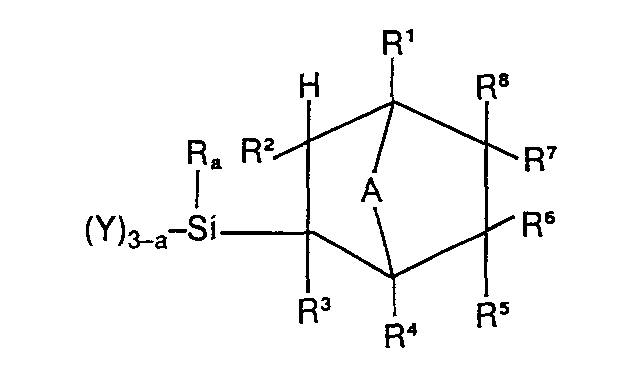
- the new organosilicon compounds according to the invention correspond to the following formula
- R is a hydrocarbon residue with 1 to 6 carbon atoms.
- the hydrocarbon residue may be an aliphatic hydrocarbon residue, e.g. be a methyl, ethyl, propyl, butyl or a hexyl radical.
- the radical R can, however, also be a phenyl radical.
- the radical R preferably has the meaning of a methyl or phenyl radical, particularly preferably the meaning of a methyl radical. If several radicals R are bonded to the silicon atom, the meaning of these radicals can be different.
- the radical R can be substituted.
- radicals R 1 , R 2 , R and R 4 are the same or different and are hydrogen radicals or methyl radicals.
- the radicals R 5 , R 6 , R 7 and R are the same or different; they are hydrogen, fluorine or hydrocarbon radicals having 1 to 8 carbon atoms, in particular aliphatic radicals having 1 to 8 carbon atoms, which can be straight-chain or branched in the case of a higher carbon number, and fluorinated hydrocarbon radicals, where at least one of the radicals R 5 , R 6 , R 7 , R 8 must be a fluorine residue or a fluorinated hydrocarbon residue.
- fluorinated coals hydrogen radicals are in particular the perfluorinated alkyl radicals having 1 to 20 carbon atoms, preferably having 1 to 12 carbon atoms.
- Y is a hydrolyzable residue that is directly attached to the silicon atom, or a hydroxyl residue or an organosiloxanyl residue.
- Such hydrolyzable groups are known to the person skilled in the art. These are in particular halogen residues and hydrocarbonoxy residues, in particular alkoxy residues.
- Y can also be a hydrocarbon carboxy radical, e.g. an acetoxy radical or an optionally alkylated amino radical.
- Y has the meaning of an organosiloxanyl radical, this can consist of differently functional silicon units.
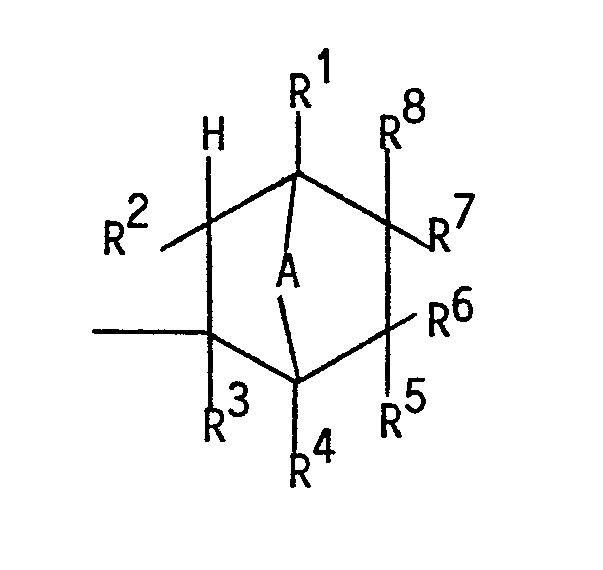
- the organosiloxanyl residue can be linear or branched. It is also possible for the siloxanyl radical to contain further groups of the formula I, for example the group wearing.
- A is a divalent hydrocarbon residue or an oxygen residue.
- the xR2 radical is particularly suitable as a divalent hydrocarbon radical, where R 9 is the same or different and denotes a hydrogen or methyl radical.
- the bridging group can thus have the meaning CHCH 3 .
- a is an integer and has the meaning 0, 1, 2 or 3.
- R is a methyl radical
- R 1 , R 2 , R 3 , R 4 are hydrogen and / or methyl radicals
- R 5 , R 6 , R 7 , R 8 are hydrogen, fluorine or hydrocarbon radicals with 1 to 6 carbon atoms, in particular aliphatic hydrocarbon radicals or fluorinated, in particular perfluorinated, alkyl radicals with 1 to 20 carbon atoms, at least one radical R 5 , R 6 , R 7 , R 8 must be a fluoro or fluoroalkyl radical.
- A has the meaning of a methylene group or the group
- the index a has the value 0, 1 or 2.
- organosilicon compounds of the formula I where R is a methyl radical, R 1 , R 2 , R 3 , R 4 is a hydrogen radical and R 5 , R 6 , R 7 , R 8 is a hydrogen radical or the radical -C n F 2n + 1 .
- the index n is an integer from 1 to 20.
- At least one of the radicals R 5 , R 6 , R 7 or R 8 must be a perfluoroalkyl radical.
- modified organosilicon compounds according to the invention are:
- Another object of the invention is the process for the preparation of the new organosilicon compounds.
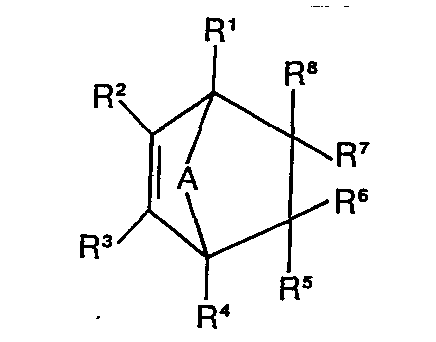
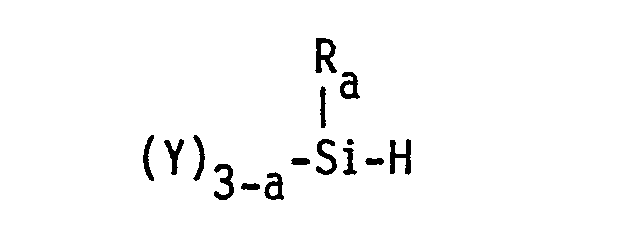
- the process according to the invention is characterized in that a 2-norbornene derivative of the general formula with an organosilicon compound of the formula in the presence of a known catalyst for the addition of -SiH to olefinic double bonds, if appropriate at elevated temperature and / or elevated pressure.
- the compounds of the formula II can be obtained in a known manner by Diels-Alder reaction from cyclopentadienes or furans and F-substituted olefins.
- the process according to the invention can be carried out without using solvents.
- the organosilicon compound carrying the reactive SiH group is highly viscous due to its molecular weight or structure, the use of an inert solvent, e.g. Toluene.
- the reaction proceeds at a satisfactory rate at temperatures above 60 ° C, especially at 70 to 120 ° C.
- the application of increased pressure is not necessary, but the reaction can be promoted by increasing the pressure.
- catalysts known from the prior art for compounds having olefinic double bonds on SiH groups can be used as catalysts.
- Such catalysts are in particular platinum catalysts, e.g. chlorine-substituted platinum compounds, such as hexachloroplatinic acid.
- the compounds according to the invention not only have the advantage of being easy to produce, but also have special properties when modifying the surface of solids, in particular of finely divided silica.
- the methanol number is used as a measure of the improved compatibility of the modified silica with organic media or for the incompatibility with water. This methanol number is greatly increased when using the norbornyl derivatives according to the invention in comparison to polysiloxanes which carry perfluorinated alkyl radicals directly on the silicon atom.
- Silicic acid, modified with the compounds according to the invention is therefore particularly suitable for incorporation into organic binders and for the production of defoamers for aqueous systems.
- the compounds according to the invention are also outstandingly suitable for the surface treatment of building materials, such as bricks, gypsum boards and prefabricated concrete components.
- the compounds according to the invention are furthermore particularly suitable for the water, oil and dirt-repellent impregnation of textile materials.
- the reaction product is dissolved in 100 g 1,1,2-trichloro Dissolved 1,2,2-trifluoroethane and poured into 250 g of acetone with stirring, the precipitated product was separated off and dried at 100 ° / 1 torr. Yield: 67.3 g of a polysiloxane containing 4.3% by weight of Si and 59.9% by weight of F.
- Example 2 In the apparatus described in Example 1, half of a solution of 37.7 g of perfluorohexylethylene, 34 ml of dry tetrahydrofuran and half of a solution of 5 mg of H 2 PtCl 6 . 6 H 2 0 in 5 ml of tetrahydrofuran and stirred at 7 ° C for 30 minutes. 6.0 g of the abovementioned polymethylhydrogensiloxane in 11 ml of dry tetrahydrofuran are then added dropwise at 23 ° C.
- the second half of the perfluorohexylethylene solution and the catalyst solution are added (duration: 2 hours); the temperature is raised to 35 ° C. and stirred at this temperature for a further 4 hours. Then the reaction mixture is stirred with 1 g of activated carbon and filtered.
- ml of H 2 O and 0.2 g of the treated silica are placed in a shaking flask and titrated with anhydrous methanol until all of the silica has been dispersed into the aqueous methanolic phase.
- the end point of the titration is reached when less than 10 visible silica particles float on the surface.
- the methanol number becomes after calculated.
- the methanol number is a measure of the degree of hydrophobization and is related to the critical wetting tension. Above this critical wetting voltage, complete wetting of the treated substrate is no longer possible.
Landscapes
- Chemical & Material Sciences (AREA)
- Organic Chemistry (AREA)
- Engineering & Computer Science (AREA)
- Chemical Kinetics & Catalysis (AREA)
- Ceramic Engineering (AREA)
- Health & Medical Sciences (AREA)
- Polymers & Plastics (AREA)
- Inorganic Chemistry (AREA)
- Medicinal Chemistry (AREA)
- General Chemical & Material Sciences (AREA)
- Materials Engineering (AREA)
- Structural Engineering (AREA)
- Application Of Or Painting With Fluid Materials (AREA)
- Aftertreatments Of Artificial And Natural Stones (AREA)
- Compositions Of Macromolecular Compounds (AREA)
- Silicon Polymers (AREA)
Abstract
- R = Kohlenwasserstoffrest mit 1 bis 6 Kohlenstoffatomen,
- R1, R2, R3, R4 = gleich oder verschieden, Wasserstoff-oder Methylrest,
- R5, R6, R7, R8 = gleich oder verschieden, Wasserstoff-, Fluor- oder Kohlenwasserstoffrest mit 1 bis 8 Kohlenstoffatomen oder fluorierter Kohlenwasserstoffrest, wobei mindestens ein Rest R5, R6, R7, R8 ein Fluor- oder fluorierter Kohlenwasserstoffrest sein muß,
- Y = hydrolysierbarer Rest, Hydroxylrest oder Organosiloxanylrest,
- A

- a = 0, 1, 2 oder 3.
Description
- Die Erfindung betrifft neue Silane oder Siloxane, welche cyclische Kohlenwasserstoffreste mit Fluor- oder Fluorkohlenwasserstoffresten aufweisen, sowie deren Herstellung und Verwendung zur Modifizierung der Oberfläche von Festkörpern, insbesondere von feinteiliger Kieselsäure.
- Silane oder Siloxane, welche Fluor- oder Fluorkohlenwasserstoffreste tragen, verleihen Substraten, auf die sie aufgebracht werden, wasser-, öl- und gegebenenfalls schmutzabweisende Eigenschaften. Diese Verbindungen werden deshalb mit Erfolg zur Modifizierung der Eigenschaften anorganischer oder organischer Materialien verwendet. Beispiele solcher Materialien sind Baustoffe, wie Gips, Zement, Mörtel oder geformte Baumaterialien, wie Ziegel aus Ton oder anderen porösen Materialien, Gipsplatten, Betonfertigbauteile.
- Eine weitere Anwendung für fluorhaltige Silane oder Siloxane ist die Modifizierung von Pigmenten und Füllstoffen, die in modifizierter Form eine verbesserte Verträglichkeit mit verschiedenen organischen Medien aufweisen. Dies zeigt sich zum Beispiel in der Erleichterung der Einarbeitung von Pigmenten in Bindemittel und in der Verringerung ihrer Tendenz zu Entmischung und Absetzen. Modifiziert man feinteilige, insbesondere pyrogen erzeugte Kieselsäure, bewirkt diese ein verbessertes Schwebeverhalten von Pigmenten, eine Veränderung der Thixotropie und eine Verringerung des Gasens von Zinkstaubfarben.
- Weitere Anwendungsmöglichkeiten ergeben sich in der Papierindustrie, wobei die Produkte sowohl dem Papierbrei bei der Papierherstellung zugesetzt wie auf die bereits verfestigte, noch feuchte Papierbahn oder auf das fertige Papier aufgebracht werden können. Fluorsiliciumorganische Verbindungen sind ferner zum Behandeln von textilen Materialien geeignet, die in Form von Fasern, Garnen oder gewebt, gewirkt, gestrickt oder in Vliesform vorliegen können.
- Schwierigkeiten bereitet jedoch die Herstellung dieser Verbindungen. Zur Herstellung von Siloxanen mit fluorierten Kohlenwasserstoffresten geht man nach dem Stand der Technik bevorzugt von Silanen aus, welche diese Fluorkohlenwasserstoffreste tragen. Dies hat seinen Grund darin, daß die Anlagerung von Fluoralkylolefinen an die SiH-Gruppe von Silanen durch die Gegenwart von an dem gleichen Si-Atom gebundenen Halogenatomen erleichtert wird. Es bereitet jedoch ebenfalls Schwierigkeiten, aus Silanen mit fluorierten Kohlenwasserstoffgruppen Siloxane vorgegebener Struktur herzustellen, da bei der Hydrolyse und Kondensation dieser Silane bevorzugt cyclische Siloxane gebildet werden.
- Will man jedoch fluorierte Kohlenwasserstoffe mit olefinischen Doppelbindungen an die SiH-Gruppe von Wasserstoffsiloxanen anlagern, stellt man fest, daß diese Additionsreaktion durch die Substitution des Si-Atoms mit anderen Kohlenwasserstoffgruppen oder Siloxygruppen erheblich erschwert wird.
- Die Aufgabe, in Siloxane vorgegebener Struktur fluorierte Kohlenwasserstoffreste in einfacher Weise einzuführen, um Verbindungen zu erhalten, deren Eigenschaften durch die Struktur der Siloxane und durch die besonderen Eigenschaften der fluorierten Kohlenwasserstoffgruppen anwendungsgerecht eingestellt werden können, ist somit aus dem Stand der Technik noch nicht befriedigend zu lösen.
- Es wurde nun überraschenderweise gefunden, daß Fluor enthaltende Kohlenwasserstoffreste in einfacher Weise in Organosiliciumverbindungen eingeführt werden können, wenn man Norbornenderivate oder deren 7-Oxaderivate, in welche Fluor- oder Fluorkohlenwasserstoffreste eingeführt sind, mit Organosiliciumverbindungen, welche SiH-Gruppen aufweisen, umsetzt.
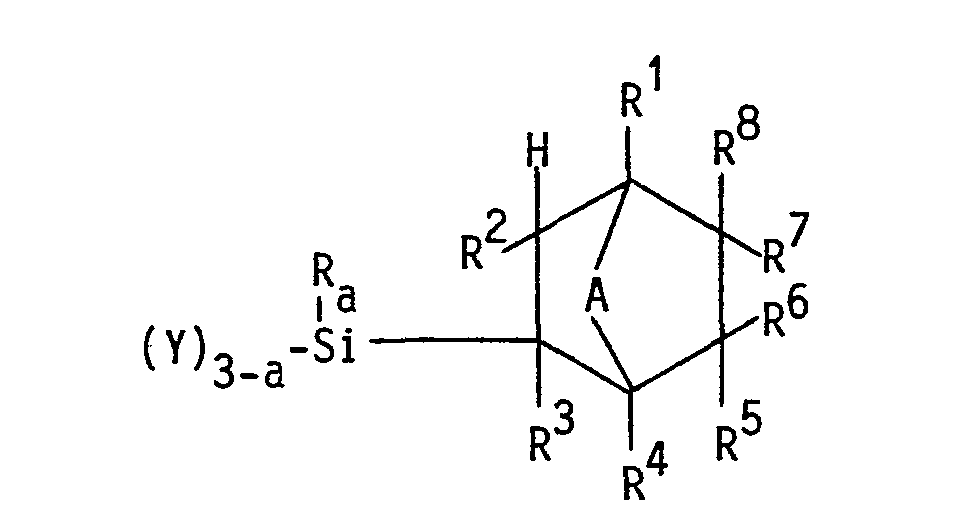
- Die neuen erfindungsgemäßen Organosiliciumverbindungen entsprechen folgender Formel

- Die Formel I ist in bezug auf die Substituenten R bis R8 nicht auf eine bestimmte räumliche Struktur beschränkt. Sie umfaßt alle stereoisomeren Formeln.
- In dieser Formel haben die Indices folgende Bedeutung:
- R ist ein Kohlenwasserstoffrest mit 1 bis 6 Kohlenstoffatomen. Der Kohlenwasserstoffrest kann ein aliphatischer Kohlenwasserstoffrest, wie z.B. ein Methyl-, Ethyl-, Propyl-, Butyl- oder ein Hexylrest sein. Der Rest R kann jedoch auch ein Phenylrest sein. Vorzugsweise hat der Rest R die Bedeutung eines Methyl- oder Phenylrestes, besonders bevorzugt die Bedeutung eines Methylrestes. Sind mehrere Reste R am Siliciumatom gebunden, kann die Bedeutung dieser Reste verschieden sein. Der Rest R kann substituiert sein.
- Die Reste R1, R2, R und R4 sind gleich oder verschieden und sind Wasserstoffreste oder Methylreste.
- Die Reste R5, R6, R7 und R sind gleich oder verschieden; sie bedeuten Wasserstoff-, Fluor- oder Kohlenwasserstoffreste mit 1 bis 8 Kohlenstoffatomen, insbesondere aliphatische Reste mit 1 bis 8 Kohlenstoffatomen, die im Falle höherer Kohlenstoffzahl geradkettig oder verzweigt sein können, sowie fluorierte Kohlenwasserstoffreste, wobei mindestens einer der Reste R5, R6, R7, R8 ein Fluorrest oder ein fluorierter Kohlenwasserstoffrest sein muß. Als fluorierte Kohlenwasserstoffreste kommen insbesondere die perfluorierten Alkylreste mit 1 bis 20 Kohlenstoffatomen, bevorzugt mit 1 bis 12 Kohlenstoffatomen, in Frage.
- Y ist ein hydrolysierbarer Rest, der direkt an das Siliciumatom gebunden ist, oder ein Hydroxylrest oder ein Organosiloxanylrest. Dem Fachmann sind derartige hydrolysierbare Gruppen bekannt. Es handelt sich hierbei insbesondere um Halogenreste und Kohlenwasserstoffoxyreste, insbesondere Alkoxyreste. Y kann jedoch auch ein Kohlenwasserstoffcarboxyrest, z.B. ein Acetoxyrest oder ein gegebenenfalls alkylierter Aminorest, sein.
- Hat Y die Bedeutung eines Organosiloxanylrestes, kann dieser aus verschiedenfunktionellen Siliciumeinheiten bestehen. Der Organosiloxanylrest kann linear oder verzweigt sein. Es ist auch möglich, daß der Siloxanylrest weitere Gruppen der Formel I, z.B. die Gruppe
- A ist ein zweiwertiger Kohlenwasserstoffrest oder ein Sauerstoffrest. Als zweiwertiger Kohlenwasserstoffrest kommt insbesondere der Rest xR2 in Frage, wobei R9 gleich oder verschieden ist und einen Wasserstoff- oder Methylrest bedeutet. Die verbrückende Gruppe kann somit die Bedeutung CHCH3 haben.
- a ist eine ganze Zahl und hat die Bedeutung 0, 1, 2 oder 3.
- Bevorzugt sind Organosiliciumverbindungen der Formel I, bei der die Substituenten folgende Bedeutung haben: R ist ein Methylrest; R1, R2, R3, R4 sind Wasserstoff- und/oder Methylreste; R5, R6, R7, R8 sind Wasserstoff-, Fluor- oder Kohlenwasserstoffreste mit 1 bis 6 Kohlenstoffatomen, insbesondere aliphatische Kohlenwasserstoffreste oder fluorierte, insbesondere perfluorierte, Alkylreste mit 1 bis 20 Kohlenstoffatomen, wobei mindestens ein Rest R5, R6, R7, R8 ein Fluor-oder Fluoralkylrest sein muß. A hat die Bedeutung einer Methylengruppe oder der Gruppe

- Typische Beispiele erfindungsgemäßer modifizierter siliciumorganischer Verbindungen sind


- Ein weiterer Gegenstand der Erfindung besteht in dem Verfahren zur Herstellung der neuen siliciumorganischen Verbindungen. Das erfindungsgemäße Verfahren ist dadurch gekennzeichnet, daß man ein 2-Norbornenderivat der allgemeinen Formel

- Die Verbindungen der Formel II sind durch Diels-Alder-Reaktion aus Cyclopentadienen bzw. Furanen und F-substituierten Olefinen in bekannter Weise erhältlich.
- Das erfindungsgemäße Verfahren kann ohne Verwendung von Lösungsmitteln durchgeführt werden. Falls jedoch die siliciumorganische Verbindung, welche die reaktive SiH-Gruppe trägt, aufgrund ihres Molekulargewichtes oder ihrer Struktur hochviskos ist, empfiehlt sich die Verwendung eines inerten Lösungsmittels, z.B. Toluol. Die Reaktion verläuft mit befriedigender Geschwindigkeit bei Temperaturen oberhalb von 60°C, insbesondere bei 70 bis 120°C. Die Anwendung erhöhten Druckes ist nicht erforderlich, jedoch kann die Reaktion durch Erhöhung des Druckes begünstigt werden.
- Als Katalysatoren können die aus dem Stand der Technik bekannten Anlagerungskatalysatoren für Verbindungen mit olefinischen Doppelbindungen an SiH-Gruppen verwendet werden. Derartige Katalysatoren sind insbesondere Platinkatalysatoren, z.B. chlorsubstituierte Platinverbindungen, wie Hexachloroplatinsäure.
- Die erfindungsgemäßen Verbindungen haben nicht nur den Vorteil der leichten Herstellbarkeit, sondern weisen auch besondere Eigenschaften bei der Modifizierung der Oberfläche von Festkörpern, insbesondere von feinteiliger Kieselsäure auf. Als Maß für die verbesserte Verträglichkeit der modifizierten Kieselsäure mit organischen Medien bzw. für die Unverträglichkeit mit Wasser gilt die Methanolzahl. Diese Methanolzahl ist im Vergleich zu Polysiloxanen, welche perfluorierte Alkylreste direkt am Siliciumatom tragen, bei Verwendung der erfindungsgemäßen Norbornylderivate stark erhöht. Kieselsäure, modifiziert mit den erfindungsgemäßen Verbindungen, eignet sich deshalb besonders zur Einarbeitung in organische Bindemittel sowie zur Herstellung von Entschäumern für wäßrige Systeme.
- Die erfindungsgemäßen Verbindungen sind ferner hervorragend zur Oberflächenbehandlung von Baustoffen, wie Ziegeln, Gipsplatten und Betonfertigbauteilen, geeignet.
- Die erfindungsgemäßen Verbindungen sind ferner zur wasser-, öl- und schmutzabweisenden Imprägnierung von textilen Materialien besonders geeignet.
- In den folgenden Beispielen werden die Herstellung und die Verwendung der Verbindungen noch näher beschrieben.
- In einem 100 ml Vierhalskolben, ausgestattet mit einem Rückflußkühler mit CaCl2-Trockenrohr, Thermometer, Magnetrührer und Heizbad, werden 30,9 g 5-Perfluorhexylnorbornen-(2) (75 mMol), eine Lösung von 3 mg H2PtCle . 6 H20 in 1,5 ml Glykoldimethylether und 25 ml Toluol vorgelegt, auf 70°C erwärmt und 13,0 g CH3HSiCl2 (113,2 mMol) so zugetropft, daß der Rückfluß minimal ist (Dauer: 7 Minuten). Dann wird weitere 3 Stunden unter Rückfluß gerührt. Die Temperatur steigt dabei von 83°C auf 104°C. Überschüssiges CH3HSiCl2 und Toluol werden abdestilliert, der Rückstand von 38,0 g im Vakuum fraktioniert:


- In einem 50 ml Kolben, ausgestattet mit einem Rückflußkühler, einem magnetischen Rührer und einem Heizbad, werden 8,2 g Perfluorhexylnorbornen-(2) und 1,5 mg H2PtC16 . 6 H20 vorgelegt und auf 65°C erwärmt. Danach werden 1,34 g 1,1,3,3-Tetramethyldisiloxan zugesetzt. Dieses Reaktionsgemisch wird 2 Stunden bei 75°C gerührt. Die gaschromatographische Analyse des Reaktionsgemisches ergibt 91,6 % eines Isomerengemisches von Bis-1,3(perfluorhexylnorbornyl)-1,1,3,3-tetramethyldisiloxan. Ausbeute des im Vakuum von flüchtigen Anteilen befreiten Produktes: 8,4 g (88,4 % der Theorie).
-

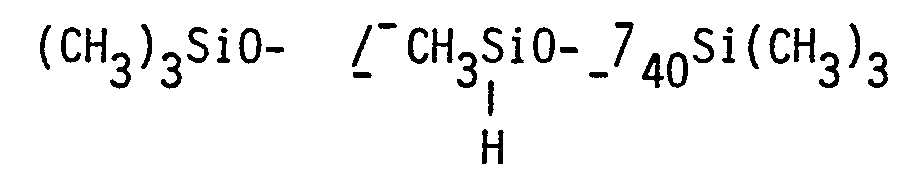
- Wiederholung des Beispiels 3, jedoch in 46 g Benzotrifluorid als Lösungsmittel. Nach Beendigung der Reaktion werden Benzotrifluorid und andere flüchtige Anteile im Vakuum bis zu einer Kolbentemperatur von 125°C bei 15 Torr abdestilliert. Ausbeute: 46,5 g eines Siloxans mit Si: 6,8 Gew.-%; F: 51,0 Gew.-%.
-


-


- Herstellung von Poly-(dodecylmethyl)-(perfluoroctylnorbornyl-methyl)-siloxan der mittleren Formel
-


- In einem 50 ml Kolben mit Rückflußkühler, Magnetrührer, Thermometer und Heizbad werden 7,0 g Perfluorhexylethylen (20 mMol) und 1,5 mg H2PtC16 . 6 H20 in 1,5 ml Glykoldimethylether vorgelegt, auf 60°C erwärmt und anschließend 1,34 g 1,1,3,3-Tetramethyldisiloxan zugesetzt und 23 Stunden bei 70 bis 75°C gerührt. Die gaschromatographische Analyse ergibt, daß unter verschiedenen unidentifizierten Produkten 92 % des eingesetzten Perfluorhexylethylens unumgesetzt vorhanden sind.
-

- Schon vor der Zugabe von Aktivkohle kann man einzelne Gelteilchen beobachten. Bei der Filtration des Reaktionsgemisches kommt es zu weiterer Gelbildung, die die Filtration vollständig verhindert.
- In einem Mischgefäß werden 1000 g hochdisperse Kieselsäure mit einer spezifischen Oberfläche von 200 m2/g vorgelegt und mit einer Lösung von 100 g der zu prüfenden Verbindung in 2400 g eines geeigneten Lösungsmittels intensiv gemischt. Nach einer Mischzeit von 1 Stunde wird das Lösungsmittel während 2 Stunden bei einer Temperatur von 140 bis 160°C und Atmosphärendruck entfernt. Die nunmehr lösungsmittelfreie, mit Wirkstoff überzogene hochdisperse Kieselsäure wird dann zur Fixierung des Behandlungsmittels auf der Oberfläche weitere 2 Stunden auf 180°C erhitzt. Nach dem Abkühlen wird die Hydrophobie der Kieselsäure nach folgender Methode bestimmt:
- In einem Schüttelkolben werden 50 ml H20 und 0,2 g der behandelten Kieselsäure vorgelegt und mit wasserfreiem Methanol titriert, bis die gesamte Kieselsäure in die wäßrige methanolische Phase eindispergiert ist. Der Endpunkt der Titration ist erreicht, wenn weniger als 10 sichtbare Kieselsäureteilchen auf der Oberfläche schwimmen. Die Methanolzahl wird nach

- In der folgenden Tabelle sind die Ergebnisse zusammengefaßt.

Claims (7)

bedeutet.
bedeutet.


Applications Claiming Priority (2)
| Application Number | Priority Date | Filing Date | Title |
|---|---|---|---|
| DE3423608A DE3423608A1 (de) | 1984-06-27 | 1984-06-27 | Fluoralkylsilane oder -siloxane, deren herstellung und verwendung |
| DE3423608 | 1984-06-27 |
Publications (3)
| Publication Number | Publication Date |
|---|---|
| EP0168645A2 true EP0168645A2 (de) | 1986-01-22 |
| EP0168645A3 EP0168645A3 (en) | 1986-02-05 |
| EP0168645B1 EP0168645B1 (de) | 1988-12-21 |
Family
ID=6239228
Family Applications (1)
| Application Number | Title | Priority Date | Filing Date |
|---|---|---|---|
| EP85107378A Expired EP0168645B1 (de) | 1984-06-27 | 1985-06-14 | Perfluoralkylnorbornylsilane oder -siloxane, deren Herstellung und Verwendung |
Country Status (4)
| Country | Link |
|---|---|
| US (1) | US4642356A (de) |
| EP (1) | EP0168645B1 (de) |
| JP (1) | JPS6115887A (de) |
| DE (2) | DE3423608A1 (de) |
Cited By (1)
| Publication number | Priority date | Publication date | Assignee | Title |
|---|---|---|---|---|
| FR2632962A1 (fr) * | 1988-06-17 | 1989-12-22 | Pola Chem Ind Inc | Poudres a revetement hydrofuge et oleofuge leur procede de production et produits cosmetiques les contenant |
Families Citing this family (12)
| Publication number | Priority date | Publication date | Assignee | Title |
|---|---|---|---|---|
| DE3635093C1 (de) * | 1986-10-15 | 1988-03-10 | Goldschmidt Ag Th | Neue Fluor enthaltende Siloxane,ihre Herstellung und Verwendung als Mittel zum Entschaeumen |
| JPH0813821B2 (ja) * | 1987-09-28 | 1996-02-14 | 東芝シリコーン株式会社 | ビニルシラン化合物 |
| JPH0196188A (ja) * | 1987-10-07 | 1989-04-14 | Toshiba Silicone Co Ltd | 5−ビニルビシクロ〔2.2.1〕ヘプチルトリクロロシランの製造方法 |
| JPH01132591A (ja) * | 1987-11-18 | 1989-05-25 | Toshiba Silicone Co Ltd | 二量体化されたビニルビシクロヘプチル基含有ケイ素化合物およびその製造方法 |
| US5348769A (en) * | 1993-03-31 | 1994-09-20 | Osi Specialties, Inc. | Fluorosilicone compositions as wash durable soil and stain repellent finishes |
| NZ303624A (en) * | 1995-03-08 | 1999-01-28 | Du Pont | Reactive organosilicons as coatings, adhesives, and sealants |
| GC0000046A (en) * | 1998-02-26 | 2004-06-30 | Shell Int Research | Compositions for use in well construction, repair and/or abandonment. |
| DE10147625C1 (de) * | 2001-09-27 | 2002-10-31 | Consortium Elektrochem Ind | Norbornylsubstituierte Silane und deren Verwendung |
| US8131342B2 (en) * | 2004-08-24 | 2012-03-06 | General Electric Company | Method and system for field mapping using integral methodology |
| JP4542128B2 (ja) * | 2007-11-09 | 2010-09-08 | 信越化学工業株式会社 | ノルボルナン骨格含有有機ケイ素化合物およびその製造方法 |
| US8034965B2 (en) | 2007-11-09 | 2011-10-11 | Shin-Etsu Chemical Co., Ltd. | Norbornane skeleton structure-containing organosilicon compound and method of producing same |
| WO2014152686A2 (en) * | 2013-03-14 | 2014-09-25 | Momentive Performance Material Inc. | High refractive index siloxanes |
Family Cites Families (6)
| Publication number | Priority date | Publication date | Assignee | Title |
|---|---|---|---|---|
| GB761505A (en) * | 1954-08-23 | 1956-11-14 | Velsicol Chemical Corp | Improvements in or relating to novel silanes and organosiloxane polymers and processes for preparing same |
| US2884434A (en) * | 1957-03-07 | 1959-04-28 | Dow Corning | Haloorgano silcarbane siloxanes |
| US3994947A (en) * | 1971-02-02 | 1976-11-30 | Copolymer Rubber & Chemical Corporation | Fulvene-silane adduct and ethylene interpolymers embodying same |
| DE2614608C3 (de) * | 1976-04-05 | 1980-04-03 | Aleksej Ivanovitsch Ponomarev | Perfluoralkylphenyl- und Perfluoralkoxyphenyl-methyldichlorsilane sowie Verfahren zu ihrer Herstellung |
| US4381396A (en) * | 1982-07-07 | 1983-04-26 | General Electric Company | Silynorbornane anhydrides and method for making |
| CA1204760A (en) * | 1982-11-18 | 1986-05-20 | Hong-Son Ryang | Silicone-polyimide copolymers, condensation vulcanizable compositions obtained therefrom, and methods for making |
-
1984
- 1984-06-27 DE DE3423608A patent/DE3423608A1/de not_active Withdrawn
-
1985
- 1985-05-07 JP JP60096574A patent/JPS6115887A/ja active Granted
- 1985-06-14 DE DE8585107378T patent/DE3566890D1/de not_active Expired
- 1985-06-14 EP EP85107378A patent/EP0168645B1/de not_active Expired
- 1985-06-14 US US06/745,258 patent/US4642356A/en not_active Expired - Fee Related
Cited By (2)
| Publication number | Priority date | Publication date | Assignee | Title |
|---|---|---|---|---|
| FR2632962A1 (fr) * | 1988-06-17 | 1989-12-22 | Pola Chem Ind Inc | Poudres a revetement hydrofuge et oleofuge leur procede de production et produits cosmetiques les contenant |
| US5458976A (en) * | 1988-06-17 | 1995-10-17 | Matsushita Electric Industrial Co., Ltd. | Water and oil repellant coated powders and method for producing same |
Also Published As
| Publication number | Publication date |
|---|---|
| EP0168645B1 (de) | 1988-12-21 |
| DE3566890D1 (en) | 1989-01-26 |
| US4642356A (en) | 1987-02-10 |
| DE3423608A1 (de) | 1986-01-02 |
| JPH0134995B2 (de) | 1989-07-21 |
| EP0168645A3 (en) | 1986-02-05 |
| JPS6115887A (ja) | 1986-01-23 |
Similar Documents
| Publication | Publication Date | Title |
|---|---|---|
| EP0348705A2 (de) | Organophile Doppelringkieselsäurederivate mit käfigartigen Strukturen, Verfahren zu ihrer Herstellung und ihre Verwendung | |
| DE3103705A1 (de) | "platin-siloxan-komplex-katalysator und diesen katalysator enthaltende zubereitungen" | |
| EP0168645B1 (de) | Perfluoralkylnorbornylsilane oder -siloxane, deren Herstellung und Verwendung | |
| DE69005271T2 (de) | Polydimethylsiloxan mit nur einer verzweigten endständigen Aminoalkylgruppe und seine Herstellung. | |
| DE2642833B2 (de) | Oxysilan-Verbindungen, Verfahren zu ihrer Herstellung und ihre Verwendung | |
| EP0646616B1 (de) | Organopolysiloxane mit bifunktionellen endständigen Siloxaneinheiten | |
| DE2642811C3 (de) | Oxysilanol-Verbindungen, Verfahren zu ihrer Herstellung und ihre Verwendung | |
| DE3546376A1 (de) | Bis(aminoalkyl)-disiloxane und verfahren zu ihrer herstellung | |
| DE3830572C2 (de) | Siliciumorganische Verbindung | |
| DE1198063B (de) | Bei Raumtemperatur durchfuehrbares Verfahren zur Herstellung von Organopolysiloxanelastomeren | |
| DE1495868C3 (de) | Verfahren zur Herstellung von Acyloxyalkylgruppen enthaltenden Organo polysiloxanen | |
| DE19707970A1 (de) | Polycarbonsäurefunktionelle Polyorganosiloxane | |
| EP0215368A2 (de) | Organopolysiloxane und diese enthaltende aushärtbare Organopolysiloxanzubereitung | |
| DE4033157A1 (de) | Verfahren zur herstellung von loeslichen methylalkoxypoly(disilyl)-siloxanen | |
| DE2345923A1 (de) | Verfahren zur herstellung von halogenhaltigen organopolysiloxanen | |
| DE2759653C2 (de) | Hitzehärtbare Organopolysiliciummasse | |
| EP0123321A2 (de) | Verfahren zum Vernetzen von Organopolysiloxanmassen | |
| DE69024294T2 (de) | Fluorierte zyklische Organosilicium-Verbindungen und Verfahren zu deren Herstellung | |
| DE1125180B (de) | Verfahren zur Hydrolyse von Chlorsilanen mit unmittelbar an Silicium gebundenem Wasserstoff bzw. organofunktionellen Gruppen | |
| DE1420470A1 (de) | Verfahren zur Herstellung von carbalkoxyalkylhaltigen Organopolysiloxanen | |
| DE2415669A1 (de) | Fluoralkylthiomethylsilane und verfahren zu ihrer herstellung | |
| EP0538868B1 (de) | Buntesalzgruppen aufweisende Organosiliciumverbindungen, Verfahren zu ihrer Herstellung sowie ihre Verwendung | |
| DE2059554C3 (de) | Verfahren zur Herstellung äquilibrierter Gemische von Polydiorganosiloxanylsulfaten | |
| DE3021043C2 (de) | ||
| DE4110793C1 (en) | Organo:polysiloxane - used as photoinitiator in cationically curable organo:polysiloxane compsn. esp. contg. epoxy¨ or vinyl¨ gps. |
Legal Events
| Date | Code | Title | Description |
|---|---|---|---|
| PUAI | Public reference made under article 153(3) epc to a published international application that has entered the european phase |
Free format text: ORIGINAL CODE: 0009012 |
|
| PUAL | Search report despatched |
Free format text: ORIGINAL CODE: 0009013 |
|
| 17P | Request for examination filed |
Effective date: 19850622 |
|
| AK | Designated contracting states |
Designated state(s): BE DE FR GB NL |
|
| AK | Designated contracting states |
Designated state(s): BE DE FR GB NL |
|
| 17Q | First examination report despatched |
Effective date: 19870522 |
|
| GRAA | (expected) grant |
Free format text: ORIGINAL CODE: 0009210 |
|
| AK | Designated contracting states |
Kind code of ref document: B1 Designated state(s): BE DE FR GB NL |
|
| GBT | Gb: translation of ep patent filed (gb section 77(6)(a)/1977) | ||
| REF | Corresponds to: |
Ref document number: 3566890 Country of ref document: DE Date of ref document: 19890126 |
|
| ET | Fr: translation filed | ||
| PLBE | No opposition filed within time limit |
Free format text: ORIGINAL CODE: 0009261 |
|
| STAA | Information on the status of an ep patent application or granted ep patent |
Free format text: STATUS: NO OPPOSITION FILED WITHIN TIME LIMIT |
|
| 26N | No opposition filed | ||
| PGFP | Annual fee paid to national office [announced via postgrant information from national office to epo] |
Ref country code: GB Payment date: 19930602 Year of fee payment: 9 |
|
| PGFP | Annual fee paid to national office [announced via postgrant information from national office to epo] |
Ref country code: FR Payment date: 19930609 Year of fee payment: 9 |
|
| PGFP | Annual fee paid to national office [announced via postgrant information from national office to epo] |
Ref country code: DE Payment date: 19930623 Year of fee payment: 9 |
|
| PGFP | Annual fee paid to national office [announced via postgrant information from national office to epo] |
Ref country code: NL Payment date: 19930630 Year of fee payment: 9 |
|
| PGFP | Annual fee paid to national office [announced via postgrant information from national office to epo] |
Ref country code: BE Payment date: 19930709 Year of fee payment: 9 |
|
| PG25 | Lapsed in a contracting state [announced via postgrant information from national office to epo] |
Ref country code: GB Effective date: 19940614 |
|
| PG25 | Lapsed in a contracting state [announced via postgrant information from national office to epo] |
Ref country code: BE Effective date: 19940630 |
|
| BERE | Be: lapsed |
Owner name: TH. GOLDSCHMIDT A.G. Effective date: 19940630 |
|
| PG25 | Lapsed in a contracting state [announced via postgrant information from national office to epo] |
Ref country code: NL Effective date: 19950101 |
|
| GBPC | Gb: european patent ceased through non-payment of renewal fee |
Effective date: 19940614 |
|
| NLV4 | Nl: lapsed or anulled due to non-payment of the annual fee | ||
| PG25 | Lapsed in a contracting state [announced via postgrant information from national office to epo] |
Ref country code: FR Effective date: 19950228 |
|
| PG25 | Lapsed in a contracting state [announced via postgrant information from national office to epo] |
Ref country code: DE Effective date: 19950301 |
|
| REG | Reference to a national code |
Ref country code: FR Ref legal event code: ST |