EP0165367B1 - Armierungseisenhalter zur Verwendung bei Anschlussbetonierungen - Google Patents
Armierungseisenhalter zur Verwendung bei Anschlussbetonierungen Download PDFInfo
- Publication number
- EP0165367B1 EP0165367B1 EP84810301A EP84810301A EP0165367B1 EP 0165367 B1 EP0165367 B1 EP 0165367B1 EP 84810301 A EP84810301 A EP 84810301A EP 84810301 A EP84810301 A EP 84810301A EP 0165367 B1 EP0165367 B1 EP 0165367B1
- Authority
- EP
- European Patent Office
- Prior art keywords
- reinforcement
- iron holder
- hollow body
- transverse ribs
- holder according
- Prior art date
- Legal status (The legal status is an assumption and is not a legal conclusion. Google has not performed a legal analysis and makes no representation as to the accuracy of the status listed.)
- Expired
Links
- XEEYBQQBJWHFJM-UHFFFAOYSA-N iron Substances [Fe] XEEYBQQBJWHFJM-UHFFFAOYSA-N 0.000 title claims abstract description 53
- 229910052742 iron Inorganic materials 0.000 title claims abstract description 31
- 230000003014 reinforcing effect Effects 0.000 claims abstract description 30
- 235000000396 iron Nutrition 0.000 claims abstract description 9
- 239000002184 metal Substances 0.000 claims description 7
- 229910052751 metal Inorganic materials 0.000 claims description 7
- 239000000463 material Substances 0.000 claims description 2
- 239000002023 wood Substances 0.000 claims description 2
- 230000002787 reinforcement Effects 0.000 description 7
- 210000000038 chest Anatomy 0.000 description 4
- 238000004873 anchoring Methods 0.000 description 2
- 210000000481 breast Anatomy 0.000 description 2
- 239000011888 foil Substances 0.000 description 2
- 238000004519 manufacturing process Methods 0.000 description 2
- 238000011161 development Methods 0.000 description 1
- 230000018109 developmental process Effects 0.000 description 1
- 238000009434 installation Methods 0.000 description 1
- 230000035515 penetration Effects 0.000 description 1
- 230000001681 protective effect Effects 0.000 description 1
- 238000003466 welding Methods 0.000 description 1
Images
Classifications
-
- E—FIXED CONSTRUCTIONS
- E04—BUILDING
- E04G—SCAFFOLDING; FORMS; SHUTTERING; BUILDING IMPLEMENTS OR AIDS, OR THEIR USE; HANDLING BUILDING MATERIALS ON THE SITE; REPAIRING, BREAKING-UP OR OTHER WORK ON EXISTING BUILDINGS
- E04G21/00—Preparing, conveying, or working-up building materials or building elements in situ; Other devices or measures for constructional work
- E04G21/12—Mounting of reinforcing inserts; Prestressing
- E04G21/125—Reinforcement continuity box
Definitions
- the present invention relates to a reinforcing iron holder for use in connection concrete, with a hollow body consisting of a box-shaped element and a cover part, the chest side facing the wall into which the holder is concreted in has transverse ribs and openings for pushing through the reinforcing iron, and wherein the side of the other part facing away from the chest also has inward transverse ribs.
- Such a reinforcement iron holder is known from DE-A-3 127 087, this reinforcement iron holder being provided for reinforcement irons with two free ends consisting of a bracket.
- This holder is primarily intended to simplify the fitting of the reinforcing bars, whereby the loading at the supplier and the transport of the entire holder is only considered as a special case and no special measures except the use of a lid with ribs, which, however, is arranged between the webs on the box are to be provided.
- These measures for securing the transport are already insufficient for the transport of holders with two free ends, since efforts are being made to use plastic foils which are as thin as possible in order to save material and facilitate removal after concreting. In this arrangement, however, thin foils are unable to hold the relatively heavy reinforcement bars safely.
- the transport lock and the assembly are then even more difficult.
- CH-A-637 178 describes an anchoring device with a U-profile rail, which is intended for armored iron with a connecting leg.
- the reinforcement rods are bent in a U-shape, the end of the bent U-leg being firmly connected to the metal holder by a protective gas welding.
- This attachment requires a metal storage part on the one hand and is complex to manufacture, in particular also when assembling the reinforcing iron holder. If the storage part is made of plastic, special measures must be taken to fasten the end of the U-shaped part.
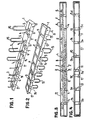
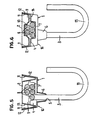
- FIGS. 5 and 6 show two sections of the reinforcement iron holder according to lines V-V, VI-VI of FIG. 3.
- the reinforcing iron holder consists of a box-shaped element 1 and a cover part 2 as well as the reinforcing iron 3.
- the box-shaped element forms the chest side, i.e. the main wall into which the reinforcing iron holder is concreted is facing.
- the cover part for the breast side.
- the hollow body 16 formed from the box-shaped element 1 and the cover part has a trapezoidal cross section, the shorter side being arranged on the breast side.
- other cross sections such as rectangular, semicircular or trapezoidal cross sections in the reverse sense, i.e.
- the top of the box-shaped element has transverse ribs 4 and, at the push-through openings 5, holding parts 6 formed integrally with this element.
- the inward transverse ribs 4 do not have a uniform cross section, but instead form steps 7 which serve to hold the bent connecting legs 8 of the reinforcing bars.
- the gradations 7 forming recesses are arranged at different points with respect to the longitudinal central axis and have different lengths. It can be seen from FIG.
- the reinforcing bars are inserted from both ends of the box-shaped element in such a way that the free ends of the legs of the reinforcing bars point towards the other end of the element, and it is clearly evident that the recesses are such must be trained so that, counted from the end, they can first pick up or hold one, then two, three, four, etc. legs.
- the arrangement according to FIG. 3 also shows that the legs first lie next to one another, then also one above the other, these legs having an angle with respect to the longitudinal central axis of the box-shaped element.
- the cover part also has transverse ribs 9 which are arranged opposite the transverse ribs 4 of the box-shaped element.
- the function of the inwardly directed transverse ribs 9 can be clearly seen from FIGS. 3 and 4, that is to say that the transverse ribs which also protrude on the inside also serve to hold the reinforcing iron legs.
- the ribs 9 form the counterpart to the ribs 4, they are Ribs 9 a, b, c and d, that is, in the places where the reinforcing iron legs come to lie side by side as flat hold-down parts, while the remaining ribs 9 e, f, g, h have recesses 10 to the upper position of the Take up reinforcement iron legs.
- the cover part 2 is arranged inside the box-shaped element, i.e. the longitudinal wall 11 of the cover part runs parallel and inside to the longitudinal wall 12 of the box-shaped element.
- This outer longitudinal wall 11 is adjoined by an inner longitudinal wall 13, so that the longitudinal walls of the cover part form a V-shaped or U-shaped longitudinal wall, which wall is continued through the transverse sides.
- the two longitudinal walls have passages 14 which engage over the transverse ribs 4.
- the fact that the longitudinal walls of the cover part protrude into the box-shaped element results in an additional mounting and securing of the reinforcing iron legs. In addition, this results in a tight seal that prevents the penetration of concrete, which prevents the reinforcing bars from becoming dirty.
- the cover part is spot welded or tacked or glued to the box-shaped element 17.
- the box-shaped element and the cover part are made of plastic, both the transverse ribs and the V-shaped or U-shaped walls of the cover part increasing the stability of the two plastic parts, so that a relatively thin-walled and thus inexpensive element is produced can.
- metal for example expanded metal or wood.
- Both the breast-side transverse ribs 4 and the holding parts 6 also bring about a toothing of the concrete part to be connected.
- the hollow body can easily be shortened from one side, as shown in FIG. 3 or 4 from the right side.
Landscapes
- Engineering & Computer Science (AREA)
- Architecture (AREA)
- Mechanical Engineering (AREA)
- Civil Engineering (AREA)
- Structural Engineering (AREA)
- Joining Of Building Structures In Genera (AREA)
- Reinforcement Elements For Buildings (AREA)
- Forms Removed On Construction Sites Or Auxiliary Members Thereof (AREA)
Description
- Die vorliegende Erfindung bezieht sich auf einen Armierungseisenhalter zur Verwendung bei Anschlussbetonierungen, mit einem aus einem kastenförmigen Element und einem Deckteil bestehenden Hohlkörper, wobei die der Wand, in die der Halter einbetoniert wird, zugewandte Brustseite Querrippen und Öffnungen zum Durchstecken der Armierungseisen aufweist und wobei die der Brustseite abgewandte Seite des anderen Teils ebenfalls nach einwärts gerichtete Querrippen aufweist.
- Ein solcher Armierungseisenhalter ist aus der DE-A-3 127 087 bekannt, wobei dieser Armierungseisenhalter für aus einem Bügel bestehende Armierungseisen mit zwei freien Enden vorgesehen ist. Dieser Halter ist vor allem gedacht, das Bestücken der Armierungseisen zu vereinfachen, wobei das Bestücken beim Lieferanten sowie der Transport des ganzen Halters nur als Sonderfall erwogen wird und keine besonderen Massnahmen ausseer die Verwendung eines Deckels mit Rippen, die jedoch zwischen den Stegen am Kasten angeordnet sind, vorgesehen werden. Bereits für den Transport von Haltern mit zwei freien Enden sind diese Massnahmen zur Transportsicherung ungenügend, da das Bestreben besteht, möglichst dünne Kunststoff-Folien zu verwneden, um Material zu sparen und das Entfernen nach dem Einbetonieren zu erleichtern. Dünne Folien vermögen jedoch in dieser Anordnung die relativ schweren Armierungseisen nicht sicher zu halten. Bei der Verwendung von Armierungseisen mit nur einem freien Ende sind die Transportsicherung und die Bestückung dann noch schweiriger.
- Die CH-A-637 178 beschreibt eine Verankerungsvorrichtung mit einer U-Profilschiene, die für Armieurngseisen mit einem Anschlußschenkel gedacht ist. Dabei sind die Armierungsesenstäbe U-förmig gebogen, wobei das Ende des umgebogenen U-Schenkels mit dem metallenen Halter durch eine Schutzgasschwissung fest verbunden ist. Diese Befestigung bedingt einerseits ein metallenes Verwahrungsteil und ist aufwendig in der Herstellung, insbesondere auch beim Zusammenbau des Armierungseisenhalters. Bei einer Ausführung des Verwahrungsteils aus Kunststoff müssen besondere Massnahmen zur Befestigung des Endes des U-förmigen Teils vorgesehen werden.
- Es ist demgegenüber Aufgabe der vorliegenden Erfindung einen Armierungseisenhalter vorzusehen, der bei kostengünstiger Herstellung insbesondere für Armierungseisen mit nur einem freien Schenkel einen sichereren Transport und einen rationelleren Einbau in de Halter gewährleistet.
- Diese Aufgabe wird mit dem im Anspruch 1 beschriebenen Armierungseisenhalter gelöst, wobei vorteilhafte Weiterbildungen des Anmeldungsgegenstandes nach Anspruch 1 in den Unteransprüchen angegeben sind. Im folgenden wird die Erfindung anhand einer Zeichnung eines Ausführungsbeispiels näher erläutert.
- Die Figuren 1 und 2 zeigen den erfindungsgemässen Armierungseisenhalter in perspektivischer Sicht von zwei Seiten,
- Fig. 3 zeigt den Armierungseisenhalter im geöffneten Zustand,
- Fig. 4 zeigt das Deckteil des Armierungseisenhalters und
- Die Figuren 5 und 6 zeigen zwei Schnitte des Armierungseisenhalters gemäss den Linien V - V, VI - VI von Fig. 3.
- Der Armierungseisenhalter besteht aus einem kastenförmigen Element 1 und einem Deckteil 2 sowie aus den Armierungseisen 3. In vorliegendem Beispiel bildet das kastenförmige Element die Brustseite, d.h., es ist der Hauptwand zugerichtet, in die der Armierungseisenhalter einbetoniert wird. Es ist aber auch durchaus denkbar, das Deckteil für die Brustseite vorzusehen. In vorliegendem Beispiel weist der aus dem kastenförmigen Element 1 und Deckteil gebildete Hohlkörper 16 einen trapezförmigen Querschnitt auf, wobei die kürzere Seite brustseitig angeordnet ist. Es ist aber auch möglich andere Querschnitte, wie rechteckige, halbrunde oder trapezförmige Querschnitte im umgekehrten Sinne, d.h. mit einer breiteren Brustseite vorzusehen, welches, insbesondere bei Metall-Hohlkörper die Verankerung des Anschlussteils erhöhen würde. In vorliegendem Beispiel wurde grösseren Wert auf leichteres Entfernen des Hohlkörpers gelegt. Die Oberseite des kastenförmigen Elementes weist Querrippen 4 sowie, an den Durchstecköffnungen 5, einstückig mit diesem Element geformte Halteteile 6 auf. Die nach innen gerichteten Querrippen 4 weisen nicht einen gleichmässigen Querschnitt auf, sondern bilden Abstufungen 7, die dazu dienen, die umgebogenen Anschlußschenkel 8 der Armierungseisen zu halten. Wie insbesondere aus Fig. 3, in Verbindung mit den Fig. 5 und 6, hervorgeht, sind die Ausnehmungen bildenden Abstufungen 7, bezogen auf die Längsmittelachse, an verschiedenen Stellen angeordnet und weisen unterschiedliche Längen auf. So kann man aus Fig. 3 ersehen, dass die Armierungseisen von beiden Enden des kastenförmigen Elementes her derart eingesteckt sind, dass die freien Enden der Schenkel der Armierungseisen jeweils gegen das andere Ende des Elementes hinweisen, und es ist klar ersichtlich, dass die Ausnehmungen derart ausgebildet sein müssen, dass sie, vom Ende her gezählt, zuerst ein dann zwei, drei, vier, usw. Schenkel aufnehmen, bzw. halten können. Aus der Anordnung gemäss Fig. 3 geht ferner hervor, dass die Schenkel zunächst nebeneinander, dann auch übereinander zu liegen kommen, wobei diese Schenkel bezüglich der Längsmittelachse des kastenförmigen Elementes einen Winkel aufweisen.
- Aus der Zeichnung geht klar hervor, dass auch das Deckteil Querrippen 9 aufweist, die gegenüber den Querrippen 4 des kastenförmigen Elementes angeordnet sind. Die Funktion der nach innen gerichteten Querrippen 9 ist aus den Fig. 3 und 4 klar ersichtlich, d.h., die an der Innenseite vorstehenden, ebenfalls abgestuften Querrippen dienen ebenfalls dem Halten der Armierungseisenschenkel Da die Rippen 9 das Gegenstück zu den Rippen 4 bilden, sind die Rippen 9 a, b, c und d, d.h., an den Orten, an welchen die Armierungseisenschenkel nebeneinander zu liegen kommen als ebene Niederhalteteile ausgebildet, während die übrigen Rippen 9 e, f, g, h Ausnehmungen 10 aufweisen, um die obere Lage der Armierungseisenschenkel aufzunehmen.
- Wie inbesondere aus den Fig. 5 und 6 ersichtlich, ist das Deckteil 2 im Inneren des kastenförmigen Elementes angeordnet, d.h., dass die Längswand 11 des Deckteils parallel und innen zur Längswand 12 des kastenförmigen Elementes verläuft. Dieser äusseren Längswand 11 schliesst sich eine innere Längswand 13 an, so dass die Längswände des Deckteils eine V- oder U-förmige Längswand bilden, welche Wand durch die Querseiten fortgesetzt wird. An den Stellen der Querrippen 4 bzw. 9 weisen die beiden Längswände Durchlässe 14 auf, die über die Querrippen 4 greifen. Dadurch, dass die Längswände des Deckteils in das kastenförmige Element hineinragen, ergibt sich eine zusätzliche Halterung und Sicherung der Armierungseisenschenkel. Ausserdem ergibt sich dadurch ein dichter Verschluss, der das Eindringen von Beton verhindert, wodurch das Verschmutzen der Armierungseisen verhindert wird. Zur zusätzlichen Sicherung des Verschlusses wird das Deckteil am kastenförmigen Element punktförmig 17 verschweisst oder geheftet oder geklebt.
- Aus der Zeichnung erkennt man ferner, dass die aus dem kastenförmigen Element herausragenden Teile 15 der Armierungseisen U-förmig gebogen sind. Doch ist es klar, dass die Form der herausragenden Armierungseisenteile variieren kann und nicht massgeblich ist. Das kastenförmige Element und das Deckteil werden in der bevorzugten Ausführungsform aus Kunststoff gefertigt, wobei sowohl die Querrippen als auch die V- oder U-fömigen Wände des Deckteils die Stabilität der beiden Kunststoffteile erhöht, so dass ein relativ dünnwandiges und damit kosten günstiges Element hergestellt werden kann. Es ist aber auch möglich die beiden Teile aus Metall, beispielsweise auch Streckmetall oder Holz, herzustellen. Sowohl die brustseitigen Querrippen 4 als auch die Halteteile 6 bewirken ausserdem eine Verzahnung des anzuschliessenden Betonteils. Der Hohlkörper lässt sich leicht von einer Seite aus kürzen, gemäss Fig. 3 oder 4 von der rechten Seite aus.
Claims (9)
Priority Applications (5)
| Application Number | Priority Date | Filing Date | Title |
|---|---|---|---|
| AT84810301T ATE35437T1 (de) | 1984-06-21 | 1984-06-21 | Armierungseisenhalter zur verwendung bei anschlussbetonierungen. |
| EP84810301A EP0165367B1 (de) | 1984-06-21 | 1984-06-21 | Armierungseisenhalter zur Verwendung bei Anschlussbetonierungen |
| DE8484810301T DE3472430D1 (en) | 1984-06-21 | 1984-06-21 | Reinforcement-iron holder for use in joining cast concrete work |
| CA000483740A CA1259202A (en) | 1984-06-21 | 1985-06-12 | Reinforcing rod holder for use in connection-type concreting operations |
| AU43702/85A AU582163B2 (en) | 1984-06-21 | 1985-06-14 | A reinforcing rod holder for use in connection-type concreting operations |
Applications Claiming Priority (1)
| Application Number | Priority Date | Filing Date | Title |
|---|---|---|---|
| EP84810301A EP0165367B1 (de) | 1984-06-21 | 1984-06-21 | Armierungseisenhalter zur Verwendung bei Anschlussbetonierungen |
Publications (2)
| Publication Number | Publication Date |
|---|---|
| EP0165367A1 EP0165367A1 (de) | 1985-12-27 |
| EP0165367B1 true EP0165367B1 (de) | 1988-06-29 |
Family
ID=8193025
Family Applications (1)
| Application Number | Title | Priority Date | Filing Date |
|---|---|---|---|
| EP84810301A Expired EP0165367B1 (de) | 1984-06-21 | 1984-06-21 | Armierungseisenhalter zur Verwendung bei Anschlussbetonierungen |
Country Status (5)
| Country | Link |
|---|---|
| EP (1) | EP0165367B1 (de) |
| AT (1) | ATE35437T1 (de) |
| AU (1) | AU582163B2 (de) |
| CA (1) | CA1259202A (de) |
| DE (1) | DE3472430D1 (de) |
Families Citing this family (3)
| Publication number | Priority date | Publication date | Assignee | Title |
|---|---|---|---|---|
| EP0230206B1 (de) * | 1986-01-15 | 1990-07-18 | Pebea N.V. | Armierungseisenhalter zur Verwendung bei Anschlussbetonierungen |
| AU657707B2 (en) * | 1990-11-02 | 1995-03-23 | Boral Building Services Pty Limited | Continuity strip for reinforced concrete |
| DE202006008530U1 (de) * | 2006-05-26 | 2006-08-17 | Max Frank Gmbh & Co. Kg | Verwahrungselement |
Family Cites Families (6)
| Publication number | Priority date | Publication date | Assignee | Title |
|---|---|---|---|---|
| US4325533A (en) * | 1979-08-23 | 1982-04-20 | Sigma Bauelemente Gmbh | Housing device for isolating connecting reinforcements at joints between first and subsequently poured concrete structures |
| ATE2155T1 (de) * | 1979-10-03 | 1983-01-15 | Losinger Ag | Abschalungsvorrichtung mit einer grundschale und mit verbindungsstaeben. |
| DE3105889A1 (de) * | 1981-02-18 | 1982-11-04 | Döllen, Heinz von, 5840 Schwerte | Vorrichtung zur aufnahme von in betonbauteile teilweise einzugiessende verbindungsstaehle |
| DE3127087C2 (de) * | 1981-07-09 | 1986-04-10 | Sigma Bauelemente Gmbh, 4800 Bielefeld | Vorrichtung zum Verwahren von Bewehrungsstählen |
| DE3201918C1 (de) * | 1982-01-22 | 1983-08-25 | Sigma Bauelemente Gmbh, 4800 Bielefeld | Vorrichtung zum Verwahren von Bewehrungsstaehlen sowie Verfahren zu deren Herstellung und Vorrichtung zur Durchfuehrung des Verfahrens |
| DE3211563C2 (de) * | 1982-02-25 | 1985-03-28 | Bernd 6451 Mainhausen Reichelt | Schalungs- und Verwahrungselement |
-
1984
- 1984-06-21 AT AT84810301T patent/ATE35437T1/de not_active IP Right Cessation
- 1984-06-21 EP EP84810301A patent/EP0165367B1/de not_active Expired
- 1984-06-21 DE DE8484810301T patent/DE3472430D1/de not_active Expired
-
1985
- 1985-06-12 CA CA000483740A patent/CA1259202A/en not_active Expired
- 1985-06-14 AU AU43702/85A patent/AU582163B2/en not_active Ceased
Also Published As
| Publication number | Publication date |
|---|---|
| EP0165367A1 (de) | 1985-12-27 |
| CA1259202A (en) | 1989-09-12 |
| DE3472430D1 (en) | 1988-08-04 |
| AU4370285A (en) | 1986-01-02 |
| AU582163B2 (en) | 1989-03-16 |
| ATE35437T1 (de) | 1988-07-15 |
Similar Documents
| Publication | Publication Date | Title |
|---|---|---|
| EP0131841B1 (de) | Verbundanker einer Schichtverbundplatte | |
| DE2808484C2 (de) | ||
| EP0024697B1 (de) | Vorrichtung zum Verwahren von Bewehrungsstählen | |
| DE9106925U1 (de) | Verkleidung für Rahmen von Fenstern, Türen o.dgl. | |
| DE570520C (de) | Tuer, insbesondere fuer geschlossene Wagenkasten bei Kraftfahrzeugen | |
| DE1283740B (de) | Fischkasten aus Kunststoff | |
| DE4007391C2 (de) | Befestigungsflansch für eine Abdeckleiste | |
| DE2436244A1 (de) | Versteifungselement fuer kraftfahrzeugseitenwaende | |
| DE2952724C2 (de) | Wärmetauscher | |
| DE8619575U1 (de) | Freitragende Bodenplatte | |
| CH656418A5 (de) | Armierungseisenhalter mit armierungseisen zur verwendung bei anschlussbetonierungen. | |
| EP0165367A1 (de) | Armierungseisenhalter zur Verwendung bei Anschlussbetonierungen | |
| EP0357817B1 (de) | Holzregal mit auf unterschiedlichen Höhen anbringbaren Einlegeböden | |
| DE7711771U1 (de) | Bausatz fuer regale o.dgl. | |
| DE3220847A1 (de) | Vorrichtung zum verwahren von verbindungsstaehlen fuer betonbauteile | |
| EP0474967A1 (de) | Ski | |
| DE8417655U1 (de) | Vorrichtung zum verwahren von verbindungsstaehlen fuer betonbauteile | |
| DE3503053C2 (de) | ||
| DE821035C (de) | Schlosstasche fuer Grubenstempel | |
| EP0397293B1 (de) | Befestigungsschiene für Trapezbleche in der Bautechnik | |
| DE3442182C2 (de) | Vorrichtung zum Verwahren von Verbindungsstählen für Betonbauteile | |
| DE19511822C2 (de) | Bewehrungsanschluß | |
| DE8530376U1 (de) | Bewehrungsanschluß | |
| DE2721308C2 (de) | Vorrichtung zum versenkten Befestigen, insbesondere Verkleben und Verfahren zum versenkten Verkleben eines Scharniertopfes in einer Ausnehmung einer insbesondere aus Glas bestehenden Türe oder Klappe | |
| CH388178A (de) | Verpackungsbehälter |
Legal Events
| Date | Code | Title | Description |
|---|---|---|---|
| PUAI | Public reference made under article 153(3) epc to a published international application that has entered the european phase |
Free format text: ORIGINAL CODE: 0009012 |
|
| AK | Designated contracting states |
Designated state(s): AT BE CH DE FR GB IT LI LU NL SE |
|
| 17P | Request for examination filed |
Effective date: 19860619 |
|
| 17Q | First examination report despatched |
Effective date: 19870326 |
|
| ITF | It: translation for a ep patent filed | ||
| RAP1 | Party data changed (applicant data changed or rights of an application transferred) |
Owner name: PAWE AG Owner name: PEBEA N.V. |
|
| RBV | Designated contracting states (corrected) |
Designated state(s): AT BE CH DE FR GB IT LI LU NL SE |
|
| GRAA | (expected) grant |
Free format text: ORIGINAL CODE: 0009210 |
|
| RAP1 | Party data changed (applicant data changed or rights of an application transferred) |
Owner name: PAWE AG Owner name: PEBEA N.V. |
|
| AK | Designated contracting states |
Kind code of ref document: B1 Designated state(s): AT BE CH DE FR GB IT LI LU NL SE |
|
| REF | Corresponds to: |
Ref document number: 35437 Country of ref document: AT Date of ref document: 19880715 Kind code of ref document: T |
|
| GBT | Gb: translation of ep patent filed (gb section 77(6)(a)/1977) | ||
| REF | Corresponds to: |
Ref document number: 3472430 Country of ref document: DE Date of ref document: 19880804 |
|
| ET | Fr: translation filed | ||
| PLBI | Opposition filed |
Free format text: ORIGINAL CODE: 0009260 |
|
| PGFP | Annual fee paid to national office [announced via postgrant information from national office to epo] |
Ref country code: FR Payment date: 19890518 Year of fee payment: 6 |
|
| 26 | Opposition filed |
Opponent name: FRANKHAUSER, PETER / WITSCHI, HEINZ Effective date: 19890328 |
|
| PG25 | Lapsed in a contracting state [announced via postgrant information from national office to epo] |
Ref country code: SE Effective date: 19890622 |
|
| PG25 | Lapsed in a contracting state [announced via postgrant information from national office to epo] |
Ref country code: LU Free format text: LAPSE BECAUSE OF NON-PAYMENT OF DUE FEES Effective date: 19890630 Ref country code: BE Effective date: 19890630 |
|
| PGFP | Annual fee paid to national office [announced via postgrant information from national office to epo] |
Ref country code: GB Payment date: 19890630 Year of fee payment: 6 |
|
| NLR1 | Nl: opposition has been filed with the epo |
Opponent name: FRANKHAUSER, PETER / WITSCHI, HEINZ |
|
| BERE | Be: lapsed |
Owner name: PEBEA N.V. Effective date: 19890630 |
|
| PG25 | Lapsed in a contracting state [announced via postgrant information from national office to epo] |
Ref country code: NL Effective date: 19900101 |
|
| NLV4 | Nl: lapsed or anulled due to non-payment of the annual fee | ||
| PG25 | Lapsed in a contracting state [announced via postgrant information from national office to epo] |
Ref country code: DE Effective date: 19900301 |
|
| PG25 | Lapsed in a contracting state [announced via postgrant information from national office to epo] |
Ref country code: GB Effective date: 19900621 |
|
| GBPC | Gb: european patent ceased through non-payment of renewal fee | ||
| PG25 | Lapsed in a contracting state [announced via postgrant information from national office to epo] |
Ref country code: FR Effective date: 19910228 |
|
| REG | Reference to a national code |
Ref country code: FR Ref legal event code: ST |
|
| PLBM | Termination of opposition procedure: date of legal effect published |
Free format text: ORIGINAL CODE: 0009276 |
|
| STAA | Information on the status of an ep patent application or granted ep patent |
Free format text: STATUS: OPPOSITION PROCEDURE CLOSED |
|
| 27C | Opposition proceedings terminated |
Effective date: 19910209 |
|
| EUG | Se: european patent has lapsed |
Ref document number: 84810301.6 Effective date: 19900418 |
|
| PGFP | Annual fee paid to national office [announced via postgrant information from national office to epo] |
Ref country code: AT Payment date: 19950629 Year of fee payment: 12 |
|
| PG25 | Lapsed in a contracting state [announced via postgrant information from national office to epo] |
Ref country code: AT Effective date: 19960621 |
|
| PGFP | Annual fee paid to national office [announced via postgrant information from national office to epo] |
Ref country code: CH Payment date: 19980630 Year of fee payment: 15 |
|
| PG25 | Lapsed in a contracting state [announced via postgrant information from national office to epo] |
Ref country code: LI Free format text: LAPSE BECAUSE OF NON-PAYMENT OF DUE FEES Effective date: 19990630 Ref country code: CH Free format text: LAPSE BECAUSE OF NON-PAYMENT OF DUE FEES Effective date: 19990630 |
|
| REG | Reference to a national code |
Ref country code: CH Ref legal event code: PL |