EP0154601A2 - Application d'un alliage inoxydable austénitique pour pièces de contruction soudables à haute résistance mécanique - Google Patents
Application d'un alliage inoxydable austénitique pour pièces de contruction soudables à haute résistance mécanique Download PDFInfo
- Publication number
- EP0154601A2 EP0154601A2 EP85730010A EP85730010A EP0154601A2 EP 0154601 A2 EP0154601 A2 EP 0154601A2 EP 85730010 A EP85730010 A EP 85730010A EP 85730010 A EP85730010 A EP 85730010A EP 0154601 A2 EP0154601 A2 EP 0154601A2
- Authority
- EP
- European Patent Office
- Prior art keywords
- nitrogen
- steels
- limits
- alloy
- welding
- Prior art date
- Legal status (The legal status is an assumption and is not a legal conclusion. Google has not performed a legal analysis and makes no representation as to the accuracy of the status listed.)
- Withdrawn
Links
Images
Classifications
-
- C—CHEMISTRY; METALLURGY
- C22—METALLURGY; FERROUS OR NON-FERROUS ALLOYS; TREATMENT OF ALLOYS OR NON-FERROUS METALS
- C22C—ALLOYS
- C22C38/00—Ferrous alloys, e.g. steel alloys
- C22C38/001—Ferrous alloys, e.g. steel alloys containing N
-
- C—CHEMISTRY; METALLURGY
- C21—METALLURGY OF IRON
- C21D—MODIFYING THE PHYSICAL STRUCTURE OF FERROUS METALS; GENERAL DEVICES FOR HEAT TREATMENT OF FERROUS OR NON-FERROUS METALS OR ALLOYS; MAKING METAL MALLEABLE, e.g. BY DECARBURISATION OR TEMPERING
- C21D6/00—Heat treatment of ferrous alloys
- C21D6/004—Heat treatment of ferrous alloys containing Cr and Ni
-
- C—CHEMISTRY; METALLURGY
- C21—METALLURGY OF IRON
- C21D—MODIFYING THE PHYSICAL STRUCTURE OF FERROUS METALS; GENERAL DEVICES FOR HEAT TREATMENT OF FERROUS OR NON-FERROUS METALS OR ALLOYS; MAKING METAL MALLEABLE, e.g. BY DECARBURISATION OR TEMPERING
- C21D8/00—Modifying the physical properties of ferrous metals or ferrous alloys by deformation combined with, or followed by, heat treatment
-
- Y—GENERAL TAGGING OF NEW TECHNOLOGICAL DEVELOPMENTS; GENERAL TAGGING OF CROSS-SECTIONAL TECHNOLOGIES SPANNING OVER SEVERAL SECTIONS OF THE IPC; TECHNICAL SUBJECTS COVERED BY FORMER USPC CROSS-REFERENCE ART COLLECTIONS [XRACs] AND DIGESTS
- Y10—TECHNICAL SUBJECTS COVERED BY FORMER USPC
- Y10T—TECHNICAL SUBJECTS COVERED BY FORMER US CLASSIFICATION
- Y10T428/00—Stock material or miscellaneous articles
- Y10T428/12—All metal or with adjacent metals
- Y10T428/12493—Composite; i.e., plural, adjacent, spatially distinct metal components [e.g., layers, joint, etc.]
- Y10T428/12771—Transition metal-base component
- Y10T428/12861—Group VIII or IB metal-base component
- Y10T428/12951—Fe-base component
- Y10T428/12958—Next to Fe-base component
- Y10T428/12965—Both containing 0.01-1.7% carbon [i.e., steel]
Definitions
- the invention relates to the use of a corrosion-resistant austenitic iron-chromium-nickel-nitrogen alloy as a material for mechanically highly stressed components with good weldability.
- austenitic steels In contrast to ferritic steels, austenitic steels generally have more favorable corrosion properties and are much more weldable, ductile and tough. Since nickel stabilizes the austenitic structure, such steels have at least 7% nickel according to "StahlKey", 13th edition, 1983, Verlag StahlKey Wegst, GmbH, Marbach, pp. 323/324 ff. They also contain more than 16% chromium to achieve sufficient passivity. To avoid intergranular corrosion The carbon content of steels not stabilized with titanium or niobium is limited to a maximum of 0.08%. A further improvement in the corrosion properties is achieved by adding up to 6% Mo, 4% Cu and 3% Si. Increased nickel content of approx. 50% improve the resistance to stress corrosion cracking (see Berg- und Wegtenmännchen Monthly Bulletin 108, 1963, pp. 1/8 and 4 ff.).
- the low guaranteed 0.2 limits of austenitic steels which according to DIN 17 440, December 1972 edition, for example for a steel with 18 to 19% Cr and about 9% Ni 185 N / mm 2 , can be determined by mixed crystal hardness. or by alloying with up to 0.30% N to 343 N / mm 2 (see Japanese Industrial Standard JIS G 4304, 1981, pp. 1301/1304 ff., steel SUS 304 N2).
- Such strength increases have not yet met all requirements.
- austenitic steels Like the nitrogen-alloyed, austenitic steels already listed, they are weldable using the same filler materials. Their pure weld metal has guaranteed 0.2 limits of at least 510 N / mm 2 . The disadvantage, however, is that the high chrome and stick The content of these steels makes hot formability more difficult. Furthermore, even at temperatures as high as 1000'C, they still separate intermetallic phases that lead to low strains of approx. 30% and can cause embrittlement after welding, hot straightening or bending. Since chromium promotes ferrite formation in steels, while nickel suppresses it and at the same time delays the elimination of intermetallic phases, the alloys listed have high nickel contents, which make the material more expensive.
- Another method of improving the strength properties of steels is grain refinement. Cold forming followed by recrystallizing annealing on an austenitic steel with approx. 18% Cr and 10% Ni with an ultra-fine microstructure of Size No. granules. 11.5 to 13.5 according to ASTM (6-3 p m) generated (see ASTM Special Technical Publication No. 369, 1965, pp 175/179 ). This increased compared to that coarse-grained initial state the 0.2 limit by approx. 150 N / mm 2 . Since the steel was not alloyed with nitrogen, its 0.2 limit was only 380 N / mm2 overall. The problem of the extent to which such extremely fine-grained, non-convertible steels are suitable for welding has not been addressed.
- the alloy element niobium is of particular importance. Its effect is based on the precipitation of a complex nitride of the type Nb 2 Cr 2 N 2 , called the Z phase. As a result, grain refinement is achieved even in hot-formed, solution-annealed steels, but this only leads to grain sizes of No. 10 according to ASTM (approx. 10 ⁇ m) (see Berg- und Wegtenmännchen Monthly Bulletin 124, 1979, p. 513 ff.). In addition, nitride precipitation hardening is also found, which can assume values of up to 90 N / mm 2 (see Thyssenaba 1, 1969, p. 14 ff.).
- these steels In order to avoid the precipitation of too much nitride, which would remove nitrogen from the mixed crystal for hardening, these steels have a niobium content which is considerably lower than their sevenfold amount of N, the stoichiometric ratio in the compound NbN.
- the hot yield strengths of austenitic steels are also raised by nitrogen mixed crystal hardening and grain refinement.
- the increase in the 0.2 limit due to nitrogen decreases with increasing temperature and is, for example, only about half as large at 400 ° C as at room temperature (see Berg- und Wegtenmännchen Monthly Bulletin 113, 1968, pp. 386/387 ff. ).
- the increase in the 0.2 limit due to grain refinement decreases significantly less with the test temperature (see Metal Science 11, 1977, p. 209 ff.). At even higher temperatures, at which the warm no longer yield point, but the lower creep rupture strength is decisive for the calculation of constructions, this favorable fine grain effect no longer exists.
- a certain compensation can be achieved by alloying with boron up to a content of 0.015%, since this measure increases the creep resistance of austenitic chromium-nickel-molybdenum steels at temperatures of, for example, 650 ° C (see Rev. Mêtallurgie 59, 1962, p. 651 / 660). This beneficial effect also appears to be seen in such steels which additionally contain nitrogen (see Arch. Eisenblinnwes. 39, 1968, p. 146 ff. And VDI-Reports 428, 1981, p. 89 ff.). As a result, the area of application in which the hot stretching limit can still be used for the calculation is expanded or shifted to higher temperatures. Due to the susceptibility of austenitic steels to hot cracking when welding with boron, its content is usually limited to 60 to 80 ppm.
- the austenitic steels listed in DIN 17 440, December 1972 edition with up to 0.22% N alloyed steels are equated with steels without nitrogen. They are all suitable for welding if the carbon content is limited to ⁇ 0.07% for wall thicknesses smaller than 6 mm and to ⁇ 0.03% for thicknesses over 6 mm. According to AD leaflet HP 7/3, April 1975 edition, only parts over 50 mm thick in pressure vessel construction are to be annealed after welding.
- the delivery condition of the corrosion-resistant austenitic steels is determined, among other things, by a heat treatment which is referred to as "quenching". It is an annealing at at least 1000 ° C with rapid cooling. This ensures that all chrome carbides, -Nitrides and intermetallic phases are solved. Another purpose of this measure is to largely reduce the dislocations brought about by deformation as a result of recrystallization and recovery, so that a state of optimum corrosion resistance and toughness which is poor in internal stresses is finally obtained.
- a heat treatment which is referred to as "quenching”. It is an annealing at at least 1000 ° C with rapid cooling. This ensures that all chrome carbides, -Nitrides and intermetallic phases are solved.
- Another purpose of this measure is to largely reduce the dislocations brought about by deformation as a result of recrystallization and recovery, so that a state of optimum corrosion resistance and toughness which is poor in internal stresses is finally obtained.
- the joint welding of austenitic steels is assessed with the help of weld joint samples.
- weld joint samples These are flat tensile specimens according to DIN 50 120, September 1975 edition, with a continuous transverse seam in the middle. This ensures during the tensile test that the weld metal, seam transition and base material are subjected to the same stress since they are arranged one behind the other in the direction of the tensile force.
- the sample is suitable for determining the tensile strength and fracture position. It is disadvantageous that it can only be used to determine the yield strengths imprecisely because weld metal, material in the transition area and unaffected base material deform plastically to varying extents within the measuring length or expand permanently.
- the unaffected base material G and the weld seam S come into consideration as the fracture position, while in the transition region U the seam to the base material normally does not break occur.
- the strength properties would not be found in these transition areas because they are too narrow. If the seam breaks, the strength of the weld metal is decisive.
- the weld metal is more or less mixed with the base material, the tensile strength of the pure weld metal is determined on longitudinal samples of specially prepared seams, for which reproducibility does not occur, for reasons of reproducibility. Their manufacture is described in DIN 32 525, Part 1, December 1981 edition.
- the degree of melting or the mixing ratio is mainly dependent on the welding current, which determines the penetration depth, the number of layers and the welding process.
- the object of the invention is now to raise the low minimum values of the 0.2 limits of the usual nitrogen-alloyed, corrosion-resistant austenitic steels to a level of approximately 500 N / mm 2 without reducing their good weldability, with an increase in the alloy contents being excluded.
- This object is achieved in that a corrosion-resistant austenitic alloy with the known chemical composition specified in claim 1 is used as a material for corrosive and mechanically highly stressed components of good weldability in such a way that after cold forming and recrystallizing annealing high 0, 2 limits can be reached due to the formation of an ultra-fine-grained structure with average grain diameters of less than 10 ⁇ m (greater than No.
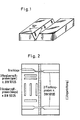
- connection samples were taken from test pieces which had been obtained by welding two sheets in the tub position. Your seam preparation can be seen in Figure 1.
- the 10 mm sheets were provided with a Y-seam (web height 2 mm), the thinner ones with a V-seam (without web).
- the welds were carried out in multiple layers with the opposite side after the root had been ground beforehand. After each pull caterpillar was laid, the work temperature was below 150 ° C. Elevations in the seams were processed at the sheet metal level. Welding was carried out at the positive pole at a voltage U of 23 V using the rutile-based, coated electrode Thermanit 20/16/510, which is commercially available.
- the pull-out ratio (bead length / length of molten rod) was 0.7 to 0.8 or 0.8 to 0.9 for the 2.5 or 3.25 mm electrode.
- the welding tests were carried out in such a way that fractures could only occur in the base material of the flat tensile connection samples.
- the 0.2 limit of the weld metal may be used as a basis in such an expert opinion for the load-bearing capacity of components if the tensile strength of the connection sample torn in the seam was sufficiently high.
- a niobium-containing welding filler material with 0.38% N, 25% Cr, 21.5% Ni, 5 was adapted to the high 0.2 limits of the ultra-fine-grained base material % Mn, 3.6% Mo u. 0.035% C used. It.
- Table 2 shows an exemplary embodiment of three steel alloys to be used according to the invention, which were joined by the welding process specified.
- the 0.2 limits were determined on test pieces, the seams of which had been prepared as already described and shown in Figure 1.
- Image 2 shows the position of these samples and their division in the test piece.
- Table 2 shows the advantages of the steel alloys to be used according to the invention: High 0.2 limits between 504 and 553 N / mm 2 , which were mainly achieved by superimposing nitrogen mixed crystal and ultra-fine grain hardening, since the steels approx. Contained 0.2% N and had grain sizes between 2.8 and 4.5 pm. Furthermore, the weldability according to the invention is good, since the weld connection samples did not break in the seam transition, but in the unaffected base material.
- the cold-forming of the steels or alloys to be used according to the invention is generally carried out for flat products using the Sendzimir or quarto rolling method, for pipes using cold crawls from hot-pressed blanks.
Landscapes
- Chemical & Material Sciences (AREA)
- Engineering & Computer Science (AREA)
- Mechanical Engineering (AREA)
- Materials Engineering (AREA)
- Metallurgy (AREA)
- Organic Chemistry (AREA)
- Physics & Mathematics (AREA)
- Thermal Sciences (AREA)
- Crystallography & Structural Chemistry (AREA)
- Arc Welding In General (AREA)
- Organic Low-Molecular-Weight Compounds And Preparation Thereof (AREA)
Applications Claiming Priority (2)
| Application Number | Priority Date | Filing Date | Title |
|---|---|---|---|
| DE3407305 | 1984-02-24 | ||
| DE19843407305 DE3407305A1 (de) | 1984-02-24 | 1984-02-24 | Verwendung einer korrosionsbestaendigen austenitischen legierung fuer mechanisch hoch beanspruchte, schweissbare bauteile |
Publications (2)
| Publication Number | Publication Date |
|---|---|
| EP0154601A2 true EP0154601A2 (fr) | 1985-09-11 |
| EP0154601A3 EP0154601A3 (fr) | 1987-04-29 |
Family
ID=6229115
Family Applications (1)
| Application Number | Title | Priority Date | Filing Date |
|---|---|---|---|
| EP85730010A Withdrawn EP0154601A3 (fr) | 1984-02-24 | 1985-01-28 | Application d'un alliage inoxydable austénitique pour pièces de contruction soudables à haute résistance mécanique |
Country Status (5)
| Country | Link |
|---|---|
| US (1) | US4584031A (fr) |
| EP (1) | EP0154601A3 (fr) |
| JP (1) | JPS60204870A (fr) |
| CA (1) | CA1232516A (fr) |
| DE (1) | DE3407305A1 (fr) |
Cited By (4)
| Publication number | Priority date | Publication date | Assignee | Title |
|---|---|---|---|---|
| EP0241553A4 (fr) * | 1985-10-15 | 1989-01-18 | Aichi Steel Works Ltd | Acier inoxydable a haute resistance et son procede de fabrication. |
| EP0264357A3 (en) * | 1986-09-08 | 1989-04-26 | Bohler Gesellschaft M.B.H. | Heat-resistant austenitic alloy, and process for its manufacture |
| FR2626893A1 (fr) * | 1988-02-10 | 1989-08-11 | Haynes Int Inc | Alliage fe-ni-cr consolide a l'azote |
| US4981647A (en) * | 1988-02-10 | 1991-01-01 | Haynes International, Inc. | Nitrogen strengthened FE-NI-CR alloy |
Families Citing this family (7)
| Publication number | Priority date | Publication date | Assignee | Title |
|---|---|---|---|---|
| US4736684A (en) * | 1984-02-10 | 1988-04-12 | Thiokol Corporation | Delayed quick cure rocket motor liner |
| JPS60208459A (ja) * | 1984-03-30 | 1985-10-21 | Aichi Steel Works Ltd | 高強度ステンレス鋼およびその製造法 |
| FR2596066B1 (fr) * | 1986-03-18 | 1994-04-08 | Electricite De France | Alliage austenitique nickel-chrome-fer |
| JPH08337853A (ja) * | 1995-06-09 | 1996-12-24 | Hitachi Ltd | 高耐食性高強度オーステナイト焼結鋼とその製造方法及びその用途 |
| US8220697B2 (en) * | 2005-01-18 | 2012-07-17 | Siemens Energy, Inc. | Weldability of alloys with directionally-solidified grain structure |
| US10994361B2 (en) | 2014-01-24 | 2021-05-04 | Electric Power Research Institute, Inc. | Stepped design weld joint preparation |
| DE102014110902A1 (de) * | 2014-07-31 | 2016-02-04 | Sandvik Materials Technology Deutschland Gmbh | Verfahren zum Herstellen eines Edelstahlrohrs sowie Edelstahlrohr |
Family Cites Families (18)
| Publication number | Priority date | Publication date | Assignee | Title |
|---|---|---|---|---|
| US3129120A (en) * | 1962-02-05 | 1964-04-14 | United States Steel Corp | Stainless steel resistant to nitric acid corrosion |
| US3284250A (en) * | 1964-01-09 | 1966-11-08 | Int Nickel Co | Austenitic stainless steel and process therefor |
| DE1483041A1 (de) * | 1964-07-08 | 1969-01-30 | Atomic Energy Authority Uk | Verfahren zur Behandlung von Metallen,insbesondere von zur Herstellung von Kernreaktor-Brennstoffhuelsen geeigneten Metallen |
| GB1124287A (en) * | 1964-12-03 | 1968-08-21 | Atomic Energy Authority Uk | Improvements in the treatment of stainless steel tubes |
| FR91375E (fr) * | 1966-01-13 | 1968-05-31 | Electro Chimie Soc D | Aciers améliorés |
| US3723193A (en) * | 1970-10-27 | 1973-03-27 | Atomic Energy Commission | Process for producing a fine-grained 316 stainless steel tubing containing a uniformly distributed intragranular carbide phase |
| SE411130C (sv) * | 1976-02-02 | 1985-09-09 | Avesta Jernverks Ab | Austenitiskt rostfritt stal med hog mo-halt |
| US4168190A (en) * | 1976-04-27 | 1979-09-18 | Daiichi Koshuha Kogyo Kabushiki Kaisha | Method for locally solution-treating stainless material |
| JPS54149316A (en) * | 1978-05-13 | 1979-11-22 | Fagersta Ab | Austenitic stainless steel |
| JPS558404A (en) * | 1978-06-30 | 1980-01-22 | Nippon Steel Corp | Manufacture of austenitic stainless steel used in atmosphere of high-temperature and high-pressure water |
| JPS56158851A (en) * | 1980-05-14 | 1981-12-07 | Aichi Steel Works Ltd | High-strength austenite stainless steel |
| JPS5929106B2 (ja) * | 1980-05-14 | 1984-07-18 | 愛知製鋼株式会社 | 高強度オ−ステナイト系ステンレス鋼 |
| DE3037954C2 (de) * | 1980-10-08 | 1983-12-01 | ARBED Saarstahl GmbH, 6620 Völklingen | Verwendung eines austenitischen Stahles im kaltverfestigten Zustand bei extremen Korrosionsbeanspruchungen |
| JPS5940901B2 (ja) * | 1981-03-24 | 1984-10-03 | 日本ステンレス株式会社 | 耐食性オ−ステナイト系ステンレス鋼 |
| JPS57171651A (en) * | 1981-04-15 | 1982-10-22 | Nisshin Steel Co Ltd | Perfect austenite stainless steel with superior corrosion resistance at weld zone |
| JPS5858257A (ja) * | 1981-09-30 | 1983-04-06 | Nippon Steel Corp | 構造用高強度ステンレス鋼 |
| JPS59136464A (ja) * | 1983-01-26 | 1984-08-06 | Hitachi Ltd | ボイラチユ−ブ |
| JPS59185763A (ja) * | 1983-04-04 | 1984-10-22 | Nippon Stainless Steel Co Ltd | 中性塩環境における耐食性に優れたオ−ステナイトステンレス鋼 |
-
1984
- 1984-02-24 DE DE19843407305 patent/DE3407305A1/de active Granted
-
1985
- 1985-01-28 EP EP85730010A patent/EP0154601A3/fr not_active Withdrawn
- 1985-02-22 US US06/704,205 patent/US4584031A/en not_active Expired - Fee Related
- 1985-02-22 CA CA000474916A patent/CA1232516A/fr not_active Expired
- 1985-02-25 JP JP60036252A patent/JPS60204870A/ja active Pending
Cited By (5)
| Publication number | Priority date | Publication date | Assignee | Title |
|---|---|---|---|---|
| EP0241553A4 (fr) * | 1985-10-15 | 1989-01-18 | Aichi Steel Works Ltd | Acier inoxydable a haute resistance et son procede de fabrication. |
| EP0264357A3 (en) * | 1986-09-08 | 1989-04-26 | Bohler Gesellschaft M.B.H. | Heat-resistant austenitic alloy, and process for its manufacture |
| FR2626893A1 (fr) * | 1988-02-10 | 1989-08-11 | Haynes Int Inc | Alliage fe-ni-cr consolide a l'azote |
| GB2215737A (en) * | 1988-02-10 | 1989-09-27 | Haynes Int Inc | Corrosion resistant alloy |
| US4981647A (en) * | 1988-02-10 | 1991-01-01 | Haynes International, Inc. | Nitrogen strengthened FE-NI-CR alloy |
Also Published As
| Publication number | Publication date |
|---|---|
| DE3407305C2 (fr) | 1987-11-26 |
| EP0154601A3 (fr) | 1987-04-29 |
| JPS60204870A (ja) | 1985-10-16 |
| CA1232516A (fr) | 1988-02-09 |
| DE3407305A1 (de) | 1985-08-29 |
| US4584031A (en) | 1986-04-22 |
Similar Documents
| Publication | Publication Date | Title |
|---|---|---|
| DE69124478T2 (de) | Verfahren zum Herstellen einer plattierten Stahlplatte mit guter Tieftemperaturzähigkeit | |
| DE69226946T2 (de) | Austenitischer manganstahlblech mit hoher verformbarkeit, festichkeit und schweissbarkeit und verfahren | |
| DE69013630T2 (de) | Verfahren zum Verbinden von korrosionsbeständigen Werkstoffen durch Diffusion. | |
| DE69805896T2 (de) | Geschweisste hochfeste Stahlstrukturen und Verfahren zu deren Herstellung | |
| DE69834932T2 (de) | Ultrahochfeste, schweissbare stähle mit ausgezeichneter ultratief-temperaturzähigkeit | |
| DE60301588T2 (de) | Hochfestes Stahlblech und hochfestes Stahlrohr mit sehr guter Verformbarkeit und Verfahren zu dessen Herstellung | |
| DE60110861T2 (de) | Wärmebeständiger Stahl | |
| DE60003501T2 (de) | Niedrig legierter, hochfester, hitzebeständiger Stahl | |
| DE60124227T2 (de) | Duplex rostfreier stahl | |
| DE3883051T2 (de) | Verfahren zur Herstellung von Stahlblechen mit guter Zähigkeit bei niedrigen Temperaturen. | |
| DE69515023T2 (de) | Hochwarmfester ferritischer stahl und verfahren zu dessen herstellung | |
| DE60203865T2 (de) | Ferritischer wärmebeständiger stahl | |
| DE60024761T2 (de) | Schweisszusatzwerkstoff und Verfahren zum Herstellen einer Schweissverbindung | |
| DE69508876T2 (de) | Temperaturbeständiger ferritischer Stahl mit hohem Chromgehalt | |
| DE69520488T2 (de) | Martensitischer edelstahl mit hoher korrisionsbeständigkeit und hervorragender schweissbarkeit und herstellungsverfahren desselben | |
| DE60318277T2 (de) | Stahlrohr mit einem niedrigem Streckgrenze/Zugfestigkeit-Verhältnis | |
| DE69905333T2 (de) | Schweisselektrode aus einer Nickelbasislegierung und diese Legierung | |
| DE3780589T2 (de) | Hochfeste, elektrowiderstandsgeschweisste stahlroehre mit guter bestaendigkeit gegen saeure. | |
| DE3528537A1 (de) | Verfahren zur herstellung von stahl hoher festigkeit und zaehigkeit fuer druckbehaelter | |
| DE3407305C2 (fr) | ||
| DE69204123T2 (de) | Hitzebeständiges ferritisches Stahl mit hohem Chromgehalt und mit höhere Beständigkeit gegen Versprödung durch intergranuläre Ausscheidung von Kupfer. | |
| DE69629552T2 (de) | Verfahren zum herstellen von stahlröhren grosser durchmesser mit einer hochfestigkeit und einer hochbeständigkeit | |
| EP2009120A2 (fr) | Utilisation d'un alliage d'acier très solide destiné à la fabrication de tuyaux en acier très résistants et ayant une bonne déformabilité | |
| DE3012139A1 (de) | Verfahren zur herstellung eines im walzzustand hochfesten und hochzaehen stahles | |
| DE3146950C2 (fr) |
Legal Events
| Date | Code | Title | Description |
|---|---|---|---|
| PUAI | Public reference made under article 153(3) epc to a published international application that has entered the european phase |
Free format text: ORIGINAL CODE: 0009012 |
|
| AK | Designated contracting states |
Designated state(s): AT FR GB IT NL SE |
|
| 17P | Request for examination filed |
Effective date: 19850907 |
|
| PUAL | Search report despatched |
Free format text: ORIGINAL CODE: 0009013 |
|
| AK | Designated contracting states |
Kind code of ref document: A3 Designated state(s): AT FR GB IT NL SE |
|
| 17Q | First examination report despatched |
Effective date: 19880623 |
|
| STAA | Information on the status of an ep patent application or granted ep patent |
Free format text: STATUS: THE APPLICATION IS DEEMED TO BE WITHDRAWN |
|
| 18D | Application deemed to be withdrawn |
Effective date: 19891030 |
|
| RIN1 | Information on inventor provided before grant (corrected) |
Inventor name: GRUETZNER, GUENTER, DR.-ING. |