EP0141054A1 - Verfahren zur Herstellung von 2- und 4-tert.-Butylcyclohexanol mit hohen Anteilen an cis-Isomeren durch katalytische Hydrierung der entsprechenden tert.-Butylphenole - Google Patents
Verfahren zur Herstellung von 2- und 4-tert.-Butylcyclohexanol mit hohen Anteilen an cis-Isomeren durch katalytische Hydrierung der entsprechenden tert.-Butylphenole Download PDFInfo
- Publication number
- EP0141054A1 EP0141054A1 EP19840108733 EP84108733A EP0141054A1 EP 0141054 A1 EP0141054 A1 EP 0141054A1 EP 19840108733 EP19840108733 EP 19840108733 EP 84108733 A EP84108733 A EP 84108733A EP 0141054 A1 EP0141054 A1 EP 0141054A1
- Authority
- EP
- European Patent Office
- Prior art keywords
- stage
- hydrogenation
- tert
- hydrogenated
- cis
- Prior art date
- Legal status (The legal status is an assumption and is not a legal conclusion. Google has not performed a legal analysis and makes no representation as to the accuracy of the status listed.)
- Granted
Links
- CCOQPGVQAWPUPE-UHFFFAOYSA-N 4-tert-butylcyclohexan-1-ol Chemical compound CC(C)(C)C1CCC(O)CC1 CCOQPGVQAWPUPE-UHFFFAOYSA-N 0.000 title claims abstract description 5
- 238000000034 method Methods 0.000 title claims description 15
- 238000004519 manufacturing process Methods 0.000 title description 4
- 238000009903 catalytic hydrogenation reaction Methods 0.000 title description 2
- LVDALGYBEFALAP-UHFFFAOYSA-N 2-butylcyclohexan-1-ol Chemical compound CCCCC1CCCCC1O LVDALGYBEFALAP-UHFFFAOYSA-N 0.000 title 1
- GJYCVCVHRSWLNY-UHFFFAOYSA-N 2-butylphenol Chemical class CCCCC1=CC=CC=C1O GJYCVCVHRSWLNY-UHFFFAOYSA-N 0.000 title 1
- 239000003054 catalyst Substances 0.000 claims abstract description 9
- WJQOZHYUIDYNHM-UHFFFAOYSA-N 2-tert-Butylphenol Chemical class CC(C)(C)C1=CC=CC=C1O WJQOZHYUIDYNHM-UHFFFAOYSA-N 0.000 claims abstract description 7
- UFHFLCQGNIYNRP-UHFFFAOYSA-N Hydrogen Chemical compound [H][H] UFHFLCQGNIYNRP-UHFFFAOYSA-N 0.000 claims abstract description 7
- 229910052739 hydrogen Inorganic materials 0.000 claims abstract description 7
- 239000001257 hydrogen Substances 0.000 claims abstract description 7
- 238000005984 hydrogenation reaction Methods 0.000 claims description 56
- 238000002360 preparation method Methods 0.000 claims description 2
- 239000000969 carrier Substances 0.000 claims 1
- TWNQGVIAIRXVLR-UHFFFAOYSA-N oxo(oxoalumanyloxy)alumane Chemical compound O=[Al]O[Al]=O TWNQGVIAIRXVLR-UHFFFAOYSA-N 0.000 claims 1
- 239000000203 mixture Substances 0.000 description 18
- 230000000052 comparative effect Effects 0.000 description 7
- 239000000047 product Substances 0.000 description 5
- FDZSOJOJVCBNNI-UHFFFAOYSA-N 1-tert-butylcyclohexan-1-ol Chemical class CC(C)(C)C1(O)CCCCC1 FDZSOJOJVCBNNI-UHFFFAOYSA-N 0.000 description 4
- QHPQWRBYOIRBIT-UHFFFAOYSA-N 4-tert-butylphenol Chemical class CC(C)(C)C1=CC=C(O)C=C1 QHPQWRBYOIRBIT-UHFFFAOYSA-N 0.000 description 4
- 229910018072 Al 2 O 3 Inorganic materials 0.000 description 3
- 239000003205 fragrance Substances 0.000 description 3
- 238000000746 purification Methods 0.000 description 3
- 239000007795 chemical reaction product Substances 0.000 description 2
- DLTWBMHADAJAAZ-UHFFFAOYSA-N 2-tert-butylcyclohexan-1-ol Chemical compound CC(C)(C)C1CCCCC1O DLTWBMHADAJAAZ-UHFFFAOYSA-N 0.000 description 1
- ZRYDPLOWJSFQAE-UHFFFAOYSA-N 2-tert-butylcyclohexan-1-one Chemical compound CC(C)(C)C1CCCCC1=O ZRYDPLOWJSFQAE-UHFFFAOYSA-N 0.000 description 1
- 125000003118 aryl group Chemical group 0.000 description 1
- 238000006243 chemical reaction Methods 0.000 description 1
- 239000002904 solvent Substances 0.000 description 1
Classifications
-
- C—CHEMISTRY; METALLURGY
- C07—ORGANIC CHEMISTRY
- C07C—ACYCLIC OR CARBOCYCLIC COMPOUNDS
- C07C29/00—Preparation of compounds having hydroxy or O-metal groups bound to a carbon atom not belonging to a six-membered aromatic ring
- C07C29/17—Preparation of compounds having hydroxy or O-metal groups bound to a carbon atom not belonging to a six-membered aromatic ring by hydrogenation of carbon-to-carbon double or triple bonds
- C07C29/19—Preparation of compounds having hydroxy or O-metal groups bound to a carbon atom not belonging to a six-membered aromatic ring by hydrogenation of carbon-to-carbon double or triple bonds in six-membered aromatic rings
- C07C29/20—Preparation of compounds having hydroxy or O-metal groups bound to a carbon atom not belonging to a six-membered aromatic ring by hydrogenation of carbon-to-carbon double or triple bonds in six-membered aromatic rings in a non-condensed rings substituted with hydroxy groups
-
- C—CHEMISTRY; METALLURGY
- C07—ORGANIC CHEMISTRY
- C07C—ACYCLIC OR CARBOCYCLIC COMPOUNDS
- C07C45/00—Preparation of compounds having >C = O groups bound only to carbon or hydrogen atoms; Preparation of chelates of such compounds
- C07C45/006—Preparation of compounds having >C = O groups bound only to carbon or hydrogen atoms; Preparation of chelates of such compounds by hydrogenation of aromatic hydroxy compounds
-
- C—CHEMISTRY; METALLURGY
- C07—ORGANIC CHEMISTRY
- C07B—GENERAL METHODS OF ORGANIC CHEMISTRY; APPARATUS THEREFOR
- C07B2200/00—Indexing scheme relating to specific properties of organic compounds
- C07B2200/09—Geometrical isomers
-
- C—CHEMISTRY; METALLURGY
- C07—ORGANIC CHEMISTRY
- C07C—ACYCLIC OR CARBOCYCLIC COMPOUNDS
- C07C2601/00—Systems containing only non-condensed rings
- C07C2601/12—Systems containing only non-condensed rings with a six-membered ring
- C07C2601/14—The ring being saturated
Definitions
- the invention relates to a process for the preparation of 2- and 4-tert-butylphenols by two-stage catalytic hydrogenation of the corresponding tert-butylphenols, the cis isomer being obtained in high proportions in the hydrogenation output.
- the desired 2- and 4-tert-butylcyclohexanols with high cis fractions are obtained in high yield and purity in the process according to the invention without the addition of solvents and without subsequent purification.
- Another advantage of the process according to the invention is that the hydrogenation is carried out continuously.
- the cis-rich tert-butyl-cyclohexanols produced in this way can be used directly for further processing, in particular for the production of fragrances or fragrance products.
- the 2- and 4-tert-butylphenols are first in a first stage with hydrogen over a fixed Pd contact, for example 0.1 to 5 wt .-%, preferably 0.5 to 1 wt .-% Pd on an inert Carrier, e.g. B. Al 2 O 3 , preferably in the trickle phase, at temperatures of 120 to 280 ° C, preferably 160 to 220 ° C and pressures above 200 bar, preferably 250 to 350 bar, with a part of the hydrogenation preferably the feed feeds in front of the reactor.
- the proportion of the recycled hydrogenation output of the first stage is 1 to 20 times, preferably 5 to 10 times the amount of the raw product feed.
- the conversion of tert-butylphenols in this first stage is 65 to 98%, preferably 80 to 90%.
- the non-recirculated part of the hydrogenation discharge with the residual contents of tert-butylphenols and tert-butylcyclohexanone as an intermediate is hydrogenated in a second stage on a fixed Ru contact, for example 0.1 to 5%, preferably 0.5 to 1% Ru on an inert carrier, e.g. B. Al 2 O 3 , preferably in the trickle phase, without back-mixing at temperatures from 70 to 200 ° C, preferably from 100 to 150 ° C and pressures above 200 bar, preferably from 250 to 350 bar free of aromatics.
- the aromatics content is below -0.2%, preferably below 10 ppm.
- a one-stage hydrogenation on Ru catalysts requires such harsh hydrogenation conditions that the proportion of cis isomers drops significantly compared to that which can be prepared by the process according to the invention.
- Post-hydrogenation is required in less severe conditions (Comparative Examples B and C).
- the throughput is also significantly lower when using the Ru contact than when using the Pd contact.
- the tert-butylcyclohexanols with a high cis content are obtained in high purity, so that they can be used for the production of fragrances without further purification.
- the hydrogenation discharge has the following composition:
- Example 2 The procedure described in Example 1 is followed, but 40 1 / h instead of 27 1 / h 2-TBPHOL are passed through the first reactor at 220 ° C. instead of 200 ° C.
- the hydrogenation discharge has the following composition:
- the hydrogenation discharge has the following composition:
- 2-TBPHOL is hydrogenated in the 1st stage, but 17 1 / h 2-TBPHOL with 200 1 / h product return at 160 ° C., with the following result:
- the hydrogenation in the second stage is carried out according to the information in Example 1 with a comparable result.
- 2-TBPHOL is hydrogenated as described in Example 3, but at 170 ° C. in the first stage, with the following result:
- the hydrogenation in the second stage is carried out according to the information in Example 1 with a comparable result.
- 2-TBPHOL is hydrogenated as described in Example 3, but at 180 ° C. in the first stage, with the following result:
- the hydrogenation in the second stage is carried out according to the information in Example 1 with a comparable result.
- 2-TBPHOL is hydrogenated as described in Example 1.
- the hydrogenation from the first stage is hydrogenated at 150 ° C. over 400 ml of the Pd contact (0.5% Pd on A1 2 0 3 ).
- the hydrogenation output of the second stage has the following composition:
- the hydrogenation of 2-THPHOL takes place in the first stage as described in Example 1.
- an Ru catalyst is used which contains 1% Ru to A1 2 0 3 . It is hydrogenated on this Ru catalyst at 120 ° C. 160 ml / h of the hydrogenation output obtained according to Example 1, stage 1.
- the hydrogenation discharge of the 2nd stage has the following composition on average:
- the hydrogenation in the second stage is carried out according to the information in Example 1 with a comparable result.
- the hydrogenation is carried out according to the instructions in Example 7, but 150 l / h of hydrogenation output are recycled.
- the hydrogenation in the second stage is carried out according to the information in Example 1 with a comparable result.
- the hydrogenation of the first stage is carried out as described in Example 1.
- 200 ml / h of the hydrogenation output obtained in the 1st stage are hydrogenated at 100 ° C. using the Ru contact used in Example 6 (1% Ru on A1 2 0 3 ).
- a hydrogenation discharge of the following composition is obtained:
- the hydrogenation in the second stage is carried out according to the information in Example 1 with a comparable result.
- Example 1 Through the 400 ml reactor described in Example 1 (2nd stage), which is filled with 400 ml of the Pd contact specified in Example 1, 80 ml of pure 2-TBPHOL (ie 1st stage, without backmixing) are passed per hour ) at 120 ° C and 300 bar.
- the hydrogenation discharge has the following composition on average:
- the hydrogenation in the second stage is carried out according to the information in Example 1 with a comparable result.
- the hydrogenation in the second stage is carried out according to the information in Example 1 with a comparable result.
- the hydrogenation of the 1st stage according to Example 1 is hydrogenated in the 400 ml apparatus (2nd stage) mentioned in Example 1 over a catalyst which contains 0.1% Ru on A1 2 0 3 .
- the end product has the following composition:
- the first stage gives a hydrogenation discharge of the following composition:
- the second stage is carried out as described in Example 1, but the hydrogenation discharge from the first stage (400 ml / h) is hydrogenated instead of at the Ru contact indicated there on the same Pd contact as is used in the first stage. at a temperature of 210 ° C instead of 140 ° C.
- the second stage hydrogenation discharge has the following composition:
- the procedure is as described in Example 1, but 4-tert-butylphenol (4-TBPHOL) is used instead of 2-tert-butylphenol and the first stage is hydrogenated with an inflow of 8 l / h instead of 27 l / h and at a temperature of 150 ° C instead of 200 ° C.
- the first stage hydrogenation discharge has the following composition:
- the second hydrogenation stage is carried out as described in Example 1, but with an inlet of 120 ml / h of the hydrogenation output from the 1st stage instead of 400 ml and at a temperature of 150 ° C. instead of 140 ° C.
- the hydrogenation discharge of the second stage has the following composition on average:
Landscapes
- Chemical & Material Sciences (AREA)
- Organic Chemistry (AREA)
- Organic Low-Molecular-Weight Compounds And Preparation Thereof (AREA)
- Low-Molecular Organic Synthesis Reactions Using Catalysts (AREA)
Abstract
Description
- Die Erfindung betrifft ein Verfahren zur Herstellung von 2- und 4-tert.-Butylphenolen durch zweistufige katalytische Hydrierung der entsprechenden tert.-Butylphenole, wobei man das cis-Isomere in hohen Anteilen im Hydrieraustrag erhält.
- Bisher war es nur möglich, beide Produkte mit erhöhtem cis-Isomerenanteil diskontinuierlich in Lösung zu gewinnen. Dies erfordert jedoch eine zusätzliche Reindestillationsstufe (GB-PS 2 016 449=DE-OS 29 09 663, DE-PS 21 32 547).
- Da die 2- und 4-tert.-Butylcyclohexanole mit hohen Anteilen an cis-Isomeren von größer werdendem wirtschaftlichen Interesse sind, bestand die Aufgabe, ein Verfahren zu finden, das es gestattet, beide Produkte mit erhöhten Anteilen an cis-Isomeren in einfacher und wirtschaftlicher Weise herzustellen.
- Diese Aufgabe wird erfindungsgemäB entsprechend den Angaben der Patentansprüche gelöst.
- Überraschenderweise erhält man bei dem erfindungsgemäßen Verfahren ohne Zusatz von Lösemitteln und ohne nachfolgende Reinigung die gewünschten 2- und 4-tert.-Butyl- cyclohexanole mit hohen cis-Anteilen in hoher Ausbeute und Reinheit. Besonders hohe cis-Anteile, bis 90 %, erhält man beim 2-tert.-Butylcyclohexanol. Ein weiterer Vorteil des erfindungsgemäBen Verfahrens ist die kontinuierliche Durchführung der Hydrierung. Die so hergestellten cis-reichen tert.-Butyl-cyclohexanole können unmittelbar für die Weiterverarbeitung, insbesondere für die Herstellung von Duftstoffen oder Duftstoffprodukten eingesetzt werden.
- Die 2- und 4-tert.-Butylphenole werden zunächst in einer ersten Stufe mit Wasserstoff über einen festangeordneten Pd-Kontakt, beispielsweise 0,1 bis 5 Gew.-%, vorzugsweise 0,5 bis 1 Gew.-% Pd auf einem inerten Träger, z. B. Al2O3, bevorzugt in der Rieselphase, bei Temperaturen von 120 bis 280 °C, vorzugsweise 160 bis 220 °C und Drücken über 200 bar, vorzugsweise 250 bis 350 bar, geleitet, wobei man bevorzugt einen Teil des Hydrieraustrages dem Einsatzstoff vor dem Reaktor zuführt. Der Anteil des rückgeführten Hydrieraustrages der ersten Stufe beträgt die 1- bis 20fache, vorzugsweise die 5- bis 10fache Menge des Rohproduktzulaufs. Der Umsatz an tert.-Butylphenolen liegt in dieser ersten Stufe bei 65 bis 98 %, vorzugsweise bei 80 bis 90 %.
- Den nicht rückgeführten Teil des Hydrieraustrages mit den Restgehalten an tert.-Butylphenolen und tert.-Butyl- cyclohexanon als Zwischenprodukt hydriert man in einer zweiten Stufe an einem fest angeordneten Ru-Kontakt, beispielsweise 0,1 bis 5 %, vorzugsweise 0,5 bis 1 % Ru auf einem inerten Träger, z. B. Al2O3, bevorzugt in der Rieselphase, ohne Rückvermischung bei Temperaturen von 70 bis 200 °C, vorzugsweise von 100 bis 150 °C und Drücken über 200 bar, vorzugsweise von 250 bis 350 bar aromatenfrei. Die Aromatengehalte liegen unter -0,2 %, vorzugsweise unter 10 ppm.
- Im allgemeinen arbeitet man bei Zulaufmengen von 0,1 bis 5 1 Zulauf/1 Katalysator . h.
- Eine zweistufige Hydrierung, bei der man in beiden Stufen einen Pd-Kontakt einsetzt, ermöglicht nicht die Herstellung eines tert.-Butylcyclohexanols mit hohen cis-Anteilen, wie das Vergleichsbeispiel A zeigt. Bei einem sehr niedrigen Aromatengehalt enthält der Hydrieraustrag immer noch erhebliche Mengen an tert.- Butylcyclohexanon (44 bis 55 %), die in einer weiteren Hydrierung (3. Stufe) z. B. an CuCr-Kontakten zu den tert.-Butylcyclohexanolen hydriert werden müßten, wodurch das Endprodukt erheblich verteuert wird.
- Eine einstufige Hydrierung an Ru-Katalysatoren erfordert so scharfe Hydrierbedingungen, daß der Anteil an cis-Isomeren gegenüber den nach dem erfindungsgemäßen Verfahren herstellbaren deutlich abfällt. Bei weniger scharfen Bedingungen ist eine Nachhydrierung erforderlich (Vergleichsbeispiele B und C). Wie die Vergleichsbeispiele B und C zeigen, ist zudem beim Einsatz des Ru-Kontaktes der Durchsatz wesentlich geringer als beim Pd-Kontakt.
- Man erhält die tert.-Butylcyclohexanole mit hohem cis-Gehalt in hoher Reinheit, so daß sie ohne weitere Reinigung zur Herstellung von Duftstoffen eingesetzt werden können.
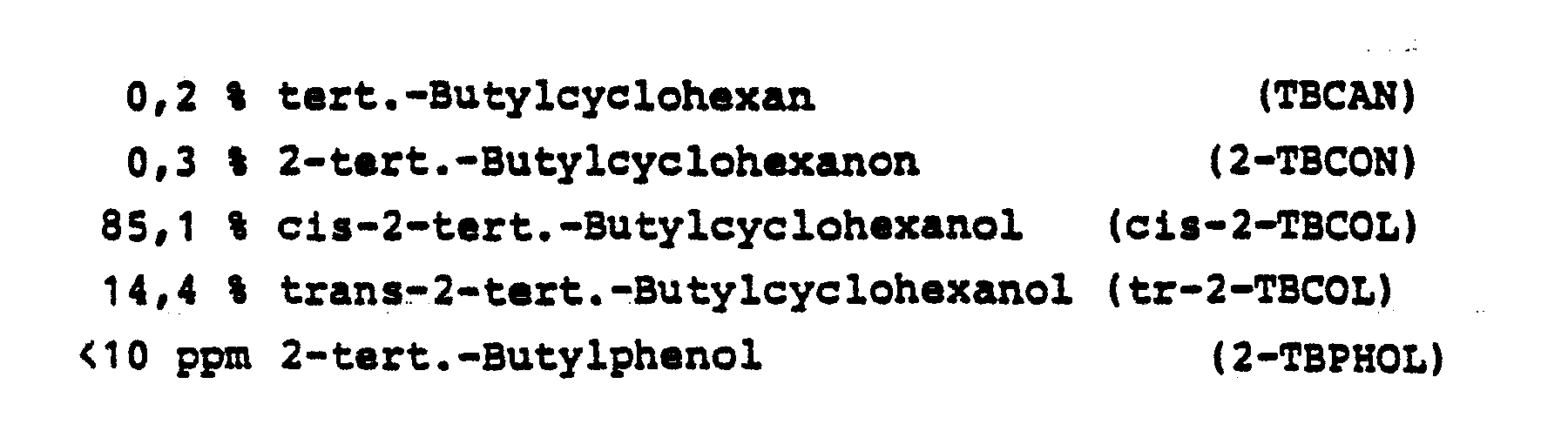
- 27 1 2-tert.-Butylphenol (2-TBPHOL) leitet man mit Wasserstoff bei 200 °C und 300 bar Gesamtdruck stündlich durch einen Durchflußreaktor (Volumen 20 1), der mit 20 1 eines Pd-Katalysators (0,5 Gew.-% Pd auf A1203) gefüllt ist. 250 1/h des Hydrieraustrages mischt man mit dem Zulauf und führt das Gemisch durch den Reaktor. Der Hydrieraustrag hat im Mittel folgende Zusammensetzung:

- Der Hydrieraustrag hat folgende Zusammensetzung:
-
- Man arbeitet nach den Angaben des Beispiels 1, führt jedoch 40 1/h statt 27 1/h 2-TBPHOL bei 220 °C statt 200 °C durch den ersten Reaktor.
- Der Hydrieraustrag hat folgende Zusammensetzung:
-

- Der Hydrieraustrag hat folgende Zusammensetzung:

- Nach den Angaben des Beispiels 1 hydriert man in der 1. Stufe 2-TBPHOL, jedoch 17 1/h 2-TBPHOL mit 200 1/h Produktrückführung bei 160 °C, mit folgendem Ergebnis:

- Die Hydrierung in der 2. Stufe erfolgt nach den Angaben des Beispiels 1 mit vergleichbarem Ergebnis.
- Man hydriert 2-TBPHOL nach den Angaben des Beispiels 3, jedoch bei 170 °C in der ersten Stufe, mit folgendem Ergebnis:

- Die Hydrierung in der 2. Stufe erfolgt nach den Angaben des Beispiels 1 mit vergleichbarem Ergebnis.
- Man hydriert 2-TBPHOL nach den Angaben des Beispiels 3, jedoch bei 180 °C in der ersten Stufe, mit folgendem Ergebnis:

- Man hydriert in der ersten Stufe 2-TBPHOL nach den Angaben des Beispiels 1. Im zweiten Reaktor hydriert man den Hydrieraustrag der ersten Stufe bei 150 °C über 400 ml des Pd-Kontaktes (0,5 % Pd auf A1203).
- Im Mittel hat der Hydrieraustrag der 2. Stufe folgende Zusammensetzung:
-


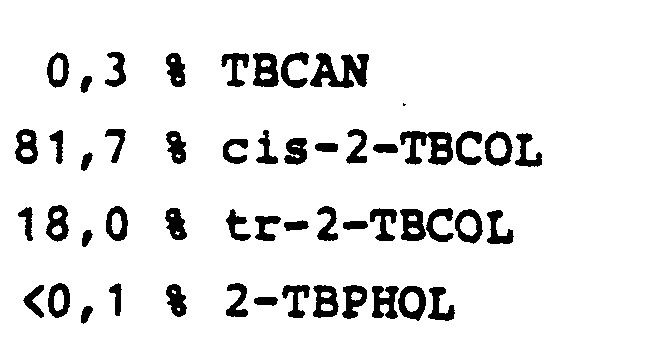
- Die Hydrierung von 2-THPHOL erfolgt in der ersten Stufe nach den Angaben des Beispiels 1. In der zweiten Stufe setzt man einen Ru-Katalysator ein, der 1 % Ru auf A1203 enthält. Man hydriert an diesem Ru-Katalysator bei 120 °C 160 ml/h des nach Beispiel 1, Stufe 1 erhaltenen Hydrieraustrages. Der Hydrieraustrag der 2. Stufe hat im Mittel folgende Zusammensetzung:
- Man hydriert nach den Angaben des Beispiels 3, jedoch bei 160 °C mit einem Zulauf von 21 1/h 2-TBPHOL und einer Rückführung von 275 1/h Hydrieraustrag mit folgendem Ergebnis:

- Die Hydrierung in der 2. Stufe erfolgt nach den Angaben des Beispiels 1 mit vergleichbarem Ergebnis.
- Die Hydrierung erfolgt nach den Angaben des Beispiels 7, jedoch werden 150 1/h Hydrieraustrag zurückgeführt.
- Man erhält in der 1. Stufe einen Hydrieraustrag folgender Zusammensetzung:

- Die Hydrierung in der 2. Stufe erfolgt nach den Angaben des Beispiels 1 mit vergleichbarem Ergebnis.
- Die Hydrierung der ersten Stufe erfolgt nach den Angaben des Beispiels 1. In der zweiten Stufe hydriert man bei 100 °C 200 ml/h des in der 1. Stufe erhaltenen Hydrieraustrages an dem im Beispiels 6 eingesetzten Ru-Kontakt (1 % Ru auf A1203). Man erhält einen Hydrieraustrag folgender Zusammensetzung:

- Die Hydrierung in der 2. Stufe erfolgt nach den Angaben des Beispiels 1 mit vergleichbarem Ergebnis.
- Durch den in Beispiel 1 in der zweiten Stufe eingesetzten 400 ml Durchflußreaktor, der mit 400 ml des in Beispiel 6 eingesetzten Ru-Kontaktes (1 % auf A1203) gefüllt ist, leitet man mit Wasserstoff stündlich 400 ml reines 2-TBPHOL (also 1. Stufe) bei 100 °C und 300 bar. Der Hydrieraustrag hat im Mittel folgende Zusammensetzung:

- Führt man die Hydrierung nach den Angaben des Vergleichsbeispiels B, jedoch bei 180 °C durch, so erhält man folgende Ergebnisse:

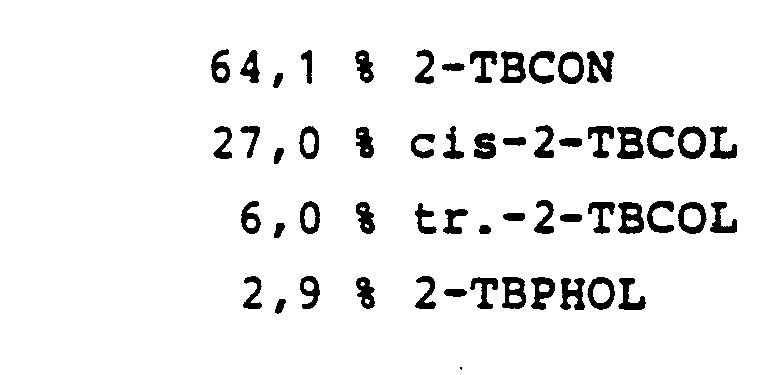
- Durch den im Beispiel 1 (2. Stufe) beschriebenen 400 ml-Reaktor, der mit 400 ml des im Beispiel 1 angegebenen Pd-Kontaktes gefüllt ist, leitet man mit Wasserstoff stündlich 80 ml reines 2-TBPHOL (also 1. Stufe, ohne Rückvermischung) bei 120 °C und 300 bar. Der Hydrieraustrag hat im Mittel folgende Zusammensetzung:
- Die Hydrierung in der 2. Stufe erfolgt nach den Angaben des Beispiels 1 mit vergleichbarem Ergebnis.
- Durchführung wie Beispiel 1, jedoch wurde ein Katalysator mit 0,1 % Pd auf Al203 eingesetzt. Der Zulauf an o-TBPHOL beträgt bei 200 °C und 300 bar Gesamtdruck 20 1/h, der mit 200 1/h Hydrieraustrag vermischt wird. Dieser Hydrieraustrag hat im Mittel folgende Zusammensetzung:

- Die Hydrierung in der 2. Stufe erfolgt nach den Angaben des Beispiels 1 mit vergleichbarem Ergebnis.
- Der Hydrieraustrag der 1. Stufe nach Beispiel 1 wird in der im Beispiel 1 genannten 400 ml-Apparatur (2. Stufe) an einem Katalysator hydriert, der 0,1 % Ru auf A1203 enthält. Bei 120 °C, 300 bar und einem Zulauf von 80 ml/h hat das Endprodukt folgende Zusammensetzung:
-

- Führt man die Hydrierung nach den Angaben des Beispiels 1, jedoch mit 4-tert.-Butylphenol (4-TBPHOL) statt mit 2-tert.-Butylphenol, bei einer Temperatur von 195 °C statt 200 °C und einem Zulauf von 10 1/h statt 27 1/h sowie einer Rückvermischung von 150 1/h statt 250 1/h durch, so erhält man in der ersten Stufe einen Hydrieraustrag folgender Zusammensetzung:

- Der Hydrieraustrag der zweiten Stufe hat folgende Zusammensetzung:

- Man arbeitet nach den Angaben des Beispiels 1, setzt jedoch 4-tert.-Butylphenol (4-TBPHOL) statt 2-tert.-Butylphenol ein und hydriert in der ersten Stufe bei einem Zulauf von 8 1/h statt 27 1/h und bei einer Temperatur von 150 °C statt 200 °C. Der Hydrieraustrag der ersten Stufe hat folgende Zusammensetzung:

- Die zweite Hydrierstufe führt man nach den Angaben des Beispiels 1 durch, jedoch bei einem Zulauf von 120 ml/h des Hydrieraustrages der 1. Stufe statt 400 ml und bei einer Temperatur von 150 °C statt 140 °C.
- Der Hydrieraustrag der zweiten Stufe hat im Mittel folgende Zusammensetzung:

Claims (6)

dadurch gekennzeichnet,
daß man die Hydrierung zweistufig bei Wasserstoffdrücken über 200 bar durchführt und in der ersten Stufe an einem Pd-Kontakt bei Temperaturen von 120 bis 280 °C und in der zweiten Stufe an einem Ru-Kontakt bei Temperaturen von 70 bis 200 °C hydriert.
dadurch gekennzeichnet,
daß man in der ersten Stufe bei einer Temperatur von 160 bis 220 °C und in der zweiten Stufe bei einer Temperatur von 100 bis 150 °C hydriert.
dadurch gekennzeichnet,
daß man bei einem Druck von 250 bis 350 bar hydriert.
dadurch gekennzeichnet,
daß man die Hydrierung in der ersten Stufe mit Produktrückvermischung durchführt, wobei die rückgeführte Menge das 1- bis 20fache, vorzugsweise das 5- bis 10fache der Zulaufmenge beträgt.
dadurch gekennzeichnet,
daß man als Pd- und/oder Ru-Kontakte Pd- bzw. Ru-Trägerkontakte einsetzt, in denen das Pd bzw. Ru auf inerten Trägern, vorzugsweise auf Aluminiumoxid, aufgebracht ist.
dadurch gekennzeichnet,
daß man das Pd bzw. Ru auf dem Träger in Konzentrationen von 0,1 bis 5 Gew.-%, vorzugsweise von 0,5 bis 1 Gew.-% einsetzt.
Applications Claiming Priority (4)
| Application Number | Priority Date | Filing Date | Title |
|---|---|---|---|
| DE3338437 | 1983-10-22 | ||
| DE3338437 | 1983-10-22 | ||
| DE19843401343 DE3401343A1 (de) | 1983-10-22 | 1984-01-17 | Verfahren zur herstellung von 2- und 4-tert.-butylcyclohexanol mit hohen anteilen an cis-isomeren durch katalytische hydrierung der entsprechenden tert.-butylphenole |
| DE3401343 | 1984-01-17 |
Publications (2)
| Publication Number | Publication Date |
|---|---|
| EP0141054A1 true EP0141054A1 (de) | 1985-05-15 |
| EP0141054B1 EP0141054B1 (de) | 1986-07-02 |
Family
ID=25815069
Family Applications (1)
| Application Number | Title | Priority Date | Filing Date |
|---|---|---|---|
| EP19840108733 Expired EP0141054B1 (de) | 1983-10-22 | 1984-07-24 | Verfahren zur Herstellung von 2- und 4-tert.-Butylcyclohexanol mit hohen Anteilen an cis-Isomeren durch katalytische Hydrierung der entsprechenden tert.-Butylphenole |
Country Status (3)
| Country | Link |
|---|---|
| US (1) | US4551564A (de) |
| EP (1) | EP0141054B1 (de) |
| DE (2) | DE3401343A1 (de) |
Cited By (4)
| Publication number | Priority date | Publication date | Assignee | Title |
|---|---|---|---|---|
| EP0803488A3 (de) * | 1996-04-26 | 1998-01-14 | Basf Aktiengesellschaft | Verfahren zur Umsetzung einer organischen Verbindung in Gegenwart eines in situ gebildeten Ruthenium-katalysators |
| US6248924B1 (en) | 1996-06-19 | 2001-06-19 | Basf Aktiengesellschaft | Process for reacting an organic compound in the presence of a supported ruthenium catalyst |
| US7355084B2 (en) | 2001-06-11 | 2008-04-08 | Basf Aktiengesellschaft | Method for hydrogenating organic compounds by means of Ru/SiO2 catalysts |
| CN107827712A (zh) * | 2017-10-31 | 2018-03-23 | 安徽华业香料合肥有限公司 | 一种乙酸邻叔丁基环己酯合成香料的生产方法 |
Families Citing this family (16)
| Publication number | Priority date | Publication date | Assignee | Title |
|---|---|---|---|---|
| DE3528124A1 (de) * | 1985-08-06 | 1987-02-12 | Huels Chemische Werke Ag | Verfahren zur entfernung von n-butyraldehyd aus gasstroemen |
| DE3629605A1 (de) * | 1986-08-30 | 1988-03-03 | Basf Ag | Verwendung von 2-tert.-butyl-4-methyl-cyclohexanol als riechstoff sowie als bestandteil von riechstoffkompositionen |
| EP0286991B1 (de) * | 1987-04-11 | 1993-08-18 | Daikin Industries, Limited | Verfahren zur Herstellung von fluorsubstituierten alicyclischen Diolen |
| IT1217317B (it) * | 1987-05-05 | 1990-03-22 | Montedison Spa | Procedimento per l'idrogenazione di bisfenoli |
| DE69009682T2 (de) * | 1989-11-13 | 1994-10-06 | Firmenich & Cie | Verfahren zur Herstellung von Cyclohexanolderivaten. |
| JP3571376B2 (ja) * | 1994-09-20 | 2004-09-29 | 富士写真フイルム株式会社 | 2,6−ジ−tert−アルキルシクロヘキサノール類の製造方法 |
| US5977402A (en) * | 1995-07-20 | 1999-11-02 | Sumitomo Chemical Company, Limited | Processes for preparing 4-tert.-butylcyclohexanol and 4-tert.-butylcyclohexyl acetate |
| DE19604791A1 (de) * | 1996-02-09 | 1997-08-14 | Basf Ag | Verfahren zur Hydrierung von aromatischen Verbindungen, in denen mindestens eine Hydroxylgruppe an einen aromatischen Kern gebunden ist |
| EP0813906A3 (de) * | 1996-06-19 | 1998-11-18 | Basf Aktiengesellschaft | Verfahren zur Umsetzung einer organischen Verbindung in Gegenwart eines geträgerten Rutheniumkatalysators |
| DE19651129A1 (de) * | 1996-12-09 | 1998-06-10 | Basf Ag | Verfahren zur Hydrierung einer aromatischen Verbindung in Gegenwart eines Trägerkatalysators |
| DE10061540C2 (de) | 2000-12-11 | 2002-11-28 | Haarmann & Reimer Gmbh | Verfahren zur Herstellung von cis-2-tertiär-Butylcyclohexanol durch katalytische Hydrierung von 2-tertiär-Butylphenol |
| FR2947545B1 (fr) | 2009-07-03 | 2011-06-10 | Aet Group | Procede continu d'hydrogenation de composes aromatiques |
| CN109704932B (zh) * | 2017-10-25 | 2022-07-26 | 中国石油化工股份有限公司 | 催化加氢制备2,6-二叔丁基-4-甲基环己醇的方法 |
| CN109704918B (zh) * | 2017-10-25 | 2022-07-26 | 中国石油化工股份有限公司 | 连续催化制备2,6-二叔丁基-4-甲基环己醇的方法 |
| CN110526799A (zh) * | 2018-05-24 | 2019-12-03 | 中国石油化工股份有限公司 | 一种制备2,6-二叔丁基-4-甲基环己醇的反应工艺 |
| CN110743546B (zh) * | 2019-10-31 | 2022-11-18 | 西安凯立新材料股份有限公司 | 连续制备顺式对叔丁基环己醇的催化剂及制备方法和应用 |
Citations (3)
| Publication number | Priority date | Publication date | Assignee | Title |
|---|---|---|---|---|
| DE1102731B (de) * | 1958-06-23 | 1961-03-23 | Ameringen Haebler Inc Van | Verfahren zur Herstellung von p-tertiaerem Butylcyclohexanol mit ueberwiegendem Anteil an cis-Isomeren |
| CH590186A5 (de) * | 1973-07-10 | 1977-07-29 | Basf Ag | |
| DE2909663A1 (de) * | 1978-03-13 | 1979-09-27 | Sankio Chemical Co | Verfahren zur herstellung von cis-alkylcyclohexanolen |
Family Cites Families (5)
| Publication number | Priority date | Publication date | Assignee | Title |
|---|---|---|---|---|
| US3124614A (en) * | 1964-03-10 | Preparation of z-substituteb | ||
| US2927127A (en) * | 1958-04-08 | 1960-03-01 | Ameringen Haebler Inc Van | Process for producing para tertiary butyl cyclohexanyl esters and the intermediate alcohol therefor |
| DE2132547C2 (de) * | 1971-06-30 | 1982-11-11 | Basf Ag, 6700 Ludwigshafen | Verfahren zur Hydrierung ein- oder mehrkerniger aromatischer Diamine zu den entsprechenden cycloaliphatischen Aminen |
| US4212990A (en) * | 1977-08-05 | 1980-07-15 | Toray Industries, Inc. | Method for producing cyclohexane derivatives directly from aromatic hydrocarbons |
| US4162267A (en) * | 1978-06-22 | 1979-07-24 | Allied Chemical Corporation | Production of cyclohexanone |
-
1984
- 1984-01-17 DE DE19843401343 patent/DE3401343A1/de not_active Withdrawn
- 1984-07-24 DE DE8484108733T patent/DE3460267D1/de not_active Expired
- 1984-07-24 EP EP19840108733 patent/EP0141054B1/de not_active Expired
- 1984-10-22 US US06/663,734 patent/US4551564A/en not_active Expired - Lifetime
Patent Citations (3)
| Publication number | Priority date | Publication date | Assignee | Title |
|---|---|---|---|---|
| DE1102731B (de) * | 1958-06-23 | 1961-03-23 | Ameringen Haebler Inc Van | Verfahren zur Herstellung von p-tertiaerem Butylcyclohexanol mit ueberwiegendem Anteil an cis-Isomeren |
| CH590186A5 (de) * | 1973-07-10 | 1977-07-29 | Basf Ag | |
| DE2909663A1 (de) * | 1978-03-13 | 1979-09-27 | Sankio Chemical Co | Verfahren zur herstellung von cis-alkylcyclohexanolen |
Non-Patent Citations (1)
| Title |
|---|
| PATENT ABSTRACTS OF JAPAN, unexamined applications, C Sektion, Band 3, Nr. 114, 21. September 1979 THE PATENT OFFICE JAPANESE GOVERNMENT Seite 125 C 59 & JP-A-54-95 546 (kawaken fine chemical k.k.) * |
Cited By (4)
| Publication number | Priority date | Publication date | Assignee | Title |
|---|---|---|---|---|
| EP0803488A3 (de) * | 1996-04-26 | 1998-01-14 | Basf Aktiengesellschaft | Verfahren zur Umsetzung einer organischen Verbindung in Gegenwart eines in situ gebildeten Ruthenium-katalysators |
| US6248924B1 (en) | 1996-06-19 | 2001-06-19 | Basf Aktiengesellschaft | Process for reacting an organic compound in the presence of a supported ruthenium catalyst |
| US7355084B2 (en) | 2001-06-11 | 2008-04-08 | Basf Aktiengesellschaft | Method for hydrogenating organic compounds by means of Ru/SiO2 catalysts |
| CN107827712A (zh) * | 2017-10-31 | 2018-03-23 | 安徽华业香料合肥有限公司 | 一种乙酸邻叔丁基环己酯合成香料的生产方法 |
Also Published As
| Publication number | Publication date |
|---|---|
| DE3401343A1 (de) | 1985-05-09 |
| DE3460267D1 (en) | 1986-08-07 |
| US4551564A (en) | 1985-11-05 |
| EP0141054B1 (de) | 1986-07-02 |
Similar Documents
| Publication | Publication Date | Title |
|---|---|---|
| EP0141054B1 (de) | Verfahren zur Herstellung von 2- und 4-tert.-Butylcyclohexanol mit hohen Anteilen an cis-Isomeren durch katalytische Hydrierung der entsprechenden tert.-Butylphenole | |
| EP0059367B1 (de) | Verfahren zur Abtrennung organischer Jod-Verbindungen von Carbonylierungsprodukten des Methanols, Methylacetates und Dimethylethers | |
| DE69511271T2 (de) | Phenol mit einem niedrigen gehalt an methylbenzofuran | |
| CH398564A (de) | Verfahren zur Herstellung von Cyclohexanon | |
| CH639053A5 (de) | Verfahren zur herstellung von cis-isomeren von alkylcyclohexanolen. | |
| EP1070698A2 (de) | Verfahren zur Hydrierung von Aceton | |
| DE69514356T2 (de) | Cyclopentadien-oligomere und verfahren zu deren herstellung | |
| EP0312735A2 (de) | Verfahren zur Herstellung von beta-Isophoron aus alpha-Isophoron | |
| EP0446781A1 (de) | Verfahren zur Qualitätsverbesserung von rohen Diaminodiphenylmethan | |
| DE1643375C3 (de) | Verfahren zur Aufarbeitungeines bei der Herstellung von Phenol durch Oxydation von Cumol und anschließende Zersetzung und Dehydratisierung des Reaktionsprodukts erhaltenen Reaktions gemisches | |
| EP0034804B1 (de) | Verfahren zur Herstellung von höheren gesättigten Ketonen | |
| DE1543229B1 (de) | Verfahren zur Herstellung von Alkylbenzolen | |
| DE2300038C2 (de) | Verwendung eines geschwefelten Katalysators für die Herstellung von technischen Weißölen | |
| DE19524969A1 (de) | Verfahren zur Herstellung von 3.3.5-Trimethylcyclohexanon | |
| DE2645770C3 (de) | Verfahren zur Herstellung von o-Kresol durch Transmethylierung von kernmethylierten Phenolen | |
| EP0230625B1 (de) | Verfahren zur Herstellung von Brenzkatechin und Hydrochinon | |
| DD218090A1 (de) | Verfahren zur herstellung von cumen und ethylbenzen | |
| DE69302762T2 (de) | Verfahren zur Herstellung von 1,4,5,8-Naphthalintetracarbonsäure | |
| DE2653445C2 (de) | Verfahren zur Hydrierung von 4-Acetoxycrotonaldehyd enthaltendem 1,4-Diacetoxybuten-2 | |
| DE1493858C (de) | ||
| EP0273109B1 (de) | Verfahren zur Herstellung von 4.4.8.8.10-Pentamethyl-bicyclo[4.4.0]decen-(1.6)-on(2) | |
| DE69806909T2 (de) | Verfahren zur herstellung von isophoron mit verbesserter farbe und farbstabilität. | |
| DE2213979C3 (de) | Verfahren zur Herstellung von n-Alkylbenzolen | |
| DE10117065A1 (de) | Verfahren zur Herstellung von C5-Acetat | |
| DE3842547A1 (de) | Verfahren zur herstellung von 2,6,6-trimethyl-cyclohex-2-en-1,4-dion |
Legal Events
| Date | Code | Title | Description |
|---|---|---|---|
| PUAI | Public reference made under article 153(3) epc to a published international application that has entered the european phase |
Free format text: ORIGINAL CODE: 0009012 |
|
| AK | Designated contracting states |
Designated state(s): BE CH DE FR GB IT LI NL |
|
| 17P | Request for examination filed |
Effective date: 19850319 |
|
| RAP1 | Party data changed (applicant data changed or rights of an application transferred) |
Owner name: HUELS AKTIENGESELLSCHAFT |
|
| GRAA | (expected) grant |
Free format text: ORIGINAL CODE: 0009210 |
|
| AK | Designated contracting states |
Kind code of ref document: B1 Designated state(s): BE CH DE FR GB IT LI NL |
|
| REF | Corresponds to: |
Ref document number: 3460267 Country of ref document: DE Date of ref document: 19860807 |
|
| ET | Fr: translation filed | ||
| ITF | It: translation for a ep patent filed | ||
| R20 | Corrections of a patent specification |
Effective date: 19860930 |
|
| PLBE | No opposition filed within time limit |
Free format text: ORIGINAL CODE: 0009261 |
|
| STAA | Information on the status of an ep patent application or granted ep patent |
Free format text: STATUS: NO OPPOSITION FILED WITHIN TIME LIMIT |
|
| 26N | No opposition filed | ||
| PGFP | Annual fee paid to national office [announced via postgrant information from national office to epo] |
Ref country code: BE Payment date: 19930709 Year of fee payment: 10 |
|
| ITTA | It: last paid annual fee | ||
| PG25 | Lapsed in a contracting state [announced via postgrant information from national office to epo] |
Ref country code: BE Effective date: 19940731 |
|
| BERE | Be: lapsed |
Owner name: HULS A.G. Effective date: 19940731 |
|
| PGFP | Annual fee paid to national office [announced via postgrant information from national office to epo] |
Ref country code: CH Payment date: 19980720 Year of fee payment: 15 |
|
| PGFP | Annual fee paid to national office [announced via postgrant information from national office to epo] |
Ref country code: NL Payment date: 19980731 Year of fee payment: 15 |
|
| PG25 | Lapsed in a contracting state [announced via postgrant information from national office to epo] |
Ref country code: LI Free format text: LAPSE BECAUSE OF NON-PAYMENT OF DUE FEES Effective date: 19990731 Ref country code: CH Free format text: LAPSE BECAUSE OF NON-PAYMENT OF DUE FEES Effective date: 19990731 |
|
| PG25 | Lapsed in a contracting state [announced via postgrant information from national office to epo] |
Ref country code: NL Free format text: LAPSE BECAUSE OF NON-PAYMENT OF DUE FEES Effective date: 20000201 |
|
| REG | Reference to a national code |
Ref country code: CH Ref legal event code: PL |
|
| NLV4 | Nl: lapsed or anulled due to non-payment of the annual fee |
Effective date: 20000201 |
|
| REG | Reference to a national code |
Ref country code: FR Ref legal event code: TP |
|
| REG | Reference to a national code |
Ref country code: GB Ref legal event code: IF02 |
|
| REG | Reference to a national code |
Ref country code: GB Ref legal event code: 732E |
|
| PGFP | Annual fee paid to national office [announced via postgrant information from national office to epo] |
Ref country code: GB Payment date: 20030704 Year of fee payment: 20 |
|
| PGFP | Annual fee paid to national office [announced via postgrant information from national office to epo] |
Ref country code: DE Payment date: 20030710 Year of fee payment: 20 |
|
| PGFP | Annual fee paid to national office [announced via postgrant information from national office to epo] |
Ref country code: FR Payment date: 20030711 Year of fee payment: 20 |
|
| REG | Reference to a national code |
Ref country code: FR Ref legal event code: TP |
|
| PG25 | Lapsed in a contracting state [announced via postgrant information from national office to epo] |
Ref country code: GB Free format text: LAPSE BECAUSE OF EXPIRATION OF PROTECTION Effective date: 20040723 |
|
| REG | Reference to a national code |
Ref country code: GB Ref legal event code: PE20 |