EP0131258A2 - Neue N-Alkoxy- N-Alkylsulfonylaminosulfonylharnstoffe, und neue (Pyrimido) Triazino-thiatriazinoxide als Vorprodukte - Google Patents
Neue N-Alkoxy- N-Alkylsulfonylaminosulfonylharnstoffe, und neue (Pyrimido) Triazino-thiatriazinoxide als Vorprodukte Download PDFInfo
- Publication number
- EP0131258A2 EP0131258A2 EP84107833A EP84107833A EP0131258A2 EP 0131258 A2 EP0131258 A2 EP 0131258A2 EP 84107833 A EP84107833 A EP 84107833A EP 84107833 A EP84107833 A EP 84107833A EP 0131258 A2 EP0131258 A2 EP 0131258A2
- Authority
- EP
- European Patent Office
- Prior art keywords
- formula
- compounds
- alkyl
- hydrogen
- alkoxy
- Prior art date
- Legal status (The legal status is an assumption and is not a legal conclusion. Google has not performed a legal analysis and makes no representation as to the accuracy of the status listed.)
- Granted
Links
Classifications
-
- C—CHEMISTRY; METALLURGY
- C07—ORGANIC CHEMISTRY
- C07D—HETEROCYCLIC COMPOUNDS
- C07D521/00—Heterocyclic compounds containing unspecified hetero rings
-
- A—HUMAN NECESSITIES
- A01—AGRICULTURE; FORESTRY; ANIMAL HUSBANDRY; HUNTING; TRAPPING; FISHING
- A01N—PRESERVATION OF BODIES OF HUMANS OR ANIMALS OR PLANTS OR PARTS THEREOF; BIOCIDES, e.g. AS DISINFECTANTS, AS PESTICIDES OR AS HERBICIDES; PEST REPELLANTS OR ATTRACTANTS; PLANT GROWTH REGULATORS
- A01N47/00—Biocides, pest repellants or attractants, or plant growth regulators containing organic compounds containing a carbon atom not being member of a ring and having no bond to a carbon or hydrogen atom, e.g. derivatives of carbonic acid
- A01N47/08—Biocides, pest repellants or attractants, or plant growth regulators containing organic compounds containing a carbon atom not being member of a ring and having no bond to a carbon or hydrogen atom, e.g. derivatives of carbonic acid the carbon atom having one or more single bonds to nitrogen atoms
- A01N47/28—Ureas or thioureas containing the groups >N—CO—N< or >N—CS—N<
- A01N47/36—Ureas or thioureas containing the groups >N—CO—N< or >N—CS—N< containing the group >N—CO—N< directly attached to at least one heterocyclic ring; Thio analogues thereof
-
- C—CHEMISTRY; METALLURGY
- C07—ORGANIC CHEMISTRY
- C07D—HETEROCYCLIC COMPOUNDS
- C07D513/00—Heterocyclic compounds containing in the condensed system at least one hetero ring having nitrogen and sulfur atoms as the only ring hetero atoms, not provided for in groups C07D463/00, C07D477/00 or C07D499/00 - C07D507/00
- C07D513/02—Heterocyclic compounds containing in the condensed system at least one hetero ring having nitrogen and sulfur atoms as the only ring hetero atoms, not provided for in groups C07D463/00, C07D477/00 or C07D499/00 - C07D507/00 in which the condensed system contains two hetero rings
- C07D513/04—Ortho-condensed systems
Definitions
- heterocyclically substituted phenylsulfonylureas have herbicidal or plant growth-regulating properties s. e.g. NL-PS 121 788, DE-OS 27 15 786, EP-PS 1 485.
- heterocyclically substituted N-alkoxy- and N-alkylsulfonylaminosulfonylureas which contain a pyrimidine or triazine ring as a heterocyclic component are particularly suitable as herbicides and plant growth regulators.
- the invention also relates to new (pyrimido) triazinothiadiazine oxides of the formula (II) which, as stated below, can act as intermediates for the preparation of the compounds of the formula (I) according to the invention.
- the new compounds of the general formula I can be synthesized from starting materials known per se or from starting materials prepared by known processes.
- the reaction of the compounds (III) and (IV) is preferably carried out in inert aprotic solvents such as aliphatic or aromatic hydrocarbons, in particular n-hexane, toluene or xylene, acetonitrile, dichloromethane, chloroform, nitromethane, tetrahydrofuran, or dioxane at temperatures between - 78 ° C and the boiling point of the solvent, preferably in the presence of an acid acceptor such as a tertiary organic amine, especially pyridine or triethylamine or an inorganic base such as an alkali carbonate.
- X oxygen
- the compound (III) can optionally be used in excess in order to act as an auxiliary base at the same time.
- Re b) In the reaction of the compounds (II) and (III), the same solvents are preferably used as in a) and the process is carried out at temperatures between -78 ° C. and the boiling point of the solvent. If appropriate, the reaction is carried out with the addition of one or more equivalents of basic compounds, such as tertiary organic amines, in particular triethylamine, ethyldiisopropylamine, pyridine or organic bases such as potassium carbonate.
- basic compounds such as tertiary organic amines, in particular triethylamine, ethyldiisopropylamine, pyridine or organic bases such as potassium carbonate.
- acylation of amino heterocycles of the formula VI with sulfonyl isocyanates of the formula V is preferably carried out to the same solvents mentioned under a) at temperatures between -20 ° C and the boiling point of the solvent.
- the procedure is preferably in inert solvents such as dioxane or dimethylformamide with the addition of an inorganic base such as sodium hydride or potassium carbonate, at temperatures from 0 ° C to the boiling point of the solvent.
- inert solvents such as dioxane or dimethylformamide
- an inorganic base such as sodium hydride or potassium carbonate
- Conventional agents such as dimethyl sulfate, methyl iodide or ethyl bromide are used as alkylating agents.
- salts of the formula I in which R 2 or R 3 is hydrogen can form salts in which H is replaced by a suitable cation.
- These salts are generally metal, in particular alkali or alkaline earth metal salts, optionally alkylated ammonium or organic amine salts and are preferably prepared in inert solvents such as water, methanol or acetone at temperatures of 20-100 ° C.
- Suitable bases for the preparation of the salts according to the invention are, for example, alkali carbonates, ammonia or ethanolamine.
- the starting materials of the formula (II) required for the preparation of the compounds of the general formula (I) according to the invention are new and can be obtained in particular by addition of chloro- or fluorosulfonyl isocyanate to aminoheterocycles of the above-mentioned formula (VI) in the presence of bases such as tertiary organic amines Triethylamine or ethyldiisopropylamine.
- bases such as tertiary organic amines Triethylamine or ethyldiisopropylamine.
- the compounds of the formula II and their preparation process are therefore also an object of the invention. This process is preferably carried out in inert organic solvents such as dichloromethane, acetonitrile, tetrahydrofuran at temperatures between -78 ° C and + 40 ° C.
- R 57 R 6 (C, -C 4 ) alkylamino or (C 1 -C 4 ) dialkylamino
- this method of preparation of the compounds of formula II is less suitable because of low yields.
- the compounds of the formula II are obtained as isomer mixtures in the case of R 5 ⁇ R 6 .
- the separation of these regioisomeric mixtures can by conventional metal - methods, such as recrystallization done chromatography, etc..
- the starting materials of the formula III are known or can be prepared by processes which are known in principle.
- the sulfonyl isocyanates of the formula (V) are prepared by reacting chlorosulfonyl isocyanate with secondary aliphatic sulfonamides (DE-OS 2 257 240).
- the starting materials of formula IV are known or can be prepared by processes known in principle, e.g. by cyclizing corresponding guanidine derivatives with appropriately substituted 1,3-diketones, compare e.g. "The Chemistry of Heterocyclic Compounds", Vol. XVI (1962) and Supplement I (1970) or by derivatization of cyanuric chloride, compare e.g. "The Chemistry of Heterocyclic Compounds", L. Rapoport: "s-Triazines and Derivatives” (1959).
- the heterocyclic sulfonylurea derivatives according to the invention have an excellent herbicidal action and a very good one in important large crops Selectivity. They are therefore suitable for the selective control of dicotyledonous and grassy annual and perennial weeds, in particular in agriculturally important crops such as, for. B. wheat, barley, rye, rice, corn, sugar beet and soy. It does not matter whether the substances are applied in pre-sowing, pre-emergence or post-emergence spraying. If the compounds according to the invention are applied to the earth's surface in a pre-sowing or pre-emergence process before the weed plants germinate, the emergence of the seedlings is not prevented.
- the weeds grow to the cotyledon stage, but then stop growing and eventually die completely after 3 - 5 weeks.
- the active ingredients are applied to the green parts of the plant in the post-emergence process, there is also a drastic growth stop very quickly after the treatment and the weed plants remain in the growth stage at the time of application or die completely after a certain time, so that one for the crop plants harmful weed competition is eliminated very early and sustainably.
- the substances according to the invention have excellent growth-regulating properties in crop plants. They intervene regulating the plant's own metabolism and can thus be used to influence plant constituents in a targeted manner and to facilitate harvesting, e.g. by triggering desiccation and stunted growth. Furthermore, they are also suitable for the general control and inhibition of undesired vegetative growth without killing the plants in the process. Inhibiting vegetative growth plays a major role in many monocotyledonous and dicotyledonous crops, as this can reduce or completely prevent storage. Particularly noteworthy is the growth regulatory effectiveness of the compounds as growth hunters in cereals, maize, soybeans, cotton, lawn and their ability to increase the content of desired ingredients such as carbohydrates and protein in crops. Finally, the compounds show a very good improvement in fruit abscess, especially in the case of citrus fruits, or a reduction in the holding power.
- the invention therefore also relates to herbicidal and growth-regulating agents which are characterized by a content of a compound of the formula I in combination with customary formulation auxiliaries and inert substances and their use in the agricultural field.
- the agents according to the invention generally contain the active ingredients of the formula I in an amount of 2-95% by weight. They can be used as wettable powders, emulsifiable concentrates, sprayable solutions, or dusts Granules can be used in the usual preparations.
- the wettable powders are preparations which are uniformly dispersible in water and, in addition to the active ingredient, in addition to a diluent or inert substance, are also wetting agents, e.g. polyoxethylated alkylphenols, polyoxethylated fatty alcohols, alkyl or alkylphenyl sulfonates and dispersants, e.g. sodium lignosulfonate, 2,2'-dinaphthylmethane-6, 6'-disulfonic acid sodium, dibutylnaphthalenesulfonic acid sodium or oleylmethyl tauric acid sodium.
- wetting agents e.g. polyoxethylated alkylphenols, polyoxethylated fatty alcohols, alkyl or alkylphenyl sulfonates and dispersants, e.g. sodium lignosulfonate, 2,2'-dinaphthylmethan
- Dusts are obtained by grinding the active ingredient with finely divided, solid substances, e.g. Talc, natural clays, such as kaolin, bentonite, pyrophillite or diatomaceous earth.
- finely divided, solid substances e.g. Talc, natural clays, such as kaolin, bentonite, pyrophillite or diatomaceous earth.
- Granules can either be produced by spraying the active ingredient onto adsorbable, granulated inert material or by applying active ingredient concentrates by means of adhesives e.g. Polyvinyl alcohol, sodium polyacrylic acid or mineral oils on the surface of carriers such as sand, kaolinite or granulated inert material. Suitable active ingredients can also be produced in the manner customary for the production of fertilizer granules - if desired in a mixture with fertilizers.
- adhesives e.g. Polyvinyl alcohol, sodium polyacrylic acid or mineral oils
- Suitable active ingredients can also be produced in the manner customary for the production of fertilizer granules - if desired in a mixture with fertilizers.
- the concentrations of the active compounds in the commercial formulations can vary.
- the active ingredient concentration in wettable powders varies e.g. between about 10% and 80%, the rest consists of the formulation additives given above. In the case of emulsifiable concentrates, the active substance concentration can likewise be approximately 10% to 80%. Dust-like formulations contain about 2 - 20%. In the case of granules, the active ingredient content depends in part on whether the active compound is in liquid or solid form and which granulation aids, fillers, etc. are used.
- the commercially available concentrates are optionally diluted in the customary manner, e.g. for wettable powders and emulsifiable concentrates using water. Dust-like and granulated preparations and sprayable solutions are no longer diluted with other inert substances before use. With the external conditions such as temperature, humidity, etc. the required application rate varies. It is generally between 0.01 and 10 kg / ha, preferably about 0.1 to 5.0 kg / ha of active ingredient.
- new herbicides together with one or more herbicides, e.g. as a tank mix or in the form of a finished formulation in order to achieve further advantageous effects.
- the active compounds according to the invention can be combined with other herbicides, insecticides and fungicides.
- Concentrations between 0.01 and 1.25 kg / ha are suitable for use as growth regulators.
- Aqueous dispersions of wettable powders or dilutions of emulsifiable honey concentrates are preferably used. The application takes place in the post-emergence.
- Preferred crops are corn and tobacco.
- the reaction mixture is allowed to come to 0 ° C. in the course of one hour, cooled to -70 ° C., 9.35 g (0.1 mol) of O, N-dimethylhydroxylamine hydrochloride are added and 20.2 are added in the course of a further hour g (0.2 mol) of triethylamine- dissolved in 100 ml of dichloromethane. After 2 hours of stirring at -70 ° C., the mixture is stirred at room temperature for 18 hours, washed with 0.5N sodium acetate solution, then with saturated sodium chloride solution and the dichloromethane phase is dried over sodium sulfate.
- the present compounds according to the invention have excellent herbicidal activity against a broad spectrum of economically important mono- and dicotyledonous harmful plants. Perennial root weeds that are difficult to control are also detected by the active ingredients. It is irrelevant whether the substances are pre-seeded, pre-emergence or post-emergence.
- the compounds according to the invention are applied to the surface of the earth in a pre-sowing or pre-emergence process before the weed plants germinate, the emergence of the seedlings is not prevented.
- the weeds grow to the cotyledon stage, but then stop growing and eventually die completely after 3 - 5 weeks.
- the active ingredients are applied to the green parts of the plants in the post-emergence process, there is also a drastic growth stop very quickly after the treatment and the weed plants remain in the growth stage at the time of application or die completely after a certain time, so that one for the crop plants harmful weed competition can be eliminated very early and sustainably by using the new agents according to the invention.
- the compounds according to the invention have an excellent herbicidal activity against monocotyledonous and dicotyledonous weeds, crops of economically harmful crops such as e.g. Wheat, barley, rye, rice, corn, sugar beet, cotton and soy are only slightly or not at all damaged. Compared to the prior art, the substances according to the invention therefore have a significantly improved herbicidal activity against monocotyledonous and dicotyledonous weeds, crops of economically harmful crops such as e.g. Wheat, barley, rye, rice, corn, sugar beet, cotton and soy are only slightly or not at all damaged. Compared to the prior art, the substances according to the invention therefore have a significantly improved
- Seeds or rhizome pieces of mono- and dicotyledon weeds were placed in plastic pots ( ⁇ 9 cm) in Lechmerde and covered with soil.
- the compounds according to the invention formulated as wettable powders or as emulsion concentrates were applied to the earth's surface in the form of aqueous suspensions or emulsions.
- the amount of water applied per pot corresponded to the equivalent of 600-800 l / ha.
- the test pots were set up in the greenhouse and the test plants were cultivated under good growth conditions (temperature: 23 ⁇ 1 ° C .; rel]. Humidity 60-80%). After approximately 3 weeks, the damage to the plants was assessed visually. Untreated controls served as a comparison.
- test results shown demonstrate the excellent herbicidal pre-thawing action of the new compounds according to the invention against grasses and weeds.
- the agents according to the invention had good herbicidal activity against a broad spectrum of economically important annual and perennial weeds and weeds (Tables 3, 4).
Landscapes
- Organic Chemistry (AREA)
- Chemical & Material Sciences (AREA)
- Life Sciences & Earth Sciences (AREA)
- Health & Medical Sciences (AREA)
- Plant Pathology (AREA)
- Engineering & Computer Science (AREA)
- Dentistry (AREA)
- General Health & Medical Sciences (AREA)
- Wood Science & Technology (AREA)
- Zoology (AREA)
- Environmental Sciences (AREA)
- Pest Control & Pesticides (AREA)
- Agronomy & Crop Science (AREA)
- Agricultural Chemicals And Associated Chemicals (AREA)
- Plural Heterocyclic Compounds (AREA)
- Nitrogen And Oxygen Or Sulfur-Condensed Heterocyclic Ring Systems (AREA)
Abstract

Description
- Es ist bereits bekannt, daß heterocyclisch substituierte Phenylsulfonylharnstoffe herbizide oder pflanzenwuchsregulierende Eigenschaften aufweisen s. z.B. NL-PS 121 788, DE-OS 27 15 786, EP-PS 1 485.
- Diese weisen jedoch Nachteile bei der Anwendung auf wie beispielsweise eine hohe Persistenz oder unzureichende Selektivität.
- Es wurde nun gefunden, daß heterocyclisch substituierte N-Alkoxy- und N-Alkylsulfonylaminosulfonylharnstoffe, welche als heterocyclische Komponente einen Pyrimidin- oder Triazinring enthalten, als Herbizide und Pflanzenwachstumsregulatoren besonders geeignet sind.
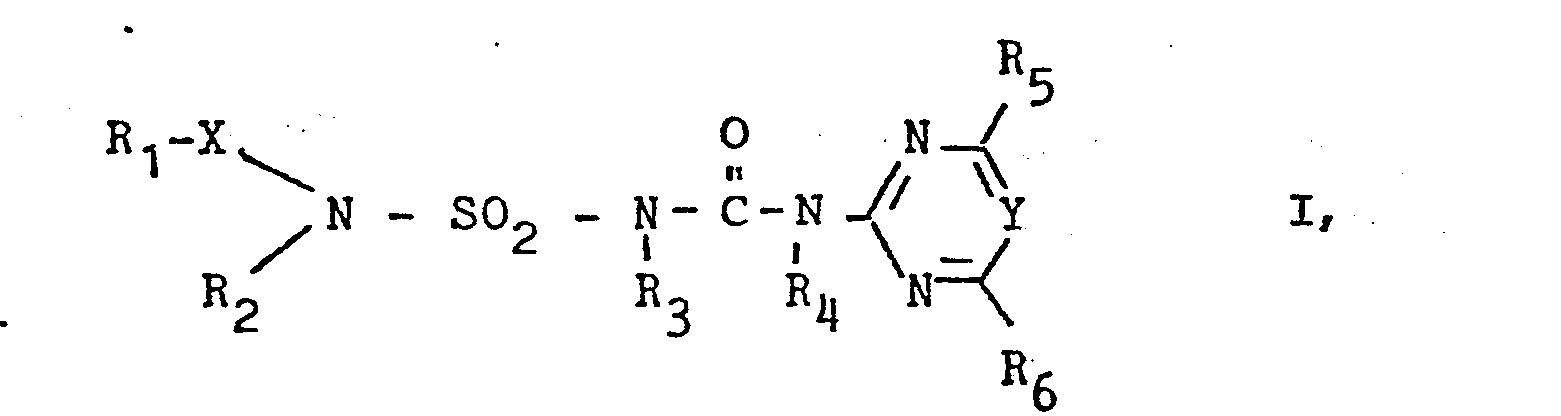
- Gegenstand der vorliegenden Erfindung sind demnach die neuen Verbindungen der allgemeinen Formel (I)
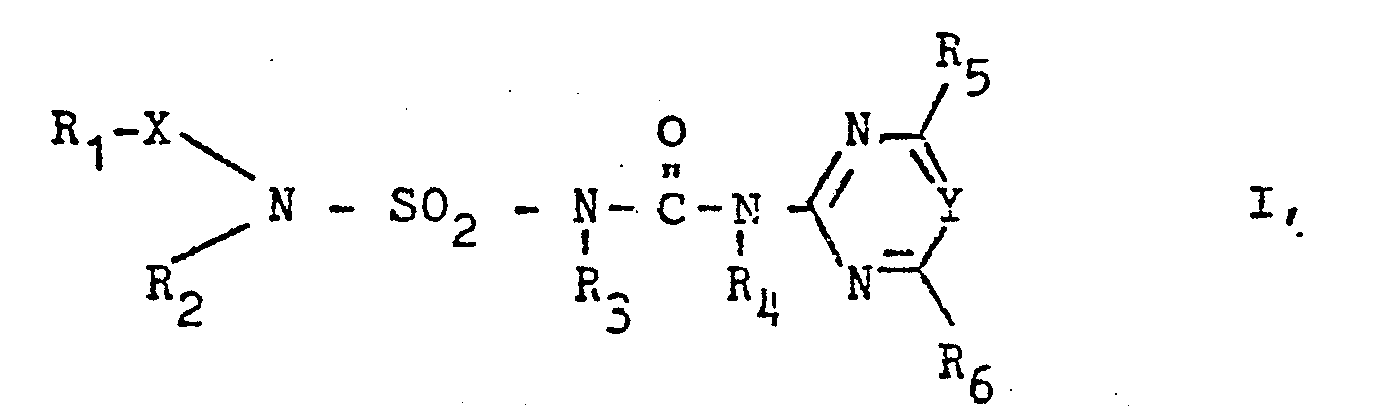
- X 0 oder -S0 2-,
- Y CH oder Stickstoff,
- R1 einen (C1-C6)-Alkyl, (C2-C6)-Alkenyl oder einen (C2-C6)-Alkinylrest bedeutet, die gegebenenfalls durch Halogen, (C1-C4)-Alkoxy oder (C1-C4)-Alkoxycarbonyl substituiert sind,
- R2 Wasserstoff, (C1-C6)-Alkyl, (C2-C6)-Alkenyl, (C2-C6)-Alkinyl oder Cyclohexyl, .
- R3, R4 unabhängig voneinander Wasserstoff oder (C1-C4)-Alkyl,
- R51 R6 unabhängig voneinander Wasserstoff, (C1-C4)-Alkyl oder (C1-C4)-Alkoxy, die gegebenenfalls ein oder mehrfach durch Halogen, (C1-C4)-Alkoxy oder (C1-C4)-Alkylthio substituiert sein können, Halogen, (C1-C4)-Alkylthio, (C1-C4)-Alkylamino oder (C1-C4)-Dialkylamino bedeuten, sowie, falls R29 R3 Wasserstoff bedeuten, deren physiologisch verträgliche Salze mit Basen. "Halogen" bedeutet bevorzugt Fluor, Chlor oder Brom.
- Unter den Verbindungen der Formel I sind diejenigen bevorzugt, in den R1, R2 unabhängig voneinander (C1-C3)-Alkyl oder (C1-C3)-Alkenyl, R3 und R4 Wasserstoff, R5, R6 unabhängig voneinander (C1-C2)-Alkyl oder (C1-C2)-Alkoxy, X= SO2 und Y= CH bedeuten.
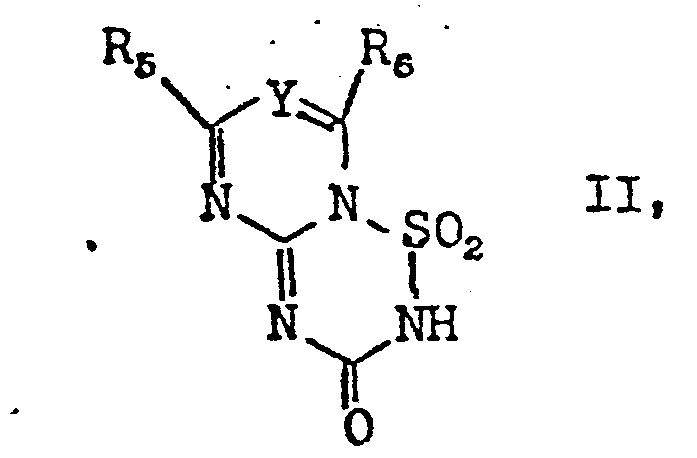
- Die Erfindung betrifft ebenfalls neue (Pyrimido) Triazinothiadiazinoxide der Formel (II), die wie unten ausgeführt, als Zwischenprodukte zur Herstellung der erfindungsgemäßen Verbindungen der Formel (I) fungieren können.

- Die neuen Verbindungen der allgemeinen Formel I lassen sich aus an sich bekannten oder aus nach bekannten Verfahren hergestellten Ausgangsmaterialien synthetisieren.
- Die Herstellungsverfahren sind dadurch gekennzeichnet, daß man
- a) Verbindungen der Formel (III), worin


- b) Verbindungen der Formel (II)

- c) im Falle X= SO2 Verbindungen der Formel (V),


- Zu a) Die Umsetzung der Verbindungen (III) und (IV) erfolgt vorzugsweise in inerten aprotischen Lösungsmitteln wie aliphatischen oder aromatischen Kohlenwasserstoffen insbesondere n-Hexan, Toluol oder Xylol, Acetonitril, Dichlormethan, Chloroform, Nitromethan, Tetrahydrofuran, oder Dioxan bei Temperaturen zwischen -78°C und der Siedetemperatur des Lösungsmittels, vorzugsweise in Gegenwart eines Säureakzeptors wie eines tertiären organischen Amins, insbesondere Pyridin oder Triethylamin oder einer anorganischen Base wie einem Alkalicarbonat. Gegebenenfalls kann im Falle X= Sauerstoff die Verbindung (III) im Überschluß eingesetzt werden, um so gleichzeitig als Hilfsbase zu fungieren.
- Zu b) Bei der Umsetzung der Verbindungen (II) und (III) verwendet man vorzugsweise die gleichen Lösungsmittel wie bei a) und arbeitet bei Temperaturen zwischen -78°C und der Siedetemperatur des Lösungsmittels. Gegebenenfalls wird die Reaktion unter Zusatz von einem oder mehreren Äquivalenten basischer Verbindungen, wie tertiären organischen Aminen, insbesondere Triethylamin, Ethyldiisopropylamin, Pyridin oder organischen Basen wie Kaliumcarbonat durchgeführt.
- Zu c) Auch die Acylierung von Aminoheterocyclen der Formel VI mit Sulfonylisocyanaten der Formel V wird vorzugsweise zu den gleichen unter a) genannten Lösungsmitteln bei Temperaturen zwischen -20°C und der Siedetemperatur des Lösungsmittels durchgeführt.
- Zur nachträglichen Alkylierung der Verbindungen der Formel 1 in R2- bzw. R3-Position arbeitet man vorzugsweise in inerten Lösungsmitteln wie z.B. Dioxan oder Dimethylformamid unter Zusatz einer anorganischen Base wie Natriumhydrid oder Kaliumcarbonat, bei Temperaturen von 0°C bis zur Siedetemperatur des Lösungsmittels. Als Alkylierungsmittel werden übliche Mittel wie Dimethylsulfat, Methyljodid oder Ethylbromid eingesetzt.
- Verbindungen der Formel I, in denen R2 oder R3 Wasserstoff bedeutet, können Salze bilden, bei denen H durch ein geeignetes Kation ersetzt ist. Diese Salze sind im allgemeinen Metall-, insbesonder Alkali- oder Erdalkalisalze, gegebenenfalls alkylierte Ammonium- oder organische Aminsalze und werden vorzugsweise in inerten Lösungsmitteln wie z.B. Wasser, Methanol oder Aceton bei Temperaturen von 20 - 100°C hergestellt. Geeignete Basen zur Herstellung der erfindungsgemäßen Salze sind z.B. Alkalicarbonate, Ammoniak oder Ethanolamin.
- Die für die Herstellung der erfindungsgemäßen Verbindungen der allgemeinen Formel (I) benötigten Ausgangsstoffe der Formel (II) sind neu und lassen sich durch Anlagerung von Chlor- oder Fluorsulfonylisocyanat an Aminoheterocyclen der obengenannten Formel (VI) in Gegenwart von Basen wie tertiären organischen Aminen, insbesondere Triethylamin oder Ethyldiisopropylamin, herstellen. Die Verbindungen der Formel II und ihr Herstellungsverfahren sind daher ebenfalls Gegenstand der Erfindung. Dieses Verfahren wird vorzugsweise in inerten organischen Lösungsmitteln wie Dichlormethan, Acetonitril, Tetrahydrofuran bei Temperaturen zwischen -78°C und +40°C durchgeführt. Für R57 R6= (C,-C4)Alkylamino oder (C1-C4)Dialkylamino ist diese Herstellungsmethode der Verbindungen der Formel II wegen geringer Ausbeuten weniger geeignet. Bei dem genannten Herstellungsverfahren fallen die Verbindungen der Formel II im Falle R5 ≠ R6 als Isomerengemische an. Es handelt sich hierbei um Gemische zweier Stellungsisomeren, wobei bei beiden Isomeren die Bedeutungen von R5 und R6 vertauscht sind, da der Ringschluß der Sulfonylgruppe des Halogensulfonylisocyanats an beiden der Aminogruppe benachbarten Stickstoffatome von Formel VI erfolgen kann. Die Auftrennung dieser Regioisomerengemische kann nach üblichen Me-- thoden wie Umkristallisation, Chromatographie usw. erfolgen.
- Die Ausgangsstoffe der Formel III sind bekannt oder lassen sich nach im Prinzip bekannten Verfahren herstellen. Die entsprechenden Hydroxylamine der Formel (III) (X= 0) werden z.B. durch alkalische Hydrolyse von Alkylalkoxycarbaminsäureestern s. Angew. 75, 851 (1963) hergestellt.
- Die aliphatischen Sulfonamide der Formel (III) (X= S02) lassen sich z.B. aus Alkylsulfochloriden durch Umsetzung mit primären aliphatischen Aminen herstellen.
- Die heterocyclischen Sulfonylharnstoffe der Formel (IV) sind bekannt oder lassen sich nach bekannten Methoden herstellen für Z= Chlor s. EP-PS 39 329, für Z= Alkoxy s. Europ. Patentanmeldung 61 611, für Z= Phenoxy s. GB-PS 2015 503.
- Die Sulfonylisocyanate der Formel (V) werden durch Umsetzung von Chlorsulfonylisocyanat mit sekundären aliphatischen Sulfonamiden hergestellt (DE-OS 2 257 240).
- Die Ausgangsstoffe der Formel IV sind bekannt oder lassen sich nach im Prinzip bekannten Verfahren herstellen, z.B. durch Zyklisierung entsprechender Guanidinderivate mit entsprechend substituierten 1,3-Diketonen, vergleiche z.B. "The Chemistry of Heterocyclic compounds", Vol. XVI (1962) und Supplement I (1970) oder durch Derivatisierung von Cyanurchlorid, vergleiche z.B. "The Chemistry of Heterocyclic Compounds", L. Rapoport: "s-Triazines and Derivatives" (1959).
- Die erfindungsgemäßen heterozyklischen Sulfonylharnstoffderivate weisen eine ausgezeichnete herbizide Wirkung und in wichtigen Großkulturen eine sehr gute Selektivität auf. Sie eignen sich daher zur selektiven Bekämpfung zweikeimblättriger und grasartiger annueller und perennierender Unkräuter, insbesondere in landwirtschaftlich bedeutenden Kulturen wie z. B. Weizen, Gerste, Roggen, Reis, Mais, Zuckerrübe und Soja. Dabei ist es gleichgültig, ob die Substanzen in Vorsaat-, Vorauflauf- oder Nachauflaufspritzung ausgebracht werden. Werden die erfindungsgemäßen Verbindungen vor dem Keimen der Unkrautpflanzen im Vorsaat- oder Vorauflaufverfahren auf die Erdoberfläche appliziert, so wird das Auflaufen der Keimlinge nicht verhindert. Die Unkräuter wachsen bis zum Keimblattstadium heran, stellen jedoch dann ihr Wachstum ein und sterben schließlich nach 3 - 5 Wochen vollkommen ab. Bei Applikation der Wirkstoffe auf die grünen Pflanzenteile im Nachauflaufverfahren tritt ebenfalls sehr rasch nach der Behandlung ein drastischer Wachstumsstop ein und die Unkrautpflanzen bleiben in dem zum Applikationszeitpunkt vorhandenen Wachstumsstadium stehen oder sterben nach einer gewissen Zeit ganz ab, so daß auf diese Weise eine für die Kulturpflanzen schädliche Unkrautkonkurrenz sehr früh und nachhaltig beseitigt wird.
- Darüberhinaus weisen die erfindungsgemäßen Substanzen hervorragende wachstumsregulatorische Eigenschaften bei Kulturpflanzen auf. Sie greifen regulierend in den pflanzencigenen Stoffwechsel ein und können damit zur gezielten Beeinflussung von Pflanzeninhaltstoffen und zur Ernteerleichterung wie z.B. durch Auslösen von Desikkation und Wuchsstauchung eingesetzt werden. Des weiteren eignen sich auch zur generellen Steuerung und Hemmung von unerwünschten vegetativen Wachstum, ohne dabei die Pflanzen abzutöten. Eine Hemmung des vegetativen Wachstums spielt bei vielen mono- und dikotylen Kulturen eine große Rolle, da das Lagern hierdurch verringert oder völlig verhindert werden kann. Besonders hervorzuheben ist die wachstumsregulatorische Wirksamkeit der Verbindungen als Wuchshenuner in Getreide, Mais, Soja, Baumwolle, Rasen sowie ihre Fähigkeiten, den Gehalt an erwünschten Inhaltsstoffen wie Kohlehydraten und Protein bei Nutzpflanzen zu erhöhen. Schließlich zeigen die Verbindungen eine sehr gute Verbesserung der Fruchtabszission insbesondere bei Zitrusfrüchten oder Reduktion der Haltekraft.
- Gegenstand der Erfindung sind daher auch herbizide und wachstumsregulierende Mittel, die gekennzeichnet sind durch einen Gehalt an einer Verbindung der Formel I in Kombination mit üblichen Formulierungshilfsmitteln und Inertstoffen sowie deren Vorwendung im landwirtschaftlichen Bereich.
- Die erfindungsgemäßen Mittel enthalten die Wirkstoffe der Formel I im allgemeinen zu 2- 95 Gew.-%. Sie können als Spritzpulver, emulgierbare Konzentrate, versprühbare Lösungen, Stäubemittel oder Granulate in den üblichen Zubereitungen angewendet werden.
- Die Spritzpulvcr sind in Wasser gleichmäßig dispergierbare Präparate, die neben dem Wirkstoff außer einem Verdünnungsmittel oder Inertstoff noch Netzmittel z.B. polyoxethylierte Alkylphenole, polyoxethylierte Fettalkohole, Alkyl- oder Alkylphenylsulfonate und Dispergiermittel, z.B. ligninsulfonsaures Natrium, 2,2'-dinaphthylmethan-6, 6' -disulfonsaures Natrium, dibutylnaphthalinsulfonsaures Natrium oder auch oleylmethyltaurinsaures Natrium enthalten.
- Emulgierbare Konzentrate werden durch Auflösen des Wirkstoffes in einem organischen Lösungsmittel, z.B. Butanol, Cyclohexanon, Dimethylformamid, Xylol oder auch höhcrsiedenden Aromaten oder Kohlenwasserstoffen unter Zusatz von einem oder mehreren Emulgatoren hergestellt. Als Emulgatoren können beispielsweise verwandt werden:
- Alkylarylsulfonsaure Kalziumsalze wie Ca-dodecylbenzosulfonat oder nichtionische Emulgatoren wie fettsäurepolyglykolster, Alkylarylpolyglykolether, Fettalkoholpolyglykolether, Propylenoxid-Ethylenoxid-Kondensationsprodukte, Fettalkohol-Propylenoxid-Ethylenoxid-Kondensationsprodukte, Alkylpolycther, Sorbitanfettsäureester, Polyoxethylensorbit- fett-säureester oder Polyoxethylen-sorbitester.
- Stäubemittel erhält man durch Vermahlen des Wirkstoffes mit fein verteilten, festen Stoffen, z.B. Talkum, natürlichen Tonen, wie Kaolin, Bentonit, pyrophillit oder Diatomeenerde.
- Granulate können entweder durch Verdusen des Wirkstoffes auf adsorptionsfähiges, granuliertes Inertmaterial hergestellt werden oder durch Aufbringen von Wirkstoffkonzntraten mittels Klebemitteln z.B. Polyvinylalkohol, polyacrylsaurem Natrium oder auch Mineralölen auf die Oberfläche von Trägerstoffen wie Sand, Kaolinite oder von granuliertem Inertmaterial. Auch können geeignete Wirkstoffe in der für die Herstellung von Düngemittelgranalien üblichen Weise - gewünschtenfalls in Mischung mit Düngemitteln - hergestellt werden.
- Bei herbiziden Mitteln können die Konzentrationen der Wirkstoffe in den handelsüblichen Formulierungen verschieden sein.
- In Spritzpulvern variiert die Wirkstoffkonzentration z.B. zwischen etwa 10 % und 80 %, der Rest besteht aus den oben angegebenen Formulierungszusätzen. Bei emulgierbaren Konzentraten kann die Wirkstoffkonzentration gleichfalls etwa 10 % bis 80 % betragen. Staubförmige Formulierungen enthalten etwa 2 - 20 %. Bei Granulaten hängt der Wirkstoffgehalt zum Teil davon ab, ob die wirksame Verbindung flüssig oder fest vorliegt und welche Granulierhilfsmittel, Füllstoffe usw. verwendet werden.
- Zur Anwendung als Herbizide werden die handelsüblichen Konzentrate gegebenenfalls in üblicher Weise verdünnt, z.B. bei Spritzpulvern und emulgierbaren Konzentraten mittels Wasser. Staubförmige und granulierte Zubereitungen sowie versprühbare Lösungen werden vor der Anwendung nicht mehr mit weiteren inerten Stoffen verdünnt. Mit den äußeren βedingungen wie Temperatur, Feuchtigkeit, u.a. variiert die erforderliche Aufwandmenge. Sie-beträgt in allgemeinen zwischen 0.01 und 10 kg/ha, vorzugsweise etwa 0. 1 bis 5.0 kg/ha Wirkstoff.
- Für einige Anwendungsgebiete kann es zweckmäßig sein, die neuen Herbizide mit einem oder mehreren Herbiziden gemeinsam anzuwenden, z.B. als Tankmischung oder in Form einer Fertigformulierung, um weitere vorteilhafte Wirkungen zu erzielen.
- Die erfindungsgemaßen Wirkstoffe können mit anderen Herbiziden, Insektiziden und Fungiziden kombiniert werden.
- Zur Anwendung als Wachstumsregulatoren eignen sich Konzentrationen zwischen 0.01 und 1.25 kg/ha. Bevorzugt verwendet man wäßrige Dispersionen von Spritzpulvern oder Verdünnungen von emulgierbaren honzentraten. Die Anwendung erfolgt im Nachauflauf. Bevorzugte Kulturen sind Mais und Tabak.
- 17,5 ml (0,2 Mol) Chlorsulfonylisocyanat (CSI) werden in 300 ml wasserfreiem CH3CN gelöst und bei -40°C unter Stickstoff in ca. 5 min. mit 24,5 g (0,2 Mol) 2-amino-4,6-methylpyrirridin versetzt. Nach Entfernen des Kältebades läßt man das Reaktionsgemisch in ca. 1,5 h auf 10°C kommen (ab-5°C nimmt der Kolbeninhalt eine tiefrote Färbung an). Nach 18 h Nachrühren bei RT wird der Niederschlag abgesaugt, mit CH3CN, anschließend mit n-Hexan gewaschen und bei 60°C im Hochvakuum getrocknet. Man erhält 21,5 g (42,2 % d.Th.) 2,3-Dihydro-6,5-dimethyl-3-oxo-pyrimido-[ 2-b7][1,2,4, 6]thiatriazin-1,1-dixoid. Fp. 240°C (Z.)
- In analoger Weise erhält man die in nachfolgender Tabelle angegebenen Verbindungen der Formel (II).

- Die Verbindungen der Beispiele 2 - 16 liegen als Isomerengemische vor.
- 14,8 g (0,105 Mol) CSI werden bei - 70°C unter Stickstoff in 150 ml Dichlormethan gelöst und protionsweise mit 13.9 g (0,1 Mol) 2-Amino-4-methoxy-6-methylpyrimidin versetzt.
- Man läßt das Reaktionsgemisch innerhalb einer Stunde auf 0°C kommen, kühlt auf - 70°C ab, fügt 9,35 g (0,1 Mol) O,N-Dimethylhydroxylamin-hydrochlorid hinzu und versetzt innerhalb einer weiteren Stunde mit 20,2 g (0,2 Mol) Triethylamin- gelöst in 100 ml Dichlormethan. Nach 2 Stunden Rühren bei - 70°C wird 18 Stunden bei Raumtemperatur nachgerührt, mit 0,5 n Natriumacetatlösung, anschließend mit gesättigter Kochsalzlösung gewaschen und die Dichlormethanphase über Natriumsulfat getrocknet. Nach Zutropfen von n-Hexan werden 19,8 g (55,3%d.Th.) an 1-[(N-Methoxy-N-methyl-amino)-sulfonyl/-3-(4-methoxy-6-methyl-2-pyrimidinyl)-harnstoff vom Schmelzpunkt 154°C erhalten.
- 5,7 g (0,025 Mol) 2,3-Dihydro-6,8-dimethyl-3-oxo- pyrimido-[I,2-b][1,2,4,6]-thiatriazin-1,1-dioxid (vergleiche Beispiel 1) werden in 100 ml Dichlormethan suspendiert und bei - 40°C mit 3,05 g (0,05 Mol) 0,N-Dimethylhydroxylamin - gelöst in 50 ml Dichlormethan - innerhalb von einer Stunde versetzt. Man rührt 18 Stunden bei Raumtemperatur nach, dampft bis zur Trockene ein, nimmt an Wasser auf und säuert mit 0,5 n HCl auf pH 4 - 5 an. Nach Extraktion mit Dichlormethan wird wie unter Beispiel 17 aufgearbeitet. Man erhält 4,9 g (67,8 d.Th.) an 1-[(N-Methoxy-N-methyl-amino)-sulfony)-3-(4,6-dimethyl-2-pyrimidinyl)-harnstoff vom Smp. 152°C.
- 13.9 g (0,1 Mol) 2-Amino-4-methoxy-6-methylpyrimidin werden in 150 ml Dichlormethan suspendiert und bei 0°C in einer Stunde mit 21,4 g (0,1 Mol) N-Methylsulfonyl-N-methyl-sulfonylisocyanat in 50 ml Dichlormethan versetzt. Nach 15 Stunden Nachrühren bei Raumtemperatur wird das Produkt mit n-Hexan ausgefällt. Man erhält 20,4 g (58 % d.Th.) an 1[(N-Methylsulfonyl-N-methyl- amino)-sulfonyl]-3-(4-methoxy-6-methyl-2-pyrimidinyl)-harnstoff vom Smp. 118 - 120°C
- Analog gemäß einem der Beispiele 17 bis 19 können die in nachfolgender Tabelle 2 aufgeführten Verbindungen der Formel I synthetisiert werden.


- Die vorliegenden erfindungsgemäßen Verbindungen weisen eine ausgezeichnete herbizide Wirksamkeit gegen ein breites Spektrum wirtschaftlich wichtiger mono- und dikotyler Schadpflanzen auf. Auch schwer bekämpfbare perennierende wurzelunkräter werden durch die Wirkstoffe Gut erfaßt. Dabei ist es geleichgültig, ob die Substanzen in Vorsaat-, Vorauflauf- oder Nachauflaufspritzung uasgebracht werden.
- werden die erfindungsem£aβen Verbindungen vor dem Keimen der Unkrautpflanzen im Vorsaat- oder Vorauflaufverfahren auf die Erdoberfläche appliziert, so wird das Auflaufen der Keimlinge nicht verhindert. Die Unkräuter wachsen bis zum Keimblattstadium heran, stellen jedoch dann ihr Wachstum ein und sterben schließlich nach 3 - 5 Wochen vollkommen ab. Bei Applikation der Wirkstoffe auf die grünen Pflanzenteile im Nachauflaufverfahren tritt ebenfalls sehr rasch nach der Behandlung ein drastischer Wachstumsstop ein und die Unkrautpflanzen bleiben in dem zum Applikationszeitpunkt vorhandenen Wachstumsstadium stehen oder sterben nach einer gewissen Zeit ganz ab, so daβ auf diese Weise eine für die Kulturpflanzen schädliche Unkrautkonkurrenz sehr früh und nachhaltig durch den Einsatz der neuen erfindungsgemäβen Mittel beseitigt werden kann.
- Öbgleich die eirfindungsgemäβen Verbindungen eine ausgezeichnete herbizide Aktivität gegenüber mono- und dikotylen Unkräutern aufweisen, werden Kulturpflanzen wirtschaftlich bedeulender Kulturen wie z.B. Weizen, Gerste, Roggen, Reis, Mais, Zuckerübe, βaumwolle und Soja nur unwesentlich oder gar nicht geschädigt. Gegenüber dem Stand der Technik besitzen die vorliegenden erfindungsgemäben Substanzen deshalb eine wesentlich verbesserte
- Selektivität bei Kulturpflanzen.
- Die vorliegenden Verbindungen eignen sich aus diesen Gründen sehr gut zur Bekämpfung von unerwüschten Pflanzenwuchs in landwirtschaftlichen Nutzpflanzungen. Die Schädigung der Unkrautflanzen bzw. die Kulturpflanzenverträglichkeit wurde in einem Schlüssel von O - 5 bonitiert. Dabei bedeutet O = ohne Wirkung (Schaden)
- 1 = 0 - 20 % Wirkung
- 2 = 20 - 40 % Wirkung
- 3 = 40 - 60 % Wirkung
- 4 = 60 % Wirkung
- 5 = 80 - 100% Wirkung
- Samen bzw. Rhizomstücke mono- und dikotyler Unkräuter wurden in Lechmerde in Plastiktöpfen (φ 9 cm) ausgelegt und mit Erde abgedeckt. Die als benetzbare Pulver bzw. als Emulsionkonzentrate formulierten erfindungsgemäβen Verbindungen wurden in Form wässriger Suspensionen oder Emulsionen auf die Erdoberfläche appliziert.. Die Wasseraufwandmenge pro Topf entsprach dabei umgerechnet 600 - 800 1/ha. Nach der Behandlung wurden die Versuchstöpfe im Gewächshaus aufgestellt und die Versuchspflanzen unter guten Wachstumsbedigungen (Temperatur: 23 ± 1°C; rel]. Luftfeuchte 60 - 80 %) kultiviert. Nach ca. 3 Wochen wurde die Pilanzenschädigung optisch bonitiert. Als Vergleich dienten dabei unbehandelte Kontrollen.
- In den Tabellen 1, 3 und 5 sind die Vorauflaufergebnisse zusammengefaβt.
- Die dargestellten Versuchsergebnisse belegen die ausgezeichnete herbizide Vorauflauwirkung der neuen, erfindungsgemäβen Verbindungen gegen Ungräser und Unkräuter.
- Samen von mono- und dikotylen Unkräutern wurden in Töpfen ausgesät und im Gewächshaus unter guten Wachstumbedingungen angezogen. 3 lochen nach der Aussaat wurden die Versuchspflanzen im Dreiblattstadium behandelt. Die als Silpritzpulver bzw. als Emulsionskonzentrate formulierten erfindungsgemäβen Präparate wurden in verschiedenen Dosierungen auf die grünen PflanKenteile gesprüht und nach ca. 3 Wochen Standzeit im Gewächshaus unter optimalen Wachstumsbedingungen (Temperatur: 23 ± 1°C; rel. Luftfeuchte 60 - 80 %) die Wirkung der Präparate optisch im vergleich zu umbehandelten Kontrollen bonitiert.
- Die erfindungsgemäβen Mittel wiesen eine gute herbizide Wirksamkeit gegen ein breites Spektrum wirtschaftlich wichtiger annueller und perennierender Unkräuter und Ungräser auf (Tabellen 3, 4).
- Abkürzungen:
- a.i. = Aktivsubstanz
- STM = Stellaria media
- AMR = Amaranthus retroflexus
- SIA = Sinapis arvensis
- LOM = Lolium multiflorum
- ECG = Echinochloa crus-galli
- AS = Avena sativa


Claims (13)






Priority Applications (1)
| Application Number | Priority Date | Filing Date | Title |
|---|---|---|---|
| AT84107833T ATE45948T1 (de) | 1983-07-09 | 1984-07-05 | Neue n-alkoxy- nalkylsulfonylaminosulfonylharnstoffe, und neue (pyrimido) triazino-thiatriazinoxide als vorprodukte. |
Applications Claiming Priority (2)
| Application Number | Priority Date | Filing Date | Title |
|---|---|---|---|
| DE19833324802 DE3324802A1 (de) | 1983-07-09 | 1983-07-09 | Neue n-alkoxy- und n- alkylsulfonylaminosulfonylharnstoffe, und neue (pyrimido) triazino-thiadiazinoxide als vorprodukte |
| DE3324802 | 1983-07-09 |
Publications (3)
| Publication Number | Publication Date |
|---|---|
| EP0131258A2 true EP0131258A2 (de) | 1985-01-16 |
| EP0131258A3 EP0131258A3 (en) | 1986-08-27 |
| EP0131258B1 EP0131258B1 (de) | 1989-08-30 |
Family
ID=6203570
Family Applications (1)
| Application Number | Title | Priority Date | Filing Date |
|---|---|---|---|
| EP84107833A Expired EP0131258B1 (de) | 1983-07-09 | 1984-07-05 | Neue N-Alkoxy- N-Alkylsulfonylaminosulfonylharnstoffe, und neue (Pyrimido) Triazino-thiatriazinoxide als Vorprodukte |
Country Status (20)
| Country | Link |
|---|---|
| US (2) | US4601747A (de) |
| EP (1) | EP0131258B1 (de) |
| JP (1) | JPH072724B2 (de) |
| AR (1) | AR244769A1 (de) |
| AT (1) | ATE45948T1 (de) |
| AU (1) | AU564963B2 (de) |
| BR (1) | BR8403383A (de) |
| CA (1) | CA1225640A (de) |
| CS (1) | CS416591A3 (de) |
| DD (1) | DD229015A5 (de) |
| DE (2) | DE3324802A1 (de) |
| DK (1) | DK166148C (de) |
| ES (1) | ES8503675A1 (de) |
| HU (1) | HU195613B (de) |
| IL (1) | IL72342A (de) |
| NL (1) | NL981003I2 (de) |
| NZ (1) | NZ208803A (de) |
| PH (1) | PH21737A (de) |
| SU (1) | SU1466634A3 (de) |
| ZA (1) | ZA845217B (de) |
Cited By (46)
| Publication number | Priority date | Publication date | Assignee | Title |
|---|---|---|---|---|
| EP0319689A3 (en) * | 1987-10-31 | 1990-03-14 | Hoechst Aktiengesellschaft | N-sultam-sulfon amides substituted by a heterocyclic ring, process for their preparation and their use as herbicides and as plant growth regulators |
| EP0347788A3 (en) * | 1988-06-18 | 1990-09-26 | Hoechst Aktiengesellschaft | Substituted sulfonyl diamides, processes for their preparation and their use as herbicides and as plant growth regulators |
| EP0342456A3 (de) * | 1988-05-10 | 1990-10-10 | Nissan Chemical Industries Ltd. | Sultamsulfonamid-Derivate und Herbizide |
| EP0401678A1 (de) * | 1989-06-05 | 1990-12-12 | Hoechst Aktiengesellschaft | Herbizide Mittel |
| EP0409114A1 (de) * | 1989-07-19 | 1991-01-23 | Hoechst Schering AgrEvo GmbH | Heterocyclisch substituierte Sulfonylharnstoffe, Verfahren zu ihrer Herstellung und ihre Verwendung als Herbizide oder Pflanzenwachstumsregulatoren |
| WO1991006546A1 (en) * | 1989-10-27 | 1991-05-16 | Nissan Chemical Industries Ltd. | Sulfamidosulfonylurea derivatives and herbicides |
| EP0353641A3 (de) * | 1988-08-05 | 1991-10-30 | Hoechst Schering AgrEvo GmbH | Heterozyklisch substituierte Sulfonylharnstoffe, Verfahren zu ihrer Herstellung und ihre Verwendung als Herbizide oder Pflanzenwachstumsregulatoren |
| EP0401677A3 (de) * | 1989-06-05 | 1991-10-30 | Hoechst Aktiengesellschaft | Herbizide Mittel |
| EP0467252A3 (en) * | 1990-07-19 | 1992-05-27 | Hoechst Aktiengesellschaft | Process for the preparation of n-alkylsulfonylaminosulfonyl ureas |
| EP0467251A3 (en) * | 1990-07-19 | 1992-06-03 | Hoechst Aktiengesellschaft | Process for the preparation of n-alkylsulfonylaminosulfonyl ureas |
| EP0464838A3 (en) * | 1990-07-06 | 1992-08-19 | Hoechst Aktiengesellschaft | Substituted sulfonylalkylsulfonylureas, process for their preparation and their use as herbicides and plant growth regulators |
| EP0501369A1 (de) * | 1991-02-25 | 1992-09-02 | Hoechst Schering AgrEvo GmbH | Verfahren zur Herstellung von Sulfonylisocyanaten |
| EP0504817A1 (de) * | 1991-03-21 | 1992-09-23 | Lonza Ag | Verfahren zur Herstellung von 1-(N-Metylsulfonyl-N-methylaminosulfonyl)-3-(2-pyrimidyl)-harnstoffderivaten |
| EP0514768A1 (de) * | 1991-05-18 | 1992-11-25 | Hoechst Schering AgrEvo GmbH | Wässrige Dispersionen von Sulfonylharnstoffderivaten |
| EP0507093A3 (en) * | 1991-03-07 | 1993-01-13 | Hoechst Ag | Process for the preparation of sulfonylureas |
| US5189217A (en) * | 1991-03-21 | 1993-02-23 | Lonza, Ltd. | Process for the production of 1-(N-Methanesulfonyl-N-methylaminosulfonyl)-3-(2-pyrimidyl)urea derivatives |
| US5231071A (en) * | 1987-07-10 | 1993-07-27 | Hoechst Aktiengesellschaft | Herbicidial agents |
| EP0560178A3 (de) * | 1992-03-07 | 1994-01-26 | Hoechst Ag | |
| WO1996024591A1 (de) * | 1995-02-09 | 1996-08-15 | Bayer Aktiengesellschaft | Cycloalkylsulfonyl-aminosulfonyl-harnstoffderivate, deren herstellung und deren verwendung als herbizide |
| US5650375A (en) * | 1991-07-12 | 1997-07-22 | Hoechst Aktiengesellschaft | Synergistic herbicidal compositions |
| EP0507277B1 (de) * | 1991-04-02 | 1998-07-08 | Hoechst Schering AgrEvo GmbH | Verfahren zur Herstellung von Sulfonylharnstoffen |
| US6750177B2 (en) | 2002-03-05 | 2004-06-15 | Bayer Cropscience Gmbh | Herbicide combination with acylated aminophenylsulfonylureas |
| WO2005011381A1 (de) * | 2003-07-28 | 2005-02-10 | Bayer Cropscience Gmbh | Herbizid-kombinationen mit speziellen sulfonamiden |
| EP1844654A1 (de) | 2006-03-29 | 2007-10-17 | Bayer CropScience GmbH | Penetrationsförderer für agrochemische Wirkstoffe |
| WO2008058622A2 (de) | 2006-11-13 | 2008-05-22 | Bayer Cropscience Ag | Herbizid-kombinationen enthaltend amidosulfuron und ein pyridinherbizid |
| DE102007013362A1 (de) | 2007-03-16 | 2008-09-18 | Bayer Cropscience Ag | Penetrationsförderer für herbizide Wirkstoffe |
| EP2052606A1 (de) | 2007-10-24 | 2009-04-29 | Bayer CropScience AG | Herbizid-Kombination |
| DE102008037620A1 (de) | 2008-08-14 | 2010-02-18 | Bayer Crop Science Ag | Herbizid-Kombination mit Dimethoxytriazinyl-substituierten Difluormethansulfonylaniliden |
| WO2011076731A1 (de) | 2009-12-23 | 2011-06-30 | Bayer Cropscience Ag | Flüssige formulierung von 2-iodo-n-[(4-methoxy-6-methyl-1,3,5-triazin-2-yl)carbamoyl] benzolsulfonamid |
| US8138321B2 (en) | 2006-09-22 | 2012-03-20 | Danisco Us Inc. | Acetolactate synthase (ALS) selectable marker from Trichoderma reesei |
| WO2012049266A1 (en) | 2010-10-15 | 2012-04-19 | Bayer Cropscience Ag | Use of als inhibitor herbicides for control of unwanted vegetation in als inhibitor herbicide tolerant beta vulgaris plants |
| WO2012110517A1 (en) | 2011-02-15 | 2012-08-23 | Bayer Cropscience Ag | Synergistic combinations containing a dithiino-tetracarboxamide fungicide and a herbicide, safener or plant growth regulator |
| DE102011080020A1 (de) | 2011-07-28 | 2012-09-13 | Bayer Cropscience Ag | Verwendung von Saatgutbehandlungs-Wirkstoffen aus der Gruppe der Dicarboximid-Fungizide als Safener |
| DE102011079991A1 (de) | 2011-07-28 | 2012-09-13 | Bayer Crop Science Ag | Verwendung von Saatgutbehandlungs-Wirkstoffen aus der Gruppe der Nicotinoid-Insektizide als Safener |
| DE102011080007A1 (de) | 2011-07-28 | 2012-09-13 | Bayer Cropscience Ag | Verwendung von Saatgutbehandlungs-Wirkstoffen aus den Gruppen der Conazole- und Triazol-Fungizide als Safener |
| DE102011080004A1 (de) | 2011-07-28 | 2012-09-13 | Bayer Cropscience Ag | Verwendung von Saatgutbehandlungs-Wirkstoffen aus der Gruppe der Carbamat-Fungizide als Safener |
| DE102011079997A1 (de) | 2011-07-28 | 2012-09-13 | Bayer Corpscience Ag | Verwendung von Saatgutbehandlungs-Wirkstoffen aus der Gruppe der Pyrazol-Insektizide als Safener |
| DE102011080010A1 (de) | 2011-07-28 | 2012-10-25 | Bayer Cropscience Ag | Verwendung von Saatgutbehandlungs-Wirkstoffen aus den Gruppen der Anilid- und Thiazol-Fungizide als Safener |
| DE102011080001A1 (de) | 2011-07-28 | 2012-10-25 | Bayer Cropscience Ag | Verwendung von Saatgutbehandlungs-Wirkstoffen aus der Gruppe der Carbamat-Insektizide als Safener |
| DE102011080016A1 (de) | 2011-07-28 | 2012-10-25 | Bayer Cropscience Ag | Verwendung von Saatgutbehandlungs-Wirkstoffen aus der Gruppe der Strobilurin-Fungizide als Safener |
| WO2012150333A1 (en) | 2011-05-04 | 2012-11-08 | Bayer Intellectual Property Gmbh | Use of als inhibitor herbicides for control of unwanted vegetation in als inhibitor herbicide tolerant brassica, such as b. napus, plants |
| WO2014060502A1 (en) | 2012-10-19 | 2014-04-24 | Bayer Cropscience Ag | Active compound combinations comprising carboxamide derivatives |
| WO2014090760A1 (en) | 2012-12-13 | 2014-06-19 | Bayer Cropscience Ag | Use of als inhibitor herbicides for control of unwanted vegetation in als inhibitor herbicide tolerant beta vulgaris plants |
| EP3222143A1 (de) | 2016-03-24 | 2017-09-27 | Bayer CropScience Aktiengesellschaft | Verwendung bestimmter herbizidkombinationen auf basis von iodosulfuron in teff-pflanzen |
| WO2022117515A1 (en) | 2020-12-01 | 2022-06-09 | Bayer Aktiengesellschaft | Compositions comprising iodosulfuron-methyl and tehp |
| WO2022117516A1 (en) | 2020-12-01 | 2022-06-09 | Bayer Aktiengesellschaft | Compositions comprising mesosulfuron-methyl and tehp |
Families Citing this family (12)
| Publication number | Priority date | Publication date | Assignee | Title |
|---|---|---|---|---|
| DE3324802A1 (de) * | 1983-07-09 | 1985-01-17 | Hoechst Ag, 6230 Frankfurt | Neue n-alkoxy- und n- alkylsulfonylaminosulfonylharnstoffe, und neue (pyrimido) triazino-thiadiazinoxide als vorprodukte |
| KR100224152B1 (ko) * | 1991-06-28 | 1999-10-15 | 도쿠시마 히데이치 | 이미노술포닐우레아 유도체 및 제초제 |
| JPH05339112A (ja) * | 1992-06-08 | 1993-12-21 | Idemitsu Kosan Co Ltd | 除草剤組成物 |
| JP3355237B2 (ja) * | 1993-10-15 | 2002-12-09 | 呉羽化学工業株式会社 | N−(置換アミノ)ピロール誘導体、その製造方法及び除草剤 |
| JPH0827147A (ja) * | 1994-07-20 | 1996-01-30 | Kureha Chem Ind Co Ltd | N−(置換アミノ)イミド誘導体、その製造方法及び除草剤 |
| DE19825998C2 (de) | 1998-06-10 | 2003-01-30 | Siemens Audiologische Technik | Am Kopf tragbares Hörgerät |
| DE19903064A1 (de) * | 1999-01-27 | 2000-10-05 | Aventis Cropscience Gmbh | Formulierung von Herbiziden und Pflanzenwachstumsregulatoren |
| DE10135642A1 (de) * | 2001-07-21 | 2003-02-27 | Bayer Cropscience Gmbh | Herbizid-Kombinationen mit speziellen Sulfonylharnstoffen |
| DE10209478A1 (de) * | 2002-03-05 | 2003-09-18 | Bayer Cropscience Gmbh | Herbizid-Kombinationen mit speziellen Sulfonylharnstoffen |
| CN102326574B (zh) * | 2011-07-11 | 2014-08-13 | 陕西美邦农药有限公司 | 一种含双氟磺草胺与磺酰脲类的除草组合物 |
| CN103392725B (zh) * | 2012-01-16 | 2015-07-15 | 河北博嘉农业有限公司 | 氟唑磺隆复配除草剂 |
| CN103288749A (zh) * | 2013-03-04 | 2013-09-11 | 盐城工学院 | 可作除草剂的氨基磺酰脲类化合物 |
Family Cites Families (14)
| Publication number | Priority date | Publication date | Assignee | Title |
|---|---|---|---|---|
| NL121788C (de) * | ||||
| NL7200577A (de) * | 1971-01-20 | 1972-07-24 | ||
| DE2257240A1 (de) * | 1972-11-22 | 1974-05-30 | Hoechst Ag | Neue isocyanate und verfahren zu ihrer herstellung |
| OA05625A (fr) * | 1976-04-07 | 1981-04-30 | Du Pont | N-(hétérocyclique aminocarbonyl) aryl sulfonamides herbicides, compositions les contenant et procédés les utilisant . |
| US4191553A (en) * | 1978-03-02 | 1980-03-04 | E. I. Du Pont De Nemours And Company | Herbicidal sulfamates |
| US4401816A (en) * | 1980-04-29 | 1983-08-30 | E. I. Du Pont De Nemours And Company | Sulfamoyl chlorides |
| DE3111451A1 (de) * | 1981-03-24 | 1982-10-07 | Hoechst Ag, 6000 Frankfurt | "heterocyclisch substituierte (halogen)alkyl- und alkoxysulfonylharnstoffe, verfahren zu ihrer herstellung und ihre verwendung in der landwirtschaft" |
| US4545811A (en) * | 1981-08-06 | 1985-10-08 | Ciba-Geigy Corporation | N-Phenylsulfonyl-N'-triazinyl-ureas |
| DE3131489A1 (de) * | 1981-08-08 | 1983-02-24 | Hoechst Ag, 6000 Frankfurt | Heterocyclisch substituierte sulfonylharnstoffe, verfahren zu ihrer herstellung und ihre verwendung in der landwirtschaft |
| DE3243533A1 (de) * | 1981-12-03 | 1983-06-09 | Sandoz-Patent-GmbH, 7850 Lörrach | Sulfonamide als herbizide |
| CH649081A5 (de) * | 1982-01-12 | 1985-04-30 | Ciba Geigy Ag | Triaza-verbindungen. |
| US4534790A (en) * | 1982-10-07 | 1985-08-13 | E. I. Du Pont De Nemours And Company | Herbicidal sulfonamides |
| DE3324802A1 (de) * | 1983-07-09 | 1985-01-17 | Hoechst Ag, 6230 Frankfurt | Neue n-alkoxy- und n- alkylsulfonylaminosulfonylharnstoffe, und neue (pyrimido) triazino-thiadiazinoxide als vorprodukte |
| US4592776A (en) * | 1985-02-04 | 1986-06-03 | Ppg Industries, Inc. | Sulfamoyl urea derivatives |
-
1983
- 1983-07-09 DE DE19833324802 patent/DE3324802A1/de not_active Withdrawn
-
1984
- 1984-06-29 AR AR84297131A patent/AR244769A1/es active
- 1984-07-03 HU HU842579A patent/HU195613B/hu unknown
- 1984-07-05 US US06/627,763 patent/US4601747A/en not_active Expired - Lifetime
- 1984-07-05 DE DE8484107833T patent/DE3479581D1/de not_active Expired
- 1984-07-05 EP EP84107833A patent/EP0131258B1/de not_active Expired
- 1984-07-05 AT AT84107833T patent/ATE45948T1/de active
- 1984-07-06 NZ NZ208803A patent/NZ208803A/en unknown
- 1984-07-06 BR BR8403383A patent/BR8403383A/pt not_active IP Right Cessation
- 1984-07-06 DD DD84265011A patent/DD229015A5/de not_active IP Right Cessation
- 1984-07-06 DK DK335284A patent/DK166148C/da not_active IP Right Cessation
- 1984-07-06 ZA ZA845217A patent/ZA845217B/xx unknown
- 1984-07-06 ES ES534114A patent/ES8503675A1/es not_active Expired
- 1984-07-06 CA CA000458287A patent/CA1225640A/en not_active Expired
- 1984-07-06 SU SU843757901A patent/SU1466634A3/ru active
- 1984-07-07 JP JP59139789A patent/JPH072724B2/ja not_active Expired - Lifetime
- 1984-07-09 IL IL72342A patent/IL72342A/xx not_active IP Right Cessation
- 1984-07-09 AU AU30432/84A patent/AU564963B2/en not_active Expired
- 1984-07-09 PH PH30946A patent/PH21737A/en unknown
-
1986
- 1986-04-09 US US06/849,737 patent/US4718937A/en not_active Expired - Lifetime
-
1991
- 1991-12-30 CS CS914165A patent/CS416591A3/cs unknown
-
1998
- 1998-06-19 NL NL981003C patent/NL981003I2/nl unknown
Cited By (72)
| Publication number | Priority date | Publication date | Assignee | Title |
|---|---|---|---|---|
| US5231071A (en) * | 1987-07-10 | 1993-07-27 | Hoechst Aktiengesellschaft | Herbicidial agents |
| US5382564A (en) * | 1987-07-10 | 1995-01-17 | Hoechst Aktiengesellschaft | Herbicidal agents |
| US5342822A (en) * | 1987-07-10 | 1994-08-30 | Hoechst Aktiengesellschaft | Herbicidal agents |
| US5073185A (en) * | 1987-10-31 | 1991-12-17 | Hoechst Aktiengesellschaft | Heterocyclically substituted n-sultamsulfonamides |
| US4925480A (en) * | 1987-10-31 | 1990-05-15 | Hoechst Aktiengesellschaft | Heterocyclically substituted N-sultamsulfonamides, and their use as herbicides and plant growth regulators |
| EP0319689A3 (en) * | 1987-10-31 | 1990-03-14 | Hoechst Aktiengesellschaft | N-sultam-sulfon amides substituted by a heterocyclic ring, process for their preparation and their use as herbicides and as plant growth regulators |
| US5103004A (en) * | 1987-10-31 | 1992-04-07 | Hoesch Aktiengellschaft | N-sultamsulfonamides |
| EP0342456A3 (de) * | 1988-05-10 | 1990-10-10 | Nissan Chemical Industries Ltd. | Sultamsulfonamid-Derivate und Herbizide |
| EP0347788A3 (en) * | 1988-06-18 | 1990-09-26 | Hoechst Aktiengesellschaft | Substituted sulfonyl diamides, processes for their preparation and their use as herbicides and as plant growth regulators |
| US5022916A (en) * | 1988-06-18 | 1991-06-11 | Hoechst Aktiengesellschaft | Substituted sulfonyldiamides, processes for their preparation, and their use as herbicides and plant growth regulators |
| EP0353641A3 (de) * | 1988-08-05 | 1991-10-30 | Hoechst Schering AgrEvo GmbH | Heterozyklisch substituierte Sulfonylharnstoffe, Verfahren zu ihrer Herstellung und ihre Verwendung als Herbizide oder Pflanzenwachstumsregulatoren |
| EP0401678A1 (de) * | 1989-06-05 | 1990-12-12 | Hoechst Aktiengesellschaft | Herbizide Mittel |
| TR24743A (tr) * | 1989-06-05 | 1992-03-01 | Hoechst Ag | Herbisidal maddeler |
| TR24436A (tr) * | 1989-06-05 | 1991-11-01 | Hoechst Ag | Herbisidal maddeler |
| EP0401677A3 (de) * | 1989-06-05 | 1991-10-30 | Hoechst Aktiengesellschaft | Herbizide Mittel |
| US5382563A (en) * | 1989-06-05 | 1995-01-17 | Hoechst Aktiengesellschaft | Herbicidal agents |
| US5129941A (en) * | 1989-07-19 | 1992-07-14 | Hoechst Aktiengesellschaft | Heterocyclically substituted sulfonylureas, and their use as herbicides or plant growth regulators |
| EP0409114A1 (de) * | 1989-07-19 | 1991-01-23 | Hoechst Schering AgrEvo GmbH | Heterocyclisch substituierte Sulfonylharnstoffe, Verfahren zu ihrer Herstellung und ihre Verwendung als Herbizide oder Pflanzenwachstumsregulatoren |
| WO1991006546A1 (en) * | 1989-10-27 | 1991-05-16 | Nissan Chemical Industries Ltd. | Sulfamidosulfonylurea derivatives and herbicides |
| US5223017A (en) * | 1990-07-06 | 1993-06-29 | Hoechst Aktiengesellschaft | Substituted sulfonylalkylsulfonylureas and their use as herbicides and plant growth regulators |
| EP0464838A3 (en) * | 1990-07-06 | 1992-08-19 | Hoechst Aktiengesellschaft | Substituted sulfonylalkylsulfonylureas, process for their preparation and their use as herbicides and plant growth regulators |
| US5157121A (en) * | 1990-07-19 | 1992-10-20 | Hoechst Aktiengesellschaft | Process for the preparation of n-alkylsulfonylaminosulfonylureas |
| EP0467252A3 (en) * | 1990-07-19 | 1992-05-27 | Hoechst Aktiengesellschaft | Process for the preparation of n-alkylsulfonylaminosulfonyl ureas |
| EP0467251A3 (en) * | 1990-07-19 | 1992-06-03 | Hoechst Aktiengesellschaft | Process for the preparation of n-alkylsulfonylaminosulfonyl ureas |
| EP0501369A1 (de) * | 1991-02-25 | 1992-09-02 | Hoechst Schering AgrEvo GmbH | Verfahren zur Herstellung von Sulfonylisocyanaten |
| US5569761A (en) * | 1991-03-07 | 1996-10-29 | Hoechst Aktiengesellschaft | Process for the preparation of sulfonylureas |
| EP0507093A3 (en) * | 1991-03-07 | 1993-01-13 | Hoechst Ag | Process for the preparation of sulfonylureas |
| US5414084A (en) * | 1991-03-07 | 1995-05-09 | Hoechst Aktiengesellschaft | Process for the preparation of sulfonylureas |
| US5189217A (en) * | 1991-03-21 | 1993-02-23 | Lonza, Ltd. | Process for the production of 1-(N-Methanesulfonyl-N-methylaminosulfonyl)-3-(2-pyrimidyl)urea derivatives |
| US5180826A (en) * | 1991-03-21 | 1993-01-19 | Lonza Ltd. | Process for the production of 1-(n-methanesulfonyl-n-methylaminosulfonyl)-3-(2-pyrimidyl) urea derivatives |
| EP0504817A1 (de) * | 1991-03-21 | 1992-09-23 | Lonza Ag | Verfahren zur Herstellung von 1-(N-Metylsulfonyl-N-methylaminosulfonyl)-3-(2-pyrimidyl)-harnstoffderivaten |
| EP0507277B1 (de) * | 1991-04-02 | 1998-07-08 | Hoechst Schering AgrEvo GmbH | Verfahren zur Herstellung von Sulfonylharnstoffen |
| US5707926A (en) * | 1991-05-18 | 1998-01-13 | Hoechst Aktiengesellschaft | Aqueous dispersions of sulfonylurea derivatives |
| US5573998A (en) * | 1991-05-18 | 1996-11-12 | Hoechst Aktiengesellschaft | Aqueous dispersions of sulfonediamide Herbicides such as amidosulfuron |
| EP0514768A1 (de) * | 1991-05-18 | 1992-11-25 | Hoechst Schering AgrEvo GmbH | Wässrige Dispersionen von Sulfonylharnstoffderivaten |
| US5650375A (en) * | 1991-07-12 | 1997-07-22 | Hoechst Aktiengesellschaft | Synergistic herbicidal compositions |
| US5872077A (en) * | 1991-07-12 | 1999-02-16 | Hoechst Aktiengesellschaft | Synergistic herbicidal compostitions |
| EP0560178A3 (de) * | 1992-03-07 | 1994-01-26 | Hoechst Ag | |
| US5912379A (en) * | 1992-03-07 | 1999-06-15 | Hoechst Aktiengesellschaft | Processes for preparing sulfonylureas |
| WO1996024591A1 (de) * | 1995-02-09 | 1996-08-15 | Bayer Aktiengesellschaft | Cycloalkylsulfonyl-aminosulfonyl-harnstoffderivate, deren herstellung und deren verwendung als herbizide |
| US6750177B2 (en) | 2002-03-05 | 2004-06-15 | Bayer Cropscience Gmbh | Herbicide combination with acylated aminophenylsulfonylureas |
| WO2005011381A1 (de) * | 2003-07-28 | 2005-02-10 | Bayer Cropscience Gmbh | Herbizid-kombinationen mit speziellen sulfonamiden |
| EA009765B1 (ru) * | 2003-07-28 | 2008-04-28 | Байер Кропсайенс Гмбх | Тройные гербицидные комбинации, включающие сульфонамиды |
| EP1844654A1 (de) | 2006-03-29 | 2007-10-17 | Bayer CropScience GmbH | Penetrationsförderer für agrochemische Wirkstoffe |
| US8138321B2 (en) | 2006-09-22 | 2012-03-20 | Danisco Us Inc. | Acetolactate synthase (ALS) selectable marker from Trichoderma reesei |
| WO2008058622A2 (de) | 2006-11-13 | 2008-05-22 | Bayer Cropscience Ag | Herbizid-kombinationen enthaltend amidosulfuron und ein pyridinherbizid |
| EP1925203A1 (de) * | 2006-11-13 | 2008-05-28 | Bayer CropScience AG | Herbizid-Kombinationen enthaltend Amidosulfuron und ein Pyridinherbizid |
| WO2008058622A3 (de) * | 2006-11-13 | 2008-10-23 | Bayer Cropscience Ag | Herbizid-kombinationen enthaltend amidosulfuron und ein pyridinherbizid |
| EA014882B1 (ru) * | 2006-11-13 | 2011-02-28 | Байер Кропсайенс Аг | Комбинации гербицидов со специальными сульфонилмочевинами |
| DE102007013362A1 (de) | 2007-03-16 | 2008-09-18 | Bayer Cropscience Ag | Penetrationsförderer für herbizide Wirkstoffe |
| EP2052606A1 (de) | 2007-10-24 | 2009-04-29 | Bayer CropScience AG | Herbizid-Kombination |
| DE102008037620A1 (de) | 2008-08-14 | 2010-02-18 | Bayer Crop Science Ag | Herbizid-Kombination mit Dimethoxytriazinyl-substituierten Difluormethansulfonylaniliden |
| WO2011076731A1 (de) | 2009-12-23 | 2011-06-30 | Bayer Cropscience Ag | Flüssige formulierung von 2-iodo-n-[(4-methoxy-6-methyl-1,3,5-triazin-2-yl)carbamoyl] benzolsulfonamid |
| WO2012049266A1 (en) | 2010-10-15 | 2012-04-19 | Bayer Cropscience Ag | Use of als inhibitor herbicides for control of unwanted vegetation in als inhibitor herbicide tolerant beta vulgaris plants |
| EP3284346A1 (de) | 2010-10-15 | 2018-02-21 | Bayer Intellectual Property GmbH | Verwendung von als-hemmenden herbiziden gegen unkräutern in als-herbizid toleranten beta vulgaris pflanzen |
| WO2012110517A1 (en) | 2011-02-15 | 2012-08-23 | Bayer Cropscience Ag | Synergistic combinations containing a dithiino-tetracarboxamide fungicide and a herbicide, safener or plant growth regulator |
| US9370183B2 (en) | 2011-05-04 | 2016-06-21 | Bayer Intellectual Property Gmbh | Use of ALS inhibitor herbicides for control of unwanted vegetation in ALS inhibitor herbicide tolerant Brassica, such as B. napus, plants |
| WO2012150333A1 (en) | 2011-05-04 | 2012-11-08 | Bayer Intellectual Property Gmbh | Use of als inhibitor herbicides for control of unwanted vegetation in als inhibitor herbicide tolerant brassica, such as b. napus, plants |
| DE102011080001A1 (de) | 2011-07-28 | 2012-10-25 | Bayer Cropscience Ag | Verwendung von Saatgutbehandlungs-Wirkstoffen aus der Gruppe der Carbamat-Insektizide als Safener |
| DE102011080020A1 (de) | 2011-07-28 | 2012-09-13 | Bayer Cropscience Ag | Verwendung von Saatgutbehandlungs-Wirkstoffen aus der Gruppe der Dicarboximid-Fungizide als Safener |
| DE102011080010A1 (de) | 2011-07-28 | 2012-10-25 | Bayer Cropscience Ag | Verwendung von Saatgutbehandlungs-Wirkstoffen aus den Gruppen der Anilid- und Thiazol-Fungizide als Safener |
| DE102011080004A1 (de) | 2011-07-28 | 2012-09-13 | Bayer Cropscience Ag | Verwendung von Saatgutbehandlungs-Wirkstoffen aus der Gruppe der Carbamat-Fungizide als Safener |
| DE102011080016A1 (de) | 2011-07-28 | 2012-10-25 | Bayer Cropscience Ag | Verwendung von Saatgutbehandlungs-Wirkstoffen aus der Gruppe der Strobilurin-Fungizide als Safener |
| DE102011080007A1 (de) | 2011-07-28 | 2012-09-13 | Bayer Cropscience Ag | Verwendung von Saatgutbehandlungs-Wirkstoffen aus den Gruppen der Conazole- und Triazol-Fungizide als Safener |
| DE102011079997A1 (de) | 2011-07-28 | 2012-09-13 | Bayer Corpscience Ag | Verwendung von Saatgutbehandlungs-Wirkstoffen aus der Gruppe der Pyrazol-Insektizide als Safener |
| DE102011079991A1 (de) | 2011-07-28 | 2012-09-13 | Bayer Crop Science Ag | Verwendung von Saatgutbehandlungs-Wirkstoffen aus der Gruppe der Nicotinoid-Insektizide als Safener |
| WO2014060502A1 (en) | 2012-10-19 | 2014-04-24 | Bayer Cropscience Ag | Active compound combinations comprising carboxamide derivatives |
| WO2014090760A1 (en) | 2012-12-13 | 2014-06-19 | Bayer Cropscience Ag | Use of als inhibitor herbicides for control of unwanted vegetation in als inhibitor herbicide tolerant beta vulgaris plants |
| EP3222143A1 (de) | 2016-03-24 | 2017-09-27 | Bayer CropScience Aktiengesellschaft | Verwendung bestimmter herbizidkombinationen auf basis von iodosulfuron in teff-pflanzen |
| US10264790B2 (en) | 2016-03-24 | 2019-04-23 | Bayer Cropscience Aktiengesellschaft | Use of certain herbicide combinations based on iodosulfuron in teff plants |
| WO2022117515A1 (en) | 2020-12-01 | 2022-06-09 | Bayer Aktiengesellschaft | Compositions comprising iodosulfuron-methyl and tehp |
| WO2022117516A1 (en) | 2020-12-01 | 2022-06-09 | Bayer Aktiengesellschaft | Compositions comprising mesosulfuron-methyl and tehp |
Also Published As
| Publication number | Publication date |
|---|---|
| ZA845217B (en) | 1985-02-27 |
| ES534114A0 (es) | 1985-04-01 |
| US4601747A (en) | 1986-07-22 |
| DK166148C (da) | 1993-08-09 |
| US4718937A (en) | 1988-01-12 |
| IL72342A0 (en) | 1984-11-30 |
| SU1466634A3 (ru) | 1989-03-15 |
| DK335284D0 (da) | 1984-07-06 |
| EP0131258A3 (en) | 1986-08-27 |
| NL981003I1 (nl) | 1998-09-01 |
| CA1225640A (en) | 1987-08-18 |
| DK166148B (da) | 1993-03-15 |
| DK335284A (da) | 1985-01-10 |
| NL981003I2 (nl) | 1999-02-01 |
| CS416591A3 (en) | 1992-05-13 |
| DE3479581D1 (en) | 1989-10-05 |
| ATE45948T1 (de) | 1989-09-15 |
| EP0131258B1 (de) | 1989-08-30 |
| BR8403383A (pt) | 1985-06-18 |
| AR244769A1 (es) | 1993-11-30 |
| HU195613B (en) | 1988-06-28 |
| PH21737A (en) | 1988-02-10 |
| AU3043284A (en) | 1985-01-10 |
| DD229015A5 (de) | 1985-10-30 |
| HUT36997A (en) | 1985-11-28 |
| DE3324802A1 (de) | 1985-01-17 |
| NZ208803A (en) | 1987-10-30 |
| IL72342A (en) | 1988-05-31 |
| JPS6048973A (ja) | 1985-03-16 |
| ES8503675A1 (es) | 1985-04-01 |
| JPH072724B2 (ja) | 1995-01-18 |
| AU564963B2 (en) | 1987-09-03 |
Similar Documents
| Publication | Publication Date | Title |
|---|---|---|
| EP0131258B1 (de) | Neue N-Alkoxy- N-Alkylsulfonylaminosulfonylharnstoffe, und neue (Pyrimido) Triazino-thiatriazinoxide als Vorprodukte | |
| EP0342569B1 (de) | Heterocyclische 2-Alkoxyphenoxysulfonylharnstoffe und ihre Verwendung als Herbizide oder Pflanzenwachstumsregulatoren | |
| EP0071958B1 (de) | Heterocyclisch substituierte Sulfonylharnstoffe, Verfahren zu ihrer Herstellung und ihre Verwendung in der Landwirtschaft | |
| EP0128116B1 (de) | Anellierte N-Phenylsulfonyl-N'-pyrimidinyl- und -triazinylharnstoffe | |
| EP0061661A1 (de) | Heterocyclisch substituierte (Halogen)Alkyl- und -Alkoxysulfonylharnstoffe, Verfahren zu ihrer Herstellung und ihre Verwendung in der Landwirtschaft | |
| EP0347788B1 (de) | Substituierte Sulfonyldiamide, Verfahren zu ihrer Herstellung und ihre Verwendung als Herbizide und Pflanzenwachstumsregulatoren | |
| EP0353641B1 (de) | Heterozyklisch substituierte Sulfonylharnstoffe, Verfahren zu ihrer Herstellung und ihre Verwendung als Herbizide oder Pflanzenwachstumsregulatoren | |
| EP0165572A2 (de) | Neue herbizid wirksame Sulfonylharnstoffe | |
| EP0098569A2 (de) | Neue heterocyclisch substituierte Sulfonylharnstoffe, Verfahren zu ihrer Herstellung und ihre Verwendung in der Landwirtschaft | |
| EP0336354B1 (de) | Heterocyclisch substituierte Alkyl- und Alkenylsulfonylharnstoffe, Verfahren zu ihrer Herstellung und ihre Verwendung als Herbizide oder Pflanzenwachstumsregulatoren | |
| EP0229630A2 (de) | 1,2-Disubstituierte Piperidine, Verfahren zu ihrer Herstellung sowie ihre Verwendung im Pflanzenschutz | |
| EP0342568B1 (de) | Heterocyclisch substituierte Phenoxysulfonylharnstoffe, Verfahren zu ihrer Herstellung und ihre Verwendung als Herbizide oder Pflanzenwachstumsregulatoren | |
| EP0337946B1 (de) | Harnstoffe | |
| EP0319689B1 (de) | Heterocyclisch substituierte N-Sultam-sulfonamide, Verfahren zu ihrer Herstellung und ihre Verwendung als Herbizide und Pflanzenwachstumsregulatoren | |
| EP0134477A1 (de) | Neue heterocyclisch substituierte Sulfonylharnstoffe | |
| EP0303114B1 (de) | Heterocyclisch substituierte Sulfamidsäurephenylester, Verfahren zu ihrer Herstellung und ihre Verwendung als Herbizide und Pflanzenwachstumsregulatoren | |
| DE3105453A1 (de) | Phenyl- bzw. phenoxysulfonyl-pyrimidyl-harnstoffe, verfahren zu ihrer herstellung und ihre verwendung als herbizide und pflanzenwuchstumsregulatoren | |
| EP0388771B1 (de) | Phenoxysulfonylharnstoffe auf Basis von 3-substituierten Salicylsäurealkylestern, Verfahren zu ihrer Herstellung und ihre Verwendung als Herbizide und Pflanzenwachstumsregulatoren | |
| EP0142629A1 (de) | Neue Pyrazolyl- und Isoxazolylsulfonylharnstoffe | |
| EP0409114A1 (de) | Heterocyclisch substituierte Sulfonylharnstoffe, Verfahren zu ihrer Herstellung und ihre Verwendung als Herbizide oder Pflanzenwachstumsregulatoren | |
| DE3709340A1 (de) | Neue heterocyclisch substituierte benzylsulfonamide, verfahren zu ihrer herstellung und ihre verwendung als herbizide und pflanzenwachstumsregulatoren | |
| DE3234448A1 (de) | Neue pyrimidinylharnstoffe, verfahren zu ihrer herstellung, sie enthaltende mittel und deren verwendung als herbizide | |
| DE3725939A1 (de) | Heterocylisch substituierte sulfamidsaeurephenylester, verfahren zu ihrer herstellung und ihre verwendung als herbizide und pflanzenwachstumsregulatoren | |
| DE3806323A1 (de) | Heterocyclisch substituierte sulfamidsaeurephenylester, verfahren zu ihrer herstellung und ihre verwendung als herbizide und pflanzenwachstumsregulatoren |
Legal Events
| Date | Code | Title | Description |
|---|---|---|---|
| PUAI | Public reference made under article 153(3) epc to a published international application that has entered the european phase |
Free format text: ORIGINAL CODE: 0009012 |
|
| AK | Designated contracting states |
Designated state(s): AT BE CH DE FR GB IT LI NL SE |
|
| PUAL | Search report despatched |
Free format text: ORIGINAL CODE: 0009013 |
|
| AK | Designated contracting states |
Kind code of ref document: A3 Designated state(s): AT BE CH DE FR GB IT LI NL SE |
|
| 17P | Request for examination filed |
Effective date: 19861030 |
|
| 17Q | First examination report despatched |
Effective date: 19880415 |
|
| GRAA | (expected) grant |
Free format text: ORIGINAL CODE: 0009210 |
|
| AK | Designated contracting states |
Kind code of ref document: B1 Designated state(s): AT BE CH DE FR GB IT LI NL SE |
|
| REF | Corresponds to: |
Ref document number: 45948 Country of ref document: AT Date of ref document: 19890915 Kind code of ref document: T |
|
| ITF | It: translation for a ep patent filed | ||
| REF | Corresponds to: |
Ref document number: 3479581 Country of ref document: DE Date of ref document: 19891005 |
|
| ET | Fr: translation filed | ||
| GBT | Gb: translation of ep patent filed (gb section 77(6)(a)/1977) | ||
| PLBE | No opposition filed within time limit |
Free format text: ORIGINAL CODE: 0009261 |
|
| STAA | Information on the status of an ep patent application or granted ep patent |
Free format text: STATUS: NO OPPOSITION FILED WITHIN TIME LIMIT |
|
| 26N | No opposition filed | ||
| ITTA | It: last paid annual fee | ||
| EAL | Se: european patent in force in sweden |
Ref document number: 84107833.0 |
|
| REG | Reference to a national code |
Ref country code: CH Ref legal event code: PUE Owner name: HOECHST AKTIENGESELLSCHAFT TRANSFER- HOECHST SCHER Ref country code: CH Ref legal event code: NV Representative=s name: SCHAAD, BALASS & PARTNER AG |
|
| FIT | It: supplementary protection certificate for herbicidal products: no action taken |
Free format text: CCPF 17, 19970716; HOECHST SCHERING AGREVO GMBH |
|
| REG | Reference to a national code |
Ref country code: FR Ref legal event code: CP Free format text: PRODUCT NAME: AMIDOSULFURON; NAT. REGISTRATION NO/DATE: 8900501 19900531; FIRST REGISTRATION: FR - 8900501 19900531 Spc suppl protection certif: 97C0086 Filing date: 19970807 |
|
| REG | Reference to a national code |
Ref country code: GB Ref legal event code: CTFF Free format text: GBCTFFSPC/GB97/043, 19970728 |
|
| REG | Reference to a national code |
Ref country code: AT Ref legal event code: EEIH Ref document number: 84107833 Country of ref document: AT Kind code of ref document: T |
|
| REG | Reference to a national code |
Ref country code: FR Ref legal event code: TP |
|
| FITD | It: supplementary protection certificate for herbicidal products: granted |
Free format text: CCPF 17, 19970716; HOECHST SCHERING AGREVO GMBH |
|
| REG | Reference to a national code |
Ref country code: GB Ref legal event code: CTFG Free format text: GBCTFGSPC/GB97/043, 980402, EXPIRES:20050530 |
|
| REG | Reference to a national code |
Ref country code: AT Ref legal event code: ESZA Ref document number: 84107833 Country of ref document: AT Kind code of ref document: T Free format text: PRODUCT NAME: AMIDOSULFURON Spc suppl protection certif: SZ 27/1997 Filing date: 19970715 |
|
| NLS | Nl: assignments of ep-patents |
Owner name: HOECHST SCHERING AGREVO G.M.B.H. |
|
| REG | Reference to a national code |
Ref country code: NL Ref legal event code: AC1 Free format text: NLAC1 981003, 980619 |
|
| REG | Reference to a national code |
Ref country code: NL Ref legal event code: KC1 Free format text: NLKC1 981003, 20040705, EXPIRES: 20050530 |
|
| CCHV | Be: grant of a complementary protection certificate for herbicides |
Free format text: 097C0038, EXPIRES: 20050531 |
|
| REG | Reference to a national code |
Ref country code: CH Ref legal event code: SPCF Free format text: CHSPCFBLW-NR. W 4597/19960101, 19991029 |
|
| REG | Reference to a national code |
Ref country code: FR Ref legal event code: C1 Free format text: FRC1 1997C0086, 19970807 |
|
| REG | Reference to a national code |
Ref country code: FR Ref legal event code: CP |
|
| REG | Reference to a national code |
Ref country code: FR Ref legal event code: C2 Free format text: FRC2 1997C0086, 19970807, EXPIRES: 20050531 |
|
| REG | Reference to a national code |
Ref country code: CH Ref legal event code: SPCC Free format text: BLW-NR. W 4597/18.01.1991, 29.10.1999 Ref country code: CH Ref legal event code: SPCG Free format text: BLW-NR. W 4597/18.01.1991, 29.10.1999, EXPIRES: 18.01.2006 |
|
| REG | Reference to a national code |
Ref country code: GB Ref legal event code: IF02 |
|
| REG | Reference to a national code |
Ref country code: AT Ref legal event code: EEZF Ref document number: 84107833 Country of ref document: AT Kind code of ref document: T Free format text: PRODUCT NAME: AMIDOSULFURON Spc suppl protection certif: SZ 27/1997 Filing date: 19970715 Extension date: 20050531 Effective date: 20020717 |
|
| PGFP | Annual fee paid to national office [announced via postgrant information from national office to epo] |
Ref country code: DE Payment date: 20030605 Year of fee payment: 20 |
|
| PGFP | Annual fee paid to national office [announced via postgrant information from national office to epo] |
Ref country code: GB Payment date: 20030702 Year of fee payment: 20 |
|
| PGFP | Annual fee paid to national office [announced via postgrant information from national office to epo] |
Ref country code: SE Payment date: 20030707 Year of fee payment: 20 |
|
| PGFP | Annual fee paid to national office [announced via postgrant information from national office to epo] |
Ref country code: FR Payment date: 20030711 Year of fee payment: 20 Ref country code: AT Payment date: 20030711 Year of fee payment: 20 |
|
| PGFP | Annual fee paid to national office [announced via postgrant information from national office to epo] |
Ref country code: CH Payment date: 20030717 Year of fee payment: 20 |
|
| PGFP | Annual fee paid to national office [announced via postgrant information from national office to epo] |
Ref country code: NL Payment date: 20030730 Year of fee payment: 20 |
|
| PGFP | Annual fee paid to national office [announced via postgrant information from national office to epo] |
Ref country code: BE Payment date: 20030922 Year of fee payment: 20 |
|
| PG25 | Lapsed in a contracting state [announced via postgrant information from national office to epo] |
Ref country code: CH Free format text: LAPSE BECAUSE OF EXPIRATION OF PROTECTION Effective date: 20040704 Ref country code: GB Free format text: LAPSE BECAUSE OF EXPIRATION OF PROTECTION Effective date: 20040704 Ref country code: LI Free format text: LAPSE BECAUSE OF EXPIRATION OF PROTECTION Effective date: 20040704 |
|
| PG25 | Lapsed in a contracting state [announced via postgrant information from national office to epo] |
Ref country code: AT Free format text: LAPSE BECAUSE OF EXPIRATION OF PROTECTION Effective date: 20040705 Ref country code: NL Free format text: LAPSE BECAUSE OF EXPIRATION OF PROTECTION Effective date: 20040705 |
|
| REG | Reference to a national code |
Ref country code: GB Ref legal event code: CTFE Free format text: SPC/GB97/043: 20040705, EXPIRES: 20050530 Spc suppl protection certif: SPC/GB97/043 Filing date: 20040705 Expiry date: 20050530 Ref country code: GB Ref legal event code: PE20 |
|
| REG | Reference to a national code |
Ref country code: CH Ref legal event code: PL |
|
| BE20 | Be: patent expired |
Owner name: *HOECHST SCHERING AGREVO G.M.B.H. Effective date: 20040705 |
|
| EUG | Se: european patent has lapsed | ||
| NLV7 | Nl: ceased due to reaching the maximum lifetime of a patent |
Effective date: 20040705 |
|
| REG | Reference to a national code |
Ref country code: AT Ref legal event code: EELA Ref document number: 45948 Country of ref document: AT Kind code of ref document: T |
|
| REG | Reference to a national code |
Ref country code: GB Ref legal event code: SPCE Free format text: SPC/GB97/043, 20050530 Spc suppl protection certif: SPC/GB97/043 Filing date: 20050530 |
|
| REG | Reference to a national code |
Ref country code: CH Ref legal event code: SPCL Spc suppl protection certif: C00131258/01 |
|
| REG | Reference to a national code |
Ref country code: BE Ref legal event code: CCRE Free format text: PRODUCT NAME: AMIDOSULFURON Spc suppl protection certif: 97C0038 Filing date: 19970627 Extension date: 20050531 |