EP0098569A2 - Neue heterocyclisch substituierte Sulfonylharnstoffe, Verfahren zu ihrer Herstellung und ihre Verwendung in der Landwirtschaft - Google Patents
Neue heterocyclisch substituierte Sulfonylharnstoffe, Verfahren zu ihrer Herstellung und ihre Verwendung in der Landwirtschaft Download PDFInfo
- Publication number
- EP0098569A2 EP0098569A2 EP83106513A EP83106513A EP0098569A2 EP 0098569 A2 EP0098569 A2 EP 0098569A2 EP 83106513 A EP83106513 A EP 83106513A EP 83106513 A EP83106513 A EP 83106513A EP 0098569 A2 EP0098569 A2 EP 0098569A2
- Authority
- EP
- European Patent Office
- Prior art keywords
- alkyl
- formula
- compounds
- halogen
- alkoxy
- Prior art date
- Legal status (The legal status is an assumption and is not a legal conclusion. Google has not performed a legal analysis and makes no representation as to the accuracy of the status listed.)
- Withdrawn
Links
- 238000000034 method Methods 0.000 title claims description 22
- 238000002360 preparation method Methods 0.000 title claims description 10
- 229940100389 Sulfonylurea Drugs 0.000 title description 5
- 150000001875 compounds Chemical class 0.000 claims abstract description 62
- -1 R 2 H Chemical group 0.000 claims abstract description 41
- 229910052736 halogen Inorganic materials 0.000 claims abstract description 36
- 150000002367 halogens Chemical class 0.000 claims abstract description 35
- IJGRMHOSHXDMSA-UHFFFAOYSA-N Atomic nitrogen Chemical group N#N IJGRMHOSHXDMSA-UHFFFAOYSA-N 0.000 claims abstract description 22
- 125000003282 alkyl amino group Chemical group 0.000 claims abstract description 11
- 229910052757 nitrogen Inorganic materials 0.000 claims abstract description 11
- 239000000126 substance Substances 0.000 claims abstract description 9
- 125000004453 alkoxycarbonyl group Chemical group 0.000 claims abstract description 6
- 125000003545 alkoxy group Chemical group 0.000 claims abstract description 5
- 125000004414 alkyl thio group Chemical group 0.000 claims abstract description 5
- 125000001434 methanylylidene group Chemical group [H]C#[*] 0.000 claims abstract description 5
- 125000000816 ethylene group Chemical group [H]C([H])([*:1])C([H])([H])[*:2] 0.000 claims abstract description 3
- 125000000325 methylidene group Chemical group [H]C([H])=* 0.000 claims abstract description 3
- 125000004178 (C1-C4) alkyl group Chemical group 0.000 claims description 48
- 125000000229 (C1-C4)alkoxy group Chemical group 0.000 claims description 22
- 238000006243 chemical reaction Methods 0.000 claims description 19
- 229910052760 oxygen Inorganic materials 0.000 claims description 15
- UFHFLCQGNIYNRP-UHFFFAOYSA-N Hydrogen Chemical compound [H][H] UFHFLCQGNIYNRP-UHFFFAOYSA-N 0.000 claims description 13
- 239000002253 acid Substances 0.000 claims description 13
- 239000001257 hydrogen Substances 0.000 claims description 12
- 229910052739 hydrogen Inorganic materials 0.000 claims description 12
- 125000001997 phenyl group Chemical group [H]C1=C([H])C([H])=C(*)C([H])=C1[H] 0.000 claims description 12
- 239000001301 oxygen Substances 0.000 claims description 11
- 125000004432 carbon atom Chemical group C* 0.000 claims description 10
- 125000005843 halogen group Chemical group 0.000 claims description 10
- 150000003839 salts Chemical class 0.000 claims description 10
- 239000000460 chlorine Substances 0.000 claims description 9
- 150000001298 alcohols Chemical class 0.000 claims description 7
- QVGXLLKOCUKJST-UHFFFAOYSA-N atomic oxygen Chemical compound [O] QVGXLLKOCUKJST-UHFFFAOYSA-N 0.000 claims description 7
- 230000002363 herbicidal effect Effects 0.000 claims description 7
- 229910004013 NO 2 Inorganic materials 0.000 claims description 6
- 230000012010 growth Effects 0.000 claims description 6
- 229920006395 saturated elastomer Polymers 0.000 claims description 6
- 239000003795 chemical substances by application Substances 0.000 claims description 5
- 239000012433 hydrogen halide Substances 0.000 claims description 5
- 229910000039 hydrogen halide Inorganic materials 0.000 claims description 5
- 125000000951 phenoxy group Chemical group [H]C1=C([H])C([H])=C(O*)C([H])=C1[H] 0.000 claims description 5
- 125000004455 (C1-C3) alkylthio group Chemical group 0.000 claims description 4
- 125000004765 (C1-C4) haloalkyl group Chemical group 0.000 claims description 4
- RWSOTUBLDIXVET-UHFFFAOYSA-N Dihydrogen sulfide Chemical class S RWSOTUBLDIXVET-UHFFFAOYSA-N 0.000 claims description 4
- 150000001412 amines Chemical class 0.000 claims description 4
- 229910052801 chlorine Inorganic materials 0.000 claims description 4
- 125000006559 (C1-C3) alkylamino group Chemical group 0.000 claims description 3
- 125000006274 (C1-C3)alkoxy group Chemical group 0.000 claims description 3
- NINIDFKCEFEMDL-UHFFFAOYSA-N Sulfur Chemical compound [S] NINIDFKCEFEMDL-UHFFFAOYSA-N 0.000 claims description 3
- 150000007513 acids Chemical class 0.000 claims description 3
- 230000029936 alkylation Effects 0.000 claims description 3
- 238000005804 alkylation reaction Methods 0.000 claims description 3
- 125000005336 allyloxy group Chemical group 0.000 claims description 3
- 150000001448 anilines Chemical class 0.000 claims description 3
- 230000015572 biosynthetic process Effects 0.000 claims description 3
- 150000002334 glycols Chemical class 0.000 claims description 3
- 125000001188 haloalkyl group Chemical group 0.000 claims description 3
- 150000002429 hydrazines Chemical class 0.000 claims description 3
- 150000002443 hydroxylamines Chemical class 0.000 claims description 3
- 230000008635 plant growth Effects 0.000 claims description 3
- 230000001105 regulatory effect Effects 0.000 claims description 3
- 150000003349 semicarbazides Chemical class 0.000 claims description 3
- 229910052717 sulfur Inorganic materials 0.000 claims description 3
- 125000002619 bicyclic group Chemical group 0.000 claims description 2
- 239000004305 biphenyl Substances 0.000 claims description 2
- 235000010290 biphenyl Nutrition 0.000 claims description 2
- 125000006267 biphenyl group Chemical group 0.000 claims description 2
- 230000001276 controlling effect Effects 0.000 claims description 2
- 125000005059 halophenyl group Chemical group 0.000 claims description 2
- 150000002431 hydrogen Chemical class 0.000 claims description 2
- ZUOUZKKEUPVFJK-UHFFFAOYSA-N phenylbenzene Natural products C1=CC=CC=C1C1=CC=CC=C1 ZUOUZKKEUPVFJK-UHFFFAOYSA-N 0.000 claims description 2
- 239000011593 sulfur Substances 0.000 claims description 2
- 125000004435 hydrogen atom Chemical group [H]* 0.000 claims 2
- 244000045561 useful plants Species 0.000 claims 2
- 125000006595 (C1-C3) alkylsulfinyl group Chemical group 0.000 claims 1
- UUEVFMOUBSLVJW-UHFFFAOYSA-N oxo-[[1-[2-[2-[2-[4-(oxoazaniumylmethylidene)pyridin-1-yl]ethoxy]ethoxy]ethyl]pyridin-4-ylidene]methyl]azanium;dibromide Chemical compound [Br-].[Br-].C1=CC(=C[NH+]=O)C=CN1CCOCCOCCN1C=CC(=C[NH+]=O)C=C1 UUEVFMOUBSLVJW-UHFFFAOYSA-N 0.000 claims 1
- 125000000217 alkyl group Chemical group 0.000 abstract description 7
- 239000004009 herbicide Substances 0.000 abstract description 6
- 125000002915 carbonyl group Chemical group [*:2]C([*:1])=O 0.000 abstract description 4
- 125000000524 functional group Chemical group 0.000 abstract description 2
- 239000003630 growth substance Substances 0.000 abstract description 2
- CIUQDSCDWFSTQR-UHFFFAOYSA-N [C]1=CC=CC=C1 Chemical compound [C]1=CC=CC=C1 CIUQDSCDWFSTQR-UHFFFAOYSA-N 0.000 abstract 1
- 125000001931 aliphatic group Chemical group 0.000 abstract 1
- YMWUJEATGCHHMB-UHFFFAOYSA-N Dichloromethane Chemical compound ClCCl YMWUJEATGCHHMB-UHFFFAOYSA-N 0.000 description 42
- 239000000203 mixture Substances 0.000 description 18
- 241000196324 Embryophyta Species 0.000 description 16
- ZMANZCXQSJIPKH-UHFFFAOYSA-N Triethylamine Chemical compound CCN(CC)CC ZMANZCXQSJIPKH-UHFFFAOYSA-N 0.000 description 15
- WEVYAHXRMPXWCK-UHFFFAOYSA-N Acetonitrile Chemical compound CC#N WEVYAHXRMPXWCK-UHFFFAOYSA-N 0.000 description 12
- OKKJLVBELUTLKV-UHFFFAOYSA-N Methanol Chemical compound OC OKKJLVBELUTLKV-UHFFFAOYSA-N 0.000 description 12
- YXFVVABEGXRONW-UHFFFAOYSA-N Toluene Chemical compound CC1=CC=CC=C1 YXFVVABEGXRONW-UHFFFAOYSA-N 0.000 description 12
- XSQUKJJJFZCRTK-UHFFFAOYSA-N Urea Chemical compound NC(N)=O XSQUKJJJFZCRTK-UHFFFAOYSA-N 0.000 description 12
- 239000004480 active ingredient Substances 0.000 description 12
- VLKZOEOYAKHREP-UHFFFAOYSA-N n-Hexane Chemical compound CCCCCC VLKZOEOYAKHREP-UHFFFAOYSA-N 0.000 description 11
- 150000003254 radicals Chemical class 0.000 description 11
- 239000000243 solution Substances 0.000 description 11
- 239000007858 starting material Substances 0.000 description 10
- 238000009835 boiling Methods 0.000 description 9
- 230000000694 effects Effects 0.000 description 9
- XLYOFNOQVPJJNP-UHFFFAOYSA-N water Substances O XLYOFNOQVPJJNP-UHFFFAOYSA-N 0.000 description 9
- ZMXDDKWLCZADIW-UHFFFAOYSA-N N,N-Dimethylformamide Chemical compound CN(C)C=O ZMXDDKWLCZADIW-UHFFFAOYSA-N 0.000 description 8
- BWHMMNNQKKPAPP-UHFFFAOYSA-L potassium carbonate Chemical compound [K+].[K+].[O-]C([O-])=O BWHMMNNQKKPAPP-UHFFFAOYSA-L 0.000 description 8
- 239000002904 solvent Substances 0.000 description 8
- DGAQECJNVWCQMB-PUAWFVPOSA-M Ilexoside XXIX Chemical compound C[C@@H]1CC[C@@]2(CC[C@@]3(C(=CC[C@H]4[C@]3(CC[C@@H]5[C@@]4(CC[C@@H](C5(C)C)OS(=O)(=O)[O-])C)C)[C@@H]2[C@]1(C)O)C)C(=O)O[C@H]6[C@@H]([C@H]([C@@H]([C@H](O6)CO)O)O)O.[Na+] DGAQECJNVWCQMB-PUAWFVPOSA-M 0.000 description 7
- 238000002844 melting Methods 0.000 description 7
- 230000008018 melting Effects 0.000 description 7
- KCZIUKYAJJEIQG-UHFFFAOYSA-N 1,3,5-triazin-2-amine Chemical class NC1=NC=NC=N1 KCZIUKYAJJEIQG-UHFFFAOYSA-N 0.000 description 6
- LFQSCWFLJHTTHZ-UHFFFAOYSA-N Ethanol Chemical compound CCO LFQSCWFLJHTTHZ-UHFFFAOYSA-N 0.000 description 6
- VEXZGXHMUGYJMC-UHFFFAOYSA-N Hydrochloric acid Chemical compound Cl VEXZGXHMUGYJMC-UHFFFAOYSA-N 0.000 description 6
- JUJWROOIHBZHMG-UHFFFAOYSA-N Pyridine Chemical compound C1=CC=NC=C1 JUJWROOIHBZHMG-UHFFFAOYSA-N 0.000 description 6
- WYURNTSHIVDZCO-UHFFFAOYSA-N Tetrahydrofuran Chemical compound C1CCOC1 WYURNTSHIVDZCO-UHFFFAOYSA-N 0.000 description 6
- 239000004202 carbamide Substances 0.000 description 6
- 235000013877 carbamide Nutrition 0.000 description 6
- 239000004495 emulsifiable concentrate Substances 0.000 description 6
- 238000009472 formulation Methods 0.000 description 6
- 239000011734 sodium Substances 0.000 description 6
- 229910052708 sodium Inorganic materials 0.000 description 6
- RYHBNJHYFVUHQT-UHFFFAOYSA-N 1,4-Dioxane Chemical compound C1COCCO1 RYHBNJHYFVUHQT-UHFFFAOYSA-N 0.000 description 5
- 239000002585 base Substances 0.000 description 5
- 230000001588 bifunctional effect Effects 0.000 description 5
- 239000007795 chemical reaction product Substances 0.000 description 5
- 239000003995 emulsifying agent Substances 0.000 description 5
- 239000000843 powder Substances 0.000 description 5
- JIHQDMXYYFUGFV-UHFFFAOYSA-N 1,3,5-triazine Chemical group C1=NC=NC=N1 JIHQDMXYYFUGFV-UHFFFAOYSA-N 0.000 description 4
- MYMOFIZGZYHOMD-UHFFFAOYSA-N Dioxygen Chemical compound O=O MYMOFIZGZYHOMD-UHFFFAOYSA-N 0.000 description 4
- LRHPLDYGYMQRHN-UHFFFAOYSA-N N-Butanol Chemical compound CCCCO LRHPLDYGYMQRHN-UHFFFAOYSA-N 0.000 description 4
- VYPSYNLAJGMNEJ-UHFFFAOYSA-N Silicium dioxide Chemical compound O=[Si]=O VYPSYNLAJGMNEJ-UHFFFAOYSA-N 0.000 description 4
- 150000001241 acetals Chemical class 0.000 description 4
- 239000003513 alkali Substances 0.000 description 4
- 239000000010 aprotic solvent Substances 0.000 description 4
- 239000012141 concentrate Substances 0.000 description 4
- 150000002148 esters Chemical class 0.000 description 4
- 150000002170 ethers Chemical class 0.000 description 4
- 239000008187 granular material Substances 0.000 description 4
- 238000004519 manufacturing process Methods 0.000 description 4
- 229910000027 potassium carbonate Inorganic materials 0.000 description 4
- JNYAEWCLZODPBN-JGWLITMVSA-N (2r,3r,4s)-2-[(1r)-1,2-dihydroxyethyl]oxolane-3,4-diol Chemical compound OC[C@@H](O)[C@H]1OC[C@H](O)[C@H]1O JNYAEWCLZODPBN-JGWLITMVSA-N 0.000 description 3
- MCUIUFJWVKXLSW-UHFFFAOYSA-N 1-(diaminomethylideneamino)oxy-1-methylurea Chemical compound N(C(=N)N)ON(C(O)=N)C MCUIUFJWVKXLSW-UHFFFAOYSA-N 0.000 description 3
- ZLQULGJIFSVDME-UHFFFAOYSA-N 4-(diethoxymethyl)-6-methoxy-1,3,5-triazin-2-amine Chemical compound CCOC(OCC)C1=NC(N)=NC(OC)=N1 ZLQULGJIFSVDME-UHFFFAOYSA-N 0.000 description 3
- FJZJVGQUXOSZRU-UHFFFAOYSA-N 4-(diethoxymethyl)-6-methylpyrimidin-2-amine Chemical compound CCOC(OCC)C1=CC(C)=NC(N)=N1 FJZJVGQUXOSZRU-UHFFFAOYSA-N 0.000 description 3
- QTBSBXVTEAMEQO-UHFFFAOYSA-N Acetic acid Chemical compound CC(O)=O QTBSBXVTEAMEQO-UHFFFAOYSA-N 0.000 description 3
- CSCPPACGZOOCGX-UHFFFAOYSA-N Acetone Chemical compound CC(C)=O CSCPPACGZOOCGX-UHFFFAOYSA-N 0.000 description 3
- KEAYESYHFKHZAL-UHFFFAOYSA-N Sodium Chemical compound [Na] KEAYESYHFKHZAL-UHFFFAOYSA-N 0.000 description 3
- 240000008042 Zea mays Species 0.000 description 3
- 235000005824 Zea mays ssp. parviglumis Nutrition 0.000 description 3
- 235000002017 Zea mays subsp mays Nutrition 0.000 description 3
- 230000002378 acidificating effect Effects 0.000 description 3
- 239000013543 active substance Substances 0.000 description 3
- 150000007854 aminals Chemical class 0.000 description 3
- 239000003054 catalyst Substances 0.000 description 3
- 235000005822 corn Nutrition 0.000 description 3
- 239000000839 emulsion Substances 0.000 description 3
- 241001233957 eudicotyledons Species 0.000 description 3
- 239000012442 inert solvent Substances 0.000 description 3
- NLYAJNPCOHFWQQ-UHFFFAOYSA-N kaolin Chemical compound O.O.O=[Al]O[Si](=O)O[Si](=O)O[Al]=O NLYAJNPCOHFWQQ-UHFFFAOYSA-N 0.000 description 3
- CPRRHERYRRXBRZ-SRVKXCTJSA-N methyl n-[(2s)-1-[[(2s)-1-hydroxy-3-[(3s)-2-oxopyrrolidin-3-yl]propan-2-yl]amino]-4-methyl-1-oxopentan-2-yl]carbamate Chemical compound COC(=O)N[C@@H](CC(C)C)C(=O)N[C@H](CO)C[C@@H]1CCNC1=O CPRRHERYRRXBRZ-SRVKXCTJSA-N 0.000 description 3
- 239000000047 product Substances 0.000 description 3
- UMJSCPRVCHMLSP-UHFFFAOYSA-N pyridine Natural products COC1=CC=CN=C1 UMJSCPRVCHMLSP-UHFFFAOYSA-N 0.000 description 3
- YLQBMQCUIZJEEH-UHFFFAOYSA-N tetrahydrofuran Natural products C=1C=COC=1 YLQBMQCUIZJEEH-UHFFFAOYSA-N 0.000 description 3
- 239000004563 wettable powder Substances 0.000 description 3
- 0 *C1=*C(O*)=NC(N)=CN1 Chemical compound *C1=*C(O*)=NC(N)=CN1 0.000 description 2
- SVTWSQPKZPJFNU-UHFFFAOYSA-N 1-but-2-en-2-ylsulfonyl-3-[4-(diethoxymethyl)-6-methylpyrimidin-2-yl]urea Chemical compound C(C)OC(C1=NC(=NC(=C1)C)NC(=O)NS(=O)(=O)C(=CC)C)OCC SVTWSQPKZPJFNU-UHFFFAOYSA-N 0.000 description 2
- MBYMAYBEHNFDKR-UHFFFAOYSA-N 1-but-2-en-2-ylsulfonyl-3-[4-(dimethoxymethyl)-6-methylpyrimidin-2-yl]urea Chemical compound COC(C1=NC(=NC(=C1)C)NC(=O)NS(=O)(=O)C(=CC)C)OC MBYMAYBEHNFDKR-UHFFFAOYSA-N 0.000 description 2
- HZAXFHJVJLSVMW-UHFFFAOYSA-N 2-Aminoethan-1-ol Chemical compound NCCO HZAXFHJVJLSVMW-UHFFFAOYSA-N 0.000 description 2
- ZWEHNKRNPOVVGH-UHFFFAOYSA-N 2-Butanone Chemical compound CCC(C)=O ZWEHNKRNPOVVGH-UHFFFAOYSA-N 0.000 description 2
- LALCDSDHLXWTTL-UHFFFAOYSA-N 2-chloro-n-(oxomethylidene)benzenesulfonamide Chemical compound ClC1=CC=CC=C1S(=O)(=O)N=C=O LALCDSDHLXWTTL-UHFFFAOYSA-N 0.000 description 2
- 239000005995 Aluminium silicate Substances 0.000 description 2
- QGZKDVFQNNGYKY-UHFFFAOYSA-N Ammonia Chemical compound N QGZKDVFQNNGYKY-UHFFFAOYSA-N 0.000 description 2
- 241000219310 Beta vulgaris subsp. vulgaris Species 0.000 description 2
- KZMGYPLQYOPHEL-UHFFFAOYSA-N Boron trifluoride etherate Chemical compound FB(F)F.CCOCC KZMGYPLQYOPHEL-UHFFFAOYSA-N 0.000 description 2
- HEDRZPFGACZZDS-UHFFFAOYSA-N Chloroform Chemical compound ClC(Cl)Cl HEDRZPFGACZZDS-UHFFFAOYSA-N 0.000 description 2
- 229920000742 Cotton Polymers 0.000 description 2
- XDTMQSROBMDMFD-UHFFFAOYSA-N Cyclohexane Chemical compound C1CCCCC1 XDTMQSROBMDMFD-UHFFFAOYSA-N 0.000 description 2
- RTZKZFJDLAIYFH-UHFFFAOYSA-N Diethyl ether Chemical compound CCOCC RTZKZFJDLAIYFH-UHFFFAOYSA-N 0.000 description 2
- 235000010469 Glycine max Nutrition 0.000 description 2
- 244000299507 Gossypium hirsutum Species 0.000 description 2
- 240000005979 Hordeum vulgare Species 0.000 description 2
- 235000007340 Hordeum vulgare Nutrition 0.000 description 2
- 241000209510 Liliopsida Species 0.000 description 2
- 240000007594 Oryza sativa Species 0.000 description 2
- 235000007164 Oryza sativa Nutrition 0.000 description 2
- 244000082988 Secale cereale Species 0.000 description 2
- 235000007238 Secale cereale Nutrition 0.000 description 2
- WQDUMFSSJAZKTM-UHFFFAOYSA-N Sodium methoxide Chemical compound [Na+].[O-]C WQDUMFSSJAZKTM-UHFFFAOYSA-N 0.000 description 2
- 235000021536 Sugar beet Nutrition 0.000 description 2
- QAOWNCQODCNURD-UHFFFAOYSA-N Sulfuric acid Chemical compound OS(O)(=O)=O QAOWNCQODCNURD-UHFFFAOYSA-N 0.000 description 2
- 230000001476 alcoholic effect Effects 0.000 description 2
- 229910001854 alkali hydroxide Inorganic materials 0.000 description 2
- 229910001860 alkaline earth metal hydroxide Inorganic materials 0.000 description 2
- 235000012211 aluminium silicate Nutrition 0.000 description 2
- 239000011230 binding agent Substances 0.000 description 2
- NBYQXBYMEUOBON-UHFFFAOYSA-N carbamothioyl chloride Chemical class NC(Cl)=S NBYQXBYMEUOBON-UHFFFAOYSA-N 0.000 description 2
- 150000004649 carbonic acid derivatives Chemical class 0.000 description 2
- 238000006555 catalytic reaction Methods 0.000 description 2
- 239000007859 condensation product Substances 0.000 description 2
- 244000038559 crop plants Species 0.000 description 2
- JHIVVAPYMSGYDF-UHFFFAOYSA-N cyclohexanone Chemical compound O=C1CCCCC1 JHIVVAPYMSGYDF-UHFFFAOYSA-N 0.000 description 2
- 235000014113 dietary fatty acids Nutrition 0.000 description 2
- 239000002270 dispersing agent Substances 0.000 description 2
- 239000000194 fatty acid Substances 0.000 description 2
- 229930195729 fatty acid Natural products 0.000 description 2
- 150000004665 fatty acids Chemical class 0.000 description 2
- 150000002191 fatty alcohols Chemical class 0.000 description 2
- 239000003337 fertilizer Substances 0.000 description 2
- 125000002485 formyl group Chemical group [H]C(*)=O 0.000 description 2
- 150000008282 halocarbons Chemical class 0.000 description 2
- 150000002373 hemiacetals Chemical class 0.000 description 2
- 150000007857 hydrazones Chemical class 0.000 description 2
- 125000000468 ketone group Chemical group 0.000 description 2
- 150000002576 ketones Chemical class 0.000 description 2
- 239000000463 material Substances 0.000 description 2
- SNQQPOLDUKLAAF-UHFFFAOYSA-N nonylphenol Chemical compound CCCCCCCCCC1=CC=CC=C1O SNQQPOLDUKLAAF-UHFFFAOYSA-N 0.000 description 2
- 239000003960 organic solvent Substances 0.000 description 2
- 150000002923 oximes Chemical class 0.000 description 2
- 239000002798 polar solvent Substances 0.000 description 2
- 229920000151 polyglycol Polymers 0.000 description 2
- 239000010695 polyglycol Substances 0.000 description 2
- 239000003586 protic polar solvent Substances 0.000 description 2
- 235000009566 rice Nutrition 0.000 description 2
- 239000012312 sodium hydride Substances 0.000 description 2
- 229910000104 sodium hydride Inorganic materials 0.000 description 2
- HEMHJVSKTPXQMS-UHFFFAOYSA-M sodium hydroxide Inorganic materials [OH-].[Na+] HEMHJVSKTPXQMS-UHFFFAOYSA-M 0.000 description 2
- 239000002689 soil Substances 0.000 description 2
- 239000007787 solid Substances 0.000 description 2
- 238000009331 sowing Methods 0.000 description 2
- 125000001424 substituent group Chemical group 0.000 description 2
- BUXTXUBQAKIQKS-UHFFFAOYSA-N sulfuryl diisocyanate Chemical class O=C=NS(=O)(=O)N=C=O BUXTXUBQAKIQKS-UHFFFAOYSA-N 0.000 description 2
- 239000000454 talc Substances 0.000 description 2
- 235000012222 talc Nutrition 0.000 description 2
- 229910052623 talc Inorganic materials 0.000 description 2
- 150000003512 tertiary amines Chemical class 0.000 description 2
- 150000003555 thioacetals Chemical class 0.000 description 2
- 150000003918 triazines Chemical class 0.000 description 2
- 230000009105 vegetative growth Effects 0.000 description 2
- 239000000080 wetting agent Substances 0.000 description 2
- 125000004767 (C1-C4) haloalkoxy group Chemical group 0.000 description 1
- NXUBLCILQTXVGB-UHFFFAOYSA-N 1,3-dioxolane-2-carboxylic acid Chemical class OC(=O)C1OCCO1 NXUBLCILQTXVGB-UHFFFAOYSA-N 0.000 description 1
- DSOVOUOPKYLGID-UHFFFAOYSA-N 1,3-dithiolane-2-carboxylic acid Chemical class OC(=O)C1SCCS1 DSOVOUOPKYLGID-UHFFFAOYSA-N 0.000 description 1
- VBUKZGDLQYERMU-UHFFFAOYSA-N 1-(2-chlorophenyl)sulfonyl-1-(4-methoxy-6-methyl-1,3,5-triazin-2-yl)urea Chemical compound COC1=NC(C)=NC(N(C(N)=O)S(=O)(=O)C=2C(=CC=CC=2)Cl)=N1 VBUKZGDLQYERMU-UHFFFAOYSA-N 0.000 description 1
- GVAMBUNCQWGBGZ-UHFFFAOYSA-N 1-(2-chlorophenyl)sulfonyl-3-[4-(diethoxymethyl)-6-methoxy-1,3,5-triazin-2-yl]urea Chemical compound ClC1=C(C=CC=C1)S(=O)(=O)NC(=O)NC1=NC(=NC(=N1)C(OCC)OCC)OC GVAMBUNCQWGBGZ-UHFFFAOYSA-N 0.000 description 1
- SAMCLOQHUPDAGC-UHFFFAOYSA-N 1-(2-chlorophenyl)sulfonyl-3-[4-(diethoxymethyl)-6-methylpyrimidin-2-yl]urea Chemical compound ClC1=C(C=CC=C1)S(=O)(=O)NC(=O)NC1=NC(=CC(=N1)C(OCC)OCC)C SAMCLOQHUPDAGC-UHFFFAOYSA-N 0.000 description 1
- PILSVHFDPCLADO-UHFFFAOYSA-N 2,2-diethoxybutanoic acid Chemical compound CCOC(CC)(C(O)=O)OCC PILSVHFDPCLADO-UHFFFAOYSA-N 0.000 description 1
- NIBFJPXGNVPNHK-UHFFFAOYSA-N 2,2-difluoro-1,3-benzodioxole-4-carbaldehyde Chemical group C1=CC(C=O)=C2OC(F)(F)OC2=C1 NIBFJPXGNVPNHK-UHFFFAOYSA-N 0.000 description 1
- OZAIFHULBGXAKX-UHFFFAOYSA-N 2-(2-cyanopropan-2-yldiazenyl)-2-methylpropanenitrile Chemical compound N#CC(C)(C)N=NC(C)(C)C#N OZAIFHULBGXAKX-UHFFFAOYSA-N 0.000 description 1
- FTKBXLIEUSEMPP-UHFFFAOYSA-N 2-(2-methyl-1,3-dioxolan-2-yl)acetic acid Chemical compound OC(=O)CC1(C)OCCO1 FTKBXLIEUSEMPP-UHFFFAOYSA-N 0.000 description 1
- LBLYYCQCTBFVLH-UHFFFAOYSA-N 2-Methylbenzenesulfonic acid Chemical compound CC1=CC=CC=C1S(O)(=O)=O LBLYYCQCTBFVLH-UHFFFAOYSA-N 0.000 description 1
- VHAYFRZYOXPWPN-UHFFFAOYSA-N 4-(dimethoxymethyl)-6-methylpyrimidin-2-amine Chemical compound COC(OC)C1=CC(C)=NC(N)=N1 VHAYFRZYOXPWPN-UHFFFAOYSA-N 0.000 description 1
- HBAQYPYDRFILMT-UHFFFAOYSA-N 8-[3-(1-cyclopropylpyrazol-4-yl)-1H-pyrazolo[4,3-d]pyrimidin-5-yl]-3-methyl-3,8-diazabicyclo[3.2.1]octan-2-one Chemical class C1(CC1)N1N=CC(=C1)C1=NNC2=C1N=C(N=C2)N1C2C(N(CC1CC2)C)=O HBAQYPYDRFILMT-UHFFFAOYSA-N 0.000 description 1
- QGZKDVFQNNGYKY-UHFFFAOYSA-O Ammonium Chemical compound [NH4+] QGZKDVFQNNGYKY-UHFFFAOYSA-O 0.000 description 1
- WKBOTKDWSSQWDR-UHFFFAOYSA-N Bromine atom Chemical compound [Br] WKBOTKDWSSQWDR-UHFFFAOYSA-N 0.000 description 1
- ZAMOUSCENKQFHK-UHFFFAOYSA-N Chlorine atom Chemical compound [Cl] ZAMOUSCENKQFHK-UHFFFAOYSA-N 0.000 description 1
- GSNUFIFRDBKVIE-UHFFFAOYSA-N DMF Natural products CC1=CC=C(C)O1 GSNUFIFRDBKVIE-UHFFFAOYSA-N 0.000 description 1
- VGGSQFUCUMXWEO-UHFFFAOYSA-N Ethene Chemical group C=C VGGSQFUCUMXWEO-UHFFFAOYSA-N 0.000 description 1
- 239000005977 Ethylene Substances 0.000 description 1
- PXGOKWXKJXAPGV-UHFFFAOYSA-N Fluorine Chemical compound FF PXGOKWXKJXAPGV-UHFFFAOYSA-N 0.000 description 1
- 244000068988 Glycine max Species 0.000 description 1
- 239000005909 Kieselgur Substances 0.000 description 1
- 239000002841 Lewis acid Substances 0.000 description 1
- JGFZNNIVVJXRND-UHFFFAOYSA-N N,N-Diisopropylethylamine (DIPEA) Chemical compound CCN(C(C)C)C(C)C JGFZNNIVVJXRND-UHFFFAOYSA-N 0.000 description 1
- 244000061176 Nicotiana tabacum Species 0.000 description 1
- 235000002637 Nicotiana tabacum Nutrition 0.000 description 1
- JCXJVPUVTGWSNB-UHFFFAOYSA-N Nitrogen dioxide Chemical compound O=[N]=O JCXJVPUVTGWSNB-UHFFFAOYSA-N 0.000 description 1
- IGFHQQFPSIBGKE-UHFFFAOYSA-N Nonylphenol Natural products CCCCCCCCCC1=CC=C(O)C=C1 IGFHQQFPSIBGKE-UHFFFAOYSA-N 0.000 description 1
- CTQNGGLPUBDAKN-UHFFFAOYSA-N O-Xylene Chemical compound CC1=CC=CC=C1C CTQNGGLPUBDAKN-UHFFFAOYSA-N 0.000 description 1
- YGYAWVDWMABLBF-UHFFFAOYSA-N Phosgene Chemical compound ClC(Cl)=O YGYAWVDWMABLBF-UHFFFAOYSA-N 0.000 description 1
- RVGRUAULSDPKGF-UHFFFAOYSA-N Poloxamer Chemical compound C1CO1.CC1CO1 RVGRUAULSDPKGF-UHFFFAOYSA-N 0.000 description 1
- 239000004372 Polyvinyl alcohol Substances 0.000 description 1
- KWYUFKZDYYNOTN-UHFFFAOYSA-M Potassium hydroxide Chemical compound [OH-].[K+] KWYUFKZDYYNOTN-UHFFFAOYSA-M 0.000 description 1
- CZPWVGJYEJSRLH-UHFFFAOYSA-N Pyrimidine Chemical group C1=CN=CN=C1 CZPWVGJYEJSRLH-UHFFFAOYSA-N 0.000 description 1
- LCTONWCANYUPML-UHFFFAOYSA-N Pyruvic acid Chemical class CC(=O)C(O)=O LCTONWCANYUPML-UHFFFAOYSA-N 0.000 description 1
- 239000002262 Schiff base Substances 0.000 description 1
- 150000004753 Schiff bases Chemical class 0.000 description 1
- PMZURENOXWZQFD-UHFFFAOYSA-L Sodium Sulfate Chemical compound [Na+].[Na+].[O-]S([O-])(=O)=O PMZURENOXWZQFD-UHFFFAOYSA-L 0.000 description 1
- VMHLLURERBWHNL-UHFFFAOYSA-M Sodium acetate Chemical compound [Na+].CC([O-])=O VMHLLURERBWHNL-UHFFFAOYSA-M 0.000 description 1
- 229920002125 Sokalan® Polymers 0.000 description 1
- 241000209140 Triticum Species 0.000 description 1
- 235000021307 Triticum Nutrition 0.000 description 1
- 240000000359 Triticum dicoccon Species 0.000 description 1
- FZNCGRZWXLXZSZ-CIQUZCHMSA-N Voglibose Chemical compound OCC(CO)N[C@H]1C[C@](O)(CO)[C@@H](O)[C@H](O)[C@H]1O FZNCGRZWXLXZSZ-CIQUZCHMSA-N 0.000 description 1
- DHKHKXVYLBGOIT-UHFFFAOYSA-N acetaldehyde Diethyl Acetal Natural products CCOC(C)OCC DHKHKXVYLBGOIT-UHFFFAOYSA-N 0.000 description 1
- 239000000654 additive Substances 0.000 description 1
- 239000000853 adhesive Substances 0.000 description 1
- 230000001070 adhesive effect Effects 0.000 description 1
- 229910052783 alkali metal Inorganic materials 0.000 description 1
- 125000005036 alkoxyphenyl group Chemical group 0.000 description 1
- 125000002877 alkyl aryl group Chemical group 0.000 description 1
- 125000005037 alkyl phenyl group Chemical group 0.000 description 1
- 125000004644 alkyl sulfinyl group Chemical group 0.000 description 1
- 125000004390 alkyl sulfonyl group Chemical group 0.000 description 1
- 239000002168 alkylating agent Substances 0.000 description 1
- 229940100198 alkylating agent Drugs 0.000 description 1
- 150000001409 amidines Chemical class 0.000 description 1
- 229910021529 ammonia Inorganic materials 0.000 description 1
- 239000007900 aqueous suspension Substances 0.000 description 1
- 150000004945 aromatic hydrocarbons Chemical class 0.000 description 1
- 125000003118 aryl group Chemical group 0.000 description 1
- 150000007514 bases Chemical class 0.000 description 1
- 239000000440 bentonite Substances 0.000 description 1
- 229910000278 bentonite Inorganic materials 0.000 description 1
- SVPXDRXYRYOSEX-UHFFFAOYSA-N bentoquatam Chemical compound O.O=[Si]=O.O=[Al]O[Al]=O SVPXDRXYRYOSEX-UHFFFAOYSA-N 0.000 description 1
- 125000000051 benzyloxy group Chemical group [H]C1=C([H])C([H])=C(C([H])=C1[H])C([H])([H])O* 0.000 description 1
- 150000004283 biguanides Chemical class 0.000 description 1
- 230000031709 bromination Effects 0.000 description 1
- 238000005893 bromination reaction Methods 0.000 description 1
- GDTBXPJZTBHREO-UHFFFAOYSA-N bromine Substances BrBr GDTBXPJZTBHREO-UHFFFAOYSA-N 0.000 description 1
- 229910052794 bromium Inorganic materials 0.000 description 1
- RDHPKYGYEGBMSE-UHFFFAOYSA-N bromoethane Chemical compound CCBr RDHPKYGYEGBMSE-UHFFFAOYSA-N 0.000 description 1
- 244000309464 bull Species 0.000 description 1
- 159000000007 calcium salts Chemical class 0.000 description 1
- 239000000969 carrier Substances 0.000 description 1
- 150000001768 cations Chemical class 0.000 description 1
- 238000005660 chlorination reaction Methods 0.000 description 1
- 239000004927 clay Substances 0.000 description 1
- 239000000470 constituent Substances 0.000 description 1
- 229920001577 copolymer Chemical group 0.000 description 1
- 239000002274 desiccant Substances 0.000 description 1
- 239000003085 diluting agent Substances 0.000 description 1
- 239000012895 dilution Substances 0.000 description 1
- 238000010790 dilution Methods 0.000 description 1
- VAYGXNSJCAHWJZ-UHFFFAOYSA-N dimethyl sulfate Chemical compound COS(=O)(=O)OC VAYGXNSJCAHWJZ-UHFFFAOYSA-N 0.000 description 1
- 150000004862 dioxolanes Chemical class 0.000 description 1
- 239000006185 dispersion Substances 0.000 description 1
- 150000004863 dithiolanes Chemical class 0.000 description 1
- 239000003814 drug Substances 0.000 description 1
- 239000000945 filler Substances 0.000 description 1
- 239000000706 filtrate Substances 0.000 description 1
- 239000011737 fluorine Substances 0.000 description 1
- 229910052731 fluorine Inorganic materials 0.000 description 1
- 239000000417 fungicide Substances 0.000 description 1
- 230000035784 germination Effects 0.000 description 1
- HHLFWLYXYJOTON-UHFFFAOYSA-N glyoxylic acid Chemical class OC(=O)C=O HHLFWLYXYJOTON-UHFFFAOYSA-N 0.000 description 1
- 238000005469 granulation Methods 0.000 description 1
- 230000003179 granulation Effects 0.000 description 1
- 238000000227 grinding Methods 0.000 description 1
- 208000037824 growth disorder Diseases 0.000 description 1
- 150000002357 guanidines Chemical class 0.000 description 1
- 229940083094 guanine derivative acting on arteriolar smooth muscle Drugs 0.000 description 1
- 125000004438 haloalkoxy group Chemical group 0.000 description 1
- 238000003306 harvesting Methods 0.000 description 1
- 150000002391 heterocyclic compounds Chemical class 0.000 description 1
- 125000000623 heterocyclic group Chemical group 0.000 description 1
- 229930195733 hydrocarbon Natural products 0.000 description 1
- 150000002430 hydrocarbons Chemical class 0.000 description 1
- 125000004356 hydroxy functional group Chemical group O* 0.000 description 1
- 239000003701 inert diluent Substances 0.000 description 1
- 230000002401 inhibitory effect Effects 0.000 description 1
- 230000005764 inhibitory process Effects 0.000 description 1
- 150000007529 inorganic bases Chemical class 0.000 description 1
- 239000002917 insecticide Substances 0.000 description 1
- 239000000543 intermediate Substances 0.000 description 1
- INQOMBQAUSQDDS-UHFFFAOYSA-N iodomethane Chemical compound IC INQOMBQAUSQDDS-UHFFFAOYSA-N 0.000 description 1
- 239000012948 isocyanate Substances 0.000 description 1
- 229910052622 kaolinite Inorganic materials 0.000 description 1
- 150000007517 lewis acids Chemical class 0.000 description 1
- 239000007788 liquid Substances 0.000 description 1
- 230000004060 metabolic process Effects 0.000 description 1
- 150000004706 metal oxides Chemical class 0.000 description 1
- XZWYZXLIPXDOLR-UHFFFAOYSA-N metformin Chemical compound CN(C)C(=N)NC(N)=N XZWYZXLIPXDOLR-UHFFFAOYSA-N 0.000 description 1
- HVQWYKPSNHGIDD-UHFFFAOYSA-N methyl 2-isocyanatosulfonylbenzoate Chemical compound COC(=O)C1=CC=CC=C1S(=O)(=O)N=C=O HVQWYKPSNHGIDD-UHFFFAOYSA-N 0.000 description 1
- RMAHPRNLQIRHIJ-UHFFFAOYSA-N methyl carbamimidate Chemical compound COC(N)=N RMAHPRNLQIRHIJ-UHFFFAOYSA-N 0.000 description 1
- 239000002480 mineral oil Substances 0.000 description 1
- 125000000896 monocarboxylic acid group Chemical group 0.000 description 1
- 150000007524 organic acids Chemical class 0.000 description 1
- 235000005985 organic acids Nutrition 0.000 description 1
- 239000012074 organic phase Substances 0.000 description 1
- TWNQGVIAIRXVLR-UHFFFAOYSA-N oxo(oxoalumanyloxy)alumane Chemical compound O=[Al]O[Al]=O TWNQGVIAIRXVLR-UHFFFAOYSA-N 0.000 description 1
- 150000002978 peroxides Chemical class 0.000 description 1
- 230000037074 physically active Effects 0.000 description 1
- 230000008654 plant damage Effects 0.000 description 1
- 239000005648 plant growth regulator Substances 0.000 description 1
- 229920003023 plastic Polymers 0.000 description 1
- 239000004033 plastic Substances 0.000 description 1
- 239000004584 polyacrylic acid Substances 0.000 description 1
- 229920001522 polyglycol ester Polymers 0.000 description 1
- 229920002451 polyvinyl alcohol Polymers 0.000 description 1
- LPNYRYFBWFDTMA-UHFFFAOYSA-N potassium tert-butoxide Chemical compound [K+].CC(C)(C)[O-] LPNYRYFBWFDTMA-UHFFFAOYSA-N 0.000 description 1
- 239000002244 precipitate Substances 0.000 description 1
- QQONPFPTGQHPMA-UHFFFAOYSA-N propylene Chemical group CC=C QQONPFPTGQHPMA-UHFFFAOYSA-N 0.000 description 1
- 238000000746 purification Methods 0.000 description 1
- 239000010453 quartz Substances 0.000 description 1
- 239000000376 reactant Substances 0.000 description 1
- 239000004576 sand Substances 0.000 description 1
- 150000007659 semicarbazones Chemical class 0.000 description 1
- 238000000926 separation method Methods 0.000 description 1
- 239000000741 silica gel Substances 0.000 description 1
- 229910002027 silica gel Inorganic materials 0.000 description 1
- 239000001632 sodium acetate Substances 0.000 description 1
- 235000017281 sodium acetate Nutrition 0.000 description 1
- QDRKDTQENPPHOJ-UHFFFAOYSA-N sodium ethoxide Chemical compound [Na+].CC[O-] QDRKDTQENPPHOJ-UHFFFAOYSA-N 0.000 description 1
- 229920005552 sodium lignosulfonate Polymers 0.000 description 1
- 229910052938 sodium sulfate Inorganic materials 0.000 description 1
- 235000011152 sodium sulphate Nutrition 0.000 description 1
- 239000007921 spray Substances 0.000 description 1
- 238000005507 spraying Methods 0.000 description 1
- 238000003860 storage Methods 0.000 description 1
- 230000036435 stunted growth Effects 0.000 description 1
- 238000006467 substitution reaction Methods 0.000 description 1
- 229940124530 sulfonamide Drugs 0.000 description 1
- 150000003456 sulfonamides Chemical class 0.000 description 1
- 239000013589 supplement Substances 0.000 description 1
- 238000003786 synthesis reaction Methods 0.000 description 1
- ZWZVWGITAAIFPS-UHFFFAOYSA-N thiophosgene Chemical compound ClC(Cl)=S ZWZVWGITAAIFPS-UHFFFAOYSA-N 0.000 description 1
- 125000002023 trifluoromethyl group Chemical group FC(F)(F)* 0.000 description 1
- 238000009736 wetting Methods 0.000 description 1
- 239000008096 xylene Substances 0.000 description 1
- 239000010457 zeolite Substances 0.000 description 1
Classifications
-
- C—CHEMISTRY; METALLURGY
- C07—ORGANIC CHEMISTRY
- C07D—HETEROCYCLIC COMPOUNDS
- C07D239/00—Heterocyclic compounds containing 1,3-diazine or hydrogenated 1,3-diazine rings
- C07D239/02—Heterocyclic compounds containing 1,3-diazine or hydrogenated 1,3-diazine rings not condensed with other rings
- C07D239/24—Heterocyclic compounds containing 1,3-diazine or hydrogenated 1,3-diazine rings not condensed with other rings having three or more double bonds between ring members or between ring members and non-ring members
- C07D239/28—Heterocyclic compounds containing 1,3-diazine or hydrogenated 1,3-diazine rings not condensed with other rings having three or more double bonds between ring members or between ring members and non-ring members with hetero atoms or with carbon atoms having three bonds to hetero atoms with at the most one bond to halogen, directly attached to ring carbon atoms
- C07D239/32—One oxygen, sulfur or nitrogen atom
- C07D239/42—One nitrogen atom
-
- A—HUMAN NECESSITIES
- A01—AGRICULTURE; FORESTRY; ANIMAL HUSBANDRY; HUNTING; TRAPPING; FISHING
- A01N—PRESERVATION OF BODIES OF HUMANS OR ANIMALS OR PLANTS OR PARTS THEREOF; BIOCIDES, e.g. AS DISINFECTANTS, AS PESTICIDES OR AS HERBICIDES; PEST REPELLANTS OR ATTRACTANTS; PLANT GROWTH REGULATORS
- A01N47/00—Biocides, pest repellants or attractants, or plant growth regulators containing organic compounds containing a carbon atom not being member of a ring and having no bond to a carbon or hydrogen atom, e.g. derivatives of carbonic acid
- A01N47/08—Biocides, pest repellants or attractants, or plant growth regulators containing organic compounds containing a carbon atom not being member of a ring and having no bond to a carbon or hydrogen atom, e.g. derivatives of carbonic acid the carbon atom having one or more single bonds to nitrogen atoms
- A01N47/28—Ureas or thioureas containing the groups >N—CO—N< or >N—CS—N<
- A01N47/36—Ureas or thioureas containing the groups >N—CO—N< or >N—CS—N< containing the group >N—CO—N< directly attached to at least one heterocyclic ring; Thio analogues thereof
-
- C—CHEMISTRY; METALLURGY
- C07—ORGANIC CHEMISTRY
- C07D—HETEROCYCLIC COMPOUNDS
- C07D251/00—Heterocyclic compounds containing 1,3,5-triazine rings
- C07D251/02—Heterocyclic compounds containing 1,3,5-triazine rings not condensed with other rings
- C07D251/12—Heterocyclic compounds containing 1,3,5-triazine rings not condensed with other rings having three double bonds between ring members or between ring members and non-ring members
- C07D251/14—Heterocyclic compounds containing 1,3,5-triazine rings not condensed with other rings having three double bonds between ring members or between ring members and non-ring members with hydrogen or carbon atoms directly attached to at least one ring carbon atom
- C07D251/16—Heterocyclic compounds containing 1,3,5-triazine rings not condensed with other rings having three double bonds between ring members or between ring members and non-ring members with hydrogen or carbon atoms directly attached to at least one ring carbon atom to only one ring carbon atom
-
- C—CHEMISTRY; METALLURGY
- C07—ORGANIC CHEMISTRY
- C07D—HETEROCYCLIC COMPOUNDS
- C07D251/00—Heterocyclic compounds containing 1,3,5-triazine rings
- C07D251/02—Heterocyclic compounds containing 1,3,5-triazine rings not condensed with other rings
- C07D251/12—Heterocyclic compounds containing 1,3,5-triazine rings not condensed with other rings having three double bonds between ring members or between ring members and non-ring members
- C07D251/14—Heterocyclic compounds containing 1,3,5-triazine rings not condensed with other rings having three double bonds between ring members or between ring members and non-ring members with hydrogen or carbon atoms directly attached to at least one ring carbon atom
- C07D251/16—Heterocyclic compounds containing 1,3,5-triazine rings not condensed with other rings having three double bonds between ring members or between ring members and non-ring members with hydrogen or carbon atoms directly attached to at least one ring carbon atom to only one ring carbon atom
- C07D251/18—Heterocyclic compounds containing 1,3,5-triazine rings not condensed with other rings having three double bonds between ring members or between ring members and non-ring members with hydrogen or carbon atoms directly attached to at least one ring carbon atom to only one ring carbon atom with nitrogen atoms directly attached to the two other ring carbon atoms, e.g. guanamines
-
- C—CHEMISTRY; METALLURGY
- C07—ORGANIC CHEMISTRY
- C07D—HETEROCYCLIC COMPOUNDS
- C07D405/00—Heterocyclic compounds containing both one or more hetero rings having oxygen atoms as the only ring hetero atoms, and one or more rings having nitrogen as the only ring hetero atom
- C07D405/02—Heterocyclic compounds containing both one or more hetero rings having oxygen atoms as the only ring hetero atoms, and one or more rings having nitrogen as the only ring hetero atom containing two hetero rings
- C07D405/04—Heterocyclic compounds containing both one or more hetero rings having oxygen atoms as the only ring hetero atoms, and one or more rings having nitrogen as the only ring hetero atom containing two hetero rings directly linked by a ring-member-to-ring-member bond
-
- C—CHEMISTRY; METALLURGY
- C07—ORGANIC CHEMISTRY
- C07D—HETEROCYCLIC COMPOUNDS
- C07D405/00—Heterocyclic compounds containing both one or more hetero rings having oxygen atoms as the only ring hetero atoms, and one or more rings having nitrogen as the only ring hetero atom
- C07D405/02—Heterocyclic compounds containing both one or more hetero rings having oxygen atoms as the only ring hetero atoms, and one or more rings having nitrogen as the only ring hetero atom containing two hetero rings
- C07D405/06—Heterocyclic compounds containing both one or more hetero rings having oxygen atoms as the only ring hetero atoms, and one or more rings having nitrogen as the only ring hetero atom containing two hetero rings linked by a carbon chain containing only aliphatic carbon atoms
-
- C—CHEMISTRY; METALLURGY
- C07—ORGANIC CHEMISTRY
- C07D—HETEROCYCLIC COMPOUNDS
- C07D409/00—Heterocyclic compounds containing two or more hetero rings, at least one ring having sulfur atoms as the only ring hetero atoms
- C07D409/02—Heterocyclic compounds containing two or more hetero rings, at least one ring having sulfur atoms as the only ring hetero atoms containing two hetero rings
- C07D409/04—Heterocyclic compounds containing two or more hetero rings, at least one ring having sulfur atoms as the only ring hetero atoms containing two hetero rings directly linked by a ring-member-to-ring-member bond
-
- C—CHEMISTRY; METALLURGY
- C07—ORGANIC CHEMISTRY
- C07D—HETEROCYCLIC COMPOUNDS
- C07D409/00—Heterocyclic compounds containing two or more hetero rings, at least one ring having sulfur atoms as the only ring hetero atoms
- C07D409/02—Heterocyclic compounds containing two or more hetero rings, at least one ring having sulfur atoms as the only ring hetero atoms containing two hetero rings
- C07D409/06—Heterocyclic compounds containing two or more hetero rings, at least one ring having sulfur atoms as the only ring hetero atoms containing two hetero rings linked by a carbon chain containing only aliphatic carbon atoms
-
- C—CHEMISTRY; METALLURGY
- C07—ORGANIC CHEMISTRY
- C07D—HETEROCYCLIC COMPOUNDS
- C07D411/00—Heterocyclic compounds containing two or more hetero rings, at least one ring having oxygen and sulfur atoms as the only ring hetero atoms
- C07D411/02—Heterocyclic compounds containing two or more hetero rings, at least one ring having oxygen and sulfur atoms as the only ring hetero atoms containing two hetero rings
- C07D411/04—Heterocyclic compounds containing two or more hetero rings, at least one ring having oxygen and sulfur atoms as the only ring hetero atoms containing two hetero rings directly linked by a ring-member-to-ring-member bond
-
- C—CHEMISTRY; METALLURGY
- C07—ORGANIC CHEMISTRY
- C07D—HETEROCYCLIC COMPOUNDS
- C07D411/00—Heterocyclic compounds containing two or more hetero rings, at least one ring having oxygen and sulfur atoms as the only ring hetero atoms
- C07D411/02—Heterocyclic compounds containing two or more hetero rings, at least one ring having oxygen and sulfur atoms as the only ring hetero atoms containing two hetero rings
- C07D411/06—Heterocyclic compounds containing two or more hetero rings, at least one ring having oxygen and sulfur atoms as the only ring hetero atoms containing two hetero rings linked by a carbon chain containing only aliphatic carbon atoms
-
- C—CHEMISTRY; METALLURGY
- C07—ORGANIC CHEMISTRY
- C07D—HETEROCYCLIC COMPOUNDS
- C07D521/00—Heterocyclic compounds containing unspecified hetero rings
Definitions
- heterocyclically substituted phenylsulfonylureas e.g. N- (2-chlorophenylsulfonyl) -N- (4-methoxy-6-methyl-1,3,5-triazin-2-yl) urea, herbicidal or plant growth-regulating properties (see, for example, NL-PS 121 788, DE -OS 27 15 786, EP 1 485, EP 1 514, EP 1 515, EP 4 163, EP 7 687, EP 9 419, EP 10 560, EP 23 140, EP 23 141, EP 23 422, EP 35 893) .
- heterocyclically substituted phenyl, phenoxy, (halogen) alkyl and (halogen) alkoxysulfonylureas which contain a pyrimidine or s-triazine ring substituted by a carbonyl function as the heterocyclic component or the functional groups derived therefrom
- Derivatives e.g. acetals, hemiacetals, dioxolanes, mercaptals, dithiolanes, aminals, azomethines, oximes, oxime ethers and hydrazones
- acetals, hemiacetals, dioxolanes, mercaptals, dithiolanes, aminals, azomethines, oximes, oxime ethers and hydrazones are suitable as herbicides and plant growth regulators.
- “Functional derivatives” are compounds with substituents which are derived from the carbonyl group -CO-R 7 . These include, for example, acetals, ketals, hemiacetals, thioacetals (or ketals), aminals, semiaminals or compounds in which the acetal, thioacetal and / or aminal groups are mixed or are linked to one another in a ring, ie compounds in which the rest R 4 for a group of the formula stands.
- Y represents O, S and / or NR 9 ; both R 8 are (C 1 -C 4 ) alkyl (one of which can also be hydrogen) or together form an ethylene or propylene bridge and R 9 is (C 1 -C 4 ) alkyl or phenyl, which may be replaced by (C 1 -C 4 ) alkyl, (C 1 -C 4 ) alkoxy or halogen may be substituted.
- R 8 are (C 1 -C 4 ) alkyl (one of which can also be hydrogen) or together form an ethylene or propylene bridge
- R 9 is (C 1 -C 4 ) alkyl or phenyl, which may be replaced by (C 1 -C 4 ) alkyl, (C 1 -C 4 ) alkoxy or halogen may be substituted.
- the functional derivatives also include oximes, oxime ethers, hydrazones, semicarbazones or Schiff bases (azomethines) of the compounds I, ie compounds in which R 4 is a radical of the formula stands.
- R 4 is a radical of the formula stands.
- R 10 is hydroxy, (C 1 -C 4 ) alkyl, (C 1 -C 4 ) alkoxy, phenyl or phenoxy (the latter being halogen, (C 1 -C 4 ) alkyl or (C 1 - C 4 ) -alkoxy may be substituted or benzyloxy and
- R 11 (which may be the same or different) are hydrogen, (C 1 -C 4 ) -alkyl or (optionally by halogen, (C 1 -C 4 ) -alkyl or ( C 1 -C 4 ) alkoxy substituted) phenyl.
- Alkyl radicals in the A position are to be understood as meaning alkyl radicals, alkenyl radicals with a single or conjugated double bond or alkynyl radicals.
- Halogen preferably means fluorine, chlorine or bromine. Residues with at least 3 carbon atoms are particularly notable strong herbicidal action.
- reaction of the compounds II or III and IV is preferably carried out in inert aprotic solvents such as acetonitrile, dichloromethane, toluene, tetrahydrofuran or dioxane at temperatures between 0 ° C and the boiling point of the solvent. If starting materials of the formula III are used, the reaction is optionally carried out in the presence of an acid acceptor such as, for example, potassium carbonate, pyridine or triethylamine.
- aprotic solvents such as acetonitrile, dichloromethane, toluene, tetrahydrofuran or dioxane at temperatures between 0 ° C and the boiling point of the solvent.
- an acid acceptor such as, for example, potassium carbonate, pyridine or triethylamine.
- Halogen (Cl 2 , Br 2 ) or hydrogen halide can be added to existing or subsequently formed multiple bonds in the A position in a likewise known manner, and new compounds of the formula I may thus be obtained.
- the bromination or chlorination is carried out in inert organic solvents such as dichloromethane or chloroform under exposure to light - for example with ultraviolet light - or in the presence of radical-decomposing compounds - for example azodiisobutyronitrile - at temperatures between 0 ° C and the boiling point of the solvent.
- Hydrogen halide can be added in the presence of inert solvents (for example toluene) by means of gaseous HCl or HBr at low temperatures, if appropriate in the presence of a peroxide catalyst.
- Subsequent alkylation in the R 1 position is preferably carried out in inert aprotic solvents such as, for example, dioxane or dimethylformamide with the addition of an inorganic base, for example sodium hydride or potassium carbonate Temperatures from 20 ° C to the boiling point of the solvent.
- inert aprotic solvents such as, for example, dioxane or dimethylformamide
- an inorganic base for example sodium hydride or potassium carbonate
- alkylating agents used are dimethyl sulfate, methyl iodide or ethyl bromide.
- acidic or basic catalysis is used.
- the acidic catalysts used are, for example, hydrochloric acid, sulfuric acid, toluenesulfonic acid or Lewis acids such as boron trifluoride etherate; basic catalysts are alkali or alkaline earth metal hydroxides, oxides or carbonates, salts of organic acids such as sodium acetate and tertiary amines such as triethylamine.
- the water of reaction formed in the reactions is either removed azeotropically or with the aid of water-binding agents, for example with physically active drying agents such as aluminum oxide, silica gel or zeolites.
- R 1 is hydrogen
- These salts are preferably alkali, alkaline earth, ammonium or organic amine salts.
- Suitable bases for the preparation of the salts according to the invention are, for example, potassium carbonate, ammonia or ethanolamine.
- compounds which have NH groups in the R 3 or R 4 position or in the B position can be converted into salts with strong acids such as HCl, HBr or H 2 SO 4 .
- glyoxalic acid esters examples include glyoxalic acid esters, ⁇ -formylacetic acid esters, pyruvic acid esters, acetoacetic esters, or functional derivatives to be derived therefrom, such as dialkoxy-2-acetic acid esters, dialkoxyacetonitrile, dialkoyypropionic acid esters or 1,3-dioxolane-2-carboxylic acid esters, 1,3-dithiolane-2-carboxylic acid esters, 1.3-diacid esters -acetic acid ester or 2-methyl-1,3-dioxolane-2-acetic acid ester.
- the reactions are preferably carried out in polar solvents, for example in alcohols such as methanol or ethanol, or in aprotic polar solvents such as acetonitrile, DMF, tetrahydrofuran and dioxane at reaction temperatures between 0 ° C. and the boiling point of the solvent. Since the ver as reactants of compounds VIII If biguanide derivatives such as N, N-dimethylbiguanide or guanidino-O-methylisourea or amidine derivatives such as O-methylisourea are usually present as salts due to their lack of stability, it is first necessary to convert them to the free bases.
- polar solvents for example in alcohols such as methanol or ethanol, or in aprotic polar solvents such as acetonitrile, DMF, tetrahydrofuran and dioxane at reaction temperatures between 0 ° C. and the boiling point of the solvent. Since the ver as reactants of compounds VIII If biguanide derivatives such
- Strong bases are used, or their solutions such as sodium methylate, sodium ethylate, potassium tert-butoxide or their alcoholic solutions; Sodium hydride, alkali and alkaline earth metal hydroxides or carbonates or tertiary amines such as triethylamine, ethyldiisopropylamine and pyridine.
- the starting materials of the formula VIII are known or can be prepared by known methods [JACS 4580 (1954); JACS 2661 (1947); Beilstein 3 III 1139; 3 IV, 1494; 19 III / IIV, 3450 ff].
- R Cl
- mercaptans and amines with the addition of bases
- compounds of the formula IV with R 3 O-alkyl, S-alkyl, NH-alkyl or N- (alkyl) 2nd
- the radical -BR 4 is, for example, a carbonyl or ketal (acetal) function
- others are obtained by reaction with alcohols, glycols, mercaptans, amines, hydroxylamines, anilines, hydrazines or semicarbazides new S-triazines of the general formula IV. This conversion takes place according to methods known in principle, as described in summary in Houben-Weyl, volume VII, (1), pages 413-488 and volume VI (3), pages 204-270 are.
- Compounds of the formula IV in which R 4 represents the radical COR r can also be converted into other compounds of the formula IV in the manner described above.
- sulfonyl isocyanates of the formula II are known or can be prepared in a simple manner by processes which are known in principle (cf. EP 15 683, DE-AS 1 211 165, DE-AS 1 226 565, DE-AS 1 230 016, DE-AS 1 568 640 and Chem. Ber. 105, 2791, 2800 (1972).
- the sulfonylcarbamoyl or thiocarbamoyl chlorides of the formula III can be prepared by reaction with phosgene or thiophosgene by customary methods from the alkali metal salts of the corresponding sulfonamides of the formula V, which are known from the literature.
- the iso (thio) cyanates of the formula VI required for the reactions according to b) are new and can be obtained by known processes (cf. Tetrahedron 29, 691 (1973); Japan. Kokai Sho-51-143686).
- heterocyclic carbamoyl chlorides and thiocarbamoyl chlorides of the formula VII see e.g. DE-AS 1 149 718 and DE-AS 2 238 870.
- Sulfonylureas of the formula I which contain one or more asymmetric carbon atoms in the aliphatic radical A are present in enantiomeric or diastereomeric forms.
- the corresponding compounds according to the invention are used as racemates or as diastereos get mixed mixtures. If desired, the usual techniques for separating these mixtures into the sterically uniform components can be used.
- the compounds mentioned can also be prepared in pure form by using sterically uniform starting materials.
- the unsaturated sulfonyl isocyanates of the general formula II are used as E or Z isomers, the unsaturated sulfonylureas of the formula I are obtained in a sterically uniform form.
- the invention therefore also relates to the individual enantiomers and diastereomeric forms of the compounds of the formula I.
- the compounds of formula I have an excellent herbicidal activity and very good selectivity in important large crops. They are suitable for selective control of dicotyledon and grassy annual and perennial weeds in agriculturally important crops such as wheat, barley, rye, rice, corn, sugar beet, cotton and soybeans in the pre- and post-emergence process. In addition, they have excellent growth-regulating properties in crops in low doses. They intervene regulating the plant's own metabolism and can thus be used to specifically influence plant constituents and to facilitate harvesting, for example by triggering desiccation and stunted growth. Also suitable they are used for general control and inhibition of undesirable vegetative growth without killing the plants. Inhibiting vegetative growth plays a major role in many monocotyledonous and dicotyledonous crops, as this can reduce or completely prevent storage.
- the compounds are applied to the earth's surface prior to germination of the weed plants in a pre-sowing or pre-emergence process, the emergence of the seedlings is not prevented.
- the weeds grow to the cotyledon stage, but then stop growing and eventually die completely after 3 - 5 weeks.
- the active ingredients are applied to the green parts of the plants in the post-emergence process, a drastic growth stop occurs very quickly after the treatment and the weed plants remain in the growth stage at the time of application or die completely after a certain period of time, so that one for them Crops harmful weed competition can be eliminated very early and sustainably.
- the compounds of the invention have excellent herbicidal activity against monocotyledonous and dicotyledonous weeds, crop plants of economically important crops such as e.g. Wheat, barley, rye, rice, corn, sugar beet, cotton and soy are only slightly or not at all damaged.
- the present compounds are outstandingly suitable for controlling undesirable plant growth in agricultural crops.
- the invention therefore also relates to herbicidal or growth-regulating agents which are characterized by a content of a compound of formula I in combination with conventional formulation auxiliaries and inert substances and their use in the agricultural field.
- the agents according to the invention generally contain the active ingredients of the formula I in an amount of 2-95% by weight. They can be used as wettable powder, emulsifiable concentrates, sprayable solutions, dusts or granules in the usual preparations.
- Spray powders are preparations which are uniformly dispersible in water and which, in addition to the active substance, contain a diluent or an inert substance, e.g. wetting agents, e.g. polyoxethylated alkylphenols, polyoxethylated fatty alcohols, alkyl or alkylphenyl sulfonates and dispersants, e.g. sodium lignosulfonate, 2,2'-dinaphthylmethane-6,6'-disulfonic acid sodium, dibutylnaphthalenesulfonic acid sodium or oleylmethyl tauric acid sodium.
- wetting agents e.g. polyoxethylated alkylphenols, polyoxethylated fatty alcohols, alkyl or alkylphenyl sulfonates and dispersants, e.g. sodium lignosulfonate, 2,2'-dinaphthylmethan
- Dusts are obtained by grinding the active ingredient with finely divided, solid substances, for example talcum, naturally Lichen clays, such as kaolin, bentonite, pyrophillite or diatomaceous earth.
- finely divided, solid substances for example talcum, naturally Lichen clays, such as kaolin, bentonite, pyrophillite or diatomaceous earth.
- Granules can either be produced by spraying the active ingredient onto adsorbable, granulated inert material or by applying active ingredient concentrates by means of adhesives, e.g. Polyvinyl alcohol, sodium polyacrylic acid or mineral oils on the surface of carriers such as sand, kaolinite or granulated inert material. Suitable active substances can also be produced in the manner customary for the production of fertilizer granules - if desired in a mixture with fertilizers.
- adhesives e.g. Polyvinyl alcohol, sodium polyacrylic acid or mineral oils
- the concentrations of the active compounds in the commercial formulations can vary.
- the active ingredient concentration in wettable powders varies e.g. between about 10% and 80%, the rest consists of the formulation additives given above. In the case of emulsifiable concentrates, the active substance concentration can likewise be approximately 10% to 80%. Dust-like formulations contain about 2 - 20%. In the case of granules, the active ingredient content depends in part on whether the active compound is in liquid or solid form and which granulation aids, fillers, etc. are used.
- the commercially available concentrates are optionally diluted in the customary manner, for. B. with wettable powders and emulsifiable concentrates using water. Dust-like and granulated preparations and sprayable solutions are no longer diluted in other inert substances before use.
- the application rate required varies with the external conditions such as temperature, humidity, etc. It is generally between 0.005 and 10 kg / ha, preferably about 0.01 to 5.0 kg / ha of active ingredient.
- the new herbicides together with one or more herbicides, e.g. as a "tank mix" or in the form of a finished formulation in order to achieve further advantageous effects.
- the active compounds according to the invention can be combined with other herbicides, insecticides and fungicides.
- Concentrations between 0.01 and 1.25 kg / ha are suitable for use as growth regulators.
- Aqueous dispersions of wettable powders or dilutions of emulsifiable concentrates are preferably used. The application takes place in the post-emergence.
- Preferred crops are corn and tobacco.
- Seeds or rhizome pieces of monocotyledonous and dicotyledonous weeds were placed in clay soil in plastic pots ( ⁇ 9 cm) and covered with soil.
- the compounds according to the invention formulated as wettable powders or as emulsion concentrates were applied to the earth's surface in the form of aqueous suspensions or emulsions.
- the water application rate per pot corresponded to the equivalent of 600 - 800 1 / ha.
- the test pots were placed in the greenhouse and the test plants were cultivated under good growth conditions (temperature: 23 ⁇ 1 ° C; relative humidity 60-80%). After about 3 weeks, the plant damage was assessed visually. Untreated controls served as a comparison.
Landscapes
- Chemical & Material Sciences (AREA)
- Organic Chemistry (AREA)
- Life Sciences & Earth Sciences (AREA)
- Agronomy & Crop Science (AREA)
- Pest Control & Pesticides (AREA)
- Plant Pathology (AREA)
- Health & Medical Sciences (AREA)
- Engineering & Computer Science (AREA)
- Dentistry (AREA)
- General Health & Medical Sciences (AREA)
- Wood Science & Technology (AREA)
- Zoology (AREA)
- Environmental Sciences (AREA)
- Plural Heterocyclic Compounds (AREA)
- Agricultural Chemicals And Associated Chemicals (AREA)
Abstract
Description
- Es ist bereits bekannt, daß heterocyclisch substituierte Phenylsulfonylharnstoffe, wie z.B. N-(2-Chlorphenylsulfonyl)-N-(4-methoxy-6-methyl-1,3,5-triazin-2-yl)-harnstoff, herbizide oder pflanzenwuchsregulierende Eigenschaften aufweisen (vgl. z.B. NL-PS 121 788, DE-OS 27 15 786, EP 1 485, EP 1 514, EP 1 515, EP 4 163, EP 7 687, EP 9 419, EP 10 560, EP 23 140, EP 23 141, EP 23 422, EP 35 893).
- 'Es wurde nun gefunden, daß heterocyclisch substituierte Phenyl-, Phenoxy-, (Halogen)Alkyl- und (Halogen)Alkoxy- sulfonylharnstoffe, die als heterocyclische Komponente einen mit einer Carbonylfunktion substituierten Pyrimidin- oder s-Triazinring enthalten bzw. die davon abgeleiteten funktionellen Derivate (z.B. Acetale, Halbacetale, Dioxolane, Mercaptale, Dithiolane, Aminale, Azomethine, Oxime, Oximether und Hydrazone) als Herbizide und Pflanzenwachstumsregulatoren geeignet sind.
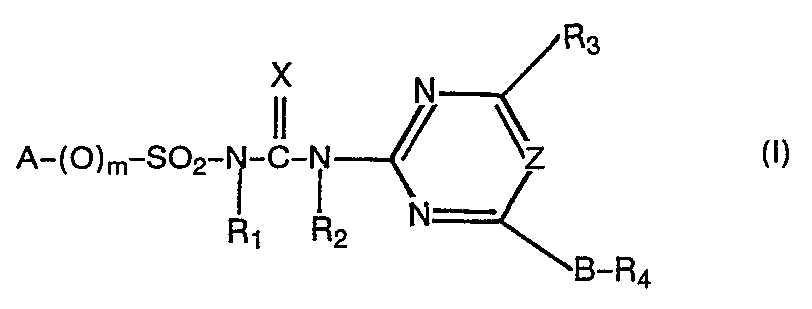
- Gegenstand der vorliegenden Erfindung sind demnach die neuen Verbindungen der Formel

- A einen (ggf. durch bis zu 6 Halogenatomen substituierten) gesättigten oder ungesättigten aliphatischen Rest mit bis zu 10 C-Atomen, der auch durch Sauerstoff unterbrochen sein kann; einen gesättigten cycloaliphatischen Rest mit 3 bis 12 C-Atomen oder einen ein- oder mehrfach ungesättigten Rest mit 5 - 12 C-Atomen, die gegebenenfalls durch bis zu 4 Halogenatome und/oder durch einen oder mehrere (C1-C4)-Alkyl- oder Halogenalkyl (letztere mit 1 - 3 Halogenatomen) bzw. durch einen (C1-C4)-Alkoxycarbonylrest substituiert sein können; einen bicyclischen gesättigten oder ein- oder zweifach ungesättigten aliphatischen Rest mit 7 bis 12 C-Atomen, welcher gegebenenfalls bis zu 6 Halogenatome oder eine oder mehrere (C1-C4)-Alkylrest tragen kann oder in dem eine CH2-Brücke durch Sauerstoff ersetzt sein kann; oder einen Rest der Formel

- m null oder 1,bevorzugt O,
- X Sauerstoff oder Schwefel, bevorzugt Sauerstoff,
- R1 Wasserstoff oder (C1-C4)-Alkyl,
- R2 Wasserstoff, (C1-C4)-Alkyl oder Phenyl, das durch Halogen, (C1-C4)-Alkyl, (C1-C4)-Alkoxy, N0 2, (C 1-C 4)-Alkylthio und/oder Di-(C1-C4)-alkylamino substituiert sein kann, bevorzugt Wasserstoff oder (C1-C4)Alkyl,
- R3 Wasserstoff, Halogen, N02, CN, (C1-C4)-Alkylamino, Di-(C1-C4)-alkyl-amino, (C1-C4)-Alkyl, das ggf. durch Halogen, (C1-C3)-Alkoxy, (C1-C3)-Alkylthio, (C1-C3)-Alkylamino, Di-(C1-C3)-alkylamino oder (C1-C4)-Alkoxycarbonyl substituiert sein kann; (C1-C4)-Alkoxy oder (C1-C4)-Alkythio, die ggf. durch Halogen, (C1-C4)-Alkoxy oder (C1-C4)-Alkoxycarbonyl substituiert sein können, Allyloxy oder (C1-C4)-Alkoxycarbonyl;
- B und D unabhängig voneinander jeweils eine einfache chemische Bindung oder eine Methylen- oder Ethylengruppe, die durch Halogen, (C1-C4)-Alkyl, (C1-C4)-Alkoxy, (C1-C4)-Alkylthio, (C1-C4)-Alkylamino oder Di-(C1-C4)-alkylamino substituiert sein kann;
- R4 ein Rest der Formel -CO-R7;
- R 5 Halogen, NO2, (C1-C4)-Alkyl, (C1-C4)-Halogenalkyl oder (C1-C4) Halogenalkoxy mit jeweils bis zu 5 Halogenatomen, (C1-C4)-Alkoxy, (C2-C5)-Alkenoxy, /C1-C3)-alkylthio, -Alkylsulfinyl oder -Alkylsulfonyl, -SO2N/(C1-C4)-Alkyl/2 oder (C1-C4)-Alkoxycarbonyl,einen Phenyl-bzw. Phenoxy, Diphenyl- bzw. Diphenoxy, Phenoxyphenyl-bzw. Phenoxyphenoxyrest, worin die Phenylreste durch Halogen, N02, (C1-C4)-Alkyl oder Alkoxy substituiert sein können, wobei die nichtaromatischen Reste bevorzugt sind,
- R6 gleich oder verschiedene Reste der Gruppe Halogen, CF3, N02, (C1-C4)-Alkyl, (C1-C4)-Alkoxy oder (C2-C5)-Alkenoxy;
- p 0 - 3;
- R7 Wasserstoff, (C1-C4)-Alkyl, (C1-C4)-Halogenalkyl, Phenyl, Halogenphenyl, (C1-C4)-Alkylphenyl oder (C1-C4)-Alkoxyphenyl, wobei die nichtaromatischen Reste bevorzugt sind,
- Z Stickstoff oder eine Methin-Gruppe bedeuten,
sowie die funktionellen Derivate dieser Verbindungen und ihre physiologisch verträglichen Salze mit Basen und Säuren. - Unter "funktionellen Derivaten" sind Verbindungen mit Substituenten, die sich von der Carbonylgruppe -CO-R7 ableiten, zu verstehen. Dazu gehören z.B. Acetale, Ketale, Halbacetale, Thioacetale (bzw. -ketale), Aminale, Halbaminale oder Verbindungen, in denen die Acetal-, Thioacetal- und/oder Aminalgruppen gemischt vorkommen oder ringförmig miteinander verknüpft sind, d.h. Verbindungen, in denen der Rest R4 für eine Gruppe der Formel

- In dieser Formel steht Y für O, S und/oder N-R9; beide R8 sind (C1-C4)-Alkyl (einer davon kann auch Wasserstoff sein) oder bilden zusammen eine Ethylen oder Propylenbrücke und R9 ist (C1-C4)-Alkyl oder Phenyl, das ggf. durch (C1-C4)-Alkyl, (C1-C4)-Alkoxy oder Halogen substituiert sein kann. Diese Derivate sind von besonderer Bedeutung.
- Zu den funktionellen Derivaten gehören ferner Oxime, Oximether, Hydrazone, Semicarbazone oder Schiff-sche Basen (Azomethine) der Verbindungen I, d.h. Verbindungen, in denen R4 für einen Rest der Formel

- Unter "aliphatischen Resten" in A-Stellung sind Alkylreste, Alkenylreste mit einfacher oder konjugierter Doppelbindung oder Alkinylreste zu verstehen. "Halogen" bedeutet bevorzugt Fluor, Chlor oder Brom. Reste mit mindestens 3 C-Atomen zeichnen sich durch besonders starke herbizide Wirkung aus.
- Die neuenVerbindungen der allgemeinen Formel I lassen sich aus an sich bekannten bzw. nach bekannten Verfahren hergestellten Ausgangsmaterialien synthetisieren. Die Herstellungsverfahren sind dadurch gekennzeichnet, daß man
- a) Verbindungen der Formel


mit Verbindungen der Formel
- b) Verbindungen der Formel


- c) Verbindungen der Formel

- Zu a) Die Umsetzung der Verbindungen II bzw. III und IV erfolgt vorzugsweise in inerten aprotischen Lösungsmitteln wie z.B. Acetonitril, Dichlormethan, Toluol, Tetrahydrofuran oder Dioxan bei Temperaturen zwischen 0°C und der Siedetemperatur des Lösungsmittels. Bei Anwendung von Ausgangsstoffen der Formel III arbeitet man gegebenenfalls in Gegenwart eines Säureakzeptors wie z.B. Kaliumcarbonat, Pyridin oder Triethylamin.
- Zu b) Bei der Umsetzung der Verbindungen V mit VI bzw. VII arbeitet man gleichfalls vorzugsweise in den oben genannten inerten Lösungsmitteln gegebenenfalls unter Zusatz basischer Verbindungen, wie z.B. Kaliumcarbonat, Pyridin oder Triethylamin bei Temperaturen zwischen 0°C und der Siedetemperatur des Lösungsmittels.
- Die nachträgliche Abspaltung von Halogenwasserstoff (HC1, HBr) aus aliphatischen halogenhaltigen Resten A erfolgt in bekannter Weise, z.B. mit Alkalialkoholat, alkoholischer Natron- oder Kalilauge, Triethylamin oder anderen säureabspaltenden Mitteln, gegebenenfalls in Gegenwart eines weiteren inerten Lösungs- oder Verdünnungsmittels (z.B. Toluol) bei Temperaturen zwischen-Raum- und Siedetemperatur.
- An vorhandene oder nachträglich gebildete Mehrfachbindungen in A-Position kann man Halogen (Cl2, Br2) oder Halogenwasserstoff in gleichfalls bekannter Weise anlagern und so gegebenenfalls zu neuen Verbindungen der Formel I gelangen. Die Bromierung bzw. Chlorierung wird in inerten organischen Lösungsmitteln wie z.B. Dichlormethan oder Chloroform unter Belichtung - beispielsweise mit ultraviolettem Licht - oder in Gegenwart von radikalisch zerfallenden Verbindungen - z.B. Azodiisobutyronitril - bei Temperaturen zwischen 0°C und der Siedetemperatur des Lösungsmittels durchgeführt. Die Anlagerung von Halogenwasserstoff gelingt in Gegenwart inerter Lösungsmittel (z.B. Toluol) mittels gasförmigem HCl oder HBr bei niedrigen Temperaturen, gegebenenfalls in Gegenwart eines Peroxidkatalysators.
- Zur nachträglichen Alkylierung in R1-Stellung arbeitet man vorzugsweise in inerten aprotischen Lösungsmitteln wie z.B. Dioxan oder Dimethylformamid unter Zusatz einer anorganischen Base, z.B. Natriumhydrid oder Kaliumcarbonat, bei Temperaturen von 20°C bis zur Siedetemperatur des Lösungsmittels. Als Alkylierungsmittel werden z.B. Dimethylsulfat, Methyljodid oder Ethylbromid eingesetzt.
- Zu c) Die Umwandlung von Verbindungen der Formel I mit z.B. einer Carbonylfunktion (R4 = -CO-R7) bzw. einer Ketalfunktion

- Verbindungen der Formel I, in denen R1 Wasserstoff bedeutet, können Salze bilden, bei denen. H durch ein physiologisch verträgliches Kation ersetzt ist. Bei diesen Salzen handelt es sich vorzugsweise um Alkali-, Erdalkali-, Ammonium- oder organische Aminsalze.
- Geeignete Basen zur Herstellung der erfindungsgemäßen Salze sind z.B. Kaliumcarbonat, Ammoniak oder Ethanolamin. Ebenso lassen sich Verbindungen, die in R3- oder R4-Stellung bzw. in Position B NH-Gruppen aufweisen, mit starken Säuren wie HCl, HBr oder H2SO4 in Salze überführen.
- Die Ausgangsstoffe der Formel IV sind im Falle Z = Stickstoff neu,sie stellen infolge ihrer bifunktionellen Struktur interessante Zwischenprodukte dar, die außer für die Herstellung der erfindungsgemäßen Verbindungen der Formel I z.B. auch für die Herstellung von Pharmazeutika geeignet sind. Bisher gibt es kaum Beispiele für s-Triazine, die mit einer Formyl oder Ketofunktion bzw. mit deren funktionellen Derivaten substituiert sind. Mono-amino-s-triazine, die neben einem beliebigen Rest R3 als weiteren Substituent eine Formyl- oder Ketofunktion bzw. deren funktionelle Derivate besitzen, werden im Rahmen der vorliegenden Anmeldung erstmals beschrieben.
- Gegenstand der Erfindung sind daher auch die 2-Amino-s-triazine der Formel IV mit Z = Stickstoff, in der R2, R3 und B-R4 die weiter oben angegebenen Bedeutungen haben.
- Die Verbindungen der Formel IV mit Z = Stickstoff lassen sich nach Methoden herstellen, wie sie prinzipiell für die Synthese monofunktioneller Amino-s-triazine bekannt sind. Solche Methoden sind z.B. in J. org. Chem. 28, 1816 (1963); s-Triazines and Derivatives 217 (New York 1959); Chem. Pharm. Bull. 16, 474 (1968), Ber. 100, 1874 (1967) und Agric. Biol.
- Chem. 35, 1572 (1971) beschrieben. Anstelle der dort verwendeten Ausgangsstoffe verwendet man entsprechende bifunktionelle Verbindungen der Formel X-B-R4 (VIII) worin X für Reste der Formel CN, COOH, COC1 oder COO(C1-C4)-Alkyl steht. Beispiele hierfür sind Glyoxalsäureester, ß-Formylessigsäureester, Brenztraubsäureester, Acetessigester, oder davon abzuleitende funktionelle Derivate wie Dialkoxy-2- essigsäureester, Dialkoxyacetonitril, Dialkoyypropionsäureester oder 1.3-Dioxolan-2-carbonsäureester, 1.3-Dithiolan-2-carbonsäureester, 1.3-Dioxolan-2-essigsäureester oder 2-Methyl-1.3-dioxolan-2-essigsäureester. Es war nicht zu erwarten, daß diese bifunktionellen Verbindungen zu den erfindungsgemäßen Triazinen cyclisieren vielmehr mußte man mit einer Vielzahl von möglichen Reaktionsprodukten rechnen. Es ist deshalb überraschend, daß die bifunktionellen Verbindungen der Formel (VIII) in einfacher Weise und in guten Ausbeuten bei Anwendung der für monofunktionelle Amino-s-triazine bekannten Methoden zu den bifunktionellen Triazinen der Formel IV führen.
- Die Herstellung der Verbindungen IV sei nachstehend am Beispiel des 2-Amino-4-diethoxy-methyl-6-methoxy-s-triazins veranschaulicht, das aus Diethoxyessigsäureethylester und Guanidino-O-methylisoharnstoff erhalten wird:

- Die Umsetzungen erfolgen vorzugsweise in polaren Lösungsmitteln z.B. in Alkoholen wie Methanol oder Ethanol bzw. in aprotischen polaren Lösungsmitteln wie Acetonitril, DMF, Tetrahydrofuran und Dioxan bei Reaktionstemperaturen zwischen 0°C und der Siedetemperatur des Lösungsmittels. Da die als Reaktionspartner der Verbindungen VIII verwendeten Biguanidabkömmlinge wie N,N-Dimethylbiguanid oder Guanidino-O-methylisoharnstoff bzw. Amidinderivate wie z.B. O-Methyliso-harnstoff wegen mangelnder Beständigkeit in der Regel als Salze vorliegen, ist es notwendig sie zunächst in die freien Basen überzuführen.
- Man verwendet dazu starke Basen, bzw. deren Lösungen wie Natriummethylat, Natriumethylat, Kalium-tert.-butylat bzw. deren alkoholische Lösungen; Natriumhydrid, Alkali- und Erdalkalihydroxide bzw. -carbonate oder tertiäre Amine wie Triethylamin, Ethyldiisopropylamin und Pyridin.
- Die Ausgangsstoffe der Formel VIII sind bekannt oder können nach bekannten Methoden hergestellt werden [JACS 4580 (1954); JACS 2661 (1947); Beilstein 3 III 1139; 3 IV, 1494; 19 III/IIV, 3450 ff].
- Die Amino-s-triazine der Formel IV (mit Z = Stickstoff) lassen sich in Abhängigkeit von den Resten R3 und B-R4 in andere Amino-s-triazine der Formel IV überführen. So erhält man durch Umsetzung von Verbindungen, in denen R = Cl ist, mit Alkoholen, Mercaptanen und Aminen unter Zusatz von Basen Verbindungen der Formel IV mit R3 = O-Alkyl, S-Alkyl, NH-Alkyl oder N-(Alkyl)2.
- Bedeutet in den Verbindungen der Formel IV mit Z = Stickstoff der Rest -B-R4 beispielsweise eine Carbonyl bzw. Ketal (Acetal)-funktion, so erhält man durch Umsetzung mit Alkoholen, Glycolen, Mercaptanen, Aminen, Hydroxylaminen, Anilinen, Hydrazinen oder Semicarbaziden andere neue S-Triazine der allgemeinen Formel IV. Diese Umwandlung erfolgt nach im Prinzip bekannten Methoden, wie sie zusammenfassend in Houben-Weyl, Band VII, (1), Seiten 413 - 488 bzw. Band VI (3), Seiten 204 - 270 beschrieben sind.
- Man verwendet für diese - an sich bekannten - Folgereakreaktionen inerte protische oder aprotische Lösungsmittel, z.B. Ketone, Alkohole halogenierte Kohlenwasserstoffe, aromatische Kohlenwasserstoffe, Ether oder Acetonitril und arbeitet bei Temperaturen zwischen 0°C und der Siedetemperatur des Lösungsmittels. Im allgemeinen wird unter saurer bzw. basischer Katalyse gearbeitet. Das bei diesen Umsetzungen entstehende Reaktionswasser wird entweder azeotrop oder mit Hilfe wasserbindender Mittel entfernt.
- Die Ausgangsstoffe der Formel IV mit Z = eine Methingruppe sind bekannt oder lassen sich nach im Prinzip bekannten Verfahren herstellen, z.B. durch Zyklisierung entsprechender Guanidinderivate mit entsprechend substituierten 1,3-Diketonen (vgl. z.B. "The Chemistry of Heterocyclic compounds", Vol. XVI (1962) und Supplement I (1970)). Verbindungen der Formel IV, in denen R4 für den Rest CORr steht, können auch in der weiter oben beschriebenen Weise in andere Verbindungen der Formel IV überführt werden.
- Die Sulfonylisocyanate der Formel II sind zum großen Teil bekannt oder lassen sich nach im Prinzip bekannten Verfahren in einfacher Weise herstellen (vgl. EP 15 683, DE-AS 1 211 165, DE-AS 1 226 565, DE-AS 1 230 016, DE-AS 1 568 640 sowie Chem. Ber. 105, 2791, 2800 (1972).
- Die Sulfonylcarbamoyl- bzw. -thiocarbamoylchloride der Formel III lassen sich nach üblichen Methoden aus den Alkalisalzen der entsprechenden Sulfonamide der Formel V, welche aus der Literatur bekannt sind, durch Umsetzung mit Phosgen oder Thiophosgen darstellen.
- Die für die Umsetzungen nach b) benötigten Iso(thio)cyanate der-Formel VI sind neu und nach bekannten Verfahren zugänglich (vgl. Tetrahedron 29, 691 (1973); Japan. Kokai Sho-51-143686).
- Gleiches gilt für die heterocyclischen Carbamoylchloride und Thiocarbamoylchloride der Formel VII (vgl. z.B. DE-AS 1 149 718 und DE-AS 2 238 870).
- Sulfonylharnstoffe der Formel I, welche im aliphatischen Rest A eines oder mehrere asymmetrische Kohlenstoffatome enthalten, liegen in enantiomeren oder diastereomeren Formen vor. Im allgemeinen werden die entsprechenden erfindungsgemäßen Verbindungen als Racemate oder als Diastereomerengemische erhalten. Falls gewünscht, können die üblichen Techniken zur Trennung dieser Gemische in die sterisch einheitlichen Bestandteile angewendet werden. Auch durch Verwendung von sterisch-einheitlichen Ausgangsmaterialien ist eine Reindarstellung der genannten Verbindungen möglich.Z.B. entstehen bei der Umsetzung von Aminoheterocyclen der Formel IV mit threo- bzw. erythro-1,2-Dihalo- genalkyl-sulfonyl-isocyanaten diesen entsprechende threo- bzw. erythro-1,2-Dihalogenalkyl-sulfonyl-harnstoffe. Ferner können Sulfonylharnstoffe der Formel I, welche im aliphatischen Rest A eine oder mehrere Doppelbindungen enthalten, bei entsprechender olefinischer Substitution als E- oder als Z-Isomere vorkommen, deren Reindarstellung bzw. Trennung ebenfalls möglich ist. Werden z.B. ungesättigte Sulfonylisocyanate der allgemeinen Formel II als E- oder Z-Isomere eingesetzt, so werden die ungesättigten Sulfonylharnstoffe der Formel I in sterisch einheitlicher Form erhalten. Die Erfindung betrifft daher auch die einzelnen Enantiomeren und diastereomeren Formen der Verbindungen der Formel I.
- Die Verbindungen der Formel I weisen eine ausgezeichnete herbizide Wirkung und in wichtigen Großkulturen eine sehr gute Selektivität auf. Sei eignen sich zu selektiven Bekämpfung zweikeimblättriger und grasartiger annueller und perennierender Unkräuter in landwirtschaftlich bedeutenden Kulturen wie z.B. Weizen, Gerste, Roggen, Reis, Mais, Zurckerrübe, Baumwolle und Soja im Vor- und Nachauflaufverfahren. Darüber hinaus besitzen sie in niedrigen Dosierungen hervorragende wachstumsregulatorische Eigenschaften bei Kulturpflanzen. Sie greifen regulierend in den pflanzeneigenen Stoffwechsel ein und können damit zur gezielten Beeinflussung von Pflanzeninhaltsstoffen und zur Ernteerleichterung, z.B. durch Auslösen von Desikkation und Wuchsstauchung, eingesetzt werden. Des weiteren eignen sie sich zur generellen Steuerung und Hemmung von unerwünschtem vegetativen Wachstum, ohne dabei die Pflanzen abzutöten. Eine Hemmung des vegetativen Wachstums spielt bei vielen mono- und dikotylen Kulturen eine große Rolle, da das Lagern hierdurch verringert oder völlig verhindert werden kann.
- Werden die Verbindungen vor dem Keimen der Unkrautpflanzen im Vorsaat- oder Vorauflaufverfahren auf die Erdoberfläche appliziert, so wird das Auflaufen der Keimlinge nicht verhindert. Die Unkräuter wachsen bis zum Keimblattstadium heran, stellen jedoch dann ihr Wachstum ein und sterben schließlich nach 3 - 5 Wochen vollkommen ab. Bei Applikation der Wirkstoffe auf die grünen Pflanzenteile im Nachauflaufverfahren tritt ebenfalls sehr rasch nach der Behandlung ein drastischer'Wachstumsstop ein und die Unkrautpflanzen bleiben in dem zum Applikationszeitpunkt vorhandenen Wachstumsstadium stehen oder sterben nach einer gewissen Zeit ganz ab, so daß auf diese Weise eine für die Kulturpflanzen schädliche Unkrautkonkurrenz sehr früh und nachhaltig beseitigt werden kann.
- Obgleich die erfindungsgemäßen Verbindungen eine ausgezeichnete herbizide Aktivität gegenüber mono- und dikotylen Unkräutern aufweisen, werden Kulturpflanzen wirtschaftlich bedeutender Kulturen wie z.B. Weizen, Gerste, Roggen, Reis, Mais, Zuckerrübe, Baumwolle und Soja nur unwesentlich oder gar nicht geschädigt.
- Die vorliegenden Verbindungen eignen sich aus diesen Gründen hervorragend zur Bekämpfung von unerwünschtem Pflanzenwuchs in landwirtschaftlichen Nutzpflanzungen.
- Gegenstand der Erfindung sind daher auch herbizide bzw. wachstumsregulierende Mittel, die gekennzeichnet sind durch einen Gehalt an einer Verbindung der Formel I in Kombination mit üblichen Formulierungshilfsmitteln und Inertstoffen sowie deren Verwendung im landwirtschaftlichen Bereich.
- Die erfindungsgemäßen Mittel enthalten die Wirkstoffe der Formel I im allgemeinen zu 2 - 95 Gew.-%. Sie können als Spritzpulver, emulgierbare Konzentrate, versprühbare Lösungen, Stäubemittel oder Granulate in den üblichen Zubereitungen angewendet werden.
- Spritzpulver sind in Wasser gleichmäßig dispergierbare Präparate, die neben dem Wirkstoff außer einem Verdünnungsmittel oder Inertstoff noch Netzmittel z.B. polyoxethylierte Alkylphenole, polyoxethylierte Fettalkohole, Alkyl-oder Alkylphenyl-sulfonate und Dispergiermittel, z.B. ligninsulfonsaures Natrium, 2,2'-dinaphthylmethan-6,6'- disulfonsaures Natrium, dibutylnaphthalinsulfonsaures Natrium oder auch oleylmethyltaurinsaures Natrium enthalten.
- Emulgierbare Konzentrate werden durch Auflösen des Wirkstoffes in einem organischen Lösungsmittel, z.B. Butanol, Cyclohexanon, Dimethylformamid, Xylol oder auch höhersiedenden Aromaten oder Kohlenwasserstoffen unter Zusatz von einem oder mehreren Emulgatoren hergestellt. Als Emulgatoren können beispielsweise verwandt werden:
- Alkylarylsulfonsaure Kalziumsalze wie Ca-dodecylbenzosulfonat oder nichtionische Emulgatoren wie fettsäurepolyglykolester, Alkylarylpolyglykolether, Fettalkoholpolyglykolether, Propylenoxid-Ethylenoxid-Kondensationsprodükte, Fettalkohol-Propylenoxid-Ethylenoxid-Kondensationsprodukte, Alkylpolyether, Sorbitanfettsäureester, Polyoxyethylensorbitan-fettsäureester oderPolyoxethylen-sorbitester.
- Stäubemittel erhält man durch Vermahlen des Wirkstoffes mit fein verteilten, festen Stoffen, z.B. Talkum, natürlichen Tonen, wie Kaolin, Bentonit, Pyrophillit oder Diatomeenerde.
- Granulate können entweder durch Verdüsen des Wirkstoffes auf adsorptionsfähiges, granuliertes Inertmaterial hergestellt werden oder durch Aufbringen von Wirkstoffkonzentraten mittels Klebemitteln z.B. Polyvinylalkohol, polyacrylsaurem Natrium oder auch Mineralölen auf die Oberfläche von Trägerstoffen wie Sand, Kaolinite oder von granuliertem Inertmaterial. Auch können geeignete Wirkstoffe in der für die Herstellung von Düngemittelgranalien üblichen Weise - gewünschtenfalls in Mischung mit Düngemitteln - hergestellt werden.
- Bei herbiziden Mitteln können die Konzentrationen der Wirkstoffe in den handelsüblichen Formulierungen verschieden sein.
- In Spritzpulvern variiert die Wirkstoffkonzentration z.B. zwischen etwa 10 % und 80 %, der Rest besteht aus den oben angegebenen Formulierungszusätzen. Bei emulgierbaren Konzentraten kann die Wirkstoffkonzentration gleichfalls etwa 10 % bis 80 % betragen. Staubförmige Formulierungen enthalten etwa 2 - 20 %. Bei Granulaten hängt der Wirkstoffgehalt zum Teil davon ab, ob die wirksame Verbindung flüssig oder fest vorliegt und welche Granulierhilfsmittel, Füllstoffe usw. verwendet werden.
- Zur Anwendung als Herbizide werden die handelsüblichen Konzentrate gegebenenfalls in üblicher Weise verdünnt, z. B. bei Spritzpulvern und emulgierbaren Konzentraten mittels Wasser. Staubförmige und granulierte Zubereitungen sowie versprühbare Lösungen werden vor der Anwendung nicht mehr in weiteren inerten Stoffen verdünnt. Mit den äußeren Bedingungen wie Temperatur, Feuchtigkeit, u.s. variiert die erforderliche Aufwandmenge. Sie beträgt im allgemeinen zwischen 0.005 und 10 kg/ha, vorzugsweise etwa 0.01 bis 5.0 kg/ha Wirkstoff.
- Für einige Anwendungsgebiete kann es zweckmäßig sein, die neuen Herbizide mit einem oder mehreren Herbiziden gemeinsam anzuwenden, z.B. als "Tankmischung" oder in Form einer Fertigformulierung, um weitere vorteilhafte Wirkungen zu erzielen.
- Die erfindungsgemäßen Wirkstoffe können mit anderen Herbiziden, Insektiziden und Fungiziden kombinert werden.
- Zur Anwendung als Wachstumsregulatoren eignen sich Konzentrationen zwischen 0.01 und 1.25 kg/ha. Bevorzugt verwendet man wäßrige Dispersionen von Spritzpulvern oder Verdünnungen von emulgierbaren Konzentraten. Die Anwendung erfolgt im Nachauflauf. Bevorzugte Kulturen sind Mais und Tabak.
- Zu 10.55 g (0.05 mol) 2-Amino-4-diethoxymethyl-6-methyl-pyrimidin in 50 ml Dichlormethan tropft man bei 0 bis 5 C eine Lösung von 11 g (0.05 mol) 2-Chlorphenylsulfonylisocyanat in 20 ml Dichlormethan. Man rührt 13 h bei Raumtemperatur nach, setzt n-Hexan hinzu und saugt das ausgefallene Reaktionsprodukt ab. Man erhält 19.8 g (93 % d. Th.) an N-(2-Chlorphenylsulfonyl)-N'-(4-diethoxynethyl-6-methyl-pyrimidin-2-yl)-harnstoff vom Schmelzpunkt 131 °C.
- Zu 10.55 g (0.05 mol) 2-Amino-4-diethoxymethyl-6-methyl-pyrimidin in 50 ml Dichlormethan tropft man bei 0 bis 5 °C eine Lösung von 12 g (0.05 mol) 2-Methoxycarbonylphenylsulfonylisocyanat in 20 ml Dichlormethan. Man rührt 12 Stunden bei Raumtemperatur nach, setzt n-Hexan hinzu und saugt das ausgefallene Reaktionsprodukt ab. Mau erhält 19 g (84 % d. Th.) an N-(4-Dicthoxymethyl-6-methyl- pyrimidin-2-yl)-N'-(2-methoxycarbonylphenylsulfonyl)-harnstoff vom Schmelzpunkt 170 °C.
- 34.5 g (0.08 mol) N-(2-Chlorphenylsulfonyl)-N'-(4-diethoxymethyl-6-methyl-pyrimidin-2-yl)-harnstoff (vergleiche Beispiel 1) werden in 350 ml Dioxan suspendiert und mit 20 ml halbkonzentrierter Salzsäure versetzt. Man rührt 18 Stunden bei Raumtemperatur nach, saugt das ausgefallene Produkt ab und wäscht den Niederschlag mit Dichlornethan. Man erhält 2S g (98 % d. Th.) an N-(2-Chlorphenylsulfonyl)-N'-(4-fomyl-6-aethyl-pyrinidin-2-yl)-harnstoff vom Schmelzpunkt 142 °C.
- Zu 6.18 g (0.05 mol) 2-Amino-4-diethoxymethyl-6-methyl-pyrimidin in 50 ml Dichlormethan tropft man bei 0 bis 5 °C eine Lösung von 5.15 g (0.032 mol) 1-1-Methylpropen-1-yl-sulfonylisocyanat in 20 ml Dichlormethan. Man rührt 12 Stunden bei Raumtemperatur nach, setzt n-Hexan hinzu und saugt das anssefallene Reaktionsprodukt ab. Man erhält 9,7 g (SS d. Th.) an N-(4-Diethoxymethyl-6-methyl-pyrimidin-2-yl)-N'(1-methyl-propen-1-yl-sulfonyl)-harnstoff vom Schmelzpunkt 100 - 102 °C.
- zu 5.5g (0.05 mol) 2-Amino-4-dimethoxymethyl-6-methyl- pyrimidin in 50 ml Dichlormethan tropft man bei 0 bis 5 °C eine Lösung von 5.15 g (0.032 mol) 1- Nethyl- propen-1-yl-sulfonylisocyanat in 20 ml Dichlormethan. Man rührt 12 Stunden bei Raumtemperatur nach, setzt n-Hexan hinzu und saugt das ausgefallene Produkt ab. Man erhält 9 g (87 % d. Th.) an N-(4-Dimethoxymethyl-6-methyl-pyrimidin-2-yl)-N'- (1-methyl-propen-1-yl- sulfonyl)-harnstoff vom Schmelzpunkt 115 - 117°C.
- In analoger Weise gemäß den in den Beispielen 1 bis 5 beschriebenen Verfahrensweisen erhält man unter Verwendung entsprechender Ausgangsstoffe die folgenden Verbindungen der Formel I von Tabelle I, wobei jeweils Z eine Methingruppe bedeutet:


- Zu 11.4 g (0.05 mol) 2-Amino-4-diethoxymethyl-6-methoxy-s-triazin in 50 ml Dichlormethan tropft man bei 0 bis 5°C eine Lösung von 11 g (0.05 mol) 2-Chlorphenylsulfonylisocyanat in 20 ml Dichlormethan. Man rührt 18 h bei Raumtemperatur nach, setzt n-Hexan hinzu und saugt das ausgefallene Reaktionsprodukt ab. Man erhält 18.3 g (82 % d. Th.) an N-(2-Chlor-phenylsulfonyl)-N'-(4-diethoxymethyl-6-methoxy-s-triazin-2-yl)-harnstoff vom Schmelzpunkt 126 - 127°C.
- In analoger Weise erhält man unter Verwendung entsprechender Ausgangsstoffe die in nachfolgender Tabelle ange- gebenen Verbindungen der Formel I, wobeijeweils Z = Stickstoff bedeutet.


- Zu einer Guanidino-O-methylisoharnstofflösung - hergestellt aus 15.25 g (0.1 mol) Guanidino-O-methylisoharnstoffhydrochlorid, 80 ml absolutem Methanol und einer Lösung von 2.53 g (0.11 mol) Natrium in 40 ml Methanol 7 läßt man bei 0°C 17.6 g (0.1 mol) Diethoxyessigester zu tropfen. Man rührt 20 Stunden bei Raumtemperatur, filbiert, engt das Filtrat ein, nimmt den Rückstand mit 2 N Essigsäure auf, extrahiert mit Methylenchlorid, wäscht die organische Phase mit Wasser, trocknet mit Natriumsulfat, filtriert, engt ein und kristallisiert den Rückstand aus Ether/n-Hexan um. Man erhält 15.4 g (67.5 %) 2-Amino-4-diethoxymethyl-6-methoxy-s-triazin vom Schmelzpunkt 82 - 83°C.
- In analoger Weise erhält man die folgenden Verbindungen der Formel IV, worin Z jeweils Stickstoff bedeutet:


- Ein emulgierbares Konzentrat wird erhalten aus
- 15 Gew.-Teilen Wirkstoff
- 75 Gew.-Teilen Cyclohexan als Lösungsmittel
- und 10 Gew.-Teilen oxethyliertes Nonylphenol (10 AeO) als Emulgator
- Ein in Wasser leicht dispergierbares benetzbares Pulver wird erhalten, indem man
- 25 Gew.-Teile Wirkstoff
- 64 Gew.-Teile Kaolinhaltiges Quarz als Inertstoff
- und 1 Gew.-Teil oleoylmethyltaurinsaures Natrium als Netz und Dispergiermittel mischt und in einer Stiftmühle mahlt.
- Ein Stäubemittel wird erhalten, indem man
- 10 Gew.-Teile Wirkstoff
- und 90 Gew.-Teile Talkum als Inertstoff mischt und in einer Schlagmühle zerkleinert.
- Samen bzw. Rhizomstücke mono- und dikotyler Unkräuter wurden in Lehmerde in Plastiktöpfen (⌀ 9 cm) ausgelegt und mit Erde abgedeckt. Die als benetzbare Pulver bzw. als Emulsionskonzentrate formulierten erfindungsgemäßen Verbidungen wurden in Form wäßriger Suspension oder Emulsionen auf die Erdoberfläche appliziert. Die Wasseraufwandmenge pro Topf entsprach dabei umgerechnet 600 - 800 1/ha. Nach der Behandlung wurden die Versuchstöpfe im Gewächshaus aufgestellt und die Versuchspflanzen unter guten Wachtumsbedingungen (Temperatur: 23 ± 1°C; rel. Luftfeuchte 60 - 80 %) kultiviert. Nach ca. 3 Wochen wurde die Pflanzenschädigung optisch bonitiert. Als Vergleich dienten dabei unbehandelte Kontrollen.
- Die Schädigung.der Unkrautpflanzen bzw. die Kulturpflanzenverträglichkeit wurde gemäß einem Schlüssel von 0 - 5 bonitiert.
- Dabei bedeutet
- 0 = ohne Wirkung
- 1 = 0 - 20 % Wirkung
- 2 = 20 - 40 % Wirkung
- 3 = 40 - 60 % Wirkung
- 4 = 60 - 80 % Wirkung
- 5 = 80 - 100 % Wirkung


- Samen von mono- und dikotylen Unkräutern wurden in Töpfen ausgesät und im Gewächshaus unter guten Wachstumsbedingungen angezogen. 3 Wochen nach der Aussaat wurden die Versuchspflanzen im Dreiblattstadium behandelt. Die als Spritzpulver bzw. als Emulsionskonzentrate formulierten erfindungsgemäßen Präparate wurden in verschiedenen Dosierungen auf die grünen Pflanzenteile gesprüht. Nach ca. 3 Wochen Standzeit im Gewächshaus unter optimalen Wachstumsbedingungen wurde die Wirkung der Präparate optisch im Vergleich zu unbehandelten Kontrollen bonitiert.
- Nachauflaufwirkung der neuen erfindungsgemäßen Mittel gegen mono- und dikotyle Unkräuter. Vergleich zur unbehandelten Kontrolle.


Claims (6)


dadurch gekennzeichnet, daß man


Applications Claiming Priority (4)
| Application Number | Priority Date | Filing Date | Title |
|---|---|---|---|
| DE3225471 | 1982-07-08 | ||
| DE19823225471 DE3225471A1 (de) | 1982-07-08 | 1982-07-08 | Neue heterocyclisch substituierte sulfonylharnstoffe, verfahren zu ihrer herstellung und ihre verwendung in der landwirtschaft |
| DE3247616 | 1982-12-23 | ||
| DE19823247616 DE3247616A1 (de) | 1982-12-23 | 1982-12-23 | Neue heterocyclisch substituierte sulfonylharnstoffe, verfahren zu ihrer herstellung und ihre verwendung in der landwirtschaft |
Publications (2)
| Publication Number | Publication Date |
|---|---|
| EP0098569A2 true EP0098569A2 (de) | 1984-01-18 |
| EP0098569A3 EP0098569A3 (de) | 1984-12-19 |
Family
ID=25802913
Family Applications (1)
| Application Number | Title | Priority Date | Filing Date |
|---|---|---|---|
| EP83106513A Withdrawn EP0098569A3 (de) | 1982-07-08 | 1983-07-04 | Neue heterocyclisch substituierte Sulfonylharnstoffe, Verfahren zu ihrer Herstellung und ihre Verwendung in der Landwirtschaft |
Country Status (11)
| Country | Link |
|---|---|
| EP (1) | EP0098569A3 (de) |
| AU (1) | AU1665483A (de) |
| BR (1) | BR8303645A (de) |
| CS (1) | CS238643B2 (de) |
| DD (1) | DD212643A5 (de) |
| DK (1) | DK314383A (de) |
| ES (1) | ES523898A0 (de) |
| IL (1) | IL69173A0 (de) |
| MA (1) | MA19844A1 (de) |
| PT (1) | PT76998B (de) |
| ZW (1) | ZW15383A1 (de) |
Cited By (13)
| Publication number | Priority date | Publication date | Assignee | Title |
|---|---|---|---|---|
| EP0169815A1 (de) * | 1984-07-26 | 1986-01-29 | Ciba-Geigy Ag | N-Arylsulfonyl-N'-triazinyl- und -pyrimidinylharnstoffe |
| US4725679A (en) * | 1983-08-25 | 1988-02-16 | Hoechst Aktiengesellschaft | Process for producing 2-amino-alkenylsulfonylurea derivatives |
| EP0152378A3 (de) * | 1984-02-14 | 1988-04-13 | Ciba-Geigy Ag | Herbizide Sulfonylharnstoffe |
| EP0106512B1 (de) * | 1982-09-10 | 1988-05-18 | E.I. Du Pont De Nemours And Company | Herbizide ortho-alkyl- und ortho-alkenyl-substituierte Benzolsulfonamide |
| EP0388771A1 (de) * | 1989-03-18 | 1990-09-26 | Hoechst Schering AgrEvo GmbH | Phenoxysulfonylharnstoffe auf Basis von 3-substituierten Salicylsäurealkylestern, Verfahren zu ihrer Herstellung und ihre Verwendung als Herbizide und Pflanzenwachstumsregulatoren |
| EP0192489B1 (de) * | 1985-02-21 | 1991-04-10 | E.I. Du Pont De Nemours And Company | Herbizide Sulfonamide |
| EP0303114A3 (de) * | 1987-08-05 | 1991-04-17 | Hoechst Schering AgrEvo GmbH | Heterocyclisch substituierte Sulfamidsäurephenylester, Verfahren zu ihrer Herstellung und ihre Verwendung als Herbizide und Pflanzenwachstumsregulatoren |
| ES2033200A1 (es) * | 1990-01-31 | 1993-03-01 | Nehezvegypari Kutato Intezet | Procedimiento de preparar derivados sulfonilureicos substituidos y composicion herbicida que los contiene. |
| US5424280A (en) * | 1993-10-07 | 1995-06-13 | American Cyanamid Company | Aryloxybenzene herbicidal agents |
| EP0696589A1 (de) | 1994-07-20 | 1996-02-14 | Kureha Kagaku Kogyo Kabushiki Kaisha | N-(substituierte Amino)Imide Derivate, Verfahren zu ihre Herstellung und herbizide Zusammensetzungen |
| US5604178A (en) * | 1993-10-15 | 1997-02-18 | Kureha Kagaku Kogyo K.K. | N-(substituted amino)pyrrole derivatives, and herbicidal compositions |
| EP2110019A1 (de) | 2008-04-19 | 2009-10-21 | Bayer CropScience AG | Herbizide Verbindungen auf Basis von N-Azinyl-N'-phenylsulfonylharnstoffen |
| WO2021093820A1 (zh) * | 2019-11-12 | 2021-05-20 | 成都百裕制药股份有限公司 | 酰胺衍生物及其制备方法和在医药上的应用 |
Family Cites Families (4)
| Publication number | Priority date | Publication date | Assignee | Title |
|---|---|---|---|---|
| US4191553A (en) * | 1978-03-02 | 1980-03-04 | E. I. Du Pont De Nemours And Company | Herbicidal sulfamates |
| DK349479A (da) * | 1978-09-27 | 1980-03-28 | Du Pont | Sulfonamidderivater og deres anvendelse til regulering af plantevaekst |
| US4394153A (en) * | 1980-07-11 | 1983-07-19 | E. I. Du Pont De Nemours And Company | Herbicidal aryl esters of N-[(heterocyclic)-aminocarbonyl]sulfamic acid |
| DK536582A (da) * | 1981-12-07 | 1983-06-08 | Du Pont | Herbicide sulfonamider |
-
1983
- 1983-07-04 EP EP83106513A patent/EP0098569A3/de not_active Withdrawn
- 1983-07-06 IL IL69173A patent/IL69173A0/xx unknown
- 1983-07-06 ZW ZW153/83A patent/ZW15383A1/xx unknown
- 1983-07-06 ES ES523898A patent/ES523898A0/es active Granted
- 1983-07-07 DD DD83252859A patent/DD212643A5/de unknown
- 1983-07-07 BR BR8303645A patent/BR8303645A/pt unknown
- 1983-07-07 PT PT76998A patent/PT76998B/pt unknown
- 1983-07-07 DK DK314383A patent/DK314383A/da not_active Application Discontinuation
- 1983-07-07 AU AU16654/83A patent/AU1665483A/en not_active Abandoned
- 1983-07-07 MA MA20064A patent/MA19844A1/fr unknown
- 1983-07-07 CS CS835168A patent/CS238643B2/cs unknown
Cited By (17)
| Publication number | Priority date | Publication date | Assignee | Title |
|---|---|---|---|---|
| EP0106512B1 (de) * | 1982-09-10 | 1988-05-18 | E.I. Du Pont De Nemours And Company | Herbizide ortho-alkyl- und ortho-alkenyl-substituierte Benzolsulfonamide |
| US4725679A (en) * | 1983-08-25 | 1988-02-16 | Hoechst Aktiengesellschaft | Process for producing 2-amino-alkenylsulfonylurea derivatives |
| EP0152378A3 (de) * | 1984-02-14 | 1988-04-13 | Ciba-Geigy Ag | Herbizide Sulfonylharnstoffe |
| EP0169815A1 (de) * | 1984-07-26 | 1986-01-29 | Ciba-Geigy Ag | N-Arylsulfonyl-N'-triazinyl- und -pyrimidinylharnstoffe |
| EP0192489B1 (de) * | 1985-02-21 | 1991-04-10 | E.I. Du Pont De Nemours And Company | Herbizide Sulfonamide |
| EP0303114A3 (de) * | 1987-08-05 | 1991-04-17 | Hoechst Schering AgrEvo GmbH | Heterocyclisch substituierte Sulfamidsäurephenylester, Verfahren zu ihrer Herstellung und ihre Verwendung als Herbizide und Pflanzenwachstumsregulatoren |
| EP0388771A1 (de) * | 1989-03-18 | 1990-09-26 | Hoechst Schering AgrEvo GmbH | Phenoxysulfonylharnstoffe auf Basis von 3-substituierten Salicylsäurealkylestern, Verfahren zu ihrer Herstellung und ihre Verwendung als Herbizide und Pflanzenwachstumsregulatoren |
| ES2033200A1 (es) * | 1990-01-31 | 1993-03-01 | Nehezvegypari Kutato Intezet | Procedimiento de preparar derivados sulfonilureicos substituidos y composicion herbicida que los contiene. |
| US5424280A (en) * | 1993-10-07 | 1995-06-13 | American Cyanamid Company | Aryloxybenzene herbicidal agents |
| US5604178A (en) * | 1993-10-15 | 1997-02-18 | Kureha Kagaku Kogyo K.K. | N-(substituted amino)pyrrole derivatives, and herbicidal compositions |
| US5612287A (en) * | 1993-10-15 | 1997-03-18 | Kureha Kagaku Kogyo K.K. | N-(substituted amino) pyrrole derivatives preparation process thereof, and herbicidal compositions |
| EP0696589A1 (de) | 1994-07-20 | 1996-02-14 | Kureha Kagaku Kogyo Kabushiki Kaisha | N-(substituierte Amino)Imide Derivate, Verfahren zu ihre Herstellung und herbizide Zusammensetzungen |
| US5683964A (en) * | 1994-07-20 | 1997-11-04 | Kureha Kagaku Kogyo K.K. | N-(substituted amino)imide derivatives, preparation process thereof, and herbicidal composition |
| EP2110019A1 (de) | 2008-04-19 | 2009-10-21 | Bayer CropScience AG | Herbizide Verbindungen auf Basis von N-Azinyl-N'-phenylsulfonylharnstoffen |
| WO2021093820A1 (zh) * | 2019-11-12 | 2021-05-20 | 成都百裕制药股份有限公司 | 酰胺衍生物及其制备方法和在医药上的应用 |
| CN117105890A (zh) * | 2019-11-12 | 2023-11-24 | 成都百裕制药股份有限公司 | 酰胺衍生物及其制备方法和在医药上的应用 |
| US11976054B2 (en) | 2019-11-12 | 2024-05-07 | Chengdu Baiyu Pharmaceutical Co., Ltd. | Amide derivative and preparation method therefore and use thereof in medicine |
Also Published As
| Publication number | Publication date |
|---|---|
| ZW15383A1 (en) | 1984-02-08 |
| DD212643A5 (de) | 1984-08-22 |
| ES8403279A1 (es) | 1984-04-01 |
| CS238643B2 (en) | 1985-12-16 |
| EP0098569A3 (de) | 1984-12-19 |
| PT76998B (en) | 1986-03-12 |
| DK314383D0 (da) | 1983-07-07 |
| AU1665483A (en) | 1984-01-12 |
| IL69173A0 (en) | 1983-11-30 |
| PT76998A (en) | 1983-08-01 |
| MA19844A1 (fr) | 1984-04-01 |
| BR8303645A (pt) | 1984-02-14 |
| ES523898A0 (es) | 1984-04-01 |
| DK314383A (da) | 1984-01-09 |
Similar Documents
| Publication | Publication Date | Title |
|---|---|---|
| EP0131258B1 (de) | Neue N-Alkoxy- N-Alkylsulfonylaminosulfonylharnstoffe, und neue (Pyrimido) Triazino-thiatriazinoxide als Vorprodukte | |
| EP0120814B1 (de) | N-Phenylsulfonyl-N'-pyrimidinyl- und -triazinylharnstoffe | |
| EP0121082B1 (de) | Guanidin-Derivate | |
| EP0342569B1 (de) | Heterocyclische 2-Alkoxyphenoxysulfonylharnstoffe und ihre Verwendung als Herbizide oder Pflanzenwachstumsregulatoren | |
| EP0071958B1 (de) | Heterocyclisch substituierte Sulfonylharnstoffe, Verfahren zu ihrer Herstellung und ihre Verwendung in der Landwirtschaft | |
| EP0347788B1 (de) | Substituierte Sulfonyldiamide, Verfahren zu ihrer Herstellung und ihre Verwendung als Herbizide und Pflanzenwachstumsregulatoren | |
| EP0353641B1 (de) | Heterozyklisch substituierte Sulfonylharnstoffe, Verfahren zu ihrer Herstellung und ihre Verwendung als Herbizide oder Pflanzenwachstumsregulatoren | |
| EP0061661A1 (de) | Heterocyclisch substituierte (Halogen)Alkyl- und -Alkoxysulfonylharnstoffe, Verfahren zu ihrer Herstellung und ihre Verwendung in der Landwirtschaft | |
| DD212643A5 (de) | Herbizide und wachstumsregulierende mittel | |
| EP0165572A2 (de) | Neue herbizid wirksame Sulfonylharnstoffe | |
| EP0264865A2 (de) | Alpha-Iminocarbonsäureanilide enthaltende herbizide Mittel sowie neue Alpha-Iminocarbonsäureanilide und Verfahren zu ihrer Herstellung | |
| EP0336354B1 (de) | Heterocyclisch substituierte Alkyl- und Alkenylsulfonylharnstoffe, Verfahren zu ihrer Herstellung und ihre Verwendung als Herbizide oder Pflanzenwachstumsregulatoren | |
| EP0152378A2 (de) | Herbizide Sulfonylharnstoffe | |
| DD261084A5 (de) | 1,2-disubstituierte piperidine, verfahren zu ihrer herstellung sowie ihre verwendung im pflanzenschutz | |
| EP0470489A1 (de) | 4,5,6,7-Tetrahydro-3-aryl-indazole, Verfahren zu ihrer Herstellung und ihre Verwendung als Herbizide | |
| DD283762A5 (de) | Herbizide und pflanzenwuchsregulierende mittel | |
| EP0145664A2 (de) | Herbizide Sulfonylharnstoffe | |
| EP0319689B1 (de) | Heterocyclisch substituierte N-Sultam-sulfonamide, Verfahren zu ihrer Herstellung und ihre Verwendung als Herbizide und Pflanzenwachstumsregulatoren | |
| EP0303114B1 (de) | Heterocyclisch substituierte Sulfamidsäurephenylester, Verfahren zu ihrer Herstellung und ihre Verwendung als Herbizide und Pflanzenwachstumsregulatoren | |
| EP0134477A1 (de) | Neue heterocyclisch substituierte Sulfonylharnstoffe | |
| EP0159966B1 (de) | Sulfonylharnstoffe | |
| EP0388771B1 (de) | Phenoxysulfonylharnstoffe auf Basis von 3-substituierten Salicylsäurealkylestern, Verfahren zu ihrer Herstellung und ihre Verwendung als Herbizide und Pflanzenwachstumsregulatoren | |
| EP0142629A1 (de) | Neue Pyrazolyl- und Isoxazolylsulfonylharnstoffe | |
| DE3225471A1 (de) | Neue heterocyclisch substituierte sulfonylharnstoffe, verfahren zu ihrer herstellung und ihre verwendung in der landwirtschaft | |
| DE3247616A1 (de) | Neue heterocyclisch substituierte sulfonylharnstoffe, verfahren zu ihrer herstellung und ihre verwendung in der landwirtschaft |
Legal Events
| Date | Code | Title | Description |
|---|---|---|---|
| PUAI | Public reference made under article 153(3) epc to a published international application that has entered the european phase |
Free format text: ORIGINAL CODE: 0009012 |
|
| AK | Designated contracting states |
Designated state(s): AT BE CH DE FR GB IT LI LU NL SE |
|
| PUAL | Search report despatched |
Free format text: ORIGINAL CODE: 0009013 |
|
| AK | Designated contracting states |
Designated state(s): AT BE CH DE FR GB IT LI LU NL SE |
|
| 17P | Request for examination filed |
Effective date: 19850222 |
|
| STAA | Information on the status of an ep patent application or granted ep patent |
Free format text: STATUS: THE APPLICATION HAS BEEN WITHDRAWN |
|
| 18W | Application withdrawn |
Withdrawal date: 19860111 |
|
| RIN1 | Information on inventor provided before grant (corrected) |
Inventor name: WILLMS, LOTHAR, DR. Inventor name: BAUER, KLAUS, DR. Inventor name: MILDENBERGER, HILMAR, DR. Inventor name: BUERSTELL, HELMUT, DR. Inventor name: HUMBURG, GERHARD, DR. Inventor name: BIERINGER, HERMANN, DR. |