EP0303114A2 - Heterocyclisch substituierte Sulfamidsäurephenylester, Verfahren zu ihrer Herstellung und ihre Verwendung als Herbizide und Pflanzenwachstumsregulatoren - Google Patents
Heterocyclisch substituierte Sulfamidsäurephenylester, Verfahren zu ihrer Herstellung und ihre Verwendung als Herbizide und Pflanzenwachstumsregulatoren Download PDFInfo
- Publication number
- EP0303114A2 EP0303114A2 EP88112280A EP88112280A EP0303114A2 EP 0303114 A2 EP0303114 A2 EP 0303114A2 EP 88112280 A EP88112280 A EP 88112280A EP 88112280 A EP88112280 A EP 88112280A EP 0303114 A2 EP0303114 A2 EP 0303114A2
- Authority
- EP
- European Patent Office
- Prior art keywords
- alkyl
- formula
- halogen
- substituted
- alkoxy
- Prior art date
- Legal status (The legal status is an assumption and is not a legal conclusion. Google has not performed a legal analysis and makes no representation as to the accuracy of the status listed.)
- Granted
Links
- 0 C*[N+](*(*)*=C*)[O-] Chemical compound C*[N+](*(*)*=C*)[O-] 0.000 description 2
Classifications
-
- C—CHEMISTRY; METALLURGY
- C07—ORGANIC CHEMISTRY
- C07D—HETEROCYCLIC COMPOUNDS
- C07D239/00—Heterocyclic compounds containing 1,3-diazine or hydrogenated 1,3-diazine rings
- C07D239/02—Heterocyclic compounds containing 1,3-diazine or hydrogenated 1,3-diazine rings not condensed with other rings
- C07D239/24—Heterocyclic compounds containing 1,3-diazine or hydrogenated 1,3-diazine rings not condensed with other rings having three or more double bonds between ring members or between ring members and non-ring members
- C07D239/28—Heterocyclic compounds containing 1,3-diazine or hydrogenated 1,3-diazine rings not condensed with other rings having three or more double bonds between ring members or between ring members and non-ring members with hetero atoms or with carbon atoms having three bonds to hetero atoms with at the most one bond to halogen, directly attached to ring carbon atoms
- C07D239/30—Halogen atoms or nitro radicals
-
- C—CHEMISTRY; METALLURGY
- C07—ORGANIC CHEMISTRY
- C07D—HETEROCYCLIC COMPOUNDS
- C07D521/00—Heterocyclic compounds containing unspecified hetero rings
-
- A—HUMAN NECESSITIES
- A01—AGRICULTURE; FORESTRY; ANIMAL HUSBANDRY; HUNTING; TRAPPING; FISHING
- A01N—PRESERVATION OF BODIES OF HUMANS OR ANIMALS OR PLANTS OR PARTS THEREOF; BIOCIDES, e.g. AS DISINFECTANTS, AS PESTICIDES OR AS HERBICIDES; PEST REPELLANTS OR ATTRACTANTS; PLANT GROWTH REGULATORS
- A01N47/00—Biocides, pest repellants or attractants, or plant growth regulators containing organic compounds containing a carbon atom not being member of a ring and having no bond to a carbon or hydrogen atom, e.g. derivatives of carbonic acid
- A01N47/08—Biocides, pest repellants or attractants, or plant growth regulators containing organic compounds containing a carbon atom not being member of a ring and having no bond to a carbon or hydrogen atom, e.g. derivatives of carbonic acid the carbon atom having one or more single bonds to nitrogen atoms
- A01N47/28—Ureas or thioureas containing the groups >N—CO—N< or >N—CS—N<
- A01N47/36—Ureas or thioureas containing the groups >N—CO—N< or >N—CS—N< containing the group >N—CO—N< directly attached to at least one heterocyclic ring; Thio analogues thereof
Definitions
- heterocyclically substituted sulfamic acid phenyl esters which contain special alkoxycarbonyl groups in the phenyl ester part, are particularly suitable as herbicides and plant growth regulators.
- the compounds of formula I can form salts in which the hydrogen of the -SO 2 -NH group is replaced by a cation suitable for agriculture.
- These salts are generally metal, in particular alkali, alkaline earth, optionally alkylated ammonium or organic amine salts. You are preferably in inert solvents such as. B. water, methanol or acetone at temperatures of 0 - 100 C.
- Suitable bases for the preparation of the salts according to the invention are, for example, alkali carbonates, such as potassium carbonate, alkali and alkaline earth metal hydroxides, ammonia or ethanolamine.
- Preferred compounds of formula 1 are those in which R '(C 1 -C 4 ) alkyl which is substituted as described above or (C 3 -C 4 ) alkenyl which may be substituted as described above or propargyl;
- R 3 is hydrogen, (C 1 -C 4 ) alkyl or allyl;
- R 4 is a radical of the formula and R 5 and R 6 independently of one another are halogen, (C 1 -C 4 ) -alkyl or (C 1 -C 4 ) -alkoxy, both of which can be substituted by halogen, and the salts thereof.
- Halogen is preferably fluorine, chlorine or bromine.
- Halogenated alkyl or halogenated alkoxy is to be understood in particular to mean the radicals CF 3 , CH 2 -CH 2 CI, CH 2 CH 2 Br, CH 2 CF 3 , OCF 2 H, OCH 2 CF 3.
- the compounds of the formulas (11) and (111) are preferably reacted in inert aprotic solvents, such as, for. B. acetonitrile, dichloromethane, toluene, tetrahydrofuran or dioxane at temperatures between 0 C and the boiling point of the solvent.
- inert aprotic solvents such as, for. B. acetonitrile, dichloromethane, toluene, tetrahydrofuran or dioxane at temperatures between 0 C and the boiling point of the solvent.
- the phenoxysulfonyl isocyanates of the formula (11) can be prepared in a simple manner from the corresponding salicylic acid esters of the formula (IV) and chlorosulfonyl isocyanate by processes known in principle (cf. G. Lohaus, Chem. Ber. 105, 2791 (1972)).
- the starting materials of formula (III) are known or can be prepared by processes known in principle, e.g. B. by cyclization of corresponding guanidine derivatives with appropriately substituted 1,3-diketones, cf. B. "The Chemistry of Heterocyclic Compounds", Vol. XVI (1962) and Supplement I (1970), or by derivatization of cyanuric chloride, cf. e.g. B. "The Chemistry of Heterocyclic Compounds", L. Rapaport: "s-Triazines and Derivates” (1959).
- the reaction of the compounds (IV) with the chlorosulfonylureas (V) is preferably carried out in inert solvents such as. B. dichloromethane, tetrahydrofuran, dioxane or dimethoxyethane at temperatures between -10 C and 80 C in the presence of a base as a HCI-binding agent.
- inert solvents such as. B. dichloromethane, tetrahydrofuran, dioxane or dimethoxyethane at temperatures between -10 C and 80 C in the presence of a base as a HCI-binding agent.
- Alkali or alkaline earth carbonates or bicarbonates such as, for. B. K 2 C0 3 , NaHCO 3 , Na 2 C0 3 or tertiary amines such as. B. pyridine or triethylamine can be used.
- the salicylic acid esters (IV) are known from the literature or can be prepared by processes known from the literature.
- the chlorosulfonylureas (V) can be obtained from the amines of the formula (111) and chlorosulfonyl isocyanate (EP-A 141 199).
- reaction of the benzoic acids (VI) with the reagents of formula (VII) is carried out in inert solvents such as. B. dimethylformamide or dimethyl sulfoxide, preferably in the presence of an auxiliary base such as. As triethylamine or tetramethylammonium hydroxide pentahydrate, carried out at temperatures between 0 ° C and the boiling point of the solvent.
- the compounds of the formula I according to the invention have excellent herbicidal activity against a broad spectrum of economically important mono- and dicotyledonous harmful plants.
- Perennial weeds that are difficult to control and that sprout from rhizomes, rhizomes or other permanent organs are also well captured by the active ingredients. It does not matter whether the substances are applied by pre-sowing, pre-emergence or post-emergence.
- Some representatives of the monocotyledonous and dicotyledonous weed flora can be mentioned in detail, which can be controlled by the compounds according to the invention, without any intention that the name should limit them to certain species.
- the compounds according to the invention are applied to the surface of the earth before germination, either weed seedlings are prevented completely or the weeds grow to the cotyledon stage, but then stop growing and finally die completely after three to four weeks.
- the active ingredients are applied to the green parts of the plants in the post-emergence process, there is also a drastic growth stop very quickly after the treatment, and the weed plants remain in the growth stage at the time of application or die more or less quickly after a certain time, so that weed competition which is harmful to the crop plants can be eliminated very early and sustainably by using the new compounds according to the invention.
- the compounds of the invention have excellent herbicidal activity against monocotyledonous and dicotyledonous weeds, crop plants of economically important crops such as e.g. Wheat, barley, rye, rice, corn, sugar overgrowth, cotton and soy are only slightly or not at all damaged. For these reasons, the present compounds are very suitable for the selective control of undesirable plant growth in agricultural crops.
- the compounds according to the invention have growth-regulating properties in crop plants. They regulate the plant's metabolism and can thus facilitate harvesting, e.g. by triggering desiccation, abscess and stunted growth. Furthermore, they are also suitable for general control and inhibition of undesirable vegetative growth without killing the plants. Inhibiting vegetative growth plays a major role in many monocotyledonous and dicotyledonous crops, as this can reduce or completely prevent storage.
- the agents according to the invention can be used as wettable powders, emulsifiable concentrates, sprayable solutions, dusts, pickling agents, dispersions, granules or microgranules in the usual preparations.
- Spray powders are preparations which are uniformly dispersible in water and which, in addition to the active ingredient, may contain wetting agents, e.g. a diluent or an inert substance, e.g. polyoxethylated alkylphenols, polyoxethylated fatty alcohols, alkyl or alkylphenyl sulfonates and dispersants, e.g. sodium lignosulfonate, 2,2'-dinaphthylmethane-6,6-disulfonic acid sodium, sodium dibutylnaphthalenesulfonic acid or sodium oleoylmethyl taurine.
- wetting agents e.g. a diluent or an inert substance, e.g. polyoxethylated alkylphenols, polyoxethylated fatty alcohols, alkyl or alkylphenyl sulfonates and dispersants, e.g. sodium
- Emulsifiable concentrates can e.g. by dissolving the active ingredient in an inert organic solvent, e.g. Butanol, cyclohexanone, dimethylformamide, xylene or higher-boiling aromatics or hydrocarbons with the addition of one or more emulsifiers.
- an inert organic solvent e.g. Butanol, cyclohexanone, dimethylformamide, xylene or higher-boiling aromatics or hydrocarbons.
- the solvent content can also be omitted entirely or in part.
- alkylarylsulfonic acid calcium salts such as c-dodecylbenzenesulfonate
- nonionic emulsifiers such as fatty acid polyglycol esters, alkyl aryl polyglycol ethers, fatty alcohol polyglycol ethers, propylene oxide-ethylene oxide condensation products, fatty alcohol propylene oxide-ethylene oxide polyethylenefluoric acid ethoxylate, polyorbityl fatty acid sorbitol, sorbitol fatty acid sorbitol, polyorbityl fatty acid sorbitol, sorbitol fatty acid sorbitol, sorbitol fatty acid sorbitol, sorbitol fatty acid sorbitol, sorbate or sorbate,
- Dusts can be obtained by grinding the active substance with finely divided, solid substances e.g. Talc, natural clays such as kaolin, bentonite, pyrophillite or diatomaceous earth are obtained.
- finely divided, solid substances e.g. Talc, natural clays such as kaolin, bentonite, pyrophillite or diatomaceous earth are obtained.
- Granules can either be produced by spraying the active ingredient onto adsorbable, granulated inert material or by applying active ingredient concentrations by means of binders, e.g. Polyvinyl alcohol, sodium polyacrylic acid or mineral oils on the surface of carriers such as sand, kaolinite or granulated inert material. Suitable active ingredients can also be granulated in the manner customary for the production of fertilizer granules, if desired in a mixture with fertilizers.
- binders e.g. Polyvinyl alcohol, sodium polyacrylic acid or mineral oils
- the active substance concentration in wettable powders is e.g. about 10 to 90 wt .-%, the rest of 100 wt .-% consists of conventional formulation components. In the case of emulsifiable concentrates, the active substance concentration can be approximately 5 to 80% by weight. Dust-like formulations usually contain 5 to 20% by weight of active ingredient, sprayable solutions about 2 to 20% by weight. In the case of granules, the active ingredient content depends in part on whether the active compound is in liquid or solid form and which granulation aids, fillers, etc. are used.
- the active ingredient formulations mentioned optionally contain the customary adhesives, wetting agents, dispersants, emulsifiers, penetrants, solvents, fillers or carriers.
- the concentrates which are commercially available, are diluted in the customary manner, if necessary, e.g. for wettable powders, emulsifiable concentrates, dispersions and sometimes also for microgranules using water. Dust-like and granulated preparations as well as sprayable solutions are usually no longer diluted with other inert substances before use.
- the required application rate varies. It can fluctuate within wide limits, e.g. between 0.005 and 10.0 kg / ha or more of active substance, but is preferably between 0.01 and 5 kg / ha.
- a dusting agent is obtained by mixing 10 parts by weight of active ingredient and 90 parts by weight of talc or inert material and comminuting them in a hammer mill.
- a water-dispersible, wettable powder is obtained by mixing 25 parts by weight of active ingredient, 64 parts by weight of kaolin-containing quartz as the inert material, 10 parts by weight of lignosulfonic acid potassium and 1 part by weight of oleoylmethyl tauric acid sodium as a wetting and dispersing agent and grinding in a pin mill.
- a dispersion concentrate which is easily dispersible in water is obtained by mixing 20 parts by weight of active compound with 6 parts by weight of alkylphenol polyglycol ether (Triton X 207), 3 parts by weight of isotridecanol polyglycol ether (8 AeO) and 71 parts by weight of paraffinic mineral oil (boiling range, for example, about 255 to above 377 ° C.) mixes and ground in a attritor to a fineness of less than 5 microns.
- An emulsifiable concentrate is obtained from 15 parts by weight of active ingredient, 75 parts by weight of cyclohexanone as solvent and 10 parts by weight of oxyethylated nonylphenol (10 AeO) as emulsifier.
- a solution of 7.5 g (0.025 mol) of the product from Example 1 in 20 ml of dichloromethane is added dropwise to 3.5 g (0.025 mol) of 2-amino-4-methoxy-6-methylpyrimidine in 15 ml of dichloromethane at 0 ° C.
- the mixture is allowed to come to room temperature and stirred for a further 24 h.
- the reaction solution is diluted with 100 ml of dichloromethane and washed with 50 ml of 1N hydrochloric acid and 50 ml of water.
- the organic phase is dried with sodium sulfate and the solvent is removed on a rotary evaporator. The remaining viscous oil is crystallized by trituration with 1-chlorobutane.
- Seeds or rhizome pieces of monocotyledonous and dicotyledonous weed plants were placed in sandy loam in plastic pots and covered with soil.
- the compounds according to the invention formulated in the form of wettable powders or emulsion concentrates were then applied as aqueous suspensions or emulsions with a water application rate of the equivalent of 600-800 l / ha in different dosages to the surface of the covering earth.
- the pots were placed in the greenhouse and kept under good growth conditions for the weeds. After the test plants had emerged, the optical damage to the plants or the emergence damage was assessed after a test period of 3 to 4 weeks in comparison to untreated controls. As the rating values in Table 2 show, the compounds according to the invention have good herbicidal pre-emergence activity against a broad spectrum of grasses and weeds.
- Seeds or rhizome pieces of monocotyledonous and dicotyledonous weeds were placed in plastic pots in sandy loam soil, covered with soil and grown in the greenhouse under good growth conditions. Three weeks after sowing, the test plants were treated at the three-leaf stage.
- the compounds according to the invention formulated as wettable powder or as emulsion concentrates were sprayed onto the green parts of the plant in various dosages with a water application rate of the equivalent of 600-800 l / ha, and after about 3-4 weeks of the test plants standing in the greenhouse under optimal growth conditions, the action of the preparations visually rated in comparison to untreated controls.
- the agents according to the invention also have good herbicidal activity against a broad spectrum of economically important grasses and weeds in post-emergence (Table 3).
- the compounds according to the invention dicotyledonous cultures such as, for. B. soy, cotton, rapeseed, sugar beet and potatoes in the pre- and post-emergence process undamaged even at high doses of active ingredient.
- Some substances also protect Gramineae crops such as. B. barley, wheat, rye, sorghum, corn or rice.
- the compounds of the formula I therefore have a high selectivity when used to combat undesirable plant growth in agricultural crops.
Landscapes
- Chemical & Material Sciences (AREA)
- Organic Chemistry (AREA)
- Life Sciences & Earth Sciences (AREA)
- Dentistry (AREA)
- Pest Control & Pesticides (AREA)
- Plant Pathology (AREA)
- Health & Medical Sciences (AREA)
- Engineering & Computer Science (AREA)
- Agronomy & Crop Science (AREA)
- General Health & Medical Sciences (AREA)
- Wood Science & Technology (AREA)
- Zoology (AREA)
- Environmental Sciences (AREA)
- Agricultural Chemicals And Associated Chemicals (AREA)
- Plural Heterocyclic Compounds (AREA)
- Heterocyclic Carbon Compounds Containing A Hetero Ring Having Nitrogen And Oxygen As The Only Ring Hetero Atoms (AREA)
Abstract
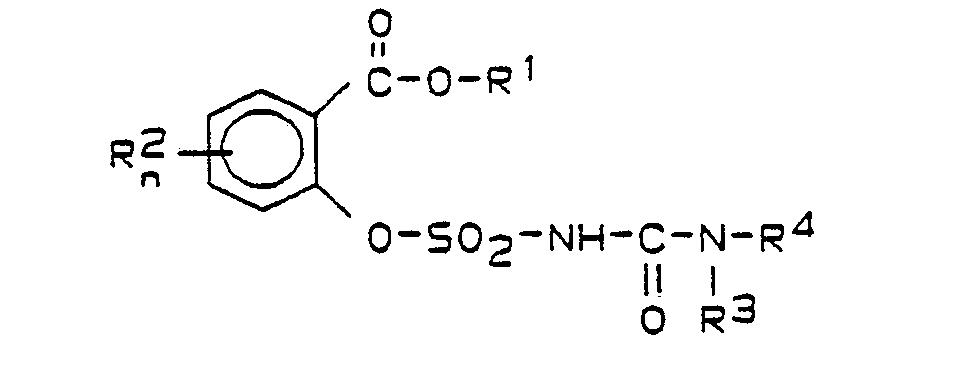
- R' substituiertes Alkyl; (subst.) Alkenyl; (subst.) Alkinyl; R2 Halogen; Nitro; (subst.) Alkyl oder (subst.) Alkoxy; R3 Wasserstoff; Alkyl; Alkenyl oder Alkinyl; R4 einen heterocyclischen Rest der Formeln
Description
- Es ist bekannt, daß heterocyclisch substituierte Phenoxysulfonylharnstoffe herbizide und pflanzenwachstumsregulierende Eigenschaften aufweisen (s. EP-A 4163, EP-A 165572).
- Diese weisen jedoch bei ihrer Anwendung Nachteile auf, wie beispielsweise eine hohe Persistenz oder unzureichende Selektivität.
- Es wurde nun gefunden, daß heterocyclisch substituierte Sulfamidsäurephenylester, die im Phenylesterteil spezielle Alkoxycarbonylgruppen enthalten, als Herbizide und Pflanzenwachstumsregulatoren besonders geeignet sind.
- Gegenstand der vorliegenden Erfindung sind daher Verbindungen der Formel (I) oder deren Salze

- R' (C1-C8)-Alkyl, das ein- oder mehrfach durch Halogen oder ein- bis zweifach durch (Ci-C4)-Alkoxy substituiert ist; (C2-C8)-Alkenyl, (C2-Cs)-Alkinyl, die beide gegebenenfalls ein- oder mehrfach durch Halogen oder ein- bis zweifach durch (C2-C4)-Alkoxy substituiert sein können,
- R2 unabhängig voneinander Halogen; Nitro; (C1-C4)-Alkyl oder (C1-C4)-Alkoxy, die beide gegebenenfalls ein- oder mehrfach durch Halogen substituiert sein können,
- R3 Wasserstoff; (C1-C8)-Alkyl; (C2-C8)-Alkenyl oder (C2-C8)-Alkinyl,
- R4 . einen heterocyclischen Rest der Formeln

- n 0, 1, 2 oder 3,
- R5,R6 unabhängig voneinander Wasserstoff; Halogen; (Ci-C4)-Alkyl oder (C1-C4)-Alkoxy, die beide gegebenenfalls ein- oder mehrfach halogeniert sein können; Di-(C1-C4)-alkoxy-(C1-C2)-alkyl; Cyclopropyl, -OCHR8COOR9; -NR9R10 oder (C1-C4)-Alkylthio,
- R7 (C1-C4)-Alkyl,
- R8 Wasserstoff oder (C1-C4)-Alkyl und
- R9,R10 unabhängig voneinander Wasserstoff; (C1-C4)-Alkyl; (C2-C4)-Alkenyl oder (C2-C4)-Alkinyl bedeuten.
- Die Verbindungen der Formel I können Salze bilden, bei denen der Wasserstoff der -SO2-NH-Gruppe durch ein für die Landwirtschaft geeignetes Kation ersetzt wird. Diese Salze sind im allgemeinen Metall-, insbesondere Alkali-, Erdalkali-, gegebenenfalls alkylierte Ammonium- oder organische Aminsalze. Sie werden vorzugsweise in inerten Lösungsmitteln wie z. B. Wasser, Methanol oder Aceton bei Temperaturen von 0 - 100 C hergestellt. Geeignete Basen zur Herstellung der erfindungsgemäßen Salze sind beispielsweise Alkalicarbonate, wie Kaliumcarbonat, Alkali- und Erdalkalihydroxide, Ammoniak oder Ethanolamin.
- Bevorzugte Verbindungen der Formel 1 sind solche, bei denen R' (C1-C4)-Alkyl, das wie oben beschrieben substituiert ist, oder (C3-C4)-Alkenyl, das wie oben beschrieben substituiert sein kann oder Propargyl; R2 Halogen, (C1-C3)-Alkyl oder (C1-C3)-Alkoxy, die wie oben beschrieben substituiert sein können, wobei R2 bevorzugt in Position 3 (bezogen auf den Rest COOR') des Phenylrings orientiert ist; n = 0, 1 oder 2; R3 Wasserstoff, (C1-C4) Alkyl oder Allyl; R4 einen Rest der Formel

- Halogen bedeutet vorzugsweise Fluor, Chlor oder Brom. Unter halogeniertem Alkyl oder halogeniertem Alkoxy sind insbesondere zu verstehen die Reste CF3, CH2-CH2CI, CH2CH2Br, CH2CF3, OCF2H, OCH2CF3 Halogeniertes Alkenyl oder halogeniertes Alkinyl bedeutet insbesondere CH2CH=CHCI, CH2CCl=CCl2, CH2-C≡CCH2-Cl.
- Besonders bevorzugte Verbindungen der Formel (I) sind solche, worin R1 (C1-C4)-Alkyl, das wie oben beschrieben substituiert ist, oder (C3-C4)-Alkenyl, das wie oben beschrieben substituiert sein kann oder Propargyl, insbesondere Allyl oder Propargyl; n = 0; R3 Wasserstoff, R4 einen Rest der Formel

- Weiterer Gegenstand der vorliegenden Erfindung sind Verfahren zur Herstellung von Verbindungen der allgemeinen Formel (1), dadurch gekennzeichnet, daß man
- (a) eine Verbindung der Formel (II)


- (b) eine Verbindung der Formel (IV)


- (c) eine substituierte Benzoesäure der Formel (VI)


- Die Umsetzung der Verbindungen der Formeln (11) und (111) erfolgt vorzugsweise in inerten aprotischen Lösungsmitteln, wie z. B. Acetonitril, Dichlormethan, Toluol, Tetrahydrofuran oder Dioxan bei Temperaturen zwischen 0 C und der Siedetemperatur des Lösungsmittels.
- Die Phenoxysulfonylisocyanate der Formel (11) lassen sich nach im Prinzip bekannten Verfahren aus den entsprechenden Salicylsäureestern der Formel (IV) und Chlorsulfonylisocyanat in einfacher Weise herstellen (vgl. G. Lohaus, Chem. Ber. 105, 2791 (1972)).
- Die Ausgangsstoffe der Formel (III) sind bekannt oder lassen sich nach im Prinzip bekannten Verfahren herstellen, z. B. durch Cyclisierung entsprechender Guanidinderivate mit entsprechend substituierten 1,3-Diketonen, vergleiche z. B. "The Chemistry of Heterocyclic Compounds", Vol. XVI (1962) and Supplement I (1970), oder durch Derivatisierung von Cyanurchlorid, vgl. z. B. "The Chemistry of Heterocyclic Compounds", L. Rapaport: "s-Triazines and Derivates" (1959).
- Die Umsetzung der Verbindungen (IV) mit den Chlorsulfonylharnstoffen (V) führt man vorzugsweise in inerten Lösungsmitteln wie z. B. Dichlormethan, Tetrahydrofuran, Dioxan oder Dimethoxyethan bei Temperaturen zwischen -10 C und 80 C in Gegenwart einer Base als HCI-bindendes Agens durch. Als Basen können Alkali- oder Erdalkalicarbonate bzw. -bicarbonate wie z. B. K2C03, NaHCO3, Na2C03 oder tertiäre Amine wie z. B. Pyridin oder Triethylamin eingesetzt werden.
- Die Salicylsäureester (IV) sind literaturbekannt oder können nach literaturbekannten Verfahren hergestellt werden. Die Chlorsulfonylharnstoffe (V) sind aus den Aminen der Formel (111) und Chlorsulfonylisocyanat zugänglich (EP-A 141 199).
- Die Umsetzung der Benzoesäuren (VI) mit den Reagentien der Formel (VII) wird in inerten Lösungsmitteln wie z. B. Dimethylformamid oder Dimethylsulfoxid, vorzugsweise in Gegenwart einer Hilfsbase wie z. B. Triethylamin oder Tetramethylammoniumhydroxidpentahydrat, bei Temperaturen zwischen 0°C und der Siedetemperatur des Lösungsmittels durchgeführt.
- Die erfindungsgemäßen Verbindungen der Formel I weisen eine ausgezeichnete herbizide Wirksamkeit gegen ein breites Spektrum wirtschaftlich wichtiger mono- und dikotyler Schadpflanzen auf. Auch schwer bekämpfbare perennierende Unkräuter, die aus Rhizomen, Wurzelstöckchen oder anderen Dauerorganen austreiben, werden durch die Wirkstoffe gut erfaßt. Dabei ist es gleichgültig, ob die Substanzen im Vorsaat-, Vorauflauf- oder Nachauflaufverfahren ausgebracht werden. Im Einzelnen seien beispielhaft einige Vertreter der mono- und dikotylen Unkrautflora genannt, die durch die erfindungsgemäßen Verbindungen kontrolliert werden können, ohne daß durch die Nennung eine Beschränkung auf bestimmte Arten erfolgen soll.
- Auf der Seite der monokotylen Unkrautarten werden z. B. Avena, Lolium, Alopecurus, Phalaris, Echinochloa, Digitaria, Setaria etc. sowie Cyperusarten aus der annuellen Gruppe und auf seiten der perennierenden Spezies Agropyron, Cynodon, Imperata sowie Sorghum etc. und auch ausdauernde Cyperusarten gut erfaßt.
- Bei dikotylen Unkrautarten erstreckt sich das Wirkungsspektrum auf Arten wie z. B. Galium, Viola, Veronica, Lamium, Stellaria, Amaranthus, Sinapis, Ipomoea, Matricaria, Abutilon, Sida etc. auf der annuellen Seite sowie Convolvulus, Cirsium, Rumex, Artemisia etc. bei den Perennierenden.
- Unter den spezifischen Kulturbedingungen im Reis vorkommenden Unkräuter wie z. B. Sagittaria, Alisma, Eleocharis, Scirpus, Cyperus etc. werden von den erfindungsgemäßen Wirkstoffen ebenfalls hervorragend bekämpft.
- Werden die erfindungsgemäßen Verbindungen vor dem Keimen auf die Erdoberfläche appliziert, so wird entweder das Auflaufen der Unkrautkeimlinge vollständig verhindert, oder die Unkräuter wachsen bis zum Keimblattstadium heran, stellen jedoch dann ihr Wachstum ein und sterben schließlich nach Ablauf von drei bis vier Wochen vollkommen ab. Bei Applikation der Wirkstoffe auf die grünen Pflanzenteile im Nachauflaufverfahren tritt ebenfalls sehr rasch nach der Behandlung ein drastischer Wachstumsstop ein, und die Unkrautpflanzen bleiben in dem zum Applikationszeitpunkt vorhandenen Wuchsstadium stehen oder sterben nach einer gewissen Zeit mehr oder weniger schnell ab, so daß auf diese Weise eine für die Kulturpflanzen schädliche Unkrautkonkurrenz sehr früh und nachhaltig durch den Einsatz der neuen erfindungsgemäßen Verbindungen beseitigt werden kann.
- Obgleich die erfindungsgemäßen Verbindungen eine ausgezeichnete herbizide Aktivität gegenüber mono- und dikotylen Unkräutern aufweisen, werden Kulturpflanzen wirtschaftlich bedeutender Kulturen wie z.B. Weizen, Gerste, Roggen, Reis, Mais, Zuckerrüber, Baumwolle und Soja nur unwesentlich oder gar nicht geschädigt. Die vorliegenden Verbindungen eignen sich aus diesen Gründen sehr gut zur selektiven Bekämpfung von unerwünschtem Pflanzenwuchs in landwirtschaftlichen Nutzpflanzungen.
- Darüber hinaus weisen die erfindungsgemäßen Verbindungen wachstumsregulatorische Eigenschaften bei Kulturpflanzen auf. Sie greifen regulierend in den pflanzeneigenen Stoffwechsel ein und können damit zur Ernteerleichterung wie z.B. durch Auslösen von Desikkation, Abszission und Wuchsstauchung eingesetzt werden. Desweiteren eignen sie sich auch zur generellen Steuerung und Hemmung von unerwünschtem vegetativen Wachstum, ohne dabei die Pflanzen abzutöten. Eine Hemmung des vegetativen Wachstums spielt bei vielen mono- und dikotylen Kulturen eine große Rolle, da das Lagern hierdurch verringert oder völlig verhindert werden kann.
- Die erfindungsgemäßen Mittel können als Spritzpulver, emulgierbaren Konzentrate, verspruhbare Lösungen, Stäubemittel, Beizmittel, Dispersionen, Granulate oder Mikrogranulate in den üblichen Zubereitungen angewendet werden.
- Spritzpulver sind in Wasser gleichmäßig dispergierbare Präparate, die neben dem Wirkstoff außer gegebenenfalls einem Verdünnungs- oder Inertstoff noch Netzmittel, z.B. polyoxethylierte Alkylphenole, polyoxethylierte Fettalkohole, Alkyl- oder Alkylphenylsulfonate und Dispergiermittel, z.B. ligninsulfonsaures Natrium, 2,2'-dinaphthylmethan-6,6 -disulfonsaures Natrium, dibutylnaphthalinsulfonsaures Natrium oder auch oleoylmethyltaurinsaures Natrium enthalten. Die Herstellung erfolgt in üblicher Weise, z.B. durch Mahlen und Vermischen der Komponenten.
- Emulgierbare Konzentrate können z.B. durch Auflösen des Wirkstoffes in einem inerten organischen Lösungsmittel, z.B. Butanol, Cyclohexanon, Dimethylformamid, Xylol oder auch höhersiedenden Aromaten oder Kohlenwasserstoffen unter Zusatz von einem oder mehreren Emulgatoren hergestellt werden. Bei flüssigen Wirkstoffen kann der Lösungsmittelanteil auch ganz oder teilweise entfallen. Als Emulgatoren können beispielsweise verwendet werden: Alkylarylsulfonsaure Calciumsalze wie Ca-dodecylbenzolsulfonat oder nichtionische Emulgatoren wie Fettsäurepolyglykolester, Alkyl-arylpolyglykolether, Fettalkoholpolyglykolether, Propylenoxid-Ethylenoxid-Kondensationsprodukte, Fettalkohol-Propylenoxid-Ethylenoxid-Kondensationsprodukte, Alkylpolyglykolether, Sorbitanfettsäureester, Polyoxethylensorbitanfettsäureester oder Polyoxethylensorbitester.
- Stäubemittel kann man durch Vermahlen des Wirkstoffes mit feinverteilten, festen Stoffen z.B. Talkum, natürlichen Tonen wie Kaolin, Bentonit, Pyrophillit oder Diatomeenerde erhalten.
- Granulate können entweder durch Verdüsen des Wirkstoffes auf adsorptionsfähiges, granuliertes Inertmaterial hergestellt werden oder durch Aufbringen von Wirkstoffkonzentrationen mittels Bindemitteln, z.B. Polyvinylalkohol, polyacrylsaurem Natrium oder auch Mineralölen auf die Oberfläche von Trägerstoffen wie Sand, Kaolinite oder von granuliertem Inertmaterial. Auch können geeignete Wirkstoffe in der für die Herstellung von Düngemittelgranulaten üblichen Weise, gewünschtenfalls in Mischung mit Düngemitteln, granuliert werden.
- In Spritzpulvern beträgt die Wirkstoffkonzentration z.B. etwa 10 bis 90 Gew.-%, der Rest zu 100 Gew.- % besteht aus üblichen Formulierungsbestandteilen. Bei emulgierbaren Konzentraten kann die Wirkstoffkonzentration etwa 5 bis 80 Gew.-% betragen. Staubförmige Formulierungen enthalten meistens 5 bis 20 Gew.- % an Wirkstoff, versprühbare Lösungen etwa 2 bis 20 Gew.-%. Bei Granulaten hängt der Wirkstoffgehalt zum Teil davon ab, ob die wirksame Verbindung flüssig oder fest vorliegt und welche Granulierhilfsmittel, Füllstoffe usw. verwendet werden.
- Daneben enthalten die genannten Wirkstofformulierungen gegebenenfalls die jeweils üblichen Haft-, Netz-, Dispergier-, Emulgier-, Penetrations-, Lösungsmittel, Füll- oder Trägerstoffe.
- Zur Anwendung werden die in handelsüblicher Form vorliegenden Konzentrate gegebenenfalls in üblicher Weise verdünnt, z.B. bei Spritzpulvern, emulgierbaren Konzentraten, Dispersionen und teilweise auch bei Mikrogranulaten mittels Wasser. Staubförmige und granulierte Zubereitungen sowie versprühbare Lösungen werden vor der Anwendung üblicherweise nicht mehr mit weiteren inerten Stoffen verdünnt.
- Mit den äußeren Bedingungen wie Temperatur, Feuchtigkeit u.a. variiert die erforderliche Aufwandmenge. Sie kann innerhalb weiter Grenzen schwanken, z.B. zwischen 0,005 und 10,0 kg/ha oder mehr Aktivsubstanz, vorzugsweise liegt sie jedoch zwischen 0,01 und 5 kg/ha.
- Auch Mischungen oder Mischformulierungen mit anderen Wirkstoffen, wie z.B. Insektiziden, Akariziden, Herbiziden, Düngemitteln, Wachstumsregulatoren oder Fungiziden sind gegebenenfalls möglich.
- Die Erfindung wird durch nachstehende Beispiele näher erläutert.
- A. Ein Stäubemittel wird erhalten, indem man 10 Gewichtsteile Wirkstoff und 90 Gewichtsteile Talkum oder Inertstoff mischt und in einer Schlagmühle zerkleinert.
- B. Ein in Wasser leicht dispergierbares, benetzbares Pulver wird erhalten, indem man 25 Gewichtsteile Wirkstoff, 64 Gewichtsteile kaolinhaltigen Quarz als Inerstoff, 10 Gewichtsteile ligninsulfonsaures Kalium und 1 Gewichtsteil oleoylmethyltaurinsaures Natrium als Netz- und Dispergiermittel mischt und in seiner Stiftmühle mahlt.
- C. Ein in Wasser leicht dispergierbares Dispersionskonzentrat wird erhalten, indem man 20 Gewichtsteile Wirkstoff mit 6 Gewichtsteilen Alkylphenolpolyglykolether (Triton X 207), 3 Gewichtsteilen Isotridecanolpolyglykolether (8 AeO) und 71 Gewichtsteilen paraffinischem Mineralöl (Siedebereich z.B. ca. 255 bis über 377° C) mischt und in einer Reibkugelmühle auf eine Feinheit von unter 5 Mikron vermahlt.
- D. Ein emulgierbares Konzentrat wird erhalten aus 15 Gewichtsteilen Wirkstoff, 75 Gewichtsteilen Cyclohexanon als Lösungsmittel und 10 Gewichtsteilen oxethyliertes Nonylphenol (10 AeO) als Emulgator.
- Zu einer Lösung von 4,8 g (0,025 mol) 3-Methylsalicylsäureallylester in 25 ml abs. Toluol tropft man bei 250 C eine Lösung von 3,7 g (0,026 mol) Chlorsulfonylisocyanat in 25 ml abs. Toluol. Nach Beendigung des Zutropfens steigert man die Temperatur langsam auf 110°C und erhitzt 6 h unter Rückfluß. Man kühlt ab und entfernt das Lösungsmittel am Rotationsverdampfer. Das zurückbleibende gelbe Öl (7,5 g ≙ 100 % d. Th.) wird ohne weitere Reinigung eingesetzt.
- Zu 3,5 g (0,025 mol) 2-Amino-4-methoxy-6-methylpyrimidin in 15 ml Dichlormethan tropft man bei 0 C eine Lösung aus 7,5 g (0,025 mol) des Produkts aus Beispiel 1 in 20 ml Dichlormethan. Man läßt auf Raumtemperatur kommen und rührt 24 h nach. Die Reaktionslösung wird mit 100 ml Dichlormethan verdünnt und mit 50 ml 1 N Salzsäure und 50 ml Wasser gewaschen. Man trocknet die organische Phase mit Natriumsulfat und entfernt das Lösungsmittel am Rotationsverdampfer. Das hinterbleibende viskose Öl wird durch Verreiben mit 1-Chlorbutan kristallisiert. Man erhält 7,4 g (68 % d. Th.) 2-[3-(4-Methoxy-6-methylpyrimidin-2-yl)ureidosulfonyloxy]-3-methylbenzoesäureallylester vom Schmp. 127 - 128°C.
- 2-[3-(4,6-Dimethoxypyrimidin-2-yl)ureidosulfionyloxy]benzoesäure-2-chlorethylester
- 2,02 g (0,013 mol 2-Amino-4,6-dimethoxypyrimidin werden in 80 ml Dichlormethan gelöst und bei 0°C mit 4,28 g (0,014 mol) 2-Isocyanatosulfonyloxy-benzoesäure-2-chlorethylester - gelöst in 20 ml Dichlormethan - versetzt. Nach 18-stündigem Rühren bei Raumtemperatur wird das Reaktionsgemisch in 600 ml n-Heptan eingerührt. Man erhält auf diese Weise 4,72 g (79 % d. Th.)
- 2-[3-(4,6-Dimethoxypyrimidin-2-yl)ureidosulfonyloxy]benzoesäure-2-chlorethylester vom Schmp. 148 - 150°C.
- 1,55 g (0,01 mol) 2-Amino-4,6-dimethoxypyrimidin werden in 100 ml Dichlormethan gelöst und bei 0°C mit 3,40 g (0,012 mol) 2-Isocyanatosulfonyloxy-benzoesäureallylester - in 20 ml Dichlormethan gelöst - versetzt. Nach 18-stündigem Rühren bei Raumtemperatur erhält man durch Absaugen 2,54 g (58 % d. Th.) 2-[3-(4,6-Dimethoxypyrimidin-2-yl)-ureidosulfonyloxy]-benzoesäureallylester vom Schmp. 110 - 112°C.
- Die nachfolgenden Verbindungen lassen sich auf analoge Weise herstellen.


- Die Schädigung der Unkrautpflanzen bzw. die Kulturpflanzenverträglichkeit wurde gemäß einem Schlüssel bonitiert, in dem die Wirksamkeit durch Wertzahlen von 0 - 5 ausgedrückt ist. Dabei bedeutet:
- 0 = ohne Wirkung
- 1 = 0 - 20 % Wirkung bzw. Schaden
- 2 = 20 - 40 % Wirkung bzw. Schaden
- 3 = 40 - 60 % Wirkung bzw. Schaden
- 4 = 60 - 80 % Wirkung bzw. Schaden
- 5 = 80 - 100 % Wirkung bzw. Schaden
- Samen bzw. Rhizomstücke von mono- und dikotylen Unkrautpflanzen wurden in Plastiktöpfen in sandiger Lehmerde ausgelegt und mit Erde abgedeckt. Die in Form von benetzbaren Pulvern oder Emulsionskonzentraten formulierten erfindungsgemäßen Verbindungen wurden dann als wäßrige Suspensionen bzw. Emulsionen mit einer Wasseraufwandmenge von umgerechnet 600 - 800 I/ha in unterschiedlichen Dosierungen auf die Oberfläche der Abdeckerde appliziert.
- Nach der Behandlung wurden die Töpfe im Gewächshaus aufgestellt und unter guten Wachstumsbedingungen für die Unkräuter gehalten. Die optische Bonitur der Pflanzen- bzw. der Auflaufschäden erfolgte nach dem Auflaufen der Versuchspflanzen nach einer Versuchszeit von 3 - 4 Wochen im Vergleich zu unbehandelten Kontrollen. Wie die Boniturwerte in Tabelle 2 zeigen, weisen die erfindungsgemäßen Verbindungen eine gute herbizide Vorauflaufwirksamkeit gegen ein breites Spektrum von Ungräsern und Unkräutern auf.
- Samen bzw. Rhizomstücke von mono- und dikotylen Unkräutern wurden in Plastiktöpfen in sandigem Lehmboden ausgelegt, mit Erde abgedeckt und im Gewächshaus unter guten Wachstumsbedingungen angezogen. Drei Wochen nach der Aussaat wurden die Versuchspflanzen im Dreiblattstadium behandelt.
- Die als Spritzpulver bzw. als Emulsionskonzentrate formulierten erfindungsgemäßen Verbindungen wurden in verschiedenen Dosierungen mit einer Wasseraufwandmenge von umgerechnet 600 - 800 I/ha auf die grünen Pflanzenteile gesprüht und nach ca. 3 - 4 Wochen Standzeit der Versuchspflanzen im Gewächshaus unter optimalen Wachstumsbedingungen die Wirkung der Präparate optisch im Vergleich zu unbehandelten Kontrollen bonitiert.
- Die erfindungsgemäßen Mittel weisen auch im Nachauflauf eine gute herbizide Wirksamkeit gegen ein breites Spektrum wirtschaftlich wichtiger Ungräser und Unkräuter auf (Tabelle 3).
- In weiteren Versuchen im Gewächshaus wurden Samen einer größeren Anzahl von Kulturpflanzen und Unkräutern in sandigem Lehmboden ausgelegt und mit Erde abgedeckt.
- Ein Teil der Töpfe wurde sofort wie unter 1. beschrieben behandelt, die übrigen im Gewächshaus aufgestellt, bis die Pflanzen zwei bis drei echte Blätter entwickelt hatten und dann mit den erfindungsgemäßen Substanzen in unterschiedlichen Dosierungen, wie unter 2. beschrieben, besprüht.
- Vier bis fünf Wochen nach der Applikation und Standzeit im Gewächshaus wurde mittels optischer Bonitur festgestellt, daß die erfindungsgemäßen Verbindungen zweikeimblättrige Kulturen wie z. B. Soja, Baumwolle, Raps, Zuckerrüben und Kartoffeln im Vor- und Nachauflaufverfahren selbst bei hohen Wirkstoffdosierungen ungeschädigt ließen. Einige Substanzen schonten darüber hinaus auch Gramineen-Kulturen wie z. B. Gerste, Weizen, Roggen, Sorghum-Hirsen, Mais oder Reis. Die Verbindungen der Formel I weisen somit eine hohe Selektivität bei Anwendung zur Bekämpfung von unerwünschtem Pflanzenwuchs in landwirtschaftlichen Kulturen auf.


Claims (9)


Applications Claiming Priority (4)
| Application Number | Priority Date | Filing Date | Title |
|---|---|---|---|
| DE19873725939 DE3725939A1 (de) | 1987-08-05 | 1987-08-05 | Heterocylisch substituierte sulfamidsaeurephenylester, verfahren zu ihrer herstellung und ihre verwendung als herbizide und pflanzenwachstumsregulatoren |
| DE3725939 | 1987-08-05 | ||
| DE19883806323 DE3806323A1 (de) | 1988-02-27 | 1988-02-27 | Heterocyclisch substituierte sulfamidsaeurephenylester, verfahren zu ihrer herstellung und ihre verwendung als herbizide und pflanzenwachstumsregulatoren |
| DE3806323 | 1988-02-27 |
Publications (3)
| Publication Number | Publication Date |
|---|---|
| EP0303114A2 true EP0303114A2 (de) | 1989-02-15 |
| EP0303114A3 EP0303114A3 (de) | 1991-04-17 |
| EP0303114B1 EP0303114B1 (de) | 1994-08-24 |
Family
ID=25858296
Family Applications (1)
| Application Number | Title | Priority Date | Filing Date |
|---|---|---|---|
| EP88112280A Expired - Lifetime EP0303114B1 (de) | 1987-08-05 | 1988-07-29 | Heterocyclisch substituierte Sulfamidsäurephenylester, Verfahren zu ihrer Herstellung und ihre Verwendung als Herbizide und Pflanzenwachstumsregulatoren |
Country Status (12)
| Country | Link |
|---|---|
| US (1) | US4963180A (de) |
| EP (1) | EP0303114B1 (de) |
| JP (1) | JP2805199B2 (de) |
| KR (1) | KR890003712A (de) |
| CN (1) | CN1026413C (de) |
| AU (1) | AU616191B2 (de) |
| BR (1) | BR8803868A (de) |
| DE (1) | DE3851188D1 (de) |
| ES (1) | ES2061570T3 (de) |
| HU (1) | HU201025B (de) |
| IL (1) | IL87355A (de) |
| PH (1) | PH26072A (de) |
Cited By (2)
| Publication number | Priority date | Publication date | Assignee | Title |
|---|---|---|---|---|
| EP0388771A1 (de) * | 1989-03-18 | 1990-09-26 | Hoechst Schering AgrEvo GmbH | Phenoxysulfonylharnstoffe auf Basis von 3-substituierten Salicylsäurealkylestern, Verfahren zu ihrer Herstellung und ihre Verwendung als Herbizide und Pflanzenwachstumsregulatoren |
| EP0661276A1 (de) * | 1993-11-05 | 1995-07-05 | Bayer Ag | Substituierte Phenylaminosulfonylharnstoffe mit herbizider Wirkung |
Families Citing this family (3)
| Publication number | Priority date | Publication date | Assignee | Title |
|---|---|---|---|---|
| EP0507093B1 (de) * | 1991-03-07 | 1996-06-19 | Hoechst Schering AgrEvo GmbH | Verfahren zur Herstellung von Sulfonylharnstoffen |
| CA2822296A1 (en) | 2010-12-21 | 2012-06-28 | Bayer Cropscience Lp | Sandpaper mutants of bacillus and methods of their use to enhance plant growth, promote plant health and control diseases and pests |
| MX2014002890A (es) | 2011-09-12 | 2015-01-19 | Bayer Cropscience Lp | Metodo para mejorar la salud y/o promover el crecimiento de una planta y/o mejorar la maduracion de frutos. |
Family Cites Families (13)
| Publication number | Priority date | Publication date | Assignee | Title |
|---|---|---|---|---|
| US4191553A (en) * | 1978-03-02 | 1980-03-04 | E. I. Du Pont De Nemours And Company | Herbicidal sulfamates |
| AU550445B2 (en) * | 1978-11-08 | 1986-03-20 | Data General Corporation | High speed digital computer system |
| ZA806970B (en) * | 1979-11-30 | 1982-06-30 | Du Pont | Agricultural sulfonamides |
| DE3105453A1 (de) * | 1981-02-14 | 1982-10-21 | Hoechst Ag, 6000 Frankfurt | Phenyl- bzw. phenoxysulfonyl-pyrimidyl-harnstoffe, verfahren zu ihrer herstellung und ihre verwendung als herbizide und pflanzenwuchstumsregulatoren |
| JPS5815962A (ja) * | 1981-07-21 | 1983-01-29 | Mitsui Toatsu Chem Inc | 新規スルホニルウレイド誘導体 |
| DK536582A (da) * | 1981-12-07 | 1983-06-08 | Du Pont | Herbicide sulfonamider |
| DE3151450A1 (de) * | 1981-12-24 | 1983-07-14 | Celamerck Gmbh & Co Kg, 6507 Ingelheim | N-phenoxysulfonylharnstoffe, ihre herstellung und verwendung |
| DE3225471A1 (de) * | 1982-07-08 | 1984-01-12 | Hoechst Ag, 6230 Frankfurt | Neue heterocyclisch substituierte sulfonylharnstoffe, verfahren zu ihrer herstellung und ihre verwendung in der landwirtschaft |
| EP0098569A3 (de) * | 1982-07-08 | 1984-12-19 | Hoechst Aktiengesellschaft | Neue heterocyclisch substituierte Sulfonylharnstoffe, Verfahren zu ihrer Herstellung und ihre Verwendung in der Landwirtschaft |
| US4534790A (en) * | 1982-10-07 | 1985-08-13 | E. I. Du Pont De Nemours And Company | Herbicidal sulfonamides |
| EP0135332B1 (de) * | 1983-08-05 | 1988-12-07 | E.I. Du Pont De Nemours And Company | Herbizid wirkende Benzolsulfonamide, Benzylsulfonamide und Benzolsulfamate |
| DE3422824A1 (de) * | 1984-06-20 | 1986-01-02 | Celamerck Gmbh & Co Kg, 6507 Ingelheim | Neue herbizid wirksame sulfonylharnstoffe |
| US4678500A (en) * | 1984-06-29 | 1987-07-07 | E. I. Du Pont De Nemours And Company | Herbicidal 2,6-disubstituted benzylsulfonamides and benzenesulfamates |
-
1988
- 1988-07-29 ES ES88112280T patent/ES2061570T3/es not_active Expired - Lifetime
- 1988-07-29 EP EP88112280A patent/EP0303114B1/de not_active Expired - Lifetime
- 1988-07-29 DE DE3851188T patent/DE3851188D1/de not_active Expired - Fee Related
- 1988-08-03 PH PH37334A patent/PH26072A/en unknown
- 1988-08-03 US US07/228,000 patent/US4963180A/en not_active Expired - Fee Related
- 1988-08-03 JP JP63192875A patent/JP2805199B2/ja not_active Expired - Lifetime
- 1988-08-04 IL IL87355A patent/IL87355A/xx not_active IP Right Cessation
- 1988-08-04 HU HU884090A patent/HU201025B/hu not_active IP Right Cessation
- 1988-08-04 KR KR1019880009934A patent/KR890003712A/ko not_active Ceased
- 1988-08-04 BR BR8803868A patent/BR8803868A/pt unknown
- 1988-08-04 AU AU20424/88A patent/AU616191B2/en not_active Ceased
- 1988-08-04 CN CN88104794A patent/CN1026413C/zh not_active Expired - Fee Related
Cited By (2)
| Publication number | Priority date | Publication date | Assignee | Title |
|---|---|---|---|---|
| EP0388771A1 (de) * | 1989-03-18 | 1990-09-26 | Hoechst Schering AgrEvo GmbH | Phenoxysulfonylharnstoffe auf Basis von 3-substituierten Salicylsäurealkylestern, Verfahren zu ihrer Herstellung und ihre Verwendung als Herbizide und Pflanzenwachstumsregulatoren |
| EP0661276A1 (de) * | 1993-11-05 | 1995-07-05 | Bayer Ag | Substituierte Phenylaminosulfonylharnstoffe mit herbizider Wirkung |
Also Published As
| Publication number | Publication date |
|---|---|
| PH26072A (en) | 1992-02-06 |
| IL87355A0 (en) | 1989-01-31 |
| CN1026413C (zh) | 1994-11-02 |
| EP0303114B1 (de) | 1994-08-24 |
| ES2061570T3 (es) | 1994-12-16 |
| EP0303114A3 (de) | 1991-04-17 |
| US4963180A (en) | 1990-10-16 |
| BR8803868A (pt) | 1989-02-21 |
| HU201025B (en) | 1990-09-28 |
| AU2042488A (en) | 1989-02-09 |
| JPS6450864A (en) | 1989-02-27 |
| CN1032006A (zh) | 1989-03-29 |
| IL87355A (en) | 1993-02-21 |
| JP2805199B2 (ja) | 1998-09-30 |
| AU616191B2 (en) | 1991-10-24 |
| KR890003712A (ko) | 1989-04-17 |
| DE3851188D1 (de) | 1994-09-29 |
| HUT49861A (en) | 1989-11-28 |
Similar Documents
| Publication | Publication Date | Title |
|---|---|---|
| EP0342569B1 (de) | Heterocyclische 2-Alkoxyphenoxysulfonylharnstoffe und ihre Verwendung als Herbizide oder Pflanzenwachstumsregulatoren | |
| EP0131258B1 (de) | Neue N-Alkoxy- N-Alkylsulfonylaminosulfonylharnstoffe, und neue (Pyrimido) Triazino-thiatriazinoxide als Vorprodukte | |
| EP0510032B1 (de) | Pyridylsulfonylharnstoffe als herbizide und pflanzenwachstumsregulatoren, verfahren zu ihrer herstellung und ihre verwendung | |
| EP0521500A1 (de) | Salze von Pyridylsulfonylharnstoffen als Herbizide und Pflanzenwachstumsregulatoren, Verfahren zu ihrer Herstellung und ihre Verwendung | |
| EP0347788B1 (de) | Substituierte Sulfonyldiamide, Verfahren zu ihrer Herstellung und ihre Verwendung als Herbizide und Pflanzenwachstumsregulatoren | |
| EP0353641B1 (de) | Heterozyklisch substituierte Sulfonylharnstoffe, Verfahren zu ihrer Herstellung und ihre Verwendung als Herbizide oder Pflanzenwachstumsregulatoren | |
| EP0336354B1 (de) | Heterocyclisch substituierte Alkyl- und Alkenylsulfonylharnstoffe, Verfahren zu ihrer Herstellung und ihre Verwendung als Herbizide oder Pflanzenwachstumsregulatoren | |
| EP0342568B1 (de) | Heterocyclisch substituierte Phenoxysulfonylharnstoffe, Verfahren zu ihrer Herstellung und ihre Verwendung als Herbizide oder Pflanzenwachstumsregulatoren | |
| EP0216243A2 (de) | N-Substituierte 3,4,5,6-Tetrahydrophthalimide, Verfahren zu ihrer Herstellung sowie ihre Verwendung im Pflanzenschutz | |
| DE3714373A1 (de) | Substituierte tetrahydrophthalimide, verfahren zu ihrer herstellung und ihre verwendung als herbizide | |
| EP0303114B1 (de) | Heterocyclisch substituierte Sulfamidsäurephenylester, Verfahren zu ihrer Herstellung und ihre Verwendung als Herbizide und Pflanzenwachstumsregulatoren | |
| EP0319689B1 (de) | Heterocyclisch substituierte N-Sultam-sulfonamide, Verfahren zu ihrer Herstellung und ihre Verwendung als Herbizide und Pflanzenwachstumsregulatoren | |
| EP0409114B1 (de) | Heterocyclisch substituierte Sulfonylharnstoffe, Verfahren zu ihrer Herstellung und ihre Verwendung als Herbizide oder Pflanzenwachstumsregulatoren | |
| EP0215424A2 (de) | Neue 2-Aryl-4,5,6,7-tetrahydroisoindolinone, Verfahren zu ihrer Herstellung sowie ihre Verwendung im Pflanzenschutz | |
| EP0388771B1 (de) | Phenoxysulfonylharnstoffe auf Basis von 3-substituierten Salicylsäurealkylestern, Verfahren zu ihrer Herstellung und ihre Verwendung als Herbizide und Pflanzenwachstumsregulatoren | |
| EP0464838B1 (de) | Substituierte Sulfonylalkylsulfonylharnstoffe, Verfahren zu ihrer Herstellung und ihre Verwendung als Herbizide und Pflanzenwachstumsregulatoren | |
| EP0863706B1 (de) | Verfahren zur bekämpfung von unerwünschtem pflanzenwuchs in reiskulturen | |
| DE3807532A1 (de) | Pyrimidin-carbonsaeuren, verfahren zur herstellung und ihre verwendung als herbizide | |
| DE3725939A1 (de) | Heterocylisch substituierte sulfamidsaeurephenylester, verfahren zu ihrer herstellung und ihre verwendung als herbizide und pflanzenwachstumsregulatoren | |
| DE3709340A1 (de) | Neue heterocyclisch substituierte benzylsulfonamide, verfahren zu ihrer herstellung und ihre verwendung als herbizide und pflanzenwachstumsregulatoren | |
| DE3806323A1 (de) | Heterocyclisch substituierte sulfamidsaeurephenylester, verfahren zu ihrer herstellung und ihre verwendung als herbizide und pflanzenwachstumsregulatoren | |
| EP0322707A2 (de) | 3-Phenoxy-phenylessigsäurederivate, Verfahren zu ihrer Herstellung und ihre Verwendung als Herbizide | |
| DE4022934A1 (de) | Heterocyclisch substituierte sulfonylharnstoffe, verfahren zu ihrer herstellung und ihre verwendung als herbizide oder pflanzenwachstumsregulatoren | |
| DE4122905A1 (de) | Pyridylsulfonylharnstoffe als herbizide und pflanzenwachstumsregulatoren, verfahren zu ihrer herstellung und ihre verwendung |
Legal Events
| Date | Code | Title | Description |
|---|---|---|---|
| PUAI | Public reference made under article 153(3) epc to a published international application that has entered the european phase |
Free format text: ORIGINAL CODE: 0009012 |
|
| AK | Designated contracting states |
Kind code of ref document: A2 Designated state(s): BE CH DE ES FR GB IT LI NL |
|
| 17P | Request for examination filed |
Effective date: 19901221 |
|
| PUAL | Search report despatched |
Free format text: ORIGINAL CODE: 0009013 |
|
| AK | Designated contracting states |
Kind code of ref document: A3 Designated state(s): BE CH DE ES FR GB IT LI NL |
|
| 17Q | First examination report despatched |
Effective date: 19921207 |
|
| RAP1 | Party data changed (applicant data changed or rights of an application transferred) |
Owner name: HOECHST SCHERING AGREVO GMBH |
|
| GRAA | (expected) grant |
Free format text: ORIGINAL CODE: 0009210 |
|
| AK | Designated contracting states |
Kind code of ref document: B1 Designated state(s): BE CH DE ES FR GB IT LI NL |
|
| RBV | Designated contracting states (corrected) |
Designated state(s): CH DE ES FR GB IT LI |
|
| REF | Corresponds to: |
Ref document number: 3851188 Country of ref document: DE Date of ref document: 19940929 |
|
| ITF | It: translation for a ep patent filed | ||
| GBT | Gb: translation of ep patent filed (gb section 77(6)(a)/1977) |
Effective date: 19941031 |
|
| REG | Reference to a national code |
Ref country code: ES Ref legal event code: FG2A Ref document number: 2061570 Country of ref document: ES Kind code of ref document: T3 |
|
| ET | Fr: translation filed | ||
| PGFP | Annual fee paid to national office [announced via postgrant information from national office to epo] |
Ref country code: FR Payment date: 19950621 Year of fee payment: 8 |
|
| PLBE | No opposition filed within time limit |
Free format text: ORIGINAL CODE: 0009261 |
|
| STAA | Information on the status of an ep patent application or granted ep patent |
Free format text: STATUS: NO OPPOSITION FILED WITHIN TIME LIMIT |
|
| PGFP | Annual fee paid to national office [announced via postgrant information from national office to epo] |
Ref country code: GB Payment date: 19950626 Year of fee payment: 8 Ref country code: CH Payment date: 19950626 Year of fee payment: 8 |
|
| PGFP | Annual fee paid to national office [announced via postgrant information from national office to epo] |
Ref country code: ES Payment date: 19950712 Year of fee payment: 8 |
|
| 26N | No opposition filed | ||
| BERE | Be: lapsed |
Owner name: HOECHST SCHERING AGREVO G.M.B.H. Effective date: 19950731 |
|
| PG25 | Lapsed in a contracting state [announced via postgrant information from national office to epo] |
Ref country code: GB Effective date: 19960729 |
|
| PG25 | Lapsed in a contracting state [announced via postgrant information from national office to epo] |
Ref country code: ES Free format text: LAPSE BECAUSE OF EXPIRATION OF PROTECTION Effective date: 19960730 |
|
| PG25 | Lapsed in a contracting state [announced via postgrant information from national office to epo] |
Ref country code: LI Effective date: 19960731 Ref country code: CH Effective date: 19960731 |
|
| REG | Reference to a national code |
Ref country code: CH Ref legal event code: PL |
|
| GBPC | Gb: european patent ceased through non-payment of renewal fee |
Effective date: 19960729 |
|
| PG25 | Lapsed in a contracting state [announced via postgrant information from national office to epo] |
Ref country code: FR Effective date: 19970328 |
|
| REG | Reference to a national code |
Ref country code: FR Ref legal event code: ST |
|
| PGFP | Annual fee paid to national office [announced via postgrant information from national office to epo] |
Ref country code: DE Payment date: 19980903 Year of fee payment: 11 |
|
| REG | Reference to a national code |
Ref country code: ES Ref legal event code: FD2A Effective date: 19991007 |
|
| PG25 | Lapsed in a contracting state [announced via postgrant information from national office to epo] |
Ref country code: DE Free format text: LAPSE BECAUSE OF NON-PAYMENT OF DUE FEES Effective date: 20000503 |
|
| PG25 | Lapsed in a contracting state [announced via postgrant information from national office to epo] |
Ref country code: IT Free format text: LAPSE BECAUSE OF NON-PAYMENT OF DUE FEES;WARNING: LAPSES OF ITALIAN PATENTS WITH EFFECTIVE DATE BEFORE 2007 MAY HAVE OCCURRED AT ANY TIME BEFORE 2007. THE CORRECT EFFECTIVE DATE MAY BE DIFFERENT FROM THE ONE RECORDED. Effective date: 20050729 |