EP0470489A1 - 4,5,6,7-Tetrahydro-3-aryl-indazole, Verfahren zu ihrer Herstellung und ihre Verwendung als Herbizide - Google Patents
4,5,6,7-Tetrahydro-3-aryl-indazole, Verfahren zu ihrer Herstellung und ihre Verwendung als Herbizide Download PDFInfo
- Publication number
- EP0470489A1 EP0470489A1 EP91112818A EP91112818A EP0470489A1 EP 0470489 A1 EP0470489 A1 EP 0470489A1 EP 91112818 A EP91112818 A EP 91112818A EP 91112818 A EP91112818 A EP 91112818A EP 0470489 A1 EP0470489 A1 EP 0470489A1
- Authority
- EP
- European Patent Office
- Prior art keywords
- formula
- alkyl
- compounds
- phenyl
- alkoxy
- Prior art date
- Legal status (The legal status is an assumption and is not a legal conclusion. Google has not performed a legal analysis and makes no representation as to the accuracy of the status listed.)
- Withdrawn
Links
- 239000004009 herbicide Substances 0.000 title claims abstract description 6
- 238000000034 method Methods 0.000 title claims description 21
- 238000002360 preparation method Methods 0.000 title claims description 11
- 150000001875 compounds Chemical class 0.000 claims abstract description 55
- 125000001997 phenyl group Chemical group [H]C1=C([H])C([H])=C(*)C([H])=C1[H] 0.000 claims abstract description 34
- -1 R1: H Chemical group 0.000 claims abstract description 30
- 229910052740 iodine Inorganic materials 0.000 claims abstract description 24
- 125000002252 acyl group Chemical group 0.000 claims abstract description 8
- 125000002915 carbonyl group Chemical group [*:2]C([*:1])=O 0.000 claims abstract description 8
- 125000003917 carbamoyl group Chemical group [H]N([H])C(*)=O 0.000 claims abstract description 5
- 230000009931 harmful effect Effects 0.000 claims abstract description 5
- 125000000882 C2-C6 alkenyl group Chemical group 0.000 claims abstract description 4
- 125000005100 aryl amino carbonyl group Chemical group 0.000 claims abstract description 4
- 125000005161 aryl oxy carbonyl group Chemical group 0.000 claims abstract description 4
- 125000003601 C2-C6 alkynyl group Chemical group 0.000 claims abstract description 3
- MYMOFIZGZYHOMD-UHFFFAOYSA-N Dioxygen Chemical compound O=O MYMOFIZGZYHOMD-UHFFFAOYSA-N 0.000 claims abstract description 3
- 229910052760 oxygen Inorganic materials 0.000 claims abstract description 3
- 239000001301 oxygen Substances 0.000 claims abstract description 3
- 229910052717 sulfur Inorganic materials 0.000 claims abstract description 3
- 125000004434 sulfur atom Chemical group 0.000 claims abstract description 3
- 229910052736 halogen Inorganic materials 0.000 claims description 11
- 150000002367 halogens Chemical class 0.000 claims description 11
- 125000004765 (C1-C4) haloalkyl group Chemical group 0.000 claims description 8
- 125000000217 alkyl group Chemical group 0.000 claims description 8
- 239000002904 solvent Substances 0.000 claims description 8
- 238000006243 chemical reaction Methods 0.000 claims description 6
- 239000002253 acid Chemical class 0.000 claims description 5
- 229910052799 carbon Inorganic materials 0.000 claims description 5
- 125000003178 carboxy group Chemical group [H]OC(*)=O 0.000 claims description 5
- HJSLFCCWAKVHIW-UHFFFAOYSA-N cyclohexane-1,3-dione Chemical class O=C1CCCC(=O)C1 HJSLFCCWAKVHIW-UHFFFAOYSA-N 0.000 claims description 5
- 229910052739 hydrogen Inorganic materials 0.000 claims description 5
- 125000002496 methyl group Chemical group [H]C([H])([H])* 0.000 claims description 5
- 125000006656 (C2-C4) alkenyl group Chemical group 0.000 claims description 4
- 125000003545 alkoxy group Chemical group 0.000 claims description 4
- 229940100198 alkylating agent Drugs 0.000 claims description 4
- 239000002168 alkylating agent Substances 0.000 claims description 4
- 238000009835 boiling Methods 0.000 claims description 4
- 125000000449 nitro group Chemical group [O-][N+](*)=O 0.000 claims description 4
- 125000004769 (C1-C4) alkylsulfonyl group Chemical group 0.000 claims description 3
- 125000004767 (C1-C4) haloalkoxy group Chemical class 0.000 claims description 3
- 125000006650 (C2-C4) alkynyl group Chemical group 0.000 claims description 3
- 150000002429 hydrazines Chemical class 0.000 claims description 3
- 239000003960 organic solvent Substances 0.000 claims description 3
- 125000004435 hydrogen atom Chemical group [H]* 0.000 claims description 2
- 230000002363 herbicidal effect Effects 0.000 abstract description 9
- 125000004169 (C1-C6) alkyl group Chemical group 0.000 abstract description 4
- 125000000171 (C1-C6) haloalkyl group Chemical group 0.000 abstract description 3
- 125000006527 (C1-C5) alkyl group Chemical group 0.000 abstract description 2
- 125000004191 (C1-C6) alkoxy group Chemical group 0.000 abstract description 2
- 125000000229 (C1-C4)alkoxy group Chemical group 0.000 abstract 1
- 235000013339 cereals Nutrition 0.000 abstract 1
- 241000196324 Embryophyta Species 0.000 description 32
- 239000000203 mixture Substances 0.000 description 23
- 239000008187 granular material Substances 0.000 description 16
- 238000009472 formulation Methods 0.000 description 15
- 239000004480 active ingredient Substances 0.000 description 14
- OKKJLVBELUTLKV-UHFFFAOYSA-N Methanol Chemical compound OC OKKJLVBELUTLKV-UHFFFAOYSA-N 0.000 description 12
- XLYOFNOQVPJJNP-UHFFFAOYSA-N water Substances O XLYOFNOQVPJJNP-UHFFFAOYSA-N 0.000 description 12
- LFQSCWFLJHTTHZ-UHFFFAOYSA-N Ethanol Chemical compound CCO LFQSCWFLJHTTHZ-UHFFFAOYSA-N 0.000 description 11
- 240000007594 Oryza sativa Species 0.000 description 11
- 239000000243 solution Substances 0.000 description 11
- 239000000126 substance Substances 0.000 description 11
- 235000007164 Oryza sativa Nutrition 0.000 description 9
- YXFVVABEGXRONW-UHFFFAOYSA-N Toluene Chemical compound CC1=CC=CC=C1 YXFVVABEGXRONW-UHFFFAOYSA-N 0.000 description 9
- 150000003254 radicals Chemical class 0.000 description 9
- 235000009566 rice Nutrition 0.000 description 9
- 230000000694 effects Effects 0.000 description 8
- 239000000839 emulsion Substances 0.000 description 7
- 239000002689 soil Substances 0.000 description 7
- HEMHJVSKTPXQMS-UHFFFAOYSA-M Sodium hydroxide Chemical compound [OH-].[Na+] HEMHJVSKTPXQMS-UHFFFAOYSA-M 0.000 description 6
- 239000004495 emulsifiable concentrate Substances 0.000 description 6
- 239000003995 emulsifying agent Substances 0.000 description 6
- 229920000151 polyglycol Polymers 0.000 description 6
- 239000010695 polyglycol Substances 0.000 description 6
- 125000002023 trifluoromethyl group Chemical group FC(F)(F)* 0.000 description 6
- 125000004178 (C1-C4) alkyl group Chemical group 0.000 description 5
- DGAQECJNVWCQMB-PUAWFVPOSA-M Ilexoside XXIX Chemical compound C[C@@H]1CC[C@@]2(CC[C@@]3(C(=CC[C@H]4[C@]3(CC[C@@H]5[C@@]4(CC[C@@H](C5(C)C)OS(=O)(=O)[O-])C)C)[C@@H]2[C@]1(C)O)C)C(=O)O[C@H]6[C@@H]([C@H]([C@@H]([C@H](O6)CO)O)O)O.[Na+] DGAQECJNVWCQMB-PUAWFVPOSA-M 0.000 description 5
- 244000038559 crop plants Species 0.000 description 5
- RTZKZFJDLAIYFH-UHFFFAOYSA-N ether Substances CCOCC RTZKZFJDLAIYFH-UHFFFAOYSA-N 0.000 description 5
- 230000012010 growth Effects 0.000 description 5
- 239000000843 powder Substances 0.000 description 5
- 239000011734 sodium Substances 0.000 description 5
- 229910052708 sodium Inorganic materials 0.000 description 5
- 241000234653 Cyperus Species 0.000 description 4
- LRHPLDYGYMQRHN-UHFFFAOYSA-N N-Butanol Chemical compound CCCCO LRHPLDYGYMQRHN-UHFFFAOYSA-N 0.000 description 4
- 241000209504 Poaceae Species 0.000 description 4
- VYPSYNLAJGMNEJ-UHFFFAOYSA-N Silicium dioxide Chemical compound O=[Si]=O VYPSYNLAJGMNEJ-UHFFFAOYSA-N 0.000 description 4
- 239000013543 active substance Substances 0.000 description 4
- 239000012141 concentrate Substances 0.000 description 4
- 239000003337 fertilizer Substances 0.000 description 4
- NLYAJNPCOHFWQQ-UHFFFAOYSA-N kaolin Chemical compound O.O.O=[Al]O[Si](=O)O[Si](=O)O[Al]=O NLYAJNPCOHFWQQ-UHFFFAOYSA-N 0.000 description 4
- 238000002844 melting Methods 0.000 description 4
- 230000008018 melting Effects 0.000 description 4
- 238000002156 mixing Methods 0.000 description 4
- 239000000047 product Substances 0.000 description 4
- 239000007921 spray Substances 0.000 description 4
- 239000004562 water dispersible granule Substances 0.000 description 4
- 239000004563 wettable powder Substances 0.000 description 4
- 239000005995 Aluminium silicate Substances 0.000 description 3
- 0 C*(CC1)Cc([n]nc2*)c2C1=* Chemical compound C*(CC1)Cc([n]nc2*)c2C1=* 0.000 description 3
- ZAMOUSCENKQFHK-UHFFFAOYSA-N Chlorine atom Chemical compound [Cl] ZAMOUSCENKQFHK-UHFFFAOYSA-N 0.000 description 3
- YMWUJEATGCHHMB-UHFFFAOYSA-N Dichloromethane Chemical compound ClCCl YMWUJEATGCHHMB-UHFFFAOYSA-N 0.000 description 3
- XEKOWRVHYACXOJ-UHFFFAOYSA-N Ethyl acetate Chemical compound CCOC(C)=O XEKOWRVHYACXOJ-UHFFFAOYSA-N 0.000 description 3
- ZMXDDKWLCZADIW-UHFFFAOYSA-N N,N-Dimethylformamide Chemical compound CN(C)C=O ZMXDDKWLCZADIW-UHFFFAOYSA-N 0.000 description 3
- ZMANZCXQSJIPKH-UHFFFAOYSA-N Triethylamine Chemical compound CCN(CC)CC ZMANZCXQSJIPKH-UHFFFAOYSA-N 0.000 description 3
- 235000012211 aluminium silicate Nutrition 0.000 description 3
- BTANRVKWQNVYAZ-UHFFFAOYSA-N butan-2-ol Chemical compound CCC(C)O BTANRVKWQNVYAZ-UHFFFAOYSA-N 0.000 description 3
- 239000000969 carrier Substances 0.000 description 3
- 239000000460 chlorine Substances 0.000 description 3
- 229910052801 chlorine Inorganic materials 0.000 description 3
- 239000002270 dispersing agent Substances 0.000 description 3
- 239000006185 dispersion Substances 0.000 description 3
- 150000002170 ethers Chemical class 0.000 description 3
- 150000002191 fatty alcohols Chemical class 0.000 description 3
- 239000000463 material Substances 0.000 description 3
- 229920003023 plastic Polymers 0.000 description 3
- 239000004033 plastic Substances 0.000 description 3
- 239000002244 precipitate Substances 0.000 description 3
- 239000007787 solid Substances 0.000 description 3
- 239000000080 wetting agent Substances 0.000 description 3
- NYOWYNSNCXRVNQ-UHFFFAOYSA-N 2,3,3a,4-tetrahydro-1h-indazole Chemical compound C1=CCC2CNNC2=C1 NYOWYNSNCXRVNQ-UHFFFAOYSA-N 0.000 description 2
- 125000004200 2-methoxyethyl group Chemical group [H]C([H])([H])OC([H])([H])C([H])([H])* 0.000 description 2
- 125000003903 2-propenyl group Chemical group [H]C([*])([H])C([H])=C([H])[H] 0.000 description 2
- 125000001494 2-propynyl group Chemical group [H]C#CC([H])([H])* 0.000 description 2
- NWSSWQWAQNPFRX-UHFFFAOYSA-N 3-(2-nitrophenyl)-1,5,6,7-tetrahydroindazol-4-one Chemical compound [O-][N+](=O)C1=CC=CC=C1C1=NNC2=C1C(=O)CCC2 NWSSWQWAQNPFRX-UHFFFAOYSA-N 0.000 description 2
- 241000219310 Beta vulgaris subsp. vulgaris Species 0.000 description 2
- 229920000742 Cotton Polymers 0.000 description 2
- 241000192043 Echinochloa Species 0.000 description 2
- 241000202829 Eleocharis Species 0.000 description 2
- PXGOKWXKJXAPGV-UHFFFAOYSA-N Fluorine Chemical compound FF PXGOKWXKJXAPGV-UHFFFAOYSA-N 0.000 description 2
- 235000010469 Glycine max Nutrition 0.000 description 2
- 241000219146 Gossypium Species 0.000 description 2
- JCXJVPUVTGWSNB-UHFFFAOYSA-N Nitrogen dioxide Chemical class O=[N]=O JCXJVPUVTGWSNB-UHFFFAOYSA-N 0.000 description 2
- 241000202758 Scirpus Species 0.000 description 2
- 244000082988 Secale cereale Species 0.000 description 2
- 235000007238 Secale cereale Nutrition 0.000 description 2
- UIIMBOGNXHQVGW-UHFFFAOYSA-M Sodium bicarbonate Chemical compound [Na+].OC([O-])=O UIIMBOGNXHQVGW-UHFFFAOYSA-M 0.000 description 2
- 240000006394 Sorghum bicolor Species 0.000 description 2
- 235000011684 Sorghum saccharatum Nutrition 0.000 description 2
- 235000021536 Sugar beet Nutrition 0.000 description 2
- DKGAVHZHDRPRBM-UHFFFAOYSA-N Tert-Butanol Chemical compound CC(C)(C)O DKGAVHZHDRPRBM-UHFFFAOYSA-N 0.000 description 2
- 240000008042 Zea mays Species 0.000 description 2
- 235000005824 Zea mays ssp. parviglumis Nutrition 0.000 description 2
- 235000002017 Zea mays subsp mays Nutrition 0.000 description 2
- 125000002777 acetyl group Chemical group [H]C([H])([H])C(*)=O 0.000 description 2
- 239000000853 adhesive Substances 0.000 description 2
- 230000001070 adhesive effect Effects 0.000 description 2
- 150000001298 alcohols Chemical class 0.000 description 2
- 150000001408 amides Chemical class 0.000 description 2
- 239000007900 aqueous suspension Substances 0.000 description 2
- 125000003118 aryl group Chemical group 0.000 description 2
- 239000011575 calcium Substances 0.000 description 2
- 125000004432 carbon atom Chemical group C* 0.000 description 2
- 239000003795 chemical substances by application Substances 0.000 description 2
- 239000000084 colloidal system Substances 0.000 description 2
- 235000005822 corn Nutrition 0.000 description 2
- JHIVVAPYMSGYDF-UHFFFAOYSA-N cyclohexanone Chemical compound O=C1CCCCC1 JHIVVAPYMSGYDF-UHFFFAOYSA-N 0.000 description 2
- 239000000428 dust Substances 0.000 description 2
- 238000005516 engineering process Methods 0.000 description 2
- 125000005745 ethoxymethyl group Chemical group [H]C([H])([H])C([H])([H])OC([H])([H])* 0.000 description 2
- 125000001495 ethyl group Chemical group [H]C([H])([H])C([H])([H])* 0.000 description 2
- 229910052731 fluorine Inorganic materials 0.000 description 2
- 239000011737 fluorine Substances 0.000 description 2
- 125000002485 formyl group Chemical group [H]C(*)=O 0.000 description 2
- 239000003630 growth substance Substances 0.000 description 2
- 125000004438 haloalkoxy group Chemical group 0.000 description 2
- 125000001188 haloalkyl group Chemical group 0.000 description 2
- 239000002917 insecticide Substances 0.000 description 2
- ZXEKIIBDNHEJCQ-UHFFFAOYSA-N isobutanol Chemical compound CC(C)CO ZXEKIIBDNHEJCQ-UHFFFAOYSA-N 0.000 description 2
- 125000001449 isopropyl group Chemical group [H]C([H])([H])C([H])(*)C([H])([H])[H] 0.000 description 2
- 239000007788 liquid Substances 0.000 description 2
- 238000004519 manufacturing process Methods 0.000 description 2
- VNWKTOKETHGBQD-UHFFFAOYSA-N methane Chemical compound C VNWKTOKETHGBQD-UHFFFAOYSA-N 0.000 description 2
- 125000004184 methoxymethyl group Chemical group [H]C([H])([H])OC([H])([H])* 0.000 description 2
- 239000002480 mineral oil Substances 0.000 description 2
- 239000003921 oil Substances 0.000 description 2
- 230000003287 optical effect Effects 0.000 description 2
- 210000000056 organ Anatomy 0.000 description 2
- 230000008635 plant growth Effects 0.000 description 2
- 238000010992 reflux Methods 0.000 description 2
- 125000002914 sec-butyl group Chemical group [H]C([H])([H])C([H])([H])C([H])(*)C([H])([H])[H] 0.000 description 2
- 229920005552 sodium lignosulfonate Polymers 0.000 description 2
- 238000009331 sowing Methods 0.000 description 2
- 241000894007 species Species 0.000 description 2
- 238000005507 spraying Methods 0.000 description 2
- 239000007858 starting material Substances 0.000 description 2
- 239000004094 surface-active agent Substances 0.000 description 2
- 239000000725 suspension Substances 0.000 description 2
- 239000004546 suspension concentrate Substances 0.000 description 2
- 239000000454 talc Substances 0.000 description 2
- 229910052623 talc Inorganic materials 0.000 description 2
- NWZSZGALRFJKBT-KNIFDHDWSA-N (2s)-2,6-diaminohexanoic acid;(2s)-2-hydroxybutanedioic acid Chemical compound OC(=O)[C@@H](O)CC(O)=O.NCCCC[C@H](N)C(O)=O NWZSZGALRFJKBT-KNIFDHDWSA-N 0.000 description 1
- WRNKKMNAHILNJH-UHFFFAOYSA-N 1,3-diphenyl-6,7-dihydro-5h-indazol-4-one Chemical compound O=C1CCCC2=C1C(C=1C=CC=CC=1)=NN2C1=CC=CC=C1 WRNKKMNAHILNJH-UHFFFAOYSA-N 0.000 description 1
- RYHBNJHYFVUHQT-UHFFFAOYSA-N 1,4-Dioxane Chemical compound C1COCCO1 RYHBNJHYFVUHQT-UHFFFAOYSA-N 0.000 description 1
- XUJLWPFSUCHPQL-UHFFFAOYSA-N 11-methyldodecan-1-ol Chemical compound CC(C)CCCCCCCCCCO XUJLWPFSUCHPQL-UHFFFAOYSA-N 0.000 description 1
- BAXOFTOLAUCFNW-UHFFFAOYSA-N 1H-indazole Chemical compound C1=CC=C2C=NNC2=C1 BAXOFTOLAUCFNW-UHFFFAOYSA-N 0.000 description 1
- 125000004206 2,2,2-trifluoroethyl group Chemical group [H]C([H])(*)C(F)(F)F 0.000 description 1
- ZZJZBPYZTKGWTD-UHFFFAOYSA-N 2-(2-nitrobenzoyl)cyclohexane-1,3-dione Chemical compound [O-][N+](=O)C1=CC=CC=C1C(=O)C1C(=O)CCCC1=O ZZJZBPYZTKGWTD-UHFFFAOYSA-N 0.000 description 1
- CMJUNAQINNWKAU-KTKRTIGZSA-N 2-[[(z)-2-oxononadec-10-enyl]amino]ethanesulfonic acid Chemical compound CCCCCCCC\C=C/CCCCCCCC(=O)CNCCS(O)(=O)=O CMJUNAQINNWKAU-KTKRTIGZSA-N 0.000 description 1
- FCOMEIOVCIRSQF-UHFFFAOYSA-N 3-(2-chloro-4-methylsulfonylphenyl)-1-methyl-6,7-dihydro-5h-indazol-4-one Chemical compound C1CCC(=O)C2=C1N(C)N=C2C1=CC=C(S(C)(=O)=O)C=C1Cl FCOMEIOVCIRSQF-UHFFFAOYSA-N 0.000 description 1
- CILXTJSYJOZWRZ-UHFFFAOYSA-N 3-(4-chloro-2-nitrophenyl)-1,5,6,7-tetrahydroindazol-4-one Chemical compound [O-][N+](=O)C1=CC(Cl)=CC=C1C1=NNC2=C1C(=O)CCC2 CILXTJSYJOZWRZ-UHFFFAOYSA-N 0.000 description 1
- FFTMZDGNCXSCCV-UHFFFAOYSA-N 3-(4-chloro-2-nitrophenyl)-1-ethyl-6,7-dihydro-5h-indazol-4-one Chemical compound C1CCC(=O)C2=C1N(CC)N=C2C1=CC=C(Cl)C=C1[N+]([O-])=O FFTMZDGNCXSCCV-UHFFFAOYSA-N 0.000 description 1
- HBAQYPYDRFILMT-UHFFFAOYSA-N 8-[3-(1-cyclopropylpyrazol-4-yl)-1H-pyrazolo[4,3-d]pyrimidin-5-yl]-3-methyl-3,8-diazabicyclo[3.2.1]octan-2-one Chemical class C1(CC1)N1N=CC(=C1)C1=NNC2=C1N=C(N=C2)N1C2C(N(CC1CC2)C)=O HBAQYPYDRFILMT-UHFFFAOYSA-N 0.000 description 1
- 241000219144 Abutilon Species 0.000 description 1
- 241000209136 Agropyron Species 0.000 description 1
- 241000748223 Alisma Species 0.000 description 1
- 241000743985 Alopecurus Species 0.000 description 1
- 241000219318 Amaranthus Species 0.000 description 1
- 235000003826 Artemisia Nutrition 0.000 description 1
- 235000003261 Artemisia vulgaris Nutrition 0.000 description 1
- 240000006891 Artemisia vulgaris Species 0.000 description 1
- 235000005781 Avena Nutrition 0.000 description 1
- 244000075850 Avena orientalis Species 0.000 description 1
- 241000339490 Brachyachne Species 0.000 description 1
- 240000002791 Brassica napus Species 0.000 description 1
- 235000004977 Brassica sinapistrum Nutrition 0.000 description 1
- WKBOTKDWSSQWDR-UHFFFAOYSA-N Bromine atom Chemical compound [Br] WKBOTKDWSSQWDR-UHFFFAOYSA-N 0.000 description 1
- OKTJSMMVPCPJKN-UHFFFAOYSA-N Carbon Chemical group [C] OKTJSMMVPCPJKN-UHFFFAOYSA-N 0.000 description 1
- 229920002134 Carboxymethyl cellulose Polymers 0.000 description 1
- VEXZGXHMUGYJMC-UHFFFAOYSA-M Chloride anion Chemical compound [Cl-] VEXZGXHMUGYJMC-UHFFFAOYSA-M 0.000 description 1
- 244000192528 Chrysanthemum parthenium Species 0.000 description 1
- 241000132536 Cirsium Species 0.000 description 1
- 241000207892 Convolvulus Species 0.000 description 1
- XDTMQSROBMDMFD-UHFFFAOYSA-N Cyclohexane Chemical compound C1CCCCC1 XDTMQSROBMDMFD-UHFFFAOYSA-N 0.000 description 1
- 235000017896 Digitaria Nutrition 0.000 description 1
- 241001303487 Digitaria <clam> Species 0.000 description 1
- IAYPIBMASNFSPL-UHFFFAOYSA-N Ethylene oxide Chemical class C1CO1 IAYPIBMASNFSPL-UHFFFAOYSA-N 0.000 description 1
- 241001101998 Galium Species 0.000 description 1
- 241001295925 Gegenes Species 0.000 description 1
- 244000068988 Glycine max Species 0.000 description 1
- 240000005979 Hordeum vulgare Species 0.000 description 1
- 235000007340 Hordeum vulgare Nutrition 0.000 description 1
- 238000006736 Huisgen cycloaddition reaction Methods 0.000 description 1
- VEXZGXHMUGYJMC-UHFFFAOYSA-N Hydrochloric acid Chemical compound Cl VEXZGXHMUGYJMC-UHFFFAOYSA-N 0.000 description 1
- 240000007171 Imperata cylindrica Species 0.000 description 1
- 235000021506 Ipomoea Nutrition 0.000 description 1
- 241000207783 Ipomoea Species 0.000 description 1
- 239000005909 Kieselgur Substances 0.000 description 1
- 241000520028 Lamium Species 0.000 description 1
- 229920001732 Lignosulfonate Polymers 0.000 description 1
- 241000209510 Liliopsida Species 0.000 description 1
- 241000209082 Lolium Species 0.000 description 1
- 235000017945 Matricaria Nutrition 0.000 description 1
- 235000007232 Matricaria chamomilla Nutrition 0.000 description 1
- CTQNGGLPUBDAKN-UHFFFAOYSA-N O-Xylene Chemical compound CC1=CC=CC=C1C CTQNGGLPUBDAKN-UHFFFAOYSA-N 0.000 description 1
- 241000745991 Phalaris Species 0.000 description 1
- RVGRUAULSDPKGF-UHFFFAOYSA-N Poloxamer Chemical compound C1CO1.CC1CO1 RVGRUAULSDPKGF-UHFFFAOYSA-N 0.000 description 1
- 229920003171 Poly (ethylene oxide) Polymers 0.000 description 1
- 239000004372 Polyvinyl alcohol Substances 0.000 description 1
- ZLMJMSJWJFRBEC-UHFFFAOYSA-N Potassium Chemical compound [K] ZLMJMSJWJFRBEC-UHFFFAOYSA-N 0.000 description 1
- 241000219053 Rumex Species 0.000 description 1
- 240000009132 Sagittaria sagittifolia Species 0.000 description 1
- 235000005775 Setaria Nutrition 0.000 description 1
- 241000232088 Setaria <nematode> Species 0.000 description 1
- 241000220261 Sinapis Species 0.000 description 1
- 229920002125 Sokalan® Polymers 0.000 description 1
- 244000061456 Solanum tuberosum Species 0.000 description 1
- 235000002595 Solanum tuberosum Nutrition 0.000 description 1
- 240000006694 Stellaria media Species 0.000 description 1
- 241000209140 Triticum Species 0.000 description 1
- 235000021307 Triticum Nutrition 0.000 description 1
- 240000000359 Triticum dicoccon Species 0.000 description 1
- 230000000895 acaricidal effect Effects 0.000 description 1
- 239000000642 acaricide Substances 0.000 description 1
- 239000000654 additive Substances 0.000 description 1
- 238000005054 agglomeration Methods 0.000 description 1
- 230000002776 aggregation Effects 0.000 description 1
- 239000003905 agrochemical Substances 0.000 description 1
- 125000001931 aliphatic group Chemical group 0.000 description 1
- 239000012670 alkaline solution Substances 0.000 description 1
- 125000005236 alkanoylamino group Chemical group 0.000 description 1
- 125000003342 alkenyl group Chemical group 0.000 description 1
- 125000004453 alkoxycarbonyl group Chemical group 0.000 description 1
- 125000002877 alkyl aryl group Chemical group 0.000 description 1
- 150000008055 alkyl aryl sulfonates Chemical class 0.000 description 1
- 125000004448 alkyl carbonyl group Chemical group 0.000 description 1
- 150000001350 alkyl halides Chemical class 0.000 description 1
- 125000000304 alkynyl group Chemical group 0.000 description 1
- 150000001412 amines Chemical class 0.000 description 1
- 235000009052 artemisia Nutrition 0.000 description 1
- 150000005840 aryl radicals Chemical class 0.000 description 1
- 125000004429 atom Chemical group 0.000 description 1
- 239000011324 bead Substances 0.000 description 1
- 239000000440 bentonite Substances 0.000 description 1
- 229910000278 bentonite Inorganic materials 0.000 description 1
- SVPXDRXYRYOSEX-UHFFFAOYSA-N bentoquatam Chemical compound O.O=[Si]=O.O=[Al]O[Al]=O SVPXDRXYRYOSEX-UHFFFAOYSA-N 0.000 description 1
- 230000015572 biosynthetic process Effects 0.000 description 1
- GDTBXPJZTBHREO-UHFFFAOYSA-N bromine Substances BrBr GDTBXPJZTBHREO-UHFFFAOYSA-N 0.000 description 1
- 229910052794 bromium Inorganic materials 0.000 description 1
- 244000309464 bull Species 0.000 description 1
- 229910052791 calcium Inorganic materials 0.000 description 1
- 239000002775 capsule Substances 0.000 description 1
- 125000001589 carboacyl group Chemical group 0.000 description 1
- 125000002837 carbocyclic group Chemical group 0.000 description 1
- 239000001768 carboxy methyl cellulose Substances 0.000 description 1
- 235000010948 carboxy methyl cellulose Nutrition 0.000 description 1
- 239000008112 carboxymethyl-cellulose Substances 0.000 description 1
- 239000004927 clay Substances 0.000 description 1
- 239000007859 condensation product Substances 0.000 description 1
- 125000004093 cyano group Chemical group *C#N 0.000 description 1
- 239000003599 detergent Substances 0.000 description 1
- 125000004663 dialkyl amino group Chemical group 0.000 description 1
- 150000008050 dialkyl sulfates Chemical class 0.000 description 1
- 125000004473 dialkylaminocarbonyl group Chemical group 0.000 description 1
- 235000014113 dietary fatty acids Nutrition 0.000 description 1
- DENRZWYUOJLTMF-UHFFFAOYSA-N diethyl sulfate Chemical compound CCOS(=O)(=O)OCC DENRZWYUOJLTMF-UHFFFAOYSA-N 0.000 description 1
- 229940008406 diethyl sulfate Drugs 0.000 description 1
- 239000003085 diluting agent Substances 0.000 description 1
- VAYGXNSJCAHWJZ-UHFFFAOYSA-N dimethyl sulfate Chemical compound COS(=O)(=O)OC VAYGXNSJCAHWJZ-UHFFFAOYSA-N 0.000 description 1
- YRIUSKIDOIARQF-UHFFFAOYSA-N dodecyl benzenesulfonate Chemical compound CCCCCCCCCCCCOS(=O)(=O)C1=CC=CC=C1 YRIUSKIDOIARQF-UHFFFAOYSA-N 0.000 description 1
- 229940071161 dodecylbenzenesulfonate Drugs 0.000 description 1
- 238000010410 dusting Methods 0.000 description 1
- 241001233957 eudicotyledons Species 0.000 description 1
- 238000002474 experimental method Methods 0.000 description 1
- 239000000194 fatty acid Substances 0.000 description 1
- 229930195729 fatty acid Natural products 0.000 description 1
- 150000004665 fatty acids Chemical class 0.000 description 1
- 239000000945 filler Substances 0.000 description 1
- 239000000417 fungicide Substances 0.000 description 1
- 230000035784 germination Effects 0.000 description 1
- 238000000227 grinding Methods 0.000 description 1
- 125000000623 heterocyclic group Chemical group 0.000 description 1
- IKDUDTNKRLTJSI-UHFFFAOYSA-N hydrazine monohydrate Substances O.NN IKDUDTNKRLTJSI-UHFFFAOYSA-N 0.000 description 1
- 229930195733 hydrocarbon Natural products 0.000 description 1
- 150000002430 hydrocarbons Chemical class 0.000 description 1
- PNDPGZBMCMUPRI-UHFFFAOYSA-N iodine Chemical compound II PNDPGZBMCMUPRI-UHFFFAOYSA-N 0.000 description 1
- 125000000959 isobutyl group Chemical group [H]C([H])([H])C([H])(C([H])([H])[H])C([H])([H])* 0.000 description 1
- 229910052622 kaolinite Inorganic materials 0.000 description 1
- AFVFQIVMOAPDHO-UHFFFAOYSA-N methanesulfonic acid Substances CS(O)(=O)=O AFVFQIVMOAPDHO-UHFFFAOYSA-N 0.000 description 1
- 230000011987 methylation Effects 0.000 description 1
- 238000007069 methylation reaction Methods 0.000 description 1
- 239000003094 microcapsule Substances 0.000 description 1
- 235000010446 mineral oil Nutrition 0.000 description 1
- HDZGCSFEDULWCS-UHFFFAOYSA-N monomethylhydrazine Chemical compound CNN HDZGCSFEDULWCS-UHFFFAOYSA-N 0.000 description 1
- 125000004108 n-butyl group Chemical group [H]C([H])([H])C([H])([H])C([H])([H])C([H])([H])* 0.000 description 1
- 125000004123 n-propyl group Chemical group [H]C([H])([H])C([H])([H])C([H])([H])* 0.000 description 1
- 150000007855 nitrilimines Chemical class 0.000 description 1
- SNQQPOLDUKLAAF-UHFFFAOYSA-N nonylphenol Chemical class CCCCCCCCCC1=CC=CC=C1O SNQQPOLDUKLAAF-UHFFFAOYSA-N 0.000 description 1
- 229920002113 octoxynol Polymers 0.000 description 1
- 239000012074 organic phase Substances 0.000 description 1
- 125000004430 oxygen atom Chemical group O* 0.000 description 1
- JOXIMZWYDAKGHI-UHFFFAOYSA-N p-toluenesulfonic acid Substances CC1=CC=C(S(O)(=O)=O)C=C1 JOXIMZWYDAKGHI-UHFFFAOYSA-N 0.000 description 1
- 235000020030 perry Nutrition 0.000 description 1
- 239000000575 pesticide Substances 0.000 description 1
- 239000004584 polyacrylic acid Substances 0.000 description 1
- 229920001522 polyglycol ester Polymers 0.000 description 1
- 229920000642 polymer Polymers 0.000 description 1
- 229920002451 polyvinyl alcohol Polymers 0.000 description 1
- 239000011591 potassium Substances 0.000 description 1
- 229910052700 potassium Inorganic materials 0.000 description 1
- 235000012015 potatoes Nutrition 0.000 description 1
- 125000002924 primary amino group Chemical group [H]N([H])* 0.000 description 1
- BDERNNFJNOPAEC-UHFFFAOYSA-N propan-1-ol Chemical compound CCCO BDERNNFJNOPAEC-UHFFFAOYSA-N 0.000 description 1
- 239000011814 protection agent Substances 0.000 description 1
- 239000010453 quartz Substances 0.000 description 1
- 239000011541 reaction mixture Substances 0.000 description 1
- 239000004576 sand Substances 0.000 description 1
- 239000000741 silica gel Substances 0.000 description 1
- 229910002027 silica gel Inorganic materials 0.000 description 1
- 229910000030 sodium bicarbonate Inorganic materials 0.000 description 1
- 235000017557 sodium bicarbonate Nutrition 0.000 description 1
- 239000004550 soluble concentrate Substances 0.000 description 1
- 238000001179 sorption measurement Methods 0.000 description 1
- 238000001228 spectrum Methods 0.000 description 1
- 238000001694 spray drying Methods 0.000 description 1
- 230000000707 stereoselective effect Effects 0.000 description 1
- 125000000547 substituted alkyl group Chemical group 0.000 description 1
- PQTBTIFWAXVEPB-UHFFFAOYSA-N sulcotrione Chemical compound ClC1=CC(S(=O)(=O)C)=CC=C1C(=O)C1C(=O)CCCC1=O PQTBTIFWAXVEPB-UHFFFAOYSA-N 0.000 description 1
- 238000003786 synthesis reaction Methods 0.000 description 1
- LMBFAGIMSUYTBN-MPZNNTNKSA-N teixobactin Chemical compound C([C@H](C(=O)N[C@@H]([C@@H](C)CC)C(=O)N[C@@H](CO)C(=O)N[C@H](CCC(N)=O)C(=O)N[C@H]([C@@H](C)CC)C(=O)N[C@@H]([C@@H](C)CC)C(=O)N[C@@H](CO)C(=O)N[C@H]1C(N[C@@H](C)C(=O)N[C@@H](C[C@@H]2NC(=N)NC2)C(=O)N[C@H](C(=O)O[C@H]1C)[C@@H](C)CC)=O)NC)C1=CC=CC=C1 LMBFAGIMSUYTBN-MPZNNTNKSA-N 0.000 description 1
- 125000000999 tert-butyl group Chemical group [H]C([H])([H])C(*)(C([H])([H])[H])C([H])([H])[H] 0.000 description 1
- 239000004552 water soluble powder Substances 0.000 description 1
- 239000001993 wax Substances 0.000 description 1
- 238000009736 wetting Methods 0.000 description 1
- 239000002023 wood Substances 0.000 description 1
- 239000008096 xylene Substances 0.000 description 1
Classifications
-
- C—CHEMISTRY; METALLURGY
- C07—ORGANIC CHEMISTRY
- C07D—HETEROCYCLIC COMPOUNDS
- C07D231/00—Heterocyclic compounds containing 1,2-diazole or hydrogenated 1,2-diazole rings
- C07D231/02—Heterocyclic compounds containing 1,2-diazole or hydrogenated 1,2-diazole rings not condensed with other rings
- C07D231/06—Heterocyclic compounds containing 1,2-diazole or hydrogenated 1,2-diazole rings not condensed with other rings having one double bond between ring members or between a ring member and a non-ring member
-
- A—HUMAN NECESSITIES
- A01—AGRICULTURE; FORESTRY; ANIMAL HUSBANDRY; HUNTING; TRAPPING; FISHING
- A01N—PRESERVATION OF BODIES OF HUMANS OR ANIMALS OR PLANTS OR PARTS THEREOF; BIOCIDES, e.g. AS DISINFECTANTS, AS PESTICIDES OR AS HERBICIDES; PEST REPELLANTS OR ATTRACTANTS; PLANT GROWTH REGULATORS
- A01N47/00—Biocides, pest repellants or attractants, or plant growth regulators containing organic compounds containing a carbon atom not being member of a ring and having no bond to a carbon or hydrogen atom, e.g. derivatives of carbonic acid
- A01N47/08—Biocides, pest repellants or attractants, or plant growth regulators containing organic compounds containing a carbon atom not being member of a ring and having no bond to a carbon or hydrogen atom, e.g. derivatives of carbonic acid the carbon atom having one or more single bonds to nitrogen atoms
- A01N47/28—Ureas or thioureas containing the groups >N—CO—N< or >N—CS—N<
- A01N47/38—Ureas or thioureas containing the groups >N—CO—N< or >N—CS—N< containing the group >N—CO—N< where at least one nitrogen atom is part of a heterocyclic ring; Thio analogues thereof
-
- A—HUMAN NECESSITIES
- A01—AGRICULTURE; FORESTRY; ANIMAL HUSBANDRY; HUNTING; TRAPPING; FISHING
- A01N—PRESERVATION OF BODIES OF HUMANS OR ANIMALS OR PLANTS OR PARTS THEREOF; BIOCIDES, e.g. AS DISINFECTANTS, AS PESTICIDES OR AS HERBICIDES; PEST REPELLANTS OR ATTRACTANTS; PLANT GROWTH REGULATORS
- A01N43/00—Biocides, pest repellants or attractants, or plant growth regulators containing heterocyclic compounds
- A01N43/48—Biocides, pest repellants or attractants, or plant growth regulators containing heterocyclic compounds having rings with two nitrogen atoms as the only ring hetero atoms
- A01N43/56—1,2-Diazoles; Hydrogenated 1,2-diazoles
-
- A—HUMAN NECESSITIES
- A01—AGRICULTURE; FORESTRY; ANIMAL HUSBANDRY; HUNTING; TRAPPING; FISHING
- A01N—PRESERVATION OF BODIES OF HUMANS OR ANIMALS OR PLANTS OR PARTS THEREOF; BIOCIDES, e.g. AS DISINFECTANTS, AS PESTICIDES OR AS HERBICIDES; PEST REPELLANTS OR ATTRACTANTS; PLANT GROWTH REGULATORS
- A01N47/00—Biocides, pest repellants or attractants, or plant growth regulators containing organic compounds containing a carbon atom not being member of a ring and having no bond to a carbon or hydrogen atom, e.g. derivatives of carbonic acid
- A01N47/08—Biocides, pest repellants or attractants, or plant growth regulators containing organic compounds containing a carbon atom not being member of a ring and having no bond to a carbon or hydrogen atom, e.g. derivatives of carbonic acid the carbon atom having one or more single bonds to nitrogen atoms
- A01N47/10—Carbamic acid derivatives, i.e. containing the group —O—CO—N<; Thio analogues thereof
- A01N47/16—Carbamic acid derivatives, i.e. containing the group —O—CO—N<; Thio analogues thereof the nitrogen atom being part of a heterocyclic ring
-
- A—HUMAN NECESSITIES
- A01—AGRICULTURE; FORESTRY; ANIMAL HUSBANDRY; HUNTING; TRAPPING; FISHING
- A01N—PRESERVATION OF BODIES OF HUMANS OR ANIMALS OR PLANTS OR PARTS THEREOF; BIOCIDES, e.g. AS DISINFECTANTS, AS PESTICIDES OR AS HERBICIDES; PEST REPELLANTS OR ATTRACTANTS; PLANT GROWTH REGULATORS
- A01N47/00—Biocides, pest repellants or attractants, or plant growth regulators containing organic compounds containing a carbon atom not being member of a ring and having no bond to a carbon or hydrogen atom, e.g. derivatives of carbonic acid
- A01N47/08—Biocides, pest repellants or attractants, or plant growth regulators containing organic compounds containing a carbon atom not being member of a ring and having no bond to a carbon or hydrogen atom, e.g. derivatives of carbonic acid the carbon atom having one or more single bonds to nitrogen atoms
- A01N47/10—Carbamic acid derivatives, i.e. containing the group —O—CO—N<; Thio analogues thereof
- A01N47/22—O-Aryl or S-Aryl esters thereof
-
- C—CHEMISTRY; METALLURGY
- C07—ORGANIC CHEMISTRY
- C07D—HETEROCYCLIC COMPOUNDS
- C07D231/00—Heterocyclic compounds containing 1,2-diazole or hydrogenated 1,2-diazole rings
- C07D231/54—Heterocyclic compounds containing 1,2-diazole or hydrogenated 1,2-diazole rings condensed with carbocyclic rings or ring systems
- C07D231/56—Benzopyrazoles; Hydrogenated benzopyrazoles
Definitions
- residues alkyl, alkenyl and alkynyl as well as the alkyl parts on which the substituted alkyl residues are based can be both straight-chain and branched.
- Halogen means fluorine, chlorine, bromine or iodine, preferably fluorine or chlorine.
- Aryl means a carbocyclic or heterocyclic, optionally substituted aromatic ring system, preferably optionally substituted phenyl.
- Substituted phenyl preferably means phenyl which has 1 to 5 radicals, in particular 1 to 3 radicals from the group halogen, alkyl, alkoxy, haloalkyl, haloalkoxy, cyano, nitro, alkanoyl, alkanoylamino, amino.
- Mono- and dialkylamino, carboxy and derivatives of the carboxy group, such as alkoxycarbonyl, mono- and dialkylaminocarbonyl is substituted.
- preference is given to those which contain 1 to 6, in particular 1 to 4, carbon atoms.
- Haloalkyl or haloalkoxy means alkyl or alkoxy which are substituted by one or more atoms from the group halogen.
- Acyl means a carbonyl group which is bonded to an aliphatic, araliphatic or an aryl radical, preferably alkylcarbonyl.
- the compounds according to the invention include derivatives of the tetrahydro-1 H-indazole and tetrahydro-2H-indazole type, which are regioisomeric compounds.
- compounds of the formula I or of the formula I' or mixtures of compounds of the formulas 1 are described below with "compounds according to the invention" and I 'meant.
- the possible stereoisomers defined by their specific spatial shape, such as enantiomers, diastereomers, Z and E isomers, are all encompassed by the formulas I and I 'and can be obtained from mixtures of the stereoisomers by customary methods or else by stereoselective reactions in combination with the use of stereochemically pure starting materials.
- the stereoisomers mentioned in pure form as well as their mixtures are thus the subject of this invention.
- the reaction of the compound of formula II according to variant a) is preferably in polar, protic (Organic) solvents, especially alcohols such as methanol, ethanol, propanol, n-butanol, isobutanol, tert-butanol and 2-butanol at temperatures from room temperature to the boiling point of the reaction mixture, especially at the reflux temperature.
- polar, protic (Organic) solvents especially alcohols such as methanol, ethanol, propanol, n-butanol, isobutanol, tert-butanol and 2-butanol at temperatures from room temperature to the boiling point of the reaction mixture, especially at the reflux temperature.
- alkylating agents R'Y leaving group
- R'Y leaving group
- dialkyl sulfates alkyl halides
- methylation with dimethyl sulfate can be carried out in an alkaline solution, preferably in sodium hydroxide solution or an alkaline alcohol solution.
- the structure of the bicyclic ring system in the reaction according to variant c) takes place as a 1,3-dipolar cycloaddition and can be used, for example, in aprotic (organic) solvents such as toluene or dioxane as well as in polar, protic (organic) solvents, such as e.g. the alcohols methanol and ethanol can be carried out.
- aprotic (organic) solvents such as toluene or dioxane
- polar, protic (organic) solvents such as e.g. the alcohols methanol and ethanol can be carried out.
- the compounds of formula 11 required for the preparation of the compounds according to variant a) according to the invention can be synthesized by or analogously to processes known from the literature; see e.g. B. J. Chem. Soc. 1953 803, J. Chem. Soc. 1955 341, Tetrahedron Lett. 29, 2491 (1975), J. Prakt. Chemie 141, 149 (1934), DE-A-3902818, EP-A-249150, US-A-4780127.
- the hydrazine derivatives III can also be prepared by or analogously to methods known from the literature; see e.g. B. J. Am. Chem. Soc. 76, 4869 (1954), Chem. Ber. 81, 81 (1948), J. Chem. Soc. 1958 4723, Org. Synth. 35, 28 (1955), J. Am. Chem. Soc. 80, 5786 (1958), J. Org. Chem. 46, 5413 (1981)).
- cyclohexane-1,3-diones of the formula IV are commercially available or can be prepared by known processes; see e.g. B. J. Chem. Soc. 1953, 811 and Chem. Pharm. Bull. 31, 1518 (1983).
- chlorohydrazones of the formula V which also serve as starting materials for the synthesis of the 1,3-dipolar nitrile imines in variant c), can be prepared by known processes; see e.g. Houben-Weyl Vol. 2, p.448 and Tetrahedron 17, 3 (1962)).
- the compounds of formula 1 or I 'according to the invention have excellent herbicidal activity against a broad spectrum of economically important mono- and dicotyledonous harmful plants.
- Perennial weeds that are difficult to control and that sprout from rhizomes, rhizomes or other permanent organs are also well captured by the active ingredients. It does not matter whether the substances are applied by pre-sowing, pre-emergence or post-emergence.
- Some representatives of the monocotyledonous and dicotyledonous weed flora can be mentioned in detail, which can be controlled by the compounds according to the invention without the name being intended to restrict them to certain species.
- the compounds of the invention have excellent herbicidal activity against monocotyledonous and dicotyledonous weeds, crop plants of economically important crops such as e.g. Wheat, barley, rye, rice, corn, sugar beet, cotton and soy are only slightly or not at all damaged. For these reasons, the present compounds are very suitable for the selective control of undesirable plant growth in agricultural crops.
- the compounds according to the invention can be formulated in various ways, depending on which biological and / or chemical-physical parameters are specified. Possible formulation options are, for example: wettable powder (WP), water-soluble powder (SP), water-soluble concentrates (SL), emulsifiable concentrates (EC), emulsions (EW) such as oil-in-water and water-in-oil emulsions, sprayable solutions or emulsions, suspension concentrates (SC), dispersions based on oil or water, oil-miscible solutions (OL) suspoemulsions, capsule suspensions (CS), dusts (DP), mordants, granules for soil or litter application, granules (GR) in the form of Micro, spray, elevator and adsorption granules, water-dispersible granules (WG), water-soluble granules (SG), ULV formulations, microcapsules and waxes.
- WP wettable powder
- SP water-soluble powder
- combinations with other pesticidally active substances, fertilizers and / or growth regulators can also be produced, e.g. in the form of a finished formulation or as a tank mix.
- Spray powders are preparations which are uniformly dispersible in water and which, in addition to the active ingredient, contain wetting agents, e.g. polyoxyethylated alkylphenols, polyoxethylated fatty alcohols and fatty amines, fatty alcohol polyglycol ether sulfates, alkanesulfonates or alkylarylsulfonates, and dispersants, e.g. sodium lignosulfonate, 2,2'-dinaphthylmethane-6,6'-disulfonic acid sodium, dibutylnaphthalenesulfonic acid sodium or oleylmethyl tauric acid sodium.
- wetting agents e.g. polyoxyethylated alkylphenols, polyoxethylated fatty alcohols and fatty amines, fatty alcohol polyglycol ether sulfates, alkanesulfonates or alkylarylsulfonates
- dispersants
- Emulsifiable concentrates are made by dissolving the active ingredient in an organic solvent e.g. Butanol, cyclohexanone, dimethylformamide, xylene or higher-boiling aromatics or hydrocarbons with the addition of one or more emulsifiers.
- organic solvent e.g. Butanol, cyclohexanone, dimethylformamide, xylene or higher-boiling aromatics or hydrocarbons
- emulsifiers may be used, for example: calcium alkylarylsulfonates such as Ca dodecylbenzenesulfonate, or nonionic emulsifiers such as fatty acid polyglycol esters, alkylaryl polyglycol ethers, fatty alcohol polyglycol ethers, propylene oxide-ethylene oxide condensation products (e.g. block polymers), alkyl polyglycol ethers, Sorbitanfett Hurreester, polyoxyethylene or Polyoxeth
- Dusts are obtained by grinding the active ingredient with finely divided solid substances, e.g. Talc, natural clays such as kaolin, bentonite and pyrophillite, or diatomaceous earth.
- finely divided solid substances e.g. Talc, natural clays such as kaolin, bentonite and pyrophillite, or diatomaceous earth.
- Granules can either be produced by spraying the active ingredient onto adsorbable, granulated inert material or by applying active ingredient concentrates by means of adhesives, e.g. Polyvinyl alcohol, sodium polyacrylic acid or mineral oils, on the surface of carriers such as sand, kaolinite or granulated inert material. Suitable active ingredients can also be granulated in the manner customary for the production of fertilizer granules, if desired in a mixture with fertilizers.
- adhesives e.g. Polyvinyl alcohol, sodium polyacrylic acid or mineral oils
- Plate, fluidized bed, extruder and spray granules can be produced by customary processes; see, for example, process in "Spray Dyring Handbook", 3rd Ed. 1979, G. Goodwin Ltd., London; JE Browning, "Agglomeration”, Chemical and Engineering 1967, pages 147 ff; "Perry's Chemical Engineer's Handbook", 5th Ed., McGraw-Hill, New York 1973, p. 8-57.
- the agrochemical preparations generally contain 0.1 to 99 percent by weight, in particular 0.1 to 95% by weight, of herbicidal active ingredient.
- the active substance concentration in wettable powders is e.g. about 10 to 90 wt .-%, the rest of 100 wt .-% consists of conventional formulation components. In the case of emulsifiable concentrates, the active substance concentration can be approximately 1 to 80% by weight. Dust-like formulations usually contain 1 to 20% by weight of active ingredient, sprayable solutions about 0.2 to 20% by weight. In the case of granules, the active ingredient content depends in part on whether the active compound is liquid or solid. The content of the water-dispersible granules is usually between 10 and 90% by weight.
- the active ingredient formulations mentioned may contain the customary adhesives, wetting agents, dispersants, emulsifiers, penetrants, solvents, fillers or carriers.
- the formulations present in the commercial form are optionally diluted in the customary manner, e.g. for wettable powders, emulsifiable concentrates, dispersions and water-dispersible granules using water.
- Preparations in the form of dust, ground granules or granules as well as sprayable solutions are usually no longer diluted with other inert substances before use.
- the required application rate of the compounds according to the invention varies. It can fluctuate within wide limits, e.g. between 0.001 and 10.0 kg / ha or more of active substance, but is preferably between 0.005 and 5 kg / ha.
- Seeds or rhizome pieces of monocotyledonous and dicotyledonous weeds were placed in plastic pots in sandy loam soil, covered with soil and grown in the greenhouse under good growth conditions. Three weeks after sowing, the test plants were treated at the three-leaf stage.
- the compounds according to the invention formulated as wettable powder or as emulsion concentrates were sprayed onto the green parts of the plant in various dosages with a water application rate of the equivalent of 600-800 l / ha, and after about 3-4 weeks of standing of the test plants in the greenhouse under optimal growth conditions, the action of the preparations visually rated in comparison to untreated controls.
- the agents according to the invention also have a good herbicidal activity against a broad spectrum of economically important grasses and weeds in post-emergence (Table 4).
- the compounds according to the invention dicotyledonous cultures such as e.g. Soybeans, cotton, rapeseed, sugar beet and potatoes pre- and post-emergence remained undamaged even with high active ingredient doses. Some substances also protect Gramineae crops such as B. Barley, wheat, rye, sorghum, corn or rice.
- the compounds according to the invention thus have a high selectivity when used to combat undesirable plant growth in agricultural crops.
- Bulbs and rhizomes or young plants or seeds of various rice weeds such as Cyperus species, Eleocharis, Scirpus and Echinochloa were planted or planted in special rice soil in closed plastic pots and dammed up with water to a height of 1 cm above the ground. The same procedure was followed with rice plants.
- the compounds according to the invention were poured into the backwater in the form of aqueous suspensions or emulsions or sprinkled into the water as granules.
- the compounds according to the invention are distinguished by the fact that they effectively control numerous weeds, in particular those which are difficult to control and which germinate from permanent organs, and are thereby tolerated by rice.
Landscapes
- Life Sciences & Earth Sciences (AREA)
- Chemical & Material Sciences (AREA)
- Organic Chemistry (AREA)
- Health & Medical Sciences (AREA)
- Pest Control & Pesticides (AREA)
- Plant Pathology (AREA)
- Agronomy & Crop Science (AREA)
- Engineering & Computer Science (AREA)
- Dentistry (AREA)
- General Health & Medical Sciences (AREA)
- Wood Science & Technology (AREA)
- Zoology (AREA)
- Environmental Sciences (AREA)
- Agricultural Chemicals And Associated Chemicals (AREA)
- Plural Heterocyclic Compounds (AREA)
Abstract
Die Erfindung betrifft neue herbizide Verbindungen der Formel I oder I', <IMAGE> worin X: Sauerstoff- oder Schwefelatom, R¹: H, C1-C6-Alkyl, C2-C6-Alkenyl, C2-C6-Alkinyl, C1-C6-Haloalkyl, (C1-C4-Alkoxy)-C1-C4-alkyl, (C1-C6-Alkoxy)-carbonyl, Aryloxycarbonyl, (C1-C6-Alkyl)-aminocarbonyl, Arylaminocarbonyl, Phenyl, substituiertes Phenyl oder Acyl, R²: Phenyl oder substituiertes Phenyl, R³: unabhängig von anderen Resten R³ H oder C1-C5-Alkyl und; n: eine ganze Zahl von 0 bis 6 bedeuten. Die Herbizide eignen sich zur selektiven Bekämpfung von Schadpflanzen in Getreidekulturen.
Description
- Die Erfindung betrifft das technische Gebiet der Planzenschutzmittel zur selektiven Bekämpfung von Unkräutern und Ungräsern in Nutzplanzenkulturen. Gegenstand der Erfindung sind 4,5,6,7-Tetrahydro-3- aryl-1 H-indazole und -2H-indazole der Formel oder I',

- X Sauerstoff- oder Schwefelatom,
- R1 H, C1-C6-Alkyl, C2-C6-Alkenyl, C2-C6-Alkinyl, C1-C6-Haloalkyl, (C1-C4-Alkoxy)-C1-C4-alkyl, (C1-C6-Alkoxy)-carbonyl, Aryloxycarbonyl, (C1-C6-Alkyl)-aminocarbonyl, Arylaminocarbonyl, Phenyl, substituiertes Phenyl oder Acyl,
- R2 Phenyl oder substituiertes Phenyl,
- R3 unabhängig von anderen Resten R3 H oder C1-C5-Alkyl und
- n eine ganze Zahl von 0 bis 6
- Hier und im folgenden können die Reste Alkyl, Alkenyl und Alkinyl als auch die den substituierten Alkylresten zugrundeliegenden Alkylteile sowohl geradkettig als auch verzweigt sein. Halogen bedeutet Fluor, Chlor, Brom oder lod, vorzugsweise Fluor oder Chlor. Aryl bedeutet ein carbocyclisches oder heterocyclisches, gegebenenfalls substituiertes aromatisches Ringsystem, vorzugsweise gegebenenfalls substituiertes Phenyl. Substituiertes Phenyl bedeutet vorzugsweise Phenyl, das durch 1 bis 5 Reste, insbesondere 1 bis 3 Reste aus der Gruppe Halogen, Alkyl, Alkoxy, Haloalkyl, Haloalkoxy, Cyano, Nitro, Alkanoyl, Alkanoylamino, Amino. Mono- und Dialkylamino, Carboxy und Derivate der Carboxygruppe, wie Alkoxycarbonyl, Mono- und Dialkylaminocarbonyl substituiert ist. Dabei sind bei den Resten mit Kohlenstoffketten solche bevorzugt, die 1 bis 6, insbesondere 1 bis 4 C-Atome enthalten. Haloalkyl oder Haloalkoxy bedeutet Alkyl bzw. Alkoxy, die mit einem oder mehreren Atomen aus der Gruppe Halogen substituiert sind. Acyl bedeutet eine Carbonylgruppe, die an einen aliphatischen, araliphatischen oder einen Aryl-rest gebunden ist, vorzugsweise Alkylcarbonyl.
- Die erfindungsgemäßen Verbindungen umfassen Derivate vom Typ des Tetrahydro-1 H-indazols und Tetrahydro-2H-indazols, die regioisomere Verbindungen darstellen. Bei den Verfahren zur deren Herstellung entstehen die regioisomeren Verbindungen der Formeln 1 und I' häufig gemeinsam. Die Verbindungen der Formel I' sind ebenfalls herbizid wirksam, jedoch sind die Verbindungen der Formel I bevorzugt.. Wenn nicht näher spezifiziert, sind im folgenden mit "erfindungsgemäßen Verbindungen" Verbindungen der Formel I oder der Formel I' oder Gemische aus Verbindungen der Formeln 1 und I' gemeint.
- Manche Verbindungen der Formel 1 und I' enthalten ein oder mehrere asymmetrische C-Atome oder auch Doppelbindungen, die in den allgemeinen Formeln I bzw I' nicht gesondert angegeben sind. Die durch ihre spezifische Raumform definierten möglichen Stereoisomeren, wie Enantiomere, Diastereomere, Z- und E-Isomere sind jedoch alle von den Formeln I bzw. I' umfaßt und können nach üblichen Methoden aus Gemischen der Stereoisomeren erhalten werden oder auch durch stereoselektive Reaktionen in Kombination mit dem Einsatz von stereochemisch reinen Ausgangsstoffen hergestellt werden. Die genannten Stereoisomeren in reiner Form als auch ihre Gemische sind somit Gegenstand dieser Erfindung.
- Von besonderem Interesse sind erfindungsgemäße Verbindungen der Formeln oder I', worin
- R1 H, C1-C4-Alkyl, C2-C4-Alkenyl, C2-C4-Alkinyl, C1-C4-Haloalkyl, (C1-C2-Alkoxy)-C1-C4-alkyl, (C1-C4-Alkoxy)-carbonyl, (C1-C4-Alkyl)-aminocarbonyl, Phenyloxycarbonyl, Phenylaminocarbonyl, Phenyl, wobei die 3 letztgenannten Gruppen jeweils im Phenylring unsubstituiert oder durch ein oder mehrere Reste aus der Grupppe Halogen, C1-C4-Alkyl, C1-C4-Haloalkyl, C1-C4-Alkoxy, C1-C4-Haloalkoxy, Nitro, Carboxy und Säurederivate von Carboxy, insbesondere C1-C4-Alkylester, C2-C4-Alkenylester, C2-C4-Alkinylester, Amid, C1-C4-Alkylamid und Di-(C1-C4-Alkyl)amid substituiert sind, oder Acyl, insbesondere C1-C6-Alkanoyl, bedeutet.
- R1 ist vorzugsweise H, Methyl, Ethyl, n- oder i-Propyl, n-, i-, t- oder 2-Butyl, Allyl, Propargyl, Trifluormethyl, 2,2,2-Trifluorethyl, Methoxymethyl, Ethoxymethyl, 1- und 2-Methoxyethyl, 1- und 2-Ethoxyethyl, Phenyloxycarbonyl, Phenylaminocarbonyl, Phenyl, wobei die 3 letztgenannten Gruppen jeweils im Phenylring unsubstituiert oder durch 1 bis 3 Reste aus der Gruppe Halogen, C1-C4-Alkyl, Trifluormethyl, C1-C4-Alkoxy, Nitro, (C1-C4-Alkoxy)-carbonyl, Mono- und Di-(C1-C4-Alkylamino)-carbonyl und C2-C3-Alkanoyl substituiert sind, Formyl oder Acetyl.
- R2 Phenyl, das unsubstituiert oder durch ein bis drei Reste aus der Gruppe Halogen, Nitro, C1-C4-Alkyl, C1-C4-Halogenalkyl und C1-C4-Alkylsulfonyl substituiert ist, bedeutet.
- R2 ist vorzugsweise Phenyl, das durch zwei nicht gleiche Reste aus der Gruppe Chlor, Nitro, Methansulfonyl und Trifluormethyl substituiert ist.
- X ist vorzugsweise ein Sauerstoffatom.
- Gegenstand der Erfindung ist auch ein Verfahren zur Herstellung der erfindungsgemäßen Verbindungen der Formeln oder I', dadurch gekennzeichnet, daß man
- a) Verbindungen der Formel II,
- b) für den Fall, daß R1=Alkyl ist, Verbindungen der genannten Formel I bzw I', in denen R1 ein Wasserstoffatom bedeutet, mit geeigneten Alkylierungsmitteln umsetzt oder
- c) ausgenommen zur Herstellung von Verbindungen der Formel I', Cyclohexan-1,3-dione der Formel IV mit Chlorhydrazonen der Formel V,
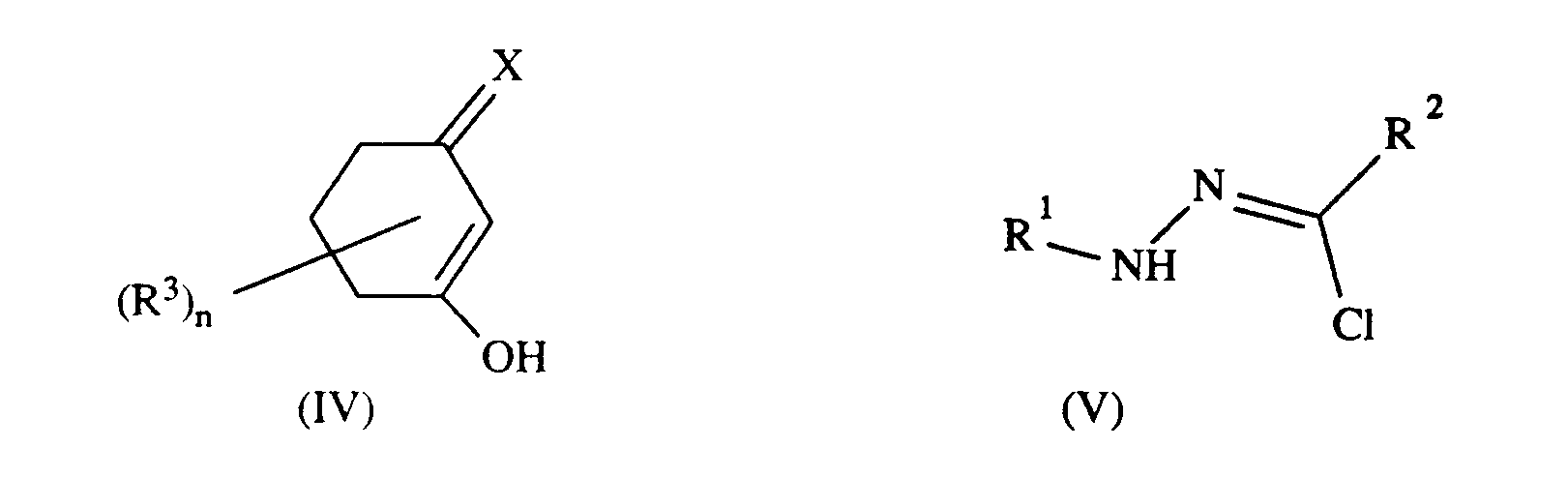
- Die Umsetzung der Verbindung der Formel II nach Variante a) wird vorzugsweise in polaren, protischen (organischen) Lösungsmitteln, insbesondere Alkoholen wie z.B. Methanol, Ethanol, Propanol, n-Butanol, Isobutanol, tert.-Butanol und 2-Butanol bei Temperaturen von Raumtemperatur bis zum Siedepunkt des Reaktionsgemisches, insbesondere bei Rückflußtemperatur durchgeführt.
- Die für die Umsetzung des an Position 1 unsubstituierten Indazols der Formel I bzw. I' geeigneten Alkylierungsmittel nach Varante b) (vgl. folgendes Schema)
-

- sind beispielsweise übliche Alkylierungsmittel R'Y(Y=Abgangsgruppe) wie Dialkylsulfate, Alkylhalogenide, Methan- und p-Toluolsulfonsäurealkylester und werden in üblicher Weise eingesetzt. Beispielsweise kann eine Methylierung mit Dimethylsulfat in alkalischer Lösung durchgeführt werden, vorzugsweise in Natronlauge oder alkalischer Alkohollösung.
- Der Aufbau des bicyclischen Ringsystems bei der Umsetzung nach Variante c) erfolgt als 1,3-dipolare Cycloaddition und kann beispielsweise sowohl in aprotischen (organischen) Lösungsmitteln wie Toluol oder Dioxan als auch in polaren, protischen (organischen) Lösungsmitteln, wie z.B. den Alkoholen Methanol und Ethanol durchgeführt werden.
- Die für die Herstellung der erfindungsgemäßen Verbindungen nach Variante a) benötigten Verbindungen der Formel 11 lassen sich nach oder analog literaturbekannten Verfahren synthetisieren; siehe z. B. J. Chem. Soc. 1953 803, J. Chem. Soc. 1955 341, Tetrahedron Lett. 29, 2491 (1975), J. prakt. Chemie 141, 149 (1934),DE-A-3902818, EP-A-249150, US-A-4780127.
- Die Hydrazinderivate III lassen sich ebenfalls nach oder analog literaturbekannten Methoden herstellen; siehe z. B. J. Am. Chem. Soc. 76, 4869 (1954), Chem. Ber. 81, 81 (1948), J. Chem. Soc. 1958 4723, Org. Synth. 35, 28 (1955), J. Am. Chem. Soc. 80, 5786 (1958), J. Org. Chem. 46, 5413 (1981)).
- Die Cyclohexan-1,3-dione der Formel IV sind teilweise im Handel erhältlich oder können nach bekannten Verfahren hergestellt werden; siehe z. B. J. Chem. Soc. 1953, 811 und Chem. Pharm. Bull. 31, 1518 (1983).
- Die Chlorhydrazone der Formel V, die ebenfalls als Ausgangsstoffe für die Synthese der 1,3-dipolaren Nitrilimine in Variante c) dienen, können nach bekannten Verfahren hergestellt werden; siehe z.B Houben-Weyl Bd. 2, S.448 und Tetrahedron 17, 3 (1962)).
- Bei der Umsetzung gemäß Varianten a) und b) können insbesondere regioisomere Verbindungen entstehen.
- Die erfindungsgemäßen Verbindungen der Formel 1 bzw I' weisen eine ausgezeichnete herbizide Wirksamkeit gegen ein breites Spektrum wirtschaftlich wichtiger mono- und dikotyler Schadpflanzen auf. Auch schwer bekämpfbare perennierende Unkräuter, die aus Rhizomen, Wurzelstöcken oder anderen Dauerorganen austreiben, werden durch die Wirkstoffe gut erfaßt. Dabei ist es gleichgültig, ob die Substanzen im Vorsaat-, Vorauflauf- oder Nachauflaufverfahren ausgebracht werden. Im einzelnen seien beispielhaft einige Vertreter der mono- und dikotylen Unkrautflora genannt, die durch die erfindungsgemäßen Verbindungen kontrolliert werden können, ohne daß durch die Nennung eine Beschränkung auf bestimmte Arten erfolgen soll.
- Auf der Seite der monokotylen Unkrautarten werden z.B. Avena, Lolium, Alopecurus, Phalaris, Echinochloa, Digitaria, Setaria etc. sowie Cyperusarten aus der annuellen Gruppe und auf seiten der perennierenden Spezies Agropyron, Cynodon, Imperata sowie Sorghum etc. und auch ausdauernde Cyperusarten gut erfaßt.
- Bei dikotylen Unkrautarten erstreckt sich das Wirkungsspektrum auf Arten wie z.B. Galium, Viola, Veronica, Lamium, Stellaria, Amaranthus, Sinapis, Ipomoea, Matricaria, Abutilon, Sida etc. auf der annuellen Seite sowie Convolvulus, Cirsium, Rumex, Artemisia etc. bei den perennierenden Unkräutern.
- Unter den spezifischen Kulturbedingungen im Reis vorkommende Unkräuter wie z.B. Sagittaria, Alisma, Eleocharis, Scirpus, Cyperus etc. werden von den erfindungsgemäßen Wirkstoffen ebenfalls hervorragend bekämpft.
- Werden die erfindungsgemäßen Verbindungen vor dem Keimen auf die Erdoberfläche appliziert, so wird entweder das Auflaufen der Unkrautkeimlinge vollständig verhindert, oder die Unkräter wachsen bis zum Keimblattstadium heran, stellen jedoch dann ihr Wachstum ein und sterben schließlich nach Ablauf von drei bis vier Wochen vollkommen ab.
- Bei Applikation der Wirkstoffe auf die grünen Pflanzenteile im Nachauflaufverfahren tritt ebenfalls sehr rasch nach der Behandlung ein drastischer Wachstumsstop ein, und die Unkrautpflanzen bleiben in dem zum Applikationszeitpunkt vorhandenen Wuchsstadium stehen oder sterben nach einer gewissen Zeit mehr oder weniger schnell ab, so daß auf diese Weise eine für die Kulturpflanzen schädliche Unkrautkonkurrenz sehr früh und nachhaltig durch den Einsatz der erfindungsgemäßen Verbindungen der Formel beseitigt werden kann.
- Obgleich die erfindungsgemäßen Verbindungen eine ausgezeichnete herbizide Aktivität gegenüber mono- und dikotylen Unkräutern aufweisen, werden Kulturpflanzen wirtschaftlich bedeutender Kulturen wie z.B. Weizen, Gerste, Roggen, Reis, Mais, Zuckerrübe, Baumwolle und Soja nur unwesentlich oder gar nicht geschädigt. Die vorliegenden Verbindungen eignen sich aus diesen Gründen sehr gut zur selektiven Bekämpfung von unerwünschtem Pflanzenwuchs in landwirtschaftlichen Nutzpflanzungen.
- Die erfindungsgemäßen Verbindungen können auf verschiedene Art formuliert werden, je nachdem welche biologischen und/oder chemisch-physikalischen Parameter vorgegeben sind. Als Formulierungsmöglichkeiten kommen beispielsweise in Frage: Spritzpulver (WP), wasserlösliche Pulver (SP), wasserlösliche Konzentrate (SL), emulgierbare Konzentrate (EC), Emulsionen (EW) wie ÖI-in-Wasser- und Wasser-in-ÖI-Emulsionen, versprühbare Lösungen oder Emulsionen, Suspensionskonzentrate(SC), Dispersionen auf Öl-oder Wasserbasis, ölmischbare Lösungen (OL) Suspoemulsionen, Kapselsuspensionen (CS), Stäubemittel (DP), Beizmittel, Granulate zur Boden- oder Streuapplikation, Granulate (GR) in Form von Mikro-, Sprüh-, Aufzugs- und Adsorptionsgranulaten, wasserdispergierbare Granulate (WG), wasserlösliche Granulate (SG), ULV-Formulierungen, Mikrokapseln und Wachse.
- Diese einzelnen Formulierungstypen sind im Prinzip bekannt und werden beispielsweise beschrieben in: Winnacker-Küchler, "Chemische Technologie", Band 7, G. Hauser Verlag München, 4. Aufl. 1986; van Valkenburg, "Pesticides Formulations", Marcel Dekker N.Y. 1973; K Martens, "Spray Drying Handbook", 3rd Ed. 1979, G. Goodwin Ltd. London.
- Die notwendigen Formulierungshilfsmittel wie Inertmaterialien, Tenside, Lösungsmittel und weitere Zusatzstoffe sind ebenfalls bekannt und werden beispielsweise beschrieben in: Watkins, "Handbook of Insecticide Dust Diluents and Carriers", 2nd Ed., Darland Books, Galdwell N.J.; H.v. Olphen, "Introduction to Clay Colloid Ghemistry"; 2nd Ed., J. Wiley & Sons, N.Y.; Marsden, "Solvents Guide", 2nd Ed., Interscience, N.Y. 1950; McCutcheon's "Detergents and Emulsifiers Annual", MG Publ. Corp., Ridgewood N.J.; Sisley and Wood, "Encyclopedia of Surface Active Agents", Chem. Publ. Co. Inc., N.Y 1964; Schönfeldt, "Grenzflächenaktive Äthylenoxidaddukte", Wiss. Verlagsgesell., Stuttgart 1976; Winnacker-Küchler, "Chemische Technologie", Band 7, G. Hauser Verlag München, 4. Aufl. 1986.
- Auf der Basis dieser Formulierungen lassen sich auch Kombinationen mit anderen pestizid wirksamen Stoffen, Düngemitteln und/oder Wachstumsregulatoren herstellen, z.B. in Form einer Fertigformulierung oder als Tankmix.
- Spritzpulver sind in Wasser gleichmäßig dispergierbare Präparate, die neben dem Wirkstoff außer einem Verdünnungs- oder Inertstoff noch Netzmittel, z.B. polyoxyethylierte Alkylphenole, polyoxethylierte Fettalkohole und Fettamine, Fettalkoholpolyglykolethersulfate, Alkansulfonate oder Alkylarylsulfonate, und Dispergiermittel, z.B. ligninsulfonsaures Natrium, 2,2'-dinaphthylmethan-6,6'-disulfonsaures Natrium, dibutylnaphthalin-sulfonsaures Natrium oder auch oleylmethyltaurinsaures Natrium enthalten.
- Emulgierbare Konzentrate werden durch Auflösen des Wirkstoffes in einem organischen Lösungsmittel z.B. Butanol, Cyclohexanon, Dimethylformamid, Xylol oder auch höhersiedenden Aromaten oder Kohlenwasserstoffen unter Zusatz von einem oder mehreren Emulgatoren hergestellt. Als Emulgatoren können beispielsweise verwendet werden: Alkylarylsulfonsaure Calzium-Salze wie Ca-dodecylbenzolsulfonat oder nichtionische Emulgatoren wie Fettsäurepolyglykolester, Alkylarylpolyglykolether, Fettalkoholpolyglykolether, Propylenoxid-Ethylenoxid-Kondensationsprodukte (z.B. Blockpolymere), Alkylpolyglycolether, Sorbitanfetträureester, Polyoxyethylensorbitanfettsäureester oder Polyoxethylensorbitester.
- Stäubemittel erhält man durch Vermahlen des Wirkstoffes mit fein verteilten festen Stoffen, z.B. Talkum, natürlichen Tonen, wie Kaolin, Bentonit und Pyrophillit, oder Diatomeenerde.
- Granulate können entweder durch Verdüsen des Wirkstoffes auf adsorptionsfähiges, granuliertes Inertmaterial hergestellt werden oder durch Aufbringen von Wirkstoffkonzentraten mittels Klebemitteln, z.B. Polyvinylalkohol, polyacrylsaurem Natrium oder auch Mineralölen, auf die Oberfläche von Trägerstoffen wie Sand, Kaolinite oder von granuliertem Inertmaterial. Auch können geeignete Wirkstoffe in der für die Herstellung von Düngemittelgranulaten üblichen Weise - gewünschtenfalls in Mischung mit Düngemitteln - granuliert werden.
- Teller-, Fließbett-, Extruder- und Sprühgranulate können nach üblichen Verfahren hergestellt werden; siehe z.B. Verfahren in "Spray Dyring Handbook", 3rd Ed. 1979, G. Goodwin Ltd., London; J.E. Browning, "Agglomeration", Chemical and Engineering 1967, Seiten 147 ff; "Perry's Chemical Engineer's Handbook", 5th Ed., McGraw-Hill, New York 1973, s. 8-57.
- Für weitere Informationen zur Formulierung von Pflanzenschutzmitteln siehe z.B. G.G. Klingman, "Weed Control as a Science", John Wiley and Sons, Inc., New York, 1961, Seiten 81-96 und J.D. Freyer' s. A. Evans, "Weed Control Handbook", 5th Ed., Blackwell Scientific Publications, Oxford, 1968, Seiten 101-103.
- Die agrochemischen Zubereitungen enthalten in der Regel 0,1 bis 99 Gewichtsprozent, insbesondere 0,1 bis 95 Gew.-%, Herbizid-Wirkstoff.
- In Spritzpulvern beträgt die Wirkstoffkonzentration z.B. etwa 10 bis 90 Gew.-%, der Rest zu 100 Gew.- % besteht aus üblichen Formulierungsbestandteilen. Bei emulgierbaren Konzentraten kann die Wirkstoffkonzentration etwa 1 bis 80 Gew.-% betragen. Staubförmige Formulierungen enthalten meistens 1 bis 20 Gew.- % an Wirkstoff, versprühbare Lösungen etwa 0,2 bis 20 Gew.-%. Bei Granulaten hängt der Wirkstoffgehalt zum Teil davon ab, ob die wirksame Verbindung flüssig oder fest vorliegt. Meist liegt der Gehalt bei den in Wasser dispergierbaren Granulaten zwischen 10 und 90 Gew.-%.
- Daneben enthalten die genannten Wirkstofformulierungen gegebenenfalls die jeweils üblichen Haft-, Netz-, Dispergier-, Emulgier-, Penetrations-, Lösungsmittel, Füll- oder Trägerstoffe.
- Zur Anwendung werden die in handelsüblicher Form vorliegenden Formulierungen gegebenenfalls in üblicher Weise verdünnt, z.B. bei Spritzpulvern, emulgierbaren Konzentraten, Dispersionen und wasserdispergierbaren Granulaten mittels Wasser. Staubförmige Zubereitungen, Boden- bzw. Streugranulate sowie versprühbare Lösungen werden vor der Anwendung üblicherweise nicht mehr mit weiteren inerten Stoffen verdünnt.
- Mit den äußeren Bedingungen wie Temperatur, Feuchtigkeit, der Art des verwendeten Herbizids, u.a. variiert die erforderliche Aufwandmenge der erfindungsgemäßen Verbindungen. Sie kann innerhalb weiter Grenzen schwanken, z.B. zwischen 0,001 und 10,0 kg/ha oder mehr Aktivsubstanz, vorzugsweise liegt sie jedoch zwischen 0,005 und 5 kg/ha.
- Auch Mischungen oder Mischformulierungen mit anderen Wirkstoffen, wie z.B. Insektiziden, Akariziden, Herbiziden, Safenern, Düngemitteln, Wachstumsregulatoren oder Fungiziden sind gegebenenfalls möglich.
- Folgende Beispiele dienen zur Erläuterung der Erfindung:
-
- A) Formulierungsbeispiele
- a) Ein Stäubemittel wird erhalten, indem man 10 Gew.-Teile einer Verbindung der Formel (I) und 90 Gew.-Teile Talkum als Inertstoff mischt und in einer Schlagmühle zerkleinert.
- b) Ein in Wasser leicht dispergierbares, benetzbares Pulver wird erhalten, indem man 25 Gewichtsteile einer Verbindung der Formel (I), 64 Gewichtsteile kaolinhaltigen Quarz als Inerstoff, 10 Gewichtsteile ligninsulfonsaures Kalium und 1 Gew.-Teil oleoylmethyltaurinsaures Natrium als Netz- und Dispergiermittel mischt und in einer Stiftmühle mahlt.
- c) Ein in Wasser leicht dispergierbares Dispersionskonzentrat wird erhalten, indem man 20 Gewichtsteile einer Verbindung der Formel (I) mit 6 Gew.-Teilen Alkylphenolpolyglykolether ((R)Triton X 207), 3 Gew.-Teilen Isotridecanolpolyglykolether (8 EO) und 71 Gew.-Teilen paraffinischem Mineralöl (Siedebereich z.B. ca 255 bis über 277° C) mischt und in einer Reibkugelmühle auf eine Feinheit von unter 5 Mikron vermahlt.
- d) Ein emulgierbares Konzentrat wird erhalten aus 15 Gew.-Teilen einer Verbindung der Formel (I), 75 Gew.-Teilen Cyclohexan als Lösungsmittel und 10 Gew.-Teilen oxethyliertem Nonylphenol als Emulgator.
- e) Ein in Wasser dispergierbares Granulat wird erhalten, indem manmischt, auf einer Stiftmühle mahlt und das Pulver in einem Wirbelbett durch Aufsprühen von Wasser als Granulierflüssigkeit granuliert.

- f) Ein in Wasser dispergierbares Granulat wird auch erhalten, indem man

- auf einer Kolloidmühle homogenisiert und vorzerkleinert, anschließend auf einer Perlmühle mahlt und die so erhaltene Suspension in einem Sprühturm mittels einer Einstoffdüse zerstäubt und trocknet.
- g) Ein Extruder-Granulat erhält man, indem man 20 Gewichtsteile Wirkstoff der Formel (I), 3 Gewichtsteile ligninsulfonsaures Natrium, 1 Gewichtsteil Carboxymethylcellulose und 76 Gewichtsteile Kaolin vermischt, vermahlt und mit Wasser anfeuchtet. Dieses Gemisch wird extrudiert und anschließend im Luftstrom getrocknet.
- h) Analog zu den vorstehenden Beispielen a) bis g) werden Formulierungen mit Verbindungen der Formel I' erhalten, wenn man letztere anstelle von Verbindungen der Formel I einsetzt.
- B) Herstellungsbeispiele
- 4,5,6,7-Tetrahydro-4-oxo-3-(2-nitrophenyl)-1H-indazol (zu Beispiel 1, Tabelle 1)
- 3,2 g (12,2 mmol) 2-Nitrobenzoylcyclohexan-1,3-dion werden mit 0,52 g (12,2 mmol) Hydrazinhydrat (80%) in 120 ml Ethanol 4h im Rückfluß erwärmt. Anschließend destilliert man das Ethanol unter reduziertem Druck ab und fügt 80 ml Methanol hinzu. Der ausgefallene Feststoff wird abgesaugt und im Vakuum getrocknet. Man erhält 1,41 g (45 % d.Th.) 4,5,6,7-Tetrahydro-4-oxo-3-(2-nitrophenyl)-1 H-indazol der Formel

- 3,2 g (12,2 mmol) 2-Nitrobenzoylcyclohexan-1,3-dion werden mit 0,52 g (12,2 mmol) Hydrazinhydrat (80%) in 120 ml Ethanol 4h im Rückfluß erwärmt. Anschließend destilliert man das Ethanol unter reduziertem Druck ab und fügt 80 ml Methanol hinzu. Der ausgefallene Feststoff wird abgesaugt und im Vakuum getrocknet. Man erhält 1,41 g (45 % d.Th.) 4,5,6,7-Tetrahydro-4-oxo-3-(2-nitrophenyl)-1 H-indazol der Formel
- 4,5,6,7-Tetrahydro-4-oxo-3-(4-chlor-2-nitrophenyl)-1-ethyl-1H-indazol (zu Beispiel 2, Tabelle 1)
- 2,08 g (7,13 mmol) 4,5,6,7-Tetrahydro-4-oxo-3-(4-chlor-2-nitrophenyl)-1 H-indazol werden in 80 ml 10% wäßriger Natronlauge gelöst, filtriert vom Ungelösten ab und fügt der Lösung dann 1,2 g (7,8 mmol) Diethylsulfat hinzu. Anschließend wird 1,5 h bei Raumtemperatur und 1 h bei 0°C nachgerührt, wobei nach ca. 10 min bereits ein Niederschlag auszufallen beginnt. Der Niederschlag wird nach Beendigung der Reaktion abgesaugt und an Kieselgel mit Essigsäureethylester/Dichlormethan (1:2) chromatografiert. Die Fraktion mit Rf=0.72 enthält 0,34 g (15,3% d.Th.) gewünschtes Produkt der Formel

- mit einem Schmelzpunkt von 184° C.
-
- 4,5,6,7-Tetrahydro-4-oxo-1,3-diphenyl-1H-indazol (zu Beispiel 4, Tabelle 1) 3 g Benz-phenylhydrazidchlorid werden zusammen mit 5,84g Cyclohexan-1,3-dion in 80 ml Toluol gelöst und 1,4g Triethylamin hinzugefügt. Die Lösung wird 4h auf 80-90 C erhitzt. Anschließend läßt man auf Raumtemperatur abkühlen und wäscht mit 1 n HCI und dann mit Natriumhydrogencarbonatlösung. Die organische Phase wird getrocknet und das Toluol unter reduziertem Druck abgezogen. Man nimmt den Rückstand in Methanol auf und läßt langsam kristallisieren. So erhält man 1,3 g (35 % d.Th.) gewünschtes Produkt der Formel

- 4,5,6,7-Tetrahydro-4-oxo-1,3-diphenyl-1H-indazol (zu Beispiel 4, Tabelle 1) 3 g Benz-phenylhydrazidchlorid werden zusammen mit 5,84g Cyclohexan-1,3-dion in 80 ml Toluol gelöst und 1,4g Triethylamin hinzugefügt. Die Lösung wird 4h auf 80-90 C erhitzt. Anschließend läßt man auf Raumtemperatur abkühlen und wäscht mit 1 n HCI und dann mit Natriumhydrogencarbonatlösung. Die organische Phase wird getrocknet und das Toluol unter reduziertem Druck abgezogen. Man nimmt den Rückstand in Methanol auf und läßt langsam kristallisieren. So erhält man 1,3 g (35 % d.Th.) gewünschtes Produkt der Formel
- 4,5,6,7-Tetrahydro-4-oxo-1-methyl-3-(2-chlor-4-methansulfonyl-phenyl)-1H-indazol (zu Beispiel 6, Tabelle 1)
- 2 g 2-(2-Chlor-4-methansulfonylbenzoyl)cyclohexan-1,3-dion werden in 50 ml Ethanol gelöst, 0,28 g Methylhydrazin hinzugefügt und die Lösung dann 4 h unter Rückfluß erhitzt. Anschließend läßt man abkühlen und saugt den ausgefallen Niederschlag ab. Man erhält 0,85 g (41 % d.Th.) des gewünschten Produkts der Formel

- mit einem Schmelzpunkt von 208°C.
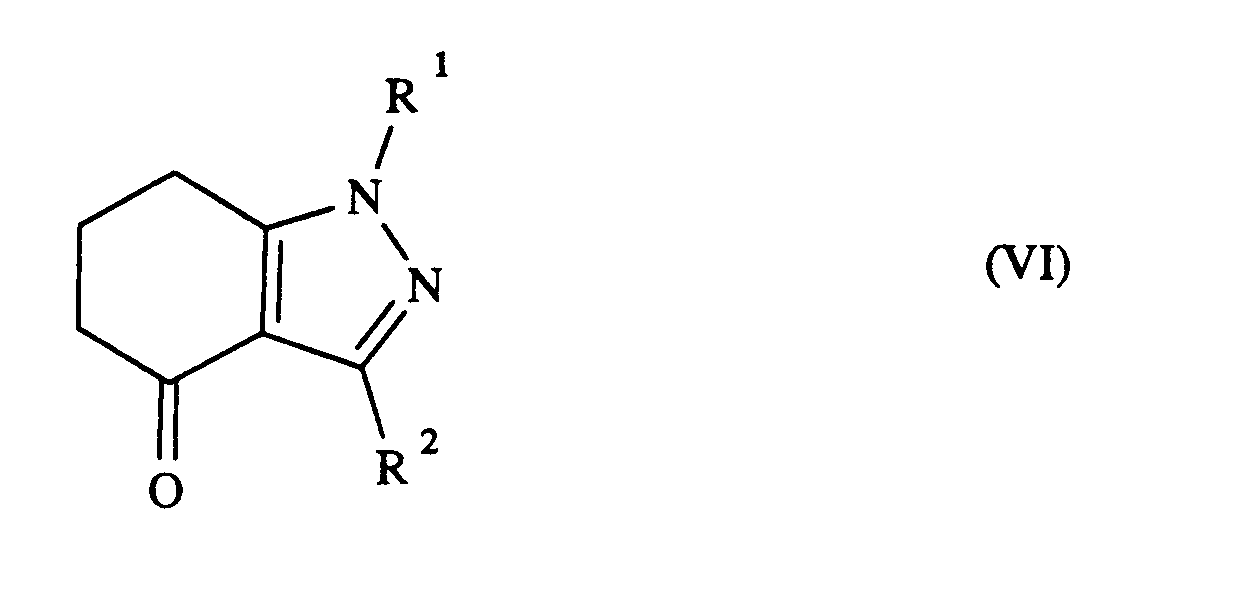
- In der folgenden Tabelle 1 sind die Beispiele 1,2,4 und 6 zusammen mit weiteren Beispielen der allgemeinen Formel VI aufgeführt, die in analoger Weise erhalten werden:


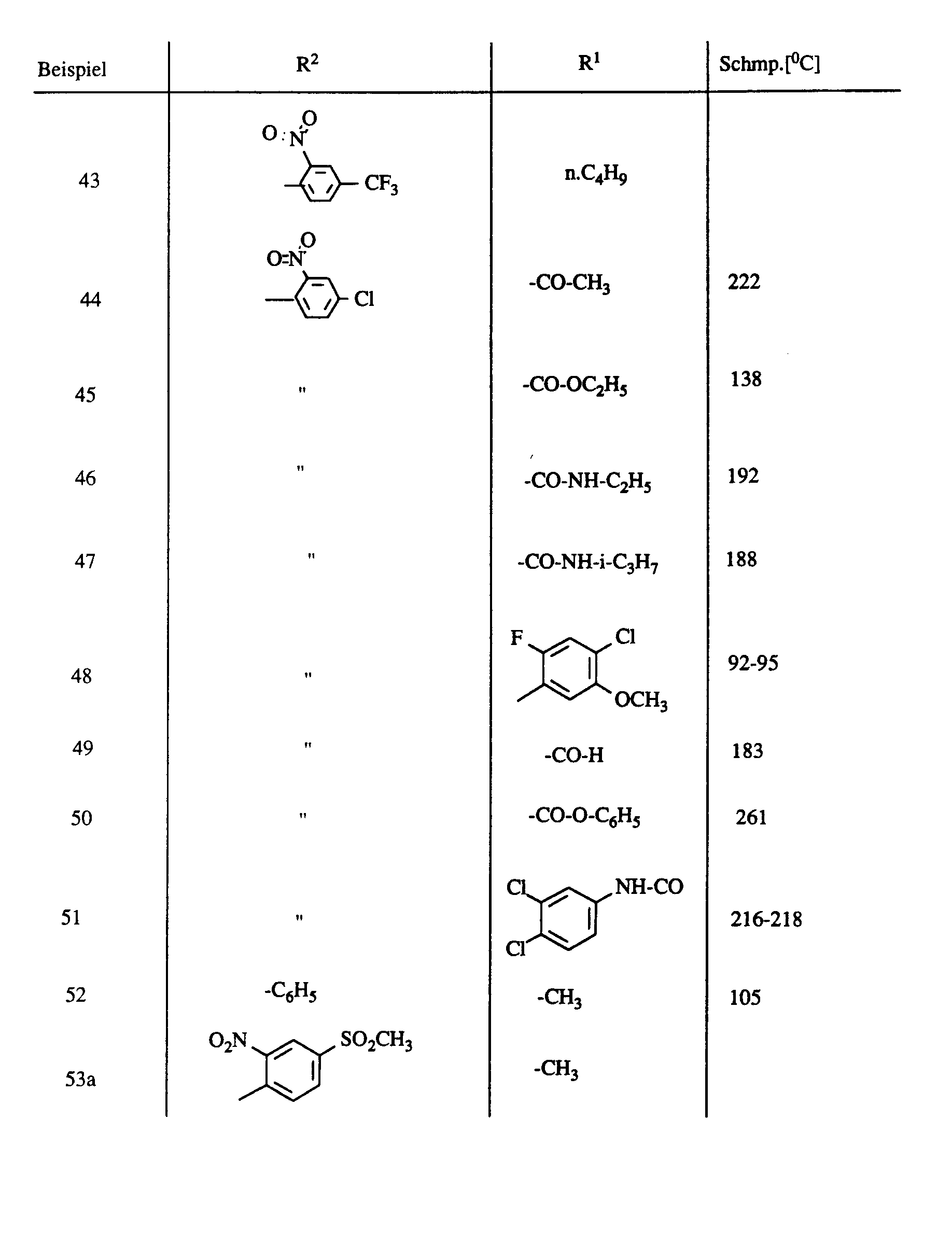

- In analoger Weise wie die Verbindungen aus der vorstehenden Tabelle 1 werden die in der folgenden Tabelle 2 aufgeführten Verbindungen der allgemeinen Formel VII erhalten:


- 2 g 2-(2-Chlor-4-methansulfonylbenzoyl)cyclohexan-1,3-dion werden in 50 ml Ethanol gelöst, 0,28 g Methylhydrazin hinzugefügt und die Lösung dann 4 h unter Rückfluß erhitzt. Anschließend läßt man abkühlen und saugt den ausgefallen Niederschlag ab. Man erhält 0,85 g (41 % d.Th.) des gewünschten Produkts der Formel
- 4,5,6,7-Tetrahydro-4-oxo-3-(2-nitrophenyl)-1H-indazol (zu Beispiel 1, Tabelle 1)
- C) Biologische Beispiele
- Die Schädigung der Unkrautpflanzen bzw. die Kulturpflanzenverträglichkeit wurde gemäß einem Schlüssel bonitiert, in dem die Wirksamkeit durch Wertzahlen von 0-5 ausgedrückt ist. Dabei bedeutet:
- 0 = ohne Wirkung bzw. Schaden
- 1 = 0 - 20 % Wirkung bzw. Schaden
- 2 = 20 - 40 % Wirkung bzw. Schaden
- 3 = 40 - 60 % Wirkung bzw. Schaden
- 4 = 60 - 80 % Wirkung bzw. Schaden
- 5 = 80 - 100 % Wirkung bzw. Schaden
- Die Schädigung der Unkrautpflanzen bzw. die Kulturpflanzenverträglichkeit wurde gemäß einem Schlüssel bonitiert, in dem die Wirksamkeit durch Wertzahlen von 0-5 ausgedrückt ist. Dabei bedeutet:
- Samen bzw. Rhizomstücke von mono- und dikoytylen Unkrautpflanzen wurden in Plastiktöpfen in sandiger Lehmerde ausgelegt und mit Erde abgedeckt. Die in Form von benetzbaren Pulvern oder Emulsionskonzentraten formulierten erfindungsgemäßen Verbindungen wurden dann als wäßrige Suspensionen bzw. Emulsionen mit einer Wasseraufwandmenge von umgerechnet 600-800 I/ha in unterschiedlichen Dosierungen auf die Oberfläche der Abdeckerde appliziert.
- Nach der Behandlung wurden die Töpfe im Gewächshaus aufgestellt und unter guten Wachstumsbedingungen für die Unkräuter gehalten. Die optische Bonitur der Pflanzen- bzw. der Auflaufschäden erfolgte nach dem Auflaufen der Versuchspflanzen nach einer Versuchszeit von 3-4 Wochen im Vergleich zu unbehandelten Kontrollen.
- Wie die Boniturwerte in Tabelle 1 zeigen, weisen die erfindungsgemäßen Verbindungen eine gute herbizide Vorauflaufwirksamkeit gegen ein breites Spektrum von Ungräsern und Unkräutern auf.

- Samen bzw. Rhizomstücke von mono- und dikotylen Unkräutern wurden in Plastiktöpfen in sandigem Lehmboden ausgelegt, mit Erde abgedeckt und im Gewächshaus unter guten Wachstumsbedingungen angezogen. Drei Wochen nach der Aussaat wurden die Versuchspflanzen im Dreiblattstadium behandelt. Die als Spritzpulver bzw. als Emulsionskonzentrate formulierten erfindungsgemäßen Verbindungen wurden in verschiedenen Dosierungen mit einer Wasseraufwandmenge von umgerechnet 600-800 I/ha auf die grünen Pflanzenteile gesprüht und nach ca. 3-4 Wochen Standzeit der Versuchspflanzen im Gewächshaus unter optimalen Wachstumsbedingungen die Wirkung der Präparate optisch im Vergleich zu unbehandelten Kontrollen bonitiert. Die erfindungsgemäßen Mittel weisen auch im Nachauflauf eine gute herbizide Wirksamkeit gegen ein breites Spektrum wirtschaftlich wichtiger Ungräser und Unkräuter auf (Tabelle 4).

- In weiteren Versuchen im Gewächshaus wurden Samen einer größeren Anzahl von Kulturpflanzen und Unkräutern in sandigem Lehmboden ausgelegt und mit Erde abgedeckt. Ein Teil der Töpfe wurde sofort wie unter 1. beschrieben behandelt, die übrigen im Gewächshaus aufgestellt, bis die Pflanzen zwei bis drei echte Blätter entwickelt hatten, und dann mit den erfindungsgemäßen Substanzen in unterschiedlichen Dosierungen wie unter 2. beschrieben besprüht.
- Vier bis fünf Wochen nach der Applikation und Standzeit im Gewächshaus wurde mittels optischer Bonitur festgestellt, daß die erfindungsgemäßen Verbindungen zweikeimblättrige Kulturen wie z.B. Soja, Baumwolle, Raps, Zuckerrüben und Kortoffeln im Vor- und Nachauflaufverfahren selbst bei hohen Wirkstoffdosierungen ungeschädigt ließen. Einige Substanzen schonten darüber hinaus auch Gramineen-Kulturen wie zu.B. Gerste, Weizen, Roggen, Sorghum-Hirsen, Mais oder Reis. Die erfindungsgemäßen Verbindungen weisen somit eine hohe Selektivität bei Anwendung zur Bekämpfung von unerwünschtem Pflanzenwuchs in landwirtschaftlichen Kulturen auf.
- Knollen und Rhizome bzw. Jungpflanzen oder Samen verschiedener Reisunkräuter wie Cyperus-Arten, Eleocharis, Scirpus und Echinochloa wurden in geschlossenen Plastiktöpfen in spezielle Reiserde ausgelegt bzw. gepflanzt und mit Wasser bis zu einer Höhe von 1 cm über dem Boden angestaut. Ebenso wurde mit Reispflanzen verfahren.
- Im Vorauflaufverfahren, d.h. 3-4 Tage nach dem Verpflanzen, wurden die erdindungsgemäßen Verbindungen in Form wäßriger Suspensionen oder Emulsionen ins Anstauwasser gegossen oder als Granulate ins Wasser gestreut.
- Jeweils drei Wochen später wurde die herbizide Wirkung und eine eventuelle Schadwirkung gegenüber Reis optisch bonitiert. Die Ergebnisse zeigen, daß sich die erfindungsgemäßen Verbindungen zur selektiven Unkrautbekämpfung in Reis eignen.
- Gegenüber bisherigen Reisherbiziden zeichnen sich die erfindungsgemäßen Verbindungen dadurch aus, daß sie zahlreiche, insbesondere auch schwer bekämpfbare Unkräuter, die aus Dauerorganen keimen, wirkungsvoll bekämpfen und dabei von Reis toleriert werden.
bedeuten.
Von besonderem Interesse sind auch erfindungsgemäße Verbindungen der Formel oder I', worin
Die Reste R3 sind unabhängig voneinander vorzugsweise H oder Methyl; n ist vorzugsweise 0 bis 4, insbesondere 0 bis 3;


worin R1 wie bei der obengenannten Formel I bzw. I' definiert ist, umsetzt oder
wobei R1 bis R3 und X wie bei der genannten Formel I bzw. I' definiert sind, in Gegenwart einer Base zu Verbindungen der genannten Formel I umsetzt.
Claims (9)
1. Verfahren zur Herstellung von Verbindungen der Formel oder I',

worin
bedeuten, dadurch gekennzeichnet, daß man
X Sauerstoff- oder Schwefelatom,
R1 H, Ci-C6-Alkyl, C2-C6-Alkenyl, C2-C6-Alkinyl, Ci-C6-Haloalkyl, (C1-C4-Alkoxy)-C1-C4-alkyl, (C1-C6-Alkoxy)-carbonyl, Aryloxycarbonyl, (Ci-C6-Alkyl)-aminocarbonyl, Arylaminocarbonyl, Phenyl, substituiertes Phenyl oder Acyl,
R2 Phenyl oder substituiertes Phenyl,
R3 unabhängig von anderen Resten R3 H oder C1-C5-Alkyl und
n eine ganze Zahl von 0 bis 6
n eine ganze Zahl von 0 bis 6
bedeuten, dadurch gekennzeichnet, daß man
a) Verbindungen der Formel II,
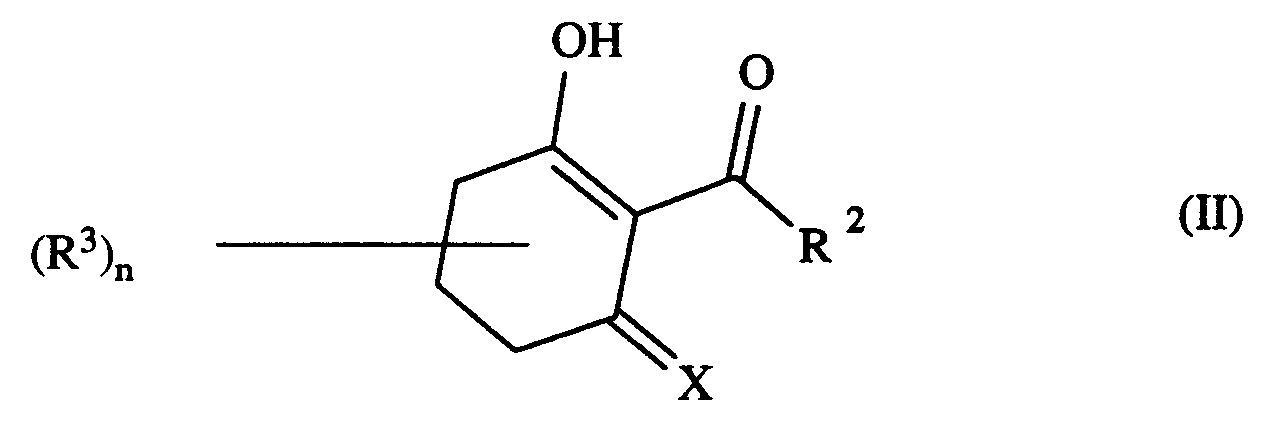
worin R2 und R3 und X wie bei der obengenannten Formel I bzw. I' definiert sind, mit Hydrazinderivaten der Formel III, 
worin R1 wie bei der obengenannten Formel I bzw. I' definiert ist, umsetzt oder
worin R2 und R3 und X wie bei der obengenannten Formel I bzw. I' definiert sind, mit Hydrazinderivaten der Formel III,
worin R1 wie bei der obengenannten Formel I bzw. I' definiert ist, umsetzt oder
b) für den Fall, daß R1=Alkyl ist, Verbindungen der genannten Formel I bzw I', in denen R1 ein Wasserstoffatom bedeutet, mit geeigneten Alkylierungsmitteln umsetzt oder
c) ausgenommen zur Herstellung von Verbindungen der Formel I', Cyclohexan-1,3-dione der Formel IV mit Chlorhydrazonen der Formel V,

wobei R1 bis R3 und X wie bei der genannten Formel I bzw. I' definiert sind, in Gegenwart einer Base zu Verbindungen der genannten Formel I umsetzt.
2. Verfahren nach Anspruch 1, dadurch gekennzeichnet, daß R1 H, C1-C4-Alkyl, C2-C4-Alkenyl, C2-C4-Alkinyl, C1-C4-Haloalkyl, (C1-C2-Alkoxy)-C1-C4-alkyl, (Ci-C4-Alkoxy)-carbonyl, (C1-C4-Alkyl)-aminocarbonyl, Phenyloxycarbonyl, Phenylaminocarbonyl, Phenyl, wobei die 3 letztgenannten Gruppen jeweils im Phenylring unsubstituiert oder durch ein oder mehrere Reste aus der Grupppe Halogen, C1-C4-Alkyl, C1-C4-Haloalkyl, C1-C4-Alkoxy, C1-C4-Haloalkoxy, Nitro, Carboxy und Säurederivate von Carboxy substituiert sind, oder Acyl bedeutet.
3. Verfahren nach Anspruch 1 oder 2, dadurch gekennzeichnet, daß R2 Phenyl, das unsubstituiert oder durch ein bis drei Reste aus der Gruppe Halogen, Nitro, C1-C4-Alkyl, C1-C4-Halogenalkyl und C1-C4-Alkylsulfonyl substituiert ist, bedeutet.
4. Verfahren nach einem oder mehreren der Ansprüche 1 bis 3, dadurch gekennzeichnet, daß die Reste R3 unabhängig voneinander vorzugsweise H oder Methyl und n eine ganze Zahl von 0 bis 4 bedeuten.
5. Verfahren nach einem oder mehreren der Ansprüche 1 bis 4, dadurch gekennzeichet, daß sie Verbindungen der oben definierten Formel I sind.
6. Verfahren nach einem oder mehreren der Ansprüche 1 bis 5, dadurch gekennzeichnet, das die Umsetzung nach Variante a) in einem polaren, protischen organischen Lösungsmittel bei einer Temperaturen von Raumtemperatur bis zum Siedepunkt des Lösungsmittels durchgeführt wird.
7. Verfahren nach einem oder mehreren der Ansprüche 1 bis 5, dadurch gekennzeichnet, das die Umsetzung nach Variante c) in einem polaren, protischen oder einem aprotischen organischen Lösungsmittel durchgeführt wird.
8. Verwendung von Verbindungen der Formel oder I', wie sie in einem oder mehreren der Ansprüche 1 bis 4 definiert sind, als Herbizide.
9. Verfahren zur selektiven Bekämpfung von Schadpflanzen, dadurch gekennzeichnet, daß man eine wirksame Menge einer nach einem oder mehreren der Ansprüche 1 bis 5 definierten Verbindungen auf die Planzen, Planzensamen oder die Anbaufläche appliziert.
Applications Claiming Priority (2)
| Application Number | Priority Date | Filing Date | Title |
|---|---|---|---|
| DE4024862A DE4024862A1 (de) | 1990-08-04 | 1990-08-04 | 4,5,6,7-tetrahydro-3-aryl-indazole, verfahren zu ihrer herstellung und ihre verwendung als herbizide |
| DE4024862 | 1990-08-04 |
Publications (1)
| Publication Number | Publication Date |
|---|---|
| EP0470489A1 true EP0470489A1 (de) | 1992-02-12 |
Family
ID=6411695
Family Applications (1)
| Application Number | Title | Priority Date | Filing Date |
|---|---|---|---|
| EP91112818A Withdrawn EP0470489A1 (de) | 1990-08-04 | 1991-07-30 | 4,5,6,7-Tetrahydro-3-aryl-indazole, Verfahren zu ihrer Herstellung und ihre Verwendung als Herbizide |
Country Status (7)
| Country | Link |
|---|---|
| US (1) | US5104442A (de) |
| EP (1) | EP0470489A1 (de) |
| JP (1) | JPH04234368A (de) |
| KR (1) | KR920004353A (de) |
| DE (1) | DE4024862A1 (de) |
| IE (1) | IE912770A1 (de) |
| PT (1) | PT98549A (de) |
Cited By (3)
| Publication number | Priority date | Publication date | Assignee | Title |
|---|---|---|---|---|
| EP0590558A1 (de) * | 1992-09-29 | 1994-04-06 | Dr. Karl Thomae GmbH | Arzneimittel enthaltend 1,5,6,7-Tetrahydro-4H-indazol-4-one, neue 1,5,6,7-Tetrahydro-4H-indazol-4-one und verfahren zu ihrer Herstellung |
| US5444038A (en) * | 1992-03-09 | 1995-08-22 | Zeneca Limited | Arylindazoles and their use as herbicides |
| EP0705829A1 (de) * | 1994-08-31 | 1996-04-10 | Sumitomo Chemical Company, Limited | Epoxyphenol-Derivate und Herbizide, die diese als Wirkstoffe enthaltend |
Families Citing this family (8)
| Publication number | Priority date | Publication date | Assignee | Title |
|---|---|---|---|---|
| US5939324A (en) * | 1997-12-02 | 1999-08-17 | The United States Of America As Represented By The United States Department Of Energy | Performance evaluation soil samples utilizing encapsulation technology |
| AU7865000A (en) | 1999-10-06 | 2001-05-10 | 3-Dimensional Pharmaceuticals, Inc. | Fused 1-(2,6-dichloro-4-trifluoromethylphenyl)-pyrazoles, the synthesis thereof and the use thereof as pesticides |
| BRPI0607739A2 (pt) * | 2005-02-25 | 2009-09-29 | Serenex Inc | derivados de tetraidroindolona e tetraidroindazolona, composição compreendendo os mesmos e uso relacionado |
| MX2008003202A (es) * | 2005-09-16 | 2008-03-25 | Serenex Inc | Derivados de carbazol. |
| JP2009532329A (ja) * | 2006-02-27 | 2009-09-10 | セレネックス, インコーポレイテッド | シクロヘキシルアミノ、ベンゼン、ピリジン及びピリダジン誘導体 |
| KR101787116B1 (ko) | 2009-01-28 | 2017-10-18 | 케러 테라퓨틱스, 인코포레이티드 | 바이시클릭 피라졸로-헤테로사이클 |
| US7741350B1 (en) * | 2009-01-28 | 2010-06-22 | Cara Therapeutics, Inc. | Bicyclic pyrazolo-heterocycles |
| EP3191473A1 (de) | 2014-09-11 | 2017-07-19 | Esanex, Inc. | Indazolyl- und indolylbenzamidderivate |
Citations (3)
| Publication number | Priority date | Publication date | Assignee | Title |
|---|---|---|---|---|
| US4059434A (en) * | 1975-10-15 | 1977-11-22 | E. I. Du Pont De Nemours And Company | Cycloalkanapyrazole herbicides |
| EP0105721A2 (de) * | 1982-09-28 | 1984-04-18 | Sumitomo Chemical Company, Limited | 2-Substituierte Phenyl-4,5,6,7-tetrahydro-2H-indazole, ihre Herstellung und Verwendung |
| EP0138527A2 (de) * | 1983-10-08 | 1985-04-24 | Nippon Kayaku Kabushiki Kaisha | Herbizide Pyrazolderivate |
-
1990
- 1990-08-04 DE DE4024862A patent/DE4024862A1/de not_active Withdrawn
-
1991
- 1991-07-30 EP EP91112818A patent/EP0470489A1/de not_active Withdrawn
- 1991-08-01 PT PT98549A patent/PT98549A/pt not_active Application Discontinuation
- 1991-08-02 JP JP3194495A patent/JPH04234368A/ja not_active Withdrawn
- 1991-08-02 US US07/739,687 patent/US5104442A/en not_active Expired - Fee Related
- 1991-08-02 IE IE277091A patent/IE912770A1/en unknown
- 1991-08-03 KR KR1019910013458A patent/KR920004353A/ko not_active Withdrawn
Patent Citations (3)
| Publication number | Priority date | Publication date | Assignee | Title |
|---|---|---|---|---|
| US4059434A (en) * | 1975-10-15 | 1977-11-22 | E. I. Du Pont De Nemours And Company | Cycloalkanapyrazole herbicides |
| EP0105721A2 (de) * | 1982-09-28 | 1984-04-18 | Sumitomo Chemical Company, Limited | 2-Substituierte Phenyl-4,5,6,7-tetrahydro-2H-indazole, ihre Herstellung und Verwendung |
| EP0138527A2 (de) * | 1983-10-08 | 1985-04-24 | Nippon Kayaku Kabushiki Kaisha | Herbizide Pyrazolderivate |
Non-Patent Citations (7)
| Title |
|---|
| CHEMISCHE BERICHTE vol. 101, no. 11, 1968, Seiten 3918 - 3940; H.-J. TEUBER: "Benzolazoketone und Tetrahydroindazole aus Phenylhydrazonen cyclischer beta-Dicarbonylverbindungen" * |
| CHEMISCHE BERICHTE vol. 109, no. 5, 1976, Seiten 1898 - 1910; V. BARDAKOS ET AL: "Enhydrazine, 14. Lactame aus 4,5,6,7-Tetrahydro-1H-4-indazolonen" * |
| CHIMIA vol. 31, no. 2, Februar 1977, Seiten 49 - 50; W. SUCROW ET AL: "Synthesis or indazoloquinones" * |
| JOURNAL OF THE CHEMICAL SOCIETY PERKIN TRANSACTIONS I 1973, Seiten 2697 - 2703; A.J. NUNN ET AL: "Semmler-Wolff aromatisation and abnormal Beckmann and Schmidt reactions of 3-alkyl-4-oxo1-phenyl-4,5,6,7-tetrahydroindazoles and their oximes in polyphosphoric acid" * |
| JOURNAL OF THE CHEMICAL SOCIETY PERKIN TRANSACTIONS I 1981, Seiten 642 - 645; F.S. AL-SALEH ET AL: "Synthesis of 4-acyl- and 4-alkoxy-carbonylpyrazoles" * |
| SYNTHESIS November 1984, Seiten 982 - 983; P. DALLA CROCE ET AL: "A convenient synthesis of indazoles" * |
| ZEITSCHRIFT F]R NATURFORSCHUNG vol. 32B, no. 9-12, September 1977, Seiten 1072 - 1076; W. SUCROW ET AL: "Enhydrazine, XVIII. Einige weitere Indazol-Derivate" * |
Cited By (4)
| Publication number | Priority date | Publication date | Assignee | Title |
|---|---|---|---|---|
| US5444038A (en) * | 1992-03-09 | 1995-08-22 | Zeneca Limited | Arylindazoles and their use as herbicides |
| EP0590558A1 (de) * | 1992-09-29 | 1994-04-06 | Dr. Karl Thomae GmbH | Arzneimittel enthaltend 1,5,6,7-Tetrahydro-4H-indazol-4-one, neue 1,5,6,7-Tetrahydro-4H-indazol-4-one und verfahren zu ihrer Herstellung |
| US5468766A (en) * | 1992-09-29 | 1995-11-21 | Dr. Karl Thomae Gmbh | 1,5,6,7-tetrahydro-4H-indazol-4-ones |
| EP0705829A1 (de) * | 1994-08-31 | 1996-04-10 | Sumitomo Chemical Company, Limited | Epoxyphenol-Derivate und Herbizide, die diese als Wirkstoffe enthaltend |
Also Published As
| Publication number | Publication date |
|---|---|
| KR920004353A (ko) | 1992-03-27 |
| JPH04234368A (ja) | 1992-08-24 |
| IE912770A1 (en) | 1992-02-12 |
| US5104442A (en) | 1992-04-14 |
| PT98549A (pt) | 1993-11-30 |
| DE4024862A1 (de) | 1992-02-13 |
Similar Documents
| Publication | Publication Date | Title |
|---|---|---|
| EP0353640B1 (de) | Heterocyclische N-Acylsulfonamide, Verfahren zu ihrer Herstellung, sie enthaltende Mittel und ihre Verwendung als Herbizide oder Wachstumsregulatoren | |
| DD283760A5 (de) | Herbizide und pflanzenwachstumregulierende mittel und deren verwendung sowie verfahren zur herstellung des in ihnen enthaltenen wirkstoffes | |
| EP0272594A1 (de) | Bicyclische Imide, Verfahren zu ihrer Herstellung sowie ihre Verwendung im Pflanzenschutz | |
| EP0521500A1 (de) | Salze von Pyridylsulfonylharnstoffen als Herbizide und Pflanzenwachstumsregulatoren, Verfahren zu ihrer Herstellung und ihre Verwendung | |
| EP0353641B1 (de) | Heterozyklisch substituierte Sulfonylharnstoffe, Verfahren zu ihrer Herstellung und ihre Verwendung als Herbizide oder Pflanzenwachstumsregulatoren | |
| EP0470489A1 (de) | 4,5,6,7-Tetrahydro-3-aryl-indazole, Verfahren zu ihrer Herstellung und ihre Verwendung als Herbizide | |
| WO1991004666A2 (de) | Synergistische herbizide mittel | |
| EP0336354B1 (de) | Heterocyclisch substituierte Alkyl- und Alkenylsulfonylharnstoffe, Verfahren zu ihrer Herstellung und ihre Verwendung als Herbizide oder Pflanzenwachstumsregulatoren | |
| EP0098569A2 (de) | Neue heterocyclisch substituierte Sulfonylharnstoffe, Verfahren zu ihrer Herstellung und ihre Verwendung in der Landwirtschaft | |
| EP0563817A2 (de) | Salze von 2-Benzoyl-cyclohexandionen, Selektive herbizide Mittel, Verfahren zu ihrer Herstellung und ihre Verwendung zur Unkrautbekämpfung | |
| EP0289910A2 (de) | Substituierte Tetrahydrophthalimide, Verfahren zu ihrer Herstellung und ihre Verwendung als Herbizide | |
| EP0216243A2 (de) | N-Substituierte 3,4,5,6-Tetrahydrophthalimide, Verfahren zu ihrer Herstellung sowie ihre Verwendung im Pflanzenschutz | |
| EP0409114B1 (de) | Heterocyclisch substituierte Sulfonylharnstoffe, Verfahren zu ihrer Herstellung und ihre Verwendung als Herbizide oder Pflanzenwachstumsregulatoren | |
| EP0319689B1 (de) | Heterocyclisch substituierte N-Sultam-sulfonamide, Verfahren zu ihrer Herstellung und ihre Verwendung als Herbizide und Pflanzenwachstumsregulatoren | |
| EP0303114B1 (de) | Heterocyclisch substituierte Sulfamidsäurephenylester, Verfahren zu ihrer Herstellung und ihre Verwendung als Herbizide und Pflanzenwachstumsregulatoren | |
| EP0502492A2 (de) | Haloalkoxy-substituierte Benzoylcyclohexandione als Herbizide und Pflanzenwachstumsregulatoren | |
| EP0388771B1 (de) | Phenoxysulfonylharnstoffe auf Basis von 3-substituierten Salicylsäurealkylestern, Verfahren zu ihrer Herstellung und ihre Verwendung als Herbizide und Pflanzenwachstumsregulatoren | |
| EP0464838B1 (de) | Substituierte Sulfonylalkylsulfonylharnstoffe, Verfahren zu ihrer Herstellung und ihre Verwendung als Herbizide und Pflanzenwachstumsregulatoren | |
| WO1991004969A1 (de) | Herbizide hetrocyclisch substituierte phenoxyalkancarbonsäurederivate und verfahren zu ihrer herstellung | |
| DE19751943A1 (de) | 1-Methyl-5-alkylsulfonyl-, 1-Methyl-5-alkylsulfinyl- und 1-Methyl-5-alkylthio-substituierte Pyrazolylpyrazole, Verfahren zu ihrer Herstellung und ihre Verwendung als Herbizide | |
| DE3807532A1 (de) | Pyrimidin-carbonsaeuren, verfahren zur herstellung und ihre verwendung als herbizide | |
| EP0863706B1 (de) | Verfahren zur bekämpfung von unerwünschtem pflanzenwuchs in reiskulturen | |
| DE3739691A1 (de) | Phosphorhaltige sulfonylharnstoffe | |
| EP0322707A2 (de) | 3-Phenoxy-phenylessigsäurederivate, Verfahren zu ihrer Herstellung und ihre Verwendung als Herbizide | |
| DE4122905A1 (de) | Pyridylsulfonylharnstoffe als herbizide und pflanzenwachstumsregulatoren, verfahren zu ihrer herstellung und ihre verwendung |
Legal Events
| Date | Code | Title | Description |
|---|---|---|---|
| PUAI | Public reference made under article 153(3) epc to a published international application that has entered the european phase |
Free format text: ORIGINAL CODE: 0009012 |
|
| AK | Designated contracting states |
Kind code of ref document: A1 Designated state(s): AT BE CH DE DK ES FR GB GR IT LI NL |
|
| STAA | Information on the status of an ep patent application or granted ep patent |
Free format text: STATUS: THE APPLICATION HAS BEEN WITHDRAWN |
|
| 18W | Application withdrawn |
Withdrawal date: 19920511 |
|
| R18W | Application withdrawn (corrected) |
Effective date: 19920506 |