EP0121840A2 - Anordnung zur Feststellung der Lage eines Gegenstandes innerhalb eines Sichtfeldes - Google Patents
Anordnung zur Feststellung der Lage eines Gegenstandes innerhalb eines Sichtfeldes Download PDFInfo
- Publication number
- EP0121840A2 EP0121840A2 EP84103195A EP84103195A EP0121840A2 EP 0121840 A2 EP0121840 A2 EP 0121840A2 EP 84103195 A EP84103195 A EP 84103195A EP 84103195 A EP84103195 A EP 84103195A EP 0121840 A2 EP0121840 A2 EP 0121840A2
- Authority
- EP
- European Patent Office
- Prior art keywords
- field
- view
- arrangement according
- radiation
- radiation source
- Prior art date
- Legal status (The legal status is an assumption and is not a legal conclusion. Google has not performed a legal analysis and makes no representation as to the accuracy of the status listed.)
- Withdrawn
Links
Images



Classifications
-
- G—PHYSICS
- G06—COMPUTING OR CALCULATING; COUNTING
- G06F—ELECTRIC DIGITAL DATA PROCESSING
- G06F3/00—Input arrangements for transferring data to be processed into a form capable of being handled by the computer; Output arrangements for transferring data from processing unit to output unit, e.g. interface arrangements
- G06F3/01—Input arrangements or combined input and output arrangements for interaction between user and computer
- G06F3/03—Arrangements for converting the position or the displacement of a member into a coded form
- G06F3/041—Digitisers, e.g. for touch screens or touch pads, characterised by the transducing means
- G06F3/042—Digitisers, e.g. for touch screens or touch pads, characterised by the transducing means by opto-electronic means
- G06F3/0428—Digitisers, e.g. for touch screens or touch pads, characterised by the transducing means by opto-electronic means by sensing at the edges of the touch surface the interruption of optical paths, e.g. an illumination plane, parallel to the touch surface which may be virtual
-
- G—PHYSICS
- G06—COMPUTING OR CALCULATING; COUNTING
- G06F—ELECTRIC DIGITAL DATA PROCESSING
- G06F3/00—Input arrangements for transferring data to be processed into a form capable of being handled by the computer; Output arrangements for transferring data from processing unit to output unit, e.g. interface arrangements
- G06F3/01—Input arrangements or combined input and output arrangements for interaction between user and computer
- G06F3/03—Arrangements for converting the position or the displacement of a member into a coded form
- G06F3/041—Digitisers, e.g. for touch screens or touch pads, characterised by the transducing means
- G06F3/042—Digitisers, e.g. for touch screens or touch pads, characterised by the transducing means by opto-electronic means
- G06F3/0421—Digitisers, e.g. for touch screens or touch pads, characterised by the transducing means by opto-electronic means by interrupting or reflecting a light beam, e.g. optical touch-screen
Definitions
- the invention relates to an arrangement for determining the position of an object within a field of view.
- Such an article may be a finger or pencil, m eem a vision device is pointed at a particular point of a screen, for example, and its presence and location to be determined.
- the arrangement can also be used to determine the presence of a person within a confined area, such as a room.
- Known devices for determining the position of an object within a field of view feel the interruption of radiation, e.g. of light, through an opaque object, e.g. the part of a human body.
- Such a device uses radiation transmitters that emit radiation across the field of view, parallel to the surface of the field of view, and radiation receivers that detect the radiation that has spread over the field of view and the presence and location of an interruption of this radiation (e.g. through an object).
- a known device for determining the position of a small object, for example a human finger or a pencil, in an XY plane uses an arrangement of light sources which lie along a side in the X direction of a rectangular field of view and a corresponding arrangement of light receivers are provided on the opposite side of the field of view extending in the X direction.
- Corresponding is an arrangement of light sources along the side of the field of view running in the Y direction and an arrangement of Light receivers are provided on the opposite side of the field of view, which also extends in the Y direction.
- light transmitters or light receivers are arranged along the circumference of the field of view. Examples of such devices are disclosed in U.S. Patents 3,478,220, 3,764,813, 3,775,560 and 3,860,754.
- the known devices have a number of disadvantages.
- the spatial resolution of the device is determined by the number, size and distance of the individual light sources and light receivers. In known devices, it is therefore possible for a human finger to lie between two adjacent light receivers and thus not to be caught by the parallel rays of light.
- the known device has a large number of active elements, e.g. Light sources and light receivers, which are very expensive and in most cases have to be assembled very precisely by human labor.
- the large number of light sources and light receivers enforce the complex and elaborate circuitry arrangements required to operate the device.
- This device comprises a rectangular frame with four sides and an open interior for the work surface or the field of view. Lamps are arranged on the frame which emit light into the interior of the frame from three sides.
- a couple of light receivers are arranged on the frame in two corners, at the opposite ends of the fourth side of the frame. Furthermore, openings are provided in the two frame corners, to be precise between the light receivers and the frame interior, in order to fix matching light areas for the light receivers increase.
- Each light receiver receives the light from a special light field inside the frame and detects the interruption of the light at any location in this field.
- the known device according to US Pat. No. 4,144,449 has the advantage over the devices already described above which have paired light sources and light receivers that the number of components is considerably reduced while the resolution of the device is increased.
- the known device requires a relatively large frame and a larger number of light sources which are arranged on at least three sides of the frame. Therefore, the device is very large and bulky and is therefore not suitable to be subsequently arranged on an existing screen.
- the object on which the invention is based is to provide an arrangement for determining the position of an object within a field of view, which is simple in structure and can easily be inserted subsequently into an existing field of vision.
- the arrangement should be usable both for small fields of view, such as computer screens, and for relatively large fields of view, such as a room in a building.
- the arrangement according to the invention thus generates, with the aid of at least one point-shaped radiation source, which can be embodied, for example, as an LED, radiation which illuminates the field of view and is reflected back from the back-reflecting surface to the point-shaped light source.
- the reflected radiation is received and evaluated by a radiation receiver arranged adjacent to the punctiform radiation source, unless the radiation is interrupted by an object in the field of view.
- the reflective surface can e.g. consist of a retroreflective tape that is commercially available for use as roadside reflectors and the like.
- the surface of this tape is formed from a layer of thin transparent balls, e.g. of glass.
- the tape is relatively inexpensive and can be easily attached to the sides or walls of the field of view.
- the field of view can therefore be relatively small, e.g. in the case of a computer screen or relatively large, such as in the case of a building room.
- the arrangement may include electronic circuitry connected to the radiation receivers in order to. Determine coordinates of the object, which is arranged within the field of view.
- the field of view may be rectangular and the electrical circuitry may then generate signals that are proportional to the X and Y coordinates of the object within the field of view.
- the radiation used in the arrangement is preferably light; however, if ambient light could interfere with the operation of the arrangement, radiation of invisible frequencies such as infrared or microwave radiation can be used.
- two radiation receivers can be arranged at adjacent corners of the rectangular field of view.
- three or more radiation receivers can be provided on the circumference of the field of view.
- the electrical circuit for determining the coordinates of an object arranged within the field of view can position the object in two dimensions (X, Y coordinates) or in three dimensions (X, Y, Z coordinates). specify. Specifying three dimensions has the advantage that the object that enters the field of view in the Z direction (for example, a finger moves against a computer screen) is only recognized if its Z coordinate exceeds a threshold.
- the electrical circuit can be implemented in such a way that it only indicates the position of objects that exceed a certain size. In this way 2 n noise and uninteresting small objects can be suppressed.
- FIG. 1 shows a computer screen that has a field of view 10 that is surrounded by a frame 12.
- the inner surface of the frame 12, which is essentially vertical to the visible surface of the screen 10, is provided with a reflective layer 14.
- Layer 14 provides a back-reflecting surface that extends around the circumference of the field of view.
- the back-reflecting surface is a surface that reflects radiation generated by a radiation source back to the radiation source.
- the reflective layer 14 can be attached directly to the frame 12 or it can be arranged on an adhesive tape which is attached to the inner surface of the frame. Corresponding back-reflecting tapes are already commercially available.
- the device also contains two essentially point-shaped radiation sources. These radiation sources are not shown in FIG. 1. However, they are shown in FIG. 2, in which their position in relation to the field of view 10 is shown. 2 that a first radiation source 16 is arranged at one corner of the field of view 10 and a second radiation source 18 is arranged at another, second corner of a side surface 20.
- the side surface 20 of the field of view does not have to be provided with a back-reflecting layer, as shown in FIG. 1.
- the point-shaped radiation sources illuminate the entire field of view with radiation, for example with light.
- the radiation propagates in a direction parallel to the plane of the field of view 10.
- the back reflection rende area on the circumference of the field of view reflects the radiation back to the corresponding radiation source, as shown in Fig. 2 by the arrows in the field of view.
- a beam 22 extends from the radiation source 16, for example an LED, to the side of the field of view and returns to the radiation source.
- the layer 14 consists of a plurality of small, transparent balls 24, which act as tiny lenses and mirrors, which reflect the incident rays and ensure that the exit angle is the same as the entry angle.
- Fig. 1 shows how the device determines the presence and location of an object 26 within the perimeter of the frame 12. It is assumed that radiation, eg light, is generated by point-shaped radiation sources, eg LEDs, at the lower left and at the lower right corner of the field of view (as shown in FIG. 2); this light crosses the field of view and is reflected back to a slit 28 in the lower left corner and to a slit 30 in the lower right corner of the field of view 10.
- Columns 28 and 30 serve as optical diaphragms to separate individual beams on sensitive surfaces 32 and 34 to map dynamic RA MB 36 and 38 modules. These are queried by an electrical circuit 40, which emits output signals that are proportional to the X, Y coordinates of the object 26.
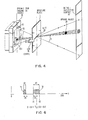
- FIG. 4 shows an imaging system in which the radiation consists of light generated by an LED
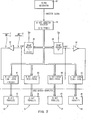
- FIG. 5 shows a block diagram of the control unit 40.
- light generated by the LED 16 is reflected back to this source by the reflecting surface 14.
- the light traverses the gap 28 and strikes the surface 32 of the dynamic RAM faceplate 36.
- the light discharges a photosensitive capacitor on surface 32, creating a logic zero in memory at each location that receives light. If an opaque object, such as a pencil or human finger, is inserted into the field of view, a shadow is cast on the faceplate and the capacitors within the shaded area keep their charge.
- the faceplate thus generates a logical 1 at the output for each memory cell within the shaded area.
- the dynamic RAM faceplate can e.g. consist of 256 cells (0 to 255) arranged in a line along the transducer surface.
- X represents the position of the shadow of an opaque object 26 on the transducer surface 32 in dynamic RAM; then X is proportional to the angle that the opaque object makes through the gap with the zeroth cell.
- the opposite sides of the shadow fall at positions X1 and X2 (0 ⁇ X1 ⁇ X2 ⁇ 255), the mean X or the center of the shadow is (X1 + X2) / 2.
- the X, Y position of the object 26 can be determined with the aid of the so-called "triangulation".
- two angles 91 and g 2 are measured and the X, Y coordinates from the values of these two angles calculated using the distance D between the two measuring points.
- FIG. 5 shows an exemplary embodiment of the electrical control unit 40 for determining the X, Y coordinates from the information which is output by the dynamic RAM modules.
- This circuit uses the principle of reading the table to find the coordinates.
- the circuit includes a clock generator 42 that sends clock pulses to a frequency divider (flip-flop) 44 and an address counter 46.
- the output of the address counter 46 is connected to the two dynamic RAM modules 36 and 38 and further to two 8 bit counters 48 and 50.
- the clock pulses from the clock generator 42 are further transmitted to two 8-bit counters 52 and 54, which generate output numbers A1 and A2.
- the outputs of the counters 52 and 54 are each connected to 8-bit comparators 56 and 58, which compare the output numbers A1 and A2 with numbers B1 and B2.
- the numbers B1 and B2 can be supplied to the control unit 40 from toggle switches or from a computer.
- the clock pulses from the clock generator 42 and from the frequency divider 44 are fed to two multiplexers 60 and 62.
- the multiplexers are connected to the dynamic RAM modules 36 and 38 with their inputs and to the counters 48 and 50 with their outputs.
- the outputs of the dynamic RAM modules 36 and 38 are also connected to the counters 52 and 54, respectively.
- the contents of the 8 bit counters 48 and 50 are each transferred into 8 bit catch registers 64 and 66 when a transfer pulse is emitted from the 8 bit address counter 46.
- the contents of the two latches 64 and 66 are used to address two 64K x 8 ROMs 68 and 70.
- Counters 52 and 54 and comparators 56 and 58 serve to eliminate shadows that do not exceed a minimum width.
- the numbers A1 and A2 which represent the widths of the shadows that are fed to the respective RAM chips 36 and 38, are compared with fixed numbers B1 and B2, which e.g. are in a range from 30 to 50 (picture element width) of objects which are to be recognizable by the RAM modules 36 and 38. If the shadows have a width (in numbers of the memory cells) that is smaller than this value (B1 or B2) then they are ignored.
- the ROM memories 68 and 70 contain the respective coordinates X and Y, which correspond to the respective values in the catch registers 64 and 66, respectively.
- the coordinate values can best be determined by manual calibration of the system. For this purpose, an object is placed in the field of view at known coordinates X and Y. These coordinates are then stored in the respective ROM memories 68 and 70 at the address generated by the system. With the help of a curve recorder, the calibration can also be carried out automatically for all addresses.
- Fig. 6 shows how shadows that are too narrow are hidden.
- the control unit determines a first shadow 72 with a width A1 that is smaller than the minimum width B1. This shadow is ignored.
- the system finds a second shadow 74 with a width A1 that is greater than the minimum width B1.
- FIG. 7 shows another embodiment of the control unit 40.
- the X and Y coordinates are determined with the aid of a microprocessor which works with appropriate software.
- the lower address (X1) of the shadow is transferred from a dynamic RAM module 36 to a first 8 bit parallel input / output port 76.
- the higher address (X2) of the shadow is transmitted to a second input / output port 78.
- the lower address (X1) of a shadow which is generated by the other dynamic RAM module 38, is transmitted to the input / output port 80 and, accordingly, the higher address (X2) of the shadow is transmitted to the input / output port 82.
- the lower and higher addresses are selected by triggering the 8 bit latches 84, 86, 88 and 90 with the rising edges of the pulses.
- Inverters 92 are used to generate rising edge pulses that change from lower to higher potential when transitioning from a darkened area to a light area.
- FIG. 8 shows a further exemplary embodiment in which an arrangement of 128 ⁇ 256 cells in a dynamic RAM module is used to define a second, the Z dimension of the shadow, which is formed by an opaque object.
- the aperture plate 94 contains a small lens 96.
- the infrared radiation which is generated by the source 98 (LED) is reflected by the back-reflecting surface 100 through the lens 96 to the converter surface 102 of the dynamic RAM module 104.
- An opaque 'article 106 such as a finger, forming a shadow 108 on the surface 102.
- the Extenz and the position of this shadow which is illustrated schematically in Fig. 9, is determined by addressing the cells of the RAM block 104th
- the control circuit for addressing the cells of the RAM module 104 is constructed similarly to that shown in FIG. 7.
- a 16-bit address counter can be used instead of the 8-bit address counter 46 to address the 128 x 256 cells of each RAM chip.
- the microcomputer memory must also be correspondingly larger in order to store the additional, third coordinates.
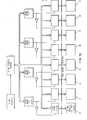
- FIG. 10 shows a control unit which is suitable for addressing 4 dynamic RAM modules in parallel operation.
- the positions of the shadow corners (cells X1 and X2) are stored repeatedly in 8 bit catch registers and are offered to the respective 8 bit parallel input / output ports of the microprocessor.
Landscapes
- Engineering & Computer Science (AREA)
- General Engineering & Computer Science (AREA)
- Theoretical Computer Science (AREA)
- Human Computer Interaction (AREA)
- Physics & Mathematics (AREA)
- General Physics & Mathematics (AREA)
- Length Measuring Devices By Optical Means (AREA)
- Geophysics And Detection Of Objects (AREA)
Abstract
Description
- Die Erfindung bezieht sich auf eine Anordnung zur Feststellung der Lage eines Gegenstandes innerhalb eines Sichtfeldes. Ein solcher Gegenstand kann ein Finger oder Bleistift sein,meem auf eine bestimmte Stelle eines Bildschirmes z.B. eines Sichtgerätes gedeutet wird und dessen Vorhandensein und Lage festgestellt werden soll. Die Anordnung kann auch verwendet werden, um das Vorhandensein einer Person innerhalb eines umgrenzten Bereiches, z.B. eines Zimmers, festzustellen.
- Bekannte Vorrichtungen zur Feststellung der Lage eines Gegenstandes innerhalb eines Sichtfeldes tasten die Unterbrechung einer Strahlung, z.B. von Licht, durch einen undurchsichtigen Gegenstand, z.B. den Teil eines menschlichen Körpers, ab. Eine solche Vorrichtung verwendet Strahlungssender, die Strahlung über das Sichtfeld, und zwar parallel zu der Oberfläche des Sichtfeldes, ausstrahlen und Strahlungsempfänger, die die Strahlung, die sich über das Siohtfeld ausgebreitet hat, erfassen und das Vorhandensein und die Lage einer Unterbrechung dieser Strahlung (z.B. durch einen Gegenstand) erkennen.
- Eine bekannte Vorrichtung zur Feststellung der Lage eines kleinen Gegenstandes, z.B. eines menschlichen Fingers oder eines Bleistiftes, in einer X-Y Ebene verwendet eine Anordnung von Lichtquellen, die entlang einer in X-Richtung liegenden Seite eines rechteckförmigen Sichtfeldes liegen und eine entsprechende Anordnung von Lichtempfänger, die auf der gegenüberliegenden in X-Richtung verlaufenden Seite des Sichtfeldes vorgesehen sind. Entsprechend ist eine Anordnung von Lichtquellen entlang der in Y-Richtung verlaufenden Seite des Sichtfeldes und eine Anordnung von Lichtempfängern auf der gegenüberliegenden ebenfalls in Y-Richtung verlaufenden Seite des Sichtfeldes vorgesehen. Somit sind entlang des Umfangs des Sichtfeldes jeweils Lichtsender oder Lichtempfänger angeordnet. Beispiele für solche Vorrichtungen sind in den US-Patentschriften 3 478 220, 3 764 813, 3 775 560 und 3 860 754 offenbart.
- Die bekannten Vorrichtungen haben eine Reihe von Nachteilen. Erstens wird die räumliche Auflösung der Vorrichtung durch die Anzahl, die Größe und den Abstand der einzelnen Lichtquellen und Lichtempfänger festgelegt. Bei bekannten Vorrichtungen ist es daher möglich, daß ein menschlicher Finger zwischen zwei benachbarten Lichtempfängern liegt und somit von den parallel verlaufenden Strahlen des Lichtes nicht erfaßt wird. Zweitens weist die bekannte Vorrichtung eine große Anzahl von aktiven Elementen, z.B. Lichtquellen und Lichtempfängern, auf, die sehr teuer sind und in den meisten Fällen durch menschliche Arbeitskraft sehr genau montiert werden müssen. Drittens erzwingt die große Anzahl von Lichtquellen und Lichtempfängern komplexe und aufwendige Anordnungen von Schaltkreisen, die zum Betrieb der Vorrichtung erforderlich sind.
- Eine andere Art einer Vorrichtung zur Feststellung der Lage eines Gegenstandes ist aus der US-Patentschrift 4 144 449 bekannt. Diese Vorrichtung umfaßt einen rechteckigen Rahmen mit vier Seiten und einen offenen Innenraum für die Arbeitsfläche oder das Sichtfeld. Auf dem Rahmen sind Lampen angeordnet, die von drei Seiten aus Licht in den Innenraum des Rahmens emittieren. Ein paar Lichtempfänger sind am Rahmen in zwei Ecken und zwar an den entgegengesetzt liegenden Enden der vierten Seite des Rahmens angeordnet. Weiterhin sind Öffnungen in den zwei Rahmenecken, und zwar zwischen den Lichtempfängern und dem Rahmeninneren vorgesehen, um übereinstimmende Lichtbereiche für die Lichtempfänger festzulegen. Jeder Lichtempfänger empfängt das Licht von einem besonderen Lichtfeld innerhalb des Rahmeninneren und stellt die Unterbrechung des Lichtes an irgendeinen Ort dieses Feldes fest. Die bekannte Vorrichtung nach dem US-Patent 4 144 449 hat den Vorteil gegenüber dem bereits oben beschriebenen Vorrichtungen, die paarweise angeordnete Lichtquellen und Lichtempfänger aufweisen, daß die Anzahl der Komponenten erheblich reduziert wird, während die Auflösung der Vorrichtung vergrößert wird.
- Trotzdem erfordert die bekannte Vorrichtung einen verhältnismäßig großen Rahmen und eine größere Anzahl von Lichtquellen, die zumindest auf drei Seiten des Rahmens angeordnet sind. Deshalb ist die Vorrichtung sehr groß und unhandlich und ist daher nicht geeignet, nachträglich an einem bereits vorhandenen Bildschirm angeordnet zu werden.
- Weiterhin ist die Anwendbarkeit der bekannten Vorrichtung auf verhältnismäßig kleine Lichtfelder, z.B. Computerbildschirme, begrenzt. Sie ist nicht geeignet, um die Lage von Gegenständen innerhalb eines großen Sichtfeldes, z.B. eines Raumes in einem Gebäude, festzustellen. Es ist zwar theoretisch denkbar, eine lineare Lichtquelle entlang den Mauern eines Raumes anzuordnen, derartige Lichtquellen wären aber extrem teuer, zufälligen Zerstörungen ausgesetzt und wären ästhetisch nicht ansprechend.
- Es wäre somit wünschenswert, eine Vorrichtung entsprechend der US-Patentschrift 4 144 449 zur Verfügung zu haben, mit der sowohl die Lage von Gegenständen in großen als auch in kleinen Sichtfeldern feststellbar ist. Die Vorrichtung wäre dann z.B. anwendbar zur überwachung von Räumen. Sie könnte aber auch in Verbindung mit mechanischen automatischen Einrichtungen verwendet werden. Dann könnte die Vorrichtung das Abschalten der Einrichtung bewirken, wenn z.B. ein Mensch den Arbeitsbereich der mechanischen Einrichtung betritt.
- Die der Erfindung zugrundeliegende Aufgabe besteht darin, eine Anordnung zur Feststellung der Lage eines Gegenstandes innerhalb eines Sichtfeldes anzugeben, die einfach im Aufbau ist und leicht nachträglich in ein bestehendes Sichtfeld eingefügt werden kann. Dabei soll die Anordnung sowohl für kleine Sichtfelder, wie Computerbildschirme, als auch für verhältnismäßig große Sichtfelder, wie ein Raum in einem Gebäude, verwendbar sein.
- Diese Aufgabe wird durch folgende Merkmale gelöst:
- Eine erste, im wesentlichen punktförmige Strahlungsquelle ist an einem ersten Ort auf dem Umfang des Sichtfeldes angeordnet, um das Sichtfeld auszuleuchten,
- eine zurückreflektierende Fläche ist am Umfang angeordnet, um die von der Strahlungsquelle auftreffende Strahlung zur Strahlungsquelle zurückzureflektieren,
- eine erste Einrichtung ist auf dem Umkreis benachbart zur ersten Strahlungsquelle so angeordnet, daß sie im Bereich der von der zurückreflektierenden Fläche reflektierten Strahlung liegt,
- die erste Einrichtung tastet das Sichtfeld in einer ersten Richtung ab und speichert beim Vorhandensein eines Gegenstandes im Sichtfeld ein dessen Lage in der ersten Richtung entsprechenden ersten Wert ab.
- Die erfindungsgemäße Anordnung erzeugt somit mit Hilfe von mindestens einer punktförmigen Strahlungsquelle, die z.B. als LED ausgeführt sein kann, Strahlung, die das Sichtfeld ausleuchtet und von der zurückreflektierenden Fläche zu der punktförmigen Lichtquelle zurückreflektiert wird. Die reflektierte Strahlung wird von einem benachbart zu der punktförmigen Strahlungsquelle angeordneten Strahlungsempfänger empfangen und ausgewertet, es sei denn, dieStrahlund wird von einem Gegenstand im Sichtfeld unterbrochen.
- Die zurückreflektierende Fläche kann z.B. aus einem zurückreflektierenden Band bestehen, das im Handel zur Verwendung als Straßenrandreflektoren und ähnlichem verfügbar ist. Die Oberfläche dieses Bandes ist aus einer Schicht aus dünnen transparenten Kugeln gebildet, z.B. aus Glas. Das Band ist verhältnismäßig billig und kann auf einfache Weise an den Seiten oder Wänden des Sichtfeldes befestigt werden. Das Sichtfeld kann deshalb verhältnismäßig klein sein, wie z.B. im Fall eines Computerbildschirmes oder verhältnismäßig groß, wie im Fall eines Gebäuderaumes.
- Die Anordnung kann einen elektronischen Schaltkreis umfassen, der mit den Strahlungsempfängern verbunden ist, um die. Koordinaten des Gegenstandes, der innerhalb des Sichtfeldes angeordnet ist, zu bestimmen. Z.B. kann das Sichtfeld rechteckig sein und der elektrische Schaltkreis kann dann Signale erzeugen, die proportional sind der X- und Y-Koordinate des Gegenstandes innerhalb des Sichtfeldes.
- Die bei der Anordnung verwendete Strahlung ist vorzugsweise Licht; wenn jedoch Umgebungslicht die Arbeitsweise der Anordnung stören könnte, kann Strahlung nicht sichtbarer Frequenzen wie Infrarot- oder Mikrowellenstrahlung verwendet werden.
- Vorzugsweise können zwei Strahlungsempfänger an benachbarten Ecken des rechteckigen Sichtfeldes angeordnet sein. Soll jedoch eine verbesserte Auflösung erreicht werden, können drei oder mehr Strahlungsempfänger am Umfang des Sichtfeldes vorgesehen werden.
- Der elektrische Schaltkreis zur Bestimmung der Koordinaten eines innerhalb des Sichtfeldes angeordneten Gegenstandes kann die Lage des Gegenstandes in zwei Dimensionen (X, Y-Koordinaten) oder in drei Dimensionen (X, Y, Z-Koordinaten) angeben. Die Angabe von drei Dimensionen hat den Vorteil, daß der Gegenstand, der in das Sichtfeld in Z-Richtung eintritt (z.B. ein Finger sigtgegen einen Computerbildschirm) nur erkannt wird, wenn seine Z-Koordinate eine Schwelle überschreitet.
- Weiterhin kann der elektrische Schaltkreis derart realisiert sein, daß er die Lage nur von solchen Gegenständen anzeigt, die eine bestimmte Größe überschreiten. Auf diese Weise kön- n2n Rauschen und uninteressante kleine Gegenstände unterdrückt werden.
- Weiterbildungen der Erfindung ergeben sich aus den Unteransprüchen.
- Anhand von Ausführungsbeispielen, die in den Figuren dargestellt sind, wird die Erfindung weiter erläutert. Es zeigen
- Fig. 1 einen Grundriß der Anordnung,
- Fig. 2 eine schematische Darstellung der Arbeitsweise der Anordnung,
- Fig. 3 eine schematische Darstellung der Arbeitsweise der zurückreflektierenden Fläche,
- Fig. 4 eine perspektivische Ansicht des optischen Systems, das in der Anordnung verwendet wird,
- Fig. 5 ein Blockschaltbild des elektrischen Schaltkreises, der in der Anordnung verwendet wird,
- Fig. 6 ein Diagramm, das die Filterfunktion des Schaltkreises nach Fig. 5 erläutert,
- Fig. 7 ein Blockschaltbild einer zweiten Ausführungsform des elektrischen Schaltkreises,
- Fig. 8 eine perspektivische Ansicht einer weiteren Ausführungsform des optischen Systems, das in Fig. 1 verwendbar ist,
- Fig. 9 ein zwei Koordinaten-Diagramm, das die Funktion des dynamischen RAM Bildbausteins im Ausführungsbeispiel der Fig. 8 zeigt,
- Fig. 10 ein Blockschaltbild einer dritten Ausführung des elektronischen Schaltkreises, der in der Anordnung verwendbar ist.
- Fig. 1 zeigt einen Computerbildschirm, der ein Sichtfeld 10 aufweist, das von einem Rahmen 12 umgeben ist. Die innere Oberfläche des Rahmens 12, die im wesentlichen vertikal zur Sichtfläche des Bildschirms 10 verläuft, ist mit einer zurückreflektierenden Schicht 14 versehen. Die Schicht 14 sieht eine zurückreflektierende Fläche vor, die am Umfang des Sichtfeldes verläuft. Die zurückreflektierende Fläche ist eine Fläche, die von einer Strahlungsquelle erzeugte Strahlung zur Strahlungsquelle zurückreflektiert.
- Die zurückreflektierende Schicht 14 kann direkt am Rahmen 12 angebracht sein oder sie kann auf einem aufklebbaren Band angeordnet sein, das an der inneren Oberfläche des Rahmens befestigt wird. Entsprechende zurückreflektierende Bänder sind fertig im Handel erhältlich.
- Die Vorrichtung enthält weiterhin zwei im wesentlichen punktförmige Strahlungsquellen. Diese Strahlungsquellen sind in Fig. 1 nicht dargestellt. Sie sind aber in Fig. 2 gezeigt, in der ihre Lage in Beziehung zum Sichtfeld 10 dargestellt ist. Aus Fig. 2 ergibt sich, daß eine erste Strahlungsquelle-16 an einer Ecke des Sichtfeldes 10 und eine zweite Strahlungsquelle 18 an einer anderen, zweiten Ecke einer Seitenfläche 20 angeordnet ist. Die Seitenfläche 20 des Sichtfeldes muß nicht mit einer zurückreflektierenden Schicht, wie in Fig. 1 gezeigt, versehen sein.
- Nach Fig. 2 beleuchten die punktenförmigen Strahlungsquellen das gesamte Sichtfeld mit Strahlung, z.B. mit Licht. Die Strahlung breitet sich dabei in einer Richtung parallel zu der Ebene des Sichtfeldes 10 aus. Die zurückreflektierende Fläche am Umfang des Sichtfeldes reflektiert die Strahlung zurück zur entsprechenden Strahlungsquelle, wie es in der Fig. 2 durch die Pfeile im Sichtfeld gezeigt ist. Zum Beispiel erstreckt sich ein Strahl 22 von der Strahlungsquelle 16, z.B. einer LED, zu der Seite des Sichtfeldes und kehrt zu der Strahlungsquelle zurück.
- Fig. 3 zeigt, wie die Strahlen 22 zu ihren Strahlungsquellen durch die zurückreflektierende Schicht 14 reflektiert werden. Die Schicht 14 besteht dabei aus einer Mehrzahl von kleinen, transparenten Kugeln 24, die als winzige Linsen und Spiegeln wirken, die die auftreffenden Strahlen reflektieren und sicherstellen, daß der Ausgangswinkel der gleiche ist wie der Eingangswinkel.
- Fig. 1 zeigt, wie die Vorrichtung das Vorhandensein und die Lage eines Gegenstandes 26 innerhalb der Umgrenzung des Rahmens 12 feststellt. Es wird angenommen, daß Strahlung, z.B. Licht, von punktförmigen Strahlungsquellen, z.B. LEDs an der unteren linken und an der unteren rechten Ecke des Sichtfeldes erzeugt wird (so wie es in der Fig. 2 dargestellt ist); dieses Licht durchquert das Sichtfeld und wird zurückreflektiert zu einem Spalt 28 in der linken unteren Ecke und zu einem Spalt 30 in der rechten unteren Ecke des Sichtfeldes 10. Die Spalten28 und 30 dienen als optische Blenden, um einzelne Strahlen auf empfindlichen Flächen 32 und 34 eines dynamischen RAM Bildbausteins 36 und 38 abzubilden. Diese werden von einem elektrischen Schaltkreis 40 abgefragt, der Ausgangssignale abgibt, die proportional sind zu den X,Y-Koordinaten des Gegenstandes 26.
- Die Arbeitsweise der Anordnung zur Feststellung der Lage eines Gegenstandes läßt sich am besten verstehen mit Hilfe der Fig. 4 und 5. Fig. 4 zeigt ein Abbildungssystem, bei dem die Strahlung aus Licht besteht, erzeugt von einem LED und Fig. 5 zeigt ein Blockschaltbild der Steuereinheit 40. Wie Fig. 4 entnommen werden kann, wird Licht, das von dem LED 16 erzeugt wird, durch die zurückreflektierende Fläche 14 zu dieser Quelle zurückreflektiert. Das Licht durchquert dabei den Spalt 28 und trifft auf der Fläche 32 des dynamischen RAM Bildbausteins 36 auf. Das Licht entlädt auf der Oberfläche 32 einen lichtempfindlichen Kondensator und erzeugt dabei eine logische Null im Speicher an jeder Speicherstelle, die Licht empfängt. Wenn ein undurchsichtiger Gegenstand, wie z.B. ein Bleistift oder ein menschlicher Finger, in das Sichtfeld eingeführt wird, dann wird ein Schatten auf den Bildbaustein geworfen und die Kondensatoren innerhalb des abgeschatteten Bereiches behalten ihre Ladung. Der Bildbaustein erzeugt so eine logische 1 am Ausgang für jede Speicherzelle innerhalb des abgeschatteten Bereiches.
- Der dynamische RAM Bildbaustein kann z.B. aus 256 Zellen (0 bis 255) bestehen, die in einer Linie entlang der Wandlerfläche angeordnet sind. Es sei angenommen, daß X die Position des Schattens eines undurchsichtigen Gegenstandes 26 auf der Wandlerfläche 32 im dynamischen RAM darstellt; dann ist X proportional zu dem Winkel, den der undurchsichtige Gegenstand durch den Spalt hindurch mit der nullten Zelle bildet. Unter der Annahme, daß die entgegengesetzten Seiten des Schattens auf Positionen X1 und X2 (0≤X1≤X2≤255) fallen, dann liegt der Mittelwert X oder das Zentrum des Schattens bei (X1 + X2)/2.
- Wenn eine Kombination von zwei Lichtquellen und zwei dynamischen Bausteinen verwendet wird, wie dies in den Fig. 1 und 2 dargestellt ist, dann kann die X, Y Lage des Gegenstandes 26 mit Hilfe der sog. "Triangulation" bestimmt werden. In diesem Falle werden zwei Winkel 91 und g2 gemessen und die X,Y Koordinaten aus den Werten dieser zwei Winkel unter Verwendung des Abstandes D zwischen den zwei Meßpunkten berechnet.
- Fig. 5 zeigt ein Ausführungsbeispiel der elektrischen Steuereinheit 40 zur Bestimmung der X, Y Koordinaten aus der Information, die von den dynamischen RAM.Bausteinen abgegeben wird. Diese Schaltung verwendet das Prinzip des Tabellenlesens, um die Koordinaten aufzusuchen. Die Schaltung enthält einen Taktgenerator 42, der Taktimpulse zu einem Frequenzunterteiler (Flip Flop) 44 und einem Adressenzähler 46 sendet. Der Ausgang des Adressenzählers 46 ist mit den beiden dynamischen RAM Bausteinen 36 und 38 und weiterhin mit zwei 8 bit Zählern 48 und 50 verbunden. Die Taktimpulse vom Taktgenerator 42 werden weiterhin zu zwei 8 bit Zählern 52 und 54 übertragen, die Ausgangszahlen A1 und A2.erzeugen. Die Ausgänge der Zähler 52 und 54 sind mit 8 bit Komparatoren 56 und 58 jeweils verbunden, die die Ausgangszahlen A1 und A2 mit Zahlen B1 und B2 vergleichen. Die Zahlen B1 und B2 können der Steuereinheit 40 von Kippschaltern oder von einem Computer zugeführt werden.
- Die Taktimpulse vom Taktgenerator 42 und vom Frequenzteiler 44 werden zwei Multiplexern 60 und 62 zugeführt. Die Multiplexer sind mit ihren Eingängen jeweils mit den dynamischen RAM Bausteinen 36 und 38 und mit ihren Ausgängen jeweils mit den Zählern 48 und 50 verbunden. Die Ausgänge der dynamischen RAM Bausteine 36 und 38 sind weiterhin jeweils mit den Zählern 52 und 54 verbunden.
- Die Inhalt der 8 bit Zähler 48 und 50 werden jeweils in 8 bit Auffangregister 64 und 66 übertragen, wenn ein übertragimpuls von dem 8 bit Adressenzähler 46 abgegeben wird. Die Inhalte der beiden Auffangregister 64 und 66 werden verwendet, um zwei 64 K x 8 ROM 68 und 70 zu adressieren.
- Durch die Schaltung nach Fig. 5 werden die Zellen der dynamischen RAM Bausteine 36 und 38 aufeinanderfolgend adressiert. Die Ausgangssignale dieser Zellen (logisch 0 für .Zellen, die Licht erhalten haben und logisch 1 für Zellen, die kein Licht erhalten haben) werden zu den 8 bit Zählern 48 und 50' in folgender Weise übertragen:
- Jede Zelle mit einer logischen 0 wird dadurch gezählt, daß der Taktimpuls vom Eingang A des jeweiligen Multiplexers zu dem Takteingang des jeweiligen Zählers 48 oder 50 übertragen wird. Jede andere Speicherzelle mit einer logischen 1 wird dadurch gezählt, daß der Taktimpuls halber Frequenz vom Eingang B des jeweiligen Multiplexers zu dem Takteingang des jeweiligen Zählers 48 oder 50 übertragen wird. Die Zähler 48 und 50 werden jedes Mal auf 0 zurückgesetzt, wenn die erste Zelle (Zelle 0) des dynamischen RAM Bausteins 36 und 38 adressiert wird. Die Zähler 48 und 50 werden gestoppt, wenn an ihren Ladeeingängen Signale von den jeweiligen-Komparatoren 56 und 58 auftreten. Die Inhalte der Zähler 48 und 50 werden dann in die jeweiligen Auffangregister 64 und 66 übertragen, wenn der 8 bit Adressenzähler 46 die Adressenzahl 255 erreicht.
- Die Zähler 52 und 54 und die Komparatoren 56 und 58 dienen dazu, um solche Schatten zu eliminieren, die eine Minimumbreite nicht überschreiten. Die Zahlen A1 und A2, die die Breiten der Schatten, die den jeweiligen RAM Bausteinen 36 und 38 zugeführt werden, darstellen, werden jeweils mit festgelegten Zahlen B1 und B2 verglichen, die z.B. in einem Bereich von 30 bis 50 (Bildelementbreite) von Gegenständen liegen, die durch die RAM Bausteine 36 und 38 erkennbar sein sollen. Wenn die Schatten eine Breite (in Zahlen der Speicherzellen) haben, die kleiner ist als dieser Wert (B1 oder B2) dann werden sie ignoriert.
- Dementsprechend erzeugen die Zähler 48 und 50 ein Zählergebnis X, das die Position (in Bildelementen) des Zentrums des Gegenstandes darstellt. Unter der Annahme, daß X1 die niedrigere Speicherzellenadresse der einen Seite des Schattens und X2 die höhere Speicherzellenadresse der entgegengesetzten Seite des Schattens ist (Fig. 4), dann wird das Zählergebnis X nach folgender Formel festgelegt:
- X = X1 + 1/2 (X2 - X1)
- Die Zähler 48 und 50 zählen zunächst die Zahlen X1 mit der ursprünglichen Taktfrequenz und zählen dann die Zahlen 1/2 (X2 - X1) mit der halben Taktfrequenz.
- Die ROM Speicher 68 und 70 enthalten die jeweiligen Koordinaten X und Y, die den jeweiligen Werten in den Auffangregistern 64 bzw. 66 entsprechen. Die Koordinatenwerte können am besten durch manuelle Eichung des Systems festgelegt werden. Dazu wird ein Gegenstand in das Sichtfeld an bekannten Koordinaten X und Y angeordnet. Diese Koordinaten werden dann in die jeweiligen ROM Speicher 68 und 70 unter der Adresse, die von dem System erzeugt wird, eingespeichert. Mit Hilfe eines Kurvenschreibers kann die Eichung auch automatisch für alle Adressen durchgeführt werden.
- Fig. 6 zeigt, auf welche Weise zu schmale Schatten ausgeblendet werden. Zunächst stellt die Steuereinheit einen ersten Schatten 72 mit einer Breite A1 fest, die kleiner ist als die Minimumbreite B1. Dieser Schatten wird ignoriert. Das System findet anschließend einen zweiten Schatten 74 mit einer Breite A1, die größer ist als die Minimumbreite B1. In diesem Fall bestimmt das System die Adresse des Zentrums des Punktes X = X1 + 1/2 (X2 - X1) und diese Adresse wird dem ROM Speicher 68 zugeführt, um die Koordinate X mit Hilfe eines Tabellenvorgangs zu finden.
- Fig. 7 zeigt eine andere Ausführungsform der Steuereinheit 40. Bei dieser Steuereinheit werden die X und Y Koordinaten mit Hilfe eines Mikroprozessors bestimmt, der mit einer entsprechenden Software arbeitet. Die niedrigere Adresse (X1) des Schattens wird vom einen dynamischen RAM Baustein 36 zu einem ersten 8 bit parallelen Eingangs/Ausgangsport 76 übertragen. Die höhere Adresse (X2) des Schattens wird zu einem zweiten Eingangs/Ausgangsport 78 übertragen. Entsprechend wird die niedrigere Adresse (X1) eines Schattens, die vom anderen dynamischen RAM Baustein 38 erzeugt wird, zum Eingangs/Ausgangsport 80 und entsprechend die höhere Adresse (X2) des Schattens zum Eingangs/Ausgangsport 82 übertragen. Die niedrigeren und höheren Adressen werden durch Triggern der 8 bit Auffangregister 84, 86, 88 und 90 mit den Anstiegsflanken der Impulse ausgewählt. Wenn ein Schatten durch einen dynamischen RAM Baustein gesehen wird, dann ändert sich das Ausgangspotential des Bausteins von einem niedrigerenwert zu einem höheren Wert; Inverter 92 werden dazu verwendet, um Impulse mit Anstiegsflanken zu erzeugen, die von niedrigeren zum höheren Potential beim Übergang von einem abgedunkelten Bereich zu einem Lichtbereich wechseln.
- Fig. 8 zeigt ein weiteres Ausführungsbeispiel, bei dem eine Anordnung von 128 x 256 Zellen in einem dynamischen RAM Baustein verwendet wird, um eine zweite, die Z Dimension des Schattens, der von einem undurchsichtigen Gegenstand gebildet wird, festzulegen. In diesem Falle enthält die Blendenplatte 94 eine kleine Linse 96. Der Infrarotstrahlung, die von der Quelle 98 (LED) erzeugt wird, wird von der zurückreflektierenden Fläche 100 durch die Linse 96 zur Wandlerfläche 102 des dynamischen RAM Bausteins 104 reflektiert. Ein undurchsichtiger 'Gegenstand 106, z.B. ein Finger, bildet einen Schatten 108 auf der Fläche 102. Die Extenz und die Lage dieses Schattens, die schematisch in Fig. 9 dargestellt ist, wird durch Adressieren der Zellen des RAM Bausteins 104 bestimmt.
- Der Steuerschaltkreis zum Adressieren der Zellen des RAM Bausteins 104 ist ähnlich aufgebaut wie es in Fig. 7 gezeigt ist. In diesem Falle kann ein 16 bit Adreßzähler anstatt des 8 bit Adreßzählers 46 verwendet werden, um die 128 x 256 Zellen jedes RAM Bausteines zu adressieren. Der Mikrocomputerspeicher muß ebenfalls entsprechend größer sein, um die zusätzlichen, dritten Koordinaten zu speichern.
- Es ist ebenfalls möglich, Strahlungsquellen und dynamische RAM Bausteine in allen vier Ecken des Sichtfeldes anzuordnen. In diesem Falle sollte eine zurückreflektierende Fläche entlang des gesamten Umfangs des Sichtfeldes gegeben sein. Diese Anordnung hat zwei besondere Vorteile:
- 1. Der undurchsichtige Gegenstand im Sichtfeld, der nahe einem RAM Baustein liegt, wird von diesem RAM Baustein als extrem langer Schatten gesehen. Vorzugsweise wird ein solch langer Schatten ignoriert ebenso wie extrem-kurze Schatten ignoriert werden und zur Bestimmung der Koordinaten des Gegenstandes werden nur die Schatten der mittleren Größe verwendet.
- 2. Wenn das Sichtfeld eine unübliche Form hat oder undurchsichtige Hindernisse in ihrem Rahmen hat, kann mit Hilfe von 4 RAM Bausteinen das gesamte Sichtfeld erfaßt werden.
- Fig. 10 zeigt eine Steuereinheit, die zur Adressierung von 4 dynamischen RAM Bausteinen im Parallelbetrieb geeignet ist. Die Stellen der Schattenecken (Zellen X1 und X2) werden wiederholt in 8 bit Auffangregistern gespeichert und werden den jeweiligen 8 bit parallel Eingangs/Ausgangsports des Mikroprozessors angeboten.
Claims (21)
Applications Claiming Priority (2)
| Application Number | Priority Date | Filing Date | Title |
|---|---|---|---|
| US468104 | 1983-04-01 | ||
| US06/468,104 US4507557A (en) | 1983-04-01 | 1983-04-01 | Non-contact X,Y digitizer using two dynamic ram imagers |
Publications (2)
| Publication Number | Publication Date |
|---|---|
| EP0121840A2 true EP0121840A2 (de) | 1984-10-17 |
| EP0121840A3 EP0121840A3 (de) | 1986-10-08 |
Family
ID=23858443
Family Applications (1)
| Application Number | Title | Priority Date | Filing Date |
|---|---|---|---|
| EP84103195A Withdrawn EP0121840A3 (de) | 1983-04-01 | 1984-03-22 | Anordnung zur Feststellung der Lage eines Gegenstandes innerhalb eines Sichtfeldes |
Country Status (2)
| Country | Link |
|---|---|
| US (1) | US4507557A (de) |
| EP (1) | EP0121840A3 (de) |
Cited By (16)
| Publication number | Priority date | Publication date | Assignee | Title |
|---|---|---|---|---|
| DE3604731A1 (de) * | 1985-02-15 | 1986-08-21 | Alps Electric Co Ltd | Photoelektrisches eingabe-lichtschrankenfeld |
| FR2585478A1 (fr) * | 1985-07-29 | 1987-01-30 | Illinois Tool Works | Agencement d'objectif |
| GB2204126A (en) * | 1987-04-28 | 1988-11-02 | Wells Gardner Electronics | Optical position determining apparatus |
| DE3816208A1 (de) * | 1987-05-11 | 1988-12-01 | Dale Electronics | Tastfeld-einrichtung und verfahren zu ihrer verwendung |
| EP0279652A3 (de) * | 1987-02-17 | 1989-12-27 | Sensor Frame Incorporated | Methode und Gerät zur Isolierung und Handhabung graphischer Objekte auf einem Computervideo-Monitor |
| FR2650904A1 (fr) * | 1989-08-11 | 1991-02-15 | Aschheim Raymond | Lecteur automatique instantane |
| GB2245969A (en) * | 1990-06-04 | 1992-01-15 | Sumitomo Rubber Ind | Determining an instantaneous spatial position of a spherical flying object |
| US5159322A (en) * | 1985-04-19 | 1992-10-27 | Loebner Hugh G | Apparatus to digitize graphic and scenic information and to determine the position of a stylus for input into a computer or the like |
| AT402119B (de) * | 1994-09-06 | 1997-02-25 | Siemens Ag Oesterreich | System zur speicherung von bilddaten |
| EP0845765A1 (de) * | 1996-12-02 | 1998-06-03 | Cerberus Ag | Einbruchmeldersystem |
| USRE36455E (en) * | 1985-04-19 | 1999-12-21 | Loebner; Hugh | Brightpen/pad II |
| EP1892495A2 (de) | 2006-03-09 | 2008-02-27 | Knestel Elektronik GmbH | Vorrichtung und Verfahren zur elektronischen Trefferauswertung |
| WO2008095733A1 (de) | 2007-02-09 | 2008-08-14 | Tezet Technik Ag | Messvorrichtung und verfahren zur ermittlung geometrischer eigenschaften von profilen |
| EP1978326A1 (de) * | 2007-04-05 | 2008-10-08 | Knestel Elektronik GmbH | Vorrichtung und Verfahren zur elektronischen Trefferauswertung |
| CN102141863A (zh) * | 2011-03-04 | 2011-08-03 | 苏州佳世达电通有限公司 | 用于光学式触控系统内的带状光源 |
| EP2443471A4 (de) * | 2009-06-16 | 2014-04-30 | Baanto Internat Ltd | Zweidimensionale positionssensorsysteme und sensoren dafür |
Families Citing this family (184)
| Publication number | Priority date | Publication date | Assignee | Title |
|---|---|---|---|---|
| US4593189A (en) * | 1983-11-09 | 1986-06-03 | Siemens Gammasonics, Inc. | Proximity detector for a body scanner |
| SE8401218D0 (sv) * | 1984-03-06 | 1984-03-06 | Akab Of Sweden Ab | Anordning for vikning av en tygkant for bildande av en fall |
| US4703316A (en) * | 1984-10-18 | 1987-10-27 | Tektronix, Inc. | Touch panel input apparatus |
| US4649270A (en) * | 1984-12-10 | 1987-03-10 | Louis Goldenberg | Photo-electric object detector having removable field stop means |
| US4710760A (en) * | 1985-03-07 | 1987-12-01 | American Telephone And Telegraph Company, At&T Information Systems Inc. | Photoelastic touch-sensitive screen |
| US4980547A (en) * | 1985-05-24 | 1990-12-25 | Wells-Gardner Electronics Corp. | Light distribution and detection apparatus |
| US4782328A (en) * | 1986-10-02 | 1988-11-01 | Product Development Services, Incorporated | Ambient-light-responsive touch screen data input method and system |
| US4771170A (en) * | 1986-10-31 | 1988-09-13 | Alps Electric Co., Ltd. | Optical coordinate input device having light adjusting means located in front of each light receiving means |
| US4849643A (en) * | 1987-09-18 | 1989-07-18 | Eaton Leonard Technologies | Optical probe with overlapping detection fields |
| US5008555A (en) * | 1988-04-08 | 1991-04-16 | Eaton Leonard Technologies, Inc. | Optical probe with overlapping detection fields |
| US5196835A (en) * | 1988-09-30 | 1993-03-23 | International Business Machines Corporation | Laser touch panel reflective surface aberration cancelling |
| US5179369A (en) * | 1989-12-06 | 1993-01-12 | Dale Electronics, Inc. | Touch panel and method for controlling same |
| BE1003136A3 (nl) * | 1990-03-23 | 1991-12-03 | Icos Vision Systems Nv | Werkwijze en inrichting voor het bepalen van een positie van ten minste een aansluitpen van een elektronische component. |
| US5317140A (en) * | 1992-11-24 | 1994-05-31 | Dunthorn David I | Diffusion-assisted position location particularly for visual pen detection |
| US5376796A (en) * | 1992-11-25 | 1994-12-27 | Adac Laboratories, Inc. | Proximity detector for body contouring system of a medical camera |
| SE9400947L (sv) * | 1994-03-22 | 1995-09-11 | Nabla Hb | Anordning för tredimensionell styrning |
| DE4415944C2 (de) * | 1994-05-05 | 1998-07-09 | Karl Stefan Riener | Elektronische Zielscheibe und Verfahren zu dessen Auswertung |
| US5764223A (en) * | 1995-06-07 | 1998-06-09 | International Business Machines Corporation | Touch-screen input device using the monitor as a light source operating at an intermediate frequency |
| US5786810A (en) * | 1995-06-07 | 1998-07-28 | Compaq Computer Corporation | Method of determining an object's position and associated apparatus |
| JPH1185377A (ja) * | 1997-09-02 | 1999-03-30 | Fujitsu Ltd | 光学式位置検出装置付き情報表示装置 |
| JP2000105671A (ja) * | 1998-05-11 | 2000-04-11 | Ricoh Co Ltd | 座標入力/検出装置および電子黒板システム |
| JP4627781B2 (ja) * | 1998-05-11 | 2011-02-09 | 株式会社リコー | 座標入力/検出装置および電子黒板システム |
| JP4033582B2 (ja) * | 1998-06-09 | 2008-01-16 | 株式会社リコー | 座標入力/検出装置および電子黒板システム |
| US6335724B1 (en) * | 1999-01-29 | 2002-01-01 | Ricoh Company, Ltd. | Method and device for inputting coordinate-position and a display board system |
| JP2000222110A (ja) * | 1999-01-29 | 2000-08-11 | Ricoh Elemex Corp | 座標入力装置 |
| JP4093665B2 (ja) * | 1999-02-04 | 2008-06-04 | リコーエレメックス株式会社 | 座標検出装置 |
| JP3905670B2 (ja) * | 1999-09-10 | 2007-04-18 | 株式会社リコー | 座標入力検出装置、情報記憶媒体及び座標入力検出方法 |
| JP4052498B2 (ja) | 1999-10-29 | 2008-02-27 | 株式会社リコー | 座標入力装置および方法 |
| US6710770B2 (en) * | 2000-02-11 | 2004-03-23 | Canesta, Inc. | Quasi-three-dimensional method and apparatus to detect and localize interaction of user-object and virtual transfer device |
| JP2001184161A (ja) | 1999-12-27 | 2001-07-06 | Ricoh Co Ltd | 情報入力方法、情報入力装置、筆記入力装置、筆記データ管理方法、表示制御方法、携帯型電子筆記装置および記録媒体 |
| WO2001057635A1 (en) * | 2000-02-02 | 2001-08-09 | Fujitsu Limited | Optical position detector |
| JP3881148B2 (ja) * | 2000-02-18 | 2007-02-14 | 株式会社リコー | 座標検出用受光装置、座標入力/検出装置、電子黒板、装着位置検出方法及び記憶媒体 |
| JP2001282445A (ja) * | 2000-03-31 | 2001-10-12 | Ricoh Co Ltd | 座標入力/検出装置および情報表示入力装置 |
| JP4393030B2 (ja) * | 2000-04-14 | 2010-01-06 | 富士通株式会社 | 光学式位置検出装置及び記録媒体 |
| JP3841685B2 (ja) * | 2000-05-22 | 2006-11-01 | 富士通株式会社 | タッチパネル装置 |
| US6717684B1 (en) * | 2000-06-09 | 2004-04-06 | Dynetics, Inc. | Target scoring system |
| US6803906B1 (en) * | 2000-07-05 | 2004-10-12 | Smart Technologies, Inc. | Passive touch system and method of detecting user input |
| ATE490501T1 (de) * | 2000-07-05 | 2010-12-15 | Smart Technologies Ulc | Kamerabasiertes berührungssystem und verfahren |
| DE60129152D1 (de) | 2000-09-07 | 2007-08-09 | Canesta Inc | Quasi-dreidimensionales verfahren und vorrichtung zur erkennung und lokalisierung der interaktion von benutzer und objekt und virtuelle transfereinrichtung |
| US7058204B2 (en) * | 2000-10-03 | 2006-06-06 | Gesturetek, Inc. | Multiple camera control system |
| GB2370395A (en) * | 2000-12-19 | 2002-06-26 | Ubinetics Ltd | Display apparatus |
| US6717073B2 (en) | 2000-12-29 | 2004-04-06 | Intel Corporation | Wireless display systems, styli, and associated methods |
| US7279646B2 (en) | 2001-05-25 | 2007-10-09 | Intel Corporation | Digital signature collection and authentication |
| US6919880B2 (en) | 2001-06-01 | 2005-07-19 | Smart Technologies Inc. | Calibrating camera offsets to facilitate object position determination using triangulation |
| US20040001144A1 (en) * | 2002-06-27 | 2004-01-01 | Mccharles Randy | Synchronization of camera images in camera-based touch system to enhance position determination of fast moving objects |
| US6954197B2 (en) | 2002-11-15 | 2005-10-11 | Smart Technologies Inc. | Size/scale and orientation determination of a pointer in a camera-based touch system |
| US6972401B2 (en) * | 2003-01-30 | 2005-12-06 | Smart Technologies Inc. | Illuminated bezel and touch system incorporating the same |
| US7629967B2 (en) | 2003-02-14 | 2009-12-08 | Next Holdings Limited | Touch screen signal processing |
| US8456447B2 (en) | 2003-02-14 | 2013-06-04 | Next Holdings Limited | Touch screen signal processing |
| US8508508B2 (en) * | 2003-02-14 | 2013-08-13 | Next Holdings Limited | Touch screen signal processing with single-point calibration |
| US6947032B2 (en) * | 2003-03-11 | 2005-09-20 | Smart Technologies Inc. | Touch system and method for determining pointer contacts on a touch surface |
| US7532206B2 (en) | 2003-03-11 | 2009-05-12 | Smart Technologies Ulc | System and method for differentiating between pointers used to contact touch surface |
| US7256772B2 (en) * | 2003-04-08 | 2007-08-14 | Smart Technologies, Inc. | Auto-aligning touch system and method |
| JP4185825B2 (ja) * | 2003-07-01 | 2008-11-26 | キヤノン株式会社 | 座標入力装置及びその制御方法、情報処理装置、プログラム |
| JP4125200B2 (ja) * | 2003-08-04 | 2008-07-30 | キヤノン株式会社 | 座標入力装置 |
| JP4405766B2 (ja) * | 2003-08-07 | 2010-01-27 | キヤノン株式会社 | 座標入力装置、座標入力方法 |
| US7411575B2 (en) * | 2003-09-16 | 2008-08-12 | Smart Technologies Ulc | Gesture recognition method and touch system incorporating the same |
| US7274356B2 (en) | 2003-10-09 | 2007-09-25 | Smart Technologies Inc. | Apparatus for determining the location of a pointer within a region of interest |
| US7355593B2 (en) * | 2004-01-02 | 2008-04-08 | Smart Technologies, Inc. | Pointer tracking across multiple overlapping coordinate input sub-regions defining a generally contiguous input region |
| US7232986B2 (en) * | 2004-02-17 | 2007-06-19 | Smart Technologies Inc. | Apparatus for detecting a pointer within a region of interest |
| JP4429047B2 (ja) * | 2004-03-11 | 2010-03-10 | キヤノン株式会社 | 座標入力装置及びその制御方法、プログラム |
| JP4522113B2 (ja) * | 2004-03-11 | 2010-08-11 | キヤノン株式会社 | 座標入力装置 |
| US7460110B2 (en) * | 2004-04-29 | 2008-12-02 | Smart Technologies Ulc | Dual mode touch system |
| US7492357B2 (en) * | 2004-05-05 | 2009-02-17 | Smart Technologies Ulc | Apparatus and method for detecting a pointer relative to a touch surface |
| US7538759B2 (en) | 2004-05-07 | 2009-05-26 | Next Holdings Limited | Touch panel display system with illumination and detection provided from a single edge |
| US8120596B2 (en) | 2004-05-21 | 2012-02-21 | Smart Technologies Ulc | Tiled touch system |
| JP4429083B2 (ja) * | 2004-06-03 | 2010-03-10 | キヤノン株式会社 | 遮光型座標入力装置及びその座標入力方法 |
| US7724242B2 (en) | 2004-08-06 | 2010-05-25 | Touchtable, Inc. | Touch driven method and apparatus to integrate and display multiple image layers forming alternate depictions of same subject matter |
| US7728821B2 (en) | 2004-08-06 | 2010-06-01 | Touchtable, Inc. | Touch detecting interactive display |
| US7719523B2 (en) | 2004-08-06 | 2010-05-18 | Touchtable, Inc. | Bounding box gesture recognition on a touch detecting interactive display |
| US20070046643A1 (en) * | 2004-08-06 | 2007-03-01 | Hillis W Daniel | State-Based Approach to Gesture Identification |
| US7355594B2 (en) * | 2004-09-30 | 2008-04-08 | Symbol Technologies, Inc. | Optical touch screen arrangement |
| JP4455392B2 (ja) * | 2005-04-15 | 2010-04-21 | キヤノン株式会社 | 座標入力装置及びその制御方法、プログラム |
| US7538894B2 (en) * | 2005-04-15 | 2009-05-26 | Canon Kabushiki Kaisha | Coordinate input apparatus, control method thereof, and program |
| JP4455391B2 (ja) * | 2005-04-15 | 2010-04-21 | キヤノン株式会社 | 座標入力装置及びその制御方法、プログラム |
| US20090090569A1 (en) * | 2005-10-13 | 2009-04-09 | Cho-Yi Lin | Sensing System |
| US20070165007A1 (en) * | 2006-01-13 | 2007-07-19 | Gerald Morrison | Interactive input system |
| US20070205994A1 (en) * | 2006-03-02 | 2007-09-06 | Taco Van Ieperen | Touch system and method for interacting with the same |
| JP4757144B2 (ja) | 2006-08-22 | 2011-08-24 | キヤノン株式会社 | 座標入力装置及びその制御方法、プログラム |
| US9442607B2 (en) * | 2006-12-04 | 2016-09-13 | Smart Technologies Inc. | Interactive input system and method |
| EP2135155B1 (de) * | 2007-04-11 | 2013-09-18 | Next Holdings, Inc. | Touchscreen-system mit gleit- und klick-eingabeverfahren |
| US8325154B2 (en) * | 2007-04-20 | 2012-12-04 | Pixart Imaging Incorporation | Optical touch control apparatus and method thereof |
| US20080259050A1 (en) * | 2007-04-20 | 2008-10-23 | Pixart Imaging Incorporation | Optical touch control apparatus and method thereof |
| US8094137B2 (en) | 2007-07-23 | 2012-01-10 | Smart Technologies Ulc | System and method of detecting contact on a display |
| JP5127337B2 (ja) * | 2007-07-23 | 2013-01-23 | キヤノン株式会社 | 座標入力装置及びその制御方法、コンピュータプログラム |
| US8044337B2 (en) * | 2007-08-10 | 2011-10-25 | Duszynski Gary J | Portable container mounted counter for fishing, hunting, and other outdoor activities |
| JP4891179B2 (ja) * | 2007-08-13 | 2012-03-07 | キヤノン株式会社 | 座標入力装置、座標入力方法 |
| CN101802760B (zh) * | 2007-08-30 | 2013-03-20 | 奈克斯特控股有限公司 | 具有改进照明的光学触摸屏 |
| CA2697856A1 (en) * | 2007-08-30 | 2009-03-05 | Next Holdings, Inc. | Low profile touch panel systems |
| US20090207144A1 (en) * | 2008-01-07 | 2009-08-20 | Next Holdings Limited | Position Sensing System With Edge Positioning Enhancement |
| US20090213093A1 (en) * | 2008-01-07 | 2009-08-27 | Next Holdings Limited | Optical position sensor using retroreflection |
| US8405636B2 (en) * | 2008-01-07 | 2013-03-26 | Next Holdings Limited | Optical position sensing system and optical position sensor assembly |
| KR101555818B1 (ko) * | 2008-01-14 | 2015-09-25 | 애버리 데니슨 코포레이션 | 터치 스크린 애플리케이션과 위치 감지 시스템에 사용하기 위한 역반사체 |
| US20090256811A1 (en) * | 2008-04-15 | 2009-10-15 | Sony Ericsson Mobile Communications Ab | Optical touch screen |
| US20090278816A1 (en) * | 2008-05-06 | 2009-11-12 | Next Holdings Limited | Systems and Methods For Resolving Multitouch Scenarios Using Software Filters |
| US8902193B2 (en) * | 2008-05-09 | 2014-12-02 | Smart Technologies Ulc | Interactive input system and bezel therefor |
| US20090277697A1 (en) * | 2008-05-09 | 2009-11-12 | Smart Technologies Ulc | Interactive Input System And Pen Tool Therefor |
| US20090278794A1 (en) * | 2008-05-09 | 2009-11-12 | Smart Technologies Ulc | Interactive Input System With Controlled Lighting |
| US8248691B2 (en) * | 2008-05-30 | 2012-08-21 | Avery Dennison Corporation | Infrared light transmission film |
| TW201001258A (en) * | 2008-06-23 | 2010-01-01 | Flatfrog Lab Ab | Determining the location of one or more objects on a touch surface |
| TW201005606A (en) * | 2008-06-23 | 2010-02-01 | Flatfrog Lab Ab | Detecting the locations of a plurality of objects on a touch surface |
| TW201013492A (en) * | 2008-06-23 | 2010-04-01 | Flatfrog Lab Ab | Determining the location of one or more objects on a touch surface |
| TW201007530A (en) | 2008-06-23 | 2010-02-16 | Flatfrog Lab Ab | Detecting the location of an object on a touch surface |
| US8542217B2 (en) * | 2008-06-23 | 2013-09-24 | Flatfrog Laboratories Ab | Optical touch detection using input and output beam scanners |
| US8131502B2 (en) * | 2008-10-10 | 2012-03-06 | Pixart Imaging Inc. | Sensing system and method for obtaining location of pointer thereof |
| US8427453B2 (en) * | 2008-07-10 | 2013-04-23 | Pixart Imaging Inc. | Optical sensing system |
| US8135561B2 (en) * | 2008-10-10 | 2012-03-13 | Pixart Imaging Inc. | Sensing system |
| JP2010019822A (ja) * | 2008-07-10 | 2010-01-28 | Pixart Imaging Inc | センシングシステム |
| TW201007254A (en) * | 2008-08-04 | 2010-02-16 | Pixart Imaging Inc | Image-sensing module and image-sensing system |
| US9092092B2 (en) * | 2008-08-07 | 2015-07-28 | Rapt Ip Limited | Detecting multitouch events in an optical touch-sensitive device using touch event templates |
| US20100079385A1 (en) * | 2008-09-29 | 2010-04-01 | Smart Technologies Ulc | Method for calibrating an interactive input system and interactive input system executing the calibration method |
| EP2353069B1 (de) * | 2008-10-02 | 2013-07-03 | Next Holdings Limited | Stereooptische sensoren zur multitouch-auflösung in einem berührungserfassungssystem |
| US8305363B2 (en) * | 2008-10-10 | 2012-11-06 | Pixart Imaging | Sensing system and locating method thereof |
| US8232511B2 (en) * | 2008-10-10 | 2012-07-31 | Pixart Imaging Inc. | Sensing system adapted to sense a pointer and calculate a location of the pointer |
| US8269158B2 (en) * | 2008-10-10 | 2012-09-18 | Pixart Imaging Inc. | Sensing system and method for obtaining position of pointer thereof |
| US8339378B2 (en) * | 2008-11-05 | 2012-12-25 | Smart Technologies Ulc | Interactive input system with multi-angle reflector |
| TW201019191A (en) * | 2008-11-07 | 2010-05-16 | Pixart Imaging Inc | Touch system and method for obtaining position of pointer thereof |
| SE533704C2 (sv) | 2008-12-05 | 2010-12-07 | Flatfrog Lab Ab | Pekkänslig apparat och förfarande för drivning av densamma |
| TWM361062U (en) * | 2009-01-09 | 2009-07-11 | Quanta Comp Inc | Touch screen |
| US20100225588A1 (en) * | 2009-01-21 | 2010-09-09 | Next Holdings Limited | Methods And Systems For Optical Detection Of Gestures |
| TW201032090A (en) * | 2009-02-16 | 2010-09-01 | Chih-Hsiung Lin | Laser scanning input device |
| TW201032105A (en) * | 2009-02-19 | 2010-09-01 | Quanta Comp Inc | Optical sensing screen and panel sensing method |
| US20100229090A1 (en) * | 2009-03-05 | 2010-09-09 | Next Holdings Limited | Systems and Methods for Interacting With Touch Displays Using Single-Touch and Multi-Touch Gestures |
| CN101859206A (zh) * | 2009-04-08 | 2010-10-13 | 鸿富锦精密工业(深圳)有限公司 | 触控式显示装置 |
| KR20170103987A (ko) * | 2009-06-18 | 2017-09-13 | 바안토 인터내셔널 엘티디. | 표면 상의 방사선 차단 물체들을 감지 및 추적하기 위한 시스템들 및 방법들 |
| US8692768B2 (en) | 2009-07-10 | 2014-04-08 | Smart Technologies Ulc | Interactive input system |
| US20110095977A1 (en) * | 2009-10-23 | 2011-04-28 | Smart Technologies Ulc | Interactive input system incorporating multi-angle reflecting structure |
| JP5525798B2 (ja) * | 2009-11-20 | 2014-06-18 | 株式会社ニューフレアテクノロジー | 荷電粒子ビーム描画装置およびその帯電効果補正方法 |
| CN102073400B (zh) * | 2009-11-23 | 2012-11-28 | 广达电脑股份有限公司 | 利用暂存图像的基于图像的坐标输入装置及方法 |
| US20110199387A1 (en) * | 2009-11-24 | 2011-08-18 | John David Newton | Activating Features on an Imaging Device Based on Manipulations |
| US20110221666A1 (en) * | 2009-11-24 | 2011-09-15 | Not Yet Assigned | Methods and Apparatus For Gesture Recognition Mode Control |
| EP2507683A1 (de) * | 2009-12-04 | 2012-10-10 | Next Holdings Limited | Verfahren und systeme zur positionsbestimmung mit einem interaktiven volumen |
| EP2510424B1 (de) | 2009-12-11 | 2016-10-19 | Avery Dennison Corporation | Positionssensorsystme für berührungsbildschirme und darin verwendete prismenfolie |
| JP5366789B2 (ja) * | 2009-12-18 | 2013-12-11 | キヤノン株式会社 | 入力指示具及びその制御方法、並びに座標入力装置 |
| US20110187678A1 (en) * | 2010-01-29 | 2011-08-04 | Tyco Electronics Corporation | Touch system using optical components to image multiple fields of view on an image sensor |
| US20110193969A1 (en) * | 2010-02-09 | 2011-08-11 | Qisda Corporation | Object-detecting system and method by use of non-coincident fields of light |
| US20110234542A1 (en) * | 2010-03-26 | 2011-09-29 | Paul Marson | Methods and Systems Utilizing Multiple Wavelengths for Position Detection |
| US8338725B2 (en) * | 2010-04-29 | 2012-12-25 | Au Optronics Corporation | Camera based touch system |
| CN102270069B (zh) * | 2010-06-03 | 2015-01-28 | 乐金显示有限公司 | 集成有触摸面板的显示设备 |
| JP5489886B2 (ja) * | 2010-06-30 | 2014-05-14 | キヤノン株式会社 | 座標入力装置、該装置における受光装置、及びその製造方法 |
| KR101706778B1 (ko) | 2010-07-19 | 2017-02-27 | 엘지이노텍 주식회사 | 광학 터치 스크린 |
| JP5725774B2 (ja) | 2010-09-13 | 2015-05-27 | キヤノン株式会社 | 座標入力装置及び座標入力方法 |
| TWI422908B (zh) * | 2010-10-12 | 2014-01-11 | Au Optronics Corp | 觸控顯示裝置 |
| TWI428804B (zh) * | 2010-10-20 | 2014-03-01 | Pixart Imaging Inc | 光學觸控系統及其感測方法 |
| KR101351418B1 (ko) * | 2010-10-26 | 2014-01-15 | 엘지디스플레이 주식회사 | 적외선 센서 모듈을 이용한 표시 장치 및 그의 구동 방법 |
| JP5591069B2 (ja) | 2010-11-04 | 2014-09-17 | キヤノン株式会社 | 座標入力装置及びその制御方法、プログラム |
| WO2012124455A1 (en) * | 2011-03-14 | 2012-09-20 | Nitto Denko Corporation | Input device |
| JP5031922B1 (ja) * | 2011-03-14 | 2012-09-26 | 日東電工株式会社 | 入力デバイス |
| TW201239710A (en) | 2011-03-29 | 2012-10-01 | Genius Electronic Optical Co Ltd | Optical touch system |
| US10019112B2 (en) * | 2011-10-25 | 2018-07-10 | Semiconductor Components Industries, Llc | Touch panels with dynamic zooming and low profile bezels |
| JP5973849B2 (ja) | 2012-03-08 | 2016-08-23 | キヤノン株式会社 | 座標入力装置および座標入力装置に用いられるセンサバー |
| TWI587196B (zh) * | 2012-03-19 | 2017-06-11 | 廣達電腦股份有限公司 | 光學觸控系統及光學觸控位置檢測方法 |
| JP2013210956A (ja) | 2012-03-30 | 2013-10-10 | Ricoh Co Ltd | ディスプレイ装置 |
| JP5875445B2 (ja) | 2012-03-30 | 2016-03-02 | キヤノン株式会社 | 座標入力装置 |
| US10168835B2 (en) | 2012-05-23 | 2019-01-01 | Flatfrog Laboratories Ab | Spatial resolution in touch displays |
| DE102012209664B4 (de) | 2012-06-08 | 2017-03-30 | Fraunhofer-Gesellschaft zur Förderung der angewandten Forschung e.V. | Vorrichtung und verfahren zum kalibrieren von trackingsystemen |
| KR101315033B1 (ko) | 2012-06-27 | 2013-10-04 | 주식회사 스마트센스테크놀러지 | 지시물체 위치인식장치 |
| JP6031293B2 (ja) | 2012-08-03 | 2016-11-24 | キヤノン株式会社 | 座標入力装置及びその制御方法、プログラム |
| JP6021531B2 (ja) | 2012-08-31 | 2016-11-09 | キヤノン株式会社 | 座標入力装置及びその制御方法、プログラム |
| CN103970363A (zh) * | 2013-02-04 | 2014-08-06 | 南京瓦迪电子科技有限公司 | 一种双操作模式的光学式触控装置及操作模式切换方法 |
| US10019113B2 (en) | 2013-04-11 | 2018-07-10 | Flatfrog Laboratories Ab | Tomographic processing for touch detection |
| US9874978B2 (en) | 2013-07-12 | 2018-01-23 | Flatfrog Laboratories Ab | Partial detect mode |
| WO2015108479A1 (en) | 2014-01-16 | 2015-07-23 | Flatfrog Laboratories Ab | Light coupling in tir-based optical touch systems |
| US10126882B2 (en) | 2014-01-16 | 2018-11-13 | Flatfrog Laboratories Ab | TIR-based optical touch systems of projection-type |
| US10161886B2 (en) | 2014-06-27 | 2018-12-25 | Flatfrog Laboratories Ab | Detection of surface contamination |
| CN107209608A (zh) | 2015-01-28 | 2017-09-26 | 平蛙实验室股份公司 | 动态触摸隔离帧 |
| US10318074B2 (en) | 2015-01-30 | 2019-06-11 | Flatfrog Laboratories Ab | Touch-sensing OLED display with tilted emitters |
| EP3256936A4 (de) | 2015-02-09 | 2018-10-17 | FlatFrog Laboratories AB | Optisches berührungssystem mit mitteln zur projektion und detektion von lichtstrahlen über und in einer durchlässigen platte |
| WO2016140612A1 (en) | 2015-03-02 | 2016-09-09 | Flatfrog Laboratories Ab | Optical component for light coupling |
| US10775937B2 (en) | 2015-12-09 | 2020-09-15 | Flatfrog Laboratories Ab | Stylus identification |
| CN109691076B (zh) * | 2016-09-07 | 2022-03-18 | 惠普发展公司,有限责任合伙企业 | 一种边缘感测装置及系统 |
| CN110100226A (zh) | 2016-11-24 | 2019-08-06 | 平蛙实验室股份公司 | 触摸信号的自动优化 |
| EP3667475B1 (de) | 2016-12-07 | 2022-09-07 | FlatFrog Laboratories AB | Krumme berührungsvorrichtung |
| CN116679845A (zh) | 2017-02-06 | 2023-09-01 | 平蛙实验室股份公司 | 触摸感测装置 |
| WO2018174786A1 (en) | 2017-03-22 | 2018-09-27 | Flatfrog Laboratories | Pen differentiation for touch displays |
| WO2018182476A1 (en) | 2017-03-28 | 2018-10-04 | Flatfrog Laboratories Ab | Touch sensing apparatus and method for assembly |
| EP3676694A4 (de) | 2017-09-01 | 2021-06-09 | FlatFrog Laboratories AB | Verbesserte optische komponente |
| US11567610B2 (en) * | 2018-03-05 | 2023-01-31 | Flatfrog Laboratories Ab | Detection line broadening |
| WO2020080992A1 (en) | 2018-10-20 | 2020-04-23 | Flatfrog Laboratories Ab | Frame for a touch-sensitive device and tool therefor |
| WO2020153890A1 (en) | 2019-01-25 | 2020-07-30 | Flatfrog Laboratories Ab | A videoconferencing terminal and method of operating the same |
| US12056316B2 (en) | 2019-11-25 | 2024-08-06 | Flatfrog Laboratories Ab | Touch-sensing apparatus |
| EP4100822A4 (de) | 2020-02-08 | 2024-02-28 | FlatFrog Laboratories AB | Berührungsgerät mit interaktionen mit niedriger latenzzeit |
| CN121614054A (zh) | 2020-02-10 | 2026-03-06 | 平蛙实验室股份公司 | 触摸感测设备和制造触摸感测设备的框架元件的方法 |
| US12353664B1 (en) * | 2022-09-28 | 2025-07-08 | Amazon Technologies, Inc. | Registering selections of graphical elements on electronic displays using time-of-flight sensors |
Family Cites Families (12)
| Publication number | Priority date | Publication date | Assignee | Title |
|---|---|---|---|---|
| US1575420A (en) * | 1924-07-14 | 1926-03-02 | Eisenstark Isadore | Cigarette case |
| US3478220A (en) * | 1966-05-11 | 1969-11-11 | Us Navy | Electro-optic cursor manipulator with associated logic circuitry |
| US3775560A (en) * | 1972-02-28 | 1973-11-27 | Univ Illinois | Infrared light beam x-y position encoder for display devices |
| US3764813A (en) * | 1972-04-12 | 1973-10-09 | Bell Telephone Labor Inc | Coordinate detection system |
| US3860754A (en) * | 1973-05-07 | 1975-01-14 | Univ Illinois | Light beam position encoder apparatus |
| DE2550653C3 (de) * | 1975-11-11 | 1978-12-21 | Erwin Sick Gmbh Optik-Elektronik, 7808 Waldkirch | Drehstrahl-Lichtvorhang |
| US4144449A (en) * | 1977-07-08 | 1979-03-13 | Sperry Rand Corporation | Position detection apparatus |
| GB1575420A (en) * | 1978-02-01 | 1980-09-24 | Marconi Co Ltd | Position resolving apparatus |
| DE2810891A1 (de) * | 1978-03-13 | 1979-09-27 | Jun Alfons Staudinger | Anlage zur kolikueberwachung von grosstieren, insbesondere pferden |
| CA1109539A (en) * | 1978-04-05 | 1981-09-22 | Her Majesty The Queen, In Right Of Canada, As Represented By The Ministe R Of Communications | Touch sensitive computer input device |
| US4267443A (en) * | 1978-04-24 | 1981-05-12 | Carroll Manufacturing Corporation | Photoelectric input apparatus |
| EP0033024A2 (de) * | 1980-01-28 | 1981-08-05 | Chloride Group Public Limited Company | Einbruch-Detektor |
-
1983
- 1983-04-01 US US06/468,104 patent/US4507557A/en not_active Expired - Fee Related
-
1984
- 1984-03-22 EP EP84103195A patent/EP0121840A3/de not_active Withdrawn
Cited By (25)
| Publication number | Priority date | Publication date | Assignee | Title |
|---|---|---|---|---|
| DE3604731A1 (de) * | 1985-02-15 | 1986-08-21 | Alps Electric Co Ltd | Photoelektrisches eingabe-lichtschrankenfeld |
| US5159322A (en) * | 1985-04-19 | 1992-10-27 | Loebner Hugh G | Apparatus to digitize graphic and scenic information and to determine the position of a stylus for input into a computer or the like |
| USRE36455E (en) * | 1985-04-19 | 1999-12-21 | Loebner; Hugh | Brightpen/pad II |
| FR2585478A1 (fr) * | 1985-07-29 | 1987-01-30 | Illinois Tool Works | Agencement d'objectif |
| EP0279652A3 (de) * | 1987-02-17 | 1989-12-27 | Sensor Frame Incorporated | Methode und Gerät zur Isolierung und Handhabung graphischer Objekte auf einem Computervideo-Monitor |
| GB2204126A (en) * | 1987-04-28 | 1988-11-02 | Wells Gardner Electronics | Optical position determining apparatus |
| US4820050A (en) * | 1987-04-28 | 1989-04-11 | Wells-Gardner Electronics Corporation | Solid-state optical position determining apparatus |
| DE3816208A1 (de) * | 1987-05-11 | 1988-12-01 | Dale Electronics | Tastfeld-einrichtung und verfahren zu ihrer verwendung |
| FR2650904A1 (fr) * | 1989-08-11 | 1991-02-15 | Aschheim Raymond | Lecteur automatique instantane |
| GB2245969B (en) * | 1990-06-04 | 1993-07-28 | Sumitomo Rubber Ind | Apparatus and method for determining instantaneous spatial position of spherical flying object |
| GB2245969A (en) * | 1990-06-04 | 1992-01-15 | Sumitomo Rubber Ind | Determining an instantaneous spatial position of a spherical flying object |
| WO1993003474A1 (en) * | 1991-08-02 | 1993-02-18 | Hugh Loebner | Apparatus to digitize graphic and scenic information and determine stylus position |
| AT402119B (de) * | 1994-09-06 | 1997-02-25 | Siemens Ag Oesterreich | System zur speicherung von bilddaten |
| EP0845765A1 (de) * | 1996-12-02 | 1998-06-03 | Cerberus Ag | Einbruchmeldersystem |
| EP1892495A2 (de) | 2006-03-09 | 2008-02-27 | Knestel Elektronik GmbH | Vorrichtung und Verfahren zur elektronischen Trefferauswertung |
| EP1892495A3 (de) * | 2006-03-09 | 2008-05-21 | Knestel Elektronik GmbH | Vorrichtung und Verfahren zur elektronischen Trefferauswertung |
| WO2008095733A1 (de) | 2007-02-09 | 2008-08-14 | Tezet Technik Ag | Messvorrichtung und verfahren zur ermittlung geometrischer eigenschaften von profilen |
| CN101641566A (zh) * | 2007-02-09 | 2010-02-03 | Tezet技术股份公司 | 用于获得剖面的几何特征的测量装置和方法 |
| US8264696B2 (en) | 2007-02-09 | 2012-09-11 | Tezet Technik Ag | Measuring instrument and method for determining geometric properties of profile sections |
| CN101641566B (zh) * | 2007-02-09 | 2014-08-13 | Tezet技术股份公司 | 用于获得型材的几何特征的测量装置和方法 |
| EP1978326A1 (de) * | 2007-04-05 | 2008-10-08 | Knestel Elektronik GmbH | Vorrichtung und Verfahren zur elektronischen Trefferauswertung |
| EP2443471A4 (de) * | 2009-06-16 | 2014-04-30 | Baanto Internat Ltd | Zweidimensionale positionssensorsysteme und sensoren dafür |
| US8969769B2 (en) | 2009-06-16 | 2015-03-03 | Baanto International Ltd. | Two-dimensional position sensing systems and sensors therefor |
| CN104655160A (zh) * | 2009-06-16 | 2015-05-27 | 百安托国际有限公司 | 二维位置感测系统及其传感器 |
| CN102141863A (zh) * | 2011-03-04 | 2011-08-03 | 苏州佳世达电通有限公司 | 用于光学式触控系统内的带状光源 |
Also Published As
| Publication number | Publication date |
|---|---|
| US4507557A (en) | 1985-03-26 |
| EP0121840A3 (de) | 1986-10-08 |
Similar Documents
| Publication | Publication Date | Title |
|---|---|---|
| DE3129753C2 (de) | ||
| DE10336458B4 (de) | System zur Abstandsmessung mittels Lichtquellen | |
| DE2833272C3 (de) | Vorrichtung zur Bestimmung der Lage einer Strahlungsquelle | |
| DE3789508T2 (de) | Detektorsystem für optische maus. | |
| DE69116270T3 (de) | Verfahren und vorrichtung zur bestimmung der position von mindestens einer anschlussfahne eines elektronischen bauelements | |
| DE202018006300U1 (de) | Laserabtastvorrichtung, Laserradarsatz und Abtastverfahren des Laserradarsatzes | |
| DE2829464A1 (de) | Geraet zur wahrnehmung der position eines untaetigen gegenstandes | |
| DE3134303A1 (de) | Optische lagebestimmungsvorrichtung | |
| DE3618271A1 (de) | Optische lageortungsvorrichtung | |
| DE19510257A1 (de) | Symbollesegerät mit verringerter Spiegelung | |
| DE10026710A1 (de) | Optoelektronische Schutzeinrichtung | |
| DE4209448C2 (de) | Fotoelektrischer Rauchanzeiger | |
| DE4213604C2 (de) | Vorrichtung zum Erfassen der Scharfeinstellung eines Objektivs | |
| DE3328753A1 (de) | Verfahren und vorrichtung zur abbildung von szenen und bereichen | |
| DE3436138C2 (de) | ||
| EP0618680A1 (de) | Opto-elektronische Tastatur | |
| DE2728534A1 (de) | Optoelektrisches winkelortungssystem fuer leuchtende objekte | |
| DE2164725C3 (de) | Optischer Datenspeicher | |
| DE19752511A1 (de) | Abtasteinheit für eine optische Positionsmeßeinrichtung | |
| DE19625235A1 (de) | Bewegungsmelder zur Detektion von Wärmestrahlung abgebenden, beweglichen Objekten | |
| DE2436510A1 (de) | Vorrichtung zur bestimmung der position eines stueckes | |
| DE1813743B2 (de) | Anordnung zur Abtastung eines Feldes in zwei Richtungen | |
| EP0279944A2 (de) | Lichtelektrische Positionsmesseinrichtung | |
| DE3879802T2 (de) | Optoelektrisches geraet zum detektieren und zur standortbestimmung einer strahlungsquelle. | |
| DE202017101091U1 (de) | Messrahmen mit optischem Filter zur berührungslosen optischen Ermittlung einer Durchschussposition |
Legal Events
| Date | Code | Title | Description |
|---|---|---|---|
| PUAI | Public reference made under article 153(3) epc to a published international application that has entered the european phase |
Free format text: ORIGINAL CODE: 0009012 |
|
| AK | Designated contracting states |
Designated state(s): AT CH DE FR GB IT LI NL |
|
| 17P | Request for examination filed |
Effective date: 19841221 |
|
| PUAL | Search report despatched |
Free format text: ORIGINAL CODE: 0009013 |
|
| AK | Designated contracting states |
Kind code of ref document: A3 Designated state(s): AT CH DE FR GB IT LI NL |
|
| 17Q | First examination report despatched |
Effective date: 19880211 |
|
| STAA | Information on the status of an ep patent application or granted ep patent |
Free format text: STATUS: THE APPLICATION IS DEEMED TO BE WITHDRAWN |
|
| 18D | Application deemed to be withdrawn |
Effective date: 19880623 |
|
| RIN1 | Information on inventor provided before grant (corrected) |
Inventor name: TSIKOS, CONSTANTINE J. |