EP0100892A2 - Wässrige Polyvinylester-Dispersion, Verfahren zu ihrer Herstellung und ihre Verwendung - Google Patents
Wässrige Polyvinylester-Dispersion, Verfahren zu ihrer Herstellung und ihre Verwendung Download PDFInfo
- Publication number
- EP0100892A2 EP0100892A2 EP83106782A EP83106782A EP0100892A2 EP 0100892 A2 EP0100892 A2 EP 0100892A2 EP 83106782 A EP83106782 A EP 83106782A EP 83106782 A EP83106782 A EP 83106782A EP 0100892 A2 EP0100892 A2 EP 0100892A2
- Authority
- EP
- European Patent Office
- Prior art keywords
- dispersion
- weight
- polyvinyl alcohol
- polyvinyl
- starch
- Prior art date
- Legal status (The legal status is an assumption and is not a legal conclusion. Google has not performed a legal analysis and makes no representation as to the accuracy of the status listed.)
- Granted
Links
Classifications
-
- C—CHEMISTRY; METALLURGY
- C08—ORGANIC MACROMOLECULAR COMPOUNDS; THEIR PREPARATION OR CHEMICAL WORKING-UP; COMPOSITIONS BASED THEREON
- C08F—MACROMOLECULAR COMPOUNDS OBTAINED BY REACTIONS ONLY INVOLVING CARBON-TO-CARBON UNSATURATED BONDS
- C08F18/00—Homopolymers and copolymers of compounds having one or more unsaturated aliphatic radicals, each having only one carbon-to-carbon double bond, and at least one being terminated by an acyloxy radical of a saturated carboxylic acid, of carbonic acid or of a haloformic acid
- C08F18/02—Esters of monocarboxylic acids
- C08F18/04—Vinyl esters
- C08F18/08—Vinyl acetate
-
- C—CHEMISTRY; METALLURGY
- C09—DYES; PAINTS; POLISHES; NATURAL RESINS; ADHESIVES; COMPOSITIONS NOT OTHERWISE PROVIDED FOR; APPLICATIONS OF MATERIALS NOT OTHERWISE PROVIDED FOR
- C09J—ADHESIVES; NON-MECHANICAL ASPECTS OF ADHESIVE PROCESSES IN GENERAL; ADHESIVE PROCESSES NOT PROVIDED FOR ELSEWHERE; USE OF MATERIALS AS ADHESIVES
- C09J131/00—Adhesives based on homopolymers or copolymers of compounds having one or more unsaturated aliphatic radicals, each having only one carbon-to-carbon double bond, and at least one being terminated by an acyloxy radical of a saturated carboxylic acid, of carbonic acid, or of a haloformic acid; Adhesives based on derivatives of such polymers
- C09J131/02—Homopolymers or copolymers of esters of monocarboxylic acids
- C09J131/04—Homopolymers or copolymers of vinyl acetate
-
- C—CHEMISTRY; METALLURGY
- C08—ORGANIC MACROMOLECULAR COMPOUNDS; THEIR PREPARATION OR CHEMICAL WORKING-UP; COMPOSITIONS BASED THEREON
- C08L—COMPOSITIONS OF MACROMOLECULAR COMPOUNDS
- C08L2666/00—Composition of polymers characterized by a further compound in the blend, being organic macromolecular compounds, natural resins, waxes or and bituminous materials, non-macromolecular organic substances, inorganic substances or characterized by their function in the composition
- C08L2666/02—Organic macromolecular compounds, natural resins, waxes or and bituminous materials
-
- C—CHEMISTRY; METALLURGY
- C08—ORGANIC MACROMOLECULAR COMPOUNDS; THEIR PREPARATION OR CHEMICAL WORKING-UP; COMPOSITIONS BASED THEREON
- C08L—COMPOSITIONS OF MACROMOLECULAR COMPOUNDS
- C08L2666/00—Composition of polymers characterized by a further compound in the blend, being organic macromolecular compounds, natural resins, waxes or and bituminous materials, non-macromolecular organic substances, inorganic substances or characterized by their function in the composition
- C08L2666/54—Inorganic substances
-
- C—CHEMISTRY; METALLURGY
- C08—ORGANIC MACROMOLECULAR COMPOUNDS; THEIR PREPARATION OR CHEMICAL WORKING-UP; COMPOSITIONS BASED THEREON
- C08L—COMPOSITIONS OF MACROMOLECULAR COMPOUNDS
- C08L29/00—Compositions of homopolymers or copolymers of compounds having one or more unsaturated aliphatic radicals, each having only one carbon-to-carbon double bond, and at least one being terminated by an alcohol, ether, aldehydo, ketonic, acetal or ketal radical; Compositions of hydrolysed polymers of esters of unsaturated alcohols with saturated carboxylic acids; Compositions of derivatives of such polymers
- C08L29/02—Homopolymers or copolymers of unsaturated alcohols
- C08L29/04—Polyvinyl alcohol; Partially hydrolysed homopolymers or copolymers of esters of unsaturated alcohols with saturated carboxylic acids
-
- C—CHEMISTRY; METALLURGY
- C08—ORGANIC MACROMOLECULAR COMPOUNDS; THEIR PREPARATION OR CHEMICAL WORKING-UP; COMPOSITIONS BASED THEREON
- C08L—COMPOSITIONS OF MACROMOLECULAR COMPOUNDS
- C08L3/00—Compositions of starch, amylose or amylopectin or of their derivatives or degradation products
Definitions
- the invention relates to a modified, aqueous polyvinyl ester dispersion, a process for its preparation and its use as an adhesive.
- Aqueous dispersions of polyvinyl esters, in particular polyvinyl acetate, are used in a variety of ways. This ranges from use as a sizing agent to a binder for paints to adhesives.
- Suitable adhesives for absorbent, organic substrates are polyvinyl acetate dispersions, the particles of which have diameters of approximately 0.3 to 8 ⁇ m, in some cases up to approximately 20 ⁇ m.
- the production of these dispersions is known (cf. DE-PS 887 411).
- Protective colloids preferably polyvinyl alcohol, are used to stabilize them.
- the vinyl ester usually the vinyl acetate, is polymerized in the aqueous protective colloid solution, which may also contain small amounts of emulsifiers and buffering substances, using free-radical initiators. There are many variants of this basic process.
- the bond strength of bonds that have been made with polyvinyl ester dispersions is very high, often higher than the cohesion of the bonded substrate. However, it is not only the final binding strength of a bond that is important; the speed at which the strength increases should also be as high as possible, especially when the adhesive is used in machine operation.
- the object of the invention is to provide a polyvinyl ester dispersion with which wood can be glued in a particularly advantageous manner, with a high strength of the glue being achieved after only a few minutes.
- the invention thus relates to an aqueous polyvinyl ester dispersion with a solids content of 35 to 65% by weight, characterized in that 3 to 60% by weight of the dispersed particles have a diameter of less than 1 ⁇ m and 95 to 100% by weight.
- the invention further relates to a process for the preparation of an aqueous polyvinyl ester dispersion having a solids content of 35 to 65% by weight, part of the dispersed particles consisting of native starch, by radical polymerization of vinyl acetate, optionally together with up to about 10 % By weight, based on the total polymer, of copolymerizable compounds in an aqueous emulsion in the presence of polyvinyl alcohol, characterized in that the polymerization is carried out in the presence of 3 to 15% by weight, based on the monomer (s) to be polymerized (n), polyvinyl alcohol, which has an ester number of 60 to 210 and whose 4% aqueous solution has a viscosity of 4 to 60 mPa's, measured at 20 ° C., and then homogeneously distributes the native starch in the dispersion obtained.
- the invention finally relates to the use of this polyvinyl ester dispersion for the production of adhesives for porous organic substrates, for example wood.
- an aqueous polyvinyl acetate primary dispersion is required, the particles of which have a certain size and which was produced with a minimum amount of polyvinyl alcohol with a certain ester number.
- the particles can consist of polyvinyl acetate or of a copolymer of predominantly vinyl acetate with small amounts, up to about 10% by weight, based on the total polymer, of other copolymerizable compounds such as higher vinyl esters, ethylene, maleic acid esters, acrylic acid, methacrylic acid, crotonic acid, maleic acid or sodium ethene sulfonate.
- the preparation of the polymer primary dispersion required for the preparation of the dispersion according to the invention is carried out in a known manner.
- an aqueous solution of polyvinyl alcohol, vinyl acetate and optionally the comonomers are polymerized in emulsion.
- this is done by free-radical initiators such as peroxydisulfates, hydrogen peroxide, organic peroxides or redox initiators.
- the reaction is preferably carried out by adding the monomer (s) and the initiator to the polyvinyl alcohol solution, preheated to about 40 to 80 ° C. and kept in motion by a stirring device, over a period of several hours.
- the polymerization takes place during this time at a temperature, depending on the type of initiator used and the removal of the heat of polymerization, from about 40 to 100 ° C., preferably from 65 to 90 ° C. It is also possible to add the entire initiator to the aqueous phase before starting to add the monomer or monomers. Similarly, the entire monomer can be emulsified in the polyvinyl alcohol solution before the start of polymerization. In a further variant of the dispersion preparation, polyvinyl alcohol solution and monomers and initiator are mixed and this mixture is continuously added to the reactor, where the polymerization takes place. Polyvinyl alcohol is used to stabilize the polymer dispersion.
- Polyvinyl alcohols of different molecular weights and different degrees of hydrolysis can be used. 3 to 15% by weight, preferably 4 to 12% by weight, of polyvinyl alcohol, based on the polymerizing monomer, are used in the preparation of the dispersion.
- the viscosity of the 4% strength aqueous solution of the polyvinyl alcohol used is 4 to 60 mPa's, preferably 18 to 50 mPa's, measured at 20 ° C.
- the ester number of the polyvinyl alcohol is 60 to 210, preferably 100 to 180.
- other protective colloids such as starch derivatives, dissolved native or swelling starch or surface-active ionic or nonionic substances.
- the solids content of the primary dispersion used (determined by drying at 110 ° C.) is 30 to 65% by weight. It is only important insofar as it enables the production of dispersions according to the invention with a certain solids content.
- the latex viscosity of the primary dispersion is generally between 5 and 50 pa's.
- Such primary dispersions of polyvinyl acetate or copolymers of vinyl acetate are also commercially available.
- an anchor stirrer, a high-speed propeller stirrer, a roller mill, a planetary mixer or a similar device evenly distributes a certain amount of native starch.
- the dispersion of the invention should contain a certain amount of polyvinyl alcohol. Therefore, polyvinyl alcohol, preferably as an aqueous solution, is added in the mixing process. Water alone can also be mixed in to set a certain solids content.
- the total amount of polyvinyl alcohol present in the dispersion according to the invention should be 3 to 12% by weight, preferably 5 to 10% by weight, based on all the dispersed particles .
- a particularly high setting speed of the dispersion is obtained if the amount of polyvinyl alcohol, based on all the dispersed particles, after mixing in the starch is not significantly less than it was in the primary dispersion.
- dispersion preparation that, when the dispersion and the starch are mixed, still more polyvinyl alcohol is added in accordance with the starch additive.
- the primary dispersion can be mixed with the native starch in such a way that the starch is first in the calculated amount of water or polyvinyl alcohol solution - preferably a polyvinyl alcohol whose 4% aqueous solution has a viscosity of more than 16 mPa's, preferably 20 to 60 mPa's, is pasted and this pre-suspension is then mixed with the primary dispersion.
- the dry starch can also be introduced into the primary dispersion, if appropriate after prior mixing with water or polyvinyl alcohol solution, with stirring or kneading. Care should be taken to ensure that the temperature of the mixture does not rise above the gelatinization temperature of the starch particles.
- the dispersion prepared in this way contains 35 to 65% by weight of nonvolatile components.
- the starch is native starch, that is to say chemically unmodified and not subjected to a degradation process.
- the starch granules have a diameter of about 1 to 40 microns, preferably 2 to 25 / um, as z. B. is the case with the starches obtained from corn, rice or wheat.
- the small particles (less than 1 ⁇ m) in the finished dispersion according to the invention consist of polyvinyl acetate or a vinyl acetate copolymer, 0 to 5% by weight of starch.
- the large particles (1 to 40 .mu.m) consist of 20 to 95% by weight, preferably 40 to 95% by weight, of polyvinyl acetate or a vinyl acetate copolymer and 6 to 80% by weight, preferably 5 to 60% by weight .-% from starch.
- the total amount of the dispersed particles bc is about 2 to 70, preferably 5 to 50% by weight of starch.
- the adhesive properties are tested in such a way that the dispersion to be tested is applied in a layer thickness of 0.3 mm to a test piece made of beech wood. Another test specimen is pressed onto an area of 3 cm 2 with a pressure of 1 bar for 2.5 minutes, and the bond strength is immediately determined using a ripping machine and the arithmetic mean of 20 bonds in N / mm 2 is calculated. This value is a measure of the setting speed. After 24 hours of storage and tearing, the value for the final binding strength is obtained.
- the dispersion according to the invention is particularly suitable for bonding porous substrates, for example if rapid setting is desired. Another advantage is that this effect is achieved with starch, a material that is independent of the petroleum base.
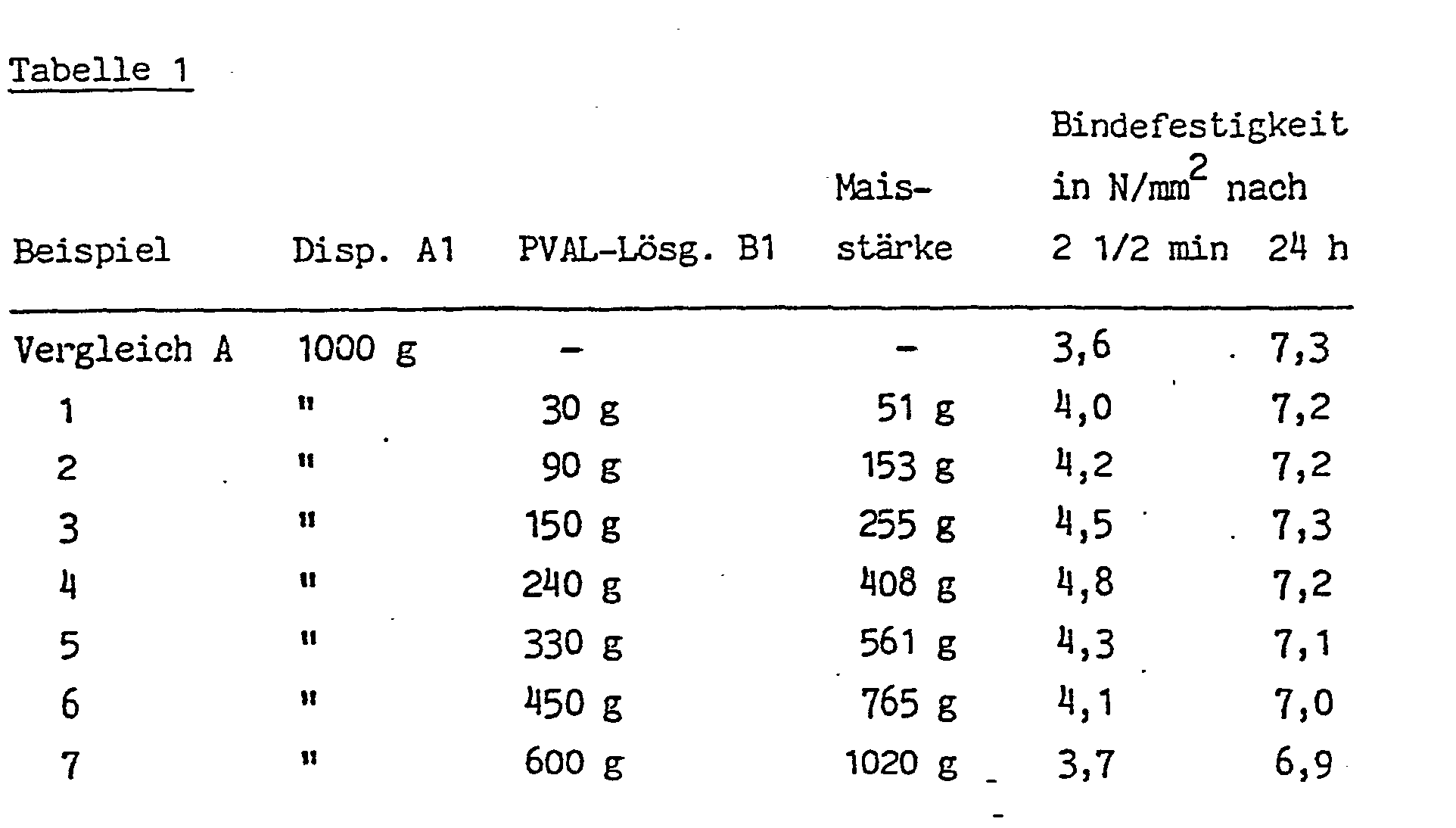
- Table 1 shows the various mixing ratios and the bond strengths that can be achieved when gluing beech wood with these mixtures after 2.5 minutes and after 24 hours.
- Table 2 shows the mixing ratios and the bond strengths that are achieved when gluing beech wood with these mixtures after 2.5 minutes and after 24 hours.
- Table 3 shows the mixing ratios and the bond strengths that can be achieved when bonding Buchholz with these mixtures after 2.5 minutes and after 24 hours.
- Table 4 shows the mixing ratios and their adhesive properties.
Landscapes
- Chemical & Material Sciences (AREA)
- Organic Chemistry (AREA)
- Health & Medical Sciences (AREA)
- Chemical Kinetics & Catalysis (AREA)
- Medicinal Chemistry (AREA)
- Polymers & Plastics (AREA)
- Adhesives Or Adhesive Processes (AREA)
- Processes Of Treating Macromolecular Substances (AREA)
- Compositions Of Macromolecular Compounds (AREA)
- Polymerisation Methods In General (AREA)
- Addition Polymer Or Copolymer, Post-Treatments, Or Chemical Modifications (AREA)
- Agricultural Chemicals And Associated Chemicals (AREA)
- Cell Separators (AREA)
- Materials For Medical Uses (AREA)
Abstract
Description
- Die Erfindung bezieht sich auf eine modifizierte, wäßrige Polyvinylester-Dispersion, ein Verfahren zu ihrer Herstellung und ihre Verwendung als Klebstoff.
- Wäßrige Dispersionen von Polyvinylestern, im besonderen von Polyvinylacetat, finden vielseitige Verwendung. Diese reicht vom Einsatz als Schlichtemittel über Bindemittel für Anstrichstoffe bis zu Klebstoffen.
- Durch die Unterschiede der Dispersionen in ihrer materiellen Zusammensetzung oder in ihrer Erscheinungsform werden ihre Verwendungsmöglichkeiten weitgehend festgelegt.
- Als Klebstoffe für saugfähige, organische Substrate eignen sich Polyvinylacetat-Dispersionen, deren Partikel Durchmesser von etwa 0,3 bis 8 µm, in manchen Fällen bis etwa 20 µm aufweisen. Die Herstellung dieser Dispersionen ist.-bekannt (vgl. DE-PS 887 411). Zu ihrer Stabilisierung werden Schutzkolloide, vorzugsweise Polyvinylalkohol, verwendet. Man polymerisiert den Vinylester, meist das Vinylacetat, in der wäßrigen Schutzkolloidlösung, die gegebenenfalls noch kleine Mengen von Emulgatoren und puffernden Substanzen enthält, unter Verwendung von radikalerzeugenden Initiatoren. Von diesem Grundverfahren kennt man viele Varianten.
- Die Bindefestigkeit von Verklebungen, die man mit Polyvinylester-Dispersionen hergestellt hat, ist sehr hoch, oft höher als die Cohäsion des verbundenen Substrats. Jedoch nicht nur die Endbindefestigkeit einer Verklebung ist wichtig; auch die Geschwindigkeit, mit der die Festigkeit ansteigt, soll möglichst hoch sein, besonders bei Verwendung des Klebstoffes im maschinellen Betrieb.
- Es ist bekannt, daß sich die Abbindegeschwindigkeit von bestimmten Dispersionen durch äußere Weichmachung steigern läßt. Dieser Effekt ist jedoch bei polyvinylalkoholnaltigen Dispersionen nicht genügend ausgeprägt, außerdem wird dadurch der "kalte Fluß" der Verleimung erhöht und ihre Wärmestandfestigkeit wird vermindert. Dies ist beispielsweise bei Holzklebstoffen sehr störend. Eine gewisse Er- .höhung der Abbindegeschwindigkeit kann auch durch nachträglichen Zusatz von Polyvinylalkohol zur- Dispersion erreicht werden. Dieser Effekt ist jedoch umso geringer, je mehr Polyvinylalkohol die Dispersion bereits enthält und es kann schließlich sogar eine Abnahme der Abbindegeschwindigkeit eintreten. -Ferner kann die Zugabe von Polyvinylalkohol zu einer fertigen Dispersion praktisch nur in Form einer wäßrigen Lösung erfolgen, wodurch der Feststoffgehalt der Dispersion in unerwünschter Weise verringert wird.
- Aufgabe der Erfindung ist die Schaffung einer Polyvinylester-Dispersion, mit welcher besonders vorteilhaft Holz verklebt werden kann, wobei bereits nach wenigen Minuten eine hohe Festigkeit der Verklebung erreicht wird.
- Es wurde gefunden, daß die Aufgabe gelöst werden kann, wenn man einer bestimmten Polyvinylester-Dispersion native Stärke zusetzt.
- Gegenstand der Erfindung ist somit eine wäßrige Polyvinylester-Dispersion mit einem Feststoffgehalt von 35 bis 65 Gew.-%, dadurch gekennzeichnet, daß 3 bis 60 Gew.-% der dispergierten Partikel einen Durchmesser von kleiner 1 µm aufweisen und zu 95 bis 100 Gew.-% aus Polyvinylacetat oder einem Vinylacetatmischpolymerisat und zu 0 bis 5 Gew.-% aus nativer Stärke bestehen, daß 40 bis 97 Gew.-% der dispergierten Partikel einen Durchmesser von 1 bis 40 µm aufweisen und zu 20 bis 95 Gew.-% aus Polyvinylacetat oder einem Vinylacetatmischpolymerisat und zu 5 bis 80 Gew.-% aus nativer Stärke bestehen, und daß die Dispersion 3 bis 12 Gew.-%, bezogen auf die Gesamtmenge der dispergierten Partikel, Polyvinylalkohol enthält.
- Gegenstand der Erfindung ist weiterhin ein Verfahren zur Herstellung einer wäßrigen Polyvinylester-Dispersion mit einem Feststoffgehalt von 35 bis 65 Gew.-%, wobei ein Teil der dispergierten Partikel aus nativer Stärke besteht, durch radikalische Polymerisation von Vinylacetat, gegebenenfalls zusammen mit bis zu etwa 10 Gew.-%, bezogen auf Gesamtpolymerisat, an mischpolymerisierbaren Verbindungen, in wäßriger Emulsion in Gegenwart von Polyvinylalkohol, dadurch gekennzeichnet, daß man die Polymerisation in Gegenwart von 3 bis 15 Gew.-%, bezogen auf das oder die zu polymerisierende(n) Monomere(n), Polyvinylalkohol, der eine Esterzahl von 60 bis 210 besitzt und dessen 4 %ige wäßrige Lösung eine Viskosität von 4 bis 60 mPa's, gemessen bei 20°C, aufweist, durchführt und anschließend die native Stärke homogen in der erhaltenen Dispersion verteilt.
- Gegenstand der Erfindung ist schließlich die Verwendung dieser Polyvinylester-Dispersion zur Herstellung von Klebstoffen für poröse organische Substrate, beispielsweise Holz.
- Zur Herstellung der erfindungsgemäßen Dispersion benötigt man eine wäßrige Polyvinylacetat-Primärdispersion, deren Partikel eine bestimmte Größe besitzen und die mit einer Mindestmenge von Polyvinylalkohol mit bestimmter Esterzahl hergestellt wurde. Die Partikel können aus Polyvinylacetat oder aus einem Mischpolymerisat aus überwiegend Vinylacetat mit geringen Mengen, bis etwa 10 Gew.-%, bezogen auf Gesamtpolymerisat, anderen mischpolymerisierbaren Verbindungen wie höheren Vinylestern, Äthylen, Maleinsäureestern, Acrylsäure, Methacrylsäure, Crotonsäure, Maleinsäure oder Natriumethensulfonat bestehen.
- Die Bereitung der für die Herstellung der erfindungsgemäßen Dispersion benötigten Polymer-Primärdispersion geschieht in bekannter Weise. In einer wäßrigen Lösung von Polyvinylalkohol wird Vinylacetat und gegebenenfalls die Comonomeren in Emulsion polymerisiert. Dies geschieht wie üblich durch radikalerzeugende Initiatoren wie Peroxidisulfate, Wasserstoffperoxid, organische Peroxide oder Redoxinitiatoren. Die Reaktion wird vorzugsweise derart durchgeführt, daß in die auf etwa 40 bis 80°C vorgeheizte, durch eine Rührvorrichtung in Bewegung gehaltene Polyvinylalkohollösung, verteilt über mehrere Stunden, das oder die Monomere(n) und der Initiator zugegeben werden. Die Polymerisation erfolgt während dieser Zeit bei einer Temperatur, je nach Art des verwendeten Initiators und der Abführung des Polymerisationswärme, von etwa 40 bis 100°C, vorzugsweise von 65 bis 90°C. Es ist auch möglich, den gesamten Initiator in die wäßrige Phase zu geben, bevor man mit der Zugabe des oder der Monomeren beginnt. Analog kann auch das gesamte Monomere vor dem Polymerisationsstart in der Polyvinylalkohollösung emulgiert werden. Bei einer weiteren Variante der Dispersionsherstellung werden Polyvinylakohollösung und Monomere und Initiator gemischt und diese Mischung kontinuierlich in den Reaktor gegeben, wo die Polymerisation erfolgt. Zur Stabilisierung der Polymerdispersion dient Polyvinylalkohol. Gemische von Polyvinylalkoholen unterschiedlichen Molekulargewichts und unterschiedlichen Hydrolysegrades können verwendet werden. Bei der Herstellung der Dispersion werden 3 bis 15 Gew.-%, vorzugsweise 4 bis 12 Gew.-% Polyvinylalkohol, bezogen auf polymerisierendes Monomer, eingesetzt. Die Viskosität der 4 % igen wäßrigen Lösung des verwendeten Polyvinylalkohols beträgt 4 bis 60 mPa's, vorzugsweise beträgt sie 18 bis 50 mPa's, gemessen bei 20°C. Die Esterzahl des Polyvinylalkohol beträgt 60 bis 210, vorzugsweise 100 bis 180. Außer dem Polyvinylalkohol können in der wäßrigen Phase in untergeordneter Menge noch andere Schutzkolloide wie Stärkederivate, gelöste Nativ-oder Quellstärke oder oberflächenaktive ionische oder nichtionische Substanzen enthalten sein. Der Feststoffgehalt der Verwendung findenden Primärdispersion (ermittelt durch Trocknen bei 110°C)liegt bei 30 bis 65 Gew.-%. Er ist nur insofern wichtig, als er die Herstellung erfindungsgemäßer Dispersionen mit bestimmtem Feststoffgehalt ermöglicht. Die Latexviskosität der Primärdispersion liegt im allgemeinen zwischen 5 und 50 Pa's.
- Derartige Primärdispersionen von Polyvinylacetat oder Mischpolymerisaten des Vinylacetats sind auch im Handel käuflich erhältlich.
- In die Primärdispersion wird mittels geeigneter technischer Hilfsmittel z. B. einem Ankerrührer, einem Propellerrührer mit hoher Drehzahl, einem Walzenstuhl, einem Planetenmischer oder einem ähnlichen Gerät eine bestimmte Menge nativer Stärke gleichmäßig verteilt.
- Die erfindungsgemäße Dispersion soll ein bestimmte Menge Polyvinylalkohol enthalten. Man gibt daher bei dem Mischprozeß gegebenenfalls Polyvinylalkohol, am besten als wäßrigre Lösung zu. Auch Wasser allein kann eingemischt werden, um einen bestimmten Feststoffgehalt einzustellen.
- Die Gesamtmenge Polyvinylalkohol, die sich in der erfindungsgemäßen Dispersion befindet, also der Polyvinylalkohol in der Primärdispersion plus dem eventuell beim Mischen zugefügten, soll 3 bis 12 Gew.-%, vorzugsweise 5 bis 10 Gew.-%, bezogen auf alle dispergierten Partikel, betragen. Man erhält eine besonders hohe Abbindegeschwindigkeit der Dispersion, wenn die Polyvinylalkohol-Menge, bezogen auf alle dispergierten Partikel, nach dem Einmischen der Stärke nicht wesentlich geringer ist, als sie in der Primärdispersion war.
- Eine bevorzugte Ausführungsform der Dispersionsherstellung ist es daher, daß beim Mischen der Dispersion und der Stärke noch weiterer Polyvinylalkohol entsprechend dem Stärkezusatz zugegeben wird.
- Das Mischen der Primärdispersion mit der nativen Stärke kann in der Weise geschehen, daß die Stärke zuerst in der berechneten Menge Wasser oder Polyvinylalkohollösung - man bevorzugt einen Polyvinylalkohol, dessen 4 %ige, wäßrige Lösung eine Viskosität von mehr als 16 mPa's, vorzugsweise 20 bis 60 mPa's aufweist, angeteigt wird und diese Vorsuspension dann mit der Primärdispersion vermischt wird. Man kann auch in die Primärdispersion, gegebenenfalls nach vorherigem Vermischen mit Wasser oder Polyvinylalkohollösung, die trockene Stärke unter Rühren oder Kneten eintragen. Dabei ist darauf zu achten, daß die Temperatur der Mischung nicht über die Gelatinierungstemperatur der Stärkepartikel ansteigt. Die so hergestellte Dispersion enthält 35 bis 65 Gew.-% nicht flüchtige Anteile.
- Bei der Stärke handelt es sich um native, also chemisch nicht modifizierte und keinem Abbauprozeß unterzogene Stärke. Die Stärkekörner besitzen einen Durchmesser von etwa 1 bis 40 µm, vorzugsweise 2 bis 25 /um, wie dies z. B. bei den aus Mais, Reis oder Weizen gewonnenen Stärken der Fall ist.
- 95 bis 100 Gew.-% der kleinen Partikel (kleiner 1 µm) in der fertigen erfindungsgemäßen Dispersion bestehen aus Polyvinylacetat oder einem Vinylacetatmischpolymerisat, 0 bis 5 Gew.-% aus Stärke. Die großen Partikel (1 bis 40 ,um) bestehen zu 20 bis 95 Gew.-%, vorzugsweise zu 40 bis 95 Gew.-% aus Polyvinylacetat oder einem Vinylacetatmischpolymerisat und zu 6 bis 80 Gew.-%, vorzugsweise zu 5 bis 60 Gew.-% aus Stärke. Die Gesamtmenge der dispergierten .Partikel bcsteht zu etwa 2 bis 70, vorzugsweise 5 bis 50 Gew.-% aus Stärke.
- Die Prüfung der Klebeeigenschaften wird in der Weise vorgenommen, daß auf einem Prüfkörper aus Buchenholz die zu prüfende Dispersion in einer Schichtdicke von 0,3 mm aufgetragen wird. Darauf wird ein anderer Prüfkörper auf einer Fläche von 3 cm2 mit einem Druck von 1 bar 2,5 Minuten aufgepreßt und sofort die Bindefestigkeit mittels einer Reißmaschine bestimmt und das arithmetische Mittel aus 20 Verklebungen in N/mm2 errechnet. Dieser Wert ist ein Maß für die Abbindegeschwindigkeit. Nach 24 Stunden Lagerung und Reißen erhält man den Wert für die Endbindefestigkeit.
- Wenn man in einer Polyvinylacetat-Dispersion die plastischen Polyvinylacetatpartikel teilweise durch klebetechnisch neutrale, starre Stärkepartikel ersetzt, so hätte man erwarten müssen, daß die Klebekraft der Dispersion mehr oder weniger stark abnimmt. Statt dessen bleibt sie bis zu einem erheblichen Stärkeanteil erhalten. Es überrascht, daß die Abbindegeschwindigkeit beispielsweise beim Verkleben von Holz mit der erfindungsgemäßen Dispersion bei steigendem Gehalt an Stärkepartikeln zunächst eindeutig ansteigt und erst bei hohem Stärkeanteil abfällt.
- Die erfindungsgemäße Dispersion eignet sich besonders zum Verkleben von porösen Substraten, beispielsweise wenn ein rasches Abbinden erwünscht ist. Ein weiterer Vorteil ist, daß dieser Effekt mit Stärke, also einem Material, das von der Erdölbasis unabhängig ist, erreicht wird.
- Die folgenden Beispiele dienen zur näheren Erläuterung der Erfindung. Prozentangaben beziehen sich jeweils auf das Gewicht.
- Unter Zuhilfenahme eines schnelldrehenden Propellerrührers werden gemischt:
- 1. eine wäßrige, etwa 60 Gew.-% nichtflüchtige Bestandteile enthaltende Polyvinylacetat-Dispersion A 1. Sie enthält etwa 56 Gew.-% Polyvinylacetat-Partikel, von denen 53 Gew.-% Durchmesser kleiner 1 µm und 47 Gew.-% Durchmesser von 1 bis 5 /um haben. Sie wurde wie folgt hergestellt: In einem 100 Liter-Kessel aus nichtrostendem Stahl, ausgestattet mit Ankerrührer (100 UpM), Rückflußkühler, Heiz-, Kühl- und Dosiervorrichtungen, wurden 22 kg entsalztes Wasser gegeben und darin 2,2 kg eines Polyvinylalkohöls mit der Esterzahl 135 und einer Viskosität seiner 4 %igen wäßrigen Lösung bei 20°C von 20 mPa·s gelöst. Dazu wurden 0,6 g Cobaltacetat gegeben und der Ansatz mit 2n-Schwefelsäure auf pH 4 eingestellt. Unter Rühren wurden 32 kg Vinylacetat und 75 g 30 %iges Wasserstoffperoxid zugegeben. Durch Aufheizen des Kesselinhaltes bis zur Rückflußtemperatur des Vinylacetats wurde die Polymerisation gestartet und dann innerhalb etwa 2 Stunden durchgeführt. Zur Vervollständigung der Reaktion wurde noch 1 Stunde bei 80°C gehalten und dann die Dispersion gekühlt.
- 2. eine 8,9 %ige wäßrige Lösung B1 von Polyvinylalkohol mit der Esterzahl 90, dessen 4 %ige wäßrige Lösung eine Viskosität von 23 mPa's hat;
- 3. eine natürliche Maisstärke mit einem Wassergehalt von 10 Gew.-%. Wenigstens 90 Gew.-% der Stärkepartikel haben einen Durchmesser von 5 bis 22 µm.
- Die Tabelle 1 zeigt die verschiedenen Mischungsverhältnisse und die Bindefestigkeiten, die man bei Verkleben von Buchenholz mit diesen Mischungen nach 2,5 Minuten und nach 24 Stunden erzielt.
- Zum Vergleich wird ein Versuch mit der reinen Primärdispersion A 1 durchgeführt (= Vergleichsbeispiel A).
- Man mischt
- 1. die Polyvinylacetat-Dispersion A 1 wie in Beispiel 1 bis 7;
- 2. eine 5 %ige, wäßrige Lösung B2 eines Polyvinylalkohols mit der Esterzahl 130, dessen 4 %ige wäßrige Lösung eine Viskosität von 26 mPa·s hat;
- 3. eine Reisstärke mit 95 Gew.-% nicht flüchtigen Anteilen und einer Partikelgröße von 2 bis 6 µm.
- Die Tabelle 2 zeigt die Mischungsverhältnisse und die Bindefestigkeiten, die man beim Verkleben von Buchenholz mit diesen Mischungen nach 2,5 Minuten und nach 24 Stunden erzielt.

- Man mischt
- 1. eine wäßrige, etwa 50 Gew.-% nichtflüchtige Bestandteile enthaltende Dispersion A2. Sie enthält 45,4 Gew.-% Polyvinylacetat-Partikel, von denen 20 Gew.-% Durchmesser von kleiner 1 µm und 80 Gew.-% Durchmesser von 1 bis 5 µm haben. Sie wurde auf folgende Weise hergestellt:
- In einen 100-Liter-Kessel aus rostfreiem Stahl, ausgestattet mit einem Ankerrührer (100 UpM), Rückflußkühler, Heiz-, Kühl- und Dosiereinrichtungen, wurden 27 kg entsalztes Wasser gegeben und darin 2,5 kg eines Polyvinylalkohols mit der Esterzahl 140 und einer Viskosität seiner 4 %igen, wäßrigen Lösung bei 20°C von 26 mPa·s gelöst. Unter Rühren wurden 25 kg Vinylacetat, 0,04 kg Maleinsäureanhydrid, 0,01 kg Dilauroylperoxid und 0,005 kg Natriumperoxidisulfat zugegeben. Die Polymerisation wurde unter Rückfluß des Vinylacetats durchgeführt.
- 2. eine Weizenstärke mit 87 Gew.-% nichtflüchtigen Bestandteilen und einer Partikelgröße von 3 bis 28 ,um.
- Die Tabelle 3 zeigt die Mischungsverhältnisse und die Bindefestigkeiten, die man beim Verkleben von Buchholz mit diesen Mischungen nach 2,5 Minuten und nach 24 Stunden erzielt.
- Zum Vergleich wird ein Versuch mit der reinen Primärdispersion A2 durchgeführt (= Vergleichsbeispiel B).

- Man mischt
- 1. eine wäßrige, etwa 40 Gew.-% nichtflüchtige Bestandteile enthaltende Primärdispersion A3. Sie enthält etwa 37 Gew.-% Partikel aus einem Mischpolymerisat aus Vinylacetat und Natriumethensulfonat, von denen 33 Gew.-% einen Durchmesser von kleiner 1 µm und 67 Gew.-% einen Durchmesser von 1 bis 12 µm haben. Sie war wie folgt worden: hergestellt worden:
- In einem 100-Liter Kessel aus rostfreiem Stahl, ausgestattet. mit einem Ankerrührer (100 UpM), Rückflußkühler, Heiz-, Kühl- und Dosiereinrichtung, wurden in 47 kg entsalztem Wasser 1,2 kg eines Polyvinylalkohols mit einer Esterzahl von 120 und einer Viskosität seiner 4 %igen wäßrigen Lösung bei 20°C von 20 mPa·s und 1,2 kg eines Polyvinylalkohols mit einer Esterzahl von 160 und einer Viskosität seiner 4 %igen wäßrigen Lösung bei 20°C von 40 mPa's gelöst. Dazu wurde 1 kg einer wäßrigen, 25 Gew.-%igen Lösung von Natriumethensulfonat gegeben. Der Kesselinhalt wurde auf eine Temperatur von 66°C gebracht, 3 kg Vinylacetat einemulgiert und danach 25 g Ammoniumperoxidisulfat zugegeben. Nach 40 Minuten wurde begonnen, innerhalb von 4 Stunden 27 kg Vinylacetat einzudosieren. Durch Betätigen der Heiz- bzw. Kühleinrichtung wurde die Polymerisation bei einer Temperatur von 70 bis 72°C durchgeführt. Nach Zugabe des Vinylacetats wurden 5 g Ammoniumperoxidisulfat, gelöst in 100 g Wasser, zugegeben und zur Vervollständigung der Polymerisation das Reaktionsgut 2 Stunden bei 80°C gehalten.
- 2. eine 12 %ige wäßrige Lösung B3 eines Polyvinylalkohols mit der Esterzahl 60, dessen 4 %ige wäßrige Lösung eine Viskosität von 18 mPa's hat;
- 3. eine Maisstärke mit 87 Gew.-% nichtflüchtigen Anteilen und einem Partikeldurchmesser von 7 bis 20 µm.
- Die Tabelle 4 zeigt die Mischungsverhältnisse und deren Klebeeigenschaften.
- Zum Vergleich wird ein Versuch mit der reinen Primärdispersion A3 durchgeführt (= Vergleichsbeispiel C).

Claims (3)
Priority Applications (1)
| Application Number | Priority Date | Filing Date | Title |
|---|---|---|---|
| AT83106782T ATE18565T1 (de) | 1982-07-16 | 1983-07-11 | Waessrige polyvinylester-dispersion, verfahren zu ihrer herstellung und ihre verwendung. |
Applications Claiming Priority (2)
| Application Number | Priority Date | Filing Date | Title |
|---|---|---|---|
| DE19823226681 DE3226681A1 (de) | 1982-07-16 | 1982-07-16 | Waessrige polyvinylester-dispersion, verfahren zu ihrer herstellung und ihre verwendung |
| DE3226681 | 1982-07-16 |
Publications (4)
| Publication Number | Publication Date |
|---|---|
| EP0100892A2 true EP0100892A2 (de) | 1984-02-22 |
| EP0100892A3 EP0100892A3 (en) | 1984-06-13 |
| EP0100892B1 EP0100892B1 (de) | 1986-03-12 |
| EP0100892B2 EP0100892B2 (de) | 1991-11-21 |
Family
ID=6168608
Family Applications (1)
| Application Number | Title | Priority Date | Filing Date |
|---|---|---|---|
| EP83106782A Expired - Lifetime EP0100892B2 (de) | 1982-07-16 | 1983-07-11 | Wässrige Polyvinylester-Dispersion, Verfahren zu ihrer Herstellung und ihre Verwendung |
Country Status (14)
| Country | Link |
|---|---|
| US (1) | US4544689A (de) |
| EP (1) | EP0100892B2 (de) |
| JP (1) | JPS5927941A (de) |
| AT (1) | ATE18565T1 (de) |
| AU (1) | AU1691783A (de) |
| CA (1) | CA1217289A (de) |
| DE (2) | DE3226681A1 (de) |
| DK (1) | DK326783A (de) |
| ES (1) | ES524100A0 (de) |
| FI (1) | FI832577L (de) |
| MX (1) | MX162540A (de) |
| NO (1) | NO832591L (de) |
| PT (1) | PT77035B (de) |
| ZA (1) | ZA835158B (de) |
Cited By (4)
| Publication number | Priority date | Publication date | Assignee | Title |
|---|---|---|---|---|
| EP0161936A3 (en) * | 1984-05-15 | 1986-09-03 | H.B. Fuller Company | Book binding adhesive composition and process using the same |
| US5331055A (en) * | 1990-05-28 | 1994-07-19 | Kuraray Co., Ltd. | Process for producing vinyl ester polymer and process for producing vinyl alcohol polymer |
| EP0460502B1 (de) * | 1990-05-28 | 1996-12-04 | Kuraray Co., Ltd. | Verfahren zur Herstellung von Vinylesterpolymeren und Verfahren zur Herstellung von Vinylalkoholpolymeren |
| WO2001016246A3 (de) * | 1999-09-02 | 2001-09-07 | Wacker Chemie Gmbh | Verwendung von polyvinylalkohol-stabilisierten polyvinylacetat-klebemitteln zur verleimung von holzspanplatten |
Families Citing this family (8)
| Publication number | Priority date | Publication date | Assignee | Title |
|---|---|---|---|---|
| JPS59123340U (ja) * | 1983-02-09 | 1984-08-20 | 凸版印刷株式会社 | 断裁用チヤツクステ−ジ |
| EP0245718B1 (de) * | 1986-05-12 | 1991-12-27 | National Starch and Chemical Investment Holding Corporation | Zement aus einer stabilisierten Stärke-Emulsion für Fugenbänder |
| US4751259A (en) * | 1987-08-05 | 1988-06-14 | Nalco Chemical Company | Compositions for iron ore agglomeration |
| DE4324474A1 (de) * | 1993-07-21 | 1995-01-26 | Henkel Kgaa | Verwendung ausgewählter Polyvinylacetat-Dispersionen für die Oberflächenverfestigung von Sand und/oder Erdreich |
| DE19949332A1 (de) | 1999-10-13 | 2001-05-23 | Clariant Gmbh | Verfärbungsarme Dispersionsklebstoffe mit verlängerter Topfzeit |
| JP2002167403A (ja) * | 2000-09-19 | 2002-06-11 | Kuraray Co Ltd | ビニルエステル系樹脂エマルジョンの製法 |
| KR100486770B1 (ko) * | 2002-11-14 | 2005-05-03 | (주)득영 | 방수테이프용 수용성접착제 및 그 제조방법 |
| CN103333644A (zh) * | 2013-05-30 | 2013-10-02 | 安徽祈艾特电子科技有限公司 | 一种高强度透纸箱用胶粘剂及其制备方法 |
Citations (1)
| Publication number | Priority date | Publication date | Assignee | Title |
|---|---|---|---|---|
| DE887411C (de) | 1938-04-01 | 1953-08-24 | Wacker Chemie Gmbh | Verfahren zur Herstellung von Emulsionen und Dispersionen von Polymerisations- und Kondensationsprodukten |
Family Cites Families (7)
| Publication number | Priority date | Publication date | Assignee | Title |
|---|---|---|---|---|
| US3442845A (en) * | 1966-11-04 | 1969-05-06 | Borden Co | Hot and cold water redispersible polyvinyl acetate adhesives |
| US3620899A (en) * | 1968-04-16 | 1971-11-16 | Formica Corp | Decorative laminate back coated with a polyvinyl acetate composition |
| US4239563A (en) * | 1971-11-02 | 1980-12-16 | Air Products And Chemicals, Inc. | Process for the use of vinyl acetate-ethylene copolymer emulsions to adhere fibers to carpet backing |
| JPS5542117B2 (de) * | 1973-04-25 | 1980-10-28 | ||
| DE2364364C3 (de) * | 1973-12-22 | 1980-04-24 | Hoechst Ag, 6000 Frankfurt | Vernetzbare wäßrige Vinylestercopolymerisatdispersionen |
| US3984275A (en) * | 1974-04-25 | 1976-10-05 | International Paper Company | Acid type starch adhesive composition |
| DE2614261C3 (de) * | 1976-04-02 | 1984-08-23 | Hoechst Ag, 6230 Frankfurt | Verfahren zur Herstellung dispergierbarer Dispersionspulver |
-
1982
- 1982-07-16 DE DE19823226681 patent/DE3226681A1/de not_active Withdrawn
-
1983
- 1983-07-11 EP EP83106782A patent/EP0100892B2/de not_active Expired - Lifetime
- 1983-07-11 DE DE8383106782T patent/DE3362537D1/de not_active Expired
- 1983-07-11 AT AT83106782T patent/ATE18565T1/de not_active IP Right Cessation
- 1983-07-14 FI FI832577A patent/FI832577L/fi not_active Application Discontinuation
- 1983-07-14 ES ES524100A patent/ES524100A0/es active Granted
- 1983-07-15 AU AU16917/83A patent/AU1691783A/en not_active Abandoned
- 1983-07-15 JP JP58128072A patent/JPS5927941A/ja active Pending
- 1983-07-15 DK DK326783A patent/DK326783A/da not_active Application Discontinuation
- 1983-07-15 US US06/514,171 patent/US4544689A/en not_active Expired - Fee Related
- 1983-07-15 CA CA000432565A patent/CA1217289A/en not_active Expired
- 1983-07-15 MX MX198055A patent/MX162540A/es unknown
- 1983-07-15 NO NO832591A patent/NO832591L/no unknown
- 1983-07-15 PT PT77035A patent/PT77035B/pt not_active IP Right Cessation
- 1983-07-15 ZA ZA835158A patent/ZA835158B/xx unknown
Patent Citations (1)
| Publication number | Priority date | Publication date | Assignee | Title |
|---|---|---|---|---|
| DE887411C (de) | 1938-04-01 | 1953-08-24 | Wacker Chemie Gmbh | Verfahren zur Herstellung von Emulsionen und Dispersionen von Polymerisations- und Kondensationsprodukten |
Cited By (4)
| Publication number | Priority date | Publication date | Assignee | Title |
|---|---|---|---|---|
| EP0161936A3 (en) * | 1984-05-15 | 1986-09-03 | H.B. Fuller Company | Book binding adhesive composition and process using the same |
| US5331055A (en) * | 1990-05-28 | 1994-07-19 | Kuraray Co., Ltd. | Process for producing vinyl ester polymer and process for producing vinyl alcohol polymer |
| EP0460502B1 (de) * | 1990-05-28 | 1996-12-04 | Kuraray Co., Ltd. | Verfahren zur Herstellung von Vinylesterpolymeren und Verfahren zur Herstellung von Vinylalkoholpolymeren |
| WO2001016246A3 (de) * | 1999-09-02 | 2001-09-07 | Wacker Chemie Gmbh | Verwendung von polyvinylalkohol-stabilisierten polyvinylacetat-klebemitteln zur verleimung von holzspanplatten |
Also Published As
| Publication number | Publication date |
|---|---|
| CA1217289A (en) | 1987-01-27 |
| FI832577A7 (fi) | 1984-01-17 |
| MX162540A (es) | 1991-05-20 |
| ES8404697A1 (es) | 1984-05-16 |
| PT77035B (en) | 1986-02-26 |
| AU1691783A (en) | 1984-01-19 |
| DK326783D0 (da) | 1983-07-15 |
| EP0100892A3 (en) | 1984-06-13 |
| EP0100892B1 (de) | 1986-03-12 |
| US4544689A (en) | 1985-10-01 |
| DE3362537D1 (en) | 1986-04-17 |
| NO832591L (no) | 1984-01-17 |
| JPS5927941A (ja) | 1984-02-14 |
| DK326783A (da) | 1984-01-17 |
| ES524100A0 (es) | 1984-05-16 |
| DE3226681A1 (de) | 1984-01-19 |
| ZA835158B (en) | 1984-04-25 |
| ATE18565T1 (de) | 1986-03-15 |
| FI832577A0 (fi) | 1983-07-14 |
| FI832577L (fi) | 1984-01-17 |
| PT77035A (en) | 1983-08-01 |
| EP0100892B2 (de) | 1991-11-21 |
Similar Documents
| Publication | Publication Date | Title |
|---|---|---|
| EP0100892B2 (de) | Wässrige Polyvinylester-Dispersion, Verfahren zu ihrer Herstellung und ihre Verwendung | |
| CH622817A5 (de) | ||
| DE19903979C2 (de) | Pfropfpolymerisat auf Stärkebasis, Verfahren zu seiner Herstellung und seine Verwendung in Druckfarben über Überdrucklacken | |
| DE4316379A1 (de) | Geruchsarmer Dispersionshaftklebstoff | |
| DE2703653C2 (de) | ||
| EP0062906B1 (de) | Wässrige Polyvinylester-Dispersion, Verfahren zu ihrer Herstellung und ihre Verwendung | |
| EP0008605A1 (de) | Zusatzmittel zur Herstellung porenarmer, kunststoffhaltiger, hydraulisch abbindender Massen und seine Verwendung | |
| EP0778870A2 (de) | Physikalisch und/oder chemisch abbindende bindemittel | |
| DE2752133C2 (de) | Latexmasse, Verfahren zu ihrer Herstellung und ihre Verwendung | |
| DE3405019C2 (de) | ||
| DE4133191A1 (de) | Schleifmittel | |
| DE3306202A1 (de) | Verwendung von gepfropften ethylen-vinylacetat-copolymeren zur herstellung von schmelzklebstoffen | |
| DE2000166C3 (de) | Druckempfindlicher Klebstoff auf Basis eines carboxylierten Acrylsäureester-Copolymerisats | |
| DE3105279A1 (de) | Druckempfindlicher klebstoff und ihn enthaltende klebefolie | |
| DE10337183B4 (de) | Verfahren zur Herstellung von mehrmodalen Polymerdispersionen durch Einsatz von polymeren Stabilisatoren und deren Verwendung | |
| WO2011003864A1 (de) | Kaltsiegelbare, durch emulsionspolymerisation in gegenwart von ethylen/(meth)acrylsäure copolymer hergestellte polymerdispersion | |
| DE2064488A1 (de) | Klebmittelmischung | |
| DE2625859A1 (de) | Verfahren zur herstellung von polyvinylacetatdispersionen | |
| DE1904549C3 (de) | Versprühbare Klebemittelmasse | |
| DE2636863A1 (de) | Kaltvernetzende dispersionskleber | |
| DE2636970A1 (de) | Kaltvernetzende dispersionskleber | |
| DE1745436C3 (de) | Verfahren zur Polymerisation von Vinylacetat in waVerfahren zur Herstellung von Polyvinylacetatklebstoffemulsionen essriger Emulsion | |
| EP0111239B1 (de) | Verfahren zur Herstellung einer Verklebung mit Hilfe eines Kontaktklebstoffes | |
| DE1127085B (de) | Verfahren zur Herstellung waessriger stabiler Dispersionen von Mischpolymerisaten aus organischen Vinylestern und AEthylen | |
| DE69635454T2 (de) | Mit basisch löslicher schutzschicht bedecktes rostfreies stahlblech |
Legal Events
| Date | Code | Title | Description |
|---|---|---|---|
| PUAI | Public reference made under article 153(3) epc to a published international application that has entered the european phase |
Free format text: ORIGINAL CODE: 0009012 |
|
| AK | Designated contracting states |
Designated state(s): AT CH DE GB LI |
|
| PUAL | Search report despatched |
Free format text: ORIGINAL CODE: 0009013 |
|
| AK | Designated contracting states |
Designated state(s): AT CH DE GB LI |
|
| RBV | Designated contracting states (corrected) |
Designated state(s): AT CH DE GB LI |
|
| 17P | Request for examination filed |
Effective date: 19841130 |
|
| GRAA | (expected) grant |
Free format text: ORIGINAL CODE: 0009210 |
|
| AK | Designated contracting states |
Kind code of ref document: B1 Designated state(s): AT CH DE GB LI |
|
| REF | Corresponds to: |
Ref document number: 18565 Country of ref document: AT Date of ref document: 19860315 Kind code of ref document: T |
|
| REF | Corresponds to: |
Ref document number: 3362537 Country of ref document: DE Date of ref document: 19860417 |
|
| PLBI | Opposition filed |
Free format text: ORIGINAL CODE: 0009260 |
|
| 26 | Opposition filed |
Opponent name: HENKEL KOMMANDITGESELLSCHAFT AUF AKTIEN Effective date: 19861211 |
|
| PUAH | Patent maintained in amended form |
Free format text: ORIGINAL CODE: 0009272 |
|
| STAA | Information on the status of an ep patent application or granted ep patent |
Free format text: STATUS: PATENT MAINTAINED AS AMENDED |
|
| 27A | Patent maintained in amended form |
Effective date: 19911121 |
|
| AK | Designated contracting states |
Kind code of ref document: B2 Designated state(s): AT CH DE GB LI |
|
| REG | Reference to a national code |
Ref country code: CH Ref legal event code: AEN |
|
| PGFP | Annual fee paid to national office [announced via postgrant information from national office to epo] |
Ref country code: CH Payment date: 19940615 Year of fee payment: 12 |
|
| PGFP | Annual fee paid to national office [announced via postgrant information from national office to epo] |
Ref country code: GB Payment date: 19940620 Year of fee payment: 12 |
|
| PGFP | Annual fee paid to national office [announced via postgrant information from national office to epo] |
Ref country code: AT Payment date: 19940623 Year of fee payment: 12 |
|
| PGFP | Annual fee paid to national office [announced via postgrant information from national office to epo] |
Ref country code: DE Payment date: 19940915 Year of fee payment: 12 |
|
| PG25 | Lapsed in a contracting state [announced via postgrant information from national office to epo] |
Ref country code: GB Effective date: 19950711 Ref country code: AT Effective date: 19950711 |
|
| PG25 | Lapsed in a contracting state [announced via postgrant information from national office to epo] |
Ref country code: LI Effective date: 19950731 Ref country code: CH Effective date: 19950731 |
|
| GBPC | Gb: european patent ceased through non-payment of renewal fee |
Effective date: 19950711 |
|
| REG | Reference to a national code |
Ref country code: CH Ref legal event code: PL |
|
| PG25 | Lapsed in a contracting state [announced via postgrant information from national office to epo] |
Ref country code: DE Effective date: 19960402 |
|
| APAC | Appeal dossier modified |
Free format text: ORIGINAL CODE: EPIDOS NOAPO |
|
| APAC | Appeal dossier modified |
Free format text: ORIGINAL CODE: EPIDOS NOAPO |
|
| APAH | Appeal reference modified |
Free format text: ORIGINAL CODE: EPIDOSCREFNO |