EP0094049A2 - Zahnfüllmasse, enthaltend einen Zusatz von Polyvinylbutyral - Google Patents
Zahnfüllmasse, enthaltend einen Zusatz von Polyvinylbutyral Download PDFInfo
- Publication number
- EP0094049A2 EP0094049A2 EP83104449A EP83104449A EP0094049A2 EP 0094049 A2 EP0094049 A2 EP 0094049A2 EP 83104449 A EP83104449 A EP 83104449A EP 83104449 A EP83104449 A EP 83104449A EP 0094049 A2 EP0094049 A2 EP 0094049A2
- Authority
- EP
- European Patent Office
- Prior art keywords
- salicylic acid
- polyvinyl butyral
- filling compound
- calcium hydroxide
- added
- Prior art date
- Legal status (The legal status is an assumption and is not a legal conclusion. Google has not performed a legal analysis and makes no representation as to the accuracy of the status listed.)
- Granted
Links
Classifications
-
- A—HUMAN NECESSITIES
- A61—MEDICAL OR VETERINARY SCIENCE; HYGIENE
- A61K—PREPARATIONS FOR MEDICAL, DENTAL OR TOILETRY PURPOSES
- A61K6/00—Preparations for dentistry
- A61K6/70—Preparations for dentistry comprising inorganic additives
- A61K6/78—Pigments
-
- A—HUMAN NECESSITIES
- A61—MEDICAL OR VETERINARY SCIENCE; HYGIENE
- A61K—PREPARATIONS FOR MEDICAL, DENTAL OR TOILETRY PURPOSES
- A61K6/00—Preparations for dentistry
- A61K6/80—Preparations for artificial teeth, for filling teeth or for capping teeth
- A61K6/849—Preparations for artificial teeth, for filling teeth or for capping teeth comprising inorganic cements
- A61K6/876—Calcium oxide
Definitions
- the invention relates to a tooth filling compound based on calcium hydroxide and salicylic acid esters with an addition of polyvinyl butyral, which is suitable for underfilling and for pulp capping.
- a tooth filling compound is described in US Pat. No. 3,047,408, which is obtained from powdered calcium hydroxide and esters from polyhydric alcohols with salicylic acid and optionally methyl salicylate, inert powdered fillers and / or plasticizers.
- This dental cement has all the advantages of calcium hydroxide dispersions, i. H. it causes the formation of secondary dentine and its high pH of more than 11 acts as a protective barrier against acids and other toxic substances that are contained in some fillers. Due to the presence of the salicylic acid esters, the cement hardens to an underfill after penetration into the tooth cavity, which protects the tooth pulp during the subsequent placement of the filling.
- Another dental cement for an underfill which consists of calcium hydroxide and a salicylic acid ester of a monohydric alcohol, is described in CH-PS 610 199. Underfills made from this cement have a relatively low compressive strength.
- Dental cements based on calcium hydroxide and salicylic acid esters are usually obtained from two pastes: a so-called salicylic ester paste, the main component of which is a mixture of different salicylic esters with inert fillers, and a so-called calcium hydroxide paste, which contains calcium hydroxide as the main component in a liquid paste base.
- the invention has for its object to provide a dental cement based on calcium hydroxide and salicylic acid esters of aliphatic alcohols, which has a sufficiently high pH and promotes the formation of secondary dentin and therefore fully functions as a protective barrier against acids and other toxic substances fulfilled, which, on the other hand, has good water resistance and increased pressure resistance and thus guarantees permanent pulp protection.
- polymers which are described in DE-AS 1 006 125 for the production of polymer films are not at all suitable for achieving the object according to the invention since they do not provide the required improvement in the water resistance of dental cements based of salicylic acid esters and calcium hydroxide.
- polyvinyl butyral is known as a binder in rubber printing inks and varnishes. This use did not suggest that the addition of polyvinyl butyral to a calcium hydroxide cement according to the invention improves its properties.
- the invention relates to a tooth filling compound consisting of two separate mixing components, one mixing component a) salicylic acid ester of aliphatic alcohols and the other mixing component b) calcium hydroxide, which is characterized in that one or both mixing components polyvinylbutyral with a degree of acetalization of at least 75% is added is.
- the dental cements obtained by the addition of polyvinyl butyral according to the invention have low water solubility and, after hardening, have increased compressive strength.
- the pH also remains strongly alkaline, so that effective pulp protection can be achieved and the formation of a secondary dentin layer is stimulated.
- polyvinyl butyral according to the invention also promotes the segregation resistance of the ester paste, i. H. the mixture component for the dental cement, which contains the salicylic acid esters.
- the cement composition corresponds to that of known salicylic acid calcium hydroxide dental cements, as described, for example, in US Pat. No. 3,047,408 and the similar DE-AS 12 02 937.
- One of the main components is calcium hydroxide, which is preferably present in a stoichiometric excess over the salicylic acid ester (s).
- Another essential ingredient is a salicylic acid ester of a mono- or polyhydric alcohol; preferably an aliphatic alcohol with 1 to 8 carbon atoms, in particular such a di- or trihydric aliphatic alcohol, preferably with 3 - 8 carbon atoms.
- salicylic acid esters of polyhydric alcohols with 3 to 8 carbon atoms are used together with salicylic acid esters of monohydric aliphatic alcohols with 1 to 4 carbon atoms, in particular methyl or ethyl esters.
- a particularly preferred embodiment contains a mixture of the salicylic acid monoester and diester of 1,3-butanediol and salicylic acid methyl ester.
- the dental cement can contain customary inert fillers, such as titanium dioxide, tin dioxide, calcium sulfate, calcium phosphate, aluminum oxide, silica or zinc oxide, and, in addition, pigments, X-ray contrast agents, such as barium sulfate or calcium tungstate, plasticizers and other additives customary for fillers can be present, e.g. B. zinc stearate.
- customary inert fillers such as titanium dioxide, tin dioxide, calcium sulfate, calcium phosphate, aluminum oxide, silica or zinc oxide
- pigments, X-ray contrast agents such as barium sulfate or calcium tungstate
- plasticizers and other additives customary for fillers customary for fillers can be present, e.g. B. zinc stearate.
- the polyvinyl butyral added according to the invention is advantageously mixed in an amount of 0.2 to 5% by weight, preferably 0.5 to 2% by weight, based on the weight of the ester or esters. It has a degree of acetalization of at least 75% and preferably at least 80 or above. The degree of polymerization is 20-70, preferably 50-70.
- polyvinylbuttral is suitable, which is described, for example, in the corporate lettering of Farbwerke Hoechst AG "Mowital B" under the names Mowital B 20 H, Mowital B 30 H and Mowital B 60 HH.
- Mowital B 20 H is described, for example, in the corporate lettering of Farbwerke Hoechst AG "Mowital B” under the names Mowital B 20 H, Mowital B 30 H and Mowital B 60 HH.
- other commercial products are of course also suitable.
- the basic materials for the production of a dental cement based on salicylic acid esters and calcium hydroxide are produced and sold as a two-paste system: a calcium hydroxide paste and a salicylic ester paste, which are mixed with one another shortly before use. Hardening takes place through the penetration of moisture, which is available in the mouth in sufficient quantity, the body temperature accelerating the hardening.
- the calcium hydroxide paste contains calcium hydroxide in a known form as the main component.
- fillers such as titanium dioxide, tin dioxide, calcium sulfate, phosphate, aluminum oxide, silica and zinc oxide, surface-active substances such as. B. zinc stearate and as a liquid base a plasticizer, such as. B. E thyltoluenesulfonamide may be present.
- the ester paste can be made from a mixture of the salicylic acid esters, inert fillers such as titanium dioxide, tin dioxide, calcium phosphate, zinc oxide, silica, aluminum oxide etc., and an X-ray opaque such as e.g. B. Ca1ci ⁇ m tungstate exist. A small amount of calcium hydroxide can also be added to the ester paste.
- both pastes can additionally contain pigments.
- the polyvinyl butyral used according to the invention is preferably mixed into the ester paste, since it largely prevents the liquid and solid from segregating when fillers are used in this paste.
- the polyvinyl butyral can be added to each of the two components or can also be divided between the two components.
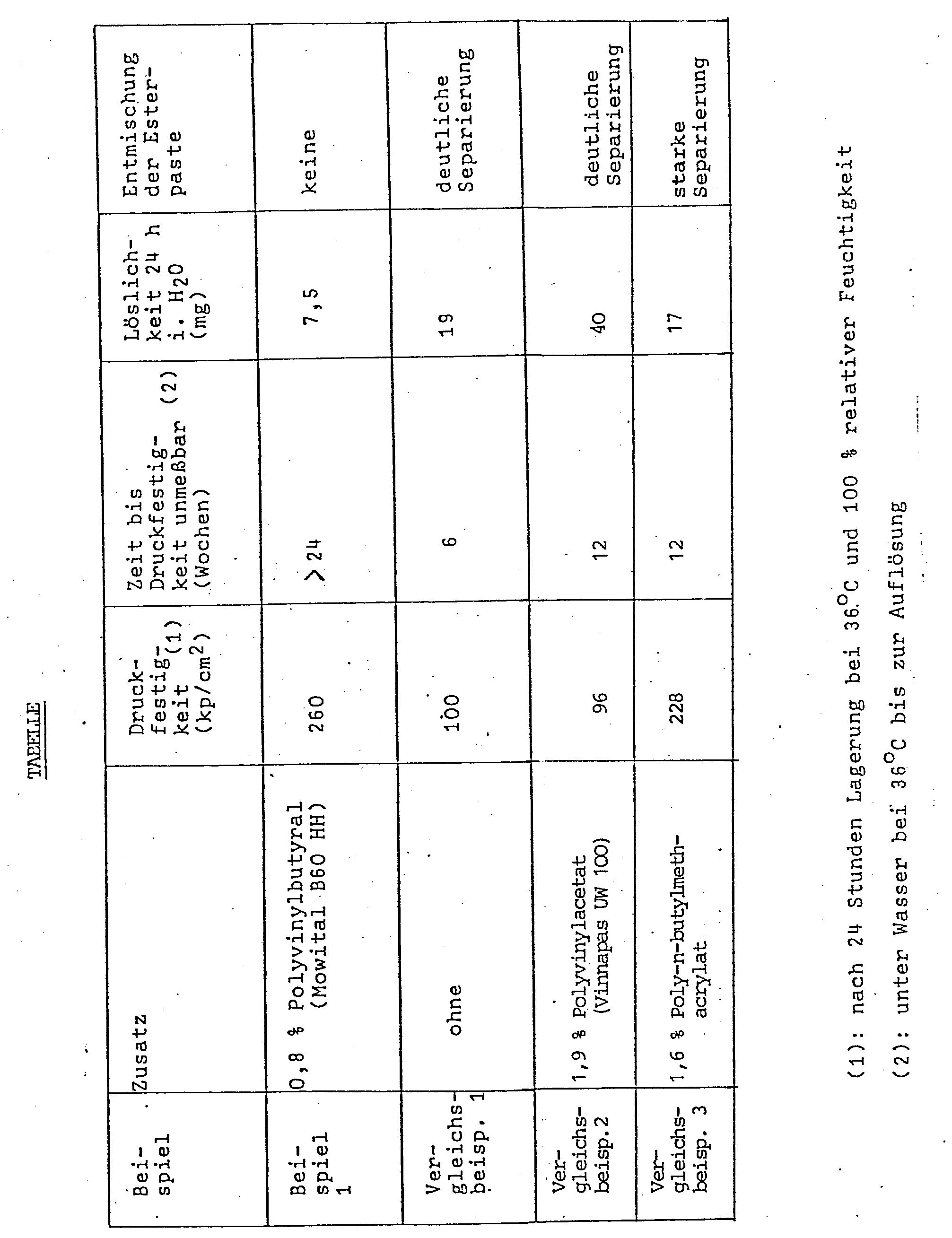
- Equal volumes of ester paste and calcium hydroxide paste are processed into a dental cement-like mixture which, after hardening at 100% relative air humidity and 36 ° C, has the physical properties specified in the table.
- a dental cement is made from the same components as in Example 1, but the addition of polyvinyl butyral is omitted.
- the physical properties of the hardened cement obtained are measured in the same manner as in Example 1 and are listed in the table.
- a dental cement is made from the same components as in Example 1, except that 1.9% polyvinyl acetate (Vinnapas UW 100) is added to the salicylic acid ester mixture.
- a dental cement is produced from the same components as in Example 1, but with 1.6% poly-n-butyl methacrylate being added to the salicylic acid ester mixture.
Landscapes
- Health & Medical Sciences (AREA)
- Oral & Maxillofacial Surgery (AREA)
- Chemical & Material Sciences (AREA)
- Inorganic Chemistry (AREA)
- Epidemiology (AREA)
- Life Sciences & Earth Sciences (AREA)
- Animal Behavior & Ethology (AREA)
- General Health & Medical Sciences (AREA)
- Public Health (AREA)
- Veterinary Medicine (AREA)
- Plastic & Reconstructive Surgery (AREA)
- Dental Preparations (AREA)
Abstract
Description
- Die Erfindung betrifft eine Zahnfüllmasse auf Basis von Calciumhydroxid und Salicylsäureestern mit einem Zusatz von Polyvinylbutyral, welche sich für Unterfüllungen und für die Pulpenüberkappung eignet.
- Wegen der Toxizität der meisten üblichen Füllungen sind für tiefergehende Zahnkavitäten und insbesondere dann, wenn eine Pulpenüberkappung nötig wird, Unterfüllungen erforderlich.
- Man hat für die Behandlung von Zahnkavitäten seit längerer Zeit Dispersionen von Calciumhydroxid in Wasser oder in wäßrigen oder organischen Lösungen von filmbildenden Materialien eingesetzt, da Calciumhydroxid einerseits die Pulpa gegen das Eindringen von Säuren aus den Füllungen schützt, andererseits die Bildung von Sekundärdentin stimuliert.
- Die Anwendung von Calciumhydroxid-Dispersionen in wäßrigen oder organischen Systemen ergibt jedoch keine Unterfüllung mit ausreichender mechanischer Festigkeit, welche den Zahn vor den mechanischen Einwirkungen beim Einbringen der Füllung schützt.
- Zur Beseitigung dieser Schwierigkeit wird in der US-PS 3 047 408 eine Zahnfüllmasse beschrieben, die aus pulverförmigem Calciumhydroxid und Estern aus mehrwertigen Alkoholen mit Salicylsäure sowie gegebenenfalls Methylsalicylat, inerten gepulverten Füllstoffen und/oder Weichmachern erhalten wird.
- Dieser Dentalzement besitzt alle Vorteile der Calciumhydroxiddispersionen, d. h. er bewirkt die Bildung von Sekundärdentin und wirkt durch seinen hohen pH-Wert von mehr als 11 als Schutzsperre gegen Säuren und andere toxische Substanzen, die in einigen Füllmaterialien enthalten sind. Durch das Vorhandensein der Salicylsäureester erhärtet der Zement nach dem Eindringen in die Zahnhöhle schnell zu einer Unterfüllung, welche die Zahnpulpa während des späteren Einbringens der Füllung schützt.
- Ein weiterer Dentalzement für eine Unterfüllung, der aus Calciumhydroxid und einem Salicylsäureester eines einwertigen Alkohols besteht, ist in der CH-PS 610 199 beschrieben. Aus diesem Zement hergestellte Unterfüllungen besitzen eine relativ geringe Druckfestigkeit.
- Es hat sich jedoch gezeigt, daß Dentalzemente auf Basis von Calciumhydroxid und Salicylsäureestern zwar nach ihrer Aufbringung die erläuterten vorteilhaften Eigenschaften zeigen, daß sie jedoch relativ wasserlöslich sind und infolgedessen ausgewaschen werden.
- Dieser nachteilige Effekt ist beispielsweise in The Journal of the British Dental Association, 147 (5) 1979, Seite 111, beschrieben worden.
- Untersuchungen der Anmelderin haben bestätigt, daß der gemäß US-PS 3 047 408 hergestellte Zement bei der Lagerung in Wasser in relativ kurzer Zeit zerfällt.
- Es war bekannt, zur Verminderung der Wasserlöslichkeit Paraffinöl oder Leinöl zu Zementen auf Basis von Salicylsäureestern zuzusetzen. Durch diesen Zusatz wird die Wasserfestigkeit zwar verbessert, es stellt sich aber nur ein pH-Wert von weniger als 10 ein, wodurch der vorteilhafte Pulpenschutz verloren geht. Bei allen bisher bekannten Versuchen zur Herstellung eines Calciumhydroxid-enthaltenden Zements schließen sich hoher pH-Wert und Wasserbeständigkeit gegenseitig aus.
- Die Dentalzemente auf Basis von Calciumhydroxid und Salicylsäureestern werden üblicherweise aus zwei Pasten erhalten: einer sog. Salicylesterpaste, deren Hauptbestandteil eine Mischung verschiedener Salicylester mit inerten Füllstoffen ist, und einer sog. Calciumhydroxidpaste, die als Hauptbestandteil Calciumhydroxid in einer flüssigen Pastengrundlage enthält.
- Ein weiterer Nachteil der bisher üblichen Calciumhydroxidzemente ist die Entmischung der pastösen Komponente, welche die Ester enthält, vor ihrer Anwendung.
- Der Erfindung liegt die Aufgabe zugrunde, einen Dentalzement auf Basis von Calciumhydroxid und Salicylsäureestern von aliphatischen Alkoholen zur Verfügung zu stellen, der einen ausreichend hohen pH-Wert hat und die Bildung von Sekundärdentin fördert und daher seine Funktion als Schutzsperre gegen Säuren und andere toxische Substanzen voll erfüllt, der andererseits jedoch gute Wasserbeständigkeit und erhöhte Druckfestigkeit aufweist und damit dauerhaften Pulpenschutz gewährleistet.
- Es wurde gefunden, daß diese Aufgabe dadurch gelöst werden kann, daß man Polyvinylbutyral zu einem Dentalzement auf der Basis von Salicylsäureestern und Calciumhydroxid zusetzt.
- Aus der DE-AS 1 006 125 war es bekannt, Polymerfilme zum Schutz der Zahnpulpa durch Aufbringen einer organischen Lösung eines Polymeren und Abdunsten des Lösungsmittels herzustellen. Eine Verwendung dieser Polymeren als Zusatz zu alkalischen, selbsthärtenden Unterfüllungszementen ist jedoch nicht vorgesehen. Zu der großen Zahl der erwähnten Polymeren gehören Polymere der verschiedensten Polymerklassen, wobei Polystyrol und Polyvinylacetat bevorzugt sind.
- Ein Hinweis auf Polyvinylbutyral wird nicht gegeben.
- Wie aus den später beschriebenen Beispielen und Vergleichsbeispielen hervorgeht, sind Polymere, die in der DE-AS 1 006 125 zur Herstellung von Polymerfilmen beschrieben werden, zur Lösung der erfindungsgemäßen Aufgabe überhaupt nicht geeignet, da sie nicht die erforderliche Verbesserung der Wasserbeständigkeit von Dentalzementen auf Basis von Salicylsäureestern und Calciumhydroxid verursachen.
- Polyvinylbutyral ist dagegen als Bindemittel in Gummidruckfarben und Lacken bekannt. Diese Verwendung ließ nicht vermuten, daß der erfindungsgemäße Zusatz von Polyvinylbutyral zu einem Calciumhydroxidze- ment'dessen Eigenschaften verbessert.
- Gegenstand der Erfindung ist eine Zahnfüllmasse aus zwei voneinander getrennt vorliegenden Anmischkcmponenten, wobei eine Anmischkomponente a) Salicylsäureester aliphatischer Alkohole und die andere Anmischkomponente b) Calciumhydroxid enthält, die dadurch gekennzeichnet ist, daß einer oder beiden Anmischkomponenten Polyvinylbutyral mit einem Acetalisierungsgrad von'mindestens 75 % zugesetzt ist.
- Die durch den erfindungsgemäßen Zusatz von Polyvinylbutyral erhaltenen Dentalzemente besitzen geringe Wasserlöslichkeit und haben nach ihrer Härtung erhöhte Druckfestigkeit.
- Auch der pH-Wert bleibt stark alkalisch, so daß ein wirksamer Pulpenschutz erreicht werden kann und die Bildung einer Sekundärdentinschicht angeregt wird.
- Der erfindungsgemäße Zusatz von Polyvinylbutyral fördert außerdem die Entmischungsbeständigkeit der Ester-Paste, d. h. der Mischungskomponente für den Dentalzement, welche die Salicylsäureester enthält.
- Mit Ausnahme des erfindungsgemäßen Zusatzes von Polyvinylbutyral entspricht die Zementzusammensetzung der von bekannten Salicylsäureester-Calciumhydroxid-Dentalzementen, wie sie beispielsweise in der US-PS 3 047 408 und der ähnlichen DE-AS 12 02 937 beschrieben sind.
- Einer der Hauptbestandteile ist Calciumhydroxid, das vorzugsweise in einem stöchiometrischen Überschuß gegenüber dem oder den Salicylsäureestern vorhanden ist.
- Ein weiterer wesentlicher Bestandteil ist ein Salicylsäureester eines ein- oder mehrwertigen Alkohols; vorzugsweise eines aliphatischen Alkohols mit 1 bis 8 Kohlenstoffatomen, insbesondere eines solchen zwei- oder dreiwertigen aliphatischen Alkohols, vorzugsweise mit 3 - 8 Kohlenstoffatcmen.
- Dabei können Gemische aus zwei oder mehr verschiedenen solcher Ester vorliegen.
- Gemäß einer bevorzugten Ausführungsform werden Salicylsäureester von mehrwertigen Alkoholen mit 3 bis 8 Kohlenstoffatomen zusammen mit Salicylsäureestern von einwertigen aliphatischen Alkoholen mit 1 bis 4 Kohlenstoffatomen, insbesondere Methyl- oder Ethylester, eingesetzt.
- Eine besonders bevorzugte Ausführungsform enthält ein Gemisch aus dem Salicylsäuremonoester und -diester von 1,3-Butandiol und Salicylsäure- methylester.
- Weiterhin kann der Dentalzement übliche inerte Füllstoffe, wie Titandioxid, Zinndioxid, Calciumsulfat, Calciumphosphat, Aluminiumoxid, Kieselsäure oder Zinkoxid enthalten und darüber hinaus können Pigmente, Röntgenkontrastmittel, wie Bariumsulfat oder Calciumwolframat, Weichmacher und sonstige für Füllmaterialien übliche Zusätze vorhanden sein, wie z. B. Zinkstearat.
- Das erfindungsgemäß zugesetzte Polyvinylbutyral wird vorteilhaft in einer Menge von 0,2 bis 5 Gew.-%, vorzugsweise 0,5 bis 2 Gew.-% bezogen auf das Gewicht des oder der Ester, zugemischt. Es hat einen Acetalisierungsgrad von mindestens 75 % und vorzugsweise mindestens 80 oder darüber. Der Polymerisationsgrad beträgt 20 -70, bevorzugt 50 - 70.
- Für die Zwecke der Erfindung eignet sich handelsübliches Polyvinylbutytral, das beispielsweise in der Firmenschrift der Farbwerke Hoechst AG "Mowital B" unter der Bezeichnung Mowital B 20 H, Mowital B 30 H und Mowital B 60 HH beschrieben ist. Solange der gewünschte Acetalisierungsgrad erreicht wird, eignen sich selbstverständlich auch andere Handelsprodukte.
- Die Grundmaterialien zur Herstellung eines Dentalzements auf Basis von Salicylsäureestern und Calciumhydroxid werden gemäß einer bevorzugten Ausführungsform als Zweipastensystem hergestellt und vertrieben: Einer Calciumhydroxidpaste und einer Salicylesterpaste, die kurz vor der Anwendung miteinander angemischt werden. Die Aushärtung geschieht durch Eindringen von Feuchtigkeit, die im Mund in ausreichender Menge vorhanden ist, wobei die Körpertemperatur die Aushärtung beschleunigt.
- Die Calciumhydroxid-Paste enthält in bekannter Form als Hauptbestandteil Calciumhydroxid. Zusätzlich können Füllstoffe wie Titandioxid, Zinndioxid, Calciumsulfat, -phosphat, Aluminiumoxid, Kieselsäure und Zinkoxid, oberflächenaktive Substanzen wie z. B. Zinkstearat und als flüssige Grundlage ein Weichmacher, wie z. B. Ethyltoluolsulfonamid vorhanden sein.
- Die Esterpaste kann aus einem Gemisch der Salicylsäureester, inerten Füllstoffen, wie Titandioxid, Zinndioxid, Calciumphosphat, Zinkoxid, Kieselsäure, Aluminiumoxid etc., und einem Röntgenopaker wie z. B. Ca1ciυmwolframat bestehen. Weiterhin kann der Esterpaste eine geringe Menge Calciumhydroxid zugesetzt werden.
- Gegebenenfalls können beide Pasten zusätzlich Pigmente enthalten.
- Das erfindungsgemäß verwendete Polyvinylbutyral wird vorzugsweise der Esterpaste zugemischt, da es bei Verwendung von Füllstoffen in dieser Paste eine Entmischung von Flüssigkeit und Feststoff weitgehend verhindert. Grundsätzlich kann das Polyvinylbutyral jedoch jeder der beiden Komponenten zugegeben werden oder auch auf beide Komponenten aufgeteilt werden.
- In einem Gemisch aus 78 g 1,3 Butandioldisalicylsäureester (Diester), 12,9 g 1,3-Butandiolmonosalicylsäureester (Monoester) und 8,4 g Salicylsäuremethylester werden 0,8 g Polyvinylbutyral, hochacetalisiert (Acetalisierungsgrad ca. 82 %) gelöst. 39,3 g dieser Lösung werden mit 60,7 g einer Pulvermischung aus 0,6 g Calciumhydroxid, 15,2 g Calciumwolframat und 45,1 g Titandioxid zu einer Paste vermischt.
- 40,7 g Calciumhydroxid werden mit 8,2 g Zinkoxid, 4,5 g Titandioxid, 0,3 g Zinkstearat, 7 g Kieselsäure und 39,4 g N-Ethyl-(o,p)toluol- sulfonamid zu einer Paste vermischt.
- Gleiche Volumina Esterpaste und Calciumhydroxidpaste werden zu einem zahnzementartigen Gemisch verarbeitet, das nach der Erhärtung bei 100 % relativer Luftfeuchte und 36° 'C die in der Tabelle angegebenen physikalischen Eigenschaften besitzt.
- Ein Zahnzement wird aus den gleichen Komponenten wie in Beispiel 1 hergestellt, wobei jedoch der Zusatz von Polyvinylbutyral weggelassen wird.
- Die physikalischen Eigenschaften des erhaltenen, gehärteten Zements werden in gleicher Weise wie in Beispiel 1 gemessen und sind in der Tabelle aufgeführt.
- Ein Zahnzement wird aus den gleichen Komponenten wie in Beispiel 1 hergestellt, wobei jedoch dem Salicylsäureestergemisch 1,9 % Polyvinylacetat (Vinnapas UW 100) zugesetzt werden.
- Die physikalischen Eigenschaften des erhaltenen gehärteten Zements, die in gleicher Weise wie in Beispiel 1 gemessen werden, sind in der nachstehenden Tabelle aufgeführt.
- Ein Zahnzement wird aus den gleichen Komponenten wie in Beispiel 1 hergestellt, wobei jedoch dem Salicylsäureestergemisch 1,6 % Poly-n-butyl-methacrylat zugesetzt werden.
- Die physikalischen Eigenschaften des erhaltenen gehärteten Zements,. die in gleicher Weise wie in Beispiel 1 gemessen wurden, sind in der nachstehenden Tabelle aufgeführt.
- In einem Gemisch aus 77,8 g Diester (s. Beispiel 1), 12,85 g Monoester (s. Beispiel 1) und 8,54 g Salicylsäuremethylester werden 0,8 g Polyvinylbutyral (Acetalisierungsgrad ca. 82 %) gelöst. 39,3 g dieser Lösung werden mit 60,7 g einer Pulvermischung aus 0,6 g Calciumhydroxid, 15,1 g Calciumwolframat und 45 g Aluminiumoxid zu einer Paste verarbeitet.
- Herstellung des Dentalzements
- Gleiche Volumina dieser Esterpaste werden mit einer Calciumhydroxid- paste nach Beispiel 1 zu einem zahnzementartigen Gemisch verarbeitet, das nach der Erhärtung vergleichbare Eigenschaften wie der Zement aus Beispiel 1 besitzt.
- 79 g Diester (s. Beispiel 1), 12,9 g Monoester (s. Beispiel 1) und 8,5 g Salicylsäuremethylester werden vermischt.
- 39,1 g dieser Lösung werden mit 45,1 g Titandioxid, 15,2 g Calciumwolframat und 0,6 g Calciumhydroxid zu einer Paste verarbeitet.
- 40,7 g Calciumhydroxid werden mit einer Lösung von 0,8 g Polyvinylbutyral (Mowital B 60 HH) in 43,3 g N-Ethyl-(o,p)toluol-sulfonamid und 8,2 g Zinkoxid, 0,25 g Zinkstearat, 2,3 g pyrogener Kieselsäure und 4,5 g Titandioxid zu einer Paste verarbeitet.
- Gleiche Volumina beider Pasten werden vermischt, nach dem Aushärten bei 100 % Luftfeuchtigkeit und 36° C ergibt sich ein Zement, der als wasserfeste, alkalische Unterfüllung geeignet ist.
- In einer Mischung aus 76,7 g Diester (s. Beispiel 1), 12,6 g Monoester (s. Beispiel 1) und 8,3 g Salicylsäuremethylester werden 2,4 g Polyvinylbutyral gelöst.
- 39,1 g dieser Lösung werden mit einer Pulvermischung aus 45,1 g Titandioxid, 15,2 g Calciumwolframat und 0,6 g Calciumhydroxid zu einer pastösen Masse verarbeitet.
- Durch Vermischen eines Volumenteils dieser Paste mit einem Volumenteil der Calciumhydroxid-Paste nach Beispiel 1, wird ein Zement mit den dort genannten Eigenschaften erhalten.
- In einer Mischung aus 78 g Diester (s. Beispiel 1), 12,9 g Monoester (s. Beispiel 1), 13,8 g Trimethylolpropan-tris-salicyl-säureester und 8,4 g Salicylsäure-methylester werden 1,2 g hochacetalisiertes Polyvinylbutyral (Acetalisierungsgrad ca. 82 %) gelöst.
- 22 g dieser Mischung werden mit einem Pulvergemisch aus 0,3 g Calciumhydroxid, 7,6 g Calciumwolframat und 22,6 g Titandioxid zu einer homogenen Paste vermischt.
- Ein Volumenteil dieser Esterpaste wird mit einem Volumenteil der in Beispiel 1 hergestellten Calciumhydroxidpaste zu einem homogenen Zement verarbeitet, der nach seiner Aushärtung günstige Eigenschaften als Unterfüllungszement aufweist.
- 38,6 g der Lösung von Polyvinylbutyral im Salicylestergemisch nach Beispiel 2 werden mit 14,8 g Calciumwolframat, 0,6 g Calciumhydroxid, 44,1 g Zinndioxid und 2 g pyrogener Kieselsäure zu einer Paste vermischt.
- Durch Vermischen eines Volumenteils dieser Esterpaste mit einem Volumenteil der Calciumhydroxidpaste nach Beispiel 1 wird ein Unterfüllungszement mit den dort genannten Eigenschaften erhalten.
Claims (16)
Priority Applications (1)
| Application Number | Priority Date | Filing Date | Title |
|---|---|---|---|
| AT83104449T ATE40042T1 (de) | 1982-05-07 | 1983-05-05 | Zahnfuellmasse, enthaltend einen zusatz von polyvinylbutyral. |
Applications Claiming Priority (2)
| Application Number | Priority Date | Filing Date | Title |
|---|---|---|---|
| DE3217259 | 1982-05-07 | ||
| DE19823217259 DE3217259A1 (de) | 1982-05-07 | 1982-05-07 | Verwendung von polyvinylbutyral als zusatz zu einem dentalzement |
Publications (3)
| Publication Number | Publication Date |
|---|---|
| EP0094049A2 true EP0094049A2 (de) | 1983-11-16 |
| EP0094049A3 EP0094049A3 (en) | 1985-09-18 |
| EP0094049B1 EP0094049B1 (de) | 1989-01-18 |
Family
ID=6163039
Family Applications (1)
| Application Number | Title | Priority Date | Filing Date |
|---|---|---|---|
| EP83104449A Expired EP0094049B1 (de) | 1982-05-07 | 1983-05-05 | Zahnfüllmasse, enthaltend einen Zusatz von Polyvinylbutyral |
Country Status (5)
| Country | Link |
|---|---|
| US (1) | US4542172A (de) |
| EP (1) | EP0094049B1 (de) |
| JP (1) | JPS58208205A (de) |
| AT (1) | ATE40042T1 (de) |
| DE (2) | DE3217259A1 (de) |
Cited By (1)
| Publication number | Priority date | Publication date | Assignee | Title |
|---|---|---|---|---|
| WO1999007328A3 (en) * | 1997-08-11 | 1999-06-10 | Kerr Corp | Dental resins |
Families Citing this family (8)
| Publication number | Priority date | Publication date | Assignee | Title |
|---|---|---|---|---|
| WO2002036517A2 (en) * | 2000-11-06 | 2002-05-10 | Institute Of Paper Science And Technology, Inc. | Fiber reinforced mineral-based materials and methods of making the same |
| US6649669B2 (en) | 2001-12-28 | 2003-11-18 | American Dental Association Health Foundation | Single solution bonding formulation |
| US7619016B2 (en) * | 2003-07-02 | 2009-11-17 | Ada Foundation | Remineralizing dental cements |
| US9259439B2 (en) * | 2005-10-21 | 2016-02-16 | Ada Foundation | Dual-phase cement precursor systems for bone repair |
| US9101436B2 (en) * | 2005-10-21 | 2015-08-11 | Ada Foundation | Dental and endodontic filling materials and methods |
| KR101363881B1 (ko) * | 2005-10-21 | 2014-02-17 | 에이다 파운데이션 | 치아 및 근관 충전 물질 및 방법 |
| EP2128110B1 (de) * | 2008-05-29 | 2016-08-17 | Sika Technology AG | Zusatzmittel für hydraulische Bindemittel mit langer Verarbeitungszeit und hoher Frühfestigkeit |
| US8591640B1 (en) * | 2012-11-19 | 2013-11-26 | Xerox Corporation | Bio-renewable fast crystallizing phase change inks |
Family Cites Families (7)
| Publication number | Priority date | Publication date | Assignee | Title |
|---|---|---|---|---|
| DE1006125B (de) * | 1954-05-07 | 1957-04-11 | Hoechst Ag | Mittel zur Herstellung von Unterfuellungen in Zahnkavitaeten zum Schutz der Pulpa |
| US3047408A (en) * | 1959-11-10 | 1962-07-31 | L D Caulk Company | Dental cement material |
| DE1202937B (de) * | 1962-05-22 | 1965-10-14 | L D Caulk Company | Mittel zur Herstellung von Zahnfuellmassen |
| US3620778A (en) * | 1969-09-17 | 1971-11-16 | Jacque C Morrell | Method of making dental impression and dental stones having smooth surfaces |
| CH610199A5 (en) * | 1974-07-24 | 1979-04-12 | Trey Ag De | Two-component system for dental purposes |
| US4272292A (en) * | 1977-11-28 | 1981-06-09 | Dai Nippon Insatsu Kabushiki Kaisha | Heat transfer printing |
| US4240832A (en) * | 1979-02-12 | 1980-12-23 | Sybron Corporation | Dental pulp capping and cavity lining composition and preparative method |
-
1982
- 1982-05-07 DE DE19823217259 patent/DE3217259A1/de not_active Ceased
-
1983
- 1983-04-21 US US06/486,997 patent/US4542172A/en not_active Expired - Lifetime
- 1983-05-04 JP JP58077707A patent/JPS58208205A/ja active Granted
- 1983-05-05 DE DE8383104449T patent/DE3378953D1/de not_active Expired
- 1983-05-05 EP EP83104449A patent/EP0094049B1/de not_active Expired
- 1983-05-05 AT AT83104449T patent/ATE40042T1/de not_active IP Right Cessation
Cited By (1)
| Publication number | Priority date | Publication date | Assignee | Title |
|---|---|---|---|---|
| WO1999007328A3 (en) * | 1997-08-11 | 1999-06-10 | Kerr Corp | Dental resins |
Also Published As
| Publication number | Publication date |
|---|---|
| EP0094049B1 (de) | 1989-01-18 |
| US4542172A (en) | 1985-09-17 |
| JPH0324441B2 (de) | 1991-04-03 |
| EP0094049A3 (en) | 1985-09-18 |
| DE3217259A1 (de) | 1983-11-10 |
| JPS58208205A (ja) | 1983-12-03 |
| ATE40042T1 (de) | 1989-02-15 |
| DE3378953D1 (en) | 1989-02-23 |
Similar Documents
| Publication | Publication Date | Title |
|---|---|---|
| DE3628823C2 (de) | ||
| DE2954204C2 (de) | Dentalgemisch | |
| DE2934380C2 (de) | Zahnfüllmaterial | |
| DE3941629C2 (de) | Dentalglasionomerzementmasse | |
| DE3122067C2 (de) | ||
| DE3428406C2 (de) | ||
| DE3005134C2 (de) | ||
| DE2920942A1 (de) | Medizinisches zementmaterial | |
| DE3610845A1 (de) | Zahnzementmasse | |
| DE69205355T2 (de) | Dentalgipsmasse. | |
| DE2101939C3 (de) | Durch Zusatz von Zinkoxid härtende Massen | |
| EP0804135B1 (de) | Elastisch-plastisches element zum füllen von wurzelkanälen und herstellungsverfahren | |
| DE3314150C2 (de) | Zahnzement, enthaltend Tanninderivate | |
| EP0864312A2 (de) | Zwei-Komponenten-Kit und Stift auf Guttaperchabasis zur Verwendung mit dem Kit | |
| DE10142152B4 (de) | Alginat-Dentalabdruckmaterial | |
| EP0094049B1 (de) | Zahnfüllmasse, enthaltend einen Zusatz von Polyvinylbutyral | |
| DE60020768T2 (de) | Heparin und Diclofenac enthaltendes topisches Pflaster | |
| DE2751069C2 (de) | Hydraulische Dentalzementzubereitung | |
| DE2639505B2 (de) | ||
| DE2739282C2 (de) | Verwendung eines aus einem Peroxid, einem sekundären oder tertiären Amin sowie einem Alkali- oder Erdalkalimetallsalz einer Arylsulfinsäure bestehenden Härtungssystem zur Herstellung eines Klebemittels | |
| DE2025268A1 (de) | Haftmittel für künstliche Gebisse | |
| WO2000059452A1 (de) | Polyelektrolytzement | |
| DE3312431A1 (de) | Pvp-iod-wundpuder mit synergistisch wirkender pudergrundlage | |
| DE2101889C2 (de) | Anmischkomponente für medizinische Silikatzemente | |
| DE68903597T2 (de) | Weichkapselzubereitung von natriumpicosulfat. |
Legal Events
| Date | Code | Title | Description |
|---|---|---|---|
| PUAI | Public reference made under article 153(3) epc to a published international application that has entered the european phase |
Free format text: ORIGINAL CODE: 0009012 |
|
| AK | Designated contracting states |
Designated state(s): AT BE CH DE FR GB IT LI LU NL SE |
|
| 17P | Request for examination filed |
Effective date: 19841107 |
|
| PUAL | Search report despatched |
Free format text: ORIGINAL CODE: 0009013 |
|
| AK | Designated contracting states |
Designated state(s): AT BE CH DE FR GB IT LI LU NL SE |
|
| RAP1 | Party data changed (applicant data changed or rights of an application transferred) |
Owner name: ESPE STIFTUNG & CO PRODUKTIONS- UND VERTRIEBS KG |
|
| 17Q | First examination report despatched |
Effective date: 19870807 |
|
| RBV | Designated contracting states (corrected) |
Designated state(s): AT BE CH DE FR GB IT LI NL SE |
|
| ITF | It: translation for a ep patent filed | ||
| GRAA | (expected) grant |
Free format text: ORIGINAL CODE: 0009210 |
|
| AK | Designated contracting states |
Kind code of ref document: B1 Designated state(s): AT BE CH DE FR GB IT LI NL SE |
|
| REF | Corresponds to: |
Ref document number: 40042 Country of ref document: AT Date of ref document: 19890215 Kind code of ref document: T |
|
| REF | Corresponds to: |
Ref document number: 3378953 Country of ref document: DE Date of ref document: 19890223 |
|
| ET | Fr: translation filed | ||
| GBT | Gb: translation of ep patent filed (gb section 77(6)(a)/1977) | ||
| PLBE | No opposition filed within time limit |
Free format text: ORIGINAL CODE: 0009261 |
|
| STAA | Information on the status of an ep patent application or granted ep patent |
Free format text: STATUS: NO OPPOSITION FILED WITHIN TIME LIMIT |
|
| 26N | No opposition filed | ||
| PGFP | Annual fee paid to national office [announced via postgrant information from national office to epo] |
Ref country code: SE Payment date: 19900425 Year of fee payment: 8 |
|
| PG25 | Lapsed in a contracting state [announced via postgrant information from national office to epo] |
Ref country code: SE Effective date: 19910506 |
|
| ITTA | It: last paid annual fee | ||
| REG | Reference to a national code |
Ref country code: GB Ref legal event code: 732E |
|
| ITPR | It: changes in ownership of a european patent |
Owner name: CESSIONE;THERA PATENT GMBH & CO. KG GESELLSCHAFT F |
|
| REG | Reference to a national code |
Ref country code: FR Ref legal event code: TP |
|
| REG | Reference to a national code |
Ref country code: CH Ref legal event code: PUE Owner name: THERA PATENT GMBH & CO. KG, GESELLSCHAFT FUER INDU |
|
| NLS | Nl: assignments of ep-patents |
Owner name: THERA PATENT GMBH & CO. KG GESELLSCHAFT FUER INDUS |
|
| EUG | Se: european patent has lapsed |
Ref document number: 83104449.0 Effective date: 19911209 |
|
| PGFP | Annual fee paid to national office [announced via postgrant information from national office to epo] |
Ref country code: GB Payment date: 19970320 Year of fee payment: 15 |
|
| PGFP | Annual fee paid to national office [announced via postgrant information from national office to epo] |
Ref country code: FR Payment date: 19970327 Year of fee payment: 15 |
|
| PGFP | Annual fee paid to national office [announced via postgrant information from national office to epo] |
Ref country code: BE Payment date: 19970410 Year of fee payment: 15 |
|
| PGFP | Annual fee paid to national office [announced via postgrant information from national office to epo] |
Ref country code: AT Payment date: 19970516 Year of fee payment: 15 |
|
| PGFP | Annual fee paid to national office [announced via postgrant information from national office to epo] |
Ref country code: NL Payment date: 19970530 Year of fee payment: 15 |
|
| PG25 | Lapsed in a contracting state [announced via postgrant information from national office to epo] |
Ref country code: GB Free format text: LAPSE BECAUSE OF NON-PAYMENT OF DUE FEES Effective date: 19980505 Ref country code: AT Free format text: LAPSE BECAUSE OF NON-PAYMENT OF DUE FEES Effective date: 19980505 |
|
| PG25 | Lapsed in a contracting state [announced via postgrant information from national office to epo] |
Ref country code: FR Free format text: LAPSE BECAUSE OF NON-PAYMENT OF DUE FEES Effective date: 19980531 Ref country code: BE Free format text: LAPSE BECAUSE OF NON-PAYMENT OF DUE FEES Effective date: 19980531 |
|
| BERE | Be: lapsed |
Owner name: THERA PATENT G.M.B.H. & CO. K.G. GESELLSCHAFT FUR Effective date: 19980531 |
|
| PG25 | Lapsed in a contracting state [announced via postgrant information from national office to epo] |
Ref country code: NL Free format text: LAPSE BECAUSE OF NON-PAYMENT OF DUE FEES Effective date: 19981201 |
|
| GBPC | Gb: european patent ceased through non-payment of renewal fee |
Effective date: 19980505 |
|
| NLV4 | Nl: lapsed or anulled due to non-payment of the annual fee |
Effective date: 19981201 |
|
| REG | Reference to a national code |
Ref country code: FR Ref legal event code: ST |
|
| PGFP | Annual fee paid to national office [announced via postgrant information from national office to epo] |
Ref country code: CH Payment date: 19990527 Year of fee payment: 17 |
|
| PG25 | Lapsed in a contracting state [announced via postgrant information from national office to epo] |
Ref country code: LI Free format text: LAPSE BECAUSE OF NON-PAYMENT OF DUE FEES Effective date: 20000531 Ref country code: CH Free format text: LAPSE BECAUSE OF NON-PAYMENT OF DUE FEES Effective date: 20000531 |
|
| REG | Reference to a national code |
Ref country code: CH Ref legal event code: PL |
|
| PGFP | Annual fee paid to national office [announced via postgrant information from national office to epo] |
Ref country code: DE Payment date: 20010723 Year of fee payment: 19 |
|
| PG25 | Lapsed in a contracting state [announced via postgrant information from national office to epo] |
Ref country code: DE Free format text: LAPSE BECAUSE OF NON-PAYMENT OF DUE FEES Effective date: 20021203 |