EP0082640B1 - Ion implantation method - Google Patents
Ion implantation method Download PDFInfo
- Publication number
- EP0082640B1 EP0082640B1 EP82306568A EP82306568A EP0082640B1 EP 0082640 B1 EP0082640 B1 EP 0082640B1 EP 82306568 A EP82306568 A EP 82306568A EP 82306568 A EP82306568 A EP 82306568A EP 0082640 B1 EP0082640 B1 EP 0082640B1
- Authority
- EP
- European Patent Office
- Prior art keywords
- ion
- ion beam
- region
- wafer
- gate
- Prior art date
- Legal status (The legal status is an assumption and is not a legal conclusion. Google has not performed a legal analysis and makes no representation as to the accuracy of the status listed.)
- Expired
Links
- 238000005468 ion implantation Methods 0.000 title claims description 20
- 238000000034 method Methods 0.000 title claims description 18
- 150000002500 ions Chemical class 0.000 claims description 73
- 238000010884 ion-beam technique Methods 0.000 claims description 40
- 239000004065 semiconductor Substances 0.000 claims description 14
- 230000007423 decrease Effects 0.000 claims description 3
- 230000003287 optical effect Effects 0.000 claims description 3
- 238000004519 manufacturing process Methods 0.000 description 9
- 230000001133 acceleration Effects 0.000 description 7
- 230000000694 effects Effects 0.000 description 7
- XUIMIQQOPSSXEZ-UHFFFAOYSA-N Silicon Chemical compound [Si] XUIMIQQOPSSXEZ-UHFFFAOYSA-N 0.000 description 6
- 229910052581 Si3N4 Inorganic materials 0.000 description 5
- 238000002513 implantation Methods 0.000 description 5
- 229910001338 liquidmetal Inorganic materials 0.000 description 5
- 229910052710 silicon Inorganic materials 0.000 description 5
- 239000010703 silicon Substances 0.000 description 5
- HQVNEWCFYHHQES-UHFFFAOYSA-N silicon nitride Chemical compound N12[Si]34N5[Si]62N3[Si]51N64 HQVNEWCFYHHQES-UHFFFAOYSA-N 0.000 description 5
- VYPSYNLAJGMNEJ-UHFFFAOYSA-N Silicium dioxide Chemical compound O=[Si]=O VYPSYNLAJGMNEJ-UHFFFAOYSA-N 0.000 description 4
- 229910052814 silicon oxide Inorganic materials 0.000 description 4
- 238000000151 deposition Methods 0.000 description 3
- 238000001459 lithography Methods 0.000 description 3
- 229910021420 polycrystalline silicon Inorganic materials 0.000 description 3
- 229920005591 polysilicon Polymers 0.000 description 3
- -1 Boron ions Chemical class 0.000 description 2
- 229910052782 aluminium Inorganic materials 0.000 description 2
- XAGFODPZIPBFFR-UHFFFAOYSA-N aluminium Chemical compound [Al] XAGFODPZIPBFFR-UHFFFAOYSA-N 0.000 description 2
- 239000012298 atmosphere Substances 0.000 description 2
- QVGXLLKOCUKJST-UHFFFAOYSA-N atomic oxygen Chemical compound [O] QVGXLLKOCUKJST-UHFFFAOYSA-N 0.000 description 2
- 229910052796 boron Inorganic materials 0.000 description 2
- 239000002131 composite material Substances 0.000 description 2
- 238000010586 diagram Methods 0.000 description 2
- 230000005684 electric field Effects 0.000 description 2
- 238000005530 etching Methods 0.000 description 2
- 238000010438 heat treatment Methods 0.000 description 2
- 238000002955 isolation Methods 0.000 description 2
- 239000001301 oxygen Substances 0.000 description 2
- 229910052760 oxygen Inorganic materials 0.000 description 2
- 239000005365 phosphate glass Substances 0.000 description 2
- ZOXJGFHDIHLPTG-UHFFFAOYSA-N Boron Chemical compound [B] ZOXJGFHDIHLPTG-UHFFFAOYSA-N 0.000 description 1
- 229910045601 alloy Inorganic materials 0.000 description 1
- 239000000956 alloy Substances 0.000 description 1
- 229910052785 arsenic Inorganic materials 0.000 description 1
- 230000015572 biosynthetic process Effects 0.000 description 1
- 239000011248 coating agent Substances 0.000 description 1
- 238000000576 coating method Methods 0.000 description 1
- 238000010894 electron beam technology Methods 0.000 description 1
- 238000005516 engineering process Methods 0.000 description 1
- 239000006023 eutectic alloy Substances 0.000 description 1
- 239000007789 gas Substances 0.000 description 1
- 239000007943 implant Substances 0.000 description 1
- 230000010354 integration Effects 0.000 description 1
- 229910044991 metal oxide Inorganic materials 0.000 description 1
- 239000012299 nitrogen atmosphere Substances 0.000 description 1
- 230000002265 prevention Effects 0.000 description 1
- 238000007493 shaping process Methods 0.000 description 1
Images


Classifications
-
- H—ELECTRICITY
- H01—ELECTRIC ELEMENTS
- H01L—SEMICONDUCTOR DEVICES NOT COVERED BY CLASS H10
- H01L21/00—Processes or apparatus adapted for the manufacture or treatment of semiconductor or solid state devices or of parts thereof
- H01L21/02—Manufacture or treatment of semiconductor devices or of parts thereof
- H01L21/04—Manufacture or treatment of semiconductor devices or of parts thereof the devices having potential barriers, e.g. a PN junction, depletion layer or carrier concentration layer
- H01L21/18—Manufacture or treatment of semiconductor devices or of parts thereof the devices having potential barriers, e.g. a PN junction, depletion layer or carrier concentration layer the devices having semiconductor bodies comprising elements of Group IV of the Periodic Table or AIIIBV compounds with or without impurities, e.g. doping materials
- H01L21/26—Bombardment with radiation
- H01L21/263—Bombardment with radiation with high-energy radiation
- H01L21/265—Bombardment with radiation with high-energy radiation producing ion implantation
-
- H—ELECTRICITY
- H01—ELECTRIC ELEMENTS
- H01J—ELECTRIC DISCHARGE TUBES OR DISCHARGE LAMPS
- H01J37/00—Discharge tubes with provision for introducing objects or material to be exposed to the discharge, e.g. for the purpose of examination or processing thereof
- H01J37/30—Electron-beam or ion-beam tubes for localised treatment of objects
- H01J37/302—Controlling tubes by external information, e.g. programme control
-
- H—ELECTRICITY
- H01—ELECTRIC ELEMENTS
- H01J—ELECTRIC DISCHARGE TUBES OR DISCHARGE LAMPS
- H01J37/00—Discharge tubes with provision for introducing objects or material to be exposed to the discharge, e.g. for the purpose of examination or processing thereof
- H01J37/30—Electron-beam or ion-beam tubes for localised treatment of objects
- H01J37/317—Electron-beam or ion-beam tubes for localised treatment of objects for changing properties of the objects or for applying thin layers thereon, e.g. for ion implantation
- H01J37/3171—Electron-beam or ion-beam tubes for localised treatment of objects for changing properties of the objects or for applying thin layers thereon, e.g. for ion implantation for ion implantation
- H01J37/3172—Maskless patterned ion implantation
-
- Y—GENERAL TAGGING OF NEW TECHNOLOGICAL DEVELOPMENTS; GENERAL TAGGING OF CROSS-SECTIONAL TECHNOLOGIES SPANNING OVER SEVERAL SECTIONS OF THE IPC; TECHNICAL SUBJECTS COVERED BY FORMER USPC CROSS-REFERENCE ART COLLECTIONS [XRACs] AND DIGESTS
- Y10—TECHNICAL SUBJECTS COVERED BY FORMER USPC
- Y10S—TECHNICAL SUBJECTS COVERED BY FORMER USPC CROSS-REFERENCE ART COLLECTIONS [XRACs] AND DIGESTS
- Y10S438/00—Semiconductor device manufacturing: process
- Y10S438/961—Ion beam source and generation
Definitions
- the present invention relates to an ion implantation method of implanting ions into a semiconductor wafer to form at least one of gate, source, drain and field regions of transistors according to the pre-characterizing part of claim 1.
- Such a method is known from J. Vac. Sci. Techno!. Vol. 12, No. 6, Nov/Dec 1975, pages 1378-1381.
- Ion implantation is a very important technique and is widely used in the manufacture of semiconductor devices.
- Si-MOS-LSI silicon metal oxide semiconductor large scale integration
- ion implantation is used for controlling the threshold voltage V TH for formation of well regions, isolation regions, source and drain regions and the like; and for prevention of the punch-through phenomenon.
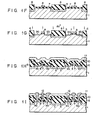
- Figs. 1A to 11 are sectional views showing a conventional Si-MOS-LSI during various manufacturing steps using conventional ion implantation techniques.
- a silicon wafer 1 is annealed in an oxygen atmosphere at 1,000°C for 20 minutes to form a silicon oxide (SiO z ) film 2 of 50 nm (500 A) thickness.
- a silicon nitride film 3 is deposited on the silicon oxide film 2 to a thickness of about 400 nm (4,000 A).
- a resist on the silicon nitride (Si 3 N 4 ) film 3 After coating a resist on the silicon nitride (Si 3 N 4 ) film 3, it is patterned by general lithography to form resist patterns 4. Then, as shown in Fig. 1 C, the silicon nitride film 3 is etched using the resist patterns 4 as a mask. Ion implantation of boron (B + ) is performed at an acceleration voltage of 100 keV to form a p +- type layer 5 for element isolation. Referring to Fig. 1 D, after removing the resist patterns 4, field oxide films 6 of 1 pm thickness are formed in an oxygen atmosphere at 1,000°C and the silicon nitride film 3 is removed thereafter. As shown in Fig.
- a gate oxide film 7 of about 30 nm (300 A) thickness is formed. Boron ions (B + ) are uniformly implanted at an acceleration voltage of 70 keV for the purpose of controlling the threshold voltage VTH.
- Fig. 1F after depositing a polysilicon film of about 300 nm (3,000 A) thickness over the entire surface of the structure, it is subjected to lithography and etching to form polysilicon gates 8. Subsequently, as shown in Fig. 1 G, the gate oxide film 7 is etched to leave only those portions below the polysilicon gates 8.
- arsenic ions are implanted at an acceleration voltage of 100 keV to form source regions 9a and drain regions 9b.
- a phosphate glass film 11 is deposited on the insulating oxide film 10 to a thickness of 700 nm (7,000 A).
- the phosphate glass film 11 is heated in a nitrogen atmosphere at about 1,000°C to smoothen its surface.
- Contact holes are then formed by lithography and etching.
- An Si-MOS-LSI as shown in Fig. 11 is finally manufactured.
- lon implantation adopted in the manufacture of the Si-MOS-LSI described above is uniform ion implantation in each case.
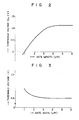
- MOS transistors manufactured by such a method have variations in the threshold voltage VTH according to the gate lengths and widths thereof.
- Fig. 2 is a graph showing the threshold voltage V TH as a function of gate length.
- Fig. 3 is a graph showing the threshold voltage V TH as a function of gate width.
- an ion implantation apparatus comprising an ion gun for producing an ion beam, an ion optical system for producing a focus spot of the beam on a semiconductor wafer on which transistors are to be formed, a deflecting device for deflecting the ion beam to scan the wafer, a blanking device for blanking the ion beam, and a controller for controlling the deflecting device and the blanking device.
- the transistors are intended to have gate, source, drain and field regions.
- the controller stores data of ion devices intended to be implanted into the wafer as a function of their location on the wafer and controls the beam in accordance with the ion dose data it has stored therein.
- the implantation dose profile is tailored by controlling the rate of sweeps per line.
- a micro ion beam of B + , P + or As+ of high luminance from a eutectic alloy liquid metal ion source has recently been made available. It is also known that the threshold voltage V TH of a transistor depends upon the gate length and width as well as on the ion concentration of the gate region.
- an ion implantation method of implanting ions into a semiconductor wafer to form at least one of gate, source, drain and field regions of transistors having small gate lengths and widths uses an ion implantation apparatus comprising an ion gun for producing an ion beam; an ion optical system for producing a focused spot of the beam on said wafer; the ion beam focused on said wafer having a spot diameter smaller than a continuous semiconductor region into which ions are to be implanted; a deflecting device for deflecting the ion beam to scan said wafer on which said transistors are to be formed; a blanking device for blanking the ion beam; and a controller for controlling said deflecting device and said blanking device, said controller being arranged to store data of ion doses to be implanted into said wafer as a function of location on said wafer and control the ion beam in accordance with the ion dose data stored therein, characterized in that:
- the threshold voltage of the transistor may be easily and precisely controlled. Moreover, the problems of the punch-through phenomenon, the short channel effect and the narrow channel effect usually found in micronized transistors having sizes in the order of submicrons may be prevented.
- the present invention is extremely useful for the manufacture of various types of semiconductor devices including micronized transistors.
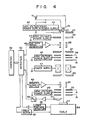
- Fig. 4 is a schematic block diagram of a micro ion beam scanner which is used in accordance with an embodiment of the present invention.
- reference numeral 21 denotes a filament for holding and heating a liquid metal; 22, an emitter; 23, a B-Pt-Au-Ge-type liquid metal alloy reservoir; 24, ion drawing electrodes; and 25, grid electrodes. These parts together form an ion gun for emitting a micro ion beam.
- Blanking electrodes 26 are for turning the ion beam ON/ OFF.
- a blanking aperture mask 27 is for blanking the ion beam.
- Electrostatic lenses or condenser lenses 28 of Einzel type serve to focus the ion beam.
- Reference numeral 29 denotes the deflection coil of a mass analyzer of.
- An ion selection aperture mask 30 is for selecting the type of ions to be implanted.
- a deflector 31 scans the ion beam on a specimen surface.
- Electrostatic lenses or objective lenses 32 are also of Einzel type.
- a specimen 33 for example, a silicon wafer, is securely held on a specimen table 34.
- a drive motor 35 drives the specimen table 34 and a laser position detector 36 detects the position of the specimen table 34.
- a reflected ion detector 37 is used for registration.
- An A/D converter 38 converts an analog reflected ion signal from the detector 37 into a digital signal.
- a computer 39 performs various types of control operations and is connected to an interface 40.
- a heating power supply 41 is used to supply power to the filament 21.
- a high voltage power supply 42 is used to supply power to the ion gun.
- a bias power supply 43 is used to drive the grid electrodes 25.
- a high voltage power supply 44 is used to drive the ion drawing electrodes 24.
- a pattern signal generator 45 converts a pattern signal from the computer 39 into an analog signal.
- a high voltage power supply 46 is used to supply power to the condenser lenses 28.
- a power supply 47 is used to produce an electric field and a magnetic field of the mass analyzer 29.
- a deflection power supply 48 is used to supply power to the deflector 31.
- a high voltage power supply 49 is used to supply power to the objective lenses 32.
- the micro ion beam scanner of the configuration as described above is similar to that of a known electron beam scanner, for example, as disclosed in US-A-4063103.
- Ions emitted from the emitter 22 are composite ions containing 32% of B + ions, for example.
- the B + ions alone are selected from the composite ions by the mass analyzer 29 and the ion selection aperture mask 30 and are focused on the specimen 33 by the objective lenses 32.
- the luminance of the ion gun is 1 x10 6 (A/cm 2 ⁇ str) and the diameter of the ion beam is variable within the range of 0.5 to 0.1 p.
- An ion dose of 10 11 to 10" (ions/cm 2 ) is required for the purpose of controlling the threshold voltage V TH of a transistor. Therefore, in the case of a silicon wafer having a diameter of 10.16 cm (4 inches) and an ion beam having the spot diameter of 0.5 pm, the ion implantation time is about 5 minutes.
- Fig. 5 is a graph showing the threshold voltage V TH as a function of ion dose; they hold a linear relation.
- the threshold voltage V TH of a MOS transistor with gate length and width being 3 pm or less is expressed by: where L is the gate length, W is the gate width and D is the ion dose.
- the threshold voltage V TH may be controlled by storing equation (1) in the computer 39 and varying the ion dose in accordance with the gate dimensions (length and width).
- the ion dose within a silicon wafer surface may be changed in thefollowing manner. Assumethatthe ion beam is OFF (blanked) when voltage Vo is applied to the blanking electrodes 26.
- the deflection voltage has a stepped waveform as shown in Fig. 6B so as to scan the ion beam in a stepped form.
- the pulse width of the blanking voltage or signal being variable in units of (1/10)At.
- the ion beam ON time is (9/10)At at locations x2, x3 and x4.
- the ion beam ON time is (5/10)At at locations x7, x8 and x9. In this manner, the ion dose may be varied in ten steps at any location.
- micro ion beam scanner as described above is used to manufacture an Si-MOS-LSI according to the method of the present invention.
- a micro ion beam scanner as shown in Fig. 4 for implantation of B + ions and another micro ion beam scanner for implantation of As+ ions are prepared; both can vary acceleration voltages.
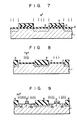
- B + ions are implanted only into a p +- type layer 5 as the field region, as shown in Fig. 7.
- the acceleration voltage of B + ions is adjusted to 100 keV so as to implant B + ions in the regions surrounding the p +- type layer 5 at a lower dose than that for the p +- type layer 5, those regions being regions close to prospective source and drain regions (9a and 9b) and also regions at the boundary between the field regions and channel regions below the gates. This prevents the narrow channel effect of the transistors, to facilitate micronization thereof.
- B + ions are implanted only into the prospective gate regions, as shown in Fig. 8.
- the acceleration voltage of B + ions at this time is controlled to be 70 keV; the ion dose is increased with a decrease in the gate length.
- the threshold voltage V TH can be easily ⁇ ontrolled even in the manufacture of a micronized transistor having a gate length of 3 ⁇ m or less.
- the position control of the ion beam with respect to the gate can be performed with high precision by detecting the reflected ions from a mark formed within an LSI chip by the reflected ion detector.
- As+ ions are implanted only into source and drain regions 9a and 9b, as shown in Fig. 9.
- the acceleration voltage of As+ ions is controlled to be 100 keV.
- the ion dose in a portion of the drain region 9b near the gate region is controlled to be higher than that in the remaining regions. Thus, the punch-through phenomenon is prevented, to facilitate micronization of the transistors.
- the present invention is not limited to the particular embodiment described above.
- the ions to be implanted are not limited to B + or As+ ions but may include ions of liquid metals such as Si + , Ga + , Se + , or P + ions which are required in the semiconductor industry.
- the method of the present invention is not limited to the manufacture of Si-MOS-LSIs but may be extended to various other types of FET semiconductor devices.
- the spot of the ion beam need not have a circular shape and may have any appropriate shape as determined by the beam shaping aperture mask.
- the electron gun as the ion gun need not be a liquid metal ion gun but may be of any type as long as it has high luminance, for example, of a gas electric field ionization type. This is because if the luminance is about 1 ⁇ 10 3 (A/ cm2. str) or below, the time required for ion implantation becomes enormously long.
Landscapes
- Physics & Mathematics (AREA)
- Engineering & Computer Science (AREA)
- Analytical Chemistry (AREA)
- High Energy & Nuclear Physics (AREA)
- Chemical & Material Sciences (AREA)
- General Physics & Mathematics (AREA)
- Toxicology (AREA)
- Condensed Matter Physics & Semiconductors (AREA)
- Health & Medical Sciences (AREA)
- Manufacturing & Machinery (AREA)
- Computer Hardware Design (AREA)
- Microelectronics & Electronic Packaging (AREA)
- Power Engineering (AREA)
- Insulated Gate Type Field-Effect Transistor (AREA)
- Physical Vapour Deposition (AREA)
- Semiconductor Memories (AREA)
Applications Claiming Priority (2)
| Application Number | Priority Date | Filing Date | Title |
|---|---|---|---|
| JP205015/81 | 1981-12-18 | ||
| JP56205015A JPS58106823A (ja) | 1981-12-18 | 1981-12-18 | イオン注入方法 |
Publications (3)
| Publication Number | Publication Date |
|---|---|
| EP0082640A2 EP0082640A2 (en) | 1983-06-29 |
| EP0082640A3 EP0082640A3 (en) | 1984-08-22 |
| EP0082640B1 true EP0082640B1 (en) | 1987-10-14 |
Family
ID=16500029
Family Applications (1)
| Application Number | Title | Priority Date | Filing Date |
|---|---|---|---|
| EP82306568A Expired EP0082640B1 (en) | 1981-12-18 | 1982-12-09 | Ion implantation method |
Country Status (4)
| Country | Link |
|---|---|
| US (1) | US4481042A (cg-RX-API-DMAC7.html) |
| EP (1) | EP0082640B1 (cg-RX-API-DMAC7.html) |
| JP (1) | JPS58106823A (cg-RX-API-DMAC7.html) |
| DE (1) | DE3277479D1 (cg-RX-API-DMAC7.html) |
Families Citing this family (18)
| Publication number | Priority date | Publication date | Assignee | Title |
|---|---|---|---|---|
| JPS60143630A (ja) * | 1983-12-29 | 1985-07-29 | Fujitsu Ltd | イオン注入方法 |
| JPS61140175A (ja) * | 1984-12-13 | 1986-06-27 | Semiconductor Energy Lab Co Ltd | 被膜作製方法 |
| US6784033B1 (en) | 1984-02-15 | 2004-08-31 | Semiconductor Energy Laboratory Co., Ltd. | Method for the manufacture of an insulated gate field effect semiconductor device |
| JPS60243960A (ja) * | 1984-05-18 | 1985-12-03 | Hitachi Ltd | イオンマイクロビ−ム装置 |
| JP2597976B2 (ja) * | 1985-03-27 | 1997-04-09 | 株式会社東芝 | 半導体装置及びその製造方法 |
| JPS61237421A (ja) * | 1985-04-15 | 1986-10-22 | Hitachi Ltd | 半導体装置の製造方法 |
| FR2592224B1 (fr) * | 1985-12-20 | 1988-10-07 | Thomson Csf | Transistor a effet de champ, et circuit integre logique comportant un tel transistor |
| FR2592225B1 (fr) * | 1985-12-20 | 1988-02-05 | Thomson Csf | Transistor hyperfrequence de puissance |
| US4746964A (en) * | 1986-08-28 | 1988-05-24 | Fairchild Semiconductor Corporation | Modification of properties of p-type dopants with other p-type dopants |
| US5256579A (en) * | 1989-04-03 | 1993-10-26 | Massachusetts Institute Of Technology | Tunable-frequency Gunn diodes fabrication with focused ion beams |
| DE4339190B4 (de) * | 1992-11-16 | 2006-04-13 | Denso Corp., Kariya | Halbleiter-Beschleunigungsmesser |
| JP2000040691A (ja) * | 1998-07-21 | 2000-02-08 | Oki Electric Ind Co Ltd | 半導体装置製造方法 |
| KR100546334B1 (ko) * | 2003-07-01 | 2006-01-26 | 삼성전자주식회사 | 반도체 웨이퍼의 각 영역별로 불순물 농도가 다른 집적회로 반도체 소자 및 그 제조방법 |
| US7425353B2 (en) * | 2004-01-29 | 2008-09-16 | International Business Machines Corporation | Enhancement of magnetic media recording performance using ion irradiation to tailor exchange coupling |
| US20070195482A1 (en) * | 2006-02-23 | 2007-08-23 | Varian Semiconductor Equipment Associates, Inc. | Johnsen-Rahbek electrostatic chuck driven with AC voltage |
| KR200466175Y1 (ko) * | 2011-06-13 | 2013-04-03 | 백미정 | 유희 시설물 결합용 코일 스프링 연결 구조물 |
| CN104538457A (zh) * | 2015-01-15 | 2015-04-22 | 京东方科技集团股份有限公司 | 薄膜晶体管及其制作方法、阵列基板和显示装置 |
| US20250166959A1 (en) * | 2023-11-16 | 2025-05-22 | Axcelis Technologies, Inc. | High bandwidth variable dose ion implantation system and method |
Family Cites Families (4)
| Publication number | Priority date | Publication date | Assignee | Title |
|---|---|---|---|---|
| CA953823A (en) * | 1971-08-24 | 1974-08-27 | Western Electric Company, Incorporated | Ion beam control apparatus |
| US4063103A (en) * | 1975-04-11 | 1977-12-13 | Tokyo Shibaura Electric Co., Ltd. | Electron beam exposure apparatus |
| FR2412939A1 (fr) * | 1977-12-23 | 1979-07-20 | Anvar | Implanteur d'ions a fort courant |
| US4283631A (en) * | 1980-02-22 | 1981-08-11 | Varian Associates, Inc. | Bean scanning and method of use for ion implantation |
-
1981
- 1981-12-18 JP JP56205015A patent/JPS58106823A/ja active Granted
-
1982
- 1982-12-08 US US06/448,048 patent/US4481042A/en not_active Expired - Lifetime
- 1982-12-09 EP EP82306568A patent/EP0082640B1/en not_active Expired
- 1982-12-09 DE DE8282306568T patent/DE3277479D1/de not_active Expired
Also Published As
| Publication number | Publication date |
|---|---|
| JPS643048B2 (cg-RX-API-DMAC7.html) | 1989-01-19 |
| US4481042A (en) | 1984-11-06 |
| EP0082640A3 (en) | 1984-08-22 |
| DE3277479D1 (en) | 1987-11-19 |
| JPS58106823A (ja) | 1983-06-25 |
| EP0082640A2 (en) | 1983-06-29 |
Similar Documents
| Publication | Publication Date | Title |
|---|---|---|
| EP0082640B1 (en) | Ion implantation method | |
| EP0082639B1 (en) | Processing method using a focused ion beam | |
| US5661043A (en) | Forming a buried insulator layer using plasma source ion implantation | |
| KR100348342B1 (ko) | 레이저 어닐링 방법 및 장치 | |
| EP0097533B1 (en) | A method of manufacturing a mis type semiconductor device | |
| Brewer | The application of electron/ion beam technology to microelectronics | |
| EP0165055B1 (en) | Method and apparatus for exposing photoresist by using an electron beam and controlling its voltage and charge | |
| US7638782B2 (en) | Semiconductor device manufacturing method and ion implanter used therein | |
| US20020185948A1 (en) | Method for fabricating tiny field emitter tips | |
| US6355574B1 (en) | Method and device for treating a semiconductor surface | |
| US5286978A (en) | Method of removing electric charge accumulated on a semiconductor substrate in ion implantation | |
| US20030211711A1 (en) | Wafer processing method and ion implantation apparatus | |
| JP2845871B2 (ja) | イオンビーム照射方法 | |
| US6191012B1 (en) | Method for forming a shallow junction in a semiconductor device using antimony dimer | |
| Downey et al. | Control of BF2 dissociation in high-current ion implantation | |
| EP0424925B1 (en) | Method of removing electric charge accumulated on a semiconductor substrate in ion implantation | |
| JPH1174232A (ja) | 膜のパターニング方法 | |
| JP3175280B2 (ja) | イオン注入方法 | |
| JPH05211328A (ja) | Mosトランジスタおよびその製造方法 | |
| JPS58223321A (ja) | イオン注入方法 | |
| WO2024246421A1 (en) | Josephson junction resistance tuning | |
| JP3057808B2 (ja) | イオン注入装置 | |
| JPS6132433A (ja) | 半導体装置の製造方法 | |
| Ea | Integrated silicon electron beam source using arrayed ultra-shallowp-n junction cold cathodes | |
| JPS61163635A (ja) | 半導体不純物添加装置 |
Legal Events
| Date | Code | Title | Description |
|---|---|---|---|
| PUAI | Public reference made under article 153(3) epc to a published international application that has entered the european phase |
Free format text: ORIGINAL CODE: 0009012 |
|
| 17P | Request for examination filed |
Effective date: 19821217 |
|
| AK | Designated contracting states |
Designated state(s): DE FR GB IT |
|
| PUAL | Search report despatched |
Free format text: ORIGINAL CODE: 0009013 |
|
| RHK1 | Main classification (correction) |
Ipc: H01L 21/265 |
|
| AK | Designated contracting states |
Designated state(s): DE FR GB IT |
|
| RAP1 | Party data changed (applicant data changed or rights of an application transferred) |
Owner name: KABUSHIKI KAISHA TOSHIBA |
|
| GRAA | (expected) grant |
Free format text: ORIGINAL CODE: 0009210 |
|
| AK | Designated contracting states |
Kind code of ref document: B1 Designated state(s): DE GB |
|
| REF | Corresponds to: |
Ref document number: 3277479 Country of ref document: DE Date of ref document: 19871119 |
|
| PLBE | No opposition filed within time limit |
Free format text: ORIGINAL CODE: 0009261 |
|
| STAA | Information on the status of an ep patent application or granted ep patent |
Free format text: STATUS: NO OPPOSITION FILED WITHIN TIME LIMIT |
|
| 26N | No opposition filed | ||
| PGFP | Annual fee paid to national office [announced via postgrant information from national office to epo] |
Ref country code: GB Payment date: 19961202 Year of fee payment: 15 |
|
| PGFP | Annual fee paid to national office [announced via postgrant information from national office to epo] |
Ref country code: DE Payment date: 19961216 Year of fee payment: 15 |
|
| PG25 | Lapsed in a contracting state [announced via postgrant information from national office to epo] |
Ref country code: GB Free format text: LAPSE BECAUSE OF NON-PAYMENT OF DUE FEES Effective date: 19971209 |
|
| GBPC | Gb: european patent ceased through non-payment of renewal fee |
Effective date: 19971209 |
|
| PG25 | Lapsed in a contracting state [announced via postgrant information from national office to epo] |
Ref country code: DE Free format text: LAPSE BECAUSE OF NON-PAYMENT OF DUE FEES Effective date: 19980901 |