EP0077331B2 - Procede et dispositif pour la fabrication de sulfate de calcium anhydre synthetique et d'acide fluorhydrique pur - Google Patents
Procede et dispositif pour la fabrication de sulfate de calcium anhydre synthetique et d'acide fluorhydrique pur Download PDFInfo
- Publication number
- EP0077331B2 EP0077331B2 EP82900014A EP82900014A EP0077331B2 EP 0077331 B2 EP0077331 B2 EP 0077331B2 EP 82900014 A EP82900014 A EP 82900014A EP 82900014 A EP82900014 A EP 82900014A EP 0077331 B2 EP0077331 B2 EP 0077331B2
- Authority
- EP
- European Patent Office
- Prior art keywords
- acid
- washing
- reactor
- reaction
- gases
- Prior art date
- Legal status (The legal status is an assumption and is not a legal conclusion. Google has not performed a legal analysis and makes no representation as to the accuracy of the status listed.)
- Expired - Lifetime
Links
- KRHYYFGTRYWZRS-UHFFFAOYSA-N Fluorane Chemical compound F KRHYYFGTRYWZRS-UHFFFAOYSA-N 0.000 title claims abstract description 67
- OSGAYBCDTDRGGQ-UHFFFAOYSA-L calcium sulfate Chemical compound [Ca+2].[O-]S([O-])(=O)=O OSGAYBCDTDRGGQ-UHFFFAOYSA-L 0.000 title claims abstract description 30
- 238000004519 manufacturing process Methods 0.000 title claims abstract description 16
- 238000000034 method Methods 0.000 title claims description 30
- 230000008569 process Effects 0.000 title claims description 21
- 239000001175 calcium sulphate Substances 0.000 title abstract 3
- 235000011132 calcium sulphate Nutrition 0.000 title abstract 3
- 239000002253 acid Substances 0.000 claims abstract description 100
- 238000006243 chemical reaction Methods 0.000 claims abstract description 67
- QAOWNCQODCNURD-UHFFFAOYSA-N Sulfuric acid Chemical compound OS(O)(=O)=O QAOWNCQODCNURD-UHFFFAOYSA-N 0.000 claims abstract description 59
- 238000005406 washing Methods 0.000 claims abstract description 56
- 239000007789 gas Substances 0.000 claims abstract description 52
- 239000000203 mixture Substances 0.000 claims abstract description 44
- 230000015572 biosynthetic process Effects 0.000 claims abstract description 19
- 239000010436 fluorite Substances 0.000 claims abstract description 13
- WUKWITHWXAAZEY-UHFFFAOYSA-L calcium difluoride Chemical compound [F-].[F-].[Ca+2] WUKWITHWXAAZEY-UHFFFAOYSA-L 0.000 claims abstract description 7
- 239000001117 sulphuric acid Substances 0.000 claims abstract 8
- 235000011149 sulphuric acid Nutrition 0.000 claims abstract 8
- 238000010521 absorption reaction Methods 0.000 claims description 23
- 229910052925 anhydrite Inorganic materials 0.000 claims description 20
- 238000002156 mixing Methods 0.000 claims description 20
- 238000004898 kneading Methods 0.000 claims description 12
- 238000009833 condensation Methods 0.000 claims description 6
- 230000005494 condensation Effects 0.000 claims description 6
- YCKRFDGAMUMZLT-UHFFFAOYSA-N Fluorine atom Chemical compound [F] YCKRFDGAMUMZLT-UHFFFAOYSA-N 0.000 claims description 5
- 238000001035 drying Methods 0.000 claims description 5
- 229910052731 fluorine Inorganic materials 0.000 claims description 5
- 239000011737 fluorine Substances 0.000 claims description 5
- 230000000630 rising effect Effects 0.000 claims description 2
- 238000005336 cracking Methods 0.000 claims 3
- 150000001875 compounds Chemical class 0.000 abstract description 4
- 230000000694 effects Effects 0.000 abstract description 2
- 229910001634 calcium fluoride Inorganic materials 0.000 abstract 2
- UQSQSQZYBQSBJZ-UHFFFAOYSA-N fluorosulfonic acid Chemical compound OS(F)(=O)=O UQSQSQZYBQSBJZ-UHFFFAOYSA-N 0.000 description 20
- XLYOFNOQVPJJNP-UHFFFAOYSA-N water Substances O XLYOFNOQVPJJNP-UHFFFAOYSA-N 0.000 description 13
- 238000001816 cooling Methods 0.000 description 9
- 239000012535 impurity Substances 0.000 description 9
- 229910052739 hydrogen Inorganic materials 0.000 description 7
- 229910004261 CaF 2 Inorganic materials 0.000 description 4
- 239000004568 cement Substances 0.000 description 4
- 239000000428 dust Substances 0.000 description 4
- 229910052602 gypsum Inorganic materials 0.000 description 4
- 239000010440 gypsum Substances 0.000 description 4
- 238000010438 heat treatment Methods 0.000 description 4
- 239000000463 material Substances 0.000 description 4
- 150000007513 acids Chemical class 0.000 description 3
- 238000009835 boiling Methods 0.000 description 3
- 239000011575 calcium Substances 0.000 description 3
- 150000002222 fluorine compounds Chemical class 0.000 description 3
- 239000002245 particle Substances 0.000 description 3
- 238000000926 separation method Methods 0.000 description 3
- 239000007787 solid Substances 0.000 description 3
- 238000004140 cleaning Methods 0.000 description 2
- 230000007797 corrosion Effects 0.000 description 2
- 238000005260 corrosion Methods 0.000 description 2
- 238000005516 engineering process Methods 0.000 description 2
- 238000002360 preparation method Methods 0.000 description 2
- 238000000746 purification Methods 0.000 description 2
- 230000035484 reaction time Effects 0.000 description 2
- 238000011084 recovery Methods 0.000 description 2
- 238000003860 storage Methods 0.000 description 2
- 239000000126 substance Substances 0.000 description 2
- 239000012808 vapor phase Substances 0.000 description 2
- KRHYYFGTRYWZRS-UHFFFAOYSA-M Fluoride anion Chemical compound [F-] KRHYYFGTRYWZRS-UHFFFAOYSA-M 0.000 description 1
- 101001094044 Mus musculus Solute carrier family 26 member 6 Proteins 0.000 description 1
- IIOYFFSHSMLHAO-UHFFFAOYSA-L [Ca+2].[O-]S(F)(=O)=O.[O-]S(F)(=O)=O Chemical compound [Ca+2].[O-]S(F)(=O)=O.[O-]S(F)(=O)=O IIOYFFSHSMLHAO-UHFFFAOYSA-L 0.000 description 1
- 239000000061 acid fraction Substances 0.000 description 1
- 239000003513 alkali Substances 0.000 description 1
- 210000000941 bile Anatomy 0.000 description 1
- 239000012267 brine Substances 0.000 description 1
- 239000004566 building material Substances 0.000 description 1
- 239000006227 byproduct Substances 0.000 description 1
- 239000007795 chemical reaction product Substances 0.000 description 1
- 238000003776 cleavage reaction Methods 0.000 description 1
- 230000001276 controlling effect Effects 0.000 description 1
- 238000007796 conventional method Methods 0.000 description 1
- 238000000354 decomposition reaction Methods 0.000 description 1
- 230000001419 dependent effect Effects 0.000 description 1
- 238000010586 diagram Methods 0.000 description 1
- 238000004821 distillation Methods 0.000 description 1
- 238000005265 energy consumption Methods 0.000 description 1
- 238000001704 evaporation Methods 0.000 description 1
- 230000008020 evaporation Effects 0.000 description 1
- 230000007717 exclusion Effects 0.000 description 1
- 238000011049 filling Methods 0.000 description 1
- 230000004907 flux Effects 0.000 description 1
- 229910000040 hydrogen fluoride Inorganic materials 0.000 description 1
- 239000013067 intermediate product Substances 0.000 description 1
- 239000007788 liquid Substances 0.000 description 1
- 238000006386 neutralization reaction Methods 0.000 description 1
- 239000012071 phase Substances 0.000 description 1
- 239000000047 product Substances 0.000 description 1
- 239000002994 raw material Substances 0.000 description 1
- 230000009467 reduction Effects 0.000 description 1
- 238000010992 reflux Methods 0.000 description 1
- 230000001105 regulatory effect Effects 0.000 description 1
- 230000004044 response Effects 0.000 description 1
- 230000007017 scission Effects 0.000 description 1
- 238000005201 scrubbing Methods 0.000 description 1
- 239000000779 smoke Substances 0.000 description 1
- HPALAKNZSZLMCH-UHFFFAOYSA-M sodium;chloride;hydrate Chemical compound O.[Na+].[Cl-] HPALAKNZSZLMCH-UHFFFAOYSA-M 0.000 description 1
- 239000000243 solution Substances 0.000 description 1
- 238000003756 stirring Methods 0.000 description 1
- BDHFUVZGWQCTTF-UHFFFAOYSA-N sulfonic acid Chemical compound OS(=O)=O BDHFUVZGWQCTTF-UHFFFAOYSA-N 0.000 description 1
- 230000008646 thermal stress Effects 0.000 description 1
Images

Classifications
-
- C—CHEMISTRY; METALLURGY
- C01—INORGANIC CHEMISTRY
- C01B—NON-METALLIC ELEMENTS; COMPOUNDS THEREOF; METALLOIDS OR COMPOUNDS THEREOF NOT COVERED BY SUBCLASS C01C
- C01B7/00—Halogens; Halogen acids
- C01B7/19—Fluorine; Hydrogen fluoride
- C01B7/191—Hydrogen fluoride
- C01B7/195—Separation; Purification
-
- C—CHEMISTRY; METALLURGY
- C01—INORGANIC CHEMISTRY
- C01B—NON-METALLIC ELEMENTS; COMPOUNDS THEREOF; METALLOIDS OR COMPOUNDS THEREOF NOT COVERED BY SUBCLASS C01C
- C01B7/00—Halogens; Halogen acids
- C01B7/19—Fluorine; Hydrogen fluoride
- C01B7/191—Hydrogen fluoride
- C01B7/192—Preparation from fluorspar
-
- C—CHEMISTRY; METALLURGY
- C01—INORGANIC CHEMISTRY
- C01F—COMPOUNDS OF THE METALS BERYLLIUM, MAGNESIUM, ALUMINIUM, CALCIUM, STRONTIUM, BARIUM, RADIUM, THORIUM, OR OF THE RARE-EARTH METALS
- C01F11/00—Compounds of calcium, strontium, or barium
- C01F11/46—Sulfates
Definitions
- the invention relates to a method measured in the preamble of claim 1.
- Synthetic anhydrite is a sought-after raw material in countries that have insufficient natural gypsum deposits. It forms an excellent aggregate for cement production and is also often used for the production of floor coverings and panels with embedded heating coils. However, it is a prerequisite that the necessary purity is achieved during production in order to avoid disruptive effects in cement softening or when the anhydrite gypsum has set or subsequent blooming. A low fluoride content is very desirable for cement production, which is why the synthetic anhydrite that can be produced in the simultaneous production of pure hydrofluoric acid is particularly sought after.
- a process for the production of hydrofluoric acid is known from Swiss patent specification 540 195. This also creates anhydrite, which is only hinted at by the way.
- a three-stage reactor is supplied with fluorspar and a hot acid mixture and reacted in the reactor.
- the resulting hydrofluoric acid gases containing impurities are fed to a washing column, washed there with washing acid and, after further operations, washed again with washing acid in an absorption column.
- the washing acid used for washing in the absorption column which contains approximately 30% hydrofluoric acid, 70% sulfuric acid and some water, is fed to the washing column and, together with other washing acids, as mentioned, is used there for the first washing of the gases coming from the reactor.
- Part of the washing acid obtained in the bottom of the washing column is fed to a mixing tank and mixed there with sulfuric acid and oleum, the acid mixture mentioned above being formed, which is then fed to the reactor.
- the washing acid supplied to the mixing container contains a large proportion of fluorine compounds.
- the acid mixture fed to the reactor also has a high proportion of fluorine compounds, one of which is formed by fluorosulphonic acid. This has various disadvantages, in particular high energy losses and the formation of undesirable by-products, as will be explained below.
- French laid-open specification 2 279 664 discloses a process and a device for the production of hydrofluoric acid and calcium sulfate from sulfuric acid and fluorspar.
- the device has two containers which are connected to one another by overflows, a vane screw being arranged in both containers. Fluorspar and acid are added to the containers, the latter apparently containing sulfuric acid, hydrofluoric acid and oleum. Whether or not the acid fed to the reactor also contains washing acid cannot be determined from the published patent document, or at least not clearly.
- the acid mixture fed to the reactor also contains a fluorine fraction in this known process, the fluorine in turn being likely to occur at least in part in the form of fluorosulphonic acid.
- the reactor formed by the above-mentioned containers presumably only has a low efficiency.
- Swiss patent 617 641 discloses methods and devices for hydrofluoric acid production.
- fluorspar and sulfuric acid are fed to a reactor, although it is mentioned that oleum can possibly also be added.
- the sulfuric acid fed to the reactor is previously used to wash the hydrofluoric acid gases formed in the reaction.
- the acid supplied to the reactor in this variant should also contain fluorosulphonic acid, insofar as the situation can be assessed on the basis of the patent specification.
- the invention has now set itself the task of creating a method that improves the known methods. It is important to produce a synthetic anhydrite that only contains the desired small proportion of CaF 2 , while the free H 2 S0 4 is completely neutralized, but other desired stimulators are already present.
- the reaction between the fluorspar and the sulfuric acid should preferably be carried out in a stoichiometric ratio or with only a very small excess of sulfuric acid.
- reaction be carried out at temperatures which are not too high in order not to subject the anhydrite which is formed to thermal stress.
- the reaction should be carried out in such a way that no or only very small amounts of fluorosulphonic acid get into the reactor and that the renewed formation of fluorosulphonic acid is also effectively suppressed therein.
- the components CaF 2 and acid mixture should be added to the reactor so hot and the reactor inlet heated so that the reaction starts at above 100 ° C., which prevents new formation of fluorosulphonic acid.
- the gases escaping from the reactor should first be dried hot in a first stage, ie freed from water and also from dust, before they are cooled in further stages.
- the washing acid with a fairly high fluorosulfone content which flows back only slightly warmed from the final absorption stage, is heated in a small separation column to such an extent that the fluorosulfonic acid is split and the resulting HF gas can be fed directly to the second purification stage before it is now heated to H 2 SO 4 concentrated and hot washing acid is added to the reaction acid.
- the invention further relates to a device according to the preamble of claim 10.
- the device is characterized according to the invention by the features of this claim.
- Advantageous embodiments of the fiction Mass furnishings result from the claims dependent on claim 10.
- the process according to the invention can reduce the proportion of fluorine compounds, ie the hydrofluoric acid in the acid mixture, which is mainly bound in the form of fluorosulphonic acid and which flows into the reactor for the reaction, to a minimum, which is determined by the solubility of the remaining hydrofluoric acid in the acid mixture an influence on the main reaction, which thermodynamically favors the formation of the new hydrofluoric acid.
- the intermediate states of Ca (HS0 3. -F.HF) and Ca (HS0 4 .F) are no longer promoted to the same extent in their formation as in known processes. This shortens the residence time required for the reaction in the reactor, which is equivalent to an increase in output.
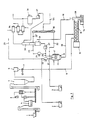
- Flow pat 1 is heated and dried in a centrifugal dryer 4 and is fed hot into a scale bunker 6 via a collecting bunker 5. From this it is conveyed via a metering element 7 through line 8 into a mixing and kneading device forming the first reaction stage 11.
- the relatively slow-running mixing and kneading device with drive 12 executes a rotating and at the same time reciprocating movement with the worm shaft, which has an interrupted worm gear, the interruptions and the worm gear interacting with kneading chicanes inserted in the housing.
- a hot acid mixture is injected through line 10 behind the multitude inlet in the outlet direction and mixed intensively with the still hot spar and reacted at about 120-160 ° C., preferably 130 ° C.
- reaction stage 11 The very short average residence time of about 1-3 minutes in the jacketed and heated mixing and kneading device forming reaction stage 11 already leads to the release of large amounts of HF after expulsion. About 70% of the conversion reaction is already complete when the reaction product in the moist, crumbly state is expelled from the subsequent single-shaft mixer, which forms the second reaction stage.
- the second reaction stage 13 is with a single screw machine with impact paddles, i.e. equipped with a vortex screw, is heated on the outside and has a drive 14.
- the speed of the single-screw machine is significantly higher than that of the preceding mixing and kneading device of the first stage 11.
- the paddles subject the material to impact and promote it to the third reac-. tion level further.
- the third reaction stage is formed by an externally heated rotary kiln 15, which only rotates at about 1-3 rpm in order to give the reaction material a sufficiently long average residence time.
- the rotary kiln 15 is from the inlet end to the outlet of 200 ° C-approx. Heated at 300 ° C.
- the removal of the contaminated HF gases is arranged in the furnace shield or in the chute 28 in the diameter of the rotary kiln.
- the residence time in the rotary kiln 15 is such that less than 1% CaF 2 and small amounts of H 2 S0 4 remain in the anhydrite gypsum when it passes from the furnace into an inclined screw conveyor 18, in which the small amount required for the residual neutralization of Ca (OH) 2 19 is admixed.
- the anhydrite passes through a fine mill 20 and is bunkered before it is bagged at 60 or loaded into containers. If the anhydrite is not to be used as a cement retarder, but rather as a high-quality building material, it is advantageous to add about 0.4 to 0.7% K 2 S0 4 as a stimulator. Although this does not take part in the reaction, it distributes it extremely finely in the anhydrite.
- hydrofluoric acid that is produced during the production of anhydrite is another valuable product, provided that it is produced economically with the required purity.
- the hydrofluoric vapors escaping through the line 16 from the three-part reactor system, which is kept under a slight negative pressure, are still heavily contaminated by
- HF gases which are loaded with water vapor and with low-volatility impurities and have a temperature of approximately 180 ° C.
- a column designed as a dryer 31 where cold or chilled acid mixtures trickle down at approx. 18 ° to 80 ° C, on average around 70 ° C, which absorb the water vapor and wash out the dust.
- some of the HF bound as HS0 3 F is split off by the hot gases or its formation is suppressed.
- the HF-enriched gases now rise at 40 to 70 ° C into the upper part of the column 31, 33 forming a cooling column 33, where they are sprayed from the head with 17 ° C cold HF.
- the gas mixture is cooled to approx. 22 ° C. and thus leaves the cooling column 33 of the column 31, 33.
- the gas mixture enters a condenser 34 cooled with approx. 10 ° C. water, where a part is condensed and collected in the container 38. This part is pumped back into the top of the cooling column 33 by a circulation pump 27 via a line 39.
- a further quantity of the gases reaches a second condenser 36, which is cooled with brine, at about 17 ° C., so that the condensates flow off into a further container 38 at 9 ° C.
- the acid can still be pumped into the rectification column 41, where the remaining volatile impurities are driven off with a little HF and an HF of more than 99.99% is drawn off from the bottom and through the cooler 44 to 10 ° C cooled through line 45 to the storage tank.
- the top of the rectification column 41 is connected to a condenser 42 via a circuit line 43.
- the exhaust air blown out by the fan 59 contains only less than 0.01% HF before the exhaust stack is diluted.
- the resulting acid mixture with about 97.8% H 2 S0 4 and only less than 1% HF now flows continuously at about 140 ° C through line 10 into the mixing and kneading device forming the first reaction stage 11.
- the variant shown in FIG. 2 is explained at the end of the example below.
- the condensation is set such that the residual gases mixed with lower-boiling impurities are passed as approx. 80% HF at approx. 9-12 ° C. and approx. 800 kg / h into the absorption tower 51, where approx. 720 kg / h 18 ° C cold 98% sulfuric acid 23 can be added.
- approx. 280 kg / h of gases still leave the absorption tower, whereby the HF content has dropped below 30% and the air content is approx. 20%.
- About 1,290 kg / h of washing acid at 18 ° C. run back into the middle part of the cooling column 33 from the absorption tower 51.
- the washing acid passed through line 54 contains approximately 40% HF, approximately 60% H 2 SO 4 and 1-3% water as an impurity.
- the washing acid in the bottom of the dryer 31 of the cooling column however, only has a content of less than 12% HF.
- approximately 3,040 kg / h of hydrofluoric acid are branched off at approximately 9 ° C. and pumped into the rectifying column 41.
- approximately 3,000 kg / h of hydrofluoric acid are drawn off at 52 ° C. with a purity of more than 99.99%, while approx. 44 kg / h of impurities of approx .
- the supply of fresh 20 ° C cold sulfuric acid 23 with 98% to the absorption tower 51 allows the condensation and distillation stages to be advantageously charged, since the separation of the uncondensable impurities from the HF at the top of the columns or in the condensation is not regulated too critically needs.
- the concentrated HF vapors are drawn off at more than about 150 ° C. and into the lower third of the Dryer 31 and cooling column 33 formed, also used for washing column 31, 33, the concentrated sulfuric acid enriched in the bottom of column 30 is fed to mixing vessel 9 at about 160.degree.
- the HF content in the acid mixture flowing through the line 10 thus drops to below 1% and this is fed to the reaction stage 11 at approximately 140 ° C.
- Fig. 2 shows a variant. This assumes that according to the diss. "Boiling equilibria of systems with hydrogen fluoride" by V. Kaiser, ETH, Zurich (1964) the boiling equilibrium between HF contaminated with dust, S0 2 , S0 3 , SiF 4 etc. by controlling the temperatures can be determined so that the formation of HS0 3 F from HF + H 2 S0 4 does not occur. As is well known, this is the case at temperatures above 100 ° C. Already at approx. 80 ° C only 1/7 of the compound is formed, the rest of the undesirable does not occur. The drying process of the reaction gases escaping from the third reactor stage 15 through line 16 at approx.
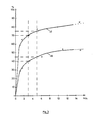
- Fig. 3 shows with curve 46 how in the previous practice with a recycled acid mixture which contained about 15% HFS0 3 , at about 100 ° C after about 3 minutes of kneading mixing time, only about 39% conversion was achieved, which during The funding, which lasted up to a total of approx. 5 minutes, rose to a total of 45% through the second level 13.
Landscapes
- Chemical & Material Sciences (AREA)
- Organic Chemistry (AREA)
- Inorganic Chemistry (AREA)
- Life Sciences & Earth Sciences (AREA)
- Geology (AREA)
- Compounds Of Alkaline-Earth Elements, Aluminum Or Rare-Earth Metals (AREA)
- Treating Waste Gases (AREA)
Claims (15)
Applications Claiming Priority (2)
| Application Number | Priority Date | Filing Date | Title |
|---|---|---|---|
| CH2745/81 | 1981-04-28 | ||
| CH274581A CH646401A5 (de) | 1981-04-28 | 1981-04-28 | Verfahren und einrichtung zur herstellung von synthetischem anhydrit und reiner flusssaeure. |
Publications (3)
| Publication Number | Publication Date |
|---|---|
| EP0077331A1 EP0077331A1 (fr) | 1983-04-27 |
| EP0077331B1 EP0077331B1 (fr) | 1985-08-07 |
| EP0077331B2 true EP0077331B2 (fr) | 1991-01-23 |
Family
ID=4240653
Family Applications (1)
| Application Number | Title | Priority Date | Filing Date |
|---|---|---|---|
| EP82900014A Expired - Lifetime EP0077331B2 (fr) | 1981-04-28 | 1981-12-21 | Procede et dispositif pour la fabrication de sulfate de calcium anhydre synthetique et d'acide fluorhydrique pur |
Country Status (7)
| Country | Link |
|---|---|
| US (1) | US4460551A (fr) |
| EP (1) | EP0077331B2 (fr) |
| AU (1) | AU546040B2 (fr) |
| BR (1) | BR8109005A (fr) |
| CH (1) | CH646401A5 (fr) |
| DE (1) | DE3152830D2 (fr) |
| WO (1) | WO1982003848A1 (fr) |
Cited By (1)
| Publication number | Priority date | Publication date | Assignee | Title |
|---|---|---|---|---|
| CN109437111A (zh) * | 2018-12-14 | 2019-03-08 | 福建龙氟化工有限公司 | 一种高纯无水氟化氢生产工艺及配套的回转反应炉 |
Families Citing this family (16)
| Publication number | Priority date | Publication date | Assignee | Title |
|---|---|---|---|---|
| US4935211A (en) * | 1989-01-23 | 1990-06-19 | Azar David G | Fluorogypsum waste solidification material |
| US5271918A (en) * | 1991-03-11 | 1993-12-21 | Alliedsignal Inc. | Furnace gas - sulfuric acid contact process for HF manufacture |
| DE4200792A1 (de) * | 1992-01-15 | 1993-07-22 | Solvay Fluor & Derivate | Aufarbeitung der fluorwasserstoff-phase aus reaktionsgemischen |
| DE19823879C1 (de) * | 1998-05-28 | 1999-08-19 | Solvay Fluor & Derivate | Flußmittelrecycling |
| RU2161121C2 (ru) * | 1998-11-30 | 2000-12-27 | Томский политехнический университет | Способ получения фтористого водорода и ангидрита |
| US6668947B2 (en) * | 2001-09-25 | 2003-12-30 | Ramon Perez Cordova | Drill cutting treatment method |
| CA2477102C (fr) * | 2002-02-27 | 2010-07-20 | Racional Energy & Environment Company | Procede et dispositif de traitement de deblais de forage |
| US20100143236A1 (en) * | 2007-02-02 | 2010-06-10 | Solvay Fluor Gmbh | Preparation of hydrogen fluoride from calcium fluoride and sulfuric acid |
| US9334436B2 (en) | 2010-10-29 | 2016-05-10 | Racional Energy And Environment Company | Oil recovery method and product |
| US8356678B2 (en) | 2010-10-29 | 2013-01-22 | Racional Energy & Environment Company | Oil recovery method and apparatus |
| DE102011111316B4 (de) | 2011-08-26 | 2017-10-19 | Plinke Gmbh | Verfahren zur Reinigung und Konzentrierung HF-haltiger Schwefelsäure |
| CN102556973B (zh) * | 2012-02-22 | 2013-10-23 | 中南大学 | 一种以萤石为原料生产氢氟酸的方法 |
| DE102018102026A1 (de) | 2018-01-30 | 2019-08-01 | Duesenfeld Gmbh | Verfahren zum Verwerten von Lithium-Batterien |
| CN108147439A (zh) * | 2018-02-12 | 2018-06-12 | 沈阳鑫博工业技术股份有限公司 | 一种利用菱镁矿粉和萤石制备氟化镁的装置及方法 |
| AU2019459228B2 (en) | 2019-07-26 | 2023-06-15 | Duesenfeld Gmbh | Method for recycling lithium batteries |
| CN115722158B (zh) * | 2022-11-28 | 2024-07-16 | 兰州理工大学 | 一种生产氟化氢的多层膨胀流化床反应器系统及工艺 |
Family Cites Families (10)
| Publication number | Priority date | Publication date | Assignee | Title |
|---|---|---|---|---|
| US2753245A (en) * | 1949-08-13 | 1956-07-03 | Pennsylvania Salt Mfg Co | Production of hydrogen fluoride |
| IT649940A (fr) * | 1960-05-23 | |||
| GB999137A (en) * | 1960-07-21 | 1965-07-21 | I C P M Ind Chimiche Porto Mar | Process for the production of hydrofluoric acid |
| DE1567778B1 (de) * | 1965-04-20 | 1970-07-23 | Riedel De Haen Ag | Verfahren zur Herstellung von im wesentlichen schwefelfreier Flusssaeure |
| CH540195A (de) * | 1970-09-30 | 1973-09-30 | Buss Ag | Verfahren zur kontinuierlichen Herstellung reiner Flusssäure und Einrichtung zur Ausübung des Verfahrens |
| DE2209960C3 (de) * | 1972-03-02 | 1979-10-11 | Bayer Ag, 5090 Leverkusen | Verfahren zur Aufarbeitung von Fluorwasserstoff-haltigen Rohgasen der Flußsäureherstellung |
| DE2435512A1 (de) * | 1974-07-24 | 1976-02-05 | Bayer Ag | Verfahren zur herstellung von fluorwasserstoff und calciumsulfat |
| CH617641A5 (en) * | 1975-04-18 | 1980-06-13 | List Heinz | Process for preparing hydrofluoric acid |
| US4150102A (en) * | 1975-10-02 | 1979-04-17 | Bayer Aktiengesellschaft | Purifying hydrofluoric acid |
| DE2601654A1 (de) * | 1976-01-17 | 1977-07-21 | Bayer Ag | Verfahren zur herstellung von flusssaeure aus phosphathaltigem flusspat |
-
1981
- 1981-04-28 CH CH274581A patent/CH646401A5/de not_active IP Right Cessation
- 1981-12-21 AU AU79308/82A patent/AU546040B2/en not_active Ceased
- 1981-12-21 BR BR8109005A patent/BR8109005A/pt unknown
- 1981-12-21 EP EP82900014A patent/EP0077331B2/fr not_active Expired - Lifetime
- 1981-12-21 WO PCT/CH1981/000146 patent/WO1982003848A1/fr not_active Ceased
- 1981-12-21 DE DE81CH8100146T patent/DE3152830D2/de not_active Expired
- 1981-12-28 US US06/456,090 patent/US4460551A/en not_active Expired - Lifetime
Cited By (1)
| Publication number | Priority date | Publication date | Assignee | Title |
|---|---|---|---|---|
| CN109437111A (zh) * | 2018-12-14 | 2019-03-08 | 福建龙氟化工有限公司 | 一种高纯无水氟化氢生产工艺及配套的回转反应炉 |
Also Published As
| Publication number | Publication date |
|---|---|
| BR8109005A (pt) | 1983-04-12 |
| US4460551A (en) | 1984-07-17 |
| AU546040B2 (en) | 1985-08-08 |
| CH646401A5 (de) | 1984-11-30 |
| EP0077331B1 (fr) | 1985-08-07 |
| DE3152830D2 (en) | 1983-04-07 |
| EP0077331A1 (fr) | 1983-04-27 |
| AU7930882A (en) | 1982-12-07 |
| WO1982003848A1 (fr) | 1982-11-11 |
Similar Documents
| Publication | Publication Date | Title |
|---|---|---|
| EP0077331B1 (fr) | Procede et dispositif pour la fabrication de sulfate de calcium anhydre synthetique et d'acide fluorhydrique pur | |
| DD232252A5 (de) | Verfahren zur herstellung von kaliumsulfat aus schwefliger saeure und kaliumchlorid | |
| DE2209960C3 (de) | Verfahren zur Aufarbeitung von Fluorwasserstoff-haltigen Rohgasen der Flußsäureherstellung | |
| WO2001089989A1 (fr) | Procede pour la production d"acide nitrique concentre, ainsi qu"installation pour l"execution de ce procede | |
| DE2106306C3 (de) | Verfahren zur Herstellung von Aluminiumfluorid | |
| EP0021381B1 (fr) | Procédé pour la récupération de l'energie de pyrolyse dans la préparation de chlorure de vinyle par craquage thermique du dichloroéthane | |
| DE69006489T2 (de) | Verfahren zur kontinuierlichen wiedergewinnung von fluorwasserstoffgas. | |
| DD206775A5 (de) | Verfahren zur herstellung von 1,2-dichlorethan | |
| DE1258844B (de) | Verfahren zur Gewinnung von Flusssaeure oder Fluorwasserstoff aus Fluorverbindungen enthaltenden Abgasen | |
| CH631135A5 (de) | Verfahren zur herstellung von hochreinem brom. | |
| DE1805698A1 (de) | Verbessertes Oxychlorierungsverfahren | |
| DE2365882A1 (de) | Verfahren zur reinigung von durch nassaufschluss gewonnener phosphorsaeure durch loesungsmittelextraktion | |
| EP0532857A1 (fr) | Procédé de traitement à la vapeur de résidus d'une distillation de chlorosilanes | |
| DD246988B1 (de) | Verfahren zur kontinuierlichen herstellung von natrium-n-butylat | |
| DE2926943C2 (fr) | ||
| DE2822303B2 (de) | Verfahren zur Herstellung einer praktisch fluorfreien konzentrierten Phosphorsäurelösung | |
| DE19920741B4 (de) | Verfahren zur Herstellung konzentrierter Salpetersäure | |
| DE2065477C3 (de) | Verfahren zur Abtrennung von Schwefelsäure aus einem Reaktionsgemisch. Ausscheidung aus: 2014783 | |
| DE3537941A1 (de) | Aus duennsaeure gewonnene metallsulfatsuspension, verfahren zu ihrer herstellung sowie deren verwendung | |
| CH540195A (de) | Verfahren zur kontinuierlichen Herstellung reiner Flusssäure und Einrichtung zur Ausübung des Verfahrens | |
| DE3215735C2 (fr) | ||
| EP0084674A1 (fr) | Procédé de purification d'acide sulfurique résiduaire | |
| DE1467109C (de) | Verfahren zur Herstellung von Fluor wasserstoff | |
| DE2757073A1 (de) | Verfahren und vorrichtung zur kontinuierlichen behandlung von salpetersaeuren aus der herstellung nitrierter alkylphenolderivate | |
| DE3137356C2 (de) | Verfahren zur Herstellung von konzentrierter Ameisensäure |
Legal Events
| Date | Code | Title | Description |
|---|---|---|---|
| PUAI | Public reference made under article 153(3) epc to a published international application that has entered the european phase |
Free format text: ORIGINAL CODE: 0009012 |
|
| 17P | Request for examination filed |
Effective date: 19821222 |
|
| AK | Designated contracting states |
Designated state(s): FR GB NL |
|
| GRAA | (expected) grant |
Free format text: ORIGINAL CODE: 0009210 |
|
| AK | Designated contracting states |
Designated state(s): FR GB NL |
|
| ET | Fr: translation filed | ||
| PLBI | Opposition filed |
Free format text: ORIGINAL CODE: 0009260 |
|
| 26 | Opposition filed |
Opponent name: KALI-CHEMIE AKTIENGESELLSCHAFT Effective date: 19860503 |
|
| NLR1 | Nl: opposition has been filed with the epo |
Opponent name: KALI-CHEMIE AKTIENGESELLSCHAFT |
|
| PUAH | Patent maintained in amended form |
Free format text: ORIGINAL CODE: 0009272 |
|
| STAA | Information on the status of an ep patent application or granted ep patent |
Free format text: STATUS: PATENT MAINTAINED AS AMENDED |
|
| 27A | Patent maintained in amended form |
Effective date: 19910123 |
|
| AK | Designated contracting states |
Kind code of ref document: B2 Designated state(s): FR GB NL |
|
| NLR2 | Nl: decision of opposition | ||
| NLR3 | Nl: receipt of modified translations in the netherlands language after an opposition procedure | ||
| EN3 | Fr: translation not filed ** decision concerning opposition | ||
| ET3 | Fr: translation filed ** decision concerning opposition | ||
| REG | Reference to a national code |
Ref country code: FR Ref legal event code: BR |
|
| REG | Reference to a national code |
Ref country code: FR Ref legal event code: CA |
|
| REG | Reference to a national code |
Ref country code: FR Ref legal event code: RM |
|
| PGFP | Annual fee paid to national office [announced via postgrant information from national office to epo] |
Ref country code: GB Payment date: 19971219 Year of fee payment: 17 |
|
| PGFP | Annual fee paid to national office [announced via postgrant information from national office to epo] |
Ref country code: FR Payment date: 19971222 Year of fee payment: 17 |
|
| PGFP | Annual fee paid to national office [announced via postgrant information from national office to epo] |
Ref country code: NL Payment date: 19971231 Year of fee payment: 17 |
|
| PG25 | Lapsed in a contracting state [announced via postgrant information from national office to epo] |
Ref country code: GB Free format text: LAPSE BECAUSE OF NON-PAYMENT OF DUE FEES Effective date: 19981221 |
|
| PG25 | Lapsed in a contracting state [announced via postgrant information from national office to epo] |
Ref country code: NL Free format text: LAPSE BECAUSE OF NON-PAYMENT OF DUE FEES Effective date: 19990701 |
|
| GBPC | Gb: european patent ceased through non-payment of renewal fee |
Effective date: 19981221 |
|
| PG25 | Lapsed in a contracting state [announced via postgrant information from national office to epo] |
Ref country code: FR Free format text: LAPSE BECAUSE OF NON-PAYMENT OF DUE FEES Effective date: 19990831 |
|
| NLV4 | Nl: lapsed or anulled due to non-payment of the annual fee |
Effective date: 19990701 |
|
| REG | Reference to a national code |
Ref country code: FR Ref legal event code: ST |