EP0072912B1 - Verfahren zur Herstellung von Glyoxal - Google Patents
Verfahren zur Herstellung von Glyoxal Download PDFInfo
- Publication number
- EP0072912B1 EP0072912B1 EP82106325A EP82106325A EP0072912B1 EP 0072912 B1 EP0072912 B1 EP 0072912B1 EP 82106325 A EP82106325 A EP 82106325A EP 82106325 A EP82106325 A EP 82106325A EP 0072912 B1 EP0072912 B1 EP 0072912B1
- Authority
- EP
- European Patent Office
- Prior art keywords
- catalyst
- copper
- silver
- glyoxal
- weight
- Prior art date
- Legal status (The legal status is an assumption and is not a legal conclusion. Google has not performed a legal analysis and makes no representation as to the accuracy of the status listed.)
- Expired
Links
- LEQAOMBKQFMDFZ-UHFFFAOYSA-N glyoxal Chemical compound O=CC=O LEQAOMBKQFMDFZ-UHFFFAOYSA-N 0.000 title claims description 106
- 229940015043 glyoxal Drugs 0.000 title claims description 53
- 238000000034 method Methods 0.000 title claims description 36
- 230000008569 process Effects 0.000 title claims description 30
- 238000002360 preparation method Methods 0.000 title claims description 6
- LYCAIKOWRPUZTN-UHFFFAOYSA-N Ethylene glycol Chemical compound OCCO LYCAIKOWRPUZTN-UHFFFAOYSA-N 0.000 claims description 107
- 239000003054 catalyst Substances 0.000 claims description 78
- BQCADISMDOOEFD-UHFFFAOYSA-N Silver Chemical compound [Ag] BQCADISMDOOEFD-UHFFFAOYSA-N 0.000 claims description 47
- 239000004332 silver Substances 0.000 claims description 47
- 229910052709 silver Inorganic materials 0.000 claims description 45
- RYGMFSIKBFXOCR-UHFFFAOYSA-N Copper Chemical compound [Cu] RYGMFSIKBFXOCR-UHFFFAOYSA-N 0.000 claims description 44
- 229910052802 copper Inorganic materials 0.000 claims description 44
- 239000010949 copper Substances 0.000 claims description 44
- 239000013078 crystal Substances 0.000 claims description 35
- 238000006243 chemical reaction Methods 0.000 claims description 30
- 229910052698 phosphorus Inorganic materials 0.000 claims description 19
- 239000011574 phosphorus Substances 0.000 claims description 19
- 230000003647 oxidation Effects 0.000 claims description 16
- 238000007254 oxidation reaction Methods 0.000 claims description 16
- OAICVXFJPJFONN-UHFFFAOYSA-N Phosphorus Chemical compound [P] OAICVXFJPJFONN-UHFFFAOYSA-N 0.000 claims description 14
- -1 phosphorus compound Chemical class 0.000 claims description 10
- QVGXLLKOCUKJST-UHFFFAOYSA-N atomic oxygen Chemical compound [O] QVGXLLKOCUKJST-UHFFFAOYSA-N 0.000 claims description 8
- 229910052760 oxygen Inorganic materials 0.000 claims description 8
- 239000001301 oxygen Substances 0.000 claims description 8
- 239000002245 particle Substances 0.000 claims description 7
- 239000011261 inert gas Substances 0.000 claims description 4
- WGCNASOHLSPBMP-UHFFFAOYSA-N hydroxyacetaldehyde Natural products OCC=O WGCNASOHLSPBMP-UHFFFAOYSA-N 0.000 description 29
- 239000000243 solution Substances 0.000 description 26
- 239000007788 liquid Substances 0.000 description 20
- 239000000203 mixture Substances 0.000 description 16
- 238000010791 quenching Methods 0.000 description 13
- 239000007789 gas Substances 0.000 description 12
- 238000009833 condensation Methods 0.000 description 11
- 230000005494 condensation Effects 0.000 description 11
- 239000011541 reaction mixture Substances 0.000 description 10
- 239000000047 product Substances 0.000 description 8
- IJGRMHOSHXDMSA-UHFFFAOYSA-N Atomic nitrogen Chemical compound N#N IJGRMHOSHXDMSA-UHFFFAOYSA-N 0.000 description 7
- 239000002253 acid Substances 0.000 description 7
- 238000004519 manufacturing process Methods 0.000 description 7
- CURLTUGMZLYLDI-UHFFFAOYSA-N Carbon dioxide Chemical compound O=C=O CURLTUGMZLYLDI-UHFFFAOYSA-N 0.000 description 6
- WSFSSNUMVMOOMR-NJFSPNSNSA-N methanone Chemical compound O=[14CH2] WSFSSNUMVMOOMR-NJFSPNSNSA-N 0.000 description 6
- 230000000052 comparative effect Effects 0.000 description 5
- YCKOAAUKSGOOJH-UHFFFAOYSA-N copper silver Chemical compound [Cu].[Ag].[Ag] YCKOAAUKSGOOJH-UHFFFAOYSA-N 0.000 description 5
- XLYOFNOQVPJJNP-UHFFFAOYSA-N water Substances O XLYOFNOQVPJJNP-UHFFFAOYSA-N 0.000 description 5
- 238000010626 work up procedure Methods 0.000 description 5
- 230000015572 biosynthetic process Effects 0.000 description 4
- 230000000694 effects Effects 0.000 description 4
- 150000003018 phosphorus compounds Chemical class 0.000 description 4
- WVLBCYQITXONBZ-UHFFFAOYSA-N trimethyl phosphate Chemical compound COP(=O)(OC)OC WVLBCYQITXONBZ-UHFFFAOYSA-N 0.000 description 4
- WSFSSNUMVMOOMR-UHFFFAOYSA-N Formaldehyde Chemical compound O=C WSFSSNUMVMOOMR-UHFFFAOYSA-N 0.000 description 3
- KWYUFKZDYYNOTN-UHFFFAOYSA-M Potassium hydroxide Chemical compound [OH-].[K+] KWYUFKZDYYNOTN-UHFFFAOYSA-M 0.000 description 3
- 239000001569 carbon dioxide Substances 0.000 description 3
- 229910002092 carbon dioxide Inorganic materials 0.000 description 3
- 238000005260 corrosion Methods 0.000 description 3
- 230000007797 corrosion Effects 0.000 description 3
- 229910052757 nitrogen Inorganic materials 0.000 description 3
- 230000008929 regeneration Effects 0.000 description 3
- 238000011069 regeneration method Methods 0.000 description 3
- WKBOTKDWSSQWDR-UHFFFAOYSA-N Bromine atom Chemical class [Br] WKBOTKDWSSQWDR-UHFFFAOYSA-N 0.000 description 2
- 239000007864 aqueous solution Substances 0.000 description 2
- DIKBFYAXUHHXCS-UHFFFAOYSA-N bromoform Chemical compound BrC(Br)Br DIKBFYAXUHHXCS-UHFFFAOYSA-N 0.000 description 2
- 230000003197 catalytic effect Effects 0.000 description 2
- 230000003247 decreasing effect Effects 0.000 description 2
- 230000009467 reduction Effects 0.000 description 2
- DQWPFSLDHJDLRL-UHFFFAOYSA-N triethyl phosphate Chemical compound CCOP(=O)(OCC)OCC DQWPFSLDHJDLRL-UHFFFAOYSA-N 0.000 description 2
- 239000012808 vapor phase Substances 0.000 description 2
- DNIAPMSPPWPWGF-GSVOUGTGSA-N (R)-(-)-Propylene glycol Chemical compound C[C@@H](O)CO DNIAPMSPPWPWGF-GSVOUGTGSA-N 0.000 description 1
- AATNZNJRDOVKDD-UHFFFAOYSA-N 1-[ethoxy(ethyl)phosphoryl]oxyethane Chemical compound CCOP(=O)(CC)OCC AATNZNJRDOVKDD-UHFFFAOYSA-N 0.000 description 1
- NYYLZXREFNYPKB-UHFFFAOYSA-N 1-[ethoxy(methyl)phosphoryl]oxyethane Chemical compound CCOP(C)(=O)OCC NYYLZXREFNYPKB-UHFFFAOYSA-N 0.000 description 1
- ZSSWXNPRLJLCDU-UHFFFAOYSA-N 1-diethylphosphorylethane Chemical compound CCP(=O)(CC)CC ZSSWXNPRLJLCDU-UHFFFAOYSA-N 0.000 description 1
- 229910001316 Ag alloy Inorganic materials 0.000 description 1
- 229910000881 Cu alloy Inorganic materials 0.000 description 1
- 229910000971 Silver steel Inorganic materials 0.000 description 1
- ATJFFYVFTNAWJD-UHFFFAOYSA-N Tin Chemical compound [Sn] ATJFFYVFTNAWJD-UHFFFAOYSA-N 0.000 description 1
- CLBRCZAHAHECKY-UHFFFAOYSA-N [Co].[Pt] Chemical compound [Co].[Pt] CLBRCZAHAHECKY-UHFFFAOYSA-N 0.000 description 1
- 239000000654 additive Substances 0.000 description 1
- 239000003570 air Substances 0.000 description 1
- 229910045601 alloy Inorganic materials 0.000 description 1
- 239000000956 alloy Substances 0.000 description 1
- 229910052787 antimony Inorganic materials 0.000 description 1
- WATWJIUSRGPENY-UHFFFAOYSA-N antimony atom Chemical compound [Sb] WATWJIUSRGPENY-UHFFFAOYSA-N 0.000 description 1
- 229910052785 arsenic Inorganic materials 0.000 description 1
- RQNWIZPPADIBDY-UHFFFAOYSA-N arsenic atom Chemical compound [As] RQNWIZPPADIBDY-UHFFFAOYSA-N 0.000 description 1
- 230000009286 beneficial effect Effects 0.000 description 1
- 230000008901 benefit Effects 0.000 description 1
- 229910052797 bismuth Inorganic materials 0.000 description 1
- JCXGWMGPZLAOME-UHFFFAOYSA-N bismuth atom Chemical compound [Bi] JCXGWMGPZLAOME-UHFFFAOYSA-N 0.000 description 1
- GDTBXPJZTBHREO-UHFFFAOYSA-N bromine Substances BrBr GDTBXPJZTBHREO-UHFFFAOYSA-N 0.000 description 1
- 229910052794 bromium Inorganic materials 0.000 description 1
- 229950005228 bromoform Drugs 0.000 description 1
- OWBTYPJTUOEWEK-UHFFFAOYSA-N butane-2,3-diol Chemical compound CC(O)C(C)O OWBTYPJTUOEWEK-UHFFFAOYSA-N 0.000 description 1
- 239000006227 byproduct Substances 0.000 description 1
- 229910052799 carbon Inorganic materials 0.000 description 1
- 239000007795 chemical reaction product Substances 0.000 description 1
- 238000004140 cleaning Methods 0.000 description 1
- 238000011109 contamination Methods 0.000 description 1
- 238000010924 continuous production Methods 0.000 description 1
- 239000012043 crude product Substances 0.000 description 1
- 230000009849 deactivation Effects 0.000 description 1
- 125000005594 diketone group Chemical group 0.000 description 1
- VONWDASPFIQPDY-UHFFFAOYSA-N dimethyl methylphosphonate Chemical compound COP(C)(=O)OC VONWDASPFIQPDY-UHFFFAOYSA-N 0.000 description 1
- 238000009826 distribution Methods 0.000 description 1
- 150000002366 halogen compounds Chemical class 0.000 description 1
- ACCCMOQWYVYDOT-UHFFFAOYSA-N hexane-1,1-diol Chemical compound CCCCCC(O)O ACCCMOQWYVYDOT-UHFFFAOYSA-N 0.000 description 1
- 230000006872 improvement Effects 0.000 description 1
- 239000012535 impurity Substances 0.000 description 1
- 239000003112 inhibitor Substances 0.000 description 1
- 230000001788 irregular Effects 0.000 description 1
- 239000010985 leather Substances 0.000 description 1
- 239000000320 mechanical mixture Substances 0.000 description 1
- 238000002156 mixing Methods 0.000 description 1
- DNIAPMSPPWPWGF-UHFFFAOYSA-N monopropylene glycol Natural products CC(O)CO DNIAPMSPPWPWGF-UHFFFAOYSA-N 0.000 description 1
- 239000000123 paper Substances 0.000 description 1
- 239000012071 phase Substances 0.000 description 1
- 230000008092 positive effect Effects 0.000 description 1
- 235000013772 propylene glycol Nutrition 0.000 description 1
- 239000012495 reaction gas Substances 0.000 description 1
- 230000009257 reactivity Effects 0.000 description 1
- 238000007086 side reaction Methods 0.000 description 1
- 238000005507 spraying Methods 0.000 description 1
- 230000006641 stabilisation Effects 0.000 description 1
- 238000011105 stabilization Methods 0.000 description 1
- 239000010935 stainless steel Substances 0.000 description 1
- 229910001220 stainless steel Inorganic materials 0.000 description 1
- 239000007858 starting material Substances 0.000 description 1
- 238000013517 stratification Methods 0.000 description 1
- 239000004753 textile Substances 0.000 description 1
- 229910052718 tin Inorganic materials 0.000 description 1
- CYTQBVOFDCPGCX-UHFFFAOYSA-N trimethyl phosphite Chemical compound COP(OC)OC CYTQBVOFDCPGCX-UHFFFAOYSA-N 0.000 description 1
- OXFUXNFMHFCELM-UHFFFAOYSA-N tripropan-2-yl phosphate Chemical compound CC(C)OP(=O)(OC(C)C)OC(C)C OXFUXNFMHFCELM-UHFFFAOYSA-N 0.000 description 1
- RXPQRKFMDQNODS-UHFFFAOYSA-N tripropyl phosphate Chemical compound CCCOP(=O)(OCCC)OCCC RXPQRKFMDQNODS-UHFFFAOYSA-N 0.000 description 1
Images
Classifications
-
- B—PERFORMING OPERATIONS; TRANSPORTING
- B01—PHYSICAL OR CHEMICAL PROCESSES OR APPARATUS IN GENERAL
- B01J—CHEMICAL OR PHYSICAL PROCESSES, e.g. CATALYSIS OR COLLOID CHEMISTRY; THEIR RELEVANT APPARATUS
- B01J37/00—Processes, in general, for preparing catalysts; Processes, in general, for activation of catalysts
- B01J37/02—Impregnation, coating or precipitation
- B01J37/024—Multiple impregnation or coating
-
- B—PERFORMING OPERATIONS; TRANSPORTING
- B01—PHYSICAL OR CHEMICAL PROCESSES OR APPARATUS IN GENERAL
- B01J—CHEMICAL OR PHYSICAL PROCESSES, e.g. CATALYSIS OR COLLOID CHEMISTRY; THEIR RELEVANT APPARATUS
- B01J23/00—Catalysts comprising metals or metal oxides or hydroxides, not provided for in group B01J21/00
- B01J23/70—Catalysts comprising metals or metal oxides or hydroxides, not provided for in group B01J21/00 of the iron group metals or copper
- B01J23/89—Catalysts comprising metals or metal oxides or hydroxides, not provided for in group B01J21/00 of the iron group metals or copper combined with noble metals
- B01J23/8926—Copper and noble metals
-
- B—PERFORMING OPERATIONS; TRANSPORTING
- B01—PHYSICAL OR CHEMICAL PROCESSES OR APPARATUS IN GENERAL
- B01J—CHEMICAL OR PHYSICAL PROCESSES, e.g. CATALYSIS OR COLLOID CHEMISTRY; THEIR RELEVANT APPARATUS
- B01J27/00—Catalysts comprising the elements or compounds of halogens, sulfur, selenium, tellurium, phosphorus or nitrogen; Catalysts comprising carbon compounds
- B01J27/14—Phosphorus; Compounds thereof
- B01J27/16—Phosphorus; Compounds thereof containing oxygen, i.e. acids, anhydrides and their derivates with N, S, B or halogens without carriers or on carriers based on C, Si, Al or Zr; also salts of Si, Al and Zr
- B01J27/18—Phosphorus; Compounds thereof containing oxygen, i.e. acids, anhydrides and their derivates with N, S, B or halogens without carriers or on carriers based on C, Si, Al or Zr; also salts of Si, Al and Zr with metals other than Al or Zr
- B01J27/1802—Salts or mixtures of anhydrides with compounds of other metals than V, Nb, Ta, Cr, Mo, W, Mn, Tc, Re, e.g. phosphates, thiophosphates
- B01J27/1817—Salts or mixtures of anhydrides with compounds of other metals than V, Nb, Ta, Cr, Mo, W, Mn, Tc, Re, e.g. phosphates, thiophosphates with copper, silver or gold
-
- C—CHEMISTRY; METALLURGY
- C07—ORGANIC CHEMISTRY
- C07C—ACYCLIC OR CARBOCYCLIC COMPOUNDS
- C07C45/00—Preparation of compounds having >C = O groups bound only to carbon or hydrogen atoms; Preparation of chelates of such compounds
- C07C45/27—Preparation of compounds having >C = O groups bound only to carbon or hydrogen atoms; Preparation of chelates of such compounds by oxidation
- C07C45/32—Preparation of compounds having >C = O groups bound only to carbon or hydrogen atoms; Preparation of chelates of such compounds by oxidation with molecular oxygen
- C07C45/37—Preparation of compounds having >C = O groups bound only to carbon or hydrogen atoms; Preparation of chelates of such compounds by oxidation with molecular oxygen of >C—O—functional groups to >C=O groups
- C07C45/38—Preparation of compounds having >C = O groups bound only to carbon or hydrogen atoms; Preparation of chelates of such compounds by oxidation with molecular oxygen of >C—O—functional groups to >C=O groups being a primary hydroxyl group
Definitions
- the invention relates to a new process for the preparation of glyoxal by oxidation of glycol in the presence of a copper / silver layer catalyst.
- glyoxal can be produced by vapor phase oxidation of ethylene glycol on an oxidation catalyst which contains copper in combination with tin, phosphorus, arsenic, antimony or bismuth.
- the catalyst which may also contain silver, is used as an alloy, preferably in the form of swarf or gauze.
- yields - based on converted ethylene glycol - are given between 55% and 72%.
- the higher values can only be achieved by accepting an incomplete glycol conversion. This is unsatisfactory from an economic point of view, since removal of the remaining glycol from the product is only possible with great effort.
- insufficient space-time yields are obtained by this known method.
- Another disadvantage is the cumbersome catalyst production.
- DE-PS 1 967147 proposes a silver catalyst which contains phosphorus for the production of glyoxal from ethylene glycol. With this process too, a glyoxal yield of up to 70%, based on the ethylene glycol converted, must be purchased with unsatisfactory sales. The space-time yields are also unsatisfactory.
- DE-OS 2158 343 the selectivity of catalysts described in DE-PS 1 923 048 drops from an initial value of 60 to 64% to 55% over a 700-hour operating period. It is also stated that a catalyst containing copper, silver and phosphorus can be regenerated after a 700 hour run time by a 12 hour reduction at 450 ° C.
- DE-OS 2158 344 describes the regeneration of a catalyst containing copper and phosphorus, in which an excess of oxygen is passed over the catalyst for at least 1 day. These regeneration processes have the disadvantage that they are associated with a loss of production and require complex safety measures in order to prevent the mixing of the air used for regeneration with the reaction gas.
- the life of copper catalysts is considerably extended if the vapor phase oxidation of ethylene glycol is carried out at from 225 to 500 ° C. and in the presence of a phosphorus compound, such as trimethyl phosphate, which is volatile under the reaction conditions, where the amount of phosphorus (calculated P), based on the amount by weight of ethylene glycol, is 1 to 100 ppm.
- a phosphorus compound such as trimethyl phosphate
- the catalysts are used in the form of swarf, wire mesh, gauze or as supported catalysts.
- DE-A2831 229 describes a process for the preparation of diketones by oxidation of aliphatic diols, such as 1,2-propanediol, 2,3-butanediol or n-hexanediol, in which a layered catalyst with several layers of silver and / and or copper crystals are used. Particularly advantageous results are obtained if mixtures of silver and copper or silver crystals alone are used.
- DE-OS 2 803 318 describes a process for the production of glyoxal from glycol, in which the oxidation on silver crystals with a grain size of 0.1 to 2.5 mm is carried out with a residence time of at most 0.05 seconds and a temperature of 447 up to 707 ° C.
- this method achieves a multiple of the space-time yields obtained with the methods described above, the relatively low yield of only 55% is disadvantageous.
- the yield can be improved by adding bromoform to the starting mixture, corrosion problems and product purity difficulties have to be accepted.
- the molar ratio of oxygen to ethylene glycol is expediently at least 0.7 to 1 and at most 1.4 to 1.
- the reaction temperatures indicated at 450 to 800 ° C. are the temperatures occurring in the catalyst bed.
- the residence time of the reaction mixture in the catalyst layer should not exceed 0.05 seconds.
- the oxidation is carried out on a multilayer catalyst which contains at least one layer of copper crystals and at least one layer of silver crystals.
- the total layer thickness of the catalyst is 5 to 100, preferably 20 to 40 mm.
- the catalyst layers are arranged in the reactor, which is usually set up vertically.
- the starting mixture of steam of the starting material ethylene glycol and oxygen or air is generally passed from top to bottom, so that the top layer also means that part of the catalyst which faces the starting mixture.
- reactors e.g. B. horizontally arranged reactors, or with other management of the starting mixture, all information in the description of the upper and lower part of the catalyst apply mutatis mutandis.
- the proportion of copper crystals is 10 to 45% by weight, in particular 20 to 30% by weight, and the proportion of silver crystals is 55 to 90% by weight, in particular 70 to 80% by weight. In a particularly preferred case, the proportion of copper crystals is 25% by weight and that of silver crystals 75% by weight of the total weight of the catalyst.
- the number of copper crystal layers, based on the number of silver crystal layers, can be larger, equal or smaller.
- the multilayer catalyst consists of one to four, preferably two to three, layers of copper crystals and one to four, preferably two to three, layers of silver crystals.
- the copper and silver crystals have a grain size of 0.1 to 2.5 mm, with grain size fractions of, for example, 0.2 to 0.4 mm, 0.4 to 0.75 mm, 0.75 to 1 for the individual layers , 0 mm, 1.0 to 2.5 mm can be used.
- the grain sizes of two adjacent layers can increase in the direction of flow increasingly, z. B. when changing from a copper layer to a silver layer or vice versa, or decreasing.
- the copper crystal layers can be arranged individually or several together above and / or below each silver crystal layer. Preferably only two or three copper layers are used and they are arranged above and / or below the upper silver layer.
- each individual silver or copper layer is usually regular, so that the layer thickness of the individual layer is the same over the entire layer cross section.
- the layer thickness depends directly on the proportions by weight of the total catalyst and the particular particle size of the particles.
- the layer thicknesses of two adjacent layers can be increasing, constant or decreasing when viewed in the direction of flow.
- the vaporous reaction mixtures obtainable in the catalytic oxidation are worked up in a manner known per se. For example, they are brought into contact with a liquid immediately after leaving the catalyst layer, which causes the immediate condensation of the oxidation products. Water, the condensed liquid reaction mixture or a mixture of these two liquids is used as the condensation liquid. It is particularly advantageous to use the condensed reaction mixture as the condensation liquid. If condensed reaction mixtures are used as the condensation liquid, the excess part of condensate, which is not circulated as a cooled condensation liquid, is removed as a crude product and, if necessary, fed to a workup or further reaction.
- the vaporous reaction mixture which has a temperature of 320 to 650 ° C., is expediently brought into contact with the condensation liquid within one second.
- the temperature of the condensation liquid is z. B. - 20 to 80 ° C.
- This treatment is carried out e.g. B. by passing the stream of hot reaction gases directly into a quench chamber, which directly adjoins the catalyst layer in the direction of flow.
- the procedure is preferably such that the condensation liquid is brought into contact with the reaction gases in the form of droplets with an average diameter of 1 to 2000 micrometers.
- the droplets are generated with the aid of conventional dividing devices, in particular nozzles.
- the spraying of the condensation liquid into the quench chamber is advantageously carried out in such a way that the majority of the droplets strike the stream of the reaction gases at an angle of 2 to 85 ° C. to the stream axis.
- the amount of condensation liquid (also referred to as quench liquid in the examples) is advantageously 20 to 100 parts by weight, based on 1 part by weight of the reaction gases.
- the process according to the invention provides a better overall result in terms of yield, space-time yield, purity of the end product and service life of the catalyst in a simpler and more economical way.
- the catalyst preparation or catalyst workup is particularly simple. For example, copper and silver crystals of the relevant particle size, as are also obtained in the electrolytic production, can be used directly.
- the copper-silver layer catalyst which is distinguished by a long service life, can easily be replaced in cases in which an exchange should nevertheless be necessary.
- the copper and silver layers can be mechanically separated from each other, which, for. B. can be effortlessly designed by inserting copper, silver or stainless steel nets between the copper and silver layers. Then both the copper and the silver can be electrolytically brought back into the catalytically active form almost without loss.
- the glyoxal obtained by the process according to the invention which can be obtained directly in the commercial form of a 40% aqueous solution, is distinguished by a comparatively high product quality which remains unchanged even after a long operating period.
- the residual content of the 40% glyoxal solution of unreacted glycol is below 0.1%, the content of glycol aldehyde and formaldehyde is only about 1% in each case.
- no special cleaning stage, e.g. B. with ion exchanger necessary.
- the addition of halogen compounds as an inhibitor which is associated with a risk of corrosion, is avoided in the process according to the invention.
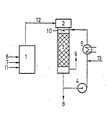
- a system with an ethylene glycol evaporator (1), corresponding feeds of ethylene glycol (6), water (7) and air or nitrogen (11) and a vertical tube reactor (2) are used.
- the reactor contains the feed (12) for the vaporous starting mixture and the reactor hood.
- the catalyst layer is below the top of the reactor, followed by the quench chamber (10), which forms the top of a packed column (3).
- the condensate is partly used as a quench liquid.
- the quench liquid is sprayed with a pump (4) via a heat exchanger (5) and a nozzle system directly behind the catalyst layer into the hot gases, which are cooled in the quench chamber and partially condensed so that the glyoxal solution can be removed via line (8) .
- the exhaust gas escapes via line (9).
- a catalyst consisting of copper and silver crystals (41 parts) of the following composition is introduced into the reactor (2) (order of the layers from top to bottom in the direction of flow of the gases):
- the height of the entire catalyst layer is 30 mm.
- An hourly mixture of 220 parts of ethylene glycol, 220 parts of water, 536 parts of air and 1 576 parts of nitrogen is fed to the evaporator (1), where it is heated and evaporated.
- the vaporous starting mixture is passed through the catalyst and reacted at 600 ° C and 1.2 bar.
- the residence time in the catalyst space is 0.006 seconds.
- the flow rate of the reaction gases when leaving the catalyst layer is 4.8 meters per second.
- the temperature of the quench liquid is 61 ° C.
- Water is initially introduced as the quench liquid. Depending on the amount of condensed reaction mixture obtained, part of the quench liquid is continuously drawn off via line 8. After a run-in phase, the quench liquid reaches a steady state concentration corresponding to its composition by concentration with a condensed reaction mixture. Thereafter, the balancing of the product solution continuously withdrawn from the quench circuit in accordance with the amount of condensing reaction mixture is started.
- Two rings, each with 6 nozzles arranged on a gap, are used to atomize the quench liquid. The nozzles of a ring are located on the column wall and are arranged symmetrically.
- the angle of impact of the droplets to the flow axis of all nozzles is different and is 15 to 75 ° C. In 70% of the droplets, this angle is 30 to 75 °.
- the droplets have an average diameter of 200 micrometers. This gives 363 parts per hour of a 40% by weight glyoxal solution, that is 145 parts of glyoxal per hour, corresponding to a yield of 70.6% of theory, based on the glyoxal used.
- the catalyst life is 90 days.
- the glyoxal solution contains 0.05 percent by weight ethylene glycol, 1.2 percent by weight formaldehyde, 0.9 percent by weight glycolaldehyde and an acid number of 4 (amount of potassium hydroxide in milligrams required to neutralize one gram of glyoxal solution).
- the conversion is 99.9 percent, the space-time yield 15.4 g glyoxal per cm 3 catalyst volume and hour. Color number of the solution after three days of operation: 12 (the color number is determined using the platinum-cobalt scale in accordance with ASTM D 1209-69).
- Example 2 The same system as in Example 1 is used.
- a layered catalyst as in Example 1 is introduced into the reactor, but instead of the copper of layers 1 and 2, corresponding amounts of silver crystals of the same grain size are used.
- Example 1 The reaction and workup is carried out as described in Example 1. 386 parts per hour of a 32% by weight glyoxal solution are obtained, that is 124 parts glyoxal per hour, corresponding to a yield of 60.3% of theory, based on the glycol used.
- the glyoxal solution has a content of 1.2 percent by weight ethylene glycol, 0.9 percent by weight formaldehyde, 6.1 percent by weight glycolaldehyde and an acid number of 4.
- the conversion is 97.9 percent, the space-time yield 13.2 g glyoxal per cm 3 catalyst volume and hour. Color number of the solution after three days of operation: 15.
- Example 2 The same system as in Example 1 is used.
- a layered catalyst as in Example 1 is introduced into the reactor, but instead of the silver of layers 3 and 4, corresponding amounts of copper crystals of the same grain size are used.
- Example 1 The reaction and workup is carried out as described in Example 1. This gives 332 parts per hour of a 34 percent by weight glyoxal solution, that is 113 parts of glyoxal per hour, corresponding to a yield of 54.9% of theory, based on the glycol used.
- the glyoxal solution has a content of 3.7 percent by weight ethylene glycol, 0.9 percent by weight formaldehyde, 1.2 percent by weight glycolaldehyde and an acid number of 5.
- the conversion is 94.4 percent, the space-time yield 12.0 g glyoxal per cm 3 catalyst volume and hour. Color number of the solution after three days of operation: 20.
- Example 1 The same system as in Example 1 is used. A mechanical mixture of copper and silver crystals with the same particle size and weight distribution as specified in Example 1 is introduced into the reactor as a catalyst. The total amount (41 parts) is the same as in Example 1. The bed height of the catalyst is somewhat lower at 27 mm due to the higher bed weight of the mixture.
- Example 1 The reaction and workup is carried out as described in Example 1. This gives 362 parts per hour of a 33% by weight glyoxal solution, that is 119 parts of glyoxal per hour, corresponding to a yield of 57.8% of theory, based on the glycol used.
- the glyoxal solution has a content of 1.9 percent by weight ethylene glycol, 1.1 percent by weight formaldehyde, 4.2 percent by weight glycolaldehyde and an acid number of 4.
- the conversion is 96.9 percent, the space-time yield 14.1 g glyoxal per cm 3 catalyst volume and hour. Color number of the solution after three days of operation: 15.
- Example 2 The same plant and the same multilayer catalyst as in Example 1 are used.
- the reaction is carried out at 600 ° C. and 1.2 bar analogously to Example 1, with the gas mixture flowing to the catalyst additionally having 0.003 parts per hour of trimethyl phosphate, (CH 3 0) 3 PO (corresponding to 3 ppm P, based on the weight of ethylene glycol fed in) ) are added.
- CH 3 0 trimethyl phosphate
- the glyoxal solution has a content of 0.05% by weight of ethylene glycol, 1.0% by weight of formaldehyde, 1.05% by weight of glycol aldehyde and an acid number of 5.
- the conversion is 99.9 percent, the space-time yield 16.9 glyoxal per cm 3 catalyst volume and hour. Color number of the solution after three days of operation: 11.
- Example 2 The same system as in Example 1 is used. A multilayer catalyst made of copper and silver analogous to Example 1 is introduced into the reactor. The reaction is carried out at 600 ° C and 1.2 bar analogous to Example 5, but here 0.03 parts per hour of trimethyl phosphate, (CH 3 0) 3 PO (ppm, corresponding to P 30, based on the weight of added ethylene glycol) to the are fed to the gas mixture flowing to the catalyst.
- CH 3 0) 3 PO ppm, corresponding to P 30, based on the weight of added ethylene glycol
- the glyoxal solution has a content of 1.1 percent by weight ethylene glycol, 0.8 percent by weight formaldehyde, 3.5 percent by weight glycolaldehyde and an acid number of 3.
- the conversion is 98.2 percent, the space-time yield 16.0 g glyoxal per cm 3 catalyst volume and hour. Color number of the solution after three days of operation: 9.
- the table shows the essential results of the examples according to the invention and of the comparative examples. It is clear that when the copper-silver layer catalyst (1) according to the invention is used, the glyoxal yield is considerably higher and the content of the glyoxal solution in troublesome and difficult to remove impurities is significantly lower than when using a pure silver or copper catalyst (2 or 3 ) or a copper-silver mixture (4).
- the addition of 3 ppm phosphorus (5) according to the invention brings about an additional increase in yield with slightly improved product quality. However, if the amount of phosphorus is increased above the optimal value (6 with 30 ppm phosphorus), the yield drops and the product quality deteriorates.
Landscapes
- Chemical & Material Sciences (AREA)
- Organic Chemistry (AREA)
- Engineering & Computer Science (AREA)
- Materials Engineering (AREA)
- Chemical Kinetics & Catalysis (AREA)
- Organic Low-Molecular-Weight Compounds And Preparation Thereof (AREA)
- Catalysts (AREA)
- Low-Molecular Organic Synthesis Reactions Using Catalysts (AREA)
Applications Claiming Priority (2)
| Application Number | Priority Date | Filing Date | Title |
|---|---|---|---|
| DE3130800 | 1981-08-04 | ||
| DE19813130800 DE3130800A1 (de) | 1981-08-04 | 1981-08-04 | Verfahren zur herstellung von glyoxal |
Publications (2)
| Publication Number | Publication Date |
|---|---|
| EP0072912A1 EP0072912A1 (de) | 1983-03-02 |
| EP0072912B1 true EP0072912B1 (de) | 1985-12-11 |
Family
ID=6138540
Family Applications (1)
| Application Number | Title | Priority Date | Filing Date |
|---|---|---|---|
| EP82106325A Expired EP0072912B1 (de) | 1981-08-04 | 1982-07-15 | Verfahren zur Herstellung von Glyoxal |
Country Status (3)
| Country | Link |
|---|---|
| EP (1) | EP0072912B1 (enExample) |
| JP (1) | JPS5826837A (enExample) |
| DE (2) | DE3130800A1 (enExample) |
Families Citing this family (4)
| Publication number | Priority date | Publication date | Assignee | Title |
|---|---|---|---|---|
| DE3213227A1 (de) * | 1982-04-08 | 1983-10-13 | Basf Ag, 6700 Ludwigshafen | Verfahren zur herstellung von formaldehyd |
| JPS5939844A (ja) * | 1982-08-31 | 1984-03-05 | Mitsui Toatsu Chem Inc | グリオキサ−ルの製造法 |
| JPS60100533A (ja) * | 1983-11-04 | 1985-06-04 | Mitsui Toatsu Chem Inc | グリオキサ−ルの製造法 |
| DE3712856A1 (de) * | 1987-04-15 | 1988-11-03 | Basf Ag | Verfahren zur herstellung von carbonylverbindungen |
Family Cites Families (6)
| Publication number | Priority date | Publication date | Assignee | Title |
|---|---|---|---|---|
| CA1064963A (en) * | 1975-07-31 | 1979-10-23 | American Cyanamid Company | Vapor phase oxidation process for glyoxal |
| US4258216A (en) * | 1975-07-31 | 1981-03-24 | American Cyanamid Company | Vapor phase oxidation process for glyoxal |
| DE2803318A1 (de) * | 1978-01-26 | 1979-08-09 | Basf Ag | Verfahren zur herstellung von glyoxal |
| DE2831229A1 (de) * | 1978-07-15 | 1980-01-31 | Basf Ag | Verfahren zur herstellung von diketonen |
| DE2831595A1 (de) * | 1978-07-19 | 1980-01-31 | Basf Ag | Verfahren zur herstellung von carbonylverbindungen |
| DE2832405A1 (de) * | 1978-07-24 | 1980-02-14 | Basf Ag | Verfahren zur herstellung von glyoxal aus aethylenglykol |
-
1981
- 1981-08-04 DE DE19813130800 patent/DE3130800A1/de not_active Withdrawn
-
1982
- 1982-07-15 EP EP82106325A patent/EP0072912B1/de not_active Expired
- 1982-07-15 DE DE8282106325T patent/DE3267908D1/de not_active Expired
- 1982-08-03 JP JP57134781A patent/JPS5826837A/ja active Granted
Also Published As
| Publication number | Publication date |
|---|---|
| DE3267908D1 (en) | 1986-01-23 |
| JPH0211575B2 (enExample) | 1990-03-14 |
| JPS5826837A (ja) | 1983-02-17 |
| EP0072912A1 (de) | 1983-03-02 |
| DE3130800A1 (de) | 1983-02-24 |
Similar Documents
| Publication | Publication Date | Title |
|---|---|---|
| DE2515419C2 (enExample) | ||
| WO2001087809A1 (de) | Verfahren zur herstellung von gesättigten c3-c20-alkoholen | |
| DE2436818A1 (de) | Verfahren zur herstellung von acrylsaeure durch oxidation von propylen mit sauerstoff enthaltenden gasen in zwei getrennten katalysatorstufen | |
| DE1923048C3 (de) | Verfahren zur Herstellung von Dicarbonylverbindungen durch Dampfphasenoxydation eines aliphatischen Diols bzw. von Cyclohexan-l,2-diol | |
| DE2251364A1 (de) | Verfahren zur herstellung ungesaettigter karbonsaeuren aus den entsprechenden ungesaettigten aldehyden | |
| DE3232557C2 (enExample) | ||
| DE2600541C3 (de) | Verfahren zur Herstellung von Phenylbrenztraubensäure oder Arylbrenztraubensäuren | |
| DE2847170C2 (de) | Verfahren zur kontinuierlichen Herstellung von Terephthalsäure | |
| DD142707A5 (de) | Verfahren zur herstellung von essigsaeure,aethanol und acetaldehyd | |
| DE3876156T2 (de) | Verfahren zum abschrecken eines reaktionsproduktgases mit methacrylsaeureinhalt und verfahren zum behandeln der abgeschreckten fluessigkeit. | |
| DE1816739C3 (de) | Verfahren zur Herstellung von Isopren | |
| DE702325C (de) | Verfahren zur Herstellung von Estern | |
| EP0072912B1 (de) | Verfahren zur Herstellung von Glyoxal | |
| DE3390191C2 (de) | Verfahren zur Herstellung von glyoxal | |
| EP0467169B1 (de) | Verfahren zur Herstellung von Formaldehyd | |
| DE1568350B1 (de) | Verfahren zur Herstellung von Aldehyden bzw.Ketonen durch Oxydation von olefinischen Verbindungen mit Thallium(III)-salzloesung | |
| EP0008013B1 (de) | Verfahren zur Herstellung von Carbonylverbindungen | |
| DE2400326C2 (de) | Verfahren zur Herstellung höherer Alkohole | |
| EP1558557B1 (de) | Verfahren zur katalytischen oxidation von methan zu methanol über methanolester | |
| DE1618639A1 (de) | Verfahren zur Herstellung von Diestern | |
| DE3248986T1 (de) | Verbessertes Verfahren zur Herstellung von Indol | |
| DE3226721C2 (enExample) | ||
| DE68915694T2 (de) | Verfahren zur Herstellung von verzweigten 1,3-Glykolen und ihren Monoestern. | |
| DE3012357C2 (de) | Verfahren und Katalysator zur ortho-Alkylierung von Phenolen | |
| DE2759027C2 (de) | Verfahren zur Herstellung von Terephthalsäure |
Legal Events
| Date | Code | Title | Description |
|---|---|---|---|
| PUAI | Public reference made under article 153(3) epc to a published international application that has entered the european phase |
Free format text: ORIGINAL CODE: 0009012 |
|
| 17P | Request for examination filed |
Effective date: 19821211 |
|
| AK | Designated contracting states |
Designated state(s): BE CH DE FR GB IT LI NL |
|
| GRAA | (expected) grant |
Free format text: ORIGINAL CODE: 0009210 |
|
| AK | Designated contracting states |
Designated state(s): BE CH DE FR GB IT LI NL |
|
| ITF | It: translation for a ep patent filed | ||
| REF | Corresponds to: |
Ref document number: 3267908 Country of ref document: DE Date of ref document: 19860123 |
|
| ET | Fr: translation filed | ||
| PLBE | No opposition filed within time limit |
Free format text: ORIGINAL CODE: 0009261 |
|
| STAA | Information on the status of an ep patent application or granted ep patent |
Free format text: STATUS: NO OPPOSITION FILED WITHIN TIME LIMIT |
|
| 26N | No opposition filed | ||
| PGFP | Annual fee paid to national office [announced via postgrant information from national office to epo] |
Ref country code: LU Payment date: 19900817 Year of fee payment: 9 |
|
| PGFP | Annual fee paid to national office [announced via postgrant information from national office to epo] |
Ref country code: FR Payment date: 19910617 Year of fee payment: 10 |
|
| PGFP | Annual fee paid to national office [announced via postgrant information from national office to epo] |
Ref country code: CH Payment date: 19910618 Year of fee payment: 10 |
|
| PGFP | Annual fee paid to national office [announced via postgrant information from national office to epo] |
Ref country code: GB Payment date: 19910701 Year of fee payment: 10 |
|
| PGFP | Annual fee paid to national office [announced via postgrant information from national office to epo] |
Ref country code: DE Payment date: 19910718 Year of fee payment: 10 |
|
| ITTA | It: last paid annual fee | ||
| PGFP | Annual fee paid to national office [announced via postgrant information from national office to epo] |
Ref country code: NL Payment date: 19910731 Year of fee payment: 10 Ref country code: BE Payment date: 19910731 Year of fee payment: 10 |
|
| PG25 | Lapsed in a contracting state [announced via postgrant information from national office to epo] |
Ref country code: GB Effective date: 19920715 |
|
| PG25 | Lapsed in a contracting state [announced via postgrant information from national office to epo] |
Ref country code: DE Effective date: 19920716 |
|
| PG25 | Lapsed in a contracting state [announced via postgrant information from national office to epo] |
Ref country code: LI Effective date: 19920731 Ref country code: CH Effective date: 19920731 Ref country code: BE Effective date: 19920731 |
|
| BERE | Be: lapsed |
Owner name: BASF A.G. Effective date: 19920731 |
|
| PG25 | Lapsed in a contracting state [announced via postgrant information from national office to epo] |
Ref country code: NL Effective date: 19930201 |
|
| NLV4 | Nl: lapsed or anulled due to non-payment of the annual fee | ||
| GBPC | Gb: european patent ceased through non-payment of renewal fee |
Effective date: 19920715 |
|
| PG25 | Lapsed in a contracting state [announced via postgrant information from national office to epo] |
Ref country code: FR Effective date: 19930331 |
|
| REG | Reference to a national code |
Ref country code: CH Ref legal event code: PL |
|
| REG | Reference to a national code |
Ref country code: FR Ref legal event code: ST |