EP0069509A1 - A circuit for reading out address data applied to a memory in a one-chip microcomputer - Google Patents
A circuit for reading out address data applied to a memory in a one-chip microcomputer Download PDFInfo
- Publication number
- EP0069509A1 EP0069509A1 EP82303282A EP82303282A EP0069509A1 EP 0069509 A1 EP0069509 A1 EP 0069509A1 EP 82303282 A EP82303282 A EP 82303282A EP 82303282 A EP82303282 A EP 82303282A EP 0069509 A1 EP0069509 A1 EP 0069509A1
- Authority
- EP
- European Patent Office
- Prior art keywords
- shift register
- circuit
- address
- address output
- program counter
- Prior art date
- Legal status (The legal status is an assumption and is not a legal conclusion. Google has not performed a legal analysis and makes no representation as to the accuracy of the status listed.)
- Ceased
Links
Images
Classifications
-
- G—PHYSICS
- G06—COMPUTING OR CALCULATING; COUNTING
- G06F—ELECTRIC DIGITAL DATA PROCESSING
- G06F1/00—Details not covered by groups G06F3/00 - G06F13/00 and G06F21/00
- G06F1/22—Means for limiting or controlling the pin/gate ratio
Definitions
- This invention relates to a circuit for reading out address data applied to a memory in a one-chip microcomputer, more particularly to a circuit for reading out reading-out address data of a memory in a one-chip microcomputer which does not have any address terminals but has input/output terminals to the outside.
- a one-chip microcomputer comprises a read-only memory (ROM) for storing a program and a program counter for executing the program by designating the addresses in the ROM.
- ROM read-only memory
- program counter for executing the program by designating the addresses in the ROM.
- the ROM is a mask ROM type and the stored program is fixed in the mask ROM. Users generally do not have to rewrite or debug the stored program.
- one-chip microcomputers do not have address output terminals for outputting the reading-out address of the ROM, i.e., the contents of the program counter (see, for example, TSM 1000 Series MOS/LSI ONE-CHIP MICROCOMPUTERS SOFTWARE User's GUIDE,TEXAS INSTRUMENTS Pages 1-1 1-8 and 105).
- the program counter see, for example, TSM 1000 Series MOS/LSI ONE-CHIP MICROCOMPUTERS SOFTWARE User's GUIDE,TEXAS INSTRUMENTS Pages 1-1 1-8 and 105.
- it is often required to investigate the contents of the program counter for debugging, functional tests, mounting tests, or analysis of bad chips.
- terminals may be provided for outputting the addresses.
- the same number of terminals would be required for outputting addresses as the number of outputs of the program counter.
- An address output function could be provided to the original input/output terminals of one-chip microcomputers, but in this case, the wiring pattern would become so complex that the chip size would be increased.
- This invention consists in a circuit for reading out address data applied to a memory in a one-chip microcomputer to the outside, comprising: a program counter having a plurality of outputs for specifying reading out addresses of said memory; and characterized by: a plurality of transfer gates, each having an input, an output, and a gate, each input being connected to one of the outputs of the program counter; a shift register comprising a plurality of stages, each stage having an input and an output, each input being connected to one of the outputs of the transfer gates; an address output enable terminal for receiving an address output enable signal, the output enable terminal being commonly connected to all of the said gates of the transfer gates, the outputs of the program counter being transferred through the transfer gates to the shift register when the address output enable signal is applied to the address output enable terminal; and an address output terminal for outputting the contents stored in the shift register, the address output terminal being connected to at least one of the outputs of the shift register.
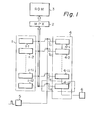
- Figure 1 is a block circuit diagram illustrating a circuit for reading out address data from a memory in a one-chip microcomputer. Referring to Fig. 1, only a part of the one-chip microcomputer is illustrated for highlighting the part pertaining to the present invention.
- a program counter 1 is connected through an address bus B and a multiplexer 2 to a ROM 3.
- Output terminals 1-1, 1-2, ..., and 1-12 are connected to drains (or sources) of metal oxide semiconductor (MOS) transistors T, , T 2 , ..., and T 12 , respectively.
- MOS metal oxide semiconductor
- the sources (or drains) of transistors T 1 , T 2 , ..., and T 12 are connected to a shift register 4.
- Shift register 4 consists of 12 stages 4-1 through 4-12. Stage 4-1 represents the most significant bit stage, while stage 4-12 represents the least significant bit stage. Thus, there is a one-to-one correspondence between the output terminals 1-1 through 1-12 and the 12 stages 4-1 through 4-12.
- transistors T 1 , T 2 , ..., and T 12 are commonly connected to an address output enable terminal 5 to which an enable signal is applied when the contents of program counter 1 are to be read out.
- transistors T 1 , T 2 , ..., and T 12 act as transfer gates for transferring data from program counter 1 to shift register 4.
- Each stage of shift register 4 is sequentially connected to the next lower bit stage.
- the least significant bit stage 4-12 is connected to an address output terminal 6.
- Address output enable terminal 5 and address output terminal 6 can be realized by utilizing common, existing input/output terminals, which a conventional microcomputer has, with address output enable terminal 5 and address output terminal 6. Therefore, no additional terminal is required for address output enable terminal 5 and address output teminal 6.
- program counter 1 When the contents of program counter 1 are to be read out, one pulse is applied to address output enable terminal 5 to turn on all of transistors T 1 , T 2 , ..., and T 12 . Then, the data stored in program counter 1 are transferred through transistors T 1 , T 2 , ..., and T 12 to the corresponding stages of shift register 4. After the pulse has been applied to address output enable terminal 5, all of transistors T 1 , T 2 ' ..., and T 12 are turned off again. Thus, program counter 1 is electrically separated from shift register 4. As a result, the contents of program counter 1, at the time when the pulse is applied to address output enable terminal 5, are stored in shift register 4, while, program counter 1 continues to operate to change its contents.
- a clock signal is applied to shift register 4 to read out the data stored therein.
- the contents of program counter 1 at the time when the pulse is applied to terminal 5 are outputted from address output terminal 6 in the sequence from the least significant bit to the most significant bit.
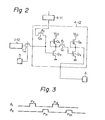
- FIG. 2 is a circuit diagram illustrating in detail the least significant bit stage 4-12 of shift register 4.
- Q 1 and Q 2 are data transferring transistors
- Q 3 and Q 5 are enhancement-type MOS transistors for storing data
- Q 4 and Q 6 are depletion-type MOS transistors functioning as load resistances.
- the drain (or source) of transistor Q 2 is connected to the output of preceding stage 4-11 of shift register 4.
- the source (or the drain) of transistor Q 2 and the source (or the drain) of transfer-gate transistor T 12 are commonly connected to the gate of transistor Q 3 .
- the drain (or the source) of transistor Q 4 is connected to power supply V CC .
- transistors Q 4 are commonly connected to the drain (or the source) of transistor Q 3 and to the gate of transistor Q 5 .
- the source (or the drain) of transistor Q 3 is grounded.
- transistors Q 3 and Q 4 constitute an inverter.
- Transistors Q 5 and Q 6 are wired similarly to the wiring of transistor Q 3 and Q 4 , to form another inverter.
- the output of the inverter that is, the commonly connecting point of the gate and the source (or the drain) of transistor Q 6 and drain (or source) of transistor Q 5 is connected to address output terminal 6.
- Clock signals ⁇ 1 and ⁇ 2 are applied to the gates of transistors Q 1 and Q 2 , respectively.
- Figure 3 is a waveform diagram illustrating clock signals 1 and ⁇ 2 applied to the gates of transistors Q 1 and Q 2 .
- clock signals ⁇ 1 and ⁇ 2 are generated alternately.
- the contents of program counter 1 are transferred through transfer-gate transistors T 1 through T 12 to shift register 4, as described with reference to Fig. 1.
- the least significant bit is transferred from output terminal 1-12 through transistor T 12 to transistor Q 3 and is stored therein.
- a pulse P 11 of clock signal ⁇ 1 is applied to the gate of transistor Q 1 so that the data stored in transistor Q 3 is transferred through transistor Q 1 to transistor Q 5 and stored therein.
- the data stored in transistor Q 5 is read out from the drain of transistor Q 5 to address output terminal 6.
- pulse P 21 of clock signal ⁇ 2 is applied to the gate of transistor Q 2 so that data stored in upper bit stage 4-11 is transferred through transistor Q 2 to transistor Q 3 and stored therein.
- data stored in upper bit stage 4-10 (not shown in Fig. 2, but shown in Fig. 1) is transferred to stage 4-11. Similar operations are effected regarding the other stages of shift register 4.
- the clock pulses of clock signals ⁇ 1 and ⁇ 2 sequentially, the data stored in shift register 4 are sequentially outputted from the least significant bit to the most significant bit.
- address output terminal 6 was connected to the least significant bit stage of shift register 4 so that the data were read out from the least significant bit.
- address output terminal 6 may be connected to the most significant bit stage for reading out data from the most significant bit.
- the program counter may alternatively consist of other than 12 bits in accordance with the number of addresses in the ROM to be accessed.
- address output enable terminal 5 and address output terminal 6 are physically separated from each other.
- these terminals 5 and 6 may be realized by one terminal including a switching circuit for selecting the signal line connected to the gates of transistors T1 through T 12 or the signal line connected to the drain of the transistor Q 5 .
- these terminals 5 and 6 may, according to the present invention, be newly added to the one-chip microcomputer.
- the address data stored in the shift register may alternatively be outputted in parallel.
- the contents of the program counter can be read out in a shorter time in comparison with conventional microcomputers. Also, since the address output enable terminal and the address output terminal are realized by existing input/output terminals, the contents of the program counter can be read out without adding any input/output terminal.
Landscapes
- Engineering & Computer Science (AREA)
- Theoretical Computer Science (AREA)
- Physics & Mathematics (AREA)
- General Engineering & Computer Science (AREA)
- General Physics & Mathematics (AREA)
- Microcomputers (AREA)
- Debugging And Monitoring (AREA)
- Test And Diagnosis Of Digital Computers (AREA)
Applications Claiming Priority (2)
| Application Number | Priority Date | Filing Date | Title |
|---|---|---|---|
| JP9739681A JPS57212563A (en) | 1981-06-25 | 1981-06-25 | Address reading circuit for one-chip microcomputer |
| JP97396/81 | 1981-06-25 |
Publications (1)
| Publication Number | Publication Date |
|---|---|
| EP0069509A1 true EP0069509A1 (en) | 1983-01-12 |
Family
ID=14191351
Family Applications (1)
| Application Number | Title | Priority Date | Filing Date |
|---|---|---|---|
| EP82303282A Ceased EP0069509A1 (en) | 1981-06-25 | 1982-06-23 | A circuit for reading out address data applied to a memory in a one-chip microcomputer |
Country Status (3)
| Country | Link |
|---|---|
| US (1) | US4513400A (enExample) |
| EP (1) | EP0069509A1 (enExample) |
| JP (1) | JPS57212563A (enExample) |
Cited By (1)
| Publication number | Priority date | Publication date | Assignee | Title |
|---|---|---|---|---|
| EP0489944A1 (de) * | 1990-12-08 | 1992-06-17 | Deutsche ITT Industries GmbH | Master-Slave-Datenübertragungsverfahren mit flexiblem Eindraht-Bus |
Families Citing this family (4)
| Publication number | Priority date | Publication date | Assignee | Title |
|---|---|---|---|---|
| JPS61222148A (ja) * | 1985-03-08 | 1986-10-02 | Fujitsu Ltd | 1チツプマイクロコンピユ−タの製造方法 |
| JP3469941B2 (ja) * | 1994-07-15 | 2003-11-25 | 三菱電機株式会社 | プログラム実行制御装置および方法 |
| JP3540844B2 (ja) * | 1994-11-02 | 2004-07-07 | 日本テキサス・インスツルメンツ株式会社 | 半導体集積回路 |
| US5611068A (en) * | 1994-12-27 | 1997-03-11 | Motorola, Inc. | Apparatus and method for controlling pipelined data transfer scheme between stages employing shift register and associated addressing mechanism |
Citations (3)
| Publication number | Priority date | Publication date | Assignee | Title |
|---|---|---|---|---|
| US3939452A (en) * | 1972-07-14 | 1976-02-17 | Ing. C. Olivetti & C., S.P.A. | Desk-top electronic computer with MOS circuit logic |
| GB1542135A (en) * | 1975-04-21 | 1979-03-14 | Siemens Ag | Integrated circuit modules for use in data processing systems |
| GB2023341A (en) * | 1978-06-06 | 1979-12-28 | Siemens Ag | Improvements in or relating to monolithic integrated semiconductor digital circuit modules |
Family Cites Families (4)
| Publication number | Priority date | Publication date | Assignee | Title |
|---|---|---|---|---|
| GB202341A (en) * | 1922-03-10 | 1923-08-10 | Michael Nathanial Jacobson | Improvements in stair carpet holders |
| US3708690A (en) * | 1971-02-22 | 1973-01-02 | Mos Technology Inc | Shift register |
| JPS5939775B2 (ja) * | 1978-03-06 | 1984-09-26 | 株式会社東芝 | メモリのアドレス指定方式 |
| JPS5515271A (en) * | 1978-07-19 | 1980-02-02 | Nissin Electric Co Ltd | Oillfilled capacitor |
-
1981
- 1981-06-25 JP JP9739681A patent/JPS57212563A/ja active Granted
-
1982
- 1982-06-22 US US06/390,875 patent/US4513400A/en not_active Expired - Lifetime
- 1982-06-23 EP EP82303282A patent/EP0069509A1/en not_active Ceased
Patent Citations (3)
| Publication number | Priority date | Publication date | Assignee | Title |
|---|---|---|---|---|
| US3939452A (en) * | 1972-07-14 | 1976-02-17 | Ing. C. Olivetti & C., S.P.A. | Desk-top electronic computer with MOS circuit logic |
| GB1542135A (en) * | 1975-04-21 | 1979-03-14 | Siemens Ag | Integrated circuit modules for use in data processing systems |
| GB2023341A (en) * | 1978-06-06 | 1979-12-28 | Siemens Ag | Improvements in or relating to monolithic integrated semiconductor digital circuit modules |
Non-Patent Citations (1)
| Title |
|---|
| IBM TECHNICAL DISCLOSURE BULLETIN, vol. 17, no. 9, February 1975, pages 2654,2655, New York (USA); * |
Cited By (3)
| Publication number | Priority date | Publication date | Assignee | Title |
|---|---|---|---|---|
| EP0489944A1 (de) * | 1990-12-08 | 1992-06-17 | Deutsche ITT Industries GmbH | Master-Slave-Datenübertragungsverfahren mit flexiblem Eindraht-Bus |
| US5237322A (en) * | 1990-12-08 | 1993-08-17 | Deutsche Itt Industries Gmbh | Master-slave data transmission system employing a flexible single-wire bus |
| US5495240A (en) * | 1990-12-08 | 1996-02-27 | Deutsche Itt Industries Gmbh | Master-slave data transmission system employing a flexible single-wire bus |
Also Published As
| Publication number | Publication date |
|---|---|
| US4513400A (en) | 1985-04-23 |
| JPS6244304B2 (enExample) | 1987-09-19 |
| JPS57212563A (en) | 1982-12-27 |
Similar Documents
| Publication | Publication Date | Title |
|---|---|---|
| US5088027A (en) | Single-chip microcomputer | |
| KR940002754B1 (ko) | 반도체 집적회로 장치의 제어방법 | |
| US4694394A (en) | Microprocessor system having a multiplexed address/data bus which communicates with a plurality of memory and input/output devices including TTL output gates | |
| US5142536A (en) | Data processor | |
| US5019970A (en) | IC card | |
| KR890005622A (ko) | 단일칩 마이크로 컴퓨터 | |
| JPH0668732B2 (ja) | 情報処理装置のスキヤン方式 | |
| US5710734A (en) | Semiconductor memory device and data writing method thereof | |
| US4513400A (en) | Circuit for reading out address data applied to a memory in a one-chip microcomputer | |
| KR880001972Y1 (ko) | 전자미싱의 제어장치 | |
| US5164918A (en) | Integrated circuit | |
| US5948114A (en) | Integrated circuit binary data output interface for multiplexed output of internal binary information elements from input/output pads | |
| US5126972A (en) | Arrangement and method of ascertaining memory addresses which have been accessed during program execution | |
| US6385073B1 (en) | Integrated circuit device with expandable nonvolatile memory | |
| EP0157342A2 (en) | Memory address expansion system | |
| KR920003183B1 (ko) | 마이크로 프로세서 | |
| JPS646489B2 (enExample) | ||
| JP2692408B2 (ja) | 大規模集積回路における内蔵型診断回路 | |
| JP3702016B2 (ja) | 不揮発性メモリ内蔵マイクロコンピュータ | |
| KR940001104B1 (ko) | 전원리셋과 수동리셋의 구분회로 및 방법 | |
| SU1236552A1 (ru) | Посто нное запоминающее устройство | |
| JP3389317B2 (ja) | 集積回路のテスト回路 | |
| JPS5934293A (ja) | 電子ミシンの縫目模様指令回路 | |
| SU1026163A1 (ru) | Устройство дл управлени записью и считыванием информации | |
| JPH0679278B2 (ja) | マイクロコンピュ−タ開発装置 |
Legal Events
| Date | Code | Title | Description |
|---|---|---|---|
| PUAI | Public reference made under article 153(3) epc to a published international application that has entered the european phase |
Free format text: ORIGINAL CODE: 0009012 |
|
| AK | Designated contracting states |
Designated state(s): DE FR GB |
|
| 17P | Request for examination filed |
Effective date: 19830629 |
|
| STAA | Information on the status of an ep patent application or granted ep patent |
Free format text: STATUS: THE APPLICATION HAS BEEN REFUSED |
|
| 18R | Application refused |
Effective date: 19880503 |
|
| APAF | Appeal reference modified |
Free format text: ORIGINAL CODE: EPIDOSCREFNE |
|
| RIN1 | Information on inventor provided before grant (corrected) |
Inventor name: MASAKI, SATORU |