EP0068232A2 - Flüssiges Waschmittel mit Zusätzen zur Verhinderung der Farbstoffübertragung - Google Patents
Flüssiges Waschmittel mit Zusätzen zur Verhinderung der Farbstoffübertragung Download PDFInfo
- Publication number
- EP0068232A2 EP0068232A2 EP19820105121 EP82105121A EP0068232A2 EP 0068232 A2 EP0068232 A2 EP 0068232A2 EP 19820105121 EP19820105121 EP 19820105121 EP 82105121 A EP82105121 A EP 82105121A EP 0068232 A2 EP0068232 A2 EP 0068232A2
- Authority
- EP
- European Patent Office
- Prior art keywords
- weight
- water
- polyglycol ether
- ethylene oxide
- polymers
- Prior art date
- Legal status (The legal status is an assumption and is not a legal conclusion. Google has not performed a legal analysis and makes no representation as to the accuracy of the status listed.)
- Withdrawn
Links
- 239000003599 detergent Substances 0.000 title claims abstract description 38
- 239000007788 liquid Substances 0.000 title claims abstract description 14
- 239000000654 additive Substances 0.000 title claims abstract description 6
- 230000005764 inhibitory process Effects 0.000 title 1
- RTZKZFJDLAIYFH-UHFFFAOYSA-N Diethyl ether Chemical compound CCOCC RTZKZFJDLAIYFH-UHFFFAOYSA-N 0.000 claims abstract description 54
- IAYPIBMASNFSPL-UHFFFAOYSA-N Ethylene oxide Chemical compound C1CO1 IAYPIBMASNFSPL-UHFFFAOYSA-N 0.000 claims abstract description 28
- 229920000151 polyglycol Polymers 0.000 claims abstract description 21
- 239000010695 polyglycol Substances 0.000 claims abstract description 21
- 229920000768 polyamine Polymers 0.000 claims abstract description 19
- 229920002873 Polyethylenimine Polymers 0.000 claims abstract description 17
- 229920000642 polymer Polymers 0.000 claims abstract description 17
- 239000000203 mixture Substances 0.000 claims abstract description 14
- 239000002736 nonionic surfactant Substances 0.000 claims abstract description 12
- 229920002401 polyacrylamide Polymers 0.000 claims abstract description 9
- 229920003169 water-soluble polymer Polymers 0.000 claims abstract description 9
- 239000002888 zwitterionic surfactant Substances 0.000 claims abstract description 5
- 150000003856 quaternary ammonium compounds Chemical class 0.000 claims abstract description 3
- LFQSCWFLJHTTHZ-UHFFFAOYSA-N Ethanol Chemical compound CCO LFQSCWFLJHTTHZ-UHFFFAOYSA-N 0.000 claims description 25
- 125000000217 alkyl group Chemical group 0.000 claims description 23
- 239000003795 chemical substances by application Substances 0.000 claims description 17
- 125000004432 carbon atom Chemical group C* 0.000 claims description 14
- XLYOFNOQVPJJNP-UHFFFAOYSA-N water Substances O XLYOFNOQVPJJNP-UHFFFAOYSA-N 0.000 claims description 11
- 239000004094 surface-active agent Substances 0.000 claims description 10
- 238000002845 discoloration Methods 0.000 claims description 9
- UFHFLCQGNIYNRP-UHFFFAOYSA-N Hydrogen Chemical compound [H][H] UFHFLCQGNIYNRP-UHFFFAOYSA-N 0.000 claims description 8
- 230000002401 inhibitory effect Effects 0.000 claims description 8
- 239000001257 hydrogen Substances 0.000 claims description 7
- 229910052739 hydrogen Inorganic materials 0.000 claims description 7
- 239000003205 fragrance Substances 0.000 claims description 6
- 125000002924 primary amino group Chemical group [H]N([H])* 0.000 claims description 6
- 125000003368 amide group Chemical group 0.000 claims description 5
- 239000003755 preservative agent Substances 0.000 claims description 5
- 239000008139 complexing agent Substances 0.000 claims description 4
- 229910001385 heavy metal Inorganic materials 0.000 claims description 4
- 239000003960 organic solvent Substances 0.000 claims description 4
- 125000004178 (C1-C4) alkyl group Chemical group 0.000 claims description 3
- 239000003086 colorant Substances 0.000 claims description 3
- 239000003605 opacifier Substances 0.000 claims description 3
- 150000002431 hydrogen Chemical class 0.000 claims description 2
- 230000003165 hydrotropic effect Effects 0.000 claims description 2
- 229920001059 synthetic polymer Polymers 0.000 claims 1
- 239000004435 Oxo alcohol Substances 0.000 abstract description 11
- 239000004753 textile Substances 0.000 abstract description 11
- 150000002191 fatty alcohols Chemical class 0.000 abstract description 9
- 238000005406 washing Methods 0.000 abstract description 7
- JSPLKZUTYZBBKA-UHFFFAOYSA-N trioxidane Chemical compound OOO JSPLKZUTYZBBKA-UHFFFAOYSA-N 0.000 abstract description 6
- 150000001412 amines Chemical class 0.000 abstract description 3
- 125000003277 amino group Chemical group 0.000 abstract description 3
- 238000010186 staining Methods 0.000 abstract 1
- XSQUKJJJFZCRTK-UHFFFAOYSA-N Urea Chemical compound NC(N)=O XSQUKJJJFZCRTK-UHFFFAOYSA-N 0.000 description 12
- 239000000047 product Substances 0.000 description 11
- 239000007864 aqueous solution Substances 0.000 description 10
- 239000007859 condensation product Substances 0.000 description 9
- LYCAIKOWRPUZTN-UHFFFAOYSA-N Ethylene glycol Chemical compound OCCO LYCAIKOWRPUZTN-UHFFFAOYSA-N 0.000 description 8
- DNIAPMSPPWPWGF-UHFFFAOYSA-N Propylene glycol Chemical compound CC(O)CO DNIAPMSPPWPWGF-UHFFFAOYSA-N 0.000 description 8
- -1 alkali metal percarbonate Chemical class 0.000 description 8
- KFZMGEQAYNKOFK-UHFFFAOYSA-N Isopropanol Chemical compound CC(C)O KFZMGEQAYNKOFK-UHFFFAOYSA-N 0.000 description 7
- 150000001875 compounds Chemical class 0.000 description 7
- 239000004202 carbamide Substances 0.000 description 6
- 150000002170 ethers Chemical class 0.000 description 6
- IVJISJACKSSFGE-UHFFFAOYSA-N formaldehyde;1,3,5-triazine-2,4,6-triamine Chemical compound O=C.NC1=NC(N)=NC(N)=N1 IVJISJACKSSFGE-UHFFFAOYSA-N 0.000 description 5
- 239000003752 hydrotrope Substances 0.000 description 5
- 239000000126 substance Substances 0.000 description 5
- 229920000742 Cotton Polymers 0.000 description 4
- 229920000877 Melamine resin Polymers 0.000 description 4
- 239000002253 acid Substances 0.000 description 4
- 230000000694 effects Effects 0.000 description 4
- JDSHMPZPIAZGSV-UHFFFAOYSA-N melamine Chemical compound NC1=NC(N)=NC(N)=N1 JDSHMPZPIAZGSV-UHFFFAOYSA-N 0.000 description 4
- WSFSSNUMVMOOMR-NJFSPNSNSA-N methanone Chemical compound O=[14CH2] WSFSSNUMVMOOMR-NJFSPNSNSA-N 0.000 description 4
- 229910052757 nitrogen Inorganic materials 0.000 description 4
- BRLQWZUYTZBJKN-UHFFFAOYSA-N Epichlorohydrin Chemical compound ClCC1CO1 BRLQWZUYTZBJKN-UHFFFAOYSA-N 0.000 description 3
- YXFVVABEGXRONW-UHFFFAOYSA-N Toluene Chemical class CC1=CC=CC=C1 YXFVVABEGXRONW-UHFFFAOYSA-N 0.000 description 3
- 150000001298 alcohols Chemical class 0.000 description 3
- 235000014113 dietary fatty acids Nutrition 0.000 description 3
- MTHSVFCYNBDYFN-UHFFFAOYSA-N diethylene glycol Chemical compound OCCOCCO MTHSVFCYNBDYFN-UHFFFAOYSA-N 0.000 description 3
- 239000004744 fabric Substances 0.000 description 3
- 229930195729 fatty acid Natural products 0.000 description 3
- 239000000194 fatty acid Substances 0.000 description 3
- 150000004665 fatty acids Chemical class 0.000 description 3
- 125000002887 hydroxy group Chemical group [H]O* 0.000 description 3
- 229920005862 polyol Polymers 0.000 description 3
- 150000003077 polyols Chemical class 0.000 description 3
- 229920001451 polypropylene glycol Polymers 0.000 description 3
- 230000002335 preservative effect Effects 0.000 description 3
- 125000001453 quaternary ammonium group Chemical group 0.000 description 3
- 239000002904 solvent Substances 0.000 description 3
- 238000012360 testing method Methods 0.000 description 3
- IJGRMHOSHXDMSA-UHFFFAOYSA-N Atomic nitrogen Chemical compound N#N IJGRMHOSHXDMSA-UHFFFAOYSA-N 0.000 description 2
- WSFSSNUMVMOOMR-UHFFFAOYSA-N Formaldehyde Chemical compound O=C WSFSSNUMVMOOMR-UHFFFAOYSA-N 0.000 description 2
- PEDCQBHIVMGVHV-UHFFFAOYSA-N Glycerine Chemical compound OCC(O)CO PEDCQBHIVMGVHV-UHFFFAOYSA-N 0.000 description 2
- NBIIXXVUZAFLBC-UHFFFAOYSA-N Phosphoric acid Chemical compound OP(O)(O)=O NBIIXXVUZAFLBC-UHFFFAOYSA-N 0.000 description 2
- 229920002472 Starch Polymers 0.000 description 2
- 150000007513 acids Chemical class 0.000 description 2
- 230000000996 additive effect Effects 0.000 description 2
- 239000002280 amphoteric surfactant Substances 0.000 description 2
- 125000000129 anionic group Chemical group 0.000 description 2
- 125000003178 carboxy group Chemical group [H]OC(*)=O 0.000 description 2
- 125000002091 cationic group Chemical group 0.000 description 2
- 238000011109 contamination Methods 0.000 description 2
- 239000000975 dye Substances 0.000 description 2
- 150000002148 esters Chemical class 0.000 description 2
- 239000000835 fiber Substances 0.000 description 2
- IPCSVZSSVZVIGE-UHFFFAOYSA-N hexadecanoic acid Chemical compound CCCCCCCCCCCCCCCC(O)=O IPCSVZSSVZVIGE-UHFFFAOYSA-N 0.000 description 2
- 230000002209 hydrophobic effect Effects 0.000 description 2
- 125000001165 hydrophobic group Chemical group 0.000 description 2
- JGJLWPGRMCADHB-UHFFFAOYSA-N hypobromite Chemical compound Br[O-] JGJLWPGRMCADHB-UHFFFAOYSA-N 0.000 description 2
- WQYVRQLZKVEZGA-UHFFFAOYSA-N hypochlorite Chemical compound Cl[O-] WQYVRQLZKVEZGA-UHFFFAOYSA-N 0.000 description 2
- 150000002500 ions Chemical class 0.000 description 2
- 230000014759 maintenance of location Effects 0.000 description 2
- 125000004433 nitrogen atom Chemical group N* 0.000 description 2
- QUCDWLYKDRVKMI-UHFFFAOYSA-M sodium;3,4-dimethylbenzenesulfonate Chemical compound [Na+].CC1=CC=C(S([O-])(=O)=O)C=C1C QUCDWLYKDRVKMI-UHFFFAOYSA-M 0.000 description 2
- 239000008107 starch Substances 0.000 description 2
- 235000019698 starch Nutrition 0.000 description 2
- BDHFUVZGWQCTTF-UHFFFAOYSA-M sulfonate Chemical compound [O-]S(=O)=O BDHFUVZGWQCTTF-UHFFFAOYSA-M 0.000 description 2
- 239000003760 tallow Substances 0.000 description 2
- ALSTYHKOOCGGFT-KTKRTIGZSA-N (9Z)-octadecen-1-ol Chemical compound CCCCCCCC\C=C/CCCCCCCCO ALSTYHKOOCGGFT-KTKRTIGZSA-N 0.000 description 1
- SCYULBFZEHDVBN-UHFFFAOYSA-N 1,1-Dichloroethane Chemical compound CC(Cl)Cl SCYULBFZEHDVBN-UHFFFAOYSA-N 0.000 description 1
- QCNOIPPDFDTMRH-UHFFFAOYSA-N 2,3-dihydroxypropyl 2-aminoacetate Chemical compound NCC(=O)OCC(O)CO QCNOIPPDFDTMRH-UHFFFAOYSA-N 0.000 description 1
- JDSQBDGCMUXRBM-UHFFFAOYSA-N 2-[2-(2-butoxypropoxy)propoxy]propan-1-ol Chemical group CCCCOC(C)COC(C)COC(C)CO JDSQBDGCMUXRBM-UHFFFAOYSA-N 0.000 description 1
- KKMIHKCGXQMFEU-UHFFFAOYSA-N 2-[dimethyl(tetradecyl)azaniumyl]acetate Chemical compound CCCCCCCCCCCCCC[N+](C)(C)CC([O-])=O KKMIHKCGXQMFEU-UHFFFAOYSA-N 0.000 description 1
- ZNQVEEAIQZEUHB-UHFFFAOYSA-N 2-ethoxyethanol Chemical compound CCOCCO ZNQVEEAIQZEUHB-UHFFFAOYSA-N 0.000 description 1
- RFVNOJDQRGSOEL-UHFFFAOYSA-N 2-hydroxyethyl octadecanoate Chemical group CCCCCCCCCCCCCCCCCC(=O)OCCO RFVNOJDQRGSOEL-UHFFFAOYSA-N 0.000 description 1
- KQIGMPWTAHJUMN-UHFFFAOYSA-N 3-aminopropane-1,2-diol Chemical compound NCC(O)CO KQIGMPWTAHJUMN-UHFFFAOYSA-N 0.000 description 1
- CVLHGLWXLDOELD-UHFFFAOYSA-N 4-(Propan-2-yl)benzenesulfonic acid Chemical class CC(C)C1=CC=C(S(O)(=O)=O)C=C1 CVLHGLWXLDOELD-UHFFFAOYSA-N 0.000 description 1
- 240000008025 Alternanthera ficoidea Species 0.000 description 1
- NOWKCMXCCJGMRR-UHFFFAOYSA-N Aziridine Chemical compound C1CN1 NOWKCMXCCJGMRR-UHFFFAOYSA-N 0.000 description 1
- UGFAIRIUMAVXCW-UHFFFAOYSA-N Carbon monoxide Chemical compound [O+]#[C-] UGFAIRIUMAVXCW-UHFFFAOYSA-N 0.000 description 1
- VEXZGXHMUGYJMC-UHFFFAOYSA-M Chloride anion Chemical compound [Cl-] VEXZGXHMUGYJMC-UHFFFAOYSA-M 0.000 description 1
- KCXVZYZYPLLWCC-UHFFFAOYSA-N EDTA Chemical compound OC(=O)CN(CC(O)=O)CCN(CC(O)=O)CC(O)=O KCXVZYZYPLLWCC-UHFFFAOYSA-N 0.000 description 1
- DGAQECJNVWCQMB-PUAWFVPOSA-M Ilexoside XXIX Chemical compound C[C@@H]1CC[C@@]2(CC[C@@]3(C(=CC[C@H]4[C@]3(CC[C@@H]5[C@@]4(CC[C@@H](C5(C)C)OS(=O)(=O)[O-])C)C)[C@@H]2[C@]1(C)O)C)C(=O)O[C@H]6[C@@H]([C@H]([C@@H]([C@H](O6)CO)O)O)O.[Na+] DGAQECJNVWCQMB-PUAWFVPOSA-M 0.000 description 1
- CTQNGGLPUBDAKN-UHFFFAOYSA-N O-Xylene Chemical class CC1=CC=CC=C1C CTQNGGLPUBDAKN-UHFFFAOYSA-N 0.000 description 1
- 229910019142 PO4 Inorganic materials 0.000 description 1
- 235000021314 Palmitic acid Nutrition 0.000 description 1
- OAICVXFJPJFONN-UHFFFAOYSA-N Phosphorus Chemical compound [P] OAICVXFJPJFONN-UHFFFAOYSA-N 0.000 description 1
- 239000002202 Polyethylene glycol Substances 0.000 description 1
- ZLMJMSJWJFRBEC-UHFFFAOYSA-N Potassium Chemical compound [K] ZLMJMSJWJFRBEC-UHFFFAOYSA-N 0.000 description 1
- 239000004902 Softening Agent Substances 0.000 description 1
- 235000021355 Stearic acid Nutrition 0.000 description 1
- 229920002359 Tetronic® Polymers 0.000 description 1
- GSEJCLTVZPLZKY-UHFFFAOYSA-N Triethanolamine Chemical class OCCN(CCO)CCO GSEJCLTVZPLZKY-UHFFFAOYSA-N 0.000 description 1
- 244000274883 Urtica dioica Species 0.000 description 1
- 235000009108 Urtica dioica Nutrition 0.000 description 1
- 238000001792 White test Methods 0.000 description 1
- QUOPYLMWOHLNLL-UHFFFAOYSA-N [3-[hexadecyl-bis(2-hydroxyethyl)azaniumyl]-2-hydroxypropyl] sulfate Chemical compound CCCCCCCCCCCCCCCC[N+](CCO)(CCO)CC(O)COS([O-])(=O)=O QUOPYLMWOHLNLL-UHFFFAOYSA-N 0.000 description 1
- 150000001242 acetic acid derivatives Chemical class 0.000 description 1
- 230000002378 acidificating effect Effects 0.000 description 1
- 239000004480 active ingredient Substances 0.000 description 1
- 125000001931 aliphatic group Chemical group 0.000 description 1
- 239000003513 alkali Substances 0.000 description 1
- 229910052783 alkali metal Inorganic materials 0.000 description 1
- 150000001447 alkali salts Chemical class 0.000 description 1
- 150000001336 alkenes Chemical class 0.000 description 1
- 125000002947 alkylene group Chemical group 0.000 description 1
- 125000005263 alkylenediamine group Chemical group 0.000 description 1
- 229910000147 aluminium phosphate Inorganic materials 0.000 description 1
- 150000001408 amides Chemical class 0.000 description 1
- XKMRRTOUMJRJIA-UHFFFAOYSA-N ammonia nh3 Chemical compound N.N XKMRRTOUMJRJIA-UHFFFAOYSA-N 0.000 description 1
- QGZKDVFQNNGYKY-UHFFFAOYSA-O ammonium group Chemical group [NH4+] QGZKDVFQNNGYKY-UHFFFAOYSA-O 0.000 description 1
- 239000003945 anionic surfactant Substances 0.000 description 1
- 239000002585 base Substances 0.000 description 1
- 238000004061 bleaching Methods 0.000 description 1
- 125000000484 butyl group Chemical group [H]C([*])([H])C([H])([H])C([H])([H])C([H])([H])[H] 0.000 description 1
- 229910052799 carbon Inorganic materials 0.000 description 1
- 229910002091 carbon monoxide Inorganic materials 0.000 description 1
- 150000007942 carboxylates Chemical class 0.000 description 1
- 239000003093 cationic surfactant Substances 0.000 description 1
- 238000006243 chemical reaction Methods 0.000 description 1
- 235000019864 coconut oil Nutrition 0.000 description 1
- 239000003240 coconut oil Substances 0.000 description 1
- 239000013065 commercial product Substances 0.000 description 1
- 238000009833 condensation Methods 0.000 description 1
- 230000005494 condensation Effects 0.000 description 1
- 239000002537 cosmetic Substances 0.000 description 1
- 150000002009 diols Chemical class 0.000 description 1
- VFNGKCDDZUSWLR-UHFFFAOYSA-N disulfuric acid Chemical compound OS(=O)(=O)OS(O)(=O)=O VFNGKCDDZUSWLR-UHFFFAOYSA-N 0.000 description 1
- LQZZUXJYWNFBMV-UHFFFAOYSA-N dodecan-1-ol Chemical compound CCCCCCCCCCCCO LQZZUXJYWNFBMV-UHFFFAOYSA-N 0.000 description 1
- 125000004185 ester group Chemical group 0.000 description 1
- 125000001495 ethyl group Chemical group [H]C([H])([H])C([H])([H])* 0.000 description 1
- 239000000945 filler Substances 0.000 description 1
- 238000005187 foaming Methods 0.000 description 1
- 235000011187 glycerol Nutrition 0.000 description 1
- 125000003827 glycol group Chemical group 0.000 description 1
- 125000005842 heteroatom Chemical group 0.000 description 1
- BAYPQSYNYDEBIB-UHFFFAOYSA-N hexadecyl-dimethyl-propylazanium Chemical compound CCCCCCCCCCCCCCCC[N+](C)(C)CCC BAYPQSYNYDEBIB-UHFFFAOYSA-N 0.000 description 1
- 229920006158 high molecular weight polymer Polymers 0.000 description 1
- 125000001183 hydrocarbyl group Chemical group 0.000 description 1
- 238000007037 hydroformylation reaction Methods 0.000 description 1
- 238000005984 hydrogenation reaction Methods 0.000 description 1
- 230000007062 hydrolysis Effects 0.000 description 1
- 238000006460 hydrolysis reaction Methods 0.000 description 1
- 238000009434 installation Methods 0.000 description 1
- 229920000831 ionic polymer Polymers 0.000 description 1
- 238000004519 manufacturing process Methods 0.000 description 1
- 238000000034 method Methods 0.000 description 1
- 125000002496 methyl group Chemical group [H]C([H])([H])* 0.000 description 1
- WQEPLUUGTLDZJY-UHFFFAOYSA-N n-Pentadecanoic acid Natural products CCCCCCCCCCCCCCC(O)=O WQEPLUUGTLDZJY-UHFFFAOYSA-N 0.000 description 1
- QIQXTHQIDYTFRH-UHFFFAOYSA-N octadecanoic acid Chemical compound CCCCCCCCCCCCCCCCCC(O)=O QIQXTHQIDYTFRH-UHFFFAOYSA-N 0.000 description 1
- OQCDKBAXFALNLD-UHFFFAOYSA-N octadecanoic acid Natural products CCCCCCCC(C)CCCCCCCCC(O)=O OQCDKBAXFALNLD-UHFFFAOYSA-N 0.000 description 1
- 229940055577 oleyl alcohol Drugs 0.000 description 1
- XMLQWXUVTXCDDL-UHFFFAOYSA-N oleyl alcohol Natural products CCCCCCC=CCCCCCCCCCCO XMLQWXUVTXCDDL-UHFFFAOYSA-N 0.000 description 1
- 150000002894 organic compounds Chemical class 0.000 description 1
- 235000011837 pasties Nutrition 0.000 description 1
- NBIIXXVUZAFLBC-UHFFFAOYSA-K phosphate Chemical compound [O-]P([O-])([O-])=O NBIIXXVUZAFLBC-UHFFFAOYSA-K 0.000 description 1
- 239000010452 phosphate Substances 0.000 description 1
- 125000001476 phosphono group Chemical group [H]OP(*)(=O)O[H] 0.000 description 1
- 229910052698 phosphorus Inorganic materials 0.000 description 1
- 239000011574 phosphorus Substances 0.000 description 1
- 229920000867 polyelectrolyte Polymers 0.000 description 1
- 229920000728 polyester Polymers 0.000 description 1
- 229920001223 polyethylene glycol Polymers 0.000 description 1
- 238000006116 polymerization reaction Methods 0.000 description 1
- 150000007519 polyprotic acids Polymers 0.000 description 1
- 239000004814 polyurethane Substances 0.000 description 1
- 229920000036 polyvinylpyrrolidone Polymers 0.000 description 1
- 239000001267 polyvinylpyrrolidone Substances 0.000 description 1
- 235000013855 polyvinylpyrrolidone Nutrition 0.000 description 1
- 229910052700 potassium Inorganic materials 0.000 description 1
- 239000011591 potassium Substances 0.000 description 1
- 159000000001 potassium salts Chemical class 0.000 description 1
- 229920001592 potato starch Polymers 0.000 description 1
- 238000002360 preparation method Methods 0.000 description 1
- 230000002035 prolonged effect Effects 0.000 description 1
- KCXFHTAICRTXLI-UHFFFAOYSA-N propane-1-sulfonic acid Chemical compound CCCS(O)(=O)=O KCXFHTAICRTXLI-UHFFFAOYSA-N 0.000 description 1
- 150000004023 quaternary phosphonium compounds Chemical class 0.000 description 1
- 239000002994 raw material Substances 0.000 description 1
- 229920005989 resin Polymers 0.000 description 1
- 239000011347 resin Substances 0.000 description 1
- 150000003839 salts Chemical class 0.000 description 1
- 229920006395 saturated elastomer Polymers 0.000 description 1
- 150000003333 secondary alcohols Chemical class 0.000 description 1
- 125000000467 secondary amino group Chemical group [H]N([*:1])[*:2] 0.000 description 1
- 238000000926 separation method Methods 0.000 description 1
- 229910052708 sodium Inorganic materials 0.000 description 1
- 239000011734 sodium Substances 0.000 description 1
- 239000000243 solution Substances 0.000 description 1
- 239000008117 stearic acid Substances 0.000 description 1
- 238000003860 storage Methods 0.000 description 1
- 125000001424 substituent group Chemical group 0.000 description 1
- QAOWNCQODCNURD-UHFFFAOYSA-L sulfate group Chemical group S(=O)(=O)([O-])[O-] QAOWNCQODCNURD-UHFFFAOYSA-L 0.000 description 1
- 150000003871 sulfonates Chemical class 0.000 description 1
- 150000003462 sulfoxides Chemical class 0.000 description 1
- 150000008053 sultones Chemical class 0.000 description 1
- 239000012209 synthetic fiber Substances 0.000 description 1
- 229920002994 synthetic fiber Polymers 0.000 description 1
- 150000003512 tertiary amines Chemical class 0.000 description 1
- 125000001302 tertiary amino group Chemical group 0.000 description 1
- 150000004026 tertiary sulfonium compounds Chemical class 0.000 description 1
- 229920003170 water-soluble synthetic polymer Polymers 0.000 description 1
- 239000008096 xylene Chemical class 0.000 description 1
- 239000004711 α-olefin Substances 0.000 description 1
Classifications
-
- C—CHEMISTRY; METALLURGY
- C11—ANIMAL OR VEGETABLE OILS, FATS, FATTY SUBSTANCES OR WAXES; FATTY ACIDS THEREFROM; DETERGENTS; CANDLES
- C11D—DETERGENT COMPOSITIONS; USE OF SINGLE SUBSTANCES AS DETERGENTS; SOAP OR SOAP-MAKING; RESIN SOAPS; RECOVERY OF GLYCEROL
- C11D3/00—Other compounding ingredients of detergent compositions covered in group C11D1/00
- C11D3/16—Organic compounds
- C11D3/37—Polymers
- C11D3/3703—Macromolecular compounds obtained otherwise than by reactions only involving carbon-to-carbon unsaturated bonds
-
- C—CHEMISTRY; METALLURGY
- C11—ANIMAL OR VEGETABLE OILS, FATS, FATTY SUBSTANCES OR WAXES; FATTY ACIDS THEREFROM; DETERGENTS; CANDLES
- C11D—DETERGENT COMPOSITIONS; USE OF SINGLE SUBSTANCES AS DETERGENTS; SOAP OR SOAP-MAKING; RESIN SOAPS; RECOVERY OF GLYCEROL
- C11D3/00—Other compounding ingredients of detergent compositions covered in group C11D1/00
- C11D3/0005—Other compounding ingredients characterised by their effect
- C11D3/0021—Dye-stain or dye-transfer inhibiting compositions
-
- C—CHEMISTRY; METALLURGY
- C11—ANIMAL OR VEGETABLE OILS, FATS, FATTY SUBSTANCES OR WAXES; FATTY ACIDS THEREFROM; DETERGENTS; CANDLES
- C11D—DETERGENT COMPOSITIONS; USE OF SINGLE SUBSTANCES AS DETERGENTS; SOAP OR SOAP-MAKING; RESIN SOAPS; RECOVERY OF GLYCEROL
- C11D3/00—Other compounding ingredients of detergent compositions covered in group C11D1/00
- C11D3/16—Organic compounds
- C11D3/37—Polymers
- C11D3/3703—Macromolecular compounds obtained otherwise than by reactions only involving carbon-to-carbon unsaturated bonds
- C11D3/3719—Polyamides or polyimides
-
- C—CHEMISTRY; METALLURGY
- C11—ANIMAL OR VEGETABLE OILS, FATS, FATTY SUBSTANCES OR WAXES; FATTY ACIDS THEREFROM; DETERGENTS; CANDLES
- C11D—DETERGENT COMPOSITIONS; USE OF SINGLE SUBSTANCES AS DETERGENTS; SOAP OR SOAP-MAKING; RESIN SOAPS; RECOVERY OF GLYCEROL
- C11D3/00—Other compounding ingredients of detergent compositions covered in group C11D1/00
- C11D3/16—Organic compounds
- C11D3/37—Polymers
- C11D3/3746—Macromolecular compounds obtained by reactions only involving carbon-to-carbon unsaturated bonds
- C11D3/3769—(Co)polymerised monomers containing nitrogen, e.g. carbonamides, nitriles or amines
- C11D3/3773—(Co)polymerised monomers containing nitrogen, e.g. carbonamides, nitriles or amines in liquid compositions
Definitions
- the present invention relates to a liquid detergent based on nonionic surfactants, which additionally contains certain water-soluble, synthetically produced, ionic polymeric compounds which counteract dye transfer from colored textiles to white or light-colored textiles during washing together.
- Dye transfer when washing colored and white or light-colored textiles together has been a problem that has been known for a long time, for which there have already been some proposed solutions, but which are not entirely satisfactory because they are only marginal compared to a number of colors or textiles Have effect.
- an agent is known whose discoloration-inhibiting additive is polyvinylpyrrolidone.
- DE-OS 24 20 561 describes a detergent with a combination of alkali metal percarbonate and polyethylene glycol of a certain molecular weight and / or Pclyvinylpyrrolidor ,.
- DE-OS 23 09 099 relates to an agent with proportions of two different organic compounds that contain basic nitrogen atoms in the molecule.
- US Pat. Nos. 4,005,029 and 4,006,092 agents are described which contain per compounds which have an anti-discoloring effect.
- DE-OS 28 28 619 describes a discoloration-inhibiting detergent composed of three different types of surfactants, namely 1. nonionic surfactants, 2. zwitterionic or semipolar and 3. cationic surfactants, which must be present in certain proportions.
- a liquid detergent containing nonionic or zwitterionic surfactants in combination with synthetic, water-soluble, amino and / or amido group-containing polymers from the group of polyethyleneimines, polyamines, polyaminamides and polyacrylamides, the detergent containing no quaternary ammonium compounds which soften the textile and is essentially phosphate-free, has an improved discoloration-inhibiting effect not only on textiles made of cotton but also of synthetic fibers and mixtures of synthetic and natural fibers.
- Such polymers which can be used individually or optionally in combination with other water-soluble polymeric compounds in the detergents according to the invention, are known, synthetically produced compounds which are used, for example, in the paper industry as retention agents for better separation of the paper fiber raw materials and fillers. According to their structural structure, these polymers can be divided into four groups: polyethyleneimines, polyamines, polyaminamides and polyacrylamides.
- Suitable polyethyleneimines are obtained by acid-catalyzed polymerization of ethyleneimine and can be modified by urea and epichlorohydrin or dichloroethane.
- Polyethyleneimines can contain primary, secondary and tertiary amino groups as well as quaternary ammonium groups.
- Aqueous solutions of polyethyleneimines react basicly. The molecular weight can be up to 100,000.
- Polyamines are addition or condensation products from polyvalent aliphatic amines and substances with several reactive groups, e.g. Epichlorohydrin or alkylene dihalides. They therefore always contain several secondary, tertiary or quaternary nitrogen atoms, and possibly also hydroxyl groups in the molecule. Accordingly, they are hydrophilic, polar compounds that behave like polyelectrolytes and are water-soluble; unless they contain large hydrophobic groups in the molecule. The polyamines react basicly in aqueous solution. Suitable compounds are described, for example, in US Pat. No. 2,969,302.
- Polyaminamides contain amino and amide at the same time. groups in the molecule. They are produced, for example, by condensation of polybasic acids, for example dibasic, saturated, aliphatic C 3 - to C 8 acids, and polyamines, and also with substances which contain several reactive groups, such as epichlorohydrin. These compounds also react basicly in aqueous solution. Suitable polyaminamides are described, for example, in US Pat. No. 2,926,154.
- Suitable polyacrylamides are high molecular weight polymers with molecular weights of several million.
- carboxyl groups which are formed, for example, by partial hydrolysis, in addition to amide groups, anionic polyacrylamides are obtained, while polyacrylamides containing amino groups react in a basic manner in aqueous solution.
- Amino groups can be introduced, for example, by reaction with alkali and hypobromite or hypochlorite.
- polymers mentioned have in common that they are water-soluble.
- Such polymers are commercially available products.
- Particularly suitable as an additive to the detergents according to the invention are the polyethyleneimines and polyamines which react strongly in water.
- Particularly suitable polyethyleneimines are "Retaminol E” and for polyamines, e.g. "Retaminol K”, from Bayer AG, Leverkusen, Federal Republic of Germany.
- These polymers can be added to the detergents according to the invention either alone or in combination with other water-soluble polymers.
- These are, for example, water-soluble resins made from melamine or urea and formaldehyde, e.g.
- the concentration of the polymers mentioned in a detergent according to the invention based on nonioni African, zwitterionic or amphoteric surfactants are in the range from about 1 to 1.5% by weight, preferably 5 to 5% by weight, based on the amount of surfactant in the detergent.
- the application concentration of the detergent is. in the range from 1 to 10 g / 1 wash liquor, preferably in the range from 3 to 6 g / l.
- the detergents according to the invention are preferably phosphate-free; however, they can also contain small amounts of phosphate, which corresponds to about 3% by weight of phosphorus.
- Addition products of 2-40, preferably 2-20, moles of ethylene oxide with 1 mole of fatty alcohol or oxo alcohol, alkylphenol, fatty acid, fatty amine, fatty acid amide or alkanesulfonamide can be used as nonionic surfactants.
- the addition products of 5-16 mol of ethylene oxide with coconut oil or tallow fatty alcohols, with oleyl alcohol or with secondary alcohols with 8-18, preferably 12-18, carbon atoms, and with mono- or dialkylphenols with 6-14 carbon atoms in, are particularly important the alkyl residues.
- non-fully or not fully water-soluble polyglycol ethers with 1-4 ethylene glycol ether residues in the molecule are also of interest, in particular if they are used together with water-soluble nonionic or anionic surfactants.
- Amine oxide or sulfoxide type surfactants can be used.
- the zwitterionic or amphoteric surfactants contain both acidic groups, such as the carboxyl, sulfo, sulfuric acid half-ester, phosphono or phosphoric acid partial ester groups, as well as basic groups, such as amino, imino or ammonium groups, in the molecule.
- Zwitterionic compounds with a tetrasubstituted, ie quaternary ammonium group are called betaines if they also have a covalently bound acid group in the molecule and the positive and negative charge is balanced intramolecularly.
- the betaines also include the correspondingly substituted quaternary phosphonium and tertiary sulfonium compounds.
- the surface-active betaines generally have a higher molecular weight aliphatic hydrocarbon radical with a hydrophobic character and two lower alkyl radicals with 1-3 carbon atoms, which can be substituted by one or two hydroxyl groups or linked directly or via a hetero atom.
- the water-solubilizing carboxylate, sulfonate or sulfate group is linked to the ammonium nitrogen via the fourth substituent, which usually consists of a short-chain aliphatic radical which may have a double bond or a hydroxyl group.
- sulfonate betaines in which the anionic, water-solubilizing group is bonded directly to the long-chain, hydrophobic hydrocarbon residue responsible for capillary activity.
- Such sulfobetaines can be obtained, for example, from the sultones which can be prepared from C 8 -C 20 - ⁇ -olefins with S0 3 and a tertiary amine with three chain aliphatic radicals obtained.
- Typical representatives of such surface-active betaines are, for example, the compounds 3- (N-hexadecyl-N, N-dimethylammonio) propane sulfonate; 3- (N-tallow alkyl-N, N-dimethylanmonio) -2-hydroxypropanesulfonate; 3- (N-hexadecyl-N, N-bis (2-hydroxyethyl) ammonio) -2-hydroxypropyl sulfate; 3- (N-cocoalkyl-N, N-bis (2,3-dihydroxypropyl) ammonium) propane sulfonate; N-tetradecyl-N, N-dimethylammonioacetate; N-hexadecyl-N, N-bis (2,3-dihydroxypropyl) ammonioacetate.
- the quantitative ratio of a): b) is preferably 2: 1 to 1: 2.
- alkyl polyglycol ethers of the formula I which are suitable as component a) are derived from alcohols which are prepared by reacting linear olefins with carbon monoxide and hydrogen by the known oxo process by hydroformylation and subsequent hydrogenation.
- Commercially available oxo alcohol mixtures which are suitable for the preparation of the surfactant component a) are, for example, the oxo alcohols available from Deutsche under the trade name "Dobanol”. Shell Chemie Deutschen, which have about 25 wt .-% of 2-alkyl branches, other suitable oxo-alcohols are among the. Name "Synprol" of Inperial Chemical Industries Ltd.
- alkyl polyglycol ethers which represent ethylene oxide condensates of the aforementioned oxo alcohols with 13 to 15 carbon atoms and an average ethylene oxide content of approximately 55 to 65% by weight.
- Typical preferred products are, for example, "Dobanol 45-7”, which consists of at least 95% C 14 / C 15 oxo alcohol with an average of 7 moles of ethylene oxide, and "Lutensol AO-8", which is a C 13 / C 15 oxo Alcohol represents ethoxylate with an average of 8 moles of ethylene oxide.
- alkyl polyglycol ethers whose alcohol base is natural or synthetic primary fatty alcohols or oxo alcohols which contain 9 to 12 carbon atoms and have an ethylene oxide content of approximately 60 to 70% by weight.
- Typical preferred products are, for example, the commercial product "Marlipal KF” (Chemische Werke Huls), which is a C 10 / C 12 fatty alcohol ethoxylate with an average of 6 moles of ethylene oxide, and the "Lutensol ON-70", which is a C 9 / C 11 -Oxo alcohol ethoxylate with an average of 7 moles of ethylene oxide.
- Suitable fatty alcohols as the basis for preferred alkyl polyglycol ethers are also the commercial products "Lorol C-8 to 12" (Henkel).
- the ratio of the amount of component a) used to the amount of component b) essentially determines the parameters of washing power, foaming behavior and softening effect. Optimal results are obtained when the ratio of a): b) is between about 2: 1 and 1: 2.
- component a) and component b) of 10 to 30% by weight, based on the total weight of the detergent, are used, an amount of 15 to 30% by weight being preferred.
- Pasty and in particular liquid detergents containing the discoloration-inhibiting polymers described are particularly preferred.
- Water is preferably used as the solvent for the preferred liquid detergents.
- organic solvents can also be used in amounts of up to 20, preferably up to 16% by weight of the total liquid detergent.
- additional solvents are either lower alkanols or lower diols or polyols such as ethanol, isopropyl alcohol, ethylene glycol, propylene glycol or glycerin.
- polyols with ether linkages such as methyl, ethyl, butyl or diethylene glycol or their acetates (for example products of the "Cellosolve" type from Union Carbide Corp.) can also be used.
- solubilizers so-called hydrotropes
- hydrotropes are non-surfactant organic sulfonates, such as C 6 -C 12 alkanesulfonates, and the salts of toluene, xylene and cumene sulfonic acid, preferably their alkanolamine and alkali salts, especially their potassium salts.
- Urea is also suitable as a hydrotrope.
- Hydrotropes are added in amounts of 2 to 12, preferably 3 to 9% by weight, based on the total liquid detergent.
- auxiliaries which are likewise usually effective in small amounts, can be added to the detergents according to the invention;
- opacifiers and viscosity regulators which are usually contained in the detergent at about 0.05 to 2% by weight.
- esters of alkanols or partial esters of polyols with longer-chain fatty acids such as palmitic or stearic acid.
- a typical product is ethylene glycol stearate.
- Formalin is usually used as a preservative in an amount of 0.05 to 1% by weight.
- complexing agents for heavy metal ions are added.
- Common complexing agents are the sodium, potassium or triethanolamine salts of aminopolycarboxylic acids, such as, for example, ethylenediaminetetraacetic acid or nitrilostriacetic acid. They are used in amounts of 0.1 to 1% by weight.
- Suitable fragrances are substances with a floral / fresh or fruity fragrance or those designated as cosmetic or creamy.
- the detergents contained the following substances in the stated amounts as water-soluble polymers:
Landscapes
- Chemical & Material Sciences (AREA)
- Life Sciences & Earth Sciences (AREA)
- Engineering & Computer Science (AREA)
- Chemical Kinetics & Catalysis (AREA)
- Oil, Petroleum & Natural Gas (AREA)
- Wood Science & Technology (AREA)
- Organic Chemistry (AREA)
- Detergent Compositions (AREA)
Abstract
Das Mittel auf Basis von nichtionischen oder zwitterionischen Tensiden enthält synthetisch hergestellte wasserlösliche Amine und/oder Aminogruppen aufweisende Polymere aus der Klasse der Polyäthylenimine, Polyamine, Polyaminamide und Polyacrylamide. Eine bevorzugte Zusammensetzung enthält a) 5 bis 18 (7,5 bis 12,5) Gewichtsprozent eines bestimmten Fettalkoholpolyglykoläthers mit einem Äthylenoxidgehalt von 55 bis 65%, b) 5 bis 18 (7,5 bis 12,5) Gewichtsprozent eines Fettalkoholpolyglykoläthers oder Oxoalkoholpolyglykoläthers mit einem Äthylenoxidgehalt von 60 bis 70% im Mengenverhältnis a) zu b) = 2 : 1 bis 1 : 2, c) 0,2 bis 2 Gewichtsprozent wasserlösliche Polymere aus der Gruppe Polyäthylenimine und Polyaminen, d) 2,5 bis 4,0 Gewichtsprozent andere wasserlösliche Polymere. Der Rest besteht aus üblichen Zusätzen für flüssige Waschmittel. Die Mittel sind frei von textilweichmachenden quartären Ammoniumverbindungen und im wesentlichen phosphatfrei.
So zusammengesetzte Waschmittel wirken einer Farbstoffübertragung von farbigen Textilien auf weiße oder hellfarbige Textilien während des gemeinsamen Waschens entgegen.
Description
- Die vorliegende Erfindung betrifft ein flüssiges Waschmittel auf Basis von nichtionischen Tensiden, das zusätzlich bestimmte wasserlösliche.synthetisch hergestellte, ionische polymere Verbindungen enthält, durch die einer Farbstoffübertragung von farbigen Textilien auf weiße oder hellfarbige Textilien während des gemeinsamen Waschens entgegengewirkt wird.
- Die Farbstoffübertragung bei der gemeinsamen Wäsche von farbigen und weißen bzw. hellfarbigen Textilien ist ein seit langem bekanntes Problem, für das es bereits einige Lösungsvorschläge gibt, die aber alle nicht voll befriedigen können, weil sie gegenüber einer Reihe von Ausfärbungen bzw. Textilien nur eine geringe Wirkung aufweisen. So ist z.B. aus der DE-AS 22 32 353 ein Mittel bekannt, dessen verfärbungsinhibierender Zusatz Polyvinylpyrrolidon ist. Die DE-OS 24 20 561 beschreibt ein Waschmittel mit einer Kombination aus Alkalimetall-Percarbonat und Polyethylenglykol eines bestimmten Molekulargewichts und/oder Pclyvinylpyrrolidor,. Die DE-OS 23 09 099 betrifft ein Mittel mit Anteilen an zwei verschiedenen organischen Verbindungen, die basische Stickstoffatome im Molekül enthalten. In den US-PS 4 005 029 und 4 006 092 sind Mittel beschrieben, die verfärbunrsinhibierend wirkende Perverbindungen enthalten.
- In der deutschen Patentanmeldung P 30 26 090.3 wurde vorgeschlagen, zur Verhinderung der Farbstoffübertragung flüssigen Waschmitteln auf Basis von bestimmten nichtionischen Tensiden und textilweichmachenden quartären Ammoniumverbindungen kationische Stärkeether zuzusetzen. In der DE-OS 28 28 619 ist ein verfärbungsinhibierendes Waschmittel aus drei verschiedenen Tensid-Typen beschrieben, nämlich 1. nichtionischen Tensiden, 2. zwitterionischen oder semipolaren und 3. kationischen Tensiden, die in bestimmten Mengenverhältnissen vorhanden sein müssen.
- Es wurde nun gefunden, daß ein flüssiges Waschmittel, enthaltend nichtionische oder zwitterionische Tenside in Kombination mit synthetischen, wasserlöslichen, amino-und/oder amidogruppenhaltigen Polymeren aus der Gruppe der Polyethylenimine, Polyamine, Polyaminamide und Polyacrylamide, wobei das Waschmittel keine textilweichmachenden quartären Ammoniumverbindungen enthält und im wesentlichen phosphatfrei ist, eine verbesserte verfärbungsinhibierende Wirkung nicht nur auf Textilien aus Baumwolle sondern auch aus synthetischen Fasern und Gemischen aus synthetischen und natürlichen Fasern aufweist.
- Derartige Polymere, die einzeln oder gegebenenfalls in Kombination mit sonstigen wasserlöslichen polymeren Verbindungen in den erfindungsgemäßen Waschmitteln eingesetzt werden können, sind bekannte, synthetisch hergestellte Verbindungen, die beispielsweise in der Papierindustrie als Retentionsmittel zur besseren Abscheidung der Papierfaser-Rohstoffe und Füllstoffe verwendet werden. Nach ihrem strukturellen Aufbau lassen sich diese Polymere in vier Gruppen einteilen: Polyethylenimine, Polyamine, Polyaminamide und Polyacrylamide.
- Geeignete Polyethylenimine werden durch säurekatalysierte Polymerisation von Ethylenimin erhalten und können durch Harnstoff und Epichlorhydrin bzw. Dichlorethan modifiziert werden. Polyethylenimine können primäre, sekundäre und tertiäre Aminogruppen sowie quartäre Ammoniumgruppen enthalten. Wäßrige Lösungen von Polyethyleniminen reagieren basisch. Das Molekulargewicht kann bis zu 100000 betragen.
- Polyamine sind Additions- oder Kondensationsprodukte aus mehrwertigen aliphatischen Aminen und Substanzen mit mehreren reaktionsfähigen Gruppen, z.B. Epichlorhydrin oder Alkylendihalogeniden. Sie enthalten daher stets mehrere sekundäre, tertiäre oder auch quartäre Stickstoffatome, sowie evtl. auch Hydroxylgruppen im Molekül. Sie sind dementsprechend hydrophile, polare Verbindungen, die sich wie Polyelektrolyte verhalten und wasserlöslich sind; soweit sie nicht große hydrophobe Gruppen im Molekül enthalten. In wäßriger Lösung reagieren die Polyamine basisch. Geeignete Verbindungen sind beispielsweise in der US-Patentschrift 2,969,302 beschrieben.
- Polyaminamide enthalten gleichzeitig Amino- und Amid- . gruppen im Molekül. Sie werden beispielsweise hergestellt durch Kondensation von mehrbasischen Säuren, z.B. zweibasischen, gesättigten, aliphatischen C3- bis C8-Säuren, und Polyaminen, sowie mit Substanzen, die mehrere reaktionsfähige Gruppen enthalten, wie beispielsweise Epichlorhydrin. Auch diese Verbindungen reagieren in wäßriger Lösung basisch. Geeignete Polyaminamide sind z.B. in der US-Patentschrift Nr. 2,926,154 beschrieben.
- Geeignete Polyacrylamide sind hochmolekulare Polymere mit Molgewichten von mehreren Millionen. Durch Einbau von Carboxylgruppen, die beispielsweise durch partielle Hydrolyse gebildet werden, neben Amidgruppen erhält man anionische Polyacrylamide, während Aminogruppen enthaltende Polyacrylamide in wäßriger Lösung basisch reagieren. Aminogruppen lassen sich z.B. durch Reaktion mit Alkali und Hypobromit oder Hypochlorit einführen.
- Allen genannten Polymeren ist gemeinsam, daß sie wasserlöslich sind. Derartige Polymere sind handelsübliche Produkte. Besonders geeignet als Zusatz zu den erfindungsgemäßen Waschmitteln sind die in Wasser stark basisch reagierenden Polyethylenimine und Polyamine. Beispiele für handelsübliche besonders geeignete Polyethylenimine sind "Retaminol E" und für Polyamine, z.B. "Retaminol K", der Firma Bayer AG, Leverkusen, Bundesrepublik Deutschland. Diese Polymere können entweder allein oder in Kombination mit sonstigen wasserlöslichen Polymeren den erfindungsgemäßen Waschmitteln zugesetzt werden. Hierbei handelt es sich beispielsweise um wasserlösliche Harze aus Melamin bzw. Harnstoff und Formaldehyd, z.B. um die Handelsprodukte "Pressal R 50" oder "Melan 125" der Firma Henkel, Düsseldorf, Bundesrepublik Deutschland. Weitere als Retentionsmittel bei der Papierherstellung einsetzbare und für die erfindungsgemäßen Waschmittel geeignete Polymere sind beispielsweise in "Encyclopedia of Polymer Science and Technology", Vol 9, S. 762 , John Wiley & Sons, Inc., New York, 1968, beschrieben. Ein Zusatz dieser Polymeren zu den erfindungsgemäßen Waschmitteln bewirkt in Kombination mit den genannten amino- und/oder amidogruppenhaltigen Polymeren eine Verstärkung des verfärbungsinhibierenden Effekts.
- Die Konzentration der genannten Polymere in einem erfindungsgemaßen Waschmittel auf Basis von nichtionischen, zwitterionischen oder amphoteren Tensiden liegt im Bereich von etwa 1 bis 1;5 Gew.-%, vorzugsweise 5 bis 5 Gew.-%, bezogen auf die Tensidmenge des Waschmittels. Die Anwendungskonzentration des Waschmittels liegt . im Bereich von 1 bis 10 g/1 Waschlauge, vorzugsweise im Bereich von 3 bis 6 g/l.
- Die erfindungsgemäßen Waschmittel sind vorzugsweise phosphatfrei; jedoch können sie auch in geringen Mengen Phosphat enthalten, der etwa 3 Gew.-% Phosphor entspricht.
- Als nichtionische Tenside sind Anlagerungsprodukte von 2-40, vorzugsweise 2-20 Mol Ethylenoxid an 1 Mol Fettalkohol oder Oxoalkohol, Alkylphenol, Fettsäure, Fettamin, Fettsäureamid oder Alkansulfonamid verwendbar. Besonders wichtig sind die Anlagerungsprodukte von 5-16 Mol Ethylenoxid an Kokos- oder Talgfettalkohole, an Oleylalkohol oder an sekundäre Alkohole mit 8 - 18, vorzugsweise 12 - 18 C-Atomen, sowie an Mono- oder Dialkylphenole mit 6 - 14 C-Atomen in den Alkylresten. Neben diesen wasserlöslichen Nonionics sind aber auch nicht bzw. nicht vollständig wasserlösliche Polyglykolether mit 1 - 4 Ethylenglykoletherresten im Molekül von Interesse, insbesondere wenn sie zusammen mit wasserlöslichen nichtionischen oder anionischen Tensiden eingesetzt werden.
- Weiterhin sind als nichtionische Tenside die wasserlöslichen, 20 - 250 Ethylenglykolethergruppen und 10 - 100 Propylenglykolethergruppen enthaltenden Anlagerungsprodukte von Ethylenoxid an Polypropylenglykol ( = Pluro- nics(R)), Alkylendiamin-polypropylenglykol ( = Tetronics (R)) und Alkylpolypropylenglykole mit 1 - 10 C-Atomen in der Alkylkette brauchbar, in denen die Polypropylenglykolkette als hydrophober Rest fungiert.
- Auch nichtionische. Tenside vom Typ der Aminoxide oder Sulfoxide sind verwendbar.
- Die zwitterionischen oder amphoteren Tenside enthalten im Molekül sowohl saure Gruppen, wie z.B. die Carboxyl-, Sulfo-, Schwefelsäurehalbester-, Phosphono- oder Phosphorsäureteilestergruppen, als auch basische Gruppen, wie z.B. Amino-, Imino- oder Ammoniumgruppierungen. Zwitterionische Verbindungen mit einer vierfach substituierten, d.h. quartären Ammoniumgruppe werden als Betaine bezeichnet, wenn sie im Molekül auch eine kovalent gebundene Säuregruppe besitzen und die positive und negative Ladung intramolekular ausgeglichen ist. Im weiteren Sinne gehören zur Klasse der Betaine auch die entsprechend substituierten quartären Phosphonium- und tertiären Sulfoniumverbindungen. Die oberflächenaktiven Betaine besitzen am Stickstoff im allgemeinen einen höhermolekularen aliphatischen Kohlenwasserstoffrest mit hydrophobem Charakter und zwei niedere Alkylreste mit 1 - 3 Kohlenstoffatomen, die durch eine oder zwei Hydroxylgruppen substituiert oder direkt oder über ein Heteroatom miteinander verbunden sein können. Die wasserlöslichmachende Carboxylat-, Sulfonat- oder Sulfatgruppe ist über den vierten Substituenten, der meist aus einem kurzkettigen, gegebenenfalls eine Doppelbindung oder eine Hydroxylgruppe aufweisenden aliphatischen Rest besteht, mit dem Ammoniumstickstoff verbunden. Als Tenside sind auch solche Sulfonatbetaine geeignet, bei denen die anionische, wasserlöslich-machende Gruppe direkt an den langkettigen, für die Kapillaraktivität verantwortlichen hydrophoben Kohlenwasserstoffrest gebunden ist. Derartige Sulfobetaine lassen sich beispielsweise aus den aus C8-C20-α-Olefinen mit S03 herstellbaren Sultonen und einem tertiären Amin mit drei kurzkettigen aliphatischen Resten erhalten. Typische Vertreter derartiger oberflächenaktiver Betaine sind beispielsweise die Verbindungen 3-(N-Hexadecyl-N,N-di- methylammonio)-propansulfonat; 3-(N-Talgalkyl-N,N-di- methylanmonio) -2-hydroxypropansulfonat; 3-(N-Hexadecyl-N,N-bis (2-hydroxyethyl)-ammonio)-2-hydroxypropyl- sulfat; 3-(N-Cocosalkyl-N,N-bis(2,3-dihydroxypropyl)-ammonio)-propansulfonat; N-Tetradecyl-N,N-dimethyl- ammonioacetat; N-Hexadecyl-N,N-bis(2,3-dihydroxypropyl)-ammonioacetat.
- Insbesondere besteht die Tensidkomponente des erfindungsgemäßen Waschmittels aus einer Kombination aus zwei verschiedenen nichtionischen Tensiden, wie sie in der DE-OS 28 17 834 beschrieben ist. Dieses besonders bevorzugte erfindungsgemäße Waschmittel enthält als nichtionisches Tensid ein Gemisch aus:
- a) 5 - 18 Gew.-% eines Alkylpolyglykolethers der Formel

- b) 5 - 18 Gew.-% eines Alkylpolyglykolethers der Formel I, in der R1 eine geradkettige Alkylgruppe und R2 entweder Wasserstoff, oder zu 20 bis 75 Gew.-% - bezogen auf den dem Alkylpolyglykol - ether zugrunde liegenden Alkohol - eine C1-C4 Alkylgruppe und im übrigen Wasserstoff bedeuten, wobei die Gesamtzahl der Kohlenstoffatome in R1 und R2 6 bis 10 beträgt und n einen Wert von 3 bis 8 bedeutet, und wobei n so ausgewählt ist, daß der Ethylenoxidanteil des Alkylpolyglykolethers etwa 55 bis 70 Gew.-% beträgt.
- Das Mengenverhältnis von a) : b) beträgt vorzugsweise 2 : 1 bis 1 : 2.
- Die als Bestandteil a) geeigneten Alkylpolyglykolether der Formel I leiten sich von Alkoholen ab, die durch Umsetzung linearer Olefine mit Kohlenstoffmonoxid und Wasserstoff nach dem bekannten Oxo-Verfahren durch Hydroformylierung und anschließende Hydrierung hergestellt werden. Handelsübliche Oxo-Alkohol-Gemische, die sich für die Herstellung der Tensidkomponente a) eignen, sind beispielsweise die unter der Handelsbezeichnung "Dobanol" erhältlichen Oxo-Alkohole der Deutsche. Shell Chemie Gesellschaft, die ca. 25 Gew.-% an 2-Alkylverzweigungen aufweisen, Andere geeignete Oxo-Alkohole sind unter der. Bezeichnung "Synprol" der Inperial Chemical Industries Ltd. erhältliche Alkoholgemische mit ca. 50 bis 70 Gew.-% 2-Alkylverzweigunger. Weitere geeignete Produkte auf Basis von Oxo-Alkoholen sind z.B. verschiedene "Lutensol"-Typen der BASF mit ca. 30 bis 35 Gew.-% verzweigten Alko- holen und einige "Lial"-Typen der Liquichimica S.p.A. mit ca. 60 Gew.-% verzweigten Alkoholen.
- Als Bestandteil a) werden besonders Alkylpolyglykolether bevorzugt, die Ethylenoxid-Kondensate der erwähnten Oxo-Alkohole mit 13 bis 15 Kohlenstoffatomen bei einen durchschnittlichen Ethylenoxidgehalt von ca. 55 bis 65 Gew.-% darstellen. Typische bevorzugte Produkte sind beispielsweise "Dobanol 45-7", das zu mindestens 95 % aus C14/C15 Oxo-Alkohol mit durchschnittlich 7 Mol Ethylenoxid besteht, und "Lutensol AO-8", das ein C13/C15-Oxo-Alkohol Ethoxylat mit durchschnittlich 8 Mol Ethylenoxid darstellt.
- Als Bestandteil b) werden Alkylpolyglykolether bevorzugt, deren Alkoholbasis natürliche oder synthetische primäre Fettalkohole oder Oxo-Alkohole darstellen, die 9 bis 12 Kohlenstoffatome enthalten und einen Ethylenoxidgehalt von ca. 60 bis 70 Gew.-% aufweisen. Typische bevorzugte Produkte sind z.B. das Handelsprodukt "Marlipal KF" (Chemische Werke Hüls), das ein C10/C12-Fettalkohol-Ethoxylat mit durchschnittlich 6 Mol Ethylenoxid darstellt, sowie das "Lutensol ON-70", das ein C9/C11-Oxo- Alkohol-Ethoxylat mit durchschnittlich 7 Mol Ethylenoxid darstellt. Geeignete Fettalkohole als Basis für bevorzugte Alkylpolyglykolether sind auch die Handelsprodukte "Lorol C - 8 bis 12" (Henkel).
- Das Verhältnis der eingesetzten Menge des Bestandteils a) zur eingesetzten Menge des Bestandteils b) bestimmt wesentlich die Parameter Waschkraft, Schäumverhalten und weichnachende Wirkung. Optimale Ergebnisse werden erhalten, wenn das Verhältnis von a) : b) zwischen etwa 2 : 1 und 1 : 2 liegt.
- Im allgemeinen werden von Bestandteil a) und Bestandteil b) Mengen von zusammen 10 bis 30 Gew.-%, bezogen auf das Gesamtgewicht des Waschmittels, eingesetzt, wobei eine Menge von 15 bis 30 Gew.-% bevorzugt wird.
- Pastöse und insbesondere flüssige Waschmittel mit einem Gehalt an den beschriebenen verfärbungsinhibierenden Polymeren sind besonders bevorzugt. Als Lösungsmittel für die bevorzugten flüssigen Waschmittel wird vorzugsweise Wasser verwendet. Es können aber auch organische Lösungsmittel in Mengen bis zu 20, vorzugsweise bis zu 16 Gew.-% des gesamten Flüssigwaschmittels mit verwendet werden. Derartige zusätzliche Lösungsmittel sind entweder niedere Alkanole oder niedere Diole oder Polyole wie beispielsweise Ethanol, Isopropylalkohol, Ethylenglykol, Propylenglykol oder Glycerin. Gegebenenfalls können auch Polyole mit Etherbindungen wie Methyl-, Ethyl-, Butyl- oder Diethylenglykol beziehungsweise deren Acetate (beispielsweise Produkte vom Typ der "Cellosolve" der Union Carbide Corp.) eingesetzt werden.
- Zur Verbesserung der Löslichkeit der Tenside ist es häufig zweckmäßig, zusätzlich oder anstelle der zuvor genannten organischen Lösungsmittel Lösungsvermittler, sogenannte Hydrotrope zu verwenden. Die bevorzugten Hydrotrope sind nichttensidische organische Sufonate, wie zum Beispiel C6-C12-Alkansulfonate, sowie die Salze der Toluol-, Xylol- und Cumolsulfonsäure, vorzugsweise deren Alkanolamin- und Alkalisalze, insbesondere deren Kaliumsalze. Auch Harnstoff ist als Hydrotrop geeignet. Hydrotrope werden in Mengen von 2 bis 12, vorzugsweise 3 bis 9 Gew.-%, bezogen auf das gesamte Flüssigwaschmittel, zugesetzt.
- Zur Verbesserung bestimmter Eigenschaften können den erfindungsgemäßen Waschmitteln weitere, ebenfalls meist in gerignen Mengen wirksame Hilfsstoffe zugesetzt werden; dies sind beispielsweise Trübungs- und Viskositätsstellmittel, die meist zu etwa 0,05 bis 2 Gew.-% in dem Waschmittel enthalten sind. Hierbei handelt es sich zum Beispiel um Ester von Alkanolen oder Partialester von Polyolen mit längerkettigen Fettsäuren, wie zum Beispiel Palmitin- oder Stearinsäure. Ein typisches Produkt ist Ethylenglykolstearat.
- Als Konservierungsmittel wird meist Formalin in einer Menge von 0,05 bis 1 Gew.-% verwendet.
- Zur Vermeidung von Verfärbungen der Waschmittel bei längerer Lagerung, die durch Verunreinigungen zum Beispiel mit Schwermetallionen bei der Herstellung hervorgerufen werden können, setzt man Komplexierungsmittel für Schwermetallionen zu. Gebräuchliche Komplexierungsmittel sind die Natrium-, Kalium- oder Triethanolaminsalze von Aminopolycarbonsäuren, wie beispielsweise Ethylendiamintetraessigsäure oder Nitrilostriessigsäure. Sie werden in Mengen von 0,1 bis 1 Gew.-% eingesetzt.
- Als Duftstoffe kommen beispielsweise Stoffe mit blumig/ frischer oder fruchtiger oder als kosmetisch oder cremig bezeichneter Duftnote in Frage.
- Ein hinsichtlich ausgewogener Produkteigenschaften besonders bevorzugtes Mittel hat die folgende Zusammensetzung:
- a) 7,5 - 12,5 Gew.-% eines Alkylpolyglykolethers der Formel I, in der R1 und R2 zusammen 11 bis 13 Kohlenstoffatome aufweisen und wobei der durchschnittliche Ethylenoxidgehalt des Alkylpolyglykolethers 55 bis 65 Gew.-% beträgt;
- b) 7,5 - 12,5 Gew.-% eines Alkylpolyglykolethers der Formel I, in der R1 7 bis 10 Kohlenstoffatome aufweist, R2 = H ist und wobei der durchschnittliche Ethylenoxidgehalt des Alkylpolyglykolethers 60 bis 70 Gew.-% beträgt;
- c) 0,2 - 2,0 Gew.-% wasserlösliche synthetische Polymere aus der Gruppe Polyethyleninine und Polyamine
- d) 2,5 - 4,0 Gew.-% sonstige wasserlösliche Polymere
- Rest Wasser und organische Lösungsmittel sowie gegebenenfalls weitere übliche, in geringen Mengen anwesende Zusätze, wie zum Beispiel Farb- und Duftstoffe, hydrotrope Mittel, Komplexierungsmittel für Schwermetallspuren sowie Konservierungsmittel, Trübungs- und Viskositätsstellmittel
- Für die folgenden Beispiele der Erfindung wurde ein flüssiges Waschmittel der nachstehenden Zusammensetzung verwendet:
- 11,0 Gew.-% C14/C15-0xo-Alkohol-Ethoxylat mit durchschnittlich 58 Gew.-% Ethylenoxid ("Dobanol 45-7", Shell);
- 11,0 Gew.-% C10/C12-Fettalkohol-Ethoxylat mit durchschnittlich 60 Gew.-% Ethylenoxid ("Marlipal KF", Chemische Werke Hüls):
- 7,0 Gew.-% Ethanol/1,2-Propylenglykol;
- Rest Wasser, geringe Mengen Konservierungsmittel, Farbstoff, Duftstoff.
- Als wasserlösliche Polymere enthielten die Waschmittel die folgenden Stoffe in den angegebenen Mengen:
- 4,4 Gew.-% einer ca. 25 %igen wäßrigen Lösung eines in Wasser stark bis mäßig basisch reagierenden Polyethylenimins ("Retaminol E", BAYER AG, Leverkusen, Bundesrepublik Deutschland)
- 1,8 Gew.-% einer ca. 25 %igen wäßrigen Lösung eines in Wasser stark bis mäßig basisch reagierenden Polyethylenimins ("Retaminol E" , BAYER AG, Leverkusen, Bundesrepublik Deutschland)
- 0,9 Gew.-% eines niedermolekularen wasserlöslichen Melamin/Formaldehyd-Kondensationsproduktes (Molverhältnis 1 : 3), "Melan 125", HENKEL, Düsseldorf, Bundesrepublik Deutschland.
- 0,9 Gew.-% eines wasserlöslichen Kondensationsproduktes aus Melamin/Harnstoff/Formaldehyd, "Pressal R50", HENKEL, Düsseldorf, Bundesrepublik Deutschland.
- 2,5 Gew.-% einer ca. 25 %igen wäßrigen Lösung eines stark bis mäßig basisch reagierenden Polyethylenimins ("Retaminol E", BAYER AG, Leverkusen, Bundesrepublik Deutschland).
- 1,3 Gew.-% eines niedermolekularen wasserlöslichen Melamin/Formaldehyd-Kondensationsproduktes (Molverhältnis 1 : 3), "Melan 125", HENKEL, Düsseldorf, Bundesrepublik Deutschland.
- 1,3 Gew.-% eines wasserlöslichen Kondensationsproduktes aus Melamin/Formaldehyd, "Pressal R 50" HENKEL, Düsseldorf, Bundesrepublik Deutschland.
- 1,8 Gew.-% einer ca..25 %igen wäßrigen Lösung eines stark basisch reagierenden Polyamins ("Retaminol K", Bayer AG, Leverkusen, Bundesrepublik Deutschland).
- 0,9 Gew.-% eines niedermolekularen wasserlöslichen Melamin/Formaldehyd/Kondensationsproduktes (Molverhältnis 1 : 3), "Melan 125", HENKEL, Düsseldorf, Bundesrepublik Deutschland
- 0,.9 Gew.-% eines wasserlöslichen Kondensationsproduktes aus Melamin/Harnstoff/Formaldehyd, "Pressal R50", HENKEL, Düsseldorf, Bundesrepublik Deutschland.
- 2,5 Gew.-% einer ca. 25 %igen wäßrigen Lösung eines stark basisch reagierenden Polyamins ("Retaminol K", BAYER AG, Leverkusen, Bundesrepublik Deutschland)
- 1,3 Gew.-% eines niedermolekularen wasserlöslichen Melamin/Formaldehyd-Kondensationsproduktes (Molverhältnis 1 : 3), "Melan 125", HENKEL Düsseldorf, Bundesrepublik Deutschland
- 1,3 Gew.-% eines wasserlöslichen Kondensationsproduktes aus Melamin/Harnstoff/Formaldehyd, "Pressal R50", HENKEL Düsseldorf, Bundesrepublik Deutschland.
- 4,4 Gew.-% einer ca. 25 %igen wäßrigen Lösung eines stark basisch reagierenden Polyamins ("Retamiol K", BAYER AG, Leverkusen, Bundesrepublik Deutschland).
- Als Beispiel für ein weniger universell einsetzbares verfärbungsinhibierendes Buntwaschmittel wurde das Waschmittel von Beispiel 1 der Patentanmeldung P 30 26.090.3 mit der folgenden Zusammensetzung verwendet:
- 11,0 Gew.-% C14/C15-Oxo-Ethoxylat mit durchschnittlich 58 Gew.-% Ethylenoxid ("Dobanol 45-7", Shell);
- 11,0 Gew.-% C10/C12-Fettalkohol-Ethoxylat mit durchschnittlich 60 Gew.-% Ethylenoxid ("Marlipal KF", Chemische Werke, Hüls)
- 3,0 Gew.-% Dimethylditalgalkylammoniumchlorid (100 %ig), eingesetzt als 75 %ige Paste, Rest Isopropylalkohol und Wasser, (Prägagen WK", HOECHST, Frankfurt, Bundesrepublik Deutschland
- 1,2 Gew.-% Kationische Kartoffelstärkeether ("Empresol N" , Emsland Stärke GmbH, Emlichheim, Bundesrepublik Deutschland)
- 7,0 Gew.-% Ethanol/Propylenglykol-1,2
- Rest Wasser, geringe Mengen Konservierungsmittel, Duftstoff, Farbstoff
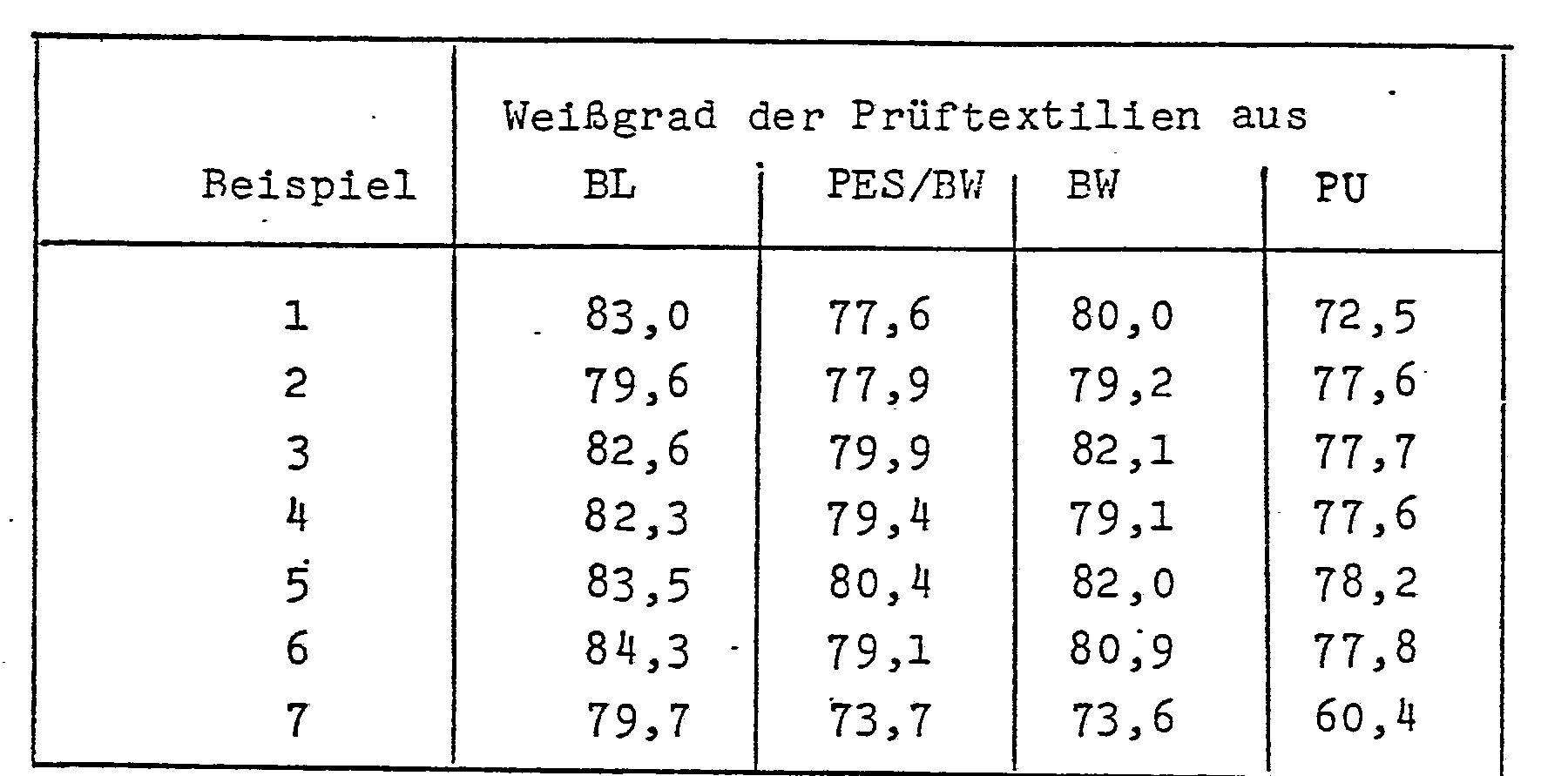
- Mit den Waschmitteln der Beispiele 1 bis 7 wurden Waschversuche in einer handelsüblichen Trommelwaschmaschine bei 60° C durchgeführt. Dabei wurden weiße-Prüftextilien aus Baumwollbleichnessel (BL), Polyester/Baumwoll 63/35 (PES/BW), ein Baumwoll-Gewirke (BW), Polyurethan-Elastomehr-Gewirke (PU) bei einem Flottenverhältnis von 1 : 20, ohne Schmutzbelastung in Gegenwart eines Stoffabschnitts, der mit 3,5 % des stark ausblutenden Farbstoffs Siriuslichtrot F 4 BL, 154 % eingefärbt war, gewaschen. Auf eine Trommelfüllung wurden 84 g der Waschmittel der Beispiele 1 bis 7 gegeben und nach der Wäsche die Reflexionswerte mit einem Spektralphotometer vom Typ Zeiss Elrepho RFC3-18, Filter R 460 gemessen.
- Das Ergebnis ist in Tabelle I dargestellt.
-
wasserlösliche, synthetische amino- und/oder amidogruppenhaltige Polymere aus der Gruppe Polyethylenimine, Polyamine, Polyaminamide, Polyacrylamide;
gegebenenfalls sonstige wasserlösliche Polymere;
Claims (7)
1. Verfärbungsinhibierendes, flüssiges Waschmittel, enthaltend nichtionische oder zwitterionische Tenside, dadurch gekennzeichnet, daß es die genannten Tenside in Kombination mit synthetischen, wasserlöslichen, amino- und/oder amidogruppenhaltigen Polymeren aus der Gruppe der Polyethylenimine, Polyamine, Polyaminamide und Polyacrylamide enthält, daß es frei von textilweichmachenden quartären Ammoniumverbindungen sowie im wesentlichen phosphatfrei ist.
2. Mittel nach Anspruch 1,gekennzeichnet durch einen Gehalt an Polymeren aus der Gruppe Polyethylenimine und Polyamine.
3. Mittel nach den Ansprüchen 1 und 2, dadurch gekennzeichnet, daß der Gehalt an Polymeren 1 bis 15 Gew.-%, vorzugsweise 5 bisl5 Gew.-% bezogen auf die Tensidmenge des Mittels beträgt.
4. Mittel nach den Ansprüchen 1 bis 3, dadurch gekennzeichnet, daß es zusätzliche sonstige wasserlösliche Polymere enthält.
5. Mittel nach den Ansprüchen 1 bis 4, enthaltend
als nichtionische Tenside in einem Mengenverhältnis
a) 5 - 18 Gew.-% eines Alkylpolyglykolethers der Formel I

in der R1 eine geradkettige Alkylgruppe und R2 zu 20 bis 75 Gew.-% - bezogen auf den dem Alkylpolyglykolether zugrunde liegenden Alkohol - eine C1-C4-Alkylgruppe und im übrigen Wasserstoff bedeuten, wobei die Gesamtzahl der Kohlenstoffatome in R1 und R2 11 bis 15 beträgt, und n einen Wert von 5 bis 9 bedeutet, und wobei n so ausgewählt ist, daß der Ethylenoxidanteil des Alkylpolyglykolethers etwa 50 bis 65 Gew.-% beträgt.
b) 5 - 18 Gew.-% eines Alkylpolyglykolethers der Formel I, in'der R1 eine geradkettige Alkylgruppe und R2 entweder Wasserstoff, oder zu 20 bis 75 Gew.-% - bezogen auf den dem Alkylpolyglykolether zugrunde liegenden Alkohol - eine C1-C4-Alkylgruppe und im übrigen Wasserstoff bedeuten, wobei die Gesamtzahl der Kohlenstoffatome in R1 und R2 6 bis 10 beträgt und n einen Wert von 3 bis 8 bedeutet, und wobei n so ausgewählt ist, daß der Ethylenoxidanteil des Alkylpolyglykolethers etwa 55 bis 70 Gew.-% beträgt
als nichtionische Tenside in einem Mengenverhältnis
a) : b) vorzugsweise von 2 : 1 bis 1 : 2.
6. Flüssiges Mittel nach den Ansprüchen 1 bis 5 enthaltend 10 bis 30 Gew.-% vorzugsweise 15 bis 30 Gew.-% Alkylpolyglykolether der Formel I.
7. Flüssiges Mittel nach den Ansprüchen 1 bis 6, gekennzeichnet durch
a) 7,5 - 12,5 Gew.-% eines Alkylpolyglykolethers der Formel I, in der R 1 und R2 zusammen 11 bis 13 Kohlenstoffatome aufweisen und wobei der durchschnittliche Ethylenoxidgehalt des Alkylpolyglykolethers 55 bis 65 Gew.-% beträgt;
b) 7,5 - 12,5 Gew.-% eines Alkylpolyglykolethers der Formel I, in der R1 7 bis 10 Kohlenstoffatome aufweist, R 2 = H ist und wobei der durchschnittliche Ethylenoxidgehalt des Alkylpolyglykolethers 60 bis 70 Gew.-% beträgt;
c) 0,2 - 2,0 Gew.-% wasserlösliche, synthetische Polymere aus der Gruppe Polyethylenimine und Polyamine
d) 2,5 - 4,0 Gew.-% sonstige wasserlösliche Polymere
Rest Wasser und organische Lösungsmittel sowie gegebenenfalls weitere übliche, in geringen Mengen anwesende Zusätze, wie zum Beispiel Farb- und Duftstoffe, hydrotrope Mittel, Komplexierungsmittel für Schwermetallspuren sowie Konservierungsmittel, Trübungs- und Viskositätsmittel.
Applications Claiming Priority (2)
| Application Number | Priority Date | Filing Date | Title |
|---|---|---|---|
| DE3124210 | 1981-06-19 | ||
| DE19813124210 DE3124210A1 (de) | 1981-06-19 | 1981-06-19 | "fluessiges waschmittel mit zusaetzen zur verhinderung der farbstoffuebertragung" |
Publications (1)
| Publication Number | Publication Date |
|---|---|
| EP0068232A2 true EP0068232A2 (de) | 1983-01-05 |
Family
ID=6134977
Family Applications (1)
| Application Number | Title | Priority Date | Filing Date |
|---|---|---|---|
| EP19820105121 Withdrawn EP0068232A2 (de) | 1981-06-19 | 1982-06-11 | Flüssiges Waschmittel mit Zusätzen zur Verhinderung der Farbstoffübertragung |
Country Status (2)
| Country | Link |
|---|---|
| EP (1) | EP0068232A2 (de) |
| DE (1) | DE3124210A1 (de) |
Cited By (11)
| Publication number | Priority date | Publication date | Assignee | Title |
|---|---|---|---|---|
| EP0158260A3 (en) * | 1984-04-09 | 1987-11-25 | Henkel Kommanditgesellschaft Auf Aktien | Detergent for coloured textiles |
| EP0345946A3 (de) * | 1988-06-10 | 1991-03-20 | Milliken Research Corporation | Wäschereinigungsmittelzusammensetzung, das einen sulfonierten farblosen blockierten Farbstoff enthält |
| WO1994029422A1 (de) * | 1993-06-16 | 1994-12-22 | Basf Aktiengesellschaft | Gepfropfte polyamidoamine und gepfropfte polyethylenimine, verfahren zu ihrer herstellung und ihre verwendung als zusatz zu waschmitteln |
| WO1995006100A1 (de) * | 1993-08-23 | 1995-03-02 | Henkel Kommanditgesellschaft Auf Aktien | Verfärbungsinhibitoren für waschmittel |
| EP0704523A1 (de) * | 1994-09-30 | 1996-04-03 | The Procter & Gamble Company | Betain enthaltende Zusammensetzungen zur Verhinderung der Farbstoffübertragung |
| EP0918089A1 (de) * | 1997-11-24 | 1999-05-26 | The Procter & Gamble Company | Gewebebehandlungsmittel |
| WO2000049124A1 (en) * | 1999-02-19 | 2000-08-24 | The Procter & Gamble Company | Laundry detergent compositions comprising fabric enhancement polyamines |
| US6277810B2 (en) | 1998-09-16 | 2001-08-21 | Unilever Home & Personal Care Usa, Division Of Conopco, Inc. | Dryer-added fabric care compositions containing amide-epichlorohydrin resins |
| US6410503B1 (en) | 1997-11-24 | 2002-06-25 | The Procter & Gamble Company | Fabric care compositions |
| US6846797B1 (en) | 1999-10-01 | 2005-01-25 | Unilever Home & Personal Care Usa A Division Of Conopco, Inc. | Fabric care composition comprising an epichlorohydrin resin and anionic polymer |
| WO2008077952A1 (de) * | 2006-12-22 | 2008-07-03 | Basf Se | Hydrophob modifizierte polyaklylenimine als farbübertragungsinhibitoren |
Families Citing this family (10)
| Publication number | Priority date | Publication date | Assignee | Title |
|---|---|---|---|---|
| DE3211532A1 (de) * | 1982-03-29 | 1983-09-29 | Henkel KGaA, 4000 Düsseldorf | Mittel zum waschen und faerbungsschonenden bleichen von textilien |
| US5380447A (en) * | 1993-07-12 | 1995-01-10 | Rohm And Haas Company | Process and fabric finishing compositions for preventing the deposition of dye in fabric finishing processes |
| DE4334368C2 (de) * | 1993-10-08 | 1995-12-14 | Henkel Kgaa | Schwach schäumende polymerfreie Reinigungsmittel |
| CA2180071A1 (en) * | 1995-07-11 | 1997-01-12 | Thomas Cleveland Kirk | Fabric washing composition and method for inhibiting deposition of dye |
| AU718027B2 (en) * | 1995-07-11 | 2000-04-06 | Rohm And Haas Company | Washing composition and use of polymer to clean and provide soil resistance to an article |
| WO1997032480A1 (en) * | 1996-03-06 | 1997-09-12 | Novo Nordisk A/S | A method of killing or inhibiting microbial cells |
| DE19611977A1 (de) | 1996-03-26 | 1997-10-02 | Basf Ag | Waschkraftverstärker für Waschmittel |
| DE19643133A1 (de) * | 1996-10-18 | 1998-04-23 | Basf Ag | Verwendung von wasserlöslichen oder in Wasser dispergierbaren vernetzten stickstoffhaltigen Verbindungen in Wasch- und Reinigungsmitteln |
| US6777530B1 (en) | 1996-10-18 | 2004-08-17 | Basf Aktiengesellschaft | Use of crosslinked nitrogenous compounds which are soluble or dispersible in water in detergents and cleaners |
| DE102010062286A1 (de) | 2010-12-01 | 2012-06-06 | Rudolf Gmbh | Polykationische Kolloidpartikel, Verfahren zu deren Herstellung und deren Verwendung zur Modifizierung von Substraten |
-
1981
- 1981-06-19 DE DE19813124210 patent/DE3124210A1/de not_active Withdrawn
-
1982
- 1982-06-11 EP EP19820105121 patent/EP0068232A2/de not_active Withdrawn
Cited By (12)
| Publication number | Priority date | Publication date | Assignee | Title |
|---|---|---|---|---|
| EP0158260A3 (en) * | 1984-04-09 | 1987-11-25 | Henkel Kommanditgesellschaft Auf Aktien | Detergent for coloured textiles |
| EP0345946A3 (de) * | 1988-06-10 | 1991-03-20 | Milliken Research Corporation | Wäschereinigungsmittelzusammensetzung, das einen sulfonierten farblosen blockierten Farbstoff enthält |
| WO1994029422A1 (de) * | 1993-06-16 | 1994-12-22 | Basf Aktiengesellschaft | Gepfropfte polyamidoamine und gepfropfte polyethylenimine, verfahren zu ihrer herstellung und ihre verwendung als zusatz zu waschmitteln |
| WO1995006100A1 (de) * | 1993-08-23 | 1995-03-02 | Henkel Kommanditgesellschaft Auf Aktien | Verfärbungsinhibitoren für waschmittel |
| EP0704523A1 (de) * | 1994-09-30 | 1996-04-03 | The Procter & Gamble Company | Betain enthaltende Zusammensetzungen zur Verhinderung der Farbstoffübertragung |
| EP0918089A1 (de) * | 1997-11-24 | 1999-05-26 | The Procter & Gamble Company | Gewebebehandlungsmittel |
| WO1999027055A1 (en) * | 1997-11-24 | 1999-06-03 | The Procter & Gamble Company | Fabric care compositions |
| US6410503B1 (en) | 1997-11-24 | 2002-06-25 | The Procter & Gamble Company | Fabric care compositions |
| US6277810B2 (en) | 1998-09-16 | 2001-08-21 | Unilever Home & Personal Care Usa, Division Of Conopco, Inc. | Dryer-added fabric care compositions containing amide-epichlorohydrin resins |
| WO2000049124A1 (en) * | 1999-02-19 | 2000-08-24 | The Procter & Gamble Company | Laundry detergent compositions comprising fabric enhancement polyamines |
| US6846797B1 (en) | 1999-10-01 | 2005-01-25 | Unilever Home & Personal Care Usa A Division Of Conopco, Inc. | Fabric care composition comprising an epichlorohydrin resin and anionic polymer |
| WO2008077952A1 (de) * | 2006-12-22 | 2008-07-03 | Basf Se | Hydrophob modifizierte polyaklylenimine als farbübertragungsinhibitoren |
Also Published As
| Publication number | Publication date |
|---|---|
| DE3124210A1 (de) | 1982-12-30 |
Similar Documents
| Publication | Publication Date | Title |
|---|---|---|
| EP0158260B1 (de) | Textil-Waschmittel für farbige Textilien | |
| DE3124210A1 (de) | "fluessiges waschmittel mit zusaetzen zur verhinderung der farbstoffuebertragung" | |
| DE1619087A1 (de) | Als Textilwaschmittel brauchbare Tensidkombinationen sowie diese enthaltende Wasch- oder Waschhilfsmittel | |
| DE1617132A1 (de) | Als Textilwaschmittel brauchbare Tensidkombinationen sowie diese enthaltende Wasch- oder Waschhilfsmittel | |
| DE1801411A1 (de) | Gerueststoffe fuer Wasch- und Reinigungsmittel | |
| EP0295590A2 (de) | Flüssiges Reinigungsmittel für harte Oberflächen | |
| EP0044003A1 (de) | Flüssiges Waschmittel mit einem Gehalt an verfärbungsinhibierenden Zusätzen | |
| DD145291A5 (de) | Stabile stilbenaufhellerloesungen | |
| EP0172534A2 (de) | Flüssiges Reinigungsmittel | |
| EP0131138A1 (de) | Verwendung von Fettsäurecyanamidsalzen als Tenside zum Reinigen von harten Oberflächen | |
| EP0090310B1 (de) | Mittel zum Waschen und färbungsschonenden Bleichen von Textilien | |
| DE2916656A1 (de) | Waschmittel fuer textilien | |
| DE2544605A1 (de) | Verfahren zur reinigung textiler flaechenbelaege | |
| DE1617120C3 (de) | Wasch- und Reinigungsmittel | |
| DE1617177A1 (de) | Fluessiges Waschmittel | |
| DE1617123A1 (de) | Wasch- und Reinigungsmittel | |
| EP0626944B1 (de) | Thiodiglykol-derivate, verfahren zu ihrer herstellung und deren verwendung zum weichmachen von textilien | |
| DE2700640C2 (de) | Für die Kaltwäsche geeignetes Waschmittel | |
| DE2808927A1 (de) | Lagerbestaendiges, klares fluessigwaschmittel mit einem gehalt an optischen aufhellern | |
| DE1806502A1 (de) | Waschmittel mit einem Gehalt an Textilweichmacher | |
| DE2114888A1 (de) | Ungesättigte zwitterionische oberflächenaktive Verbindungen | |
| DE2539270C2 (de) | Textil-Weichmacher enthaltende Waschmittel | |
| DE1933014A1 (de) | Eiweissloesende Wasch-,Waschhilfs- und Reinigungsmittel | |
| DE2243282A1 (de) | Wasch- und waschhilfsmittel | |
| CH646949A5 (de) | Substituierte methansulfonamide und diese enthaltende antistatische zusammensetzung zum waschen von textilien. |
Legal Events
| Date | Code | Title | Description |
|---|---|---|---|
| PUAI | Public reference made under article 153(3) epc to a published international application that has entered the european phase |
Free format text: ORIGINAL CODE: 0009012 |
|
| AK | Designated contracting states |
Designated state(s): AT BE CH DE FR GB IT LI LU NL SE |
|
| STAA | Information on the status of an ep patent application or granted ep patent |
Free format text: STATUS: THE APPLICATION HAS BEEN WITHDRAWN |
|
| 18W | Application withdrawn |
Withdrawal date: 19840125 |
|
| RIN1 | Information on inventor provided before grant (corrected) |
Inventor name: ANDREE, HANS, DR. Inventor name: WEBER, RUDOLF Inventor name: POCHANDKE, WINFRIED |