EP0057891B2 - Zusammensetzungen aus Äthylen-Copolymeren - Google Patents
Zusammensetzungen aus Äthylen-Copolymeren Download PDFInfo
- Publication number
- EP0057891B2 EP0057891B2 EP82100690A EP82100690A EP0057891B2 EP 0057891 B2 EP0057891 B2 EP 0057891B2 EP 82100690 A EP82100690 A EP 82100690A EP 82100690 A EP82100690 A EP 82100690A EP 0057891 B2 EP0057891 B2 EP 0057891B2
- Authority
- EP
- European Patent Office
- Prior art keywords
- molecular weight
- copolymer
- ethylene
- olefin
- ratio
- Prior art date
- Legal status (The legal status is an assumption and is not a legal conclusion. Google has not performed a legal analysis and makes no representation as to the accuracy of the status listed.)
- Expired - Lifetime
Links
Images




Classifications
-
- C—CHEMISTRY; METALLURGY
- C08—ORGANIC MACROMOLECULAR COMPOUNDS; THEIR PREPARATION OR CHEMICAL WORKING-UP; COMPOSITIONS BASED THEREON
- C08F—MACROMOLECULAR COMPOUNDS OBTAINED BY REACTIONS ONLY INVOLVING CARBON-TO-CARBON UNSATURATED BONDS
- C08F210/00—Copolymers of unsaturated aliphatic hydrocarbons having only one carbon-to-carbon double bond
- C08F210/16—Copolymers of ethene with alpha-alkenes, e.g. EP rubbers
-
- C—CHEMISTRY; METALLURGY
- C08—ORGANIC MACROMOLECULAR COMPOUNDS; THEIR PREPARATION OR CHEMICAL WORKING-UP; COMPOSITIONS BASED THEREON
- C08L—COMPOSITIONS OF MACROMOLECULAR COMPOUNDS
- C08L23/00—Compositions of homopolymers or copolymers of unsaturated aliphatic hydrocarbons having only one carbon-to-carbon double bond; Compositions of derivatives of such polymers
- C08L23/02—Compositions of homopolymers or copolymers of unsaturated aliphatic hydrocarbons having only one carbon-to-carbon double bond; Compositions of derivatives of such polymers not modified by chemical after-treatment
- C08L23/04—Homopolymers or copolymers of ethene
- C08L23/08—Copolymers of ethene
- C08L23/0807—Copolymers of ethene with unsaturated hydrocarbons only containing four or more carbon atoms
- C08L23/0815—Copolymers of ethene with unsaturated hydrocarbons only containing four or more carbon atoms with aliphatic 1-olefins containing one carbon-to-carbon double bond
-
- C—CHEMISTRY; METALLURGY
- C08—ORGANIC MACROMOLECULAR COMPOUNDS; THEIR PREPARATION OR CHEMICAL WORKING-UP; COMPOSITIONS BASED THEREON
- C08L—COMPOSITIONS OF MACROMOLECULAR COMPOUNDS
- C08L2205/00—Polymer mixtures characterised by other features
- C08L2205/02—Polymer mixtures characterised by other features containing two or more polymers of the same C08L -group
-
- Y—GENERAL TAGGING OF NEW TECHNOLOGICAL DEVELOPMENTS; GENERAL TAGGING OF CROSS-SECTIONAL TECHNOLOGIES SPANNING OVER SEVERAL SECTIONS OF THE IPC; TECHNICAL SUBJECTS COVERED BY FORMER USPC CROSS-REFERENCE ART COLLECTIONS [XRACs] AND DIGESTS
- Y10—TECHNICAL SUBJECTS COVERED BY FORMER USPC
- Y10T—TECHNICAL SUBJECTS COVERED BY FORMER US CLASSIFICATION
- Y10T428/00—Stock material or miscellaneous articles
- Y10T428/24—Structurally defined web or sheet [e.g., overall dimension, etc.]
- Y10T428/24942—Structurally defined web or sheet [e.g., overall dimension, etc.] including components having same physical characteristic in differing degree
- Y10T428/24992—Density or compression of components
Definitions
- the present invention relates to an ethylene- ⁇ -olefin copolymer composition. More particularly, the present invention relates to ethylene- ⁇ -olefin copolymer compositions excellent in processability, impact strength, tensile strength, environmental stress cracking resistance, low temperature resistance, creep characteristics, tear strength, transparency, heat-sealing characteristics and chemical characteristics such as chemicals resistance.
- high pressure polyethylene Low density polyethylenes manufactured by the high pressure method
- high pressure polyethylenes are excellent in melt rheology characteristics, and therefore, they are excellent in processability.
- high pressure polyethylenes When used for extrusion processing or injection molding, their production efficiency is high, resulting in relatively low electricity consumption.
- blown film processing the above polyethylenes give good bubble stability.
- cast film processing and extrusion lamination processing there is only slight “neck-in”.
- blow molding these polyethylenes give good parison stability.
- their mechanical strengths such as tensile strength and impact strength, are relatively low and accordingly these products can not be used in thin forms.
- High pressure polyethylenes have various other problems. They are used in many fields as films. Films of high pressure polyethylenes are required to have the following properties in recent, highly developed automatic packaging systems.
- the former method still has many problems such as (a) reduction of tear strength, rigidity and heat resistance of films, (b) occurrence of corrosion of extruder and smell in processing due to liberation of acetic acid and (c) occurrence of blocking due to sticky film surface and cold flow.
- the latter method has problems of reduction of thermal stability and weather resistance and of high cost.
- resins which have low densities about equal to those of high pressure polyethylenes there are known resins which are prepared by co-polymerizing ethylene and an ⁇ -olefin under a medium to low pressure using a transition metal catalyst. (Hereinafter, such are abbreviated as "ethylene- ⁇ -olefin copolymers").
- ethylene- ⁇ -olefin copolymers The copolymers produced with a vanadium catalyst are low in degree of crystallization, and have problems in heat resistance, weather resistance and mechanical strengths.
- the ethylene- ⁇ -olefin copolymers produced under normal polymerization conditions with a titanium catalyst having generally narrow molecular weight distributions (narrower than those of high pressure polyethylenes), are relatively excellent in mechanical strengths but poor in melt rheology characteristics and have many problems in processing.
- blown film processing a large quantity of electricity is needed, output is reduced or bubble stability is lost.
- high speed processing "shark skin” appears on film surfaces, thereby decreasing product values.
- parison stability is lost, or surfaces of molded products turn to "shark skin” and product values are lost.
- processing temperatures need to be largely raised because of poorer flow property under high pressures as compared with high pressure polyethylenes, which requires more heat energy and moreover causes resin deterioration.
- ethylene- ⁇ -olefin copolymers polymerized under a medium to low pressure using a transition metal catalyst, have non-uniform component distributions.
- S.C.B the number of short chain branching per 1000 carbon atoms (excluding methyl groups at the ends)
- S.C.B the number of short chain branching per 1000 carbon atoms (excluding methyl groups at the ends)
- S.C.B the number of short chain branching per 1000 carbon atoms (excluding methyl groups at the ends)
- S.C.B the number of short chain branching per 1000 carbon atoms (excluding methyl groups at the ends)
- ethylene- ⁇ -olefin copolymers having densities about equal to those of high pressure polyethylenes and synthesized under a medium to low pressure with a transision metal catalyst can not satisfy all of processability, mechanical strengths and transparency. For instance, lowering of molecular weight for improvement of processability results in large reduction in mechanical strengths and disappearance of said copolymer characteristics. Broadening of molecular weight distribution leads to large reduction in mechanical strengths as well (cf. Reference Example 2), and moreover transparency worsens and surfaces of molded products get sticky. Thus, both of processability and physical properties are not met together yet, and any low density ethylene- ⁇ -olefin copolymer excellent in processability and mechanical strengths have not yet been provided.
- high pressure polyethylenes are excellent in rheology characteristics and processability but relatively poor in mechanical strengths.
- ethylene- ⁇ -olefin copolymers polymerized under a medium to low pressure with a transition metal catalyst and having density about equal to those of high pressure polyethylenes have excellent mechanical strengths due to their narrower molecular weight distributions but are poor in processability. These property differences are considered to originate from molecular structures of polymers.
- High pressure polyethylenes are obtained from radical polymerization under a pressure of about 1500 to 4000 bar at a temperature of about 150° to 350°C in an autoclave or a tubular reactor. Their molecular structures are very complicated and, in spite of being homopolymers of ethylene, have short chain branches which are alkyl groups of 1 to 6 carbon atoms. These short chain branches affect crystallinities and therefore densities of polymers. The distribution of short chain branching of high pressure polyethylenes is relatively even, and both lower molecular weight components and high molecular weight components have almost similar numbers of branches.
- polyethylenes also have long chain branches in complicated structures. Identification of these long chain branches is difficult, but these branches are considered to be alkyl groups of which lengths vary from about lengths of main chains to lengths having carbon atoms of over several thousands. The presence of these long chain branches largely affects melt rheology characteristics of polymers and this is one of the reasons for the excellent processability of high pressure method polyethylenes.
- ethylene- ⁇ -olefin copolymers synthesized under a medium to low pressure with a transition metal catalyst and having densities about equal to those of high pressure polyethylenes are obtained by copolymerizing ethylene and an ⁇ -olefin under a medium to low pressure of about 5 to 150 bar and at 0°-250°C normally at a relatively low temperature of 30° to 200°C with a transition metal catalyst in an autoclave or a tubular reactor.
- Their molecular structures are relatively simple. These ethylene- ⁇ -olefin copolymers seldom possess long chain branches and have only short chain branches.
- short chain branches are not formed through complicated reaction processes as so in high pressure polyethylenes, but are controlled by the kind of an ⁇ -olefin to be used in the copolymerization.
- short chain branches formed are normally ethyl branches. These branches could be hexyl branches as a result of dimerization of butene-1).
- Short chain branches formed control crystallinities and densities of polymers.
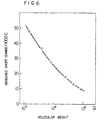
- Distribution of short chain branches is also affected by the nature of a transition metal catalyst used in the copolymerization, the type of polymerization and the temperature of polymerization. Different from the case of high pressure polyethylenes, the distribution is wide. Namely, as a general trend, lower molecular weight components have larger S.C.B. and higher molecular weight components have smaller S.C.B. (cf. Reference Example 1).
- Ethylene- ⁇ -olefin copolymers obtained by copolymerizing ethylene and an ⁇ -olefin under a medium to low pressure with a transition metal catalyst and having densities about equal to those of high pressure polyethylenes have come to be practically used. Therefore, the conventional classification that polyethylene resins having densities of 0.910 to 0.935 g/cm 3 fall in a category of high pressure polyethylenes, is improper and a new classification should be developed, mainly based on whether or not a polymer or resin has long chain branches.
- As low density polyethylenes substantially not having long chain branches there are resins which are obtained by polymerization using a transition metal catalyst under a same high pressure and temperature as employed in the manufacture of high pressure method polyethylenes. These resins are also included in "ethylene- ⁇ -olefin copolymers" as defined by the present invention.
- Presence or absence of long chain branches is clarified to a considerable extent by a theory of solution.
- the presence of long chain branches in an ethylene polymer can be known by using [ ⁇ ]/[ ⁇ ], namely g * ⁇ .
- [ ⁇ ] is the intrinsic viscosity of the ethylene polymer
- [ ⁇ ] l is the intrinsic viscosity of a reference linear polyethylene (high density polyethylene produced from homopolymerization of ethylene under a medium to low pressure with a Ziegler catalyst) having the same weight average molecular weight by the light scattering method.
- Molecules having more long chain branches have less spread in a solution, and therefore, their g * ⁇ is small.
- g * ⁇ of high pressure polyethylenes is 0.6 or less.
- high pressure polyethylenes and ethylene- ⁇ -olefin copolymers Due to the difference of presence or absence of long chain branches, high pressure polyethylenes and ethylene- ⁇ -olefin copolymers give largely different properties in melt rheology characteristics, crystallinity, solid mechanical properties and optical properties.
- the present inventors made strenuous efforts with an aim to obtain polyethylenes which will solve the above-mentioned defects of polyethylenes, will have a processability equal to or better than that of high pressure polyethylenes, and will be excellent in tear strength, impact strength, environmental stress cracking resistance, low temperature resistance, creep characteristics, chemicals resistance, transparency and heat-sealing characteristics.
- the present inventors have found that, by mixing (a) an ethylene- ⁇ -olefin copolymer having a relatively higher molecular weight and of which density, intrinsic viscosity, S.C.B., kind of ⁇ -olefin and (weight average molecular weight)/(number average molecular weight) are specified and (b) another ethylene- ⁇ -olefin copolymer having a relatively lower molecular weight and of which density, intrinsic viscosity, S.C.B., kind of ⁇ -olefin and (weight average molecular weight)/(number average molecular weight) are specified, in such a way that the ratio of S.C.B.
- ethylene copolymer compositions can be obtained which have extremely good processability compared with the conventional polyethylenes, as well as very excellent physical and chemical properties such as tear strength, impact strength, environmental stress cracking resistance, low temperature resistance, creep characteristics, chemicals resistance, transparency, and heat-sealing characteristics.
- the present inventors have also found that ethylene- ⁇ -olefin copolymer compositions substantially not having long chain branches and having a specific distribution of S.C.B.
- copolymer A and said copolymer B being selected in order to satisfy a condition that (S.C.B. of said copolymer A)/(S.C.B.
- copolymer composition has a g ⁇ * of at least 0.9 and a ratio of (SCB of higher molecular weight components)/(SCB of lower molecular weight components) of 0.6 to 0.8, wherein these SCB values are obtained by: obtaining a curve of the molecular weight distribution by gel permeation chromatography, wherein the abscissa is the logarithm of the chain length (unit nm) calibrated with a standard polystyrene sample, and the ordinate is the relative weight fraction; then obtaining fractions of lower and higher molecular weight by either one of the following methods:
- the present invention also provides a composition of copolymer of ethylene and an ⁇ -olefin of 3 to 18 carbon atoms, having the following properties:
- the first feature of this invention is to provide an ethylene copolymer composition of which processability is about equal to or better than that of high pressure polyethylenes and of which physical and chemical properties such as tensile strength, impact strength, environmental stress cracking resistance, creep characteristics, tear strength, transparency, heat-sealing characteristics and chemicals resistance are very excellent.
- the second feature of this invention is that, because the product of this invention is excellent in mechanical strengths, has a rigidity higher than those of high pressure polyethylenes and has a transparency about equal to that of high pressure polyethylenes, material saving can be expected with the product of this invention; for instance, when this product is used for films, the same performance can be obtained with the thickness of 10 to 20% thinner than that of high pressure polyethylenes.
- the third feature of this invention is that, because the product of this invention has extrusion processability superior to that of relatively low density ethylene- ⁇ -olefin copolymers by the conventional technique, conventional extruders being used for high pressure polyethylenes can be utilized for the present product without any modification.
- the fourth feature of this invention is that, because the present product, even if possessing a melt index lower than that of low density ethylene- ⁇ -olefin copolymers by the conventional technique, shows satisfactory flow properties in actual processing, it gives excellent bubble stability and mechanical strengths of machine and transverse directions can be easily balanced, whereby molded products can have a uniform quality.
- the fifth feature of this invention is that, because a resin composition less sticky than low density ethylene- ⁇ -olefin copolymers by the conventional technique is obtained even when the density of the composition is lowered, the composition can be applied even for the usages where transparency, flexibility and impact characteristics are required.
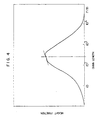
- Figs. 1 to 5 show curves of molecular weight distributions obtained from gel permeation chromatography. Broken lines in these figures are for dividing lower molecular weight components and high molecular weight components into two respective territories.
- Fig. 6 is a typical example showing "distribution of S.C.B. against molecular weight" of an ethylene- ⁇ -olefin copolymer of the conventional technique.
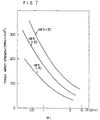
- Fig. 7 shows correlations between melt indices (MI) and tensile impact strengths of ethylene- ⁇ -olefin copolymers of the conventional technique, with their melt flow ratios (MFR) used as a parameter.
- Fig. 8 shows correlations between Ml and intrinsic viscosities [ ⁇ ] of a high pressure polyethylene and a linear polyethylene of the medium to low pressure method as a method for distinguishing these two polymers.
- a broken line is drawn to separate two territories, the left side territory is for the high pressure polyethylene of the conventional technique and the right side territory is for the linear polyethylene of the medium to low pressure method.
- copolymer A An ethylene- ⁇ -olefin copolymer of a relatively high molecular weight (hereinafter referred to as "copolymer A") which is used in the present invention as one mixing component, is a copolymer of ethylene and an ⁇ -olefin of 3 to 18 carbon atoms.
- Examples of the ⁇ -olefin include propylene, butene-1, pentene-1, hexene-1, heptene-1, octene-1, nonene-1, decene-1,4-methyl,pentene-1, 4-methyl-hexene-1 and 4,4-dimethyl-pentene-1.
- ⁇ -olefins of at least 4 carbon atoms are preferred.
- butene-1, pentene-1, hexene-1, octene-1 and 4-methyl-pentene-1 are preferred from the standpoints of monomer availability, copolymerizability and quality of polymer obtained.
- the density of the copolymer A is influenced by the kind of an ⁇ -olefin used, the content of the olefin and the intrinsic viscosity of the copolymer.
- the density is required to be 0.895 to 0.935 g/cm 3 and more preferably 0.895 to 0.930 g/cm 3 .
- copolymers stick to the reactor walls making polymerization difficult, or, the density of the relatively lower molecular weight copolymer (namely "copolymer B" which is described later and used as another mixing component in the present invention) is required to be raised, resulting in formation of polymer compositions of undesirable qualities such as films of poor transparency.
- the density higher than 0.930 g/cm 3 the content of the ⁇ -olefin in the copolymer A becomes very low, and the copolymer A of such a high density does not give satisfactory mechanical strengths. For instance, in films, balancing of MD and TD strengths becomes difficult and heat-sealing characteristics get worse. S.C.B.
- the number of methyl groups at branch ends per 1000 carbon atoms is S.C.B.
- R is an alkyl group with a branch or branches, for instance, the ⁇ -olefin is 4-methyl-pentene-1, the branch is isobutyl group and the half number of methyl groups at the branch ends is S.C.B.
- Short chain branching in ethylene- ⁇ -olefin copolymers occurs due to ⁇ -olefins and it hinders crystallization mainly of ethylene sequences and lowers densities.
- the molecular weight of the copolymer A is 1.2 to 6.0 dl/g as intrinsic viscosity and preferred to be 1.2 to 4.5 dl/g.
- the intrinsic viscosity is below 1.2 dl/g, mechanical strengths of polymer compositions of the present invention are reduced. Over 6.0 dl/g, mixing with the copolymer B becomes difficult, and the polymer compositions obtained have fish eyes and further worsened flow properties as well as reduced transparency.
- the intrinsic viscosity is preferably 1.2 to 4.0 dl/g and more preferably 1.2 to 3.0 dl/g. If it is less than 1.2 dl/g, mechanical strengths of compositions are lowered. If it is over 4.0 dl/g, mixing with the copolymer B becomes insufficient, and the polymer compositions obtained have fish eyes, deteriorated flow properties (tend to cause flow marks) and reduced transparency.
- (Weight average molecular weight)/(Number average molecular weight) of the copolymer A which is a measure for the molecular weight distribution of the copolymer obtained from gel permeation chromatography (hereinafter abbreviated as "GPC"), is 2 to 10 and preferably 3 to 8. If it is less than 2, such a copolymer A is difficult to produce. If it is over 10, polymer compositions have lower mechanical strengths and, when processed into films, cause blocking.
- copolymer B An ethylene- ⁇ -olefin copolymer of a relatively low molecular weight (hereinafter abbreviated as "copolymer B") which is used in the present invention as another mixing component, is a copolymer of ethylene and an ⁇ -olefin of 3 to 18 carbon atoms.
- ⁇ -olefins there may be selected the ⁇ -olefins used in the copolymer A.
- the density of the copolymer B is 0.910 to 0.955 g/cm 3 .
- it is 0.915 to 0.953 g/cm 3 .
- the copolymer compositions possess reduced mechanical strengths and cause blocking due to bleeding of lower molecular weight components of low density on film surfaces.
- copolymer compositions of this invention possess worsened transparency and too high densities.
- the density of the copolymer B is preferred to be 0.910 to 0.950 g/cm 3 and more preferred to be 0.915 to 0.948 g/cm 3 .
- the density is below 0.910 g/cm 3 , mechanical strengths of compositions are reduced and surface tackiness occurs.
- compositions have too high densities.
- S.C.B. of the copolymer B is 5 to 35 and preferred to be 7 to 30.
- S.C.B. is below 5
- the copolymer B has a lower molecular weight as a whole and its crystallization speed is fast, resulting in poor transparency of compositions. In case of over 35, reduction in mechanical strengths as well as blocking in films occurs.
- the molecular weight of the copolymer B is 0.3 to 1.5 dl/g preferably 0.4 to 1.5 dl/g as intrinsic viscosity. When the intrinsic viscosity is less than 0.3 dl/g, mechanical strengths and transparency of compositions are reduced. In case of over 1.5 dl/g, fluidity of compositions is poor.
- the molecular weight of the copolymer B is preferably 0.3 to 1.2 dl/g as intrinsic viscosity and more preferably 0.4 to 1.2 dl/g. When the intrinsic viscosity is below 0.3 dl/g, mechanical strengths and transparency of compositions are reduced. In case of over 1.2 dl/g, fluidity of compositions is poor.
- the value of (weight average molecular weight)/(number average molecular weight), namely, M ⁇ w/ M ⁇ n of the copolymer B determined by gel permeation chromatography (GPC) is preferably 2 to 10 and more preferably 3 to 8.
- M ⁇ w/ M ⁇ n is below 2, the copolymer B is difficult to produce.
- over 10 mechanical strengths of the compositions are reduced and surface tackiness of films occurs.
- the copolymer A and the copolymer B as mentioned above can be obtained by copolymerizing ethylene and an ⁇ -olefin of 3 to 18 carbon atoms under a medium to low pressure using a transition metal catalyst.
- catalysts such as Ziegler type catalyst and Phillips type catalyst as well as polymerization methods such as slurry polymerization, gas phase polymerization and solution polymerization are used.
- a Ziegler type catalyst system using a carrier-supported Ziegler catalyst component is convenient in this invention from its activity and copolymerizability.
- Specific examples of an effective carrier of this carrier-supported Ziegler catalyst component include oxides, hydroxides, chlorides and carbonates of metals and silicon and their mixtures as well as inorganic complexes.
- magnesium oxides titanium oxides, silica, alumina, magnesium carbonates, divalent metal hydroxychlorides, magnesium hydroxides, magnesium chlorides, magnesium alkoxides, magnesium haloalkoxides, double oxides of magnesium and aluminum and double oxides of magnesium and calcium.
- magnesium compounds are particularly preferred.
- the following magnesium compounds are particularly preferred.
- the following magnesium compound carrier is most preferred in the production of the low density polyethylene type resin composition of this invention, because it gives a satisfactory slurry with no abnormal tackiness and there occurs no sticking of polymers to the reactor wall. (Reference is made to Japanese Patent Publication No. 23561/1980).
- the carrier obtained by (a) reacting in a solvent an aluminum halide represented by the general formula R n AlX 3-n (R is an alkyl, aryl or alkenyl group of 1 to 20 carbon atoms and X is a halogen atom and n is an integer of 0 to 3) and/or a silicon halide represented by the general formula R ' m SiX 4-m (R' is an alkyl, aryl or alkenyl group of 1 to 20 carbon atoms and X is a halogen atom and m is an integer of 0 to 4) with an organomagnesium compound represented by the general formulas R"MgX and/or R " 2 Mg (R" is an alkyl, aryl or alkenyl group of 1 to 20 carbon atoms and X is a halogen atom), and (b) isolating the solid product formed.
- R n AlX 3-n R is an alkyl, aryl or alkenyl group of
- titanium compounds there are, for instance, titanium compounds, vanadium compounds and zirconium compounds.
- Specific examples include titanium tetrachloride, titanium tetrabromide, titanium tetraiodide, titanium trichloride, titanium alkoxy halides or titanium aryloxy halides represented by the general formula Ti(OR 1 ) 4-p X p (where R 1 is a hydrocarbon group, X is a halogen atom and p is an integer of 0 ⁇ p ⁇ 4), vanadium tetrachloride, vanadium oxy trichloride, zirconium tetrachloride and zirconium alkoxy halides or zirconium aryloxy halides represented by the general formula Zr(OR 2 ) 4-q X q (where R 2 is a hydrocarbon group, X is a halogen atom and q is an integer of 0 ⁇ q ⁇ 4).
- titanium compounds and/or vanadium compounds are particularly preferred in the production of the low density polyethylene type resin composition of this invention, because they give satisfactory slurries with no abnormal tackiness and there occurs almost no sticking of polymers to the reactor wall. (Reference is made to Japanese Patent Publication No. 23561/1980). Titanium compounds are most preferred from the standpoints of weather resistance and heat resistance.
- the transition metal compound is represented by the general formula Ti(OR 3 ) 4-r X r (where R 3 is a hydrocarbon group, X is a halogen atom and r is an integer of 0 ⁇ r ⁇ 4, and includes titanium tetrahalides, titanium alkoxides, titanium aryloxides, titanium alkoxy halides and titanium aryloxy halides.
- organoaluminum compounds such as trialkyl aluminums (triethyl aluminum, tri-n-propyl aluminum, tri-i-butyl alminum, tri-n-butyl aluminum, tri-n-hexyl aluminum, etc.), dialkyl aluminum monohalides (diethyl aluminum monochloride, di-n-propyl aluminum monochloride, di-i-butyl aluminum monochloride, di-n-butyl aluminum monochloride, di-n-hexyl aluminum monochloride, etc.), alkyl aluminum dihalides (ethyl aluminum dichloride, n-propyl aluminum dichloride, i-butyl aluminum dichloride, n-butyl aluminum dichloride, n-hexyl aluminum dichloride, etc.), ethyl aluminum sesquichloride, i-propyl aluminum sesquichloride, i-propyl aluminum sesquichloride, i-propyl aluminum sesquichloride,
- mixing of the ethylene- ⁇ -olefin copolymer A of relatively higher molecular weight and the ethylene- ⁇ -olefin copolymer B of relatively lower molecular weight is not necessarily limited to mixing one of each kind.
- the mixing may be also done by using two or more kinds of each of the copolymer A and the copolymer B.
- the copolymer A in the first stage, the copolymer A is polymerized for a certain length of time and, successively in the second stage, the copolymer B is polymerized using the same catalyst but changing other polymerization conditions until the composition containing the copolymers A and B at an intended ratio is obtained.
- the order of polymerization of A and B is not restricted.
- the above two- or multi-stage polymerization method is an ideal mixing method, because the copolymers A and B undergo molecular dispersion.
- the most effective mixing method can be selected from above various mixing methods, in order to obtain a uniform composition, which meets intended requirements.
- the intrinsic viscosity [ ⁇ ] of the ethylene- ⁇ -olefin copolymer composition of this invention is preferred to be 0.7 to 4 dl/g and more preferred to be 0.8 to 3.5 dl/g and most preferred to be 0.9 to 3 dl/g.
- the intrinsic viscosity is below the lower limit, mechanical strengths are reduced and, in blown film processing, bubble stability is insufficient. In case of above the upper limit, extrusion processability worsens.
- S.C.B. of the composition is 10 to 35.
- S.C.B. is below its lower limit, transparency worsens.
- S.C.B. is above its upper limit, mechanical strengths are reduced and molded products have tackiness.
- the "index of long chain branching" of the copolymer composition of this invention is described.
- the intrinsic viscosity of a copolymer composition of this invention is put as [ ⁇ ] and the intrinsic viscosity of a linear polyethylene having the same M ⁇ w measured by light scattering method (a high density polyethylene obtained by homopolymerization of ethylene under a medium to low pressure using a Ziegler catalyst) is put as [ ⁇ ] l , [ ⁇ ]/[ ⁇ ] l namely g * ⁇ is called the "index of long chain branching" of the composition and indicates the extent of presence of long chain branching in the composition.
- intrinsic viscosities of two polymers are compared.
- One polymer X is a polyethylene having long chain branches of which index of branching is unknown (for instance, a high pressure polyethylene) and the other polymer is a linear polyethylene containing no long chain branches but having the same M ⁇ w measured by light scattering method.
- the polymer X gives a less-viscous solution because the spread of its molecular chain is smaller than that of the linear polyethylene. Accordingly, by measuring the intrinsic viscosities of the two polymers and calculating their ratio namely g * ⁇ , the index of long chain branching can be known.
- g * ⁇ is almost 1 within the range of experimental errors.
- the polymer has long chain branches, g * ⁇ is smaller than 1. In most cases, high pressure polyethylenes show g * ⁇ of below 0.6 and have considerable quantities of long chain branches.
- the ethylene- ⁇ -olefin copolymer composition of this invention is preferred to have g * ⁇ of the copolymer at least 0.9 and practically has no long chain branches.
- g * ⁇ is below 0.8 and contains a large quantity of long chain branches, the copolymer is poor in tensile strength, impact strength, environmental stress cracking resistance, low temperature resistance and chemicals resistance.
- S.C.B. of higher molecular weight components/(S.C.B. of lower molecular weight components) of the copolymer composition of this invention is 0.6 to 0.8.
- these S.C.B. are obtained by dividing the composition of this invention into two groups of lower molecular weight components and higher molecular weight components using molecular weight fractionation and then measuring S.C.B. of each group.
- the ratio is below 0.6, mechanical strengths of the composition are poor, and when the composition is subjected to extrusion processing and injection molding, balancing of MD and TD strengths is difficult and molded products have sticky surfaces, and in films, heat-sealing characteristics worsen.
- a sample is adsorbed on a carrier, Celite® 745, in xylene and the carrier is charged into a column.
- the column is heated to 130°C and a mixed solvent of butyl cellosolve and xylene is passed through the column with their mixing ratio being gradually changed (namely with the solvency of the mixed solvent being gradually changed).
- the lower molecular weight fractions to higher molecular weight fractions are successively fractionated.
- To each eluate is added methanol to cause precipitation. After recovery of each polymer, they are dried under reduced pressure to be used as each fraction.
- the characteristic values of the sample obtained by dividing the ethylene- ⁇ -olefin copolymer of this invention into two fractions such as a higher molecular weight component and a lower molecular weight component are same to the characteristic values of copolymer A and copolymer B. respectively, as previously defined.
- the polyethylene type resin composition of this invention When compared with low density ethylene- ⁇ -olefin copolymers obtained from the conventional medium to low pressure method (normally called "linear low density polyethylene or LLDPE”), the polyethylene type resin composition of this invention has the following advantages.
- the composition of this invention is largely excellent in processability (about equal even to high pressure polyethylenes) and moreover has excellent mechanical strengths (ESCR, tensile strength, impact strength and tear strength) as well as excellent low temperature resistance. Therefore, reduction in thicknesses of molded products becomes possible.
- the composition of this invention has wide applications and can be used even in the application where transparency is required.
- the present composition is far superior in processability (about equal even to high pressure polyethylenes). Further, the composition has excellent mechanical strengths such as tensile strength, impact strength and tear strength, by which reduction in thicknesses of films becomes possible. Moreover, the present composition has excellent transparency and heat-sealing characteristics, by which it is used as a high quality film in wide applications including high speed bag manufacturing.
- the present composition is largely excellent in processability (about equal even to high pressure polyethylenes). Moreover, there occurs no flow marks, there is no warpage with molded products, and transparency, low temperature resistance and mechanical strengths such as environmental stress cracking resistance, tensile strength and impact strength are excellent. Thereby, reduction in thicknesses of molded products is possible and the present composition has wide applications including the case where transparency is required.
- composition of this invention can be added if necessary various additives being commonly used in the industries such as oxidation inhibitors, lubricants, anti-blocking agents, anti-static agents, photostabilizers, and coloring pigments. Also, other polymers can be added in small quantities as long as the scope of this invention is kept.
- n-Butyl magnesium chloride in the n-butyl ether was measured for its concentration by hydrolyzing with 1 N sulfuric acid and back-titrating with 1 N sodium hydroxide using phenolphthalein as an indicator. The concentration was 1.96 mol/l.
- Ethylene- ⁇ -olefin copolymers A were polymerized, using the catalyst produced in Reference Example 1 and organoaluminum compounds (co-catalyst) and employing various ⁇ -olefins and other polymerization conditions as shown in Table 1. Densities, intrinsic viscosities, S.C.B. and (weight average molecular weight/number average molecular weight) of these polymers obtained were also shown in Table 1.
- copolymers are used in the following examples as mixing components.
- Ethylene- ⁇ -olefin copolymers B were polymerized, using the catalyst produced in Reference Example 1 and organoaluminum compounds (co-catalyst) and employing various ⁇ -olefins and other polymerization conditions as shown in Table 2. Densities, intrinsic viscosities, S.C.B. and (weight average molecular weight/number average molecular weight) of these ethylene- ⁇ -olefin copolymers were also shown in Table 2.
- copolymers are used in following examples as mixing components.
- Ethylene- ⁇ -olefin copolymers A were polymerized, using the catalyst produced in Reference Example 1 and organoaluminum compounds (co-catalyst) and employing various ⁇ -olefins and other polymerization conditions shown in Table 3. Densities, intrinsic viscosities, S.C.B. and (weight average molecular weight/number average molecular weight) of these ethylene/ ⁇ -olefin copolymers were also shown in Table 3.
- copolymers are used in the following examples as mixing components.
- Ethylene- ⁇ -olefin copolymers B were polymerized, using the catalyst produced in Reference Example 1 and organoaluminum compounds (co-catalyst) and employing various ⁇ -olefins and other polymerization conditions as shown in Table 4. Densities, intrinsic viscosities, S.C.B. and (weight average molecular weight/number average molecular weight) of these ethylene/ ⁇ -olefin copolymers were also shown in Table 4.
- copolymers are used in the following examples as mixing components.
- Ethylene- ⁇ -olefin copolymers A were polymerized using the catalyst produced in Reference Example 1 and organoaluminum compounds (co-catalyst) and employing ⁇ -olefins and other polymerization conditions as shown in Table 5. Their densities. intrinsic viscosities, S.C.B. and (weight average molecular weight/number average molecular weight) are shown in Table 5.
- Ethylene- ⁇ -olefin copolymers B were polymerized using the catalyst produced in Reference Example 1 and organoaluminum compounds (co-catalyst) and employing ⁇ -olefins and other polymerization conditions shown in Table 6. Their densities, intrinsic viscosities, S.C.B. and (weight average molecular weight/number average molecular weight) are shown in Table 6.
- copolymers are used in the following Examples as mixing components.
- Ethylene- ⁇ -olefin copolymers A were synthesized using the catalyst produced in Reference Example 1 and organo-aluminum compounds (co-catalyst) and employing ⁇ -olefins and other polymerization conditions as shown in Table 7. Densities, intrinsic viscosities, S.C.B. and (weight average molecular weight/number average molecular weight) of these copolymers are shown in Table 7.
- copolymers are used in the following examples as mixing components.
- Ethylene- ⁇ -olefin copolymers B were synthesized using the catalyst produced in Reference Example 1 and organo-aluminum compounds (co-catalyst) and employing ⁇ -olefins and other polymerization conditions as shown in Table 8. Densities, intrinsic viscosities, S.C.B. and (weight average molecular weight/number average molecular weight) of these copolymers are shown in Table 8.
- copolymers are used in the following examples as mixing components.
- Ethylene- ⁇ -olefin copolymers were synthesized using the catalyst produced in Reference Example 1 and organo-aluminum compounds (co-catalyst) and employing ⁇ -olefins and other polymerization conditions as shown in Table 9. Densities, intrinsic viscosities, and S.C.B. of these copolymers are shown in Table 9.
- copolymers are used in the following Examples as higher molecular weight components.
- Ethylene- ⁇ -olefin copolymers were synthesized using the catalyst produced in Reference Example 1 and organoaluminum compounds (co-catalyst) and employing ⁇ -olefins and other polymerization conditions as shown in Table 10. Densities, intrinsic viscosities and S.C.B. of these copolymers are shown in Table 10.
- copolymers are used in the following Examples as lower molecular weight components.
- a composition of ethylene- ⁇ -olefin copolymers was prepared in two stage polymerization.
- the first stage polymerization was carried out for 70 min. using the catalyst produced in Reference Example 1 and triethyl aluminum (co-catalyst) and other polymerization conditions as shown in Table 11.
- the second stage polymerization was conducted for 180 min. by changing only the hydrogen partial pressure and the ethylene partial pressure as shown in Table 11.
- the liquid phase molar ratio of ethylene, butene-1 and hydrogen was kept constant at respective fixed levels.
- the polymerized quantities in each stage were calculated from the quantities of fed ethylene.
- the copolymer composition consisted of about 50% by weight of higher molecular weight components and about 50% by weight of lower molecular weight components.
- the whole polymer obtained after the second stage was also measured for the same test items. From the values of the first stage polymer and the whole polymer, the intrinsic viscosity and the number of branched short chains of the polymer formed in the second stage alone were calculated. These values were shown in Table 11.
- the whole polymer gave: density 0.921 g/cm 3 , Ml 0.5 g/10 min., MFR 70, intrinsic viscosity 1.7 dl/g, S.C.B. 24, g * ⁇ 0.93.
- the whole polymer was subjected to gel permeation chromatography and a curve of molecular weight distribution shown in Fig. 4 was obtained.
- the curve was divided into two parts using broken lines. The areas of each part were calculated, and the lower molecular weight components and the higher molecular weight components were determined to be 48 and 52% by weight, respectively.
- the whole polymer was divided into 30 fractions using column chromatography. These fractions were divided into two parts (the lower molecular weight components and the higher molecular weight components) so that the former became 48% by weight and the latter 52% by weight.
- S.C.B., densities and intrinsic viscosities of each component are shown in Table 13.
- ethylene- ⁇ -olefin copolymers as higher molecular weight components and ethylene- ⁇ -olefin copolymers as lower molecular weight components were mixed at respective fixed ratios (total quantity 1 kg) and kneaded for 5 min. with a Banbury mixer (150 to 230 rpm). At that time, replacement by nitrogen was conducted completely and the polymer temperatures were controlled not to exceed 250°C.
- Ethylene- ⁇ -olefin copolymers obtained in Example 1 and ethylene- ⁇ -olefin copolymers obtained in Example 2 were kneaded with a Banbury mixer at ratios as shown in Table 12.
- compositions of copolymers having densities. Mls, MFRs. intrinsic viscosities, S.C.B. and g * ⁇ shown in Table 13 were obtained. These compositions had molecular weight distribution curves about equal to Fig. 4. With the same technique as used in Example 3, quantities of lower molecular weight components and higher molecular weight components were calculated, and they were both approximately 50% by weight as shown in Table 13. Physical properties of these compositions are shown in Table 14.
- Example 3 using a composition of ethylene- ⁇ -olefin copolymers prepared in two stage polymerization and, for comparison, Comparative Example 1 using a high pressure method polyethylene of the conventional technique (commercial product Sumikathene® F 101-1 manufactured by Sumitomo Chemical Co., Ltd.), Comparative Example 2 using a composition of low density ethylene- ⁇ -olefin copolymers of the conventional technique and Comparative Example 3 using a composition of low density ethylene- ⁇ -olefin copolymers of the conventional technique of which molecular weight distribution is made wider and of which lower molecular weight components have larger S.C.B. and of which higher molecular weight components have smaller S.C.B.
- the copolymer compositions of this invention when compared with the high pressure polyethylene, the copolymer compositions of this invention have about equivalent Brabender torques (excellent in processability), and are largely excellent in tensile impact strength, rigidity, ESCR and tensile strength. Transparency is equally good, because distribution index of S.C.B. is in a certain range as defined by the present invention.
- the compositions of this invention When compared with the composition of low density ethylene- ⁇ -olefin copolymers of the conventional technique, the compositions of this invention have far smaller Brabender torques (much better processability) and higher tensile impact strengths and tensile strengths.
- a composition of ethylene- ⁇ -olefin copolymers was prepared by mixing an ethylene- ⁇ -olefin copolymer obtained in Example 1 and an ethylene- ⁇ -olefin copolymer obtained in Example 2 at a ratio shown in Table 15. Densities, Mls, MFRs, [ ⁇ ], S.C.B. and g * ⁇ of this composition is shown in Table 16. The physical properties are shown in Table 17.
- Example 6 The molecular weight distribution of Example 6 showed "one almost symmetrical mountain" curve. Column fractionation was applied with the same technique as used in Example 3. Its result is shown in Table 16.
- This polyethylene has low g * ⁇ of 0.48 and it suggests that this sample has many long chain branches. Its molecular weight distribution curve was shown in Fig. 5. Column fractionation was applied with the same technique as used in Example 12. The fractions obtained were divided into two groups so that the lower molecular weight component group and the higher molecular weight component group became about 36 and 64% by weight, respectively. Densities, S.C.B. and intrinsic viscosity of each group are measured and results are shown in Table 13.
- a low density ethylene- ⁇ -olefin copolymer of the conventional technique was synthesized using the catalyst produced in Reference Example 1, triethyl aluminum (co-catalyst) and other polymerization conditions as shown in Table 18.
- the copolymer gave: density 0.920 g/cm 3 . MI 0.5 g/10 min., MFR 30, intrinsic viscosity 1.7 dl/g, S.C.B. 23, g * ⁇ 0.95. Its physical properties are shown in Table 14. Its molecular weight distribution showed "one almost symmetrical mountain" curve, as seen in Fig. 1. From the area ratio, the lower molecular weight components and the higher molecular weight components were determined to be both 50% by weight. Column fractionation was applied with the same technique as used in Example 12 and results are shown in Table 13.
- compositions of low density ethylene- ⁇ -olefin copolymers of the conventional technique were prepared of which molecular weight distributions are made wider and of which lower molecular weight components have larger S.C.B. and of which higher molecular weight components have smaller S.C.B.
- Densities, Mls, MFRs, [ ⁇ ], S.C.B. and g * ⁇ of these compositions were shown in Tables 16. Physical properties of these compositions are shown in Table 17. TABLE 15 Higher molecular weight component Lower molecular weight component Designation % by weight Designation % by weight Example 6 A-5 60 B-5 40 Comparative Example 4 A-6 60 B-6 40 Comparative Example 5 A-8 50 B-8 50
- An ethylene- ⁇ -olefin copolymer was synthesized from ethylene and butene-1, using the catalyst produced in Reference Example 1, diethyl aluminum monochloride (co-catalyst) and other polymerization conditions as shown in Table 19. Properties of this copolymer are shown in Table 20. By applying column fractionation, the copolymer was fractionated into fractions of different molecular weights. Then, distribution of S.C.B. against molecular weight was examined as shown in Fig. 7.
- melt index MI
- MFR melt flow ratio
- the fractions were divided into two groups (lower molecular weight group and higher molecular weight group) in such a way that each group became about 50% by weight, and (S.C.B. of higher molecular weight component/S.C.B. of lower molecular weight component) was calculated. It was below 0.5 in all the copolymers.
Landscapes
- Chemical & Material Sciences (AREA)
- Health & Medical Sciences (AREA)
- Chemical Kinetics & Catalysis (AREA)
- Medicinal Chemistry (AREA)
- Polymers & Plastics (AREA)
- Organic Chemistry (AREA)
- Transition And Organic Metals Composition Catalysts For Addition Polymerization (AREA)
- Compositions Of Macromolecular Compounds (AREA)
- Manufacture Of Macromolecular Shaped Articles (AREA)
Claims (4)
- Ethylen/α-Olefin-Mischpolymerisatmasse hervorragender Durchsichtigkeit und Festigkeit mit einer Dichte von 0,915 bis 0,929 g/cm3, einem Schmelzindex von 0,1 bis 30 g/10 min. und einem Schmelzflußverhältnis von 35 bis 250, die 10 bis 70 Gewichtsprozent mindestens eines Ethylen/α-Olefin-Mischpolymers A und 90 bis 30 Gewichtsprozent mindestens eines Ethylen/α-Olefin-Mischpolymers B enthält, wobei das Mischpolymer A ein höheres Molekulargewicht aufweist als das Mischpolymer B und aus einem Mischpolymer aus Ethylen und einem α-Olefin von 3 bis 18 Kohlenstoffatomen einer Dichte von 0,895 bis 0,935 g/cm3, einer Strukturviskosität [η]A von 1,2 bis 6,0 dl/g, einer Anzahl kurzkettiger Verzweigungen pro 1.000 Kohlenstoffatome (im folgenden als "S.C.B." abgekürzt) von 7 bis 40 und eines Gewichtsmittelmolekulargewicht/Zahlmittelmolekulargewicht-Werts von 2 bis 10 besteht, das Mischpolymer B aus einem Mischpolymer aus Ethylen und einem α-Olefin mit 3 bis 18 Kohlenstoffatomen einer Dichte von 0,910 bis 0,955 g/cm3, einer Strukturviskosität [η]B von 0,3 bis 1,5 dl/g, einer S.C.B. von 5 bis 35 und eines Gewichtsmittelmolekulargewicht/Zahlmittelmolekulargewicht-Werts von 2 bis 10 besteht, und das Mischpolymer A und das Mischpolymer B derart ausgewählt sind, daß die Bedingung (S.C.B. des Mischpolymers A)/ (S.C.B. des Mischpolymers B) gleich 0,6 bis 1,7 und [η]A/[η]B gleich 1,75 bis 6,35 erfüllt ist, wobei die Mischpolymerisatmasse einen gη*-Wert von mindestens 0,9 und ein Verhältnis (S.C.B. der Komponenten mit höherem Molekulargewicht)/(S.C.B. der Komponenten mit niedrigerem Molekulargewicht) von 0,6 bis 0,8 aufweist und wobei die S.C.B.-Werte durch Aufstellen einer Molekulargewichtsverteilungskurve, bei der auf der Abszisse der Logarithmus der Kettenlänge, geeicht mit einer Standardpolystyrolprobe, (Einheit nm) und auf der Ordinate die relative Gewichtsfraktion aufgetragen sind, mittels Geldurchdringungschromatographie und anschließendes Gewinnen von Fraktionen niedrigeren und höheren Molekulargewichts nach einer der folgenden Methoden:1.) In Fällen, in denen Molekulargewichtsverteilungskurven einen Peak aufweisen, werden Komponenten auf der niedrigeren Molekulargewichtsseite und Komponenten auf der höheren Molekulargewichtsseite durch eine am Kurvenpeak gezogene Senkrechte geteilt. Das Verhältnis der Flächen dieser beiden Seiten ist das Gewichtsverhältnis von niedriger- und höhermolekularen Komponenten. Getrennt (davon) werden durch Säulenfraktionierung Fraktionen derselben Probe hergestellt. Diese Fraktionen werden in zwei Portionen niedriger- und höhermolekularer Komponenten vereinigt, um das Gewichtsverhältnis dieser beiden Portionen möglichst nahe an das obige Gewichtsverhältnis zu bringen;2.) In Fällen, in denen Molekulargewichtsverteilungskurven zwei Peaks mit Schultern aufweisen, wird zwischen den beiden Hauptpeaks der Komponenten auf der höheren Molekulargewichtsseite oder zwischen einem Peak und einer Schulter auf derselben Seite eine Tangente und anschließend an einer Stelle, wo der Abstand zwischen der GPC-Kurve und der Tangente am größten wird, eine Senkrechte gezogen. Diese Senkrechte spaltet die Komponenten auf der niedrigeren Molekulargewichtsseite und die Komponenten auf der höheren Molekulargewichtsseite auf. Das Verhältnis der Flächen dieser beiden Seiten ist das Gewichtsverhältnis von niedriger- und höhermolekularen Komponenten. Getrennt (davon) werden durch Säulenfraktionierung Fraktionen derselben Probe hergestellt. Diese Fraktionen werden in zwei Portionen niedriger- und höhermolekularer Komponenten vereinigt, um das Gewichtsverhältnis dieser beiden Portionen möglichst nahe an das obige Gewichtsverhältnis zu bringen.
- Ethylen/α-Olefin-Mischpolymerisatmasse nach Anspruch 1, dadurch gekennzeichnet, daß mindestens eines der Mischpolymere A und B aus einem Ethylen/Buten-l-Mischpolymer, Ethylen-4-Methylpenten-1-Mischpolymer, Ethylen-α-Hexen-1-Mischpolymer oder Ethylen/Octen-1-Mischpolymer besteht.
- Ethylen/α-Olefin-Mischpolymerisatmasse nach Anspruch 1 oder 2, dadurch gekennzeichnet, daß sie durch mehrstufige Polymerisation hergestellt ist.
- Ethylen/α-Olefin-Mischpolymerisatmasse nach Ansprüchen 1, 2 oder 3, dadurch gekennzeichnet, daß die Mischpolymerisatkomponenten als Ergebnis einer zweistufigen Polymerisation gemischt werden, wobei in der ersten Stufe das Mischpolymer A unter bestimmten Polymerisationsbedingungen eine bestimmte Zeit lang polymerisiert wird und anschließend in der zweiten Stufe das Mischpolymer B unter Änderung der Polymerisationsbedingungen der ersten Stufe mit Ausnahme der Katalysatoren polymerisiert wird, bis ein gewünschtes Gewichtsverhältnis der Mischpolymere A und B erreicht ist.
Applications Claiming Priority (14)
| Application Number | Priority Date | Filing Date | Title |
|---|---|---|---|
| JP1404381A JPS57126838A (en) | 1981-01-30 | 1981-01-30 | Improved ethylenic resin composition |
| JP56014039A JPS57126834A (en) | 1981-01-30 | 1981-01-30 | Ethylene-alpha-olefin copolymer resin composition |
| JP1404081A JPS57126835A (en) | 1981-01-30 | 1981-01-30 | Ethylenic resin composition |
| JP14044/81 | 1981-01-30 | ||
| JP14042/81 | 1981-01-30 | ||
| JP1404481A JPS57126839A (en) | 1981-01-30 | 1981-01-30 | Improved polyethylene resin composition |
| JP14041/81 | 1981-01-30 | ||
| JP14039/81 | 1981-01-30 | ||
| JP56014042A JPS57126837A (en) | 1981-01-30 | 1981-01-30 | High-quality ethylenic resin composition |
| JP14040/81 | 1981-01-30 | ||
| JP1403881A JPS57126809A (en) | 1981-01-30 | 1981-01-30 | Ethylene/alpha-olefin copolymer |
| JP14038/81 | 1981-01-30 | ||
| JP14043/81 | 1981-01-30 | ||
| JP1404181A JPS57126836A (en) | 1981-01-30 | 1981-01-30 | High-quality polyethylene resin composition |
Publications (4)
| Publication Number | Publication Date |
|---|---|
| EP0057891A2 EP0057891A2 (de) | 1982-08-18 |
| EP0057891A3 EP0057891A3 (en) | 1982-09-01 |
| EP0057891B1 EP0057891B1 (de) | 1987-07-08 |
| EP0057891B2 true EP0057891B2 (de) | 1997-08-27 |
Family
ID=27563669
Family Applications (1)
| Application Number | Title | Priority Date | Filing Date |
|---|---|---|---|
| EP82100690A Expired - Lifetime EP0057891B2 (de) | 1981-01-30 | 1982-02-01 | Zusammensetzungen aus Äthylen-Copolymeren |
Country Status (5)
| Country | Link |
|---|---|
| US (1) | US4438238A (de) |
| EP (1) | EP0057891B2 (de) |
| CA (1) | CA1198542A (de) |
| DE (1) | DE3276704D1 (de) |
| GB (1) | GB2093044B (de) |
Cited By (1)
| Publication number | Priority date | Publication date | Assignee | Title |
|---|---|---|---|---|
| US7588830B2 (en) | 1992-11-13 | 2009-09-15 | Cryovac, Inc. | Heat shrinkable films containing single site catalyzed copolymers |
Families Citing this family (130)
| Publication number | Priority date | Publication date | Assignee | Title |
|---|---|---|---|---|
| US4576993A (en) * | 1978-09-20 | 1986-03-18 | Raychem Limited | Low density polyethylene polymeric compositions |
| US4532189A (en) * | 1982-02-19 | 1985-07-30 | W. R. Grace & Co., Cryovac Div. | Linear polyethylene shrink films |
| JPS6088016A (ja) * | 1983-10-21 | 1985-05-17 | Mitsui Petrochem Ind Ltd | エチレン共重合体 |
| US4590124A (en) * | 1984-05-10 | 1986-05-20 | W. R. Grace & Co., Cryovac Div. | Storm window film |
| US4643943A (en) * | 1984-05-30 | 1987-02-17 | W. R. Grace & Co., Cryovac Div. | Multi-layer polyolefin shrink film |
| US4514465A (en) * | 1984-05-30 | 1985-04-30 | W. R. Grace & Co., Cryovac Div. | Storm window film comprising at least five layers |
| JPS6154934A (ja) * | 1984-08-27 | 1986-03-19 | 富士写真フイルム株式会社 | 写真感光材料包装用フイルム |
| US4847164A (en) * | 1984-10-18 | 1989-07-11 | The Dow Chemical Company | Ethylene copolymers reacted with metal oxides |
| US4614764A (en) * | 1985-03-06 | 1986-09-30 | Mobil Oil Corporation | Linear low density ethylene polymers blended with modified linear low density ethylene polymers |
| US5256351A (en) * | 1985-06-17 | 1993-10-26 | Viskase Corporation | Process for making biaxially stretched, heat shrinkable VLDPE films |
| CA1340037C (en) * | 1985-06-17 | 1998-09-08 | Stanley Lustig | Puncture resistant, heat-shrinkable films containing very low density polyethylene copolymer |
| US4976898A (en) * | 1985-06-17 | 1990-12-11 | Viskase Corporation | Process for making puncture resistant, heat-shrinkable films containing very low density polyethylene |
| US5059481A (en) * | 1985-06-17 | 1991-10-22 | Viskase Corporation | Biaxially stretched, heat shrinkable VLDPE film |
| USRE35285E (en) * | 1985-09-30 | 1996-06-25 | W. R. Grace & Co.-Conn. | Thermoplastic multi-layer packaging film and bags made therefrom |
| EP0246328B1 (de) * | 1985-11-07 | 1994-01-05 | Showa Denko Kabushiki Kaisha | Durchsichtiger polyäthylenfilm hoher dichte und dessen herstellung |
| US4705829A (en) * | 1986-04-11 | 1987-11-10 | Mobil Oil Corporation | Low density polyethylene resin compositions and thermoplastic films thereof |
| US5066724A (en) * | 1986-04-25 | 1991-11-19 | Rexene Products Company | Novel film compositions |
| JPH0737547B2 (ja) * | 1986-09-05 | 1995-04-26 | 三井石油化学工業株式会社 | 農業用被覆材フイルム |
| US4824912A (en) * | 1987-08-31 | 1989-04-25 | Mobil Oil Corporation | Terblends and films of LLDPE, LMW-HDPE and HMW-HDPE |
| US4990204A (en) * | 1987-10-27 | 1991-02-05 | The Dow Chemical Company | Improved spunbonding of linear polyethylenes |
| AU619785B2 (en) * | 1987-10-27 | 1992-02-06 | Dow Chemical Company, The | Spunbonded unshaped polyethylene blend |
| US5112686A (en) * | 1987-10-27 | 1992-05-12 | The Dow Chemical Company | Linear ethylene polymer staple fibers |
| US4842922A (en) * | 1987-10-27 | 1989-06-27 | The Dow Chemical Company | Polyethylene fibers and spunbonded fabric or web |
| US4804714A (en) * | 1987-11-20 | 1989-02-14 | Union Carbide Corporation | Polyolefin blends |
| JPH02504166A (ja) * | 1988-05-06 | 1990-11-29 | ザ ダウ ケミカル カンパニー | 超低密度の線状低密度ポリエチレン |
| JP2800283B2 (ja) * | 1988-07-11 | 1998-09-21 | 住友化学工業株式会社 | エチレン−αオレフィン共重合体及びそのフィルム |
| US5032463A (en) * | 1988-07-18 | 1991-07-16 | Viskase Corporation | Very low density polyethylene film from blends |
| US5082902A (en) * | 1988-07-22 | 1992-01-21 | Mobil Oil Corporation | Method for reducing cycle time and improving molded part impact energy and ESCR of linear high density polyethylene using a blend of two linear polyethylenes of different densities |
| JP2857438B2 (ja) * | 1988-09-30 | 1999-02-17 | エクソン・ケミカル・パテンツ・インク | 分子量分布および組成分布のせまい共重合体の線状エチレン共重合体ブレンド |
| US5382630A (en) * | 1988-09-30 | 1995-01-17 | Exxon Chemical Patents Inc. | Linear ethylene interpolymer blends of interpolymers having narrow molecular weight and composition distribution |
| US5382631A (en) * | 1988-09-30 | 1995-01-17 | Exxon Chemical Patents Inc. | Linear ethylene interpolymer blends of interpolymers having narrow molecular weight and composition distributions |
| DE68928696T2 (de) † | 1988-12-26 | 1998-12-03 | Mitsui Chemicals, Inc., Tokio/Tokyo | Olefin-kopolymer und verfahren zur herstellung |
| US5237013A (en) * | 1989-08-30 | 1993-08-17 | Idemitsu Petrochemical Company Limited | Composition of polybutene-1 and a process for preparing same |
| US5548014A (en) * | 1989-09-13 | 1996-08-20 | Exxon Chemical Patents Inc. | Blends of ethylene copolymers for hot melt adhesives |
| DD300443A5 (de) * | 1989-09-13 | 1992-06-11 | Exxon Chemical Patents Inc | Heissschmelzklebstoff |
| JPH03115445A (ja) * | 1989-09-29 | 1991-05-16 | Nippon Petrochem Co Ltd | エチレン系重合体組成物 |
| US5102955A (en) * | 1989-12-29 | 1992-04-07 | Mobil Oil Corporation | Broad distribution, high molecular weight low density polyethylene and method of making thereof |
| CA2033486A1 (en) * | 1990-01-03 | 1991-07-04 | David T. Raske | Extended-life polyethylene gas distribution pipe |
| FI112252B (fi) * | 1990-02-05 | 2003-11-14 | Fibervisions L P | Korkealämpötilasietoisia kuitusidoksia |
| TW206240B (de) * | 1990-02-13 | 1993-05-21 | Mitsui Petroleum Chemicals Ind | |
| US5519091A (en) * | 1990-02-13 | 1996-05-21 | Mitsui Petrochemical Industries, Ltd. | Method for the preparation of ethylene polymer compositions |
| US6006745A (en) * | 1990-12-21 | 1999-12-28 | Minnesota Mining And Manufacturing Company | Device for delivering an aerosol |
| JP3045548B2 (ja) * | 1990-12-28 | 2000-05-29 | 日本石油化学株式会社 | ポリエチレン組成物 |
| US6172173B1 (en) | 1991-01-18 | 2001-01-09 | The Dow Chemical Company | Silica supported transition metal catalyst |
| US6747113B1 (en) | 1991-01-18 | 2004-06-08 | The Dow Chemical Company | Silica supported transition metal catalyst |
| CA2113627A1 (en) * | 1991-07-18 | 1993-02-18 | Prasadarao Meka | Heat sealed article |
| JPH0565373A (ja) * | 1991-09-06 | 1993-03-19 | Nippon Petrochem Co Ltd | ポリエチレン組成物 |
| KR930006089A (ko) * | 1991-09-18 | 1993-04-20 | 제이 이이 휘립프스 | 폴리에틸렌 블렌드 |
| US5250612A (en) * | 1991-10-07 | 1993-10-05 | The Dow Chemical Company | Polyethylene films exhibiting low blocking force |
| US6316549B1 (en) | 1991-10-15 | 2001-11-13 | The Dow Chemical Company | Ethylene polymer fiber made from ethylene polymer blends |
| US5674342A (en) * | 1991-10-15 | 1997-10-07 | The Dow Chemical Company | High drawdown extrusion composition and process |
| US5847053A (en) * | 1991-10-15 | 1998-12-08 | The Dow Chemical Company | Ethylene polymer film made from ethylene polymer blends |
| US5677383A (en) * | 1991-10-15 | 1997-10-14 | The Dow Chemical Company | Fabricated articles made from ethylene polymer blends |
| US5582923A (en) * | 1991-10-15 | 1996-12-10 | The Dow Chemical Company | Extrusion compositions having high drawdown and substantially reduced neck-in |
| US5395471A (en) * | 1991-10-15 | 1995-03-07 | The Dow Chemical Company | High drawdown extrusion process with greater resistance to draw resonance |
| US5530065A (en) * | 1992-01-07 | 1996-06-25 | Exxon Chemical Patents Inc. | Heat sealable films and articles made therefrom |
| ATE178666T1 (de) * | 1992-01-13 | 1999-04-15 | Hercules Inc | Wärmeverbindbare fasern für wiederstandsfähige vliesstoffe |
| ES2126647T3 (es) * | 1992-04-20 | 1999-04-01 | Exxon Chemical Patents Inc | Copolimeros de etileno/olefinas ramificadas. |
| ES2096346T5 (es) * | 1992-11-02 | 2007-11-01 | Exxonmobil Chemical Patents, Inc. | Mezclas de copolimeros de etileno para adhesivos de fusion en caliente. |
| GB9224876D0 (en) † | 1992-11-27 | 1993-01-13 | Exxon Chemical Patents Inc | Improved processing polyolefin blends |
| BE1006439A3 (fr) * | 1992-12-21 | 1994-08-30 | Solvay Societe Annonyme | Procede de preparation d'une composition de polymeres d'ethylene, composition de polymeres d'ethylene et son utilisation. |
| US5420220A (en) * | 1993-03-25 | 1995-05-30 | Mobil Oil Corporation | LLDPE films |
| SG50447A1 (en) * | 1993-06-24 | 1998-07-20 | Hercules Inc | Skin-core high thermal bond strength fiber on melt spin system |
| US5631069A (en) * | 1994-05-09 | 1997-05-20 | The Dow Chemical Company | Medium modulus molded material comprising substantially linear polyethlene and fabrication method |
| WO1995030714A1 (en) * | 1994-05-09 | 1995-11-16 | The Dow Chemical Company | Medium modulus film and fabrication method |
| US5455303A (en) * | 1994-06-20 | 1995-10-03 | Montell North America Inc. | Linear low density polyethylene based compositions with improved optics |
| CA2152239C (en) * | 1994-06-28 | 1998-09-22 | Hermann Van Laak | Polyethylene molding compositions |
| US5503914A (en) * | 1994-07-08 | 1996-04-02 | Union Carbide Chemicals & Plastics Technology Corporation | Film extruded from an in situ blend of ethylene copolymers |
| US5514455A (en) * | 1994-07-08 | 1996-05-07 | Union Carbide Chemicals & Plastics Technology Corporation | Film extruded from an in situ blend of ethylene copolymers |
| US5792534A (en) * | 1994-10-21 | 1998-08-11 | The Dow Chemical Company | Polyolefin film exhibiting heat resistivity, low hexane extractives and controlled modulus |
| US7153909B2 (en) * | 1994-11-17 | 2006-12-26 | Dow Global Technologies Inc. | High density ethylene homopolymers and blend compositions |
| US6506866B2 (en) * | 1994-11-17 | 2003-01-14 | Dow Global Technologies Inc. | Ethylene copolymer compositions |
| DK0719879T3 (da) * | 1994-12-19 | 2000-09-18 | Fibervisions L P | Fremgangsmåde til fremstilling af fibre til ikke-vævede materialer af høj styrke og de resulterende fibre og ikke-vævede ma |
| CN1094963C (zh) | 1995-07-10 | 2002-11-27 | 博雷利丝·波利默斯公司 | 涂料组合物 |
| US5795941A (en) * | 1995-10-03 | 1998-08-18 | The Dow Chemical Company | Crosslinkable bimodal polyolefin compositions |
| US5925448A (en) † | 1995-11-07 | 1999-07-20 | Union Carbide Chemicals & Plastics Technology Corporation | Film extruded from a blend of ethylene copolymers |
| JP3840499B2 (ja) * | 1996-01-22 | 2006-11-01 | ザ・ダウ・ケミカル・カンパニー | 向上した特性を示すポリオレフィンエラストマーブレンド物 |
| JPH09309926A (ja) * | 1996-05-17 | 1997-12-02 | Dow Chem Co:The | エチレン共重合体の製造方法 |
| US5849823A (en) * | 1996-09-04 | 1998-12-15 | The Dow Chemical Company | Homogeneously branched ethylene α-olefin interpolymer compositions for use in gasket applications |
| JP3724129B2 (ja) * | 1996-09-30 | 2005-12-07 | 三井化学株式会社 | ゴム改質剤 |
| JPH10259279A (ja) * | 1997-03-19 | 1998-09-29 | Sumitomo Chem Co Ltd | ポリエチレン系樹脂組成物およびそのフィルム |
| US5919565A (en) * | 1997-03-20 | 1999-07-06 | Union Carbide Chemicals & Plastics Technology Corporation | Tree resistant cable |
| US6153551A (en) * | 1997-07-14 | 2000-11-28 | Mobil Oil Corporation | Preparation of supported catalyst using trialkylaluminum-metallocene contact products |
| DE19849426A1 (de) | 1998-10-27 | 2000-05-04 | Elenac Gmbh | Bimodale Polyethylen-Blends mit hoher Mischgüte |
| WO2000078828A1 (en) * | 1999-06-17 | 2000-12-28 | Mitsui Chemicals, Inc. | Ethylene (co)polymers and uses thereof |
| US6497676B1 (en) | 2000-02-10 | 2002-12-24 | Baxter International | Method and apparatus for monitoring and controlling peritoneal dialysis therapy |
| US6455638B2 (en) | 2000-05-11 | 2002-09-24 | Dupont Dow Elastomers L.L.C. | Ethylene/α-olefin polymer blends comprising components with differing ethylene contents |
| US6388051B1 (en) | 2000-12-20 | 2002-05-14 | Union Carbide Chemicals & Plastics Technology Corporation | Process for selecting a polyethylene having improved processability |
| MY131000A (en) | 2001-03-16 | 2007-07-31 | Dow Global Technologies Inc | High melt strength polymers and method of making same |
| CN100362049C (zh) * | 2001-08-31 | 2008-01-16 | 陶氏环球技术公司 | 多峰聚乙烯材料 |
| US20030125662A1 (en) * | 2002-01-03 | 2003-07-03 | Tuan Bui | Method and apparatus for providing medical treatment therapy based on calculated demand |
| US7238164B2 (en) * | 2002-07-19 | 2007-07-03 | Baxter International Inc. | Systems, methods and apparatuses for pumping cassette-based therapies |
| US7396878B2 (en) * | 2002-10-01 | 2008-07-08 | Exxonmobil Chemical Patents Inc. | Polyethylene compositions for injection molding |
| CA2498087A1 (en) * | 2002-10-01 | 2004-04-15 | Exxonmobil Chemical Patents Inc. | Polyethylene compositions for rotational molding |
| US7943700B2 (en) * | 2002-10-01 | 2011-05-17 | Exxonmobil Chemical Patents Inc. | Enhanced ESCR of HDPE resins |
| US7396881B2 (en) * | 2002-10-01 | 2008-07-08 | Exxonmobil Chemical Patents Inc. | Polyethylene compositions for rotational molding |
| JP4084209B2 (ja) * | 2003-02-21 | 2008-04-30 | 株式会社ジェイエスピー | 発泡成形体及びその製造方法 |
| TW200504093A (en) * | 2003-05-12 | 2005-02-01 | Dow Global Technologies Inc | Polymer composition and process to manufacture high molecular weight-high density polyethylene and film therefrom |
| US6870010B1 (en) * | 2003-12-01 | 2005-03-22 | Univation Technologies, Llc | Low haze high strength polyethylene compositions |
| US20050209563A1 (en) * | 2004-03-19 | 2005-09-22 | Peter Hopping | Cassette-based dialysis medical fluid therapy systems, apparatuses and methods |
| DE102004020524A1 (de) | 2004-04-26 | 2005-11-10 | Basell Polyolefine Gmbh | Polyethylen und Katalysatorzusammensetzung zu dessen Herstellung |
| US7696280B2 (en) | 2004-04-30 | 2010-04-13 | Chevron Phillips Chemical Company, Lp | HDPE resins for use in pressure pipe and related applications |
| US8022142B2 (en) * | 2008-12-15 | 2011-09-20 | Exxonmobil Chemical Patents Inc. | Thermoplastic olefin compositions |
| DE102006001959A1 (de) | 2006-01-13 | 2007-07-19 | Basell Polyolefine Gmbh | Verfahren zur Herstellung von unsymmetrischen Bis(imino)verbindungen |
| JP5306183B2 (ja) * | 2006-05-02 | 2013-10-02 | ダウ グローバル テクノロジーズ エルエルシー | 高密度ポリエチレン組成物、それを作製する方法、それから作製された製品、およびそのような製品を作製する方法 |
| US8080699B2 (en) * | 2009-08-28 | 2011-12-20 | Chemtura Corporation | Two-stage process and system for forming high viscosity polyalphaolefins |
| US8361023B2 (en) * | 2007-02-15 | 2013-01-29 | Baxter International Inc. | Dialysis system with efficient battery back-up |
| US8558964B2 (en) | 2007-02-15 | 2013-10-15 | Baxter International Inc. | Dialysis system having display with electromagnetic compliance (“EMC”) seal |
| US8870812B2 (en) * | 2007-02-15 | 2014-10-28 | Baxter International Inc. | Dialysis system having video display with ambient light adjustment |
| US7998115B2 (en) * | 2007-02-15 | 2011-08-16 | Baxter International Inc. | Dialysis system having optical flowrate detection |
| US7731689B2 (en) | 2007-02-15 | 2010-06-08 | Baxter International Inc. | Dialysis system having inductive heating |
| DE102007017903A1 (de) * | 2007-04-13 | 2008-10-16 | Basell Polyolefine Gmbh | Polyethylen und Katalysatorzusammensetzung und Verfahren zu dessen Herstellung |
| DE112008001952T5 (de) * | 2007-07-26 | 2010-06-02 | Sumitomo Chemical Co., Ltd. | Verfahren zur Herstellung einer Polyolefinharzzusammensetzung |
| WO2009077142A1 (en) * | 2007-12-18 | 2009-06-25 | Basell Polyolefine Gmbh | Pe moulding composition for producing injection-molded screw cap closures and high-strenght screw cap closure for carbonated beverages produced therewith |
| WO2009114275A1 (en) * | 2008-03-12 | 2009-09-17 | Dow Global Technologies Inc. | Clarified polypropylene and ethylene alpha olefin blend |
| US8497325B2 (en) | 2008-12-15 | 2013-07-30 | Exxonmobil Chemical Patents Inc. | Thermoplastic polyolefin blends and films therefrom |
| US8410217B2 (en) * | 2008-12-15 | 2013-04-02 | Exxonmobil Chemical Patents Inc. | Thermoplastic polyolefin blends |
| US8101685B2 (en) | 2008-12-15 | 2012-01-24 | Exxonmobil Chemical Patents Inc. | Thermoplastic elastomer polyolefin in-reactor blends and molded articles therefrom |
| US8772411B2 (en) * | 2009-05-22 | 2014-07-08 | Equistar Chemicals, Lp | Preparation of polyolefin-based adhesives |
| US8993693B2 (en) | 2012-03-23 | 2015-03-31 | Formosa Plastics Corporation | Ethylene copolymers with a novel composition distribution and processes for making the same |
| JP6089102B2 (ja) * | 2012-06-28 | 2017-03-01 | ダウ グローバル テクノロジーズ エルエルシー | 高硬度および低圧縮永久歪を有する架橋発泡体 |
| EP3214123B1 (de) * | 2013-05-22 | 2021-03-31 | Dow Global Technologies LLC | Polymerzusammensetzungen auf der basis von ethylen mit niedriger dichte mit guter schmelzfestigkeit und mittelhoher dichtekontrolle |
| JP6377141B2 (ja) * | 2013-05-22 | 2018-08-22 | ダウ グローバル テクノロジーズ エルエルシー | 改善された溶融強度、産出量、及び機械特性を有する低密度エチレン系組成物 |
| US20150322184A1 (en) * | 2014-05-07 | 2015-11-12 | Chevron Phillips Chemical Company Lp | High Performance Moisture Barrier Films at Lower Densities |
| US11760851B2 (en) | 2014-06-30 | 2023-09-19 | Formosa Plastics Corporation, U.S.A. | Cast film component layer exhibiting an outstanding cling property |
| CN109641989B (zh) * | 2016-07-13 | 2022-05-03 | 埃克森美孚化学专利公司 | 双金属茂催化剂共聚物组合物 |
| CN109641990B (zh) * | 2016-07-13 | 2022-08-19 | 埃克森美孚化学专利公司 | 双金属茂催化剂共聚物组合物 |
| JP6850862B2 (ja) * | 2016-07-14 | 2021-03-31 | エクソンモービル・ケミカル・パテンツ・インク | 粘度調整剤として有用な、2元メタロセン触媒で重合されたバイモーダルのコポリマー組成物 |
| US11390704B2 (en) * | 2017-06-14 | 2022-07-19 | Exxonmobil Chemical Patents Inc. | Ethylene copolymer blends for cross-linking applications |
| US11179516B2 (en) | 2017-06-22 | 2021-11-23 | Baxter International Inc. | Systems and methods for incorporating patient pressure into medical fluid delivery |
Family Cites Families (8)
| Publication number | Priority date | Publication date | Assignee | Title |
|---|---|---|---|---|
| BE626817A (de) * | 1962-01-15 | |||
| BE721676A (de) * | 1967-10-02 | 1969-04-01 | ||
| CA984087A (en) * | 1971-06-30 | 1976-02-17 | Robert J. Turbett | High density ethylene copolymer blend as cable jacketing |
| US3914342A (en) | 1971-07-13 | 1975-10-21 | Dow Chemical Co | Ethylene polymer blend and polymerization process for preparation thereof |
| US4390677A (en) * | 1978-03-31 | 1983-06-28 | Karol Frederick J | Article molded from ethylene hydrocarbon copolymer |
| JPS5610506A (en) | 1979-07-09 | 1981-02-03 | Mitsui Petrochem Ind Ltd | Production of ethylene polymer composition |
| JPS5692937A (en) * | 1979-12-26 | 1981-07-28 | Nippon Oil Co Ltd | Resin composition for molding polyethylene film |
| JPS56120741A (en) | 1980-02-29 | 1981-09-22 | Nippon Oil Co Ltd | Polyethylene resin composition |
-
1982
- 1982-01-25 US US06/342,428 patent/US4438238A/en not_active Expired - Lifetime
- 1982-02-01 EP EP82100690A patent/EP0057891B2/de not_active Expired - Lifetime
- 1982-02-01 CA CA000395280A patent/CA1198542A/en not_active Expired
- 1982-02-01 DE DE8282100690T patent/DE3276704D1/de not_active Expired
- 1982-02-01 GB GB8202753A patent/GB2093044B/en not_active Expired
Cited By (2)
| Publication number | Priority date | Publication date | Assignee | Title |
|---|---|---|---|---|
| US7588830B2 (en) | 1992-11-13 | 2009-09-15 | Cryovac, Inc. | Heat shrinkable films containing single site catalyzed copolymers |
| US8021759B1 (en) | 1992-11-13 | 2011-09-20 | Cryovac Inc. | Heat shrinkable films containing single site catalyzed copolymers |
Also Published As
| Publication number | Publication date |
|---|---|
| GB2093044B (en) | 1984-12-12 |
| US4438238A (en) | 1984-03-20 |
| EP0057891B1 (de) | 1987-07-08 |
| GB2093044A (en) | 1982-08-25 |
| EP0057891A3 (en) | 1982-09-01 |
| DE3276704D1 (en) | 1987-08-13 |
| EP0057891A2 (de) | 1982-08-18 |
| CA1198542A (en) | 1985-12-24 |
Similar Documents
| Publication | Publication Date | Title |
|---|---|---|
| EP0057891B2 (de) | Zusammensetzungen aus Äthylen-Copolymeren | |
| US7153909B2 (en) | High density ethylene homopolymers and blend compositions | |
| EP1198484B1 (de) | Polyethylen mit hoher dichte und mischungen davon | |
| KR100849051B1 (ko) | 에틸렌 중합체 조성물 | |
| US8022143B2 (en) | Closures for bottles | |
| EP0492656B1 (de) | Polyäthylen-Zusammensetzung | |
| US8129473B2 (en) | Polypropylene resin composition | |
| EP1159313B1 (de) | Polymerzusammensetzung, verfahren zu ihrer herstellung und daraus hergestellte filme | |
| US9321865B2 (en) | Rotomolding resin | |
| EP2528970B1 (de) | Polyethylenformungszusammensetzungen mit verbessertem spannungsriss/steifheits-verhältnis und verbesserter schlagfestigkeit | |
| US5602223A (en) | Ethylene-α-olefin copolymer and a molded article therefor | |
| EP0306777B1 (de) | Olefin-Copolymer-Zusammensetzung | |
| JPS647096B2 (de) | ||
| WO2000014129A1 (en) | Long chain branched ethylene homopolymer made by a slurry process and blends thereof | |
| JP3547533B2 (ja) | ポリプロピレン系樹脂シート | |
| JPS5922946A (ja) | フイルム成形用高品質エチレン−αオレフイン共重合体系樹脂組成物およびその製造法 | |
| JP4023859B2 (ja) | ポリプロピレン系樹脂組成物 | |
| JPS5922945A (ja) | フイルム成形用エチレン−αオレフイン共重合体系樹脂組成物およびその製造法 | |
| JP3668342B2 (ja) | ポリエチレン系樹脂組成物 | |
| EP1820822A2 (de) | Polypropylen-Harz-Zusammensetzung |
Legal Events
| Date | Code | Title | Description |
|---|---|---|---|
| PUAI | Public reference made under article 153(3) epc to a published international application that has entered the european phase |
Free format text: ORIGINAL CODE: 0009012 |
|
| PUAL | Search report despatched |
Free format text: ORIGINAL CODE: 0009013 |
|
| AK | Designated contracting states |
Designated state(s): BE DE FR IT NL |
|
| AK | Designated contracting states |
Designated state(s): BE DE FR IT NL |
|
| 17P | Request for examination filed |
Effective date: 19830126 |
|
| ITF | It: translation for a ep patent filed | ||
| GRAA | (expected) grant |
Free format text: ORIGINAL CODE: 0009210 |
|
| AK | Designated contracting states |
Kind code of ref document: B1 Designated state(s): BE DE FR IT NL |
|
| REF | Corresponds to: |
Ref document number: 3276704 Country of ref document: DE Date of ref document: 19870813 |
|
| RIN2 | Information on inventor provided after grant (corrected) |
Free format text: FUKUSHIMA, NOBUO * KITAMURA, SHUJI * NAKAE, KIYOHIKO * OGAWA, TADATOSHI * KOTANI, KOZO * HOSONO, HIDEKAZU |
|
| ET | Fr: translation filed | ||
| PLBI | Opposition filed |
Free format text: ORIGINAL CODE: 0009260 |
|
| 26 | Opposition filed |
Opponent name: STAMICARBON B.V, Effective date: 19880408 |
|
| NLR1 | Nl: opposition has been filed with the epo |
Opponent name: STAMICARBON B.V. |
|
| RAP4 | Party data changed (patent owner data changed or rights of a patent transferred) |
Owner name: SUMITOMO CHEMICAL COMPANY, LIMITED |
|
| ITTA | It: last paid annual fee | ||
| PLAW | Interlocutory decision in opposition |
Free format text: ORIGINAL CODE: EPIDOS IDOP |
|
| PLAW | Interlocutory decision in opposition |
Free format text: ORIGINAL CODE: EPIDOS IDOP |
|
| PUAH | Patent maintained in amended form |
Free format text: ORIGINAL CODE: 0009272 |
|
| STAA | Information on the status of an ep patent application or granted ep patent |
Free format text: STATUS: PATENT MAINTAINED AS AMENDED |
|
| 27A | Patent maintained in amended form |
Effective date: 19970827 |
|
| AK | Designated contracting states |
Kind code of ref document: B2 Designated state(s): BE DE FR IT NL |
|
| ITF | It: translation for a ep patent filed | ||
| NLR2 | Nl: decision of opposition | ||
| NLR3 | Nl: receipt of modified translations in the netherlands language after an opposition procedure | ||
| ET3 | Fr: translation filed ** decision concerning opposition | ||
| PGFP | Annual fee paid to national office [announced via postgrant information from national office to epo] |
Ref country code: FR Payment date: 20000112 Year of fee payment: 19 |
|
| PGFP | Annual fee paid to national office [announced via postgrant information from national office to epo] |
Ref country code: NL Payment date: 20000117 Year of fee payment: 19 |
|
| PGFP | Annual fee paid to national office [announced via postgrant information from national office to epo] |
Ref country code: DE Payment date: 20000127 Year of fee payment: 19 |
|
| PGFP | Annual fee paid to national office [announced via postgrant information from national office to epo] |
Ref country code: BE Payment date: 20000208 Year of fee payment: 19 |
|
| PG25 | Lapsed in a contracting state [announced via postgrant information from national office to epo] |
Ref country code: BE Free format text: LAPSE BECAUSE OF NON-PAYMENT OF DUE FEES Effective date: 20010228 |
|
| BERE | Be: lapsed |
Owner name: SUMITOMO CHEMICAL CY LTD Effective date: 20010228 |
|
| PG25 | Lapsed in a contracting state [announced via postgrant information from national office to epo] |
Ref country code: NL Free format text: LAPSE BECAUSE OF NON-PAYMENT OF DUE FEES Effective date: 20010901 |
|
| PG25 | Lapsed in a contracting state [announced via postgrant information from national office to epo] |
Ref country code: FR Free format text: LAPSE BECAUSE OF NON-PAYMENT OF DUE FEES Effective date: 20011031 |
|
| NLV4 | Nl: lapsed or anulled due to non-payment of the annual fee |
Effective date: 20010901 |
|
| REG | Reference to a national code |
Ref country code: FR Ref legal event code: ST |
|
| PG25 | Lapsed in a contracting state [announced via postgrant information from national office to epo] |
Ref country code: DE Free format text: LAPSE BECAUSE OF NON-PAYMENT OF DUE FEES Effective date: 20011201 |