EP0056586A2 - Verfahren zur Herstellung von Einkristallen aus Galliumphosphid - Google Patents
Verfahren zur Herstellung von Einkristallen aus Galliumphosphid Download PDFInfo
- Publication number
- EP0056586A2 EP0056586A2 EP82100073A EP82100073A EP0056586A2 EP 0056586 A2 EP0056586 A2 EP 0056586A2 EP 82100073 A EP82100073 A EP 82100073A EP 82100073 A EP82100073 A EP 82100073A EP 0056586 A2 EP0056586 A2 EP 0056586A2
- Authority
- EP
- European Patent Office
- Prior art keywords
- gap
- gallium phosphide
- reduction
- liquid
- gallium
- Prior art date
- Legal status (The legal status is an assumption and is not a legal conclusion. Google has not performed a legal analysis and makes no representation as to the accuracy of the status listed.)
- Granted
Links
- HZXMRANICFIONG-UHFFFAOYSA-N gallium phosphide Chemical compound [Ga]#P HZXMRANICFIONG-UHFFFAOYSA-N 0.000 title claims abstract description 95
- 229910005540 GaP Inorganic materials 0.000 title claims abstract description 94
- 239000013078 crystal Substances 0.000 title claims abstract description 33
- 238000000034 method Methods 0.000 title claims description 40
- 238000004519 manufacturing process Methods 0.000 title claims description 18
- 239000007788 liquid Substances 0.000 claims abstract description 47
- 239000000843 powder Substances 0.000 claims abstract description 33
- UFHFLCQGNIYNRP-UHFFFAOYSA-N Hydrogen Chemical compound [H][H] UFHFLCQGNIYNRP-UHFFFAOYSA-N 0.000 claims abstract description 29
- 229910000154 gallium phosphate Inorganic materials 0.000 claims abstract description 20
- LWFNJDOYCSNXDO-UHFFFAOYSA-K gallium;phosphate Chemical compound [Ga+3].[O-]P([O-])([O-])=O LWFNJDOYCSNXDO-UHFFFAOYSA-K 0.000 claims abstract description 20
- 229910019142 PO4 Inorganic materials 0.000 claims abstract description 16
- 239000010452 phosphate Substances 0.000 claims abstract description 15
- 239000001257 hydrogen Substances 0.000 claims abstract description 13
- 229910052739 hydrogen Inorganic materials 0.000 claims abstract description 13
- 239000008393 encapsulating agent Substances 0.000 claims description 25
- 239000007795 chemical reaction product Substances 0.000 claims description 14
- 238000010438 heat treatment Methods 0.000 claims description 2
- 229910052810 boron oxide Inorganic materials 0.000 claims 1
- JKWMSGQKBLHBQQ-UHFFFAOYSA-N diboron trioxide Chemical group O=BOB=O JKWMSGQKBLHBQQ-UHFFFAOYSA-N 0.000 claims 1
- 239000002994 raw material Substances 0.000 abstract description 20
- 239000010410 layer Substances 0.000 description 22
- 238000006243 chemical reaction Methods 0.000 description 14
- 238000002844 melting Methods 0.000 description 8
- 230000008018 melting Effects 0.000 description 8
- 239000002245 particle Substances 0.000 description 5
- 239000002344 surface layer Substances 0.000 description 5
- GYHNNYVSQQEPJS-UHFFFAOYSA-N Gallium Chemical compound [Ga] GYHNNYVSQQEPJS-UHFFFAOYSA-N 0.000 description 3
- ZOKXTWBITQBERF-UHFFFAOYSA-N Molybdenum Chemical compound [Mo] ZOKXTWBITQBERF-UHFFFAOYSA-N 0.000 description 3
- 238000013019 agitation Methods 0.000 description 3
- 238000011109 contamination Methods 0.000 description 3
- 229910052733 gallium Inorganic materials 0.000 description 3
- 229910052750 molybdenum Inorganic materials 0.000 description 3
- 239000011733 molybdenum Substances 0.000 description 3
- NBIIXXVUZAFLBC-UHFFFAOYSA-N phosphoric acid Substances OP(O)(O)=O NBIIXXVUZAFLBC-UHFFFAOYSA-N 0.000 description 3
- 239000011163 secondary particle Substances 0.000 description 3
- 239000007858 starting material Substances 0.000 description 3
- 229910000147 aluminium phosphate Inorganic materials 0.000 description 2
- 239000011230 binding agent Substances 0.000 description 2
- 230000015572 biosynthetic process Effects 0.000 description 2
- 238000000354 decomposition reaction Methods 0.000 description 2
- 238000002474 experimental method Methods 0.000 description 2
- 239000007789 gas Substances 0.000 description 2
- 230000005484 gravity Effects 0.000 description 2
- 239000011261 inert gas Substances 0.000 description 2
- 239000000155 melt Substances 0.000 description 2
- 238000010309 melting process Methods 0.000 description 2
- 238000002156 mixing Methods 0.000 description 2
- 238000011946 reduction process Methods 0.000 description 2
- IJGRMHOSHXDMSA-UHFFFAOYSA-N Atomic nitrogen Chemical compound N#N IJGRMHOSHXDMSA-UHFFFAOYSA-N 0.000 description 1
- XYFCBTPGUUZFHI-UHFFFAOYSA-N Phosphine Chemical compound P XYFCBTPGUUZFHI-UHFFFAOYSA-N 0.000 description 1
- OAICVXFJPJFONN-UHFFFAOYSA-N Phosphorus Chemical compound [P] OAICVXFJPJFONN-UHFFFAOYSA-N 0.000 description 1
- 238000007796 conventional method Methods 0.000 description 1
- 230000000593 degrading effect Effects 0.000 description 1
- 229910001873 dinitrogen Inorganic materials 0.000 description 1
- 230000000694 effects Effects 0.000 description 1
- 229920001971 elastomer Polymers 0.000 description 1
- 239000011521 glass Substances 0.000 description 1
- 230000000977 initiatory effect Effects 0.000 description 1
- 238000005259 measurement Methods 0.000 description 1
- 239000000203 mixture Substances 0.000 description 1
- 238000012544 monitoring process Methods 0.000 description 1
- 239000012466 permeate Substances 0.000 description 1
- 229910052698 phosphorus Inorganic materials 0.000 description 1
- 239000011574 phosphorus Substances 0.000 description 1
- 239000000047 product Substances 0.000 description 1
- 239000010453 quartz Substances 0.000 description 1
- 229920006395 saturated elastomer Polymers 0.000 description 1
- 238000007873 sieving Methods 0.000 description 1
- VYPSYNLAJGMNEJ-UHFFFAOYSA-N silicon dioxide Inorganic materials O=[Si]=O VYPSYNLAJGMNEJ-UHFFFAOYSA-N 0.000 description 1
- 239000000126 substance Substances 0.000 description 1
Images
Classifications
-
- C—CHEMISTRY; METALLURGY
- C01—INORGANIC CHEMISTRY
- C01B—NON-METALLIC ELEMENTS; COMPOUNDS THEREOF; METALLOIDS OR COMPOUNDS THEREOF NOT COVERED BY SUBCLASS C01C
- C01B25/00—Phosphorus; Compounds thereof
- C01B25/08—Other phosphides
- C01B25/082—Other phosphides of boron, aluminium, gallium or indium
- C01B25/087—Other phosphides of boron, aluminium, gallium or indium of gallium or indium
-
- C—CHEMISTRY; METALLURGY
- C30—CRYSTAL GROWTH
- C30B—SINGLE-CRYSTAL GROWTH; UNIDIRECTIONAL SOLIDIFICATION OF EUTECTIC MATERIAL OR UNIDIRECTIONAL DEMIXING OF EUTECTOID MATERIAL; REFINING BY ZONE-MELTING OF MATERIAL; PRODUCTION OF A HOMOGENEOUS POLYCRYSTALLINE MATERIAL WITH DEFINED STRUCTURE; SINGLE CRYSTALS OR HOMOGENEOUS POLYCRYSTALLINE MATERIAL WITH DEFINED STRUCTURE; AFTER-TREATMENT OF SINGLE CRYSTALS OR A HOMOGENEOUS POLYCRYSTALLINE MATERIAL WITH DEFINED STRUCTURE; APPARATUS THEREFOR
- C30B27/00—Single-crystal growth under a protective fluid
- C30B27/02—Single-crystal growth under a protective fluid by pulling from a melt
-
- C—CHEMISTRY; METALLURGY
- C30—CRYSTAL GROWTH
- C30B—SINGLE-CRYSTAL GROWTH; UNIDIRECTIONAL SOLIDIFICATION OF EUTECTIC MATERIAL OR UNIDIRECTIONAL DEMIXING OF EUTECTOID MATERIAL; REFINING BY ZONE-MELTING OF MATERIAL; PRODUCTION OF A HOMOGENEOUS POLYCRYSTALLINE MATERIAL WITH DEFINED STRUCTURE; SINGLE CRYSTALS OR HOMOGENEOUS POLYCRYSTALLINE MATERIAL WITH DEFINED STRUCTURE; AFTER-TREATMENT OF SINGLE CRYSTALS OR A HOMOGENEOUS POLYCRYSTALLINE MATERIAL WITH DEFINED STRUCTURE; APPARATUS THEREFOR
- C30B29/00—Single crystals or homogeneous polycrystalline material with defined structure characterised by the material or by their shape
- C30B29/10—Inorganic compounds or compositions
- C30B29/40—AIIIBV compounds wherein A is B, Al, Ga, In or Tl and B is N, P, As, Sb or Bi
Definitions
- the present invention relates to a method for manufacturing gallium phosphide single crystals and, more particularly, to a method for manufacturing gallium phosphide single crystals by the pulling process.
- Gallium phosphide (GaP) single crystals are widely used for manufacturing light-emitting diodes (LEDs).
- the GaP single crystals are conventionally manufactured by the rotary pulling process from liquid GaP. Since the melting point of GaP is as high as 1,467°C and the decomposition pressure of GaP at this melting point is as high as about 32 atmospheres, there is conventionally adopted a method for encapsulating the GaP liquid by an encapsulating agent (liquid encapsulated Czochralski method). According to this method, the polycrystalline GaP raw material which is prepared in advance and the encapsulating agent are charged in a crucible which is arranged in a pressure-resistant vessel. The pressure-resistant vessel is pressurized by an inert gas.
- the encapsulating agent which has the lower melting point melts and covers the polycrystalline GaP raw material.
- the crucible is further heated to melt the polycrystalline GaP raw material and to provide a GaP liquid.
- the encapsulating agent liquid and the GaP liquid form separate layers due to the difference in specific gravity.
- the encapsulating agent liquid layer covers the GaP liquid layer and prevents the decomposition of the GaP liquid.
- a seed crystal is brought into contact with the GaP liquid and is slowly pulled while being rotated. In this manner, the single crystal is grown while the GaP liquid solidifies.
- the method for manufacturing the polycrystalline gallium phosphide raw material As for the method for manufacturing the polycrystalline gallium phosphide raw material, a direct method is known wherein gallium and phosphorus are directly reacted in a pressure-resistant vessel. However, since this reaction is performed under high pressure and high temperature, various drawbacks are involved. The reaction apparatus becomes expensive to manufacture and complex in structure. Therefore, the manufacturing cost of this raw material becomes high. Even if gallium and phophorus of high purity such as above 99.9999% are used for manufacturing the raw material, the gallium phosphide obtained from the reaction apparatus necessarily has a low purity of less than 99.999% due to unavoidable contamination.
- the starting raw material is a polycrystalline gallium phosphide powder which is obtained by hydrogen reduction of gallium phosphate and which contains residual phosphate radicals in an amount of 0.03 to 0.5% by weight.
- This starting material is compressed to provide a green compact which is melted into the GaP liquid.
- a seed crystal is brought into contact with this GaP liquid and the seed crystal is pulled to manufacture the gallium phosphide single crystal.
- the problem of attachment of the GaP liquid to the wall surface of the crucible during melting does not occur. Furthermore, the GaP powder need not be formed into a mass using a binder. The GaP powder can be placed in the crucible separately from the encapsulating agent. Therefore, the problem of mixing of the raw material in the encapsulating agent and the resultant contamination of the surface of the encapsulating agent liquid and the gallium phosphide liquid by the GaP powder are prevented. According to the method of the present invention, GaP single crystals of excellent quality may be manufactured at less cost and with an excellent manufacturing yield.
- the starting raw material of the present invention is a polycrystalline gallium phosphide powder which is obtained by hydrogen reduction of gallium phosphate and which contains 0.03 to 0.5% by weight of phosphate radicals.
- the gallium phosphide powder which contains the phosphate radicals within the range of the amount described above may be obtained by terminating the hydrogen reduction of gallium phosphate before it is completed.
- the measurement of the amount of the residual phosphate radicals may be performed by the molybdenum blue absorptiometric method.
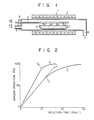
- the hydrogen reduction of gallium phosphate may be performed by, for example, an apparatus as shown in Fig. 1 according to the method described in Japanese Patent Publication (KOKOKU) NO. 13,880/79.
- the apparatus shown in Fig. 1 has a furnace 1 in which is arranged a reaction tube 2.
- a heat-resistant stop 3 closes one end of the reaction tube 2.
- Through the stop 3 extend a main supply tube 4 for introducing hydrogen gas and an auxiliary supply tube 5 made of quartz which extends to the central portion of the reaction tube 2.
- a plurality of holes 5a are formed through the lower surface of the auxiliary tube 5 along the longitudinal direction thereof to provide a hydrogen gas shower in order to facilitate the reaction between hydrogen and gallium phosphate 7 placed in a boat 6.
- the hydrogen gas introduced into the reaction tube 2 through the main supply tube 4 and the hydrogen gas introduced through the auxiliary supply tube 5 are mixed together above the gallium phosphate 7 in the boat 6 and contacted to react with the gallium phosphate.
- the hydrogen gas and gallium phosphide are reacted react at a temperature of 750 to 1,050°C.
- the unreacted hydrogen gas serves as a carrier for the reaction products except the gallium phosphide, such as hydrogen phosphide and H 2 0 vapor and is exhausted through an outlet port 8.
- the flow rate of the hydrogen gas is 1,500 to 3,000 i/h.
- the reduction of the gallium phosphate is a time-consuming procedure particularly when the flow rate of the hydrogen gas is small.
- the present inventors conducted the following experiments in order to determine the cause of this phenomenon.
- Gallium phosphate in the amount of 1 kg was placed on a semicylindrical boat of 500 mm length in a reaction tube of 80 mm inner diameter, and reduction was performed at 900°C.
- the ratio of the flow rate of the hydrogen gas through the main supply tube 4 to the flow rate of the hydrogen gas through the auxiliary tube 5 was set to be 4 : 1.
- Reduction was performed when the total flow rate of the hydrogen gas was 3,000 Q/h and 1,500 Z/h for the purpose of comparison. The relationship between the percent reduction and reduction time was examined.
- Fig. 2 The results are shown in Fig. 2. The percent reduction here was calculated in the weight ratio in percent of the raw material gallium phosphate to gallium phosphide.
- curve a represents the case wherein the total flow rate of the hydrogen gas was 3,000 k/h and curve b represents the case wherein the total flow rate of the hydrogen gas was 1,500 i/h.
- the reduction first progressed linearly. However, the reduction then started to taper off and form a saturated curve. As the reduction progressed, the reaction products were bound and formed secondary particles. The reaction products obtained during the initial period of the reaction were weakly bound together and were easy to separate by sieving through a sieve of predetermined mesh. However, the secondary particles grew larger and were strongly bound. The reaction products after turning points TA and TB did not easily pass through the sieve of predetermined mesh.
- the reason why these turning points appear on the curves during the course of the reduction may be considered to be attributable to a change in the rate-limiting mechanism of the reduction. However, the details are not yet clear.
- the region before the turning point during the course of reduction will be referred to as the surface layer reduction region, and the region after the turning point will be referred to as the inner layer reduction region.
- the surface layer reduction region As is apparent from Fig. 2, when the flow rate of the hydrogen gas is reduced from 3,000 Q/h to 1,500 i/h, the surface layer reducing rate becomes less, and the reaction progresses into the inner layer reduction region wherein the reaction progresses more slowly before the reduction is terminated.
- the reaction products were then sieved through a sieve of about 100 pm mesh for agitation.
- the re-reduction was then performed under the same condition as the first reduction.
- the re-reduction progressed linearly as represented by curve c in Fig. 2.
- the reduction was completed after about 5 hours.
- the reduction time may thus be significantly reduced by agitating the reaction products at least once during the hydrogen reduction.
- the reduction conditions may be varied before and after the agitation.
- the reduction is terminated and the reaction products are taken from the furnace when the residual amount of the phosphate radicals in the gallium phosphide powder is within the range of 0.03 to 0.5% by weight.
- the starting raw material of the present invention is prepared.
- the form of the residual phosphate radicals in the reduced GaP is not clear. However, it was impossible to manufacture GaP single crystals of satisfactory quality from the starting raw material which was a mixture of pure GaP and phosphoric acid or gallium phosphate in a mixing ratio such that the content of PO 4 may be 0.03 to 0.5% by weight.
- the amount of the residual phosphate radicals can be measured by the molybdenum blue absorptiometry.
- the amount of the residual phosphate radicals in the GaP powder is below 0.03% by weight, the effects of the present invention may not be obtained and the GaP powder becomes attached to the inner wall nf the crucible during the melting process.
- the amount of the phosphate radicals exceeds 0.5% by weight, the radicals are present at the interface of the encapsulating agent liquid and the GaP liquid, frequently resulting in the formation of polycrystalline GaP.
- the preferable amount of the residual phosphate radicals is 0.05 to 0.1% by weight.
- the starting raw material thus prepared is compressed to prepare a green compact to increase the bulk density.
- the bulk density of the green compact is generally about 2.0 g/cc or more and is, in most cases, about 2.0 to 3.0 g/cc. If the bulk density is below 2.0 g/cc, when the encapsulating agent is placed on the green compact and is melted, the encapsulating agent liquid permeates into the green compact, and the GaP powder and the encapsulating agent cannot be separated from each other.
- the green compact may be obtained by a known method such as the isotropic rubber press method.
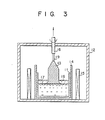
- the single crystal is grown by an apparatus as shown in Fig. 3 according to the conventional method and conditions.
- the apparatus shown in Fig. 3 has a pressure-resistant vessel 12 in which is arranged a crucible 11 as held in a susceptor 14.
- a heater 15 surrounds the susceptor 14.
- a pulling shaft 16 extends through the upper wall of the pressure-resistant vessel 12, and a seed crystal 19 is attached to the tip of the pulling shaft 16.
- the starting raw material, formed into a green compact, is placed in the crucible 11 and an inert transparent glass of low vapor pressure such as B 2 0 3 is placed thereover as an encapsulating agent.
- the interior of the pressure-resistant vessel 12 is pressurized by an inert gas such as nitrogen gas.
- the encapsulating agent having a lower melting point melts first and is converted to a transparent encapsulating agent liquid 18 to cover the green compact of GaP raw material. Heating is further performed to melt the GaP raw material to provide a GaP liquid 17.
- the encapsulating agent liquid 18 and the GaP liquid 17 are separated into two separate layers due to the difference in their specific gravities; the encapsulating agent liquid 18 covers the GaP liquid 17.
- the seed crystal 19 is brought into contact with the GaP liquid 17 through the encapsulating agent liquid 17. While keeping good contact between the seed crystal 19 and the GaP liquid 17, the pulling shaft 16 is rotated while being slowly pulled up. Then, the GaP liquid 17 is solidified to grow a GaP single crystal 13.
- the bulk density of the obtained GaP powder was about 1.1 g/cc.
- this GaP powder was isotropically pressed at a pressure of about 2,000 kg/cm 2
- the bulk density of the pressed polycrystalline raw material was 2.2 g/cc.
- This polycrystalline starting material was placed in the crucible.
- the bulk density after filling was also about 2.2 g/cc.
- B 2 0 3 was placed over the polycrystalline starting raw material, and melting was performed according to the predetermined method in a high-pressure vessel. The B 2 0 3 which has the lower melting point melted first. It was then confirmed that the B 2 0 3 liquid layer covered the GaP powder layer in separate layers.
- the GaP powder layer melted down and the GaP liquid layer was covered by the B 2 0 3 liquid layer in separate layers. During this melting process, the attachment of the GaP powder to the wall surface of the crucible was not observed which is common when the conventional GaP powder is used. The surfaces of the B203 liquid layer and the GaP liquid layer were clean.
- the seed crystal was brought into contact with the GaP liquid layer through the B 2 0 3 liquid layer according to the predetermined method to complete the pulling of a single crystal. As a result, a complete single crystal was obtained which did not contain subgrains.
- an inexpensive GaP single crystal may be manufactured in a simple manner and with good yield, providing a method which is industrially advantageous.
Landscapes
- Chemical & Material Sciences (AREA)
- Organic Chemistry (AREA)
- Engineering & Computer Science (AREA)
- Crystallography & Structural Chemistry (AREA)
- Materials Engineering (AREA)
- Metallurgy (AREA)
- Inorganic Chemistry (AREA)
- Crystals, And After-Treatments Of Crystals (AREA)
Applications Claiming Priority (4)
| Application Number | Priority Date | Filing Date | Title |
|---|---|---|---|
| JP4592/81 | 1981-01-17 | ||
| JP459281A JPS6012320B2 (ja) | 1981-01-17 | 1981-01-17 | GaP単結晶の製造方法 |
| JP141296/81 | 1981-09-08 | ||
| JP56141296A JPS5843581A (ja) | 1981-09-08 | 1981-09-08 | りん化ガリウム多結晶の製造方法 |
Publications (3)
| Publication Number | Publication Date |
|---|---|
| EP0056586A2 true EP0056586A2 (de) | 1982-07-28 |
| EP0056586A3 EP0056586A3 (en) | 1982-08-04 |
| EP0056586B1 EP0056586B1 (de) | 1984-08-01 |
Family
ID=26338399
Family Applications (1)
| Application Number | Title | Priority Date | Filing Date |
|---|---|---|---|
| EP82100073A Expired EP0056586B1 (de) | 1981-01-17 | 1982-01-07 | Verfahren zur Herstellung von Einkristallen aus Galliumphosphid |
Country Status (5)
| Country | Link |
|---|---|
| US (1) | US4431476A (de) |
| EP (1) | EP0056586B1 (de) |
| DD (1) | DD207938A5 (de) |
| DE (1) | DE3260469D1 (de) |
| PL (1) | PL137175B1 (de) |
Cited By (1)
| Publication number | Priority date | Publication date | Assignee | Title |
|---|---|---|---|---|
| US4816240A (en) * | 1985-03-28 | 1989-03-28 | Kabushiki Kaisha Toshiba | Method of synthesizing Group III element-phosphorus compound |
Families Citing this family (5)
| Publication number | Priority date | Publication date | Assignee | Title |
|---|---|---|---|---|
| JPS60251191A (ja) * | 1984-05-25 | 1985-12-11 | Res Dev Corp Of Japan | 高解離圧化合物単結晶成長方法 |
| JPS623096A (ja) * | 1985-06-27 | 1987-01-09 | Res Dev Corp Of Japan | 高解離圧化合物半導体単結晶成長方法 |
| US4721539A (en) * | 1986-07-15 | 1988-01-26 | The United States Of America As Represented By The United States Department Of Energy | Large single crystal quaternary alloys of IB-IIIA-SE2 and methods of synthesizing the same |
| US4824520A (en) * | 1987-03-19 | 1989-04-25 | The United States Of America As Represented By The Administrator Of The National Aeronautics And Space Administration | Liquid encapsulated crystal growth |
| US5078830A (en) * | 1989-04-10 | 1992-01-07 | Mitsubishi Metal Corporation | Method for growing single crystal |
Family Cites Families (4)
| Publication number | Priority date | Publication date | Assignee | Title |
|---|---|---|---|---|
| US3647389A (en) * | 1970-05-11 | 1972-03-07 | Bell Telephone Labor Inc | Method of group iii-v semiconductor crystal growth using getter dried boric oxide encapsulant |
| JPS6024078B2 (ja) * | 1977-09-05 | 1985-06-11 | 株式会社東芝 | 3−5族化合物半導体単結晶の製造装置 |
| JPS6028800B2 (ja) * | 1977-10-17 | 1985-07-06 | 住友電気工業株式会社 | 低欠陥密度りん化ガリウム単結晶 |
| JPS55136109A (en) * | 1979-04-05 | 1980-10-23 | Toshiba Corp | Production of gap |
-
1982
- 1982-01-04 US US06/336,701 patent/US4431476A/en not_active Expired - Lifetime
- 1982-01-07 EP EP82100073A patent/EP0056586B1/de not_active Expired
- 1982-01-07 DE DE8282100073T patent/DE3260469D1/de not_active Expired
- 1982-01-15 PL PL1982234725A patent/PL137175B1/pl unknown
- 1982-01-15 DD DD82236800A patent/DD207938A5/de unknown
Cited By (1)
| Publication number | Priority date | Publication date | Assignee | Title |
|---|---|---|---|---|
| US4816240A (en) * | 1985-03-28 | 1989-03-28 | Kabushiki Kaisha Toshiba | Method of synthesizing Group III element-phosphorus compound |
Also Published As
| Publication number | Publication date |
|---|---|
| EP0056586B1 (de) | 1984-08-01 |
| PL234725A1 (de) | 1982-09-13 |
| EP0056586A3 (en) | 1982-08-04 |
| DD207938A5 (de) | 1984-03-21 |
| PL137175B1 (en) | 1986-05-31 |
| DE3260469D1 (en) | 1984-09-06 |
| US4431476A (en) | 1984-02-14 |
Similar Documents
| Publication | Publication Date | Title |
|---|---|---|
| US5515810A (en) | Method and apparatus for manufacturing semi-insulation GaAs monocrystal | |
| DE69609782T2 (de) | Verfahren zur Herstellung einer Siliziumschmelze von einem polykristallinen Siliziumchargiergut | |
| EP0056586B1 (de) | Verfahren zur Herstellung von Einkristallen aus Galliumphosphid | |
| DE112014000677T5 (de) | Verfahren zur Herstellung von Siliziumkarbid und Siliziumkarbid | |
| US3367394A (en) | Process for manufacturing homogeneous bodies of germanium-silicon | |
| JP2779188B2 (ja) | 高い純度のドーピング合金 | |
| JP3707110B2 (ja) | 化合物半導体単結晶の育成方法 | |
| US4119704A (en) | Process for making gallium arsenide or phosphide | |
| JPH06128096A (ja) | 化合物半導体多結晶の製造方法 | |
| KR0166367B1 (ko) | 폴리실리콘 및 이의 제조방법 | |
| JPS5918191A (ja) | シリコン単結晶の製造方法 | |
| JPS5747795A (en) | Manufacture of mixed single crystal | |
| JPH11116393A (ja) | 無機フッ化物単結晶の育成方法 | |
| JP2000154088A (ja) | 単結晶製造方法および装置 | |
| JPS6051697A (ja) | 化合物半導体の製造方法 | |
| Talyzin et al. | The Preparation and Properties of Indium Phosphide | |
| JP2005112685A (ja) | 化合物半導体単結晶の製造方法、化合物半導体単結晶、及びその製造装置 | |
| JPS6278196A (ja) | ニオブ酸リチウム単結晶の製造方法 | |
| JPS6424097A (en) | Production of iii-v compound semiconductor single crystal | |
| JPS60264392A (ja) | 3−v族半絶縁性単結晶の製造方法 | |
| JPS6252945B2 (de) | ||
| JPS6054993A (ja) | 半導体単結晶育成方法 | |
| JPS57123889A (en) | Preparation of single crystal | |
| JPS54128990A (en) | Growing method for single crystal of gallium phosphide | |
| JPH0925104A (ja) | 金属硫化物の製造方法 |
Legal Events
| Date | Code | Title | Description |
|---|---|---|---|
| PUAI | Public reference made under article 153(3) epc to a published international application that has entered the european phase |
Free format text: ORIGINAL CODE: 0009012 |
|
| PUAL | Search report despatched |
Free format text: ORIGINAL CODE: 0009013 |
|
| 17P | Request for examination filed |
Effective date: 19820203 |
|
| AK | Designated contracting states |
Designated state(s): DE FR GB NL |
|
| AK | Designated contracting states |
Designated state(s): DE FR GB NL |
|
| GRAA | (expected) grant |
Free format text: ORIGINAL CODE: 0009210 |
|
| AK | Designated contracting states |
Designated state(s): DE FR GB NL |
|
| PG25 | Lapsed in a contracting state [announced via postgrant information from national office to epo] |
Ref country code: NL Effective date: 19840801 |
|
| REF | Corresponds to: |
Ref document number: 3260469 Country of ref document: DE Date of ref document: 19840906 |
|
| RAP2 | Party data changed (patent owner data changed or rights of a patent transferred) |
Owner name: KABUSHIKI KAISHA TOSHIBA |
|
| ET | Fr: translation filed | ||
| NLV1 | Nl: lapsed or annulled due to failure to fulfill the requirements of art. 29p and 29m of the patents act | ||
| REG | Reference to a national code |
Ref country code: FR Ref legal event code: CD |
|
| PLBE | No opposition filed within time limit |
Free format text: ORIGINAL CODE: 0009261 |
|
| STAA | Information on the status of an ep patent application or granted ep patent |
Free format text: STATUS: NO OPPOSITION FILED WITHIN TIME LIMIT |
|
| 26N | No opposition filed | ||
| REG | Reference to a national code |
Ref country code: GB Ref legal event code: 746 |
|
| REG | Reference to a national code |
Ref country code: FR Ref legal event code: D6 |
|
| REG | Reference to a national code |
Ref country code: FR Ref legal event code: ER Free format text: ERRATUM: LICENCE OF RIGHT ACCEPTED |
|
| PGFP | Annual fee paid to national office [announced via postgrant information from national office to epo] |
Ref country code: DE Payment date: 20010102 Year of fee payment: 20 |
|
| PGFP | Annual fee paid to national office [announced via postgrant information from national office to epo] |
Ref country code: GB Payment date: 20010103 Year of fee payment: 20 |
|
| PGFP | Annual fee paid to national office [announced via postgrant information from national office to epo] |
Ref country code: FR Payment date: 20010125 Year of fee payment: 20 |
|
| REG | Reference to a national code |
Ref country code: GB Ref legal event code: IF02 |
|
| PG25 | Lapsed in a contracting state [announced via postgrant information from national office to epo] |
Ref country code: GB Free format text: LAPSE BECAUSE OF EXPIRATION OF PROTECTION Effective date: 20020106 |
|
| REG | Reference to a national code |
Ref country code: GB Ref legal event code: PE20 Effective date: 20020106 |