EP0050794B2 - Übertragbare Lackfolie sowie Verfahren zu ihrer Herstellung - Google Patents
Übertragbare Lackfolie sowie Verfahren zu ihrer Herstellung Download PDFInfo
- Publication number
- EP0050794B2 EP0050794B2 EP81108299A EP81108299A EP0050794B2 EP 0050794 B2 EP0050794 B2 EP 0050794B2 EP 81108299 A EP81108299 A EP 81108299A EP 81108299 A EP81108299 A EP 81108299A EP 0050794 B2 EP0050794 B2 EP 0050794B2
- Authority
- EP
- European Patent Office
- Prior art keywords
- layer
- lacquer
- adhesive
- paint
- film
- Prior art date
- Legal status (The legal status is an assumption and is not a legal conclusion. Google has not performed a legal analysis and makes no representation as to the accuracy of the status listed.)
- Expired
Links
- 239000004922 lacquer Substances 0.000 title claims description 43
- 238000004519 manufacturing process Methods 0.000 title claims description 9
- 239000010410 layer Substances 0.000 claims abstract description 127
- 238000000034 method Methods 0.000 claims abstract description 25
- 239000012790 adhesive layer Substances 0.000 claims abstract description 21
- 229920001296 polysiloxane Polymers 0.000 claims abstract description 14
- 239000004925 Acrylic resin Substances 0.000 claims abstract description 10
- -1 dimethyl-siloxane Chemical class 0.000 claims abstract description 7
- 239000011248 coating agent Substances 0.000 claims abstract 4
- 238000000576 coating method Methods 0.000 claims abstract 4
- 239000000853 adhesive Substances 0.000 claims description 27
- 230000001070 adhesive effect Effects 0.000 claims description 26
- 238000001035 drying Methods 0.000 claims description 18
- 239000002904 solvent Substances 0.000 claims description 16
- 239000000203 mixture Substances 0.000 claims description 5
- 229920006267 polyester film Polymers 0.000 claims description 4
- 229920000139 polyethylene terephthalate Polymers 0.000 claims description 3
- 239000005020 polyethylene terephthalate Substances 0.000 claims description 3
- NIXOWILDQLNWCW-UHFFFAOYSA-M Acrylate Chemical compound [O-]C(=O)C=C NIXOWILDQLNWCW-UHFFFAOYSA-M 0.000 claims description 2
- 239000002253 acid Substances 0.000 claims description 2
- 125000004432 carbon atom Chemical group C* 0.000 claims description 2
- 238000003825 pressing Methods 0.000 claims description 2
- 230000003472 neutralizing effect Effects 0.000 claims 7
- 239000001993 wax Substances 0.000 claims 2
- 125000003178 carboxy group Chemical group [H]OC(*)=O 0.000 claims 1
- 235000013869 carnauba wax Nutrition 0.000 claims 1
- 239000004203 carnauba wax Substances 0.000 claims 1
- 125000001183 hydrocarbyl group Chemical group 0.000 claims 1
- 239000003973 paint Substances 0.000 abstract description 56
- 229920000178 Acrylic resin Polymers 0.000 abstract description 9
- 238000006386 neutralization reaction Methods 0.000 abstract description 8
- 210000003298 dental enamel Anatomy 0.000 abstract description 7
- 239000002320 enamel (paints) Substances 0.000 abstract 1
- 239000000463 material Substances 0.000 description 13
- 239000000243 solution Substances 0.000 description 9
- 239000007921 spray Substances 0.000 description 9
- 238000005507 spraying Methods 0.000 description 7
- 238000007639 printing Methods 0.000 description 6
- YXFVVABEGXRONW-UHFFFAOYSA-N Toluene Chemical compound CC1=CC=CC=C1 YXFVVABEGXRONW-UHFFFAOYSA-N 0.000 description 5
- 239000003292 glue Substances 0.000 description 5
- 230000008439 repair process Effects 0.000 description 5
- 239000002966 varnish Substances 0.000 description 5
- XEKOWRVHYACXOJ-UHFFFAOYSA-N Ethyl acetate Chemical compound CCOC(C)=O XEKOWRVHYACXOJ-UHFFFAOYSA-N 0.000 description 4
- KPUWHANPEXNPJT-UHFFFAOYSA-N disiloxane Chemical class [SiH3]O[SiH3] KPUWHANPEXNPJT-UHFFFAOYSA-N 0.000 description 4
- 238000001704 evaporation Methods 0.000 description 4
- 230000008020 evaporation Effects 0.000 description 4
- 239000012948 isocyanate Substances 0.000 description 4
- 150000002513 isocyanates Chemical class 0.000 description 4
- 238000007650 screen-printing Methods 0.000 description 4
- MLFHJEHSLIIPHL-UHFFFAOYSA-N isoamyl acetate Chemical compound CC(C)CCOC(C)=O MLFHJEHSLIIPHL-UHFFFAOYSA-N 0.000 description 3
- 239000011347 resin Substances 0.000 description 3
- 229920005989 resin Polymers 0.000 description 3
- 239000011345 viscous material Substances 0.000 description 3
- XEEYBQQBJWHFJM-UHFFFAOYSA-N Iron Chemical compound [Fe] XEEYBQQBJWHFJM-UHFFFAOYSA-N 0.000 description 2
- 239000000020 Nitrocellulose Substances 0.000 description 2
- 239000004840 adhesive resin Substances 0.000 description 2
- 229920006223 adhesive resin Polymers 0.000 description 2
- 230000015572 biosynthetic process Effects 0.000 description 2
- 238000006243 chemical reaction Methods 0.000 description 2
- 230000000694 effects Effects 0.000 description 2
- 239000000976 ink Substances 0.000 description 2
- 239000002184 metal Substances 0.000 description 2
- 229910052751 metal Inorganic materials 0.000 description 2
- 229920001220 nitrocellulos Polymers 0.000 description 2
- 238000010422 painting Methods 0.000 description 2
- 239000007787 solid Substances 0.000 description 2
- 238000009423 ventilation Methods 0.000 description 2
- 239000002023 wood Substances 0.000 description 2
- 208000023514 Barrett esophagus Diseases 0.000 description 1
- OWIKHYCFFJSOEH-UHFFFAOYSA-N Isocyanic acid Chemical compound N=C=O OWIKHYCFFJSOEH-UHFFFAOYSA-N 0.000 description 1
- 239000004743 Polypropylene Substances 0.000 description 1
- 239000004820 Pressure-sensitive adhesive Substances 0.000 description 1
- 241000779819 Syncarpia glomulifera Species 0.000 description 1
- KBAYQFWFCOOCIC-GNVSMLMZSA-N [(1s,4ar,4bs,7s,8ar,10ar)-1,4a-dimethyl-7-propan-2-yl-2,3,4,4b,5,6,7,8,8a,9,10,10a-dodecahydrophenanthren-1-yl]methanol Chemical compound OC[C@@]1(C)CCC[C@]2(C)[C@H]3CC[C@H](C(C)C)C[C@H]3CC[C@H]21 KBAYQFWFCOOCIC-GNVSMLMZSA-N 0.000 description 1
- 125000005396 acrylic acid ester group Chemical group 0.000 description 1
- 150000001338 aliphatic hydrocarbons Chemical class 0.000 description 1
- 229920000180 alkyd Polymers 0.000 description 1
- 238000004873 anchoring Methods 0.000 description 1
- 150000004945 aromatic hydrocarbons Chemical class 0.000 description 1
- 239000003849 aromatic solvent Substances 0.000 description 1
- 238000009835 boiling Methods 0.000 description 1
- 239000007795 chemical reaction product Substances 0.000 description 1
- 238000001816 cooling Methods 0.000 description 1
- 238000004132 cross linking Methods 0.000 description 1
- 238000005520 cutting process Methods 0.000 description 1
- MALGCDOKXMEUNO-UHFFFAOYSA-N cyanic acid;prop-2-enoic acid Chemical compound OC#N.OC(=O)C=C MALGCDOKXMEUNO-UHFFFAOYSA-N 0.000 description 1
- 238000004090 dissolution Methods 0.000 description 1
- 230000020169 heat generation Effects 0.000 description 1
- 238000010438 heat treatment Methods 0.000 description 1
- 150000002430 hydrocarbons Chemical group 0.000 description 1
- 229910052500 inorganic mineral Inorganic materials 0.000 description 1
- 238000009434 installation Methods 0.000 description 1
- 229910052742 iron Inorganic materials 0.000 description 1
- 229940117955 isoamyl acetate Drugs 0.000 description 1
- 238000002372 labelling Methods 0.000 description 1
- 150000002605 large molecules Chemical class 0.000 description 1
- 239000007788 liquid Substances 0.000 description 1
- 229920002521 macromolecule Polymers 0.000 description 1
- 238000002844 melting Methods 0.000 description 1
- 230000008018 melting Effects 0.000 description 1
- 239000013528 metallic particle Substances 0.000 description 1
- 239000011707 mineral Substances 0.000 description 1
- 239000003595 mist Substances 0.000 description 1
- 125000000896 monocarboxylic acid group Chemical group 0.000 description 1
- 230000003287 optical effect Effects 0.000 description 1
- 239000001739 pinus spp. Substances 0.000 description 1
- 239000011505 plaster Substances 0.000 description 1
- 239000004033 plastic Substances 0.000 description 1
- 229920003023 plastic Polymers 0.000 description 1
- 239000004014 plasticizer Substances 0.000 description 1
- 238000006116 polymerization reaction Methods 0.000 description 1
- 229920001155 polypropylene Polymers 0.000 description 1
- 239000004540 pour-on Substances 0.000 description 1
- 238000004321 preservation Methods 0.000 description 1
- 239000000047 product Substances 0.000 description 1
- 230000001681 protective effect Effects 0.000 description 1
- 239000011241 protective layer Substances 0.000 description 1
- 238000000926 separation method Methods 0.000 description 1
- 235000015096 spirit Nutrition 0.000 description 1
- 230000003068 static effect Effects 0.000 description 1
- 229940036248 turpentine Drugs 0.000 description 1
- 230000000007 visual effect Effects 0.000 description 1
Images
Classifications
-
- B—PERFORMING OPERATIONS; TRANSPORTING
- B05—SPRAYING OR ATOMISING IN GENERAL; APPLYING FLUENT MATERIALS TO SURFACES, IN GENERAL
- B05D—PROCESSES FOR APPLYING FLUENT MATERIALS TO SURFACES, IN GENERAL
- B05D7/00—Processes, other than flocking, specially adapted for applying liquids or other fluent materials to particular surfaces or for applying particular liquids or other fluent materials
-
- B—PERFORMING OPERATIONS; TRANSPORTING
- B05—SPRAYING OR ATOMISING IN GENERAL; APPLYING FLUENT MATERIALS TO SURFACES, IN GENERAL
- B05D—PROCESSES FOR APPLYING FLUENT MATERIALS TO SURFACES, IN GENERAL
- B05D1/00—Processes for applying liquids or other fluent materials
- B05D1/28—Processes for applying liquids or other fluent materials performed by transfer from the surfaces of elements carrying the liquid or other fluent material, e.g. brushes, pads, rollers
-
- B—PERFORMING OPERATIONS; TRANSPORTING
- B44—DECORATIVE ARTS
- B44C—PRODUCING DECORATIVE EFFECTS; MOSAICS; TARSIA WORK; PAPERHANGING
- B44C1/00—Processes, not specifically provided for elsewhere, for producing decorative surface effects
- B44C1/16—Processes, not specifically provided for elsewhere, for producing decorative surface effects for applying transfer pictures or the like
- B44C1/165—Processes, not specifically provided for elsewhere, for producing decorative surface effects for applying transfer pictures or the like for decalcomanias; sheet material therefor
- B44C1/17—Dry transfer
- B44C1/1733—Decalcomanias applied under pressure only, e.g. provided with a pressure sensitive adhesive
- B44C1/1737—Decalcomanias provided with a particular decorative layer, e.g. specially adapted to allow the formation of a metallic or dyestuff on a substrate unsuitable for direct deposition
-
- B—PERFORMING OPERATIONS; TRANSPORTING
- B44—DECORATIVE ARTS
- B44C—PRODUCING DECORATIVE EFFECTS; MOSAICS; TARSIA WORK; PAPERHANGING
- B44C1/00—Processes, not specifically provided for elsewhere, for producing decorative surface effects
- B44C1/16—Processes, not specifically provided for elsewhere, for producing decorative surface effects for applying transfer pictures or the like
- B44C1/165—Processes, not specifically provided for elsewhere, for producing decorative surface effects for applying transfer pictures or the like for decalcomanias; sheet material therefor
- B44C1/17—Dry transfer
- B44C1/1733—Decalcomanias applied under pressure only, e.g. provided with a pressure sensitive adhesive
- B44C1/1741—Decalcomanias provided with a layer being specially adapted to facilitate their release from a temporary carrier
-
- Y—GENERAL TAGGING OF NEW TECHNOLOGICAL DEVELOPMENTS; GENERAL TAGGING OF CROSS-SECTIONAL TECHNOLOGIES SPANNING OVER SEVERAL SECTIONS OF THE IPC; TECHNICAL SUBJECTS COVERED BY FORMER USPC CROSS-REFERENCE ART COLLECTIONS [XRACs] AND DIGESTS
- Y10—TECHNICAL SUBJECTS COVERED BY FORMER USPC
- Y10S—TECHNICAL SUBJECTS COVERED BY FORMER USPC CROSS-REFERENCE ART COLLECTIONS [XRACs] AND DIGESTS
- Y10S428/00—Stock material or miscellaneous articles
- Y10S428/914—Transfer or decalcomania
-
- Y—GENERAL TAGGING OF NEW TECHNOLOGICAL DEVELOPMENTS; GENERAL TAGGING OF CROSS-SECTIONAL TECHNOLOGIES SPANNING OVER SEVERAL SECTIONS OF THE IPC; TECHNICAL SUBJECTS COVERED BY FORMER USPC CROSS-REFERENCE ART COLLECTIONS [XRACs] AND DIGESTS
- Y10—TECHNICAL SUBJECTS COVERED BY FORMER USPC
- Y10T—TECHNICAL SUBJECTS COVERED BY FORMER US CLASSIFICATION
- Y10T428/00—Stock material or miscellaneous articles
- Y10T428/24—Structurally defined web or sheet [e.g., overall dimension, etc.]
- Y10T428/24802—Discontinuous or differential coating, impregnation or bond [e.g., artwork, printing, retouched photograph, etc.]
- Y10T428/24851—Intermediate layer is discontinuous or differential
-
- Y—GENERAL TAGGING OF NEW TECHNOLOGICAL DEVELOPMENTS; GENERAL TAGGING OF CROSS-SECTIONAL TECHNOLOGIES SPANNING OVER SEVERAL SECTIONS OF THE IPC; TECHNICAL SUBJECTS COVERED BY FORMER USPC CROSS-REFERENCE ART COLLECTIONS [XRACs] AND DIGESTS
- Y10—TECHNICAL SUBJECTS COVERED BY FORMER USPC
- Y10T—TECHNICAL SUBJECTS COVERED BY FORMER US CLASSIFICATION
- Y10T428/00—Stock material or miscellaneous articles
- Y10T428/24—Structurally defined web or sheet [e.g., overall dimension, etc.]
- Y10T428/24802—Discontinuous or differential coating, impregnation or bond [e.g., artwork, printing, retouched photograph, etc.]
- Y10T428/24851—Intermediate layer is discontinuous or differential
- Y10T428/2486—Intermediate layer is discontinuous or differential with outer strippable or release layer
-
- Y—GENERAL TAGGING OF NEW TECHNOLOGICAL DEVELOPMENTS; GENERAL TAGGING OF CROSS-SECTIONAL TECHNOLOGIES SPANNING OVER SEVERAL SECTIONS OF THE IPC; TECHNICAL SUBJECTS COVERED BY FORMER USPC CROSS-REFERENCE ART COLLECTIONS [XRACs] AND DIGESTS
- Y10—TECHNICAL SUBJECTS COVERED BY FORMER USPC
- Y10T—TECHNICAL SUBJECTS COVERED BY FORMER US CLASSIFICATION
- Y10T428/00—Stock material or miscellaneous articles
- Y10T428/28—Web or sheet containing structurally defined element or component and having an adhesive outermost layer
- Y10T428/2839—Web or sheet containing structurally defined element or component and having an adhesive outermost layer with release or antistick coating
-
- Y—GENERAL TAGGING OF NEW TECHNOLOGICAL DEVELOPMENTS; GENERAL TAGGING OF CROSS-SECTIONAL TECHNOLOGIES SPANNING OVER SEVERAL SECTIONS OF THE IPC; TECHNICAL SUBJECTS COVERED BY FORMER USPC CROSS-REFERENCE ART COLLECTIONS [XRACs] AND DIGESTS
- Y10—TECHNICAL SUBJECTS COVERED BY FORMER USPC
- Y10T—TECHNICAL SUBJECTS COVERED BY FORMER US CLASSIFICATION
- Y10T428/00—Stock material or miscellaneous articles
- Y10T428/28—Web or sheet containing structurally defined element or component and having an adhesive outermost layer
- Y10T428/2843—Web or sheet containing structurally defined element or component and having an adhesive outermost layer including a primer layer
-
- Y—GENERAL TAGGING OF NEW TECHNOLOGICAL DEVELOPMENTS; GENERAL TAGGING OF CROSS-SECTIONAL TECHNOLOGIES SPANNING OVER SEVERAL SECTIONS OF THE IPC; TECHNICAL SUBJECTS COVERED BY FORMER USPC CROSS-REFERENCE ART COLLECTIONS [XRACs] AND DIGESTS
- Y10—TECHNICAL SUBJECTS COVERED BY FORMER USPC
- Y10T—TECHNICAL SUBJECTS COVERED BY FORMER US CLASSIFICATION
- Y10T428/00—Stock material or miscellaneous articles
- Y10T428/28—Web or sheet containing structurally defined element or component and having an adhesive outermost layer
- Y10T428/2848—Three or more layers
-
- Y—GENERAL TAGGING OF NEW TECHNOLOGICAL DEVELOPMENTS; GENERAL TAGGING OF CROSS-SECTIONAL TECHNOLOGIES SPANNING OVER SEVERAL SECTIONS OF THE IPC; TECHNICAL SUBJECTS COVERED BY FORMER USPC CROSS-REFERENCE ART COLLECTIONS [XRACs] AND DIGESTS
- Y10—TECHNICAL SUBJECTS COVERED BY FORMER USPC
- Y10T—TECHNICAL SUBJECTS COVERED BY FORMER US CLASSIFICATION
- Y10T428/00—Stock material or miscellaneous articles
- Y10T428/31504—Composite [nonstructural laminate]
- Y10T428/31551—Of polyamidoester [polyurethane, polyisocyanate, polycarbamate, etc.]
- Y10T428/31554—Next to second layer of polyamidoester
-
- Y—GENERAL TAGGING OF NEW TECHNOLOGICAL DEVELOPMENTS; GENERAL TAGGING OF CROSS-SECTIONAL TECHNOLOGIES SPANNING OVER SEVERAL SECTIONS OF THE IPC; TECHNICAL SUBJECTS COVERED BY FORMER USPC CROSS-REFERENCE ART COLLECTIONS [XRACs] AND DIGESTS
- Y10—TECHNICAL SUBJECTS COVERED BY FORMER USPC
- Y10T—TECHNICAL SUBJECTS COVERED BY FORMER US CLASSIFICATION
- Y10T428/00—Stock material or miscellaneous articles
- Y10T428/31504—Composite [nonstructural laminate]
- Y10T428/31652—Of asbestos
- Y10T428/31663—As siloxane, silicone or silane
-
- Y—GENERAL TAGGING OF NEW TECHNOLOGICAL DEVELOPMENTS; GENERAL TAGGING OF CROSS-SECTIONAL TECHNOLOGIES SPANNING OVER SEVERAL SECTIONS OF THE IPC; TECHNICAL SUBJECTS COVERED BY FORMER USPC CROSS-REFERENCE ART COLLECTIONS [XRACs] AND DIGESTS
- Y10—TECHNICAL SUBJECTS COVERED BY FORMER USPC
- Y10T—TECHNICAL SUBJECTS COVERED BY FORMER US CLASSIFICATION
- Y10T428/00—Stock material or miscellaneous articles
- Y10T428/31504—Composite [nonstructural laminate]
- Y10T428/31801—Of wax or waxy material
-
- Y—GENERAL TAGGING OF NEW TECHNOLOGICAL DEVELOPMENTS; GENERAL TAGGING OF CROSS-SECTIONAL TECHNOLOGIES SPANNING OVER SEVERAL SECTIONS OF THE IPC; TECHNICAL SUBJECTS COVERED BY FORMER USPC CROSS-REFERENCE ART COLLECTIONS [XRACs] AND DIGESTS
- Y10—TECHNICAL SUBJECTS COVERED BY FORMER USPC
- Y10T—TECHNICAL SUBJECTS COVERED BY FORMER US CLASSIFICATION
- Y10T428/00—Stock material or miscellaneous articles
- Y10T428/31504—Composite [nonstructural laminate]
- Y10T428/31855—Of addition polymer from unsaturated monomers
- Y10T428/31909—Next to second addition polymer from unsaturated monomers
Definitions
- the invention relates to a method for producing a transferable lacquer film according to the preamble of patent claim 1.
- Paint films for touching up paint on motor vehicles and processes for their production are known (GB-PS 12 32 971).
- a carrier film is provided on which a solution layer consisting of 23 parts of nitrocellulose, 80 parts of solvents, 2 parts of plasticizer and 10 parts of alkyd resin is applied.
- a nitrocellulose lacquer is applied to this layer, which in turn is provided with a customary pressure-sensitive adhesive after drying.
- the lacquer film produced in this way can be cut out accordingly and brought with the adhesive side down over a damaged lacquer spot on the motor vehicle and stuck on under pressure.
- the carrier film is then peeled off.
- So-called tracing materials (NL-PS 123 093) are also known, which consist of a transparent or transparent carrier film, on which characters are printed so that they can be traced using the screen printing process. Such signs are only suitable for indoor applications, such as for labeling drawings or advertising material.
- transfer materials are also known (US Pat. No. 3,516,904) with which printing inks can be transferred in a label-like manner, for example to plastic containers.
- a carrier for example on a suitable paper
- this transfer material of which the release layer adjacent to the carrier is a wax layer melting under the action of heat (at 80 ° to 125 ° C.).
- a primer layer, a printing layer and an adhesive layer are then applied to this wax layer. Under pressure and heat, the printing layer with its primer layer can be detached from the support and can adhere to the surface to be printed.
- the primer layer then on the outside serves as a protective layer.
- Such materials which can only be transferred under the action of heat, are - unlike the paint films mentioned at the outset - not suitable for paint repair, for example on motor vehicles, because the devices required for heat generation, such as, for example, according to US Pat. No. 2,667,003 or US Pat. No. 3,434,902 , are either not available to the user or, such as an iron, are not suitable for non-flat surfaces.
- the present invention is therefore based on the object of designing a method for producing a paint film of the type mentioned at the outset in such a way that there are no restrictions with regard to the paints to be used, so that, for example, original motor vehicle paints of any type are also present as dry material, so that Original paint repairs, but also inscriptions with original paint can be made.
- the characterizing features of claim 1 are provided in the method of the type mentioned. It has been shown that this is the only way to achieve complete freedom with regard to the paint to be applied.
- the wax layer applied as a neutralization layer ensures that a well adhering, continuous and uniformly smooth lacquer layer can be applied to the silicone layer, which is known per se as a solution layer.
- the wax layer therefore does not serve, as in the prior art, to soften by later heating and to take over the function of a solution layer, but only to neutralize the apolar properties of the silicone layer, which initially repels each layer applied to it and the formation of a layer would prevent a continuous layer of paint.
- the disadvantage of the dimethylsiloxane layer which is not suitable due to the interfacial layer stress that occurs to directly take up a material layer in low-viscosity form, can be avoided in a simple manner.
- the wax layer which is applied in a highly viscous state, a closed layer can be achieved. A less viscous substance would result in a less well-closed layer due to the boundary layer stresses of the solution layer underneath, so that the layers to be applied thereon would not adhere properly and evenly.
- the wax layer has a low cohesion and is therefore very thin. The adhesion with the siloxane layer is sufficient, but low.
- the new process is suitable for applying automotive paint based on acrylic resin, what was previously not possible.
- the wax-like neutralization layer which allows the application of any layers, it is also particularly advantageous and without any difficulty possible to apply and dry the adhesive layer evenly with the addition of solvents with apolar properties to this neutralization layer before the lacquer layer is applied.
- This adhesive layer which is self-adhesive and cures at normal temperatures, has a high level of adhesion to the usual surfaces such as metal and wood and, after curing, a high degree of cohesion, lies between the lacquer layer and the wax layer in this process, which, however, since the composition of the adhesive layer and the wax layer is coordinated, then dissolves.
- an adhesive acrylic resin can be used as an adhesive layer, since it is related to the paint to be applied.
- the adhesive layer is either sprayed onto the wax layer in the low-viscosity state or also knife-coated in the higher-viscosity state.
- the result is a transferable lacquer film that can be used particularly well for painting or touch-up work on motor vehicles or else on other parts.
- a lacquer film constructed in this way has the advantage that the original lacquer is in solid film form and can be stored without damage even after production, even at high temperatures, for example in the car in summer.
- the adhesive layer does not dry out.
- the silicone layer takes on the task of preserving this adhesive and also ensures that the lacquer and adhesive layers are pulled off the carrier film properly. This type of film therefore has the advantage that a separate protective film need not be provided.
- the varnish itself takes on the task of a peelable layer which, after separation from the carrier film, can be glued directly onto the surface to be treated.
- This has the advantage that the original lacquer layer, which is otherwise only formed on the spot, can now be applied by hand and in a dry process.
- a method which of course has considerable advantages, both in terms of the duration of the repair or painting treatment, and advantages of a different kind. It is obvious that the thinning mist which is otherwise customary in the spraying process is completely eliminated with such handling, so that the new method is very environmentally friendly .
- a lacquer film produced in this way also has the advantage that, for example, multi-layer lacquers can be applied in exactly the same layer as is desired on the finished product.
- the optical effect of such multi-layer lacquers, such as metallic effect lacquers, is therefore the same as that of an original lacquer.
- Such paints could not previously be presented as dry paints.
- lacquer layer is then on the outside in this type of production, when using suitable carrier films, such as clear polyester film based on polyethylene terephthalate, an original stoving lacquer, which consists of two components that react at 120 °, can also be applied to the film.
- the film is stable at temperatures between 100 ° and 200 °.
- lacquer can therefore also be applied in the lacquer baking process. This results in optimal cross-linking between the two paint components after about 20 minutes. Large molecules have formed, which give the special advantages of the stove enamel.
- Such a paint has so far only been able to be applied directly to motor vehicles or the like using customary paint touch-up methods.
- the lacquer film produced in this way in which the adhesive layer is initially on the outside, is particularly recommended for lettering or the like, where it is important to give them a certain hold before the lacquer characters stick. It has been shown that the transfer of letters or numbers from lacquer with a film produced by this method is much easier than was the case with previous tracing materials. There is also the possibility to use varnishes.
- the transfer of the symbols from, the new paint film to the primer does not need with the help of separate spatulas or with Ballpoint pens, which put considerable pressure on the letters.
- the paint symbols can be transferred from the new film in a simple manner by pressing on them with a handkerchief or only by hand, as is the case with the other type of paint films with the adhesive lying between the paint layer and the carrier.
- the symbols are applied by screen printing.
- transferring there is no stretching and no deformation of the paint symbols because there is practically no adhesion to the carrier film, but there is good adhesive strength of the adhesive, so that easy and direct transfer can be achieved at low pressure.
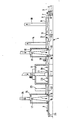
- a carrying and conveyor track (1) which consists of an elongated support frame (2) for a rotating conveyor belt, not shown, which is moved in the direction of the arrows (3).
- the carrying and conveying path (1) which in the exemplary embodiment is about twenty times as long as it is wide, several devices are provided for treating the surface of a polyester film which is wound up into a roll 4 and from this roll 4 via a deflection roll 5 the carrier and conveyor track 1 is placed.
- This carrier film 6 consists, for. B. from an optically clear polyester film based on polyethylene terephthalate. This material has all the conditions for producing the paint film according to the invention.
- This carrier film 6 has been provided with a dimethylsiloxane (silicone) layer on one side in a previous operation.
- This layer serves as a solution layer and ensures that the layers applied later can also be detached from the carrier film. Due to its apolar property, this silicone layer repels almost every layer applied to it.
- the silicone layer lies inside the wound roll 4. As a result of the deflection by means of the roller 5, the silicone layer reaches the top during the movement on the carrying and conveyor track 1.
- the carrier web 6 therefore lies with its uncoated side on the carrier and conveyor web 1.
- the silicone layer applied to the carrier film 6 is not suitable because of the boundary layer tensions which occur in order to apply a low-viscosity material layer directly thereon. The applied material would contract into drops. This also applies to paints.
- a static discharge of the carrier film 6 is therefore first carried out, and a wax-like layer, for. B. Karnauba wax applied to the silicone layer of the film 6, this wax-like layer is thinned with turpentine to an extremely viscous substance.
- the correspondingly diluted wax is applied directly to the siloxane layer using the doctor blade 8. Since the wax is highly viscous, a closed layer can be achieved. A less viscous substance would not result in a closed layer due to the boundary layer stresses previously indicated.
- the wax used chemically consists of long, unbranched hydrocarbon chains with an average length of carbon atoms with a COOH (acid) group at some points on the chain.
- the wax layer has a low cohesion and is therefore very thin.
- the adhesion with the siloxane layer is sufficient, but low.
- a spray booth 11 is arranged behind the evaporation zone, in which a certain drying of the wax takes place on the siloxane layer, in which a self-adhesive resin is applied as an adhesive layer to the wax layer with the aid of several spray nozzles 12.
- This resin e.g. B. self-adhesive acrylic resin cures at normal temperatures and has a large adhesive force compared to the usual surfaces such as metal and wood and after curing a high degree of cohesion.
- the adhesive layer must be weatherproof and also resistant to UV rays. When using acrylic resin, acrylic resin paints can be applied.
- the self-adhesive resin is sprayed onto the wax layer in a low-viscosity state, with a solids content of 25 to 30 g / m 2 .
- a mirror-smooth, high-gloss surface can be obtained by using a spraying process, which is particularly important when using high-gloss lacquers to be applied later.
- the adhesive After spraying, the adhesive floats on the wax layer, whereby a low level of adhesion to this wax layer arises.
- the Desmodur L fraction ensures that the adhesive cross-links, which increases cohesion and consequently weather resistance.
- the addition of the isocyanate results in cross-connections between the molecules, i.e. network formation through polymerization.
- an evaporation zone 13 with a ventilation channel 14 is again provided.
- the film 6 then passes into a drying room 15, which is provided with guide rollers 16 and 17 for the carrier film web 6.
- the guide roller 17 is arranged at such a distance above the support and conveyor track 1, but aligned parallel to this, that there is enough path length of the film 6 of the drying room 15 to achieve a quick drying of the adhesive by supplying warm air.
- a cooling zone 18 is provided before the film 6, lying on the carrying and conveying device 1, again runs into a paint spraying system 19, in which, in the present case, with the aid of conventional spray nozzles the type of across the carrying and conveyor track 1 supply pipes 20 with nozzles, a first coat of paint is applied, which is then subjected to an intense warm air supply below the drying nozzle 21 in the embodiment, so that another coat of paint can then be applied to the pre-dried paint layer .
- All spray nozzles 20 are surrounded in a manner known per se by a suction housing which removes the solvent vapors.
- two-component paints or multi-layer paints can also be applied, as is readily apparent.
- varnishes are then guided with the carrier film 6 through an evaporation zone 22 with a drain channel 23 and then again enter a drying chamber 24, which in turn is provided with guide and deflection rollers 18 and 17, such as the drying chamber 15, which runs parallel to the carrier and Conveyor path 1 are aligned and ensure that the carrier film 6 is guided upwards while it is exposed to the supply of warm air through the channel 25.
- the arrangement of the two drying rooms 15 and 24, in which certain sections of the film are pulled upward saves space in the conveying direction 3 for the overall system.
- the film leaving the drying room 24 is dried. It has a continuous lacquer layer which, depending on the choice of temperatures in the drying room 24, can correspond, for example, to the original stove enamel of motor vehicles.
- the film is cut into pieces and packed by a schematically indicated cutting device 26.
- the required sizes for paint repair work can then be cut out from these individual pieces of film.
- the paint itself takes on the function of a continuous film which can be pulled off the carrier film 6 and can be glued to the surfaces to be treated with its adhesive layer by pressure.
- a two-component acrylate paint can be applied to the adhesive layer in the spray booth, which is extremely weatherproof and chemically closely matches the previously used adhesive.
- the color curing process which occurs essentially as a result of the cyanate-acrylate reaction the color pushes itself into the adhesive to some extent, which creates a mechanical anchor between the adhesive and the paint layer.
- This anchoring between the adhesive and the lacquer layer is further promoted in that the lacquer is processed as second component isocyanate, which enters into a reaction with the top layer of the glue, which is not completely crosslinked even as a result of the low isocyanate content.
- Films of the second type in which a buffer layer, e.g. B. in the form of an acrylic resin, and then only paint and adhesive is applied, since it is usually a film for transferring individual symbols, such as letters or numbers, stripes, or the like that after the paint symbols have been printed on, the adhesive can be applied with the aid of the register in such a way that it is only present at the locations where the paint symbols are also present.
- a buffer layer e.g. B. in the form of an acrylic resin
Landscapes
- Life Sciences & Earth Sciences (AREA)
- Engineering & Computer Science (AREA)
- Wood Science & Technology (AREA)
- Application Of Or Painting With Fluid Materials (AREA)
- Decoration By Transfer Pictures (AREA)
- Laminated Bodies (AREA)
- Shaping Of Tube Ends By Bending Or Straightening (AREA)
- Medicinal Preparation (AREA)
- Press Drives And Press Lines (AREA)
- Control Of Vending Devices And Auxiliary Devices For Vending Devices (AREA)
- Devices For Checking Fares Or Tickets At Control Points (AREA)
- Adhesive Tapes (AREA)
Priority Applications (1)
| Application Number | Priority Date | Filing Date | Title |
|---|---|---|---|
| AT81108299T ATE7461T1 (de) | 1980-10-29 | 1981-10-14 | Uebertragbare lackfolie sowie verfahren zu ihrer herstellung. |
Applications Claiming Priority (2)
| Application Number | Priority Date | Filing Date | Title |
|---|---|---|---|
| NL8005935 | 1980-10-29 | ||
| NL8005935A NL8005935A (nl) | 1980-10-29 | 1980-10-29 | Overdraagbaar lakvel, alsmede werkwijze voor het vervaardigen daarvan. |
Publications (3)
| Publication Number | Publication Date |
|---|---|
| EP0050794A1 EP0050794A1 (de) | 1982-05-05 |
| EP0050794B1 EP0050794B1 (de) | 1984-05-16 |
| EP0050794B2 true EP0050794B2 (de) | 1988-02-10 |
Family
ID=19836076
Family Applications (1)
| Application Number | Title | Priority Date | Filing Date |
|---|---|---|---|
| EP81108299A Expired EP0050794B2 (de) | 1980-10-29 | 1981-10-14 | Übertragbare Lackfolie sowie Verfahren zu ihrer Herstellung |
Country Status (10)
| Country | Link |
|---|---|
| US (2) | US4451522A (https=) |
| EP (1) | EP0050794B2 (https=) |
| JP (1) | JPS57103889A (https=) |
| KR (1) | KR830007151A (https=) |
| AT (1) | ATE7461T1 (https=) |
| BR (1) | BR8106883A (https=) |
| DE (2) | DE3042156C2 (https=) |
| IL (1) | IL63975A (https=) |
| NL (1) | NL8005935A (https=) |
| ZA (1) | ZA816728B (https=) |
Cited By (1)
| Publication number | Priority date | Publication date | Assignee | Title |
|---|---|---|---|---|
| US6210796B1 (en) | 1995-09-27 | 2001-04-03 | Basf Coatings Ag | Adhesive paint film |
Families Citing this family (51)
| Publication number | Priority date | Publication date | Assignee | Title |
|---|---|---|---|---|
| DE3343583A1 (de) * | 1983-12-01 | 1985-06-13 | D. Swarovski & Co., Wattens, Tirol | Dekormaterial |
| US4661182A (en) * | 1985-07-31 | 1987-04-28 | Color Communications, Inc. | Method and composition for repairing minor surface damage to coated surfaces |
| DE3527609A1 (de) * | 1985-08-01 | 1987-02-05 | Nordipa Ag | Rbertragbare lackfolie und verfahren zu ihrer herstellung |
| US4814200A (en) * | 1985-08-26 | 1989-03-21 | International Flying Colors, Inc. | Method for restoring painted surface |
| JPH0739156B2 (ja) * | 1985-10-14 | 1995-05-01 | 大日本インキ化学工業株式会社 | 外観および耐候性にすぐれた着色フイルム |
| CA1319862C (en) * | 1986-01-14 | 1993-07-06 | Bruce E. Johnson | Composite useful for paint transfer and method of use and preparation thereof |
| JPH0615230B2 (ja) * | 1986-02-07 | 1994-03-02 | 日本ペイント株式会社 | 多色被覆方法 |
| US4810540A (en) * | 1986-10-28 | 1989-03-07 | Rexham Corporation | Decorative sheet material simulating the appearance of a base coat/clear coat paint finish |
| USRE36457E (en) * | 1986-10-28 | 1999-12-21 | Rexam Industries, Corp. | Injection molded plastic article with integrated weatherable pigmented film surface |
| US5342666A (en) * | 1986-10-28 | 1994-08-30 | Rexham Industries Corp. | Injection molded plastic article with integral weatherable pigmented film surface |
| USRE35894E (en) * | 1986-10-28 | 1998-09-08 | Rexam Industries Corp. | Injection molded plastic article with integral weatherable pigmented film surface |
| US6835267B1 (en) * | 1987-03-27 | 2004-12-28 | Avery Dennison Corporation | Dry paint transfer process and product |
| US5707697A (en) * | 1987-03-27 | 1998-01-13 | Avery Dennison Corporation | Dry paint transfer product having high DOI automotive paint coat |
| YU46540B (sh) | 1987-03-27 | 1993-11-16 | Avery International Corp. | Laminat koji se može toplotno oblikovati za obrazovanje trodimenzionalno oblikovanog spoljneg sloja na spoljnoj površini panela automobila |
| US5114789A (en) * | 1987-11-03 | 1992-05-19 | Eastman Kodak Company | Protective and decorative sheet material having a transparent topcoat |
| GB2245847A (en) * | 1990-04-02 | 1992-01-15 | Federal Printers Limited | Stamping foil |
| US5215826A (en) * | 1990-09-25 | 1993-06-01 | Rexham Industries Corp. | Surfacing film with thermoformable carrier layer |
| US5254192A (en) * | 1991-09-03 | 1993-10-19 | E. I. Du Pont De Nemours And Company | Process for matching color of paints on vehicles |
| CA2097980A1 (en) * | 1992-06-16 | 1993-12-17 | Stanley Lerner | Method and apparatus for the manufacture of sheets bearing display samples |
| GB2330795B (en) * | 1997-11-04 | 1999-10-13 | Ici Plc | Facilitation of the choice of paint according to the visual appearance of a dried coat when on a surface |
| US6468458B1 (en) | 1998-10-23 | 2002-10-22 | Textron Automotive Company Inc, | Method for forming a composite product |
| US6990904B2 (en) * | 2000-10-31 | 2006-01-31 | International Imaging Materials, Inc | Thermal transfer assembly for ceramic imaging |
| US6854386B2 (en) * | 2000-10-31 | 2005-02-15 | International Imaging Materials Inc. | Ceramic decal assembly |
| US7507453B2 (en) * | 2000-10-31 | 2009-03-24 | International Imaging Materials, Inc | Digital decoration and marking of glass and ceramic substrates |
| US6796733B2 (en) | 2000-10-31 | 2004-09-28 | International Imaging Materials Inc. | Thermal transfer ribbon with frosting ink layer |
| DE10140205A1 (de) * | 2001-08-16 | 2003-03-06 | Basf Coatings Ag | Farb- und/oder effektgebende Folien, Verfahren zu ihrer Herstellung und ihre Verwendung |
| DE10141767A1 (de) * | 2001-08-29 | 2003-03-20 | Wipak Walsrode Gmbh & Co Kg | Farbdekorübertragungssystem |
| US6958171B2 (en) * | 2001-12-14 | 2005-10-25 | E. I. Du Pont De Nemours And Company | Process for repairing coated substrate surfaces |
| US7316832B2 (en) * | 2001-12-20 | 2008-01-08 | The Procter & Gamble Company | Articles and methods for applying color on surfaces |
| US7709070B2 (en) * | 2001-12-20 | 2010-05-04 | The Procter & Gamble Company | Articles and methods for applying color on surfaces |
| US7299657B2 (en) * | 2002-07-12 | 2007-11-27 | Corning Incorporated | Method of making high strain point glass |
| US20060165979A1 (en) * | 2002-12-13 | 2006-07-27 | Kinsey Von A | Articles and methods for applying color on surfaces |
| WO2004067249A2 (en) * | 2003-01-27 | 2004-08-12 | Robert Lafave | Decorative system composite and method |
| US20040161564A1 (en) * | 2003-02-14 | 2004-08-19 | Truog Keith L. | Dry paint transfer laminate |
| EP1597089A2 (en) * | 2003-02-14 | 2005-11-23 | Avery Dennison Corporation | Multi-layer dry paint decorative laminate having discoloration prevention barrier |
| US20040247837A1 (en) * | 2003-06-09 | 2004-12-09 | Howard Enlow | Multilayer film |
| US20050196607A1 (en) * | 2003-06-09 | 2005-09-08 | Shih Frank Y. | Multi-layer dry paint decorative laminate having discoloration prevention barrier |
| US7332046B2 (en) * | 2003-09-26 | 2008-02-19 | Eastman Chemical Company | Methods of blocking stains on a substrate to be painted, and composites suitable for use in such methods |
| US6908240B1 (en) * | 2003-12-16 | 2005-06-21 | International Imaging Materials, Inc | Thermal printing and cleaning assembly |
| EP1599334A1 (en) * | 2004-02-13 | 2005-11-30 | The Procter and Gamble Company | Article for being applied to a surface and method thereof |
| CN1774336B (zh) * | 2004-02-13 | 2010-10-06 | 宝洁公司 | 将颜色涂敷到表面上的耐脱色制品及减轻将颜色涂敷到表面上的制品内脱色的方法 |
| DE102004010787A1 (de) * | 2004-03-05 | 2005-09-22 | Basf Coatings Ag | Verfahren zur Herstellung einer mehrschichtigen Folie F und ihre Verwendung |
| FR2873226B1 (fr) * | 2004-07-16 | 2008-04-04 | Plastic Omnium Cie | Plaque etalon et procede de controle de peinture de pieces de carrosserie de vehicules automobiles |
| US7853454B2 (en) * | 2004-12-02 | 2010-12-14 | Laminate Products, Inc. | Method of producing a paint film part |
| US20060177649A1 (en) * | 2005-02-07 | 2006-08-10 | Clark Mark D | Methods of blocking stains on a substrate to be painted, and composites suitable for use in such methods |
| DE102005020605A1 (de) * | 2005-05-03 | 2006-11-09 | Basf Coatings Ag | Verfahren zur Herstellung von eine Beschichtung(B) aufweisenden Folien(F), die so erhaltenen Folien(F) sowie ihre Verwendung zur Herstellung von Formteilen, insbesondere ihre Anwendung im Automobilbau |
| GB2436428A (en) * | 2006-02-16 | 2007-09-26 | Corus Uk Ltd | Self-supporting film of paint |
| US7829162B2 (en) * | 2006-08-29 | 2010-11-09 | international imagining materials, inc | Thermal transfer ribbon |
| US20080057233A1 (en) * | 2006-08-29 | 2008-03-06 | Harrison Daniel J | Conductive thermal transfer ribbon |
| US20080078498A1 (en) * | 2006-10-03 | 2008-04-03 | Zeik Douglas B | Articles and methods for applying color on surfaces |
| US8536087B2 (en) | 2010-04-08 | 2013-09-17 | International Imaging Materials, Inc. | Thermographic imaging element |
Family Cites Families (10)
| Publication number | Priority date | Publication date | Assignee | Title |
|---|---|---|---|---|
| US3235395A (en) * | 1962-03-27 | 1966-02-15 | Walter G Scharf | Transfers for metallic coatings |
| GB1046411A (en) * | 1964-02-04 | 1966-10-26 | Letraset International Ltd | Transfer materials |
| GB1113695A (en) * | 1964-10-30 | 1968-05-15 | Letraset International Ltd | Dry transfer materials and products |
| US3516904A (en) * | 1966-04-07 | 1970-06-23 | Diamond Int Corp | Heat transfer decalcomania for application to plastic bottles made from a laminate of a polyamide adhesive,a printed layer,and a wax like heat release layer |
| GB1201605A (en) * | 1966-09-05 | 1970-08-12 | Johnson Matthey Co Ltd | Improvements in and relating to transfers and decalcomanias |
| GB1232971A (https=) * | 1967-04-28 | 1971-05-26 | ||
| US3640791A (en) * | 1969-02-19 | 1972-02-08 | Richard Rosenheim | Process of preparing and applying an improved painting device |
| FR2076802A5 (en) * | 1970-01-28 | 1971-10-15 | Seytier Andre | Paint transfer - with silicone-coated paper support |
| US4012552A (en) * | 1975-03-10 | 1977-03-15 | Dennison Manufacturing Company | Decorative metal film heat transfer decalcomania |
| JPS5327313A (en) * | 1976-08-26 | 1978-03-14 | Nec Corp | Synthesizer for video signal |
-
1980
- 1980-10-29 NL NL8005935A patent/NL8005935A/nl not_active Application Discontinuation
- 1980-11-08 DE DE3042156A patent/DE3042156C2/de not_active Expired
-
1981
- 1981-09-28 IL IL63975A patent/IL63975A/xx unknown
- 1981-09-29 ZA ZA816728A patent/ZA816728B/xx unknown
- 1981-10-14 AT AT81108299T patent/ATE7461T1/de not_active IP Right Cessation
- 1981-10-14 EP EP81108299A patent/EP0050794B2/de not_active Expired
- 1981-10-14 DE DE8181108299T patent/DE3163661D1/de not_active Expired
- 1981-10-22 KR KR1019810004012A patent/KR830007151A/ko not_active Withdrawn
- 1981-10-26 BR BR8106883A patent/BR8106883A/pt unknown
- 1981-10-27 US US06/315,295 patent/US4451522A/en not_active Expired - Fee Related
- 1981-10-28 JP JP56172661A patent/JPS57103889A/ja active Granted
-
1982
- 1982-09-30 US US06/431,232 patent/US4497851A/en not_active Expired - Fee Related
Cited By (1)
| Publication number | Priority date | Publication date | Assignee | Title |
|---|---|---|---|---|
| US6210796B1 (en) | 1995-09-27 | 2001-04-03 | Basf Coatings Ag | Adhesive paint film |
Also Published As
| Publication number | Publication date |
|---|---|
| JPS6147719B2 (https=) | 1986-10-21 |
| KR830007151A (ko) | 1983-10-14 |
| IL63975A (en) | 1984-10-31 |
| ZA816728B (en) | 1982-09-29 |
| IL63975A0 (en) | 1981-12-31 |
| US4451522A (en) | 1984-05-29 |
| JPS57103889A (en) | 1982-06-28 |
| US4497851A (en) | 1985-02-05 |
| DE3163661D1 (en) | 1984-06-20 |
| ATE7461T1 (de) | 1984-06-15 |
| EP0050794B1 (de) | 1984-05-16 |
| BR8106883A (pt) | 1982-07-13 |
| EP0050794A1 (de) | 1982-05-05 |
| DE3042156C2 (de) | 1984-08-30 |
| DE3042156A1 (de) | 1982-05-13 |
| NL8005935A (nl) | 1982-05-17 |
Similar Documents
| Publication | Publication Date | Title |
|---|---|---|
| EP0050794B2 (de) | Übertragbare Lackfolie sowie Verfahren zu ihrer Herstellung | |
| DE1571168B2 (de) | Verfahren zum Überziehen von Gegenständen | |
| DE102015219239A1 (de) | Verfahren zum Lackieren von Stiften sowie Lackiervorrichtung | |
| EP1423208B1 (de) | Verfahren zur herstellung von teilen mit einer versiegelungsschicht auf der oberfläche | |
| EP1053793A1 (de) | Verfahren zum Auftragen von Lack und Dekor auf einen Gegenstand und Verfahren sowie Vorrichtung zum Laminieren von Lack, Dekor und Kleber auf einen Film | |
| DD156702A5 (de) | Verfahren und vorrichtung zum reparieren oberflaechenbeschaedigter glasbehaelter | |
| DE2342601A1 (de) | Verbessertes folienmaterial | |
| DE60316710T2 (de) | Verfahren und vorrichtung zur kontinuierlichen beschichtung von mindestens einem substrat mit einem film | |
| DE3438489A1 (de) | Verfahren zur oberflaechenkaschierung selbsttragender formteile, beispielsweise fuer die innenverkleidung von kraftfahrzeugen, und vorrichtung zur durchfuehrung des verfahrens | |
| WO2006066954A1 (de) | Verfahren zur versiegelung von oberflächen | |
| DE3535685C2 (de) | Verfahren und Vorrichtung zum Kalandrieren von mit Lack beschichteten Bogen | |
| DE3936043C2 (https=) | ||
| DE1621918C (de) | Verfahren zum Beschichten von Flächengebilden | |
| DE2028102C3 (de) | Verfahren zur Herstellung von Spiegeln | |
| DE2756392C3 (de) | Trockenübertragungsmaterial und Verfahren zu seiner Herstellung | |
| DE10107238A1 (de) | Verfahren zur Herstellung von strukturierten Oberflächen | |
| DE2156542A1 (de) | Buntdruckbogen | |
| DE2024979A1 (en) | Protective varnish layer applied to unset film of ink - on laminar backing | |
| DE2545622A1 (de) | Mehrschichtiges abziehbilderpapier zum auftrag von druckbildern auf einbrennfaehige werkstuecke oder auf kunststoffgegenstaende | |
| DE2364188C3 (de) | Vorrichtung zum Beschichten von Flaschen mit einer hochviskosen Farbe | |
| EP0017641B1 (de) | Verfahren zum Auftragen von Überzügen auf metallische Gegenstände, sowie Vorrichtung zur Durchführung dieses Verfahrens | |
| DE4219397C1 (de) | Verfahren zur Vorbehandlung von zur Recyclierung vorgesehenen lackierten Kunststoffteilen | |
| DE4413010A1 (de) | Verfahren zur Herstellung von Farbmusterkarten für wasserhaltige Lackfarben | |
| DE102019119771A1 (de) | Verfahren zur Oberflächengestaltung eines Objekts, Applikationsanlage zur Oberflächengestaltung eines Objekts | |
| DE1571387C2 (de) | Abziehbild zur Aufbringung von Dekors |
Legal Events
| Date | Code | Title | Description |
|---|---|---|---|
| PUAI | Public reference made under article 153(3) epc to a published international application that has entered the european phase |
Free format text: ORIGINAL CODE: 0009012 |
|
| AK | Designated contracting states |
Designated state(s): AT BE CH DE FR GB IT LI LU NL SE |
|
| 17P | Request for examination filed |
Effective date: 19820617 |
|
| RAP1 | Party data changed (applicant data changed or rights of an application transferred) |
Owner name: NORDIPA AG |
|
| ITF | It: translation for a ep patent filed | ||
| GRAA | (expected) grant |
Free format text: ORIGINAL CODE: 0009210 |
|
| AK | Designated contracting states |
Designated state(s): AT BE CH DE FR GB IT LI LU NL SE |
|
| REF | Corresponds to: |
Ref document number: 7461 Country of ref document: AT Date of ref document: 19840615 Kind code of ref document: T |
|
| REF | Corresponds to: |
Ref document number: 3163661 Country of ref document: DE Date of ref document: 19840620 |
|
| ET | Fr: translation filed | ||
| PLBI | Opposition filed |
Free format text: ORIGINAL CODE: 0009260 |
|
| 26 | Opposition filed |
Opponent name: PETER KWASNY KG CHEMISCH-TECHNISCHE ERZEUGNISSE Effective date: 19850213 |
|
| NLR1 | Nl: opposition has been filed with the epo |
Opponent name: PETER KWASNY KG CHEMISCH-TECHNISCHE ERZEUGNISSE |
|
| PUAH | Patent maintained in amended form |
Free format text: ORIGINAL CODE: 0009272 |
|
| STAA | Information on the status of an ep patent application or granted ep patent |
Free format text: STATUS: PATENT MAINTAINED AS AMENDED |
|
| 27A | Patent maintained in amended form |
Effective date: 19880210 |
|
| AK | Designated contracting states |
Kind code of ref document: B2 Designated state(s): AT BE CH DE FR GB IT LI LU NL SE |
|
| ITF | It: translation for a ep patent filed | ||
| NLR2 | Nl: decision of opposition | ||
| ET3 | Fr: translation filed ** decision concerning opposition | ||
| NLR3 | Nl: receipt of modified translations in the netherlands language after an opposition procedure | ||
| PGFP | Annual fee paid to national office [announced via postgrant information from national office to epo] |
Ref country code: GB Payment date: 19910927 Year of fee payment: 11 |
|
| PGFP | Annual fee paid to national office [announced via postgrant information from national office to epo] |
Ref country code: SE Payment date: 19910930 Year of fee payment: 11 |
|
| PGFP | Annual fee paid to national office [announced via postgrant information from national office to epo] |
Ref country code: AT Payment date: 19911007 Year of fee payment: 11 |
|
| PGFP | Annual fee paid to national office [announced via postgrant information from national office to epo] |
Ref country code: LU Payment date: 19911024 Year of fee payment: 11 |
|
| PGFP | Annual fee paid to national office [announced via postgrant information from national office to epo] |
Ref country code: FR Payment date: 19911030 Year of fee payment: 11 |
|
| ITTA | It: last paid annual fee | ||
| PGFP | Annual fee paid to national office [announced via postgrant information from national office to epo] |
Ref country code: CH Payment date: 19911218 Year of fee payment: 11 |
|
| EPTA | Lu: last paid annual fee | ||
| PG25 | Lapsed in a contracting state [announced via postgrant information from national office to epo] |
Ref country code: LU Free format text: LAPSE BECAUSE OF NON-PAYMENT OF DUE FEES Effective date: 19921014 Ref country code: GB Effective date: 19921014 Ref country code: AT Effective date: 19921014 |
|
| PG25 | Lapsed in a contracting state [announced via postgrant information from national office to epo] |
Ref country code: SE Effective date: 19921015 |
|
| PG25 | Lapsed in a contracting state [announced via postgrant information from national office to epo] |
Ref country code: LI Effective date: 19921031 Ref country code: CH Effective date: 19921031 |
|
| GBPC | Gb: european patent ceased through non-payment of renewal fee |
Effective date: 19921014 |
|
| PG25 | Lapsed in a contracting state [announced via postgrant information from national office to epo] |
Ref country code: FR Effective date: 19930630 |
|
| REG | Reference to a national code |
Ref country code: CH Ref legal event code: PL |
|
| REG | Reference to a national code |
Ref country code: FR Ref legal event code: ST |
|
| PGFP | Annual fee paid to national office [announced via postgrant information from national office to epo] |
Ref country code: DE Payment date: 19931008 Year of fee payment: 13 |
|
| PGFP | Annual fee paid to national office [announced via postgrant information from national office to epo] |
Ref country code: BE Payment date: 19931020 Year of fee payment: 13 |
|
| PGFP | Annual fee paid to national office [announced via postgrant information from national office to epo] |
Ref country code: NL Payment date: 19931031 Year of fee payment: 13 |
|
| PG25 | Lapsed in a contracting state [announced via postgrant information from national office to epo] |
Ref country code: BE Effective date: 19941031 |
|
| EUG | Se: european patent has lapsed |
Ref document number: 81108299.9 Effective date: 19930510 |
|
| BERE | Be: lapsed |
Owner name: NORDIPA A.G. Effective date: 19941031 |
|
| PG25 | Lapsed in a contracting state [announced via postgrant information from national office to epo] |
Ref country code: NL Effective date: 19950501 |
|
| NLV4 | Nl: lapsed or anulled due to non-payment of the annual fee | ||
| PG25 | Lapsed in a contracting state [announced via postgrant information from national office to epo] |
Ref country code: DE Effective date: 19950701 |