EP0034272A2 - Verfahren zur Herstellung von Velourleder-Imitaten im Umkehrverfahren - Google Patents
Verfahren zur Herstellung von Velourleder-Imitaten im Umkehrverfahren Download PDFInfo
- Publication number
- EP0034272A2 EP0034272A2 EP81100538A EP81100538A EP0034272A2 EP 0034272 A2 EP0034272 A2 EP 0034272A2 EP 81100538 A EP81100538 A EP 81100538A EP 81100538 A EP81100538 A EP 81100538A EP 0034272 A2 EP0034272 A2 EP 0034272A2
- Authority
- EP
- European Patent Office
- Prior art keywords
- coating
- die
- nco
- viscosity
- heating
- Prior art date
- Legal status (The legal status is an assumption and is not a legal conclusion. Google has not performed a legal analysis and makes no representation as to the accuracy of the status listed.)
- Granted
Links
- 238000000034 method Methods 0.000 title claims abstract description 20
- 239000010985 leather Substances 0.000 title description 5
- 238000000576 coating method Methods 0.000 claims abstract description 63
- 239000011248 coating agent Substances 0.000 claims abstract description 52
- 239000002904 solvent Substances 0.000 claims abstract description 23
- 238000010438 heat treatment Methods 0.000 claims abstract description 21
- 239000000463 material Substances 0.000 claims abstract description 17
- 229920000768 polyamine Polymers 0.000 claims abstract description 13
- 238000004519 manufacturing process Methods 0.000 claims abstract description 10
- 239000004744 fabric Substances 0.000 claims abstract description 8
- 239000004753 textile Substances 0.000 claims abstract description 7
- 125000003118 aryl group Chemical group 0.000 claims abstract description 6
- 229920003226 polyurethane urea Polymers 0.000 claims abstract description 6
- 239000003513 alkali Substances 0.000 claims abstract description 4
- 150000004820 halides Chemical class 0.000 claims abstract description 4
- 238000010030 laminating Methods 0.000 claims abstract description 3
- 229920002635 polyurethane Polymers 0.000 claims description 19
- 239000004814 polyurethane Substances 0.000 claims description 18
- 125000002887 hydroxy group Chemical group [H]O* 0.000 claims description 6
- 229920000570 polyether Polymers 0.000 claims description 5
- 239000004971 Cross linker Substances 0.000 claims description 4
- UFHFLCQGNIYNRP-UHFFFAOYSA-N Hydrogen Chemical compound [H][H] UFHFLCQGNIYNRP-UHFFFAOYSA-N 0.000 claims description 4
- 239000000654 additive Substances 0.000 claims description 4
- 150000004985 diamines Chemical class 0.000 claims description 4
- 229910052739 hydrogen Inorganic materials 0.000 claims description 4
- 239000001257 hydrogen Substances 0.000 claims description 4
- 239000000049 pigment Substances 0.000 claims description 4
- 229920000728 polyester Polymers 0.000 claims description 4
- IGSBHTZEJMPDSZ-UHFFFAOYSA-N 4-[(4-amino-3-methylcyclohexyl)methyl]-2-methylcyclohexan-1-amine Chemical compound C1CC(N)C(C)CC1CC1CC(C)C(N)CC1 IGSBHTZEJMPDSZ-UHFFFAOYSA-N 0.000 claims description 3
- 239000004604 Blowing Agent Substances 0.000 claims description 3
- 239000004721 Polyphenylene oxide Substances 0.000 claims description 3
- 239000000945 filler Substances 0.000 claims description 3
- 229920002545 silicone oil Polymers 0.000 claims description 3
- 125000006273 (C1-C3) alkyl group Chemical group 0.000 claims description 2
- 150000002431 hydrogen Chemical class 0.000 claims description 2
- 230000000996 additive effect Effects 0.000 claims 1
- 239000008199 coating composition Substances 0.000 description 16
- 238000004132 cross linking Methods 0.000 description 10
- 239000000203 mixture Substances 0.000 description 10
- ZWEHNKRNPOVVGH-UHFFFAOYSA-N 2-Butanone Chemical compound CCC(C)=O ZWEHNKRNPOVVGH-UHFFFAOYSA-N 0.000 description 9
- 230000015572 biosynthetic process Effects 0.000 description 6
- 239000002981 blocking agent Substances 0.000 description 6
- JBKVHLHDHHXQEQ-UHFFFAOYSA-N epsilon-caprolactam Chemical compound O=C1CCCCCN1 JBKVHLHDHHXQEQ-UHFFFAOYSA-N 0.000 description 6
- XLLIQLLCWZCATF-UHFFFAOYSA-N ethylene glycol monomethyl ether acetate Natural products COCCOC(C)=O XLLIQLLCWZCATF-UHFFFAOYSA-N 0.000 description 6
- 239000007787 solid Substances 0.000 description 6
- 150000001412 amines Chemical class 0.000 description 5
- 239000005056 polyisocyanate Substances 0.000 description 5
- 229920001228 polyisocyanate Polymers 0.000 description 5
- 229920000742 Cotton Polymers 0.000 description 4
- FAPWRFPIFSIZLT-UHFFFAOYSA-M Sodium chloride Chemical compound [Na+].[Cl-] FAPWRFPIFSIZLT-UHFFFAOYSA-M 0.000 description 4
- WNLRTRBMVRJNCN-UHFFFAOYSA-N adipic acid Chemical compound OC(=O)CCCCC(O)=O WNLRTRBMVRJNCN-UHFFFAOYSA-N 0.000 description 4
- 125000001931 aliphatic group Chemical group 0.000 description 4
- 230000001680 brushing effect Effects 0.000 description 4
- WERYXYBDKMZEQL-UHFFFAOYSA-N butane-1,4-diol Chemical compound OCCCCO WERYXYBDKMZEQL-UHFFFAOYSA-N 0.000 description 4
- 150000001875 compounds Chemical class 0.000 description 4
- 238000001816 cooling Methods 0.000 description 4
- JHIVVAPYMSGYDF-UHFFFAOYSA-N cyclohexanone Chemical compound O=C1CCCCC1 JHIVVAPYMSGYDF-UHFFFAOYSA-N 0.000 description 4
- 239000007788 liquid Substances 0.000 description 4
- 235000002639 sodium chloride Nutrition 0.000 description 4
- CSCPPACGZOOCGX-UHFFFAOYSA-N Acetone Chemical compound CC(C)=O CSCPPACGZOOCGX-UHFFFAOYSA-N 0.000 description 3
- 238000004566 IR spectroscopy Methods 0.000 description 3
- -1 Polypropylene Polymers 0.000 description 3
- DNIAPMSPPWPWGF-UHFFFAOYSA-N Propylene glycol Chemical compound CC(O)CO DNIAPMSPPWPWGF-UHFFFAOYSA-N 0.000 description 3
- GOOHAUXETOMSMM-UHFFFAOYSA-N Propylene oxide Chemical compound CC1CO1 GOOHAUXETOMSMM-UHFFFAOYSA-N 0.000 description 3
- 230000000903 blocking effect Effects 0.000 description 3
- 125000005442 diisocyanate group Chemical group 0.000 description 3
- 238000001035 drying Methods 0.000 description 3
- 210000004209 hair Anatomy 0.000 description 3
- 239000012948 isocyanate Substances 0.000 description 3
- 150000002513 isocyanates Chemical class 0.000 description 3
- 229920000642 polymer Polymers 0.000 description 3
- 238000002360 preparation method Methods 0.000 description 3
- 239000000376 reactant Substances 0.000 description 3
- 238000005507 spraying Methods 0.000 description 3
- WHIVNJATOVLWBW-PLNGDYQASA-N (nz)-n-butan-2-ylidenehydroxylamine Chemical compound CC\C(C)=N/O WHIVNJATOVLWBW-PLNGDYQASA-N 0.000 description 2
- UPMLOUAZCHDJJD-UHFFFAOYSA-N 4,4'-Diphenylmethane Diisocyanate Chemical compound C1=CC(N=C=O)=CC=C1CC1=CC=C(N=C=O)C=C1 UPMLOUAZCHDJJD-UHFFFAOYSA-N 0.000 description 2
- KWOLFJPFCHCOCG-UHFFFAOYSA-N Acetophenone Chemical compound CC(=O)C1=CC=CC=C1 KWOLFJPFCHCOCG-UHFFFAOYSA-N 0.000 description 2
- KFZMGEQAYNKOFK-UHFFFAOYSA-N Isopropanol Chemical compound CC(C)O KFZMGEQAYNKOFK-UHFFFAOYSA-N 0.000 description 2
- ZMXDDKWLCZADIW-UHFFFAOYSA-N N,N-Dimethylformamide Chemical compound CN(C)C=O ZMXDDKWLCZADIW-UHFFFAOYSA-N 0.000 description 2
- ZJCCRDAZUWHFQH-UHFFFAOYSA-N Trimethylolpropane Chemical compound CCC(CO)(CO)CO ZJCCRDAZUWHFQH-UHFFFAOYSA-N 0.000 description 2
- 239000001361 adipic acid Substances 0.000 description 2
- 235000011037 adipic acid Nutrition 0.000 description 2
- 235000013334 alcoholic beverage Nutrition 0.000 description 2
- 230000000694 effects Effects 0.000 description 2
- 150000002148 esters Chemical class 0.000 description 2
- 239000000835 fiber Substances 0.000 description 2
- 239000011888 foil Substances 0.000 description 2
- XXMIOPMDWAUFGU-UHFFFAOYSA-N hexane-1,6-diol Chemical compound OCCCCCCO XXMIOPMDWAUFGU-UHFFFAOYSA-N 0.000 description 2
- 150000002576 ketones Chemical class 0.000 description 2
- 239000011159 matrix material Substances 0.000 description 2
- 238000002156 mixing Methods 0.000 description 2
- SLCVBVWXLSEKPL-UHFFFAOYSA-N neopentyl glycol Chemical compound OCC(C)(C)CO SLCVBVWXLSEKPL-UHFFFAOYSA-N 0.000 description 2
- FDPIMTJIUBPUKL-UHFFFAOYSA-N pentan-3-one Chemical compound CCC(=O)CC FDPIMTJIUBPUKL-UHFFFAOYSA-N 0.000 description 2
- 229920005862 polyol Polymers 0.000 description 2
- 150000003077 polyols Chemical class 0.000 description 2
- 229920001296 polysiloxane Polymers 0.000 description 2
- 230000009257 reactivity Effects 0.000 description 2
- 150000003839 salts Chemical class 0.000 description 2
- 239000011780 sodium chloride Substances 0.000 description 2
- 239000007858 starting material Substances 0.000 description 2
- 229920001169 thermoplastic Polymers 0.000 description 2
- 239000012815 thermoplastic material Substances 0.000 description 2
- 229920001187 thermosetting polymer Polymers 0.000 description 2
- 239000004416 thermosoftening plastic Substances 0.000 description 2
- RKMGAJGJIURJSJ-UHFFFAOYSA-N 2,2,6,6-tetramethylpiperidine Chemical class CC1(C)CCCC(C)(C)N1 RKMGAJGJIURJSJ-UHFFFAOYSA-N 0.000 description 1
- LTMRRSWNXVJMBA-UHFFFAOYSA-L 2,2-diethylpropanedioate Chemical compound CCC(CC)(C([O-])=O)C([O-])=O LTMRRSWNXVJMBA-UHFFFAOYSA-L 0.000 description 1
- ZFFMLCVRJBZUDZ-UHFFFAOYSA-N 2,3-dimethylbutane Chemical group CC(C)C(C)C ZFFMLCVRJBZUDZ-UHFFFAOYSA-N 0.000 description 1
- XNWFRZJHXBZDAG-UHFFFAOYSA-N 2-METHOXYETHANOL Chemical group COCCO XNWFRZJHXBZDAG-UHFFFAOYSA-N 0.000 description 1
- ZNQVEEAIQZEUHB-UHFFFAOYSA-N 2-ethoxyethanol Chemical compound CCOCCO ZNQVEEAIQZEUHB-UHFFFAOYSA-N 0.000 description 1
- YBRVSVVVWCFQMG-UHFFFAOYSA-N 4,4'-diaminodiphenylmethane Chemical compound C1=CC(N)=CC=C1CC1=CC=C(N)C=C1 YBRVSVVVWCFQMG-UHFFFAOYSA-N 0.000 description 1
- 241001136792 Alle Species 0.000 description 1
- DKPFZGUDAPQIHT-UHFFFAOYSA-N Butyl acetate Natural products CCCCOC(C)=O DKPFZGUDAPQIHT-UHFFFAOYSA-N 0.000 description 1
- 0 CC(CC1C)CC(*)C1N Chemical compound CC(CC1C)CC(*)C1N 0.000 description 1
- 239000004215 Carbon black (E152) Substances 0.000 description 1
- 239000004970 Chain extender Substances 0.000 description 1
- GSNUFIFRDBKVIE-UHFFFAOYSA-N DMF Natural products CC1=CC=C(C)O1 GSNUFIFRDBKVIE-UHFFFAOYSA-N 0.000 description 1
- IYXGSMUGOJNHAZ-UHFFFAOYSA-N Ethyl malonate Chemical compound CCOC(=O)CC(=O)OCC IYXGSMUGOJNHAZ-UHFFFAOYSA-N 0.000 description 1
- 239000005057 Hexamethylene diisocyanate Substances 0.000 description 1
- AVXURJPOCDRRFD-UHFFFAOYSA-N Hydroxylamine Chemical compound ON AVXURJPOCDRRFD-UHFFFAOYSA-N 0.000 description 1
- 229920000877 Melamine resin Polymers 0.000 description 1
- ISWSIDIOOBJBQZ-UHFFFAOYSA-N Phenol Chemical compound OC1=CC=CC=C1 ISWSIDIOOBJBQZ-UHFFFAOYSA-N 0.000 description 1
- 229920003171 Poly (ethylene oxide) Polymers 0.000 description 1
- 239000004952 Polyamide Substances 0.000 description 1
- 239000004743 Polypropylene Substances 0.000 description 1
- 239000004820 Pressure-sensitive adhesive Substances 0.000 description 1
- 239000004433 Thermoplastic polyurethane Substances 0.000 description 1
- 239000012963 UV stabilizer Substances 0.000 description 1
- 238000005299 abrasion Methods 0.000 description 1
- 238000004026 adhesive bonding Methods 0.000 description 1
- 230000001476 alcoholic effect Effects 0.000 description 1
- 150000004984 aromatic diamines Chemical class 0.000 description 1
- RWCCWEUUXYIKHB-UHFFFAOYSA-N benzophenone Chemical compound C=1C=CC=CC=1C(=O)C1=CC=CC=C1 RWCCWEUUXYIKHB-UHFFFAOYSA-N 0.000 description 1
- 239000012965 benzophenone Substances 0.000 description 1
- 239000012876 carrier material Substances 0.000 description 1
- 238000005266 casting Methods 0.000 description 1
- 239000003795 chemical substances by application Substances 0.000 description 1
- 238000004140 cleaning Methods 0.000 description 1
- 238000010276 construction Methods 0.000 description 1
- 239000003431 cross linking reagent Substances 0.000 description 1
- 230000007547 defect Effects 0.000 description 1
- KORSJDCBLAPZEQ-UHFFFAOYSA-N dicyclohexylmethane-4,4'-diisocyanate Chemical compound C1CC(N=C=O)CCC1CC1CCC(N=C=O)CC1 KORSJDCBLAPZEQ-UHFFFAOYSA-N 0.000 description 1
- 235000013870 dimethyl polysiloxane Nutrition 0.000 description 1
- 238000007606 doctor blade method Methods 0.000 description 1
- 229920001971 elastomer Polymers 0.000 description 1
- 239000000806 elastomer Substances 0.000 description 1
- 239000003822 epoxy resin Substances 0.000 description 1
- 150000002168 ethanoic acid esters Chemical class 0.000 description 1
- 238000001704 evaporation Methods 0.000 description 1
- 230000008020 evaporation Effects 0.000 description 1
- 238000007730 finishing process Methods 0.000 description 1
- 238000000227 grinding Methods 0.000 description 1
- 229910052736 halogen Inorganic materials 0.000 description 1
- 150000002367 halogens Chemical class 0.000 description 1
- LNEPOXFFQSENCJ-UHFFFAOYSA-N haloperidol Chemical compound C1CC(O)(C=2C=CC(Cl)=CC=2)CCN1CCCC(=O)C1=CC=C(F)C=C1 LNEPOXFFQSENCJ-UHFFFAOYSA-N 0.000 description 1
- RRAMGCGOFNQTLD-UHFFFAOYSA-N hexamethylene diisocyanate Chemical compound O=C=NCCCCCCN=C=O RRAMGCGOFNQTLD-UHFFFAOYSA-N 0.000 description 1
- NAQMVNRVTILPCV-UHFFFAOYSA-N hexane-1,6-diamine Chemical compound NCCCCCCN NAQMVNRVTILPCV-UHFFFAOYSA-N 0.000 description 1
- FUZZWVXGSFPDMH-UHFFFAOYSA-N hexanoic acid Chemical compound CCCCCC(O)=O FUZZWVXGSFPDMH-UHFFFAOYSA-N 0.000 description 1
- 238000000265 homogenisation Methods 0.000 description 1
- 229930195733 hydrocarbon Natural products 0.000 description 1
- 150000002430 hydrocarbons Chemical class 0.000 description 1
- 238000005470 impregnation Methods 0.000 description 1
- 239000012535 impurity Substances 0.000 description 1
- 230000001678 irradiating effect Effects 0.000 description 1
- IQPQWNKOIGAROB-UHFFFAOYSA-N isocyanate group Chemical group [N-]=C=O IQPQWNKOIGAROB-UHFFFAOYSA-N 0.000 description 1
- NIMLQBUJDJZYEJ-UHFFFAOYSA-N isophorone diisocyanate Chemical compound CC1(C)CC(N=C=O)CC(C)(CN=C=O)C1 NIMLQBUJDJZYEJ-UHFFFAOYSA-N 0.000 description 1
- 238000003475 lamination Methods 0.000 description 1
- 239000004611 light stabiliser Substances 0.000 description 1
- 230000014759 maintenance of location Effects 0.000 description 1
- 238000002844 melting Methods 0.000 description 1
- 230000008018 melting Effects 0.000 description 1
- 229910052751 metal Inorganic materials 0.000 description 1
- 239000002184 metal Substances 0.000 description 1
- 150000002739 metals Chemical class 0.000 description 1
- OETHQSJEHLVLGH-UHFFFAOYSA-N metformin hydrochloride Chemical compound Cl.CN(C)C(=N)N=C(N)N OETHQSJEHLVLGH-UHFFFAOYSA-N 0.000 description 1
- CRVGTESFCCXCTH-UHFFFAOYSA-N methyl diethanolamine Chemical compound OCCN(C)CCO CRVGTESFCCXCTH-UHFFFAOYSA-N 0.000 description 1
- VLKZOEOYAKHREP-UHFFFAOYSA-N n-Hexane Chemical group CCCCCC VLKZOEOYAKHREP-UHFFFAOYSA-N 0.000 description 1
- WHIVNJATOVLWBW-UHFFFAOYSA-N n-butan-2-ylidenehydroxylamine Chemical compound CCC(C)=NO WHIVNJATOVLWBW-UHFFFAOYSA-N 0.000 description 1
- 239000004745 nonwoven fabric Substances 0.000 description 1
- 239000003960 organic solvent Substances 0.000 description 1
- 230000035515 penetration Effects 0.000 description 1
- 230000035699 permeability Effects 0.000 description 1
- 239000002530 phenolic antioxidant Substances 0.000 description 1
- 229920003023 plastic Polymers 0.000 description 1
- 239000004033 plastic Substances 0.000 description 1
- 239000004014 plasticizer Substances 0.000 description 1
- 229920000435 poly(dimethylsiloxane) Polymers 0.000 description 1
- 229920002647 polyamide Polymers 0.000 description 1
- 229920000647 polyepoxide Polymers 0.000 description 1
- 239000004645 polyester resin Substances 0.000 description 1
- 229920001225 polyester resin Polymers 0.000 description 1
- 229920001155 polypropylene Polymers 0.000 description 1
- 229920006264 polyurethane film Polymers 0.000 description 1
- 229920000915 polyvinyl chloride Polymers 0.000 description 1
- 239000004800 polyvinyl chloride Substances 0.000 description 1
- 230000005855 radiation Effects 0.000 description 1
- 230000003678 scratch resistant effect Effects 0.000 description 1
- 238000000926 separation method Methods 0.000 description 1
- 229920002379 silicone rubber Polymers 0.000 description 1
- 239000004945 silicone rubber Substances 0.000 description 1
- 239000007921 spray Substances 0.000 description 1
- 239000003381 stabilizer Substances 0.000 description 1
- 239000000758 substrate Substances 0.000 description 1
- 238000010345 tape casting Methods 0.000 description 1
- 150000003512 tertiary amines Chemical class 0.000 description 1
- 125000001302 tertiary amino group Chemical group 0.000 description 1
- 229920002803 thermoplastic polyurethane Polymers 0.000 description 1
- DVKJHBMWWAPEIU-UHFFFAOYSA-N toluene 2,4-diisocyanate Chemical compound CC1=CC=C(N=C=O)C=C1N=C=O DVKJHBMWWAPEIU-UHFFFAOYSA-N 0.000 description 1
- 150000003673 urethanes Chemical class 0.000 description 1
- XLYOFNOQVPJJNP-UHFFFAOYSA-N water Chemical compound O XLYOFNOQVPJJNP-UHFFFAOYSA-N 0.000 description 1
- 238000009736 wetting Methods 0.000 description 1
- 239000002023 wood Substances 0.000 description 1
Images
Classifications
-
- D—TEXTILES; PAPER
- D06—TREATMENT OF TEXTILES OR THE LIKE; LAUNDERING; FLEXIBLE MATERIALS NOT OTHERWISE PROVIDED FOR
- D06N—WALL, FLOOR, OR LIKE COVERING MATERIALS, e.g. LINOLEUM, OILCLOTH, ARTIFICIAL LEATHER, ROOFING FELT, CONSISTING OF A FIBROUS WEB COATED WITH A LAYER OF MACROMOLECULAR MATERIAL; FLEXIBLE SHEET MATERIAL NOT OTHERWISE PROVIDED FOR
- D06N3/00—Artificial leather, oilcloth or other material obtained by covering fibrous webs with macromolecular material, e.g. resins, rubber or derivatives thereof
- D06N3/12—Artificial leather, oilcloth or other material obtained by covering fibrous webs with macromolecular material, e.g. resins, rubber or derivatives thereof with macromolecular compounds obtained otherwise than by reactions only involving carbon-to-carbon unsaturated bonds, e.g. gelatine proteins
- D06N3/14—Artificial leather, oilcloth or other material obtained by covering fibrous webs with macromolecular material, e.g. resins, rubber or derivatives thereof with macromolecular compounds obtained otherwise than by reactions only involving carbon-to-carbon unsaturated bonds, e.g. gelatine proteins with polyurethanes
-
- B—PERFORMING OPERATIONS; TRANSPORTING
- B29—WORKING OF PLASTICS; WORKING OF SUBSTANCES IN A PLASTIC STATE IN GENERAL
- B29C—SHAPING OR JOINING OF PLASTICS; SHAPING OF MATERIAL IN A PLASTIC STATE, NOT OTHERWISE PROVIDED FOR; AFTER-TREATMENT OF THE SHAPED PRODUCTS, e.g. REPAIRING
- B29C43/00—Compression moulding, i.e. applying external pressure to flow the moulding material; Apparatus therefor
- B29C43/22—Compression moulding, i.e. applying external pressure to flow the moulding material; Apparatus therefor of articles of indefinite length
- B29C43/222—Compression moulding, i.e. applying external pressure to flow the moulding material; Apparatus therefor of articles of indefinite length characterised by the shape of the surface
-
- B—PERFORMING OPERATIONS; TRANSPORTING
- B29—WORKING OF PLASTICS; WORKING OF SUBSTANCES IN A PLASTIC STATE IN GENERAL
- B29C—SHAPING OR JOINING OF PLASTICS; SHAPING OF MATERIAL IN A PLASTIC STATE, NOT OTHERWISE PROVIDED FOR; AFTER-TREATMENT OF THE SHAPED PRODUCTS, e.g. REPAIRING
- B29C59/00—Surface shaping of articles, e.g. embossing; Apparatus therefor
- B29C59/02—Surface shaping of articles, e.g. embossing; Apparatus therefor by mechanical means, e.g. pressing
- B29C59/022—Surface shaping of articles, e.g. embossing; Apparatus therefor by mechanical means, e.g. pressing characterised by the disposition or the configuration, e.g. dimensions, of the embossments or the shaping tools therefor
- B29C59/025—Fibrous surfaces with piles or similar fibres substantially perpendicular to the surface
-
- C—CHEMISTRY; METALLURGY
- C08—ORGANIC MACROMOLECULAR COMPOUNDS; THEIR PREPARATION OR CHEMICAL WORKING-UP; COMPOSITIONS BASED THEREON
- C08G—MACROMOLECULAR COMPOUNDS OBTAINED OTHERWISE THAN BY REACTIONS ONLY INVOLVING UNSATURATED CARBON-TO-CARBON BONDS
- C08G18/00—Polymeric products of isocyanates or isothiocyanates
- C08G18/06—Polymeric products of isocyanates or isothiocyanates with compounds having active hydrogen
- C08G18/08—Processes
- C08G18/10—Prepolymer processes involving reaction of isocyanates or isothiocyanates with compounds having active hydrogen in a first reaction step
-
- D—TEXTILES; PAPER
- D06—TREATMENT OF TEXTILES OR THE LIKE; LAUNDERING; FLEXIBLE MATERIALS NOT OTHERWISE PROVIDED FOR
- D06N—WALL, FLOOR, OR LIKE COVERING MATERIALS, e.g. LINOLEUM, OILCLOTH, ARTIFICIAL LEATHER, ROOFING FELT, CONSISTING OF A FIBROUS WEB COATED WITH A LAYER OF MACROMOLECULAR MATERIAL; FLEXIBLE SHEET MATERIAL NOT OTHERWISE PROVIDED FOR
- D06N3/00—Artificial leather, oilcloth or other material obtained by covering fibrous webs with macromolecular material, e.g. resins, rubber or derivatives thereof
-
- Y—GENERAL TAGGING OF NEW TECHNOLOGICAL DEVELOPMENTS; GENERAL TAGGING OF CROSS-SECTIONAL TECHNOLOGIES SPANNING OVER SEVERAL SECTIONS OF THE IPC; TECHNICAL SUBJECTS COVERED BY FORMER USPC CROSS-REFERENCE ART COLLECTIONS [XRACs] AND DIGESTS
- Y10—TECHNICAL SUBJECTS COVERED BY FORMER USPC
- Y10T—TECHNICAL SUBJECTS COVERED BY FORMER US CLASSIFICATION
- Y10T428/00—Stock material or miscellaneous articles
- Y10T428/23907—Pile or nap type surface or component
- Y10T428/23914—Interlaminar
-
- Y—GENERAL TAGGING OF NEW TECHNOLOGICAL DEVELOPMENTS; GENERAL TAGGING OF CROSS-SECTIONAL TECHNOLOGIES SPANNING OVER SEVERAL SECTIONS OF THE IPC; TECHNICAL SUBJECTS COVERED BY FORMER USPC CROSS-REFERENCE ART COLLECTIONS [XRACs] AND DIGESTS
- Y10—TECHNICAL SUBJECTS COVERED BY FORMER USPC
- Y10T—TECHNICAL SUBJECTS COVERED BY FORMER US CLASSIFICATION
- Y10T428/00—Stock material or miscellaneous articles
- Y10T428/23907—Pile or nap type surface or component
- Y10T428/23986—With coating, impregnation, or bond
-
- Y—GENERAL TAGGING OF NEW TECHNOLOGICAL DEVELOPMENTS; GENERAL TAGGING OF CROSS-SECTIONAL TECHNOLOGIES SPANNING OVER SEVERAL SECTIONS OF THE IPC; TECHNICAL SUBJECTS COVERED BY FORMER USPC CROSS-REFERENCE ART COLLECTIONS [XRACs] AND DIGESTS
- Y10—TECHNICAL SUBJECTS COVERED BY FORMER USPC
- Y10T—TECHNICAL SUBJECTS COVERED BY FORMER US CLASSIFICATION
- Y10T428/00—Stock material or miscellaneous articles
- Y10T428/23907—Pile or nap type surface or component
- Y10T428/23993—Composition of pile or adhesive
Definitions
- the present invention relates to a process for the production of suede-like materials with the aid of coating compositions which can be crosslinked to high molecular weight at elevated temperature and which, owing to a special course of their viscosity as a function of the temperature, are used primarily for the reverse coating of dies with particularly deep and narrow recesses own. After the coating has been separated from the die, flat structures with long fibers protruding from the surface are obtained, as is particularly desirable for imitation suede.
- Preferred coating systems are thermoplastic or else e.g. with polyisocyanates or melamine resins, polyurethane, PVC compositions which can be dissolved in solvents and which can have different plasticizer contents, polyamides and others used (US Pat. No. 3,861,937). Blocked two-component reactive systems are also described for conventional coatings, e.g. in US Pat. No. 3,755,261 the amine curing of polymers or prepolymers based on NCO-terminated urethanes, of epoxy resins, halogen-containing hydrocarbon polymers etc. with finely divided complexes of certain aromatic diamines and salts such as NaCl.
- NCO prepolymers blocked with conventional blocking agents are known, e.g. B. according to DE-OS 2 131 299 (US Pat. No. 3,770,703) with NCO prepolymers blocked with caprolactam or prepolymers blocked with malondialkyl esters.
- NCO prepolymers blocked with ketoximes, which are then crosslinked with polyols containing tertiary amino groups are described in their advantageous behavior in comparison with phenol-blocked NCO prepolymers in DE-OS 1 621 910. According to DE-OS 1 519 432 (US Pat. No.
- ketoxime-blocked NCO prepolymers are mixed with polyketimines (ie with polyamines blocked with ketones) which cure at room temperature in the presence of moisture.
- GB-PS 1 085 454 describes ketoxime-blocked NCO prepolymers with aliphatic diamines for producing abrasion-resistant coatings or impregnations of nonwovens, leather and wood.
- Solvent-free coatings are based on foils made of thermoplastic materials, which soften when heated and thus flow into the recesses in the dies. After cooling, the plastic solidifies, so that a negative image of the die is reproduced on the film surface in this way.
- Matrices which are taken from real suede or also from flocked velor-like materials, are characterized by the fact that they have particularly narrow and deep cups, whereby the long hair or fibers of a suede can be reproduced.
- foils of soluble thermoplastic polyurethane elastomers are embossed in silicone matrices at high temperatures and high pressure.
- the mold may only be separated after cooling and the products are very sensitive to pressure in the pile for 1 to 2 days, and also very sensitive to solvents.
- the systems selected according to the invention which only harden by heating to a polyurethane urea, and after heating are solvent-stable and preferably crosslinked, based on blocked polyurethane starting components, while observing the conditions according to the invention, can mold both the finest details in the die (such as the finest velor hairs) , and also after the completion of the polyurethane formation from the reactive systems within the die allow a smooth and problem-free detachment of the polyurethane urea from the die.
- the procedure according to the invention also achieves a homogeneous, uniformly thick back of the polyurethane velor material, while using the same materials if the temperature range of the viscosity minimum is not met at 30 to 80 ° C before the start of crosslinking, e.g. with immediate heating to high oven temperatures such as 170 ° C inhomogeneous, blister and crater-containing velor coatings are obtained.
- the temperature at which the crosslinking begins can be seen clearly from the viscosity curve as a function of the temperature through an increase in the viscosity. If the temperature is increased further beyond the minimum viscosity to the temperature of the optimal crosslinking, the coating compositions react to form solid high molecular weight. This final crosslinking usually takes place sufficiently quickly at temperatures above 90 ° C., preferably between 100-180 ° C., particularly at 100-150 ° C. and only in the less reactive systems based on aliphatic polyisocyanates at approximately 150-180 ° C., during short exposure time of less than 5 minutes.
- the reaction begins immediately after the reactants have been mixed, consequently already during application to the die, which leads to a rapid increase in viscosity.
- the coating material flows into the deep cells, there is already a crosslinking in time, which hinders the escape of the air in these depressions and the solvents contained in the coating material and also leads to rapid film formation.
- the surface of the coating is therefore because of a poor impression of the matrix less good.
- the method according to the invention for producing a fabric with a suede-like surface can e.g. according to the following scheme:
- the coating composition is knife-coated at room temperature by a conventional coating unit onto a die of the type described (preferably a die according to US Pat. No. 3,369,949 or DE-PS 19 33 255).
- a die of the type described preferably a die according to US Pat. No. 3,369,949 or DE-PS 19 33 255.
- the coating composition is brought to the temperature at which it passes through its minimum viscosity without crosslinking.
- the coating is brought to a temperature at which the curing reaction takes place by stronger heat radiation from the heating radiators or by introducing the coated die into a hotter flow channel.
- This procedure of knife coating, lowering the viscosity and subsequent crosslinking with solvent removal can be carried out one or more times. After cooling, the finished coating is removed from the die and, if necessary, its appearance and properties are corrected somewhat by a suitable aftertreatment.
- aromatic polyisocyanates for the construction of the NCO prepolymers, which are optionally converted into the ketoxime-blocked NCO prepolymers, preference is given to aromatic polyisocyanates, as described in detail in US Pat. Nos. 3,984,607 and 4,035,213, in DE-OS 24 02 840 and DE-AS 25 57 387 are described, in question.
- Preferred according to the invention are 2,4'- or 4,4'-diisocyanatodiphenylmethane, the isomeric tolylene diisocyanates and in particular mixtures of these diisocyanates.
- Aliphatic or cycloaliphatic diisocyanates can also be used, e.g. Hexamethylene diisocyanate, dicyclohexylmethane 4,4'-diisocyanate and isophorone diisocyanate (IPDI).
- Suitable reactants for these polyisocyanates for the preparation of the NCO prepolymers are polyhydroxyl compounds which have 2 to 8, preferably 2 or 3, hydroxyl groups and have a molecular weight of 500 to 10,000, preferably 1000 to 6000, and as they are described in detail in the publications mentioned above.
- Preferred reaction partners are on average 2 to 3 hydroxyl group-containing propylene oxide polyethers, which may also contain polyethylene oxide units, and hydroxypolyesters melting below 60 ° C. with 2 or 3 terminal OH groups and an average molecular weight of 1000-6000.
- Low molecular weight polyols with a molecular weight of less than about 300 can optionally also be used in the preparation of the NCO prepolymers.
- 1,4-butanediol, di- (2-hydroxyethyl) methylamine and trimethylolpropane are preferred according to the invention.
- the NCO prepolymers are prepared in a manner known per se by reacting the polyhydroxyl compounds mentioned with excess aromatic and / or (cyclo) aliphatic polyisocyanates, preferably diisocyanates, at about 70 to 110 ° C.
- blocking agents for the NCO prepolymers are Ketoximes from hydroxylamine and ketones such as acetone, methyl ethyl ketone, diethyl ketone, cyclohexanone, acetophenone and benzophenone in question.
- a preferred blocking agent for this is methyl ethyl ketoxime (butanone oxime).
- the blocking reaction is carried out by treating the NCO prepolymer with stoichiometric amounts of ketoxime at elevated temperature, e.g. 70 - 100 ° C, until the NCO groups disappear.
- blocking agents such as phenol, caprolactam or malonic esters can be used, albeit less preferably, or as the sole blocking agent be used. It is also possible to use blocked NCO prepolymers in which not all free NCO groups have been converted into the blocked form, but only about 75%, preferably 90%.
- the blocked NCO prepolymers can be mixed with small amounts of organic solvents at approx. 20 ° C to set the optimal processing viscosity of 5000 - 70,000 mPas. Due to the blocked nature of the NCO groups, solvents which are inert to NCO groups need not necessarily be used. For example, isopropanol, ethylene glycol monomethyl or ethylene glycol monoethyl ether and their acetic acid esters, methyl ethyl ketone, cyclohexanone, butyl acetate and DMF can be used.
- 4,4'-diamino-3,3'-dimethyl-dicyclohexylmethane, an aliphatic diamine which is liquid at room temperature and has a very low vapor pressure, which results in excellent suede leather with a dry feel and high pile stability, is preferably used as the crosslinking component B for the blocked NCO prepolymers .
- crosslinkers are e.g. the corresponding homologous 3,3'-diethyl, dipropyl and diisopropyl derivatives, the 4,4'-diamino-3,3 ', 5,5'-tetramethyl-dicyclohexylmethane or the homologous tetraethyl derivative and 4,4'- Diamino-3,5-dimethyl-3 ', 5'-diethyl-dicyclohexylmethane, and also other aliphatic or cycloaliphatic diamines with a preferably lower vapor pressure than 1,6-hexanediamine.
- the blocking of the blocked NCO prepolymers with the diamine crosslinker generally takes place approximately in the ratio of the equivalent weights of these components, although for some applications it is also expedient to undercrosslink, so that the equivalent ratio of blocked NCO to NH 2 according to the invention is generally between 1.35 : 1 and 0.95: 1, preferably 1.25: 1 to 1: 1.
- thermosetting reactive mixtures can contain known additives, such as e.g. Pigments, UV stabilizers, light stabilizers, phenolic antioxidants, tertiary amine stabilizers, fillers, 2,2,6,6-tetramethylpiperidine derivatives, blowing agents or leveling agents, e.g. Silicone oils or e.g. organofunctional polydimethyl siloxanes can be added.
- additives such as e.g. Pigments, UV stabilizers, light stabilizers, phenolic antioxidants, tertiary amine stabilizers, fillers, 2,2,6,6-tetramethylpiperidine derivatives, blowing agents or leveling agents, e.g. Silicone oils or e.g. organofunctional polydimethyl siloxanes can be added.
- thermosetting reactive mixtures With the thermosetting reactive mixtures, coatings can be produced on all reverse coating systems that are common in practice.
- the blocked NCO prepolymer a colorless, clear liquid with a viscosity of approx.40,000 mPas at 20 ° C, has a determinable, latent NCO content of 3.3% by weight and thus an NCO equivalent weight of 1280.
- the coating composition is applied to a die which has been produced in accordance with US Pat. No. 4,124,428 in a doctor blade process with a coating of approximately 200 g / m 2 .
- the coated die is now guided at a belt speed of approx. 9 m per minute through a heating duct of 9 m length, which is heated to an air temperature of 80 ° C. After passing through this first heating duct, the coated die is guided into a second duct, which it passes through at the same speed.
- This heating duct is 18 m long and is kept at a temperature of 170 ° C.
- the coating is removed from the die and reinforced by gluing it with a cotton fabric roughened on one side, optionally also with a mixed fabric made of polyester-cotton, with a weight of approx. 190 g.
- the lamination is carried out on the smooth side of the coating and the non-roughened fabric side using a commercially available one-component polyurethane system.
- the velor effect is enhanced by brushing the surface with the brushing and cleaning machines that are common in the textile industry.
- the velor can still be stabilized and its usage properties can be improved.
- this material is also characterized by the fact that it has a water vapor permeability of 0.5 to 1.5 mg per cm 2 and hour, measured according to IUP 15. By varying the added solvents, these values can be influenced and in some cases even exceeded.
- Example 1 The coating composition described in Example 1 is again applied in a customary manner to a die according to US Pat. No. 4,124,428.
- the coated die passes through a drying tunnel 18 m long at a speed of 5 m per minute.
- the channel is gradually heated from 4 ⁇ ° C to 160 ° C.
- the minimum viscosity of the coating paste is passed through in the first part of the drying tunnel, and the crosslinking reaction takes place in the second part.
- the die is removed.
- the polyurethane film obtained, with a suede-like surface is bonded to the smooth surface by means of a customary pressure-sensitive adhesive dissolved in solvents with a smooth, non-roughened cotton or polyester cotton or polyester fabric.
- the performance properties can be influenced and improved by brushing and aftertreatment.
- the suede-like material obtained serves e.g. for the production of upholstery fabrics.
- a coating composition as described in examples of US Pat. No. 3,755,261, is applied to the die used in Example 1 by means of a doctor blade method and the coated die is heated as described in Example 2, but the last zone of the channel is only at 140 ° C is held.
- Example 1 After the cooled coating has been removed from the die, it is covered with textile as described in Example 1 and treated further.
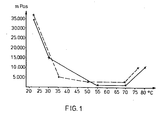
- FIG. 1 shows the viscosity curve of the coating compositions used in the examples as a function of the temperature.
- the solid line corresponds to the paste of Examples 1 and 2, the broken line corresponds to that of Example 3.
- NCO prepolymer is prepared as described in Example 1, but blocked with 655 g of caprolactam. Then 645 g of ethylene glycol monomethyl ether acetate are rapidly stirred in. After 30 minutes, NCO is no longer detectable by IR spectroscopy.
- the blocked prepolymer a whitish, cloudy liquid with a viscosity of 50,000 mPas at 20 ° C., has a determinable, latent NCO content of 3.2% by weight and an NCO equivalent weight of 1310.
- the coating composition is applied to a die and carried out in the first heating channel (90 ° C. air temperature) at a belt speed of approx. 7 m per minute. After passing through the first heating channel, the coated die is passed through a second channel (temperature 190 ° C.) at the same speed. Then proceed as in Example 1.
- Example 4 The failure of the coating produced according to Example 4 is similar to Example 1 and is also free of air pockets on the back.
- the physical fastness properties are comparable. Resistance to alcoholic solutions such as high-percentage alcoholic beverages, as with coatings according to Example 1, is generally good, but slightly worse than in Examples 1-3.
- NCO prepolymer is prepared as described in Example 1, but blocked with 1005 g of malonic ester (diethyl malonate). 675 g of ethylene glycol monomethyl ether acetate are then stirred in rapidly. After 30 minutes, NCO is no longer detectable by IR spectroscopy.
- the blocked NCO prepolymer a colorless, clear liquid with a viscosity of 43 OOOmPas at 20 ° C, had a determinable, latent NCO content of 3.0% by weight and an equivalent weight of 1400. The procedure is continued as described in Example 1.
- the resulting coating is homogeneous.
- the coating composition comparable to that of Example 1.
- the velor-like surface is slightly softer and more pleasant, but somewhat less wear-resistant and scratch-resistant.
- the resistance to high-percentage alcoholic beverages is good and the substrate is insoluble even in solvents such as methyl ethyl ketone.
- the suede as are accessible according to the invention from blocked, high-solids systems according to example 1, 4 and 5, show a soft, long pile, which can be aligned in different directions when brushing, as is known from natural suede.
Landscapes
- Engineering & Computer Science (AREA)
- Chemical & Material Sciences (AREA)
- Mechanical Engineering (AREA)
- Chemical Kinetics & Catalysis (AREA)
- Textile Engineering (AREA)
- Health & Medical Sciences (AREA)
- Medicinal Chemistry (AREA)
- Polymers & Plastics (AREA)
- Organic Chemistry (AREA)
- Dispersion Chemistry (AREA)
- Paints Or Removers (AREA)
- Synthetic Leather, Interior Materials Or Flexible Sheet Materials (AREA)
- Treatment And Processing Of Natural Fur Or Leather (AREA)
- Polyurethanes Or Polyureas (AREA)
- Moulding By Coating Moulds (AREA)
- Molding Of Porous Articles (AREA)
- Processes Of Treating Macromolecular Substances (AREA)
- Manufacture Of Macromolecular Shaped Articles (AREA)
- Laminated Bodies (AREA)
- Compositions Of Oxide Ceramics (AREA)
- Macromolecular Compounds Obtained By Forming Nitrogen-Containing Linkages In General (AREA)
- Application Of Or Painting With Fluid Materials (AREA)
- Shaping Of Tube Ends By Bending Or Straightening (AREA)
Abstract
- a) eine Beschichtungspaste eines erst durch Erhitzen zu einem Polyurethanharnstoff aushärtbaren Zwei-Komponentensystem auf Basis von entweder einem blockierten NCO-Präpolymeren und einem Polyamin oder einem NCO-Präpolymeren und einen Komplex aus einem Alkalihalogenid und einem aromatischen Polyamin, sowie gegebenenfalls bis zu 30 Gew.-%, bevorzugt weniger als 25 Gew.-% insbesondere weniger als 15 Gew.-% an Lösemitteln, so daß die Beschichtungspaste eine Viskosität von maximal 100.000 mPa.s bei Raumtemperatur aufweist, aufträgt,
- b) die Beschichtung auf eine Temperatur zwischen 30 und 80°C erwärmt, wobei die Viskosität der Beschichtungspaste ein Minimum durchläuft, welches maximal 30.000 mPa.s beträgt und
- c) Die Beschichtung durch Erwärmen auf eine Temperatur oberhalb 90°C zum Polyurethanharnstoff aushärtet.
Description
- Die vorliegende Erfindung betrifft ein Verfahren zur Herstellung von velourlederartigen Materialien mit Hilfe von Beschichtungsmassen, die bei erhöhter Temperatur zu Hochmolekularen vernetzbar sind und die sich infolge eines speziellen Verlaufs ihrer Viskosität in Abhängigkeit von der Temperatur vor allem zum Umkehrbeschichten von Matrizen mit besonders tiefen und engen Vertiefungen eignen. Nach dem Abtrennen der Beschichtung von der Matrize erhält man so Flächengebilde mit langen, von der Oberfläche abstehenden Fasern, wie dies vor allem für Velourleder-Imitate erwünscht ist.
- Es ist Stand der Technik, Matrizen unterschiedlichster Art durch Rakeln oder Sprühen mit thermoplastischen Kunststoffen zu beschichten und nach dem Verdampfen eventuell verwendeter Lösemittel bzw., im Falle von Reaktivsystemen, nach der Härtungsreaktion von der Matrize abzunehmen. Man erhält so Beschichtungen, die das Abbild der,Matrizenoberfläche als Negativ enthalten.
- Als Matrizen-Materialien kommen beispielsweise alle üblichen geprägten Trennpapiere mit Oberflächen aus z.B. Polypropylen oder Silicon, Metalle, Siliconkautschukmassen oder Polyesterharzmassen in Frage.
- Als Beschichtungssysteme werden bevorzugt thermoplastische oder auch z.B. mit Polyisocyanaten oder Melaminharzen vernetzbare, in Lösemitteln gelöste Polyurethane, PVC-Massen, die unterschiedlichen Weichmachergehalt aufweisen können, Polyamide und andere verwendet (US-PS 3 861 937). Für übliche Beschichtungen werden auch blockierte Zweikomponenten-Reaktivsysteme beschrieben, z.B. in der US-PS 3 755 261 die Amin-Härtung von Polymeren oder Prepolymeren auf Basis von NCO-endständigen Urethanen, von Epoxyharzen, halogenhaltigen Kohlenwasserstoff-Polymeren etc. mit feinverteilten Komplexen aus bestimmten aromatischen Diaminen und Salzen wie NaCl.
- Weiterhin sind mit üblichen Blockierungsmitteln blockierte NCO-Prepolymere bekannt, z.B. nach der DE-OS 2 131 299 (US-PS 3 770 703) mit Caprolactam blockierte NCO-Prepolymere oder auch mit Malondialkylestern blockierte Prepolymere. Ferner werden mit Ketoximen blockierte NCO-Prepolymere, die anschließend mit tertiär-Aminogruppen-haltigen Polyolen vernetzt werden, in ihrem vorteilhaften Verhalten im Vergleich zu Phenol-blockierten NCO-Prepolymeren in der DE-OS 1 621 910 beschrieben. Nach der DE-OS 1 519 432 (US-PS 3 267 078) werden Ketoxim-blockierte NCO-Prepolymere mit Polyketiminen (d.h. mit Ketonen blockierten Polyaminen) vermischt, die bei Raumtemperatur in Gegenwart von Feuchtigkeit aushärten. In der GB-PS 1 085 454 werden Ketoxim-blockierte NCO-Prepolymere mit aliphatischen Diaminen zur Herstellung abriebbeständiger Überzüge bzw. Imprägnierungen von nonwovens, Leder und Holz beschrieben.
- Obwohl diese beschriebenen Reaktivsysteme allgemein für die Verwendung zur Herstellung von Beschichtungen bekannt sind, so sind sie nicht für die Herstellung von Velourslederimitaten beschrieben, und es sind auch nicht die besonderen Bedingungen für die Herstellung solcher Velourslederimitate bekannt. Bei lösemittelfreien Beschichtungen geht man von Folien aus thermoplastischen Kunststoffen aus, die beim Erhitzen erweichen und so in die Vertiefungen der Matrizen einfließen. Nach dem Erkalten erstarrt der Kunststoff, so daß auf diese Art wieder ein Negativ-Abbild der Matrize an der Folienoberfläche wiedergegeben wird.
- In der Regel werden mit Hilfe der beschriebenen Matrizen Oberflächen imitiert, wie sie bei Narbenledern üblich sind; selbstverständlich können jedoch auch andere Muster, z.B. textile Strukturen usw. abgebildet werden. Besonders schwierig ist es jedoch, auf diese Weise Velourslederimitate herzustellen. Matrizen, die von echtem Veloursleder oder auch von beflockten veloursartigen Materialien abgenommen werden, zeichnen sich dadurch aus, daß sie besonders enge und tiefe Näpfchen aufweisen, wodurch die langen Haare bzw. Fasern eines Veloursleders reproduziert werden können. In der US-PS 3 533 895 werden Folien aus löslichen thermoplastischen Polyurethanelastomeren bei hohen Temperaturen und hohem Druck in Silikonmatrizen eingeprägt. Die Trennung von der Form darf aber erst nach Abkühlung erfolgen und die Produkte sind 1 bis 2 Tage sehr druckempfindlich im Flor, außerdem sehr lösungsmittelempfindlich.
- Daher hat man versucht, durch Nachbehandlung von solchen löslichen Polyurethanledern unter Aufsprühen verdünnter Lösungen polymerer Isocyanate, Trocknung bei 80°C und 3-tägiges Stehenlassen bei Raumtemperatur eine verbesserte Thermostabilität zu erreichen (DGBM 7141380). Dieses Verfahren ist jedoch zu kompliziert, langwierig und wegen der Lösungsmittel nicht umweltfreundlich.
- Die Herstellung von Matrizen und deren Verwendung im Umkehrbeschichtungsverfahren sind an sich bekannt. Sie werden z.B. in den US-Patentschriften 3 369 949, 3 655 497 und 4 124 428 sowie in der deutschen Patentschrift 1 933 255 beschrieben. Eine Schwierigkeit dieser Verfahren besteht jedoch darin, daß hochmolekulare thermoplastische Produkte in der Regel in die engen Vertiefungen solcher Matrizen nicht genügend gut eindringen. Verwendet man hingegen niederviskose Lösungen von Polymeren, so dringen diese Lösungen zwar gut in die tiefen Näpfchen ein, beim Verdampfen der Lösemittel entstehen jedoch Störstellen, welche die Wiedergabe eines schönen Velourscharakters beeinträchtigen. Durch eine gleichzeitig einsetzende Erhöhung der Viskosität unter Filmbildung werden diese Störstellen dann fixiert.
- Bei der Reaktion nicht-geblockter Polyurethan-Reaktivsysteme, selbst mit hohem Feststoffgehalt wie z.B. 67 Gew.-%, wird ein ähnlich unbefriedigendes Ergebnis erzielt und es fehlt auch hier die Ausbildung des Flors und die stabile Entformbarkeit des Polyurethanvelours von der Matrize. Es liegt offenbar sowohl eine unvollständige Eindringung in die feinen Kapillaren durch das Polyurethan vor, als auch ein Haften und Abbrechen von feinen Velourshärchen beim Trennen des Polyurethan von der Matrize.
- Entsprechend diesen Ergebnissen war anzunehmen, daß high-solids-Reaktivsysteme mit blockierten Ausgangsmaterialien entsprechende Schwierigkeiten bei der Trennung der innerhalb der feinen Matrizenkapillaren aushärtenden Reaktiv-Polyurethane ergeben würden.
- Überraschenderweise wurde jedoch gefunden, daß die erfindungsgemäß ausgewählten, erst durch Erhitzen zu einem Polyurethanharnstoff aushärtenden, nach Erhitzen lösungsmittelstabilen und vorzugsweise vernetzten Systeme auf der Basis blockierter Polyurethan-Ausgangskomponenten bei Einhaltung der erfindungsgemäßen Bedingungen sowohl feinste Details in der Matrize (wie feinste Velourshärchen) abformen können, als auch nach der Beendigung der Polyurethanbildung aus den Reaktivsystemen innerhalb der Matrize eine glatte und problemlose Ablösung des Polyurethanharnstoffs von der Matrize erlauben. Neben der detailgetreuen Abbildung der Matrizenvorlage und guter Entformbarkeit wird nach dem erfindungsgemäßen Vorgehen auch eine homogene, gleichmäßig dicke Rückseite des Polyurethan-Velourmaterials erreicht, während mit den gleichen Materialien bei Nichteinhalten des Temperaturbereichs des Viskositätsminimums bei 30 bis 80°C vor Vernetzungsbeginn, sondern z.B. bei sofortiger Erwärmung auf hohe Ofentemperaturen wie 170°C inhomogene, blasen-und kraterhalige Veloursbeschichtungen erhalten werden.
- Gegenstand der Erfindung ist somit ein Verfahren zur Herstellung von Flächengebilden mit veloursartiger Oberfläche durch Aufbringen einer Beschichtungspaste auf eine Matrize, deren Oberfläche als Negativ zu Veloursleder oder velourslederartigen Materialien ausgebildet ist, Verfestigung der Beschichtung durch Erhitzen, Abziehen der verfestigten Beschichtung von der Matrize und gegebenenfalls Kaschieren auf ein textiles Trägermaterial, dadurch gekennzeichnet, daß man
- a) eine Beschichtungspaste eines erst durch Erhitzen zu einem Polyurethanharnstoff aushärtbaren Zweikomponentensystems auf Basis von entweder einem blockierten NCO-Präpolymeren und einem Polyamin oder einem NCO-Präpolymeren und einen Komplex aus einem Alkalihalogenid und einem aromatischen Polyamin, sowie gegebenenfalls bis zu 40 Gew.-%. besser bis zu 30 Gew.-%, bevorzugt weniger als 25 Gew.-%, insbesondere weniger als 15 Gew.-%, an Lösemitteln, so daß die Beschichtungspaste eine Viskosität von maximal 100.000 mPas bei Raumtemperatur aufweist, aufträgt,
- b) die Beschichtung auf eine Temperatur zwischen 30 und 80°C erwärmt, wobei die Viskosität der Beschichtungspaste ein Minimum durchläuft, welches maximal 30.000 mPas beträgt und
- c) Die Beschichtung durch Erwärmen auf eine Temperatur oberhalb 90°C zum Polyurethan aushärtet.
- Besonders gut eignen sich Beschichtungsmassen auf Basis blockierter, hitzehärtbarer Polyurethan-Zweikomponentensysteme, welche die folgenden Voraussetzungen erfüllen:
- d) Die Beschichtungsmassen müssen bei Raumtemperatur (ca. 17-25°C) eine Viskosität von maximal 100.000 mPas, vorzugsweise 5.000 bis 70.000 mPas aufweisen;
- e) die Massen sollen beim Erhitzen auf Temperaturen von ca. 30-80°C ein Viskositätsminimum von maximal 30.000, vorzugsweise unter 15.000, besonders bevorzugt zwischen 100 und 10.000 mPas durchlaufen;
- f) der Gehalt der Beschichtungsmassen an Lösemitteln soll so gering wie möglich sein, um Störungen der Oberflächenbildung zu vermeiden; er soll nach Möglichkeit 30 Gew.-% nicht übersteigen und vorzugsweise unter 25 %, insbesondere unter 15 % liegen, kann jedoch bei höherviskosen Ausgangsstoffen, wie z.B. bei aus mit aliphatischen Diisocyanaten aufgebauten NCO-Präpolymeren auch höher liegen und z.B. 40 Gew.-% betragen.
- g) im oben angegebenen Temperaturbereich, in welchem die Viskosität ein Minimum durchläuft und die Beschichtungsmasse in die Vertiefungen der Matrize eindringt, soll im Beschichtungssystem noch keine merkliche Vernetzungsreaktion unter Bildung von Hochmolekularen ablaufen..
- Die Temperaturen, bei der die Vernetzung beginnt, ist aus dem Viskositätsverlauf in Abhängigkeit von der Temperatur durch einen Anstieg der Viskosität gut zu erkennen. Bei einer weiteren Erhöhung der Temperatur über das Viskositätsminimum hinaus bis zur Temperatur der optimalen Vernetzung reagieren die Beschichtungsmassen unter Bildung von festen Hochmolekularen aus. Diese Endvernetzung erfolgt meist erst genügend schnell bei Temperaturen oberhalb 90°C, vorzugsweise zwischen 100 - 180°C, besonders bei 100 - 150°C und nur bei den weniger reaktiven Systemen auf Basis aliphatischer Polyisocyanate bei ca. 150 - 180°C, während kurzer Einwirkungszeit von weniger als 5 Minuten.
- Mittels der beanspruchten, hohe Feststoffgehalte von 60 bis 70 %, vorzugsweise über 75 Gew.-% besonders über 85 Gew.-% enthaltenden Polyurethan-Reaktivsysteme, welche solche blockierte Reaktivgruppen aufweisen müssen, daß sie erst oberhalb von 90°C eine nennenswerte Aufbaureaktion eingehen und welche zusätzlich ein bestimmtes Temperaturviskositätsverhalten zeigen müssen, wurde ein Weg eröffnet, mit hervorragender Formtreue auch velourslederartige Matrizen fehlerfrei abzubilden und ein hochwertiges velourslederartiges Abgußmaterial zu erhalten. Neben der sehr hohen Feststoffkonzentration war es dazu wesentlich, daß solche blockierten Polyurethan-Reaktivsysteme - ausgehend von einer guten Streichviskosität - zunächst durch Erwärmen auf ca. 30 - 80°C ein Viskositätsmiminum durchlaufen, bei dieser niedrigen Viskosität erst vollständig die Matrize füllen und erst dann bei weiterer Temperaturerhöhung zur Ver netzung ausreagieren (s. Viskositätskurven zu den Beispielen). Eine solche Vorgehensweise war keiner der zitierten Literaturstelle zu entnehmen.
- Werden Polyurethan-Reaktivbeschichtungen verwendet, bei denen keiner der Reaktionspartner durch Blockierung in der Reaktivität gebremst ist, so werden Beschichtungen erhalten, die den gestellten Anforderungen nicht voll genügen. So wird z.B. mit einer Beschichtungsmasse aus nichtblockierten NCO-Prepolymeren und freien Aminen als Vernetzer auch ein veloursartiger Flor erhalten, der jedoch in seiner Oberfläche stark gestört ist. Solchen Massen müssen zur Senkung der Anfangsviskosität in der Regel höhere Lösungsmittelmengen zugesetzt werden. Die Vermischung muß in der Regel wegen der hohen Reaktivität der beiden Komponenten in einem Zweikomponenten-Mischkopf vor sich gehen, und das reagierende Gemisch wird in der Regel durch Sprühen aufgetragen. Zwangsweise ist bei diesem Sprühauftrag ein störender Anteil von Luftbläschen in der Beschichtungsmasse enthalten.
- Außerdem beginnt hier sofort nach dem Durchmischen der Reaktionspartner, folglich schon während des Auftragens auf die Matrize, die Reaktion, die zu einer raschen Erhöhung der Viskosität führt. Mit dem Einfließen der Beschichtungsmasse in die tiefen Näpfchen geht hier bereits eine Vernetzung zeitlich einher, welche das Entweichen der in diesen Vertiefungen befindlichen Luft und der in der Beschichtungsmasse enthaltenden Lösemittel behindert und auch zu einer schnellen Filmbildung führt. Die Oberfläche der Beschichtung ist daher wegen einer schlechteren Abformung der Matrize weniger gut.
- Das erfindungsgemäße Verfahren zur Erzeugung eines Flächengebildes mit velourslederartiger Oberfläche kann z.B. nach folgendem Schema erfolgen: Die Beschichtungsmasse wird bei Raumtemperatur durch ein übliches Streichwerk auf eine Matrize der beschriebenen Art (vorzugsweise eine Matrize gemäß US-PS 3 369 949 oder DE-PS 19 33 255) aufgerakelt. Zum Beispiel durch Bestrahlen der beschichteten Matrize mit üblichen Wärmestrahlern oder auch mittels eines in der Beschichtungsindustrie üblichen Heizkanals wird die Beschichtungsmasse nun auf die Temperatur gebracht, bei der sie ohne Vernetzung ihr Viskositätsminimum durchläuft. Anschließend wird, z.B. durch stärkere Wärmestrahlung der beheizenden Strahler oder durch Einführen der beschichteten Matrize in einen heißeren Durchlaufkanal, die Beschichtung auf eine Temperatur gebracht, bei der die Aushärtungsreaktion erfolgt.
- Diese Prozedur des Aufrakelns, der Viskositätserniedrigung und anschließender Vernetzung unter Lösungsmittelentfernung kann ein- oder mehrfach vorgenommen werden. Nach dem Abkühlen wird die fertige Beschichtung von der Matrize abgenommen und gegebenenfalls durch eine geeignete Nachbehandlung in ihrem Erscheinungs- und Eigenschaftbild noch etwas korrigiert.
- Als Beschichtungsmassen, die den erfindungsgemäß gestellten Anforderungen genügen, seien beispielhaft genannt:
- 1. Mit üblichen Blockierungsmitteln blockierte NCO-Prepolymere, die mit Polyaminen vernetzt werden. Die Systeme können ca. 0 - 40 Gew.-% an Lösemittel enthalten, wobei die Lösemittel als Verlaufhilfsmittel dienen können. Die Entblockung der maskierten Isocyanate und damit die Härtungsreaktion mit den Aminen erfolgt innerhalb von wenigen Minuten, wenn man die Beschichtung auf Temperaturen oberhalb ca. 100°C, vorzugsweise oberhalb ca. 140°C; erhitzt.
- 2. Mischungen aus NCO-Prepolymeren mit einem Komplex aus Alkalihalogeniden und aromatischen Polyaminen, z.B. dem Kochsalzkomplex des 4,4'-Diamino-diphenylmethans, wie sie z.B. in der US-PS 37 55 261 beschrieben werden. Der Komplex zerfällt bei ca. 120°C in freies Kochsalz und freies Amin, wobei anschließend das freigewordene Amin mit den Isocyanat-Gruppen des NCO-Prepolymeren unter Bildung eines Hochmolekularen reagiert. Auch hier kann zwecks Regulierung der Viskosität der Beschichtungsmasse beim Aufbringen auf die Matrize etwas Lösemittel zugegeben werden.
- Für das erfindungsgemäße Verfahren bevorzugt sind Beschichtungsmassen der erstgenannten Art. Als besonders geeignet haben sich dabei hitzehärtbare Zweikomponentensysteme erwiesen, die folgende wesentliche Komponenten enthalten:
- A) ein durchschnittlich 2 bis 4, vorzugsweise 2 bis 3, Ketoxim-blockierte aromatische NCO-Gruppen aufweisendes Vorpolymerisat mit einem durchschnittlichen Molekulargewicht von 1000 bis 15000, vorzugsweise 2000 bis 8000,
- B) einen Vernetzer der Formel

R1, R2, R3 und R4 unabhängig voneinander für Wasserstoff oder eine C1-C3-Alkylgruppe stehen, mit der Maßgabe, daß das Diamin zu mindestens 75 % aus dem cis, cis-Isomeren besteht, wenn R 1 bis R 4 alle Wasserstoff bedeuten,
sowie gegebenenfalls - C) Pigmente, Füllstoffe, Treibmittel und weitere an sich bekannte Zusatzstoffe,
- Für den Aufbau der NCO-Vorpolymerisate, die gegebenenfalls in die Ketoxim-blockierten NCO-Prepolymeren überführt werden, kommen vorzugsweise aromatische Polyisocyanate, wie sie eingehend in den US-Patentschriften 3 984 607 und 4 035 213, in DE-OS 24 02 840 bzw. DE-AS 25 57 387 beschrieben sind, in Frage. Erfindungsgemäß bevorzugt sind 2,4'- bzw. 4,4'-Diisocyanato-diphenylmethan, die isomeren Toluylendiisocyanate sowie insbesondere Gemische dieser Diisocyanate. Ferner sind aliphatische oder cycloaliphatische Diisocyanate einsetzbar, z.B. Hexamethylendiisocyanat, Dicyclohexylmethan-4,4'-diisocyanat und Isophoron-diisocyanat (IPDI).
- Als Reaktionspartner für diese Polyisocyanate zur Herstellung der NCO-Vorpolymerisate kommen Polyhydroxylverbindungen in Frage, die 2 bis 8, vorzugsweise 2 oder'3, Hydroxylgruppen aufweisen und ein Molekulargewicht von 500 bis 10.000, vorzugsweise 1000 bis 6000, haben und wie sie im Detail ebenfalls in den oben genannten Publikationen beschrieben werden.
- Bevorzugt als Reaktionspartner sind im Durchschnitt 2 bis 3 Hydroxylgruppen aufweisende Propylenoxid-Polyäther, die auch Polyethylenoxid-Einheiten enthalten können, sowie unterhalb von 60°C schmelzende Hydroxypolyester mit 2 oder 3 endständigen OH-Gruppen und einem mittleren Molekulargewicht von 1000 - 6000.
- Besonders bevorzugt sind Mischungen der genannten Hydroxy-Polyäther mit Hydroxypolyestern aus Adipinsäure, Hexandiol-1,6 und Neopentylglykol vom mittleren Molekulargewicht 1000 bis 3000.
- Bei der Herstellung der NCO-Vorpolymerisate können gegebenenfalls auch niedermolekulare Polyole mit einem Molekulargewicht von weniger als etwa 300 mitverwendet werden, wie sie als Kettenverlängerungsmittel an sich bekannt sind. Bevorzugt sind erfindungsgemäß in diesem Zusammenhang Butandiol-1,4, Di-(2-hydroxyethyl)-methylamin.und Trimethylolpropan.
- Die Herstellung der NCO-Vorpolymerisate erfolgt in an sich bekannter Weise, indem man die genannten Polyhydroxylverbindungen mit überschüssigen aromatischen und/ oder (cyclo-)aliphatischen Polyisocyanaten, vorzugsweise Diisocyanaten, bei ca. 70 bis 110°C umsetzt. Man wählt hierbei im allgemeinen ein NCO/OH-Verhältnis von -6,0 : 1, vorzugsweise von 1,7 : 1 bis 2,5 : 1.
- Als Blockierungsmittel für die NCO-Vorpolymerisate kommen z.B. Ketoxime aus Hydroxylamin und Ketonen wie Aceton, Methylethylketon, Diethylketon, Cyclohexanon, Acetophenon und Benzophenon in Frage.
- Ein dafür bevorzugtes Blockierungsmittel ist Methylethylketoxim (Butanonoxim).
- Die Blockierungsreaktion wird in der Weise durchgeführt, daß man das NCO-Vorpolymerisat mit stöchiometrischen Mengen an Ketoxim bei erhöhter Temperatur, z.B. 70 - 100°C, bis zum Verschwinden der NCO-Gruppen umsetzt.
- Es können - wenn auch weniger bevorzugt - andere übliche Blockierungsmittel wie Phenol, Caprolactam oder Malonester mitverwendet oder als alleinige Blockierungsmittel eingesetzt werden. Es können auch solche blockierte NCO-Prepolymere eingesetzt werden, bei denen nicht alle freien NCO-Gruppen in die blockierte Form überführt wurden, sondern nur ca. 75%, vorzugsweise)90%.
- Die blockierten NCO-Vorpolymerisate können zwecks Einstellung der optimalen Verarbeitungsviskosität von 5000 - 70.000 mPas bei ca. 20°C mit kleinen Mengen an organischen Lösungsmitteln gemischt werden. Infolge des blockierten Charakters der NCO-Gruppen müssen hierbei nicht notwendigerweise gegenüber NCO-Gruppen inerte Lösemittel eingesetzt werden. Beispielsweise können Isopropanol, Ethylenglykolmonomethyl- bzw. - Ethylenglykolmonoethyläther sowie deren Essigsäureester, Methylethylketon, Cyclohexanon, Butylacetat und DMF verwendet werden.
- Als Vernetzerkomponente B für die blockierten NCO-Vorpolymerisate dient erfindungsgemäß vorzugsweise 4,4'-Diamino-3,3'-dimethyl-dicyclohexylmethan, ein bei Raumtemperatur flüssiges, aliphatisches Diamin mit sehr geringem Dampfdruck, das hervorragende Veloursleder mit trockenem Griff und hoher Florstabilität ergibt.
- Weitere geeignete Vernetzer sind z.B. die entsprechenden homologen 3,3'-Diethyl-, Dipropyl- und Diisopropyl-Derivate, das 4,4'-Diamino-3,3',5,5'-tetramethyl-dicyclohexylmethan bzw. das homologe Tetraethylderivat und 4,4'-Diamino-3,5-dimethyl-3',5'-diethyl-dicyclohexylmethan, sowie auch andere aliphatische oder cycloaliphatische Diamine mit vorzugsweise geringerem Dampfdruck als 1,6-Hexandiamin.
- Die Vermischung der blockierten NCO-Vorpolymerisate mit dem Diamin-Vernetzer erfolgt im allgemeinen etwa im Verhältnis der Äquivalentgewichte dieser Komponenten, obwohl für einige Anwendungszwecke auch eine Untervernetzung zweckmäßig ist, so daß das Äquivalentverhältnis von blockiertem NCO zu NH2 erfindungsgemäß im allgemeinen zwischen 1,35 : 1 und 0,95 : 1, bevorzugt 1,25 : 1 bis 1 : 1, liegt.
- Zur Herstellung von gebrauchsfertigen Beschichtungsmassen können den hitzehärtbaren Reaktivgemischen an sich bekannte Zuschläge, wie z.B. Pigmente, UV-Stabilisatoren, Lichtschutzmittel, phenolische Antioxidantien, tert.-Aminstabilisatoren, Füllstoffe, 2,2,6,6-Tetramethylpiperidin-Derivate, Treibmittel oder Verlaufmittel, z.B. Silikonöle oder z.B. organofunktionelle Polydimethyl-siloxane beigemischt werden.
- Mit den hitzehärtbaren Reaktivgemischen können Beschichtungen auf allen in der Praxis üblichen Umkehrbeschichtungsanlagen hergestellt werden.
- Die folgenden Beispiele dienen zur Erläuterung der vorliegenden Erfindung.
- 2000 g eines Polyäthers auf Basis von Trimethylolpropan und Propylenoxid mit einem Molekulargewicht von 6000, 1000 g eines linearen Polyäthers auf Basis von Propylenglykol und Propylenoxid mit einem Molekulargewicht von 1000, 1450 g eines linearen Poly- esters aus 1,6-Hexandiol, Neopentylglykol und Adipinsäure (Molekulargewicht 1700) sowie 22,5 g Butandiol-1,4 werden mit 1125 g 4,4'-Diisocyanato-diphenylmethan und 174 g 2,4-Diisocyanatotoluol ca. 3 Stunden lang bei 80 - 90°C umgesetzt, bis der berechnete NCO-Gehalt von 4,26 Gew.-% knapp unterschritten ist. Anschließend werden bei 60 - 70°C 496 g Butanonoxim sowie 696 g Ethylenglykolmonomethylätheracetat rasch eingerührt. Nach 20 Minuten ist IR-spektroskopisch kein NCO mehr nachweisbar.
- Das blockierte NCO-Vorpolymerisat, eine farblose, .klare Flüssigkeit mit einer Viskosität von ca. 40.000 mPas bei 20°C, hat einen bestimmbaren, latenten NCO-Gehalt von 3,3 Gew.-% und somit ein NCO-Äquivalentgewicht von 1280.
- 1280 g des Vorpolymerisats werden mit 119 g (d.h. einer äquimolaren Menge) 4,4'-Diamino-3,3'-dimethyl- dicyclohexylmethan.vermischt. Außerdem werden 10 Gew.-% (bezogen auf Gesamtgemisch) einer handelsr üblichen Pigmentanreibung und 1 Gew.-% Silikonöl zugesetzt. Die Viskosität dieser anwendungsfertigen Paste beträgt bei Raumtemperatur ca. 40.000 mPas.
- Die Beschichtungsmasse wird auf eine Matrize, die gemäß US-PS 4 124 428 hergestellt wurde, im Rakelverfahren mit einer Auflage von ca. 200 g/m2 aufgetragen. Die beschichtete Matrize wird nunmehr mit einer Bandgeschwindigkeit von ca. 9 m pro Minute durch einen Heizkanal von 9 m Länge geführt, der auf eine Lufttemperatur von 80°C beheizt ist. Nach Durchlaufen dieses ersten Heizkanals wird die beschichtete Matrize in einen zweiten Kanal geführt, den sie bei gleicher Geschwindigkeit durchläuft. Dieser Heizkanal ist 18 m lang und wird auf einer Temperatur von 170°C gehalten. Nach dem Abkühlen wird die Beschichtung von der Matrize genommen und durch Unterkleben mit einem einseitig gerauhten Baumwollgewebe, wahlweise auch mit einem Mischgewebe aus PolyesterBaumwolle, mit einem Quadratmetergewicht von ca. 190 g verstärkt. Die Kaschierung erfolgt auf der glatten Seite der Beschichtung und der nicht gerauhten Gewebeseite mittels eines handelsüblichen Polyurethan-Einkomponentensystems.
- Der Veloureffekt wird durch Aufbürsten der Oberfläche mit den in der Textil-Industrie üblichen Bürst- und Putzmaschinen verstärkt. Mittels an sich bekannter Hilfs- und Ausrüstungsverfahren kann der Velour noch stabilisiert und in seinen Gebrauchseigenschaften verbessert werden. Es entsteht so ein textiles Flächengebilde mit verlourlederartiger Oberfläche, das z.B. als Schuhmaterial oder auch für Bekleidungszwecke dienen kann. Dieses Material zeichnet sich überraschenderweise auch dadurch aus, daß es eine Wasserdampdurchlässigkeit von 0,5 bis 1,5 mg pro cm2 und Stunde, gemessen nach IUP 15, aufweist. Durch eine Variation der zugesetzten Lösemittel lassen sich diese Werte beeinflussen und zum Teil noch übertreffen.
- Die in Beispiel 1 beschriebene Beschichtungsmasse wird wieder in üblicher Weise auf eine Matrize gemäß US-PS 4 124 428 aufgetragen. Die beschichtete Matrize durchläuft einen Trockenkanal von 18 m Länge in einer Geschwindigkeit von 5 m pro Minute. Der Kanal ist stufenweise von 4Ö°C bis auf 160°C erhitzt. Im ersten Teil des Trockenkanals wird das Viskositätsminimum der Beschichtungspaste durchlaufen, im zweiten Teil erfolgt die Vernetzungsreaktion. Nach dem Abkühlen der Beschichtung wird die Matrize entfernt. Der erhaltene Polyurethanfilm mit velourlederartiger Oberfläche wird auf der glatten Fläche mittels eines üblichen, in Lösemitteln gelösten Haftklebers mit einem glatten, nicht gerauhten Baumwolle- oder Polyesterbaumwolle- oder Polyester-Gewebe verklebt. Wie in Beispiel 1 beschrieben, können die Gebrauchseigenschaften durch Bürsten und Nachbehandeln beeinflußt und verbessert werden.
- Das erhaltene velourlederartige Material dient z.B. zur Herstellung von Möbelbezugsstoffen.
- Eine Beschichtungsmasse, wie sie in Beispiele von US-PS 37 55 261 beschrieben ist, wird auf die in Beispiel 1 verwendete Matrize mittels Rakelverfahren aufgebracht und die beschichtete Matrize wie in Beispiel 2 beschrieben erhitzt, wobei jedoch die letzte Zone des Kanals nur auf 140°C gehalten wird.
- Nach dem Abnehmen der abgekühlten Beschichtung von der Matrize wird sie wie in Beispiel 1 beschrieben mit Textil unterklebt und weiterbehandelt.
- In Figur 1 ist der Viskositätsverlauf der in den Beispielen verwendeten Beschichtungsmassen in Abhängigkeit von der Temperatur dargestellt. Die ausgezogene Linie entspricht der Paste von Beispiel 1 und 2, die strichlierte Linie jener von Beispiel 3.
- Ein NCO-Vorpolymerisat wird wie in Beispiel 1 beschrieben hergestellt, jedoch mit 655 g Caprolactam blockiert. Anschließend werden sofort 645 g Ethylenglykolmonomethylätheracetat rasch eingerührt. Nach 30 Minuten ist IR-spektroskopisch kein NCO mehr nachweisbar. Das blockierte Vorpolymerisat, eine weißliche trübe Flüssigkeit mit einer Viskotität von 50 000 mPas bei 20°C, hat einen bestimmbaren, lateten NCO-Gehalt von 3,2 Gew.-% und ein NCO-Äquivalentgewicht von 1310.
- Vor der Verarbeitung des weißlich trüben, imhonogenen, griesigen Produktes ist eine Homogenisierung durch Erwärmung auf ca. 40 - 50°C notwendig.
- Wie in Beispiel 1 beschrieben,wird die Beschichtungsmasse auf eine Matrize aufgebracht und im ersten Heizkanal (90oC Lufttemperatur) mit einer Bandgeschwindigkeit von ca. 7 m pro Minute durchgeführt. Nach Durchlaufen des ersten Heizkanales wird die beschichtete Matrize durch einen zweiten Kanal (Temperatur 190oC) mit gleicher Geschwindigkeit geführt. Danach wird wie in Beispiel 1 weiterverfahren.
- Der Ausfall der nach Beispiel 4 hergestellten Beschichtung ist ähnlich Beispiel 1 und ist auch auf der Rückseite frei von Lufteinschlüssen. Die physikalischen Echtheiten sind vergleichbar. Die Beständigkeit gegenüber alkoholischen Lösungen, wie z.B. hochprozentigen alkoholischen Getränken, ist wie bei Beschichtungen gemäß Beispiel 1 generell gut, jedoch geringfügig schlechter als in Beispiel 1 - 3.
- Ein NCO-Vorpolymerisat wird wie in Beispiel 1 beschrieben hergestellt, jedoch mit 1005 g Malonester (Malonsäurediäthylester) blockiert. Anschließend wird sofort 675 g Ethylenglykolmonomethylätheracetat rasch eingerührt. Nach 30 Minuten ist'IR-spektroskopisch kein NCO mehr nachweisbar. Das blockierte NCO-Vorpolymerisat, eine farblose, klare Flüssigkeit mit einer Viskosität von 43 OOOmPas bei 20°C, hatte einen bestimmbaren, latenten NCO--Gehalt von 3,0 Gew.-% und ein Äquivalentgewicht von 1400. Es wird wie in Beispiel 1 beschrieben weiterverfahren.
- Die resultierende Beschichtung ist bezüglich Homogenität. der Beschichtungsmasse mit der von Beispiel 1 vergleichbar. Die velourartige Oberfläche ist geringfügig weicher und angenehmer,in der Abriebbeständigkeit und in der Kratzfestigkeit jedoch etwas schlechter.
- Die Beständigkeit gegenüber hochprozentigen alkoholischen Getränken ist gut und auch in Lösungsmitteln wie Methylethylketon ist das Substrat unlöslich.
- Die Velourleder, wie sie etwa nach Beispiel 1, 4 und 5 erfindungsgemäß aus blockierten, hochfeststoffhaltigen Systemen zugänglich sind, zeigen einen weichen, langen Flor, der sich beim Bürsten nach verschiedenen Richtungen ausrichten läßt, wie dies von natürlichem Velourleder bekannt ist.
- Dagegen werden aus verdünnten Lösungen von Polyurethanen nach dem Stand der Technik kurze, borstig rauhe, kurzflorige Verlours minderer Qualität erhalten, die auch im Griff und im "Schreibeffekt" nicht mit den Velourleder Imitaten gemäß Beispielen 1 - 5 konkurrieren können.
wobei das Äquivalentverhältnis von blockierten NCO-Gruppen zu NH2-Gruppen zwischen 1,35 : 1 und 0.95 : 1, bevorzugt zwischen 1,25 : 1 und 1 : 1 liegt.
Claims (6)
oder
einem NCO-Präpolymeren und einem Komplex aus einem Alkalihalogenid und einem aromatischen Polyamin,
sowie gegebenenfalls bis zu 40 Gew.-% an Lösemittel, so daß die Beschichtungspaste eine Viskosität von maximal 100.000 mPa.s bei Raumtemperatur aufweist, aufträgt,

R 1, R 2, R 3 und R 4 unabhängig voneinander für Wasserstoff oder eine C1-C3-Alkylgruppe stehen, mit der Maßgabe, daß das Diamin zu mindestens 75 % aus dem cis, cis-Isomeren besteht, wenn R bis R 4 alle Wasserstoff bedeuten, als wesentlichste Komponenten sowie gegebenenfalls
wobei das Äquivalentverhältnis von blockierten NCO-Gruppen zu NH2-Gruppen zwischen 1,35 : 1 und 0,95 : 1 liegt.
Priority Applications (1)
| Application Number | Priority Date | Filing Date | Title |
|---|---|---|---|
| AT81100538T ATE6519T1 (de) | 1980-02-06 | 1981-01-26 | Verfahren zur herstellung von velourlederimitaten im umkehrverfahren. |
Applications Claiming Priority (2)
| Application Number | Priority Date | Filing Date | Title |
|---|---|---|---|
| DE3004327A DE3004327C2 (de) | 1980-02-06 | 1980-02-06 | Verfahren zur Herstellung von Velourleder-Imitaten im Umkehrverfahren |
| DE3004327 | 1980-02-06 |
Publications (3)
| Publication Number | Publication Date |
|---|---|
| EP0034272A2 true EP0034272A2 (de) | 1981-08-26 |
| EP0034272A3 EP0034272A3 (en) | 1981-09-09 |
| EP0034272B1 EP0034272B1 (de) | 1984-03-07 |
Family
ID=6093900
Family Applications (1)
| Application Number | Title | Priority Date | Filing Date |
|---|---|---|---|
| EP81100538A Expired EP0034272B1 (de) | 1980-02-06 | 1981-01-26 | Verfahren zur Herstellung von Velourleder-Imitaten im Umkehrverfahren |
Country Status (9)
| Country | Link |
|---|---|
| US (1) | US4363686A (de) |
| EP (1) | EP0034272B1 (de) |
| JP (1) | JPS56140184A (de) |
| AT (1) | ATE6519T1 (de) |
| CA (1) | CA1181207A (de) |
| CS (1) | CS222194B2 (de) |
| DE (2) | DE3004327C2 (de) |
| ES (1) | ES499149A0 (de) |
| HU (1) | HU193506B (de) |
Cited By (8)
| Publication number | Priority date | Publication date | Assignee | Title |
|---|---|---|---|---|
| EP0155585A1 (de) * | 1984-03-05 | 1985-09-25 | Ashland Oil, Inc. | Aktiver Weichmacher für Urethanprepolymere und Komplex eines Alkalimetallsalzes mit 4,4'-Methylendianilin |
| EP0107838A3 (de) * | 1982-10-28 | 1988-01-13 | Bayer Ag | Verlaufmittelhaltige Polyurethan-High-Solid-Reaktivbeschichtungssysteme und ihre Verwendung zur Reaktivbeschichtung |
| EP0206217A3 (en) * | 1985-06-27 | 1988-10-19 | Bayer Ag | Process for the preparation of photostable solvent-stable polyurethane urea elastomer coatings by a reactive coating process |
| EP0324337A1 (de) * | 1988-01-09 | 1989-07-19 | Bayer Ag | Hitzehärtbare Beschichtungszusammensetzung auf Polyurethanharnstoff-Basis |
| EP0324338A1 (de) * | 1988-01-09 | 1989-07-19 | Bayer Ag | Verfahren zur Beschichtung mit Polyurethanharnstoffen |
| EP0536614A3 (de) * | 1991-10-10 | 1993-04-21 | Bayer Ag | Hitzehärtbares Beschichtungsmittel und seine Verwendung |
| FR2801004A1 (fr) * | 1999-11-15 | 2001-05-18 | Gen Electric | Pale de ventilateur de moteur d'avion, composition pour sa realisation et leurs procedes de preparation |
| EP4289878A1 (de) | 2022-06-08 | 2023-12-13 | Evonik Operations GmbH | Ein-komponentensystem umfassend blockierte polyurethanprepolymere |
Families Citing this family (11)
| Publication number | Priority date | Publication date | Assignee | Title |
|---|---|---|---|---|
| JPS6043472B2 (ja) * | 1981-12-15 | 1985-09-28 | 東レ株式会社 | 高耐久性立毛布帛の製造方法 |
| DE3309992A1 (de) * | 1983-03-19 | 1984-09-20 | Bayer Ag, 5090 Leverkusen | Verfahren zum beschichten von (spalt)leder |
| DE3815720A1 (de) * | 1988-05-07 | 1989-11-16 | Hasso Von Bluecher | Wasserdampfdurchlaessiges, wasserdichtes material und verfahren zu seiner herstellung |
| DE3938629A1 (de) * | 1989-11-21 | 1991-05-23 | Benecke Ag J H | Druck- und vakuumverformbare schaumfolie zur verkleidung von fahrzeuginnenraeumen |
| US5455374A (en) * | 1993-06-30 | 1995-10-03 | Bayer Corporation | Liquification of trans, trans-4,4'-diisocyanate dicyclohexylmethane by partially reacting the isocyanate groups with blocking agents |
| US6383325B1 (en) * | 2000-05-10 | 2002-05-07 | Chai-Bang Tsai | Method for manufacturing a polyurethane product with high wetting ability, gas permeability and high water repellent ability by a dry transfer coating process |
| DE502006006105D1 (de) * | 2005-03-04 | 2010-03-25 | Basf Se | Matrize mit kleinen näpfchenartigen vertiefungen |
| DE102006056956A1 (de) | 2006-11-30 | 2008-06-05 | Benecke-Kaliko Ag | Verbundgebilde mit einer Polyurethanschicht, Verfahren zu deren Hersellung und Verwendung |
| EP2243618B1 (de) * | 2009-04-22 | 2012-10-31 | Nordenia Deutschland Gronau GmbH | Verfahren zur Herstellung einer thermoplastischen Folie mit einer dreidimensional strukturierten Oberfläche |
| ITMI20112111A1 (it) | 2011-11-21 | 2013-05-22 | Getters Spa | Lampada contenente un'amalgama di partenza migliorata |
| TWI691533B (zh) * | 2019-04-19 | 2020-04-21 | 財團法人中華民國紡織業拓展會 | 具有高貼合性與高彈性的熱塑性聚氨酯薄膜的製備方法 |
Family Cites Families (17)
| Publication number | Priority date | Publication date | Assignee | Title |
|---|---|---|---|---|
| US3267078A (en) * | 1963-12-16 | 1966-08-16 | Wyandotte Chemicals Corp | Polyether urethane coating composition cured with a di-imine |
| GB1085455A (en) | 1964-11-06 | 1967-10-04 | Du Pont | Impervious sheet material |
| GB1085454A (en) * | 1964-11-06 | 1967-10-04 | Du Pont | Compositions for the formation of polyether-urethane/polyurea copolymers |
| GB1133783A (en) * | 1966-04-20 | 1968-11-20 | Nairn Williamson Ltd | Embossing thermoplastic material |
| US3369949A (en) * | 1966-08-08 | 1968-02-20 | Forrest Norman | Method of making a flexible mold |
| DE1621910A1 (de) * | 1967-09-06 | 1971-06-24 | Bayer Ag | Verfahren zum Beschichten mit Polyurethanen |
| US3655497A (en) * | 1967-09-28 | 1972-04-11 | Tenneco Chem | Synthetic suede |
| DE1933255A1 (de) * | 1969-07-01 | 1971-01-21 | J H Benecke Beteiligungsgmbh & | Verfahren zur Herstellung eines wildlederartigen,flexiblen,mit Kunststoff beschichteten flaechigen Materials |
| US3678011A (en) * | 1970-01-13 | 1972-07-18 | Allied Chem | Novel polyurethane-urea coating composition and cast film |
| DE2131299C3 (de) * | 1971-06-24 | 1981-04-23 | Bayer Ag, 5090 Leverkusen | Durch Hitzeeinwirkung härtbare Gemische und Verfahren zur Herstellung von Formkörpern aus diesen Gemischen |
| US3755261A (en) * | 1972-05-01 | 1973-08-28 | Du Pont | Curing of amine curable polymers diamines with complexes of selected and alkali metal salts |
| US3861937A (en) * | 1972-07-03 | 1975-01-21 | Hooker Chemicals Plastics Corp | Method of producing suede-like synthetic leathers |
| DE2252280C3 (de) * | 1972-10-25 | 1981-03-19 | Bayer Ag, 5090 Leverkusen | Textilbeschichtungen und Syntheseleder aus Polycarbonat-Polyharnstoff-Elastomeren |
| DE2402840A1 (de) * | 1974-01-22 | 1975-08-07 | Bayer Ag | Textilbeschichtung mit gemischen aus polyurethanen, vinylcopolymeren und dienpfropfcopolymerisaten |
| FR2277130A1 (fr) * | 1974-07-05 | 1976-01-30 | Ugine Kuhlmann | Procede de revetement de substrats souples par projection d'elastomeres de polyurethane-polyuree et produit obtenus |
| US4044183A (en) * | 1976-11-04 | 1977-08-23 | Norman Forrest | Synthetic suede and process therefor |
| DE2902090A1 (de) * | 1979-01-19 | 1980-07-24 | Bayer Ag | Hitzehaertbare beschichtungsmassen und verfahren zur beschichtung von substraten |
-
1980
- 1980-02-06 DE DE3004327A patent/DE3004327C2/de not_active Expired
-
1981
- 1981-01-26 DE DE8181100538T patent/DE3162451D1/de not_active Expired
- 1981-01-26 AT AT81100538T patent/ATE6519T1/de not_active IP Right Cessation
- 1981-01-26 EP EP81100538A patent/EP0034272B1/de not_active Expired
- 1981-01-29 CA CA000369614A patent/CA1181207A/en not_active Expired
- 1981-01-30 US US06/229,813 patent/US4363686A/en not_active Expired - Fee Related
- 1981-02-04 JP JP1450681A patent/JPS56140184A/ja active Granted
- 1981-02-04 CS CS81822A patent/CS222194B2/cs unknown
- 1981-02-05 ES ES499149A patent/ES499149A0/es active Granted
- 1981-02-05 HU HU81279A patent/HU193506B/hu not_active IP Right Cessation
Cited By (8)
| Publication number | Priority date | Publication date | Assignee | Title |
|---|---|---|---|---|
| EP0107838A3 (de) * | 1982-10-28 | 1988-01-13 | Bayer Ag | Verlaufmittelhaltige Polyurethan-High-Solid-Reaktivbeschichtungssysteme und ihre Verwendung zur Reaktivbeschichtung |
| EP0155585A1 (de) * | 1984-03-05 | 1985-09-25 | Ashland Oil, Inc. | Aktiver Weichmacher für Urethanprepolymere und Komplex eines Alkalimetallsalzes mit 4,4'-Methylendianilin |
| EP0206217A3 (en) * | 1985-06-27 | 1988-10-19 | Bayer Ag | Process for the preparation of photostable solvent-stable polyurethane urea elastomer coatings by a reactive coating process |
| EP0324337A1 (de) * | 1988-01-09 | 1989-07-19 | Bayer Ag | Hitzehärtbare Beschichtungszusammensetzung auf Polyurethanharnstoff-Basis |
| EP0324338A1 (de) * | 1988-01-09 | 1989-07-19 | Bayer Ag | Verfahren zur Beschichtung mit Polyurethanharnstoffen |
| EP0536614A3 (de) * | 1991-10-10 | 1993-04-21 | Bayer Ag | Hitzehärtbares Beschichtungsmittel und seine Verwendung |
| FR2801004A1 (fr) * | 1999-11-15 | 2001-05-18 | Gen Electric | Pale de ventilateur de moteur d'avion, composition pour sa realisation et leurs procedes de preparation |
| EP4289878A1 (de) | 2022-06-08 | 2023-12-13 | Evonik Operations GmbH | Ein-komponentensystem umfassend blockierte polyurethanprepolymere |
Also Published As
| Publication number | Publication date |
|---|---|
| JPS56140184A (en) | 1981-11-02 |
| ES8201659A1 (es) | 1981-12-16 |
| DE3004327C2 (de) | 1982-06-03 |
| CS222194B2 (en) | 1983-05-27 |
| US4363686A (en) | 1982-12-14 |
| EP0034272B1 (de) | 1984-03-07 |
| DE3162451D1 (en) | 1984-04-12 |
| CA1181207A (en) | 1985-01-22 |
| EP0034272A3 (en) | 1981-09-09 |
| JPS642711B2 (de) | 1989-01-18 |
| DE3004327A1 (de) | 1981-08-13 |
| ATE6519T1 (de) | 1984-03-15 |
| HU193506B (en) | 1987-10-28 |
| ES499149A0 (es) | 1981-12-16 |
Similar Documents
| Publication | Publication Date | Title |
|---|---|---|
| EP0034272B1 (de) | Verfahren zur Herstellung von Velourleder-Imitaten im Umkehrverfahren | |
| EP0073392B1 (de) | Überzugmittel aus Polyurethan-Dispersionen und ihre Verwendung für Deckstriche und Finishs | |
| EP0004597B1 (de) | Beschichtungsmassen und Verfahren zur Beschichtung von textilen Materialien und Leder | |
| EP2057293B1 (de) | Zugerichtetes leder | |
| DE3140873C2 (de) | Stabile wäßrige Polyutheran-Dispersion | |
| EP0013890B2 (de) | Hitzehärtbare Beschichtungsmassen und ihre Verwendung zur Beschichtung von Substraten | |
| DE2814173C2 (de) | Beschichtungsmassen | |
| DE2221756C3 (de) | Verfahren zur Herstellung von lösungsmittelbeständigen, lichtechten, knick- und reibfesten Polyurethanüberzügen auf textlien Substraten, Leder oder Kunstleder oder von Folien | |
| DE2637115A1 (de) | Verfahren zur herstellung von polyurethanharnstoffen | |
| EP0003785B1 (de) | Überzugsmittel und Verfahren zur Beschichtung von PVC | |
| DE2345257B1 (de) | Verfahren zur Herstellung von mikroporoesen Flaechengebilden auf Polyurethanbasis | |
| EP0319816B1 (de) | Polyurethanharnstoffe | |
| EP0125464A2 (de) | Lösungsmittelhaltige, vernetzerhaltige Beschichtungszubereitungen und ihre Verwendung zur thermoaktiven Einstrich-Umkehrbeschichtung | |
| DE3522978A1 (de) | Verfahren zur herstellung von lichtechten, loesungsmittelbestaendigen polyurethanharnstoffelastomerbeschichtungen im reaktiv-beschichtungsverfahren | |
| EP0065688B1 (de) | Verfahren zur Herstellung von Lösungsmittelarmen, hitzehärtbaren Polyurethan-Reaktivbeschichtungsmassen und ihre Verwendung in Direkt- und Umkehr-Beschichtungsverfahren | |
| DE3143253A1 (de) | Nichtkristalline polyamin/kohlensaeuresalz-kompositionen, ein verfahren zu ihrer herstellung und ihre verwendung zur herstellung von polyurethanharnstoffen, speziell geschaeumten beschichtungen | |
| DE2448133A1 (de) | Polyurethan-reaktivbeschichtungen | |
| DE3309992A1 (de) | Verfahren zum beschichten von (spalt)leder | |
| EP0445192B2 (de) | Wässrige polyurethan- bzw. polyurethanharnstoffdispersionen, verfahren zum beflocken elastomerer formkörper sowie zur heissversiegelung von textilen flächengebilden unter verwendung dieser dispersionen | |
| EP0276482A2 (de) | Mischungen aus wässrigen Polymerdispersionen und deren Verwendung als Beschichtungsmasse | |
| EP0147668A1 (de) | Hitzevernetzbare PUR-Beschichtungsmassen, Verfahren zu ihrer Herstellung und ihre Verwendung | |
| DE2617044A1 (de) | Verfahren zum beschichten von geweben mit polyurethan | |
| EP0122554B1 (de) | Verwendung von Vernetzerkombinationen enthaltende Polyurethanzubereitungen als thermoaktive Haftstriche | |
| DE19733044A1 (de) | Wässerige Disperionen enthaltend Polyurethane mit Carbodiimidgruppen | |
| DE2623962B2 (de) | Verfahren zum Grundieren von Leder |
Legal Events
| Date | Code | Title | Description |
|---|---|---|---|
| PUAI | Public reference made under article 153(3) epc to a published international application that has entered the european phase |
Free format text: ORIGINAL CODE: 0009012 |
|
| PUAL | Search report despatched |
Free format text: ORIGINAL CODE: 0009013 |
|
| 17P | Request for examination filed |
Effective date: 19810126 |
|
| AK | Designated contracting states |
Designated state(s): AT BE CH DE FR GB IT NL |
|
| AK | Designated contracting states |
Designated state(s): AT BE CH DE FR GB IT NL |
|
| ITF | It: translation for a ep patent filed | ||
| GRAA | (expected) grant |
Free format text: ORIGINAL CODE: 0009210 |
|
| AK | Designated contracting states |
Designated state(s): AT BE CH DE FR GB IT LI NL |
|
| REF | Corresponds to: |
Ref document number: 6519 Country of ref document: AT Date of ref document: 19840315 Kind code of ref document: T |
|
| REF | Corresponds to: |
Ref document number: 3162451 Country of ref document: DE Date of ref document: 19840412 |
|
| ET | Fr: translation filed | ||
| PLBE | No opposition filed within time limit |
Free format text: ORIGINAL CODE: 0009261 |
|
| STAA | Information on the status of an ep patent application or granted ep patent |
Free format text: STATUS: NO OPPOSITION FILED WITHIN TIME LIMIT |
|
| 26N | No opposition filed | ||
| REG | Reference to a national code |
Ref country code: CH Ref legal event code: PUE Owner name: J. H. BENECKE GMBH |
|
| REG | Reference to a national code |
Ref country code: CH Ref legal event code: PFA Free format text: J. H. BENECKE AG |
|
| PGFP | Annual fee paid to national office [announced via postgrant information from national office to epo] |
Ref country code: DE Payment date: 19911218 Year of fee payment: 12 |
|
| PGFP | Annual fee paid to national office [announced via postgrant information from national office to epo] |
Ref country code: AT Payment date: 19911223 Year of fee payment: 12 |
|
| PGFP | Annual fee paid to national office [announced via postgrant information from national office to epo] |
Ref country code: FR Payment date: 19911230 Year of fee payment: 12 |
|
| PGFP | Annual fee paid to national office [announced via postgrant information from national office to epo] |
Ref country code: GB Payment date: 19920114 Year of fee payment: 12 |
|
| PGFP | Annual fee paid to national office [announced via postgrant information from national office to epo] |
Ref country code: BE Payment date: 19920129 Year of fee payment: 12 |
|
| ITTA | It: last paid annual fee | ||
| PGFP | Annual fee paid to national office [announced via postgrant information from national office to epo] |
Ref country code: NL Payment date: 19920131 Year of fee payment: 12 |
|
| PG25 | Lapsed in a contracting state [announced via postgrant information from national office to epo] |
Ref country code: AT Effective date: 19930126 Ref country code: GB Effective date: 19930126 |
|
| PG25 | Lapsed in a contracting state [announced via postgrant information from national office to epo] |
Ref country code: BE Effective date: 19930131 |
|
| BERE | Be: lapsed |
Owner name: BAYER A.G. Effective date: 19930131 |
|
| PG25 | Lapsed in a contracting state [announced via postgrant information from national office to epo] |
Ref country code: NL Effective date: 19930801 |
|
| NLV4 | Nl: lapsed or anulled due to non-payment of the annual fee | ||
| GBPC | Gb: european patent ceased through non-payment of renewal fee |
Effective date: 19930126 |
|
| PG25 | Lapsed in a contracting state [announced via postgrant information from national office to epo] |
Ref country code: FR Effective date: 19930930 |
|
| PG25 | Lapsed in a contracting state [announced via postgrant information from national office to epo] |
Ref country code: DE Effective date: 19931001 |
|
| REG | Reference to a national code |
Ref country code: FR Ref legal event code: ST |
|
| PGFP | Annual fee paid to national office [announced via postgrant information from national office to epo] |
Ref country code: CH Payment date: 19941230 Year of fee payment: 15 |
|
| PG25 | Lapsed in a contracting state [announced via postgrant information from national office to epo] |
Ref country code: CH Effective date: 19960131 Ref country code: LI Effective date: 19960131 |
|
| REG | Reference to a national code |
Ref country code: CH Ref legal event code: PL |