EP0032676A2 - Einrichtung zum Beheizen einer Bedienungskabine - Google Patents
Einrichtung zum Beheizen einer Bedienungskabine Download PDFInfo
- Publication number
- EP0032676A2 EP0032676A2 EP81100071A EP81100071A EP0032676A2 EP 0032676 A2 EP0032676 A2 EP 0032676A2 EP 81100071 A EP81100071 A EP 81100071A EP 81100071 A EP81100071 A EP 81100071A EP 0032676 A2 EP0032676 A2 EP 0032676A2
- Authority
- EP
- European Patent Office
- Prior art keywords
- line
- valve
- liquid
- heat exchanger
- return line
- Prior art date
- Legal status (The legal status is an assumption and is not a legal conclusion. Google has not performed a legal analysis and makes no representation as to the accuracy of the status listed.)
- Granted
Links
Images


Classifications
-
- F—MECHANICAL ENGINEERING; LIGHTING; HEATING; WEAPONS; BLASTING
- F24—HEATING; RANGES; VENTILATING
- F24D—DOMESTIC- OR SPACE-HEATING SYSTEMS, e.g. CENTRAL HEATING SYSTEMS; DOMESTIC HOT-WATER SUPPLY SYSTEMS; ELEMENTS OR COMPONENTS THEREFOR
- F24D7/00—Central heating systems employing heat-transfer fluids not covered by groups F24D1/00 - F24D5/00, e.g. oil, salt or gas
-
- B—PERFORMING OPERATIONS; TRANSPORTING
- B60—VEHICLES IN GENERAL
- B60H—ARRANGEMENTS OF HEATING, COOLING, VENTILATING OR OTHER AIR-TREATING DEVICES SPECIALLY ADAPTED FOR PASSENGER OR GOODS SPACES OF VEHICLES
- B60H1/00—Heating, cooling or ventilating devices
- B60H1/02—Heating, cooling or ventilating devices the heat being derived from the propulsion plant
- B60H1/14—Heating, cooling or ventilating devices the heat being derived from the propulsion plant other than from cooling liquid of the plant
-
- B—PERFORMING OPERATIONS; TRANSPORTING
- B60—VEHICLES IN GENERAL
- B60H—ARRANGEMENTS OF HEATING, COOLING, VENTILATING OR OTHER AIR-TREATING DEVICES SPECIALLY ADAPTED FOR PASSENGER OR GOODS SPACES OF VEHICLES
- B60H1/00—Heating, cooling or ventilating devices
- B60H1/22—Heating, cooling or ventilating devices the heat source being other than the propulsion plant
-
- F—MECHANICAL ENGINEERING; LIGHTING; HEATING; WEAPONS; BLASTING
- F24—HEATING; RANGES; VENTILATING
- F24V—COLLECTION, PRODUCTION OR USE OF HEAT NOT OTHERWISE PROVIDED FOR
- F24V40/00—Production or use of heat resulting from internal friction of moving fluids or from friction between fluids and moving bodies
- F24V40/10—Production or use of heat resulting from internal friction of moving fluids or from friction between fluids and moving bodies the fluid passing through restriction means
Definitions
- the invention relates to a device for heating an operating cabin of a machine which is driven by an internal combustion engine, in particular the driver's cab of a vehicle, with a hydraulic pump driven by the internal combustion engine, which comes from the oil pan, the oil collecting container or the like. removes oil from the internal combustion engine, with a working element, for example a throttle, which can be connected to the hydraulic pump by a pressure line, and with a liquid-air heat exchanger in the cab, which can be connected to the working element by a pressure line and is connected to the oil pan by a return line is.
- a working element for example a throttle
- a liquid-air heat exchanger in the cab which can be connected to the working element by a pressure line and is connected to the oil pan by a return line is.
- a device for heating the operating cabin of a vehicle with a heat exchanger that uses the heat of the lubricating oil is known (DE-PS 26 23 621).
- This arrangement has the disadvantage that heating is only available when the engine is low in operation and therefore only to a sufficient extent when the engine is under load. In principle, this problem occurs in the same way with air-cooled and water-cooled internal combustion engines.
- the invention has for its object to release mechanically supplied energy with the largest possible proportion directly for heating the control cabin in the heat exchanger.
- the object is achieved according to the invention in that an adjustable or regulated flow divider is arranged either in the return line between the liquid-air heat exchanger and the collecting container or in the supply line between the working element and the liquid-air heat exchanger and with a branch into a short-circuit line to the suction side of the high-pressure feed pump flows.
- the amount of heat generated in the throttle causes an increase in temperature in the unbranched circuit, which generates an increased temperature gradient at the heat exchanger, so that a contribution is made to the heating and at the same time the amount of oil in the oil sump and the engine components is heated. This applies to the warm-up phase and for all operating states in which the lubricating oil temperature in the oil sump is below the return temperature from the heat exchanger, such as. B. with longer idle periods and lower outside temperature.
- the flow divider which is arranged in front of or behind the liquid-air heat exchanger, a short-circuit line to a small circuit with high-pressure feed pump, working element and, if necessary Has liquid-air heat exchanger in which a portion is circulated several times for accelerated heating. If the temperature of the filling of the collecting container has risen, in particular above the return temperature from this small circuit, the flow divider closes the short-circuit line and the heat supplied to the collecting container contributes to the heating.
- Various temperature or temperature difference-dependent control elements can be used to control the flow divider.
- a liquid-liquid heat exchanger can be used according to the invention in the lines from and to the collecting container, which causes the flow of heating medium to be preheated if the return temperature rises above the supply temperature.
- a bypass and various options for regulating it are provided.
- the working element is designed as a variable throttle, the throttle gap of which is set as a function of the pressure conditions at the throttle.
- a servo element acts on the gap in the closing direction together with a spring, which is connected on the one hand via a bore with a small cross section to the pressure line in front of the throttle point and on the other hand via a line provided with an adjustment valve to the collecting container. By adjusting the flow rate in the adjustment valve, the pressure in the servo element can be varied between the value upstream of the throttle and that in the collection container.
- the shut-off valve and the adjustment valve can be combined to form a manually operated control element which connects the adjustment ranges of both.
- the throttle is first acted upon by closing the shut-off valve and then the spring pressure against the throttle gap is increasingly increased by the increasing pressure in the servo element by closing the adjusting valve. This increases the power loss and thus the heat generation.
- the work element, flow divider, shut-off valve and adjusting valve are housed together in several or all in one housing.
- the heating air flow can also be regulated, in particular in the form that it is supplied to the room or the environment to be heated with a variable proportion with an unchanged volume flow.
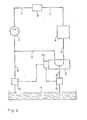
- Fig. 1 the heating system with a collecting container 1, a high pressure feed pump 2, a working element 3, a liquid-air heat exchanger 4 and a flow divider 5 is shown.
- the high-pressure feed pump 2 is connected to the container 1 through a suction line 6 and connected to the liquid-air heat exchanger through a Vorlauiannon 7, in which the working element 3 is arranged.
- a return line 8 leads from the liquid-air heat exchanger 4 to the collecting container 1.
- the flow divider 5 is arranged in the return line 8 in the embodiment shown and that a branch into the short-circuit line 9, which in turn opens into the suction line 6.
- Fig. 2 two temperature sensors 10 and 11 are arranged in the intake and return lines 6, 8, which are connected to a comparison point 1.2, which controls the flow divider 5.
- the arrangement of the components corresponds to FIG. 1.
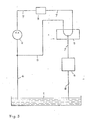
- the flow divider 5 is arranged in the flow line 7 between the working element 3 and liquid-air heat exchanger 4. Otherwise, the design corresponds to that of FIG. 1.
- FIG. 4 shows a heating system with a liquid-liquid heat exchanger 13 which is arranged on the one hand in the intake line 6 and on the other hand in the return line 8. Parallel to the liquid-liquid heat exchanger 13 is a bypass 14 in the return flow, which is controlled by a three-way valve 15 depending on the temperature.
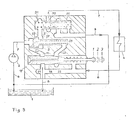
- FIG. 5 shows a heating system with a working element designed as a variable throttle in combination with a shut-off and adjusting valve, in whose housing is also integrated with the flow divider.
- the Abspcrr- and adjustment valve is provided with a pull rod 18, which is shown in three characteristic positions. In position “1”, the relief line 19 and the connecting line 20 are both open. At the transition from position “1" to position “2”, the shut-off valve 21 is closed, the adjusting valve 22 is still open. The heating medium flow flows through the throttle gap. The pressure in the servo element 25 behind the valve body 23 corresponds to that in the collecting container 1. When changing from position "2" to position "3", the adjusting valve 22 is also closed.
- the pressure in the servo element 25 adjusts to the amount in the feed line 7 upstream of the throttle.
- the throttle gap 26 there is a balance between the pressure of the heating medium in front of the throttle and the sum of the contact pressure of the spring 27 and the pressure in the servo element 25.
- the heating medium flow is passed to the flow divider 5.
- This has a temperature-dependent source body 29, which adjusts a slide 30 against the restoring force of a spring 31 so that either the feed line 7 to the liquid-air heat exchanger 4 or the short-circuit line 9 to the high-pressure feed pump 2 are released.
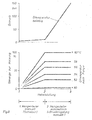
- FIG. 6 shows in two diagrams the dependence of the heating medium flow - here especially the oil flow - to the liquid-air heat exchanger and the heating medium pressure - here especially the oil pressure - in front of the throttle point from the position of the shut-off and adjustment valve with the heating medium temperature, here as the oil temperature after the pump, as a parameter.
Landscapes
- Engineering & Computer Science (AREA)
- Physics & Mathematics (AREA)
- Thermal Sciences (AREA)
- Mechanical Engineering (AREA)
- Chemical & Material Sciences (AREA)
- Combustion & Propulsion (AREA)
- General Engineering & Computer Science (AREA)
- Air-Conditioning For Vehicles (AREA)
- Central Heating Systems (AREA)
- Fluid-Pressure Circuits (AREA)
- Forklifts And Lifting Vehicles (AREA)
- Harvester Elements (AREA)
- Body Structure For Vehicles (AREA)
Abstract
Description
- Die Erfindung betrifft eine Einrichtung zum Beheizen einer Bedienungskabine einer Maschine, die von einer Brennkraftmaschine angetrieben wird, insbesondere des Fahrerhauses eines Fahrzeuges, mit einer von der Brennkraftmaschine angetriebenen Hydraulikpumpe, die aus der Ölwanne, dem Ölsammelbehälter o.dergl. der Brennkraftmaschine Öl entnimmt, mit einem Arbeitselement, beispielsweise einer Drossel, das durch eine Druckleitung mit der Hydraulikpumpe verbindbar ist, und mit einem Flüssigkeit-Luft-Wärmetauscher im Fahrerhaus, der durch eine Druckleitung an das Arbeitselement anschließbar und durch eine Rücklaufleitung mit der Ölwanne verbunden ist.
- Es ist eine Einrichtung zum Beheizen der Bedienungskabine eines Fahrzeuges mit einem die Schmierölwärme ausnutzende Wärmetauscher bekannt (DE-PS 26 23 621). Diese Anordnung hat den Nachteil, daß Heizwärme nur bei betriebsusarmen und in ausreichendem Maße daher nur bei belastetem Motor zur VerfÜgung steht. Dieses Problem tritt prinzipiell in gleicher Art bei luft- und wassergekühlten Brennkraftmaschinen auf.
- Der Erfindung liegt die Aufgabe zugrunde, mechanisch zugeführte Energie mit größtmöglichem Anteil unmittelbar zur Beheizung der Bedienungskabine im Wärmetauscher freizusetzen. Die Aufgabe twird erfindungsgemäß dadurch gelöst, daß ein verstellbarer oder geregelter Mengenteiler entweder in der Rücklaufleitung zwischen Flüssigkeit-Luft-Wärmetauscher und Sammelbehälter oder in der Vorlaufleitung zwischen Arbeitselement und Flüssigkeit-Luft-Wärmetauscher angeordnet ist und mit einer Abzweigung in eine Kurzschlußleitung zur Ansaugseite der Hochdruckförderpumpe mündet.
- Die in der Drossel erzeugte Wärmemenge bewirkt eine Temperatursteigerung im unverzweigten Kreislauf, die am Wärmetauscher ein erhöhtes Temperaturgefälle erzeugt, so daß ein Beitrag zur Heizung gegeben ist und zugleich eine Erwärmung der Ölmenge im Ölsumpf und der Motorbauteile stattfindet. Dies gilt für die Warmlaufphase und für alle Betriebszustände, bei denen die Schmieröltemperatur im Ölsumpf unter der Rücklauftemperatur aus dem Wärmetauscher liegt, wie z. B. bei längeren Leerlaufphasen und niedrigerer Außentemperatur.
- Die Aufgabe, die im Arbeitselement erzeugte Wärme ganz zu Heizzwecken und nicht zur Erwärmung des Ölsumpfinhalts zu verwenden, erfüllt in vorteilhafter Weise der Mengenteiler, der vor oder hinter dem Flüssigkeit-Luft-Wärmetauscher angeordnet eine Kurzschlußleitung zu einem kleinen Kreislauf mit Hochdruckförderpumpe, Arbeitselement und ggfs. Flüssigkeit-Luft-Wärmetauscher aufweist, in welchem eine Teilmenge zur beschleunigten Aufheizung mehrfach umgewälzt wird. Ist die Temperatur der Füllung des Sammelbehälters angestiegen, insbesondere über die Rücklauftemperatur aus diesem kleinen Kreislauf, schließt der Mengenteiler die Kurzschlußleitung und die dem Sammelbehälter zugeführte Wärme trägt zur Heizung bei.
- Zur Steuerung des Mengenteilers sind verschiedene temperatur- oder temperaturdifferenzabhängige Regelglieder anwendbar.
- Zur weiter verbesserten Wärmeausnutzung kann erfindungsgemäß ein Flüssigkeit-Flüssigkeit-Wärmetauscher in die Leitungen vom und zum Sammelbehälter eingesetzt werden, der eine Vorwärmung des Heizmittelstroms bewirkt, sofern die Rücklauftemperatur über die Vorlauftemperatur steigt. Um einen umgekehrten Wärmefluß zu vermeiden, sind ein Bypaß und verschiedene Möglichkeiten zu dessen Regelung vorgesehen.
- Das Arbeitselement ist in besonderer erfindungsgemäßer Gestaltung als variable Drossel ausgeführt, deren Drosselspalt in Abhängigkeit der Druckverhältnisse an der Drossel eingestellt wird. Auf den Spalt wirkt im Schließsinn zusammen mit einer Feder ein Servoelement, das zum einen über eine Bohrung geringen Querschnitts mit der Druckleitung vor der Drosselstelle und zum anderen über eine mit einem Justierventil versehene Leitung mit dem Sammelbehälter verbunden ist. Durch Eintellen der Durchflußmenge im Justierventil kann der Druck im Servoelement zwischen dem Wert vor der Drossel und dem im Sammelbehälter variiert werden.
- In besonders günstiger Weise können Absperrventil und Justierventil zu einem handbetätigten Bedienungselement zusammengefaßt werden, das die Stellbereiche von beiden verbindet. Hierbei wird zunächst durch Schließen des Absperrventils die Drossel beaufschlagt und anschließend der Federdruck gegen den Drosselspalt durch Schließen des Justierventils zunehmend um den ansteigenden Druck im Servoelement verstärkt. Hierbei nimmt die Verlustleistung und damit die Wärmeerzeugung zu.
- In kompakter Gestaltung werden die Bauteile Arbeitselement, Mengenteiler, Absperrventil und Justierventil zu mehreren oder alle gemeinsam in einem Gehäuse untergebracht.
- Neben der Regelung des Heizmittelstroms kann auch der Heizungsluftstrom geregelt werden, insbesondere in der Form, daß er bei unverändertem Volumenstrom mit veränderlichem Anteil dem zu beheizenden Raum oder der Umgebung zugeführt wird.
- Schematische Darstellungen, Einzelheiten und Diagramme zur Erfindung sind in den Zeichnungen dargestellt.
- Im einzelnen zeigen:
- Fig. 1 einen Kreislauf mit Mengenteiler hinter dem Flüssigkeit-Luft-Wärmetauscher,
- Fig. 2 einen Kreislauf nach Fig. 1 mit Regeleinrichtung,
- Fig. 3 einen Kreislauf mit Mengenteiler vor dem Flüssigkeit-Luft-Wärmetauscher,
- Fig. 4 einen Kreislauf mit zusätzlichem Flüssigkeit-Flüssigkeit-Wärmetauscher in Ansaug-und Rücklaufleitung,
- Fig. 5 eine Kombination von Absperrventil und Justierventil in einem Gehäuse mit Drossel und Mengenteiler,
- Fig. 6 Diagramme der Funktionen von Absperr- und Justierventil.
- In Fig. 1 ist das Heizungssystem mit einem Sammelbehälter 1, einer Hochdruckförderpumpe 2, einem Arbeitselement 3, einem Flüssigkeit-Luft-Wärmetauscher 4 und einem Mengenteiler 5 dargestellt. Die Hochdruckförderpumpe 2 ist mit dem Sammelbe- hälter 1 durch eine Ansaugleitung 6 und mit dem Flüssigkeit-Luft-Wärmetauscher durch eine Vorlauiteilung 7 verbunden, in der das Arbeitselement 3 angeordnet ist. Vom Flüssigkeit-Luft-Wärmetauscher 4 führt eine Rücklaufleitung 8 zum Sammelbehälter 1. Der Mengenteiler 5 ist in der gezeigten Ausführung in der Rücklaufleitung 8 angeordnet und that eine Abzweigung in die Kurzschlußleitung 9, die wiederum in die Ansaugleitung 6 mündet.
- In Fig. 2 sind zwei Temperaturfühler 10 und 11 in der Ansaug- bzw. Rücklaufleitung 6, 8 angeordnet, die mit einer Vergleichsstelle 1.2 verbunden sind, die den Mengenteiler 5 steuert. Die Anordnung der Bauteile entspricht Fig. 1.
- In Fig. 3 ist der Mengenteiler 5 in der Vorlaufleitung 7 zwischen Arbeitselement 3 und Flüssigkeit-Luft-Wärmetauscher 4 angeordnet. Im übrigen .entspricht die Ausführung der aus Fig. 1.
- Fig. 4 zeigt ein Heizungssystem mit einem Flüssigkeit-Flüssigkeit-Wärmetauscher 13, der zum einen in der Ansaugleitung 6, zum anderen in der Rücklaufleitung 8 angeordnet ist. Parallel zum Flüssigkeit-Flüssigkeit-Wärmetauscher 13 liegt im Rücklaufstrom ein Bypaß 14, der von einem Drei-Wege-Ventil 15 temperaturabhängig gesteuert wird.
- Fig. 5 zeigt ein Heizungssystem mit einem als variable Drossel in Kombination mit einem Absperr-und Justierventil ausgeführten Arbeitselement, in dessen Gehäuse zusätzlich der Mengenteiler integriert ist. Das Abspcrr- und Justierventil ist mit einer Zugstange 18 versehen, die in drei kennzeichnenden Stellungen dargestellt ist. In der Stellung "1" sind die Entlastungsleitung 19 und die Verbindungsleitung 20 beide geöffnet. Beim Übergang von der Stellung "1" zur Stellung "2" wird das Absperrventil 21 geschlossen, das Justierventil 22 ist noch geöffnet. Der Heizmittelstrom fließt über den Drosselspalt. Der Druck im Servoelement 25 hinter dem Ventilkörper 23 stimmt mit dem im Sammelbehälter 1 überein. Beim Übergang von der Stellung "2" zur Stellung "3" wird das Justierventil 22 ebenfalls geschlossen. Über eine Ausgleichsbohrung 24 im Ventilkörper 23 stellt sich der Druck im Servoelement 25 auf den Betrag in der Vorlaufleitung 7 vor der Drossel ein. Am Drosselspalt 26 stellt sich ein Gleichgewicht zwischen dem Druck des Heizmittels vor der Drossel und der Summe aus dem Anpreßdruck der Feder 27 und dem Druck im Servoelement 25 ein. Der Heizmittelstrom wird zum Mengenteiler 5 geleitet. Dieser besitzt einen temperaturabhängigen Quellkörper 29, der einen Schieber 30 gegen die Rückstellkraft einer Feder 31 so verstellt, daß entweder die Vorlaufleitung 7 zum Flüssigkeit-Luft-Wärmetauscher 4 oder die Kurzschlußleitung 9 zur Hochdruckförderpumpe 2 freigegeben werden.
- Fig. 6 zeigt in zwei Diagrammen die Abhängigkeit des Heizmittelstroms - hier speziell des Ölmengenstroms - zum Flüssigkeit-Luft-Wärmetauscher und des Heizmitteldrucks - hier speziell des Öldrucks - vor der Drosselstelle von der Stellung des Absperr-und Justierventils mit der Heizmitteltemperatur, hier als Öltemperatur nach der Pumpe, als Parameter.
Claims (13)
dadurch gekennzeichnet, daß ein verstellbarer oder geregelter Mengenteiler (5) entweder in der Rücklaufleitung (8) zwischen Flüssigkeit-Luft-Wärmetauscher (4) und Sammelbehälter (1) oder in der Zuführungsleitung (7) zwischen Arbeitselement (3) und Flüssigkeit-Luft-Wärmetauscher (4) angeordnet ist und über eine Kurzschlußleitung (9) mit der Ansaugleitung (6) der Hochdruckförderpumpe (2) verbindbar ist.
dadurch gekennzeichnet, daß ein Flüssigkeit-Flüssigkeit-Wärmetauscher (13) einerseits vom Heizmittelstrom in der Ansaugleitung (6) zwischen Sammelbehälter (1) und Hochdruckförderpumpe (2) und andererseits vom Heizmittelstrom in der Rücklaufleitung (8) zwischen Flüssigkeit-Luft-Wärmetauscher (4) und Sammelbehälter (1) beaufschlagt wird.
dadurch gekennzeichnet, daß in der Rücklaufleitung (8) ein Bypaß (14) parallel zum Flüssigkeit-Flüssigkeit-Wärmetauscher (13) angeordnet ist, der am Verzweigungspunkt ein verstellbares oder geregeltes Drei-Wege-Ventil (15) aufweist.
dadurch gekennzeichnet, daß der Mengenteiler (5) als temperaturgeregeltes Ventil ausgebildet ist, das in Abhängigkeit von einer vorgegebenen Motor- öltemperatur an einer bestimmten Stelle, z. B. in der Ölwanne, die Kurzschlußleitung (9) und die Rücklaufleitung (8) gegensinnig im Durchfluß steuert.
dadurch gekennzeichnet, daß der Mengenteiler (5) als temperaturgeregeltes Ventil ausgebildet ist, das bei zunehmender Zuströmtemperatur die Kurzschlußleitung (9) zur Hochdruckförderpumpe (2) im Schließsinn steuert.
dadurch gekennzeichnet, daß der Mengenteiler (5) als temperaturdifferenzgeregeltes Ventil ausgebildet ist, das bei positiver Temperaturdifferenz zwischen dem Heizmittelstrom in der Rucklaufleitung (8) und dem Heizmittelstrom in der Ansaugleitung (6) die Kurzschlußleitung (9) zur Hochdruckförderpumpe (2) im Öffnungssinn und die Rücklaufleitung (8) im Schließsinn steuert.
dadurch gekennzeichnet, daß das Drei-Wege-Ventil (15) als temperaturgeregeltes Ventil ausgebildet ist, das bei zunehmender Temperatur in der Ansaugleitung (6) den Bypaß (14) parallel zum Flüssigkeit-Flüssigkeit-Wärmetauscher (13) in der Rücklaufleitung (8) im Öffnungssinn steuert.
dadurch gekennzeichnet, daß das Drei-Wege-Ventil (15) als temperaturdifferenzgeregeltes Ventil ausgebildet ist, das bei positiver Temperaturdifferenz zwischen dem Heizmittelstrom der Rücklaufleitung (8) und dem Heizmittelstrom in der Ansaugleitung (6) die Kurzschlußleitung (9) zur Hochdruckförderpumpe (2) im Öffnungssinn und die Rücklaufleitung (8) im Schließsinn steuert.
dadurch gekennzeichnet, daß das Arbeitselement (3) einen als variable Drossel ausgebildeten Ventilkörper (23) aufweist, daß eine Ausgleichsbohrung (24) geringen Querschnitts von der flüssigkeitsdruckbelasteten Vorderseite zur federbelasteten Rückseite des Ventilkörpers (23) verläuft und daß eine Verbindungsleitung (20) von einem von der Rückseite begrenzten Servoelement (25) zum Sammelbehälter (1) besteht, in der ein verstellbares Justierventil (22) angeordnet ist.
dadurch gekennzeichnet, daß das Absperrventil (21) und das Justierventil (22) ein gemeinsames Gehäuse (17) und einen gemeinsamen Schieber (18) mit verschiedenen Steuerkanten bzw. Sitzen aufweisen und daß die Stellbereiche bei geschlossenem Absperrventil (21) und geöffnetem Justierventil (22) unmittelbar aneinandergrenzen und im Stellbereich der einen Durchflußmenge die jeweils andere Durchflußmenge unverändert bleibt.
dadurch gekennzeichnet, daß das Arbeitselement (3) mit Absperrventil (21) und/oder Justierventil (22) in einem gemeinsamen Gehäuse (17) angeordnet sind.
dadurch gekennzeichnet, daß der Mengenteiler (5) mit dem Absperrventil (21) und/oder dem Justierventil (22) in einem gemeinsamen Gehäuse angeordnet sind.
dadurch gekennzeichnet, daß.das Heizungssystem mit anderen Umlaufsystemen, insbesondere mit Schmier-und Hydraulikeinrichtungen in Reihen- und/oder Parallelanordnungen verbunden sind.
Priority Applications (1)
| Application Number | Priority Date | Filing Date | Title |
|---|---|---|---|
| AT81100071T ATE6352T1 (de) | 1980-01-17 | 1981-01-08 | Einrichtung zum beheizen einer bedienungskabine. |
Applications Claiming Priority (2)
| Application Number | Priority Date | Filing Date | Title |
|---|---|---|---|
| DE3001564 | 1980-01-17 | ||
| DE19803001564 DE3001564A1 (de) | 1980-01-17 | 1980-01-17 | Einrichtung zum beheizen einer bedienungskabine |
Publications (3)
| Publication Number | Publication Date |
|---|---|
| EP0032676A2 true EP0032676A2 (de) | 1981-07-29 |
| EP0032676A3 EP0032676A3 (en) | 1981-08-12 |
| EP0032676B1 EP0032676B1 (de) | 1984-02-22 |
Family
ID=6092287
Family Applications (1)
| Application Number | Title | Priority Date | Filing Date |
|---|---|---|---|
| EP81100071A Expired EP0032676B1 (de) | 1980-01-17 | 1981-01-08 | Einrichtung zum Beheizen einer Bedienungskabine |
Country Status (5)
| Country | Link |
|---|---|
| US (1) | US4386735A (de) |
| EP (1) | EP0032676B1 (de) |
| JP (2) | JPS56103608A (de) |
| AT (1) | ATE6352T1 (de) |
| DE (1) | DE3001564A1 (de) |
Cited By (3)
| Publication number | Priority date | Publication date | Assignee | Title |
|---|---|---|---|---|
| FR2489759A1 (fr) * | 1980-09-06 | 1982-03-12 | Kloeckner Humboldt Deutz Ag | Installation pour le chauffage de la cabine de service d'un engin ou d'un vehicule |
| EP0051872A3 (de) * | 1980-11-10 | 1982-09-01 | NIL-DAN Inh. E. u. A. Nielsen oHG. | Wärmepumpe |
| EP0082946A3 (en) * | 1981-12-24 | 1986-02-19 | Klockner-Humboldt-Deutz Aktiengesellschaft | Equipment for heating a working cabin |
Families Citing this family (14)
| Publication number | Priority date | Publication date | Assignee | Title |
|---|---|---|---|---|
| DE3603308A1 (de) * | 1986-02-04 | 1987-08-06 | Kloeckner Humboldt Deutz Ag | Einrichtung zum aufheizen von raumluft |
| US4708095A (en) * | 1986-06-16 | 1987-11-24 | Deere & Company | Combined engine cooling and lube system |
| DE3717404A1 (de) * | 1987-05-23 | 1988-12-08 | Kloeckner Humboldt Deutz Ag | Oelgekuehlte brennkraftmaschine |
| DE4033551A1 (de) * | 1989-10-23 | 1991-04-25 | Sanden Corp | Klimaanlage fuer fahrzeuge |
| DE69214604T2 (de) * | 1991-11-18 | 1997-03-13 | Sanden Corp | Verfahren und Vorrichtung für die Klimaanlage eines Fahrzeugs |
| US5355939A (en) * | 1991-11-18 | 1994-10-18 | Sanden Corporation | Hydraulically driven vehicular air conditioning system with valve cleaning feature |
| JP4400803B2 (ja) * | 1999-09-03 | 2010-01-20 | 本田技研工業株式会社 | 車両用冷却装置 |
| US8302876B2 (en) * | 2004-02-26 | 2012-11-06 | Ventech, Llc | Vehicle supplemental heating system |
| US8480006B2 (en) | 2006-09-08 | 2013-07-09 | Ventech, Llc | Vehicle supplemental heating system |
| EP2313284B1 (de) | 2008-07-29 | 2019-10-16 | Ventech, LLC | Zusätzliches heizsystem mit intergriertem wärmetauscher |
| DE102010027816B4 (de) * | 2010-04-15 | 2018-09-13 | Ford Global Technologies, Llc | Brennkraftmaschine mit Ölkreislauf und Verfahren zur Erwärmung des Motoröls einer derartigen Brennkraftmaschine |
| DE102011075793A1 (de) * | 2011-05-13 | 2012-11-15 | Robert Bosch Gmbh | Brennkraftmaschine und Kraftstofffördereinrichtung |
| GB201119371D0 (en) | 2011-11-10 | 2011-12-21 | Ford Global Tech Llc | A method for improving warm-up of an engine |
| US10145586B2 (en) | 2015-01-20 | 2018-12-04 | Wacker Neuson Production Americas Llc | Flameless heater |
Family Cites Families (16)
| Publication number | Priority date | Publication date | Assignee | Title |
|---|---|---|---|---|
| US2107933A (en) * | 1935-04-29 | 1938-02-08 | Crockett Robert Arthur | Heating system and method |
| CH266304A (fr) * | 1945-08-11 | 1950-01-31 | Foundation John B Pierce | Installation de distribution de chaleur. |
| US2764147A (en) * | 1951-02-23 | 1956-09-25 | Northrop Aircraft Inc | Frictional heater for hydraulic system |
| GB747024A (en) * | 1953-08-11 | 1956-03-28 | Dewandre Co Ltd C | Improvements in or relating to apparatus for heating the interiors of motor-vehicles |
| DE1247884B (de) * | 1958-06-06 | 1967-08-17 | Maschf Augsburg Nuernberg Ag | Einrichtung zur Fahrzeugheizung und zur Kuehlung eines Fahrzeugmotors |
| GB1082501A (en) * | 1965-06-04 | 1967-09-06 | Gardner & Sons Ltd | Improvements in or relating to a vehicle heating system |
| US3813036A (en) * | 1973-05-08 | 1974-05-28 | G Lutz | Heating system |
| JPS5112348A (en) * | 1974-07-22 | 1976-01-30 | Japan Gasoline | Aruminiumu mataha kuromukakusanshintoshorikozaino yosetsuhoho |
| FR2315666A1 (fr) * | 1975-06-27 | 1977-01-21 | Ppm Sa | Dispositif de chauffage utilisant la chaleur resultant du laminage d'un fluide sous pression |
| GB1563701A (en) * | 1975-08-16 | 1980-03-26 | Massey Ferguson Services Nv | Heating systeme for vehicles |
| DE2623621C2 (de) * | 1976-05-26 | 1978-04-20 | Kloeckner-Humboldt-Deutz Ag, 5000 Koeln | Einrichtung zum Beheizen der Bedienungskabine einer Maschine |
| JPS5922141B2 (ja) * | 1977-12-26 | 1984-05-24 | 松下電器産業株式会社 | 暖房設備 |
| US4192456A (en) * | 1978-08-21 | 1980-03-11 | Harnischfeger Corporation | Heating system for machine operator's cab |
| DE2916870A1 (de) * | 1979-04-26 | 1980-11-13 | Kloeckner Humboldt Deutz Ag | Heizung fuer ein land- und/oder wasserfahrzeug |
| DE2928999A1 (de) * | 1979-07-18 | 1981-02-12 | Kloeckner Humboldt Deutz Ag | Vorrichtung zur nutzung der erwaermten druckfluessigkeit der arbeitshydraulik eines kraftfahrzeugs |
| DE2932448A1 (de) * | 1979-08-10 | 1981-02-26 | Kloeckner Humboldt Deutz Ag | Einrichtung zum beheizen der bedienungskabine einer von einer brennkraftmaschine angetriebenen maschine |
-
1980
- 1980-01-17 DE DE19803001564 patent/DE3001564A1/de not_active Withdrawn
-
1981
- 1981-01-08 EP EP81100071A patent/EP0032676B1/de not_active Expired
- 1981-01-08 AT AT81100071T patent/ATE6352T1/de not_active IP Right Cessation
- 1981-01-12 JP JP221381A patent/JPS56103608A/ja active Pending
- 1981-01-16 US US06/225,610 patent/US4386735A/en not_active Expired - Fee Related
-
1987
- 1987-11-06 JP JP1987169104U patent/JPS63104209U/ja active Pending
Cited By (3)
| Publication number | Priority date | Publication date | Assignee | Title |
|---|---|---|---|---|
| FR2489759A1 (fr) * | 1980-09-06 | 1982-03-12 | Kloeckner Humboldt Deutz Ag | Installation pour le chauffage de la cabine de service d'un engin ou d'un vehicule |
| EP0051872A3 (de) * | 1980-11-10 | 1982-09-01 | NIL-DAN Inh. E. u. A. Nielsen oHG. | Wärmepumpe |
| EP0082946A3 (en) * | 1981-12-24 | 1986-02-19 | Klockner-Humboldt-Deutz Aktiengesellschaft | Equipment for heating a working cabin |
Also Published As
| Publication number | Publication date |
|---|---|
| JPS56103608A (en) | 1981-08-18 |
| DE3001564A1 (de) | 1981-07-23 |
| US4386735A (en) | 1983-06-07 |
| EP0032676A3 (en) | 1981-08-12 |
| EP0032676B1 (de) | 1984-02-22 |
| JPS63104209U (de) | 1988-07-06 |
| ATE6352T1 (de) | 1984-03-15 |
Similar Documents
| Publication | Publication Date | Title |
|---|---|---|
| EP0032676A2 (de) | Einrichtung zum Beheizen einer Bedienungskabine | |
| DE4327261C1 (de) | Kühlmittelkreislauf | |
| EP0054792A2 (de) | Kühleinrichtung zur Kühlung einer Brennkraftmaschine und der Ladeluft | |
| EP0177025A2 (de) | Kühlsystem | |
| DD149920A5 (de) | Heizeinrichtung | |
| DE2755464A1 (de) | Thermostatisches regelventil | |
| DE2245257B2 (de) | Kühleinrichtung für eine aufgeladene Brennkraftmaschine | |
| DE19741861B4 (de) | Vorrichtung zur Regelung des Kühlwasserkreislaufes für einen Verbrennungsmotor | |
| EP0034242A1 (de) | Einrichtung zum Aufheizen von Raumluft | |
| DE102019118585A1 (de) | Vorrichtung und verfahren zum steuern einer motorkühlmitteldurchflussrate mittels eines thermostats | |
| CH654257A5 (de) | Heizeinrichtung an einer arbeitsmaschine zur heizung einer bedienungskabine oder eines fahrerhauses. | |
| DE3320338A1 (de) | Vorrichtung zum kuehlen eines verbrennungsmotors | |
| EP0376150A2 (de) | Brennkraftmaschine mit zwei hydraulischen Flüssigkeitskreisläufen | |
| CH653962A5 (de) | Einrichtung zum beheizen der bedienungskabine eines geraetes oder fahrzeuges. | |
| DE102004021551A1 (de) | Kühlsystem, insbesondere für ein Kraftfahrzeug | |
| DE2826373A1 (de) | Aufgeladener dieselmotor | |
| DE2523436A1 (de) | Fluessigkeitskuehlsystem fuer eine brennkraftmaschine | |
| DE19641558A1 (de) | Verfahren und Steuerung zur Regelung des Kühlkreislaufes eines Fahrzeuges mittels einer thermisch geregelten Wasserpumpe | |
| DE3622378A1 (de) | Kuehlfluessigkeitssystem fuer eine brennkraftmaschine | |
| DE3517567A1 (de) | Antriebsanlage fuer geraete und fahrzeuge, insbesondere kraftfahrzeuge | |
| DE19641559A1 (de) | Antriebseinheit mit thermisch geregelter Wasserpumpe | |
| DE10143109A1 (de) | Verfahren und Vorrichtung zur Einstellung definierter Kühlmittelströme in Kühlsystemen von Brennkraftmaschinen in Kraftfahrzeugen | |
| DE102014008859A1 (de) | Einkreiskühlsystem zur Leistungssteigerung von aufgeladenen Brennkraftmaschinen und Verfahren dazu | |
| DE102022210957A1 (de) | Temperiereinrichtung für ein Kraftfahrzeug | |
| DE3126534C2 (de) |
Legal Events
| Date | Code | Title | Description |
|---|---|---|---|
| PUAI | Public reference made under article 153(3) epc to a published international application that has entered the european phase |
Free format text: ORIGINAL CODE: 0009012 |
|
| PUAL | Search report despatched |
Free format text: ORIGINAL CODE: 0009013 |
|
| AK | Designated contracting states |
Designated state(s): AT CH FR GB NL SE |
|
| AK | Designated contracting states |
Designated state(s): AT CH FR GB NL SE |
|
| 17P | Request for examination filed |
Effective date: 19811024 |
|
| GRAA | (expected) grant |
Free format text: ORIGINAL CODE: 0009210 |
|
| AK | Designated contracting states |
Designated state(s): AT CH FR GB LI NL SE |
|
| REF | Corresponds to: |
Ref document number: 6352 Country of ref document: AT Date of ref document: 19840315 Kind code of ref document: T |
|
| ET | Fr: translation filed | ||
| PGFP | Annual fee paid to national office [announced via postgrant information from national office to epo] |
Ref country code: FR Payment date: 19841210 Year of fee payment: 5 |
|
| PLBE | No opposition filed within time limit |
Free format text: ORIGINAL CODE: 0009261 |
|
| STAA | Information on the status of an ep patent application or granted ep patent |
Free format text: STATUS: NO OPPOSITION FILED WITHIN TIME LIMIT |
|
| PGFP | Annual fee paid to national office [announced via postgrant information from national office to epo] |
Ref country code: SE Payment date: 19841231 Year of fee payment: 5 |
|
| 26N | No opposition filed | ||
| PGFP | Annual fee paid to national office [announced via postgrant information from national office to epo] |
Ref country code: AT Payment date: 19861209 Year of fee payment: 7 |
|
| PGFP | Annual fee paid to national office [announced via postgrant information from national office to epo] |
Ref country code: NL Payment date: 19870131 Year of fee payment: 7 |
|
| PG25 | Lapsed in a contracting state [announced via postgrant information from national office to epo] |
Ref country code: GB Effective date: 19890108 Ref country code: AT Effective date: 19890108 |
|
| PG25 | Lapsed in a contracting state [announced via postgrant information from national office to epo] |
Ref country code: SE Effective date: 19890109 |
|
| PG25 | Lapsed in a contracting state [announced via postgrant information from national office to epo] |
Ref country code: LI Effective date: 19890131 Ref country code: CH Effective date: 19890131 |
|
| PG25 | Lapsed in a contracting state [announced via postgrant information from national office to epo] |
Ref country code: NL Effective date: 19890801 |
|
| NLV4 | Nl: lapsed or anulled due to non-payment of the annual fee | ||
| GBPC | Gb: european patent ceased through non-payment of renewal fee | ||
| PG25 | Lapsed in a contracting state [announced via postgrant information from national office to epo] |
Ref country code: FR Free format text: LAPSE BECAUSE OF NON-PAYMENT OF DUE FEES Effective date: 19890929 |
|
| REG | Reference to a national code |
Ref country code: CH Ref legal event code: PL |
|
| REG | Reference to a national code |
Ref country code: FR Ref legal event code: ST |
|
| EUG | Se: european patent has lapsed |
Ref document number: 81100071.0 Effective date: 19891204 |