EP0017833B1 - Farbfotographisches gelbkupplerhaltiges Aufzeichnungsmaterial - Google Patents
Farbfotographisches gelbkupplerhaltiges Aufzeichnungsmaterial Download PDFInfo
- Publication number
- EP0017833B1 EP0017833B1 EP80101706A EP80101706A EP0017833B1 EP 0017833 B1 EP0017833 B1 EP 0017833B1 EP 80101706 A EP80101706 A EP 80101706A EP 80101706 A EP80101706 A EP 80101706A EP 0017833 B1 EP0017833 B1 EP 0017833B1
- Authority
- EP
- European Patent Office
- Prior art keywords
- coupler
- couplers
- color
- yellow
- yellow coupler
- Prior art date
- Legal status (The legal status is an assumption and is not a legal conclusion. Google has not performed a legal analysis and makes no representation as to the accuracy of the status listed.)
- Expired
Links
- 239000000463 material Substances 0.000 title claims description 30
- 239000000839 emulsion Substances 0.000 claims description 25
- -1 silver halide Chemical class 0.000 claims description 25
- 229910052709 silver Inorganic materials 0.000 claims description 13
- 239000004332 silver Substances 0.000 claims description 13
- 238000005859 coupling reaction Methods 0.000 claims description 8
- 230000008878 coupling Effects 0.000 claims description 7
- 238000010168 coupling process Methods 0.000 claims description 7
- 125000004432 carbon atom Chemical group C* 0.000 claims description 5
- 229960001413 acetanilide Drugs 0.000 claims description 4
- 239000001257 hydrogen Substances 0.000 claims description 4
- 229910052739 hydrogen Inorganic materials 0.000 claims description 4
- 125000004435 hydrogen atom Chemical group [H]* 0.000 claims description 4
- 125000001931 aliphatic group Chemical group 0.000 claims description 3
- FZERHIULMFGESH-UHFFFAOYSA-N methylenecarboxanilide Natural products CC(=O)NC1=CC=CC=C1 FZERHIULMFGESH-UHFFFAOYSA-N 0.000 claims description 3
- 125000004422 alkyl sulphonamide group Chemical group 0.000 claims description 2
- 229920006395 saturated elastomer Polymers 0.000 claims description 2
- OKKJLVBELUTLKV-UHFFFAOYSA-N Methanol Chemical compound OC OKKJLVBELUTLKV-UHFFFAOYSA-N 0.000 description 24
- 238000000034 method Methods 0.000 description 22
- XEKOWRVHYACXOJ-UHFFFAOYSA-N Ethyl acetate Chemical compound CCOC(C)=O XEKOWRVHYACXOJ-UHFFFAOYSA-N 0.000 description 19
- 239000000203 mixture Substances 0.000 description 19
- WEVYAHXRMPXWCK-UHFFFAOYSA-N Acetonitrile Chemical compound CC#N WEVYAHXRMPXWCK-UHFFFAOYSA-N 0.000 description 18
- 238000011161 development Methods 0.000 description 17
- CSCPPACGZOOCGX-UHFFFAOYSA-N Acetone Chemical compound CC(C)=O CSCPPACGZOOCGX-UHFFFAOYSA-N 0.000 description 15
- LFQSCWFLJHTTHZ-UHFFFAOYSA-N Ethanol Chemical compound CCO LFQSCWFLJHTTHZ-UHFFFAOYSA-N 0.000 description 15
- XLYOFNOQVPJJNP-UHFFFAOYSA-N water Substances O XLYOFNOQVPJJNP-UHFFFAOYSA-N 0.000 description 14
- 239000000047 product Substances 0.000 description 13
- WVDDGKGOMKODPV-UHFFFAOYSA-N Benzyl alcohol Chemical compound OCC1=CC=CC=C1 WVDDGKGOMKODPV-UHFFFAOYSA-N 0.000 description 12
- 125000002496 methyl group Chemical group [H]C([H])([H])* 0.000 description 12
- 239000002904 solvent Substances 0.000 description 12
- YMWUJEATGCHHMB-UHFFFAOYSA-N Dichloromethane Chemical compound ClCCl YMWUJEATGCHHMB-UHFFFAOYSA-N 0.000 description 11
- 239000002253 acid Substances 0.000 description 11
- 238000006243 chemical reaction Methods 0.000 description 11
- WQDUMFSSJAZKTM-UHFFFAOYSA-N Sodium methoxide Chemical compound [Na+].[O-]C WQDUMFSSJAZKTM-UHFFFAOYSA-N 0.000 description 10
- 235000002639 sodium chloride Nutrition 0.000 description 9
- LYCAIKOWRPUZTN-UHFFFAOYSA-N Ethylene glycol Chemical compound OCCO LYCAIKOWRPUZTN-UHFFFAOYSA-N 0.000 description 8
- VEXZGXHMUGYJMC-UHFFFAOYSA-N Hydrochloric acid Chemical compound Cl VEXZGXHMUGYJMC-UHFFFAOYSA-N 0.000 description 8
- 239000006185 dispersion Substances 0.000 description 8
- 239000000975 dye Substances 0.000 description 8
- 239000003960 organic solvent Substances 0.000 description 8
- 150000003839 salts Chemical class 0.000 description 8
- 239000000243 solution Substances 0.000 description 8
- FYSNRJHAOHDILO-UHFFFAOYSA-N thionyl chloride Chemical compound ClS(Cl)=O FYSNRJHAOHDILO-UHFFFAOYSA-N 0.000 description 8
- ZMXDDKWLCZADIW-UHFFFAOYSA-N N,N-Dimethylformamide Chemical compound CN(C)C=O ZMXDDKWLCZADIW-UHFFFAOYSA-N 0.000 description 7
- MHYFEEDKONKGEB-UHFFFAOYSA-N oxathiane 2,2-dioxide Chemical compound O=S1(=O)CCCCO1 MHYFEEDKONKGEB-UHFFFAOYSA-N 0.000 description 7
- 150000003254 radicals Chemical class 0.000 description 7
- 239000011734 sodium Substances 0.000 description 7
- JUJWROOIHBZHMG-UHFFFAOYSA-N Pyridine Chemical compound C1=CC=NC=C1 JUJWROOIHBZHMG-UHFFFAOYSA-N 0.000 description 6
- YXFVVABEGXRONW-UHFFFAOYSA-N Toluene Chemical compound CC1=CC=CC=C1 YXFVVABEGXRONW-UHFFFAOYSA-N 0.000 description 6
- 125000003118 aryl group Chemical group 0.000 description 6
- 230000008901 benefit Effects 0.000 description 6
- 230000000052 comparative effect Effects 0.000 description 6
- 159000000000 sodium salts Chemical class 0.000 description 6
- NGNBDVOYPDDBFK-UHFFFAOYSA-N 2-[2,4-di(pentan-2-yl)phenoxy]acetyl chloride Chemical compound CCCC(C)C1=CC=C(OCC(Cl)=O)C(C(C)CCC)=C1 NGNBDVOYPDDBFK-UHFFFAOYSA-N 0.000 description 5
- FXHOOIRPVKKKFG-UHFFFAOYSA-N N,N-Dimethylacetamide Chemical compound CN(C)C(C)=O FXHOOIRPVKKKFG-UHFFFAOYSA-N 0.000 description 5
- 125000003545 alkoxy group Chemical group 0.000 description 5
- 230000015572 biosynthetic process Effects 0.000 description 5
- 150000001875 compounds Chemical class 0.000 description 5
- 238000009792 diffusion process Methods 0.000 description 5
- 230000000694 effects Effects 0.000 description 5
- 229920000159 gelatin Polymers 0.000 description 5
- 235000019322 gelatine Nutrition 0.000 description 5
- 230000002209 hydrophobic effect Effects 0.000 description 5
- 230000008569 process Effects 0.000 description 5
- 230000035945 sensitivity Effects 0.000 description 5
- IJGRMHOSHXDMSA-UHFFFAOYSA-N Atomic nitrogen Chemical compound N#N IJGRMHOSHXDMSA-UHFFFAOYSA-N 0.000 description 4
- CSGQJHQYWJLPKY-UHFFFAOYSA-N CITRAZINIC ACID Chemical compound OC(=O)C=1C=C(O)NC(=O)C=1 CSGQJHQYWJLPKY-UHFFFAOYSA-N 0.000 description 4
- HEDRZPFGACZZDS-UHFFFAOYSA-N Chloroform Chemical compound ClC(Cl)Cl HEDRZPFGACZZDS-UHFFFAOYSA-N 0.000 description 4
- IAZDPXIOMUYVGZ-UHFFFAOYSA-N Dimethylsulphoxide Chemical compound CS(C)=O IAZDPXIOMUYVGZ-UHFFFAOYSA-N 0.000 description 4
- 108010010803 Gelatin Proteins 0.000 description 4
- CTQNGGLPUBDAKN-UHFFFAOYSA-N O-Xylene Chemical compound CC1=CC=CC=C1C CTQNGGLPUBDAKN-UHFFFAOYSA-N 0.000 description 4
- 230000009102 absorption Effects 0.000 description 4
- 238000010521 absorption reaction Methods 0.000 description 4
- 239000000654 additive Substances 0.000 description 4
- 235000019445 benzyl alcohol Nutrition 0.000 description 4
- 230000002860 competitive effect Effects 0.000 description 4
- DOIRQSBPFJWKBE-UHFFFAOYSA-N dibutyl phthalate Chemical compound CCCCOC(=O)C1=CC=CC=C1C(=O)OCCCC DOIRQSBPFJWKBE-UHFFFAOYSA-N 0.000 description 4
- MTHSVFCYNBDYFN-UHFFFAOYSA-N diethylene glycol Chemical compound OCCOCCO MTHSVFCYNBDYFN-UHFFFAOYSA-N 0.000 description 4
- 239000008273 gelatin Substances 0.000 description 4
- 235000011852 gelatine desserts Nutrition 0.000 description 4
- 229910052736 halogen Inorganic materials 0.000 description 4
- 150000002367 halogens Chemical class 0.000 description 4
- 229920000126 latex Polymers 0.000 description 4
- 238000004519 manufacturing process Methods 0.000 description 4
- 238000002844 melting Methods 0.000 description 4
- 230000008018 melting Effects 0.000 description 4
- 229910052708 sodium Inorganic materials 0.000 description 4
- 238000003786 synthesis reaction Methods 0.000 description 4
- 239000008096 xylene Substances 0.000 description 4
- ZWEHNKRNPOVVGH-UHFFFAOYSA-N 2-Butanone Chemical compound CCC(C)=O ZWEHNKRNPOVVGH-UHFFFAOYSA-N 0.000 description 3
- DGAQECJNVWCQMB-PUAWFVPOSA-M Ilexoside XXIX Chemical compound C[C@@H]1CC[C@@]2(CC[C@@]3(C(=CC[C@H]4[C@]3(CC[C@@H]5[C@@]4(CC[C@@H](C5(C)C)OS(=O)(=O)[O-])C)C)[C@@H]2[C@]1(C)O)C)C(=O)O[C@H]6[C@@H]([C@H]([C@@H]([C@H](O6)CO)O)O)O.[Na+] DGAQECJNVWCQMB-PUAWFVPOSA-M 0.000 description 3
- SECXISVLQFMRJM-UHFFFAOYSA-N N-Methylpyrrolidone Chemical compound CN1CCCC1=O SECXISVLQFMRJM-UHFFFAOYSA-N 0.000 description 3
- 239000007868 Raney catalyst Substances 0.000 description 3
- NPXOKRUENSOPAO-UHFFFAOYSA-N Raney nickel Chemical compound [Al].[Ni] NPXOKRUENSOPAO-UHFFFAOYSA-N 0.000 description 3
- 229910000564 Raney nickel Inorganic materials 0.000 description 3
- ZMANZCXQSJIPKH-UHFFFAOYSA-N Triethylamine Chemical compound CCN(CC)CC ZMANZCXQSJIPKH-UHFFFAOYSA-N 0.000 description 3
- 150000007513 acids Chemical class 0.000 description 3
- 125000000217 alkyl group Chemical group 0.000 description 3
- 239000011230 binding agent Substances 0.000 description 3
- JHIVVAPYMSGYDF-UHFFFAOYSA-N cyclohexanone Chemical compound O=C1CCCCC1 JHIVVAPYMSGYDF-UHFFFAOYSA-N 0.000 description 3
- 229960002380 dibutyl phthalate Drugs 0.000 description 3
- 125000001033 ether group Chemical group 0.000 description 3
- 125000001495 ethyl group Chemical group [H]C([H])([H])C([H])([H])* 0.000 description 3
- 229910052757 nitrogen Inorganic materials 0.000 description 3
- 230000003647 oxidation Effects 0.000 description 3
- 238000007254 oxidation reaction Methods 0.000 description 3
- 238000002360 preparation method Methods 0.000 description 3
- UMJSCPRVCHMLSP-UHFFFAOYSA-N pyridine Natural products COC1=CC=CN=C1 UMJSCPRVCHMLSP-UHFFFAOYSA-N 0.000 description 3
- 230000003595 spectral effect Effects 0.000 description 3
- 238000003756 stirring Methods 0.000 description 3
- 239000000126 substance Substances 0.000 description 3
- 125000000999 tert-butyl group Chemical group [H]C([H])([H])C(*)(C([H])([H])[H])C([H])([H])[H] 0.000 description 3
- PCKKNFLLFBDNPA-UHFFFAOYSA-N 1,1-dibutylurea Chemical compound CCCCN(C(N)=O)CCCC PCKKNFLLFBDNPA-UHFFFAOYSA-N 0.000 description 2
- CBCKQZAAMUWICA-UHFFFAOYSA-N 1,4-phenylenediamine Chemical compound NC1=CC=C(N)C=C1 CBCKQZAAMUWICA-UHFFFAOYSA-N 0.000 description 2
- KBPLFHHGFOOTCA-UHFFFAOYSA-N 1-Octanol Chemical compound CCCCCCCCO KBPLFHHGFOOTCA-UHFFFAOYSA-N 0.000 description 2
- WADSJYLPJPTMLN-UHFFFAOYSA-N 3-(cycloundecen-1-yl)-1,2-diazacycloundec-2-ene Chemical compound C1CCCCCCCCC=C1C1=NNCCCCCCCC1 WADSJYLPJPTMLN-UHFFFAOYSA-N 0.000 description 2
- QTBSBXVTEAMEQO-UHFFFAOYSA-N Acetic acid Chemical compound CC(O)=O QTBSBXVTEAMEQO-UHFFFAOYSA-N 0.000 description 2
- PAYRUJLWNCNPSJ-UHFFFAOYSA-N Aniline Chemical compound NC1=CC=CC=C1 PAYRUJLWNCNPSJ-UHFFFAOYSA-N 0.000 description 2
- ZAMOUSCENKQFHK-UHFFFAOYSA-N Chlorine atom Chemical compound [Cl] ZAMOUSCENKQFHK-UHFFFAOYSA-N 0.000 description 2
- OIFBSDVPJOWBCH-UHFFFAOYSA-N Diethyl carbonate Chemical compound CCOC(=O)OCC OIFBSDVPJOWBCH-UHFFFAOYSA-N 0.000 description 2
- UFHFLCQGNIYNRP-UHFFFAOYSA-N Hydrogen Chemical compound [H][H] UFHFLCQGNIYNRP-UHFFFAOYSA-N 0.000 description 2
- YGYAWVDWMABLBF-UHFFFAOYSA-N Phosgene Chemical compound ClC(Cl)=O YGYAWVDWMABLBF-UHFFFAOYSA-N 0.000 description 2
- LXWXRUQQSKSWED-UHFFFAOYSA-N S(=O)(=O)(O)O.NC1=CC=CC=C1.S(=O)(=O)(O)O.S(=O)(=O)(O)O.NC1=CC=CC=C1 Chemical compound S(=O)(=O)(O)O.NC1=CC=CC=C1.S(=O)(=O)(O)O.S(=O)(=O)(O)O.NC1=CC=CC=C1 LXWXRUQQSKSWED-UHFFFAOYSA-N 0.000 description 2
- BQCADISMDOOEFD-UHFFFAOYSA-N Silver Chemical compound [Ag] BQCADISMDOOEFD-UHFFFAOYSA-N 0.000 description 2
- CIUQDSCDWFSTQR-UHFFFAOYSA-N [C]1=CC=CC=C1 Chemical compound [C]1=CC=CC=C1 CIUQDSCDWFSTQR-UHFFFAOYSA-N 0.000 description 2
- 150000001298 alcohols Chemical class 0.000 description 2
- 125000004390 alkyl sulfonyl group Chemical group 0.000 description 2
- 125000003277 amino group Chemical group 0.000 description 2
- 239000012736 aqueous medium Substances 0.000 description 2
- 238000009835 boiling Methods 0.000 description 2
- 239000007853 buffer solution Substances 0.000 description 2
- 125000000484 butyl group Chemical group [H]C([*])([H])C([H])([H])C([H])([H])C([H])([H])[H] 0.000 description 2
- 238000005266 casting Methods 0.000 description 2
- 239000001913 cellulose Substances 0.000 description 2
- 229920002678 cellulose Polymers 0.000 description 2
- 239000000084 colloidal system Substances 0.000 description 2
- 238000002425 crystallisation Methods 0.000 description 2
- 230000008025 crystallization Effects 0.000 description 2
- 229960001760 dimethyl sulfoxide Drugs 0.000 description 2
- 150000002009 diols Chemical class 0.000 description 2
- LQZZUXJYWNFBMV-UHFFFAOYSA-N dodecan-1-ol Chemical compound CCCCCCCCCCCCO LQZZUXJYWNFBMV-UHFFFAOYSA-N 0.000 description 2
- 230000001804 emulsifying effect Effects 0.000 description 2
- RTZKZFJDLAIYFH-UHFFFAOYSA-N ether Substances CCOCC RTZKZFJDLAIYFH-UHFFFAOYSA-N 0.000 description 2
- 230000002349 favourable effect Effects 0.000 description 2
- 239000004816 latex Substances 0.000 description 2
- 239000002609 medium Substances 0.000 description 2
- 239000000178 monomer Substances 0.000 description 2
- 230000003287 optical effect Effects 0.000 description 2
- 229910052760 oxygen Inorganic materials 0.000 description 2
- 239000001301 oxygen Substances 0.000 description 2
- 125000000951 phenoxy group Chemical group [H]C1=C([H])C([H])=C(O*)C([H])=C1[H] 0.000 description 2
- 150000003015 phosphoric acid halides Chemical class 0.000 description 2
- FAIAAWCVCHQXDN-UHFFFAOYSA-N phosphorus trichloride Chemical compound ClP(Cl)Cl FAIAAWCVCHQXDN-UHFFFAOYSA-N 0.000 description 2
- XHXFXVLFKHQFAL-UHFFFAOYSA-N phosphoryl trichloride Chemical compound ClP(Cl)(Cl)=O XHXFXVLFKHQFAL-UHFFFAOYSA-N 0.000 description 2
- 229920000642 polymer Polymers 0.000 description 2
- 230000009257 reactivity Effects 0.000 description 2
- 238000010992 reflux Methods 0.000 description 2
- 125000002914 sec-butyl group Chemical group [H]C([H])([H])C([H])([H])C([H])(*)C([H])([H])[H] 0.000 description 2
- ADZWSOLPGZMUMY-UHFFFAOYSA-M silver bromide Chemical compound [Ag]Br ADZWSOLPGZMUMY-UHFFFAOYSA-M 0.000 description 2
- 229910000104 sodium hydride Inorganic materials 0.000 description 2
- HLZKNKRTKFSKGZ-UHFFFAOYSA-N tetradecan-1-ol Chemical compound CCCCCCCCCCCCCCO HLZKNKRTKFSKGZ-UHFFFAOYSA-N 0.000 description 2
- ZFXYFBGIUFBOJW-UHFFFAOYSA-N theophylline Chemical compound O=C1N(C)C(=O)N(C)C2=C1NC=N2 ZFXYFBGIUFBOJW-UHFFFAOYSA-N 0.000 description 2
- NCNYEGJDGNOYJX-NSCUHMNNSA-N (e)-2,3-dibromo-4-oxobut-2-enoic acid Chemical compound OC(=O)C(\Br)=C(/Br)C=O NCNYEGJDGNOYJX-NSCUHMNNSA-N 0.000 description 1
- KYVBNYUBXIEUFW-UHFFFAOYSA-N 1,1,3,3-tetramethylguanidine Chemical compound CN(C)C(=N)N(C)C KYVBNYUBXIEUFW-UHFFFAOYSA-N 0.000 description 1
- FSSPGSAQUIYDCN-UHFFFAOYSA-N 1,3-Propane sultone Chemical compound O=S1(=O)CCCO1 FSSPGSAQUIYDCN-UHFFFAOYSA-N 0.000 description 1
- AIDFJGKWTOULTC-UHFFFAOYSA-N 1-butylsulfonylbutane Chemical compound CCCCS(=O)(=O)CCCC AIDFJGKWTOULTC-UHFFFAOYSA-N 0.000 description 1
- HIXDQWDOVZUNNA-UHFFFAOYSA-N 2-(3,4-dimethoxyphenyl)-5-hydroxy-7-methoxychromen-4-one Chemical compound C=1C(OC)=CC(O)=C(C(C=2)=O)C=1OC=2C1=CC=C(OC)C(OC)=C1 HIXDQWDOVZUNNA-UHFFFAOYSA-N 0.000 description 1
- QTLHLXYADXCVCF-UHFFFAOYSA-N 2-(4-amino-n-ethyl-3-methylanilino)ethanol Chemical compound OCCN(CC)C1=CC=C(N)C(C)=C1 QTLHLXYADXCVCF-UHFFFAOYSA-N 0.000 description 1
- JKFYKCYQEWQPTM-UHFFFAOYSA-N 2-azaniumyl-2-(4-fluorophenyl)acetate Chemical compound OC(=O)C(N)C1=CC=C(F)C=C1 JKFYKCYQEWQPTM-UHFFFAOYSA-N 0.000 description 1
- KWIXNFOTNVKIGM-UHFFFAOYSA-N 2-chloro-5-nitroaniline Chemical compound NC1=CC([N+]([O-])=O)=CC=C1Cl KWIXNFOTNVKIGM-UHFFFAOYSA-N 0.000 description 1
- FXKMTSIKHBYZSZ-UHFFFAOYSA-N 2-chloroethanesulfonic acid Chemical compound OS(=O)(=O)CCCl FXKMTSIKHBYZSZ-UHFFFAOYSA-N 0.000 description 1
- NIPDVSLAMPAWTP-UHFFFAOYSA-N 2-methoxy-5-nitroaniline Chemical compound COC1=CC=C([N+]([O-])=O)C=C1N NIPDVSLAMPAWTP-UHFFFAOYSA-N 0.000 description 1
- AZRXAHPPXLFLRD-UHFFFAOYSA-N 2-methoxycarbonyl-1h-imidazole-5-carboxylic acid Chemical compound COC(=O)C1=NC(C(O)=O)=CN1 AZRXAHPPXLFLRD-UHFFFAOYSA-N 0.000 description 1
- 125000001999 4-Methoxybenzoyl group Chemical group [H]C1=C([H])C(=C([H])C([H])=C1OC([H])([H])[H])C(*)=O 0.000 description 1
- FOHHWGVAOVDVLP-UHFFFAOYSA-N 4-chloro-3-nitroaniline Chemical compound NC1=CC=C(Cl)C([N+]([O-])=O)=C1 FOHHWGVAOVDVLP-UHFFFAOYSA-N 0.000 description 1
- YDSCNYYRPIFOJD-UHFFFAOYSA-N 4-chlorobutane-1-sulfonyl chloride Chemical compound ClCCCCS(Cl)(=O)=O YDSCNYYRPIFOJD-UHFFFAOYSA-N 0.000 description 1
- YEGPVWSPNYPPIK-UHFFFAOYSA-N 4-hydroxybutane-1-sulfonic acid Chemical compound OCCCCS(O)(=O)=O YEGPVWSPNYPPIK-UHFFFAOYSA-N 0.000 description 1
- NOVPUEUJDUZKBM-UHFFFAOYSA-N 4-methoxybutane-1-sulfonic acid Chemical compound COCCCCS(O)(=O)=O NOVPUEUJDUZKBM-UHFFFAOYSA-N 0.000 description 1
- XBTWVJKPQPQTDW-UHFFFAOYSA-N 4-n,4-n-diethyl-2-methylbenzene-1,4-diamine Chemical compound CCN(CC)C1=CC=C(N)C(C)=C1 XBTWVJKPQPQTDW-UHFFFAOYSA-N 0.000 description 1
- QNGVNLMMEQUVQK-UHFFFAOYSA-N 4-n,4-n-diethylbenzene-1,4-diamine Chemical compound CCN(CC)C1=CC=C(N)C=C1 QNGVNLMMEQUVQK-UHFFFAOYSA-N 0.000 description 1
- RAEHYISCRHEVNT-UHFFFAOYSA-N 5-methyloxathiolane 2,2-dioxide Chemical compound CC1CCS(=O)(=O)O1 RAEHYISCRHEVNT-UHFFFAOYSA-N 0.000 description 1
- UHOVQNZJYSORNB-UHFFFAOYSA-N Benzene Chemical compound C1=CC=CC=C1 UHOVQNZJYSORNB-UHFFFAOYSA-N 0.000 description 1
- WKBOTKDWSSQWDR-UHFFFAOYSA-N Bromine atom Chemical compound [Br] WKBOTKDWSSQWDR-UHFFFAOYSA-N 0.000 description 1
- 229920002134 Carboxymethyl cellulose Polymers 0.000 description 1
- 229920002284 Cellulose triacetate Polymers 0.000 description 1
- MYMOFIZGZYHOMD-UHFFFAOYSA-N Dioxygen Chemical compound O=O MYMOFIZGZYHOMD-UHFFFAOYSA-N 0.000 description 1
- QXNVGIXVLWOKEQ-UHFFFAOYSA-N Disodium Chemical class [Na][Na] QXNVGIXVLWOKEQ-UHFFFAOYSA-N 0.000 description 1
- 239000001828 Gelatine Substances 0.000 description 1
- AFVFQIVMOAPDHO-UHFFFAOYSA-N Methanesulfonic acid Chemical class CS(O)(=O)=O AFVFQIVMOAPDHO-UHFFFAOYSA-N 0.000 description 1
- BDYUSDIJIDGWCY-UHFFFAOYSA-N NN-Dimethyllauramide Chemical compound CCCCCCCCCCCC(=O)N(C)C BDYUSDIJIDGWCY-UHFFFAOYSA-N 0.000 description 1
- 229910020656 PBr5 Inorganic materials 0.000 description 1
- 239000004372 Polyvinyl alcohol Substances 0.000 description 1
- 229910021607 Silver chloride Inorganic materials 0.000 description 1
- 229910021612 Silver iodide Inorganic materials 0.000 description 1
- KEAYESYHFKHZAL-UHFFFAOYSA-N Sodium Chemical compound [Na] KEAYESYHFKHZAL-UHFFFAOYSA-N 0.000 description 1
- FAPWRFPIFSIZLT-UHFFFAOYSA-M Sodium chloride Chemical compound [Na+].[Cl-] FAPWRFPIFSIZLT-UHFFFAOYSA-M 0.000 description 1
- QAOWNCQODCNURD-UHFFFAOYSA-L Sulfate Chemical compound [O-]S([O-])(=O)=O QAOWNCQODCNURD-UHFFFAOYSA-L 0.000 description 1
- YSMRWXYRXBRSND-UHFFFAOYSA-N TOTP Chemical compound CC1=CC=CC=C1OP(=O)(OC=1C(=CC=CC=1)C)OC1=CC=CC=C1C YSMRWXYRXBRSND-UHFFFAOYSA-N 0.000 description 1
- NNLVGZFZQQXQNW-ADJNRHBOSA-N [(2r,3r,4s,5r,6s)-4,5-diacetyloxy-3-[(2s,3r,4s,5r,6r)-3,4,5-triacetyloxy-6-(acetyloxymethyl)oxan-2-yl]oxy-6-[(2r,3r,4s,5r,6s)-4,5,6-triacetyloxy-2-(acetyloxymethyl)oxan-3-yl]oxyoxan-2-yl]methyl acetate Chemical compound O([C@@H]1O[C@@H]([C@H]([C@H](OC(C)=O)[C@H]1OC(C)=O)O[C@H]1[C@@H]([C@@H](OC(C)=O)[C@H](OC(C)=O)[C@@H](COC(C)=O)O1)OC(C)=O)COC(=O)C)[C@@H]1[C@@H](COC(C)=O)O[C@@H](OC(C)=O)[C@H](OC(C)=O)[C@H]1OC(C)=O NNLVGZFZQQXQNW-ADJNRHBOSA-N 0.000 description 1
- 239000006096 absorbing agent Substances 0.000 description 1
- 229960000583 acetic acid Drugs 0.000 description 1
- 230000002411 adverse Effects 0.000 description 1
- 150000001299 aldehydes Chemical class 0.000 description 1
- 239000000783 alginic acid Substances 0.000 description 1
- 235000010443 alginic acid Nutrition 0.000 description 1
- 229920000615 alginic acid Polymers 0.000 description 1
- 229960001126 alginic acid Drugs 0.000 description 1
- 150000004781 alginic acids Chemical class 0.000 description 1
- 150000001346 alkyl aryl ethers Chemical class 0.000 description 1
- 238000007098 aminolysis reaction Methods 0.000 description 1
- MMCPOSDMTGQNKG-UHFFFAOYSA-N anilinium chloride Chemical compound Cl.NC1=CC=CC=C1 MMCPOSDMTGQNKG-UHFFFAOYSA-N 0.000 description 1
- 239000002216 antistatic agent Substances 0.000 description 1
- 238000013459 approach Methods 0.000 description 1
- 150000001491 aromatic compounds Chemical class 0.000 description 1
- 125000006615 aromatic heterocyclic group Chemical group 0.000 description 1
- QVGXLLKOCUKJST-UHFFFAOYSA-N atomic oxygen Chemical compound [O] QVGXLLKOCUKJST-UHFFFAOYSA-N 0.000 description 1
- 150000001541 aziridines Chemical group 0.000 description 1
- 125000001797 benzyl group Chemical group [H]C1=C([H])C([H])=C(C([H])=C1[H])C([H])([H])* 0.000 description 1
- GDTBXPJZTBHREO-UHFFFAOYSA-N bromine Substances BrBr GDTBXPJZTBHREO-UHFFFAOYSA-N 0.000 description 1
- 229910052794 bromium Inorganic materials 0.000 description 1
- 125000002837 carbocyclic group Chemical group 0.000 description 1
- 125000003178 carboxy group Chemical group [H]OC(*)=O 0.000 description 1
- 239000001768 carboxy methyl cellulose Substances 0.000 description 1
- 235000010948 carboxy methyl cellulose Nutrition 0.000 description 1
- 125000004181 carboxyalkyl group Chemical group 0.000 description 1
- 239000008112 carboxymethyl-cellulose Substances 0.000 description 1
- 239000003054 catalyst Substances 0.000 description 1
- 239000003638 chemical reducing agent Substances 0.000 description 1
- 239000003795 chemical substances by application Substances 0.000 description 1
- 238000005660 chlorination reaction Methods 0.000 description 1
- 239000000460 chlorine Substances 0.000 description 1
- 229910052801 chlorine Inorganic materials 0.000 description 1
- 150000001805 chlorine compounds Chemical class 0.000 description 1
- WYYQVWLEPYFFLP-UHFFFAOYSA-K chromium(3+);triacetate Chemical compound [Cr+3].CC([O-])=O.CC([O-])=O.CC([O-])=O WYYQVWLEPYFFLP-UHFFFAOYSA-K 0.000 description 1
- 239000011248 coating agent Substances 0.000 description 1
- 238000000576 coating method Methods 0.000 description 1
- 239000003086 colorant Substances 0.000 description 1
- 230000001808 coupling effect Effects 0.000 description 1
- 230000001419 dependent effect Effects 0.000 description 1
- 229940028356 diethylene glycol monobutyl ether Drugs 0.000 description 1
- 125000005594 diketone group Chemical group 0.000 description 1
- 239000003995 emulsifying agent Substances 0.000 description 1
- 150000002118 epoxides Chemical class 0.000 description 1
- VCXQYKGROMDLMU-UHFFFAOYSA-N ethyl 2-oxoimidazolidine-4-carboxylate Chemical compound CCOC(=O)C1CNC(=O)N1 VCXQYKGROMDLMU-UHFFFAOYSA-N 0.000 description 1
- VUYNTIDSHCJIKF-UHFFFAOYSA-N ethyl 4,4-dimethyl-3-oxopentanoate Chemical compound CCOC(=O)CC(=O)C(C)(C)C VUYNTIDSHCJIKF-UHFFFAOYSA-N 0.000 description 1
- 150000002191 fatty alcohols Chemical class 0.000 description 1
- 239000000706 filtrate Substances 0.000 description 1
- 239000012362 glacial acetic acid Substances 0.000 description 1
- 150000004820 halides Chemical class 0.000 description 1
- 125000005843 halogen group Chemical group 0.000 description 1
- 230000002140 halogenating effect Effects 0.000 description 1
- 239000000383 hazardous chemical Substances 0.000 description 1
- 231100000206 health hazard Toxicity 0.000 description 1
- 238000010438 heat treatment Methods 0.000 description 1
- 150000002391 heterocyclic compounds Chemical class 0.000 description 1
- GNOIPBMMFNIUFM-UHFFFAOYSA-N hexamethylphosphoric triamide Chemical compound CN(C)P(=O)(N(C)C)N(C)C GNOIPBMMFNIUFM-UHFFFAOYSA-N 0.000 description 1
- 150000002440 hydroxy compounds Chemical class 0.000 description 1
- WGCNASOHLSPBMP-UHFFFAOYSA-N hydroxyacetaldehyde Natural products OCC=O WGCNASOHLSPBMP-UHFFFAOYSA-N 0.000 description 1
- 125000001449 isopropyl group Chemical group [H]C([H])([H])C([H])(*)C([H])([H])[H] 0.000 description 1
- 229910052751 metal Inorganic materials 0.000 description 1
- 239000002184 metal Substances 0.000 description 1
- WSFSSNUMVMOOMR-NJFSPNSNSA-N methanone Chemical compound O=[14CH2] WSFSSNUMVMOOMR-NJFSPNSNSA-N 0.000 description 1
- DVLGIQNHKLWSRU-UHFFFAOYSA-N methyl 1h-imidazole-5-carboxylate Chemical compound COC(=O)C1=CN=CN1 DVLGIQNHKLWSRU-UHFFFAOYSA-N 0.000 description 1
- 230000004048 modification Effects 0.000 description 1
- 238000012986 modification Methods 0.000 description 1
- PKDBSOOYVOEUQR-UHFFFAOYSA-N mucobromic acid Natural products OC1OC(=O)C(Br)=C1Br PKDBSOOYVOEUQR-UHFFFAOYSA-N 0.000 description 1
- DMXLCLJIICYGOD-UHFFFAOYSA-N n'-ethyl-n'-phenylmethanesulfonohydrazide Chemical compound CS(=O)(=O)NN(CC)C1=CC=CC=C1 DMXLCLJIICYGOD-UHFFFAOYSA-N 0.000 description 1
- ZZTJARSULYQEHS-UHFFFAOYSA-N n,n-diethylhexanamide Chemical compound CCCCCC(=O)N(CC)CC ZZTJARSULYQEHS-UHFFFAOYSA-N 0.000 description 1
- 239000000025 natural resin Substances 0.000 description 1
- 125000004433 nitrogen atom Chemical group N* 0.000 description 1
- 150000002894 organic compounds Chemical class 0.000 description 1
- 239000007800 oxidant agent Substances 0.000 description 1
- JCGNDDUYTRNOFT-UHFFFAOYSA-N oxolane-2,4-dione Chemical compound O=C1COC(=O)C1 JCGNDDUYTRNOFT-UHFFFAOYSA-N 0.000 description 1
- 230000036961 partial effect Effects 0.000 description 1
- 239000002245 particle Substances 0.000 description 1
- UHZYTMXLRWXGPK-UHFFFAOYSA-N phosphorus pentachloride Chemical compound ClP(Cl)(Cl)(Cl)Cl UHZYTMXLRWXGPK-UHFFFAOYSA-N 0.000 description 1
- 229920001223 polyethylene glycol Polymers 0.000 description 1
- 229920002451 polyvinyl alcohol Polymers 0.000 description 1
- LPNYRYFBWFDTMA-UHFFFAOYSA-N potassium tert-butoxide Chemical compound [K+].CC(C)(C)[O-] LPNYRYFBWFDTMA-UHFFFAOYSA-N 0.000 description 1
- 239000002244 precipitate Substances 0.000 description 1
- 125000002924 primary amino group Chemical group [H]N([H])* 0.000 description 1
- 238000012545 processing Methods 0.000 description 1
- 230000002035 prolonged effect Effects 0.000 description 1
- 108090000623 proteins and genes Proteins 0.000 description 1
- 102000004169 proteins and genes Human genes 0.000 description 1
- 150000003230 pyrimidines Chemical class 0.000 description 1
- 230000002441 reversible effect Effects 0.000 description 1
- 239000011833 salt mixture Substances 0.000 description 1
- 229940045105 silver iodide Drugs 0.000 description 1
- HKZLPVFGJNLROG-UHFFFAOYSA-M silver monochloride Chemical compound [Cl-].[Ag+] HKZLPVFGJNLROG-UHFFFAOYSA-M 0.000 description 1
- 150000003385 sodium Chemical class 0.000 description 1
- 239000011780 sodium chloride Substances 0.000 description 1
- 239000012312 sodium hydride Substances 0.000 description 1
- HNFOAHXBHLWKNF-UHFFFAOYSA-M sodium;2-bromoethanesulfonate Chemical compound [Na+].[O-]S(=O)(=O)CCBr HNFOAHXBHLWKNF-UHFFFAOYSA-M 0.000 description 1
- QPILZZVXGUNELN-UHFFFAOYSA-M sodium;4-amino-5-hydroxynaphthalene-2,7-disulfonate;hydron Chemical compound [Na+].OS(=O)(=O)C1=CC(O)=C2C(N)=CC(S([O-])(=O)=O)=CC2=C1 QPILZZVXGUNELN-UHFFFAOYSA-M 0.000 description 1
- JDBNUMXMGTYDDY-UHFFFAOYSA-N sodium;decan-1-olate Chemical compound [Na+].CCCCCCCCCC[O-] JDBNUMXMGTYDDY-UHFFFAOYSA-N 0.000 description 1
- 239000011877 solvent mixture Substances 0.000 description 1
- 239000003381 stabilizer Substances 0.000 description 1
- PJANXHGTPQOBST-UHFFFAOYSA-N stilbene Chemical class C=1C=CC=CC=1C=CC1=CC=CC=C1 PJANXHGTPQOBST-UHFFFAOYSA-N 0.000 description 1
- 125000001424 substituent group Chemical group 0.000 description 1
- 229940124530 sulfonamide Drugs 0.000 description 1
- 150000003456 sulfonamides Chemical class 0.000 description 1
- YBBRCQOCSYXUOC-UHFFFAOYSA-N sulfuryl dichloride Chemical compound ClS(Cl)(=O)=O YBBRCQOCSYXUOC-UHFFFAOYSA-N 0.000 description 1
- 150000008053 sultones Chemical class 0.000 description 1
- 239000000725 suspension Substances 0.000 description 1
- UWHCKJMYHZGTIT-UHFFFAOYSA-N tetraethylene glycol Chemical compound OCCOCCOCCOCCO UWHCKJMYHZGTIT-UHFFFAOYSA-N 0.000 description 1
- UEUXEKPTXMALOB-UHFFFAOYSA-J tetrasodium;2-[2-[bis(carboxylatomethyl)amino]ethyl-(carboxylatomethyl)amino]acetate Chemical compound [Na+].[Na+].[Na+].[Na+].[O-]C(=O)CN(CC([O-])=O)CCN(CC([O-])=O)CC([O-])=O UEUXEKPTXMALOB-UHFFFAOYSA-J 0.000 description 1
- 229960000278 theophylline Drugs 0.000 description 1
- 238000012546 transfer Methods 0.000 description 1
- 238000011282 treatment Methods 0.000 description 1
- 150000003918 triazines Chemical class 0.000 description 1
- ZIBGPFATKBEMQZ-UHFFFAOYSA-N triethylene glycol Chemical compound OCCOCCOCCO ZIBGPFATKBEMQZ-UHFFFAOYSA-N 0.000 description 1
- 229910000406 trisodium phosphate Inorganic materials 0.000 description 1
- 239000001043 yellow dye Substances 0.000 description 1
Classifications
-
- G—PHYSICS
- G03—PHOTOGRAPHY; CINEMATOGRAPHY; ANALOGOUS TECHNIQUES USING WAVES OTHER THAN OPTICAL WAVES; ELECTROGRAPHY; HOLOGRAPHY
- G03C—PHOTOSENSITIVE MATERIALS FOR PHOTOGRAPHIC PURPOSES; PHOTOGRAPHIC PROCESSES, e.g. CINE, X-RAY, COLOUR, STEREO-PHOTOGRAPHIC PROCESSES; AUXILIARY PROCESSES IN PHOTOGRAPHY
- G03C7/00—Multicolour photographic processes or agents therefor; Regeneration of such processing agents; Photosensitive materials for multicolour processes
- G03C7/30—Colour processes using colour-coupling substances; Materials therefor; Preparing or processing such materials
- G03C7/305—Substances liberating photographically active agents, e.g. development-inhibiting releasing couplers
- G03C7/30511—Substances liberating photographically active agents, e.g. development-inhibiting releasing couplers characterised by the releasing group
- G03C7/30517—2-equivalent couplers, i.e. with a substitution on the coupling site being compulsory with the exception of halogen-substitution
- G03C7/30535—2-equivalent couplers, i.e. with a substitution on the coupling site being compulsory with the exception of halogen-substitution having the coupling site not in rings of cyclic compounds
-
- C—CHEMISTRY; METALLURGY
- C07—ORGANIC CHEMISTRY
- C07D—HETEROCYCLIC COMPOUNDS
- C07D233/00—Heterocyclic compounds containing 1,3-diazole or hydrogenated 1,3-diazole rings, not condensed with other rings
- C07D233/54—Heterocyclic compounds containing 1,3-diazole or hydrogenated 1,3-diazole rings, not condensed with other rings having two double bonds between ring members or between ring members and non-ring members
- C07D233/66—Heterocyclic compounds containing 1,3-diazole or hydrogenated 1,3-diazole rings, not condensed with other rings having two double bonds between ring members or between ring members and non-ring members with hetero atoms or with carbon atoms having three bonds to hetero atoms with at the most one bond to halogen, e.g. ester or nitrile radicals, directly attached to ring carbon atoms
- C07D233/90—Carbon atoms having three bonds to hetero atoms with at the most one bond to halogen, e.g. ester or nitrile radicals
-
- G—PHYSICS
- G03—PHOTOGRAPHY; CINEMATOGRAPHY; ANALOGOUS TECHNIQUES USING WAVES OTHER THAN OPTICAL WAVES; ELECTROGRAPHY; HOLOGRAPHY
- G03C—PHOTOSENSITIVE MATERIALS FOR PHOTOGRAPHIC PURPOSES; PHOTOGRAPHIC PROCESSES, e.g. CINE, X-RAY, COLOUR, STEREO-PHOTOGRAPHIC PROCESSES; AUXILIARY PROCESSES IN PHOTOGRAPHY
- G03C7/00—Multicolour photographic processes or agents therefor; Regeneration of such processing agents; Photosensitive materials for multicolour processes
- G03C7/30—Colour processes using colour-coupling substances; Materials therefor; Preparing or processing such materials
- G03C7/32—Colour coupling substances
- G03C7/36—Couplers containing compounds with active methylene groups
Definitions
- the invention relates to a color photographic recording material having at least one silver halide emulsion layer and containing a non-diffusing emulsified yellow coupler which contains an alkoxyalkylsulfonyl group.
- color photographic images by chromogenic development, i.e. by developing imagewise exposed silver halide emulsion layers in the presence of suitable color couplers by means of suitable color-forming developer substances - so-called color developers - the oxidation product of the developer substances resulting in accordance with the silver image reacting with the color coupler to form a dye image.
- color developers i.e. by developing imagewise exposed silver halide emulsion layers in the presence of suitable color couplers by means of suitable color-forming developer substances - so-called color developers - the oxidation product of the developer substances resulting in accordance with the silver image reacting with the color coupler to form a dye image.
- Aromatic compounds containing primary amino groups especially those of the p-phenylenediamine type, are usually used as color developers.
- the coupling speed of the color couplers with the oxidation product of the color developer should be as high as possible and the highest possible color density should be achieved.
- the color couplers and the dyes obtained from them must be sufficiently stable to light, elevated temperature and moisture. This applies to both fresh material and processed material. For example, the remaining coupler still present in the image whites of the processed material must not turn yellow.
- the dyes should be sufficiently resistant to gaseous reducing or oxidizing agents. They must also be firmly anchored in the image layer and should separate as fine a grain as possible during the chromogenic development.
- the dyes resulting from the color couplers in the chromogenic development must have a favorable absorption curve with a maximum that corresponds to the color of the desired partial image and the lowest possible secondary absorptions.
- a problem that has not yet been completely satisfactorily solved in practice is to introduce the couplers permanently in finely divided form into the hydrophilic colloid layers of photographic materials without them falling out again or in any other way adversely affecting the photographic or mechanical properties of the layers.
- Hydrophobic couplers must be added to the emulsions in the form of stable dispersions.
- the layers often become cloudy due to the crystallization of the coupler. Crystallization has a particularly disadvantageous effect on the maximum color density that can be achieved.
- DE-A-2456076 describes yellow couplers which contain an alkylsulfonylamide group and which have good development sensitivity and which provide dyes with a high maximum color density and good absorption properties during color development.
- these couplers often require the use of certain developer additives such as benzyl alcohol or diethylene glycol in color development in order to achieve the high maximum color density mentioned and a sufficiently high development speed.
- developer additives such as benzyl alcohol or diethylene glycol
- the invention has for its object to provide a color photographic recording material with an emulsified yellow coupler, which are simple to manufacture, can be easily emulsified, have a high reactivity and good sensitivity and in the chromogenic development even without using special development additives, dyes with the desired spectral and sensitometric properties deliver.
- the yellow couplers represented by Y are conventional 4-equivalent couplers and, in a particularly preferred manner, are 2-equivalent couplers which contain a removable substituent in the coupling point.
- the group is according to the invention either via R 1 or via R 2 to the yellow coupler molecule of the above formula (II).
- This group can be identical to the group that provides the diffusion resistance of the yellow coupler; however, it can also be present in addition to such a group.
- diffusion-proofing residues Since the diffusion properties depend on the molecular size of the total compound used, it is sufficient in certain cases, e.g. if the total molecule used is large enough to use short-chain residues as "diffusion-proofing residues".
- Both the -C m H 2m radical and the -C n H 2n radical are unbranched or branched alkylene radicals, in the latter case essentially methyl side groups being present.
- the yellow couplers according to the invention with an alkoxyalkylsulfonyl radical apparently have an additional hydrophilic center on account of the presence of at least one ether group - several such groups cumulate the effect - which promotes the developability of the color couplers and thus also without the developer additives mentioned above, which act as mediators hydrophilic and hydrophobic phase can be seen, the development of the dyes from color coupler with the required sensitivity and maximum color density.
- This effect of the additional hydrophilic centers (ether bonds) also has a positive influence on the “competitive reaction ratio” of color couplers described in DE-A-2456076.
- the above-described positive influence of the color couplers according to the invention in photographic layers manifests itself in a smaller, competing reaction ratio.
- the new color couplers according to the invention have the advantage over the known color couplers containing alkylsulfonyl groups that they are less influenced by the presence of competitive couplers in the color coupling. This can then be seen in a smaller competing reaction ratio or in a higher color yield with appropriate development.
- the advantages of a higher color yield, such as, for example, lower application of couplers and silver, especially in the yellow layer, are known and do not require any further explanation here.
- the yellow couplers according to the invention are furthermore distinguished above all by excellent solubility and low tendency to crystallize in organic solvents, in particular in solvents which are immiscible with water and have a high boiling point, such as e.g. Trikresylphosphat isomer mixture or dibutyl phthalate.
- alkoxyalkylsulfonyl ballast groups provide significantly improved hydrophilic properties compared to long-chain or branched, hydrophobic alkyl radicals. This is expressed, among other things. characterized by high coupling activity. Regarding advantages of hydrophilic groups in oil-soluble couplers, see also DE-A-1 958303.
- the color photographic material produced using such a new coupler is therefore characterized by good photographic properties, good color reproduction, sufficient stability before and after the treatments and ease of production.
- the yellow couplers described in the present patent application with the alkoxyalkylsulfonyl radicals according to the invention are produced by methods known per se.
- the synthesis of the 2-equivalent yellow couplers mentioned is carried out according to e.g. methods described in DE-A-2329587, GB-A-1 420564, DE-A-2545756, DE-A-2554321 from the corresponding 4-equivalent yellow couplers.
- Escape groups for 2-equivalent yellow couplers are e.g. known from US-A-3644498, US-A-3408194 and DE-A-2414006, 2431480, 2433812, 2344155, 2441779,2442703,2448170,2454741.
- the second process in particular is a process because of the simple synthesis and the alkoxyalkanesulfonic acid and its derivatives which can be prepared very cost-effectively in this way suitable for displaying components for color couplers to be used in color photography.
- a further possibility for the production of the yellow coupler according to the invention consists in the reaction of a yellow coupler with an aromatic amino group with a haloalkanesulfonic acid halide, e.g. 4-chlorobutanesulfonic acid chloride to the corresponding sulfonamide, which is then reacted with the salt of an alcohol to form the ether.
- a haloalkanesulfonic acid halide e.g. 4-chlorobutanesulfonic acid chloride
- the sodium salt of diethylene glycol monobutyl ether is prepared by the method given under B.
- the reaction with butane sultone is also carried out in the same way.
- the remaining residue is mixed with twice the volume of acetonitrile, cooled and suction filtered. 233 g of salt (81%) are obtained.
- the disodium salt is prepared analogously to the methods described in Houben-Weyl VI / 2 p. 12 ff. It is reacted analogously to B with a double molar amount of butane sultone and is worked up as described under F. 166.5 g of 2-chloroethanesulfonic acid sodium salt are reacted in 500 ml of dimethylacetamide at 90 ° C. within 3 hours with 54 g of sodium methylate with stirring. The solvent is evaporated off and the residue is stirred with 300 ml of acetonitrile. A mixture of the specified salt with common salt is obtained in quantitative yield. Instead of the dimethylacetamide used under H, 500 ml of acetonitrile can be used. The mixture is then refluxed for 6 hours and the mixture is filtered off with suction.
- the solvent is distilled off; the residue can be recrystallized from methanol.
- Method B is used to produce the corresponding alcoholate from myristic alcohol in xylene.
- 190 g of 2-bromoethanesulfonic acid sodium salt are added to 238 g of this sodium alcoholate in 1000 ml of xylene and the mixture is boiled under reflux.
- the salt mixture can be suctioned off and washed with acetone.
- PCl s the acid chloride of tetradekanoxyethanesulfonic acid can be obtained therefrom according to Method II.
- the yellow couplers according to the invention are outstandingly suitable for use in light-sensitive silver halide emulsion layers of color photographic single- or multilayer materials.
- the couplers need not necessarily be incorporated into the photosensitive silver halide emulsion layers; on the contrary, it is also possible to place them in a light-insensitive binder layer which is adjacent to a light-sensitive silver halide emulsion layer.
- one or more couplers of the formula given can also be used together men can be used with one or more known couplers.
- Suitable light-sensitive emulsions are emulsions of silver halides such as silver chloride, silver bromide or mixtures thereof, optionally with a low content of silver iodide up to 10 mol%, in one of the usually hydrophilic binders such as a protein, in particular gelatin, polyvinyl alcohol, polyvinylpyrrolides, cellulose derivatives such as carboxyalkyl cellulose , in particular carboxymethyl cellulose, or derivatives of alginic acid.
- the usually hydrophilic binders such as a protein, in particular gelatin, polyvinyl alcohol, polyvinylpyrrolides, cellulose derivatives such as carboxyalkyl cellulose , in particular carboxymethyl cellulose, or derivatives of alginic acid.
- the color coupler-containing silver halide emulsion layers can contain further additives in the usual way, such as chemical sensitizers, spectral sensitizers, stabilizers, UV absorbers, optical brighteners, coating aids and antistatic agents.
- the emulsions can be hardened in the customary manner, for example with metal salts such as zirconyl sulfate or chromium triacetate or with organic compounds such as formaldehyde, halogen-substituted aldehydes which contain a carboxyl group, such as mucobromic acid; Diketones, dialdehydes, methanesulfonic acid esters, epoxides, heterocyclic compounds, in particular azines, such as triazines, or pyrimidines with suitable leaving groups, such as halogen atoms, alkoxy groups, alkylsulfonyl groups or groups with a quaternary nitrogen atom; Aziridine compounds or compounds containing a -CO- or _S0 2 - group activated double bond, such as bisacrylamides and the like.
- metal salts such as zirconyl sulfate or chromium triacetate
- organic compounds such as formaldehyde
- the new couplers react very well with the oxidation product of all common developers of the p-phenylene diamine type, such as, for example, N, N-diethyl-p-phenylene diamine, N, N-diethyl-3-methyl-p-phenylene diamine, 4- Amino-3-methyl-N-ethyl-N-ß (-methanesulfonamido) ethylaniline, N-ethyl-N (ß-hydroxyethyl) -p-phenylenediamine, N-ethyl-N-ß-hydroxyethyl-3-methyl- p-phenylene diamine, N-butyl-N-8-sulfobutyl-p-phenylene diamine.
- Other useful color developers are described, for example, in J.Am. Chem. Soc. 73, 3100-3125 [1951].
- the color developers used to develop the color photographic recording materials according to the invention can also contain compounds which control the development, such as, for example, citrazinic acid and the like.
- the material according to the invention can also be an optical brightener, e.g. a stilbene derivative included.
- the support can first be coated, for example, with a red-sensitive layer, then with a green-sensitive layer and finally with a blue-sensitive layer, with or without a Carey Lea filter layer between the blue-sensitive and the green-sensitive layer.
- the three different color-sensitized layers can also be arranged one above the other in a different order, with the exception, however, that the Carey-Lea filter layer cannot be arranged over the blue-sensitive layer.
- the photosensitive layers are advantageously arranged on the same side of the support. If necessary, the recording material can have intermediate and / or cover layers in the usual known manner.
- the invention is not only limited to color photographic materials with several different spectrally sensitized silver halide emulsions, but also relates to color photographic materials which contain mixed grain emulsions.
- the yellow couplers according to the invention can be used both in the negative-positive process and in the reverse process.
- Example 2 The emulsions obtained in Example 2 were then mixed with 85 g of a 7.5% gelatin solution, which contains 1.93 g of silver bromide in dispersed form, and diluted with water until the casting viscosity was reached.
- the material obtained after pouring onto a transparent cellulose triacetate support is divided into several samples.
- the dependence of the color density formed on the development time is determined for different developers (E 1 , E 2 ).
- the following table gives the color density obtained after 1 minute in percent, based on the maximum color density obtained during development.
- the table shows that the couplers according to the invention couple to useful color densities even in a benzyl alcohol-free developer. This is probably due to the hydrophilizing influence of the ether group in the emulsifying part, which favors the reaction between the hydrophobic and hydrophilic phase, namely the coupling reaction, by a kind of phase transfer effect. This effect is even more pronounced, ie approaches the value 1, for couplers with several ether groups in the emulsifying part.
- KRV "competing reaction ratio”
- a color developer of the following composition was used:
- the citrazinic acid is only contained in the comparative developer.
- the sensitivity is given in ° DIN, the coupler 12 being considered the standard.
Landscapes
- Chemical & Material Sciences (AREA)
- Organic Chemistry (AREA)
- Physics & Mathematics (AREA)
- General Physics & Mathematics (AREA)
- Silver Salt Photography Or Processing Solution Therefor (AREA)
Description
- Die Erfindung betrifft ein farbfotografisches Aufzeichnungsmaterial mit mindestens einer Silberhalogenidemulsionsschicht und einem Gehalt an einem nicht diffundierenden einemulgierten Gelbkuppler, der eine Alkoxyalkylsulfonyl-Gruppe enthält.
- Es ist bekannt, farbige fotografische Bilder durch chromogene Entwicklung herzustellen, d.h. dadurch, dass man bildmässig belichtete Silberhalogenidemulsionsschichten in Gegenwart geeigneter Farbkuppler mittels geeigneter farbbildender Entwicklersubstanzen - sogenannter Farbentwickler - entwickelt, wobei das in Übereinstimmung mit dem Silberbild entstehende Oxidationsprodukt der Entwicklersubstanzen mit dem Farbkuppler unter Bildung eines Farbstoffbildes reagiert. Als Farbentwickler werden gewöhnlich aromatische, primäre Aminogruppen enthaltende Verbindungen, insbesondere solche vom p-Phenylendiamintyp, verwendet.
- An die Farbkuppler, sowie an die daraus durch chromogene Entwicklung erhaltenen Farbstoffe werden in der Praxis eine Reihe von Forderungen gestellt. So soll die Kupplungsgeschwindigkeit der Farbkuppler mit dem Oxidationsprodukt des Farbentwicklers möglichst gross sein und es soll eine möglichst hohe maximale Farbdichte erzielt werden können. Die Farbkuppler sowie die daraus erhaltenen Farbstoffe müssen hinreichend stabil sein gegenüber Licht, erhöhter Temperatur und Feuchtigkeit. Dies gilt sowohl für frisches Material, als auch für verarbeitetes Material. Beispielsweise darf der in den Bildweissen des verarbeiteten Materials noch vorhandene restliche Kuppler nicht vergilben. Ausserdem sollen die Farbstoffe hinreichend beständig sein gegenüber gasförmigen reduzierenden oder oxidierenden Agentien. Sie müssen ferner diffusionsfest in der Bildschicht verankert sein und sollen sich bei der chromogenen Entwicklung als möglichst feines Korn abscheiden. Schliesslich müssen die aus den Farbkupplern bei der chromogenen Entwicklung entstehenden Farbstoffe eine günstige Absorptionskurve aufweisen mit einem Maximum, das der Farbe des jeweils gewünschten Teilbildes entspricht, und möglichst geringen Nebenabsorptionen.
- Ein in der Praxis noch nicht ganz befriedigend gelöstes Problem besteht darin, die Kuppler dauerhaft in fein verteilter Form in die hydrophilen Kolloidschichten von fotografischen Materialien einzubringen, ohne dass sie wieder ausfallen oder in anderer Weise die fotografischen oder mechanischen Eigenschaften der Schichten nachteilig beeinflussen. Hydrophobe Kuppler müssen den Emulsionen in Form von stabilen Dispersionen zugesetzt werden. Bei längerer Lagerung von fotografischen Materialien, die hydrophobe Kuppler enthalten, beobachtet man häufig eine Trübung der Schichten, die auf dem Auskristallisieren des Kupplers beruht. Das Auskristallisieren wirkt sich insbesondere nachteilig aus auf die erzielbare maximale Farbdichte. Gelegentlich gelingt es, die Kristallisationsneigung der Farbkuppler zu verringern durch Einführung bestimmter organischer Reste in das Kupplermolekül, z.B. durch Einführung geeignet substituierter Phenoxygruppen.
- In der DE-A-2456076 sind Gelbkuppler beschrieben, die eine Alkylsulfonylamid-Gruppe enthalten und die eine gute Entwicklungsempfindlichkeit aufweisen und bei der Farbentwicklung Farbstoffe mit hoher maximaler Farbdichte und guten Absorptionseigenschaften liefern. Diese Kuppler erfordern jedoch häufig zur Erzielung der genannten hohen maximalen Farbdichte und einer ausreichend hohen Entwicklungsgeschwindigkeit die Anwendung betimmter Entwicklerzusätze wie Benzylalkohol oder Diethylenglykol bei der Farbentwicklung. Ausserdem ist die Herstellung der für ihre Synthese benötigten Alkansulfonsäuren relativ aufwendig.
- Der Erfindung liegt die Aufgabe zugrunde, ein farbfotografisches Aufzeichnungsmaterial mit einemulgierten Gelbkupplern anzugeben, die einfach herzustellen sind, leicht emulgiert werden können, eine hohe Reaktivität und gute Empfindlichkeit aufweisen und bei der chromogenen Entwicklung auch ohne Verwendung besonderer Entwicklungszusätze Farbstoffe mit den gewünschten spektralen und sensitometrischen Eigenschaften liefern.
- Gegenstand der Erfindung ist ein farbfotografisches Aufzeichnungsmaterial mit mindestens einer lichtempfindlichen Silberhalogenidemulsionsschicht, die einen einemulgierten, nicht diffundierenden Gelbkuppler mit einer Alkylsulfonamidgruppe enthält, dadurch gekennzeichnet, dass der Gelbkuppler der folgenden Formel entspricht

- Y den Rest eines Acylacetanilid-Gelbkupplers, der den Rest der Formel

- R Wasserstoff oder eine geradkettige oder verzweigte, gesättigte oder olefinisch ungesättigte aliphatische Kohlenwasserstoffgruppe mit 1 bis 20 C-Atomen
- m eine ganze Zahl von 1 bis 8, vorzugsweise 2,3 3 oder4
- n 2 oder 3
- p für eine ganze Zahl von 1 bis 8, vorzugsweise 1, oder 3.
- Bei den durch Y dargestellten Gelbkupplern handelt es sich um übliche 4-Äquivalentkuppler wie auch in besonders bevorzugter Weise um 2-Äquivalentkuppler, die in der Kupplungsstelle einen abspaltbaren Substituenten enthalten.
- Y lässt sich demnach durch folgende Formel darstellen

- Rl Alkyl mit bis zu 22 C-Atomen, insbesondere einen verzweigten Alkylrest wie tert.-Butyl, oder Aryl, insbesondere einen Phenylrest, der in für Gelbkuppler üblicher Weise weiter substituiert sein kann, z.B. durch Alkoxy,
- R2 Aryl, insbesondere einen Phenylrest, der in für Gelbkuppler üblicher Weise weiter substituiert sein kann, z.B. durch Halogen, Alkoxy,
- X Wasserstoff, Halogen, z.B. Chlor oder eine sonstige bei der Kupplung abspaltbare vorzugsweise über Sauerstoff oder Stickstoff angeknüpfte Gruppe.
- Erfindungsgemäss ist die Gruppe

- Als diffusionsfestmachende Reste sind solche Reste anzusehen, die es ermöglichen, die erfindungsgemässen Gelbkuppler in den üblicherweise bei fotografischen Materialien verwendeten hydrophilen Kolloiden diffusionsfest einzulagern. Hierzu sind vorzugsweise organische Reste geeignet, die im allgemeinen gradkettige oder verzweigte aliphatische Gruppen und gegebenfalls auch carbocyclische oder heterocyclische aromatische Gruppen mit im allgemeinen 8-20 C-Atomen enthalten. Mit dem übrigen Molekülteil sind diese Reste entweder direkt oder indirekt, z.B. über eine der folgenden Gruppen verbunden: -NHCO-, -NHS02-, -NR-, wobei R Wasserstoff oder Alkyl bedeutet, -O- oder -S-.
- Da die Diffusionseigenschaften von der Molekülgrösse der verwendeten Gesamtverbindung abhängen, genügt es in bestimmten Fällen, z.B. wenn das verwendete Gesamtmolekül gross genug ist, als «diffusionsfestmachende Reste» auch kürzerkettige Reste zu verwenden.
- Sowohl bei dem Rest -CmH2m- als auch bei dem Rest -CnH2n- handelt es sich um unverzweigte oder verzweigte Alkylenreste, wobei im letzteren Fall im wesentlichen Methylseitengruppen vorhanden sind.
- Beispiele für erfindungsgemässe Gelbkuppler sind im folgenden angegeben:


- Die erfindungsgemässen Gelbkuppler mit Alkoxyalkylsulfonyl-Rest weisen offenbar aufgrund des Vorhandenseins von mindestens einer Ethergruppierung - mehrere derartige Gruppierungen kumulieren den Effekt - ein zusätzliches hydrophiles Zentrum auf, das die Entwickelbarkeit der Farbkuppler fördert und damit auch ohne die weiter oben genannten Entwicklerzusätze, die als Vermittler zwischen hydrophiler und hydrophober Phase anzusehen sind, die Entwicklung der Farbstoffe aus Farbkuppler mit der geforderten Empfindlichkeit und maximalen Farbdichte ermöglicht. Diese Wirkung der zusätzlichen hydrophilen Zentren (Etherbindungen) hat auch einen positiven Einfluss auf das in DE-A-2456076 beschriebene «konkurrierende Reaktionsverhältnis» von Farbkupplern.
- Der Ausdruck «konkurrierendes Reaktionsverhältnis» bezieht sich auf das Verhältnis der relativen Reaktionsfähigkeiten eines Gelbkupplers, einerseits in Gegenwart und andrerseits in Abwesenheit eines konkurrierenden Kupplers, wie Zitrazinsäure, H-Säure, Weisskuppler gemäss der folgenden Gliederung

- D. = maximale Farbdichte einer fotografischen Schicht, die in einem Farbentwickler ohne konkurrierendem Kuppler entwickelt wurde,
- D, = maximale Farbdichte der gleichen Schicht, die in einem Farbentwickler mit konkurrierendem Kuppler entwickelt wurde.
- Der oben beschriebene positive Einfluss der erfindungsgemässen Farbkuppler in fotographischen Schichten äussert sich in einem kleineren konkurrierenden Reaktionsverhältnis. D.h. die erfindungsgemässen neuen Farbkuppler besitzen gegenüber den bekannten alkylsulfonylgruppenhaltigen Farbkupplern den Vorteil, dass sie bei der Farbkupplung durch die Anwesenheit von Konkurrenzkupplern weniger beeinflusst werden. Dies zeigt sich dann in einem kleineren konkurrierenden Reaktionsverhältnis bzw. in einer höheren Farbausbeute bei entsprechender Entwicklung. Die Vorteile einer höheren Farbausbeute, wie beispielsweise geringerer Kuppler- und Silberauftrag, speziell in der Gelbschicht, sind bekannt und bedürfen hier keiner näheren Erläuterung.
- Die erfindungsgemässen Gelbkuppler zeichnen sich weiterhin vor allem durch eine ausgezeichnete Löslichkeit und geringe Kristallisationstendenz in organischen Lösungsmitteln, insbesondere in mit Wasser nicht mischbaren Lösungsmitteln mit hohem Siedepunkt, wie z.B. Trikresylphosphat-Isomerengemisch oder Dibutylphthalat aus.
- Ausserdem besitzen sie eine hervorragende Diffusionsfestigkeit in fotografischen Schichten, sowohl beim Giessvorgang als auch während der fotografischen Verarbeitung.
- Ein besonderer Vorteil der Alkoxyalkylsulfonyl-Ballastgruppen liegt auch darin, dass sie im Vergleich zu langkettigen oder verzweigten, hydrophoben Alkylresten wesentlich verbesserte hydrophile Eigenschaften ergeben. Dies drückt sich u.a. durch hohe Kupplungsaktivität aus. Betreffend Vorteile hydrophiler Gruppen in öllöslichen Kupplern siehe auch die DE-A-1 958303.
- Die Kombination von ausgezeichneter Löslichkeit in organischen Lösungsmitteln und hervorragender Diffusionsfestigkeit einerseits mit guter Wasserverträglichkeit andererseits ist eine besonders überraschende, unvorhersehbare Eigenschaft der erfindungsgemässen Kuppler. Ein weiterer Vorteil der erfindungsgemässen Kuppler liegt in ihrer leichten Herstellbarkeit und in der guten Zugänglichkeit der benötigten Ausgangsprodukte. Die neuen Kuppler ergeben bei der Farbenentwicklung Farbbilder von vorzüglicher Lichtechtheit und günstiger spektraler Absorption, die für die fotografischen Anwendungen geeignet ist. _ _
- Das farbfotografische Material, das unter Verwendung eines derartigen neuen Kupplers hergestellt wird, ist daher durch gute fotographische Eigenschaften, gute Farbreproduktion, ausreichende Stabilität vor und nach den Behandlungen und Leichtigkeit seiner Herstellung gekennzeichnet.
- Die in der vorliegenden Patentanmeldung beschriebenen Gelbkuppler mit den erfindungsgemässen Alkoxyalkylsulfonyl-Resten werden nach an sich bekannten Methoden hergestellt.
- Die Synthese der genannten 2-Äquivalent-Gelbkuppler erfolgt nach den z.B. in DE-A-2329587, GB-A-1 420564, DE-A-2545756, DE-A-2554321 beschriebenen Methoden aus den entsprechenden 4-Äquivalent-Gelbkupplern. Fluchtgruppen für 2-Äquivalent-Gelbkuppler sind z.B. aus US-A-3644498, US-A-3408194 und den DE-A-2414006, 2431480, 2433812, 2344155, 2441779,2442703,2448170,2454741 bekannt.
- Die zur Einführung der erfindungsgemässen Alkoxyalkylsulfonyl-Reste geeigneten Verbindungen können auf zwei verschiedenen Wegen einfach erhalten werden:
- 1. Durch Umsetzung einer Halogenalkansulfonsäure bzw. eines Derivats davon mit dem Salz eines Alkohols der Formel

- 2. Durch Umsetzung eines Salzes eines Alkohols der unter 1 genannten Formel mit einem Sulton.
- Die aus den Umsetzungen 1 bzw. 2 resultierenden Alkoxyalkansulfonsäuren werden anschliessend in bekannter Weise mit aromatischen Aminogruppen eines entsprechenden Gelbkupplers umgesetzt.
- Besonders das 2. Verfahren ist aufgrund der einfachen Synthese und der auf diesem Wege sehr kostengünstig darzustellenden Alkoxyalkansulfonsäure und ihrer Derivate als Verfahren zur Darstellung von Bausteinen für in der Farbenfotografie einzusetzenden Farbkuppler geeignet.
- Eine weitere Möglichkeit zur Herstellung der erfindungsgemässen Gelbkuppler besteht in der Umsetzung eines Gelbkupplers mit einer aromatischen Aminogruppe mit einem Halogenalkansulfonsäurehalogenid, z.B. 4-Chlorbutansulfonsäurechlorid zum entsprechenden Sulfonamid, das anschliessend mit dem Salz eines Alkohols zum Ether umgesetzt wird.
- Als Alkohol der Formel

- Monoalkohole:
- z.B. HO-CH3
- HO-C2Hs
- HO-CH2-CH2-CH3
- HO-CH (CH3)2
- HO-(CH2)3-CH3
- HO-(CH2)3-CH(CH3)2
- HO-CHz-C(CH3)3
- HO-C(CH3)3
- HO-(CH2)4-CH3
- HO-CH(CH3)-CH2-CH3
- HO-CH2-CH(C2H5)-CH2-CH3
- HO-(CH2)5-CH3
- HO-(CH2)7-CH3
- HO-(CH2)2-CH(CH3)-CH2-C(CH2)3
- HO-(CH2)8-CH=CH-(CH2)7-CH3 u.a. ungesättigte Alkohole, Monoalkylether von Diolen wie Ethylenglykol oder Di-, Tri- oder Tetraalkylenglykol, beispielsweise
- HO-(CH2)2-O-C2H5
- HO-(CH2)2-O-C4H9
- HO-[(CH2)2O]-C4H9
- HO-(CH2)2CH(OCH3-CH3
- HOCH(CH2-OC2H5)2
- Diole
- HO-(CH2)"-OH n = 1-20
- z.B. HO-CH(C2H5-CH2-OH
- HO-CH(CH3)-CH2-CH2-OH
- HO-CH(CH3)-CH(CH3)-OH
- HO-CH2-CH=CH-CH2-OH
- HO-C(CH3)2-CH2-CH2-C(CH3)2-OH
- Ethylenglykol, Di-, Tri- oder Tetraethylenglykol.
- Triole, Tetraole


- Anstelle des 4-Hydroxybutansulfonsäure-Gliedes in den Alkoxyalkansulfonsäureresten der erfindungsgemässen Gelbkuppler, das erhalten wird durch Umsatz mit 1,4-Butansulton, können natürlich auch andere Sultone, z.B. Propansulton, oder 1,3-Butansulton u.a. verwendet werden. Der Einsatz dieser hier nicht durch Beispiele belegten Sultone ist jedoch aus Gründen der Gesundheitsgefährdung problematisch und deshalb bei verantwortungsvollem Arbeiten nur mit hohem technischen Aufwand realisierbar.
- Die Herstellung einiger bei der Synthese der erfindungsgemässen Gelbkuppler benötigten Alkoxyalkansulfonsäuren bzw. deren Salze ist im folgenden im Detail beschrieben.


- Man arbeitet analog zu der unter B gegebenen Vorschrift mit der Abänderung, dass anstelle von 24 g NaH 23 g Natrium eingesetzt werden.

- Man arbeitet wie unter A beschrieben mit der Abänderung, dass man Kalium-tert.-butylat an Stelle von Natriummethylat verwendet.


- Nach der unter B angegebenen Methode wird das Natriumsalz des Diethylenglykolmonobutylethers hergestellt. In ebenfalls gleicher Weise wird mit Butansulton umgesetzt. Der verbleibende Rückstand wird mit dem doppelten Volumen Acetonitril versetzt, abgekühlt und abgesaugt. Man erhält 233 g Salz (81%).

- Die Darstellung des Dinatrium-Salzes erfolgt analog der in Houben-Weyl VI/2 S. 12 ff beschriebenen Methoden. Man setzt analog B mit doppelt molarer Menge Butansulton um und arbeitet wie unter F beschrieben auf.


- Die Alkoxyalkansulfonsäurechloride können aus obigen Natriumsalzen auf mehreren Wegen erhalten werden.
- I. Man säuert das Natriumsalz an und setzt die freie Alkoxyalkansulfonsäure mit einem Halogenierungsmittel wie z.B. Phosgen, Thionylchlorid, Phosphortrichlorid u.a. um.
- 11. Man setzt das Natriumsalz der Alkoxyalkansulfonsäure mit einem Phosphorsäurehalogenid z.B. PCI5- oder PBr5 in einem Benzin um und destilliert danach das Lösungsmittel und das entstandene Phosphoroxichlorid ab.
- 111. Man kann wie unter II. beschrieben verfahren mit der Ausnahme, dass man Thionylchlorid/ Dimethylacetamid oder Dimethylformamaid an Stelle des Phosphorsäurehalogenids verwendet.
-
- a. 0,55 Mol des nach B.II erhaltenen Alkoxyalkansulfonsäurechlorids werden mit 0,5 Mol 4-Chlor-3-nitroanilin in einem Lösungsmittelgemisch von 800 ml Aceton und 200 ml Pyridin bei 50°C umgesetzt. Man rührt wässrig aus, nimmt mit Essigester auf und dampft das Lösungsmittel im Vakuum ab. Das Produkt bleibt ölig, Ausbeute nahezu quantitativ.
- b. 174 g aus unter a. erhaltenen Produktes werden in 600 ml Methanol gelöst und bei 50°C, 50 bar mit Raney-Nickel als Katalysator hydriert. Man saugt vom Raney-Nickel ab und versetzt den Rückstand mit Salzsäure. Das Anilinhydrochlorid kristallisiert aus und wird abgesaugt. Man erhält 118 g = 66% Ausbeute.
- c. 107 g des bei b. erhaltenen Anilins werden in 600 ml Xylol und 100 ml Pyridin einer Aminolyse mit 56 g Pivaloylessigsäureethylester unterworfen.
- Das Lösungsmittel wird abdestilliert; der Rückstand kann aus Methanol umkristallisiert werden.
- Man erhält 81 g (74% Ausbeute) 4-Äquivalentkuppler vom Schmelzpunkt 92-94°C.
- d. 51,6 g des unter c. erhaltenen Kupplers werden mit 13,5 g Sulfurychlorid in 150 ml Methylenchlorid chloriert. Das Lösungsmittel wird entfernt. Der Rückstand wird mit 200 ml Dimethylacetamid versetzt. Dazu gibt man 31 g 4'-Benzy- loxy-4-hydroxydiphenylsulfon und 30,5 g Diazabicycloundecen. Man rührt 3 h bei Raumtemperatur, arbeitet sauer auf, nimmt mit Essigester auf, dampft ein und kristallisiert den Rückstand aus Alkohol um. F: 74-76°C, Ausbeute 53 g = 62% (Kuppler 12).
-
- a. 173 g 2-Chlor-5-nitroanilin werden in 1000 ml Xynol mit 223 g Pivaloylessigester am Rückfluss erhitzt. Xylol wird abdestilliert. Der Rückstand kann aus Äthanol umgelöst werden. Ausbeute 221 g = 74%.
- b. 200 g Natriumprodukt nach a. werden in 1800 ml Methanol gelöst und bei 35°C mit Raney-Nickel hydriert. Man säuert das Filtrat mit Salzsäure an und kühlt ab. Es fällt a-Pivaloy-2-chlor-5-aminoacetanilid als Hydrochlorid aus. Man erhält 143 g = 69%.
- c. Man stellt 4-Dodecoxybutansulfochlorid nach C.I mit Thionylchlorid her. Das Säurechlorid wird ohne weitere Reinigung bei d. eingesetzt.
- d. 152 g des unter b. erhaltenen Aminhydrochlorids werden in 150 ml Pyridin und 300 ml Aceton gelöst. Bei 50°C gibt man dazu unter Rühren 178 g des unter c. erhaltenen Säurechlorids. Man rührt nach und fällt mit Wasser/Salzsäure aus. Das Produkt kann aus Alkohol umgelöst werden. Man erhält Gelbkuppler Nr. 15 (4-Äquivalentkuppler) 132 g = 56% Ausbeute.
- e. Das bei d. erhaltene Produkt wird wie bei Kuppler Nr. 12, Stufe d., beschrieben chloriert. 30,5 g a-Chlor- a -pivaloyl-2-chlor-5- (a-dodekanoxy-butylsulfonamido) -acetanilid und 10 g Theophyllin werden in 200 ml N-Methylpyrrolidon gelöst. Dazu tropft man langsam bei 40°C 12 g Tetramethylguanidin. Man arbeitet sauer auf und kristallisiert das Produkt aus Methanol um und erhält Gelbkuppler Nr. 1 mit einer Ausbeute 47 g = 62 %.
-
- a. Entsprechend dem bei Kuppler Nr. 15, Stufen a und b beschriebenen Verfahren stellt man aus p-Methoxybenzoyl-essigester und 2-Metho- xy-5-nitroanilin das Hydrochlorid von a-(p-Me- thoxy-benzoyl)-2-methoxy-5-amino-acetanilid her.
- b. Das nach a. hergestellte Produkt wird mit dem nach Methode E. 11, aus Natriumdecanolat, Butansulton und Phosphorpentachlorid erhaltenen Säurechlorid in Methylethylketon und Triäthylamin umgesetzt. Man erhält in 59%iger Ausbeute den entsprechenden 4-Äquivalentkuppler.
- c. Die Chlorierung des unter b. erhaltenen 4-Äquivalentkupplers erfolgt nach der für Gelbkuppler Nr. 12, Stufe d., beschriebenen Methode. 31,3 g a-(4-Methoxybenzoyl)-a-chlor-2-methoxy-5- (a-decoxy-butylsulfonylamido)-acetanilid werden mit 8,5 g Imidazol-4-carbonsäuremethylester in 300 ml Acetonitril gelöst. Man gibt portionsweise bei 50°C 5,5 g Natriummethylat zu. Man arbeitet sauer auf, nimmt in Essigester auf, dampft ein und kristallisiert den Rückstand aus Acetonitril um. Ausbeute: 16 g = 44%.
- Der bei Gelbkuppler Nr. 18, Stufe b., erhaltene 4-Äquivalentkuppler wird in Methylenchlorid bei 0°-5°C mit Brom, gelöst in Eisessig, bromiert. 3,5 g des erhaltenen bromierten Kupplers werden mit 10 g Imidazolin-2-on-4-carbonsäureethyl- ester in 200 ml Hexamethylphosphorsäuretriamid gelöst. Bei Raumtemperatur werden dazu 16 g Diazabicycloundecen getropft. Man rührt noch 2 h bei gleicher Temperatur nach und arbeitet danach nach üblicher Methode auf. Das Produkt kann aus Methanol umgelöst werden. Ausbeute: 23,5 g = 63%.
- Nach der Methode B wird aus Myristinalkohol in Xylol das entsprechende Alkoholat hergestellt. Zu 238 g dieses Natriumalkoholats in 1000 ml Xylol gibt man 190 g 2-Bromethansulfonsäure-Natriumsalz und kocht am Rückfluss. Das Salzgemisch lässt sich absaugen und mit Aceton waschen. Mit PCls kann daraus nach Methode II das Säurechlorid der Tetradekanoxyethansulfonsäure erhalten werden.
- Auf dem bei Gelbkuppler Nr. 12 beschriebenen Weg erhält man mit Imidazoldicarbonsäuremethylester als Fluchtgruppe den Gelbkuppler Nr. 3.
- Aus Acetonitril umlösbar F: 72-75°C.
- Die erfindungsgemässen Gelbkuppler eignen sich in hervorragender Weise für die Verwendung in lichtempfindlichen Silberhalogenidemulsionsschichten farbfotografischer Ein- oder Mehrschichtenmaterialien. Die Kuppler müssen jedoch nicht unbedingt den lichtempfindlichen Silberhalogenidemulsionsschichten einverleibt sein; es ist vielmehr auch möglich, sie in einer lichtunempfindlichen Bindemittelschicht unterzubringen, die einer lichtempfindlichen Silberhalogenidemulsionsschicht benachbart ist.
- Die erfindungsgemässen Gelbkuppler können nach einer der bekannten Methoden einer Silberhalogenidemulsion oder aber auch einem anderen Bindemittelgemisch einverleibt werden. Dies geschieht zweckmässig nach einer der folgenden Arbeitsweisen:
- (a) Auflösen des Kupplers in einem wenig wasserlöslichen flüchtigen organischen Lösungsmittel (Kp. z.B. oberhalb 200°C) und Dispergieren der Kupplerlösung entweder unmittelbar in einer fotografischen Emulsion oder Dispergieren der Kupplerlösung zunächst in einem wässrigen Medium und anschliessendes Zugeben der Dispersion zu einer fotografischen Emulsion. Din-butylphthalat, Trikresylphosphat, N,N-Di- ethylcapronsäureamid, Laurinsäuredimethylamid, Dibutylsulfon oder N,N-Dibutylharnstoff sind Beispiele für derartige organische Lösungsmittel. Verwiesen wird hierzu auf US-A-2304939, US-A-2304940, US-A-2322027.
- (b) Dispersion des erfindungsgemässen Gelbkupplers in Lösungsmitteln vom sogenannten Naturharztyp, d.h. beispielsweise in Lösungsmitteln der aus der US-A-2284879 bekannten Art.
- (c) Zum Dispergieren des Gelbkupplers wird ein verhältnismässig wasserunlösliches in diesem Fall aber niedrigsiedendes Lösungsmittel verwendet, das jedoch während einer der letzten Stufen entfernt werden soll. Ethylacetat, Methylenchlorid, Diethylcarbonat, Chloroform und Cyclohexanon werden als derartige Lösungsmittel verwendet.
- (d) Es wird ein mit Wasser mischbares organisches Lösungsmittel verwendet, das während einer der letzten Stufen entfernt werden oder in dem fotografischen Material verbleiben kann. Beispiele für derartige organische Lösungsmittel sind Dimethylformamid, Dimethylsulfoxid, N-Methylpyrrolidon, Methanol und Ethanol.
- (e) Erhitzen und Schmelzen des Kupplers ohne Anwendung eines organischen Lösungsmittels und Dispergieren des geschmolzenen Kupplers direkt in einer fotografischen Emulsion oder in einem wässrigen Medium. Diese Arbeitsweise ist für unterhalb 85°C schmelzende Kuppler geeignet. In einigen Fällen kann man die unter (a), (b), (c) und (d) angeführten organischen Lösungsmittel mischen, um eine gute Dispersion des Kupplers zu erhalten.
- (f) Schliesslich können die Kuppler auch in Lösungen von polymerisierbaren Monomeren gelöst werden, worauf die Monomeren, z.B. in Gegenwart von Gelatine, polymerisiert werden, wodurch Dispersionen der Farbkuppler in den Polymeren erhalten werden. Verwiesen wird hierzu beispielsweise auf das aus US-A-2825382 bekannte Verfahren.
- (g) Weiterhin können die Kuppler auch auf geeigneten Latices ausgefällt bzw. niedergeschlagen werden, beispielsweise in der Form, dass die Farbkuppler in einem mit Wasser mischbaren Lösungsmittel gelöst werden, um dann durch Zusatz eines wässrigen Latex wieder in fein verteilter Form an den Polymerteilchen ausgefällt zu werden (siehe dazu DE-A-2541 274).
- Zur Herstellung einer fotografischen Emulsionsschicht können ausserdem ein oder mehrere Kuppler der angegebenen Formel auch zusammen mit einem oder mehreren bekannten Kupplern angewendet werden.
- Als lichtempfindliche Emulsionen eignen sich Emulsionen von Silberhalogeniden wie Silberchlorid, Silberbromid oder Gemischen davon, gegebenenfalls mit einem geringen Gehalt an Silberjodid bis zu 10 Mol-%, in einem der üblicherweise hydrophilen Bindemittel wie einem Protein, insbesondere Gelatine, Polyvinylalkohol, Polyvinylpyrroliden, Cellulosederivaten wie Carboxyalkylcellulose, insbesondere Carboxymethylcellulose, oder Derivaten der Alginsäure.
- Die farbkupplerhaltigen Silberhalogenidemulsionsschichten können in üblicher Weise weitere Zusätze enthalten wie chemische Sensibilisatoren, spektrale Sensibilisatoren, Stabilisatoren, UV-Absorber, optische Aufheller, Beschichtungshilfsmittel und Antistatika.
- Die Emulsionen können in der üblichen Weise gehärtet sein, beispielsweise mit Metallsalzen wie Zirkonylsulfat oder Chromtriacetat oder aber mit organischen Verbindungen wie Formaldehyd, halogensubstituierten Aldehyden, die eine Carboxylgruppe enthalten, wie Mucobromsäure; Diketonen, Dialdehyden, Methansulfonsäureestern, Epoxyden, heterocyclischen Verbindungen, insbesondere Azinen, wie Triazinen, oder Pyrimidinen mit geeigneten Abgangsgruppen, wie Halogenatome, Alkoxygruppen, Alkylsulfonylgruppen oder Gruppen mit einem quaternären Stickstoffatom; Aziridinverbindungen oder Verbindungen, die eine -CO- oder _S02- Gruppe aktivierte Doppelbindung enthalten, wie Bisacrylamide und dergleichen.
- Die neuen Kuppler reagieren sehr gut mit dem Oxidationsprodukt aller gebräuchlichen Entwickler von der Art des p-Phenylendiamins, wie beispielsweise N,N-Diethyl-p-phenylen-diamin, N,N-Diethyl-3-methyl-p-phenylendiamin, 4-Ami- no-3-methyl-N-ethyl-N-ß (-methansulfonamido) ethylanilin, N-Ethyl-N (ß-hydroxyethyl) -p-phenylendiamin, N-Ethyl-N-ß-hydroxyethyl-3-methyl-p-phenylendiamin, N-Butyl-N-8-sulfobutyl- p-phenylen-diamin. Weitere brauchbare Farbentwickler sind beispielsweise beschrieben in J.Am. Chem. Soc. 73, 3100 - 3125 [1951].
- Neben den genannten Entwicklerverbindungen können die zur Entwicklung der erfindungsgemässen farbfotografischen Aufzeichnungsmaterialien verwendeten Farbentwickler noch die Entwicklung steuernde Verbindungen, wie beispielsweise Citrazinsäure und dergleichen enthalten.
- Das erfindungsgemässe Material kann auch einen optischen Aufheller, z.B. ein Stilbenderivat, enthalten.
- Von besonderer Bedeutung sind solche farbfotografischen Aufzeichnungsmaterialien, die aus mindestens 3 spektral verschieden sensibilisierten Emulsionsschichten bestehen die übereinander angeordnet sind. Zur Herstellung derartiger Aufzeichnungsmaterialien kann der Schichtträger zunächst beispielsweise mit einer rotempfindlichen Schicht, anschliessend mit einer grünempfindlichen Schicht und schliesslich mit einer blauempfindlichen Schicht beschichtet werden, und zwar mit oder ohne Carey-Lea-Filterschicht zwischen der blauempfindlichen und der grünempfindlichen Schicht. Die drei verschieden farbsensibilisierten Schichten können dabei jedoch auch in anderer Reihenfolge übereinander angeordnet werden, mit der Ausnahme jedoch, das die Carey-Lea-Filterschicht nicht über der blauempfindlichen Schicht angeordnet werden kann. In vorteilhafter Weise werden die lichtempfindlichen Schichten auf der gleichen Seite des Schichtträgers angeordnet. Gegebenenfalls kann das Aufzeichnungmaterial in üblicher bekannter Weise Zwischen- und/oder Deckschichten aufweisen.
- Die Erfindung ist jedoch nicht nur auf farbenfotografische Materialien mit mehreren verschiedenen spektral sensibilisierten silberhalogenidemulsionen beschränkt, sondern betrifft auch farbenfotografische Materialien, die Mischkornemulsionen enthalten.
- Die Gelbkuppler gemäss der Erfindung können sowohl im Negativ-Positiv-Prozess eingesetzt werden, als auch im Umkehrprozess.
-


- Aus der Tabelle ist ersichtlich, dass die erfindungsgemässen Gelbkuppler - verglichen mit entsprechenden Kupplern aus dem Stand der Technik - niedere Schmelzpunkte haben. Das bedeutet, dass die erfindungsgemässen Kuppler leichter emulgierbar sind und stabilere Emulgate liefern.
- Vergleichskuppler A:
- DE-A-2456076 Kuppler Nr. 12
- Vergleichskuppler B:
- DE-A-2713022 Kuppler Nr. 14
- Jeweils 2 m Mol der in Beispiel 1 erwähnten Kuppler wurden in 3 ml Essigsäureethylester gelöst und nach Zusatz von 1 g Dibutylphthalat bei 60°C unter Verwendung von 0,16 g Natriumdodecylbenzolsulfat in bekannter Weise in 20 ml einer 5%igen wässrigen Gelatinelösung emulgiert. Für die so erhaltenen Emulgatoren wurden nach der in DE-A-2 704797 beschriebenen Methode die effektiven Reaktionsgeschwindigkeitskonstanten k [1 . Mol-1. sec-1] bestimmt.
- Folgende Lösungen wurden verwendet:
- Entwicklerlösung:
- 1,12 g Ethylendiamintetraessigsäure-Natriumsalz
- 11,3 g Na3P04
- 2,5 g Na2S03
- 6,17 g 4-Amino-3-methyl-N-ethyl-N- [ß- (methansulfonamido) -ethyl] -anilin-sesquisulfat, auffülfen mit Wasser auf 2000 ml.
-

- Für die Bestimmung der k-Werte wurden 6 ml Entwicklerlösung mit 75 ml Pufferlösung gemischt; pH 11,7. Die Ergebnisse sind in der folgenden Tabelle niedergelegt.

- Hieraus geht hervor, dass die erfindungsgemässen Kuppler reaktiver sind und um bis zu 50% schneller kuppeln als die entsprechenden Vergleichskuppler aus dem Stand derTechnik.
- Die unter Beispiel 2 erhaltenen Emulgate wurden anschliessend mit 85 g einer 7,5%igen Gelatinelösung, die in dispergierter Form 1,93 g Silberbromid enthält, vermischt und mit Wasser bis zum Erreichen der Giessviskosität verdünnt. Das nach Vergiessen auf einen transparenten Cellulosetriacetat-Schichtträger erhaltene Material wird in mehrere Proben aufgeteilt.
- Es wird für verschiedene Entwickler (E1, E2) die Abhängigkeit der gebildeten Farbdichte von der Entwicklungszeit ermittelt. Die folgende Tabelle gibt die nach 1 Minute erhaltene Farbdichte in Prozenten, bezogen auf die bei Ausentwicklung erhaltene maximale Farbdichte, an.

- 4-Amino-3-methyl-N-ethyl-N-ß-hydroxyethyl- anilin H20-Sulfat, pH 10,6.
- 4-Amino-3-methyl-N-ethyl-N [ß- (methansulfonamido) - ethyl] -anilin-sesquisulfat, pH 11,7
- Die Ergebnisse zeigen, dass die erfindungsgemässen Kuppler, besonders im Entwickler E 2, schneller zu gelben Farbstoffen kuppeln als die bekannten Kuppler.
- Ein Teil der Proben wurde hinter einem Graustufenkeil belichtet und in dem nachstehend angegebenen Entwickler einmal mit und einmal ohne Benzylalkohol entwickelt.
- Entwickler
-

- Die erhaltenen Farbdichten bei Entwicklung ohne Benzylalkohol (D1) bzw. mit Benzylalkohol (D2) sowie das daraus gebildete Verhältnis


- Die Tabelle zeigt, dass die erfindungsgemässen Kuppler bereits in einem benzylalkoholfreien Entwickler zu brauchbaren Farbdichten kuppeln. Dies ist vermutlich auf den hydrophilierenden Einfluss der Ethergruppierung im Emulgierteil zurückzuführen, die die Reaktion zwischen hydrophober und hydrophiler Phase, nämlich die Kupplungsreaktion, durch eine Art Phasentransferwirkung begünstigt. Dieser Effekt ist noch stärker ausgeprägt, d.h.

- c) Ein weiterer Teil der wie oben hergestellten Materialien wurde zur Bestimmung des «konkurrierenden Reaktionsverhältnisses» (KRV) verwendet. Die Methode ist in DE-A-2456076 beschrieben. Es wurden folgende KRV-Werte gefunden:

- Dabei wurde ein Farbentwickler folgender Zusammensetzung verwendet:
-

- Die Zitrazinsäure ist nur im Vergleichsentwickler enthalten.
- Das Ergebnis zeigt zweierlei:
- 1. KRV-Werte sind keine kupplerspezifischen Konstanten, sondern sehr stark abhängig von bestimmten Bedingungen. Beispielsweise wird für den Kuppler A in DE-A-2456076 ein KRV-Wert von 1,1 angegeben, wobei allerdings ein Farbentwickler einer anderen Zusammensetzung verwendet wurde.
- 2. Die erfindungsgemässen Gelbkuppler weisen geringere KRV-Werte auf als die Kuppler der DE-A-2456076; sie inhibieren in erhöhtem Masse die Konkurrenzkupplung derZitrazinsäure.
- Wie in Beispiel 3 beschrieben wurden weitere Materialien hergestellt mit dem erfindungsgemässen Gelbkuppler Nr. 15 (4-Äquivalentkuppler) und dem Vergleichskuppler C:
- Kuppler C: a-Pivaloyl-2-chlor-5-(n-hexadecan- sulfonamido)-acetanilid
- Die Materialien ebenso wie entsprechende Materialien mit den Kupplern 12,17 und dem Vergleichskuppler A wurden hinter Graustufenkeilen belichtet und in den folgenden Entwicklern (E 3, E 4) negativ entwickelt.
- 800 ml Wasser
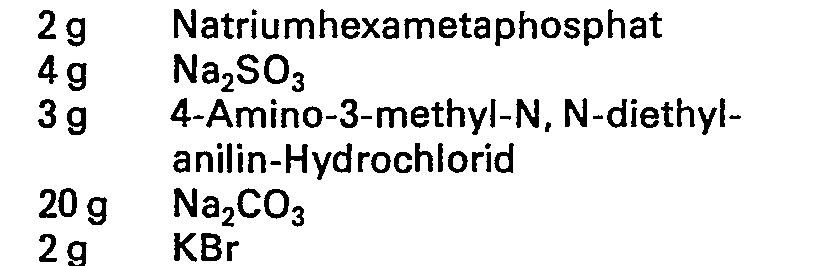
-

- Folgende Ergebnisse wurden erhalten:

- Die Empfindlichkeit ist in °DIN angegeben, wobei der Kuppler 12 als Standard angesehen wurde.
- Der Vergleich zeigt die hohen Empfindlichkeiten, mit denen die erfindungsgemässen Kuppler zu hohen Farbdichten kuppeln; er zeigt aber auch, dass selbst emulgierbare 4-Äquivalentkuppler dieses Typs in fotografischen Materialien mit Vorteil eingesetzt werden können.
Claims (1)
- Farbfotografisches Aufzeichnungsmaterial mit mindestens einer lichtempfindlichen Silberhalogenidemulsionsschicht, die einen einemulgierten nicht diffundierenden Gelbkuppler mit einer Alkylsulfonamidgruppe enthält, dadurch gekennzeichnet, dass der Gelbkuppler der folgenden Formel entspricht
 Y den Rest eines Acylacetanilid-Gelbkupplers, der den Rest der Formel
 R Wasserstoff oder eine gradkettige oder verzweigte, gesättigte oder olefinisch ungesättigte aliphatische Kohlenwasserstoffgruppe mit 1 bis 20 C-Atomenm eine ganze Zahl von 1 bis 8, n 2 oder 3p eine ganze Zahl von 1 bis 8.
Applications Claiming Priority (2)
| Application Number | Priority Date | Filing Date | Title |
|---|---|---|---|
| DE19792915025 DE2915025A1 (de) | 1979-04-12 | 1979-04-12 | Farbfotografisches farbkupplerhaltiges aufzeichnungsmaterial |
| DE2915025 | 1979-04-12 |
Publications (2)
| Publication Number | Publication Date |
|---|---|
| EP0017833A1 EP0017833A1 (de) | 1980-10-29 |
| EP0017833B1 true EP0017833B1 (de) | 1982-01-20 |
Family
ID=6068283
Family Applications (1)
| Application Number | Title | Priority Date | Filing Date |
|---|---|---|---|
| EP80101706A Expired EP0017833B1 (de) | 1979-04-12 | 1980-03-31 | Farbfotographisches gelbkupplerhaltiges Aufzeichnungsmaterial |
Country Status (3)
| Country | Link |
|---|---|
| EP (1) | EP0017833B1 (de) |
| JP (1) | JPS55142340A (de) |
| DE (2) | DE2915025A1 (de) |
Families Citing this family (1)
| Publication number | Priority date | Publication date | Assignee | Title |
|---|---|---|---|---|
| EP0079630B1 (de) * | 1981-11-12 | 1986-07-30 | Agfa-Gevaert N.V. | Photographische Aufzeichnungsmaterialien, die Ballastgruppen tragende Verbindungen enthalten |
Family Cites Families (4)
| Publication number | Priority date | Publication date | Assignee | Title |
|---|---|---|---|---|
| JPS4825933B1 (de) * | 1969-11-26 | 1973-08-02 | ||
| FR2322390A1 (fr) * | 1975-08-26 | 1977-03-25 | Agfa Gevaert | Nouveaux copulants chromogenes a deux equivalents |
| DE2707488A1 (de) * | 1977-02-21 | 1978-08-24 | Agfa Gevaert Ag | Farbfotografisches farbkupplerhaltiges aufzeichnungsmaterial |
| DE2723301A1 (de) * | 1977-05-24 | 1978-12-07 | Agfa Gevaert Ag | Farbphotographisches material mit neuen 2-aequivalent-gelbkupplern |
-
1979
- 1979-04-12 DE DE19792915025 patent/DE2915025A1/de not_active Withdrawn
-
1980
- 1980-03-31 DE DE8080101706T patent/DE3060146D1/de not_active Expired
- 1980-03-31 EP EP80101706A patent/EP0017833B1/de not_active Expired
- 1980-04-10 JP JP4631380A patent/JPS55142340A/ja active Pending
Also Published As
| Publication number | Publication date |
|---|---|
| EP0017833A1 (de) | 1980-10-29 |
| DE3060146D1 (en) | 1982-03-04 |
| DE2915025A1 (de) | 1980-10-23 |
| JPS55142340A (en) | 1980-11-06 |
Similar Documents
| Publication | Publication Date | Title |
|---|---|---|
| DE2329587C2 (de) | Farbphotographisches Aufzeichnungsmaterial | |
| DE2841166C2 (de) | Farbphotographische Silberhalogenidemulsion und deren Verwendung zur Erzeugung von Farbbildern | |
| DE2432041A1 (de) | Lichtempfindliches, photographisches halogensilberelement | |
| DE2502820C3 (de) | Farbfotografisches Verfahren zur Herstellung von Cyanbildern | |
| DE2540959C3 (de) | Farbphotographisches Aufzeichnungsmaterial | |
| DE2528638C2 (de) | ||
| DE19525666A1 (de) | Farbfotografisches Aufzeichnungsmaterial mit einem neuen Magentakuppler vom Typ 2-Äquivalentanilinopyrazolon | |
| DE2261361A1 (de) | Gelbkuppler fuer die farbfotografie | |
| DE3633364A1 (de) | Farbfotografisches aufzeichnungsmaterial mit einem farbkuppler vom pyrazoloazol-typ | |
| DE2605890A1 (de) | Lichtempfindliches photographisches material mit neuen purpurkupplern des 2-pyrazolin-5-on-typs | |
| EP0122533B1 (de) | Farbfotografisches farbkupplerhaltiges Aufzeichnungsmaterial | |
| DE69029828T2 (de) | Photographische gelbe Kuppler, Verfahren zur ihrer Herstellung und Zwischenprodukte dafür | |
| DE2515771A1 (de) | Verfahren zur erzeugung eines farbphotographischen bildes | |
| DE3622007C2 (de) | Farbfotografisches Aufzeichnungsmaterial mit 2-Äquivalentpurpurkupplern | |
| DE2004983A1 (de) | Neue Magenta-Kuppler | |
| DE2640601C2 (de) | Farbphotographisches Material mit 2-Äquivalent-Gelbkupplern | |
| DE2410914A1 (de) | Einlagerungsverfahren | |
| DE69522513T2 (de) | Fotographische Zwei-Äquivalent-Purpurrot-Kuppler mit die Aktivität modifizierender Ballastgruppen | |
| DE2729213A1 (de) | Lichtempfindliches farbfotografisches material | |
| DE2420067C2 (de) | Farbphotographisches Aufzeichnungsmaterial | |
| DE2442703A1 (de) | Farbphotographisches material mit neuen 2-aequivalent-gelbkupplern | |
| DE2945813A1 (de) | Lichtempfindliches photographisches silberhalogenidmaterial | |
| EP0056787B1 (de) | Photographisches Aufzeichnungsmaterial und Verfahren zu seiner Herstellung | |
| EP0017833A1 (de) | Farbfotographisches gelbkupplerhaltiges Aufzeichnungsmaterial | |
| DE2843954A1 (de) | Lichtempfindliches frabphotographisches element |
Legal Events
| Date | Code | Title | Description |
|---|---|---|---|
| PUAI | Public reference made under article 153(3) epc to a published international application that has entered the european phase |
Free format text: ORIGINAL CODE: 0009012 |
|
| 17P | Request for examination filed | ||
| AK | Designated contracting states |
Designated state(s): BE DE FR GB |
|
| GRAA | (expected) grant |
Free format text: ORIGINAL CODE: 0009210 |
|
| AK | Designated contracting states |
Designated state(s): BE DE FR GB |
|
| REF | Corresponds to: |
Ref document number: 3060146 Country of ref document: DE Date of ref document: 19820304 |
|
| PGFP | Annual fee paid to national office [announced via postgrant information from national office to epo] |
Ref country code: FR Payment date: 19840327 Year of fee payment: 5 |
|
| PGFP | Annual fee paid to national office [announced via postgrant information from national office to epo] |
Ref country code: BE Payment date: 19840331 Year of fee payment: 5 |
|
| BERE | Be: lapsed |
Owner name: AGFA-GEVAERT A.G. Effective date: 19880331 |
|
| PG25 | Lapsed in a contracting state [announced via postgrant information from national office to epo] |
Ref country code: GB Free format text: LAPSE BECAUSE OF NON-PAYMENT OF DUE FEES Effective date: 19881118 |
|
| GBPC | Gb: european patent ceased through non-payment of renewal fee | ||
| PG25 | Lapsed in a contracting state [announced via postgrant information from national office to epo] |
Ref country code: FR Free format text: LAPSE BECAUSE OF NON-PAYMENT OF DUE FEES Effective date: 19881130 |
|
| REG | Reference to a national code |
Ref country code: FR Ref legal event code: ST |
|
| PG25 | Lapsed in a contracting state [announced via postgrant information from national office to epo] |
Ref country code: BE Effective date: 19890331 |
|
| PGFP | Annual fee paid to national office [announced via postgrant information from national office to epo] |
Ref country code: DE Payment date: 19920220 Year of fee payment: 13 |
|
| PG25 | Lapsed in a contracting state [announced via postgrant information from national office to epo] |
Ref country code: DE Effective date: 19931201 |
|
| PLBE | No opposition filed within time limit |
Free format text: ORIGINAL CODE: 0009261 |
|
| STAA | Information on the status of an ep patent application or granted ep patent |
Free format text: STATUS: NO OPPOSITION FILED WITHIN TIME LIMIT |