EP0017543B1 - Dérivés du benzothiazole, leur procédé de préparation et leurs applications en thérapeutique - Google Patents
Dérivés du benzothiazole, leur procédé de préparation et leurs applications en thérapeutique Download PDFInfo
- Publication number
- EP0017543B1 EP0017543B1 EP80400368A EP80400368A EP0017543B1 EP 0017543 B1 EP0017543 B1 EP 0017543B1 EP 80400368 A EP80400368 A EP 80400368A EP 80400368 A EP80400368 A EP 80400368A EP 0017543 B1 EP0017543 B1 EP 0017543B1
- Authority
- EP
- European Patent Office
- Prior art keywords
- acid
- formula
- solution
- compound
- salt
- Prior art date
- Legal status (The legal status is an assumption and is not a legal conclusion. Google has not performed a legal analysis and makes no representation as to the accuracy of the status listed.)
- Expired
Links
- 238000002360 preparation method Methods 0.000 title claims description 7
- 238000000034 method Methods 0.000 title claims description 5
- 230000001225 therapeutic effect Effects 0.000 title claims 2
- IOJUPLGTWVMSFF-UHFFFAOYSA-N benzothiazole Chemical class C1=CC=C2SC=NC2=C1 IOJUPLGTWVMSFF-UHFFFAOYSA-N 0.000 title description 5
- 239000002253 acid Substances 0.000 claims description 30
- 150000001875 compounds Chemical class 0.000 claims description 24
- 150000003839 salts Chemical class 0.000 claims description 21
- 239000000203 mixture Substances 0.000 claims description 11
- 150000001412 amines Chemical class 0.000 claims description 6
- WPYMKLBDIGXBTP-UHFFFAOYSA-N benzoic acid Chemical compound OC(=O)C1=CC=CC=C1 WPYMKLBDIGXBTP-UHFFFAOYSA-N 0.000 claims description 6
- HBAQYPYDRFILMT-UHFFFAOYSA-N 8-[3-(1-cyclopropylpyrazol-4-yl)-1H-pyrazolo[4,3-d]pyrimidin-5-yl]-3-methyl-3,8-diazabicyclo[3.2.1]octan-2-one Chemical class C1(CC1)N1N=CC(=C1)C1=NNC2=C1N=C(N=C2)N1C2C(N(CC1CC2)C)=O HBAQYPYDRFILMT-UHFFFAOYSA-N 0.000 claims description 5
- 150000002148 esters Chemical class 0.000 claims description 5
- 239000005711 Benzoic acid Substances 0.000 claims description 3
- 235000010233 benzoic acid Nutrition 0.000 claims description 3
- 238000006243 chemical reaction Methods 0.000 claims description 3
- NGNBDVOYPDDBFK-UHFFFAOYSA-N 2-[2,4-di(pentan-2-yl)phenoxy]acetyl chloride Chemical compound CCCC(C)C1=CC=C(OCC(Cl)=O)C(C(C)CCC)=C1 NGNBDVOYPDDBFK-UHFFFAOYSA-N 0.000 claims description 2
- BWGNESOTFCXPMA-UHFFFAOYSA-N Dihydrogen disulfide Chemical compound SS BWGNESOTFCXPMA-UHFFFAOYSA-N 0.000 claims description 2
- 125000005907 alkyl ester group Chemical group 0.000 claims description 2
- 238000000926 separation method Methods 0.000 claims description 2
- DPRKTNKWAXPYNW-UHFFFAOYSA-N 2-(2-phenyl-1,3-benzothiazol-6-yl)propanoic acid Chemical compound S1C2=CC(C(C(O)=O)C)=CC=C2N=C1C1=CC=CC=C1 DPRKTNKWAXPYNW-UHFFFAOYSA-N 0.000 claims 1
- 239000004480 active ingredient Substances 0.000 claims 1
- 150000001767 cationic compounds Chemical class 0.000 claims 1
- 125000002485 formyl group Chemical class [H]C(*)=O 0.000 claims 1
- 229910001411 inorganic cation Inorganic materials 0.000 claims 1
- 150000007522 mineralic acids Chemical class 0.000 claims 1
- 150000007524 organic acids Chemical class 0.000 claims 1
- 235000005985 organic acids Nutrition 0.000 claims 1
- 239000000243 solution Substances 0.000 description 26
- XBDQKXXYIPTUBI-UHFFFAOYSA-N Propionic acid Substances CCC(O)=O XBDQKXXYIPTUBI-UHFFFAOYSA-N 0.000 description 23
- OKKJLVBELUTLKV-UHFFFAOYSA-N Methanol Chemical compound OC OKKJLVBELUTLKV-UHFFFAOYSA-N 0.000 description 18
- QTBSBXVTEAMEQO-UHFFFAOYSA-N Acetic acid Chemical compound CC(O)=O QTBSBXVTEAMEQO-UHFFFAOYSA-N 0.000 description 12
- HEMHJVSKTPXQMS-UHFFFAOYSA-M Sodium hydroxide Chemical compound [OH-].[Na+] HEMHJVSKTPXQMS-UHFFFAOYSA-M 0.000 description 12
- VEXZGXHMUGYJMC-UHFFFAOYSA-N Hydrochloric acid Chemical compound Cl VEXZGXHMUGYJMC-UHFFFAOYSA-N 0.000 description 11
- LFQSCWFLJHTTHZ-UHFFFAOYSA-N Ethanol Chemical compound CCO LFQSCWFLJHTTHZ-UHFFFAOYSA-N 0.000 description 10
- XLYOFNOQVPJJNP-UHFFFAOYSA-N water Substances O XLYOFNOQVPJJNP-UHFFFAOYSA-N 0.000 description 10
- ZWEHNKRNPOVVGH-UHFFFAOYSA-N 2-Butanone Chemical compound CCC(C)=O ZWEHNKRNPOVVGH-UHFFFAOYSA-N 0.000 description 9
- UHOVQNZJYSORNB-UHFFFAOYSA-N Benzene Chemical compound C1=CC=CC=C1 UHOVQNZJYSORNB-UHFFFAOYSA-N 0.000 description 9
- ZMXDDKWLCZADIW-UHFFFAOYSA-N N,N-Dimethylformamide Chemical compound CN(C)C=O ZMXDDKWLCZADIW-UHFFFAOYSA-N 0.000 description 9
- 239000002244 precipitate Substances 0.000 description 9
- HUMNYLRZRPPJDN-UHFFFAOYSA-N benzaldehyde Chemical compound O=CC1=CC=CC=C1 HUMNYLRZRPPJDN-UHFFFAOYSA-N 0.000 description 8
- 235000019260 propionic acid Nutrition 0.000 description 8
- IUVKMZGDUIUOCP-BTNSXGMBSA-N quinbolone Chemical compound O([C@H]1CC[C@H]2[C@H]3[C@@H]([C@]4(C=CC(=O)C=C4CC3)C)CC[C@@]21C)C1=CCCC1 IUVKMZGDUIUOCP-BTNSXGMBSA-N 0.000 description 8
- 239000002904 solvent Substances 0.000 description 8
- 150000007513 acids Chemical class 0.000 description 7
- -1 2-phenyl-6-benzothiazolyl Chemical group 0.000 description 6
- KFZMGEQAYNKOFK-UHFFFAOYSA-N Isopropanol Chemical compound CC(C)O KFZMGEQAYNKOFK-UHFFFAOYSA-N 0.000 description 6
- 235000011054 acetic acid Nutrition 0.000 description 5
- 239000007864 aqueous solution Substances 0.000 description 5
- 238000002844 melting Methods 0.000 description 5
- 230000008018 melting Effects 0.000 description 5
- JUJWROOIHBZHMG-UHFFFAOYSA-N Pyridine Chemical compound C1=CC=NC=C1 JUJWROOIHBZHMG-UHFFFAOYSA-N 0.000 description 4
- 230000000202 analgesic effect Effects 0.000 description 4
- YZXBAPSDXZZRGB-DOFZRALJSA-N arachidonic acid Chemical compound CCCCC\C=C/C\C=C/C\C=C/C\C=C/CCCC(O)=O YZXBAPSDXZZRGB-DOFZRALJSA-N 0.000 description 4
- PASDCCFISLVPSO-UHFFFAOYSA-N benzoyl chloride Chemical compound ClC(=O)C1=CC=CC=C1 PASDCCFISLVPSO-UHFFFAOYSA-N 0.000 description 4
- 239000007787 solid Substances 0.000 description 4
- 241000699670 Mus sp. Species 0.000 description 3
- KWYUFKZDYYNOTN-UHFFFAOYSA-M Potassium hydroxide Chemical compound [OH-].[K+] KWYUFKZDYYNOTN-UHFFFAOYSA-M 0.000 description 3
- 239000002585 base Substances 0.000 description 3
- 230000015572 biosynthetic process Effects 0.000 description 3
- 230000000694 effects Effects 0.000 description 3
- 239000000155 melt Substances 0.000 description 3
- QNGNSVIICDLXHT-UHFFFAOYSA-N para-ethylbenzaldehyde Natural products CCC1=CC=C(C=O)C=C1 QNGNSVIICDLXHT-UHFFFAOYSA-N 0.000 description 3
- 238000001953 recrystallisation Methods 0.000 description 3
- 238000010992 reflux Methods 0.000 description 3
- RSPCKAHMRANGJZ-UHFFFAOYSA-N thiohydroxylamine Chemical compound SN RSPCKAHMRANGJZ-UHFFFAOYSA-N 0.000 description 3
- RQEUFEKYXDPUSK-UHFFFAOYSA-N 1-phenylethylamine Chemical compound CC(N)C1=CC=CC=C1 RQEUFEKYXDPUSK-UHFFFAOYSA-N 0.000 description 2
- CSCPPACGZOOCGX-UHFFFAOYSA-N Acetone Chemical compound CC(C)=O CSCPPACGZOOCGX-UHFFFAOYSA-N 0.000 description 2
- QGZKDVFQNNGYKY-UHFFFAOYSA-N Ammonia Chemical compound N QGZKDVFQNNGYKY-UHFFFAOYSA-N 0.000 description 2
- WKBOTKDWSSQWDR-UHFFFAOYSA-N Bromine atom Chemical compound [Br] WKBOTKDWSSQWDR-UHFFFAOYSA-N 0.000 description 2
- XDTMQSROBMDMFD-UHFFFAOYSA-N Cyclohexane Chemical compound C1CCCCC1 XDTMQSROBMDMFD-UHFFFAOYSA-N 0.000 description 2
- RTZKZFJDLAIYFH-UHFFFAOYSA-N Diethyl ether Chemical compound CCOCC RTZKZFJDLAIYFH-UHFFFAOYSA-N 0.000 description 2
- IAZDPXIOMUYVGZ-UHFFFAOYSA-N Dimethylsulphoxide Chemical compound CS(C)=O IAZDPXIOMUYVGZ-UHFFFAOYSA-N 0.000 description 2
- BHHGXPLMPWCGHP-UHFFFAOYSA-N Phenethylamine Chemical compound NCCC1=CC=CC=C1 BHHGXPLMPWCGHP-UHFFFAOYSA-N 0.000 description 2
- SMWDFEZZVXVKRB-UHFFFAOYSA-N Quinoline Chemical compound N1=CC=CC2=CC=CC=C21 SMWDFEZZVXVKRB-UHFFFAOYSA-N 0.000 description 2
- 206010040070 Septic Shock Diseases 0.000 description 2
- SOIFLUNRINLCBN-UHFFFAOYSA-N ammonium thiocyanate Chemical compound [NH4+].[S-]C#N SOIFLUNRINLCBN-UHFFFAOYSA-N 0.000 description 2
- 230000003110 anti-inflammatory effect Effects 0.000 description 2
- 239000008346 aqueous phase Substances 0.000 description 2
- 229940114079 arachidonic acid Drugs 0.000 description 2
- 235000021342 arachidonic acid Nutrition 0.000 description 2
- GDTBXPJZTBHREO-UHFFFAOYSA-N bromine Substances BrBr GDTBXPJZTBHREO-UHFFFAOYSA-N 0.000 description 2
- 229910052794 bromium Inorganic materials 0.000 description 2
- 150000001768 cations Chemical class 0.000 description 2
- 230000002526 effect on cardiovascular system Effects 0.000 description 2
- 238000001914 filtration Methods 0.000 description 2
- 238000010438 heat treatment Methods 0.000 description 2
- LQNUZADURLCDLV-UHFFFAOYSA-N nitrobenzene Chemical compound [O-][N+](=O)C1=CC=CC=C1 LQNUZADURLCDLV-UHFFFAOYSA-N 0.000 description 2
- 238000001556 precipitation Methods 0.000 description 2
- 150000003180 prostaglandins Chemical class 0.000 description 2
- 230000001681 protective effect Effects 0.000 description 2
- UMJSCPRVCHMLSP-UHFFFAOYSA-N pyridine Natural products COC1=CC=CN=C1 UMJSCPRVCHMLSP-UHFFFAOYSA-N 0.000 description 2
- 238000007363 ring formation reaction Methods 0.000 description 2
- 159000000000 sodium salts Chemical class 0.000 description 2
- 208000010110 spontaneous platelet aggregation Diseases 0.000 description 2
- 238000003756 stirring Methods 0.000 description 2
- 231100000419 toxicity Toxicity 0.000 description 2
- 230000001988 toxicity Effects 0.000 description 2
- RLQZIECDMISZHS-UHFFFAOYSA-N 2-phenylcyclohexa-2,5-diene-1,4-dione Chemical compound O=C1C=CC(=O)C(C=2C=CC=CC=2)=C1 RLQZIECDMISZHS-UHFFFAOYSA-N 0.000 description 1
- UJVBZCCNLAAMOV-UHFFFAOYSA-N 2h-1,2-benzothiazine Chemical compound C1=CC=C2C=CNSC2=C1 UJVBZCCNLAAMOV-UHFFFAOYSA-N 0.000 description 1
- BSYNRYMUTXBXSQ-UHFFFAOYSA-N Aspirin Chemical compound CC(=O)OC1=CC=CC=C1C(O)=O BSYNRYMUTXBXSQ-UHFFFAOYSA-N 0.000 description 1
- LSNNMFCWUKXFEE-UHFFFAOYSA-M Bisulfite Chemical compound OS([O-])=O LSNNMFCWUKXFEE-UHFFFAOYSA-M 0.000 description 1
- WOMVICAMAQURRN-UHFFFAOYSA-N CC(C(O)=O)c(cc1)ccc1N Chemical compound CC(C(O)=O)c(cc1)ccc1N WOMVICAMAQURRN-UHFFFAOYSA-N 0.000 description 1
- ZVBINIQZKBXOHX-UHFFFAOYSA-N CC(C(O)=O)c(cc1O)ccc1N Chemical compound CC(C(O)=O)c(cc1O)ccc1N ZVBINIQZKBXOHX-UHFFFAOYSA-N 0.000 description 1
- 208000005171 Dysmenorrhea Diseases 0.000 description 1
- 206010013935 Dysmenorrhoea Diseases 0.000 description 1
- 241000588724 Escherichia coli Species 0.000 description 1
- 206010020843 Hyperthermia Diseases 0.000 description 1
- DGAQECJNVWCQMB-PUAWFVPOSA-M Ilexoside XXIX Chemical compound C[C@@H]1CC[C@@]2(CC[C@@]3(C(=CC[C@H]4[C@]3(CC[C@@H]5[C@@]4(CC[C@@H](C5(C)C)OS(=O)(=O)[O-])C)C)[C@@H]2[C@]1(C)O)C)C(=O)O[C@H]6[C@@H]([C@H]([C@@H]([C@H](O6)CO)O)O)O.[Na+] DGAQECJNVWCQMB-PUAWFVPOSA-M 0.000 description 1
- 229910021578 Iron(III) chloride Inorganic materials 0.000 description 1
- RJUFJBKOKNCXHH-UHFFFAOYSA-N Methyl propionate Chemical compound CCC(=O)OC RJUFJBKOKNCXHH-UHFFFAOYSA-N 0.000 description 1
- 208000002193 Pain Diseases 0.000 description 1
- 150000001243 acetic acids Chemical class 0.000 description 1
- 229960001138 acetylsalicylic acid Drugs 0.000 description 1
- 230000002378 acidificating effect Effects 0.000 description 1
- 125000001931 aliphatic group Chemical group 0.000 description 1
- 239000003513 alkali Substances 0.000 description 1
- 150000001350 alkyl halides Chemical class 0.000 description 1
- 150000001413 amino acids Chemical class 0.000 description 1
- 125000005365 aminothiol group Chemical group 0.000 description 1
- 229910021529 ammonia Inorganic materials 0.000 description 1
- 230000036592 analgesia Effects 0.000 description 1
- 230000002744 anti-aggregatory effect Effects 0.000 description 1
- 230000001760 anti-analgesic effect Effects 0.000 description 1
- 230000001754 anti-pyretic effect Effects 0.000 description 1
- 239000002775 capsule Substances 0.000 description 1
- 239000003638 chemical reducing agent Substances 0.000 description 1
- 238000001816 cooling Methods 0.000 description 1
- 238000000354 decomposition reaction Methods 0.000 description 1
- 239000003085 diluting agent Substances 0.000 description 1
- 201000010099 disease Diseases 0.000 description 1
- 208000037265 diseases, disorders, signs and symptoms Diseases 0.000 description 1
- UCYWDWSKWUEDSC-UHFFFAOYSA-M disodium;sulfanide;nonahydrate Chemical compound O.O.O.O.O.O.O.O.O.[Na+].[Na+].[SH-] UCYWDWSKWUEDSC-UHFFFAOYSA-M 0.000 description 1
- 239000003814 drug Substances 0.000 description 1
- 229940079593 drug Drugs 0.000 description 1
- 230000008030 elimination Effects 0.000 description 1
- 238000003379 elimination reaction Methods 0.000 description 1
- 239000012467 final product Substances 0.000 description 1
- XLYOFNOQVPJJNP-UHFFFAOYSA-M hydroxide Chemical compound [OH-] XLYOFNOQVPJJNP-UHFFFAOYSA-M 0.000 description 1
- 230000036031 hyperthermia Effects 0.000 description 1
- 239000005457 ice water Substances 0.000 description 1
- 238000000338 in vitro Methods 0.000 description 1
- 238000002329 infrared spectrum Methods 0.000 description 1
- 239000004615 ingredient Substances 0.000 description 1
- 239000003112 inhibitor Substances 0.000 description 1
- 230000002401 inhibitory effect Effects 0.000 description 1
- 229910052500 inorganic mineral Inorganic materials 0.000 description 1
- 238000001990 intravenous administration Methods 0.000 description 1
- RBTARNINKXHZNM-UHFFFAOYSA-K iron trichloride Chemical compound Cl[Fe](Cl)Cl RBTARNINKXHZNM-UHFFFAOYSA-K 0.000 description 1
- 150000002576 ketones Chemical class 0.000 description 1
- 231100000636 lethal dose Toxicity 0.000 description 1
- 229940017219 methyl propionate Drugs 0.000 description 1
- 239000011707 mineral Substances 0.000 description 1
- 231100000252 nontoxic Toxicity 0.000 description 1
- 230000003000 nontoxic effect Effects 0.000 description 1
- 230000003287 optical effect Effects 0.000 description 1
- 150000007530 organic bases Chemical class 0.000 description 1
- 239000012074 organic phase Substances 0.000 description 1
- 230000003647 oxidation Effects 0.000 description 1
- 238000007254 oxidation reaction Methods 0.000 description 1
- 229940094443 oxytocics prostaglandins Drugs 0.000 description 1
- 230000020477 pH reduction Effects 0.000 description 1
- 230000036407 pain Effects 0.000 description 1
- 238000007911 parenteral administration Methods 0.000 description 1
- 239000000546 pharmaceutical excipient Substances 0.000 description 1
- 230000000144 pharmacologic effect Effects 0.000 description 1
- 239000006187 pill Substances 0.000 description 1
- 239000002243 precursor Substances 0.000 description 1
- 239000000047 product Substances 0.000 description 1
- 230000002035 prolonged effect Effects 0.000 description 1
- 150000003235 pyrrolidines Chemical class 0.000 description 1
- 239000011541 reaction mixture Substances 0.000 description 1
- 230000035939 shock Effects 0.000 description 1
- 239000011734 sodium Substances 0.000 description 1
- 229910052708 sodium Inorganic materials 0.000 description 1
- JXKPEJDQGNYQSM-UHFFFAOYSA-M sodium propionate Chemical compound [Na+].CCC([O-])=O JXKPEJDQGNYQSM-UHFFFAOYSA-M 0.000 description 1
- 235000010334 sodium propionate Nutrition 0.000 description 1
- 239000004324 sodium propionate Substances 0.000 description 1
- 229960003212 sodium propionate Drugs 0.000 description 1
- 239000007790 solid phase Substances 0.000 description 1
- 239000000126 substance Substances 0.000 description 1
- QAOWNCQODCNURD-UHFFFAOYSA-N sulfuric acid Substances OS(O)(=O)=O QAOWNCQODCNURD-UHFFFAOYSA-N 0.000 description 1
- 231100001274 therapeutic index Toxicity 0.000 description 1
- 238000002560 therapeutic procedure Methods 0.000 description 1
Classifications
-
- C—CHEMISTRY; METALLURGY
- C07—ORGANIC CHEMISTRY
- C07D—HETEROCYCLIC COMPOUNDS
- C07D277/00—Heterocyclic compounds containing 1,3-thiazole or hydrogenated 1,3-thiazole rings
- C07D277/60—Heterocyclic compounds containing 1,3-thiazole or hydrogenated 1,3-thiazole rings condensed with carbocyclic rings or ring systems
- C07D277/62—Benzothiazoles
- C07D277/64—Benzothiazoles with only hydrocarbon or substituted hydrocarbon radicals attached in position 2
- C07D277/66—Benzothiazoles with only hydrocarbon or substituted hydrocarbon radicals attached in position 2 with aromatic rings or ring systems directly attached in position 2
-
- A—HUMAN NECESSITIES
- A61—MEDICAL OR VETERINARY SCIENCE; HYGIENE
- A61P—SPECIFIC THERAPEUTIC ACTIVITY OF CHEMICAL COMPOUNDS OR MEDICINAL PREPARATIONS
- A61P25/00—Drugs for disorders of the nervous system
- A61P25/04—Centrally acting analgesics, e.g. opioids
-
- A—HUMAN NECESSITIES
- A61—MEDICAL OR VETERINARY SCIENCE; HYGIENE
- A61P—SPECIFIC THERAPEUTIC ACTIVITY OF CHEMICAL COMPOUNDS OR MEDICINAL PREPARATIONS
- A61P29/00—Non-central analgesic, antipyretic or antiinflammatory agents, e.g. antirheumatic agents; Non-steroidal antiinflammatory drugs [NSAID]
- A61P29/02—Non-central analgesic, antipyretic or antiinflammatory agents, e.g. antirheumatic agents; Non-steroidal antiinflammatory drugs [NSAID] without antiinflammatory effect
-
- A—HUMAN NECESSITIES
- A61—MEDICAL OR VETERINARY SCIENCE; HYGIENE
- A61P—SPECIFIC THERAPEUTIC ACTIVITY OF CHEMICAL COMPOUNDS OR MEDICINAL PREPARATIONS
- A61P43/00—Drugs for specific purposes, not provided for in groups A61P1/00-A61P41/00
-
- A—HUMAN NECESSITIES
- A61—MEDICAL OR VETERINARY SCIENCE; HYGIENE
- A61P—SPECIFIC THERAPEUTIC ACTIVITY OF CHEMICAL COMPOUNDS OR MEDICINAL PREPARATIONS
- A61P7/00—Drugs for disorders of the blood or the extracellular fluid
- A61P7/02—Antithrombotic agents; Anticoagulants; Platelet aggregation inhibitors
-
- C—CHEMISTRY; METALLURGY
- C07—ORGANIC CHEMISTRY
- C07D—HETEROCYCLIC COMPOUNDS
- C07D277/00—Heterocyclic compounds containing 1,3-thiazole or hydrogenated 1,3-thiazole rings
- C07D277/60—Heterocyclic compounds containing 1,3-thiazole or hydrogenated 1,3-thiazole rings condensed with carbocyclic rings or ring systems
- C07D277/62—Benzothiazoles
- C07D277/68—Benzothiazoles with hetero atoms or with carbon atoms having three bonds to hetero atoms with at the most one bond to halogen, e.g. ester or nitrile radicals, directly attached in position 2
- C07D277/82—Nitrogen atoms
Definitions
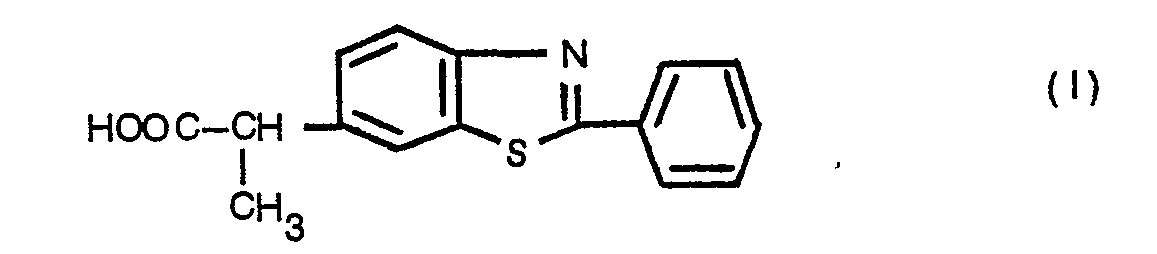
- the present invention relates to derivatives of 2-phenylbenzothiazolyl-6 acetic acid.
- Patent Application FR-A 2 106 462 describes the 2-phenylbenzothiazolyl-5 and 6 acetic acids and the anti-inflammatory, analgesic and antipyretic properties of these compounds.
- Patent application FR-A 2 198 757 and the article in the Journal of Medicinal Chemistry, 1974 vol. 17 No. 5 pages 491-496 describe (phenyl-2-benzothiazolyl-5) -2-propionic acid and its anti-inflammatory and analgesic properties.
- the present invention therefore relates to the two stereoisomers and the racemic of propionic acid (2-phenyl-2-benzothiazolyl-6) -2 of formula and their salts with physiologically acceptable bases, alkali, alkaline earth cations and amines, as well as their salts with physiologically acceptable acids, inorganic or organic, and their alkyl esters.
- racemic acids of formula 1 can be prepared by reaction on the aminothiol of formula II or an equivalent such as the disulfide corresponding to formula III benzoic acid or a derivative such as benzoyl chloride, a benzoyl ester or benzoic aldehyde, the reaction with benzoyl chloride leading to the best yield.
- the two enantiomers of the acid of formula 1 can be separated using a salt of the corresponding acid with a chiral amine, and more particularly each of the two enantiomers of 2-phenylethylamine. According to a method known per se, these salts are recrystallized to separate the two diastereoisomers.
- the salts of the acids of formula 1 can be prepared by the action of a stoichiometric amount of the chosen acid or base on the acids of formula in solution in an alcohol, a ketone or an aliphatic ether.
- esters of the acids of formula 1 can be prepared by the action of an alcohol or of a haloalkane on the acids of formula I or one of their reactive derivatives, according to methods known per se.
- aminothiols of formula II can be prepared by decomposition, in basic medium, in the presence or not of a reducing agent, of a compound of formula
- amino acids are new chemicals which can be prepared by the action of bromine and ammonium thiocyanate on a compound of formula in solution in acetic acid.
- reaction mixture is allowed to return to ambient temperature and the aqitation is continued for a few hours before separating the organic phase and acidifying the aqueous phase up to pH 4 by addition of hydrochloric acid in concentrated aqueous solution.
- the precipitate which appears contains benzoic acid, the non-cyclized derivatives, of type IV and V, and sometimes even of the final benzothiazole.
- Cyclization is carried out on this mixture, for example by heating the gummy solid at 120 ° C. for several hours, or alternatively in an acid medium as follows: the solid is dissolved in 1 liter of water containing 70 ml of an aqueous hydroxide solution 40% sodium; the solution is filtered through decolouring black, then poured, drop by drop, into an aqueous solution of about 2 N of hydrochloric acid, maintained at around 50 ° C; the precipitate which appears is isolated by filtration at this temperature.
- the final acid of which 45 g are thus obtained, is recrystallized from aqueous isopropanol (2/1) or from a butanone-2 / cyclohexane (1/2) mixture to give 36 g of pure product, melting at around 160 ° C. .
- the acid will appear in different crystalline forms, with melting points sometimes very close but whose infrared spectra in solid phase are not superimposable.
- Cyclization can also be carried out in a basic medium: the solid obtained is then abundantly washed with water, in 350 ml of a 95% aqueous ethanol solution containing 25 g of potassium hydroxide, then after a few hours of heating, acidification, elimination of ethanol and pouring into about 1 liter of water, the final acid precipitate which forms is isolated and recrystallized as previously mentioned.
- the pyrrolidine salt of propionic (2-phenyl-benzothiazolyl-6) -2 acid is prepared by the action of I g of amine on 4 g of acid in solution in methanol. It melts at 142 ° C. This salt is soluble in water.
- Propionic acid (2-phenyl-2-benzothiazolyl-6) -2-methanesulfonate is prepared by the action of 0.1 mole of sulfonic acid on 0.1 mole of acid in solution in 500 ml of acetone. Mp 182 ° C.
- the propionic acid (2-phenyl-2-benzothiazolyl-6) -2 hydrochloride is prepared by the action of gaseous hydrochloric acid on the acid in solution in benzene. It melts at 150 ° C while decomposing.
- the acid salt is prepared with the levorotatory ⁇ -phenyl ethylamine in butanone-2.
- 19 g of amine in solution in 50 ml of butanone-2 to a solution of 50 g of acid in 500 ml of butanone-2, there is precipitation of 51 g of salt.
- the acid is released by adding hydrochloric acid to the aqueous solution of this amine salt.
- the isolated precipitate is recrystallized several times from isopropanol / water mixtures (2/1) to give the dextrorotatory enantiomer with 35% yield. Mp 179 ° C.
- the recrystallization solvents for the chiral salt obtained according to (a) are evaporated and the acid, slightly enriched in levorotatory enantiomer, is freed from its salt. 25 g of acid are thus obtained, of which 28 g of salt are prepared by the action of 10.3 g of dextrorotatory ⁇ -phenylethylamine on the acid in solution in 540 ml of butanone-2.
- the compounds of formula 1 and their derivatives are inhibitors of prostaglandin biosynthesis, and exhibit analgesic properties at inhibitory doses. They also have an anti-aggregation activity, and protect against the cardiovascular effects of endotoxin shock.
- the analgesic activity of the compounds of formula 1 was demonstrated in the test of phenylbenzoquinone torsions in mice.
- the acid of formula 1 (racemic) has in this test an ED 50 of 3 to 6 mg / kg PO
- This analgesic activity is prolonged in time, a dose of 12.5 mg / kg of this compound further causing a 42% analgesia, 24 hours after administration.
- the compounds of formula 1 decrease the platelet aggregation caused in vitro by ADP on rat plasma enriched in platelets; thus (2-phenyl-benzothiazolyl-6) -2 sodium propionate is active at a concentration ten times lower than acetyl salicylic acid.
- the activity of the compounds of formula 1 on the biosynthesis of prostaglandins results in a protective effect against the toxicity of the arachidonic acid precursor of this biosynthesis.
- the compounds of formula 1 administered at a dose of 0.5 mg / kg orally cause a reduction in the mortality of mice having received a lethal dose of arachidonic acid.
- the soluble salts of the compounds of formula 1, and in particular the sodium salt are active at the same doses.
- the dextrorotatory enantiomer of acid (example 8) has an activity comparable to that of the racemic (example 1), and greater than that of its levorotatory counterpart.
- the compounds of formula 1 administered intravenously at a dose of 1 mg / kg exert a protective effect in the anesthetized dog, against the cardiovascular effects of the endotoxin shock of Escherichia Coli.
- the compounds of formula 1 can be administered in various forms to humans, orally, rectally or parenterally, in effective and non-toxic doses for the treatment of pain, hyperthermia, dysmenorrhea, states of shock or else diseases in which the decrease in platelet aggregation is an important factor.
- the unit dose depends on the form of administration and the compound chosen as the active principle of the drug.
- the solutions for parenteral or intravenous administration are preferably prepared with aqueous diluents, and the active principle being in a form soluble in this medium and for example in the form of a salt of alkaline cation.
- the compounds of the invention can be introduced into capsules or mixed with the usual excipients to form pills, cachets or tablets which immediately release the active or enteric-soluble ingredients.
- the daily dosage in adults is, except in special cases, between 20 mg and 1 g, in one or more doses.
Landscapes
- Health & Medical Sciences (AREA)
- Chemical & Material Sciences (AREA)
- Organic Chemistry (AREA)
- General Health & Medical Sciences (AREA)
- Veterinary Medicine (AREA)
- General Chemical & Material Sciences (AREA)
- Medicinal Chemistry (AREA)
- Nuclear Medicine, Radiotherapy & Molecular Imaging (AREA)
- Chemical Kinetics & Catalysis (AREA)
- Pharmacology & Pharmacy (AREA)
- Life Sciences & Earth Sciences (AREA)
- Animal Behavior & Ethology (AREA)
- Public Health (AREA)
- Bioinformatics & Cheminformatics (AREA)
- Engineering & Computer Science (AREA)
- Pain & Pain Management (AREA)
- Neurology (AREA)
- Hematology (AREA)
- Biomedical Technology (AREA)
- Diabetes (AREA)
- Neurosurgery (AREA)
- Rheumatology (AREA)
- Pharmaceuticals Containing Other Organic And Inorganic Compounds (AREA)
- Thiazole And Isothizaole Compounds (AREA)
- Nitrogen And Oxygen Or Sulfur-Condensed Heterocyclic Ring Systems (AREA)
- Nitrogen- Or Sulfur-Containing Heterocyclic Ring Compounds With Rings Of Six Or More Members (AREA)
Description
- La présente invention concerne des dérivés de l'acide phényl-2 benzothiazolyl-6, acétique.
- La Demande de brevet FR-A 2 106 462 décrit les acides phényl-2 benzothiazolyl-5 et 6 acétiques et les propriétés anti-inflammatoires, analgésiques et antipyrétiques de ces composés.
- La demande de brevet FR-A 2 198 757 et l'article du Journal of Medicinal Chemistry, 1974 vol. 17 No. 5 pages 491-496 décrivent l'acide (phényl-2-benzothiazolyl-5)-2-propionique et ses propriétés anti-inflammatoires et analgésiques.
- La Demanderesse a trouvé que l'acide (phényl-2 benzothiazolyl-6)-2 propionique présentant des propriétiés pharmacologiques inattendues par rapport à celles de ces composés.
- La présente invention a donc pour objet les deux stéréoisomères et le racémique de l'acide (phényl-2 benzothiazolyl-6)-2 propionique de formule
- Les acides racémiques de formule 1 peuvent être préparés par réaction sur l'aminothiol de formule Il ou un équivalent tel le disulfure correspondant à la formule III

- Lors de 1 action de chlorure d'acide sur l'aminothiol de formule II, qui a lieu de préférence en présence d'une base minérale ou organique, il se forme en particulier les composés intermédiaires IV et V

- Ces composés de formules IV et V ne sont pas purifiés mais leur mélange est cyclisé soit par l'action de la chaleur, soit par action des acides ou des bases.
- Lors de l'action de la benzaldéhyde sur l'aminothiol de formule 11, qui a lieu soit dans un solvant indifférent, tel que nitrobenzène, benzène, ... soit dans un solvant basique, tel que pyridine, quinoléine, il peut se former intermédiaire ment une benzothiazine de formule VI

- Les deux énantiomères de l'acide de formule 1 peuvent être séparés en utilisant un sel de l'acide correspondant avec une amine chirale, et plus particulièrement chacun des deux énantiomères de la phényl-2 éthylamine. Selon une méthode connue en soi, on recristallise ces sels pour séparer les deux diastéréo-isomères.
- Les sels des acides de formule 1 peuvent être préparés par action d'une quantité stoechio- métrique de l'acide ou de la base choisie sur les acides de formule en solution dans un alcool, une cétone ou un éther aliphatique.
- Les esters des acides de formule 1 peuvent étre préparés par action d'un alcool ou d'un halogéno- alkane sur les acides de formule I ou l'un de leurs dérivés réactifs, selon des méthodes connues en soi.
- Les aminothiols de formule Il peuvent être préparés par décomposition, en milieu basique, en présence ou non d'un réducteur, d'un composé de formule

- Ces aminoacides sont des produits chimiques nouveaux, qui peuvent être préparés par action du brome et du thiocyanate d'ammonium, sur un composé de formule

- Les exemples suivants illustrent la préparation des composés de la formule (I).
- On dissout 24,7 g d'acide (amino-4, phényl)-2 propionique, préparé par exemple comme dans Org. Prep. Proc. Int. p. 303-307 (1977), dans 300 ml d'acide acétique, puis 22,8 g de thiocyanate d'ammonium. A 15°C, on introduit, goutte à goutte dans cette solution 24 g de brome en solution dans 60 ml d'acide acétique, puis laisse le mélange revenir à température ambiante sous agitation, pour quelques heures. on élimine alors le solvant sous pression réduite et met l'huile rédiduelle en suspension dans une solution aqueuse acide; on élimine le précipité et amène la phase aqueuse à pH 4,5 par addition d'une solution d'hydroxyde de sodium. Le précipité formé est isolé par filtration et recristallisé dans le méthanol ou l'éthanol pour donner 26 g d'acide (amino-2 benzothiazolyl-6)-2 propionique pur de point de fusion 234°C.
- On porte à la température du reflux jusqu'à fin de dégagement d'ammoniac une solution de 45 g d'acide (amino-2 benzothiazolyl-6)-2 propionique dans 200 ml de solution aqueuse d'hydroxyde de sodium à 40% contenant ou non 40 g de sulfure de sodium, nonahydrate. Environ 500 ml d'eau sont introduits dans la solution et à la température de 10°C, on ajoute lentement sous forte agitation à cette solution aqueuse, 70 g de chlorure de benzoyle en solution à 10% dans un solvant non miscible à l'eau, tel le benzène. Après la fin de l'addition, on laisse le mélange réactionnel revenir à température ambiante et continue l'aqitation quelques heures avant de séparer la phase organique et d'acidifier la phase aqueuse jusqu'à pH 4 par addition d'acide chlorhydrique en solution aqueuse concentrée. Le précipité apparu contient de l'acide benzoïque, les dérivés non cyclisés, de type IV et V, et parfois même du benzothiazole final.
- La cyclisation est effectuée sur ce mélange par exemple par chauffage du solide gommeux à 120°C plusieurs heures, ou encore en milieu acide comme suit: le solide est dissous dans 1 litre d'eau contenant 70 ml d'une solution aqueuse d'hydroxyde de sodium à 40%; la solution est filtrée sur noir décolarant, puis versée, goutte à goutte, dans une solution aqueuse environ 2 N d'acide chlorhydrique, maintenue vers 50°C; le précipité apparu est isolé par filtration à cette température.
- L'acide final, dont 45 g sont ainsi obtenus, est recristallisé dans l'isopropanol aqueux (2/1) ou dans un mélange butanone-2/cyclohexane (1/2) pour donner 36 g de produit pur fondant vers 160°C. Suivant les solvants de recristallisation et la vitesse de précipitation, l'acide se présentera sous des formes cristallines différentes, de points de fusion parfois très proches mais dont les spectres infrarouge en phase solide ne sont pas superposables.
- La cyclisation peut aussi être effectuée en milieu basique: on dissout alors le solide obtenu abondammet lavé à l'eau, dans 350 ml d'une solution d'éthanol aqueux à 95% contenant 25 g d'hydroxyde de potassium, puis après quelques heures de chauffage, on acidifie, élimine l'éthanol et verse dans 1 litre d'eau environ, Le précipité d acide final qui se forme est isolé et recristallisé comme précédemment mentionné.
- 22 g d'acide (amino-2 benzothiazolyl-6)-2 propionique sont dissous dans 100 ml d'une solution concentrée d'hydroxyde de sodium et le mélange porté 1 heure à sa température de reflux (fin de dégagement d'ammoniac). A température ambiante, on amène la solution à pH 4,5 par addition d'une solution d'acide chlorhydrique et filtre le précipité apparu. On isole ainsi 16 g de précipité de point de fusion voisin de 154°C. Ce solide et 8 g de benzaldéhyde sont dissous dans 100 ml de pyridine et le mélange maintenu à sa température de reflux 5 heures. On élimine alors le solvant sous pression réduite. Le résidu est dissous dans 100 ml d'éthanol, 200 mg de chlorure ferrique sont ajoutés et la solution est maintenue 2 heures à sa température de reflux. Le précipité apparu au refroidissement est purifié par dissolution dans une solution aqueuse basique avant d'être recristallisé dans un mélange butanone-2/cyclohexane (1/2). On obtient le produit final pur avec 40% de rendement.
- Le sel de sodium de l'acide (phényl-2 benzothiazolyl-6(-2 propionique hygroscopique est préparé par action de 0,55 g d'hydroxyde de sodium sur 3,7 g d'acide en solution dans 100 ml de méthanol. F = 270°C. Ce sel est soluble dans l'eau.
- Le sel de pyrrolidine de l'acide (phényl-2 benzothiazolyl-6)-2 propionique est préparé par action d'I g d'amine sur 4 g d'acide en solution dans le méthanol. Il fond à 142°C. Ce sel est soluble dans l'eau.
- Le méthanesulfonate de l'acide (phényl-2 benzothiazolyl-6)-2 propionique est préparé par action de 0,1 mole d'acide sulfonique sur 0,1 mole d'acide en solution dans 500 ml d'acétone. F = 182°C.
- Le chlorhydrate de l'acide (phényl-2 benzothiazolyl-6)-2 propionique est préparé par action d'acide chlorhydrique gazeux sur l'acide en solution dans le benzène. Il fond à 150°C en se décomposant.
- On dissout 6 g d'acide (phényl-2 benzothiazolyl-6)-2 propionique dans 100 ml de méthanol anhydre et porte au reflux du solvant 6 heures après addition de quelques gouttes d'acide sulfurique concentré. La solution est concentrée de moitié et l'ester précipité par addition d'un volume d'eau glacée. On obtient ainsi 5 g d'ester qui fond à 86°C.
- Séparation des 2 énantiomères de l'acide (phényl-2 benzothiazolyl-6)-2 propionique à partir de leur mélange racémique.
- On prépare le sel de l'acide avec I'α-phényl éthylamine lévogyre dans la butanone-2. Par addition de 19 g d'amine en solution dans 50 ml de butanone-2 à une solution de 50 g d'acide dans 500 ml de butanone-2, il y a précipitation de 51 g de sel. Celui-ci est recristallisé six fois dans la quantité minimale de butanone-2 pour donner 10g de sel de pouvoir rotatoire spécifique, dans le méthanol (C = 2 g/1 00 ml) de :

- L'acide est libéré par addition d'acide chlorhydrique à la solution aqueuse de ce sel d'amine. Le précipité isolé est recristallisé plusieurs fois dans des mélanges isopropanol/eau (2/1) pour donnere avec 35% de rendement l'énantiomère dextrogyre. F = 179°C.
- Les solvants de recristallisation du sel chiral obtenus selon (a) sont évaporés et l'acide, légère, ment enrichi en énantiomère lévogyre, est libéré de son sel. On obtient ainsi 25 g d'acide dont on prépare 28 g de sel par action de 10,3 g d'α-phényléthylamine dextrogyre sur l'acide en solution dans 540 ml de butanone-2.
- Après trois recristallisations dans la butanone-2 le sel isolé a un pouvoir rotatoire:

- L'acide est alors libéré de son sel et recristallisé plusieurs fois successivement dans des mélanges isopropanol/eau (2/1) et butanone-2/cyclohaxane (1/2) pour donner avec 25% de rendement l'isomère lévogyre de pureté optique proche de 98%.

- Les composés de formule 1 et leurs dérivés sont des inhibiteurs de la biosynthèse des prostaglandines, et présentent des propiétés antalgiques aux doses inhibitrices. Ils possèdent également une activité antiagrégante plaquettaire, et protègent contre les effets cardiovasculaires du choc à l'endotoxine.
- Leur toxicité est faible (DL50 chez la souris par voie orale supérieure à 1000 mg/kg). Les doses efficaces mesurées dans les différents essais étant nettement plus faibles, l'indice thérapeutique de ces composés est excellent, ce qui permet leur utilisation en thérapeutique humaine.
- L'activité analgésique des composés de formule 1 a été mise en évidence dans le test des torsions à la phénylbenzoquinone chez la souris. Ainsi, l'acide de formule 1 (racémique) possède dans ce test une DE50 de 3 à 6 mg/kg P.O. Cette activité analgésique est prolongée dans le temps, une dose de 12,5 mg/kg de ce composé entraînant encore une analgésie de 42%, 24 heures après son administration.
- Par ailleurs, les composés de formule 1 diminuent l'agrégation plaquettaire provoquée in vitro par l'ADP sur du plasma de rat enrichi en plaquettes; c'est ainsi que le (phényl-2 benzothiazolyl-6)-2 propionate de sodium est actif à une concentration dix fois plus faible que l'acide acétyl salicylique.
- L'activité des composés de formule 1 sur la biosynthèse des prostaglandines se traduit par un effet protecteur contre la toxicité de l'acide arachidonique précurseur de cette biosynthèse. Ainsi, les composés de formule 1 administrés à la dose de 0,5 mg/kg par voie orale provoquent une diminution de la mortalité des souris ayant reçu une dose léthale d'acide arachidonique. Par voie intraveineuse, les sels solubles des composés de formule 1, et notamment le sel de sodium, sont actifs aux mêmes doses. L'énantiomère dextrogyre de l'acide (exemple 8) a une activité comparable à celle du racémique (exemple 1), et supérieure à celle de son homologue lévogyre.
- Enfin, les composés de formule 1 administrés par voie intraveineuse à la dose de 1 mg/kg, exercent un effet protecteur chez le chien anesthésié, contre les effets cardiovasculaires du choc à l'endotoxine d'Escherichia Coli.
- Les composés de formule 1 peuvent être administrés sous différentes formes à l'homme, par voie orale, rectale ou parentérale, à des doses efficaces et non toxiques pour le traitement de la douleur, des hyperthermies, des dysménorrhées, des états de choc ou encore des maladies dans lesquelles la diminution de l'agrégation plaquettaire est un facteur important.
- La dose unitaire dépend de la forme d'administration et du composé choisi comme principe actif du médicament. Les solutions pour administration parentérale ou intraveineuse sont préparées de préférence avec des diluants aqueux, et le principe actif étant sous une forme soluble dans ce milieu et par exemple sous forme d'un sel de cation alcalin. Pour l'administration orale, les composés de l'invention peuvent être introduits dans des gélules ou mélangés aux excipients habituels pour former des pilules, cachets ou comprimés libérant de façon immédiate les ingrédients actifs ou entérosolubles.
- La posologie journalière chez l'adulte est, sauf cas particulier, comprise entre 20 mg et 1 g, en une ou plusieurs prises.
Claims (4)


Priority Applications (1)
| Application Number | Priority Date | Filing Date | Title |
|---|---|---|---|
| AT80400368T ATE4807T1 (de) | 1979-04-03 | 1980-03-19 | Benzothiazolderivate, verfahren zu ihrer herstellung und ihre therapeutischen anwendungen. |
Applications Claiming Priority (2)
| Application Number | Priority Date | Filing Date | Title |
|---|---|---|---|
| FR7908303 | 1979-04-03 | ||
| FR7908303A FR2453163A1 (fr) | 1979-04-03 | 1979-04-03 | Derives de benzothiazole, leur procede de preparation et leurs applications en therapeutique |
Publications (2)
| Publication Number | Publication Date |
|---|---|
| EP0017543A1 EP0017543A1 (fr) | 1980-10-15 |
| EP0017543B1 true EP0017543B1 (fr) | 1983-09-28 |
Family
ID=9223868
Family Applications (1)
| Application Number | Title | Priority Date | Filing Date |
|---|---|---|---|
| EP80400368A Expired EP0017543B1 (fr) | 1979-04-03 | 1980-03-19 | Dérivés du benzothiazole, leur procédé de préparation et leurs applications en thérapeutique |
Country Status (27)
| Country | Link |
|---|---|
| EP (1) | EP0017543B1 (fr) |
| JP (1) | JPS55133367A (fr) |
| AR (1) | AR227884A1 (fr) |
| AT (1) | ATE4807T1 (fr) |
| AU (1) | AU530911B2 (fr) |
| BE (1) | BE882270A (fr) |
| CA (1) | CA1144556A (fr) |
| DD (1) | DD151448A5 (fr) |
| DE (1) | DE3065004D1 (fr) |
| DK (1) | DK134880A (fr) |
| ES (2) | ES490797A0 (fr) |
| FI (1) | FI801023A7 (fr) |
| FR (1) | FR2453163A1 (fr) |
| GR (1) | GR67195B (fr) |
| HU (1) | HU178851B (fr) |
| IL (1) | IL59655A (fr) |
| IT (1) | IT8048308A0 (fr) |
| MA (1) | MA18772A1 (fr) |
| NO (1) | NO800946L (fr) |
| NZ (1) | NZ193337A (fr) |
| OA (1) | OA06504A (fr) |
| PH (1) | PH15451A (fr) |
| PL (1) | PL123701B1 (fr) |
| PT (1) | PT71035A (fr) |
| SU (1) | SU910120A3 (fr) |
| YU (1) | YU80780A (fr) |
| ZA (1) | ZA801574B (fr) |
Families Citing this family (7)
| Publication number | Priority date | Publication date | Assignee | Title |
|---|---|---|---|---|
| CN1303043C (zh) | 2002-02-05 | 2007-03-07 | 住友化学工业株式会社 | 二芳基化合物的制备方法 |
| PH12013500015A1 (en) | 2010-07-02 | 2013-02-18 | Gilead Sciences Inc | 2 -quinolinyl- acetic acid derivatives as hiv antiviral compounds |
| AP2013006706A0 (en) | 2010-07-02 | 2013-02-28 | Gilead Sciences Inc | Napht-2-ylacetic acid derivatives to treat AIDS |
| UA111841C2 (uk) * | 2011-04-21 | 2016-06-24 | Гіліад Сайєнсіз, Інк. | Сполуки бензотіазолу та їх фармацевтичне застосування |
| US9376392B2 (en) | 2012-01-04 | 2016-06-28 | Gilead Sciences, Inc. | 2-(tert-butoxy)-2-(7-methylquinolin-6-yl) acetic acid derivatives for treating AIDS |
| WO2013103738A1 (fr) | 2012-01-04 | 2013-07-11 | Gilead Sciences, Inc. | Dérivés d'acide naphtalène acétique contre l'infection par le vih |
| US9096586B2 (en) | 2012-04-20 | 2015-08-04 | Gilead Sciences, Inc. | Therapeutic compounds |
Family Cites Families (2)
| Publication number | Priority date | Publication date | Assignee | Title |
|---|---|---|---|---|
| DE2145178C3 (de) * | 1970-09-11 | 1975-12-11 | Tokyo Tanabe Co., Ltd., Tokio | 2-Phenyl-5-oder -6-benzothiazolylessigsäure-Verblndungen |
| US3895028A (en) * | 1972-09-12 | 1975-07-15 | Tokyo Tanabe Co | Alpha-(2-phenylbenzothiazol-5-yl)propionic acid |
-
1979
- 1979-04-03 FR FR7908303A patent/FR2453163A1/fr active Granted
-
1980
- 1980-03-10 MA MA18970A patent/MA18772A1/fr unknown
- 1980-03-17 GR GR61462A patent/GR67195B/el unknown
- 1980-03-17 BE BE0/199830A patent/BE882270A/fr not_active IP Right Cessation
- 1980-03-18 IL IL59655A patent/IL59655A/xx unknown
- 1980-03-18 ZA ZA00801574A patent/ZA801574B/xx unknown
- 1980-03-19 EP EP80400368A patent/EP0017543B1/fr not_active Expired
- 1980-03-19 DE DE8080400368T patent/DE3065004D1/de not_active Expired
- 1980-03-19 AT AT80400368T patent/ATE4807T1/de not_active IP Right Cessation
- 1980-03-24 YU YU00807/80A patent/YU80780A/xx unknown
- 1980-03-26 AU AU56864/80A patent/AU530911B2/en not_active Ceased
- 1980-03-28 PT PT71035A patent/PT71035A/fr unknown
- 1980-03-28 DK DK134880A patent/DK134880A/da not_active Application Discontinuation
- 1980-03-31 AR AR280502A patent/AR227884A1/es active
- 1980-04-01 SU SU802901454A patent/SU910120A3/ru active
- 1980-04-01 PH PH23847A patent/PH15451A/en unknown
- 1980-04-01 NO NO800946A patent/NO800946L/no unknown
- 1980-04-01 CA CA000348939A patent/CA1144556A/fr not_active Expired
- 1980-04-01 IT IT8048308A patent/IT8048308A0/it unknown
- 1980-04-01 FI FI801023A patent/FI801023A7/fi not_active Application Discontinuation
- 1980-04-01 ES ES490797A patent/ES490797A0/es active Granted
- 1980-04-02 PL PL1980223191A patent/PL123701B1/pl unknown
- 1980-04-02 HU HU8080789A patent/HU178851B/hu unknown
- 1980-04-02 DD DD80220177A patent/DD151448A5/de unknown
- 1980-04-02 NZ NZ193337A patent/NZ193337A/xx unknown
- 1980-04-03 JP JP4402480A patent/JPS55133367A/ja active Pending
- 1980-04-03 OA OA57074A patent/OA06504A/fr unknown
- 1980-12-11 ES ES498313A patent/ES8204989A1/es not_active Expired
Also Published As
| Publication number | Publication date |
|---|---|
| GR67195B (fr) | 1981-06-24 |
| SU910120A3 (ru) | 1982-02-28 |
| IL59655A (en) | 1983-05-15 |
| ES8200098A1 (es) | 1981-11-01 |
| MA18772A1 (fr) | 1980-10-01 |
| CA1144556A (fr) | 1983-04-12 |
| ES498313A0 (es) | 1982-06-01 |
| AU530911B2 (en) | 1983-08-04 |
| ES490797A0 (es) | 1981-11-01 |
| DE3065004D1 (en) | 1983-11-03 |
| PL223191A1 (fr) | 1981-01-30 |
| HU178851B (en) | 1982-07-28 |
| PH15451A (en) | 1983-01-18 |
| AR227884A1 (es) | 1982-12-30 |
| ZA801574B (en) | 1981-03-25 |
| BE882270A (fr) | 1980-09-17 |
| JPS55133367A (en) | 1980-10-17 |
| NZ193337A (en) | 1982-12-07 |
| DD151448A5 (de) | 1981-10-21 |
| ES8204989A1 (es) | 1982-06-01 |
| AU5686480A (en) | 1980-10-09 |
| OA06504A (fr) | 1981-07-31 |
| FI801023A7 (fi) | 1981-01-01 |
| FR2453163A1 (fr) | 1980-10-31 |
| DK134880A (da) | 1980-10-04 |
| PT71035A (fr) | 1980-04-01 |
| FR2453163B1 (fr) | 1982-07-02 |
| PL123701B1 (en) | 1982-11-30 |
| IT8048308A0 (it) | 1980-04-01 |
| YU80780A (en) | 1983-02-28 |
| NO800946L (no) | 1980-10-06 |
| EP0017543A1 (fr) | 1980-10-15 |
| IL59655A0 (en) | 1980-06-30 |
| ATE4807T1 (de) | 1983-10-15 |
Similar Documents
| Publication | Publication Date | Title |
|---|---|---|
| CA1265517A (fr) | DERIVES DE L'ACIDE .alpha.-[OXO-2 HEXAHYDRO-2,4,5,6,7, 7A THIENO (3,2-C) PYRIDYL-5] PHENYL ACETIQUE, LEUR PROCEDE DE PREPARATION ET LEUR APPLICATION THERAPEUTIQUE | |
| EP0172096A1 (fr) | Dérivés d'acylaminométhyl-3 imidazo[1,2-a]pyridines, leur préparation et leur application en thérapeutique | |
| WO1995001333A1 (fr) | Derives d'acetamide et leur utilisation comme modificateurs du comportement de prise alimentaire | |
| EP0202157B1 (fr) | Amino-2 thiazoles N-substitués, leur procédé de préparation et leur application en thérapeutique | |
| EP0114014B1 (fr) | Dérivés de thiéno (2,3-b) pyrrole, leur procédé de préparation et les compositions pharmaceutiques les renfermant | |
| EP0151072B1 (fr) | Dérivés de l'acide méthylènediphosphonique, procédé d'obtention et compositions pharmaceutiques antirhumatismales les contenant | |
| FR2647676A1 (fr) | Nouveaux derives de pyridazinone, leurs procedes de preparation, medicaments les contenant, utiles notamment comme inhibiteurs de l'aldose reductase | |
| EP0021940B1 (fr) | Nouveaux dérivés aminés du benzothiazole, leur procédé de préparation et leur application en thérapeutique | |
| EP0017543A1 (fr) | Dérivés du benzothiazole, leur procédé de préparation et leurs applications en thérapeutique | |
| EP0002978B1 (fr) | Dérivés de thiazolidinedione-2,4, leur préparation et leur application en thérapeutique | |
| CH630606A5 (en) | Phenylamidine derivatives useful especially in therapeutics | |
| FR2634766A1 (fr) | Acides (rs)-2-(2,3-dihydro-5-hydroxy-4,6,7-trimethylbenzofurannyl)-acetiques, et acides 2-(2,3-dihydro-5-acyloxy-4,6,7-trimethylbenzofurannyl)-acetiques et leurs esters, utiles comme medicaments mucoregulateurs et anti-ischemiques, procede pour leur preparation et compositions pharmaceutiques les contenant | |
| LU83307A1 (fr) | Derives d'adenosine a activite anti-inflammatoire et analgesique,ainsi que des compositions therapeutiques contenant ces derives comme principe actif | |
| BE861454A (fr) | Derives d'acides thiazolidinecarboxyliques, leur preparation et leur utilisation | |
| CH615414A5 (fr) | ||
| CH622795A5 (fr) | ||
| BE828003A (fr) | Nouveaux derives d'acides amidocarboxyliques aromatiques | |
| MC1135A1 (fr) | Derives de thiazine | |
| FR2745810A1 (fr) | Nouveaux composes gem-difluoro d'acide phenylacetique et de phenylacetamide, utiles comme medicaments anti-inflammatoires et anti-rhumatismaux, et procede de fabrication | |
| FR2478094A1 (fr) | Derives de cinnamylmoranoline a substitution ammonio, a activite d'inhibition de l'augmentation de niveau de sucre dans le sang | |
| FR2612185A1 (fr) | Derives oxo-isoindolinyliques optiquement actifs, leur preparation et leur utilisation comme medicaments | |
| CH618977A5 (fr) | ||
| FR2526793A1 (fr) | Nouveaux a-(n-pyrrolyl)-acides et leurs sels et esters, utiles comme medicaments et procede de la preparation de tels composes | |
| LU86706A1 (fr) | Nouveaux derives du benzo(4,5)cyclohepta(1,2-b)thiophene,leur preparation et leur utilisation comme medicaments | |
| BE503348A (fr) |
Legal Events
| Date | Code | Title | Description |
|---|---|---|---|
| PUAI | Public reference made under article 153(3) epc to a published international application that has entered the european phase |
Free format text: ORIGINAL CODE: 0009012 |
|
| AK | Designated contracting states |
Designated state(s): AT CH DE GB LU NL SE |
|
| 17P | Request for examination filed |
Effective date: 19810206 |
|
| GRAA | (expected) grant |
Free format text: ORIGINAL CODE: 0009210 |
|
| AK | Designated contracting states |
Designated state(s): AT CH DE GB LU NL SE |
|
| REF | Corresponds to: |
Ref document number: 4807 Country of ref document: AT Date of ref document: 19831015 Kind code of ref document: T |
|
| REF | Corresponds to: |
Ref document number: 3065004 Country of ref document: DE Date of ref document: 19831103 |
|
| PGFP | Annual fee paid to national office [announced via postgrant information from national office to epo] |
Ref country code: CH Payment date: 19840223 Year of fee payment: 5 |
|
| PGFP | Annual fee paid to national office [announced via postgrant information from national office to epo] |
Ref country code: DE Payment date: 19840229 Year of fee payment: 5 |
|
| PGFP | Annual fee paid to national office [announced via postgrant information from national office to epo] |
Ref country code: LU Payment date: 19840302 Year of fee payment: 5 |
|
| PGFP | Annual fee paid to national office [announced via postgrant information from national office to epo] |
Ref country code: AT Payment date: 19840319 Year of fee payment: 5 |
|
| PG25 | Lapsed in a contracting state [announced via postgrant information from national office to epo] |
Ref country code: LU Free format text: LAPSE BECAUSE OF NON-PAYMENT OF DUE FEES Effective date: 19840331 |
|
| PGFP | Annual fee paid to national office [announced via postgrant information from national office to epo] |
Ref country code: SE Payment date: 19840331 Year of fee payment: 5 Ref country code: NL Payment date: 19840331 Year of fee payment: 5 |
|
| PLBE | No opposition filed within time limit |
Free format text: ORIGINAL CODE: 0009261 |
|
| STAA | Information on the status of an ep patent application or granted ep patent |
Free format text: STATUS: NO OPPOSITION FILED WITHIN TIME LIMIT |
|
| 26N | No opposition filed | ||
| PG25 | Lapsed in a contracting state [announced via postgrant information from national office to epo] |
Ref country code: AT Effective date: 19850319 |
|
| PG25 | Lapsed in a contracting state [announced via postgrant information from national office to epo] |
Ref country code: SE Effective date: 19850320 |
|
| PG25 | Lapsed in a contracting state [announced via postgrant information from national office to epo] |
Ref country code: CH Effective date: 19850331 |
|
| PG25 | Lapsed in a contracting state [announced via postgrant information from national office to epo] |
Ref country code: NL Effective date: 19851001 |
|
| GBPC | Gb: european patent ceased through non-payment of renewal fee | ||
| REG | Reference to a national code |
Ref country code: CH Ref legal event code: PL |
|
| PG25 | Lapsed in a contracting state [announced via postgrant information from national office to epo] |
Ref country code: DE Effective date: 19851203 |
|
| NLV4 | Nl: lapsed or anulled due to non-payment of the annual fee | ||
| PG25 | Lapsed in a contracting state [announced via postgrant information from national office to epo] |
Ref country code: GB Effective date: 19881118 |
|
| EUG | Se: european patent has lapsed |
Ref document number: 80400368.9 Effective date: 19860128 |